
Jeremiah 15:3

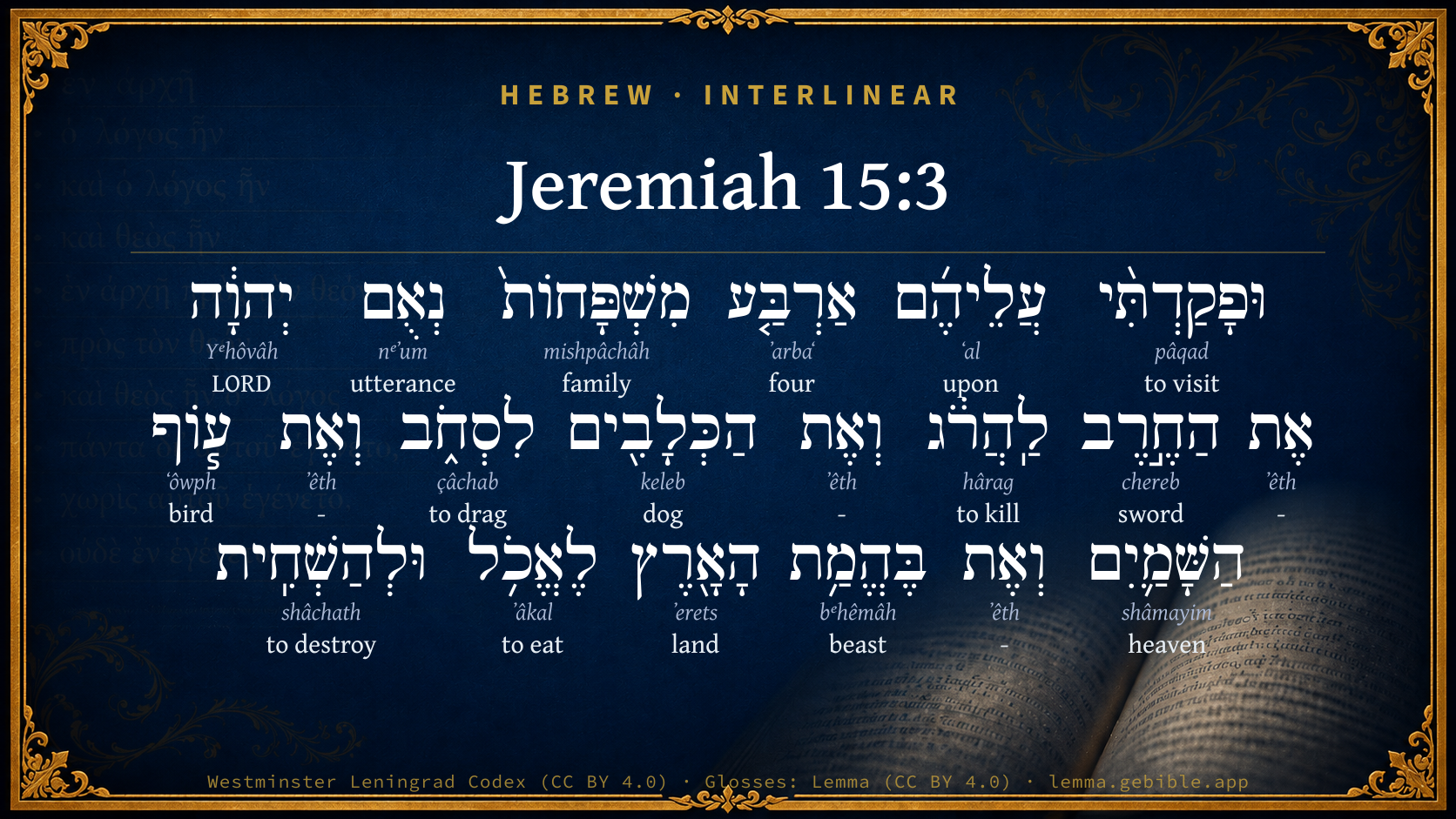
Hebrew (Westminster Leningrad Codex) Jeremiah 15:3 appears in the Hebrew Old Testament. The text above is from the Westminster Leningrad Codex. Each word links to its Strong’s number, a concise gloss, and parsing drawn from the Open Scriptures Hebrew Bible morphology. Click any word for its full Brown-Driver-Briggs (BDB) entry.
Download image
Cite this verse

Jeremiah 15:3 (World English Bible). Public Domain. Lemma interlinear Bible study tool, https://lemma.gebible.app/v/jeremiah/15/3.

Show BibTeX & RIS
BibTeX
RIS
English Translation
I will appoint over them four kinds, says Yahweh: the sword to kill, and the dogs to tear, and the birds of the sky, and the animals of the earth, to devour and to destroy.
World English Bible · Public Domain
Download a study sheet

One document with this verse’s original text, its word-by-word gloss line, the meaning frame, cross-references with their text, attributed commentary, and full source and license credits — printable, and it pastes into notes with its structure intact.

This verse Autodidact and up

Study sheet (.html) Plain text (.txt)

A passage Seminary Student

Up to 50 verses in one chapter. A passage sheet keeps up to 6 commentary sources and 12 cross-references per verse, in the order this page ranks them, and says so on the sheet whenever that leaves anything out. Ask for a single verse and you get the Autodidact verse sheet above.

Everything on this page stays free to read, with no account — the sheet is a download of what is already on screen, not access to it.

Want to remove ads? Support Godless Engineer
Compare translations 3

The same verse in 3 English versions, stacked beneath the original-language interlinear above. Click any original word for its lexicon entry.

Each is an independent rendering of the whole verse — the interlinear is not word-aligned to these translations.

Highlighted words mark where these versions differ — a whole-verse word diff, not a word-by-word alignment.

  • World English Bible Public Domain
    I will appoint over them four kinds, says Yahweh: the sword to kill, and the dogs to tear, and the birds of the sky, and the animals of the earth, to devour and to destroy.
  • King James Version Public Domain
    And I will appoint over them four kinds, saith the LORD: the sword to slay, and the dogs to tear, and the fowls of the heaven, and the beasts of the earth, to devour and destroy.
  • unfoldingWord Literal Text CC BY-SA 4.0
    And I will appoint over them four kinds”—the declaration of Yahweh—“The sword to kill and the dogs to drag away and the bird of the skies and the beast of the earth to devour and to destroy.

unfoldingWord Literal Text — © unfoldingWord, licensed CC BY-SA 4.0. Word-aligned USFM3 via Door43 (git.door43.org/unfoldingWord/en_ult).

Versions to compare (up to 4)

3 of 4 selected

Show all 18 translations

Every available English version of this verse, each an independent rendering of the whole verse.

  • World English Bible Public Domain
    I will appoint over them four kinds, says Yahweh: the sword to kill, and the dogs to tear, and the birds of the sky, and the animals of the earth, to devour and to destroy.
  • Berean Standard Bible Public Domain
    I will appoint over them four kinds of destroyers, declares the LORD: the sword to kill, the dogs to drag away, and the birds of the air and beasts of the earth to devour and destroy.
  • Majority Standard Bible Public Domain
    I will appoint over them four kinds of destroyers, declares the LORD: the sword to kill, the dogs to drag away, and the birds of the air and beasts of the earth to devour and destroy.
  • King James Version Public Domain
    And I will appoint over them four kinds, saith the LORD: the sword to slay, and the dogs to tear, and the fowls of the heaven, and the beasts of the earth, to devour and destroy.
  • American Standard Version (1901) Public Domain
    And I will appoint over them four kinds, saith Jehovah: the sword to slay, and the dogs to tear, and the birds of the heavens, and the beasts of the earth, to devour and to destroy.
  • Revised Version (1885) Public Domain
    And I will appoint over them four kinds, saith the LORD: the sword to slay, and the dogs to tear, and the fowls of the heaven, and the beasts of the earth, to devour and to destroy.
  • Geneva Bible (1599) Public Domain
    And I wil appoint ouer them foure kindes, sayth the Lord, the sworde to slay, and the dogs to teare in pieces, and the soules of the heauen, and the beastes of the earth to deuoure, and to destroy.
  • Douay-Rheims (1899) Public Domain
    And I will visit them with four kinds, saith the Lord: The sword to kill, and the dogs to tear, and the fowls of the air, and the beasts of the earth, to devour and destroy.
  • Young's Literal Translation Public Domain
    And I have appointed over them four kinds, an affirmation of Jehovah, The sword to slay, and the dogs to drag, And the fowl of the heavens, And the beast of the earth, to consume and to devour.
  • Literal Standard Version CC BY-SA 4.0
    And I have appointed four kinds over them,” || A declaration of YHWH, || “The sword to slay, and the dogs to drag, || And the bird of the heavens, || And the beast of the earth, to consume and to devour.
  • Unlocked Literal Bible CC BY-SA 4.0
    For I will assign them to four groups—this is Yahweh's declaration—the sword to slaughter some, the dogs to drag some away, the birds of the skies and the beast of the earth to consume and destroy some.
  • unfoldingWord Literal Text CC BY-SA 4.0
    And I will appoint over them four kinds”—the declaration of Yahweh—“The sword to kill and the dogs to drag away and the bird of the skies and the beast of the earth to devour and to destroy.
  • Darby Bible Public Domain
    For I will visit them with four kinds [of punishments], saith Jehovah: the sword to slay, and dogs to tear, and the fowl of the heavens, and the beasts of the earth, to devour and to destroy.
  • World Messianic Bible Public Domain
    “I will appoint over them four kinds,” says the LORD: “the sword to kill, the dogs to tear, the birds of the sky, and the animals of the earth, to devour and to destroy.
  • Webster's Bible Public Domain
    And I will appoint over them four kinds, saith the LORD: the sword to slay, and the dogs to tear, and the fowls of the heaven, and the beasts of the earth, to devour and destroy.
  • Free Bible Version CC BY-SA 4.0
    I will put four kinds of destroyers in charge of them, declares the Lord: swords to kill, dogs to drag their bodies away, and the birds of prey and wild animals to eat them and destroy them.
  • Bible in Basic English Public Domain
    And I will put over them four divisions, says the Lord: the sword causing death, dogs pulling the dead bodies about, and the birds of heaven, and the beasts of the earth to take their bodies for food and put an end to them.
  • JPS Tanakh (1917) Public Domain
    And I will appoint over them four kinds, saith the LORD: the sword to slay, and the dogs to drag, and the fowls of the heaven, and the beasts of the earth, to devour and to destroy.

Literal Standard Version (2020), Covenant Press — licensed CC BY-SA 4.0. Text via the HelloAO Bible API (eBible.org). Unlocked Literal Bible (unfoldingWord) — licensed CC BY-SA 4.0. Text via the HelloAO Bible API (eBible.org). unfoldingWord Literal Text — © unfoldingWord, licensed CC BY-SA 4.0. Word-aligned USFM3 via Door43 (git.door43.org/unfoldingWord/en_ult). Free Bible Version, Dr. Jonathan Gallagher — licensed CC BY-SA 4.0. Text via the HelloAO Bible API (eBible.org).

Word by word

More ways to search: Search by grammar → Find every occurrence → Compare this word →

Practice this passage: Drill this verse → Learn its vocabulary →

לִסְחֹ֑ב
çâchab
H5498
“to drag”
Preposition + Verb, Qal, Infinitive Construct
Part of Speech
Preposition + Verb
Stem
Qal
Form
Infinitive Construct
Full BDB Definition

Origin: a primitive root

TWOT: 1482

(Qal) to drag
  1. וּפָקַדְתִּ֨י pâqad H6485 “and · to visit” Conjunction + Verb, Qal, Sequential Perfect, 1st Person, Common, Singular
  2. עֲלֵיהֶ֜ם ʻal H5921 “upon · them” Preposition + Suffix, Personal, 3rd Person, Masculine, Plural
  3. אַרְבַּ֤ע ʼarbaʻ H702 “four” Adjective, Cardinal number, Feminine, Singular, Absolute
  4. מִשְׁפָּחוֹת֙ mishpâchâh H4940 “families” Noun, Common, Feminine, Plural, Absolute
  5. נְאֻם nᵉʼum H5002 “utterance of” Noun, Common, Masculine, Singular, Construct
  6. יְהוָ֔ה Yᵉhôvâh H3068 “LORD” Noun, Proper
  7. אֶת ʼêth H853 “-” Particle, Direct Object
  8. הַחֶ֣רֶב chereb H2719 “the · sword” Particle, Definite Article + Noun, Common, Feminine, Singular, Absolute
  9. לַֽהֲרֹ֔ג hârag H2026 “to kill” Preposition + Verb, Qal, Infinitive Construct
  10. וְאֶת ʼêth H853 “and · -” Conjunction + Particle, Direct Object
  11. הַכְּלָבִ֖ים keleb H3611 “the · dogs” Particle, Definite Article + Noun, Common, Masculine, Plural, Absolute
  12. וְאֶת ʼêth H853 “and · -” Conjunction + Particle, Direct Object
  13. ע֧וֹף ʻôwph H5775 “bird of” Noun, Common, Masculine, Singular, Construct
  14. הַשָּׁמַ֛יִם shâmayim H8064 “the · heaven(s)” Particle, Definite Article + Noun, Common, Masculine, Plural, Absolute
  15. וְאֶת ʼêth H853 “and · -” Conjunction + Particle, Direct Object
  16. בֶּהֱמַ֥ת bᵉhêmâh H929 “beast of” Noun, Common, Feminine, Singular, Construct
  17. הָאָ֖רֶץ ʼerets H776 “the · land” Particle, Definite Article + Noun, Common, Both, Singular, Absolute
  18. לֶאֱכֹ֥ל ʼâkal H398 “to eat” Preposition + Verb, Qal, Infinitive Construct
  19. וּלְהַשְׁחִֽית shâchath H7843 “and · to destroy” Conjunction + Preposition + Verb, Hiphil, Infinitive Construct

About this verse

These counts appear in no published source. They are computed here, from the morphology-tagged text and Lemma’s own curated glosses. What Lemma adds →

20
words
17
distinct lemmas
Prophets
section

Notable vocabulary

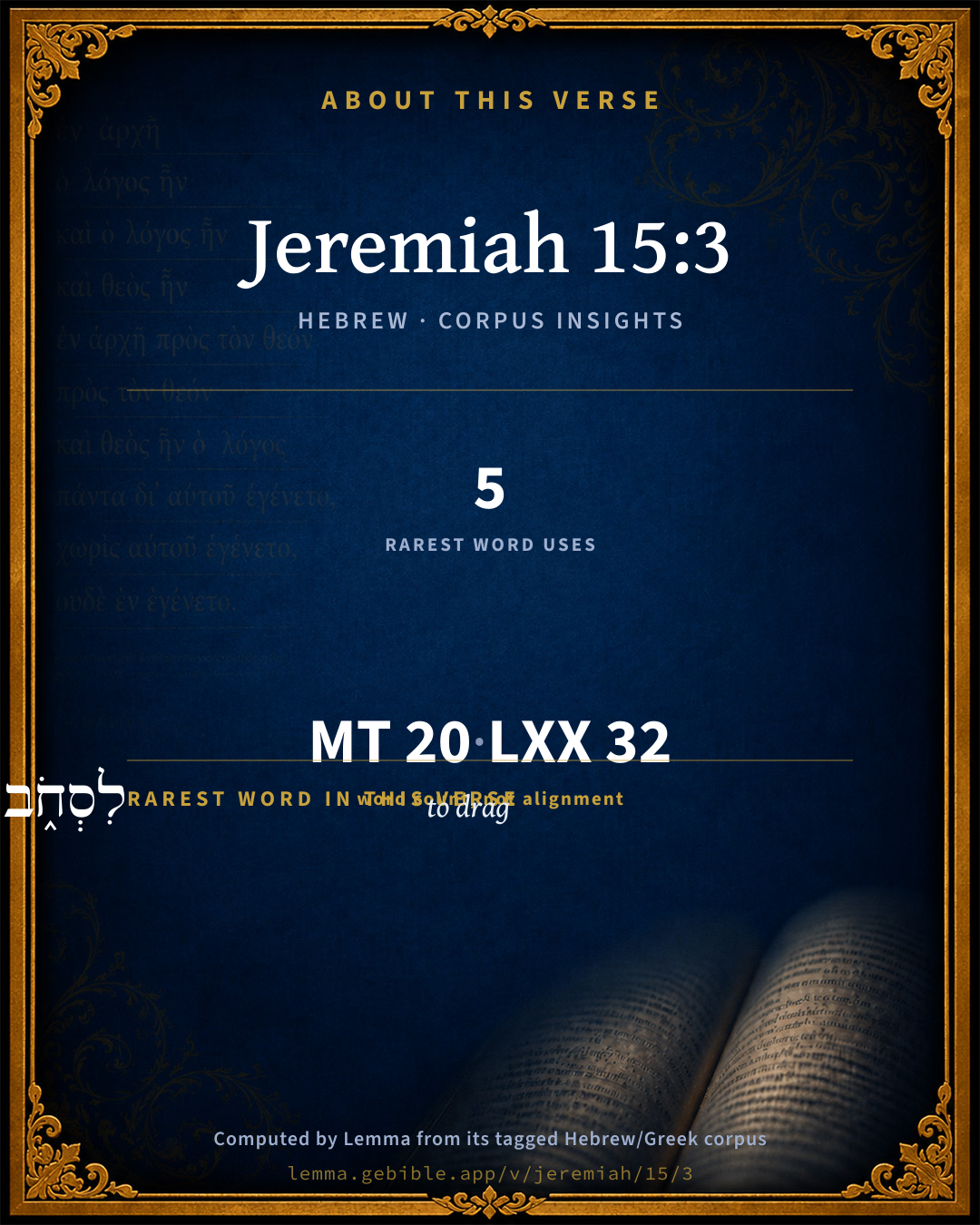
The rarest word here is לִסְחֹ֑ב to drag H5498 — appearing just 5 times in the whole Hebrew Bible.

Shared distinctive vocabulary

לִסְחֹ֑ב to drag H5498 occurs in 5 verses of the Hebrew Bible. Also found in:

Grammatical profile

  • 5 verbs
  • 9 nouns
  • 1 adjective
  • 1 preposition
  • 4 particles

Verb forms

  • וּפָקַדְתִּ֨י Qal · Sequential Perfect
  • לַֽהֲרֹ֔ג Qal · Infinitive Construct
  • לִסְחֹ֑ב Qal · Infinitive Construct
  • לֶאֱכֹ֥ל Qal · Infinitive Construct
  • וּלְהַשְׁחִֽית Hiphil · Infinitive Construct

Hebrew & Septuagint length

In the original languages it is 20 Hebrew tokens and 32 Greek tokens — but the two are counted differently (Hebrew bundles its prefixes and suffixes into one token; the Greek is in lemma form), so that isn’t a like-for-like length.

Cross-references

12

Topical passages linked to Jeremiah 15:3 in the Treasury of Scripture Knowledge — connected by theme and wording, ordered by reader-vote popularity; previews shown in the World English Bible.

  • Deuteronomy 28:26 Your dead body shall be food to all birds of the sky, and to the animals of the earth; and there shall be none to frighten them away.
  • Leviticus 26:16 I also will do this to you: I will appoint terror over you, even consumption and fever, that shall consume the eyes, and make the soul to pine away; and you will sow your seed in vain, for your enemies will eat it.
  • Leviticus 26:22 I will send the wild animals among you, which will rob you of your children, destroy your cattle, and make you few in number; and your roads will become desolate.
  • Leviticus 26:25 I will bring a sword upon you, that will execute the vengeance of the covenant; and you will be gathered together within your cities: and I will send the pestilence among you; and you will be delivered into the hand of the enemy.
  • Ezekiel 14:21 For thus says the Lord Yahweh: How much more when I send my four sore judgments on Jerusalem, the sword, and the famine, and the evil animals, and the pestilence, to cut off from it man and animal!
  • Revelation 6:8 And behold, a pale horse, and he who sat on it, his name was Death. Hades followed with him. Authority over one fourth of the earth, to kill with the sword, with famine, with death, and by the wild animals of the earth was given to him.
  • 1 Kings 21:23–24 Of Jezebel also spoke Yahweh, saying, The dogs shall eat Jezebel by the rampart of Jezreel.
  • Isaiah 18:6 They shall be left together to the ravenous birds of the mountains, and to the animals of the earth; and the ravenous birds shall summer on them, and all the animals of the earth shall winter on them.
  • Jeremiah 7:33 The dead bodies of this people shall be food for the birds of the sky, and for the animals of the earth; and none shall frighten them away.
  • Isaiah 56:9–10 All you animals of the field, come to devour, [yes], all you animals in the forest.
  • Revelation 19:17–18 I saw an angel standing in the sun. He cried with a loud voice, saying to all the birds that fly in the sky, "Come! Be gathered together to the great supper of God,
  • 2 Kings 9:35–37 They went to bury her; but they found no more of her than the skull, and the feet, and the palms of her hands.

Cross-references courtesy of OpenBible.info (CC BY 4.0).

Hebrew and Greek witnesses Masoretic Hebrew ↔ Greek Septuagint

The same verse in the two great witnesses to the Old Testament, shown verse-for-verse.

These are two independent witnesses, not word-aligned to each other, and the Septuagint is shown in lemma (dictionary) form.

Hebrew Jeremiah 15:3 Masoretic · Westminster Leningrad Codex

וּפָקַדְתִּ֨י עֲלֵיהֶ֜ם אַרְבַּ֤ע מִשְׁפָּחוֹת֙ נְאֻם יְהוָ֔ה אֶת הַחֶ֣רֶב לַֽהֲרֹ֔ג וְאֶת הַכְּלָבִ֖ים לִסְחֹ֑ב וְאֶת ע֧וֹף הַשָּׁמַ֛יִם וְאֶת בֶּהֱמַ֥ת הָאָ֖רֶץ לֶאֱכֹ֥ל וּלְהַשְׁחִֽית

I will appoint over them four kinds, says Yahweh: the sword to kill, and the dogs to tear, and the birds of the sky, and the animals of the earth, to devour and to destroy.

World English Bible · Public Domain

Greek LXX Structure differs

In the Septuagint, Jeremiah is about an eighth shorter than the Hebrew and arranges its material differently — the Oracles Against the Nations (Hebrew chapters 46–51) appear in the middle of the Greek book, after 25:13. Because the chapter and verse boundaries do not line up, a verse-for-verse comparison with the Hebrew is not shown.

A verse-for-verse comparison isn’t shown here because the chapters and verses don’t line up. Switch to the LXX edition with the MT / LXX toggle above to read the Greek directly.

Hebrew: Westminster Leningrad Codex (CC BY 4.0). Greek: Septuagint (public domain); English from a public-domain English Septuagint. How the Septuagint differs from the Hebrew →

Targum (Aramaic paraphrase)

1

The Targum is the ancient Jewish Aramaic paraphrase of the Hebrew Scriptures — an interpretive translation, not the Hebrew text itself. Onkelos (literal) and Pseudo-Jonathan (expansive) render the Torah, and Jonathan the Prophets. Coverage is partial: where no permissively-licensed English translation exists for a verse, only the Aramaic is shown. This is verse-level text, not a word-by-word alignment to the Hebrew.

  1. Targum Jonathan Prophets (Joshua–Malachi)
    וְאַסְעַר עֲלֵיהוֹן אַרְבַּע פוּרְעֲנוּן בִּישַׁן אֲמַר יְיָ יַת דְקַטְלִין בְּחַרְבָּא לְמִקְטַל וְיַת כַּלְבַיָא לְגָרְרָא וְיַת עוֹפָא דִשְׁמַיָא וְיַת בְּעִירָא דְאַרְעָא לְמֵיכַל וּלְחַבָּלָא:

    (no public-domain English translation for this verse)

    Targum Jonathan — Aramaic: “Mikraot Gedolot” (public domain). English: “Sefaria Community Translation” (CC0 1.0 (public-domain dedication)); “London "Chaldee Paraphrase," 1871” (public domain). Text via Sefaria.

Commentary

Notes on Jeremiah 15:3 from classic Christian and Jewish commentators (each source and its license shown beneath its notes). The classic Christian expositions comment on the surrounding passage and are grouped to its opening verse, so a note may address several verses; the Jewish commentaries on the Tanakh (Rashi and others) are per-verse, so they appear only where the commentator wrote on this verse.

Lemma curates 59 commentaries, every one of them public domain or Creative Commons licensed, each selected and text-cleaned for this edition rather than reprinted as found. About our sources →

Trapp's Complete Commentary

John Trapp

Jer 15:3 And I will appoint over them four kinds, saith the LORD: the sword to slay, and the dogs to tear, and the fowls of the heaven, and the beasts of the earth, to devour and destroy.

Ver. 3. And I will appoint over them four kinds.] Heb., Families, or kindreds - i.e., quatuor cognata carnivora, dogs, birds, and beasts being added to the former four evils, {Jer 15:2} quasi per auxesin.

John Trapp, A Commentary or Exposition upon All the Books of the Old and New Testament (1647–1656) — public domain. Text from a community e-Sword module.

Geneva Bible (1599)

Geneva Bible translators

The dogs, birds, and beasts should devour them that were slain.

Geneva Bible (1599) marginal notes — public domain. Text via Bolls.life.

Jamieson, Fausset & Brown

Robert Jamieson, A. R. Fausset & David Brown

appoint-- (Lev 26:16).

kinds--of punishments.

Jamieson, Fausset & Brown — Commentary Critical and Explanatory on the Whole Bible (1871) — public domain (CC PDM 1.0). Text via the HelloAO Bible API.

Adam Clarke's Commentary

Verse 3. I will appoint over them four kinds] There shall appear four instruments of my justice.

1. The sword to slay.

2. The dogs to tear what is slain.

3. The fowls of the heaven to feed on the dead carcasses. And,

4. The wild beasts to destroy all that the fowls have left.

Adam Clarke's Commentary on the Bible (1810–1826) — public domain. Text from a community e-Sword/MySword module.

John Calvin's Commentaries

Jeremiah proceeds with the same subject. He said yesterday that the people were no longer cared for by God, and so that nothing remained for them but in various ways to perish, and that the last punishment would be exile. He now confirms the same thing, and says, that God would prepare against them ravenous birds as well as wild beasts, the sword and dogs as though he had said, that all animals would be hostile to them, and be the executioners of God’s vengeance.

Some render the verb פקד, pekod, to visit, but improperly, as I think; for they must give this version, “I will visit four families upon them;” but there is no sense in this, nor can any sense be elicited from it. The meaning most suitable here is to set over, “I will set over them four kinds;” which he calls “four families.” And there is to be understood here a contrast: as they thought it hard to obey God, they were now to have over them dogs and wild beasts, and the birds of the air, and the sword. The meaning is, that there would be no end to God’s vengeance, and to various punishments, until the Jews were wholly destroyed. He further intimates, that he would have in readiness many to execute his wrath, as he had all creatures under his control. As then he would employ in his service dogs, and birds, and animals, as well as men, it behoved the Jews to feel assured that they in vain had recourse to this or that refuge. We indeed know that men impiously confine the power of God, both with regard to their salvation and the punishment of their sins, for when he passes by any evil they think that they have escaped, and promise themselves impunity, as though God indeed were not able every moment to inflict many and various scourges. This then is the reason why the Prophet speaks here of four kinds of judgments. It follows —

John Calvin's Commentaries (1540-1563) — public domain. Text from the Calvin Translation Society English edition (1840s-50s) via the Christian Classics Ethereal Library (ccel.org). Calvin's coverage is partial (roughly two-thirds of the Bible); uncommented books and verses are honest gaps, never fabricated. The 19th-century editor's footnotes and remarks are omitted so the notes are faithfully Calvin's own voice.

Ellicott's Commentary for English Readers

(3) Four kinds.—The sword, as the direct instrument of death, is followed by those that follow up its work, the beasts and birds of prey that feed on the corpses of the slain. The latter feature has naturally been from the earliest stages of human history the crowning horror of defeat. So Homer, Il. i. 4 :—

“And many mighty souls of heroes sent

To Hades, and their bodies made a prey

To dogs and to all birds.”

A Bible Commentary for English Readers, edited by Charles John Ellicott (1878–1897) — public domain. Text from a community e-Sword module.

The Cambridge Bible for Schools and Colleges

gen. ed. J. J. S. Perowne

3. kinds] lit. as mg. families. Four sorts of destructive agencies. Similar threats occur chs. Jer_19:7, Jer_34:20.

tear] lit. as mg. drag.

The Cambridge Bible for Schools and Colleges (gen. ed. J. J. S. Perowne; Cambridge University Press, 1878–1918) — public domain. Text from a community e-Sword module.

John Gill's Exposition

And I will appoint over them four kinds, saith the Lord,.... Or four families (x), and these very devouring ones; that is, four sorts of punishment; and so the Targum,

"four evil punishments;''

which are after mentioned. These are represented as under God, and at his beck and command; servants of his, that go and come at his pleasure, and do his will; and as being over men, and having power and authority to kill and to destroy by a divine commission:

the sword to slay: the first and chief of the four families or punishments, which had a commission from the Lord to sheath itself in his people, the Jews; even the sword of the enemy, the Chaldeans, drawn against them by a divine order and appointment:

and the dogs to tear; the carcasses of those that are slain with the sword: or "to draw" (y); as the word signifies; it being the usual way of dogs to draw and drag the flesh about they are feeding on; this is another of the four families, and a very voracious one it is:

and the fowls of the heaven, and the beasts of the earth, to devour and destroy; or "to eat, and to corrupt", the bodies of those that are slain by the sword. The meaning is, that such should not have a burial, but should be the food of fowls and wild beasts: these are the other two destroying families, which have their commission from the Lord for such service.

(x) "quatuor familias, sive cognationes", Vatablus, Tigurine version, Calvin. (y) "ad trahendum", Calvin, Pagninus, Montanus, Junius & Tremellius, Piscator, Schmidt; so Ben Melech,

John Gill's Exposition of the Whole Bible (1746–1763) — public domain (CC PDM 1.0). Text via the HelloAO Bible API.

Albert Barnes' Notes on the Bible

Kinds - literally, as the margin, i. e., classes of things. The first is to destroy the living, the other three to mutilate and consume the dead.

To tear - literally, “to drag along the ground.” It forcibly expresses the contumely to which the bodies of the slain will be exposed.

Albert Barnes' Notes on the Bible (1834–1885) — public domain. Text from a community e-Sword/MySword module.

Haydock's Catholic Bible Commentary

Kinds of persecutors, the sword, &c. (Calmet)

George Leo Haydock (1774–1849), Haydock's Catholic Family Bible and Commentary, 1859 edition — public domain. Excludes Psalms (Douay-Rheims chapter numbering differs from Protestant) and Deuterocanonical books (Catholic canon only).

Matthew Poole's English Annotations

Four kinds of destroyers; the enemies’ swords shall slay them, and so make meat for the dogs, who shall tear their carcasses, and for the birds of prey, who shall prey upon their dead bodies that shall lie unburied. And I will also send amongst them wild beasts, who shall both tear their living bodies and their dead carcasses.

Matthew Poole's English Annotations on the Holy Bible (1683–1685) — public domain. Text from a community e-Sword/MySword module.

Whedon's Commentary on the Bible

Daniel D. Whedon

3. Four kinds — One to kill, the rest to tear and mutilate the dead.

Daniel D. Whedon (gen. ed.), Commentary on the Old and New Testaments (1874–1909) — public domain. Text from a community e-Sword module.

The Pulpit Commentary

Appoint; i.e. give full power to them as my vicegerents. (Jer_1:10) Four kinds; literally, families; i.e. kinds of things. The first-mentioned has reference to the living; the remaining ones to the unburied corpses. (Jer_14:16 Jer_19:7 Jer_34:20) To tear; rather, to drag along.

The Pulpit Commentary (1880–1919), ed. H.D.M. Spence-Jones & Joseph S. Exell — public domain. Text from a community e-Sword module.

unfoldingWord translationNotes

Door43 World Missions Community

General Information:

Yahweh has just told them he will send some of them to death, some to die by the sword, some to die by famine, and some to be captives.

For I will assign them to four groups

This means that Yahweh will send four groups to work together to get rid of the people. AT: "For I will send four groups to get rid of them" (See: Assumed Knowledge and Implicit Information)

this is Yahweh's declaration

Yahweh speaks of himself by name to express the certainty of what he is declaring. See how you translated this in Jeremiah 1:8. AT: "this is what Yahweh has declared" or "this is what I, Yahweh, have declared" (See: First, Second, or Third Person)

the sword

Here the "sword" refers to the enemy soldiers. AT: "the enemy soldiers" (See: Metonymy)

I will make of them

Here the word "them" refers to the people of Judah, not to the four groups listed in the previous verse.

because of what Manasseh ... did in Jerusalem

Manasseh was a very wicked king who did many evil things in Jerusalem. AT: "because of the wicked things that Manasseh ... did in Jerusalem" (See: Assumed Knowledge and Implicit Information)

translationWords

slaughter

heaven

earth

consume

kingdom

Manasseh

Hezekiah

king

kingdom of Judah

Jerusalem

unfoldingWord translationNotes — © Distant Shores Media and the Door43 World Missions Community, licensed CC BY-SA 4.0. Source: git.door43.org/Door43/en_tn.

Rashi

Rabbi Shlomo Yitzchaki (Rashi)

And I will appoint an expression of appointment and designation.

to drag to drag. Cf. (infra. 49: 20) “If the young of the sheep do not drag them (יִסְחָבוּם).”

Rashi on the Tanakh — English translations: “The Judaica Press complete Tanach with Rashi, translated by A. J. Rosenberg” (CC BY 4.0); “Pentateuch with Rashi's commentary by M. Rosenbaum and A.M. Silbermann, 1929-1934” (public domain); “The Metsudah Tanach series, Lakewood, N.J” (CC BY 4.0); and “The Book of Joshua, Metsudah Publications, 1997” (CC BY 4.0). Text via Sefaria.

Lesson kit

Teaching starters — assembled from the data on this page, not authored interpretation. Every prompt links to the verse data it draws on. Edit before teaching.

Jeremiah, in the Prophets, opens this verse with 20 words (17 distinct Hebrew lemmas). Its most distinctive word is çâchab (“to drag”). A historical commentator’s framing appears above. Read the whole chapter for the surrounding context.

Discussion questions

  1. What does “to drag” (çâchab) contribute to the verse as a whole?
  2. 2 Samuel 17:13 shares the word «to drag» with this verse. How do the two illuminate each other?
  3. These translations render this verse differently. What is at stake in choosing one wording over another?
  4. The verb «וּפָקַדְתִּ֨י» is Qal Sequential Perfect. How does its form color the action?
  5. Reading how Trapp's Complete Commentary and Geneva Bible (1599) read this verse, where do the two commentators agree and where do they part?

Things to notice

Reading settings

Reading text

Shown beneath each verse's original-language words.

Old Testament
Old Testament edition

Read the OT as the Masoretic Hebrew (MT) or the Greek Septuagint (LXX).

English shown for the Greek Septuagint (in the Hebrew ↔ Greek comparison).

Comparing translations? Open the Compare panel on any verse page to stack up to four side by side.