
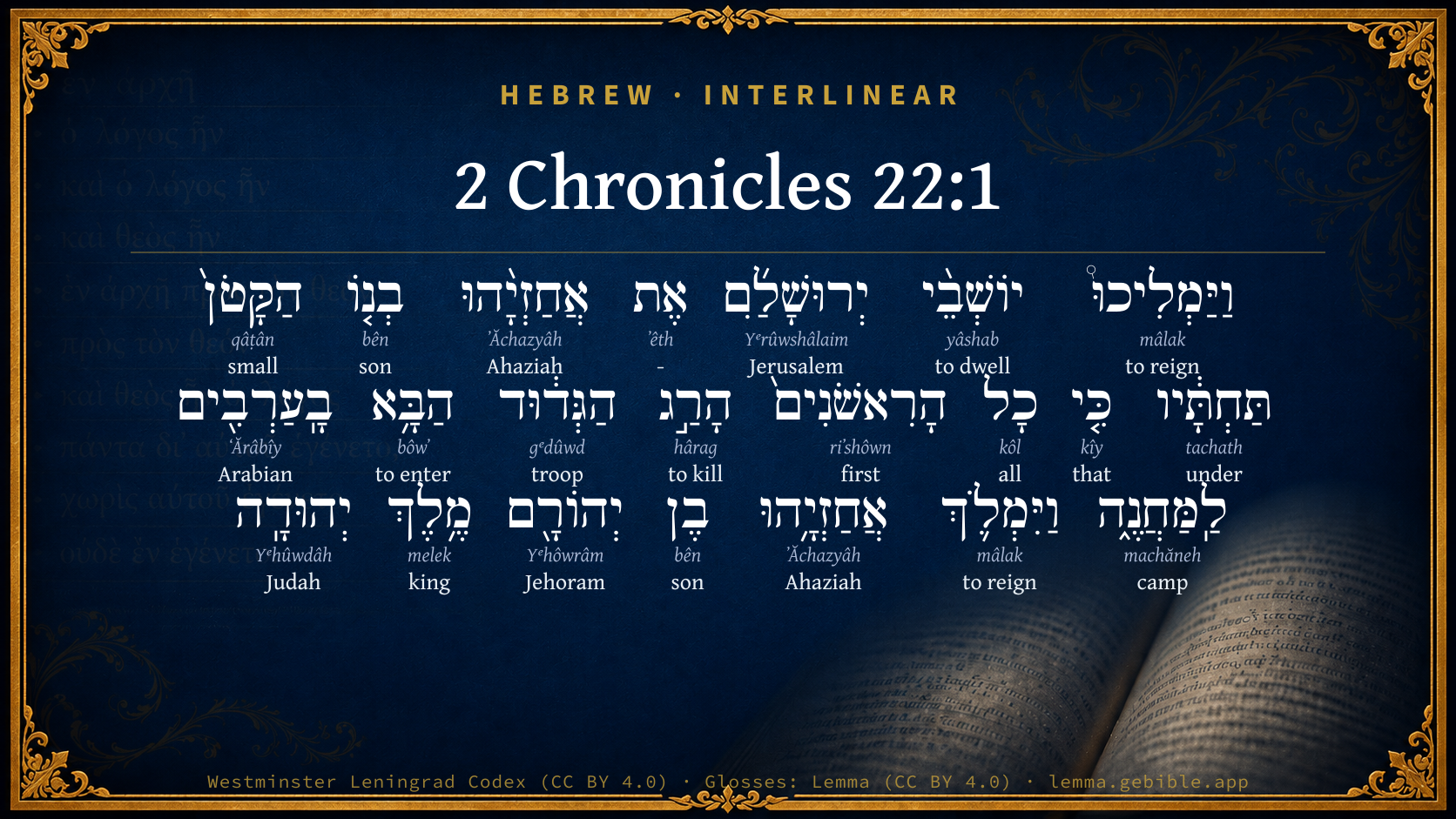
2 Chronicles 22:1

Hebrew (Westminster Leningrad Codex) 2 Chronicles 22:1 appears in the Hebrew Old Testament. The text above is from the Westminster Leningrad Codex. Each word links to its Strong’s number, a concise gloss, and parsing drawn from the Open Scriptures Hebrew Bible morphology. Click any word for its full Brown-Driver-Briggs (BDB) entry.
Download image
Cite this verse

2 Chronicles 22:1 (World English Bible). Public Domain. Lemma interlinear Bible study tool, https://lemma.gebible.app/v/2-chronicles/22/1.

Show BibTeX & RIS
BibTeX
RIS
English Translation
The inhabitants of Jerusalem made Ahaziah his youngest son king in his place; for the band of men who came with the Arabians to the camp had slain all the eldest. So Ahaziah the son of Jehoram king of Judah reigned.
World English Bible · Public Domain
Download a study sheet

One document with this verse’s original text, its word-by-word gloss line, the meaning frame, cross-references with their text, attributed commentary, and full source and license credits — printable, and it pastes into notes with its structure intact.

This verse Autodidact and up

Study sheet (.html) Plain text (.txt)

A passage Seminary Student

Up to 50 verses in one chapter. A passage sheet keeps up to 6 commentary sources and 12 cross-references per verse, in the order this page ranks them, and says so on the sheet whenever that leaves anything out. Ask for a single verse and you get the Autodidact verse sheet above.

Everything on this page stays free to read, with no account — the sheet is a download of what is already on screen, not access to it.

Want to remove ads? Support Godless Engineer
Compare translations 3

The same verse in 3 English versions, stacked beneath the original-language interlinear above. Click any original word for its lexicon entry.

Each is an independent rendering of the whole verse — the interlinear is not word-aligned to these translations.

Highlighted words mark where these versions differ — a whole-verse word diff, not a word-by-word alignment.

  • World English Bible Public Domain
    The inhabitants of Jerusalem made Ahaziah his youngest son king in his place; for the band of men who came with the Arabians to the camp had slain all the eldest. So Ahaziah the son of Jehoram king of Judah reigned.
  • King James Version Public Domain
    And the inhabitants of Jerusalem made Ahaziah his youngest son king in his stead: for the band of men that came with the Arabians to the camp had slain all the eldest. So Ahaziah the son of Jehoram king of Judah reigned.
  • unfoldingWord Literal Text CC BY-SA 4.0
    And the inhabitants of Jerusalem made Ahaziah, his youngest son, king in his place, for all the older the band had killed coming with the Arabians to the camp. And Ahaziah the son of Jehoram, the king of Judah, reigned.

unfoldingWord Literal Text — © unfoldingWord, licensed CC BY-SA 4.0. Word-aligned USFM3 via Door43 (git.door43.org/unfoldingWord/en_ult).

Versions to compare (up to 4)

3 of 4 selected

Show all 18 translations

Every available English version of this verse, each an independent rendering of the whole verse.

  • World English Bible Public Domain
    The inhabitants of Jerusalem made Ahaziah his youngest son king in his place; for the band of men who came with the Arabians to the camp had slain all the eldest. So Ahaziah the son of Jehoram king of Judah reigned.
  • Berean Standard Bible Public Domain
    Then the people of Jerusalem made Ahaziah, the youngest son of Jehoram, king in his place, since the raiders who had come into the camp with the Arabs had killed all the older sons. So Ahaziah son of Jehoram became king of Judah.
  • Majority Standard Bible Public Domain
    Then the people of Jerusalem made Ahaziah, the youngest son of Jehoram, king in his place, since the raiders who had come into the camp with the Arabs had killed all the older sons. So Ahaziah son of Jehoram became king of Judah.
  • King James Version Public Domain
    And the inhabitants of Jerusalem made Ahaziah his youngest son king in his stead: for the band of men that came with the Arabians to the camp had slain all the eldest. So Ahaziah the son of Jehoram king of Judah reigned.
  • American Standard Version (1901) Public Domain
    And the inhabitants of Jerusalem made Ahaziah his youngest son king in his stead; for the band of men that came with the Arabians to the camp had slain all the eldest. So Ahaziah the son of Jehoram king of Judah reigned.
  • Revised Version (1885) Public Domain
    And the inhabitants of Jerusalem made Ahaziah his youngest son king in his stead: for the band of men that came with the Arabians to the camp had slain all the eldest. So Ahaziah the son of Jehoram king of Judah reigned.
  • Geneva Bible (1599) Public Domain
    And the inhabitants of Ierusalem made Ahaziah his yongest sonne King in his steade: for the armie that came with the Arabians to the campe, had slayne all the eldest: therefore Ahaziah the sonne of Iehoram King of Iudah reigned.
  • Douay-Rheims (1899) Public Domain
    And the inhabitants of Jerusalem made Ochozias his youngest son king in his place: for the rovers of the Arabians, who had broke in upon the camp, had killed all that were his elder brothers. So Ochozias the son of Joram king of Juda reigned.
  • Young's Literal Translation Public Domain
    And the inhabitants of Jerusalem cause Ahaziah his youngest son to reign in his stead, (for all the elder had the troop slain that came in with the Arabians to the camp,) and Ahaziah son of Jehoram king of Judah reigneth.
  • Literal Standard Version CC BY-SA 4.0
    And the inhabitants of Jerusalem cause his youngest son Ahaziah to reign in his stead (for the troop had slain all the chiefly that came in with the Arabians to the camp), and Ahaziah son of Jehoram, king of Judah, reigns.
  • Unlocked Literal Bible CC BY-SA 4.0
    The inhabitants of Jerusalem made Ahaziah, Jehoram's youngest son, king in his place, for the band of men that came with the Arabians into the camp had killed all his older sons. So Ahaziah son of Jehoram, king of Judah, became king.
  • unfoldingWord Literal Text CC BY-SA 4.0
    And the inhabitants of Jerusalem made Ahaziah, his youngest son, king in his place, for all the older the band had killed coming with the Arabians to the camp. And Ahaziah the son of Jehoram, the king of Judah, reigned.
  • Darby Bible Public Domain
    And the inhabitants of Jerusalem made Ahaziah his youngest son king in his stead; for the band of men that came in the camp with the Arabians had slain all the elder ones. And Ahaziah the son of Jehoram king of Judah reigned.
  • World Messianic Bible Public Domain
    The inhabitants of Jerusalem made Ahaziah his youngest son king in his place, because the band of men who came with the Arabians to the camp had slain all the oldest. So Ahaziah the son of Jehoram king of Judah reigned.
  • Webster's Bible Public Domain
    And the inhabitants of Jerusalem made Ahaziah his youngest son king in his stead: for the band of men that came with the Arabians to the camp had slain all the eldest. So Ahaziah the son of Jehoram king of Judah reigned.
  • Free Bible Version CC BY-SA 4.0
    The people of Jerusalem made Ahaziah, Jehoram's youngest son, king in succession to his father, since the invaders who had entered the camp with the Arabians had killed all the older sons. So Ahaziah, son of Jehoram, became king of Judah.
  • Bible in Basic English Public Domain
    And the people of Jerusalem made Ahaziah, his youngest son, king in his place, for the band of men who came with the Arabians to the army had put all the older sons to death. So Ahaziah, the son of Jehoram, became king.
  • JPS Tanakh (1917) Public Domain
    And the inhabitants of Jerusalem made Ahaziah his youngest son king in his stead; for the band of men that came with the Arabians to the camp had slain all the eldest. So Ahaziah the son of Jehoram king of Judah reigned.

Literal Standard Version (2020), Covenant Press — licensed CC BY-SA 4.0. Text via the HelloAO Bible API (eBible.org). Unlocked Literal Bible (unfoldingWord) — licensed CC BY-SA 4.0. Text via the HelloAO Bible API (eBible.org). unfoldingWord Literal Text — © unfoldingWord, licensed CC BY-SA 4.0. Word-aligned USFM3 via Door43 (git.door43.org/unfoldingWord/en_ult). Free Bible Version, Dr. Jonathan Gallagher — licensed CC BY-SA 4.0. Text via the HelloAO Bible API (eBible.org).

Word by word

More ways to search: Search by grammar → Find every occurrence → Compare this word →

Practice this passage: Drill this verse → Learn its vocabulary →

בָֽעַרְבִ֖ים
ʻĂrâbîy
H6163
“in/at the · Arabians”
Preposition, Determined + Noun, Gentilic, Masculine, Plural, Absolute
Part of Speech
Preposition + Noun
Type
Gentilic
Gender
Masculine
Number
Plural
State
Absolute
Full BDB Definition

Origin: from H6152

TWOT: None

Arabian = see Arabia " mixed" - an inhabitant of Arabia - steppe-dweller
  1. וַיַּמְלִיכוּ֩ mâlak H4427 “and · to reign” Conjunction + Verb, Hiphil, Sequential Imperfect, 3rd Person, Masculine, Plural
  2. יוֹשְׁבֵ֨י yâshab H3427 “dwelling” Verb, Qal, Participle Active, Masculine, Plural, Construct
  3. יְרוּשָׁלִַ֜ם Yᵉrûwshâlaim H3389 “Jerusalem” Noun, Proper
  4. אֶת ʼêth H853 “-” Particle, Direct Object
  5. אֲחַזְיָ֨הוּ ʼĂchazyâh H274 “Ahaziah” Noun, Proper
  6. בְנ֤וֹ bên H1121 “son · his” Noun, Common, Masculine, Singular, Construct + Suffix, Personal, 3rd Person, Masculine, Singular
  7. הַקָּטֹן֙ qâṭân H6996 “the · small” Particle, Definite Article + Adjective, Adjective, Masculine, Singular, Absolute
  8. תַּחְתָּ֔יו tachath H8478 “under · him” Preposition + Suffix, Personal, 3rd Person, Masculine, Singular
  9. כִּ֤י kîy H3588 “that” Conjunction
  10. כָל kôl H3605 “all of” Noun, Common, Masculine, Singular, Construct
  11. הָרִאשֹׁנִים֙ riʼshôwn H7223 “the · first” Particle, Definite Article + Adjective, Adjective, Masculine, Plural, Absolute
  12. הָרַ֣ג hârag H2026 “to kill” Verb, Qal, Perfect, 3rd Person, Masculine, Singular
  13. הַגְּד֔וּד gᵉdûwd H1416 “the · troop” Particle, Definite Article + Noun, Common, Masculine, Singular, Absolute
  14. הַבָּ֥א bôwʼ H935 “the · entering” Particle, Definite Article + Verb, Qal, Participle Active, Masculine, Singular, Absolute
  15. לַֽמַּחֲנֶ֑ה machăneh H4264 “to/for the · camp” Preposition, Determined + Noun, Common, Both, Singular, Absolute
  16. וַיִּמְלֹ֛ךְ mâlak H4427 “and · to reign” Conjunction + Verb, Qal, Sequential Imperfect, 3rd Person, Masculine, Singular
  17. אֲחַזְיָ֥הוּ ʼĂchazyâh H274 “Ahaziah” Noun, Proper
  18. בֶן bên H1121 “son of” Noun, Common, Masculine, Singular, Construct
  19. יְהוֹרָ֖ם Yᵉhôwrâm H3088 “Jehoram” Noun, Proper
  20. מֶ֥לֶךְ melek H4428 “king of” Noun, Common, Masculine, Singular, Construct
  21. יְהוּדָֽה Yᵉhûwdâh H3063 “Judah” Noun, Proper

About this verse

These counts appear in no published source. They are computed here, from the morphology-tagged text and Lemma’s own curated glosses. What Lemma adds →

22
words
19
distinct lemmas
Historical
section

Notable vocabulary

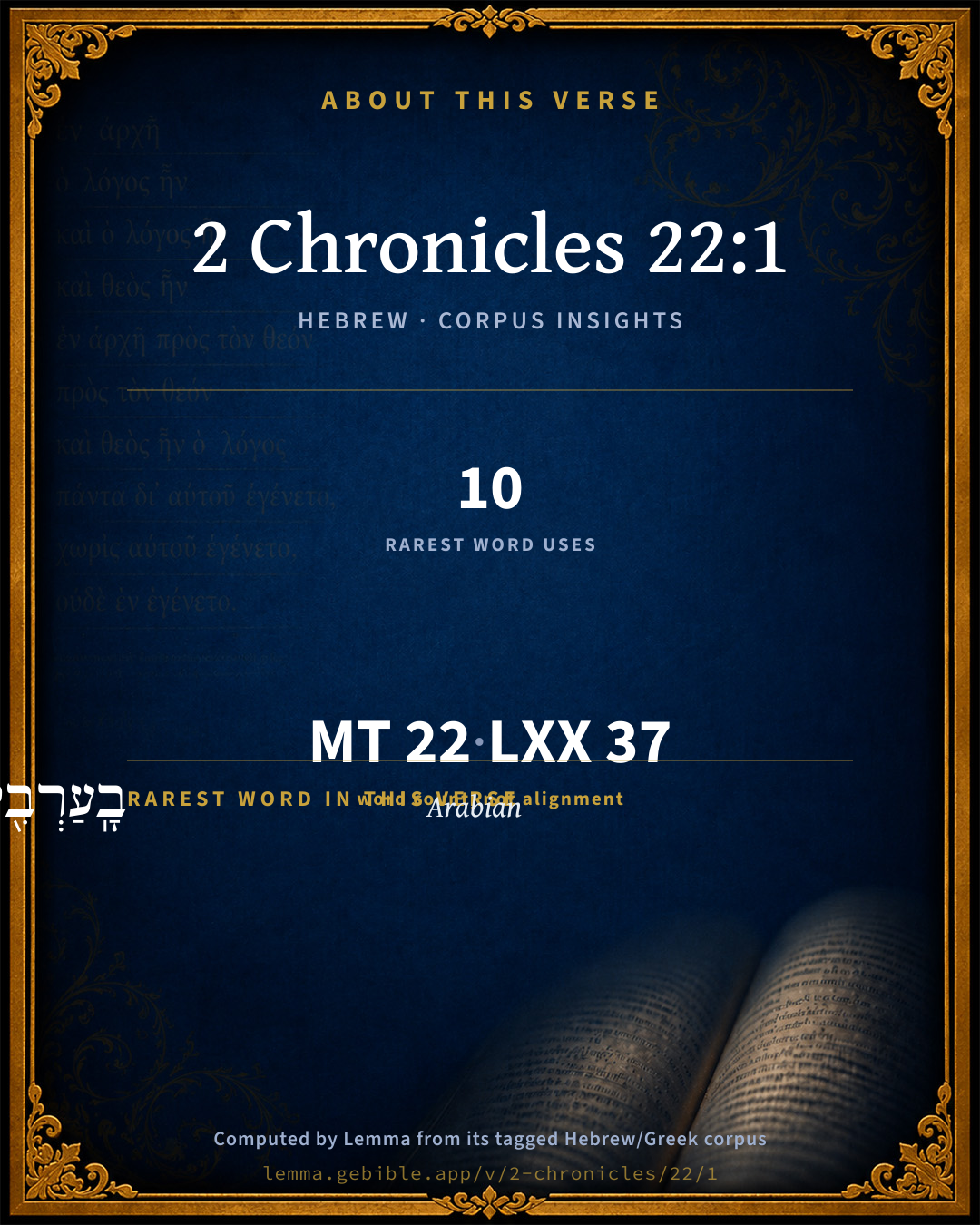
The rarest word here is בָֽעַרְבִ֖ים Arabian H6163 — appearing just 10 times in the whole Hebrew Bible.

Shared distinctive vocabulary

בָֽעַרְבִ֖ים Arabian H6163 occurs in 9 verses of the Hebrew Bible. Also found in:

Grammatical profile

  • 5 verbs
  • 12 nouns
  • 2 adjectives
  • 1 preposition
  • 1 conjunction
  • 1 particle

Verb forms

  • וַיַּמְלִיכוּ֩ Hiphil · Sequential Imperfect
  • יוֹשְׁבֵ֨י Qal · Participle Active
  • הָרַ֣ג Qal · Perfect
  • הַבָּ֥א Qal · Participle Active
  • וַיִּמְלֹ֛ךְ Qal · Sequential Imperfect

Repetition

Words recur within this verse — often emphatic in Hebrew:

  • וַיַּמְלִיכוּ֩ to reign H4427 ×2
  • אֲחַזְיָ֨הוּ Ahaziah H274 ×2
  • בְנ֤וֹ son H1121 ×2

Hebrew & Septuagint length

In English translation the verse runs 41 words from the Hebrew and 44 from the Septuagint (LXX English) — closely comparable.

A rough comparison of the two English renderings, which tokenize alike — not a word-level alignment.

Word counts can differ between the Hebrew and the Greek without any difference in meaning — e.g. the Hebrew direct-object marker אֵת has no separate Greek word, and Greek often adds the article ὁ.

In the original languages it is 22 Hebrew tokens and 37 Greek tokens — but the two are counted differently (Hebrew bundles its prefixes and suffixes into one token; the Greek is in lemma form), so that isn’t a like-for-like length.

Cross-references

7

Topical passages linked to 2 Chronicles 22:1 in the Treasury of Scripture Knowledge — connected by theme and wording, ordered by reader-vote popularity; previews shown in the World English Bible.

  • 2 Chronicles 21:16–17 Yahweh stirred up against Jehoram the spirit of the Philistines, and of the Arabians who are beside the Ethiopians:
  • 2 Kings 8:24–29 Joram slept with his fathers, and was buried with his fathers in the city of David; and Ahaziah his son reigned in his place.
  • 2 Chronicles 23:3 All the assembly made a covenant with the king in the house of God. He said to them, Behold, the king's son shall reign, as Yahweh has spoken concerning the sons of David.
  • 2 Chronicles 26:1 All the people of Judah took Uzziah, who was sixteen years old, and made him king in the room of his father Amaziah.
  • 2 Chronicles 33:25 But the people of the land killed all those who had conspired against king Amon; and the people of the land made Josiah his son king in his place.
  • 2 Chronicles 36:1 Then the people of the land took Jehoahaz the son of Josiah, and made him king in his father's place in Jerusalem.
  • 1 Chronicles 3:11 Joram his son, Ahaziah his son, Joash his son,

Cross-references courtesy of OpenBible.info (CC BY 4.0).

Hebrew and Greek witnesses Masoretic Hebrew ↔ Greek Septuagint

The same verse in the two great witnesses to the Old Testament, shown verse-for-verse.

These are two independent witnesses, not word-aligned to each other, and the Septuagint is shown in lemma (dictionary) form.

Hebrew 2 Chronicles 22:1 Masoretic · Westminster Leningrad Codex

וַיַּמְלִיכוּ֩ יוֹשְׁבֵ֨י יְרוּשָׁלִַ֜ם אֶת אֲחַזְיָ֨הוּ בְנ֤וֹ הַקָּטֹן֙ תַּחְתָּ֔יו כִּ֤י כָל הָרִאשֹׁנִים֙ הָרַ֣ג הַגְּד֔וּד הַבָּ֥א בָֽעַרְבִ֖ים לַֽמַּחֲנֶ֑ה וַיִּמְלֹ֛ךְ אֲחַזְיָ֥הוּ בֶן יְהוֹרָ֖ם מֶ֥לֶךְ יְהוּדָֽה

The inhabitants of Jerusalem made Ahaziah his youngest son king in his place; for the band of men who came with the Arabians to the camp had slain all the eldest. So Ahaziah the son of Jehoram king of Judah reigned.

World English Bible · Public Domain

Greek LXX 2 Chronicles 22:1 Septuagint · lemma form

καί βασιλεύω ὁ καταοἰκέω ἐν ἰερουσαλήμ ὁ οχοζιας υἱός αὐτός ὁ μικρός ἀντί αὐτός ὅτι πᾶς ὁ πρεσβύτερος ἀποκτείνω ὁ λῃστήριον ὁ ἐπιἔρχομαι ἐπί αὐτός ὁ ἄραψ καί ὁ αλιμαζονις καί βασιλεύω οχοζιας υἱός ιωραμ βασιλεύς ἰουδά

And the inhabitants of Jerusalem made Ochozias his youngest son king in his stead: for the band of robbers that came against them, even the Arabians and the Alimazonians, had slain all the elder ones. So Ochozias son of Joram king of Juda reigned.

LXX2012 (modern English Septuagint) · Public Domain

On this verse, The Cambridge Bible for Schools and Colleges discusses the Septuagint’s reading. Read the note in Commentary ↓

Hebrew: Westminster Leningrad Codex (CC BY 4.0). Greek: Septuagint (public domain); English from LXX2012 (modern English Septuagint) (Public Domain). How the Septuagint differs from the Hebrew →

Commentary

Notes on 2 Chronicles 22:1 from classic Christian and Jewish commentators (each source and its license shown beneath its notes). The classic Christian expositions comment on the surrounding passage and are grouped to its opening verse, so a note may address several verses; the Jewish commentaries on the Tanakh (Rashi and others) are per-verse, so they appear only where the commentator wrote on this verse.

Lemma curates 59 commentaries, every one of them public domain or Creative Commons licensed, each selected and text-cleaned for this edition rather than reprinted as found. About our sources →

Ellicott's Commentary for English Readers

XXII.

THE SHORT REIGN OF AHAZIAH (2Ch_22:1-9).

(Comp. 2Ki_8:25-29.)

(1) And the inhabitants of Jerusalem.—2Ch_21:11; 2Ch_21:13.

Made Ahaziah . . . king.—This variation from the usual formula—“And Ahaziah his son reigned in his stead”—has been supposed to indicate that the succession was disputed, either Athaliah, the queen-mother, or Jehoiada, the high priest, opposing it. It is more likely that the difference of expression simply points to the use of a different source by the writer.

The band of men that came with the Arabians to the camp.—The Hebrew is obscure for want of further details. “The troop that came among the Arabs to the camp” appears to have been some party of half-savage warriors, who, after the Jewish camp had been stormed by the invaders and the royal princes taken prisoners, fell upon and slew their captives. (Comp. 2Ch_21:17; and Jdg_8:18, seq.; 1Sa_15:32.)

All the eldest.—Heb., the former (rîshonîm). Syriac: “For all the elder the troop had destroyed them; for the Arabs came and destroyed the camp of Israel.”

A Bible Commentary for English Readers, edited by Charles John Ellicott (1878–1897) — public domain. Text from a community e-Sword module.

The Cambridge Bible for Schools and Colleges

gen. ed. J. J. S. Perowne

Ch. 2Ch_22:1-4 (= 2Ki_8:25-27). The Reign of Ahaziah

1. the inhabitants of Jerusalem, etc.] This unusual formula is no doubt intended to call attention to the fact that the succession of the youngest son was unusual, possibly there was opposition to it.

with the Arabians to the camp] Render, with the Arabians of Mâzin; LXX., Ἄραβες οἱ Ἀλειμαζονεῖς. Cp. 2Ch_14:15 (note on the tents of cattle).

The Cambridge Bible for Schools and Colleges (gen. ed. J. J. S. Perowne; Cambridge University Press, 1878–1918) — public domain. Text from a community e-Sword module.

Trapp's Complete Commentary

John Trapp

2Ch 22:1 And the inhabitants of Jerusalem made Ahaziah his youngest son king in his stead: for the band of men that came with the Arabians to the camp had slain all the eldest. So Ahaziah the son of Jehoram king of Judah reigned.

Ver. 1. And the inhabitants of Jerusalem.] The Sanhedrim especially there sitting.

Made Ahaziah.] Called also Azariah, {2Ch 22:6} and Jehoahaz, {2Ch 21:17} for he was trinomous.

Had slain all the eldest.] After that they had carried them captive. {2Ch 21:17}

John Trapp, A Commentary or Exposition upon All the Books of the Old and New Testament (1647–1656) — public domain. Text from a community e-Sword module.

The Biblical Illustrator

Joseph S. Exell

2Ch_22:1-9

And the inhabitants of Jerusalem made Ahaziah his youngest son king.

Ahaziahs wicked reign

I. Its beginning through home influence. Here all start life in right or wrong direction. Home influence affects societies, Churches, and nations.

II. Its continuance by evil counsellors (2Ch_22:4). A nation with evil legislators like a ship directed in the midst of rooks--in imminent peril.

III. Its end in judgment which it entailed. (J. Wolfendale.)

The Biblical Illustrator, edited by Joseph S. Exell (c. 1880s–1900s) — public domain. Text from a community e-Sword module.

Joseph Benson's Commentary

A.M. 3119. — B.C. 885.

Ahaziah’s wicked reign, 2Ch 22:1-4. Being confederate with Joram, he is slain by Jehu, 2Ch 22:5-9. Athaliah destroys the seed royal, and usurps the kingdom, 2Ch 22:10-12.

2Ch 22:1. The band of men had slain all the eldest — A cruel sort of men, who came along with the Arabians, and therefore slew those whom the Arabians had spared, and only carried into captivity. Or the Philistines may be intended, who accompanied the Arabians in this expedition, (2Ch 21:16,) and who lived near the kingdom of Judah, and therefore wished to destroy all the branches of the royal family, lest, if any of them survived, they should afterward gain strength, and revenge themselves upon them for plundering their country, and carrying so many of the seed royal away captive.

Joseph Benson's Commentary on the Old and New Testaments (1811–1818) — public domain. Text from a community e-Sword module.

The Preacher's Complete Homiletical Commentary

Joseph S. Exell (gen. ed.)

CRITICAL NOTES.] In this chapter the reign of Ahaziah (2Ch_22:1-6); his and (2Ch_22:7-9); and usurpation of Athaliah (2Ch_22:10-12). Parallel in 2Ki_8:24-29; 2Ki_9:27; and 2Ki_11:1-3.

2Ch_22:1-4.—Succession and beginning of A. Ah. (called Jehoahaz, 2Ch_21:17) chosen by the people, elder brothers slain by Arabs and could not be ransomed. Forty and two, an error of transcription for 22 (2Ki_8:26), for J., his father, not more than 40 at death (2Ch_21:20); daughter, i.e., grand-daughter of Omri, founder of family (2Ki_8:18-26). 2Ch_22:3. He also as well as his father walked, &c. 2Ch_22:4. They, Athaliah and Jehoram of Israel, her brother (cf. 2Ch_22:1; 2Ch_22:3; 2Ch_22:5).

2Ch_22:5-9.—Visit of A. to Jehoram. This ver. and next have come from a source used also by writer of Kings, and are nearly identical with 2Ki_8:28-29 [Speak. Com.]. War of two kings against Hazael, aggressive to recover Ramoth-Gil., which Ahab and Jehoshaphat had failed to do fourteen years earlier (1Ki_22:3-36). J. wounded by Syrians withdrew from siege to Jezreel, leaving his army under Jehu within the walls of town. Ahaz. went to visit Joram, and met with death. 2Ch_22:8. Sons, princes of royal house, on a visit met with Jehu, and 42 of them slain (2Ki_10:14). 2Ch_22:9. Hid, about to hide in Samaria, where friends (2Ki_10:12-15) were, but turned aside by pursuers, brought to Jehu, was wounded mortally, fled and died at Megiddo. None left of royal house to assume rule.

2Ch_22:10-12.—Athaliah’s usurpation (cf. 2Ki_11:1-3). Seed royal, who aspired to govern. Bed-chamber, in a chamber of mattresses, a repository for beds, not a lodging chamber. Jeh., as priest, had a right to occupy buildings in outer wall, and resided in one of these apartments.

HOMILETICS

AHAZIAH’S WICKED REIGN.—2Ch_22:1-9

I. Its beginning through home influence. Here all start life in right or wrong direction. Foundations then laid, habits then formed, are permanent factors in future years. To begin life without godly training and virtuous principles will ensure failure, often early and final. Home influence affects societies, churches, and nations. “They that rock the cradle rule the world,” said Napoleon.

II. Its continuance by evil counsellors. A. and her brother counselled A. (2Ch_22:4). Bad training, bad advice. Formed in childhood, directed as a man, how could his reign be otherwise? “In the multitude of counsellors there is safety,” and the larger the number the greater the safety. To one such Pharaoh owed the security of his kingdom from desolating famine. But “where no counsel is,” or only evil counsel, “the people must fall” (Pro_11:14). A nation with evil legislators like a ship directed in the midst of rocks in imminent peril. “The counsels of the wicked are deceit.”

III. Its end in judgment which it entailed. A. survived to be the ruin of her son, as she had been the bane of her husband (2Ch_22:10). Under her influence he began a career of ungodliness and licentiousness which ended in his destruction. Certain and irretrievable ruin results from wicked counsel and wicked life. “How oft is the candle of the wicked put out! and how oft cometh their destruction upon them! God distributeth sorrows in his anger.”

THE POWER OF A MOTHER’S INFLUENCE.—2Ch_22:3

For is a kind of explanation, the reason assigned for results which are given. “For his mother was his counsellor to do wickedly.”

I. It begins early in life. Education begins sooner than parents imagine; long enough before they are responsible; even when they begin to see, feel, and observe. Hence great importance to have first teaching of a child. Early impressions are elementary principles out of which mature life is organised. “When should I begin the education of my children now four years old?” asked a mother from a clergyman, who replied, “Madam, if you have not begun already you have lost those four years. From the first smile that gleams upon an infant’s cheek your opportunity begins.”

II. It moulds through life. A living power, forming character and directing conduct. The child becomes a man, the subject becomes a sovereign; influence is thus repeated and transmitted. Home the most powerful school in the world. Mother’s influence for good or evil mightier than pulpits and thrones. “My opinion is,” said Napoleon, “that the future good or bad conduct of a child depends entirely on the mother.”

III. It leaves permanent impress upon life. Alexander the Great could never correct the faults of gait and manners learned in childhood from Leonidas, his master. The face, words, and example of mothers leave permanent influence. “Every first thing continues for ever with the child; the first colour, the first music, the first flower, paint the foreground of life. Every new educator effects less than his predecessor; until, at last, if we regard all life as an educational institute, a circumnavigator of the world is less influenced by all the nations he has seen than by his nurse” [Richter].

“The fond attachment to the well-known place,

Whence first we started into life’s long race,

Retains its hold with such unfailing sway,

We feel it e’en in age, and at our latest day” [Cowper].

THE DEATH OF AHAZIAH.—2Ch_22:6-9

I. Untimely in its method. Neither advanced in life, nor delicate in health. On a friendly visit to see a sick relative! Surely this errand of pity the occasion of gladness, not grief? Death everywhere at home and abroad, in our own families and those of friends. From the desk, the pulpit, and the throne we may be suddenly carried to the grave.

II. Brought about by companionship with evil men. Intimacy with Joram involved him in the common ruin of Ahab’s house. “Tell me with whom thou goest, and I will tell thee what thou art,” is the Spanish proverb; rendered into English, “A man is known by the company he keeps.” To be seen with the frivolous is to be known as frivolous; to have friendship with the wise is to enjoy reputation for wisdom; but “a companion of fools shall be destroyed.”

“Heaven with a secret principle endued

Mankind to seek their own similitude.”

III. Arranged by the providence of God. “And the destruction of A. was of God by coming to J.” (2Ch_22:7). Remarkable that threatened vengeance was brought on house of Ahab at the very time King of Judah was visiting Joram, that he might partake of punishment as a descendant of wicked Ahab. No evidence that Jehu fixed on this time from wish to include Ahaziah in punishment; nor was he aware of his presence at Jezreel. Unexpected concurrence of circumstances. All result of immutable purpose, and accomplished by a wonderful arrangement of Providence in time and place. May escape for a time, but no concealment from divine retribution.

WOMEN GOOD AND BAD.—2Ch_22:10-12

What a contrast in these verses! Two females acting very different parts.

I. A bad woman engaged in wicked designs. Athaliah endeavours to destroy seed royal after death of her son. To this wickedness impelled in rage at destruction of Ahab’s family, hence David’s family must share the same fate; in zeal for idolatry and worship of Baal, which she was determined to uphold amid opposition; in regard to her own defence and in ambitious desire to usurp the throne and transmit the crown to her own family. “Athaliah had inherited the spirit of Jezebel, her mother. As wife of Joram and mother of Ahaziah, she had guided both the internal and the external policy of the Jewish kingdom; she had procured the establishment of the worship of Baal in Judæa (2Ki_8:18-27), and had maintained a close alliance with the sister kingdom. The revolution effected by Jehu touched her nearly. It struck away from her the entire support which she derived from the power and grandeur of her relatives and their readiness to help her at need. It isolated her religious system, severing the communication with Phœnicia. Moreover, the death of Ahaziah deprived her of her legal status in Judæa, which was that of Gebirah, or queen-mother, and transferred that position to the chief wife of her deceased son. Under these circumstances, which might well have daunted even a woman of more than ordinary courage, Athaliah’s hereditary spirit and energy asserted itself. Instead of yielding to the storm, or merely standing on the defensive, she resolved to become the assailant, and, before any plans could be formed against her, to strike” [Speak. Com.].

II. A good woman engaged in benevolent designs. The family of David not entirely destroyed. J., daughter of Joram (not of Athaliah, Josephus), wife of Jehoiada, the high priest, took Joash, her nephew, to conceal and save him (2Ch_22:11). The lineage of David and the human descent of Messiah suspended on the life of a child one year old! This loyal act a benevolent work, the means of fulfilling prophetic words and blessing the world! Women may be devils or ministering angels. “If once she falls, it is the fall of Lucifer” [Colton]. But “in great crises it is woman’s special lot to soften our misfortunes” [Napoleon].

“Her office there to rear, to teach,

Becoming, as is meet and fit,

A link among the days, to knit

The generations each with each” [Tennyson].

The Preacher's Complete Homiletical Commentary (gen. ed. Joseph S. Exell; Funk & Wagnalls, c. 1892) — public domain (pre-1929). A full-Bible homiletical/sermon-outline anthology covering 65 of 66 books (2 John is absent from the source module). Text from a community e-Sword module.

Keil & Delitzsch

C. F. Keil & F. Delitzsch

Ahaziah's reign of a year, and his death. - The account of Ahaziah in Kg2 8:26-29 agrees with our narrative, except that there the reflections of the chronicler on the spirit of his government are wanting; but, on the contrary, the account of his death is very brief in the Chronicle (Ch2 22:6-9), while in 2 Kings 9 and 10 the extirpation of the Ahabic house by Jehu, in the course of which Ahaziah was slain with his relatives, is narrated at length.

Ch2 22:1

Instead of the short stereotyped notice, "and Ahaziah his son was king in his stead," with which Kg2 8:24 concludes the history of Joram, the Chronicle gives more exact information as to Ahaziah's accession: "The inhabitants of Jerusalem made Ahaziah, his youngest son (who is called in Ch2 21:17 Jehoahaz), king in his stead; for all the elder (sons), the band which had come among the Arabs to the camp had slain." In ימליכוּ we have a hint that Ahaziah's succession was disputed or doubtful; for where the son follows the father on the throne without opposition, it is simply said in the Chronicle also, "and his son was king in his stead." But the only person who could contest the throne with Ahaziah, since all the other sons of Joram who would have had claims upon it were not then alive, was his mother Athaliah, who usurped the throne after his death. All the elder sons (הראשׁנים, the earlier born) were slain by the troop which had come among (with) the Arabians (see Ch2 21:16.) into the camp, - not of the Philistines (Cler.), but of the men of Judah; that is, they were slain by a reconnoitring party, which, in the invasion of Judah by the Philistines and Arabs, surprised the camp of the men of Judah, and slew the elder sons of Joram, who had marched to the war. Probably they did not cut them down on the spot, but (according to Ch2 21:17) took them prisoners and slew them afterwards.

Ch2 22:2

The number 42 is an orthographical error for 22 (ב having been changed into )מ, Kg2 8:26. As Joram was thirty-two years of age at his accession, and reigned eight years (Ch2 21:20 and Ch2 21:5), at his death his youngest son could not be older than twenty-one or twenty-two years of age, and even then Joram must have begotten him in his eighteenth or nineteenth year. It is quite consistent with this that Joram had yet older sons; for in the East marriages are entered upon at a very early age, and the royal princes were wont to have several wives, or, besides their proper wives, concubines also. Certainly, had Ahaziah had forty-two older brothers, as Berth. and other critics conclude from Kg2 10:13., then he could not possibly have been begotten, or been born, in his father's eighteenth year. But that idea rests merely upon an erroneous interpretation of the passage quoted; see on Ch2 22:8. Ahaziah's mother Athaliah is called the daughter, i.e., granddaughter, of Omri, as in Kg2 8:26, because he was the founder of the idolatrous dynasty of the kingdom of the ten tribes.

Ch2 22:3

He also (like his father Joram, Ch2 21:6) walked in the ways of the house of Ahab. This statement is accounted for by the clause: for his mother (a daughter of Ahab and the godless Jezebel) was his counsellor to do evil, i.e., led him to give himself up to the idolatry of the house of Ahab.

Ch2 22:4-6

The further remark also, "he did that which was displeasing in the sight of the Lord, like the house of Ahab," is similarly explained; for they (the members of the house of Ahab related to him through his mother) were counsellors to him after the death of his father to his destruction, cf. Ch2 20:23; while in Kg2 8:27, the relationship alone is spoken of as the reason of his evil-doing. How far this counsel led to his destruction is narrated in Ch2 22:5 and onwards, and the narrative is introduced by the words, "He walked also in their counsel;" whence it is clear beyond all doubt, that Ahaziah entered along with Joram, Ahab's son, upon the war which was to bring about the destruction of Ahab's house, and to cost him his life, on the advice of Ahab's relations. There is no doubt that Joram, Ahab's son, had called upon Ahaziah to take part in the war against the Syrians at Ramoth Gilead (see on Ch2 18:28), and that Athaliah with her party supported his proposal, so that Ahaziah complied. In the war the Aramaeans (Syrians) smote Joram; i.e., according to Ch2 22:6, they wounded him (הרמּים is a contraction for הארמּים, Kg2 8:28). In consequence of this Joram returned to Jezreel, the summer residence of the Ahabic royal house (Kg1 18:45), the present Zerin; see on Jos 19:18. המּכּים כּי has no meaning, and is merely an error for המּכּים מן, Kg2 8:29, which indeed is the reading of several Codd.: to let himself be cured of his strokes (wounds). ועזריהוּ, too, is an orthographical error for ועחזיהוּ: and Ahaziah went down to visit the wounded Joram, his brother-in-law. Whether he went from Jerusalem or from the loftily-situated Ramah cannot be with certainty determined, for we have no special account of the course of the war, and from Kg2 9:14. we only learn that the Israelite army remained in Ramoth after the return of the wounded Joram. It is therefore probable that Ahaziah went direct from Ramoth to visit Joram, but it is not ascertained; for there is nothing opposed to the supposition that, after Joram had been wounded in the battle, and while the Israelite host remained to hold the city against the Syrian king Hazael, Ahaziah had returned to his capital, and thence went after some time to visit the wounded Joram in Jezreel.

Ch2 22:7-9

Without touching upon the conspiracy against Joram, narrated in 2 Kings 9, at the head of which was Jehu, the captain of the host, whom God caused to be anointed king over Israel by a scholar of the prophets deputed by Elisha, and whom he called upon to extirpate the idolatrous family of Ahab, since it did not belong to the plan of the Chronicle to narrate the history of Israel, our historian only briefly records the slaughter of Ahaziah and his brother's sons by Jehu as being the result of a divine dispensation.

Ch2 22:7

"And of God was (came) the destruction (תּבוּסה, a being trodden down, a formation which occurs here only) of Ahaziah, that he went to Joram;" i.e., under divine leading had Ahaziah come to Joram, there to find his death. וגו וּבבאו, and when he was come, he went out with Joram against Jehu (instead of אל־יהוּא, we have in Kg2 9:21 the more distinct יהוּא לקראת, towards Jehu) the son of Nimshi, whom God had anointed to extirpate the house of Ahab (Kg2 9:1-10).

Ch2 22:8

When Jehu was executing judgment upon the house of Ahab (נשׁפּט usually construed with את, to be at law with any one, to administer justice; cf. Isa 46:13, Eze 38:22), he found the princes of Judah, and the sons of the brothers of Ahaziah, serving Ahaziah, and slew them. משׁרתים, i.e., in the train of King Ahaziah as his servants. As to when and where Jehu met the brothers' sons of Ahaziah and slew them, we have no further statement, as the author of the Chronicle mentions that fact only as a proof of the divinely directed extirpation of all the members of the idolatrous royal house. In Kg2 10:12-14 we read that Jehu, after he had extirpated the whole Israelite royal house - Joram and Jezebel, and the seventy sons of Ahab - went to Samaria, there to eradicate the Baal-worship, and upon his way thither met the brothers of Ahaziah the king of Judah, and caused them to be taken alive, and then slain, to the number of forty-two. These עחזיהוּ אחי, forty-two men, cannot have been actual brothers of Ahaziah, since all Ahaziah's brethren had, according to Ch2 22:1 and Ch2 21:17, been slain in the reign of Joram, in the invasion of the Philistines and Arabians. They must be brothers only in the wider sense, i.e., cousins and nephews of Ahaziah, as Movers (S. 258) and Ewald recognise, along with the older commentators. The Chronicle, therefore, is quite correct in saying, "sons of the brethren of Ahaziah," and along with these princes of Judah, who, according to the context, can only be princes who held offices at court, especially such as were entrusted with the education and guardianship of the royal princes. Perhaps these are included in the number forty-two (Kings). But even if this be not the case, we need not suppose that there were forty-two brothers' sons, or nephews of Ahaziah, since אחים includes cousins also, and in the text of the Chronicle no number is stated, although forty-two nephews would not be an unheard-of number; and we do not know how many elder brothers Ahaziah had. Certainly the nephews or brothers' sons of Ahaziah cannot have been very old, since Ahaziah's father Joram died at the age of forty, and Ahaziah, who became king in his twenty-second year, reigned only one year. But from the early development of posterity in southern lands, and the polygamy practised by the royal princes, Joram might easily have had in his fortieth year a considerable number of grandsons from five to eight years old, and boys of from six to nine years might quite well make a journey with their tutors to Jezreel to visit their relations. In this way the divergent statements as to the slaughter of the brothers and brothers' sons of Ahaziah, contained in 2 Kings 9 and in our Ch2 22:8, may be reconciled, without our being compelled, as Berth. thinks we are, to suppose that there were two different traditions on this subject.

Ch2 22:9

And he (Jehu) sought Ahaziah, and they (Jehu's body-guard or his warriors) caught him while he was hiding in Samaria, and brought him to Jehu, and slew him. Then they (his servants, Kg2 9:27) buried him, for they said: He is a son of Jehoshaphat, who sought Jahve with all his heart. We find more exact information as to Ahaziah's death in Kg2 9:27., according to which Ahaziah, overtaken by Jehu near Jibleam in his flight before him, and smitten, i.e., wounded, fled to Megiddo, and there died, and was brought by his servants to Jerusalem, and buried with his fathers in the city of David. For the reconciliation of these statements, see on Kg2 9:27. The circumstance that in our account first the slaughter of the brothers' sons, then that of Ahaziah is mentioned, while according to 2 Kings 9 and 10 the slaughter of Ahaziah would seem to have preceded, does not make any essential difference; for the short account in the Chronicle is not arranged chronologically, but according to the subject, and the death of Ahaziah is mentioned last only in order that it might be connected with the further events which occurred in Judah. The last clause of Ch2 22:9, "and there was not to the house of Ahab one who would have possessed power for the kingdom," i.e., there was no successor on the throne to whom the government might straightway be transferred, forms a transition to the succeeding account of Athaliah's usurpation.

Keil & Delitzsch — Biblical Commentary on the Old Testament (1861–1891) — public domain (CC PDM 1.0). Text via the HelloAO Bible API. (Old Testament only.)

The Annotated Bible

Arno C. Gaebelein

CHAPTER 22 Ahaziah and Athaliah

1. Ahaziah and his evil reign (2Ch 22:1-4)

2. His alliance with Ahab’s son (2Ch 22:5)

3. At Jezreel (2Ch 22:6-7)

4. Jehu’s judgment and Ahaziah’s end (2Ch 22:8-9)

5. Athaliah (2Ch 22:10-12)

When the Philistines and Arabians invaded Judah they carried away the treasures of Jehoram, and slew his sons. Only Jehoahaz the youngest son was left (2Ch 21:17). He is also known as Ahaziah and Azariah. These names in Hebrew have the same meaning “upheld by Jehovah.” Poor, young Ahaziah still reaps the harvest of the unfortunate alliance of his grandfather Jehoshaphat. The leaven is doing its dreadful work. His mother Athaliah, granddaughter of the wicked Omri and daughter of Ahab, was his counsellor to do wickedly. He therefore did evil in the sight of the LORD, like the house of Ahab, for they were his counsellors, after the death of his father, to his destruction. What might have been if his grandfather Jehoshaphat had not made affinity with Ahab and his house and marrying his son Jehoram to Athaliah! Ahaziah’s end, after he went with his uncle Jehoram, the son of Ahab, and the circumstances connected with it we have already annotated in Second Kings. Athaliah’s awful crime in slaying the seed royal and the miraculous preservation of Joash, the reader will also find explained in 2 Kings.

Arno C. Gaebelein, The Annotated Bible (1913–1922) — public domain. Text from a community e-Sword module.

Geneva Bible (1599)

Geneva Bible translators

Meaning, the Philistines.

Geneva Bible (1599) marginal notes — public domain. Text via Bolls.life.

Matthew Henry's Commentary

We have here an account of the reign of Ahaziah, a short reign (of one year only), yet long enough, unless it had been better. He was called Jeho-ahaz (Ch2 21:17); here he is called Ahaz-iah, which is the same name and of the same signification, only the words of which it is compounded are transposed. He is here said to be forty-two years old when he began to reign (Ch2 22:2), which could not be, for his father, his immediate predecessor, was but forty when he died, and it is said (Kg2 8:26) that he was twenty-two years old when he began to reign. Some make this forty-two to be the age of his mother Athaliah, for in the original it is, he was the son of forty-two years, that is, the son of a mother that was of that age; and justly is her age put for his, in reproach to him, because she managed him, and did what she would - she, in effect, reigned, and he had little more than the title of king. Many good expositors are ready to allow that this, with some few more such difficulties, arise from the mistake of some transcriber, who put forty-two for twenty-two, and the copies by which the error should have been corrected might be lost. Many ancient translations read it here twenty-two. Few books are now printed without some errata, yet the authors do not therefore disown them, nor are the errors of the press imputed to the author, but the candid reader amends them by the sense, or by comparing them with some other part of the work, as we may easily do this.

The history of Ahaziah's reign is briefly summed up in two clauses, Ch2 22:3, Ch2 22:4. His mother and her relations were his counselors to do wickedly, and it was to his destruction.

I. He did wickedly. Though by a special providence of God he was preserved alive, when all his brethren were slain, and reserved for the crown, notwithstanding he was the youngest of them - though the inhabitants of Jerusalem, when they had buried his father ingloriously, made him king, in hopes he would take warning by that not to tread in his steps, but would do better for himself and his kingdom - yet he was not influenced by the favours either of God or man, but walked in the way of the house of Ahab, did evil in the sight of the Lord like them (Ch2 22:3, Ch2 22:4), that is, he worshipped, Baalim and Ashtaroth, supposing (as the learned bishop Patrick thinks) that by these demons, as mediators, they might have easier access to the supreme Numen, the God of Israel, or that these they might resort to at all times and for all matters, as being nearer at hand, and not of so high a dignity, but of a middle nature between the immortal God and mortal men - deified heroes; so they worshipped them as the church of Rome does saints and angels. That was sufficiently bad; but I wish there was no reason to suspect worse. I am apprehensive that they looked upon Jehovah, the God of their fathers, to be altogether such a one as these Baalim, and them to be as great and as good as he, nay, upon one account, more eligible inasmuch as these Baalim encouraged in their worshippers all manner of lewdness and sensuality, which the God of Israel strictly forbade.

II. He was counselled by his mother and her relations to do so. She was his counsellor (Ch2 22:3) and so were they, after the death of his father, Ch2 22:4. While his father lived he took care to keep him to idolatry; but, when he was dead, the house of Ahab feared lest his father's miserable end should deter him from it, and therefore they were very industrious to keep him closely to it, and to make him seven times more a child of hell than themselves. The counsel of the ungodly is the ruin of many young persons when they are setting out in the world. This young prince might have had better advice if he had pleased from the princes and the judges, the priests and the Levites, that had been famous in his good grandfather's time for teaching in the knowledge of God; but the house of Ahab humoured him, and he walked after their counsel, gave himself up to be led by them, and did just as they would have him. Thus do those debase and destroy themselves that forsake the divine guidance.

III. He was counselled by them to his destruction. So it proved. Those that counsel us to do wickedly counsel us to our destruction; while they fawn, and flatter, and pretend friendship, they are really our worst enemies. Those that debauch young men destroy them. It was bad enough that they exposed him to the sword of the Syrians, drawing him in to join with Joram king of Israel in an expedition to Ramoth-Gilead, where Joram was wounded, an expedition that was not for his honour. Those that give us bad counsel in the affairs of religion, if regarded by us, may justly be made of God our counsellors to do foolishly in our own affairs. But that was not all: by engaging him in an intimacy with Joram king of Israel, they involved him in the common ruin of the house of Ahab. He came on a visit to Joram (Ch2 22:6) just at the time that Jehu was executing the judgment of God upon that idolatrous family, and so was cut off with them, Ch2 22:7-9. Here, 1. See and dread the mischief of bad company - of joining in with sinners. If not the infection, yet let the destruction be feared. Come out from Babylon, that falling house, Rev 18:4. 2. See and acknowledge the justice of God. His providence brought Ahaziah, just at this fatal juncture, to see Joram, that he might fall with him and be taken as in a snare. This we had an account of before, Kg2 9:27, Kg2 9:28. It is here added that he was decently buried (not as Jehoram, whose dead body was cast into Naboth's vineyard, Kg2 9:26), and the reason given is because he was the son (that is, the grandson) of good Jehoshaphat, who sought the Lord with his heart. Thus is he remembered with honour long after his death, and some respect shown even to his degenerate unworthy seed for his sake. The memory of the just is blessed, but the name of the wicked shall rot.

Matthew Henry's Commentary on the Whole Bible (1708–1710) — public domain (CC PDM 1.0). Text via the HelloAO Bible API.

Adam Clarke's Commentary

CHAPTER XXII

Ahaziah beans to reign; and reigns wickedly under the counsels

of his bad mother, 1-4.

He is slain by Jehu, who destroys all the house of Ahab, 5-9.

Athaliah destroys all the seed royal of Judah, except Joash,

who is hidden by his nurse in the temple six years, 10-12.

NOTES ON CHAP. XXII

Verse 1. Made Ahaziah his youngest son king] All the others had been slain by the Arabians, c. see the preceding chapter, 2Ch 21:17.

Adam Clarke's Commentary on the Bible (1810–1826) — public domain. Text from a community e-Sword/MySword module.

John Gill's Exposition

And the inhabitants of Jerusalem made Ahaziah his youngest son king in his stead,.... He being the only surviving one of the sons of Jehoram, the same with Jehoahaz, Ch2 21:17 who was saved when the rest were taken captive and slain, by his mother Athaliah, and he made his escape, and that she also escaped is clear from Ch2 22:10.

for the band of men that came with the Arabians to the camp; that is, of the Philistines, Ch2 21:16, which band seems to be a band or company of thieves and robbers, as the Septuagint, cruel and barbarous, as the action ascribed to them shows:

for they had slain all the eldest; sons of Jehoram; the Philistines and Arabians only carried them away captives, but those slew them in cold blood:

so Ahaziah the son of Jehoram king of Judah reigned; being declared his successor by the inhabitants of Jerusalem.

John Gill's Exposition of the Whole Bible (1746–1763) — public domain (CC PDM 1.0). Text via the HelloAO Bible API.

Haydock's Catholic Bible Commentary

Arabians and Philistines, C. xxi. 17. H.

George Leo Haydock (1774–1849), Haydock's Catholic Family Bible and Commentary, 1859 edition — public domain. Excludes Psalms (Douay-Rheims chapter numbering differs from Protestant) and Deuterocanonical books (Catholic canon only).

Matthew Poole's English Annotations

Men that came with the Arabians; either,

1. A cruel sort of men who came along with the Arabians, and therefore slew those whom the Arabians had spared, and only carried into captivity. Or,

2. The Philistines, who did accompany the Arabians in this expedition, 2Ch 21:16, who lived near the kingdom of Judah, and therefore thought to make as sure work as they could in destroying all the branches of the royal family, who otherwise, they expected, would recover strength, and revenge themselves upon them.

Matthew Poole's English Annotations on the Holy Bible (1683–1685) — public domain. Text from a community e-Sword/MySword module.

Dummelow's Commentary on the Holy Bible

J. R. Dummelow

Reign of Ahaziah

This chapter reproduces with some differences 2Ki_8:24-29 and 2Ki_11:1-3 (the intervening chapters being omitted because they relate exclusively to Israel).

2. Forty and two] This must be an error, for his father was only 40 when he died (2Ch_21:20). 2Ki_8:26 has 'twenty-two.'

6. Azariah] An error for 'Ahaziah,' which LXX has.

7. Had anointed] see 2Ki_9:1-10.

8. The sons of the brethren, etc.] i.e. of the elder sons of Jehoram who were killed by the Arabians (2Ch_21:17). If Jehoram was only 40 at his death (2Ch_21:20), his grandsons at this time (2Ch_22:2) must have been quite young children.

9. He was hid in Samaria] 2Ki_9:27 states that he was mortally wounded in his chariot when escaping from Jehu, and died at Megiddo.

They had slain.. they buried] The first verb refers to the emissaries of Jehu, the second to the servants of the murdered Ahaziah. To keep still] i.e. to retain.

J. R. Dummelow, A Commentary on the Holy Bible (Macmillan, 1909) — public domain. Text from a community e-Sword module.

The Pulpit Commentary

This chapter comprises the accession, brief reign, and death of Ahaziah (vers. 1-9) and the following murders and usurpation of Athaliah during six years (vers. 10-12). The parallel of the former section is to be found in 2Ki_8:24-29 2Ki_9:14-16, 2Ki_9:21-28; and of the latter, 11:1-3.

This verse does not so much purport to say how the inhabitants of Jerusalem proceeded to appoint Ahaziah, in default of any previous appointment on the part of his father, but merely that whereas they appointed him, the youngest son, it was because they had no choice, the elder brothers having been slain. (2Ch_21:17) though the deceased Jehoram possibly might not have known up to the time of his death, for certain, of their several deaths. This, if we may judge from the particular language here used, had been brought about at the bands of the band of men that came with the Arabians to the camp, now first particularized. The parallel, (2Ki_8:25) wanting both of these items, states that this reign began in the twelfth year of Joram of Israel.

Vers. 1-12.

A medley of the memoranda of evil-doing, its consequences, and its end.

The one surviving son of Jehoram, his youngest son, Ahaziah, is put on an unsteady, unsafe throne. Jehoram had caused all his own brethren to be slain, and now it had come to pass that all his "eldest sons had been slain by the band of men that came with the Arabians to the camp" As Athaliah, the daughter of Ahab and granddaughter of Omri, the evil wife of Jehoram, had not failed to make an evil husband of Jehoram, so, the evil mother, she does not fail to make an evil son of Ahaziah. She "was his counsellor to do wickedly." And therein her whole house, "the house of Ahab," were "after the death of his father, counsellors to his destruction." Ahaziah repeated the error of his grandfather Jehoshaphat, in associating himself with the King of Israel, going up with him to fight against Hazael King of Syria, at Ramoth-Gilead. It leads to further complications. The King of Israel is wounded and returns to Jezreel, and because "he was sick," Ahaziah must go thither also to "see" him. He unconsciously is courting "his destruction," "of God" (ver. 7); for once there he must support the king of his rival line against one whom "God had anointed" to the very work of "cutting off the house of Ahab." He is not only setting himself "to help the ungodly, and to love them that hate the Lord", (2Ch_19:2) but he is setting himself in battle with one against whom the Lord has anointed his own servant ("Jehu the son of Nimshi"), that he may destroy him and his! That is, he has put himself in the position of actively and directly fighting against God. And now, by doing thus, he not only involves "the princes of Judah, and the sons of his own brethren" (because of the company in which they were found), in indiscriminate slaughter, but himself, the King of Judah, hidden hidden in Samaria, searched for, caught, taken. He with his mother has been run to earth in a double sense, hounded to his miserable earthly end, his bones being honoured with decent burial only out of reverence for his good grandfather Jehoshaphat. The humiliating epitaph, however, on his grave was to this effect, "The house of Ahaziah had no power to keep still the kingdom!" Once more the enraged mother of the son whom she more than any one else had driven into his sin and his grave, plots the slaughter of the entire royal seed of David; but in vain. A faithful promise, a sure covenant, an unalterable purpose, prevents the thing! The sister of the king just buried was married to Jehoiada the priest, and she was the appointed preserver of the royal line, in the providence of God. She saves one, an infant, her nephew, and with her husband hides him for six years where alone so many others have taken refuge, and been safely hidden till the stormy wind and tempest have been overpast the house of God." The usurping and iniquitous Athaliah, daughter of Ahab, wife of Jehoram once, and once mother of Ahaziah, an orphan, a widow, and without a son, unloving and unloved, neither fearing God nor regarding man, reigns awhile, but does not rule! God rules the people, rides the storm, keeps the sleep, the infancy, the childhood, of his anointed; inspires his true priest, Jehoiada, with wisdom, patience, determination, and religious courage. The royal line of Judah is not cut off in its sixth king, and, when to the most of human knowledge it seemed so, that six years" interval may well have served as a needed pause in the life of the kingdom and of its chief men. "The Word of the Lord" was no doubt "precious in those days," but it was not lost, and there was a faithful priest. The silences of nations and oft of our own individual life, the silences of Scripture and of the inscrutable God himself, all have meaning, all bear the mark of design and long-suffering providence, and if improved instead of neglected, sinned against, and defied, may be rich with future blessings.

HOMILIES BY W. CLARKSON Vers. 1-4.

A pitiable prince; or, an unfortunate child of fortune.

The thorough pitiableness of one born to a high estate is the lesson of the text; but we must wait to learn

I THAT MEN SUFFER AS THEY SIN. It appears that Ahaziah was the only son left to the house of Jehoram; all the eldest had been slain by the invaders (ver. 1). Thus we find that the man who with shameful selfishness murdered his own brothers, had to suffer the loss, by violence, of his own sons. It was a fitting penalty fitting that he who used the sword remorselessly should suffer from the sword; fitting that the man whose darkest crime was committed "under his own roof" should bear his penalty in his own kindred. We do not, of course, invariably find such "poetic justice" dealt in the providence of God; but we do find that men not only suffer because they sin, but they suffer as they sin. If they sin as husbands or fathers, they suffer as such; if they sin as sons, they suffer through their children; if they sin in the flesh, they suffer in the flesh; or if they sin in the spirit, they suffer in the spirit. There is a close, a plain, a righteous correspondence between guilt and penalty.

II THAT PARENTAGE GOES A VERY LONG WAY TO ACCOUNT FOR HUMAN CHARACTER AND FOR THE CAREERS OF MEN. Ahaziah was the grandson on his mother"s side, of Ahab and of Jezebel. What may he not have inherited from them? He was the son of Athaliah. And, apart from the consideration of heredity, what evil did he not drink in from the counsels of that wicked woman? She was "his counsellor to do wickedly" (ver. 3).

1. We may well bless God for all the good we and others have derivedfrom godly parents, especially from a holy mother, from the "counsels" received at "the mother"s knee." The blessing thus conferred upon the world is quite inestimable.

2. Those who are parents may well realize the sacred burden ofresponsibility which rests upon them; for it rests with them, very largely indeed, to determine what their sons and daughters shall he whether a blessing or a bane to the world.

3. We do well to try and elevate those who are, or will be, the mothers ofthe future. There is no worthier Christian enterprise than the Zenana Mission, in which the aim is to reach and to raise the women who will be "the counsellors" of the men and women of the next generation.

4. Evil counsel may extenuate, but it will not excuse, our individual follyand wrong-doing. Not even a mother may lead us into paths of sin..

III THAT FAVORABLE CIRCUMSTANCES WILL NOT GUARANTEE ANY MAN"S WELL-BEING.

1. Who so fortunate in Judah as Ahaziah? Heir to the throne, and succeeding at an early age; (see 2Ki_8:26 with ver. 17 of that chapter) married while he was young; with little children soon about him; with every prospect of power, wealth, domestic affection, royal estate, for many years.

2. And who more pitiable than this young prince? Educated and trained inthe belief of error, in the practice of folly, with a mother whose whole influence was against moral worth, seeking and forming a dangerous alliance, cut off after a very brief reign (ver. 2), leaving a reputation of ill odour behind him. It is certain that no man can count on a future of prosperity and joy simply because the circumstantial outlook is favourable. The child of fortune, like Ahaziah, proves to be one of the most unfortunate of men. Whom all his young contemporaries were disposed to envy, we who look back unite to pity with a most genuine and deep compassion. Who, let us ask, is the man to be envied, or rather to be congratulated? Surely it is he who is born of Christian parents, who has about him in childhood and in youth "counsellors" who will know what is true, and do what is really kind and wise; it is he whom his human father trains in the way of righteousness, and whom his heavenly Father disciplines, according to his Divine wisdom, building him up in purity, in integrity, in strength, in love. C.

HOMILIES BY T. WHITELAW Vers. 1-12.

A chapter of tragedies.

I THE SLAUGHTER OF JEHORAM"S SONS. (Ver. 1.) An illustration of three things.

1. The perils attending high station. Jehoram"s sons were among the captives taken by the Philistines and Arabians. (2Ch_21:17) Had they been common soldiers, their lives might have been spared; being princes of the blood, they were put to death. A man"s social elevation attracts towards him the arrows of hate, envy, malice, and other secret foes; an obscure position tends to protect him. Therefore let none murmur that the Arbiter of destinies has not made them kings or great ones; neither let any rejoice that their places on earth are not low.

2. The mischances accompanying war. It was probably their duty to take the field against the combined hordes of the Philistines and Arabians; nevertheless, they who go to war even for defence, and much more for aggression, must not be surprised if they are killed. In the case of Jehoram"s sons, the camp of Judah had been surprised by a reconnoitring party who had come with the Arabians (Keil), or by "a hand of wild men who served in the army of the Arabians, possibly against the will of the leaders" (Bertheau); and Jehoram"s sons, having first been carried off as prisoners, were afterwards put to death. In ancient timed, when prisoners became troublesome or proved dangerous, this was the customary way in which they were disposed of.

3 The retributions wrought by Providence. Even if Jehoram"s sons were not as wicked as himself, it was a signal illustration of the lex talionis, a conspicuous demonstration of the truth that with what measure one metes it shall be measured to him again. (Mat_7:2) Jehoram had assassinated all his brothers on ascending the throne; before he descended from it, Jehovah suffered him to see all his sons (except the youngest) cut off by invading marauders. "Are not my ways equal? saith the Lord". (Eze_18:29)

II THE EXTERMINATION OF AHAB"S HOUSE. (Ver. 7.) Incidentally referred to by the Chronicler, it is more fully detailed in 2Ki 9. and 10., and may here be briefly narrated.

1. The thing determined by God.

(1) When? As far back as the time of Elijah, in the days of Ahab himself. (1Ki_19:16, 1Ki_19:17) Divine foreordination interferes not with the freedom of human action. If the destruction of Ahab"s house was carried out in fulfilment of a previously formed Divine decree, it was, nevertheless, effected by a political revolution.

(2) Why? On account of the incurable apostasy, outrageous irreligion, and flagrant blood-guiltiness of Ahab and his successors on the throne of Israel. Besides being an idolater of the most debasing type, Ahab had been a murderer of extreme ferocity, and his successors had walked in his ways. There was, therefore, no remedy remaining but one complete extirpation. Under the Divine government, redemption or destruction are the two alternatives that stand before all evil-doers. (Isa_1:19, Isa_1:20) Souls that cannot be recovered must be cut off. (Psa_37:9) When the prediluvian world had sunk below the line of possible restoration, it was submerged beneath the waters of a flood. (Gen_6:7) When Sodom and Gomorrah had become too filthy to be renovated, they were burnt up from off the face of the earth (Gen_18:21 Gen_19:24, Gen_19:25; 2Pe_2:6 Jud_1:7)

2. The instrument selected by God.

(1) His name. Jehu, the son of Jehoshaphat, the son of Nimshi. This first revealed to Elijah at Horeb. (1Ki_19:16) In the Assyrian inscriptions Jehu is twice mentioned, and each time as "Jehu the son of Omri," the foreign scribe being unacquainted with his history as recorded in Scripture, and regarding him as a prince of the dynasty of Omri. An obelisk of black marble, five feet in height, found at Nimroud, and now in the British Museum, represents the tribute brought to Shal-maneser II by vassal princes, among whom appear "Yahua, son. of Khumri," giving "silver, gold, bowls of gold, vessels of gold, goblets of gold, pitchers of gold, lead, sceptres for the king"s hand, and staves" ("Records," etc., 5:41); while a fragment from the annals of Shalmaneser III contains a similar statement, that in the eighteenth year of his reign, after conquering Hazael of Damascus, he received the tribute of the Tyrian, the Sidonian, and of "Yahua the son of Khumri" (Schrader, " Keilinschriften," p. 210).

(2) His station. Originally an officer, probably the ablest general, and therefore field-marshal of Jehoram"s army. (2Ki_9:5) God culls his instruments from all ranks and occupations. Those who have served him most efficiently in the Christian Church have not unfrequently been drawn from the army. The profession of a soldier need not hinder one from being a servant of God.

(3) His character. Energetic, active, decisive, ambitious, unscrupulous, bloodthirsty, cruel, and fanatical, "the worst type of a son of Jacob, the "supplanter," as he is called, without the noble and princely qualities of Israel, the most unlovely and the most coldly commended of all the heroes of his country" (Stanley, "Jewish Church," p. 338). God"s selection of a man to be his instrument does not imply a commendation of his character witness Pharaoh, Saul, Nebuchadnezzar, Herod.

(4) His designation. To be king over Israel This first communicated at Horeh to Elijah, who received at the same time a commission to see Jehu"s anointing to the throne carried out a commission afterwards executed by Elisha. (2Ki_8:29 2Ki_9:6)

(5) His usurpation. In this he was assisted by his brother-officers. (2Ki_9:13) Though designated and anointed by Elisha to the throne of Israel, more than likely, as in the case of Jeroboam, (1Ki_11:31) the project of dethroning Jehoram had already floated before his mind.

(6) His commission. To execute Divine vengeance on the house of Ahab by extirpating it, root and branch, from the land. Rough work, it needed a rough instrument.

3. The work carried through by God. By means of his instrument. The Chronicler recognizes (vers. 7, 8) that Jehu was God"s sword. How far Jehu himself was under the dominion of this thought may be hazardous to affirm. But, in any case, he lost no time in discharging the bloody business entrusted to his hand. With a swiftness and relentless severity that suggested leonine ferocity as much as religious zeal, he posted to Jezreel and began the work of butchery. First he drove an arrow through the heart of Jehoram; (2Ki_9:24) next procured the death of Jezebel by commanding two of her servants, his minions, to throw her from the palace window; (2Ki_9:33) and finally caused the seventy sons of Ahab in Samaria to be beheaded. (2Ki_10:7)

III THE MURDER OF THE PRINCES OF JUDAH. (Ver. 8.)

1. Who these were.

(1) Sons of the brethren of Ahaziah. Not the brethren of Ahaziah, (2Ki_10:13) since these had all been slain by the Arabian marauders, (2Ch_21:17) but the children of these brothers, and therefore Ahaziah"s nephews. That they were forty-two in number cannot be pronounced impossible, since it is not known how many elder brothers Ahaziah had.

(2) Princes of Judah, who were doubtless remoter branches of the royal house, and held important offices in the court. Possibly these should be included in the number forty-two mentioned above.

2. When they were killed.

(1) When Jehu was executing judgment on the house of Ahab (ver. 8). Though not responsible for being connected with the house of Ahab, that they were so proved the cause of their destruction. Their sad fate was an illustration of two truths that the innocent often suffer with and for the guilty, (Job_9:23) and that no one can predict how far the disastrous consequences of one false step may reach. Had Jehoram not married Athaliah, these princes had not fallen victims to Jehu"s sword.

(2) When Jehu was on the way from Jezreel, where he had perpetrated three murders, to Samaria, where he had committed one massacre by deputy, and whither he was going to add another. (2Ki_10:25) Having fallen in with the princes of Judah, Jehu ordered his attendants to take them alive. Their resistance, it is supposed, led to their immediate slaughter. One massacre more was nothing to Jehu. Besides, the destruction of forty-two princes, mostly boys, was a trifle to that he was contemplating the wholesale sacrifice of Baal"s worshippers in the house of Baal.

(3) When Ahaziah"s nephews were on the way to Jezreel to pay a visit to the court at Jezreel, "to salute the children of the queen and the children of the king". (2Ki_10:13) One never knows where he may be overtaken by death; hence the necessity of being always ready.

1. Where they were killed. At the pit or cistern of the shearing-house, or "house of gathering"; (2Ki_10:13) at "the shepherds" house of meeting" (Chaldee Version, Thenius, Bahr) a house which served the shepherds of the region round about for assembling; or at the house where

2. the shepherds tied up their sheep for shearing (Keil). "In a well close by, as at Cawnpore, they were all slaughtered" (Stanley).

3. By whom they were killed. Jehu, whose motive may have been either

(1) because he regarded their death as embraced within the scope of his commission, or

(2) because he feared the exaction by some of them of bleed-vengeance, or

(3) because he wished to render impossible any future attempt at the subversion of his authority.

IV THE ASSASSINATION OF AHAZIAH. (Ver. 9.)

1. After a brief reign. Ahaziah succeeded to his father"s throne in his forty-second year, or in his twenty-second (2Ki_8:26) a discrepancy removed, by supposing the forty-two to. indicate the age of the kingdom of his mother s family (Lightfoot), but best explained by conceding that an error has crept into the text (Keil, Bertheau, Bahr). After enjoying regal power for one year, he fell a victim to the sword of Jehu a startling reminder cf the uncertainty of life and the vanity of human greatness.

2. By the hand of Providence. "The destruction of Ahaziah was of God" (ver. 7); not merely as all things are under the Divine control, but in the special sense that the incidents which led to Ahaziah"s destruction were of God"s permitting, if not ordering.

(1) God allowed Jehoram to go to war, as his father had done, with the Syrian king, now not Benhadad II, but Hazael the usurper (ver. 6), who is mentioned along with Jehu in the Assyrian inscriptions, and with whom Shalmaneser II, in the eighteenth year of his reign, fought at Damascus, capturing his camp with 1221 chariots and 470 war-carriages (Schrader, " Keilinschriften," p. 210; "Records," etc., 5:34; Sayce, "Fresh Light," etc., p. 123).

(2) Ahaziah of Judah he permitted to go to Ramoth-Gilead with his uncle.

(3) In the war Jehovah ordered it that Jehoram should be wounded and return to Jezreel to be healed, and that Ahaziah should afterwards also leave Ramoth and go to the Israslitish capital to inquire for his mother"s brother.

(4) Hence it came to pass that he was found in Jehoram"s company when Jehu came to Jezreel on his murderous errand. (2Ki_9:21)

(5) Had this train of circumstances not preceded, Ahaziah"s death might not have followed, at least at the time when and the place where it did.

3. As a just retribution for his wickedness. For Ahaziah a tremendous misfortune, for which he was in no way responsible, that he had Jehoram and Athalish for his parents. If any man might be said to have "a double dose of original sin," or inherited corruption, he had. If he may be pronounced happy who has the piety of generations at his back and within his veins, propelling him forward in the ways of virtue and religion, on the other hand he should be deemed an object of pity who is not only held back from the paths of godliness, but urged into the broad roads of sin and vice by secret forces of heredity that have been gathering momentum through a long succession of wicked ancestors. Disadvantageously placed as Ahaziah was, he was under no compulsion to yield to the evil influences by which he was surrounded. That he did not resist them, but abandoned himself to them without let or hindrance, was his sin.

(1) He "walked in the ways of the house of Ahab," and "did evil in the sight of the Lord like the house of Ahab." He copied their idolatries and their immoralities.

(2) He took as his example the house of Ahab, and especially his mother, Athaliah, whom the Chronicler, with reference to her wicked propensities, fitly designates "the daughter of Omri.

4. In spite of strenuous efforts to escape. The accounts given of these efforts to escape are considerably divergent. According to the Chronicler, when Ahaziah saw Jehorem sink down in his chariot after being struck with Jehu"s arrow, he fled by the way of the garden house, but was followed by Jehu, and, like his uncle, wounded with an arrow at the going up to Gur, which is by Ibleam, whence he fled to Megiddo, and died there. (2Ki_9:27) According to 2 Kings, Ahaziah had hid himself in Samaria, and, being found there, was slain by Jehu"s servants. The accounts are pronounced irreconcilable, that of Kings being the older and more authentic (Bahr, Bertheau); but the explanations ordinarily proffered (Lightfoot, Keil) are deserving of consideration that Ahaziah, on first escaping, fled to Samaria, and was afterwards found there by Jehu"s servants, who brought him to Jehu, at whose command he was shot while in his chariot at Gur, beside Ibleam, and that, once more escaping, though this time mortally wounded, he reached Megiddo, and perished them. On the sites here mentioned, consult the Exposition.

V THE DESTRUCTION OF THE SEED ROYAL OF THE HOUSE OF JUDAH. (Ver. 10.)

1. victims of this massacre. All the seed royal, i.e. all the direct descendants of the kingly house, all who might in any measure or degree aspire to the throne. As Ahaziah"s elder brothers had been captured and slain by the Arabs, (2Ch_21:17) and as their sons, Ahaziah"s nephews, had been (in part at least) put to death by Jehu, (2Ch_22:8) it is possible that the actual victims were not numerous.

2. The perpetrator of this massacre. Athaliah, the queen-mother, who thereby proved herself a true daughter of Jezebel. Instead of grieving at the tidings of her son"s death, and taking measures to shield his young children, her grandsons, from the sword of Jehu, she herself compassed their destruction. Thereby she showed herself a most unnatural mother, an inhuman monster a woman, like Lady Macbeth, "from the crown to the toe, top-full of direst cruelty" ("Macbeth," act 1. sc. 5).

3. The motive of this massacre. Probably mingled fear and ambition. Apprehensive of her own safety when she saw that Jehu had slain her son, she may have judged that the speediest and surest way to establish her security was to cut off every possible rival from her side, and seize the throne of Judah for herself. It was the usual mode of procedure amongst Oriental sovereigns, on ascending the throne, to put to death all possible claimants of the crown. It is not difficult to see who was Jehoram"s teacher. (2Ch_21:4)

4. The extent of this massacre. All the seed royal, with one exception, Joash, Ahaziah"s son, who was rescued by his aunt, Jehoshabeath, his father"s daughter but not his mother"s she was obviously the daughter of one of Jehoram"s secondary wives and the wife of Jehoiada the priest (see next homily).

LESSONS.

1. The vicissitudes of human life (ver. 1).

2. The vanity of earthly glory (ver. 2).

3. The danger of evil counsel (ver. 3).

4. The self-destructive character of sin (ver. 4).

5. The madness of walking with wicked men (ver. 5).

6. The propriety of sympathizing with the ungodly in theirafflictions (ver. 6).

7. The tiger-like ferocity of some monsters in sin (vers. 7-10).

8. The mystery of Providence in suffering such monsters to live. W.

The Pulpit Commentary (1880–1919), ed. H.D.M. Spence-Jones & Joseph S. Exell — public domain. Text from a community e-Sword module.

John Wesley's Explanatory Notes

Ahaziah's wicked reign, ver. 1-4. Being confederate with Joram, he is slain by Jehu, ver. 5-9. Athaliah destroys the seed royal, and usurps the kingdom, ver. 10-12.

John Wesley, Explanatory Notes Upon the Whole Bible (1754–1765) — public domain. Text via the GEBible commentary corpus.

Scofield Reference Notes

C. I. Scofield

Ahaziah

where he is called Jehoahaz. 2Ch 21:17.

The Scofield Reference Bible (1917 edition), notes by C. I. Scofield — public domain. Text from a community e-Sword module.

Kretzmann's Popular Commentary

Paul E. Kretzmann

The Reign of Ahaziah.

v. 1. And the inhabitants of Jerusalem made Ahaziah, his (Joram’s) youngest son, who probably assumed this name upon his accession to the throne, king in his stead, this being expressly mentioned because he was not the crown prince; for the band of men that came with the Arabians to the camp, the band consisting of Arabians which had plundered the royal domain, had slain all the eldest, thus leaving this son as the only legitimate heir of Jehoram. So Ahaziah, the son of Jehoram, king of Judah, reigned, he was proclaimed and accepted as king of the southern kingdom.

v. 2. Forty and two years old was Ahaziah when he began to reign, that is, it was the forty-second year of the kingdom of his mother’s family and the twenty-second of his life, and he reigned one year in Jerusalem. His mother’s name also was Athaliah, the daughter of Omri, a daughter of the house of Ahab and therefore expert in every idolatrous wickedness.

v. 3. He also walked in the ways of the house of Ahab; for his mother was his counselor to do wickedly, she brought about a further corruption of religion and morals.

v. 4. Wherefore he did evil in the sight of the Lord like the house of Ahab, again named as an extreme example of ungodliness; for they, his relatives on his mother’s side, were his counselors after the death of his father to his destruction.

v. 5. He walked also after their counsel, and went with Jehoram, the son of Ahab, king of Israel, in another alliance which displeased the Lord, to war against Hazael, king of Syria, at Ramoth-gilead, in a second effort to recapture this city from the Syrians; and the Syrians smote Joram, 2Ki 8:28-29.

v. 6. And he returned to be healed in Jezreel, his summer residence, because of the wounds which were given him at Ramah, when he fought with Hazael, king of Syria. And Azariah (or Ahaziah), the son of Jehoram, king of Judah, went down to see Jehoram, the son of Ahab, at Jezreel, because he was sick, this visit probably taking place after his return to Jerusalem, after the unfortunate expedition in which he participated.

v. 7. And the destruction of Ahaziah, literally, "his down-treading," his downfall, was of God by coming to Joram, God made use of this move in bringing about his destruction; for when he was come, he went out with Jehoram against Jehu, the son of Nimshi, that is, to meet Jehu, who was the grandson of Nimshi, whom the Lord had anointed to cut off the house of Ahab, 2Ki 9:6-7.

v. 8. And it came to pass that, when Jehu was executing judgment upon the house of Ahab, in slaying all the kinsfolks of Ahab, 2Ki 10:10-11, and found the princes of Judah, and the sons of the brethren of Ahaziah that ministered to Ahaziah, all of whom had accompanied the king of Judah down to Jezreel, he slew them.

v. 9. And he sought Ahaziah; and they caught him (for he was hid in Samaria) and brought him to Jehu. This account is easily reconciled with that of 2Ki 9:27-29. "Ahaziah fled first to the garden-house and escaped to Samaria, but was there, where he had hid himself, taken by Jehu’s men, who had pursued him, brought to Jehu, who was still in or near Jezreel and at his command slain at the hill Gur, beside Ibleam, in his chariot; that is, mortally wounded with an arrow, so that he, again fleeing, expired at Megiddo. " (Keil. ) And when they had slain him, they buried him, giving him the honor of a decent burial, because, said they, he is the son of Jehoshaphat, who sought the Lord with all his heart. So the house of Ahaziah had no power to keep still the kingdom, all the other princes having been slain by Jehu, and Ahaziah’s children being yet too young to become rulers of the people.

v. 10. But when Athaliah, the mother of Ahaziah, saw that her son was dead, she arose and destroyed all the seed royal of the house of Judah, all the infant children of her son whom she could locate.

v. 11. But Jehoshabeath (or Jehosheba), the daughter of the king, probably a daughter of Jehoram by another wife than Athaliah, took Joash, the son of Ahaziah, and stole him from among the king’s sons that were slain, and put him and his nurse in a bed-chamber. So Jehoshabeath, the daughter of King Jehoram, the wife of Jehoiada, the priest, (for she was the sister, or more exactly, the half-sister, of Ahaziah,) hid him from Athaliah, so that she slew him not.

v. 12. And he was with them hid in the house of God six years. And Athaliah reigned over the land, as queen or dowager regent, although a usurper at the same time. In this way the Lord laid affliction upon His people in order to knit their hearts more closely to Him once more; for that is ever the purpose of His visitations upon His children.

Paul E. Kretzmann, Popular Commentary of the Bible (1921–1924) — public domain. Text from a community e-Sword module.

unfoldingWord translationNotes

Door43 World Missions Community

for the band of men ... had killed all his older sons

This is background information about the events of 2 Chronicles 21:16-17. Ahaziah was called "Jehoahaz" in that earlier account. It is possible he changed his name when he became king. (See: Background Information)

all his older sons

"all Jehoram's older sons"

twenty-two years old

"22 years old" (See: Numbers)

Athaliah

This is the name of Ahaziah's mother. (See: How to Translate Names)

He also walked in the ways

Here "walked in the ways" is an idiom that means he followed Ahab's example. See how you translated this in 2 Chronicles 20:32. AT: "He also followed the example" (See: Idiom)

the house of Ahab

The word "house" is a metonym for the family that lives in the house. In this case it refers to the descendants of Ahab. See how you translated this in 2 Chronicles 21:6. AT: "the descendants of Ahab" (See: Metonymy)

translationWords

Jerusalem

Ahaziah

Jehoram

Arabia

king

Judah

Athaliah

Omri

house

Ahab

evil

unfoldingWord translationNotes — © Distant Shores Media and the Door43 World Missions Community, licensed CC BY-SA 4.0. Source: git.door43.org/Door43/en_tn.

Lesson kit

Teaching starters — assembled from the data on this page, not authored interpretation. Every prompt links to the verse data it draws on. Edit before teaching.

2 Chronicles, in the Historical, opens this verse with 22 words (19 distinct Hebrew lemmas). Its most distinctive word is ʻĂrâbîy (“Arabian”). A historical commentator’s framing appears above. Read the whole chapter for the surrounding context.

Discussion questions

  1. How does “Arabian” (ʻĂrâbîy) shape what this verse is saying?
  2. How does 2 Chronicles 17:11, which shares the word «Arabian», read alongside this verse?
  3. What does the repetition of “to reign” (2× in this one verse) do in this verse?
  4. These translations render this verse differently. What is at stake in choosing one wording over another?
  5. «וַיַּמְלִיכוּ֩» is a Hiphil Sequential Imperfect verb. How does that grammatical form shape the action described?
  6. Compare how Ellicott's Commentary for English Readers and The Cambridge Bible for Schools and Colleges read this verse. Where do they agree or differ?

Things to notice

Reading settings

Reading text

Shown beneath each verse's original-language words.

Old Testament
Old Testament edition

Read the OT as the Masoretic Hebrew (MT) or the Greek Septuagint (LXX).

English shown for the Greek Septuagint (in the Hebrew ↔ Greek comparison).

Comparing translations? Open the Compare panel on any verse page to stack up to four side by side.