
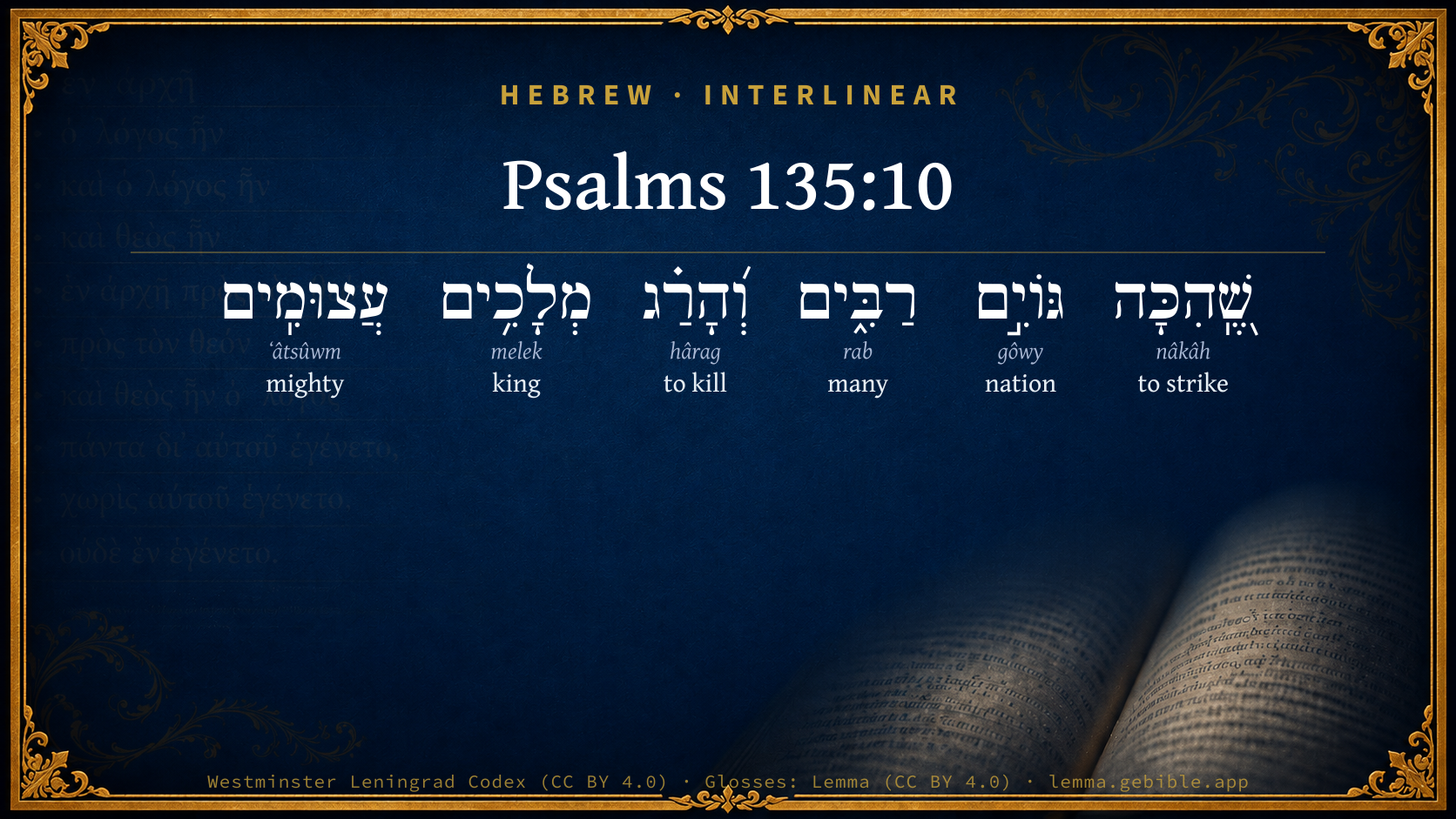
Psalms 135:10

Hebrew (Westminster Leningrad Codex) Psalms 135:10 appears in the Hebrew Old Testament. The text above is from the Westminster Leningrad Codex. Each word links to its Strong’s number, a concise gloss, and parsing drawn from the Open Scriptures Hebrew Bible morphology. Click any word for its full Brown-Driver-Briggs (BDB) entry.
Download image
Cite this verse

Psalms 135:10 (World English Bible). Public Domain. Lemma interlinear Bible study tool, https://lemma.gebible.app/v/psalms/135/10.

Show BibTeX & RIS
BibTeX
RIS
English Translation
Who struck many nations, And killed mighty kings,
World English Bible · Public Domain
Download a study sheet

One document with this verse’s original text, its word-by-word gloss line, the meaning frame, cross-references with their text, attributed commentary, and full source and license credits — printable, and it pastes into notes with its structure intact.

This verse Autodidact and up

Study sheet (.html) Plain text (.txt)

A passage Seminary Student

Up to 50 verses in one chapter. A passage sheet keeps up to 6 commentary sources and 12 cross-references per verse, in the order this page ranks them, and says so on the sheet whenever that leaves anything out. Ask for a single verse and you get the Autodidact verse sheet above.

Everything on this page stays free to read, with no account — the sheet is a download of what is already on screen, not access to it.

Want to remove ads? Support Godless Engineer
Compare translations 3

The same verse in 3 English versions, stacked beneath the original-language interlinear above. Click any original word for its lexicon entry.

Each is an independent rendering of the whole verse — the interlinear is not word-aligned to these translations.

Highlighted words mark where these versions differ — a whole-verse word diff, not a word-by-word alignment.

  • World English Bible Public Domain
    Who struck many nations, And killed mighty kings,
  • King James Version Public Domain
    Who smote great nations, and slew mighty kings;
  • unfoldingWord Literal Text CC BY-SA 4.0
    who struck many nations and slew mighty kings:

unfoldingWord Literal Text — © unfoldingWord, licensed CC BY-SA 4.0. Word-aligned USFM3 via Door43 (git.door43.org/unfoldingWord/en_ult).

Versions to compare (up to 4)

3 of 4 selected

Show all 17 translations

Every available English version of this verse, each an independent rendering of the whole verse.

  • World English Bible Public Domain
    Who struck many nations, And killed mighty kings,
  • Berean Standard Bible Public Domain
    He struck down many nations and slaughtered mighty kings:
  • Majority Standard Bible Public Domain
    He struck down many nations and slaughtered mighty kings:
  • King James Version Public Domain
    Who smote great nations, and slew mighty kings;
  • American Standard Version (1901) Public Domain
    Who smote many nations, And slew mighty kings,
  • Revised Version (1885) Public Domain
    Who smote many nations, and slew mighty kings;
  • Geneva Bible (1599) Public Domain
    He smote many nations, and slew mightie Kings:
  • Young's Literal Translation Public Domain
    Who smote many nations, and slew strong kings,
  • Literal Standard Version CC BY-SA 4.0
    Who struck many nations, and slew strong kings,
  • Unlocked Literal Bible CC BY-SA 4.0
    He attacked many nations and killed mighty kings,
  • unfoldingWord Literal Text CC BY-SA 4.0
    who struck many nations and slew mighty kings:
  • Darby Bible Public Domain
    Who smote great nations, and slew mighty kings,
  • World Messianic Bible Public Domain
    He struck many nations, and killed mighty kings—
  • Webster's Bible Public Domain
    Who smote great nations, and slew mighty kings;
  • Free Bible Version CC BY-SA 4.0
    He struck down many nations, he killed powerful kings, such as
  • Bible in Basic English Public Domain
    He overcame great nations, and put strong kings to death;
  • JPS Tanakh (1917) Public Domain
    Who smote many nations, and slew mighty kings:

Literal Standard Version (2020), Covenant Press — licensed CC BY-SA 4.0. Text via the HelloAO Bible API (eBible.org). Unlocked Literal Bible (unfoldingWord) — licensed CC BY-SA 4.0. Text via the HelloAO Bible API (eBible.org). unfoldingWord Literal Text — © unfoldingWord, licensed CC BY-SA 4.0. Word-aligned USFM3 via Door43 (git.door43.org/unfoldingWord/en_ult). Free Bible Version, Dr. Jonathan Gallagher — licensed CC BY-SA 4.0. Text via the HelloAO Bible API (eBible.org).

Word by word

More ways to search: Search by grammar → Find every occurrence → Compare this word →

Practice this passage: Drill this verse → Learn its vocabulary →

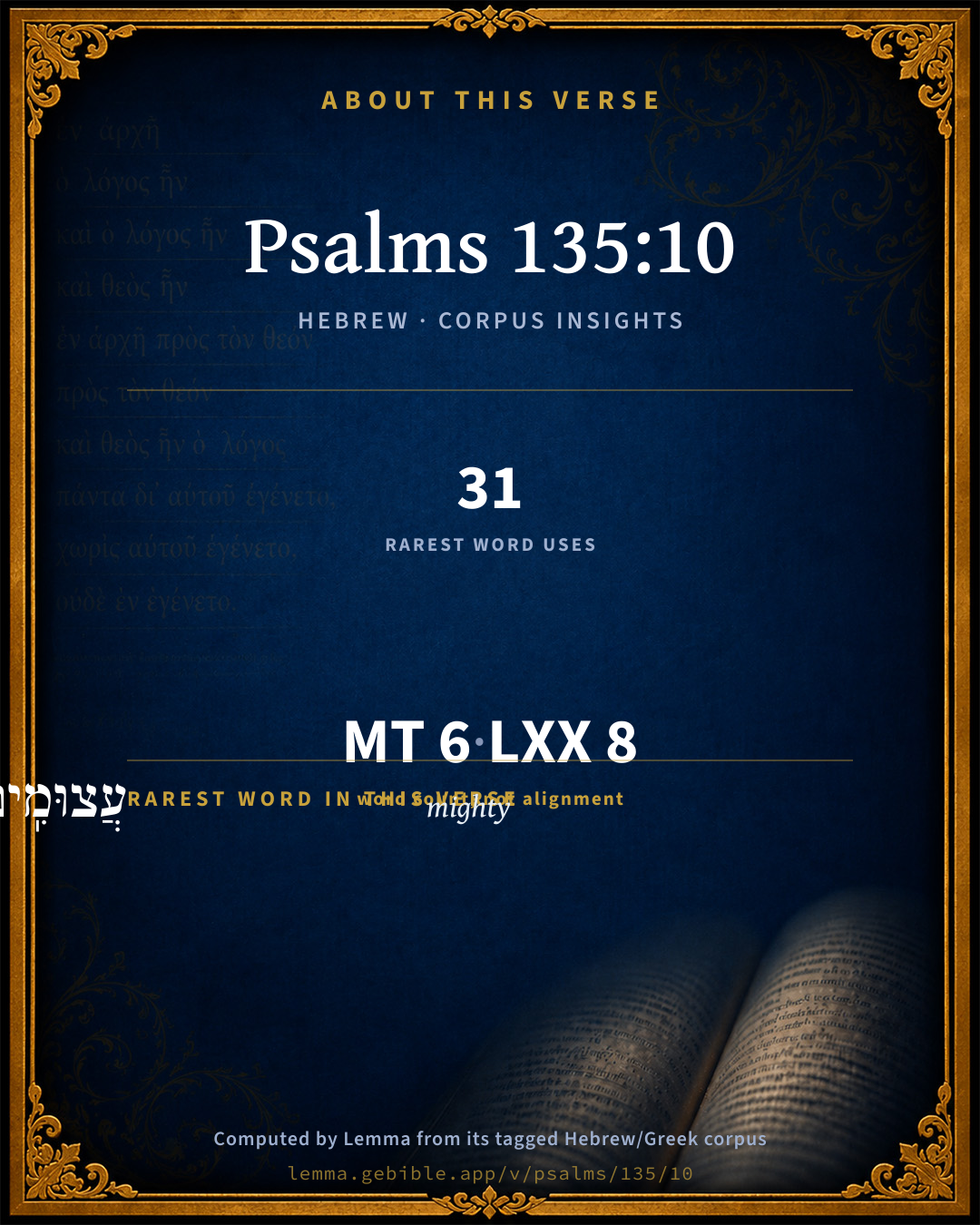
About this verse

These counts appear in no published source. They are computed here, from the morphology-tagged text and Lemma’s own curated glosses. What Lemma adds →

6
words
6
distinct lemmas
Wisdom
section

Shared distinctive vocabulary

עֲצוּמִֽים mighty H6099 occurs in 31 verses of the Hebrew Bible. Also found in:

Grammatical profile

  • 2 verbs
  • 2 nouns
  • 2 adjectives

Verb forms

  • שֶֽׁ֭הִכָּה Hiphil · Perfect
  • וְ֝הָרַ֗ג Qal · Perfect

Hebrew & Septuagint length

In English translation the verse runs 8 words from the Hebrew and 8 from the Septuagint (LXX English) — the same length.

A rough comparison of the two English renderings, which tokenize alike — not a word-level alignment.

Word counts can differ between the Hebrew and the Greek without any difference in meaning — e.g. the Hebrew direct-object marker אֵת has no separate Greek word, and Greek often adds the article ὁ.

In the original languages it is 6 Hebrew tokens and 8 Greek tokens — but the two are counted differently (Hebrew bundles its prefixes and suffixes into one token; the Greek is in lemma form), so that isn’t a like-for-like length.

Cross-references

3

Topical passages linked to Psalms 135:10 in the Treasury of Scripture Knowledge — connected by theme and wording, ordered by reader-vote popularity; previews shown in the World English Bible.

  • Psalms 136:17–22 To him who struck great kings; For his loving kindness endures forever;
  • Numbers 21:24 Israel struck him with the edge of the sword, and possessed his land from the Arnon to the Jabbok, even to the children of Ammon; for the border of the children of Ammon was strong.
  • Psalms 44:2–3 You drove out the nations with your hand, But you planted them. You afflicted the peoples, But you spread them abroad.

Cross-references courtesy of OpenBible.info (CC BY 4.0).

Hebrew and Greek witnesses Masoretic Hebrew ↔ Greek Septuagint

The same verse in the two great witnesses to the Old Testament, shown verse-for-verse.

You’re reading Greek Psalm 134 (Hebrew Psalm 135). The Septuagint counts the superscription, so verse numbers can differ from the Hebrew — chapter-level alignment, not verse-by-verse. Numbering follows Rahlfs.

These are two independent witnesses, not word-aligned to each other, and the Septuagint is shown in lemma (dictionary) form.

Hebrew Psalms 135:10 Masoretic · Westminster Leningrad Codex

שֶֽׁ֭הִכָּה גּוֹיִ֣ם רַבִּ֑ים וְ֝הָרַ֗ג מְלָכִ֥ים עֲצוּמִֽים

Who struck many nations, And killed mighty kings,

World English Bible · Public Domain

Greek LXX Greek Psalm 134:10 Septuagint · lemma form

ὅς πατάσσω ἔθνος πολύς καί ἀποκτείνω βασιλεύς κραταιός

Who struck many nations, and killed mighty kings;

LXX2012 (modern English Septuagint) · Public Domain

Hebrew: Westminster Leningrad Codex (CC BY 4.0). Greek: Septuagint (public domain); English from LXX2012 (modern English Septuagint) (Public Domain). How the Septuagint differs from the Hebrew →

Commentary

Notes on Psalms 135:10 from classic Christian and Jewish commentators (each source and its license shown beneath its notes). The classic Christian expositions comment on the surrounding passage and are grouped to its opening verse, so a note may address several verses; the Jewish commentaries on the Tanakh (Rashi and others) are per-verse, so they appear only where the commentator wrote on this verse.

Lemma curates 59 commentaries, every one of them public domain or Creative Commons licensed, each selected and text-cleaned for this edition rather than reprinted as found. About our sources →

Trapp's Complete Commentary

John Trapp

Psa 135:10 Who smote great nations, and slew mighty kings;

Ver. 10. Who smote great nations] Who, by their great sins, had greatly polluted their land; and filled it with filth from one end to another, Ezr 9:11.

And slew mighty kings] Heb. bony, big, massive fellows, quasi ossatos, sive torosos, as the word signifieth.

John Trapp, A Commentary or Exposition upon All the Books of the Old and New Testament (1647–1656) — public domain. Text from a community e-Sword module.

Joseph Benson's Commentary

Psa 135:10-12. Who smote great nations, &c. — “The victories gained by Israel over Sihon and Og, in their passage to Canaan, and afterward over the idolatrous kings of that country, are further proofs of the same point. For Israel therefore conquered because Jehovah fought for them, and put them in possession of that good land when the iniquity of its old inhabitants was full, and cried to heaven for vengeance.”

Joseph Benson's Commentary on the Old and New Testaments (1811–1818) — public domain. Text from a community e-Sword module.

Keil & Delitzsch

C. F. Keil & F. Delitzsch

Worthy is He to be praised, for He is the Conqueror of the Land of Promise. in connection with Psa 135:10 one is reminded of Deu 4:38; Deu 7:1; Deu 9:1; Deu 11:23; Jos 23:9. גּוים רבּים are here not many, but great peoples (cf. גּדלים in Psa 136:17), since the parallel word עצוּמים is by no means intended of a powerful number, but of powerful might (cf. Isa 53:12). As to the rest also, the poet follows the Book of Deuteronomy: viz., לכל ממלכות as in Deu 3:21, and נתן נחלה as in Deu 4:38 and other passages. It is all Deuteronomic with the exception of the שׁ, and the ל e in Psa 135:11 as the nota accus. (as in Psa 136:19., cf. Psa 69:6; Psa 116:16; Psa 129:3); the construction of הרג is just as Aramaizing in Job 5:2; Sa2 3:30 (where Sa2 3:30-31, like Sa2 3:36-37, are a later explanatory addition). The הרג alternating with הכּה is, next to the two kings, also referred to the kingdoms of Canaan, viz., their inhabitants. Og was also an Amoritish king, Deu 3:8.

Keil & Delitzsch — Biblical Commentary on the Old Testament (1861–1891) — public domain (CC PDM 1.0). Text via the HelloAO Bible API. (Old Testament only.)

J. A. Alexander on Psalms

Joseph Addison Alexander

10. (Psa 135:10) Who smote many rations and slew mighty kings. To the miracles of Egypt and the Exode are now added those of Canaan and the Conquest.

Joseph Addison Alexander, The Psalms Translated and Explained (1850) — public domain. Text from a community e-Sword module.

John Calvin's Commentaries

10. He smote great nations He comes now to speak of the end for which God delivered them from their bondage. He did not lead his people out of Egypt, and then leave them to wander as they might, but brought them forth that he might settle them in the promised inheritance. This the Psalmist mentions as another signal proof of the favor of God, and his unwearied kindness to them; for having once taken the children of Abraham by the hand, he led them on, in the continued exercise of his power, till he put them in possession of the promised land. He takes occasion to extol God’s power, from the circumstance that it was only after the slaughter of many enemies that they came to the peaceable possession of the country. And it was a striking illustration of the divine goodness to manifest this preference for the Israelites, who were but a multitude of inconsiderable persons, while those opposed to them were mighty kings and powerful nations. Notice is taken of two kings, Sihon and Og, not as being more powerful than the rest, but because shutting up the entrance to the land in front they were the first formidable enemies met with “Sed quia praecluso terrae aditu in primis erant formidabiles.” — Lat. “Mais pource qu’ils estoyent les plus a redouter, a cause qu’ils tenoyent l’entree de la terre fermee.” — Fr.

“Non minor est virtus quam quaerere, parta tueri,”

“It is no less an achievement to keep possession than to acquire it;” and as the Israelites were surrounded with deadly enemies, the power of God was very eminently displayed in preserving them from being rooted out and expelled again, an event which must have repeatedly taken place, had they not been firmly settled in the inheritance.

John Calvin's Commentaries (1540-1563) — public domain. Text from the Calvin Translation Society English edition (1840s-50s) via the Christian Classics Ethereal Library (ccel.org). Calvin's coverage is partial (roughly two-thirds of the Bible); uncommented books and verses are honest gaps, never fabricated. The 19th-century editor's footnotes and remarks are omitted so the notes are faithfully Calvin's own voice.

The Cambridge Bible for Schools and Colleges

gen. ed. J. J. S. Perowne

10. great nations] Or, many nations. Cp. Deu_7:1.

The Cambridge Bible for Schools and Colleges (gen. ed. J. J. S. Perowne; Cambridge University Press, 1878–1918) — public domain. Text from a community e-Sword module.

John Gill's Exposition

Sihon king of the Amorites, and Og king of Bashan,.... These are particularly named, because they were the first that were slain, and were the most mighty and powerful; see Deu 3:11. These the Lord slew by the hand of Moses, a type of Christ; who has destroyed the god and prince of this world, that had the power of death, the devil; and has spoiled all his principalities and powers;

and all the kingdoms of Canaan; thirty one of them. These words explain the former; as the two kings mentioned point at the mighty kings slain, these kingdoms show who the great nations were that were smitten.

John Gill's Exposition of the Whole Bible (1746–1763) — public domain (CC PDM 1.0). Text via the HelloAO Bible API.

Albert Barnes' Notes on the Bible

Who smote great nations ... - To wit, those specified in the following verse.

Albert Barnes' Notes on the Bible (1834–1885) — public domain. Text from a community e-Sword/MySword module.

The Treasury of David

Charles H. Spurgeon

Ver. 10. Who smote great nations, and slew mighty kings. The nations of Canaan joined in the desperate resistance offered by their monarchs, and so they were smitten; while their kings, the ringleaders of the fight, were slain. Those who resist the divine purpose will find it hard to kick against the pricks. The greatness of the nations and the might of the kings availed nothing against the Lord. He is prepared to mete out vengeance to those who oppose his designs: those who dream of him as too tender to come to blows have mistaken the God of Israel. He intended to bless the world through his chosen people, and he would not be turned from his purpose: cost what it might, he would preserve the candle of truth which he had lighted, even though the blood of nations should be spilt in its defence. The wars against the Canaanite races were a price paid for the setting up of a nation which was to preserve for the whole world the lively oracles of God.

Ver. 10. Who smote great nations, etc. It is better that the wicked should be destroyed a hundred times over than that they should tempt those who are as yet innocent to join their company. Let us but think what might have been our fate, and the fate of every other nation under heaven at this hour, had the sword of the Israelites done its work more sparingly. Even as it was, the small portions of the Canaanites who were left, and the nations around them, so tempted the Israelites by their idolatrous practices that we read continually of the whole people of God turning away from his service. But, had the heathen lived in the land in equal numbers, and, still more, had they intermarried largely with the Israelites, how was it possible, humanly speaking, that any sparks of the light of God's truth should have survived to the coming of Christ? Would not tim Israelites have lost all their peculiar character; and if they had retained the name of Jehovah as of their God, would they not have formed as unworthy notions of his attributes, and worshipped him with a worship as abominable as that which the Moabites paid to Chemosh or the Philistines to Dagon?

But this was not to be, and therefore the nations of Canaan were to be cut off utterly. The Israelites' sword, in its bloodiest executions, wrought a work of mercy for all the countries of the earth to the very end of the world. They seem of very small importance to us now, those perpetual contests with the Canaanites, and the Midianites, and the Ammonites, and the Philistines, with which the Books of Joshua and Judges and Samuel are almost filled. We may half wonder that God should have interfered in such quarrels, or have changed the course of nature, in order to give one of the nations of Palestine the victory over another. But in these contests, on the fate of one of these nations of Palestine the happiness of the human race depended. The Israelites fought not for themselves only, but for us. It might follow that they should thus be accounted the enemies of all mankind, it might be that they were tempted by their very distinctness to despise other nations; still they did God's work, still they preserved unhurt the seed of eternal life, and were the ministers of blessing to all other nations, even though they themselves failed to enjoy it. Thomas Arnold, 1795-1842.

Ver. 10. Who smote great nations, etc. Let us not stand in fear of any enemies that rise up against us, and conspire to hinder the peace of the church, and stop the passage of the gospel; when God begins to take the cause of his people into his own hand, and smiteth any of his enemies on the jawbone, the rest are reserved to the like destruction. For wherefore doth God punish his adversaries, and enter into judgment with them? Wherefore doth he visit them, and strike them down with his right hand? Is it only to take vengeance, and to show his justice in their confusion? No, it serveth for the comfort and consolation of his servants, that howsoever God be patient, yet in the end they shall not escape. William Attersoll, 1618.

Psalms 135:11*

Charles H. Spurgeon's The Treasury of David (1869–1885) — public domain. Psalms only. Text from a community e-Sword/MySword module.

Whedon's Commentary on the Bible

Daniel D. Whedon

10-12. Smote… nations—From the judgments of Egypt, the writer passes over the desert life of the Israelites, and proceeds to narrate the conquest of the land east of Jordan.

Sihon king of the Amorites—The Amorites had conquered the territory from Arnon to Jabbok from the Moabites and Ammonites long before Moses. See Numbers 12:21-31. The latter nations reasserted their title afterward, but failed to maintain it. Jdg_10:11.

Og king of Bashan—Num_21:32-35; Deuteronomy 3. His kingdom embraced all the land north of the Jabbok.

The kingdoms of Canaan—All the land west of the Jordan. See notes on Psa_136:17-21

Daniel D. Whedon (gen. ed.), Commentary on the Old and New Testaments (1874–1909) — public domain. Text from a community e-Sword module.

The Pulpit Commentary

Who smote great nations. (see Exo_14:27, 28 17:8-13 Num_21:24-30, 33-35 Jos_8:21-26 Jos_10:10, 11 Jud 4:10-16 7:19-23 11:32, 33 1Sa_7:10-13 2Sa_8:1-14 2Sa_10:8-19 1Ki_20:1-30 2Ki_3:4-27 2Ki_14:25-28 2Ki_18:7, 8 19:35 2Ch_14:9-15 2Ch_20:1-25, etc.) And slew mighty kings. (see Jos_12:9-24 Jud_1:7:25 8:21 1Sa_15:33, etc.)

The Lord is a "Man of war.

1. So thoroughly has Christianity filled the modern mind with the love of peace, that the older associations of Jehovah with times and scenes of war have become positively painful to us. Taking advantage of this feeling perhaps we should say this weakness of feeling the infidel makes easy attacks upon the Old Testament Jehovah as an altogether unlovely and even bloodthirsty conception. Are we to be unduly alarmed, and to attempt explanations and excuses? or are we to take a firm stand, and say that, as the experience of war is one of the commonplaces of humanity, the association of Jehovah with war is inevitable; it must be made in every nation and in every generation, and according to the idea a nation has of war must be its notion of God as associated with war. In the last hundred years there have been a great variety of wars, right ones and wrong. Men cannot help it; they must associate their God with their wars. The thing to seek is a right association. Wars are dreadful things; but it is not possible to read history intelligently, and say that they have always been wrong. But if they have ever been just and right, God cannot be dishonored by being thought of as connected with them, and working out his purposes by means of them.

2. Then, again, wars belong to that liberty with which God has entrusted his creatures. It is a liberty over which he watches, and which he holds in due restraints. But he would not be fair to men unless he gave them a good length of tether. Man must have liberty enough to fight for his ends.

3. Again, if the self-defense of an individual man be right, and even aggressive action under some conditions, self-defense in an aggregate of individuals, in a nation, need not be wrong. We must distinguish between the misery of it and the sin of it. A nation has no way of aggressive or defensive action, in relation to the aggressive or defensive action of another nation, save by war.

4. And lastly, God may use nations, as well as natural forces, for the execution of his judgments. Natural forces are pestilence, famine, and convulsions, as we call them, of nature. The only national executive force is war. Reasonably, as well as poetically, God may be called a Man of war. R.T.

The Pulpit Commentary (1880–1919), ed. H.D.M. Spence-Jones & Joseph S. Exell — public domain. Text from a community e-Sword module.

unfoldingWord translationNotes

Door43 World Missions Community

Sihon ... Og

These are the names of two men. (See: How to Translate Names)

translationWords

nation

might

king

Amorite

Bashan

kingdom

Canaan

unfoldingWord translationNotes — © Distant Shores Media and the Door43 World Missions Community, licensed CC BY-SA 4.0. Source: git.door43.org/Door43/en_tn.

Lesson kit

Teaching starters — assembled from the data on this page, not authored interpretation. Every prompt links to the verse data it draws on. Edit before teaching.

Psalms, in the Wisdom, opens this verse with 6 words (6 distinct Hebrew lemmas). Its most distinctive word is ʻâtsûwm (“mighty”). A historical commentator’s framing appears above. Read the whole chapter for the surrounding context.

Discussion questions

  1. What does “mighty” (ʻâtsûwm) contribute to the verse as a whole?
  2. Genesis 18:18 shares the word «mighty» with this verse. How do the two illuminate each other?
  3. These translations render this verse differently; the difference is in the English rendering, not the original. What questions does that raise?
  4. The verb «שֶֽׁ֭הִכָּה» is Hiphil Perfect. How does its form color the action?
  5. Reading how Trapp's Complete Commentary and Joseph Benson's Commentary read this verse, where do the two commentators agree and where do they part?

Things to notice

Reading settings

Reading text

Shown beneath each verse's original-language words.

Old Testament
Old Testament edition

Read the OT as the Masoretic Hebrew (MT) or the Greek Septuagint (LXX).

English shown for the Greek Septuagint (in the Hebrew ↔ Greek comparison).

Comparing translations? Open the Compare panel on any verse page to stack up to four side by side.