
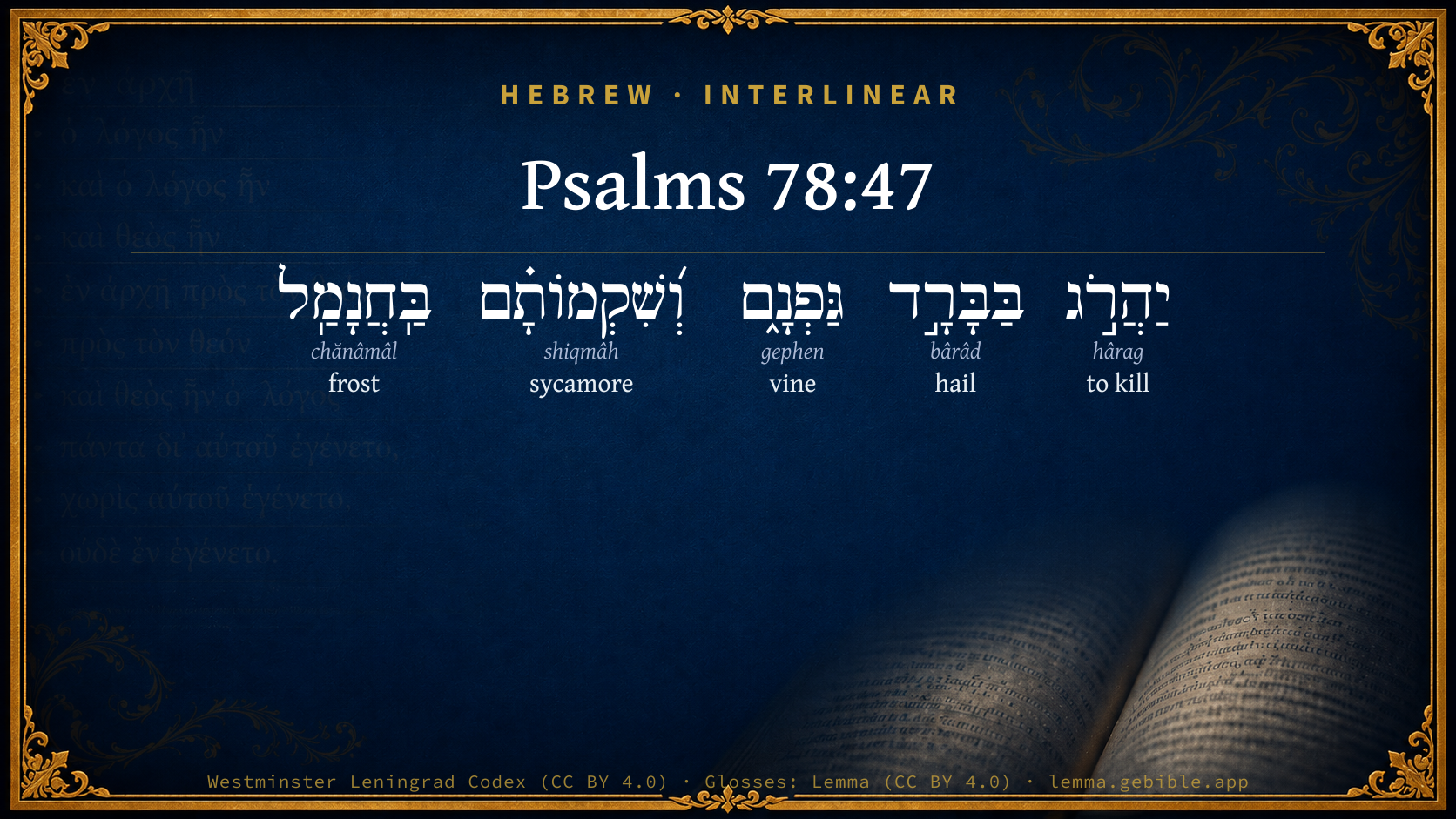
Psalms 78:47

Hebrew (Westminster Leningrad Codex) Psalms 78:47 appears in the Hebrew Old Testament. The text above is from the Westminster Leningrad Codex. Each word links to its Strong’s number, a concise gloss, and parsing drawn from the Open Scriptures Hebrew Bible morphology. Click any word for its full Brown-Driver-Briggs (BDB) entry.
Download image
Cite this verse

Psalms 78:47 (World English Bible). Public Domain. Lemma interlinear Bible study tool, https://lemma.gebible.app/v/psalms/78/47.

Show BibTeX & RIS
BibTeX
RIS
English Translation
He destroyed their vines with hail, Their sycamore-fig trees with frost.
World English Bible · Public Domain
Highlights
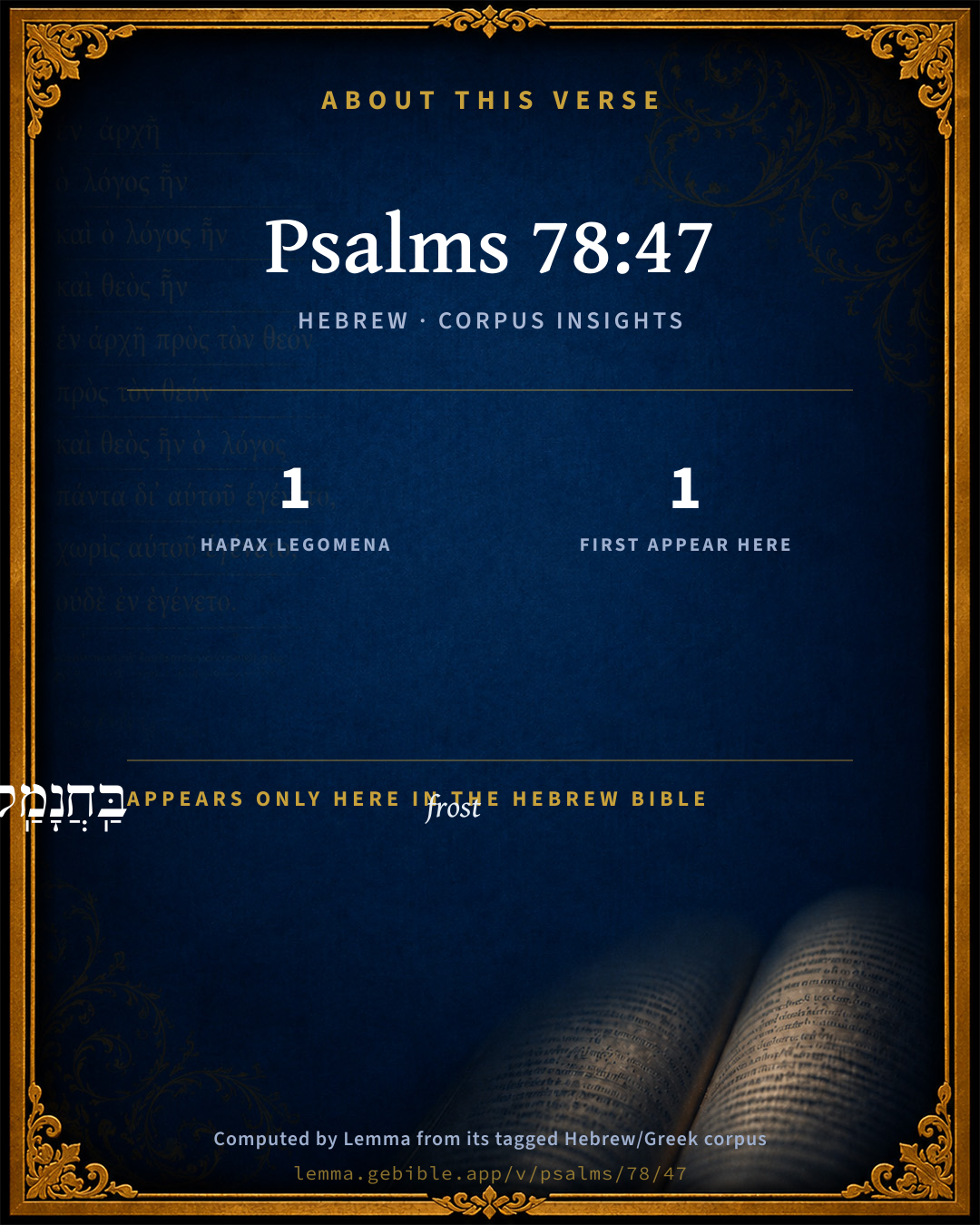
  • 1 hapax legomenon — only here in the Hebrew Bible
  • 1 first appearance in the Hebrew Bible
Full analysis ↓
Download a study sheet

One document with this verse’s original text, its word-by-word gloss line, the meaning frame, cross-references with their text, attributed commentary, and full source and license credits — printable, and it pastes into notes with its structure intact.

This verse Autodidact and up

Study sheet (.html) Plain text (.txt)

A passage Seminary Student

Up to 50 verses in one chapter. A passage sheet keeps up to 6 commentary sources and 12 cross-references per verse, in the order this page ranks them, and says so on the sheet whenever that leaves anything out. Ask for a single verse and you get the Autodidact verse sheet above.

Everything on this page stays free to read, with no account — the sheet is a download of what is already on screen, not access to it.

Want to remove ads? Support Godless Engineer
Compare translations 3

The same verse in 3 English versions, stacked beneath the original-language interlinear above. Click any original word for its lexicon entry.

Each is an independent rendering of the whole verse — the interlinear is not word-aligned to these translations.

Highlighted words mark where these versions differ — a whole-verse word diff, not a word-by-word alignment.

  • World English Bible Public Domain
    He destroyed their vines with hail, Their sycamore-fig trees with frost.
  • King James Version Public Domain
    He destroyed their vines with hail, and their sycomore trees with frost.
  • unfoldingWord Literal Text CC BY-SA 4.0
    He slew their vines with hail and their sycamore trees with frost.

unfoldingWord Literal Text — © unfoldingWord, licensed CC BY-SA 4.0. Word-aligned USFM3 via Door43 (git.door43.org/unfoldingWord/en_ult).

Versions to compare (up to 4)

3 of 4 selected

Show all 18 translations

Every available English version of this verse, each an independent rendering of the whole verse.

  • World English Bible Public Domain
    He destroyed their vines with hail, Their sycamore-fig trees with frost.
  • Berean Standard Bible Public Domain
    He killed their vines with hailstones and their sycamore-figs with sleet.
  • Majority Standard Bible Public Domain
    He killed their vines with hailstones and their sycamore-figs with sleet.
  • King James Version Public Domain
    He destroyed their vines with hail, and their sycomore trees with frost.
  • American Standard Version (1901) Public Domain
    He destroyed their vines with hail, And their sycomore-trees with frost.
  • Revised Version (1885) Public Domain
    He destroyed their vines with hail, and their sycomore trees with frost.
  • Geneva Bible (1599) Public Domain
    He destroied their vines with haile, and their wilde figge trees with the hailestone.
  • Douay-Rheims (1899) Public Domain
    And he destroyed their vineyards with hail, and their mulberry trees with hoarfrost.
  • Young's Literal Translation Public Domain
    He destroyeth with hail their vine, And their sycamores with frost,
  • Literal Standard Version CC BY-SA 4.0
    He destroys their vine with hail, || And their sycamores with frost,
  • Unlocked Literal Bible CC BY-SA 4.0
    He destroyed their vines with hail and their sycamore trees with more hail.
  • unfoldingWord Literal Text CC BY-SA 4.0
    He slew their vines with hail and their sycamore trees with frost.
  • Darby Bible Public Domain
    He killed their vines with hail, and their sycamore trees with hail-stones;
  • World Messianic Bible Public Domain
    He destroyed their vines with hail, their sycamore fig trees with frost.
  • Webster's Bible Public Domain
    He destroyed their vines with hail, and their sycamore trees with frost.
  • Free Bible Version CC BY-SA 4.0
    He destroyed their vines with hail, and their fig trees with freezing rain.
  • Bible in Basic English Public Domain
    He sent ice for the destruction of their vines; their trees were damaged by the bitter cold.
  • JPS Tanakh (1917) Public Domain
    He destroyed their vines with hail, and their sycamore-trees with frost.

Literal Standard Version (2020), Covenant Press — licensed CC BY-SA 4.0. Text via the HelloAO Bible API (eBible.org). Unlocked Literal Bible (unfoldingWord) — licensed CC BY-SA 4.0. Text via the HelloAO Bible API (eBible.org). unfoldingWord Literal Text — © unfoldingWord, licensed CC BY-SA 4.0. Word-aligned USFM3 via Door43 (git.door43.org/unfoldingWord/en_ult). Free Bible Version, Dr. Jonathan Gallagher — licensed CC BY-SA 4.0. Text via the HelloAO Bible API (eBible.org).

Word by word

More ways to search: Search by grammar → Find every occurrence → Compare this word →

Practice this passage: Drill this verse → Learn its vocabulary →

About this verse

These counts appear in no published source. They are computed here, from the morphology-tagged text and Lemma’s own curated glosses. What Lemma adds →

5
words
5
distinct lemmas
Wisdom
section

Notable vocabulary

1 hapax legomenon — a word that appears only here in the entire Hebrew Bible:

  • בַּֽחֲנָמַֽל frost H2602

First appearance in Scripture

This word makes its first canonical appearance in the Hebrew Bible here:

  • בַּֽחֲנָמַֽל frost H2602

Shared distinctive vocabulary

וְ֝שִׁקְמוֹתָ֗ם sycamore H8256 occurs in 7 verses of the Hebrew Bible. Also found in:

Grammatical profile

  • 1 verb
  • 4 nouns

Verb forms

  • יַהֲרֹ֣ג Qal · Imperfect

Hebrew & Septuagint length

In English translation the verse runs 11 words from the Hebrew and 11 from the Septuagint (LXX English) — the same length.

A rough comparison of the two English renderings, which tokenize alike — not a word-level alignment.

Word counts can differ between the Hebrew and the Greek without any difference in meaning — e.g. the Hebrew direct-object marker אֵת has no separate Greek word, and Greek often adds the article ὁ.

Cross-references

2

Topical passages linked to Psalms 78:47 in the Treasury of Scripture Knowledge — connected by theme and wording, ordered by reader-vote popularity; previews shown in the World English Bible.

  • Exodus 9:18–34 Behold, tomorrow about this time I will cause it to rain a very grievous hail, such as has not been in Egypt since the day it was founded even until now.
  • Psalms 105:32–33 He gave them hail for rain, With lightning in their land.

Cross-references courtesy of OpenBible.info (CC BY 4.0).

Hebrew and Greek witnesses Masoretic Hebrew ↔ Greek Septuagint

The same verse in the two great witnesses to the Old Testament, shown verse-for-verse.

You’re reading Greek Psalm 77 (Hebrew Psalm 78). The Septuagint counts the superscription, so verse numbers can differ from the Hebrew — chapter-level alignment, not verse-by-verse. Numbering follows Rahlfs.

These are two independent witnesses, not word-aligned to each other, and the Septuagint is shown in lemma (dictionary) form.

Hebrew Psalms 78:47 Masoretic · Westminster Leningrad Codex

יַהֲרֹ֣ג בַּבָּרָ֣ד גַּפְנָ֑ם וְ֝שִׁקְמוֹתָ֗ם בַּֽחֲנָמַֽל

He destroyed their vines with hail, Their sycamore-fig trees with frost.

World English Bible · Public Domain

Greek LXX Greek Psalm 77:47 Septuagint · lemma form

ἀποκτείνω ἐν χάλαζα ὁ ἄμπελος αὐτός καί ὁ συκάμινος αὐτός ἐν ὁ πάχνη

He killed their vines with hail, and their sycamores with frost.

LXX2012 (modern English Septuagint) · Public Domain

On this verse, Ellicott's Commentary for English Readers discusses the Septuagint’s reading. Read the note in Commentary ↓

Hebrew: Westminster Leningrad Codex (CC BY 4.0). Greek: Septuagint (public domain); English from LXX2012 (modern English Septuagint) (Public Domain). How the Septuagint differs from the Hebrew →

Commentary

Notes on Psalms 78:47 from classic Christian and Jewish commentators (each source and its license shown beneath its notes). The classic Christian expositions comment on the surrounding passage and are grouped to its opening verse, so a note may address several verses; the Jewish commentaries on the Tanakh (Rashi and others) are per-verse, so they appear only where the commentator wrote on this verse.

Lemma curates 59 commentaries, every one of them public domain or Creative Commons licensed, each selected and text-cleaned for this edition rather than reprinted as found. About our sources →

Trapp's Complete Commentary

John Trapp

Psa 78:47 He destroyed their vines with hail, and their sycomore trees with frost.

Ver. 47. He destroyed their vines with hail] Heb. He killed, Quia planta habet animam vegetativain, ut Job 14:8, saith Kimchi.

And their sycamores with frost] Or, with great hailstones mingled with fire, running along and catching, Exo 9:24. Confer Rev 16:21.

John Trapp, A Commentary or Exposition upon All the Books of the Old and New Testament (1647–1656) — public domain. Text from a community e-Sword module.

J. A. Alexander on Psalms

Joseph Addison Alexander

47. (Psa 78:47) He kills with hail their vine and their sycamores with frost. The destruction of the vines is not mentioned in the history (Exo 9:23-32), though it is in Psa 105:33. It has even been denied that the culture of the vine was known in ancient Egypt; but the fact has been fully established by modern investigation and discovery. The last word of the sentence occurs nowhere else. Some of the moderns explain it, from an Arabic analogy, to mean an ant; but the parallelism favours the usual interpretation which is derived from the ancient versions.

Joseph Addison Alexander, The Psalms Translated and Explained (1850) — public domain. Text from a community e-Sword module.

Adam Clarke's Commentary

Verse 47. He destroyed their vines with hail] Though the vine was never plentiful in Egypt, yet they have some; and the wine made in that country is among the most delicious. The leaf of the vine is often used by the Egyptians of the present day for wrapping up their mince-meat, which they lay leaf upon leaf, season it after their fashion, and so cook it, making it a most exquisite sort of food, according to Mr. Maillet.

And their sycamore-trees] This tree was very useful to the ancient Egyptians, as all their coffins are made of this wood; and to the modern, as their barques are made of it. Besides, it produces a kind of fig, on which the common people in general live; and Mr. Norden observes that "they think themselves well regaled when they have a piece of bread, a couple of sycamore figs, and a pitcher of water from the Nile." The loss therefore of their vines and sycamore-trees must have been very distressing to the Egyptians.

Adam Clarke's Commentary on the Bible (1810–1826) — public domain. Text from a community e-Sword/MySword module.

Ellicott's Commentary for English Readers

(47) Vines.—In the history of the plagues (Exo_9:13-25) no mention is made either of vines or sycamores or of fig-trees, as in Psa_105:33, and some consider that the poem reflects a Palestinian rather than an Egyptian point of view. But besides Num_20:5 and Joseph’s dream there is abundance of evidence of the extensive cultivation of the vine in Egypt. The mural paintings contain many representations of vineyards. Wine stood prominent among the offerings to the gods, and a note on a papyrus of Rameses II. speaks of rations of wine made to workmen.

Sycamore.—See 1Ki_10:27.

Frost.—The Hebrew word is peculiar to this place. The LXX. and Vulg. have “hoar-frost,” Aquila “ice,” Symmachus “worm.” The root of the word appears to mean to cut off, so that by derivation any devastating force would suit the word.

A Bible Commentary for English Readers, edited by Charles John Ellicott (1878–1897) — public domain. Text from a community e-Sword module.

The Cambridge Bible for Schools and Colleges

gen. ed. J. J. S. Perowne

47. He killed their vines &c. The seventh plague, Exo_9:13 ff. Cp. Psa_105:33. Grapes and figs are among the fruits frequently represented in paintings in Egyptian tombs. The sycomore was and is one of the common trees of Egypt, much valued for its durable wood, of which mummy cases were commonly made.

with frost] This is the rendering of the LXX, Aq., Syr., Jer., but great hailstones (R.V. marg.) or lumps of ice is more probably the meaning.

The Cambridge Bible for Schools and Colleges (gen. ed. J. J. S. Perowne; Cambridge University Press, 1878–1918) — public domain. Text from a community e-Sword module.

John Gill's Exposition

He gave up their cattle also to the hail,.... For the hail fell upon man and beast, as well as upon herbs and trees, Exo 9:22,

and their flocks to hot thunderbolts: which were killed by them: this is to be understood of the fire that was mingled with the hail, and ran upon the ground, and destroyed their flocks, Exo 9:23. Jarchi, out of the Midrash, interprets the words of fowls which devoured the sheep killed by the hail.

John Gill's Exposition of the Whole Bible (1746–1763) — public domain (CC PDM 1.0). Text via the HelloAO Bible API.

Albert Barnes' Notes on the Bible

He destroyed their vines with hail - Margin, killed. See Exo 9:22-26. In the account in Exodus the hail is said to have smitten man and beast, the herb, and the tree of the field. In the psalm only one thing is mentioned, perhaps denoting the ruin by what would be particularly felt in Palestine, where the culture of the grape was so common and so important.

And their sycamore trees with frost - The sycamore is mentioned particularly as giving poetic beauty to the passage. Of the sycamore tree, Dr. Thomson remarks (“land and the Book,” vol. i. p. 25), “It is a tender tree, flourishes immensely in sandy plains and warm vales, but cannot bear the hard, cold mountain. A sharp frost will kill them; and this agrees with the fact that they were killed by it in Egypt. Among the wonders performed in the field of Zoan, David says, ‘He destroyed their vines with hail, and their sycamores with frost.’ Certainly, a frost keen enough to kill the sycamore would be one of the greatest ‘wonders’ that could happen at the present day in this same field of Zoan.” The word rendered “frost” - חנמל chănâmâl - occurs nowhere else. It is parallel with the word hail in the other member of the sentence, and denotes something that would be destructive to trees. The Septuagint, the Vulgate, and the Arabic render it frost. Gesenius renders it ants.

Albert Barnes' Notes on the Bible (1834–1885) — public domain. Text from a community e-Sword/MySword module.

Matthew Poole's English Annotations

Sycomore trees; or, wild fig trees, which were there in great plenty. Under these and the vines all other trees are comprehended. And this hail and frost did destroy the fruits of the trees, and sometimes the trees themselves.

Matthew Poole's English Annotations on the Holy Bible (1683–1685) — public domain. Text from a community e-Sword/MySword module.

The Treasury of David

Charles H. Spurgeon

Ver. 47. He destroyed their vines with hail. No more shall thy butler press the clusters into thy cup, O Pharaoh! The young fruit bearing shoots were broken off, the vintage failed.

And their sycomore trees with frost. Frost was not usual, but Jehovah regards no laws of nature when men regard not his moral laws. The sycomore fig was perhaps more the fruit of the many than was the vine, therefore this judgment was meant to smite the poor, while the former fell most heavily upon the rich. Mark how the heavens obey their Lord and yield their stores of hail, and note how the fickle weather is equally subservient to the divine will.

Ver. 43-51. See Psalms on "Ps 78:43" for further information.

Ver. 47. He destroyed their vines with hail, and their sycomore trees with frost. The grape vine for the rich, and the sycomore fig for the poor, were cut off by the just judgment of God upon the nation. W. Wilson.

Ver. 47. The sycomore (not sycamore, for this is altogether different, though, in consequence of a typographical error, often confounded with it in our Bibles) was the name of a tree, common in Egypt, Am 7:14 Lu 19:4. This tree resembled the mulberry in its leaves, and the fig in its fruit; and on its produce the inferior ranks of people, for the most part, lived. The psalmist refers to but one sort, still he clearly means every kind, of valuable tree. William Keatinge Clay.

Ver. 47. (last clause). Sometimes it will not shoot. Sometimes it will. And when it does, it misses the mark.

Charles H. Spurgeon's The Treasury of David (1869–1885) — public domain. Psalms only. Text from a community e-Sword/MySword module.

Whedon's Commentary on the Bible

Daniel D. Whedon

47. Hail—Not uncommon in Egypt, but this, for severity, exceeded any hail tempest ever known. The miracle consisted in the unwonted severity of the storm, (Exo_9:22-25,) and in its being foretold. Psa_78:18.

Sycamore—Or fig mulberry, or wild fig tree, abounding in Egypt. Its leaves are like the mulberry, and its fruit like the fig, affording large supplies to the poor, and hence cultivated. 1Ch_27:28.

Frost— The Hebrew word occurs nowhere else in Scripture, but as it is parallel to “hail” in the preceding member, the obvious climax of the verse would lead us to suppose icy hailstones of great weight, which destroyed animals, and even trees, where the common hailstone destroyed only the vine. See Jos_10:11; Rev_16:21. The marginal reading is “great hailstones.”

Daniel D. Whedon (gen. ed.), Commentary on the Old and New Testaments (1874–1909) — public domain. Text from a community e-Sword module.

The Pulpit Commentary

He destroyed their vines with hail. (see Exo_9:23-25) Here, again, there is an inversion of the order in which the plagues came, since the plague of hail preceded that of the locusts. There is also an addition to the narrative of Exodus in the mention of "vines", (see also Psa_105:33) which may indicate a use of tradition. That vines were cultivated in Egypt is now generally acknowledged. And their sycamore trees with frost; or, with sleet a variant of the "hail" in the other hemistich.

The Pulpit Commentary (1880–1919), ed. H.D.M. Spence-Jones & Joseph S. Exell — public domain. Text from a community e-Sword module.

John Wesley's Explanatory Notes

Sycamore-trees - Under these and the vines, all other trees are comprehended. This hail and frost destroyed the fruit of the trees, and sometimes the trees themselves.

John Wesley, Explanatory Notes Upon the Whole Bible (1754–1765) — public domain. Text via the GEBible commentary corpus.

unfoldingWord translationNotes

Door43 World Missions Community

General Information:

The writer continues to describe what God did to the Egyptians.

sycamore

a tree that gives fruit

lightning bolts

lightning that makes loud thunder

He rained hail

"He brought hail" or "He caused hail to fall"

The fierceness of his anger lashed out against them

Asaph speaks of God's fierceness as if it were a person who could attack another person. AT: "He was angry with them, so he suddenly and fiercely attacked them" (See: Personification)

The fierceness of his anger

"His fierce anger"

lashed out against them

"attacked them when they were not expecting anything to happen"

He sent wrath, fury, and trouble like agents who bring disaster

Asaph speaks of wrath, fury, and trouble as though they are people God can send to do his work for him. AT: "He was so angry that he wanted to harm the Egyptians, so he made trouble for them and brought them to disaster" (See: Personification and Simile)

fury

anger that makes someone want to harm others

translationWords

vine

hail

livestock

send

anger

wrath

trouble

unfoldingWord translationNotes — © Distant Shores Media and the Door43 World Missions Community, licensed CC BY-SA 4.0. Source: git.door43.org/Door43/en_tn.

Rashi

Rabbi Shlomo Yitzchaki (Rashi)

with locusts Heb. בחנמל, the name of the locust. According to the Midrash (Mid. Ps. 78:13) [it is composed of the following words]: בָּא חָן מָל, it comes, encamps, and cuts. It cut off the greens of the tree and the grass and ate it.

Rashi on the Tanakh — English translations: “The Judaica Press complete Tanach with Rashi, translated by A. J. Rosenberg” (CC BY 4.0); “Pentateuch with Rashi's commentary by M. Rosenbaum and A.M. Silbermann, 1929-1934” (public domain); “The Metsudah Tanach series, Lakewood, N.J” (CC BY 4.0); and “The Book of Joshua, Metsudah Publications, 1997” (CC BY 4.0). Text via Sefaria.

Lesson kit

Teaching starters — assembled from the data on this page, not authored interpretation. Every prompt links to the verse data it draws on. Edit before teaching.

Psalms, in the Wisdom, opens this verse with 5 words (5 distinct Hebrew lemmas). Its most distinctive word is chănâmâl (“frost”). A historical commentator’s framing appears above. Read the whole chapter for the surrounding context.

Discussion questions

  1. How does “frost” (chănâmâl) shape what this verse is saying?
  2. This verse holds 1 word here found nowhere else in the Hebrew Bible. What might the rare word draw attention to?
  3. The word “frost” first appears here in Scripture. What is being introduced at this debut?
  4. 1 Kings 10:27 shares the word «sycamore» with this verse. How do the two illuminate each other?
  5. The translations on this page render this verse differently — a whole-verse word diff, not a word-by-word alignment. What might account for the different wordings?
  6. The verb «יַהֲרֹ֣ג» is Qal Imperfect. How does its form color the action?
  7. Reading how Trapp's Complete Commentary and J. A. Alexander on Psalms read this verse, where do the two commentators agree and where do they part?

Things to notice

  • 1 word in this verse appears nowhere else in the Hebrew Bible.
  • 1 word makes its first canonical appearance in Scripture here.
  • These translations choose different wording for 5 words in this verse.
  • 5 distinct Hebrew lemmas span 5 words in this verse.

Reading settings

Reading text

Shown beneath each verse's original-language words.

Old Testament
Old Testament edition

Read the OT as the Masoretic Hebrew (MT) or the Greek Septuagint (LXX).

English shown for the Greek Septuagint (in the Hebrew ↔ Greek comparison).

Comparing translations? Open the Compare panel on any verse page to stack up to four side by side.