Isaiah 14:20

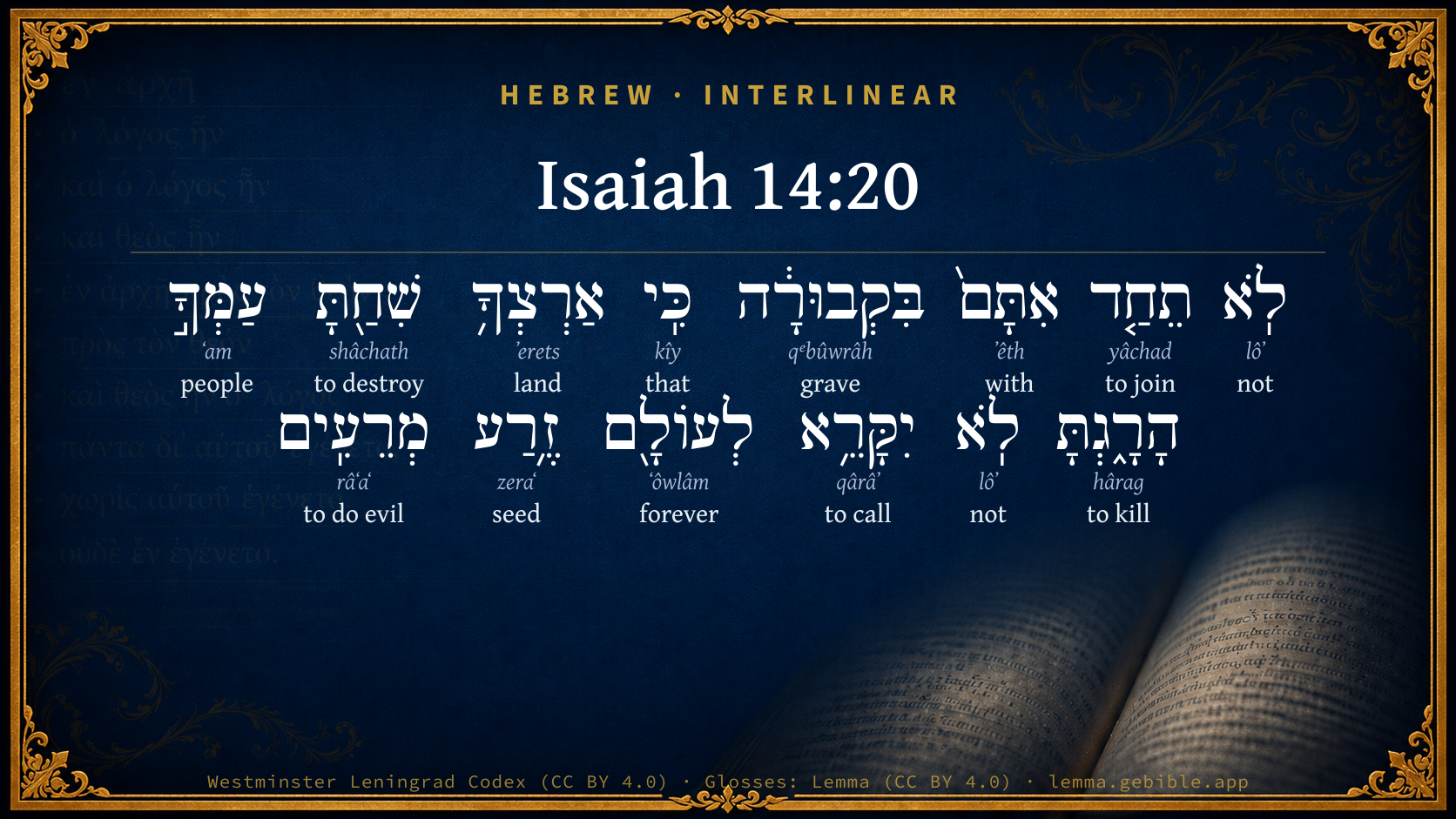
Hebrew (Westminster Leningrad Codex) Isaiah 14:20 appears in the Hebrew Old Testament. The text above is from the Westminster Leningrad Codex. Each word links to its Strong’s number, a concise gloss, and parsing drawn from the Open Scriptures Hebrew Bible morphology. Click any word for its full Brown-Driver-Briggs (BDB) entry.
Download image
Cite this verse

Isaiah 14:20 (World English Bible). Public Domain. Lemma interlinear Bible study tool, https://lemma.gebible.app/v/isaiah/14/20.

Show BibTeX & RIS
BibTeX
RIS
English Translation
You shall not be joined with them in burial, because you have destroyed your land, you have killed your people; the seed of evil-doers shall not be named forever.
World English Bible · Public Domain
Download a study sheet

One document with this verse’s original text, its word-by-word gloss line, the meaning frame, cross-references with their text, attributed commentary, and full source and license credits — printable, and it pastes into notes with its structure intact.

This verse Autodidact and up

Study sheet (.html) Plain text (.txt)

A passage Seminary Student

Up to 50 verses in one chapter. A passage sheet keeps up to 6 commentary sources and 12 cross-references per verse, in the order this page ranks them, and says so on the sheet whenever that leaves anything out. Ask for a single verse and you get the Autodidact verse sheet above.

Everything on this page stays free to read, with no account — the sheet is a download of what is already on screen, not access to it.

Want to remove ads? Support Godless Engineer
Compare translations 3

The same verse in 3 English versions, stacked beneath the original-language interlinear above. Click any original word for its lexicon entry.

Each is an independent rendering of the whole verse — the interlinear is not word-aligned to these translations.

Highlighted words mark where these versions differ — a whole-verse word diff, not a word-by-word alignment.

  • World English Bible Public Domain
    You shall not be joined with them in burial, because you have destroyed your land, you have killed your people; the seed of evil-doers shall not be named forever.
  • King James Version Public Domain
    Thou shalt not be joined with them in burial, because thou hast destroyed thy land, and slain thy people: the seed of evildoers shall never be renowned.
  • unfoldingWord Literal Text CC BY-SA 4.0
    You will not join with them in burial, for you have destroyed your land, you have killed your people. The seed of evildoers will not be named forever.

unfoldingWord Literal Text — © unfoldingWord, licensed CC BY-SA 4.0. Word-aligned USFM3 via Door43 (git.door43.org/unfoldingWord/en_ult).

Versions to compare (up to 4)

3 of 4 selected

Show all 18 translations

Every available English version of this verse, each an independent rendering of the whole verse.

  • World English Bible Public Domain
    You shall not be joined with them in burial, because you have destroyed your land, you have killed your people; the seed of evil-doers shall not be named forever.
  • Berean Standard Bible Public Domain
    You will not join them in burial, since you have destroyed your land and slaughtered your own people. The offspring of the wicked will never again be mentioned.
  • Majority Standard Bible Public Domain
    You will not join them in burial, since you have destroyed your land and slaughtered your own people. The offspring of the wicked will never again be mentioned.
  • King James Version Public Domain
    Thou shalt not be joined with them in burial, because thou hast destroyed thy land, and slain thy people: the seed of evildoers shall never be renowned.
  • American Standard Version (1901) Public Domain
    Thou shalt not be joined with them in burial, because thou hast destroyed thy land, thou hast slain thy people; the seed of evil-doers shall not be named for ever.
  • Revised Version (1885) Public Domain
    Thou shalt not be joined with them in burial, because thou hast destroyed thy land, thou hast slain thy people; the seed of evil-doers shall not be named for ever.
  • Geneva Bible (1599) Public Domain
    Thou shalt not be ioyned with them in the graue, because thou hast destroied thine owne lande, and slaine thy people: the seede of the wicked shall not be renoumed for euer.
  • Douay-Rheims (1899) Public Domain
    Thou shalt not keep company with them, even in burial: for thou hast destroyed thy land, thou hast slain thy people: the seed of the wicked shall not be named for ever.
  • Young's Literal Translation Public Domain
    Thou art not united with them in burial, For thy land thou hast destroyed, Thy people thou hast slain, Not named to the age is the seed of evil doers.
  • Literal Standard Version CC BY-SA 4.0
    You are not united with them in burial, || For you have destroyed your land, || You have slain your people, || The seed of evildoers is not named for all time.
  • Unlocked Literal Bible CC BY-SA 4.0
    You will not join them in burial, because you have destroyed your land and killed your people. The offspring of evildoers will never be mentioned again.”
  • unfoldingWord Literal Text CC BY-SA 4.0
    You will not join with them in burial, for you have destroyed your land, you have killed your people. The seed of evildoers will not be named forever.
  • Darby Bible Public Domain
    Thou shalt not be joined with them in burial; for thou hast destroyed thy land, hast slain thy people. Of the seed of evildoers no mention shall be made for ever.
  • World Messianic Bible Public Domain
    You will not join them in burial, because you have destroyed your land. You have killed your people. The offspring of evildoers will not be named forever.
  • Webster's Bible Public Domain
    Thou shalt not be joined with them in burial, because thou hast destroyed thy land, and slain thy people: the seed of evil-doers shall never be renowned.
  • Free Bible Version CC BY-SA 4.0
    you will not be buried like those other kings because you destroyed your own land and killed your own people. The descendants of those who do evil will never survive.
  • Bible in Basic English Public Domain
    As for your fathers, you will not be united with them in their resting-place, because you have been the cause of destruction to your land, and of death to your people; the seed of the evil-doer will have no place in the memory of man.
  • JPS Tanakh (1917) Public Domain
    Thou shalt not be joined with them in burial, because thou hast destroyed thy land, thou hast slain thy people; the seed of evil-doers shall not be named for ever.

Literal Standard Version (2020), Covenant Press — licensed CC BY-SA 4.0. Text via the HelloAO Bible API (eBible.org). Unlocked Literal Bible (unfoldingWord) — licensed CC BY-SA 4.0. Text via the HelloAO Bible API (eBible.org). unfoldingWord Literal Text — © unfoldingWord, licensed CC BY-SA 4.0. Word-aligned USFM3 via Door43 (git.door43.org/unfoldingWord/en_ult). Free Bible Version, Dr. Jonathan Gallagher — licensed CC BY-SA 4.0. Text via the HelloAO Bible API (eBible.org).

Word by word

More ways to search: Search by grammar → Find every occurrence → Compare this word →

Practice this passage: Drill this verse → Learn its vocabulary →

תֵחַ֤ד
yâchad
H3161
“to join”
Verb, Qal, Imperfect, 2nd Person, Masculine, Singular
Part of Speech
Verb
Stem
Qal
Form
Imperfect
Person
2nd Person
Gender
Masculine
Number
Singular
Full BDB Definition

Origin: a primitive root

TWOT: 858

to join, unite, be joined, be united - (Qal) to be united - (Piel) to unite
  1. לֹֽא lôʼ H3808 “not” Particle, Negative
  2. אִתָּם֙ ʼêth H854 “with · them” Preposition + Suffix, Personal, 3rd Person, Masculine, Plural
  3. בִּקְבוּרָ֔ה qᵉbûwrâh H6900 “in/at · grave” Preposition + Noun, Common, Feminine, Singular, Absolute
  4. כִּֽי kîy H3588 “that” Conjunction
  5. אַרְצְךָ֥ ʼerets H776 “land · your” Noun, Common, Both, Singular, Construct + Suffix, Personal, 2nd Person, Masculine, Singular
  6. שִׁחַ֖תָּ shâchath H7843 “to destroy” Verb, Piel, Perfect, 2nd Person, Masculine, Singular
  7. עַמְּךָ֣ ʻam H5971 “people · your” Noun, Common, Masculine, Singular, Construct + Suffix, Personal, 2nd Person, Masculine, Singular
  8. הָרָ֑גְתָּ hârag H2026 “to kill” Verb, Qal, Perfect, 2nd Person, Masculine, Singular
  9. לֹֽא lôʼ H3808 “not” Particle, Negative
  10. יִקָּרֵ֥א qârâʼ H7121 “to call” Verb, Niphal, Imperfect, 3rd Person, Masculine, Singular
  11. לְעוֹלָ֖ם ʻôwlâm H5769 “to/for · forever” Preposition + Noun, Common, Masculine, Singular, Absolute
  12. זֶ֥רַע zeraʻ H2233 “seed of” Noun, Common, Masculine, Singular, Construct
  13. מְרֵעִֽים râʻaʻ H7489 “doing evil” Verb, Hiphil, Participle Active, Masculine, Plural, Absolute

About this verse

These counts appear in no published source. They are computed here, from the morphology-tagged text and Lemma’s own curated glosses. What Lemma adds →

14
words
13
distinct lemmas
Prophets
section

Notable vocabulary

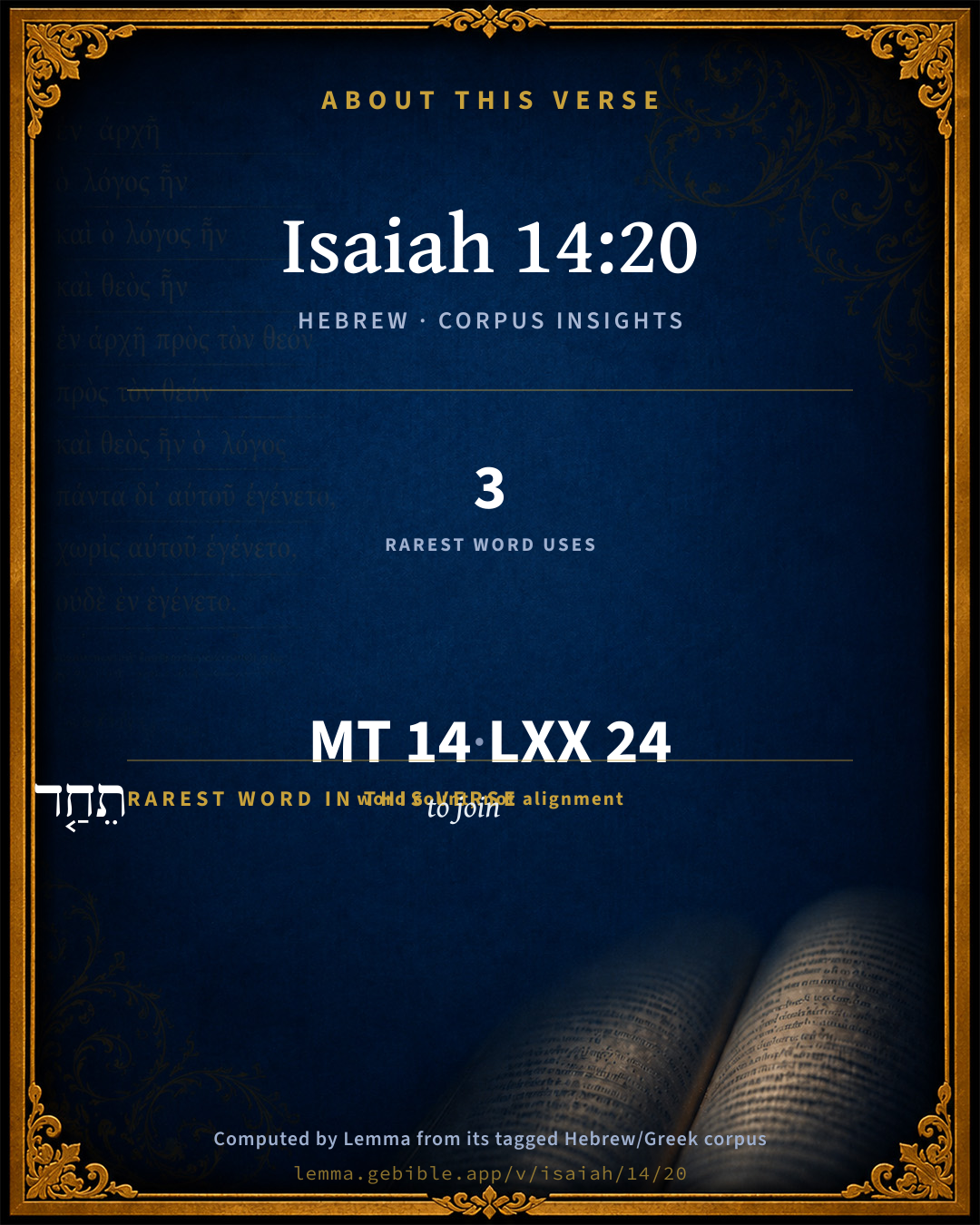
The rarest word here is תֵחַ֤ד to join H3161 — appearing just 3 times in the whole Hebrew Bible.

Shared distinctive vocabulary

תֵחַ֤ד to join H3161 occurs in 3 verses of the Hebrew Bible. Also found in:

Grammatical profile

  • 5 verbs
  • 5 nouns
  • 1 preposition
  • 1 conjunction
  • 2 particles

Verb forms

  • תֵחַ֤ד Qal · Imperfect
  • שִׁחַ֖תָּ Piel · Perfect
  • הָרָ֑גְתָּ Qal · Perfect
  • יִקָּרֵ֥א Niphal · Imperfect
  • מְרֵעִֽים Hiphil · Participle Active

Repetition

A word recurs within this verse — often emphatic in Hebrew:

Hebrew & Septuagint length

In English translation the verse runs 29 words from the Hebrew and 37 from the Septuagint (LXX English) — closely comparable.

A rough comparison of the two English renderings, which tokenize alike — not a word-level alignment.

Word counts can differ between the Hebrew and the Greek without any difference in meaning — e.g. the Hebrew direct-object marker אֵת has no separate Greek word, and Greek often adds the article ὁ.

In the original languages it is 14 Hebrew tokens and 24 Greek tokens — but the two are counted differently (Hebrew bundles its prefixes and suffixes into one token; the Greek is in lemma form), so that isn’t a like-for-like length.

Cross-references

8

Topical passages linked to Isaiah 14:20 in the Treasury of Scripture Knowledge — connected by theme and wording, ordered by reader-vote popularity; previews shown in the World English Bible.

  • Job 18:19 He shall have neither son nor grandson among his people, Nor any remaining where he sojourned.
  • Psalms 21:10 You will destroy their descendants from the earth, Their posterity from among the children of men.
  • Psalms 37:28 For Yahweh loves justice, And doesn't forsake his saints. They are preserved forever, But the children of the wicked shall be cut off.
  • Psalms 109:13 Let his posterity be cut off. In the generation following let their name be blotted out.
  • Job 18:16 His roots shall be dried up beneath, Above shall his branch be cut off.
  • Psalms 137:8–9 Daughter of Babylon, doomed to destruction, He will be happy who rewards you, As you have served us.
  • Isaiah 1:4 Ah sinful nation, A people loaded with iniquity, A seed of evil-doers, Children who deal corruptly! They have forsaken Yahweh. They have despised the Holy One of Israel. They are estranged and backward.
  • Isaiah 13:15–19 Everyone who is found shall be thrust through; and everyone who is taken shall fall by the sword.

Cross-references courtesy of OpenBible.info (CC BY 4.0).

Hebrew and Greek witnesses Masoretic Hebrew ↔ Greek Septuagint

The same verse in the two great witnesses to the Old Testament, shown verse-for-verse.

These are two independent witnesses, not word-aligned to each other, and the Septuagint is shown in lemma (dictionary) form.

Hebrew Isaiah 14:20 Masoretic · Westminster Leningrad Codex

לֹֽא תֵחַ֤ד אִתָּם֙ בִּקְבוּרָ֔ה כִּֽי אַרְצְךָ֥ שִׁחַ֖תָּ עַמְּךָ֣ הָרָ֑גְתָּ לֹֽא יִקָּרֵ֥א לְעוֹלָ֖ם זֶ֥רַע מְרֵעִֽים

You shall not be joined with them in burial, because you have destroyed your land, you have killed your people; the seed of evil-doers shall not be named forever.

World English Bible · Public Domain

Greek LXX Isaiah 14:20 Septuagint · lemma form

οὕτως οὐδέ σύ εἰμί καθαρός διότι ὁ γῆ ἐγώ ἀποὀλλύω καί ὁ λαός ἐγώ ἀποκτείνω οὐ μή μένω εἰς ὁ αἰών χρόνος σπέρμα πονηρός

As a garment defiled with blood shall not be pure, so neither shall you be pure; because you have destroyed my land, and have slain my people: you shall not endure for ever, —you an evil seed.

LXX2012 (modern English Septuagint) · Public Domain

On this verse, Trapp's Complete Commentary discusses the Septuagint’s reading. Read the note in Commentary ↓

Hebrew: Westminster Leningrad Codex (CC BY 4.0). Greek: Septuagint (public domain); English from LXX2012 (modern English Septuagint) (Public Domain). How the Septuagint differs from the Hebrew →

Targum (Aramaic paraphrase)

1

The Targum is the ancient Jewish Aramaic paraphrase of the Hebrew Scriptures — an interpretive translation, not the Hebrew text itself. Onkelos (literal) and Pseudo-Jonathan (expansive) render the Torah, and Jonathan the Prophets. Coverage is partial: where no permissively-licensed English translation exists for a verse, only the Aramaic is shown. This is verse-level text, not a word-by-word alignment to the Hebrew.

  1. Targum Jonathan Prophets (Joshua–Malachi)
    לָא תְהֵי כְּחַד מִנְהוֹן בִּקְבוּרָה אֲרֵי אַרְעָךְ חַבֵּילְתָּא וְעַמָךְ קָטֵילְתָּא לָא יִתְקַיֵים לַעֲלָם זֶרַע מַבְאָשִׁין:

    Thou shalt not be like one of them in burial; because thou hast destroyed thy country, thou hast slain thy people: the seed of evildoers shall not be established for ever.

    Targum Jonathan — Aramaic: “Mikraot Gedolot” (public domain). English: “Sefaria Community Translation” (CC0 1.0 (public-domain dedication)); “London "Chaldee Paraphrase," 1871” (public domain). Text via Sefaria.

Commentary

Notes on Isaiah 14:20 from classic Christian and Jewish commentators (each source and its license shown beneath its notes). The classic Christian expositions comment on the surrounding passage and are grouped to its opening verse, so a note may address several verses; the Jewish commentaries on the Tanakh (Rashi and others) are per-verse, so they appear only where the commentator wrote on this verse.

Lemma curates 59 commentaries, every one of them public domain or Creative Commons licensed, each selected and text-cleaned for this edition rather than reprinted as found. About our sources →

Trapp's Complete Commentary

John Trapp

Isa 14:20 Thou shalt not be joined with them in burial, because thou hast destroyed thy land, [and] slain thy people: the seed of evildoers shall never be renowned.

Ver. 20. Thou shalt not be joined to them in burial,] i.e., To your equals, your fellow kings, in funeral state and pomp. Christians have an honest care, περι συνταφων, with whom they be buried, and where they are laid when dead, that as they lived together and loved together, so in their death they may not be divided. {2Sa 1:23}

Because thou hast destroyed thy {a} land.] Tyrannised over thine own subjects also. So did Saul, Manasseh, Herod - who butchered about Bethlehem fourteen thousand infants, as some affirm, and his own son among the rest - Tiberius, that tiger, Nero, that lion, Commodus, who was, saith Oresius, cunctis incommodus, Charles IX of France, &c.

The seed of evildoers shall never be renowned.] The house of the wicked shall be overthrown, but the tabernacle of the upright shall flourish: {Pro 14:11} {See Trapp on "Pro 14:11"} Et notanto hoc parentes, et a sceleribus se abstinento: ni sibi velint parcere, ut posteritat; parcant.

{a} The Septuagint read it, my land, and my people.

John Trapp, A Commentary or Exposition upon All the Books of the Old and New Testament (1647–1656) — public domain. Text from a community e-Sword module.

The Preacher's Complete Homiletical Commentary

Joseph S. Exell (gen. ed.)

THE SEED OF EVILDOERS

Isa_14:20. The seed of evildoers shall never be renowned.

I. This is the verdict of the Scriptures. They abound in evidence that confirms it. Whatever may be the resources of wicked men, true glory does not lie in their path, and nought they can do will avail to secure honourable memory for their wickedness. On the contrary, their name and deeds will be attended with disaster and covered with shame. And this in spite—

1. Of the wealth which may be connected with evil-doing (Job_21:7-21; Psa_52:5-7, &c.); or,

2. The power it may have (Psa_73:3-8; Psa_73:18-20), even if it be a confederated power (Pro_11:21); or,

3. The ingenuity with which it may conduct its work (Psa_36:2-4; Mic_2:1-3). These are but a few of the declarations of the Bible on this subject.

II. This is also the verdict of human experience. As a matter of fact, we see that a wicked course of life is regarded as a shame. It is held up as a beacon to be avoided, whilst the career of the good is held up as a model to be followed. History is full of examples of men whose names are held in universal detestation, notwithstanding their connection with ingenuity, wealth, and power. Each of us knows how well the fact is proved by myriads of examples in social life. A persistently wicked course is known to be a blighted one, and any attempt to invest it with glory or renown is felt to be wrong. We recoil even from the thought that it should be possible for such a course to command the homage of men.

III. This truth gives us great hope for the future of our world. If it were possible for wrongdoing to gain for itself imperishable renown, we might tremble for the safety of those principles of righteousness and truth which have always been regarded as the main support and stay of good men. Reckless folly and wild presumption would become exalted and enthroned, and we might well shudder at the possibility that, under the attractions of successful wickedness, men would rush in masses and bow down to Evil, declaring it to be their Good. This abandoned idolatry, this deep depravity, is now reached only in isolated cases, and such are regarded even by godless men as deplorable and hopeless. It is a hopeful fact that evildoers have to carry on much of their work in the dark, for it is a sure token that, as the light widens and deepens, the works of darkness must fall; their covering will be removed, and their shelter will be gone.

IV. This truth is also one of encouragement to every individual Christian in his efforts after a Christ-like life. Evil-doing does not fail for want of effort; its attempts are bold, its struggles are determined. Yet it is doomed always to wear the name of dishonour and shame; a wicked man will never get glory for his wickedness. But Christian life is in itself true and real honour; its glory is as a shining light, shining more and more unto the perfect day. The Christian is a son of God, and no higher dignity than this is conceivable (H. E. I., 1073–1076); he is traversing a path which will for ever lead him on to scenes of new splendour and blessedness. Seeing that this is our high calling and destiny, let us neither fear nor envy the seed of evildoers, however strong or secure they may be, but with greater persistency than ever let us “hold fast the confidence and the rejoicing of the hope firm unto the end.”—William Manning.

This is—

1. Matter of observation;

2. The natural effects of bad training and example (H. E. I., 777–779);

3. The judicial appointment of God (H. E. I., 824).—J. Lyth, D.D.: Homiletical Treasury, part i. p. 21.

The Preacher's Complete Homiletical Commentary (gen. ed. Joseph S. Exell; Funk & Wagnalls, c. 1892) — public domain (pre-1929). A full-Bible homiletical/sermon-outline anthology covering 65 of 66 books (2 John is absent from the source module). Text from a community e-Sword module.

Jamieson, Fausset & Brown

Robert Jamieson, A. R. Fausset & David Brown

not . . . joined with them--whereas the princes slain with thee shall be buried, thou shalt not.

thou . . . destroyed . . . land--Belshazzar (or Naboned) oppressed his land with wars and tyranny, so that he was much hated [XENOPHON, Cyropædia 4.6, 3; 7.5, 32].

seed . . . never be renowned--rather, "shall not be named for ever"; the Babylonian dynasty shall end with Belshazzar; his family shall not be perpetuated [HORSLEY].

Jamieson, Fausset & Brown — Commentary Critical and Explanatory on the Whole Bible (1871) — public domain (CC PDM 1.0). Text via the HelloAO Bible API.

Adam Clarke's Commentary

Verse 20. Because thou hast destroyed thy land, c. - "Because thou hast destroyed thy country thou hast slain thy people"] Xenophon gives an instance of this king's wanton cruelty in killing the son of Gobrias, on no other provocation than that, in hunting, he struck a boar and a lion which the king had missed. Cyrop. iv. 309.

Adam Clarke's Commentary on the Bible (1810–1826) — public domain. Text from a community e-Sword/MySword module.

Ellicott's Commentary for English Readers

(20) Thou shalt not be joined with them in burial . . .—The curse of the dishonoured death is connected with its cause. The conqueror had inflicted that shame even on his own people, and was punished in like kind himself. Comp. Jeremiah’s prediction as to Jehoiakim (Jer_22:19), and parallel instances in 2Ch_21:20; 2Ch_24:25; Eze_29:5.

The seed of evildoers shall never be renowned.—Literally, shall not be named for ever. Here we have a parallel in the sentence on Coniah (Jer_22:30). In the inscription of Eshmunazzar, king of Sidon (quoted by Cheyne), we have both elements of the imprecation: “Let him (the man who violates the sacredness of the king’s tomb) not have a couch with the shade, and let him not be buried in the grave, and let him not have son or seed in his stead.” In the inscriptions of Tiglath-pileser (Records of the Past, v. 26) and Merôdach-baladan III. (ib., ix. 36) we find like curses. Historically, as the Behistun inscription shows, the dynasty of Nabopolassar disappeared from history. and Darius boasts of having subdued an impostor, a second Nebuchadnezzar, who claimed to represent it (Records of the Past, i. 114).

A Bible Commentary for English Readers, edited by Charles John Ellicott (1878–1897) — public domain. Text from a community e-Sword module.

The Cambridge Bible for Schools and Colleges

gen. ed. J. J. S. Perowne

20. Thou shalt not be joined with them] i.e. either with the kings of the nations (Isa_14:18) or (if the transposition mentioned be adopted) with those who lie in stone sepulchres.

thou hast destroyed thy land …] The king has acted as a tyrant not only to Israel but to his own people.

shall never be renowned] Rather, named (R.V.). Their very names shall be forgotten.

20, 21. The fifth strophe. The guilt of the king of Babylon, which descends like a curse on his children and leads to their extermination. The impression of textual confusion is confirmed by the fact that this last strophe falls short by about two lines of its proper length.

The Cambridge Bible for Schools and Colleges (gen. ed. J. J. S. Perowne; Cambridge University Press, 1878–1918) — public domain. Text from a community e-Sword module.

John Gill's Exposition

Thou shall not be joined with them in burial,.... The kings before mentioned; not that the sense is that he should not be interred in the same place they were, or lie in the same stately monuments they did, for that was never designed by him or others; but that he should not be buried in like manner, be embalmed as they, or have odours burned for him, or lie in such state and pomp, or have a "pyramid" or "mausoleum", or any rich monument, erected over him; unless this can be understood of his ancestors, the kings that were before him; and the sense be, that he should not have a burial with the kings of Babylon, or be inferred where they were, but, as before said, should be cast out, or be kept from the place of sepulture. The Targum is,

"thou shall not be as one of them in the grave;''

shall not be like them, or equal to them, in the glory and pomp of a funeral, not having the same funeral rites; obsequies, and ornaments they have had. So the whore of Rome shall have no funeral, but the kings of the earth will eat her flesh, and burn her with fire Rev 17:16,

because thou hast destroyed thy land; not only other lands and nations, but also his own, and the inhabitants of it, by his tyrannical government, by levies and exactions, by mulcts and fines, on various pretences: or, "hast corrupted, thy land" (g); which phrase is used of mystical Babylon, Rev 19:2 see also Rev 11:18 whose land or earth is the whole Romish jurisdiction, corrupted by her idolatries, and wasted and destroyed by the various methods used to drain away the substance thereof:

and slain thy people; put them to death at pleasure, without any just cause, for trifling matters; which is often done by arbitrary princes. Jarchi and Kimchi apply this to Nebuchadnezzar's slaying the wise men of Babylon, because they could not tell him his dream, and the interpretation of it. It is true of antichrist slaying such, that would not worship his image, and receive his mark, Rev 13:10.

The seed of evildoers shall never be renowned; or, "not for ever"; though they may have a name, and be very famous for a while, yet not always; in process of time their honour is laid in the dust; or, "shall not be called for ever" (h); their name and their memory shall not always last; their name shall be cut off, and their memory shall rot; they shall have none to keep up their name, and they shall not be spoken of with respect; such a seed of evildoers were Belshazzar and his family, who descended from Nebuchadnezzar and Evilmerodach, and were at once extinct, as follows:

(g) "terram tuam corrupisti", Montanus, Cocceius, Junius, Tremellius, Piscator. (h) "non nominabitur in seculum", Forerius; "vocabitur", Pagninus, Montanus, Munster.

John Gill's Exposition of the Whole Bible (1746–1763) — public domain (CC PDM 1.0). Text via the HelloAO Bible API.

Albert Barnes' Notes on the Bible

Thou shalt not be joined with them in burial - That is, even with those who are slain with the sword in battle, and to whom is granted the privilege of a decent burial.

Hast destroyed thy land - Hast been a cruel, harsh, and oppressive prince.

The seed of evil-doers - The posterity of the wicked.

Shall never be renowned - Hebrew, ‘Shall never be called,’ or ‘named’ (לא־יקרא lo'-yı̂qārē'); that is, shall never be distinguished, celebrated, or honored. This is a general proposition; but the prophet here possibly designs to apply it to the king of which he is speaking, as having been descended from ancestors that were wicked; or more probably it is a new circumstance, more fully explained in the following verse, that his posterity should be cut off from the honor of succeeding him on the throne, and that they, as well as he, should be loaded with disgrace. The design is to affirm the fact that the Babylonian dynasty would end with him; and that his posterity would be reduced from the honors which they had hoped to have inherited. At the same time, the general proposition is applicable not only to the posterity of the king of Babylon, but to all. It is a great truth pertaining to the divine administration, that the descendants of wicked people shall be dishonored. So it is with the posterity of a traitor, a pirate, a drunkard, a man of profligacy. They are involved in disgrace, poverty, and calamity, as the result of the sin of their ancestor.

Albert Barnes' Notes on the Bible (1834–1885) — public domain. Text from a community e-Sword/MySword module.

Haydock's Catholic Bible Commentary

Thy. Septuagint, "my." Thou hast been a murderer instead of a shepherd. --- Ever. The children and monarchy of Nabuchodonosor presently perished. Evilmerodac and Baltassar reigned but a short time, and left no issue to inherit the throne.

George Leo Haydock (1774–1849), Haydock's Catholic Family Bible and Commentary, 1859 edition — public domain. Excludes Psalms (Douay-Rheims chapter numbering differs from Protestant) and Deuterocanonical books (Catholic canon only).

Matthew Poole's English Annotations

Thou shalt not be joined with them; not in place, for so the kings of several nations did not use to be joined in the same sepulchre; but in condition, not be buried as they are.

Thou hast destroyed thy land, and slain thy people; thou hast exercised great tyranny and cruelty, not only to thine enemies, but even to thine own subjects; which it is more than probable Belshazzar did, and it is certain that his parents and predecessors had done, whose sins contributed, together with his, to bring down God’s judgments upon that empire.

The seed of evil-doers, such as Belshazzar was, being descended from that Nebuchadnezzar who had made such horrid slaughters and devastations in the world, merely to gratify his own unsatiable lusts, and who had been so impious towards God and his temple, and so bloody towards his church and people.

Shall never be renowned; or, shall not be renowned for ever. Although I have long borne with thee and thy family, and suffered them to get a great name in the world, yet I will now put a period to the renown of thy family and empire.

Matthew Poole's English Annotations on the Holy Bible (1683–1685) — public domain. Text from a community e-Sword/MySword module.

Whedon's Commentary on the Bible

Daniel D. Whedon

20. Shalt not be joined with them — Not even with the slain herd of men who have a decent burial. Hast destroyed thy land, etc. — To the Oriental such a judgment was the harshest conceivable; but in this case it is pronounced deserved.

Daniel D. Whedon (gen. ed.), Commentary on the Old and New Testaments (1874–1909) — public domain. Text from a community e-Sword module.

The Pulpit Commentary

If we make the alteration suggested in the preceding note, this verse will begin as follows: "They that have gone down to the stoner of the pit, with these thou shalt not be joined in burial a repetition certainly of the first clause of ver. 19, but with amplification, and with the reason appended. Thou hast destroyed thy land; i.e. "brought ruin on it by displeasing God, and causing him to visit it with a judgment." The seed of evil-doers shall never be renowned; rather, shall not be named forever. (Psa_109:13) The meaning is that they shall have no seed, or, if they have any, that it shall be early cut off, and the whole race blotted out. Pretenders rose up under Darius Hystaspis, claiming descent from Belshazzar"s father, Nabenidus; but the claim is characterized as false, and a false claim would scarcely have been set up had real descendants survived.

The children of the ungodly; or, parental responsibility.

"The seed of evil-doers shall never be renowned." We must not insist on a literal fulfillment of these words. It is not intended that there has never been an instance in which the children of wicked parents have attained to celebrity. Here, as elsewhere, the spirit, not the letter, "giveth life." The ill fortune which attends the sons of the guilty may be regarded as

I A DISTINCT, DIVINELY ORDERED PENALTY. Under the old dispensation it certainly was this. That was a dispensation in which temporal rewards and punishments were almost everything; then the spiritual and the eternal were only faintly felt as motives to action. And one of the most potent considerations which could be brought to bear was the effect of a mans behavior on the fortunes of his children; consequently we continually meet with the prospects of "thy seed," for good or for evil, as a powerful incentive to righteousness, or dissuasion from sin. There can hardly be a stronger force than this; where everything else would fail, this might succeed. There is nothing that reaches us so surely, that moves us so mightily, as an argument in which our children"s fortunes are concerned. Whatever "touches them touches the apple of our eye." And here God is saying to those who were showing signs of wandering from his service, "If you fall into great sin and grievous condemnation, you not only do yourselves irreparable wrong, but you involve your children also in misery and shame. The penalty of your guilt will go down to them.

II THE INEVITABLE RESULT OF RIGHTEOUS LAW. It is likely, in a very high degree, that the children of evil-doers will follow in the steps of their parents, and stoop to the shame to which they fall. All things are against them.

1. They are without the incentive which comes from inheriting a good name and the natural desire to perpetuate it.

2. They are weighted with the positive and most serious disadvantage of bearing a name which is dishonored.

3. They are depressed by a positive and disheartening sense of shame, if they have not imbibed the spirit and acquired the habits of their parents. In the latter case (which is by far the worse of the two):

4. They suffer in their character, and therefore in their career, from the degenerating influences to which they are subjected. And without the preserving and directing principles which make life a true success, impelled by the passions, the prejudices, the ambitions which constitute it a lamentable failure, they do not rise to "renown;" they sink down into disregard, into actual disrepute, into open shame.

(1) This is not positively inevitable. A determination to pursue a holy course, under the guidance of God, in the service of Jesus Christ, will redeem the unlikeliest life from failure, and lift it up to honor and usefulness.

(2) If not for other reasons, then for the sake of our children, let us walk in the ways of godliness; for their present and lasting interests are bound up in the choice we make as to the path we will ourselves pursue. C.

The Pulpit Commentary (1880–1919), ed. H.D.M. Spence-Jones & Joseph S. Exell — public domain. Text from a community e-Sword module.

John Wesley's Explanatory Notes

Joined - Not buried as they are. Slain - Thou hast exercised great tyranny and cruelty, not only to thine enemies, but even to thine own subjects. The seed - Such as Belshazzar was, being descended from that Nebuchadnezzar who had made such horrid slaughters and devastations in the world, merely to gratify his own insatiable lusts, and who had been so impious towards God and his temple, and so bloody towards his church and people. Renowned - Or, shall not be renowned forever: although I have long born with thee and thy family.

John Wesley, Explanatory Notes Upon the Whole Bible (1754–1765) — public domain. Text via the GEBible commentary corpus.

Keil & Delitzsch

C. F. Keil & F. Delitzsch

"Thou art not united with them in burial, for thou hast destroyed thy land, murdered thy people: the seed of evil-doers will not be named for ever." In this way is vengeance taken for the tyrannical manner in which he has oppressed and exhausted his land, making his people the involuntary instruments of his thirst for conquest, and sacrificing them as victims to that thirst. For this reason he does not meet with the same compassion as those who have been compelled to sacrifice their lives in his service. And it is not only all over for ever with him, but it is so with his dynasty also. The prophet, the messenger of the penal justice of God, and the mouthpiece of that Omnipotence which regulates the course of history, commands this.

Keil & Delitzsch — Biblical Commentary on the Old Testament (1861–1891) — public domain (CC PDM 1.0). Text via the HelloAO Bible API. (Old Testament only.)

J. A. Alexander on Isaiah

Joseph Addison Alexander

“Thou shalt not be joined with them (the other kings of the nations) in burial, because thy land thou hast destroyed, thy people thou hast slain. Let the seed of evil-doers be named no more forever.” The only natural interpretation of these words is that which applies them to the Babylonian tyranny as generally exercised. The charge here brought against the king implies that his power was given him for a very different purpose. The older writers read the last clause as a simple prediction. Thus the English version is, ‘the seed of evil-doers shall never be renowned’. But the later writers seem to make it more emphatic by giving the future the force of an imperative or optative (mood). Some of the older writers understand the clause to mean that the names of the wicked shall not be perpetuated by transmission in the line of their descendants. Others explain the verb as meaning to be called, (i.e., proclaimed or celebrated). It is now pretty generally understood to mean, or to express a wish, that the posterity of such should not be spoken of at all, implying both extinction and oblivion.

Joseph Addison Alexander, The Prophecies of Isaiah (1846–1847; New York: Scribner, 1870–1878) — public domain. Text from a community e-Sword module.

Rashi

Rabbi Shlomo Yitzchaki (Rashi)

You shall not join them in burial You shall not be equal to other kings, to rest in your grave.

for you have destroyed your land with excessive labor, and you have slain your people groundlessly, as it is related in Daniel (2:12): “And he said to destroy all the wise men of Babylon.” Therefore, they hated you and treated you with contempt to throw you out of your grave.

the seed of evil doers shall not be named forever Even your children shall suffer for your iniquities, and they shall not endure long after you, for their enemies will unite against them and destroy them, and they shall say to each other.

Rashi on the Tanakh — English translations: “The Judaica Press complete Tanach with Rashi, translated by A. J. Rosenberg” (CC BY 4.0); “Pentateuch with Rashi's commentary by M. Rosenbaum and A.M. Silbermann, 1929-1934” (public domain); “The Metsudah Tanach series, Lakewood, N.J” (CC BY 4.0); and “The Book of Joshua, Metsudah Publications, 1997” (CC BY 4.0). Text via Sefaria.

Ibn Ezra

Rabbi Abraham ibn Ezra

תחר Thou shall be joined. The radical א is dropped; comp. אהב I love (Prov. 8:17); according to the grammarian R. Jehudah, י is omitted, and the word is derived from יחד to be together.

For thou hast destroyed thy land, even thy land, how much more other countries; this explains the words: And he pulled down his cities (ver. 17).

Ibn Ezra on the Tanakh — English translations: “Sefaria Community Translation” (CC0 1.0 (public-domain dedication)); “Yalkut, Sifsei Chachomim Chumash, Metsudah Publications, 2009” (CC BY 4.0); and “Commentary of Ibn Ezra on Isaiah - trans. by M. Friedlander, 1873” (public domain). Text via Sefaria.

Lesson kit

Teaching starters — assembled from the data on this page, not authored interpretation. Every prompt links to the verse data it draws on. Edit before teaching.

Isaiah, in the Prophets, opens this verse with 14 words (13 distinct Hebrew lemmas). Its most distinctive word is yâchad (“to join”). A historical commentator’s framing appears above. Read the whole chapter for the surrounding context.

Discussion questions

  1. The word yâchad carries the sense “to join.” How does it shape the verse?
  2. Genesis 49:6 shares the word «to join» with this verse. How do the two illuminate each other?
  3. “not” occurs 2× in this one verse. What is the effect of the repetition?
  4. The translations on this page render this verse differently — a whole-verse word diff, not a word-by-word alignment. What might account for the different wordings?
  5. The verb «תֵחַ֤ד» is Qal Imperfect. How does its form color the action?
  6. Reading how Trapp's Complete Commentary and The Preacher's Complete Homiletical Commentary read this verse, where do the two commentators agree and where do they part?

Things to notice

Reading settings

Reading text

Shown beneath each verse's original-language words.

Old Testament
Old Testament edition

Read the OT as the Masoretic Hebrew (MT) or the Greek Septuagint (LXX).

English shown for the Greek Septuagint (in the Hebrew ↔ Greek comparison).

Comparing translations? Open the Compare panel on any verse page to stack up to four side by side.