
Ezekiel 26:11

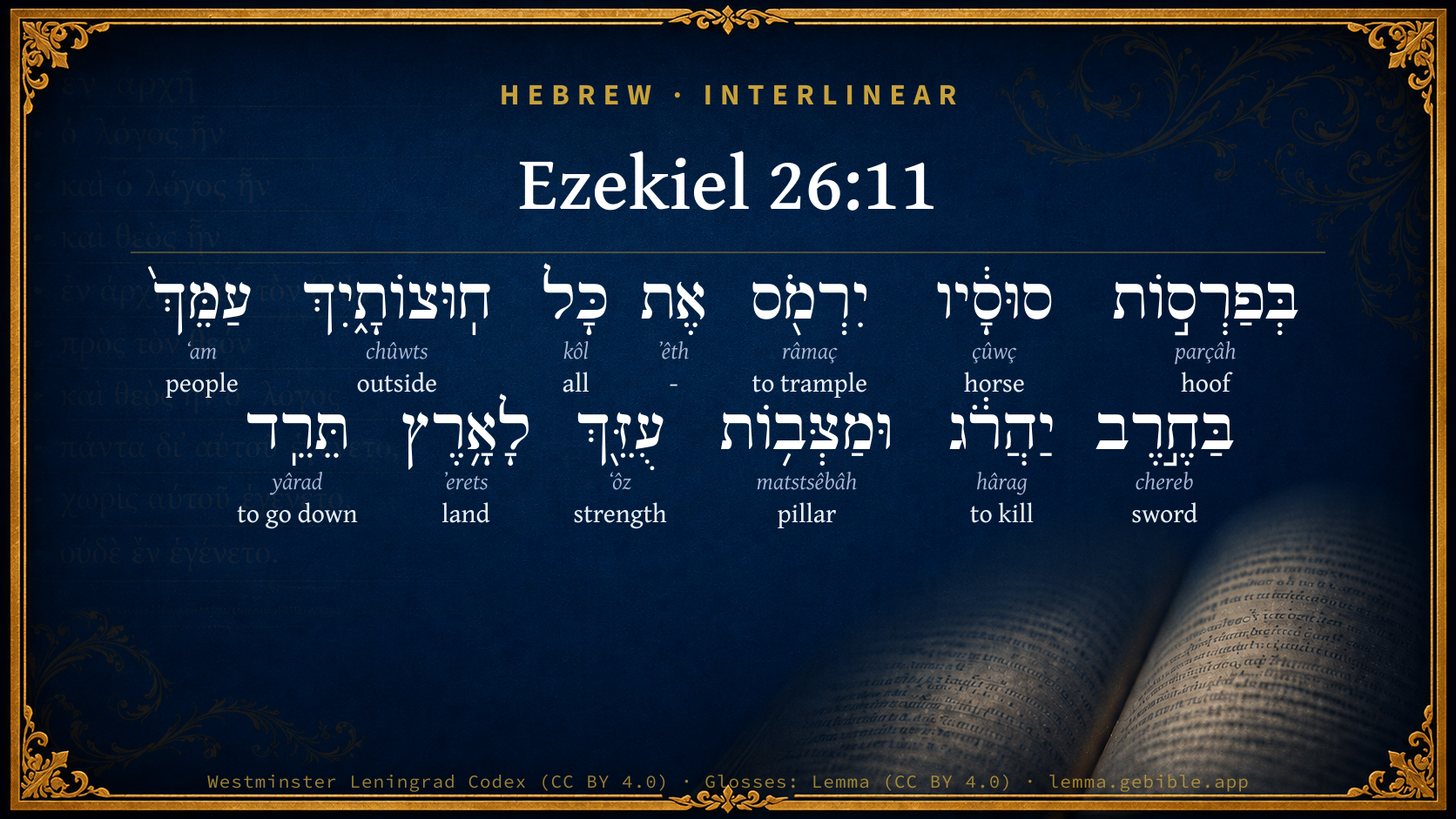
Hebrew (Westminster Leningrad Codex) Ezekiel 26:11 appears in the Hebrew Old Testament. The text above is from the Westminster Leningrad Codex. Each word links to its Strong’s number, a concise gloss, and parsing drawn from the Open Scriptures Hebrew Bible morphology. Click any word for its full Brown-Driver-Briggs (BDB) entry.
Download image
Cite this verse

Ezekiel 26:11 (World English Bible). Public Domain. Lemma interlinear Bible study tool, https://lemma.gebible.app/v/ezekiel/26/11.

Show BibTeX & RIS
BibTeX
RIS
English Translation
With the hoofs of his horses shall he tread down all your streets; he shall kill your people with the sword; and the pillars of your strength shall go down to the ground.
World English Bible · Public Domain
Download a study sheet

One document with this verse’s original text, its word-by-word gloss line, the meaning frame, cross-references with their text, attributed commentary, and full source and license credits — printable, and it pastes into notes with its structure intact.

This verse Autodidact and up

Study sheet (.html) Plain text (.txt)

A passage Seminary Student

Up to 50 verses in one chapter. A passage sheet keeps up to 6 commentary sources and 12 cross-references per verse, in the order this page ranks them, and says so on the sheet whenever that leaves anything out. Ask for a single verse and you get the Autodidact verse sheet above.

Everything on this page stays free to read, with no account — the sheet is a download of what is already on screen, not access to it.

Want to remove ads? Support Godless Engineer
Compare translations 3

The same verse in 3 English versions, stacked beneath the original-language interlinear above. Click any original word for its lexicon entry.

Each is an independent rendering of the whole verse — the interlinear is not word-aligned to these translations.

Highlighted words mark where these versions differ — a whole-verse word diff, not a word-by-word alignment.

  • World English Bible Public Domain
    With the hoofs of his horses shall he tread down all your streets; he shall kill your people with the sword; and the pillars of your strength shall go down to the ground.
  • King James Version Public Domain
    With the hoofs of his horses shall he tread down all thy streets: he shall slay thy people by the sword, and thy strong garrisons shall go down to the ground.
  • unfoldingWord Literal Text CC BY-SA 4.0
    The hooves of his horses will trample all of your streets. He will kill your people with the sword and your mighty stone pillars will fall to the ground.

unfoldingWord Literal Text — © unfoldingWord, licensed CC BY-SA 4.0. Word-aligned USFM3 via Door43 (git.door43.org/unfoldingWord/en_ult).

Versions to compare (up to 4)

3 of 4 selected

Show all 18 translations

Every available English version of this verse, each an independent rendering of the whole verse.

  • World English Bible Public Domain
    With the hoofs of his horses shall he tread down all your streets; he shall kill your people with the sword; and the pillars of your strength shall go down to the ground.
  • Berean Standard Bible Public Domain
    The hooves of his horses will trample all your streets. He will slaughter your people with the sword, and your mighty pillars will fall to the ground.
  • Majority Standard Bible Public Domain
    The hooves of his horses will trample all your streets. He will slaughter your people with the sword, and your mighty pillars will fall to the ground.
  • King James Version Public Domain
    With the hoofs of his horses shall he tread down all thy streets: he shall slay thy people by the sword, and thy strong garrisons shall go down to the ground.
  • American Standard Version (1901) Public Domain
    With the hoofs of his horses shall he tread down all thy streets; he shall slay thy people with the sword; and the pillars of thy strength shall go down to the ground.
  • Revised Version (1885) Public Domain
    With the hoofs of his horses shall he tread down all thy streets: he shall slay thy people with the sword, and the pillars of thy strength shall go down to the ground.
  • Geneva Bible (1599) Public Domain
    With the hooues of his horses shall he treade downe all thy streetes: he shall slay thy people by the sworde, and the pillars of thy strength shall fall downe to the ground.
  • Douay-Rheims (1899) Public Domain
    With the hoofs of his horses he shall tread down all thy streets: thy people he shall kill with the sword, and thy famous statues shall fall to the ground.
  • Young's Literal Translation Public Domain
    With hoofs of his horses he treadeth all thine out-places, Thy people by sword he doth slay, And the pillars of thy strength to the earth come down.
  • Literal Standard Version CC BY-SA 4.0
    He treads all your out-places with [the] hooves of his horses, || He slays your people by sword, || And the pillars of your strength come down to the earth.
  • Unlocked Literal Bible CC BY-SA 4.0
    The hooves of his horses will trample all of your streets. He will kill your people with the sword and your mighty stone pillars will fall to the ground.
  • unfoldingWord Literal Text CC BY-SA 4.0
    The hooves of his horses will trample all of your streets. He will kill your people with the sword and your mighty stone pillars will fall to the ground.
  • Darby Bible Public Domain
    With the hoofs of his horses shall he tread down all thy streets; he shall slay thy people by the sword, and the pillars of thy strength shall go down to the ground.
  • World Messianic Bible Public Domain
    He will tread down all your streets with the hoofs of his horses. He will kill your people with the sword. The pillars of your strength will go down to the ground.
  • Webster's Bible Public Domain
    With the hoofs of his horses shall he tread down all thy streets: he shall slay thy people by the sword, and thy strong garrisons shall go down to the ground.
  • Free Bible Version CC BY-SA 4.0
    His horses will race through your city streets. He will kill all your people with the sword. Your massive pillars will come tumbling to the ground.
  • Bible in Basic English Public Domain
    Your streets will be stamped down by the feet of his horses: he will put your people to the sword, and will send down the pillars of your strength to the earth.
  • JPS Tanakh (1917) Public Domain
    With the hoofs of his horses shall he tread down all thy streets; he shall slay thy people with the sword, and the pillars of thy strength shall go down to the ground.

Literal Standard Version (2020), Covenant Press — licensed CC BY-SA 4.0. Text via the HelloAO Bible API (eBible.org). Unlocked Literal Bible (unfoldingWord) — licensed CC BY-SA 4.0. Text via the HelloAO Bible API (eBible.org). unfoldingWord Literal Text — © unfoldingWord, licensed CC BY-SA 4.0. Word-aligned USFM3 via Door43 (git.door43.org/unfoldingWord/en_ult). Free Bible Version, Dr. Jonathan Gallagher — licensed CC BY-SA 4.0. Text via the HelloAO Bible API (eBible.org).

Word by word

More ways to search: Search by grammar → Find every occurrence → Compare this word →

Practice this passage: Drill this verse → Learn its vocabulary →

יִרְמֹ֖ס
râmaç
H7429
“to trample”
Verb, Qal, Imperfect, 3rd Person, Masculine, Singular
Part of Speech
Verb
Stem
Qal
Form
Imperfect
Person
3rd Person
Gender
Masculine
Number
Singular
Full BDB Definition

Origin: a primitive root

TWOT: 2176

to trample - (Qal) - to trample - trampler (participle) - (Niphal) to be trampled
  1. בְּפַרְס֣וֹת parçâh H6541 “in/at · hooves of” Preposition + Noun, Common, Feminine, Plural, Construct
  2. סוּסָ֔יו çûwç H5483 “horses · his” Noun, Common, Masculine, Plural, Construct + Suffix, Personal, 3rd Person, Masculine, Singular
  3. אֶת ʼêth H853 “-” Particle, Direct Object
  4. כָּל kôl H3605 “all of” Noun, Common, Masculine, Singular, Construct
  5. חֽוּצוֹתָ֑יִךְ chûwts H2351 “streets · your” Noun, Common, Masculine, Plural, Construct + Suffix, Personal, 2nd Person, Feminine, Singular
  6. עַמֵּךְ֙ ʻam H5971 “people · your” Noun, Common, Masculine, Singular, Construct + Suffix, Personal, 2nd Person, Feminine, Singular
  7. בַּחֶ֣רֶב chereb H2719 “in/at the · sword” Preposition, Determined + Noun, Common, Feminine, Singular, Absolute
  8. יַהֲרֹ֔ג hârag H2026 “to kill” Verb, Qal, Imperfect, 3rd Person, Masculine, Singular
  9. וּמַצְּב֥וֹת matstsêbâh H4676 “and · pillars of” Conjunction + Noun, Common, Feminine, Plural, Construct
  10. עֻזֵּ֖ךְ ʻôz H5797 “strength · your” Noun, Common, Masculine, Singular, Construct + Suffix, Personal, 2nd Person, Feminine, Singular
  11. לָאָ֥רֶץ ʼerets H776 “to/for the · land” Preposition, Determined + Noun, Common, Both, Singular, Absolute
  12. תֵּרֵֽד yârad H3381 “to go down” Verb, Qal, Imperfect, 3rd Person, Feminine, Singular

About this verse

These counts appear in no published source. They are computed here, from the morphology-tagged text and Lemma’s own curated glosses. What Lemma adds →

13
words
13
distinct lemmas
Prophets
section

Notable vocabulary

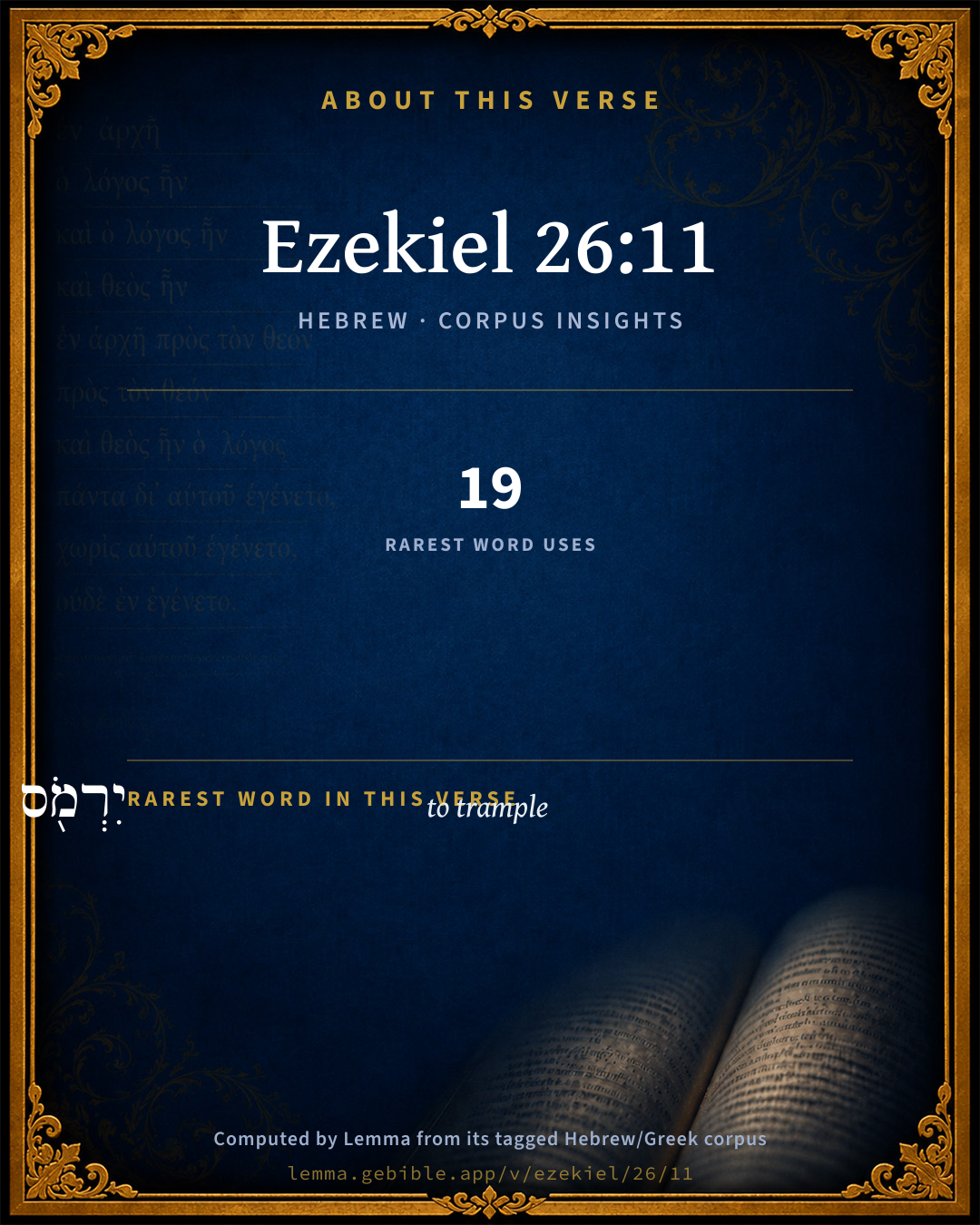
The rarest word here is יִרְמֹ֖ס to trample H7429 — appearing just 19 times in the whole Hebrew Bible.

Shared distinctive vocabulary

יִרְמֹ֖ס to trample H7429 occurs in 19 verses of the Hebrew Bible. Also found in:

Grammatical profile

  • 3 verbs
  • 9 nouns
  • 1 particle

Verb forms

  • יִרְמֹ֖ס Qal · Imperfect
  • יַהֲרֹ֔ג Qal · Imperfect
  • תֵּרֵֽד Qal · Imperfect

Hebrew & Septuagint length

In English translation the verse runs 33 words from the Hebrew and 32 from the Septuagint (LXX English) — closely comparable.

A rough comparison of the two English renderings, which tokenize alike — not a word-level alignment.

Word counts can differ between the Hebrew and the Greek without any difference in meaning — e.g. the Hebrew direct-object marker אֵת has no separate Greek word, and Greek often adds the article ὁ.

Cross-references

5

Topical passages linked to Ezekiel 26:11 in the Treasury of Scripture Knowledge — connected by theme and wording, ordered by reader-vote popularity; previews shown in the World English Bible.

  • Isaiah 5:28 Whose arrows are sharp, And all their bows bent. Their horses' hoofs will be like flint, And their wheels like a whirlwind.
  • Isaiah 26:5 For he has brought down those who dwell on high, the lofty city: he lays it low, he lays it low even to the ground; he brings it even to the dust.
  • Habakkuk 1:8 Their horses also are swifter than leopards, and are more fierce than the evening wolves. Their horsemen press proudly on. Yes, their horsemen come from afar. They fly as an eagle that hurries to devour.
  • Jeremiah 43:13 He shall also break the pillars of Beth-shemesh, that is in the land of Egypt; and the houses of the gods of Egypt shall he burn with fire.
  • Jeremiah 51:27 Set up a standard in the land, blow the trumpet among the nations, prepare the nations against her, call together against her the kingdoms of Ararat, Minni, and Ashkenaz: appoint a marshal against her; cause the horses to come up as the rough canker-worm.

Cross-references courtesy of OpenBible.info (CC BY 4.0).

Hebrew and Greek witnesses Masoretic Hebrew ↔ Greek Septuagint

The same verse in the two great witnesses to the Old Testament, shown verse-for-verse.

These are two independent witnesses, not word-aligned to each other, and the Septuagint is shown in lemma (dictionary) form.

Hebrew Ezekiel 26:11 Masoretic · Westminster Leningrad Codex

בְּפַרְס֣וֹת סוּסָ֔יו יִרְמֹ֖ס אֶת כָּל חֽוּצוֹתָ֑יִךְ עַמֵּךְ֙ בַּחֶ֣רֶב יַהֲרֹ֔ג וּמַצְּב֥וֹת עֻזֵּ֖ךְ לָאָ֥רֶץ תֵּרֵֽד

With the hoofs of his horses shall he tread down all your streets; he shall kill your people with the sword; and the pillars of your strength shall go down to the ground.

World English Bible · Public Domain

Greek LXX Ezekiel 26:11 Septuagint · lemma form

ἐν ὁ ὁπλή ὁ ἵππος αὐτός καταἀπατάω σύ πᾶς ὁ πλατύς ὁ λαός σύ μάχαιρα ἀνααἱρέω καί ὁ ὑπόστασις σύ ὁ ἰσχύς ἐπί ὁ γῆ καταἄγω

With the hoofs of his horses they shall trample all your streets: he shall kill your people with the sword, and shall bring down to the ground the support of your strength.

LXX2012 (modern English Septuagint) · Public Domain

Hebrew: Westminster Leningrad Codex (CC BY 4.0). Greek: Septuagint (public domain); English from LXX2012 (modern English Septuagint) (Public Domain). How the Septuagint differs from the Hebrew →

Targum (Aramaic paraphrase)

1

The Targum is the ancient Jewish Aramaic paraphrase of the Hebrew Scriptures — an interpretive translation, not the Hebrew text itself. Onkelos (literal) and Pseudo-Jonathan (expansive) render the Torah, and Jonathan the Prophets. Coverage is partial: where no permissively-licensed English translation exists for a verse, only the Aramaic is shown. This is verse-level text, not a word-by-word alignment to the Hebrew.

  1. Targum Jonathan Prophets (Joshua–Malachi)
    בְּפַרְסַת סוּסְוָתֵיהּ יְרוּשׁ יַת כָּל שׁוּקָךְ עַמִיךְ בְּחַרְבָּא יִקְטֵיל וְקָמַת תּוּקְפִיךְ לְאַרְעָא יְמַגֵר:

    (no public-domain English translation for this verse)

    Targum Jonathan — Aramaic: “Mikraot Gedolot” (public domain). English: “Sefaria Community Translation” (CC0 1.0 (public-domain dedication)); “London "Chaldee Paraphrase," 1871” (public domain). Text via Sefaria.

Commentary

Notes on Ezekiel 26:11 from classic Christian and Jewish commentators (each source and its license shown beneath its notes). The classic Christian expositions comment on the surrounding passage and are grouped to its opening verse, so a note may address several verses; the Jewish commentaries on the Tanakh (Rashi and others) are per-verse, so they appear only where the commentator wrote on this verse.

Lemma curates 59 commentaries, every one of them public domain or Creative Commons licensed, each selected and text-cleaned for this edition rather than reprinted as found. About our sources →

Trapp's Complete Commentary

John Trapp

Eze 26:11 With the hoofs of his horses shall he tread down all thy streets: he shall slay thy people by the sword, and thy strong garrisons shall go down to the ground.

Ver. 11. And thy strong garrisons.] Or, Statues, or idols. Their chief idols were Apollo, Hercules, and Astarte. {a} See on Eze 26:3.

{a} Curt., lib. iv.; Plut. Probl.

John Trapp, A Commentary or Exposition upon All the Books of the Old and New Testament (1647–1656) — public domain. Text from a community e-Sword module.

Geneva Bible (1599)

Geneva Bible translators

For Tyre was much built by art and by labor of men was won out of the Sea. Some refer this unto the images of the noble men which they had erected up for their glory and renown.

Geneva Bible (1599) marginal notes — public domain. Text via Bolls.life.

Jamieson, Fausset & Brown

Robert Jamieson, A. R. Fausset & David Brown

thy strong garrisons--literally, "the statutes of thy strength"; so the forts which are "monuments of thy strength." MAURER understands, in stricter agreement with the literal meaning, "the statues" or "obelisks erected in honor of the idols, the tutelary gods of Tyre," as Melecarte, answering to the Grecian Hercules, whose temple stood in Old Tyre (compare Jer 43:13, Margin).

Jamieson, Fausset & Brown — Commentary Critical and Explanatory on the Whole Bible (1871) — public domain (CC PDM 1.0). Text via the HelloAO Bible API.

Ellicott's Commentary for English Readers

(11) Thy strong garrisons.—This is the only instance in the Bible in which this common word is so translated, although a word closely akin to it is rendered garrison throughout the Books of Samuel. Both words mean a pillar set up as a monument or memorial. Translate, therefore, the pillars of thy strength. It is probable that the pillars intended are those mentioned by Herodotus (Bk. 2:44) as standing in the Temple of Hercules at Tyre, one of gold and the other of emerald.

A Bible Commentary for English Readers, edited by Charles John Ellicott (1878–1897) — public domain. Text from a community e-Sword module.

The Cambridge Bible for Schools and Colleges

gen. ed. J. J. S. Perowne

11. thy strong garrisons] thy strong (or, proud) pillars. The word is almost always used of a pillar having religious meaning, particularly the obelisk dedicated to Baal (2Ki_10:26). The rendering “pillars of thy strength,” those in which Tyre confided and thought her strength to lie (Ges.), is rather out of the way here; more naturally, her proud or majestic pillars, cf. Eze_24:21; Eze_24:25.

The Cambridge Bible for Schools and Colleges (gen. ed. J. J. S. Perowne; Cambridge University Press, 1878–1918) — public domain. Text from a community e-Sword module.

John Gill's Exposition

With the hoofs of his horses shall he tread down all thy streets,.... Such a number of horses running to and fro in the streets, and prancing upon the pavements, shall break them up, and destroy them, so that they shall be mere mire and dirt:

he shall slay thy people by the sword; such as would not lay down their arms and submit; or their principal ones, who encouraged the inhabitants to hold out the siege to such a length of time as they did; which might provoke Nebuchadnezzar to use them with more severity:

and thy strong garrisons shall go down to the ground: where their soldiers were placed for defence; their citadel and other towers: or, "the statues of thy strengths" (k); their strong statues made of marble, &c. erected as trophies of victories obtained by them; or to the honour of some worthy magistrates, and principal citizens; or of their confederates and allies; or rather of their deities, such as Hercules and Apollo, their tutelar gods; which, though chained as they were, that they might not depart, shall now fall to the ground, unable to protect themselves or their worshippers: all that is here said, concerning the destruction of Tyre by Nebuchadnezzar, seems to be understood of old Tyre, which was upon the continent; for this account agrees not with the isle.

(k) "statuae fortitudinis tuae", Pagninus, Montanus; "columnas tuas robustas", Cocceius; "columnas ruboris tui", Starckius.

John Gill's Exposition of the Whole Bible (1746–1763) — public domain (CC PDM 1.0). Text via the HelloAO Bible API.

Haydock's Catholic Bible Commentary

Statues. The citizens chained the golden statue of Apollo to the altar of Hercules, for fear of its leaving them, when Alexander [the Great] attacked the town. (Curtius iv.) --- Hiram placed a pillar of gold in the temple of Hercules. (Josephus, contra Apion i.) --- Herodotus (ii. 44.) saw another also of emerald stone, (Greek: smaragdon) which illuminated the temple in the night. On such the Tyrian might depend; though some render, "the substance or guard of thy strength," denoting the soldiers (Calmet) and towers. (Haydock) --- The gods were treated like the people, and their precious ornaments plundered.

George Leo Haydock (1774–1849), Haydock's Catholic Family Bible and Commentary, 1859 edition — public domain. Excludes Psalms (Douay-Rheims chapter numbering differs from Protestant) and Deuterocanonical books (Catholic canon only).

Matthew Poole's English Annotations

In proud, stately, and menacing posture shall the king of Babylon ride through all the streets of thy city, to the grief and sorrow of the Tyrians; and so shall his troops do too.

He shall slay thy people; in the wars some of thy people shall fall by his sword; but that is no wonder; I rather think that it is meant of giving judgment against some of the most valiant, constant, and active citizens, which were the cause of the city’s holding out so long against Nebuchadnezzar, as he did with some of the nobles of Jerusalem.

Strong garrisons; bastions, or forts about the city, or triumphal arches built by Tyrians, or statues erected in honour to some eminent citizens, or to the kings of Egypt, their ancient allies, enemies to the Chaldeans; or the statues of their gods Hercules and Apollo chained, that neither in nature and angry, nor yet charmed with other men’s songs, should depart, and leave their pupils without a guard.

Shall go down to the ground; shall be all cast down together.

Matthew Poole's English Annotations on the Holy Bible (1683–1685) — public domain. Text from a community e-Sword/MySword module.

The Pulpit Commentary

Thy strong garrisons; literally, the pillars of thy strength (Revised Version). So the Vulgate, nobiles statuae. So the word is used in Isa_19:19; Jer_43:13; 2Ki_3:2. The words probably refer to the two famous columns standing in the temple of the Tyrian Hercules, one of gold and one of emerald (possibly malachite or lapis-lazuli) as symbols of strength, or as pedestals surmounted by a statue of Baal (Herod., 2:44).

The Pulpit Commentary (1880–1919), ed. H.D.M. Spence-Jones & Joseph S. Exell — public domain. Text from a community e-Sword module.

John Wesley's Explanatory Notes

Garrisons - Bastions, or forts, or triumphal arches.

John Wesley, Explanatory Notes Upon the Whole Bible (1754–1765) — public domain. Text via the GEBible commentary corpus.

Lesson kit

Teaching starters — assembled from the data on this page, not authored interpretation. Every prompt links to the verse data it draws on. Edit before teaching.

Ezekiel, in the Prophets, opens this verse with 13 words (13 distinct Hebrew lemmas). Its most distinctive word is râmaç (“to trample”). A historical commentator’s framing appears above. Read the whole chapter for the surrounding context.

Discussion questions

  1. How does “to trample” (râmaç) shape what this verse is saying?
  2. How does 2 Kings 7:17, which shares the word «to trample», read alongside this verse?
  3. These translations render this verse differently; the difference is in the English rendering, not the original. What questions does that raise?
  4. «יִרְמֹ֖ס» is a Qal Imperfect verb. How does that grammatical form shape the action described?
  5. Compare how Trapp's Complete Commentary and Geneva Bible (1599) read this verse. Where do they agree or differ?

Things to notice

Reading settings

Reading text

Shown beneath each verse's original-language words.

Old Testament
Old Testament edition

Read the OT as the Masoretic Hebrew (MT) or the Greek Septuagint (LXX).

English shown for the Greek Septuagint (in the Hebrew ↔ Greek comparison).

Comparing translations? Open the Compare panel on any verse page to stack up to four side by side.