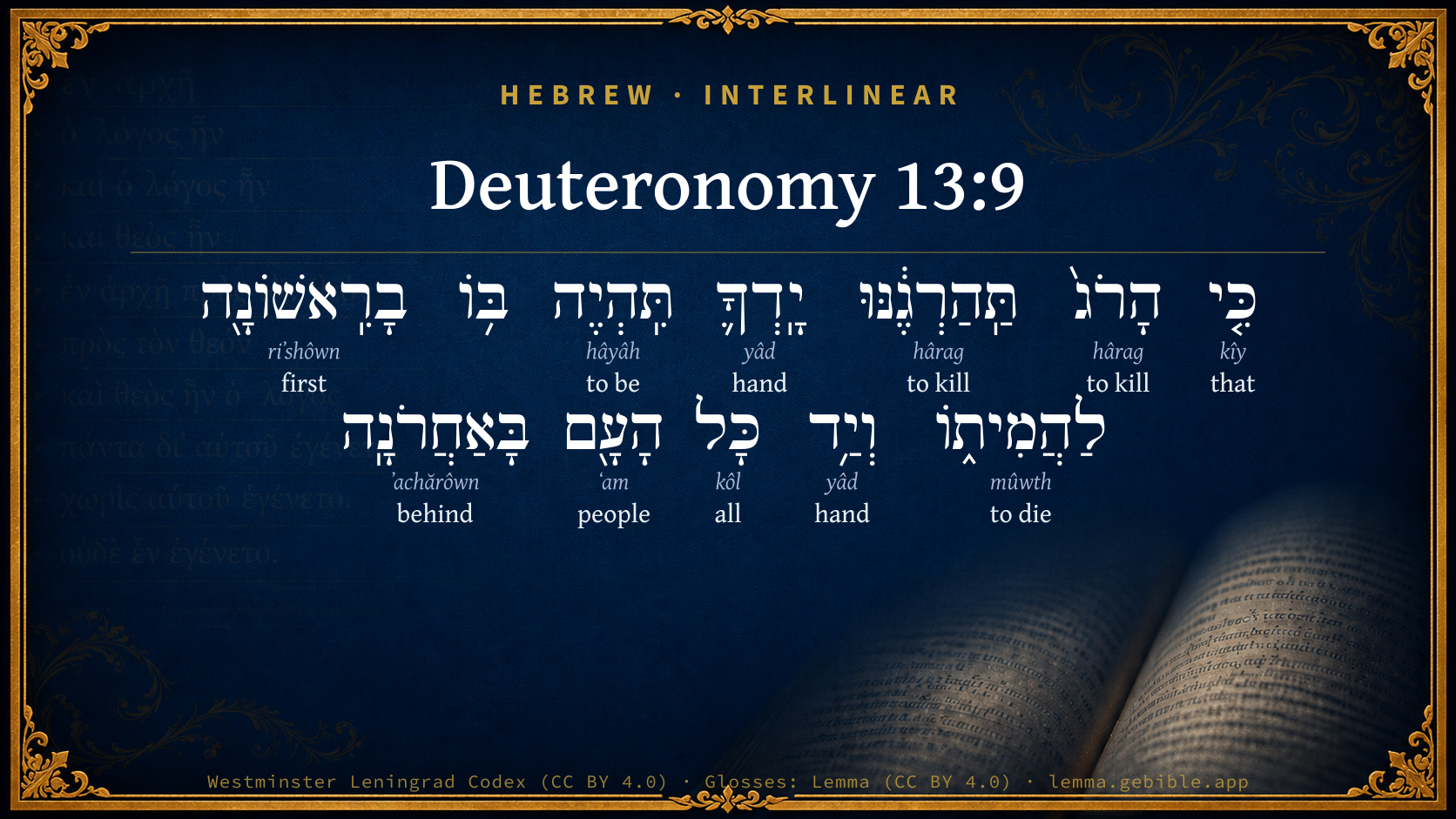
Deuteronomy 13:9

Hebrew (Westminster Leningrad Codex) Deuteronomy 13:9 appears in the Hebrew Old Testament. The text above is from the Westminster Leningrad Codex. Each word links to its Strong’s number, a concise gloss, and parsing drawn from the Open Scriptures Hebrew Bible morphology. Click any word for its full Brown-Driver-Briggs (BDB) entry.
Download image
Cite this verse

Deuteronomy 13:9 (World English Bible). Public Domain. Lemma interlinear Bible study tool, https://lemma.gebible.app/v/deuteronomy/13/9.

Show BibTeX & RIS
BibTeX
RIS
English Translation
but you shall surely kill him; your hand shall be first on him to put him to death, and afterwards the hand of all the people.
World English Bible · Public Domain
Download a study sheet

One document with this verse’s original text, its word-by-word gloss line, the meaning frame, cross-references with their text, attributed commentary, and full source and license credits — printable, and it pastes into notes with its structure intact.

This verse Autodidact and up

Study sheet (.html) Plain text (.txt)

A passage Seminary Student

Up to 50 verses in one chapter. A passage sheet keeps up to 6 commentary sources and 12 cross-references per verse, in the order this page ranks them, and says so on the sheet whenever that leaves anything out. Ask for a single verse and you get the Autodidact verse sheet above.

Everything on this page stays free to read, with no account — the sheet is a download of what is already on screen, not access to it.

Want to remove ads? Support Godless Engineer
Compare translations 3

The same verse in 3 English versions, stacked beneath the original-language interlinear above. Click any original word for its lexicon entry.

Each is an independent rendering of the whole verse — the interlinear is not word-aligned to these translations.

Highlighted words mark where these versions differ — a whole-verse word diff, not a word-by-word alignment.

  • World English Bible Public Domain
    but you shall surely kill him; your hand shall be first on him to put him to death, and afterwards the hand of all the people.
  • King James Version Public Domain
    But thou shalt surely kill him; thine hand shall be first upon him to put him to death, and afterwards the hand of all the people.
  • unfoldingWord Literal Text CC BY-SA 4.0
    Instead, killing, you shall kill him. Your hand shall be the first on him to put him to death, and afterwards, the hand of all the people.

unfoldingWord Literal Text — © unfoldingWord, licensed CC BY-SA 4.0. Word-aligned USFM3 via Door43 (git.door43.org/unfoldingWord/en_ult).

Versions to compare (up to 4)

3 of 4 selected

Show all 18 translations

Every available English version of this verse, each an independent rendering of the whole verse.

  • World English Bible Public Domain
    but you shall surely kill him; your hand shall be first on him to put him to death, and afterwards the hand of all the people.
  • Berean Standard Bible Public Domain
    Instead, you must surely kill him. Your hand must be the first against him to put him to death, and then the hands of all the people.
  • Majority Standard Bible Public Domain
    Instead, you must surely kill him. Your hand must be the first against him to put him to death, and then the hands of all the people.
  • King James Version Public Domain
    But thou shalt surely kill him; thine hand shall be first upon him to put him to death, and afterwards the hand of all the people.
  • American Standard Version (1901) Public Domain
    but thou shalt surely kill him; thy hand shall be first upon him to put him to death, and afterwards the hand of all the people.
  • Revised Version (1885) Public Domain
    but thou shalt surely kill him; thine hand shall be first upon him to put him to death, and afterwards the hand of all the people.
  • Geneva Bible (1599) Public Domain
    But thou shalt euen kill him: thine hand shall be first vpon him to put him to death, and then the handes of all the people.
  • Douay-Rheims (1899) Public Domain
    But thou shalt presently put him to death. It Let thy hand be first upon him, and afterwards the hands of all the people.
  • Young's Literal Translation Public Domain
    `But thou dost surely kill him; thy hand is on him, in the first place, to put him to death, and the hand of all the people last;
  • Literal Standard Version CC BY-SA 4.0
    But you surely kill him; your hand is on him in the first place to put him to death, and the hand of all the people last;
  • Unlocked Literal Bible CC BY-SA 4.0
    Instead, you will surely kill him; your hand will be the first on him to put him to death, and afterwards the hand of all the people.
  • unfoldingWord Literal Text CC BY-SA 4.0
    Instead, killing, you shall kill him. Your hand shall be the first on him to put him to death, and afterwards, the hand of all the people.
  • Darby Bible Public Domain
    but thou shalt in any case kill him: thy hand shall be the first against him to put him to death, and afterwards the hands of all the people;
  • World Messianic Bible Public Domain
    but you shall surely kill him. Your hand shall be first on him to put him to death, and afterwards the hands of all the people.
  • Webster's Bible Public Domain
    But thou shalt surely kill him; thy hand shall be first upon him to put him to death, and afterwards the hand of all the people.
  • Free Bible Version CC BY-SA 4.0
    No, you absolutely must kill them! You start killing them, and then have everyone else help.
  • Bible in Basic English Public Domain
    But put him to death without question; let your hand be the first stretched out against him to put him to death, and then the hands of all the people.
  • JPS Tanakh (1917) Public Domain
    (13-10) but thou shalt surely kill him; thy hand shall be first upon him to put him to death, and afterwards the hand of all the people.

Literal Standard Version (2020), Covenant Press — licensed CC BY-SA 4.0. Text via the HelloAO Bible API (eBible.org). Unlocked Literal Bible (unfoldingWord) — licensed CC BY-SA 4.0. Text via the HelloAO Bible API (eBible.org). unfoldingWord Literal Text — © unfoldingWord, licensed CC BY-SA 4.0. Word-aligned USFM3 via Door43 (git.door43.org/unfoldingWord/en_ult). Free Bible Version, Dr. Jonathan Gallagher — licensed CC BY-SA 4.0. Text via the HelloAO Bible API (eBible.org).

Word by word

More ways to search: Search by grammar → Find every occurrence → Compare this word →

Practice this passage: Drill this verse → Learn its vocabulary →

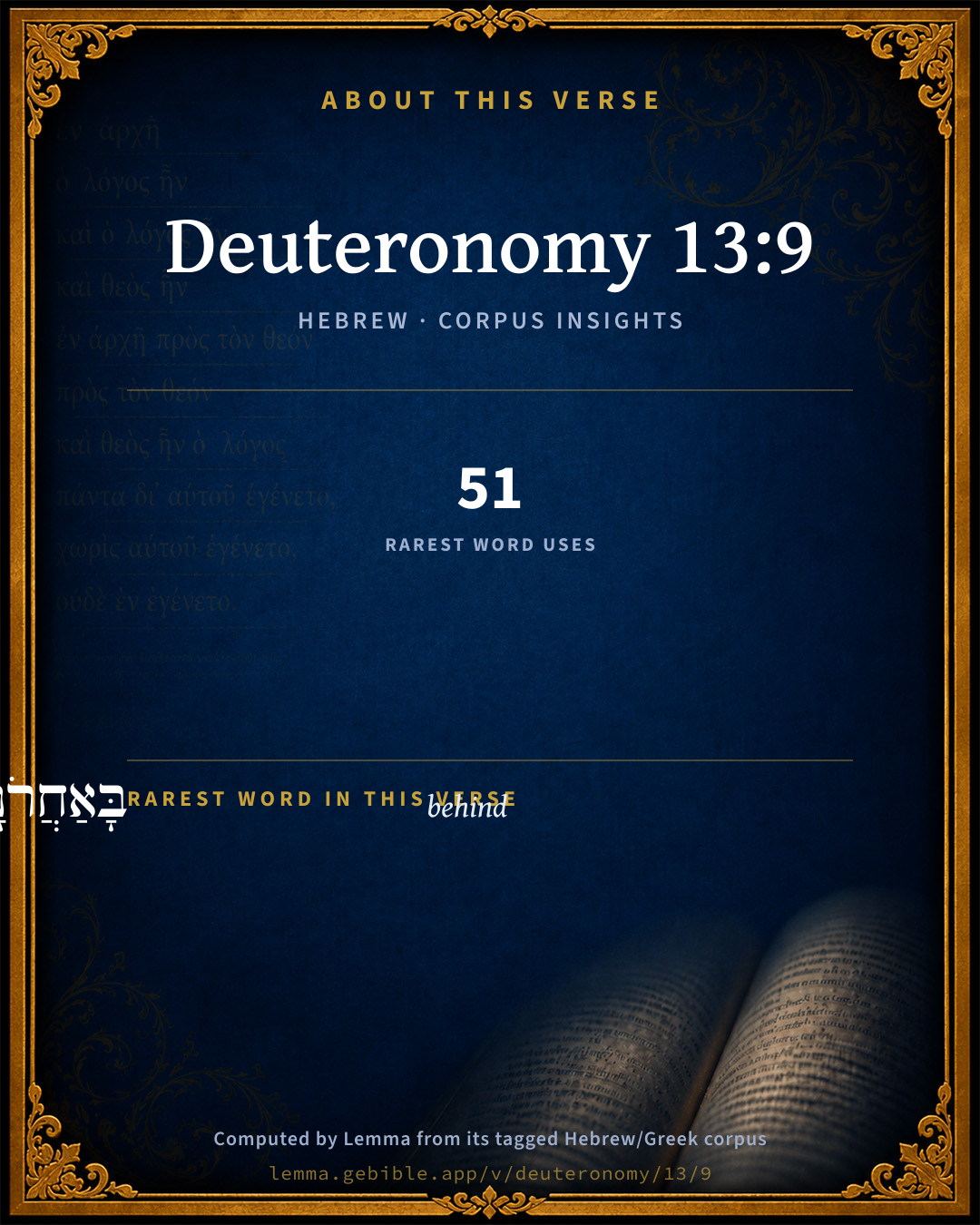
בָּאַחֲרֹנָֽה
ʼachărôwn
H314
“in/at the · behind”
Preposition, Determined + Adjective, Adjective, Feminine, Singular, Absolute
Part of Speech
Preposition + Adjective
Type
Adjective
Gender
Feminine
Number
Singular
State
Absolute
Full BDB Definition

Origin: from H309

TWOT: 68e

behind, following, subsequent, western - behind, hindermost, western (of location) - later, subsequent, latter, last (of time)
  1. כִּ֤י kîy H3588 “that” Conjunction
  2. הָרֹג֙ hârag H2026 “to kill” Verb, Qal, Infinitive Absolute
  3. תַּֽהַרְגֶ֔נּוּ hârag H2026 “to kill · him” Verb, Qal, Imperfect, 2nd Person, Masculine, Singular + Suffix, Personal, 3rd Person, Masculine, Singular
  4. יָֽדְךָ֛ yâd H3027 “hand · your” Noun, Common, Both, Singular, Construct + Suffix, Personal, 2nd Person, Masculine, Singular
  5. תִּֽהְיֶה hâyâh H1961 “to be” Verb, Qal, Imperfect, 3rd Person, Feminine, Singular
  6. בָרִֽאשׁוֹנָ֖ה riʼshôwn H7223 “in/at the · first” Preposition, Determined + Adjective, Ordinal number, Feminine, Singular, Absolute
  7. לַהֲמִית֑וֹ mûwth H4191 “to die · him” Preposition + Verb, Hiphil, Infinitive Construct + Suffix, Personal, 3rd Person, Masculine, Singular
  8. וְיַ֥ד yâd H3027 “and · hand of” Conjunction + Noun, Common, Both, Singular, Construct
  9. כָּל kôl H3605 “all of” Noun, Common, Masculine, Singular, Construct
  10. הָעָ֖ם ʻam H5971 “the · people” Particle, Definite Article + Noun, Common, Masculine, Singular, Absolute

About this verse

These counts appear in no published source. They are computed here, from the morphology-tagged text and Lemma’s own curated glosses. What Lemma adds →

12
words
9
distinct lemmas
Pentateuch
section

Shared distinctive vocabulary

בָּאַחֲרֹנָֽה behind H314 occurs in 48 verses of the Hebrew Bible. Also found in:

Grammatical profile

  • 4 verbs
  • 4 nouns
  • 2 adjectives
  • 1 preposition
  • 1 conjunction

Verb forms

  • הָרֹג֙ Qal · Infinitive Absolute
  • תַּֽהַרְגֶ֔נּוּ Qal · Imperfect
  • תִּֽהְיֶה Qal · Imperfect
  • לַהֲמִית֑וֹ Hiphil · Infinitive Construct

Repetition

Words recur within this verse — often emphatic in Hebrew:

  • הָרֹג֙ to kill H2026 ×2
  • יָֽדְךָ֛ hand H3027 ×2

Hebrew & Septuagint length

In English translation the verse runs 26 words from the Hebrew and 29 from the Septuagint (LXX English) — closely comparable.

A rough comparison of the two English renderings, which tokenize alike — not a word-level alignment.

Word counts can differ between the Hebrew and the Greek without any difference in meaning — e.g. the Hebrew direct-object marker אֵת has no separate Greek word, and Greek often adds the article ὁ.

Cross-references

5

Topical passages linked to Deuteronomy 13:9 in the Treasury of Scripture Knowledge — connected by theme and wording, ordered by reader-vote popularity; previews shown in the World English Bible.

  • Deuteronomy 17:2–7 If there be found in the midst of you, within any of your gates which Yahweh your God gives you, man or woman, who does that which is evil in the sight of Yahweh your God, in transgressing his covenant,
  • Matthew 10:37 He who loves father or mother more than me is not worthy of me; and he who loves son or daughter more than me isn't worthy of me.
  • Luke 14:26 "If anyone comes to me, and doesn't hate his own father, mother, wife, children, brothers, and sisters, yes, and his own life also, he can't be my disciple.
  • John 8:7 But when they continued asking him, he looked up and said to them, "He who is without sin among you, let him throw the first stone at her."
  • Acts 7:58 They threw him out of the city, and stoned him. The witnesses placed their garments at the feet of a young man named Saul.

Cross-references courtesy of OpenBible.info (CC BY 4.0).

Hebrew and Greek witnesses Masoretic Hebrew ↔ Greek Septuagint

The same verse in the two great witnesses to the Old Testament, shown verse-for-verse.

These are two independent witnesses, not word-aligned to each other, and the Septuagint is shown in lemma (dictionary) form.

Hebrew Deuteronomy 13:9 Masoretic · Westminster Leningrad Codex

כִּ֤י הָרֹג֙ תַּֽהַרְגֶ֔נּוּ יָֽדְךָ֛ תִּֽהְיֶה בּ֥וֹ בָרִֽאשׁוֹנָ֖ה לַהֲמִית֑וֹ וְיַ֥ד כָּל הָעָ֖ם בָּאַחֲרֹנָֽה

but you shall surely kill him; your hand shall be first on him to put him to death, and afterwards the hand of all the people.

World English Bible · Public Domain

Greek LXX Deuteronomy 13:9 Septuagint · lemma form

οὐ συνθέλω αὐτός καί οὐ εἰςἀκούω αὐτός καί οὐ φείδομαι ὁ ὀφθαλμός σύ ἐπί αὐτός οὐ ἐπιποθέω ἐπί αὐτός οὐδέ οὐ μή σκεπάζω αὐτός

you shall surely report concerning him, and your hands shall be upon him among the first to kill him, and the hands of all the people at the last.

LXX2012 (modern English Septuagint) · Public Domain

Hebrew: Westminster Leningrad Codex (CC BY 4.0). Greek: Septuagint (public domain); English from LXX2012 (modern English Septuagint) (Public Domain). How the Septuagint differs from the Hebrew →

Targum (Aramaic paraphrase)

2

The Targum is the ancient Jewish Aramaic paraphrase of the Hebrew Scriptures — an interpretive translation, not the Hebrew text itself. Onkelos (literal) and Pseudo-Jonathan (expansive) render the Torah, and Jonathan the Prophets. Coverage is partial: where no permissively-licensed English translation exists for a verse, only the Aramaic is shown. This is verse-level text, not a word-by-word alignment to the Hebrew.

  1. Targum Onkelos Torah (Genesis–Deuteronomy)
    לָא תֵיבֵי לֵהּ וְלָא תְקַבֵּל מִנֵהּ וְלָא תְחוּס עֵינָךְ עֲלוֹהִי וְלָא תְרַחַם וְלָא תְכַסֵי עֲלוֹהִי

    (no public-domain English translation for this verse)

    Targum Onkelos — Aramaic: “Onkelos Genesis” (public domain); “Onkelos Exodus” (public domain); “Onkelos Leviticus” (public domain); “Onkelos Numbers” (public domain); “Onkelos Deuteronomy” (public domain). English: “Sefaria Community Translation” (CC0 1.0 (public-domain dedication)); “J.W. Etheridge. The Targums of Onkelos and Jonathan Ben Uzziel on the Pentateuch. London: Longmans, Green, 1862” (public domain). Text via Sefaria.

  2. Targum Pseudo-Jonathan Torah (Genesis–Deuteronomy)
    לָא תִיצְבוּן לְהוֹן וְלָא תְקַבְּלוּן מִנֵּיהּ וְלָא תֵיחוֹס עֵינֵיכוֹן עֲלוֹי וְלָא תְרַחֲמוּן וְלָא תְכַסּוּן בְּטוּמְרָא עֲלוֹי

    you shall not consent to them, nor hearken to him, neither shall your eye spare him or have compassion, nor shall you hide him in secret;

    Targum Pseudo-Jonathan — Aramaic: “Targum Jonathan on Genesis” (public domain); “Targum Jonathan on Exodus” (public domain); “Targum Jonathan on Leviticus” (public domain); “Targum Jonathan on Numbers” (public domain); “Targum Jonathan on Deuteronomy” (public domain). English: “The Targum of Jonathan ben Uzziel, trans. J. W. Etheridge, London, 1862” (public domain). Text via Sefaria.

Commentary

Notes on Deuteronomy 13:9 from classic Christian and Jewish commentators (each source and its license shown beneath its notes). The classic Christian expositions comment on the surrounding passage and are grouped to its opening verse, so a note may address several verses; the Jewish commentaries on the Tanakh (Rashi and others) are per-verse, so they appear only where the commentator wrote on this verse.

Lemma curates 59 commentaries, every one of them public domain or Creative Commons licensed, each selected and text-cleaned for this edition rather than reprinted as found. About our sources →

Trapp's Complete Commentary

John Trapp

Deu 13:9 But thou shalt surely kill him; thine hand shall be first upon him to put him to death, and afterwards the hand of all the people.

Ver. 9. Kill him,] i.e., Deliver him up to the magistrate to be killed; for he bears not the sword in vain, like St Paul in a glass window, or George on a signpost.

John Trapp, A Commentary or Exposition upon All the Books of the Old and New Testament (1647–1656) — public domain. Text from a community e-Sword module.

Joseph Benson's Commentary

Deu 13:9-11. Thou shalt surely kill him — Not privately, a permission to do which, under pretence of the party’s being guilty of the crime in question, would have opened the door to innumerable murders; but by procuring his death through the sentence of the magistrate. Thy hand shall be first upon him — As the witness of his crime; for he was to be stoned to death, and the accuser was to throw the first stone, together with the witnesses, Deu 17:7. This law, at first sight, may appear too great a trial to humanity; but it is indeed no more than requiring a compliance with that plain principle of religion and morality, to sacrifice all private considerations to the glory of God and good of mankind. All Israel shall hear and fear — The law, though severe, yet was just and necessary, and calculated to preserve the body of the people from the contagion of idolatry.

Joseph Benson's Commentary on the Old and New Testaments (1811–1818) — public domain. Text from a community e-Sword module.

Tyndale Open Study Notes

Tyndale Open Resources

13:9 Strike the first blow yourself: Because the guilty parties would be members of one’s own family (13:6), this difficult demand would test the depth of a person’s commitment to worship the Lord exclusively. Love for God must take priority over love for family members and friends (Matt 10:34-39).

Tyndale Open Study Notes — © Tyndale Open Resources, licensed CC BY-SA 4.0. Text via the HelloAO Bible API.

Geneva Bible (1599)

Geneva Bible translators

As the witness is charged, Deut. 17:7.

Geneva Bible (1599) marginal notes — public domain. Text via Bolls.life.

Jamieson, Fausset & Brown

Robert Jamieson, A. R. Fausset & David Brown

thou shalt surely kill him--not hastily, or in a private manner, but after trial and conviction; and his relative, as informer, was to cast the first stone (see on Deu 17:2; Act 7:58). It is manifest that what was done in secret could not be legally proved by a single informer; and hence Jewish writers say that spies were set in some private part of the house, to hear the conversation and watch the conduct of a person suspected of idolatrous tendencies.

Jamieson, Fausset & Brown — Commentary Critical and Explanatory on the Whole Bible (1871) — public domain (CC PDM 1.0). Text via the HelloAO Bible API.

Ellicott's Commentary for English Readers

(9) Thine hand shall be first upon him to put him to death.—A law tending to prevent false accusation. Where the witness is obliged to carry out himself, or to aid in carrying out, the sentence he demands, secret accusation is impossible; and it is far less easy to pervert the law in order to prosecute a private quarrel.

A Bible Commentary for English Readers, edited by Charles John Ellicott (1878–1897) — public domain. Text from a community e-Sword module.

John Gill's Exposition

But thou shalt surely kill him,.... Not privately and secretly, when and where he entices, nor the enticed himself by his own authority, but after being examined, judged, and condemned by the civil magistrate; and none might judge a false prophet but the sanhedrim at Jerusalem, the sanhedrim of seventy one (m); see Luk 13:33, but the difficulty is how such an one could be convicted, since the affair was transacted secretly, Deu 13:6 and there were none present to be witnesses, none but the enticer and the enticed; so that either the enticer must be brought to a confession of his guilt, or the testimony of the enticed alone must be taken. The Jewish doctors say (n), that they laid in wait for the enticer, which they never did for any other person, and the method they took was this; the enticed brought two persons, and put them behind a hedge, so that they might see the enticer, and hear his words, and he not see them; and he said to the enticer, say what thou hast said to me privately; which said, the enticed answered to him, how shall we leave our God which is in heaven, and go and serve wood and stone? if he returned (from his evil) hereby, or was silent, he was free; but if he said unto him, so we are obliged, and thus it is comely for us; they that stood afar off, behind the hedge (or in a dark room), brought him to the sanhedrim, and stoned him, that is, after examination, trial, judgment, and condemnation:

thine hand shall be first upon him, to put him to death; he was to throw the first stone at him, partly to show his indignation against the sin he had enticed him to, and that it had not at all affected him so as to incline him unto it; and partly to show that he had bore a true testimony, of which a suspicion might have been created in the minds of some, had he been backward to the execution of him:

and afterwards the hand of all the people; who then could proceed with more certainty and satisfaction: this shows that the person enticed had not a right to kill the enticer, without a judicial process, and the order of the civil magistrate.

(m) Misn. Sanhedrin, c. 1. sect. 7. (n) Ibid. c. 7. sect. 10. Maimon. Obede Cochabim, c. 5. sect. 3.

John Gill's Exposition of the Whole Bible (1746–1763) — public domain (CC PDM 1.0). Text via the HelloAO Bible API.

Haydock's Catholic Bible Commentary

Presently put him to death. Not by killing him by private authority, but by informing the magistrate, and proceeding by order of justice. (Challoner) (Worthington) --- Philo seems to assert the contrary. But he perhaps speaks of those who publicly endeavoured to lead the people astray. Presently in not in Hebrew. Other criminals were allowed twenty-four hours after condemnation. No delay was granted to false prophets. No excuse was admitted. If he had even been once acquitted, he might be examined again. --- Thy hand. The accuser of witness first threw a stone, after the wretch had been conducted out of the city, chap. xvii. 4., and Acts vii. 58.

George Leo Haydock (1774–1849), Haydock's Catholic Family Bible and Commentary, 1859 edition — public domain. Excludes Psalms (Douay-Rheims chapter numbering differs from Protestant) and Deuterocanonical books (Catholic canon only).

Matthew Poole's English Annotations

Thou shalt surely kill him; not privately, which pretence would have opened the door to innumerable murders, but by procuring his death by the sentence of the magistrate; and thou shalt cast the first stone at him, as the witness was to do. See Deu 17:7; Act 7:58.

Matthew Poole's English Annotations on the Holy Bible (1683–1685) — public domain. Text from a community e-Sword/MySword module.

John Wesley's Explanatory Notes

Thou shalt kill him - Not privately, which pretense would have opened the door to innumerable murders, but by procuring his death by the sentence of the magistrate. Thou shalt cast the first stone at him, as the witness was to do.

John Wesley, Explanatory Notes Upon the Whole Bible (1754–1765) — public domain. Text via the GEBible commentary corpus.

Keil & Delitzsch

C. F. Keil & F. Delitzsch

To such persuasion Israel was not to yield, nor were they to spare the tempters. The accumulation of synonyms (pity, spare, conceal) serves to make the passage more emphatic. כּסּה, to cover, i.e., to keep secret, conceal. They were to put him to death without pity, viz., to stone him (cf. Lev 20:2). That the execution even in this case was to be carried out by the regular authorities, is evident from the words, "thy hand shall be first against him to put him to death, and the hand of all the people afterwards," which presuppose the judicial procedure prescribed in Deu 17:7, that the witnesses were to cast the first stones at the person condemned.

Keil & Delitzsch — Biblical Commentary on the Old Testament (1861–1891) — public domain (CC PDM 1.0). Text via the HelloAO Bible API. (Old Testament only.)

Rashi

Rabbi Shlomo Yitzchaki (Rashi)

לא תאבה לו THOU SHALT NOT CONSENT UNTO HIM — i.e. thou shalt feel no longing (תאב) towards him, thou shalt show no affection for him (אהב); This is stated because it is said, (Leviticus 19:18) “Thou shalt love thy fellowman as thyself”; this man, however, thou shalt not love (Sifrei Devarim 89:1).

ולא תשמע אליו AND THOU SHALT NOT HEARKEN UNTO HIM when he makes entreaty for his life, that you should forgive him. This is stated because it says. (Exodus 23:5) “[If thou see the ass of him that hateth thee] thou shalt surely help him”; this man, however, thou shalt not help (Sifrei Devarim 89:2).

ולא תחוס עינך עליו NEITHER SHALL THINE EYE SPARE HIM — This is stated because it says, (Leviticus 19:16) “thou shalt not stand against the blood of thy fellow” — this man, however, thou shalt not spare (Sifrei Devarim 89:3).

ולא תחמל NEITHER SHALT THOU PITY [HIM] — i.e. thou shalt not occupy thyself in his favour (you shall not seek to find anything favorable to him) (Sifrei Devarim 89:4).

ולא תכסה עליו AND THOU SHALT NOT CONCEAL (COVER OVER) HIM — If you know anything about him that will condemn him, you are not allowed to keep silent (Sifrei Devarim 89:5).

Rashi on the Tanakh — English translations: “The Judaica Press complete Tanach with Rashi, translated by A. J. Rosenberg” (CC BY 4.0); “Pentateuch with Rashi's commentary by M. Rosenbaum and A.M. Silbermann, 1929-1934” (public domain); “The Metsudah Tanach series, Lakewood, N.J” (CC BY 4.0); and “The Book of Joshua, Metsudah Publications, 1997” (CC BY 4.0). Text via Sefaria.

Ramban (Nachmanides)

Rabbi Moshe ben Nachman (Ramban / Nachmanides)

THOU SHALT NOT ‘THOVEH LO’ — “you shall not ‘long’ for him, nor shall you love him. Because it is said, Thou shalt love thy neighbor as thyself — [it is necessary to caution that] this one [who seeks to mislead you into idolatry] you shall not love.” This is Rashi’s language quoting the Sifre. 89. But in the Gemara the Rabbis have said [in connection with this verse]: “But [if the one misled] avah (wanted) and consented [to the words of the inciter, although he actually did not worship the idols, the misleader] is guilty” [thus showing that the word thoveh is not an expression of “longing” as Rashi holds, but of “willingness”]. And this is correct, for avah is an expression of “desire,” as it is said, And the Eternal thy G-d was not ‘avah’ (willing) to hearken unto Balaam, meaning “He did not desire.” So also, he is not ‘avah’ (willing) to perform the duty of my husband’s brother, 25:7. [this expression being based upon the statement in the first part of that verse], and if the man ‘desires’ not to take his brother’s wife. Thus, thou shalt not ‘thoveh lo’ means [“thou shalt not be willing] in your heart [to give credence to him”], nor hearken unto him by consenting to him, saying “I will do so; I will go and I will worship the idol you mentioned.” And [the inciter] becomes liable to the death penalty because of his [the victim’s] consent. And such is the opinion of Onkelos [who translated]: “Do not accept [the offer] from him.” Now these two prohibitions [Thou shalt not be willing to give credence to him in your heart, nor shalt thou hearken unto him] are like Neither shalt thou desire thy neighbor’s house [which prohibits us from desiring what belongs to another], and Thou shalt not covet thy neighbor’s house [which prohibits us from scheming to acquire it], so that if he desires it in his heart, he infringes the first prohibition, and if he goes on to do as he thought, he transgresses also the second negative commandment.

NEITHER SHALL THINE EYE PITY HIM — to show him mercy that he not die.

NEITHER SHALT THOU SPARE because of the close [family] relationship as mentioned, as it is said, as a man spareth his own son that serveth him.

NEITHER SHALT THOU CONCEAL HIM — by not testifying against him in court. And in the Sifre it is written: 89. “Neither shalt thou spare — you shall not plead in his favor. Neither shalt thou conceal — if you know anything unfavorable to him, you are not permitted to stand mute.” All [these interpretations] by “not testifying” against him, or “withhold” anything unfavorable to him — the purport is the same, since covering up of evidence is a form of silence. convey the same thought, for the term “concealing” is from he that ‘concealeth’ his transgressions; but a prudent man ‘concealeth’ shame, 12:16. meaning that he refrains from telling it. And he states, and they shall do no more any such wickedness as this is in the midst of thee, because this matter [of a misleader] is very common, and it would be frequently done were it not for the law [as a deterrent, hence this pronouncement was necessary], but the matter of a false prophet mentioned [above] is not a common occurrence, [therefore, unlike in the verse before us, no admonitions were mentioned in Verse 6].

Ramban (Nachmanides) on the Tanakh — English translation: “Commentary on the Torah by Ramban (Nachmanides). Translated and annotated by Charles B. Chavel. New York, Shilo Pub. House, 1971-1976” (CC BY 4.0). Text via Sefaria.

Ibn Ezra

Rabbi Abraham ibn Ezra

Do not be favorably inclined to him. With belief in the heart.

Do not listen to him. In actions.

Do not view him compassionately. To refrain from executing him.

Do not cover for him. To leave him. Rather, reveal the matter so that the witnesses hear it from his mouth, and then you must execute him.

Ibn Ezra on the Tanakh — English translations: “Sefaria Community Translation” (CC0 1.0 (public-domain dedication)); “Yalkut, Sifsei Chachomim Chumash, Metsudah Publications, 2009” (CC BY 4.0); and “Commentary of Ibn Ezra on Isaiah - trans. by M. Friedlander, 1873” (public domain). Text via Sefaria.

Lesson kit

Teaching starters — assembled from the data on this page, not authored interpretation. Every prompt links to the verse data it draws on. Edit before teaching.

Deuteronomy, in the Pentateuch, opens this verse with 12 words (9 distinct Hebrew lemmas). Its most distinctive word is ʼachărôwn (“behind”). A historical commentator’s framing appears above. Read the whole chapter for the surrounding context.

Discussion questions

  1. The word ʼachărôwn carries the sense “behind.” How does it shape the verse?
  2. Genesis 33:2 shares the word «behind» with this verse. How do the two illuminate each other?
  3. “to kill” occurs 2× in this one verse. What is the effect of the repetition?
  4. The translations on this page render this verse differently — a whole-verse word diff, not a word-by-word alignment. What might account for the different wordings?
  5. The verb «הָרֹג֙» is Qal Infinitive Absolute. How does its form color the action?
  6. Reading how Trapp's Complete Commentary and Joseph Benson's Commentary read this verse, where do the two commentators agree and where do they part?

Things to notice

  • These translations choose different wording for 5 words in this verse.
  • “to kill” occurs 2× in this single verse.
  • 9 distinct Hebrew lemmas span 12 words in this verse.

Reading settings

Reading text

Shown beneath each verse's original-language words.

Old Testament
Old Testament edition

Read the OT as the Masoretic Hebrew (MT) or the Greek Septuagint (LXX).

English shown for the Greek Septuagint (in the Hebrew ↔ Greek comparison).

Comparing translations? Open the Compare panel on any verse page to stack up to four side by side.