2 Chronicles 28:7

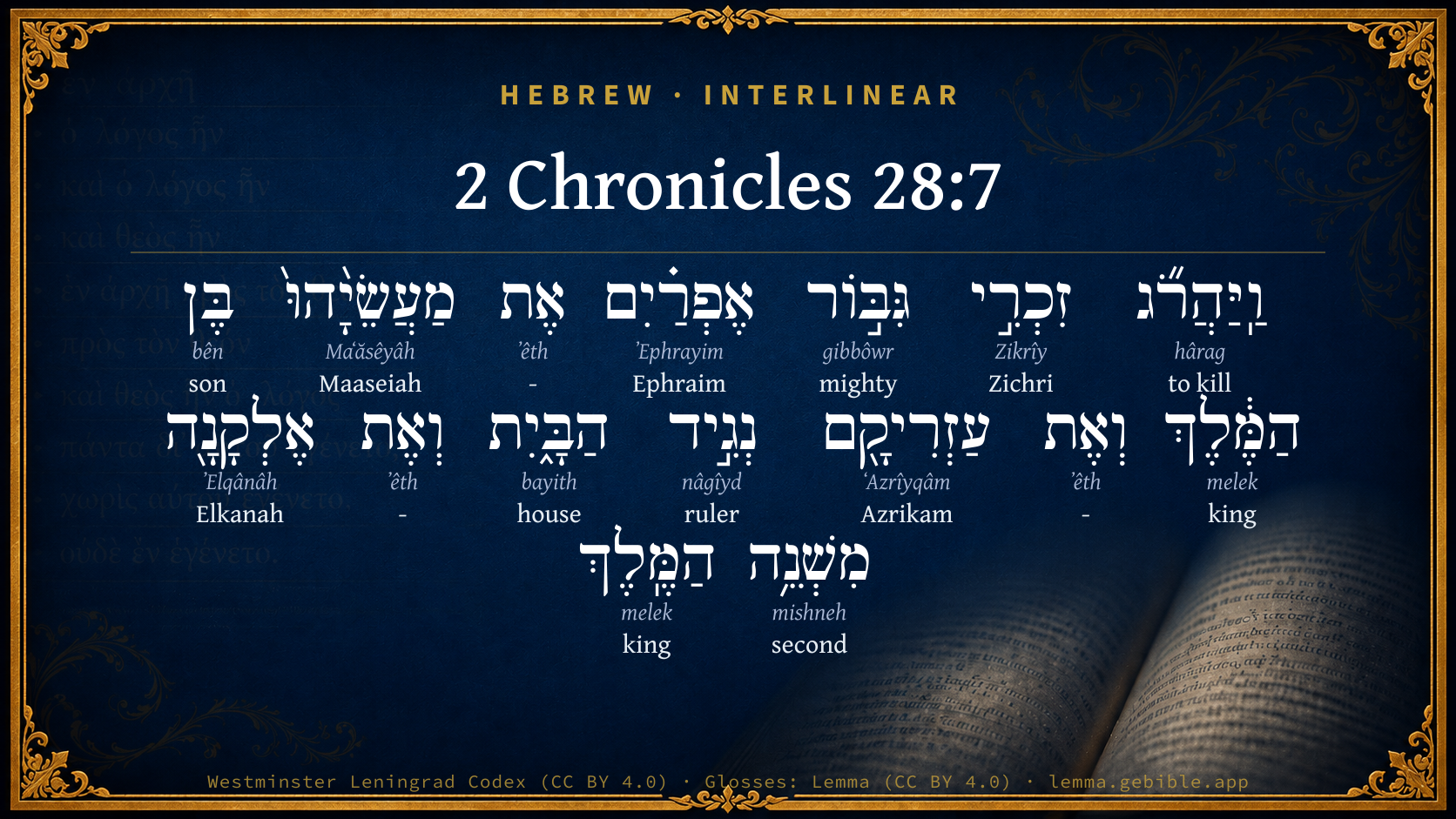
Hebrew (Westminster Leningrad Codex) 2 Chronicles 28:7 appears in the Hebrew Old Testament. The text above is from the Westminster Leningrad Codex. Each word links to its Strong’s number, a concise gloss, and parsing drawn from the Open Scriptures Hebrew Bible morphology. Click any word for its full Brown-Driver-Briggs (BDB) entry.
Download image
Cite this verse

2 Chronicles 28:7 (World English Bible). Public Domain. Lemma interlinear Bible study tool, https://lemma.gebible.app/v/2-chronicles/28/7.

Show BibTeX & RIS
BibTeX
RIS
English Translation
Zichri, a mighty man of Ephraim, killed Maaseiah the king's son, and Azrikam the ruler of the house, and Elkanah who was next to the king.
World English Bible · Public Domain
Download a study sheet

One document with this verse’s original text, its word-by-word gloss line, the meaning frame, cross-references with their text, attributed commentary, and full source and license credits — printable, and it pastes into notes with its structure intact.

This verse Autodidact and up

Study sheet (.html) Plain text (.txt)

A passage Seminary Student

Up to 50 verses in one chapter. A passage sheet keeps up to 6 commentary sources and 12 cross-references per verse, in the order this page ranks them, and says so on the sheet whenever that leaves anything out. Ask for a single verse and you get the Autodidact verse sheet above.

Everything on this page stays free to read, with no account — the sheet is a download of what is already on screen, not access to it.

Want to remove ads? Support Godless Engineer
Compare translations 3

The same verse in 3 English versions, stacked beneath the original-language interlinear above. Click any original word for its lexicon entry.

Each is an independent rendering of the whole verse — the interlinear is not word-aligned to these translations.

Highlighted words mark where these versions differ — a whole-verse word diff, not a word-by-word alignment.

  • World English Bible Public Domain
    Zichri, a mighty man of Ephraim, killed Maaseiah the king's son, and Azrikam the ruler of the house, and Elkanah who was next to the king.
  • King James Version Public Domain
    And Zichri, a mighty man of Ephraim, slew Maaseiah the king's son, and Azrikam the governor of the house, and Elkanah that was next to the king.
  • unfoldingWord Literal Text CC BY-SA 4.0
    And Zicri, a mighty one of Ephraim, killed Maaseiah, the son of the king, and Azrikam, the leader of the house, and Elkanah, the second of the king.

unfoldingWord Literal Text — © unfoldingWord, licensed CC BY-SA 4.0. Word-aligned USFM3 via Door43 (git.door43.org/unfoldingWord/en_ult).

Versions to compare (up to 4)

3 of 4 selected

Show all 18 translations

Every available English version of this verse, each an independent rendering of the whole verse.

  • World English Bible Public Domain
    Zichri, a mighty man of Ephraim, killed Maaseiah the king's son, and Azrikam the ruler of the house, and Elkanah who was next to the king.
  • Berean Standard Bible Public Domain
    Zichri, a mighty man of Ephraim, killed Maaseiah the son of the king, Azrikam the governor of the palace, and Elkanah the second to the king.
  • Majority Standard Bible Public Domain
    Zichri, a mighty man of Ephraim, killed Maaseiah the son of the king, Azrikam the governor of the palace, and Elkanah the second to the king.
  • King James Version Public Domain
    And Zichri, a mighty man of Ephraim, slew Maaseiah the king's son, and Azrikam the governor of the house, and Elkanah that was next to the king.
  • American Standard Version (1901) Public Domain
    And Zichri, a mighty man of Ephraim, slew Maaseiah the king's son, and Azrikam the ruler of the house, and Elkanah that was next to the king.
  • Revised Version (1885) Public Domain
    And Zichri, a mighty man of Ephraim, slew Maaseiah the king’s son, and Azrikam the ruler of the house, and Elkanah that was next to the king.
  • Geneva Bible (1599) Public Domain
    And Zichri a mighty man of Ephraim slew Maaseiah the Kings sonne, and Azrikam the gouernour of the house, and Elkanah the second after the King.
  • Douay-Rheims (1899) Public Domain
    At the same time Zechri a powerful man of Ephraim, slew Maasias the king's son, and Ezricam the governor of his house, and Elcana who was next to the king.
  • Young's Literal Translation Public Domain
    And Zichri, a mighty one of Ephraim, slayeth Maaseiah son of the king, and Azrikam leader of the house, and Elkanah second to the king.
  • Literal Standard Version CC BY-SA 4.0
    And Zichri, a mighty one of Ephraim, slays Maaseiah son of the king, and Azrikam leader of the house, and Elkanah second to the king.
  • Unlocked Literal Bible CC BY-SA 4.0
    Zicri, a powerful man from Ephraim, killed Maaseiah the king's son, Azrikam, the official over the palace, and Elkanah, who was next to the king.
  • unfoldingWord Literal Text CC BY-SA 4.0
    And Zicri, a mighty one of Ephraim, killed Maaseiah, the son of the king, and Azrikam, the leader of the house, and Elkanah, the second of the king.
  • Darby Bible Public Domain
    And Zichri, a mighty man of Ephraim, slew Maaseiah the king's son, and Azrikam the governor of the house, and Elkanah the second to the king.
  • World Messianic Bible Public Domain
    Zichri, a mighty man of Ephraim, killed Maaseiah the king’s son, Azrikam the ruler of the house, and Elkanah who was next to the king.
  • Webster's Bible Public Domain
    And Zichri, a mighty man of Ephraim, slew Maaseiah the king's son, and Azrikam the governor of the house, and Elkanah that was next to the king.
  • Free Bible Version CC BY-SA 4.0
    Zichri, a warrior from Ephraim, killed Maaseiah, the son of the king; Azrikam, the palace governor; and Elkanah, the king's second-in-command.
  • Bible in Basic English Public Domain
    And Zichri, a great fighting-man of Ephraim, put to death Maaseiah, the king's son, and Azrikam, the controller of his house, and Elkanah, who was second in authority to the king.
  • JPS Tanakh (1917) Public Domain
    And Zichri, a mighty man of Ephraim, slew Maaseiah the king's son, and Azrikam the ruler of the house, and Elkanah that was next to the king.

Literal Standard Version (2020), Covenant Press — licensed CC BY-SA 4.0. Text via the HelloAO Bible API (eBible.org). Unlocked Literal Bible (unfoldingWord) — licensed CC BY-SA 4.0. Text via the HelloAO Bible API (eBible.org). unfoldingWord Literal Text — © unfoldingWord, licensed CC BY-SA 4.0. Word-aligned USFM3 via Door43 (git.door43.org/unfoldingWord/en_ult). Free Bible Version, Dr. Jonathan Gallagher — licensed CC BY-SA 4.0. Text via the HelloAO Bible API (eBible.org).

Word by word

More ways to search: Search by grammar → Find every occurrence → Compare this word →

Practice this passage: Drill this verse → Learn its vocabulary →

עַזְרִיקָ֖ם
ʻAzrîyqâm
H5840
“Azrikam”
Noun, Proper
Part of Speech
Noun
Type
Proper
Full BDB Definition

Origin: from H5828 and act part of H6965

TWOT: None

Azrikam = "help against the enemy" - son of Neariah and descendant of Zerubbabel of the royal line of Judah - a Benjamite, eldest son of Azel and descendant of Saul - a Levite, ancestor of Shemaiah in the time of Nehemiah - governor of the palace of king Ahaz of Judah and victim of murder by Zichri
  1. וַֽיַּהֲרֹ֞ג hârag H2026 “and · to kill” Conjunction + Verb, Qal, Sequential Imperfect, 3rd Person, Masculine, Singular
  2. זִכְרִ֣י Zikrîy H2147 “Zichri” Noun, Proper
  3. גִּבּ֣וֹר gibbôwr H1368 “mighty of” Adjective, Adjective, Masculine, Singular, Construct
  4. אֶפְרַ֗יִם ʼEphrayim H669 “Ephraim” Noun, Proper
  5. אֶת ʼêth H853 “-” Particle, Direct Object
  6. מַעֲשֵׂיָ֨הוּ֙ Maʻăsêyâh H4641 “Maaseiah” Noun, Proper
  7. בֶּן bên H1121 “son of” Noun, Common, Masculine, Singular, Construct
  8. הַמֶּ֔לֶךְ melek H4428 “the · king” Particle, Definite Article + Noun, Common, Masculine, Singular, Absolute
  9. וְאֶת ʼêth H853 “and · -” Conjunction + Particle, Direct Object
  10. נְגִ֣יד nâgîyd H5057 “ruler of” Noun, Common, Masculine, Singular, Construct
  11. הַבָּ֑יִת bayith H1004 “the · house” Particle, Definite Article + Noun, Common, Masculine, Singular, Absolute
  12. וְאֶת ʼêth H853 “and · -” Conjunction + Particle, Direct Object
  13. אֶלְקָנָ֖ה ʼElqânâh H511 “Elkanah” Noun, Proper
  14. מִשְׁנֵ֥ה mishneh H4932 “second of” Noun, Common, Masculine, Singular, Construct
  15. הַמֶּֽלֶךְ melek H4428 “the · king” Particle, Definite Article + Noun, Common, Masculine, Singular, Absolute

About this verse

These counts appear in no published source. They are computed here, from the morphology-tagged text and Lemma’s own curated glosses. What Lemma adds →

16
words
13
distinct lemmas
Historical
section

Notable vocabulary

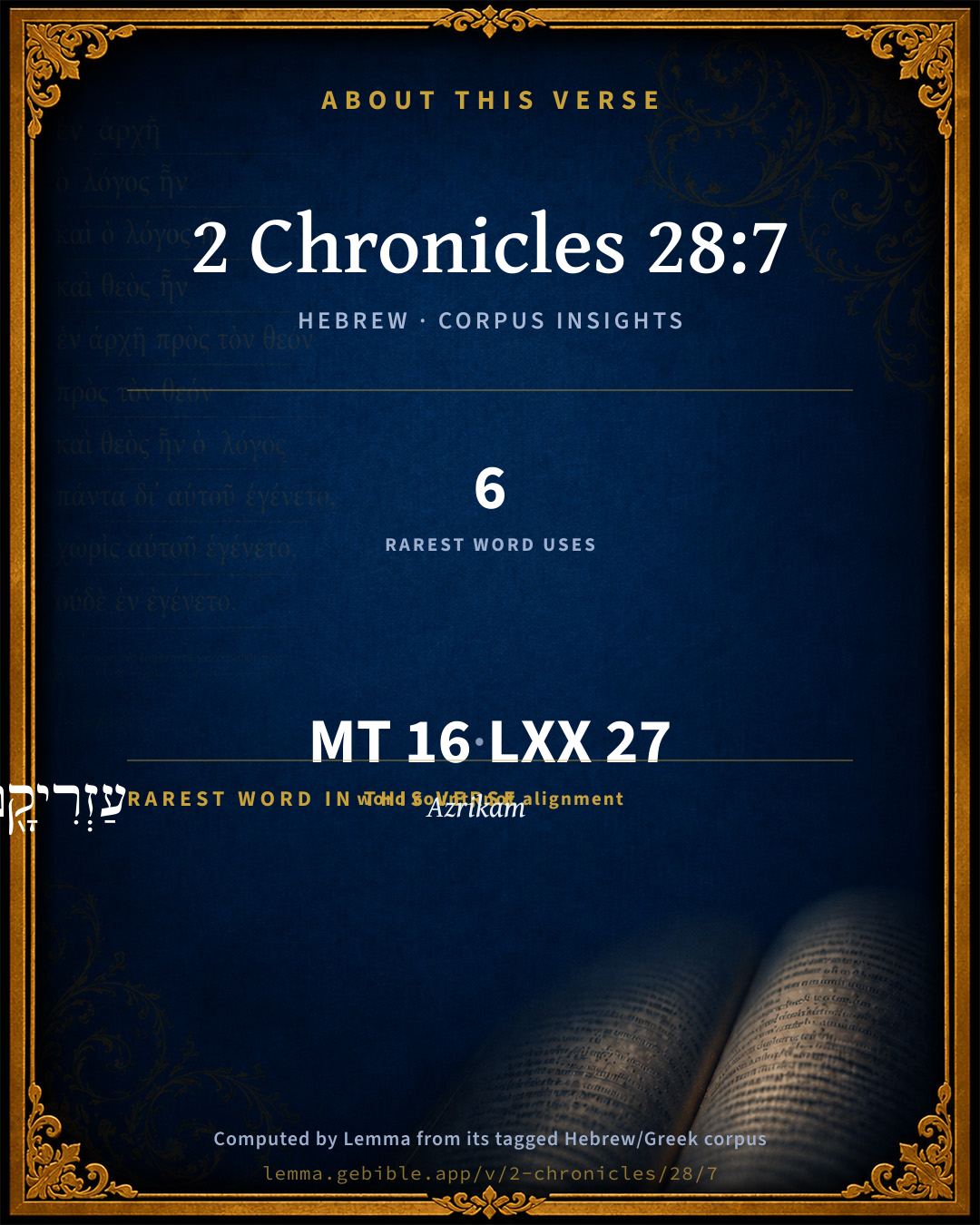
The rarest word here is עַזְרִיקָ֖ם Azrikam H5840 — appearing just 6 times in the whole Hebrew Bible.

Shared distinctive vocabulary

עַזְרִיקָ֖ם Azrikam H5840 occurs in 6 verses of the Hebrew Bible. Also found in:

Grammatical profile

  • 1 verb
  • 11 nouns
  • 1 adjective
  • 3 particles

Verb forms

  • וַֽיַּהֲרֹ֞ג Qal · Sequential Imperfect

Repetition

A word recurs within this verse — often emphatic in Hebrew:

  • הַמֶּ֔לֶךְ king H4428 ×2

Hebrew & Septuagint length

In English translation the verse runs 26 words from the Hebrew and 24 from the Septuagint (LXX English) — closely comparable.

A rough comparison of the two English renderings, which tokenize alike — not a word-level alignment.

Word counts can differ between the Hebrew and the Greek without any difference in meaning — e.g. the Hebrew direct-object marker אֵת has no separate Greek word, and Greek often adds the article ὁ.

In the original languages it is 16 Hebrew tokens and 27 Greek tokens — but the two are counted differently (Hebrew bundles its prefixes and suffixes into one token; the Greek is in lemma form), so that isn’t a like-for-like length.

Cross-references

4

Topical passages linked to 2 Chronicles 28:7 in the Treasury of Scripture Knowledge — connected by theme and wording, ordered by reader-vote popularity; previews shown in the World English Bible.

  • Genesis 41:43 and he made him to ride in the second chariot which he had. They cried before him, "Bow the knee!" He set him over all the land of Egypt.
  • Genesis 43:12 and take double money in your hand, with the money that was returned in the mouth of your sacks carry again in your hand. Perhaps it was an oversight.
  • Genesis 43:15 The men took that present, and they took double money in their hand, and Benjamin; and rose up, went down to Egypt, and stood before Joseph.
  • Esther 10:3 For Mordecai the Jew was next to king Ahasuerus, and great among the Jews, and accepted of the multitude of his brothers, seeking the good of his people, and speaking peace to all his seed.

Cross-references courtesy of OpenBible.info (CC BY 4.0).

Hebrew and Greek witnesses Masoretic Hebrew ↔ Greek Septuagint

The same verse in the two great witnesses to the Old Testament, shown verse-for-verse.

These are two independent witnesses, not word-aligned to each other, and the Septuagint is shown in lemma (dictionary) form.

Hebrew 2 Chronicles 28:7 Masoretic · Westminster Leningrad Codex

וַֽיַּהֲרֹ֞ג זִכְרִ֣י גִּבּ֣וֹר אֶפְרַ֗יִם אֶת מַעֲשֵׂיָ֨הוּ֙ בֶּן הַמֶּ֔לֶךְ וְאֶת עַזְרִיקָ֖ם נְגִ֣יד הַבָּ֑יִת וְאֶת אֶלְקָנָ֖ה מִשְׁנֵ֥ה הַמֶּֽלֶךְ

Zichri, a mighty man of Ephraim, killed Maaseiah the king's son, and Azrikam the ruler of the house, and Elkanah who was next to the king.

World English Bible · Public Domain

Greek LXX 2 Chronicles 28:7 Septuagint · lemma form

καί ἀποκτείνω εζεκρι ὁ δυνατός ὁ ἐφράιμ ὁ μαασαια ὁ υἱός ὁ βασιλεύς καί ὁ εσδρικαμ ἡγέομαι ὁ οἶκος αὐτός καί ὁ ελκανα ὁ διάδοχος ὁ βασιλεύς

And Zechri, a mighty man of Ephraim, killed Maasias the king's son, and Ezrican the chief of his house, and Elcana the king's deputy.

LXX2012 (modern English Septuagint) · Public Domain

Hebrew: Westminster Leningrad Codex (CC BY 4.0). Greek: Septuagint (public domain); English from LXX2012 (modern English Septuagint) (Public Domain). How the Septuagint differs from the Hebrew →

Commentary

Notes on 2 Chronicles 28:7 from classic Christian and Jewish commentators (each source and its license shown beneath its notes). The classic Christian expositions comment on the surrounding passage and are grouped to its opening verse, so a note may address several verses; the Jewish commentaries on the Tanakh (Rashi and others) are per-verse, so they appear only where the commentator wrote on this verse.

Lemma curates 59 commentaries, every one of them public domain or Creative Commons licensed, each selected and text-cleaned for this edition rather than reprinted as found. About our sources →

Trapp's Complete Commentary

John Trapp

2Ch 28:7 And Zichri, a mighty man of Ephraim, slew Maaseiah the king’s son, and Azrikam the governor of the house, and Elkanah [that was] next to the king.

Ver. 7. And Zichri, a mighty man of Ephraim.] Heros fortis Ephraita, a man of extraordinary courage and strength: he must be so, that slew so many grandees and their guards.

John Trapp, A Commentary or Exposition upon All the Books of the Old and New Testament (1647–1656) — public domain. Text from a community e-Sword module.

Geneva Bible (1599)

Geneva Bible translators

Or, tyrant.

Geneva Bible (1599) marginal notes — public domain. Text via Bolls.life.

Jamieson, Fausset & Brown

Robert Jamieson, A. R. Fausset & David Brown

Maaseiah the king's son--the sons of Ahaz being too young to take part in a battle, this individual must have been a younger son of the late King Jotham;

Azrikam the governor of the house--that is, "the palace"; and

Elkanah that was next to the king--that is, the vizier or prime minister (Gen 41:40; Est 10:3). These were all cut down on the field by Zichri, an Israelitish warrior, or as some think, ordered to be put to death after the battle. A vast number of captives also fell into the power of the conquerors; and an equal division of war prisoners being made between the allies, they were sent off under a military escort to the respective capitals of Syria and Israel [Ch2 28:8].

Jamieson, Fausset & Brown — Commentary Critical and Explanatory on the Whole Bible (1871) — public domain (CC PDM 1.0). Text via the HelloAO Bible API.

Ellicott's Commentary for English Readers

(7) Maaseiah the king’s son—i.e., a prince of the royal house, related to Ahaz, but not his own son; or he would have been too young to be engaged in the battle. (Comp. 2Ch_18:25 : “Joash the king’s son.”)

Azrikam the governor of the house—i.e., of the royal house, or palace. Azrikam was nagîd, “prince” or superintendent of the palace, a high court official. (Comp. 1Ki_4:6; 1Ki_18:3.)

Elkanah . . . next to the king.—See margin. Elkanah was grand vizier. (Comp. 1Sa_23:17; Est_10:3.) The writer mentions the deaths of these three personages, because of their intimate connection with Ahaz, whose punishment he is describing. The blow which struck them struck the king. (Comp. 2Ch_24:23.)

A Bible Commentary for English Readers, edited by Charles John Ellicott (1878–1897) — public domain. Text from a community e-Sword module.

The Cambridge Bible for Schools and Colleges

gen. ed. J. J. S. Perowne

7. the governor of the house] R.V. the ruler (nâgîd, Heb.) of the house. Probably the head of the king’s household is meant, his “chancellor”; but cp. Neh_11:11, “the ruler (nâgîd) of the house of God.”

next to the king] Cp. 1Sa_23:17.

The Cambridge Bible for Schools and Colleges (gen. ed. J. J. S. Perowne; Cambridge University Press, 1878–1918) — public domain. Text from a community e-Sword module.

John Gill's Exposition

And Zichri, a mighty man of Ephraim, slew Maaseiah the king's son,.... Who therefore must have escaped being burnt in the valley of Hinnom, or only was caused to pass through the fire there, Ch2 28:3,

and Azrikam the governor of the house; steward or treasurer in the king's house, in the same office as Sheban was, Isa 22:15.

and Elkanah that was next to the king: prime minister of state.

John Gill's Exposition of the Whole Bible (1746–1763) — public domain (CC PDM 1.0). Text via the HelloAO Bible API.

Albert Barnes' Notes on the Bible

Maaseiah was either an officer called “the king’s son” (compare 1Ki 22:26), or perhaps a son of Jotham, since Ahaz could hardly have had a son old enough to take part in the battle (compare 2Ch 28:1).

Elkanah, as “second to the king,” was probably the chief of the royal counselors.

Albert Barnes' Notes on the Bible (1834–1885) — public domain. Text from a community e-Sword/MySword module.

Haydock's Catholic Bible Commentary

CHAPTER XXVIII.

At the same time, is not in Hebrew (C.) or Sept. H. --- Zechri, one of the generals of Phacee, slew the king’s son, &c. after the engagement. --- Next. Joseph and Aman enjoyed the like dignity, Gen. xli. 42., and Esther xiii. 3. The high priests had also seconds, 4 K. xxv. 18. Sept. "vicar of the king." C.

George Leo Haydock (1774–1849), Haydock's Catholic Family Bible and Commentary, 1859 edition — public domain. Excludes Psalms (Douay-Rheims chapter numbering differs from Protestant) and Deuterocanonical books (Catholic canon only).

The Pulpit Commentary

The king"s son. This can scarcely mean the child of Ahaz, considering Ahaz"s age; some think a brother of the present king, son of Jotham, may be intended. We have also to fall back upon the use of the phrase, "king"s son," for some special official of the king or court (see note 2Ch_18:25; and its parallel. 1Ki_22:26) The governor of the house; Revised Version, ruler. We have probably a sufficient clue to this designation in 1Ki_4:6; and the designation itself, 2Ch_18:3; 2Ki_18:18; 2Ch_19:11. Next to the king; Hebrew, hnevmi literally, therefore, the next of the king, the general meaning of which expression cannot be doubtful (1Ch_16:5; Est_10:3; Neh_11:9) but the exacter scope and functions of the person under the kings of the divided kingdom thus designated is less certain. It is naturally to be supposed his place may have been king"s deputy in councils in his absence, or in and over the city itself, when he was at a distance with an army.

The Pulpit Commentary (1880–1919), ed. H.D.M. Spence-Jones & Joseph S. Exell — public domain. Text from a community e-Sword module.

Keil & Delitzsch

C. F. Keil & F. Delitzsch

In this battle, Zichri, an Ephraimite hero, slew three men who were closely connected with the king: Maaseiah, the king's son, i.e., not a son of Ahaz, for in the first years of his reign, in which this war arose, he cannot have had an adult son capable of bearing arms, but a royal prince, a cousin or uncle of Ahaz, as in Ch2 18:25; Ch2 22:11, etc. (cf. Caspari, loc. cit. S. 45ff.); Azrikam, a prince of the house, probably not of the house of God (Ch2 31:13; Ch2 9:11), but a high official in the royal palace; and Elkanah, the second from the king, i.e., his first minister; cf. Est 10:3; Sa1 23:17.

Keil & Delitzsch — Biblical Commentary on the Old Testament (1861–1891) — public domain (CC PDM 1.0). Text via the HelloAO Bible API. (Old Testament only.)

unfoldingWord translationNotes

Door43 World Missions Community

Zicri ... Maaseiah ... Azrikam ... Elkanah

These are the names of men. (See: How to Translate Names)

a powerful man

This is an idiom that refers to a mighty warrior. AT: "a mighty warrior" (See: Idiom)

who was next to the king

This idiom means that this man was the king's assistant who was second in command. AT: "who was the king's second in command" (See: Idiom)

The army of Israel took captive from their relatives

"From their own relatives, the army of Israel took captive." The word "their" refers to the army of Israel. The narrator speaks of the people of Judah as the relatives of the people of Israel.

200,000 wives, sons, and daughters

"two hundred thousand wives, sons, and daughters" (See: Numbers)

translationWords

Ephraim

king

palace

Israel

Samaria

unfoldingWord translationNotes — © Distant Shores Media and the Door43 World Missions Community, licensed CC BY-SA 4.0. Source: git.door43.org/Door43/en_tn.

Rashi

Rabbi Shlomo Yitzchaki (Rashi)

Maaseiah, the king’s son [I.e., the son of] Ahaz. Zichri, a mighty man of Ephraim slew [him].

and Azrikam - Heb. וְאֶת וְאֶת, similar to (Gen. 36:24): “and Aiah and Anah (וְאַיָּה וְעַנָה),” and similarly, (Ps. 76:7): “and chariot and horse (וָרֶכֶב וָסוּס) were stunned.”

Rashi on the Tanakh — English translations: “The Judaica Press complete Tanach with Rashi, translated by A. J. Rosenberg” (CC BY 4.0); “Pentateuch with Rashi's commentary by M. Rosenbaum and A.M. Silbermann, 1929-1934” (public domain); “The Metsudah Tanach series, Lakewood, N.J” (CC BY 4.0); and “The Book of Joshua, Metsudah Publications, 1997” (CC BY 4.0). Text via Sefaria.

Lesson kit

Teaching starters — assembled from the data on this page, not authored interpretation. Every prompt links to the verse data it draws on. Edit before teaching.

2 Chronicles, in the Historical, opens this verse with 16 words (13 distinct Hebrew lemmas). Its most distinctive word is ʻAzrîyqâm (“Azrikam”). A historical commentator’s framing appears above. Read the whole chapter for the surrounding context.

Discussion questions

  1. The word ʻAzrîyqâm carries the sense “Azrikam.” How does it shape the verse?
  2. How does 1 Chronicles 3:23, which shares the word «Azrikam», read alongside this verse?
  3. What does the repetition of “king” (2× in this one verse) do in this verse?
  4. The translations on this page render this verse differently — a whole-verse word diff, not a word-by-word alignment. What might account for the different wordings?
  5. «וַֽיַּהֲרֹ֞ג» is a Qal Sequential Imperfect verb. How does that grammatical form shape the action described?
  6. Compare how Trapp's Complete Commentary and Geneva Bible (1599) read this verse. Where do they agree or differ?

Things to notice

Reading settings

Reading text

Shown beneath each verse's original-language words.

Old Testament
Old Testament edition

Read the OT as the Masoretic Hebrew (MT) or the Greek Septuagint (LXX).

English shown for the Greek Septuagint (in the Hebrew ↔ Greek comparison).

Comparing translations? Open the Compare panel on any verse page to stack up to four side by side.