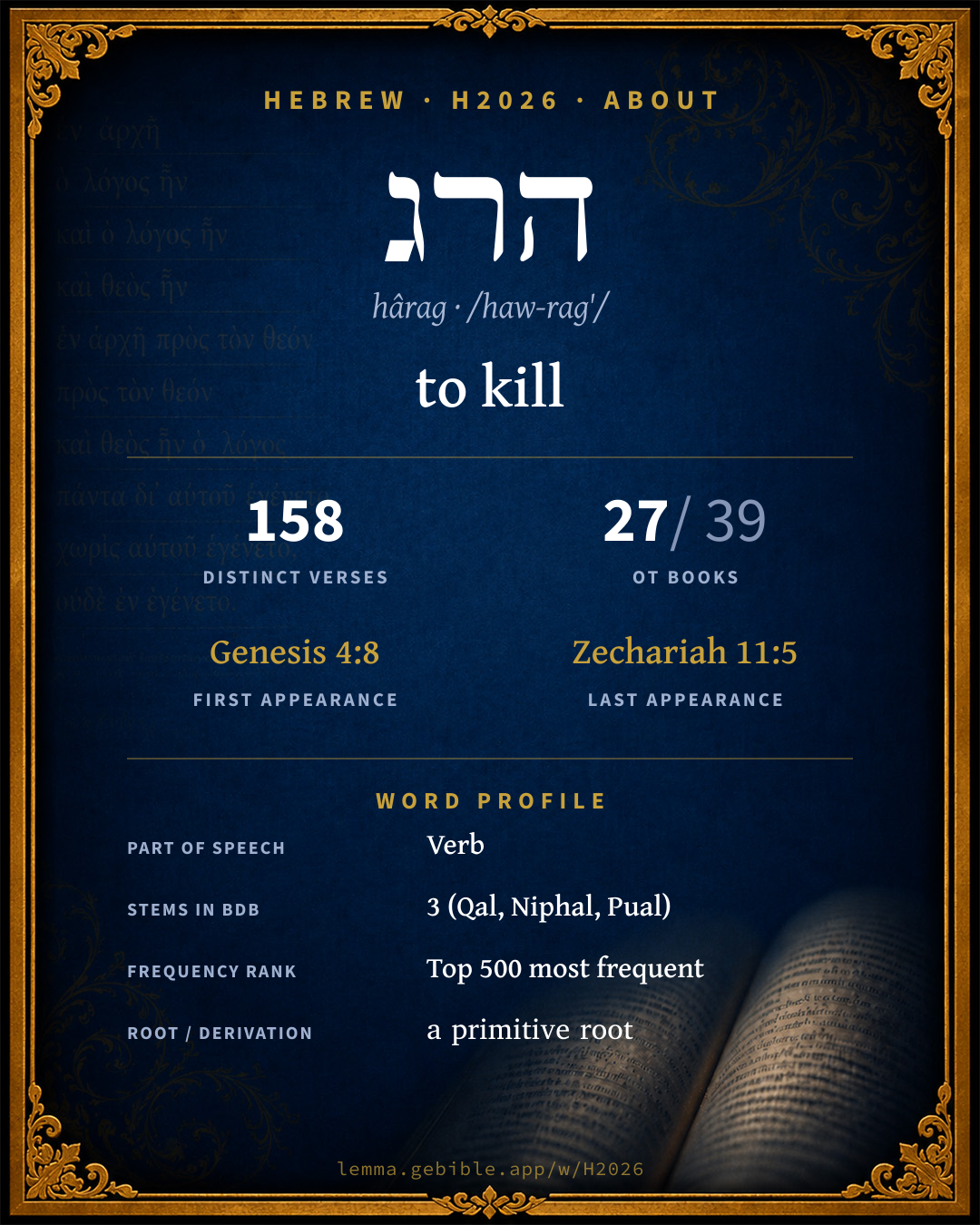
הָרַג
to kill
also: slay, murder, destroy, murderer fuller range ↓
Full lexicon entry — Brown-Driver-Briggs (BDB)
From Brown-Driver-Briggs (BDB)
Where this word appears
Grammar key — what these labels mean
Part of speech
- Verb
- An action or state-of-being word.
Stem
- Qal
- The basic, simple active stem — the plain form of the verb (“he wrote”). Here: ‘kill’
- Niphal
- Usually the simple passive or reflexive of the Qal (“he was written”). Here: ‘of Qal 1 a’
- Pual
- The passive counterpart of the Piel.
- Qal Passive
- An archaic passive of the Qal, preserved in a few forms.
Form
- Perfect
- A completed action or state — Hebrew marks aspect (completeness) more than strict tense (“he wrote”).
- Sequential Imperfect
- An imperfect with prefixed waw — the standard past-narrative form (waw-consecutive imperfect).
- Infinitive Construct
- A bound verbal noun, frequently with prepositions (“to write / in writing”).
- Imperfect
- An incomplete, ongoing, or future action (“he will / would write”).
- Participle Active
- A verbal adjective expressing ongoing or characteristic action (“writing / one who writes”).
- Sequential Perfect
- A perfect with prefixed waw continuing a preceding imperfect or command (waw-consecutive perfect).
- Infinitive Absolute
- An unbound verbal noun, often intensifying or standing in for a finite verb.
- Imperative
- A direct command (“write!”).
- Participle Passive
- A verbal adjective expressing action received (“written”).
- Cohortative
- A first-person volitional form expressing wish or resolve (“let me / let us write”).
- Jussive
- A third- or second-person volitional form expressing wish or command (“let him write”).
State
- Absolute
- The independent form of a noun, not bound to a following word.
- Construct
- A noun bound to a following noun in a possessive / “of” relationship (the construct chain).
Person
- 3rd Person
- The one spoken about (“he / she / it / they”).
- 2nd Person
- The one addressed (“you”).
- 1st Person
- The speaker (“I / we”).
Gender
- Common
- Either gender — not distinguished for this form.
- Masculine
- Grammatically masculine.
- Feminine
- Grammatically feminine.
Number
- Plural
- More than one (in Hebrew, generally three or more).
- Singular
- One.
Every verse where H2026 appears in the Book of Genesis — 16 distinct verses. Click any verse to open its interlinear word-by-word view. Verse text shown in the World English Bible for context — . Each verse’s Hebrew form is shown with its reference; the English is not keyword-highlighted, since the data carries no word-level English alignment. Use “Compare translations” on any verse to read it across multiple English versions. This concordance covers the Hebrew Bible; Septuagint (Greek Old Testament) occurrences are not indexed here.
Genesis
- Genesis 4:8 וַ/יַּהַרְגֵֽ/הוּ conj + Qal wimpf 3ms + sfx pers 3ms Cain said to Abel, his brother, "Let's go into the field." It happened, when they were in the field, that Cain rose up against Abel, his brother, and killed him.
- Genesis 4:14 יַֽהַרְגֵֽ/נִי Qal impf 3ms + sfx pers 1cs Behold, you have driven me out this day from the surface of the ground. I will be hidden from your face, and I will be a fugitive and a wanderer in the earth. It will happen that whoever finds me will kill me."
- Genesis 4:15 הֹרֵ֣ג Qal ptcp.act ms cs Yahweh said to him, "Therefore whoever slays Cain, vengeance will be taken on him sevenfold." Yahweh appointed a sign for Cain, lest any finding him should strike him.
- Genesis 4:23 הָרַ֨גְתִּי֙ Qal pf 1cs Lamech said to his wives, "Adah and Zillah, Hear my voice, You wives of Lamech, listen to my speech, For I have slain a man for wounding me, A young man for bruising me.
- Genesis 4:25 הֲרָג֖/וֹ Qal pf 3ms + sfx pers 3ms Adam knew his wife again. She gave birth to a son, and named him Seth. For, she said, "God has appointed me another child instead of Abel, for Cain killed him."
- Genesis 12:12 וְ/הָרְג֥וּ conj + Qal pf 3cp It will happen, when the Egyptians will see you, that they will say, 'This is his wife.' They will kill me, but they will save you alive.
- Genesis 20:4 תַּהֲרֹֽג Qal impf 2ms Now Abimelech had not come near her. He said, "Lord, will you kill even a righteous nation?
- Genesis 20:11 וַ/הֲרָג֖וּ/נִי conj + Qal wpf 3cp + sfx pers 1cs Abraham said, "Because I thought, 'Surely the fear of God is not in this place. They will kill me for my wife's sake.'
- Genesis 26:7 יַֽהַרְגֻ֜/נִי Qal impf 3mp + sfx pers 1cs The men of the place asked him about his wife. He said, "She is my sister," for he was afraid to say, "My wife," lest, he thought, the men of the place might kill me for Rebekah, because she was beautiful to look on.
- Genesis 27:41 וְ/אַֽהַרְגָ֖ה conj + Qal coh 1cs Esau hated Jacob because of the blessing with which his father blessed him. Esau said in his heart, "The days of mourning for my father are at hand. Then I will kill my brother Jacob."
- Genesis 27:42 לְ/הָרְגֶֽ/ךָ prep + Qal inf.cs + sfx pers 2ms The words of Esau, her elder son, were told to Rebekah. She sent and called Jacob her younger son, and said to him, "Behold, your brother Esau comforts himself about you by planning to kill you.
- Genesis 34:25 וַ/יַּֽהַרְג֖וּ conj + Qal wimpf 3mp It happened on the third day, when they were sore, that two of Jacob's sons, Simeon and Levi, Dinah's brothers, each took his sword, came upon the unsuspecting city, and killed all the males.
- Genesis 34:26 הָרְג֖וּ Qal pf 3cp They killed Hamor and Shechem, his son, with the edge of the sword, and took Dinah out of Shechem's house, and went away.
- Genesis 37:20 וְ/נַֽהַרְגֵ֗/הוּ conj + Qal coh 1cp + sfx pers 3ms Come now therefore, and let's kill him, and cast him into one of the pits, and we will say, 'An evil animal has devoured him.' We will see what will become of his dreams."
- Genesis 37:26 נַהֲרֹג֙ Qal impf 1cp Judah said to his brothers, "What profit is it if we kill our brother and conceal his blood?
- Genesis 49:6 הָ֣רְגוּ Qal pf 3cp My soul, don't come into their council; My glory, don't be united to their assembly; For in their anger they killed a man, In their self-will they hamstrung an ox.
About this entry
At a glance — auto-summarized from this page’s data, not written by a person. Every figure links to its source below. This summary describes the numbers; it doesn’t interpret them.
At its core, הרג (hârag) means “to kill.” The King James Version usually renders it “slew,” while modern versions prefer “killed” (Berean Standard Bible) — see the renderings breakdown. Spanning 158 verses in 27 books, it ranks among the common words of the Hebrew Bible. Scripture first uses it in Genesis 4:8. Different stems carry different senses — BDB groups them under 3 stems, among them Qal and Niphal. Dig into 158-verse concordance and the renderings breakdown below.
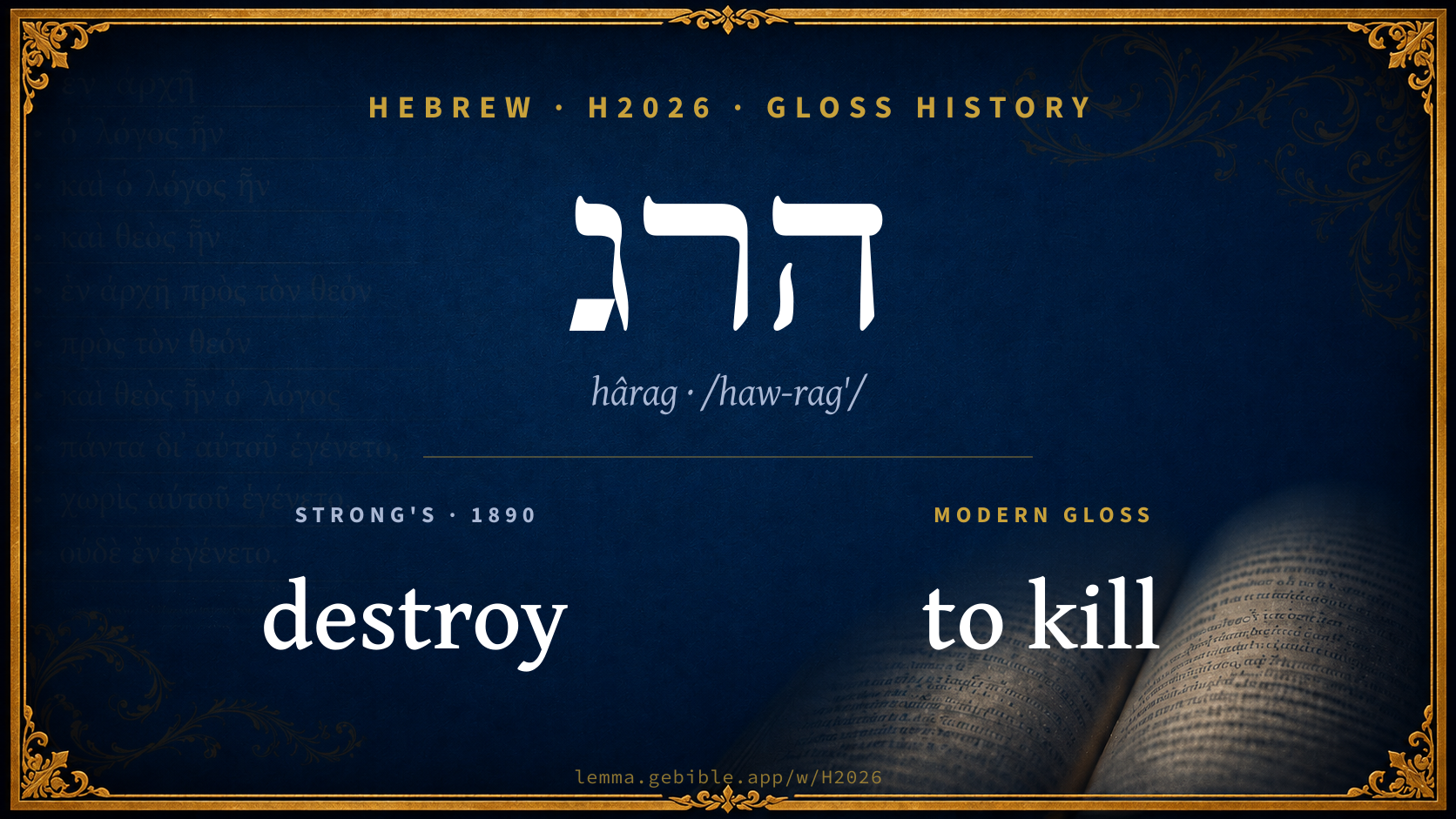
Gloss history
Strong's 1890 vs modern scholarship
About this word
Strong's H2026 catalogs a Hebrew word from the Hebrew Old Testament.
These counts are not copied from any lexicon or concordance. They are computed here, from the morphology-tagged Hebrew Old Testament. What Lemma adds →
- 158
- distinct verses
- The word appears in 158 distinct verses.
- 27 / 39
- OT books
- The word appears in 27 of 39 Old Testament books.
- #273
- by frequency
- Top 500 most frequent Hebrew words (rank 273 of 8,640 Hebrew words by occurrence).
View all 158 occurrences in the concordance →
Most concentrated in
- Genesis 16 verses 10%
- Judges 14 verses 9%
- 2 Chronicles 12 verses 8%
By section of the Old Testament
By traditional corpus
Conventional, traditional groupings — biblical authorship is debated, so this is a traditional corpus grouping, not an authorship claim. Each share is this word’s portion of its verses in that division of the Hebrew canon. Each figure is a share of the word’s 158 distinct verses.
- Prophets (Nevi'im) 76 verses · 48%
- Writings (Ketuvim) 45 verses · 28%
- Torah (Pentateuch) 37 verses · 23%
How translations render this word
Counts come from each version’s own published word-to-Strong’s tagging or interlinear alignment — an approximate guide to how each version renders this word, not a word-level alignment the data otherwise carries. Because each total is that version’s own tagged count, the per-version totals vary from one another and need not match the appearance or distinct-verse counts above. These counts may also differ from a printed concordance because Lemma counts each distinctly tagged rendering and does not collapse phrase taggings into a single head-word total. This is a fixed set of word-tagged versions (KJV, ASV, BSB, ULT) and does not change with the reading translation you choose elsewhere. Each version’s license is shown beside its name below (and on Sources).
- King James Version: Slew 37×, Slay 18×, They slew 9×
- American Standard Version: Slew 30×, Slay 14×, They slew 9×
- Berean Standard Bible: Killed 20×, Kill 13×, They killed 8×
- unfoldingWord Literal Text: Killed 12×, Kill 10×, He killed 8×
King James Version Public Domain
Renders H2026 across 167 tagged occurrences — most commonly:
Plus other, less common renderings. Plus 55 renderings that appear only once — usually multi-word phrases or single function words the recovered tagging swept in, not distinct renderings.
American Standard Version Public Domain
Renders H2026 across 165 tagged occurrences — most commonly:
Plus other, less common renderings. Plus 64 renderings that appear only once — usually multi-word phrases or single function words the recovered tagging swept in, not distinct renderings.
Berean Standard Bible Public Domain
Renders H2026 across 159 tagged occurrences — most commonly:
Plus other, less common renderings. Plus 62 renderings that appear only once — usually multi-word phrases or single function words the recovered tagging swept in, not distinct renderings. Not rendered by a distinct English word in 8 further occurrences.
unfoldingWord Literal Text CC BY-SA 4.0
Renders H2026 across 182 tagged occurrences — most commonly:
Plus other, less common renderings. Plus 62 renderings that appear only once — usually multi-word phrases or single function words the recovered tagging swept in, not distinct renderings.
13 senses and sub-senses in the full BDB
Hebrew verbs can shift meaning by stem (binyan): Qal is the basic action, Niphal is often passive or reflexive, Piel often intensifies or makes it factitive, and Hiphil is typically causative. The senses below are grouped under the stem BDB assigns to each. This entry also uses Pual (the passive of Piel).
What do BDB’s symbols mean?
BDB uses these scholarly abbreviations:
| Symbol | Meaning |
|---|---|
| 𝔊 | the Septuagint (the ancient Greek translation, LXX) |
| 𝔙 | the Vulgate (the Latin translation) |
| 𝔖 | the Syriac version (the Peshitta) |
| 𝔗 | the Targum (the Aramaic translation) |
| ψ | the Psalms |
| √ | root (the underlying root or stem) |
| ‖ | parallel passage (a synonymous or contrasted parallel) |
| † | the dagger: every passage where the word occurs is cited |
The 13 senses and sub-senses the full Brown-Driver-Briggs lexicon distinguishes for this word, in lexicon order (not ranked by frequency), with BDB’s own verbatim wording and sub-sense lettering. Shown in Hebrew script with BDB’s own scholarly abbreviations. The condensed entry is in the Lexicon Entry tab. See also the Forms in the corpus table below.
Qal
- Pf. 3 ms. ה׳ Ju 9:24 + 4 times, הָרָ֑ג 2 S 14:7 + 2 times, וְהָרַג consec. Is 27:1; sf. וַהֲרָגָ֑נִי consec. 1 S 16:2 + 2 times; הֲרָגוֹ Gn 4:25; etc.; Impf. יַהֲרֹג ψ 10:8 + 4 times; יַהֲרָג־ Jb 5:2; וַיַּהֲרֹג Ex 13:15 + 14 times; sf. יַהַרְגֵנִי Gn 4:14; 1 s. אַהֱרוֹג Am 2:3, אֶהֱרֹג Am 9:1; cohort. וְאַהַרְגָה Gn 27:41; sf. וָאֶהֶרְגֵהוּ 2 S 4:10 2 K 10:9; 3 mpl. יַהֲרֹ֑גוּ ψ 94:6 Ez 23:47; וַיַּהַרְגוּ Gn 34:25 + 4 times; sf. יַהַרְגֻנִי Gn 26:7, etc.; Imv. הֲרֹג Ju 8:20; sf. הָרְגֵנִי Nu 11:15; pl. הִרְגוּ Nu 25:5 + 2 times; הֲרֹ֑גוּ Nu 31:17; Inf. abs. הָרֹג Nu 11:15 + 2 times; הָרוֹג Est 9:16; cstr. הֲרֹג Ex 2:15 + 11 times; הֲרוֹג Ec 3:3 Est 7:4; sf. הָרְגֵנִי Ex 2:14; הָרְגֵנוּ Ex 5:21; הֲרָגְךָ 1 S 24:11; הָרְגֶ֑ךָ Gn 27:42 + 2 times; הָרְגוֹ Ex 21:14; Pt. act. הֹרֵג Gn 4:15 + 4 times; הוֹרֵג Ez 21:16; הֹרֱג֑ךָ Ez 28:9; הֹרְגִים Je 4:31 2 K 17:25; pass. הֲרוּגִים Is 10:4 + 2 times; הֲרֻגִים Is 14:19; cstr. הֲרֻגֵי Je 18:21; הֲרוּגָיו Is 27:7; הֲרוּגֶיהָ Is 26:21; הֲרֻגֶיהָ Pr 7:26;— e.g. Judges 9:24
- 1.
- a. kill, slay, implying ruthless violence, especially private violence Gn 4:8, 14, 15, 23, 25; 12:12 (all J), 20:11 (E) 26:7; 27:41, 42; 34:25, 26; 37:20, 26 (all J), 49:6 (poem in J), Ex 2:14(×2), 15 (E), 5:21 (J) 21:14; 23:7 (both JE), Nu 31:19 (P) Ju 9:5, 18, 24(×2), 56; 16:2; 20:5 1 S 16:2; 22:21; 24:11, 12, 18 2 S 3:30; 4:10, 11, 12; 12:9; 14:7; 23:21 1 K 2:5, 32; 18:12, 13, 14; 19:1, 10, 14 2 K 9:31; 10:9 1 Ch 7:21; 11:23 2 Ch 21:4, 13; 22:8; 24:23, 25; 25:3 Ne 4:5; 6:10(×2) Zc 11:5 ψ 10:8; 94:6 (‖ רִצֵּתַ); cf. Ju 8:18, 19, 20, 21; 9:54 1 K 12:27 Is 14:20 2 Ch 22:1 Ne 9:26; so of massacre of Jews planned by Haman Est 3:13; 7:4 (both לְהַשְׁמִיד לַהֲרֹג וּלְאַבֵּד), and of slaughter of Jews’ enemies in defence and revenge Est 8:11 (same combin.) 9:6, 10, 12, 15, 16 cf. v 11 (pt. pass. the slain). e.g. Genesis 4:8
- b. hence of wholesale slaughter after battle Nu 31:7, 8(×2) 17(×2) (all P), Jos 8:24; 10:11 (both JE), 13:22 (P), Ju 7:25(×2); 8:17; 9:45 2 S 10:18 1 K 9:16; 11:24 2 K 8:12 1 Ch 19:18 2 Ch 28:6, 7, 9; 36:17 Ez 26:8, 11, cf. Ju 9:26; pt. pass. the slain Is 10:4; 14:19 cf. Ez 23:10, 47; 37:9, Je 18:21 הֲרֻגֵי מָוֶת (‖ מֻכֵּי־חֶרֶב); further Ho 9:13 Hb 1:17 Je 4:31 Ez 21:16; 28:9; also of slaughter in a revolt 2 K 11:8 = 2 Ch 23:17. e.g. Numbers 31:7
- 2. of God’s slaying in judgment (stern and inscrutable), Gn 20:4 (E), Ex 4:23; 13:15; 22:23 (all JE), Am 2:3; 4:10; 9:1, 4 La 2:4, 21; 3:43 ψ 59:12; 78:31, 34; 135:10; 136:18 cf. Nu 11:15(×2) (JE), 22:23 (J), Is 14:30, 26;21 (pass. the slain, so 27:7), Je 15:3; fig. הֲרַגְתִּים בְּאִמְרֵי־פִ֑י Ho 6:5 (‖ חָצַבְתִּי בַּנְּבִיאִים). e.g. Genesis 20:4
- 3. rarely of judicial killing by men (at God’s command), Ex 32:27 (JE), Lv 20:15, 16 (H), Nu 25:5 (JE), Dt 13:10(×2) cf. Ez 9:6 תַּהַרְגוּ לְמַשְׁחִית. e.g. Exodus 32:27
- 4. of killing beasts, Nu 22:29 (J; Balaam’s ass), Lv 20:15 cf. supr., Is 22:13 (oxen; ‖ שָׁחֹט), הַתַּנִּין אֲשֶׁר בַּיָּ֑ם Is 27:1; also of killing vines, by hail ψ 78:47. e.g. Numbers 22:29
- 5. of killing by beasts: lions 2 K 17:25, viper Jb 20:16. e.g. 2 Kings 17:25
- 6. quite general is עֵת לַהֲרוֹג וְעֵת לִרְפּוֹא Ec 3:3. e.g. Ecclesiastes 3:3
- 7. destroy, ruin לֶאֱוִיל יַהֲרָג־כָּ֑עַשׂ וּפֹתֶה תָּמִית קִנְאָה Jb 5:2; מְשׁוּבַת פְּתָיִם תַּהַרְגֵם וְשַׁלְוַת כְּסִילִים תְּאַבְּדֵם Pr 1:32; also of those ruined by shameless woman Pr 7:26.—Regular construction is c. acc.; obj. sometimes om., as La 2:21; used abs. Ho 9:13 Je 4:31; 15:3 La 3:43 Ez 21:16 Ec 3:3; sq. בְּ slay among, i.e. some of, 2 K 17:25 2 Ch 28:6, 9 ψ 78:31; sq. מִן (part of), + acc., 1 Ch 19:18; sq. dir. obj. c. לְ †2 S 3:30 Jb 5:2 ψ 135:11 = 136:19, 20 (but in last 3 first obj. is acc.). e.g. Job 5:2
Niphal
- Impf.
- 1. pass. of Qal 1 a, יֵהָרֵג La 2:20 shall priest and prophet be slain in the sanctuary? e.g. Lamentations 2:20
- 2. pass. of Qal 1 b, 3 fpl. תֵּהָרַגְנָה Ez 26:6; also Ez 26:15 בֶּחָהרֵגּ הֶרֶג (= בְּהֵהָרֵג), but 𝔊 Co בַּהֲרֹג חֶרֶב. e.g. Ezekiel 26:6
Pual
- Pf. 3 ms. הֹרָ֑ג Is 27:7 be slain (pass. of Qal 1 b); cf. 1 pl. הֹרַגְנוּ ψ 44:23 (‖ נֶחְשַׁבְנוּ כְּעֹאן טִבְחָה). e.g. Isaiah 27:7
Senses from the full Brown-Driver-Briggs lexicon (Brown, Driver, Briggs; Oxford 1906 — public domain), digitized via Sefaria, supplemented by the OpenScriptures HebrewLexicon (CC BY 4.0). Full attribution on Sources.
Word origin
vb. kill, slay (NH id., ואהרג MI (1 s. Impf. consec.); Arabic هَرَجَ fall into war, conflict, disorder, slaughter; Sab. הרג fight Os4, 1, 17, kill Sab Denkm24, 25)—
— Brown-Driver-Briggs (Oxford 1906, public domain), digitized via Sefaria, supplemented by the OpenScriptures HebrewLexicon (CC BY 4.0). See Sources.
Origin: a primitive root
Jastrow Dictionary
A second Hebrew/Aramaic lexicon for comparison, covering Aramaic and post-biblical (Talmudic, Targumic, Midrashic) usage that the biblical-Hebrew BDB does not. Matched by lemma rather than by Strong’s number, so a lemma may carry more than one Jastrow headword (shown separately below), and the entries cover usage well beyond the Bible.
הָרַג
- (b. h.) [to cut, v. הֶרֶג,] to kill, put to death. Num. R. s. 21, beg. בא לַהֲרָגְךָ השכם להָרְגֹּו if one comes to kill thee, be the first to kill him; Ber. 58ᵃ; Snh. 72ᵃ להוֹרְגְּךָ … להוֹרְגוֹ. Gitt. 56ᵇ כסבור ה׳ את עצמו he (Titus) thought he had killed himself (euphem. for the Lord); a. v. fr.—Part. pass. הָרוּג. Tosef. Gitt. V (III), 1 הֲרוּגִין שנהרגו לפני מלחמה ובשעת מלחמה (ed. Zuck. בשעת) those executed (by the Roman government) before and during the Vespasian war; Y. Gitt. V, 47ᵇ top [read:] הֲרוּגֵי המלחמה ולפני וכ׳. Y. Ber. I, 3ᵈ, v. בִּיתֵּר. Pes. 50ᵃ; B. Bath. 10ᵇ, a. e. הרוגי מלכות martyrs under the Roman government (R. Akiba and his fellow-martyrs), v. לוּד; a. fr.
- to be killed, executed. Taan. 18ᵇ נֶהֶרְגוּ were put to death (by the Roman government). Gitt. 56ᵃ יֵהָרֵג is to be put to death. Snh. 74ᵃ עבור ואל תֵּהָרֵג transgress or thou wilt be killed; a. fr.
הָרָג
- (preced.) murderer, highway-man, contrad. to חרם the oppressor who does not threaten to kill. Y. B. Mets. IV, end, 9ᵈ.—Pl. הָרָגִין. Ned. III, 4, v. נָדַר.
הֶרֶג
- preced. wds.) execution by decapitation with a sword. Snh. VII, 1; a. fr.
A Dictionary of the Targumim, the Talmud Babli and Yerushalmi, and the Midrashic Literature (Marcus Jastrow; London, Luzac, 1903) — Public Domain. Digitized via Sefaria. Digitized via Sefaria. Full attribution on Sources.
Forms in the corpus
The 139 distinct written forms H2026 takes in the Hebrew Bible, most frequent first — each parse links to that stem’s occurrences in the concordance. Hebrew forms include their vowel points and cantillation, so a single lemma takes many written forms.
The 60 most common forms are shown; 79 rarer forms follow in the full concordance.
Same root — word family
Other BDB entries built from the same root as H2026, grouped by Strong’s listed origin. These share a root / origin per the lexicon — not necessarily a shared meaning. Each links to that word’s own entry.
Derived from this word
Compare all same-root words → They share a root, not necessarily a meaning.
Septuagint verse parallels
This word appears in 148 verses that also exist in the Greek Old Testament (Septuagint), out of the 158 Hebrew verses it occurs in. You can read those verses in Greek by switching the Old Testament edition to the Septuagint.
Read these verses in the Septuagint
- Genesis 4:8
- Exodus 2:14
- Leviticus 20:15
- Numbers 11:15
- Deuteronomy 13:9
- Joshua 8:24
- Judges 7:25
- 1 Samuel 16:2
- 2 Samuel 3:30
- 1 Kings 2:5
- 2 Kings 8:12
- 1 Chronicles 7:21
This is a verse-level parallel only — the same verses exist in both the Hebrew and Greek Old Testaments. No word-level Hebrew↔Greek correspondence is claimed: the data carries no such alignment, so no Greek word is shown as this Hebrew word’s translation. Coverage is not total — the Septuagint omits the deuterocanon and renumbers the Psalms, so some Hebrew verses have no direct Greek parallel.