
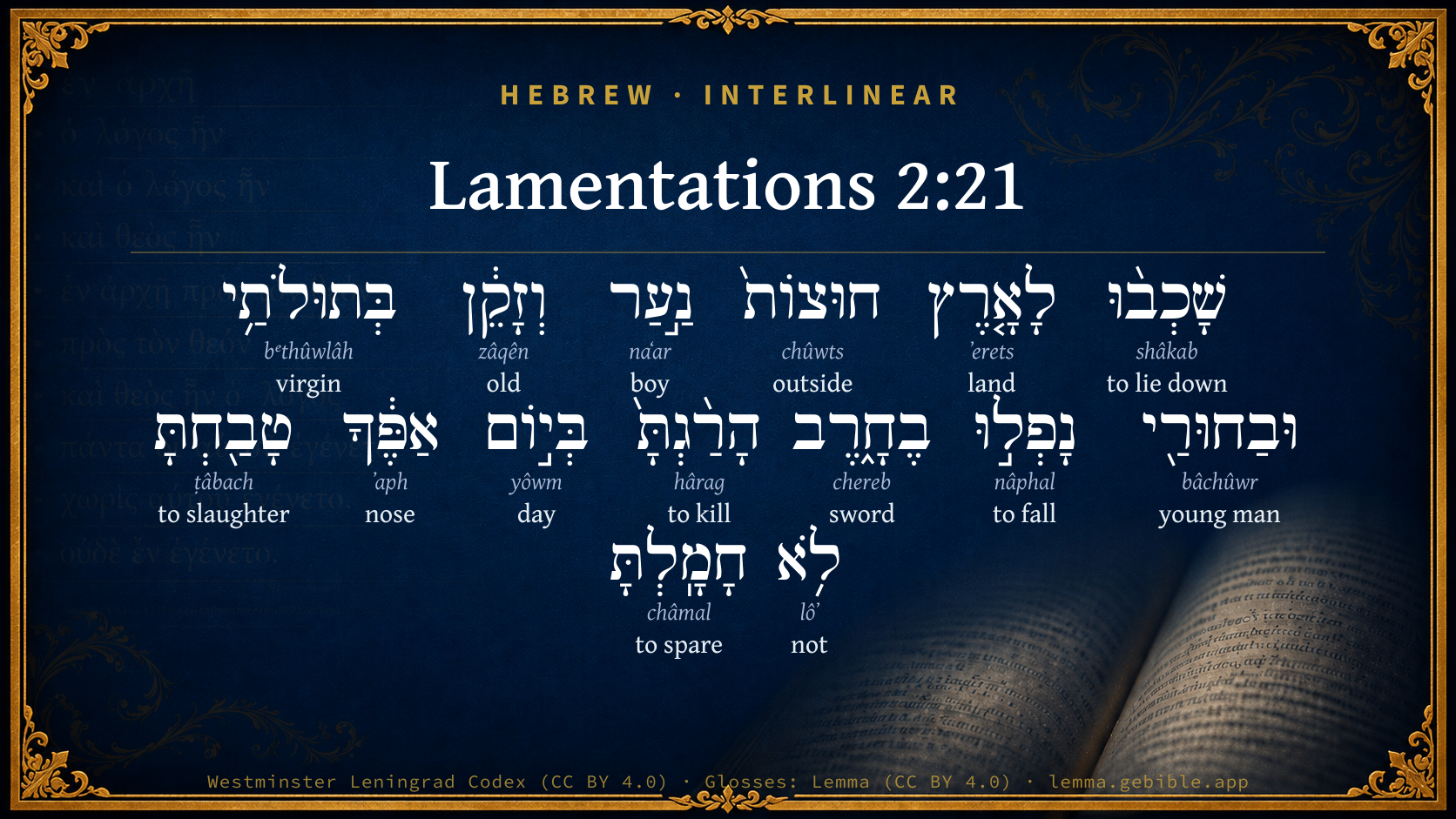
Lamentations 2:21

Hebrew (Westminster Leningrad Codex) Lamentations 2:21 appears in the Hebrew Old Testament. The text above is from the Westminster Leningrad Codex. Each word links to its Strong’s number, a concise gloss, and parsing drawn from the Open Scriptures Hebrew Bible morphology. Click any word for its full Brown-Driver-Briggs (BDB) entry.
Download image
Cite this verse

Lamentations 2:21 (World English Bible). Public Domain. Lemma interlinear Bible study tool, https://lemma.gebible.app/v/lamentations/2/21.

Show BibTeX & RIS
BibTeX
RIS
English Translation
The youth and the old man lie on the ground in the streets; My virgins and my young men are fallen by the sword: You have killed them in the day of your anger; you have slaughtered, [and] not pitied.
World English Bible · Public Domain
Download a study sheet

One document with this verse’s original text, its word-by-word gloss line, the meaning frame, cross-references with their text, attributed commentary, and full source and license credits — printable, and it pastes into notes with its structure intact.

This verse Autodidact and up

Study sheet (.html) Plain text (.txt)

A passage Seminary Student

Up to 50 verses in one chapter. A passage sheet keeps up to 6 commentary sources and 12 cross-references per verse, in the order this page ranks them, and says so on the sheet whenever that leaves anything out. Ask for a single verse and you get the Autodidact verse sheet above.

Everything on this page stays free to read, with no account — the sheet is a download of what is already on screen, not access to it.

Want to remove ads? Support Godless Engineer
Compare translations 3

The same verse in 3 English versions, stacked beneath the original-language interlinear above. Click any original word for its lexicon entry.

Each is an independent rendering of the whole verse — the interlinear is not word-aligned to these translations.

Highlighted words mark where these versions differ — a whole-verse word diff, not a word-by-word alignment.

  • World English Bible Public Domain
    The youth and the old man lie on the ground in the streets; My virgins and my young men are fallen by the sword: You have killed them in the day of your anger; you have slaughtered, [and] not pitied.
  • King James Version Public Domain
    The young and the old lie on the ground in the streets: my virgins and my young men are fallen by the sword; thou hast slain them in the day of thine anger; thou hast killed, and not pitied.
  • unfoldingWord Literal Text CC BY-SA 4.0
    Young and old lie down on the ground in the streets. My young women and my young men have fallen by the sword. You have slain on the day of your anger; you have slaughtered; you have not shown compassion. TAW

unfoldingWord Literal Text — © unfoldingWord, licensed CC BY-SA 4.0. Word-aligned USFM3 via Door43 (git.door43.org/unfoldingWord/en_ult).

Versions to compare (up to 4)

3 of 4 selected

Show all 18 translations

Every available English version of this verse, each an independent rendering of the whole verse.

  • World English Bible Public Domain
    The youth and the old man lie on the ground in the streets; My virgins and my young men are fallen by the sword: You have killed them in the day of your anger; you have slaughtered, [and] not pitied.
  • Berean Standard Bible Public Domain
    Both young and old lie together in the dust of the streets. My young men and maidens have fallen by the sword. You have slain them in the day of Your anger; You have slaughtered them without compassion.
  • Majority Standard Bible Public Domain
    Both young and old lie together in the dust of the streets. My young men and maidens have fallen by the sword. You have slain them in the day of Your anger; You have slaughtered them without compassion.
  • King James Version Public Domain
    The young and the old lie on the ground in the streets: my virgins and my young men are fallen by the sword; thou hast slain them in the day of thine anger; thou hast killed, and not pitied.
  • American Standard Version (1901) Public Domain
    The youth and the old man lie on the ground in the streets; My virgins and my young men are fallen by the sword: Thou hast slain them in the day of thine anger; thou hast slaughtered, `and' not pitied.
  • Revised Version (1885) Public Domain
    The youth and the old man lie on the ground in the streets; my virgins and my young men are fallen by the sword: thou hast slain them in the day of thine anger; thou hast slaughtered, and not pitied.
  • Geneva Bible (1599) Public Domain
    The yong and the olde lie on the ground in the streetes: my virgins and my yong men are fallen by the sworde: thou hast slaine them in the day of thy wrath: thou hast killed and not spared.
  • Douay-Rheims (1899) Public Domain
    Sin. The child and the old man lie without on the ground: my virgins and my young men are fallen by the sword: thou hast slain them in the day of thy wrath: thou hast killed, and shewn them no pity.
  • Young's Literal Translation Public Domain
    Lain on the earth `in' out-places have young and old, My virgins and my young men have fallen by the sword, Thou hast slain in a day of Thine anger, Thou hast slaughtered -- Thou hast not pitied.
  • Literal Standard Version CC BY-SA 4.0
    Lain on the earth [in] out-places have young and old, || My virgins and my young men have fallen by the sword, || You have slain in a day of Your anger, || You have slaughtered—You have not pitied.
  • Unlocked Literal Bible CC BY-SA 4.0
    Both the young and the old lie on the dust of the streets. My young women and my young men have fallen by the sword; you have slaughtered them without taking pity on them.
  • unfoldingWord Literal Text CC BY-SA 4.0
    Young and old lie down on the ground in the streets. My young women and my young men have fallen by the sword. You have slain on the day of your anger; you have slaughtered; you have not shown compassion. TAW
  • Darby Bible Public Domain
    The child and the old man lie on the ground in the streets; my virgins and my young men are fallen by the sword: thou hast slain [them] in the day of thine anger; thou hast killed, thou hast not spared.
  • World Messianic Bible Public Domain
    “The youth and the old man lie on the ground in the streets. My virgins and my young men have fallen by the sword. You have killed them in the day of your anger. You have slaughtered, and not pitied.
  • Webster's Bible Public Domain
    The young and the old lie on the ground in the streets: my virgins and my young men have fallen by the sword; thou hast slain them in the day of thy anger; thou hast killed, and not pitied.
  • Free Bible Version CC BY-SA 4.0
    The dead, young and old, lie together in the dust of the streets. My young men and young women, have been killed by the sword. You killed them when you were angry; you have slaughtered them without mercy.
  • Bible in Basic English Public Domain
    The young men and the old are stretched on the earth in the streets; my virgins and my young men have been put to the sword: you have sent death on them in the day of your wrath, causing death without pity.
  • JPS Tanakh (1917) Public Domain
    The youth and the old man lie on the ground in the streets; my virgins and my young men are fallen by the sword; Thou hast slain them in the day of Thine anger; Thou hast slaughtered unsparingly.

Literal Standard Version (2020), Covenant Press — licensed CC BY-SA 4.0. Text via the HelloAO Bible API (eBible.org). Unlocked Literal Bible (unfoldingWord) — licensed CC BY-SA 4.0. Text via the HelloAO Bible API (eBible.org). unfoldingWord Literal Text — © unfoldingWord, licensed CC BY-SA 4.0. Word-aligned USFM3 via Door43 (git.door43.org/unfoldingWord/en_ult). Free Bible Version, Dr. Jonathan Gallagher — licensed CC BY-SA 4.0. Text via the HelloAO Bible API (eBible.org).

Word by word

More ways to search: Search by grammar → Find every occurrence → Compare this word →

Practice this passage: Drill this verse → Learn its vocabulary →

טָבַ֖חְתָּ
ṭâbach
H2873
“to slaughter”
Verb, Qal, Perfect, 2nd Person, Masculine, Singular
Part of Speech
Verb
Stem
Qal
Form
Perfect
Person
2nd Person
Gender
Masculine
Number
Singular
Full BDB Definition

Origin: a primitive root

TWOT: 786

to slaughter, slay, butcher, kill ruthlessly - (Qal) - to slaughter, butcher - to slay, kill ruthlessly (figuratively)
  1. שָׁכְב֨וּ shâkab H7901 “to lie down” Verb, Qal, Perfect, 3rd Person, Common, Plural
  2. לָאָ֤רֶץ ʼerets H776 “to/for the · land” Preposition, Determined + Noun, Common, Both, Singular, Absolute
  3. חוּצוֹת֙ chûwts H2351 “streets” Noun, Common, Masculine, Plural, Absolute
  4. נַ֣עַר naʻar H5288 “boy” Noun, Common, Masculine, Singular, Absolute
  5. וְזָקֵ֔ן zâqên H2205 “and · old” Conjunction + Adjective, Adjective, Masculine, Singular, Absolute
  6. בְּתוּלֹתַ֥י bᵉthûwlâh H1330 “virgins · my” Noun, Common, Feminine, Plural, Construct + Suffix, Personal, 1st Person, Common, Singular
  7. וּבַחוּרַ֖י bâchûwr H970 “and · young men · my” Conjunction + Noun, Common, Masculine, Plural, Construct + Suffix, Personal, 1st Person, Common, Singular
  8. נָפְל֣וּ nâphal H5307 “to fall” Verb, Qal, Perfect, 3rd Person, Common, Plural
  9. בֶחָ֑רֶב chereb H2719 “in/at the · sword” Preposition, Determined + Noun, Common, Feminine, Singular, Absolute
  10. הָרַ֨גְתָּ֙ hârag H2026 “to kill” Verb, Qal, Perfect, 2nd Person, Masculine, Singular
  11. בְּי֣וֹם yôwm H3117 “in/at · day of” Preposition + Noun, Common, Masculine, Singular, Construct
  12. אַפֶּ֔ךָ ʼaph H639 “nose · your” Noun, Common, Masculine, Singular, Construct + Suffix, Personal, 2nd Person, Masculine, Singular
  13. לֹ֥א lôʼ H3808 “not” Particle, Negative
  14. חָמָֽלְתָּ châmal H2550 “to spare” Verb, Qal, Perfect, 2nd Person, Masculine, Singular

About this verse

These counts appear in no published source. They are computed here, from the morphology-tagged text and Lemma’s own curated glosses. What Lemma adds →

15
words
15
distinct lemmas
Prophets
section

Notable vocabulary

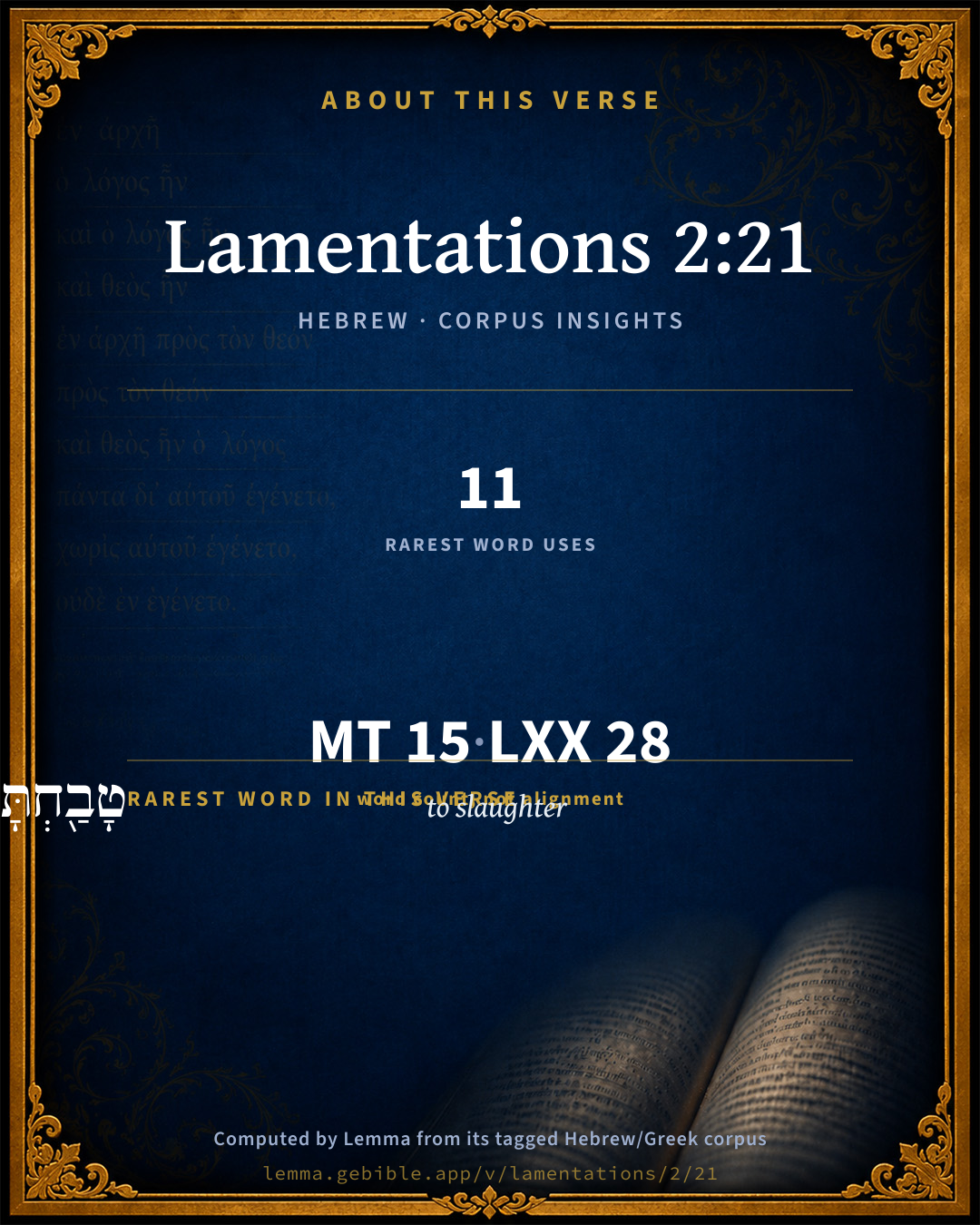
The rarest word here is טָבַ֖חְתָּ to slaughter H2873 — appearing just 11 times in the whole Hebrew Bible.

Shared distinctive vocabulary

טָבַ֖חְתָּ to slaughter H2873 occurs in 11 verses of the Hebrew Bible. Also found in:

Grammatical profile

  • 5 verbs
  • 8 nouns
  • 1 adjective
  • 1 particle

Verb forms

  • שָׁכְב֨וּ Qal · Perfect
  • נָפְל֣וּ Qal · Perfect
  • הָרַ֨גְתָּ֙ Qal · Perfect
  • טָבַ֖חְתָּ Qal · Perfect
  • חָמָֽלְתָּ Qal · Perfect

Hebrew & Septuagint length

In English translation the verse runs 40 words from the Hebrew and 46 from the Septuagint (LXX English) — closely comparable.

A rough comparison of the two English renderings, which tokenize alike — not a word-level alignment.

Word counts can differ between the Hebrew and the Greek without any difference in meaning — e.g. the Hebrew direct-object marker אֵת has no separate Greek word, and Greek often adds the article ὁ.

In the original languages it is 15 Hebrew tokens and 28 Greek tokens — but the two are counted differently (Hebrew bundles its prefixes and suffixes into one token; the Greek is in lemma form), so that isn’t a like-for-like length.

Cross-references

27

Topical passages linked to Lamentations 2:21 in the Treasury of Scripture Knowledge — connected by theme and wording, ordered by reader-vote popularity; previews shown in the World English Bible.

  • 2 Chronicles 36:17 Therefore he brought on them the king of the Chaldeans, who killed their young men with the sword in the house of their sanctuary, and had no compassion on young man or virgin, old man or gray-headed: he gave them all into his hand.
  • Zechariah 11:6 For I will no more pity the inhabitants of the land," says Yahweh; "but, behold, I will deliver the men everyone into his neighbor's hand, and into the hand of his king. They will strike the land, and out of their hand I will not deliver them."
  • Jeremiah 13:14 I will dash them one against another, even the fathers and the sons together, says Yahweh: I will not pity, nor spare, nor have compassion, that I should not destroy them.
  • Lamentations 3:43 You have covered with anger and pursued us; you have killed, you have not pitied.
  • Jeremiah 18:21 Therefore deliver up their children to the famine, and give them over to the power of the sword; and let their wives become childless, and widows; and let their men be slain of death, [and] their young men struck of the sword in battle.
  • Lamentations 1:15 The Lord has set at nothing all my mighty men in the midst of me; He has called a solemn assembly against me to crush my young men: The Lord has trodden as in a winepress the virgin daughter of Judah.
  • Lamentations 2:2 The Lord has swallowed up all the habitations of Jacob, and has not pitied: He has thrown down in his wrath the strongholds of the daughter of Judah; He has brought them down to the ground; he has profaned the kingdom and the princes of it.
  • Lamentations 2:17 Yahweh has done that which he purposed; he has fulfilled his word that he commanded in the days of old; He has thrown down, and has not pitied: He has caused the enemy to rejoice over you; he has exalted the horn of your adversaries.
  • Deuteronomy 28:50 a nation of fierce facial expressions, that shall not regard the person of the old, nor show favor to the young,
  • Joshua 6:21 They utterly destroyed all that was in the city, both man and woman, both young and old, and ox, and sheep, and donkey, with the edge of the sword.
  • 1 Samuel 15:3 Now go and strike Amalek, and utterly destroy all that they have, and don't spare them; but kill both man and woman, infant and suckling, ox and sheep, camel and donkey.
  • Esther 3:13 Letters were sent by posts into all the king's provinces, to destroy, to kill, and to cause to perish, all Jews, both young and old, little children and women, in one day, even on the thirteenth [day] of the twelfth month, which is the month Adar, and to take the spoil of them for a prey.
  • Psalms 78:62–63 He also gave his people over to the sword, And was angry with his inheritance.
  • Isaiah 27:11 When the boughs of it are withered, they shall be broken off; the women shall come, and set them on fire; for it is a people of no understanding: therefore he who made them will not have compassion on them, and he who formed them will show them no favor.
  • Jeremiah 6:11 Therefore I am full of the wrath of Yahweh; I am weary with holding in: pour it out on the children in the street, and on the assembly of young men together; for even the husband with the wife shall be taken, the aged with him who is full of days.
  • Jeremiah 9:21 For death is come up into our windows, it is entered into our palaces; to cut off the children from outside, [and] the young men from the streets.
  • Jeremiah 11:22 therefore thus says Yahweh of hosts, Behold, I will punish them: the young men shall die by the sword; their sons and their daughters shall die by famine;
  • Jeremiah 21:7 Afterward, says Yahweh, I will deliver Zedekiah king of Judah, and his servants, and the people, even such as are left in this city from the pestilence, from the sword, and from the famine, into the hand of Nebuchadrezzar king of Babylon, and into the hand of their enemies, and into the hand of those who seek their life: and he shall strike them with the edge of the sword; he shall not spare them, neither have pity, nor have mercy.
  • Jeremiah 51:22 and with you will I break in pieces the chariot and him who rides therein; and with you will I break in pieces man and woman; and with you will I break in pieces the old man and the youth; and with you will I break in pieces the young man and the virgin;
  • Lamentations 1:18 Yahweh is righteous; for I have rebelled against his commandment: Please hear all you peoples, and see my sorrow: My virgins and my young men are gone into captivity.
  • Ezekiel 5:11 Therefore, as I live, says the Lord Yahweh, surely, because you have defiled my sanctuary with all your detestable things, and with all your abominations, therefore will I also diminish [you]; neither shall my eye spare, and I also will have no pity.
  • Ezekiel 7:4 My eye shall not spare you, neither will I have pity; but I will bring your ways on you, and your abominations shall be in the midst of you: and you shall know that I am Yahweh.
  • Ezekiel 7:9 My eye shall not spare, neither will I have pity: I will bring on you according to your ways; and your abominations shall be in the midst of you; and you shall know that I, Yahweh, do strike.
  • Ezekiel 8:18 Therefore will I also deal in wrath; my eye shall not spare, neither will I have pity; and though they cry in my ears with a loud voice, yet will I not hear them.
  • Ezekiel 9:5–6 To the others he said in my hearing, Go you through the city after him, and strike: don't let your eye spare, neither have you pity;
  • Ezekiel 9:10 As for me also, my eye shall not spare, neither will I have pity, but I will bring their way on their head.
  • Amos 4:10 I sent plagues among you like I did Egypt. I have slain your young men with the sword, And have carried away your horses; And I filled your nostrils with the stench of your camp Yet you haven't returned to me," says Yahweh.

Cross-references courtesy of OpenBible.info (CC BY 4.0).

Hebrew and Greek witnesses Masoretic Hebrew ↔ Greek Septuagint

The same verse in the two great witnesses to the Old Testament, shown verse-for-verse.

These are two independent witnesses, not word-aligned to each other, and the Septuagint is shown in lemma (dictionary) form.

Hebrew Lamentations 2:21 Masoretic · Westminster Leningrad Codex

שָׁכְב֨וּ לָאָ֤רֶץ חוּצוֹת֙ נַ֣עַר וְזָקֵ֔ן בְּתוּלֹתַ֥י וּבַחוּרַ֖י נָפְל֣וּ בֶחָ֑רֶב הָרַ֨גְתָּ֙ בְּי֣וֹם אַפֶּ֔ךָ טָבַ֖חְתָּ לֹ֥א חָמָֽלְתָּ

The youth and the old man lie on the ground in the streets; My virgins and my young men are fallen by the sword: You have killed them in the day of your anger; you have slaughtered, [and] not pitied.

World English Bible · Public Domain

Greek LXX Lamentations 2:21 Septuagint · lemma form

κοιμάω εἰς ὁ ἔξοδος παιδάριον καί πρεσβύτης παρθένος ἐγώ καί νεανίσκος ἐγώ πορεύομαι ἐν αἰχμαλωσία ἐν ῥομφαία καί ἐν λιμός ἀποκτείνω ἐν ἡμέρα ὀργή σύ μαγειρεύω οὐ φείδομαι

CHSEN. The child and old man have lain down in the street: my virgins and my young men are gone into captivity: you have slain them with the sword and with famine; in the day of your wrath you have mangled them, you have not spared.

LXX2012 (modern English Septuagint) · Public Domain

Hebrew: Westminster Leningrad Codex (CC BY 4.0). Greek: Septuagint (public domain); English from LXX2012 (modern English Septuagint) (Public Domain). How the Septuagint differs from the Hebrew →

Commentary

Notes on Lamentations 2:21 from classic Christian and Jewish commentators (each source and its license shown beneath its notes). The classic Christian expositions comment on the surrounding passage and are grouped to its opening verse, so a note may address several verses; the Jewish commentaries on the Tanakh (Rashi and others) are per-verse, so they appear only where the commentator wrote on this verse.

Lemma curates 59 commentaries, every one of them public domain or Creative Commons licensed, each selected and text-cleaned for this edition rather than reprinted as found. About our sources →

Trapp's Complete Commentary

John Trapp

Lam 2:21 The young and the old lie on the ground in the streets: my virgins and my young men are fallen by the sword; thou hast slain [them] in the day of thine anger; thou hast killed, [and] not pitied.

Ver. 21. The young and the old lie on the ground in the streets.] Oh, the woe of war! oh, the bloody work that the sword maketh wheresoever it is in commission! Well may it be called "an evil, an only evil," by an antonomasy. {a} {Isa 45:7}

{a} The substitution of an epithet or appellative, or the name of an office or dignity, for a person’s proper name, as the Iron Duke for Wellington, his Grace for an archbishop. Also, conversely, the use of a proper name to express a general idea, as in calling an orator a Cicero, a wise judge a Daniel. ŒD

John Trapp, A Commentary or Exposition upon All the Books of the Old and New Testament (1647–1656) — public domain. Text from a community e-Sword module.

The Biblical Illustrator

Joseph S. Exell

Lam_2:21

The young and the old lie on the ground in the streets.

Unburied

1. When God punisheth a people for sin, He spareth neither age nor sex.

2. It is a sign of Gods anger upon a people, when they want decent burial (Psa_79:3).

3. The wicked will do most barbarous things, when God bridleth them not.

4. As God is full of mercy in His longsuffering, so is His anger unappeasable when it breaketh out. (J. Udall.)

The Biblical Illustrator, edited by Joseph S. Exell (c. 1880s–1900s) — public domain. Text from a community e-Sword module.

Jamieson, Fausset & Brown

Robert Jamieson, A. R. Fausset & David Brown

(Ch2 36:17).

Jamieson, Fausset & Brown — Commentary Critical and Explanatory on the Whole Bible (1871) — public domain (CC PDM 1.0). Text via the HelloAO Bible API.

John Calvin's Commentaries

Here he relates in the person of the Church another calamity, that the young and the aged were lying prostrate in the streets; and he joins children to the old men, to shew that there was no difference as to age. Then he says that dead bodies were lying promiscuously in public places. He adds, that virgins and young men had fallen by the sword; by which he confirms the previous clause, for there is nothing new said here, but only the manner is shewn by which they had been slain; for slain by the sword had been the young men and young women without any distinction; the enemies at the same time had not spared the old, while they killed the very flower of the people.

But the Prophet at the same time shews that all this was to be ascribed to God, not. that the Jews might expostulate with him, but that they might cease vainly to lament their calamities, and in order that they might on the contrary turn to God. Hence he does not say that the young and the old had been slain by the enemies, but by God himself. But it was difficult to convince the Jews of this, for they were so filled with rage against their enemies, that they could not turn their thoughts to the consideration of God’s judgments. This, then, is the reason why the Prophet makes God the author of all their calamities; Thou, he says, hast slain in the day of thy wrath; thou hast killed and not spared. And though the people seem here in a manner to contend with God, we must yet bear in mind the design of the Prophet, even to teach the people to look to God himself, so that they might know that they had to do with him. For there ought to be a passing from one truth to another, so that men, conscious of their sins, should first give glory to God, and then humbly deprecate the wrath which they have deserved. It follows at length, —

John Calvin's Commentaries (1540-1563) — public domain. Text from the Calvin Translation Society English edition (1840s-50s) via the Christian Classics Ethereal Library (ccel.org). Calvin's coverage is partial (roughly two-thirds of the Bible); uncommented books and verses are honest gaps, never fabricated. The 19th-century editor's footnotes and remarks are omitted so the notes are faithfully Calvin's own voice.

Ellicott's Commentary for English Readers

(21) The young and the old . . .—The thoughts of the mourner turn from the massacre in the sanctuary to the slaughter which did its dread work in every corner of the city.

A Bible Commentary for English Readers, edited by Charles John Ellicott (1878–1897) — public domain. Text from a community e-Sword module.

John Gill's Exposition

The young and the old lie on the ground in the streets,.... Young men and old men, virgins and aged women; these promiscuously lay on the ground in the public streets, fainting and dying for want of food; or lay killed there by the sword of the enemy; the Chaldeans sparing neither age nor sex. The Targum interprets it of their sleeping on the ground,

"young men slept on the ground in the villages, and old men who used to lie on pillows of fine wool, and on beds of ivory;''

but the former sense is confirmed by what follows:

my virgins and my young men are fallen by the sword; by the sword of the Chaldeans, when they entered the city:

thou hast slain them in the day of thine anger: thou hast killed,

and not pitied; the Chaldeans were only instruments; it was the Lord's doing; it was according to his will; it was what he had purposed and decreed; what he had solemnly declared and threatened; and now in his providence brought about, for the sins of the Jews, by which he was provoked to anger; and so gave them up into the hands of their enemies, to slay them without mercy; and which is here owned; the church takes notice of the hand of God in all this.

John Gill's Exposition of the Whole Bible (1746–1763) — public domain (CC PDM 1.0). Text via the HelloAO Bible API.

Albert Barnes' Notes on the Bible

Omit “them” and “and,” which weaken the intensity of the passage.

Albert Barnes' Notes on the Bible (1834–1885) — public domain. Text from a community e-Sword/MySword module.

Haydock's Catholic Bible Commentary

Killed. Literally, "stricken" (Haydock) with unusual severity. (Worthington)

George Leo Haydock (1774–1849), Haydock's Catholic Family Bible and Commentary, 1859 edition — public domain. Excludes Psalms (Douay-Rheims chapter numbering differs from Protestant) and Deuterocanonical books (Catholic canon only).

Matthew Poole's English Annotations

None of what sex or age soever are spared: though the hands of the Chaldeans have done this, yet they have been set on and assisted by thee, and have been but the executioners of thy wrath and displeasure.

Matthew Poole's English Annotations on the Holy Bible (1683–1685) — public domain. Text from a community e-Sword/MySword module.

Whedon's Commentary on the Bible

Daniel D. Whedon

21. Young and… old — More literally, boy and old man.

Daniel D. Whedon (gen. ed.), Commentary on the Old and New Testaments (1874–1909) — public domain. Text from a community e-Sword module.

unfoldingWord translationNotes

Door43 World Missions Community

Both the young and the old lie on the dust

It is implied here that this refers to dead people. AT: "The corpses of both the young and the old lie on the dust" (See: Assumed Knowledge and Implicit Information)

Both the young and the old

These phrases refer to people. These two opposites are used to refer to all ages of people. AT: "Both young people and old people" or "People of all ages" (See: Nominal Adjectives and Merism)

My young women and my young men have fallen by the sword

Here the "sword" refers to their enemies. This is a euphemism that means that they were murdered by their enemies. AT: "My young women and my young men have been murdered by their enemies" or "My enemies have murdered my young women and my young men" (See: Euphemism)

you have slaughtered them

This speaks of Yahweh allowing the poeple to be slaughtered as if he killed them himself. AT: "you allowed them to be slaughtered" or "you allowed this to happen" (See: Metonymy)

as you would call the people to a feast day

"as if they were coming to a feast." This speaks of how Yahweh summoned his enemies as if he were inviting them to a feast. (See: Simile)

my terrors

Here the people the author fears are referred to as his "terrors." AT: "the attackers I was afraid of" (See: Metonymy)

on every side

This is an idiom. AT: "to attack from every direction" (See: Idiom)

on the day of the anger of Yahweh

Here "day" is used as an idiom that refers to a general period of time. AT: "at the time when Yahweh acted in his anger" or "during the time that Yahweh displayed his anger" (See: Idiom)

translationWords

virgin

sword

slaughter

wrath

compassion

terror

assembly

Yahweh

adversary

unfoldingWord translationNotes — © Distant Shores Media and the Door43 World Missions Community, licensed CC BY-SA 4.0. Source: git.door43.org/Door43/en_tn.

Lesson kit

Teaching starters — assembled from the data on this page, not authored interpretation. Every prompt links to the verse data it draws on. Edit before teaching.

Lamentations, in the Prophets, opens this verse with 15 words (15 distinct Hebrew lemmas). Its most distinctive word is ṭâbach (“to slaughter”). A historical commentator’s framing appears above. Read the whole chapter for the surrounding context.

Discussion questions

  1. The word ṭâbach carries the sense “to slaughter.” How does it shape the verse?
  2. Genesis 43:16 shares the word «to slaughter» with this verse. How do the two illuminate each other?
  3. The translations on this page render this verse differently — a whole-verse word diff, not a word-by-word alignment. What might account for the different wordings?
  4. The verb «שָׁכְב֨וּ» is Qal Perfect. How does its form color the action?
  5. Reading how Trapp's Complete Commentary and The Biblical Illustrator read this verse, where do the two commentators agree and where do they part?

Things to notice

Reading settings

Reading text

Shown beneath each verse's original-language words.

Old Testament
Old Testament edition

Read the OT as the Masoretic Hebrew (MT) or the Greek Septuagint (LXX).

English shown for the Greek Septuagint (in the Hebrew ↔ Greek comparison).

Comparing translations? Open the Compare panel on any verse page to stack up to four side by side.