Ezekiel 28:9

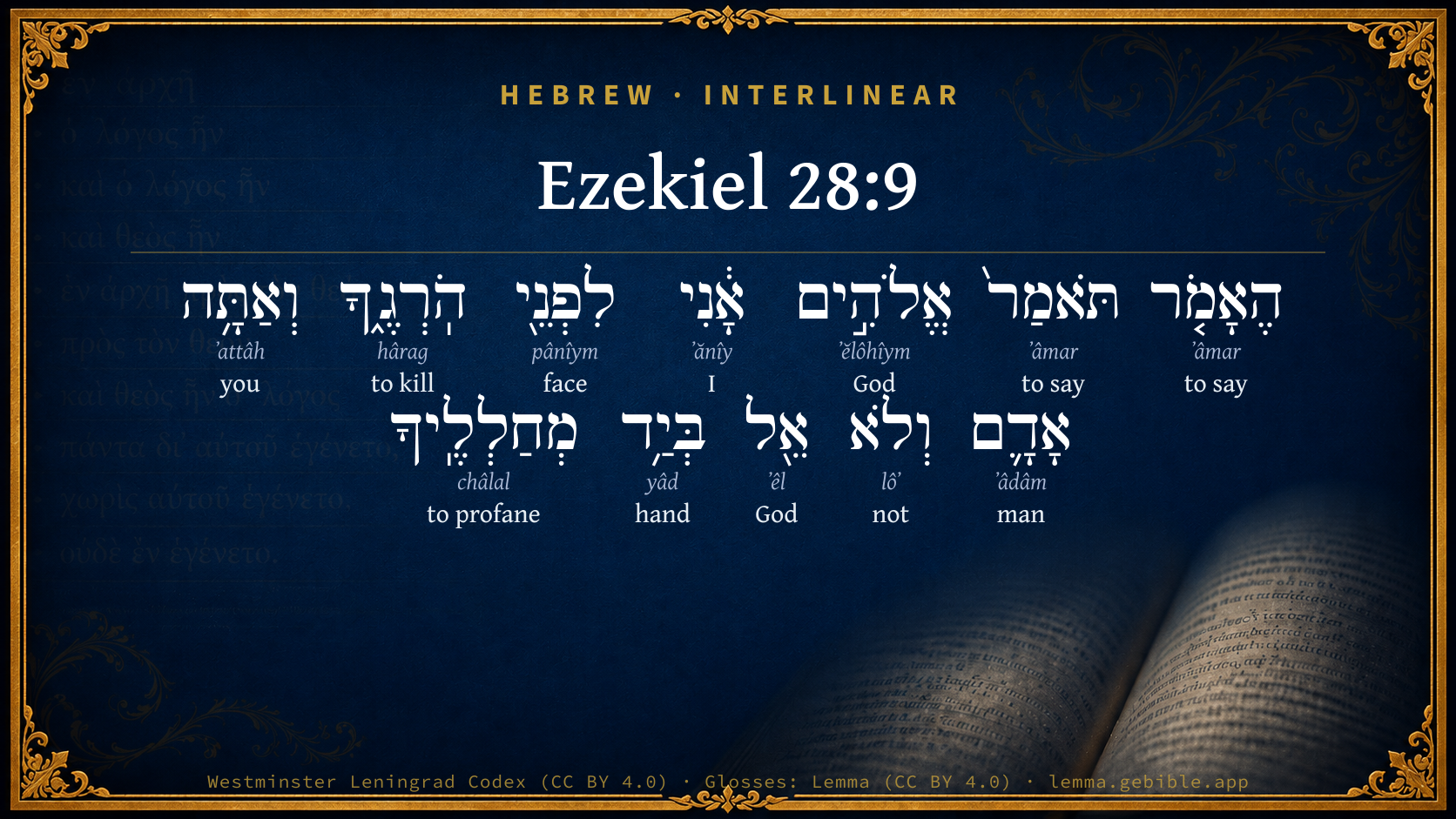
Hebrew (Westminster Leningrad Codex) Ezekiel 28:9 appears in the Hebrew Old Testament. The text above is from the Westminster Leningrad Codex. Each word links to its Strong’s number, a concise gloss, and parsing drawn from the Open Scriptures Hebrew Bible morphology. Click any word for its full Brown-Driver-Briggs (BDB) entry.
Download image
Cite this verse

Ezekiel 28:9 (World English Bible). Public Domain. Lemma interlinear Bible study tool, https://lemma.gebible.app/v/ezekiel/28/9.

Show BibTeX & RIS
BibTeX
RIS
English Translation
Will you yet say before him who kills you, I am God? but you are man, and not God, in the hand of him who wounds you.
World English Bible · Public Domain
Download a study sheet

One document with this verse’s original text, its word-by-word gloss line, the meaning frame, cross-references with their text, attributed commentary, and full source and license credits — printable, and it pastes into notes with its structure intact.

This verse Autodidact and up

Study sheet (.html) Plain text (.txt)

A passage Seminary Student

Up to 50 verses in one chapter. A passage sheet keeps up to 6 commentary sources and 12 cross-references per verse, in the order this page ranks them, and says so on the sheet whenever that leaves anything out. Ask for a single verse and you get the Autodidact verse sheet above.

Everything on this page stays free to read, with no account — the sheet is a download of what is already on screen, not access to it.

Want to remove ads? Support Godless Engineer
Compare translations 3

The same verse in 3 English versions, stacked beneath the original-language interlinear above. Click any original word for its lexicon entry.

Each is an independent rendering of the whole verse — the interlinear is not word-aligned to these translations.

Highlighted words mark where these versions differ — a whole-verse word diff, not a word-by-word alignment.

  • World English Bible Public Domain
    Will you yet say before him who kills you, I am God? but you are man, and not God, in the hand of him who wounds you.
  • King James Version Public Domain
    Wilt thou yet say before him that slayeth thee, I am God? but thou shalt be a man, and no God, in the hand of him that slayeth thee.
  • unfoldingWord Literal Text CC BY-SA 4.0
    Will you truly say, “I am a god” to the face of one who kills you? You are a man and not God, and you will be in the hand of the one who pierces you.

unfoldingWord Literal Text — © unfoldingWord, licensed CC BY-SA 4.0. Word-aligned USFM3 via Door43 (git.door43.org/unfoldingWord/en_ult).

Versions to compare (up to 4)

3 of 4 selected

Show all 18 translations

Every available English version of this verse, each an independent rendering of the whole verse.

  • World English Bible Public Domain
    Will you yet say before him who kills you, I am God? but you are man, and not God, in the hand of him who wounds you.
  • Berean Standard Bible Public Domain
    Will you still say, ‘I am a god,’ in the presence of those who slay you? You will be only a man, not a god, in the hands of those who wound you.
  • Majority Standard Bible Public Domain
    Will you still say, ‘I am a god,’ in the presence of those who slay you? You will be only a man, not a god, in the hands of those who wound you.
  • King James Version Public Domain
    Wilt thou yet say before him that slayeth thee, I am God? but thou shalt be a man, and no God, in the hand of him that slayeth thee.
  • American Standard Version (1901) Public Domain
    Wilt thou yet say before him that slayeth thee, I am God? but thou art man, and not God, in the hand of him that woundeth thee.
  • Revised Version (1885) Public Domain
    Wilt thou yet say before him that slayeth thee, I am God? but thou art man, and not God, in the hand of him that woundeth thee.
  • Geneva Bible (1599) Public Domain
    Wilt thou say then before him, that slayeth thee, I am a god? but thou shalt be a man, and no God, in the hands of him that slayeth thee.
  • Douay-Rheims (1899) Public Domain
    Wilt thou yet say before them that slay thee: I am God; whereas thou art a man, and not God, in the hand of them that slay thee?
  • Young's Literal Translation Public Domain
    Dost thou really say, `I `am' God,' Before him who is slaying thee? And thou `art' man, and not God, In the hand of him who is piercing thee.
  • Literal Standard Version CC BY-SA 4.0
    Do you really say, I [am] God, || Before him who is slaying you? And you [are] man, and not God, || In the hand of him who is piercing you.
  • Unlocked Literal Bible CC BY-SA 4.0
    Will you truly say, “I am a god” to the face of one who kills you? You are a man and not God, and you will be in the hand of the one who pierces you.
  • unfoldingWord Literal Text CC BY-SA 4.0
    Will you truly say, “I am a god” to the face of one who kills you? You are a man and not God, and you will be in the hand of the one who pierces you.
  • Darby Bible Public Domain
    Wilt thou then say before him that slayeth thee, I am God? but thou shalt be a man, and not ùGod, in the hand of him that pierceth thee.
  • World Messianic Bible Public Domain
    Will you yet say before him who kills you, ‘I am God’? But you are man, and not God, in the hand of him who wounds you.
  • Webster's Bible Public Domain
    Wilt thou yet say before him that slayeth thee, I am God? but thou shalt be a man, and no god, in the hand of him that slayeth thee.
  • Free Bible Version CC BY-SA 4.0
    Are you still going to claim, ‘I'm a god,’ to those who are killing you? You'll just be another human victim, not a god, in the eyes of your attackers.
  • Bible in Basic English Public Domain
    Will you say, in the face of those who are taking your life, I am God? but you are man and not God in the hands of those who are wounding you.
  • JPS Tanakh (1917) Public Domain
    Wilt thou yet say before him that slayeth thee: I am God? But thou art man, and not God, in the hand of them that defile thee.

Literal Standard Version (2020), Covenant Press — licensed CC BY-SA 4.0. Text via the HelloAO Bible API (eBible.org). Unlocked Literal Bible (unfoldingWord) — licensed CC BY-SA 4.0. Text via the HelloAO Bible API (eBible.org). unfoldingWord Literal Text — © unfoldingWord, licensed CC BY-SA 4.0. Word-aligned USFM3 via Door43 (git.door43.org/unfoldingWord/en_ult). Free Bible Version, Dr. Jonathan Gallagher — licensed CC BY-SA 4.0. Text via the HelloAO Bible API (eBible.org).

Word by word

More ways to search: Search by grammar → Find every occurrence → Compare this word →

Practice this passage: Drill this verse → Learn its vocabulary →

מְחַלְלֶֽיךָ
châlal
H2490
“profaning · you”
Verb, Piel, Participle Active, Masculine, Plural, Construct + Suffix, Personal, 2nd Person, Masculine, Singular
Part of Speech
Verb
Stem
Piel
Form
Participle Active
Gender
Masculine
Number
Plural
State
Construct
Full BDB Definition

Origin: a primitive root [compare H2470 ]

TWOT: 660 , 661

to profane, defile, pollute, desecrate, begin - (Niphal) - to profane oneself, defile oneself, pollute oneself - ritually - sexually - to be polluted, be defiled - (Piel) - to profane, make common, defile, pollute - to violate the honour of, dishonour - to violate (a covenant) - to treat as common - (Pual) to profane (name of God) - (Hiphil) - to let be profaned - to begin - (Hophal) to be begun - to wound (fatally), bore through, pierce, bore - (Qal) to pierce - (Pual) to be slain - (Poel) to wound, pierce - (Poal) to be wounded - (Piel) to play the flute or pipe

  1. הֶאָמֹ֤ר ʼâmar H559 “to say” Particle, Interrogative + Verb, Qal, Infinitive Absolute
  2. תֹּאמַר֙ ʼâmar H559 “to say” Verb, Qal, Imperfect, 2nd Person, Masculine, Singular
  3. אֱלֹהִ֣ים ʼĕlôhîym H430 “God(s)” Noun, Common, Masculine, Plural, Absolute
  4. אָ֔נִי ʼănîy H589 “I” Pronoun, Personal, 1st Person, Common, Singular
  5. לִפְנֵ֖י pânîym H6440 “to/for · face(s) of” Preposition + Noun, Common, Both, Plural, Construct
  6. הֹֽרְגֶ֑ךָ hârag H2026 “killing · you” Verb, Qal, Participle Active, Masculine, Plural, Construct + Suffix, Personal, 2nd Person, Masculine, Singular
  7. וְאַתָּ֥ה ʼattâh H859 “and · you” Conjunction + Pronoun, Personal, 2nd Person, Masculine, Singular
  8. אָדָ֛ם ʼâdâm H120 “man” Noun, Common, Masculine, Singular, Absolute
  9. וְלֹא lôʼ H3808 “and · not” Conjunction + Particle, Negative
  10. אֵ֖ל ʼêl H410 “God” Noun, Common, Masculine, Singular, Absolute
  11. בְּיַ֥ד yâd H3027 “in/at · hand of” Preposition + Noun, Common, Both, Singular, Construct

About this verse

These counts appear in no published source. They are computed here, from the morphology-tagged text and Lemma’s own curated glosses. What Lemma adds →

12
words
11
distinct lemmas
Prophets
section

Grammatical profile

  • 4 verbs
  • 5 nouns
  • 2 pronouns
  • 1 particle

Verb forms

  • הֶאָמֹ֤ר Qal · Infinitive Absolute
  • תֹּאמַר֙ Qal · Imperfect
  • הֹֽרְגֶ֑ךָ Qal · Participle Active
  • מְחַלְלֶֽיךָ Piel · Participle Active

Repetition

A word recurs within this verse — often emphatic in Hebrew:

  • הֶאָמֹ֤ר to say H559 ×2

Hebrew & Septuagint length

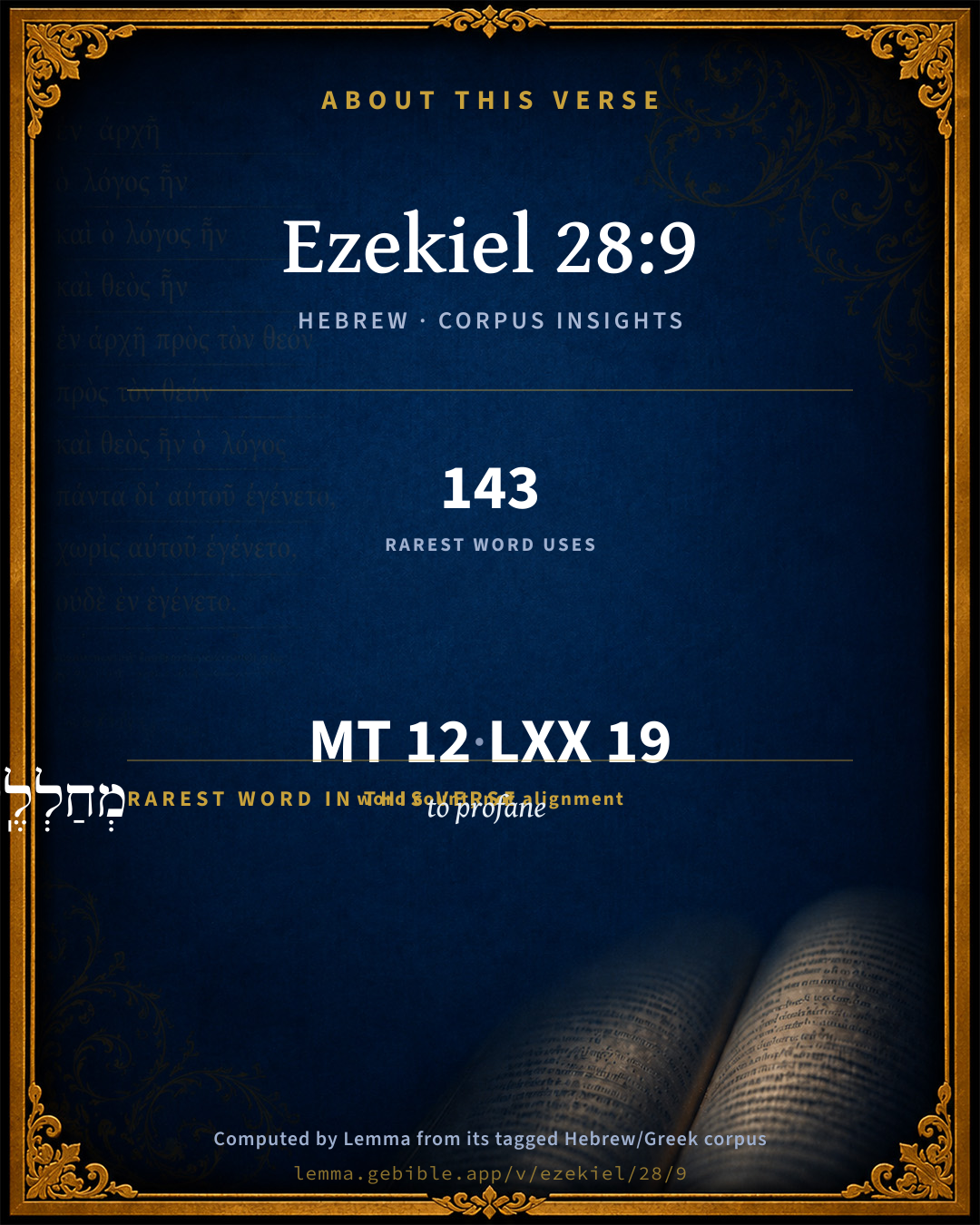
In English translation the verse runs 27 words from the Hebrew and 19 from the Septuagint (LXX English) — the Septuagint runs noticeably shorter here. See the side-by-side →

A rough comparison of the two English renderings, which tokenize alike — not a word-level alignment.

Word counts can differ between the Hebrew and the Greek without any difference in meaning — e.g. the Hebrew direct-object marker אֵת has no separate Greek word, and Greek often adds the article ὁ.

In the original languages it is 12 Hebrew tokens and 19 Greek tokens — but the two are counted differently (Hebrew bundles its prefixes and suffixes into one token; the Greek is in lemma form), so that isn’t a like-for-like length.

Cross-references

6

Topical passages linked to Ezekiel 28:9 in the Treasury of Scripture Knowledge — connected by theme and wording, ordered by reader-vote popularity; previews shown in the World English Bible.

  • Ezekiel 28:2 Son of man, tell the prince of Tyre, Thus says the Lord Yahweh: Because your heart is lifted up, and you have said, I am a god, I sit in the seat of God, in the midst of the seas; yet you are man, and not God, though you did set your heart as the heart of God;-
  • Psalms 82:7 Nevertheless you shall die like men, And fall like one of the rulers."
  • Isaiah 31:3 Now the Egyptians are men, and not God; and their horses flesh, and not spirit: and when Yahweh shall stretch out his hand, both he who helps shall stumble, and he who is helped shall fall, and they all shall be consumed together.
  • Daniel 4:31–32 While the word was in the king's mouth, there fell a voice from the sky, [saying], O king Nebuchadnezzar, to you it is spoken: The kingdom is departed from you:
  • Daniel 5:23–30 but have lifted up yourself against the Lord of heaven; and they have brought the vessels of his house before you, and you and your lords, your wives and your concubines, have drunk wine from them; and you have praised the gods of silver and gold, of brass, iron, wood, and stone, which don't see, nor hear, nor know; and the God in whose hand your breath is, and whose are all your ways, you have not glorified.
  • Acts 12:22–23 The people shouted, "The voice of a god, and not of a man!"

Cross-references courtesy of OpenBible.info (CC BY 4.0).

Hebrew and Greek witnesses Masoretic Hebrew ↔ Greek Septuagint

The same verse in the two great witnesses to the Old Testament, shown verse-for-verse.

Here the Septuagint runs noticeably shorter than the Hebrew — LXX2012 (modern English Septuagint) 19 words vs World English Bible 27. A rough length comparison of the two English translations, not a word-level alignment — read both below.

These are two independent witnesses, not word-aligned to each other, and the Septuagint is shown in lemma (dictionary) form.

Hebrew Ezekiel 28:9 Masoretic · Westminster Leningrad Codex

הֶאָמֹ֤ר תֹּאמַר֙ אֱלֹהִ֣ים אָ֔נִי לִפְנֵ֖י הֹֽרְגֶ֑ךָ וְאַתָּ֥ה אָדָ֛ם וְלֹא אֵ֖ל בְּיַ֥ד מְחַלְלֶֽיךָ

Will you yet say before him who kills you, I am God? but you are man, and not God, in the hand of him who wounds you.

World English Bible · Public Domain

Greek LXX Ezekiel 28:9 Septuagint · lemma form

μή λέγω εἶπον θεός εἰμί ἐγώ ἐνώπιον ὁ ἀνααἱρέω σύ σύ δέ εἰμί ἄνθρωπος καί οὐ θεός ἐν πλῆθος

Will you indeed say, I am God, before them that kill you? whereas you are man, and not God.

LXX2012 (modern English Septuagint) · Public Domain

On this verse, The Cambridge Bible for Schools and Colleges discusses the Septuagint’s reading. Read the note in Commentary ↓

Hebrew: Westminster Leningrad Codex (CC BY 4.0). Greek: Septuagint (public domain); English from LXX2012 (modern English Septuagint) (Public Domain). How the Septuagint differs from the Hebrew →

Targum (Aramaic paraphrase)

1

The Targum is the ancient Jewish Aramaic paraphrase of the Hebrew Scriptures — an interpretive translation, not the Hebrew text itself. Onkelos (literal) and Pseudo-Jonathan (expansive) render the Torah, and Jonathan the Prophets. Coverage is partial: where no permissively-licensed English translation exists for a verse, only the Aramaic is shown. This is verse-level text, not a word-by-word alignment to the Hebrew.

  1. Targum Jonathan Prophets (Joshua–Malachi)
    הֲמֵימַר תֵּימַר דַחֲלָא אֲנָא קֳדָם דְקַטְלָךְ וְאַתְּ אֱנָשָׁא וְלֵית בָּךְ צְרוֹךְ בְּיַד מְחַבְּלָךְ:

    (no public-domain English translation for this verse)

    Targum Jonathan — Aramaic: “Mikraot Gedolot” (public domain). English: “Sefaria Community Translation” (CC0 1.0 (public-domain dedication)); “London "Chaldee Paraphrase," 1871” (public domain). Text via Sefaria.

Commentary

Notes on Ezekiel 28:9 from classic Christian and Jewish commentators (each source and its license shown beneath its notes). The classic Christian expositions comment on the surrounding passage and are grouped to its opening verse, so a note may address several verses; the Jewish commentaries on the Tanakh (Rashi and others) are per-verse, so they appear only where the commentator wrote on this verse.

Lemma curates 59 commentaries, every one of them public domain or Creative Commons licensed, each selected and text-cleaned for this edition rather than reprinted as found. About our sources →

Trapp's Complete Commentary

John Trapp

Eze 28:9 Wilt thou yet say before him that slayeth thee, I [am] God? but thou [shalt be] a man, and no God, in the hand of him that slayeth thee.

Ver. 9. Wilt thou say before him that slayeth thee, I am God?] That will prove a poor plea, and thou wilt soon be confuted, as afterwards great Alexander confuted his flatterers, when, being wounded in fight, he showed them his blood.

John Trapp, A Commentary or Exposition upon All the Books of the Old and New Testament (1647–1656) — public domain. Text from a community e-Sword module.

Joseph Benson's Commentary

Eze 28:9. Wilt thou yet say — Or, Wilt thou then say, before him that slayeth thee, I am God — Nothing can be more finely expressed than this: the prince of Tyrus thought himself, as a god, as invincible, as secure from all harm; God therefore, by his prophet, asks him here if he would have these proud thoughts, if he would think of himself as a god, when he found himself in his enemy’s power, just going to be slain. The question is most sharp and cutting: it sets the folly of his insolent pride in the strongest light; for surely he could not boast of being a god, when he was to fall by the sword of a man; and whatever proud thoughts he now entertained of himself, they certainly would be changed when he saw the sword of his enemy lifted up to slay him. So Plutarch tells us of Alexander, that “he vainly affected to be thought Jupiter’s son, and next in honour to Bacchus and Hercules: yet when he saw the blood run out of a wound he had received, which at the same time gave him much pain, he confessed that was not such blood as Homer said issued from the immortal gods.” — Lib. 2, De Alexandri fortuna. This whole chapter, as well as the foregoing one, is exceedingly fine, both as to the style and composition.

Joseph Benson's Commentary on the Old and New Testaments (1811–1818) — public domain. Text from a community e-Sword module.

Jamieson, Fausset & Brown

Robert Jamieson, A. R. Fausset & David Brown

yet say--that is, still say; referring to Eze 28:2.

but, &c.--But thy blasphemous boastings shall be falsified, and thou shalt be shown to be but man, and not God, in the hand (at the mercy) of Him.

Jamieson, Fausset & Brown — Commentary Critical and Explanatory on the Whole Bible (1871) — public domain (CC PDM 1.0). Text via the HelloAO Bible API.

Adam Clarke's Commentary

Verse 9. Wilt thou yet say before him that slayeth thee] Wilt thou continue thy pride and arrogance when the sword is sheathed in thee, and still imagine that thou art self-sufficient and independent?

Adam Clarke's Commentary on the Bible (1810–1826) — public domain. Text from a community e-Sword/MySword module.

Ellicott's Commentary for English Readers

(9) Thou shalt be a man.—The future, added to the text by the words in italics, should be omitted. The original form is exactly the same as in Eze_28:2, and should be so translated. In both cases the article is better omitted. The contrast between the weakness of man and the power of God is strongly brought out: “yet thou art man, in the hand of him that slayeth thee.”

A Bible Commentary for English Readers, edited by Charles John Ellicott (1878–1897) — public domain. Text from a community e-Sword module.

The Cambridge Bible for Schools and Colleges

gen. ed. J. J. S. Perowne

9. but thou shalt be] Rather: whilst thou art man, and not God. The last clause “in the hand,” &c. is wanting in LXX.

The Cambridge Bible for Schools and Colleges (gen. ed. J. J. S. Perowne; Cambridge University Press, 1878–1918) — public domain. Text from a community e-Sword module.

John Gill's Exposition

Wilt thou yet say before him that slayeth thee, I am God?.... When thou art in the enemies' hands, and just going to be put to death, wilt thou then confidently assert thy deity, and to his face tell him that thou art God? surely thy courage and thy confidence, thy blasphemy and impiety, will leave thee then; a bitter sarcasm this! and so the pope of Rome, the antichristian beast, when taken, and just going to be cast into the lake of fire along with the false prophet, will not have the impudence to style himself God, or to call himself Christ's vicar on earth:

but thou shalt be a man, and no god, in the hand of him that slayeth thee; that is, thou shalt appear to be a poor, weak, frail, mortal, trembling, dying man, when got into the hand of the enemy, and he is just going to put an end to thy life; where will be then thy boasted deity?

John Gill's Exposition of the Whole Bible (1746–1763) — public domain (CC PDM 1.0). Text via the HelloAO Bible API.

Matthew Poole's English Annotations

A cutting taunt, or sarcasm: What will become of thy godship then? Wilt thou then dream of immortality and almighty power, when thine enemy is cutting thy throat?

Thou shalt be a man; appear thou to thyself and others to be a mortal, weak, conquered man, who dieth a sacrifice to the conqueror’s pride and cruelty.

Matthew Poole's English Annotations on the Holy Bible (1683–1685) — public domain. Text from a community e-Sword/MySword module.

Whedon's Commentary on the Bible

Daniel D. Whedon

9, 10. Thou shalt be a man — Literally, thou art man (as Eze_28:2).

The deaths of the uncircumcised — Here, as Dr. Plumptre says, we reach the climax of Hebrew scorn. As the uncircumcised were to the Israelites (1 Samuel 17; 1 Samuel 26; 1Sa_31:4), so should the king of Tyre, unhonored, unwept, with no outward marks of reverence, be among the great ones of the past who dwell in Hades (Eze_31:18; Eze_32:24). If Herodotus is right in saying that the ancient Phoenicians practiced circumcision, it adds a double sting to these words.

Daniel D. Whedon (gen. ed.), Commentary on the Old and New Testaments (1874–1909) — public domain. Text from a community e-Sword module.

Rashi

Rabbi Shlomo Yitzchaki (Rashi)

your slayer [Heb. מְחַלְלֶךָ,] like הוֹרְגֶךָ.

Rashi on the Tanakh — English translations: “The Judaica Press complete Tanach with Rashi, translated by A. J. Rosenberg” (CC BY 4.0); “Pentateuch with Rashi's commentary by M. Rosenbaum and A.M. Silbermann, 1929-1934” (public domain); “The Metsudah Tanach series, Lakewood, N.J” (CC BY 4.0); and “The Book of Joshua, Metsudah Publications, 1997” (CC BY 4.0). Text via Sefaria.

Lesson kit

Teaching starters — assembled from the data on this page, not authored interpretation. Every prompt links to the verse data it draws on. Edit before teaching.

Ezekiel, in the Prophets, opens this verse with 12 words (11 distinct Hebrew lemmas). Its most distinctive word is châlal (“to profane”). The Greek Septuagint runs shorter here. A historical commentator’s framing appears above. Read the whole chapter for the surrounding context.

Discussion questions

  1. How does “to profane” (châlal) shape what this verse is saying?
  2. Ezekiel 28:2 shares this passage’s theme. How do the two illuminate each other?
  3. “to say” occurs 2× in this one verse. What is the effect of the repetition?
  4. Compared with the Hebrew, the Septuagint runs shorter here. What questions does that raise?
  5. These translations render this verse differently. What is at stake in choosing one wording over another?
  6. The verb «הֶאָמֹ֤ר» is Qal Infinitive Absolute. How does its form color the action?
  7. Reading how Trapp's Complete Commentary and Joseph Benson's Commentary read this verse, where do the two commentators agree and where do they part?

Things to notice

Reading settings

Reading text

Shown beneath each verse's original-language words.

Old Testament
Old Testament edition

Read the OT as the Masoretic Hebrew (MT) or the Greek Septuagint (LXX).

English shown for the Greek Septuagint (in the Hebrew ↔ Greek comparison).

Comparing translations? Open the Compare panel on any verse page to stack up to four side by side.