Psalms 10:8

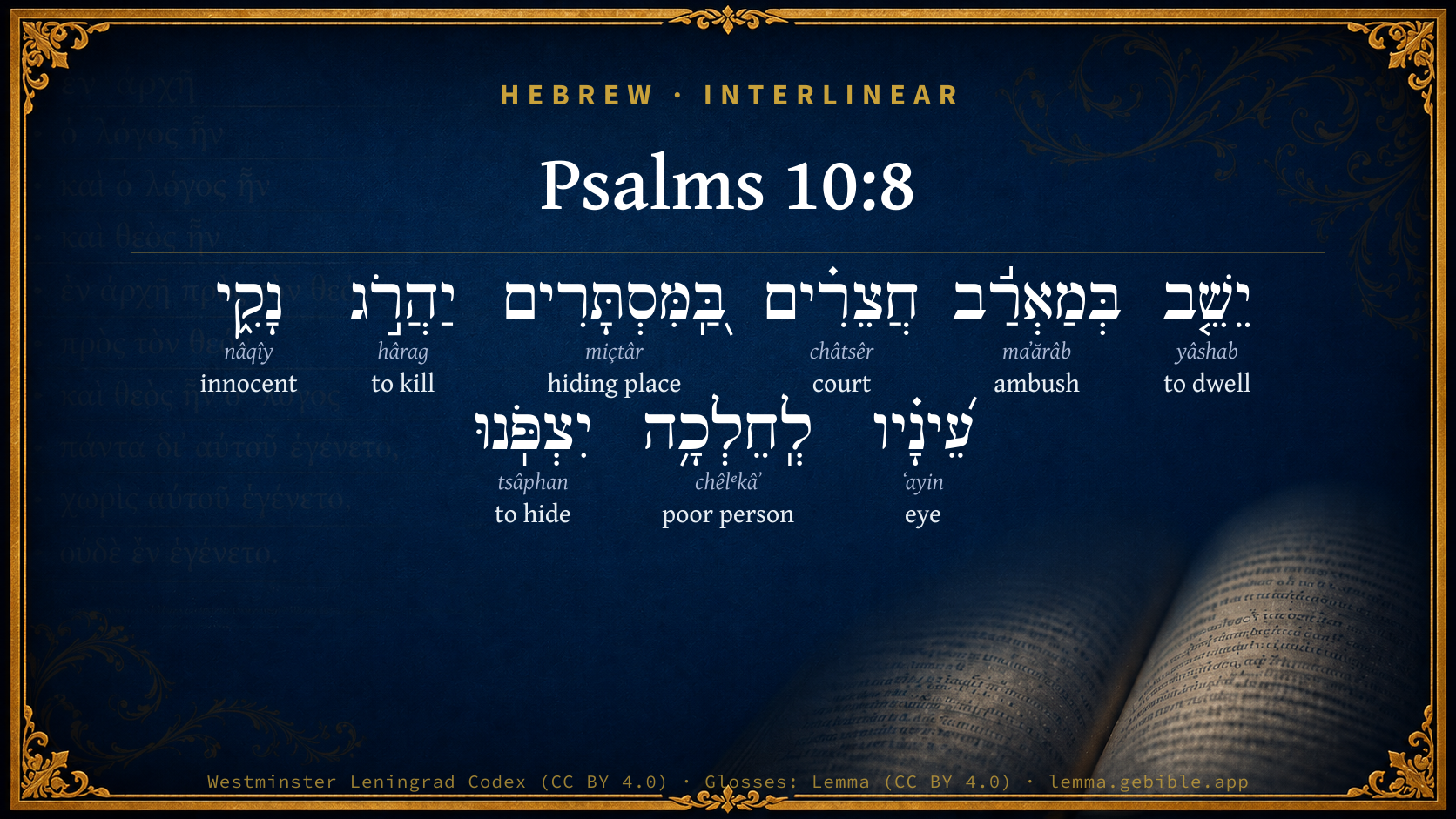
Hebrew (Westminster Leningrad Codex) Psalms 10:8 appears in the Hebrew Old Testament. The text above is from the Westminster Leningrad Codex. Each word links to its Strong’s number, a concise gloss, and parsing drawn from the Open Scriptures Hebrew Bible morphology. Click any word for its full Brown-Driver-Briggs (BDB) entry.
Download image
Cite this verse

Psalms 10:8 (World English Bible). Public Domain. Lemma interlinear Bible study tool, https://lemma.gebible.app/v/psalms/10/8.

Show BibTeX & RIS
BibTeX
RIS
English Translation
He lies in wait near the villages. From ambushes, he murders the innocent. His eyes are secretly set against the helpless.
World English Bible · Public Domain
Highlights
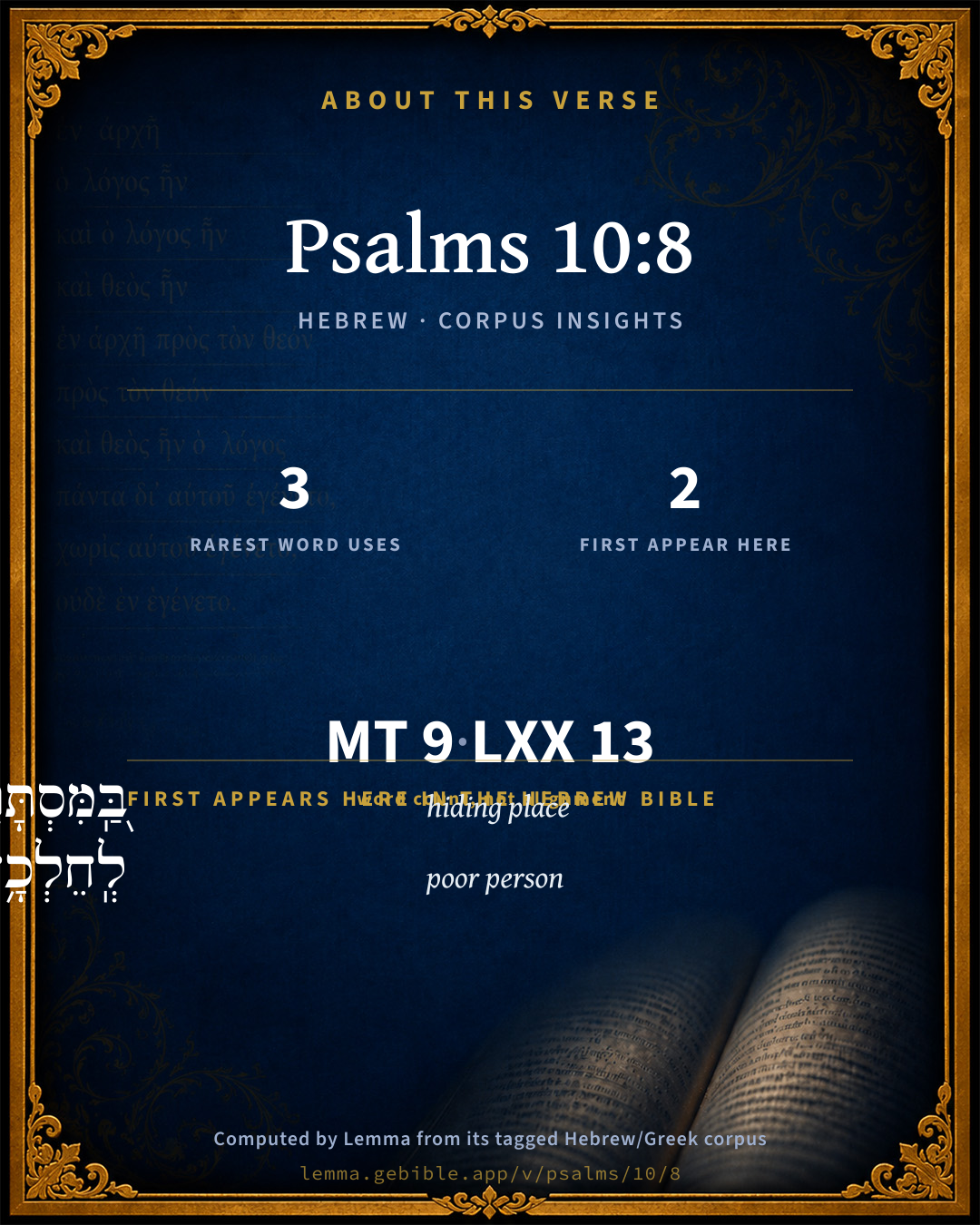
  • 2 first appearances in the Hebrew Bible
Full analysis ↓
Download a study sheet

One document with this verse’s original text, its word-by-word gloss line, the meaning frame, cross-references with their text, attributed commentary, and full source and license credits — printable, and it pastes into notes with its structure intact.

This verse Autodidact and up

Study sheet (.html) Plain text (.txt)

A passage Seminary Student

Up to 50 verses in one chapter. A passage sheet keeps up to 6 commentary sources and 12 cross-references per verse, in the order this page ranks them, and says so on the sheet whenever that leaves anything out. Ask for a single verse and you get the Autodidact verse sheet above.

Everything on this page stays free to read, with no account — the sheet is a download of what is already on screen, not access to it.

Want to remove ads? Support Godless Engineer
Compare translations 3

The same verse in 3 English versions, stacked beneath the original-language interlinear above. Click any original word for its lexicon entry.

Each is an independent rendering of the whole verse — the interlinear is not word-aligned to these translations.

Highlighted words mark where these versions differ — a whole-verse word diff, not a word-by-word alignment.

  • World English Bible Public Domain
    He lies in wait near the villages. From ambushes, he murders the innocent. His eyes are secretly set against the helpless.
  • King James Version Public Domain
    He sitteth in the lurking places of the villages: in the secret places doth he murder the innocent: his eyes are privily set against the poor.
  • unfoldingWord Literal Text CC BY-SA 4.0
    He sits in ambush near the villages; in the secret places he murders the innocent; his eyes stealthily watch for a helpless person.

unfoldingWord Literal Text — © unfoldingWord, licensed CC BY-SA 4.0. Word-aligned USFM3 via Door43 (git.door43.org/unfoldingWord/en_ult).

Versions to compare (up to 4)

3 of 4 selected

Show all 17 translations

Every available English version of this verse, each an independent rendering of the whole verse.

  • World English Bible Public Domain
    He lies in wait near the villages. From ambushes, he murders the innocent. His eyes are secretly set against the helpless.
  • Berean Standard Bible Public Domain
    He lies in wait near the villages; in ambush he slays the innocent; his eyes watch in stealth for the helpless.
  • Majority Standard Bible Public Domain
    He lies in wait near the villages; in ambush he slays the innocent; his eyes watch in stealth for the helpless.
  • King James Version Public Domain
    He sitteth in the lurking places of the villages: in the secret places doth he murder the innocent: his eyes are privily set against the poor.
  • American Standard Version (1901) Public Domain
    He sitteth in the lurking-places of the villages; In the secret places doth he murder the innocent; His eyes are privily set against the helpless.
  • Revised Version (1885) Public Domain
    He sitteth in the lurking places of the villages: in the covert places doth he murder the innocent: his eyes are privily set against the helpless.
  • Geneva Bible (1599) Public Domain
    He lieth in waite in the villages: in the secret places doeth hee murder the innocent: his eyes are bent against the poore.
  • Young's Literal Translation Public Domain
    He doth sit in an ambush of the villages, In secret places he doth slay the innocent. His eyes for the afflicted watch secretly,
  • Literal Standard Version CC BY-SA 4.0
    He sits in an ambush of the villages, || He slays the innocent in secret places. His eyes secretly watch for the afflicted,
  • Unlocked Literal Bible CC BY-SA 4.0
    He waits in ambush near the villages; in the secret places he murders the innocent; his eyes look for some helpless victim.
  • unfoldingWord Literal Text CC BY-SA 4.0
    He sits in ambush near the villages; in the secret places he murders the innocent; his eyes stealthily watch for a helpless person.
  • Darby Bible Public Domain
    He sitteth in the lurking-places of the villages; in the secret places doth he slay the innocent: his eyes watch for the wretched.
  • World Messianic Bible Public Domain
    He lies in wait near the villages. From ambushes, he murders the innocent. His eyes are secretly set against the helpless.
  • Webster's Bible Public Domain
    He sitteth in the lurking places of the villages: in the secret places doth he murder the innocent: his eyes are privily set against the poor.
  • Free Bible Version CC BY-SA 4.0
    They hide out in ambush in the villages, ready to kill innocent passers-by. They are always on the lookout for their next victim.
  • Bible in Basic English Public Domain
    He is waiting in the dark places of the towns: in the secret places he puts to death those who have done no wrong: his eyes are secretly turned against the poor.
  • JPS Tanakh (1917) Public Domain
    He sitteth in the lurking-places of the villages; in secret places doth he slay the innocent; his eyes are on the watch for the helpless.

Literal Standard Version (2020), Covenant Press — licensed CC BY-SA 4.0. Text via the HelloAO Bible API (eBible.org). Unlocked Literal Bible (unfoldingWord) — licensed CC BY-SA 4.0. Text via the HelloAO Bible API (eBible.org). unfoldingWord Literal Text — © unfoldingWord, licensed CC BY-SA 4.0. Word-aligned USFM3 via Door43 (git.door43.org/unfoldingWord/en_ult). Free Bible Version, Dr. Jonathan Gallagher — licensed CC BY-SA 4.0. Text via the HelloAO Bible API (eBible.org).

Word by word

More ways to search: Search by grammar → Find every occurrence → Compare this word →

Practice this passage: Drill this verse → Learn its vocabulary →

לְֽחֵלְכָ֥ה
chêlᵉkâʼ
H2489
“to/for · poor person”
Preposition + Noun, Common, Feminine, Singular, Absolute
Part of Speech
Preposition + Noun
Type
Common
Gender
Feminine
Number
Singular
State
Absolute
Full BDB Definition

Origin: apparently from an unused root probably meaning to be dark or (fig.) unhappy

TWOT: 659a

hapless, poor, unfortunate person
  1. יֵשֵׁ֤ב yâshab H3427 “to dwell” Verb, Qal, Imperfect, 3rd Person, Masculine, Singular
  2. בְּמַאְרַ֬ב maʼărâb H3993 “in/at · ambush of” Preposition + Noun, Common, Masculine, Singular, Construct
  3. חֲצֵרִ֗ים châtsêr H2691 “courts” Noun, Common, Both, Plural, Absolute
  4. בַּֽ֭מִּסְתָּרִים miçtâr H4565 “in/at the · hiding places” Preposition, Determined + Noun, Common, Masculine, Plural, Absolute
  5. יַהֲרֹ֣ג hârag H2026 “to kill” Verb, Qal, Imperfect, 3rd Person, Masculine, Singular
  6. נָקִ֑י nâqîy H5355 “innocent” Adjective, Adjective, Masculine, Singular, Absolute
  7. עֵ֝ינָ֗יו ʻayin H5869 “eyes · his” Noun, Common, Both, Dual, Construct + Suffix, Personal, 3rd Person, Masculine, Singular
  8. יִצְפֹּֽנוּ tsâphan H6845 “to hide” Verb, Qal, Imperfect, 3rd Person, Masculine, Plural

About this verse

These counts appear in no published source. They are computed here, from the morphology-tagged text and Lemma’s own curated glosses. What Lemma adds →

9
words
9
distinct lemmas
Wisdom
section

Notable vocabulary

The rarest word here is לְֽחֵלְכָ֥ה poor person H2489 — appearing just 3 times in the whole Hebrew Bible.

First appearance in Scripture

These words make their first canonical appearance in the Hebrew Bible here:

  • בַּֽ֭מִּסְתָּרִים hiding place H4565
  • לְֽחֵלְכָ֥ה poor person H2489

Shared distinctive vocabulary

לְֽחֵלְכָ֥ה poor person H2489 occurs in 3 verses of the Hebrew Bible. Also found in:

Grammatical profile

  • 3 verbs
  • 5 nouns
  • 1 adjective

Verb forms

  • יֵשֵׁ֤ב Qal · Imperfect
  • יַהֲרֹ֣ג Qal · Imperfect
  • יִצְפֹּֽנוּ Qal · Imperfect

Hebrew & Septuagint length

In English translation the verse runs 21 words from the Hebrew and 15 from the Septuagint (LXX English) — closely comparable.

A rough comparison of the two English renderings, which tokenize alike — not a word-level alignment.

Word counts can differ between the Hebrew and the Greek without any difference in meaning — e.g. the Hebrew direct-object marker אֵת has no separate Greek word, and Greek often adds the article ὁ.

In the original languages it is 9 Hebrew tokens and 13 Greek tokens — but the two are counted differently (Hebrew bundles its prefixes and suffixes into one token; the Greek is in lemma form), so that isn’t a like-for-like length.

Cross-references

11

Topical passages linked to Psalms 10:8 in the Treasury of Scripture Knowledge — connected by theme and wording, ordered by reader-vote popularity; previews shown in the World English Bible.

  • Habakkuk 3:14 You pierced the heads of his warriors with their own spears. They came as a whirlwind to scatter me, Gloating as if to devour the wretched in secret.
  • 1 Samuel 22:18 The king said to Doeg, Turn you, and fall on the priests. Doeg the Edomite turned, and he fell on the priests, and he killed on that day eighty-five persons who wore a linen ephod.
  • Jeremiah 22:17 But your eyes and your heart are not but for your covetousness, and for shedding innocent blood, and for oppression, and for violence, to do it.
  • 1 Samuel 23:23 See therefore, and take knowledge of all the lurking-places where he hides himself, and come you again to me of a certainty, and I will go with you: and it shall happen, if he be in the land, that I will search him out among all the thousands of Judah.
  • 2 Kings 21:16 Moreover Manasseh shed innocent blood very much, until he had filled Jerusalem from one end to another; besides his sin with which he made Judah to sin, in doing that which was evil in the sight of Yahweh.
  • Psalms 17:11 They have now surrounded us in our steps. They set their eyes to cast us down to the earth.
  • Psalms 94:6 They kill the widow and the alien, And murder the fatherless.
  • Proverbs 1:11–12 If they say, "Come with us, Let's lay in wait for blood; Let's lurk secretly for the innocent without cause;
  • Proverbs 6:12–13 A worthless person, a man of iniquity, Is he who walks with a perverse mouth;
  • Luke 8:1 It happened soon afterwards, that he went about through cities and villages, preaching and bringing the good news of the Kingdom of God. With him were the twelve,
  • Luke 10:1 Now after these things, the Lord also appointed seventy others, and sent them two by two ahead of him into every city and place, where he was about to come.

Cross-references courtesy of OpenBible.info (CC BY 4.0).

Hebrew and Greek witnesses Masoretic Hebrew ↔ Greek Septuagint

The same verse in the two great witnesses to the Old Testament, shown verse-for-verse.

You’re reading Greek Psalm 9 (Hebrew Psalm 10). The Septuagint counts the superscription, so verse numbers can differ from the Hebrew — chapter-level alignment, not verse-by-verse. Numbering follows Rahlfs.

These are two independent witnesses, not word-aligned to each other, and the Septuagint is shown in lemma (dictionary) form.

Hebrew Psalms 10:8 Masoretic · Westminster Leningrad Codex

יֵשֵׁ֤ב בְּמַאְרַ֬ב חֲצֵרִ֗ים בַּֽ֭מִּסְתָּרִים יַהֲרֹ֣ג נָקִ֑י עֵ֝ינָ֗יו לְֽחֵלְכָ֥ה יִצְפֹּֽנוּ

He lies in wait near the villages. From ambushes, he murders the innocent. His eyes are secretly set against the helpless.

World English Bible · Public Domain

Greek LXX Greek Psalm 9:8 Septuagint · lemma form

καί ὁ κύριος εἰς ὁ αἰών μένω ἑτοιμάζω ἐν κρίσις ὁ θρόνος αὐτός

And he will judge the world in righteousness, he will judge the nations in uprightness.

LXX2012 (modern English Septuagint) · Public Domain

On this verse, John Calvin's Commentaries discusses the Septuagint’s reading. Read the note in Commentary ↓

Hebrew: Westminster Leningrad Codex (CC BY 4.0). Greek: Septuagint (public domain); English from LXX2012 (modern English Septuagint) (Public Domain). How the Septuagint differs from the Hebrew →

Commentary

Notes on Psalms 10:8 from classic Christian and Jewish commentators (each source and its license shown beneath its notes). The classic Christian expositions comment on the surrounding passage and are grouped to its opening verse, so a note may address several verses; the Jewish commentaries on the Tanakh (Rashi and others) are per-verse, so they appear only where the commentator wrote on this verse.

Lemma curates 59 commentaries, every one of them public domain or Creative Commons licensed, each selected and text-cleaned for this edition rather than reprinted as found. About our sources →

Trapp's Complete Commentary

John Trapp

Psa 10:8 He sitteth in the lurking places of the villages: in the secret places doth he murder the innocent: his eyes are privily set against the poor.

Ver. 8. He sitteth in the lurking places, &c.] A. description of a highway robber, saith Diodati, under which name are meant all violent and fraudulent men, and their actions.

John Trapp, A Commentary or Exposition upon All the Books of the Old and New Testament (1647–1656) — public domain. Text from a community e-Sword module.

The Treasury of David

Charles H. Spurgeon

Ver. 8. Despite the bragging of this base wretch, it seems that he is as cowardly as he is cruel.

He sitteth in the lurking places of the villages: in the secret places doth he murder the innocent: his eyes are privily set against the poor. He acts the part of the highwayman, who springs upon the unsuspecting traveller in some desolate part of the road. There are always bad men lying in wait for the saints. This is a land of robbers and thieves; let us travel well armed, for every bush conceals an enemy. Everywhere there are traps laid for us, and foes thirsting for our blood. There are enemies at our table as well as across the sea. We are never safe, save when the Lord is with us.

Ver. 8. He sitteth in the lurking places of the villages, etc. The Arab robber lurks like a wolf among these sand heaps, and often springs out suddenly upon the solitary traveller, robs him in a trice, and then plunges again into the wilderness of sand hills and reedy downs, where pursuit is fruitless. Our friends are careful not to allow us to straggle about, or lag behind, and yet it seems absurd to fear a surprise here Kaifa before, Acre in the rear, and travellers in sight on both sides. Robberies, however, do often occur, just where we now are. Strange country! and it has always been so. There are a hundred allusions to just such things in the history, the Psalms, and the prophets of Israel. A whole class of imagery is based upon them. Thus, in Ps 10:8-10, "He sits in the lurking places of the villages: in the secret places doth he murder the innocent: he lieth in wait secretly as a lion in his den: he lieth in wait to catch the poor: he doth catch the poor, when he draweth him into his net; he croucheth and humbleth himself, that the poor may fall by his strong ones." And a thousand rascals, the living originals of this picture, are this day crouching and lying in wait all over the country to catch poor helpless travellers. You observe that all these people we meet or pass are armed; nor would they venture to go from Acre to Kaifa without their musket, although the cannon of the castles seem to command every foot of the way. Strange, most strange land! but it tallies wonderfully with its ancient story. W. M. Thompson, D.D., in "The Land and the Book, "1859.

Ver. 8. My companions asked me if I knew the danger I had escaped. "No, "I replied; "What danger?" They then told me that, just after they started, they saw a wild Arab skulking after me, crouching to the ground, with a musket in his hand; and that, as soon as he had reached within what appeared to them musket shot of me, he raised his gun; but, looking wildly around him, as a man will do who is about to perpetrate some desperate act, he caught sight of them and disappeared. Jeremiah knew something of the ways of these Arabs when he wrote (Jer 3:2) "In the ways hast thou sat for them, as the Arabian in the wilderness; " and the simile is used in Ps 10:9-10, for the Arabs wait and watch for their prey with the greatest eagerness and perseverance. John Gadsby, in "My Wanderings, "1860.

Ver. 8. He sitteth in the lurking places of the villages: in the secret places doth he murder the innocent: his eyes are privily set against the poor. All this strength of metaphor and imagery is intended to mark the assiduity, the cunning, the low artifice, to which the enemies of truth and righteousness will often resort in order to accomplish their corrupt and vicious designs. The extirpation of true religion is their great object; and there is nothing to which they will not stoop in order to effect that object. The great powers which have oppressed the church of Christ, in different ages, have answered to this description. Both heathen and papistical authorities have thus condescended in infamy. They have sat, as it were, in ambush for the poor of Christ's flock; they have adopted every stratagem that infernal skill could invent; they have associated themselves with princes in their palaces, and with beggars on their dunghill; they have resorted to the village, and they have mingled in the gay and populous city; and all for the vain purpose of attempting to blot out a "name which shall endure for ever, and which shall be continued as long as the sun." John Morison.

Ver. 8. Dangers of godly men, or the snares in the way of believers.

Charles H. Spurgeon's The Treasury of David (1869–1885) — public domain. Psalms only. Text from a community e-Sword/MySword module.

Joseph Benson's Commentary

Psa 10:8-9. He sitteth in the lurking places of the villages — Not within the villages, but in the ways bordering upon them, or leading to them, as robbers used to do. In the secret places — That he may avoid the shame and punishment of men; which is the only thing that he fears. His eyes are privily set — Hebrew, יצפנו, jitzponu, delitescunt, lie hid; skulk, or lurk. He watches, and looks out of his lurking place, to spy what passengers come that way. The allusion is still to the practice of robbers. As a lion in his den — Which lurks and waits for prey. He doth catch — יחתŠ, jachtop, snatch, or seize upon; the poor — Namely, with violence, and to devour or destroy him; when he draweth him — Or rather, by drawing him, or, after he hath drawn him, as במשׁכו, bemashecho, properly signifies, into his net. He lays snares for him, and when he takes him he tears him in pieces.

Joseph Benson's Commentary on the Old and New Testaments (1811–1818) — public domain. Text from a community e-Sword module.

Tyndale Open Study Notes

Tyndale Open Resources

10:8 The wicked rely on outright violence (11:5; 37:32) and deception (Prov 12:6; 23:27-28).

Tyndale Open Study Notes — © Tyndale Open Resources, licensed CC BY-SA 4.0. Text via the HelloAO Bible API.

Geneva Bible (1599)

Geneva Bible translators

He showeth that the wicked have many means to hide their cruelty, and therefore ought more to be feared.

Geneva Bible (1599) marginal notes — public domain. Text via Bolls.life.

Jamieson, Fausset & Brown

Robert Jamieson, A. R. Fausset & David Brown

eyes . . . privily--He watches with half-closed eyes, appearing not to see.

Jamieson, Fausset & Brown — Commentary Critical and Explanatory on the Whole Bible (1871) — public domain (CC PDM 1.0). Text via the HelloAO Bible API.

Adam Clarke's Commentary

Verse 8. He sitteth in the lurking places] In this and the following verse there appears to be an allusion to espionage, or setting of spies on a man's conduct; or to the conduct of an assassin or private murderer. He sitteth in lurking places-in secret places; his eyes-spies-are privily set; he lieth in wait secretly: he doth catch the poor, when he draweth him into his net. He is like a hunter that lays his traps and gins, digs his pits, sets his nets; and when the prey falls into them, he destroys its life.

Adam Clarke's Commentary on the Bible (1810–1826) — public domain. Text from a community e-Sword/MySword module.

John Calvin's Commentaries

8. He will sit in the ensnaring places of the villages. Horsley renders the eighth verse thus:

“He sitteth in ambush* in the villages in secret places; He murdereth the innocent; his eyes are ever watching for the helpless.”

And he has the following note: ”Symmachus and St Jerome certainly read thus ישכ מארב בחצרים, and they both render, ה, as a participle. ‘He sitteth prowling about the farm-houses.’ This I take to be the true reading and the true rendering. The image is that of a beast of prey of the lesser order, a fox or a wolf, lying upon the watch about the farm-yard in the evening.”

*Or, “he sitteth prowling about the farmyard.”

Bishop Mant reads “peering eyes.” Concerning the word, says he, “which I have rendered peering, Parkhurst says that it is applied to winking or half closing the eyes in order to see more distinctly. The Septuagint and Vulgate translations, which mean look at, behold, give the general sense, but not the beautiful image expressed in the Hebrew.”

“Qui sont parmi les bois.” — Fr

John Calvin's Commentaries (1540-1563) — public domain. Text from the Calvin Translation Society English edition (1840s-50s) via the Christian Classics Ethereal Library (ccel.org). Calvin's coverage is partial (roughly two-thirds of the Bible); uncommented books and verses are honest gaps, never fabricated. The 19th-century editor's footnotes and remarks are omitted so the notes are faithfully Calvin's own voice.

Ellicott's Commentary for English Readers

(8) In lurking places . . .—i.e., in ambush.

Villages.—Properly, enclosed spaces, but then, like our “town” (ton, an enclosure), for any collection of dwellings; and in Lev_25:31, “an unwalled place”; applied also to a nomadic encampment (Gen_25:16).

Privily set.—Literally, hid: i.e., watched secretly.

The poor.—The Hebrew word, occurring three times in this psalm (Psa_10:10; Psa_10:14), is peculiar to it. The root idea is darkness; hence here, by an easy transition, obscure, humble. Symmachus has “feeble.” But Mr. Burgess suggests that we may in all three places keep the root idea, darkness. Translate, his eyes hide (i.e., wait) for the darkness; and comp. Job_24:15. “The eye of the adulterer waiteth for the twilight.”

“The Arab robber lurks like a wolf among these sand-heaps, and often springs out suddenly upon the solitary traveller, robs him in a trice, and then plunges again into the wilderness of sandhills and reedy downs, where pursuit is fruitless. Our friends are careful not to allow us to straggle about or linger behind, and yet it seems absurd to fear a surprise here—Khaifa before our eyes, Acre in our rear, and travellers in sight on both sides. Robberies, however, do often occur just where we now are. Strange country; and it has always been so.”—Thomson, The Land and Book.

A Bible Commentary for English Readers, edited by Charles John Ellicott (1878–1897) — public domain. Text from a community e-Sword module.

The Cambridge Bible for Schools and Colleges

gen. ed. J. J. S. Perowne

8. He coucheth in ambush in the villages:

In the secret places doth he murder the innocent,

His eyes watch privily for the helpless.

The unwalled villages would be most exposed to the raids of marauders; and the country-folk, as Micah shews, suffered most from the oppression of the nobles.

Helpless (R.V.) or hapless (R.V. marg.) are good renderings of an obscure word peculiar to this psalm (Psa_10:10; Psa_10:14).

8–11. The wicked man’s crimes. He is described as a brigand, lying in wait to rob; as a lion lurking for its prey; as a hunter snaring his game. His victims are the innocent and defenceless poor.

The reference is probably to the bands of freebooters which, in the absence of a system of police, have always been common in the East. At no time was the country entirely free from them, and in periods of anarchy they would multiply rapidly. See Jdg_11:3; 1Sa_22:2; 2Sa_4:2; Hos_6:9; St Luk_10:30. The emphatic warning of the wise man to his disciple in Pro_1:10-18 (a passage which should be studied in illustration of this Psalm) shews that such a life was common, and had strong attractions for young men.

But in all probability the Psalmist has also in view the powerful nobles who plundered their poorer neighbours, and made their lives intolerable by oppressive exactions. They were no better than the professed brigands, and no doubt did not shrink from actual murder. See the prophets generally, and in particular Micah’s bitter invective, Psa_2:1-11; Psa_3:1-3. Cp. Sir_13:18-19.

The Cambridge Bible for Schools and Colleges (gen. ed. J. J. S. Perowne; Cambridge University Press, 1878–1918) — public domain. Text from a community e-Sword module.

John Gill's Exposition

He sitteth in the lurking places of the villages,.... Which were by the wayside, where thieves and robbers harboured, and out of which they came, and robbed passengers as they came by. The word (f) signifies "palaces" or "courts": and so it is rendered by the Chaldee paraphrase and Syriac version; and so the allusion is not to mean thieves and robbers, but to persons of note and figure. Hence the Septuagint and Vulgate Latin, Arabic, and Ethiopic versions, render it, "he sitteth in lurking places with the rich"; and may be fitly applied to the pope and his cardinals. Antichrist sits in the temple of God, and by his emissaries gets into the villages, the particular churches and congregations of saints, where they lie in ambush to do mischief, to corrupt their faith, worship, and manners; and like thieves and robbers enter in to steal, kill, and destroy;

in secret places doth he murder the innocent; the harmless lambs and sheep of Christ; who, though they are not without sin in themselves, yet are innocent with respect to the cause and the things for which they suffer: these are the saints and prophets and martyrs of Jesus, whose blood is shed by antichrist; and the taking away of their lives is reckoned murder with God; and is so styled in the Scriptures, Rev 9:21; though the antichristian party call it doing God good service, and impute it to zeal for the good of holy church; and yet this they choose to do in secret, by private massacres, or by the inquisition; which having condemned men to death, delivers them over to the secular power to execute the sentence on them: just as the Jews delivered Christ to the Roman governor, to shift off the sin and blame from themselves; murder being what no one cares to be known in, or chargeable with;

his eyes are privily set against the poor: the word rendered "poor", is used nowhere but in this psalm, in which it is used three times, here, and in Psa 10:1; and in the plural number in Psa 10:10. It is translated "poor" both in the Chaldee paraphrase and Septuagint version, and in those that follow them. In the Arabic language it signifies "black" (g), and may design such who are black by reason of persecution and affliction, who go mourning all the day long on account of sin, their own and others; and because of the distresses and calamities of the church and people of God. These the eyes of the wicked watch and observe, and are set against them to do them all the mischief they can; their eyes are full of envy and indignation at them, though it is all in a private and secret way. The allusion is to thieves and robbers, who hide themselves in some secret place, and from thence look out for them that pass by, and narrowly observe whether they are for their purpose, and when it will be proper to come out and seize upon them.

(f) Symmachus in Drusius; "atriorum", Munster; so Hammond, Ainsworth, & Michaelis. (g) "Chalae, valde niger fuit", Golius, col. 646.

John Gill's Exposition of the Whole Bible (1746–1763) — public domain (CC PDM 1.0). Text via the HelloAO Bible API.

Albert Barnes' Notes on the Bible

He sitteth in the lurking-places of the villages - As robbers do, who hide themselves in the vicinity of villages, that they make a sudden descent upon them in the silence of the night, or that they may seize and rob the inhabitants as they go forth in the morning to attend their flocks to the pastures, or to labor in the fields. The word rendered “villages” means properly an enclosure, as a court before a building; and then a village or hamlet, farm-buildings, or farm hamlets, usually erected around an open space; and it is then used to denote the encampment of nomadic tribes, who usually pitch their tents in a circle so as to form an enclosure, Gen 25:16; Isa 42:11. In the neighborhood of such places - in the thickets, bushes, or ravines, that might be near such encampments or enclosures - robbers would naturally secrete themselves, that they might fall upon them suddenly, or that they might seize anyone who left the village or encampment for ally purpose. So Frazer remarks in his Travels in Chorasan, i. 437: “When the Turkomans design to fall upon a village, they take a position near it in the rear, until in the morning the unsuspecting inhabitants drive out their herds, or leave the villages for some other purpose, and then they suddenly fall upon them.” DeWette, in loc.

In the secret places doth he murder the innocent - From these retreats he suddenly falls upon those who are unsuspicious, and who have done him no wrong. The word “innocent” here does not mean sinless in the absolute sense, but it means that they were innocent so far as the robber was concerned. They had done him no wrong; they had given him no occasion to make war upon them.

His eyes are privily set - Margin, “hide themselves.” The Hebrew word means to hide, to conceal; to lay up in private; to hoard; to keep back; to hold back, etc. Here it means to conceal, to lurk in ambush; and the idea is that his eyes will secretly watch, or keep a lookout for them; that is, that his eyes, or that he himself will be concealed, that he may observe the goings of those whom he intends to make his prey.

Against the poor - Or, the wretched, the afflicted, the defenseless. The meaning is, that instead of being a helper of the poor and wretched, he is disposed to take every advantage of them, and deprive them of all their rights and comforts.

Albert Barnes' Notes on the Bible (1834–1885) — public domain. Text from a community e-Sword/MySword module.

Matthew Poole's English Annotations

In the lurking places of the villages; not within the villages, which is not a fit place for lurking; but about them, in the ways bordering upon them, or leading to them, as robbers use to do.

In the secret places, that he may avoid the shame and punishment of men; which is the only thing that he fears.

Are privily set, Heb. are hid. The sense is either,

1. He winketh as men do when they shoot their arrows at a mark. Or rather,

2. He watcheth and looketh out of his lurking-place, to spy what passengers come that way. He alludes still to the practices of robbers.

Matthew Poole's English Annotations on the Holy Bible (1683–1685) — public domain. Text from a community e-Sword/MySword module.

Whedon's Commentary on the Bible

Daniel D. Whedon

8. In… lurking places—In ambush.

Villages—Unwalled towns; hence more exposed to depredations.

Privily set—The word may mean to hide, or to intently watch, like a scout or a spy.

Daniel D. Whedon (gen. ed.), Commentary on the Old and New Testaments (1874–1909) — public domain. Text from a community e-Sword module.

The Pulpit Commentary

He sitteth in the lurking-places of the villages. These "lurking-places" must not be supposed to have been inside the villages, but outside of them They were retired spots at no great distance, where brigands or others might lie in ambush, ready to seize on such of the villagers as might show themselves. In the secret places doth he murder the innocent. (comp. Job_24:14) The usual object would be, not murder, but robbery. Still, there would be cases where it would be convenient to remove a man, as Jezebel removed Naboth; and moreover, in every case of robbery, there is a chance that the victim may resist, and a struggle ensue, in which he may lose his life. His eyes are privily set against the poor; or, his eyes lay ambush for the helpless (Kay). The word translated" poor" (hklhe) is only found in this place and in ver. 10, where the antithesis of "strong ones" seems to imply that the weak and helpless are meant.

The Pulpit Commentary (1880–1919), ed. H.D.M. Spence-Jones & Joseph S. Exell — public domain. Text from a community e-Sword module.

John Wesley's Explanatory Notes

Sitteth - Not within the villages, but in the ways bordering upon them, or leading to them, as robbers use to do. Are set - Hebrew. Are hid. He watches and looks out of his lurking-place. He alludes still to the practices of robbers.

John Wesley, Explanatory Notes Upon the Whole Bible (1754–1765) — public domain. Text via the GEBible commentary corpus.

Keil & Delitzsch

C. F. Keil & F. Delitzsch

The ungodly is described as a lier in wait; and one is reminded by it of such a state of anarchy, as that described in Hos 6:9 for instance. The picture fixes upon one simple feature in which the meanness of the ungodly culminates; and it is possible that it is intended to be taken as emblematical rather than literally. חצר (from חצר to surround, cf. Arab. hdr, hṣr, and especially hdr) is a farm premises walled in (Arab. hadar, hadâr, hadâra), then losing the special characteristic of being walled round it comes to mean generally a settled abode (with a house of clay or stone) in opposition to a roaming life in tents (cf. Lev 25:31; Gen 25:16). In such a place where men are more sure of falling into his hands than in the open plain, he lies in wait (ישׁב, like Arab. q‛d lh, subsedit = insidiatus est ei), murders unobserved him who had never provoked his vengeance, and his eyes להלכה יצפּנוּ. צפה to spie, Psa 37:32, might have been used instead of צפן; but צפן also obtains the meaning, to lie in ambush (Psa 56:7; Pro 1:11, Pro 1:18) from the primary notion of restraining one's self (Arab. ḍfn, fut. i. in Beduin Arabic: to keep still, to be immoveably lost in thought, vid., on Job 24:1), which takes a transitive turn in צפן "to conceal." חלכה, the dative of the object, is pointed just as though it came from חיל: Thy host, i.e., Thy church, O Jahve. The pausal form accordingly is חלכה with Segol, in Psa 10:14, not with Ṣere as in incorrect editions. And the appeal against this interpretation, which is found in the plur. חלכאים Psa 10:10, is set aside by the fact that this plural is taken as a double word: host (חל = חיל = חיל as in Oba 1:20) of the troubled ones (כּאים, not as Ben-Labrat supposes, for נכאים, but from כּאה weary, and mellow and decayed), as the Ker (which is followed by the Syriac version) and the Masora direct, and accordingly it is pointed חלכּאים with Ṣere. The punctuation therefore sets aside a word which was unintelligible to it, and cannot be binding on us. There is a verb הלך, which, it is true, does not occur in the Old Testament, but in the Arabic, from the root Arab. ḥk, firmus fuit, firmum fecit (whence also Arab. ḥkl, intrans. to be firm, ferm, i.e., closed), it gains the signification in reference to colour: to be dark (cognate with חכל, whence חכלילי) and is also transferred to the gloom and blackness of misfortune.

(Note: Cf. Samachschari's Golden Necklaces, Proverb 67, which Fleischer translates: "Which is blacker: the plumage of the raven, which is black as coal, or thy life, O stranger among strangers?" The word "blacker" is here expressed by Arab. ahlaku, just as the verb Arab. halika, with its infinitives halak or hulkat and its derivatives is applied to sorrow and misery.)

From this an abstract is formed חלך or חלך (like חפשׁ): blackness, misfortune, or also of a defective development of the senses: imbecility; and from this an adjective חלכּה = חלכּי, or also (cf. חפשׁי, עלפּה Eze 31:15 = one in a condition of languishing, עלף) חלכּה = חלכּי, plur. חלכּאים, after the form דּוּדאים, from דּוּדי, Ew. 189, g.

Keil & Delitzsch — Biblical Commentary on the Old Testament (1861–1891) — public domain (CC PDM 1.0). Text via the HelloAO Bible API. (Old Testament only.)

J. A. Alexander on Psalms

Joseph Addison Alexander

8. He will sit in the lurking-place of villages; in the secret places he will slay the innocent; his eyes for the sufferer will hide, watch secretly, or lie in wait. From sins of word he now proceeds to those of deed or outward action. The wicked enemy is here represented as a robber. The futures, as in Psa 10:5, imply that what is now is likely to continue. Sitting implies patient waiting for his prey or victim. The lurking-place, the place where murderers and robbers usually lurk or lie in wait. Where such crimes are habitually practised, there is commonly some spot especially associated with them; either as the scene of the iniquity itself, or as a place of refuge and resort to those who perpetrate it.—The mention of villages is no proof that the psalm relates to any specific case of lawless violence, but only that the Psalmist gives individuality to his description by traits directly drawn from real life. 'A slight change in the form of expression would convert it into a poetic simile. As the robber sits in the lurking-place of villages,' etc. The verb hide has the same sense as in Pro 1:11; Pro 1:18.—The word translated sufferer is peculiar to this psalm, and was not improbably coined for the occasion, as a kind of enigmatical description, in which David seems to have delighted. A Jewish tradition makes it mean thy host, i.e. the church of God; but this, besides being forced in itself, is forbidden by the use of the plural in Psa 10:10 below. Others derive it from an Arabic root, meaning to be black, dark, gloomy, sad, unhappy. A third hypothesis explains it as a compound of two Hebrew words, one meaning weak or sick, the other sad or sorrowful, and both together representing the object of the enemy's malice, in the strongest light, as a sufferer both in mind and body.

Joseph Addison Alexander, The Psalms Translated and Explained (1850) — public domain. Text from a community e-Sword module.

unfoldingWord translationNotes

Door43 World Missions Community

He waits in ambush

The word "he" refers to the wicked man.

his eyes look for some helpless victim

The eyes represent him. AT: "he looks for some helpless victim" (See: Synecdoche)

He lurks in secret like a lion in the thicket

This speaks of the wicked person as if he were a lion. AT: "He hides while he waits for the weak to walk near him, the same way a lion quietly waits in the bush for the animal it wants to attack" (See: Simile)

lurks

This means to hide or wait with intent to harm or kill.

he lies in wait

"lies down waiting" or "he hides and waits"

He catches the oppressed when he pulls in his net

The writer speaks of the wicked person catching people as if he were a hunter using a net to catch animals. AT: "He catches the oppressed like a hunter that catches an animal in a net and drags it away" (See: Metaphor)

they fall into his strong nets

The writer continues to speak of the wicked person catching people as if he were a hunter, his plans were nets, and the people were animals that fall into his net. AT: "his victims are caught by his plans like animals that fall into a hunter's strong nets" (See: Metaphor)

translationWords

innocent

lions

oppress

unfoldingWord translationNotes — © Distant Shores Media and the Door43 World Missions Community, licensed CC BY-SA 4.0. Source: git.door43.org/Door43/en_tn.

Rashi

Rabbi Shlomo Yitzchaki (Rashi)

his eyes spy on Your army The eyes of Esau lurk for Israel, who are Your army.

on Your army Heb. לחלכה; (verse 14), “upon You Your army (חלכה) leaves.” Both of them are in the masorah as words spelled with כה instead of ך, like (Exod. 7:29), “upon you (ובכה) and upon your people”; (Prov. 2:11), “discretion shall guard you (תנצרכה) (Exod. 29:35), “I commanded you (אתכה)”; (I Sam. 1: 26), “who was standing with you (עמכה).” We learn from the masorah that חלכה is like חילך, Your army. But Menachem (p.89) interprets לחלכה יצפנו and so יעזב חלכה like (verse 10), “and helpless ones (חלכאים) shall fall into his power,” a word meaning humble and moaning. Accordingly, כה is [part of] the radical.

Rashi on the Tanakh — English translations: “The Judaica Press complete Tanach with Rashi, translated by A. J. Rosenberg” (CC BY 4.0); “Pentateuch with Rashi's commentary by M. Rosenbaum and A.M. Silbermann, 1929-1934” (public domain); “The Metsudah Tanach series, Lakewood, N.J” (CC BY 4.0); and “The Book of Joshua, Metsudah Publications, 1997” (CC BY 4.0). Text via Sefaria.

Radak

Rabbi David Kimhi (Radak)

He sitteth in the places of ambush of the villages: – The villages are the open towns which are upon the highways: as “her towns (lit. her daughters) and her villages” (Jos. 15:45); “the villages that Kedar doth inhabit” (Is. 42:11). Similarly we find (Zech. 2:8) “Jerusalem shall dwell as open regions.”

In the secret places doth he murder the innocent: – for usually the wicked does not do his wicked work openly, but he sits in ambushes and secret places that he may beware of the sons of men so that they may not see him. But he cannot beware of the All-seeing God!

His eyes lie in wait for the hapless: – לחלכה is equivalent to חלך with the addition of he; and its interpretation: “for the poor.” He says: that the eyes of the wicked are on the look out for the poor, to take him. And יצפנו (lie in wait for) is an intransitive verb, as if he meant “he sets his eyes in a hidden place (צפון), and from thence looks out over the roads.”

Radak on the Tanakh — English translations: “Sefaria Community Translation” (CC0 1.0 (public-domain dedication)); “Eliyahu Munk, HaChut Hameshulash” (CC BY 4.0); “Rabbi Mike Feuer, Jerusalem Anthology” (CC BY 4.0); and “R. David Kimhi on the first book of Psalms, Translated by R.G. Finch, London, 1919” (public domain). Text via Sefaria.

Lesson kit

Teaching starters — assembled from the data on this page, not authored interpretation. Every prompt links to the verse data it draws on. Edit before teaching.

Psalms, in the Wisdom, opens this verse with 9 words (9 distinct Hebrew lemmas). Its most distinctive word is chêlᵉkâʼ (“poor person”). A historical commentator’s framing appears above. Read the whole chapter for the surrounding context.

Discussion questions

  1. What does “poor person” (chêlᵉkâʼ) contribute to the verse as a whole?
  2. 2 words make their first appearance in Scripture here. What does this debut establish?
  3. How does Psalms 10:10, which shares the word «poor person», read alongside this verse?
  4. The translations on this page render this verse differently — a whole-verse word diff, not a word-by-word alignment. What might account for the different wordings?
  5. «יֵשֵׁ֤ב» is a Qal Imperfect verb. How does that grammatical form shape the action described?
  6. Compare how Trapp's Complete Commentary and The Treasury of David read this verse. Where do they agree or differ?

Things to notice

Reading settings

Reading text

Shown beneath each verse's original-language words.

Old Testament
Old Testament edition

Read the OT as the Masoretic Hebrew (MT) or the Greek Septuagint (LXX).

English shown for the Greek Septuagint (in the Hebrew ↔ Greek comparison).

Comparing translations? Open the Compare panel on any verse page to stack up to four side by side.