
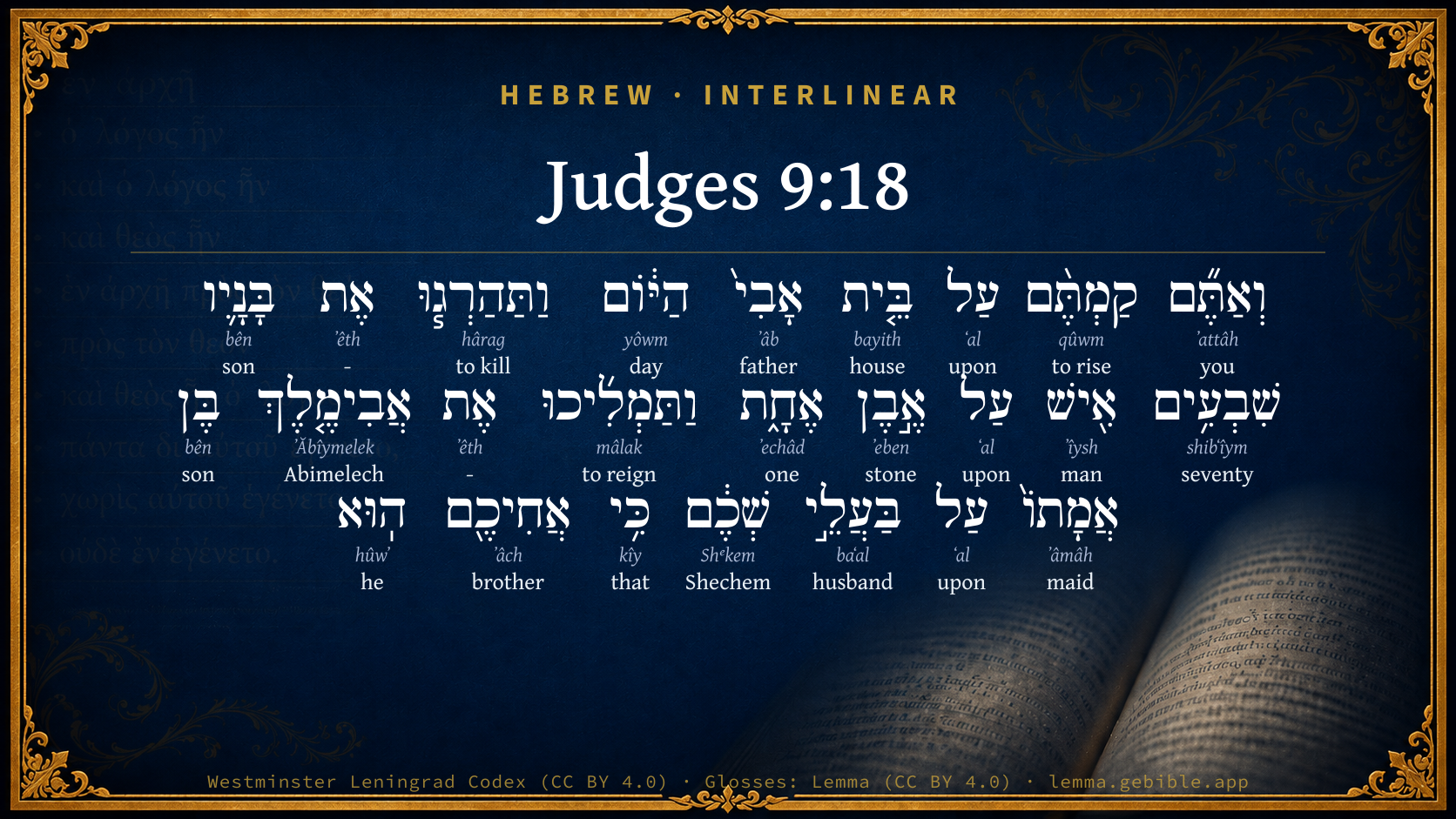
Judges 9:18

Hebrew (Westminster Leningrad Codex) Judges 9:18 appears in the Hebrew Old Testament. The text above is from the Westminster Leningrad Codex. Each word links to its Strong’s number, a concise gloss, and parsing drawn from the Open Scriptures Hebrew Bible morphology. Click any word for its full Brown-Driver-Briggs (BDB) entry.
Download image
Cite this verse

Judges 9:18 (World English Bible). Public Domain. Lemma interlinear Bible study tool, https://lemma.gebible.app/v/judges/9/18.

Show BibTeX & RIS
BibTeX
RIS
English Translation
and you are risen up against my father's house this day, and have slain his sons, seventy persons, on one stone, and have made Abimelech, the son of his maid-servant, king over the men of Shechem, because he is your brother);
World English Bible · Public Domain
Download a study sheet

One document with this verse’s original text, its word-by-word gloss line, the meaning frame, cross-references with their text, attributed commentary, and full source and license credits — printable, and it pastes into notes with its structure intact.

This verse Autodidact and up

Study sheet (.html) Plain text (.txt)

A passage Seminary Student

Up to 50 verses in one chapter. A passage sheet keeps up to 6 commentary sources and 12 cross-references per verse, in the order this page ranks them, and says so on the sheet whenever that leaves anything out. Ask for a single verse and you get the Autodidact verse sheet above.

Everything on this page stays free to read, with no account — the sheet is a download of what is already on screen, not access to it.

Want to remove ads? Support Godless Engineer
Compare translations 3

The same verse in 3 English versions, stacked beneath the original-language interlinear above. Click any original word for its lexicon entry.

Each is an independent rendering of the whole verse — the interlinear is not word-aligned to these translations.

Highlighted words mark where these versions differ — a whole-verse word diff, not a word-by-word alignment.

  • World English Bible Public Domain
    and you are risen up against my father's house this day, and have slain his sons, seventy persons, on one stone, and have made Abimelech, the son of his maid-servant, king over the men of Shechem, because he is your brother);
  • King James Version Public Domain
    And ye are risen up against my father's house this day, and have slain his sons, threescore and ten persons, upon one stone, and have made Abimelech, the son of his maidservant, king over the men of Shechem, because he is your brother;)
  • unfoldingWord Literal Text CC BY-SA 4.0
    but today you have arisen against the house of my father and have killed his sons, 70 men upon one stone, and you have made Abimelech, the son of his female slave, reign over the lords of Shechem because he is your brother—

unfoldingWord Literal Text — © unfoldingWord, licensed CC BY-SA 4.0. Word-aligned USFM3 via Door43 (git.door43.org/unfoldingWord/en_ult).

Versions to compare (up to 4)

3 of 4 selected

Show all 18 translations

Every available English version of this verse, each an independent rendering of the whole verse.

  • World English Bible Public Domain
    and you are risen up against my father's house this day, and have slain his sons, seventy persons, on one stone, and have made Abimelech, the son of his maid-servant, king over the men of Shechem, because he is your brother);
  • Berean Standard Bible Public Domain
    but you have risen up against my father’s house this day and killed his seventy sons on a single stone, and you have made Abimelech, the son of his maidservant, king over the leaders of Shechem because he is your brother—
  • Majority Standard Bible Public Domain
    but you have risen up against my father’s house this day and killed his seventy sons on a single stone, and you have made Abimelech, the son of his maidservant, king over the leaders of Shechem because he is your brother—
  • King James Version Public Domain
    And ye are risen up against my father's house this day, and have slain his sons, threescore and ten persons, upon one stone, and have made Abimelech, the son of his maidservant, king over the men of Shechem, because he is your brother;)
  • American Standard Version (1901) Public Domain
    and ye are risen up against my father's house this day, and have slain his sons, threescore and ten persons, upon one stone, and have made Abimelech, the son of his maid-servant, king over the men of Shechem, because he is your brother);
  • Revised Version (1885) Public Domain
    and ye are risen up against my father’s house this day, and have slain his sons, threescore and ten persons, upon one stone, and have made Abimelech, the son of his maidservant, king over the men of Shechem, because he is your brother;)
  • Geneva Bible (1599) Public Domain
    And yee are risen vp against my fathers house this day, and haue slayne his children, about seuentie persons vpon one stone, and haue made Abimelech the sonne of his mayde seruant, King ouer the men of Shechem, because hee is your brother)
  • Douay-Rheims (1899) Public Domain
    And you are now risen up against my father's house, and have killed his sons seventy men upon one stone, and have made Abimelech the son of his handmaid king over the inhabitants of Sichem, because he is your brother:
  • Young's Literal Translation Public Domain
    and ye have risen against the house of my father to-day, and slay his sons, seventy men, on one stone, and cause Abimelech son of his handmaid to reign over the masters of Shechem, because he `is' your brother --
  • Literal Standard Version CC BY-SA 4.0
    and you have risen against the house of my father today, and slay his sons, seventy men, on one stone, and cause Abimelech son of his handmaid to reign over the masters of Shechem, because he [is] your brother—
  • Unlocked Literal Bible CC BY-SA 4.0
    but today you have risen up against my father's house and have killed his sons, seventy persons, upon one stone. Then you have made Abimelech, the son of his female servant, king over the leaders of Shechem, because he is your relative.
  • unfoldingWord Literal Text CC BY-SA 4.0
    but today you have arisen against the house of my father and have killed his sons, 70 men upon one stone, and you have made Abimelech, the son of his female slave, reign over the lords of Shechem because he is your brother—
  • Darby Bible Public Domain
    and you have risen up against my father's house this day, and have slain his sons, seventy men on one stone, and have made Abim'elech, the son of his maidservant, king over the citizens of Shechem, because he is your kinsman--
  • World Messianic Bible Public Domain
    and you have risen up against my father’s house today and have slain his sons, seventy persons, on one stone, and have made Abimelech, the son of his female servant, king over the men of Shechem, because he is your brother);
  • Webster's Bible Public Domain
    And ye have risen up against my father's house this day, and have slain his sons, seventy persons, upon one stone, and have made Abimelech, the son of his maid-servant, king over the men of Shechem, because he is your brother:)
  • Free Bible Version CC BY-SA 4.0
    But you have rebelled against my father's family today. You have killed his seventy sons on one stone and have made Abimelech, the son of his slave woman, king over the leaders of Shechem simply because he's related to you.
  • Bible in Basic English Public Domain
    And you have gone against my father's family this day, and have put to death his sons, even seventy men on one stone, and have made Abimelech, the son of his servant-wife, king over the townsmen of Shechem because he is your brother;)
  • JPS Tanakh (1917) Public Domain
    and ye are risen up against my father's house this day, and have slain his sons, threescore and ten persons, upon one stone, and have made Abimelech, the son of his maid-servant, king over the men of Shechem, because he is your brother —

Literal Standard Version (2020), Covenant Press — licensed CC BY-SA 4.0. Text via the HelloAO Bible API (eBible.org). Unlocked Literal Bible (unfoldingWord) — licensed CC BY-SA 4.0. Text via the HelloAO Bible API (eBible.org). unfoldingWord Literal Text — © unfoldingWord, licensed CC BY-SA 4.0. Word-aligned USFM3 via Door43 (git.door43.org/unfoldingWord/en_ult). Free Bible Version, Dr. Jonathan Gallagher — licensed CC BY-SA 4.0. Text via the HelloAO Bible API (eBible.org).

Word by word

More ways to search: Search by grammar → Find every occurrence → Compare this word →

Practice this passage: Drill this verse → Learn its vocabulary →

אֲמָתוֹ֙
ʼâmâh
H519
“maid · his”
Noun, Common, Feminine, Singular, Construct + Suffix, Personal, 3rd Person, Masculine, Singular
Part of Speech
Noun
Type
Common
Gender
Feminine
Number
Singular
State
Construct
Full BDB Definition

Origin: apparently a primitive word

TWOT: 112

maid-servant, female slave, maid, handmaid, concubine - of humility (figuratively)
  1. וְאַתֶּ֞ם ʼattâh H859 “and · you” Conjunction + Pronoun, Personal, 2nd Person, Masculine, Plural
  2. קַמְתֶּ֨ם qûwm H6965 “to rise” Verb, Qal, Perfect, 2nd Person, Masculine, Plural
  3. עַל ʻal H5921 “upon” Preposition
  4. בֵּ֤ית bayith H1004 “house of” Noun, Common, Masculine, Singular, Construct
  5. אָבִי֙ ʼâb H1 “father · my” Noun, Common, Masculine, Singular, Construct + Suffix, Personal, 1st Person, Common, Singular
  6. הַיּ֔וֹם yôwm H3117 “the · day” Particle, Definite Article + Noun, Common, Masculine, Singular, Absolute
  7. וַתַּהַרְג֧וּ hârag H2026 “and · to kill” Conjunction + Verb, Qal, Sequential Imperfect, 2nd Person, Masculine, Plural
  8. אֶת ʼêth H853 “-” Particle, Direct Object
  9. בָּנָ֛יו bên H1121 “sons · his” Noun, Common, Masculine, Plural, Construct + Suffix, Personal, 3rd Person, Masculine, Singular
  10. שִׁבְעִ֥ים shibʻîym H7657 “seventy” Adjective, Cardinal number, Both, Plural, Absolute
  11. אִ֖ישׁ ʼîysh H376 “man” Noun, Common, Masculine, Singular, Absolute
  12. עַל ʻal H5921 “upon” Preposition
  13. אֶ֣בֶן ʼeben H68 “stone” Noun, Common, Feminine, Singular, Absolute
  14. אֶחָ֑ת ʼechâd H259 “one” Adjective, Cardinal number, Feminine, Singular, Absolute
  15. וַתַּמְלִ֜יכוּ mâlak H4427 “and · to reign” Conjunction + Verb, Hiphil, Sequential Imperfect, 2nd Person, Masculine, Plural
  16. אֶת ʼêth H853 “-” Particle, Direct Object
  17. אֲבִימֶ֤לֶךְ ʼĂbîymelek H40 “Abimelech” Noun, Proper
  18. בֶּן bên H1121 “son of” Noun, Common, Masculine, Singular, Construct
  19. עַל ʻal H5921 “upon” Preposition
  20. בַּעֲלֵ֣י baʻal H1167 “husbands of” Noun, Common, Masculine, Plural, Construct
  21. שְׁכֶ֔ם Shᵉkem H7927 “Shechem” Noun, Proper
  22. כִּ֥י kîy H3588 “that” Conjunction
  23. אֲחִיכֶ֖ם ʼâch H251 “brother · your” Noun, Common, Masculine, Singular, Construct + Suffix, Personal, 2nd Person, Masculine, Plural
  24. הֽוּא hûwʼ H1931 “he” Pronoun, Personal, 3rd Person, Masculine, Singular

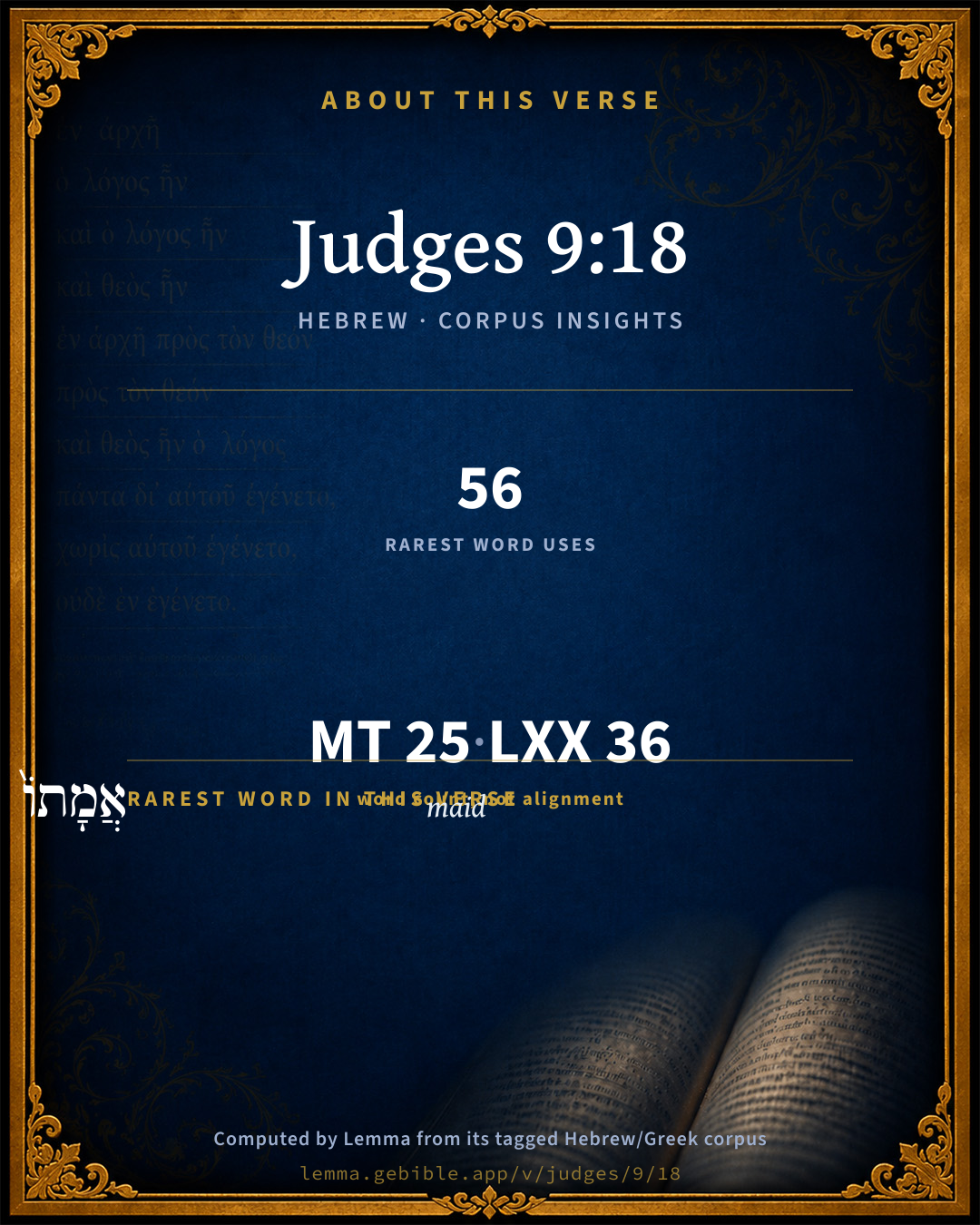
About this verse

These counts appear in no published source. They are computed here, from the morphology-tagged text and Lemma’s own curated glosses. What Lemma adds →

25
words
21
distinct lemmas
Historical
section

Shared distinctive vocabulary

אֲמָתוֹ֙ maid H519 occurs in 49 verses of the Hebrew Bible. Also found in:

Grammatical profile

  • 3 verbs
  • 12 nouns
  • 2 adjectives
  • 2 pronouns
  • 3 prepositions
  • 1 conjunction
  • 2 particles

Verb forms

  • קַמְתֶּ֨ם Qal · Perfect
  • וַתַּהַרְג֧וּ Qal · Sequential Imperfect
  • וַתַּמְלִ֜יכוּ Hiphil · Sequential Imperfect

Repetition

Words recur within this verse — often emphatic in Hebrew:

  • עַל upon H5921 ×3
  • בָּנָ֛יו son H1121 ×2

Hebrew & Septuagint length

In English translation the verse runs 41 words from the Hebrew and 44 from the Septuagint (LXX English) — closely comparable.

A rough comparison of the two English renderings, which tokenize alike — not a word-level alignment.

Word counts can differ between the Hebrew and the Greek without any difference in meaning — e.g. the Hebrew direct-object marker אֵת has no separate Greek word, and Greek often adds the article ὁ.

In the original languages it is 25 Hebrew tokens and 36 Greek tokens — but the two are counted differently (Hebrew bundles its prefixes and suffixes into one token; the Greek is in lemma form), so that isn’t a like-for-like length.

Cross-references

5

Topical passages linked to Judges 9:18 in the Treasury of Scripture Knowledge — connected by theme and wording, ordered by reader-vote popularity; previews shown in the World English Bible.

  • Judges 9:5–6 He went to his father's house at Ophrah, and killed his brothers the sons of Jerubbaal, being seventy persons, on one stone: but Jotham the youngest son of Jerubbaal was left; for he hid himself.
  • Psalms 109:4 In return for my love, they are my adversaries; But I am in prayer.
  • Judges 8:30–31 Gideon had seventy sons conceived from his body; for he had many wives.
  • Judges 8:35 neither shown they kindness to the house of Jerubbaal, [who is] Gideon, according to all the goodness which he had shown to Israel.
  • Judges 9:14 Then said all the trees to the bramble, Come you, and reign over us.

Cross-references courtesy of OpenBible.info (CC BY 4.0).

Hebrew and Greek witnesses Masoretic Hebrew ↔ Greek Septuagint

The same verse in the two great witnesses to the Old Testament, shown verse-for-verse.

These are two independent witnesses, not word-aligned to each other, and the Septuagint is shown in lemma (dictionary) form.

Hebrew Judges 9:18 Masoretic · Westminster Leningrad Codex

וְאַתֶּ֞ם קַמְתֶּ֨ם עַל בֵּ֤ית אָבִי֙ הַיּ֔וֹם וַתַּהַרְג֧וּ אֶת בָּנָ֛יו שִׁבְעִ֥ים אִ֖ישׁ עַל אֶ֣בֶן אֶחָ֑ת וַתַּמְלִ֜יכוּ אֶת אֲבִימֶ֤לֶךְ בֶּן אֲמָתוֹ֙ עַל בַּעֲלֵ֣י שְׁכֶ֔ם כִּ֥י אֲחִיכֶ֖ם הֽוּא

and you are risen up against my father's house this day, and have slain his sons, seventy persons, on one stone, and have made Abimelech, the son of his maid-servant, king over the men of Shechem, because he is your brother);

World English Bible · Public Domain

Greek LXX Judges 9:18 Septuagint · lemma form

καί σύ ἐπι ἀναἵστημι ἐπί ὁ οἶκος ὁ πατήρ ἐγώ σήμερον καί ἀποκτείνω ὁ υἱός αὐτός ἑβδομήκοντα ἀνήρ ἐπί λίθος εἷς καί βασιλεύω ὁ αβιμελεχ υἱός παιδίσκη αὐτός ἐπί ὁ ἀνήρ σικιμα ὅτι ἀδελφός σύ εἰμί

and you⌃ are risen up this day against the house of my father, and have slain his sons, being seventy men, upon one stone, and have made Abimelech the son of his bondwoman king over the men of Sicima, because he is your brother:

LXX2012 (modern English Septuagint) · Public Domain

Hebrew: Westminster Leningrad Codex (CC BY 4.0). Greek: Septuagint (public domain); English from LXX2012 (modern English Septuagint) (Public Domain). How the Septuagint differs from the Hebrew →

Targum (Aramaic paraphrase)

1

The Targum is the ancient Jewish Aramaic paraphrase of the Hebrew Scriptures — an interpretive translation, not the Hebrew text itself. Onkelos (literal) and Pseudo-Jonathan (expansive) render the Torah, and Jonathan the Prophets. Coverage is partial: where no permissively-licensed English translation exists for a verse, only the Aramaic is shown. This is verse-level text, not a word-by-word alignment to the Hebrew.

  1. Targum Jonathan Prophets (Joshua–Malachi)
    וְאַתּוּן קַמְתּוּן עַל בֵּית אַבָּא יוֹמָא דֵין וּקְטַלְתּוּן יַת בְּנוֹהִי שַׁבְעִין גַבְרָא עַל אַבְנָא חֲדָא וְאַמְלַכְתּוּן יַת אֲבִימֶלֶךְ בַּר אַמְתֵיהּ עַל יַתְבֵי שְׁכֶם אֲרֵי אֲחוּכוֹן הוּא:

    (no public-domain English translation for this verse)

    Targum Jonathan — Aramaic: “Mikraot Gedolot” (public domain). English: “Sefaria Community Translation” (CC0 1.0 (public-domain dedication)); “London "Chaldee Paraphrase," 1871” (public domain). Text via Sefaria.

Commentary

Notes on Judges 9:18 from classic Christian and Jewish commentators (each source and its license shown beneath its notes). The classic Christian expositions comment on the surrounding passage and are grouped to its opening verse, so a note may address several verses; the Jewish commentaries on the Tanakh (Rashi and others) are per-verse, so they appear only where the commentator wrote on this verse.

Lemma curates 59 commentaries, every one of them public domain or Creative Commons licensed, each selected and text-cleaned for this edition rather than reprinted as found. About our sources →

Trapp's Complete Commentary

John Trapp

Jdg 9:18 And ye are risen up against my father’s house this day, and have slain his sons, threescore and ten persons, upon one stone, and have made Abimelech, the son of his maidservant, king over the men of Shechem, because he [is] your brother;)

Ver. 18. And ye are risen up against my father’s house, &c.] This was

“ Mordaci radere vero, ”

plain dealing indeed. They who do what they should not, shall once hear what they would not; as Ahab did from Eliah; Herod from John Baptist; Eudoxia, the Empress, from Chrysostom; &c.

John Trapp, A Commentary or Exposition upon All the Books of the Old and New Testament (1647–1656) — public domain. Text from a community e-Sword module.

Joseph Benson's Commentary

Jdg 9:18. Ye have slain his sons, &c. — Abimelech’s crime is justly charged upon them, as being committed by their consent, approbation, and assistance. Maid-servant — His concubine, whom he so calls by way of reproach. Over Shechem — By which limitation of their power, and his kingdom, he reflects contempt upon him, and chargeth them with presumption, that, having only power over their own city, they durst impose a king upon all Israel.

Joseph Benson's Commentary on the Old and New Testaments (1811–1818) — public domain. Text from a community e-Sword module.

Ellicott's Commentary for English Readers

(18) Threescore and ten persons.—See Note on. Jdg_9:5.

The son of his maidservant.—The term is intentionally contemptuous. It seems clear from Jdg_8:31; Jdg_9:1, that she was not a slave, but even of high birth among the Canaanites.

A Bible Commentary for English Readers, edited by Charles John Ellicott (1878–1897) — public domain. Text from a community e-Sword module.

The Cambridge Bible for Schools and Colleges

gen. ed. J. J. S. Perowne

18. his maidservant] This goes beyond Jdg_9:1 and Jdg_8:31, which imply that Abimelech’s mother was not a slave but a freewoman.

The Cambridge Bible for Schools and Colleges (gen. ed. J. J. S. Perowne; Cambridge University Press, 1878–1918) — public domain. Text from a community e-Sword module.

John Gill's Exposition

And ye are risen up against my father's house this day,.... Which was an instance of great ingratitude in them, after such services done for them, and favours received by them:

and have slain his sons, seventy persons on one stone; excepting one, himself, and he was intentionally slain, their design was to cut off everyone; and all being slain but one, the round number is given, and this being so large, is the rather observed; and though Abimelech committed the fact, the men of Shechem were accessory to it, they gave him money, with which he hired men to assist him in it, see Jdg 9:20 and it is very probable they were privy to his intention, and encouraged him to it; and certain it is they showed their approbation of it, by making Abimelech king after it, and therefore they are justly charged with it:

and have made Abimelech, the son of his handmaid, king over the men of Shechem; which was both to the disgrace of Gideon, and his family, and of themselves too, that a base son of his should be made their king; when it would have been more to the credit of Gideon, and his family, that he had lived in obscurity, and had not been known as a son of his; and this was to the reproach of the men of Shechem, and especially to the princes thereof; for, by the men of Shechem are meant the lords, and great men thereof, as Kimchi observes; and great contempt is cast on Abimelech himself, who is here represented as making a very poor figure, being by extraction the son of an handmaid, and king only over the men of Shechem; and who made him so for no other reason but this:

because he is your brother; not because he had any right to the kingdom, or had any qualification for it, but because his mother lived among them, and her family belonged to them, and so he was related to many of them, and they hoped on that account to have preferment and favours from him.

John Gill's Exposition of the Whole Bible (1746–1763) — public domain (CC PDM 1.0). Text via the HelloAO Bible API.

Haydock's Catholic Bible Commentary

You are. People are answerable for the injuries which they do not prevent, when they have it in their power. (Calmet) --- Many of the citizens of Sichem had assisted Abimelech, ver. 4. --- Brother. The ties of kindred could not hide their ingratitude and cruelty. (Haydock)

George Leo Haydock (1774–1849), Haydock's Catholic Family Bible and Commentary, 1859 edition — public domain. Excludes Psalms (Douay-Rheims chapter numbering differs from Protestant) and Deuterocanonical books (Catholic canon only).

Matthew Poole's English Annotations

Abimelech’s fact is justly charged upon them, as done by their consent, approbation, and assistance.

His maid-servant; his concubine, whom he so calls by way of reproach, because maid-servants were oft made concubines, Exo 21:7-10.

Over the men of Shechem; by which limitation of their power, and his kingdom, he reflects contempt upon him, and chargeth them with presumption, that having only power over their own city, they durst impose a king upon all Israel.

Matthew Poole's English Annotations on the Holy Bible (1683–1685) — public domain. Text from a community e-Sword/MySword module.

John Wesley's Explanatory Notes

Ye have slain - Abimelech's fact is justly charged upon them, as done by their consent, approbation and assistance. Maidservant - His concubine, whom he so calls by way of reproach. Over Shechem - By which limitation of their power, and his kingdom, he reflects contempt upon him, and chargeth them with presumption, that having only power over their own city, they durst impose a king upon all Israel.

John Wesley, Explanatory Notes Upon the Whole Bible (1754–1765) — public domain. Text via the GEBible commentary corpus.

Lesson kit

Teaching starters — assembled from the data on this page, not authored interpretation. Every prompt links to the verse data it draws on. Edit before teaching.

Judges, in the Historical, opens this verse with 25 words (21 distinct Hebrew lemmas). Its most distinctive word is ʼâmâh (“maid”). A historical commentator’s framing appears above. Read the whole chapter for the surrounding context.

Discussion questions

  1. What does “maid” (ʼâmâh) contribute to the verse as a whole?
  2. Genesis 20:17 shares the word «maid» with this verse. How do the two illuminate each other?
  3. “upon” occurs 3× in this one verse. What is the effect of the repetition?
  4. These translations render this verse differently. What is at stake in choosing one wording over another?
  5. The verb «קַמְתֶּ֨ם» is Qal Perfect. How does its form color the action?
  6. Reading how Trapp's Complete Commentary and Joseph Benson's Commentary read this verse, where do the two commentators agree and where do they part?

Things to notice

Reading settings

Reading text

Shown beneath each verse's original-language words.

Old Testament
Old Testament edition

Read the OT as the Masoretic Hebrew (MT) or the Greek Septuagint (LXX).

English shown for the Greek Septuagint (in the Hebrew ↔ Greek comparison).

Comparing translations? Open the Compare panel on any verse page to stack up to four side by side.