Hosea 9:13

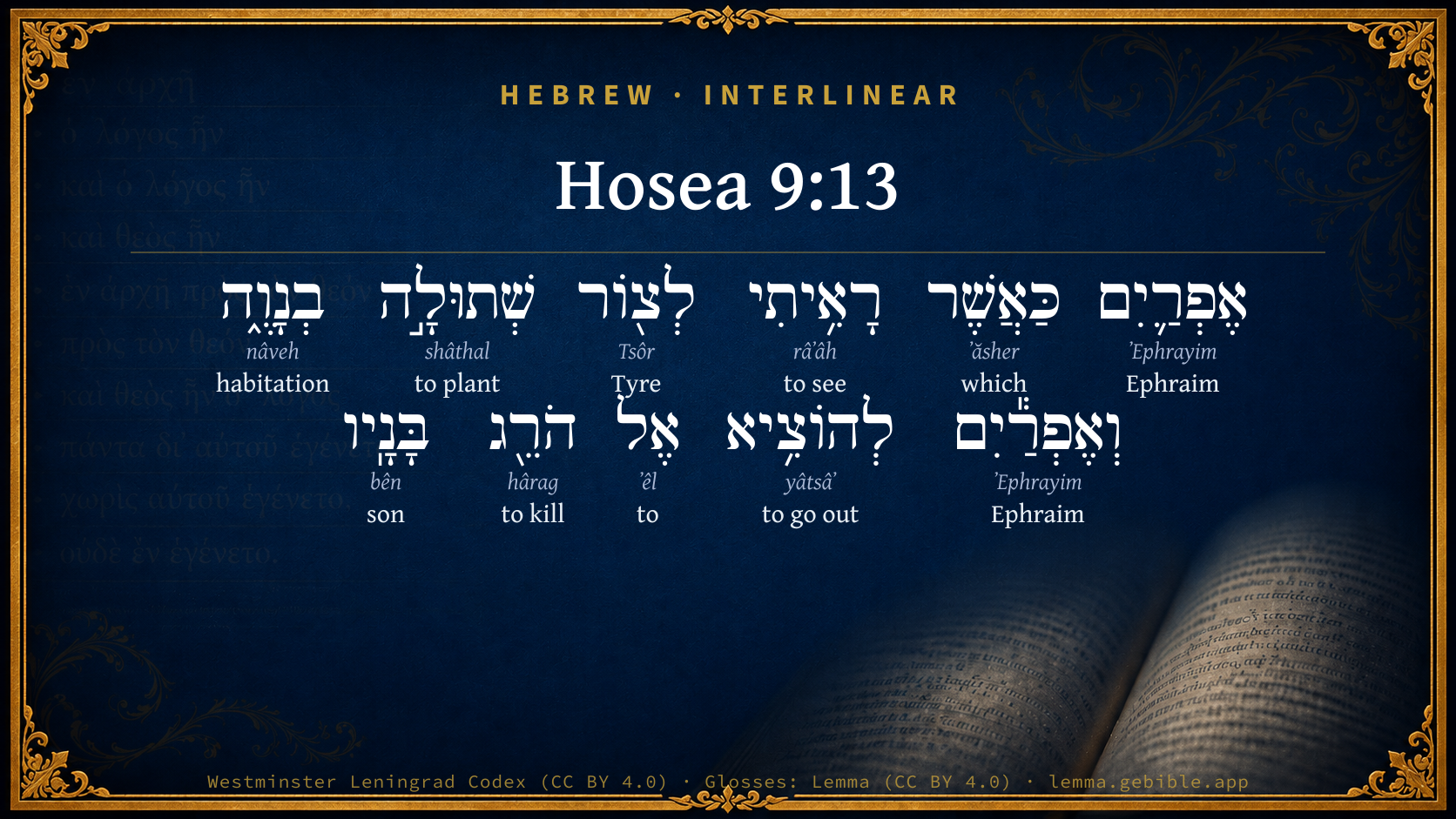
Hebrew (Westminster Leningrad Codex) Hosea 9:13 appears in the Hebrew Old Testament. The text above is from the Westminster Leningrad Codex. Each word links to its Strong’s number, a concise gloss, and parsing drawn from the Open Scriptures Hebrew Bible morphology. Click any word for its full Brown-Driver-Briggs (BDB) entry.
Download image
Cite this verse

Hosea 9:13 (World English Bible). Public Domain. Lemma interlinear Bible study tool, https://lemma.gebible.app/v/hosea/9/13.

Show BibTeX & RIS
BibTeX
RIS
English Translation
Ephraim, like I have seen Tyre, is planted in a pleasant place; But Ephraim will bring out his children to the killer.
World English Bible · Public Domain
Download a study sheet

One document with this verse’s original text, its word-by-word gloss line, the meaning frame, cross-references with their text, attributed commentary, and full source and license credits — printable, and it pastes into notes with its structure intact.

This verse Autodidact and up

Study sheet (.html) Plain text (.txt)

A passage Seminary Student

Up to 50 verses in one chapter. A passage sheet keeps up to 6 commentary sources and 12 cross-references per verse, in the order this page ranks them, and says so on the sheet whenever that leaves anything out. Ask for a single verse and you get the Autodidact verse sheet above.

Everything on this page stays free to read, with no account — the sheet is a download of what is already on screen, not access to it.

Want to remove ads? Support Godless Engineer
Compare translations 3

The same verse in 3 English versions, stacked beneath the original-language interlinear above. Click any original word for its lexicon entry.

Each is an independent rendering of the whole verse — the interlinear is not word-aligned to these translations.

Highlighted words mark where these versions differ — a whole-verse word diff, not a word-by-word alignment.

  • World English Bible Public Domain
    Ephraim, like I have seen Tyre, is planted in a pleasant place; But Ephraim will bring out his children to the killer.
  • King James Version Public Domain
    Ephraim, as I saw Tyrus, is planted in a pleasant place: but Ephraim shall bring forth his children to the murderer.
  • unfoldingWord Literal Text CC BY-SA 4.0
    Ephraim—just as I have seen for Tyre, planted in a meadow, so Ephraim to bring out his children to the slayer.

unfoldingWord Literal Text — © unfoldingWord, licensed CC BY-SA 4.0. Word-aligned USFM3 via Door43 (git.door43.org/unfoldingWord/en_ult).

Versions to compare (up to 4)

3 of 4 selected

Show all 18 translations

Every available English version of this verse, each an independent rendering of the whole verse.

  • World English Bible Public Domain
    Ephraim, like I have seen Tyre, is planted in a pleasant place; But Ephraim will bring out his children to the killer.
  • Berean Standard Bible Public Domain
    I have seen Ephraim, like Tyre, planted in a meadow. But Ephraim will bring out his children for slaughter.
  • Majority Standard Bible Public Domain
    I have seen Ephraim, like Tyre, planted in a meadow. But Ephraim will bring out his children for slaughter.
  • King James Version Public Domain
    Ephraim, as I saw Tyrus, is planted in a pleasant place: but Ephraim shall bring forth his children to the murderer.
  • American Standard Version (1901) Public Domain
    Ephraim, like as I have seen Tyre, is planted in a pleasant place: but Ephraim shall bring out his children to the slayer.
  • Revised Version (1885) Public Domain
    Ephraim, like as I have seen Tyre, is planted in a pleasant place: but Ephraim shall bring out his children to the slayer.
  • Geneva Bible (1599) Public Domain
    Ephraim, as I sawe, is as a tree in Tyrus planted in a cottage: but Ephraim shall bring forth his children to the murtherer.
  • Douay-Rheims (1899) Public Domain
    Ephraim, as I saw, was a Tyre founded in beauty: and Ephraim shall bring out his children to the murderer.
  • Young's Literal Translation Public Domain
    Ephraim! when I have looked to the rock, Is planted in comeliness, And Ephraim `is' to bring out unto a slayer his sons.
  • Literal Standard Version CC BY-SA 4.0
    Ephraim! When I have looked to the rock, || Is planted in comeliness, || And Ephraim [is] to bring out his sons to a slayer.
  • Unlocked Literal Bible CC BY-SA 4.0
    I have seen Ephraim, just like Tyre, planted in a meadow, but Ephraim will bring out his children to someone who will slaughter them.”
  • unfoldingWord Literal Text CC BY-SA 4.0
    Ephraim—just as I have seen for Tyre, planted in a meadow, so Ephraim to bring out his children to the slayer.
  • Darby Bible Public Domain
    Ephraim, as I saw [him], was a Tyre planted in a beautiful place; but Ephraim shall bring forth his children to the slayer.
  • World Messianic Bible Public Domain
    I have seen Ephraim, like Tyre, planted in a pleasant place; but Ephraim will bring out his children to the murderer.
  • Webster's Bible Public Domain
    Ephraim, as I saw Tyre, is planted in a pleasant place: but Ephraim shall bring forth his children to the murderer.
  • Free Bible Version CC BY-SA 4.0
    Ephraim! Just as I saw Tyre planted in a meadow, so too Ephraim will lead out his children to the murderer.
  • Bible in Basic English Public Domain
    As I have seen a beast whose young have been taken from her, so Ephraim will give birth to children only for them to be put to death.
  • JPS Tanakh (1917) Public Domain
    Ephraim, like as I have seen Tyre, is planted in a pleasant place; but Ephraim shall bring forth his children to the slayer.

Literal Standard Version (2020), Covenant Press — licensed CC BY-SA 4.0. Text via the HelloAO Bible API (eBible.org). Unlocked Literal Bible (unfoldingWord) — licensed CC BY-SA 4.0. Text via the HelloAO Bible API (eBible.org). unfoldingWord Literal Text — © unfoldingWord, licensed CC BY-SA 4.0. Word-aligned USFM3 via Door43 (git.door43.org/unfoldingWord/en_ult). Free Bible Version, Dr. Jonathan Gallagher — licensed CC BY-SA 4.0. Text via the HelloAO Bible API (eBible.org).

Word by word

More ways to search: Search by grammar → Find every occurrence → Compare this word →

Practice this passage: Drill this verse → Learn its vocabulary →

שְׁתוּלָ֣ה
shâthal
H8362
“planted”
Verb, Qal, Participle Passive, Feminine, Singular, Absolute
Part of Speech
Verb
Stem
Qal
Form
Participle Passive
Gender
Feminine
Number
Singular
State
Absolute
Full BDB Definition

Origin: a primitive root

TWOT: 2480

(Qal) to plant, transplant
  1. אֶפְרַ֛יִם ʼEphrayim H669 “Ephraim” Noun, Proper
  2. כַּאֲשֶׁר ʼăsher H834 “like/as · which” Preposition + Particle, Relative
  3. רָאִ֥יתִי râʼâh H7200 “to see” Verb, Qal, Perfect, 1st Person, Common, Singular
  4. לְצ֖וֹר Tsôr H6865 “to/for · Tyre” Preposition + Noun, Proper
  5. בְנָוֶ֑ה nâveh H5116 “in/at · habitation” Preposition + Noun, Common, Both, Singular, Absolute
  6. וְאֶפְרַ֕יִם ʼEphrayim H669 “and · Ephraim” Conjunction + Noun, Proper
  7. לְהוֹצִ֥יא yâtsâʼ H3318 “to go out” Preposition + Verb, Hiphil, Infinitive Construct
  8. אֶל ʼêl H413 “to” Preposition
  9. הֹרֵ֖ג hârag H2026 “killing” Verb, Qal, Participle Active, Masculine, Singular, Absolute
  10. בָּנָֽיו bên H1121 “sons · his” Noun, Common, Masculine, Plural, Construct + Suffix, Personal, 3rd Person, Masculine, Singular

About this verse

These counts appear in no published source. They are computed here, from the morphology-tagged text and Lemma’s own curated glosses. What Lemma adds →

11
words
10
distinct lemmas
Prophets
section

Notable vocabulary

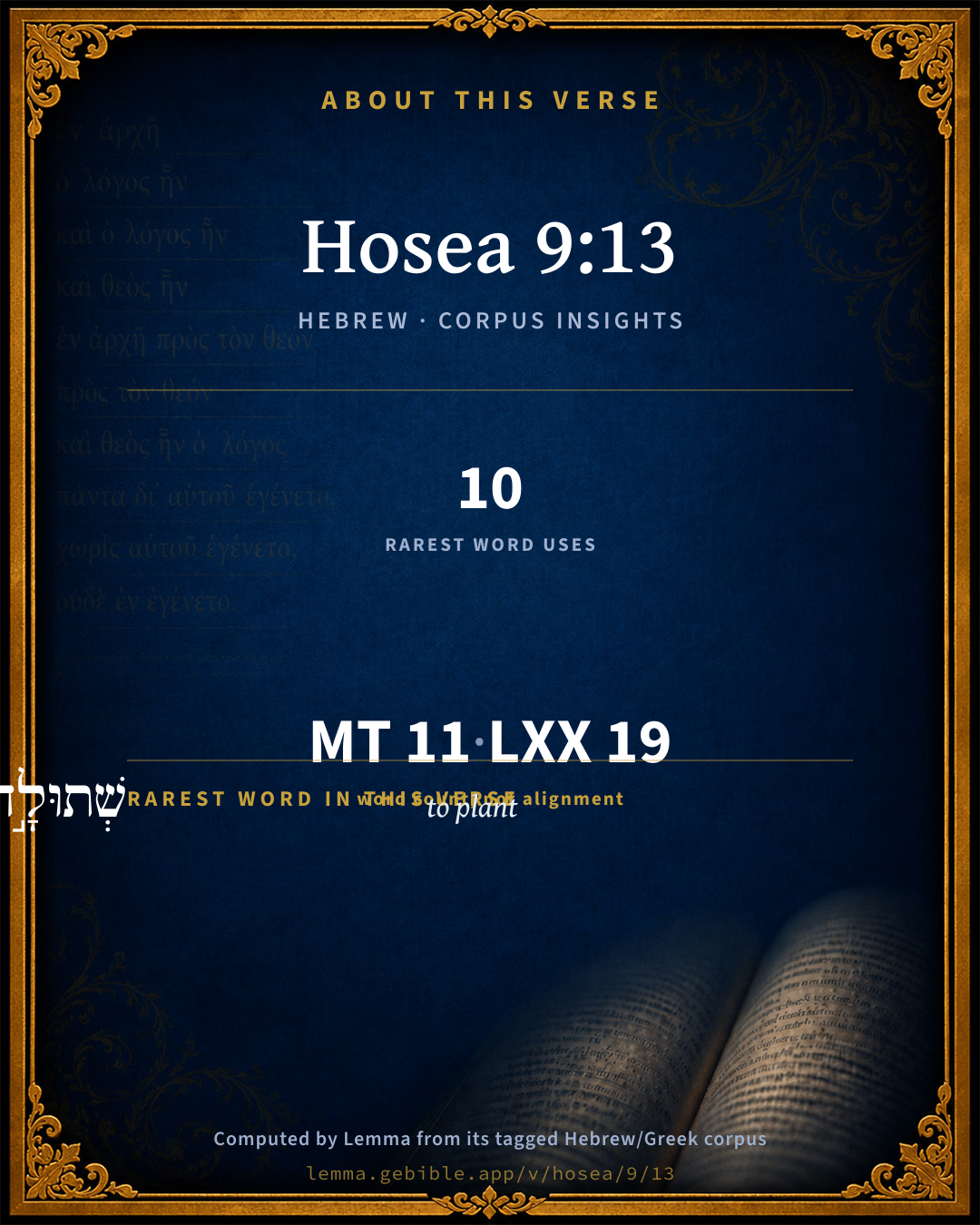
The rarest word here is שְׁתוּלָ֣ה to plant H8362 — appearing just 10 times in the whole Hebrew Bible.

Shared distinctive vocabulary

שְׁתוּלָ֣ה to plant H8362 occurs in 10 verses of the Hebrew Bible. Also found in:

Grammatical profile

  • 4 verbs
  • 5 nouns
  • 1 preposition
  • 1 particle

Verb forms

  • רָאִ֥יתִי Qal · Perfect
  • שְׁתוּלָ֣ה Qal · Participle Passive
  • לְהוֹצִ֥יא Hiphil · Infinitive Construct
  • הֹרֵ֖ג Qal · Participle Active

Repetition

A word recurs within this verse — often emphatic in Hebrew:

  • אֶפְרַ֛יִם Ephraim H669 ×2

Hebrew & Septuagint length

In English translation the verse runs 22 words from the Hebrew and 22 from the Septuagint (LXX English) — the same length.

A rough comparison of the two English renderings, which tokenize alike — not a word-level alignment.

Word counts can differ between the Hebrew and the Greek without any difference in meaning — e.g. the Hebrew direct-object marker אֵת has no separate Greek word, and Greek often adds the article ὁ.

In the original languages it is 11 Hebrew tokens and 19 Greek tokens — but the two are counted differently (Hebrew bundles its prefixes and suffixes into one token; the Greek is in lemma form), so that isn’t a like-for-like length.

Cross-references

9

Topical passages linked to Hosea 9:13 in the Treasury of Scripture Knowledge — connected by theme and wording, ordered by reader-vote popularity; previews shown in the World English Bible.

  • Ezekiel 26:1–21 It happened in the eleventh year, in the first [day] of the month, that the word of Yahweh came to me, saying,
  • Ezekiel 27:3 and tell Tyre, you who dwell at the entry of the sea, who are the merchant of the peoples to many isles, thus says the Lord Yahweh: You, Tyre, have said, I am perfect in beauty.
  • 2 Kings 15:16 Then Menahem struck Tiphsah, and all who were therein, and the borders of it, from Tirzah: because they didn't open to him, therefore he struck it; and all the women therein who were with child he ripped up.
  • Jeremiah 9:21 For death is come up into our windows, it is entered into our palaces; to cut off the children from outside, [and] the young men from the streets.
  • Hosea 9:16 Ephraim is struck. Their root has dried up. They will bear no fruit. Even though they bring forth, yet I will kill the beloved ones of their womb."
  • Hosea 10:14 Therefore a battle roar will arise among your people, And all your fortresses will be destroyed, As Shalman destroyed Beth Arbel in the day of battle. The mother was dashed in pieces with her children.
  • Hosea 13:8 I will meet them like a bear that is bereaved of her cubs, And will tear the covering of their heart. And there I will devour them like a lioness. The wild animal will tear them.
  • Hosea 13:16 Samaria will bear her guilt; For she has rebelled against her God. They will fall by the sword. Their infants will be dashed in pieces, And their pregnant women will be ripped open."
  • Amos 7:17 Therefore thus says Yahweh: 'Your wife shall be a prostitute in the city, and your sons and your daughters shall fall by the sword, and your land shall be divided by line; and you yourself shall die in a land that is unclean, and Israel shall surely be led away captive out of his land.'"

Cross-references courtesy of OpenBible.info (CC BY 4.0).

Hebrew and Greek witnesses Masoretic Hebrew ↔ Greek Septuagint

The same verse in the two great witnesses to the Old Testament, shown verse-for-verse.

These are two independent witnesses, not word-aligned to each other, and the Septuagint is shown in lemma (dictionary) form.

Hebrew Hosea 9:13 Masoretic · Westminster Leningrad Codex

אֶפְרַ֛יִם כַּאֲשֶׁר רָאִ֥יתִי לְצ֖וֹר שְׁתוּלָ֣ה בְנָוֶ֑ה וְאֶפְרַ֕יִם לְהוֹצִ֥יא אֶל הֹרֵ֖ג בָּנָֽיו

Ephraim, like I have seen Tyre, is planted in a pleasant place; But Ephraim will bring out his children to the killer.

World English Bible · Public Domain

Greek LXX Hosea 9:13 Septuagint · lemma form

ἐφράιμ ὅς τρόπος ὁράω εἰς θήρα παραἵστημι ὁ τέκνον αὐτός καί ἐφράιμ ὁ ἐκἄγω εἰς ἀποκέντησις ὁ τέκνον αὐτός

Ephraim, even as I saw, gave their children for a prey; yes, Ephraim was ready to bring out his children to slaughter.

LXX2012 (modern English Septuagint) · Public Domain

On this verse, Keil & Delitzsch discusses the Septuagint’s reading. Read the note in Commentary ↓

Hebrew: Westminster Leningrad Codex (CC BY 4.0). Greek: Septuagint (public domain); English from LXX2012 (modern English Septuagint) (Public Domain). How the Septuagint differs from the Hebrew →

Targum (Aramaic paraphrase)

1

The Targum is the ancient Jewish Aramaic paraphrase of the Hebrew Scriptures — an interpretive translation, not the Hebrew text itself. Onkelos (literal) and Pseudo-Jonathan (expansive) render the Torah, and Jonathan the Prophets. Coverage is partial: where no permissively-licensed English translation exists for a verse, only the Aramaic is shown. This is verse-level text, not a word-by-word alignment to the Hebrew.

  1. Targum Jonathan Prophets (Joshua–Malachi)
    כְּנִשְׁתָּא דְיִשְׂרָאֵל בְּמֶעְבְּרָה אוֹרַיְיתָא דַמְיָא לְצוֹר בְּאַצְלָחוּתָא בִּשְׁלֵוַיְתָהּ חָבוּ דְבֵית אֶפְרַיִם לְקַטְלָא לְפוּלְחַן טַעֲוָתָא בְּנֵיהוֹן:

    (no public-domain English translation for this verse)

    Targum Jonathan — Aramaic: “Mikraot Gedolot” (public domain). English: “Sefaria Community Translation” (CC0 1.0 (public-domain dedication)); “London "Chaldee Paraphrase," 1871” (public domain). Text via Sefaria.

Commentary

Notes on Hosea 9:13 from classic Christian and Jewish commentators (each source and its license shown beneath its notes). The classic Christian expositions comment on the surrounding passage and are grouped to its opening verse, so a note may address several verses; the Jewish commentaries on the Tanakh (Rashi and others) are per-verse, so they appear only where the commentator wrote on this verse.

Lemma curates 59 commentaries, every one of them public domain or Creative Commons licensed, each selected and text-cleaned for this edition rather than reprinted as found. About our sources →

Trapp's Complete Commentary

John Trapp

Hos 9:13 Ephraim, as I saw Tyrus, [is] planted in a pleasant place: but Ephraim shall bring forth his children to the murderer.

Ver. 13. Ephraim, as I saw Tyrus, is planted in a pleasant place] And therefore pleaseth himself as not forsaken of God. But he may be angry enough with those that yet outwardly prosper; as he was with the old world buried in security; with Sodom, who had fulness of bread, and abundance of idleness; with the land of Shinar (where Babel was built, Gen 11:2-4), fruitful beyond credulity, as Herodotus and Pliny testify; with Tyre, a maritime and magnificent city, planted in a pleasant place, in the very heart of the sea; as Venice is at this day, media insuperabilis unda, environed with her embracing Neptune, to whom (as the ceremony of her throwing a ring into the sea implies) she marrieth herself with yearly nuptials, and hath for her motto, Nec fluctu nec flatu movetur, Nor winds nor waves can stir her. Of the pomp, pride, and populousness of Tyre read Eze 26:1-21; Eze 27:1-36; Eze 28:1-19. Lo, such a one was Ephraim, when ripe for ruin, near to an utter downfall. What can be more fair and flourishing than a grainfield or vineyard a little before the harvest, the vintage? Physicians say that the uttermost degree of bodily health is next unto sickness. Glass, or other metals, cast into the fire, shine most when ready to melt and run. This was Tyre’s case, this was Ephraim’s, pleasantly planted, but marked out for destruction; as a carpenter cometh to a wood, and with his axe marketh out the fairest trees for felling. Ephraim is the worse because he seeth Tyre yet prosper. But God will take that from heathen Tyre that he will not take from Ephraim; and the sunshine of prosperity doth but ripen the sins of them both for divine vengeance.

They shall bring forth children to the murderers] As to God’s executioners; and so show themselves not parents, but parricides; because they betray their children (as Babel did by her idolatry, Psa 137:8 Isa 13:8) into the hands of the enemy. Wherein they are more cruel than that false schoolmaster in Italy (mentioned by Livy and Florus), that brought forth his scholars, the flower of the nobility and gentry there, to Hannibal; who, if he had not been more merciful than otherwise, they had all been murdered. But what shall we say of such wretched parents, as bring forth children to that old manslayer, the devil? and how shall such undone children curse their careless parents in hell, throughout all eternity! If the Lord also could say of those poor children that were sacrificed to Moloch (the Chaldee paraphrase understands this text of those children), "Thou hast slain my children, and delivered them to cause them to pass through the fire for them" (namely, for the images of the foresaid idols), Eze 16:21, what will he say, or rather, what will he not say, to those bloody parents, that carry their children with them, to Satan’s slaughter house?

John Trapp, A Commentary or Exposition upon All the Books of the Old and New Testament (1647–1656) — public domain. Text from a community e-Sword module.

Keil & Delitzsch

C. F. Keil & F. Delitzsch

The vanishing of the glory of Ephraim is carried out still further in what follows. Hos 9:13. "Ephraim as I selected it for a Tyre planted in the valley; so shall Ephraim lead out its sons to the murderer. Hos 9:14. Give them, O Jehovah: what shalt Thou give him? Give them a childless womb and dry breasts." In Hos 9:13 Ephraim is the object to ראיתי (I have seen), but on account of the emphasis it is placed first, as in Hos 9:11; and ראה with an accusative and ל dna evi signifies to select anything for a purpose, as in Gen 22:8. The Lord had selected Ephraim for Himself to be a Tyre planted in the meadow, i.e., in a soil adapted for growth and prosperity, had intended for it the bloom and glory of the rich and powerful Tyre; but now, for its apostasy, He would give it up to desolation, and dedicate its sons, i.e., its people, to death by the sword. The commentators, for the most part, like the lxx, have overlooked this meaning of ראה, and therefore have not only been unable to explain letsōr (for a Tyre), but have been driven either to resort to alterations of the text, like letsūrâh, "after the form" (Ewald), or to arbitrary assumptions, e.g., that tsōr signifies "palm" after the Arabic (Arnold, Hitzig), or that letsōr means "as far as Tyre" (ל = עד), in order to bring a more or less forced interpretation into the sentence. The Vav before 'Ephraim introduces the apodosis to כּאשׁר: "as I have selected Ephraim, so shall Ephraim lead out," etc. On the construction להוציא, see Ewald, 237, c. In Hos 9:14 the threat rises into an appeal to God to execute the threatened punishment. The excited style of the language is indicated in the interpolated mah-titteen (what wilt Thou give?). The words do not contain an intercessory prayer on the part of the prophet, that God will not punish the people too severely but condemn them to barrenness rather than to the loss of the young men (Ewald), but are expressive of holy indignation at the deep corruption of the people.

Keil & Delitzsch — Biblical Commentary on the Old Testament (1861–1891) — public domain (CC PDM 1.0). Text via the HelloAO Bible API. (Old Testament only.)

Tyndale Open Study Notes

Tyndale Open Resources

9:13 for slaughter: Rather than gaining them more children, the Israelites’ idolatry would backfire, resulting in their children’s deaths.

Tyndale Open Study Notes — © Tyndale Open Resources, licensed CC BY-SA 4.0. Text via the HelloAO Bible API.

Geneva Bible (1599)

Geneva Bible translators

As they kept tender plants in their houses in Tyre to preserve them from the cold air of the sea, so was Ephraim at the first unto me, but now I will give him to the slaughter.

Geneva Bible (1599) marginal notes — public domain. Text via Bolls.life.

Jamieson, Fausset & Brown

Robert Jamieson, A. R. Fausset & David Brown

Ephraim, as I saw Tyrus . . . in a pleasant place--that is, in looking towards Tyrus (on whose borders Ephraim lay) I saw Ephraim beautiful in situation like her (Eze. 26:1-28:26).

is planted--as a fruitful tree; image suggested by the meaning of "Ephraim" (Hos 9:11).

bring forth his children to the murderer-- (Hos 9:16; Hos 13:16). With all his fruitfulness, his children shall only be brought up to be slain.

Jamieson, Fausset & Brown — Commentary Critical and Explanatory on the Whole Bible (1871) — public domain (CC PDM 1.0). Text via the HelloAO Bible API.

Adam Clarke's Commentary

Verse 13. Ephraim, as I saw Tyrus] Tyre was strongly situated on a rock in the sea; Samaria was on a mountain, both strong and pleasant. But the strength and beauty of those cities shall not save them from destruction.

Ephraim shall bring forth his children to the murderer.] The people shall be destroyed, or led into captivity by the Assyrians. Of the grandeur, wealth, power, &c., of Tyre, see the notes on Ezekiel, Eze 27:2-28:25.

Adam Clarke's Commentary on the Bible (1810–1826) — public domain. Text from a community e-Sword/MySword module.

John Calvin's Commentaries

Hosea here confirms his previous statements that the Israelites in vain trusted in their present condition, for the Lord could reverse their prosperity whenever it pleased him. Men, we know, harden themselves in their vices, when they enjoy their wishes and when they are sunk in pleasures; for prosperity is not without reason often compared to wine, because it inebriates men; nay, rather it dementates them. We see what happened to the Sodomites and to others; yea, the abuse of God’s forbearance has ever been the cause of destruction to almost all the reprobate, as Paul also says. Such pride reigned in the people of Israel, that they heedlessly despised all threatening, as it has been already often stated. To this then the Prophet refers when he says, Ephraim is like a tree planted in Tyrus: yet he shall bring forth his children to the slaughter The Prophet then points out here the indulgences of Israel, and then adds, that in a short time the Lord would draw them forth to judgement, though he had treated them as a precious tree, by fostering them gently and tenderly for a time.

Some render this place thus, “I have seen Ephraim planted like Tyrus;” and they render the next word, בנוה, benue, “in pleasantness.” But since it means a house or a habitation, I am disposed to retain its proper sense. Interpreters, however, vary in their opinion; for some say, “I have seen Ephraim like Tyrus;” because an event awaits this people similar to that which happened to Tyrus; for, as punishment was inflicted on Tyrus, so Ephraim shall not escape unpunished. This is the exposition of some, but in my view it is too refined. As, however, there is here a preposition, ל“lamed”, I am inclined to consider “a tree” or “plant,” or some such word, understood. Ephraim then was, as if one beheld a tree in Tyrus, literally to Tyrus, or in Tyrus. This letter, as a preposition, I allow, is redundant in many places; and yet it preserves some propriety, except when necessity interferes: and in this place what I have already stated is the most suitable rendering, “Ephraim is like a tree planted in Tyrus, in a dwelling” or shed. Tyrus, we know, was built on an island in the sea; it had gardens the most pleasant, but not formed without much expense and labour. It was washed on every side by the sea; and unless mounds were set up, the dwellings were confined. Since, then, it was difficult to raise trees there, much work and labour was doubtless necessary, as it is usually the case; for men often struggle with nature. And if we say that Ephraim was planted like Tyrus in a dwelling, what can it mean? We therefore say, that he was like a tree preserved as in a dwelling: for we see that there are some trees which cannot bear the cold air, and are kept during winter in a house that they may be preserved; and it is probable that the Syrians, who were rich and had a lucrative trade, employed much care in rearing their trees.

The meaning is, that Ephraim was like tender trees, preserved by men with great care and with much expense; but that they should hereafter bring forth their children for the slaughter. This bringing forth is set in opposition to the house or dwelling. They had been kept without danger from the cold and heat, like a tender tree under cover; but they would be constrained to draw forth their children to the slaughter; that is, there would be no longer any dwelling for them to protect them from the violence of their enemies, but that they would be drawn forth to the light.

We now see that the words harmonise well with the view, that the people of Israel in vain flattered themselves because they had hitherto been subject to no evils, and that God had preserved them free from calamity. There is no reason, the Prophet says, for the people to be proud, because they had been hitherto so indulgently treated; for though they had been like tender trees, they would yet be forced to draw forth their children to be killed. And this comparison, which he amplifies, is what often occurs in Scripture. ‘If Jehoiakim were as a ring on my right hand, saith the Lord, I would pluck him thence.’ Men are wont to abuse even the promises of God. As king Jehoiakim was of the posterity of David, he thought it impossible that hid enemies could ever deprive him of his kingdom; “But it shall not be so; for though he were as a ring on my hand, I would pluck him thence.” So also in this place; “Though the Israelites had been hitherto brought up in my bosom, and though I have kindly given them all kinds of blessings, and though they have been like tender trees, yet their condition hereafter shall be entirely different.” Then it follows —

John Calvin's Commentaries (1540-1563) — public domain. Text from the Calvin Translation Society English edition (1840s-50s) via the Christian Classics Ethereal Library (ccel.org). Calvin's coverage is partial (roughly two-thirds of the Bible); uncommented books and verses are honest gaps, never fabricated. The 19th-century editor's footnotes and remarks are omitted so the notes are faithfully Calvin's own voice.

Ellicott's Commentary for English Readers

(13) The LXX. suggest a doubt as to the validity of our text. They render “Ephraim, even as I saw, gave their children for a prey.” The reference to Tyre is very obscure. Some would render the Hebrew word for “meadow” by “resting-place,” and interpret, “I look on Ephraim even as I look on Tyre, planted in a sure resting-place.” The impregnable fortress of Tyre was a conspicuous object in the days of Hosea. Similarly Samaria was a stronghold which was able to resist prolonged sieges. (Comp. Isaiah’s graphic words: Isa_28:1-4, and Amo_6:1)—“Yet Ephraim shall bring forth sons to the murderer,” i.e., in the impending overthrow and massacre, 721 B.C.

A Bible Commentary for English Readers, edited by Charles John Ellicott (1878–1897) — public domain. Text from a community e-Sword module.

The Cambridge Bible for Schools and Colleges

gen. ed. J. J. S. Perowne

13. Ephraim, as I saw Tyrus, &c.] The passage is most obscure, and it is difficult to believe that Hosea meant what A.V. supposes. ‘As I look at Tyre’, would be better; but then it becomes difficult to extract a sense. Tyre is, in fact, very much out of place in a description of the fortunes of Ephraim; and it is a relief to find that it has been introduced by critics contrary to Hebrew usage, for Tyre is elsewhere spelt without a Vâv. How, too, can Ephraim be said to be planted, without any explanatory figurative words? The Sept. seems to have had a different text, ‘As for Ephraim, according as I see, they have set their sons for a prey’; and this seems preferable to the received text. The prophet sees in imagination the Ephraimites taken like wild beasts, and put to death by their cruel captors.

but Ephraim shall, &c.] Taking the passage as a contrast between Ephraim’s past glory and the dreadful fate impending over it. But if Hosea is throughout describing the judgment, render rather, and Ephraim shall (or better, must), &c.

The Cambridge Bible for Schools and Colleges (gen. ed. J. J. S. Perowne; Cambridge University Press, 1878–1918) — public domain. Text from a community e-Sword module.

John Gill's Exposition

Give them, O Lord: what wilt thou give them?.... The prophet foreseeing the butchery and destruction of their children, his heart ached for them; and, to show his tender affection for this people, was desirous of putting up a supplication for them; but was at a loss what to ask, their sins were so many, and so aggravated, and the decree gone forth for their destruction: or, "give them what thou wilt give them" (l); so Jarchi, Kimchi, and Abarbinel, what thou hast threatened before to give them, Hos 9:11; do not give them to be butchered and murdered before the eyes of their parents by their enemies; but rather let them die in the womb, or as soon as born; so it follows:

give them a miscarrying womb and dry breasts; the latter being a sign of the former, as physicians observe; or the words may be rendered disjunctively, give them one, or the other; that is, to the wives of the people of Israel, if they conceive, let them miscarry, prove abortive, rather than bring forth children to be destroyed in such a cruel manner by murderers; or if they bear them to the birth, and bring them forth, let their breasts be dried up, and afford no milk for their nourishment; and so die for lack of it, rather than fall into the hands of their merciless enemies: thus, of two evils, the prophet chooses and prays for the least. Some interpret this as a prediction of what would be, or an imprecation of it; but it rather seems a pathetic wish, flowing from the tender affection of the prophet, judging such a case to be preferable to the former; see Luk 23:29; though the other sense seems best to agree with what follows, and which is favoured by the Targum,

"give thou, O Lord, the recompence of their works; give them a miscarrying womb and dry breasts.''

(l) "da eis quod daturus es", Junius & Tremellius, Vatablus, Grotius; "da illis id quod dabis", Schmidt.

John Gill's Exposition of the Whole Bible (1746–1763) — public domain (CC PDM 1.0). Text via the HelloAO Bible API.

Albert Barnes' Notes on the Bible

Ephraim, as I saw Tyrus, is planted in a pleasant place - Or (better) “as I saw (her) toward Tyre,” or “as I saw as to Tyre.” Ephraim stretched out, in her dependent tribes, “toward” or “to” Tyre itself. Like to Tyrus she was, “in her riches, her glory, her pleasantness, her strength, her pride,” and in the end, her fall. The picture is that of a fair tree, not chance-sown, but “planted” carefully by hand in a pleasant place. Beauty and strength were blended in her. On the tribe of Joseph especially, Moses had pronounced the blessing; “Blessed of the Lord be his land, for the precious things of heaven, for the dew, and for the deep which coucheth beneath, and for the precious fruits brought forth by the sun, and for the precious things put forth by the moons (i. e., month by month) and for the chief things of the ancient mountains, and for the precious things of the lasting hills and for the precious things of the earth and the fulness thereof, and for the good pleasure of Him who dwelt in the bush” Deu 33:13-16. Beautiful are the mountains of Ephraim, and the rich valleys or plains which break them. And chief in beauty and in strength was the valley, whose central hill its capital, Samaria, crowned; “the crown of pride to the drunkards of Ephraim, whose glorious beauty is a fading flower which is on the head of the fat valleys of them that are overcome with wine” Isa 28:1. The blessing of Moses pointed perhaps to the time when Shiloh was the tabernacle of Him, who once dwelt and revealed Himself in the bush. Now that it had exchanged its God for the calves, the blessings which it still retained, stood but in the more awful contrast with its future.

But Ephraim shall bring forth his children to the murderer - Literally, “and Ephraim is to bring forth etc.” i. e., proud though her wealth, and high her state, pleasantly situated and firmly rooted, one thing lay before her, one destiny, she “was to bring forth children only for the murderer.” Childlessness in God’s providence is the appropriate and frequent punishment of sins of the flesh. Pride too brought Peninnah, the adversary of Hannah, low, even as to that which was the ground of her pride, her children. “The barren hath born seven, and she that hath many children is waxed feeble” 1Sa 2:5. So as to the soul, “pride deprives of grace.”

Albert Barnes' Notes on the Bible (1834–1885) — public domain. Text from a community e-Sword/MySword module.

Haydock's Catholic Bible Commentary

Tyre. The kingdom of Israel was no less proud, Ezechiel xxvi. (Worthington) --- It was in the highest prosperity under Jeroboam II. Osee saw this and the subsequent overthrow. Tyre was a most populous and wealthy city. (Calmet) --- Other interpreters have, "a rock;" Septuagint, "a prey." The latter read d for r. (St. Jerome) (Haydock) --- The Vulgate seems best. (Calmet) --- Tsor denotes, "Tyre and a rock." (Haydock)

George Leo Haydock (1774–1849), Haydock's Catholic Family Bible and Commentary, 1859 edition — public domain. Excludes Psalms (Douay-Rheims chapter numbering differs from Protestant) and Deuterocanonical books (Catholic canon only).

Matthew Poole's English Annotations

Ephraim; the kingdom of Israel.

Tyrus; of which see Eze 26; Eze 27; Eze 28;; a very rich, well-fortified, and pleasant city, and secure too, that afterward held out thirteen years’ siege against all the power of the Babylonian empire in Nebuchadnezzar’s time.

Is planted in a pleasant place; is now well provided, seems invincible, is as secure as Tyrus was in her prosperity; perhaps reckons either strength shall break the enemies, or money buy friends, or the magnificence and beauty of their places and dwellings shall be some safety to them; but all this shall avail nothing.

Shall bring forth his children to the murderer; though a multitude of children to send forth in mighty armies against the enemy, yet it will be but a sending them out to the slaughter: God is departed from them, and will not go out with their armies, so they shall fall by the sword of the enemy, as they needs must whom God doth not befriend in a war.

Matthew Poole's English Annotations on the Holy Bible (1683–1685) — public domain. Text from a community e-Sword/MySword module.

John Wesley's Explanatory Notes

To the murderer - He will send them forth in mighty armies; but it will be sending them out to the slaughter.

John Wesley, Explanatory Notes Upon the Whole Bible (1754–1765) — public domain. Text via the GEBible commentary corpus.

unfoldingWord translationNotes

Door43 World Missions Community

General Information:

Hosea the prophet is speaking.

I have seen Ephraim, just like Tyre, planted in a meadow

This speaks of the people being in a safe place as if they were a tree planted in a peaceful meadow. AT: "The nation of Israel was once beautiful and pleasant like the city of Tyre, like a tree that someone plants in a meadow" (See: Metaphor)

Ephraim ... Tyre

Here "Ephraim" represents the whole northern kingdom of Israel. These places refer to the people who live in them. (See: Synecdoche and Metonymy)

but Ephraim will bring out his children

The word "children" are the people from that nation. AT: "but the people of Israel will bring out their children" (See: Metonymy)

Give them, Yahweh—what will you give them? Give them

Hosea uses a question to emphasize that he wants Yahweh to give the people of Israel what they deserve. AT: "This is what I ask you, Yahweh, to give them: give them" (See: Rhetorical Question)

a miscarrying womb

To "miscarry" means that a pregnancy ends too early and the baby dies. Hosea is asking that all the nation's women be like that.

translationWords

Ephraim

Tyre

children

slaughter

Yahweh

womb

unfoldingWord translationNotes — © Distant Shores Media and the Door43 World Missions Community, licensed CC BY-SA 4.0. Source: git.door43.org/Door43/en_tn.

Rashi

Rabbi Shlomo Yitzchaki (Rashi)

Ephraim, as I saw Tyre in its tranquility, enjoying royalty and wealth more than all the provinces, so did I see Ephraim, planted in a dwelling place. But Ephraim what recompense did he recompense Me? He occupied himself with taking his children out to the slayer, to slaughter them in worship of the idols. So did Jonathan translate.

Rashi on the Tanakh — English translations: “The Judaica Press complete Tanach with Rashi, translated by A. J. Rosenberg” (CC BY 4.0); “Pentateuch with Rashi's commentary by M. Rosenbaum and A.M. Silbermann, 1929-1934” (public domain); “The Metsudah Tanach series, Lakewood, N.J” (CC BY 4.0); and “The Book of Joshua, Metsudah Publications, 1997” (CC BY 4.0). Text via Sefaria.

Lesson kit

Teaching starters — assembled from the data on this page, not authored interpretation. Every prompt links to the verse data it draws on. Edit before teaching.

Hosea, in the Prophets, opens this verse with 11 words (10 distinct Hebrew lemmas). Its most distinctive word is shâthal (“to plant”). A historical commentator’s framing appears above. Read the whole chapter for the surrounding context.

Discussion questions

  1. What does “to plant” (shâthal) contribute to the verse as a whole?
  2. How does Psalms 1:3, which shares the word «to plant», read alongside this verse?
  3. What does the repetition of “Ephraim” (2× in this one verse) do in this verse?
  4. These translations render this verse differently; the difference is in the English rendering, not the original. What questions does that raise?
  5. «רָאִ֥יתִי» is a Qal Perfect verb. How does that grammatical form shape the action described?
  6. Compare how Trapp's Complete Commentary and Keil & Delitzsch read this verse. Where do they agree or differ?

Things to notice

Reading settings

Reading text

Shown beneath each verse's original-language words.

Old Testament
Old Testament edition

Read the OT as the Masoretic Hebrew (MT) or the Greek Septuagint (LXX).

English shown for the Greek Septuagint (in the Hebrew ↔ Greek comparison).

Comparing translations? Open the Compare panel on any verse page to stack up to four side by side.