
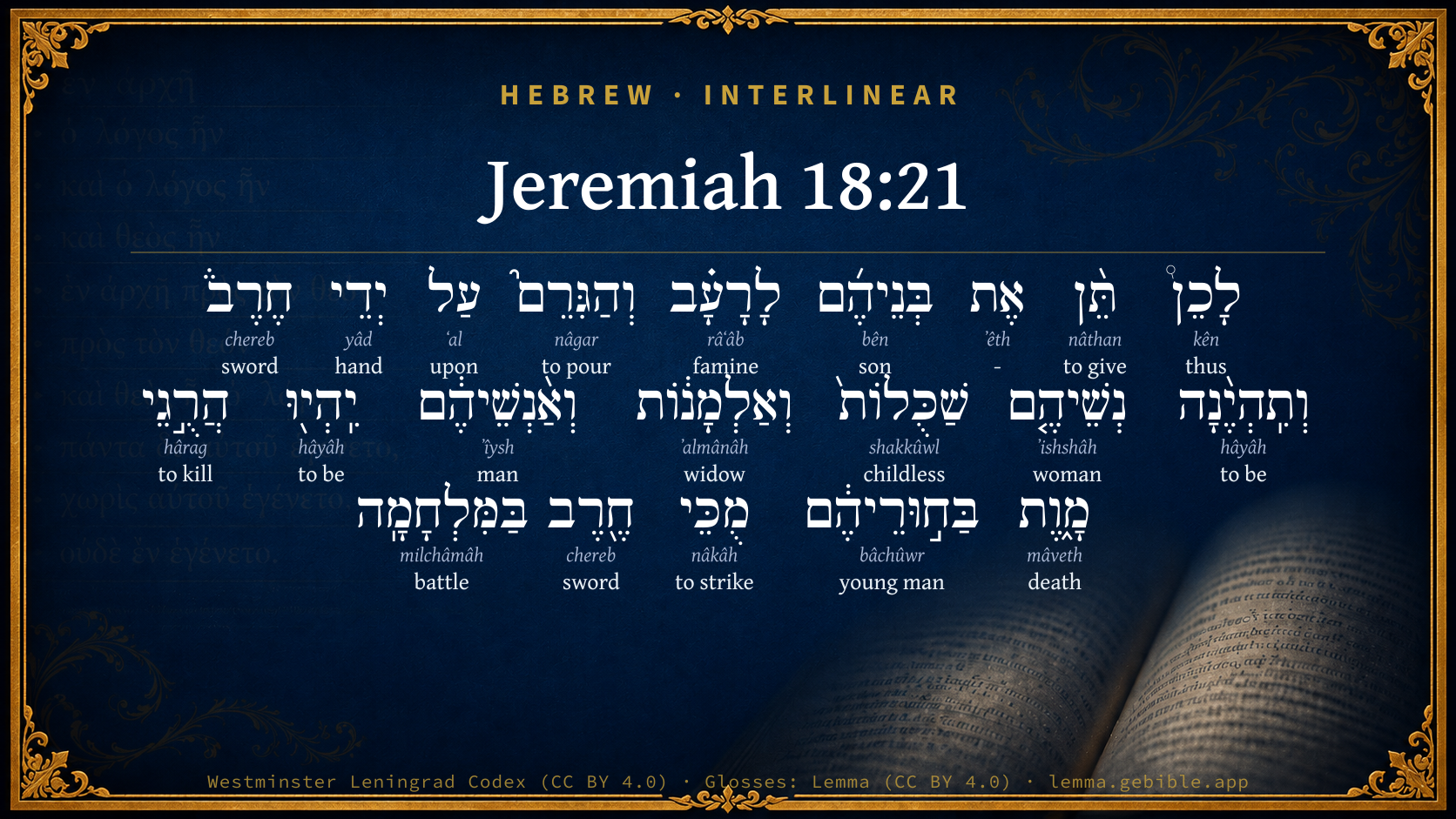
Jeremiah 18:21

Hebrew (Westminster Leningrad Codex) Jeremiah 18:21 appears in the Hebrew Old Testament. The text above is from the Westminster Leningrad Codex. Each word links to its Strong’s number, a concise gloss, and parsing drawn from the Open Scriptures Hebrew Bible morphology. Click any word for its full Brown-Driver-Briggs (BDB) entry.
Download image
Cite this verse

Jeremiah 18:21 (World English Bible). Public Domain. Lemma interlinear Bible study tool, https://lemma.gebible.app/v/jeremiah/18/21.

Show BibTeX & RIS
BibTeX
RIS
English Translation
Therefore deliver up their children to the famine, and give them over to the power of the sword; and let their wives become childless, and widows; and let their men be slain of death, [and] their young men struck of the sword in battle.
World English Bible · Public Domain
Download a study sheet

One document with this verse’s original text, its word-by-word gloss line, the meaning frame, cross-references with their text, attributed commentary, and full source and license credits — printable, and it pastes into notes with its structure intact.

This verse Autodidact and up

Study sheet (.html) Plain text (.txt)

A passage Seminary Student

Up to 50 verses in one chapter. A passage sheet keeps up to 6 commentary sources and 12 cross-references per verse, in the order this page ranks them, and says so on the sheet whenever that leaves anything out. Ask for a single verse and you get the Autodidact verse sheet above.

Everything on this page stays free to read, with no account — the sheet is a download of what is already on screen, not access to it.

Want to remove ads? Support Godless Engineer
Compare translations 3

The same verse in 3 English versions, stacked beneath the original-language interlinear above. Click any original word for its lexicon entry.

Each is an independent rendering of the whole verse — the interlinear is not word-aligned to these translations.

Highlighted words mark where these versions differ — a whole-verse word diff, not a word-by-word alignment.

  • World English Bible Public Domain
    Therefore deliver up their children to the famine, and give them over to the power of the sword; and let their wives become childless, and widows; and let their men be slain of death, [and] their young men struck of the sword in battle.
  • King James Version Public Domain
    Therefore deliver up their children to the famine, and pour out their blood by the force of the sword; and let their wives be bereaved of their children, and be widows; and let their men be put to death; let their young men be slain by the sword in battle.
  • unfoldingWord Literal Text CC BY-SA 4.0
    Therefore, give their sons to the famine, and deliver them over to the hands of the sword. And let their wives become bereaved of children and widows, and let their men become those killed of death, their young men struck of the sword in the battle.

unfoldingWord Literal Text — © unfoldingWord, licensed CC BY-SA 4.0. Word-aligned USFM3 via Door43 (git.door43.org/unfoldingWord/en_ult).

Versions to compare (up to 4)

3 of 4 selected

Show all 18 translations

Every available English version of this verse, each an independent rendering of the whole verse.

  • World English Bible Public Domain
    Therefore deliver up their children to the famine, and give them over to the power of the sword; and let their wives become childless, and widows; and let their men be slain of death, [and] their young men struck of the sword in battle.
  • Berean Standard Bible Public Domain
    Therefore, hand their children over to famine; pour out the power of the sword upon them. Let their wives become childless and widowed; let their husbands be slain by disease, their young men struck down by the sword in battle.
  • Majority Standard Bible Public Domain
    Therefore, hand their children over to famine; pour out the power of the sword upon them. Let their wives become childless and widowed; let their husbands be slain by disease, their young men struck down by the sword in battle.
  • King James Version Public Domain
    Therefore deliver up their children to the famine, and pour out their blood by the force of the sword; and let their wives be bereaved of their children, and be widows; and let their men be put to death; let their young men be slain by the sword in battle.
  • American Standard Version (1901) Public Domain
    Therefore deliver up their children to the famine, and give them over to the power of the sword; and let their wives become childless, and widows; and let their men be slain of death, `and' their young men smitten of the sword in battle.
  • Revised Version (1885) Public Domain
    Therefore deliver up their children to the famine, and give them over to the power of the sword; and let their wives become childless, and widows; and let their men be slain of death, and their young men smitten of the sword in battle.
  • Geneva Bible (1599) Public Domain
    Therefore, deliuer vp their children to famine, and let them drop away by the force of the sworde, and let their wiues be robbed of their children, and be widowes: and let their husbands be put to death, and let their yong men be slayne by the sword in the battell.
  • Douay-Rheims (1899) Public Domain
    Therefore deliver up their children to famine, and bring them into the hands of the sword: let their wives be bereaved of children and widows: and let their husbands be slain by death: let their young men be stabbed with the sword in battle.
  • Young's Literal Translation Public Domain
    Therefore, give up their sons to famine, And cause them to run on the sides of the sword, And their wives are bereaved and widows, And their men are slain by death, Their young men smitten by sword in battle,
  • Literal Standard Version CC BY-SA 4.0
    Therefore, give up their sons to famine, || And cause them to run on the sides of the sword, || And their wives are bereaved and widows, || And their men are slain by death, || Their young men [are] struck by sword in battle,
  • Unlocked Literal Bible CC BY-SA 4.0
    Therefore give their children over to famine, and give them to the hands of those who use the sword. So let their women become bereaved and widows, and their men be killed, and their young men killed by the sword in battle.
  • unfoldingWord Literal Text CC BY-SA 4.0
    Therefore, give their sons to the famine, and deliver them over to the hands of the sword. And let their wives become bereaved of children and widows, and let their men become those killed of death, their young men struck of the sword in the battle.
  • Darby Bible Public Domain
    Therefore give up their children to the famine, and deliver them over to the power of the sword; and let their wives be bereaved of children and be widows; and let their men be swept off by death, their young men be smitten by the sword in battle.
  • World Messianic Bible Public Domain
    Therefore deliver up their children to the famine, and give them over to the power of the sword. Let their wives become childless and widows. Let their men be killed and their young men struck by the sword in battle.
  • Webster's Bible Public Domain
    Therefore deliver their children to the famine, and pour out their blood by the force of the sword; and let their wives be bereaved of their children, and be widows; and let their men be put to death; let their young men be slain by the sword in battle.
  • Free Bible Version CC BY-SA 4.0
    But now may their children starve; may they be killed by the sword. May their wives lose their children and their husbands; may their husbands die from disease; may their young men be killed in battle.
  • Bible in Basic English Public Domain
    For this cause, let their children be without food, and give them over to the power of the sword; and let their wives be without children and become widows; let their men be overtaken by death, and their young men be put to the sword in the fight.
  • JPS Tanakh (1917) Public Domain
    Therefore deliver up their children to the famine, and hurl them to the power of the sword; and let their wives be bereaved of their children, and widows; and let their men be slain of death, and their young men smitten of the sword in battle.

Literal Standard Version (2020), Covenant Press — licensed CC BY-SA 4.0. Text via the HelloAO Bible API (eBible.org). Unlocked Literal Bible (unfoldingWord) — licensed CC BY-SA 4.0. Text via the HelloAO Bible API (eBible.org). unfoldingWord Literal Text — © unfoldingWord, licensed CC BY-SA 4.0. Word-aligned USFM3 via Door43 (git.door43.org/unfoldingWord/en_ult). Free Bible Version, Dr. Jonathan Gallagher — licensed CC BY-SA 4.0. Text via the HelloAO Bible API (eBible.org).

Word by word

More ways to search: Search by grammar → Find every occurrence → Compare this word →

Practice this passage: Drill this verse → Learn its vocabulary →

שַׁכֻּלוֹת֙
shakkûwl
H7909
“childless”
Adjective, Adjective, Feminine, Plural, Absolute
Part of Speech
Adjective
Type
Adjective
Gender
Feminine
Number
Plural
State
Absolute
Full BDB Definition

Origin: from H7921

TWOT: 2385b , 2385c

childless (through bereavement) - bereaved, robbed of offspring
  1. לָכֵן֩ kên H3651 “to/for · thus” Preposition + Adverb
  2. תֵּ֨ן nâthan H5414 “give” Verb, Qal, Imperative, 2nd Person, Masculine, Singular
  3. אֶת ʼêth H853 “-” Particle, Direct Object
  4. בְּנֵיהֶ֜ם bên H1121 “sons · their” Noun, Common, Masculine, Plural, Construct + Suffix, Personal, 3rd Person, Masculine, Plural
  5. לָרָעָ֗ב râʻâb H7458 “to/for the · famine” Preposition, Determined + Noun, Common, Masculine, Singular, Absolute
  6. וְהַגִּרֵם֮ nâgar H5064 “and · pour · them” Conjunction + Verb, Hiphil, Imperative, 2nd Person, Masculine, Singular + Suffix, Personal, 3rd Person, Masculine, Plural
  7. עַל ʻal H5921 “upon” Preposition
  8. יְדֵי yâd H3027 “hands of” Noun, Common, Both, Dual, Construct
  9. חֶרֶב֒ chereb H2719 “sword” Noun, Common, Feminine, Singular, Absolute
  10. וְתִֽהְיֶ֨נָה hâyâh H1961 “and · to be” Conjunction + Verb, Qal, Jussive, 3rd Person, Feminine, Plural
  11. נְשֵׁיהֶ֤ם ʼishshâh H802 “women · their” Noun, Common, Feminine, Plural, Construct + Suffix, Personal, 3rd Person, Masculine, Plural
  12. וְאַלְמָנ֔וֹת ʼalmânâh H490 “and · widows” Conjunction + Noun, Common, Feminine, Plural, Absolute
  13. וְאַ֨נְשֵׁיהֶ֔ם ʼîysh H376 “and · men · their” Conjunction + Noun, Common, Masculine, Plural, Construct + Suffix, Personal, 3rd Person, Masculine, Plural
  14. יִֽהְי֖וּ hâyâh H1961 “to be” Verb, Qal, Imperfect, 3rd Person, Masculine, Plural
  15. הֲרֻ֣גֵי hârag H2026 “killed” Verb, Qal, Participle Passive, Masculine, Plural, Construct
  16. מָ֑וֶת mâveth H4194 “death” Noun, Common, Masculine, Singular, Absolute
  17. בַּח֣וּרֵיהֶ֔ם bâchûwr H970 “young men · their” Noun, Common, Masculine, Plural, Construct + Suffix, Personal, 3rd Person, Masculine, Plural
  18. מֻכֵּי nâkâh H5221 “struck” Verb, Hophal, Participle Passive, Masculine, Plural, Construct
  19. חֶ֖רֶב chereb H2719 “sword” Noun, Common, Feminine, Singular, Absolute
  20. בַּמִּלְחָמָֽה milchâmâh H4421 “in/at the · battle” Preposition, Determined + Noun, Common, Feminine, Singular, Absolute

About this verse

These counts appear in no published source. They are computed here, from the morphology-tagged text and Lemma’s own curated glosses. What Lemma adds →

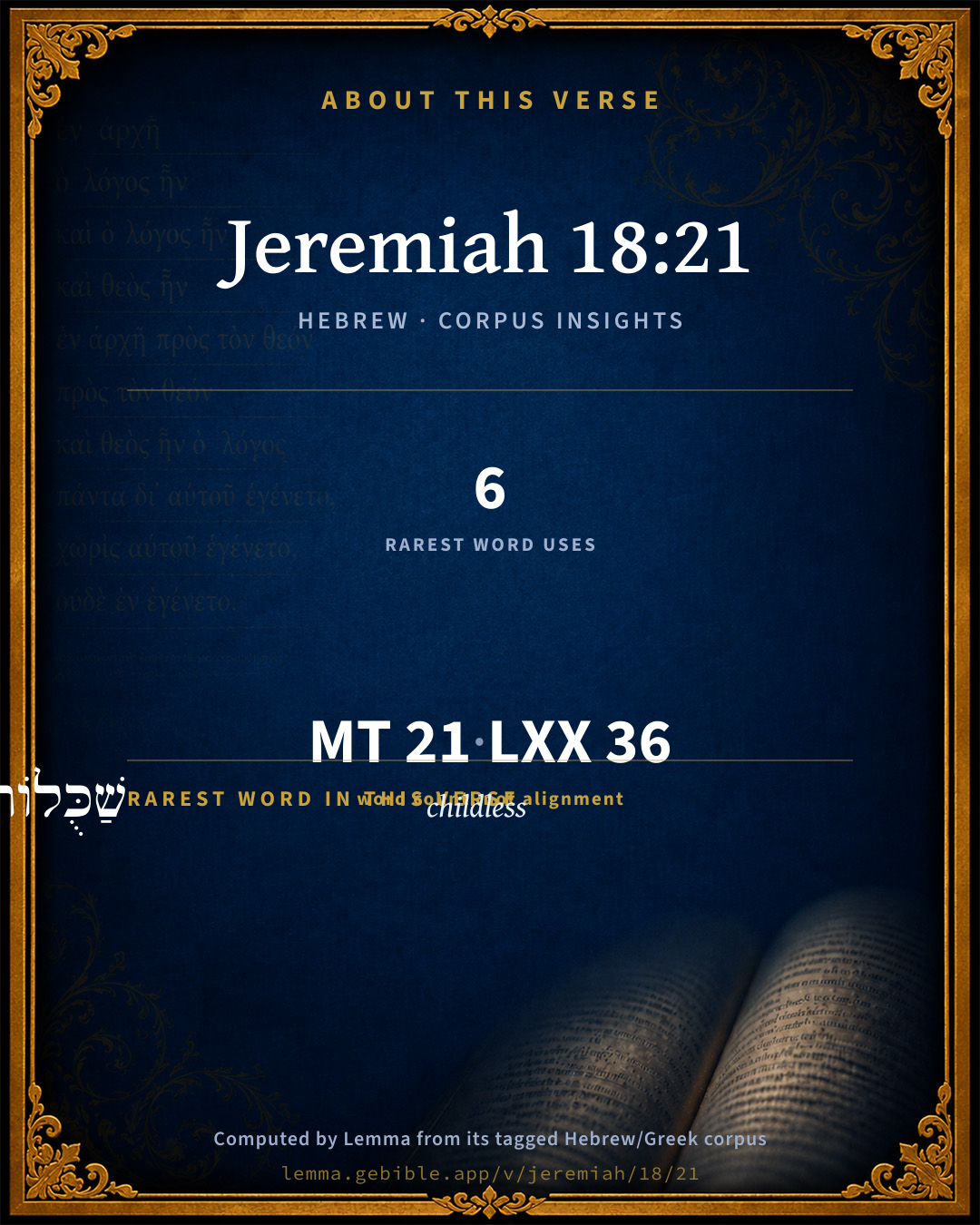
21
words
19
distinct lemmas
Prophets
section

Notable vocabulary

The rarest word here is שַׁכֻּלוֹת֙ childless H7909 — appearing just 6 times in the whole Hebrew Bible.

Shared distinctive vocabulary

שַׁכֻּלוֹת֙ childless H7909 occurs in 6 verses of the Hebrew Bible. Also found in:

Grammatical profile

  • 6 verbs
  • 11 nouns
  • 1 adjective
  • 1 preposition
  • 1 adverb
  • 1 particle

Verb forms

  • תֵּ֨ן Qal · Imperative
  • וְהַגִּרֵם֮ Hiphil · Imperative
  • וְתִֽהְיֶ֨נָה Qal · Jussive
  • יִֽהְי֖וּ Qal · Imperfect
  • הֲרֻ֣גֵי Qal · Participle Passive
  • מֻכֵּי Hophal · Participle Passive

Repetition

Words recur within this verse — often emphatic in Hebrew:

  • חֶרֶב֒ sword H2719 ×2
  • וְתִֽהְיֶ֨נָה to be H1961 ×2

Hebrew & Septuagint length

In the original languages it is 21 Hebrew tokens and 36 Greek tokens — but the two are counted differently (Hebrew bundles its prefixes and suffixes into one token; the Greek is in lemma form), so that isn’t a like-for-like length.

Cross-references

15

Topical passages linked to Jeremiah 18:21 in the Treasury of Scripture Knowledge — connected by theme and wording, ordered by reader-vote popularity; previews shown in the World English Bible.

  • Psalms 109:9–20 Let his children be fatherless, And his wife a widow.
  • Exodus 22:24 and my wrath will grow hot, and I will kill you with the sword; and your wives shall be widows, and your children fatherless.
  • Deuteronomy 32:25 Outside shall the sword bereave, In the chambers terror; [It shall destroy] both young man and virgin, The suckling with the man of gray hairs.
  • Jeremiah 9:21 For death is come up into our windows, it is entered into our palaces; to cut off the children from outside, [and] the young men from the streets.
  • Jeremiah 15:8 Their widows are increased to me above the sand of the seas; I have brought on them against the mother of the young men a destroyer at noonday: I have caused anguish and terrors to fall on her suddenly.
  • Jeremiah 16:3–4 For thus says Yahweh concerning the sons and concerning the daughters who are born in this place, and concerning their mothers who bore them, and concerning their fathers who became the father of them in this land:
  • Lamentations 5:3 We are orphans and fatherless; Our mothers are as widows.
  • Amos 4:10 I sent plagues among you like I did Egypt. I have slain your young men with the sword, And have carried away your horses; And I filled your nostrils with the stench of your camp Yet you haven't returned to me," says Yahweh.
  • 2 Chronicles 36:17 Therefore he brought on them the king of the Chaldeans, who killed their young men with the sword in the house of their sanctuary, and had no compassion on young man or virgin, old man or gray-headed: he gave them all into his hand.
  • Jeremiah 11:20–23 But, Yahweh of Hosts, who judge righteously, who try the heart and the mind, I shall see your vengeance on them; for to you have I revealed my cause.
  • Jeremiah 12:3 But you, Yahweh, know me; you see me, and try my heart toward you: pull them out like sheep for the slaughter, and prepare them for the day of slaughter.
  • Jeremiah 15:2–3 It shall happen, when they tell you, Where shall we go forth? then you shall tell them, Thus says Yahweh: Such as are for death, to death; and such as are for the sword, to the sword; and such as are for the famine, to the famine; and such as are for captivity, to captivity.
  • Jeremiah 20:1–6 Now Pashhur, the son of Immer the priest, who was chief officer in the house of Yahweh, heard Jeremiah prophesying these things.
  • Jeremiah 20:11–12 But Yahweh is with me as an awesome mighty one: therefore my persecutors shall stumble, and they shall not prevail; they shall be utterly disappointed, because they have not dealt wisely, even with an everlasting dishonor which shall never be forgotten.
  • 2 Timothy 4:14 Alexander, the coppersmith, did much evil to me. The Lord will repay him according to his works,

Cross-references courtesy of OpenBible.info (CC BY 4.0).

Hebrew and Greek witnesses Masoretic Hebrew ↔ Greek Septuagint

The same verse in the two great witnesses to the Old Testament, shown verse-for-verse.

These are two independent witnesses, not word-aligned to each other, and the Septuagint is shown in lemma (dictionary) form.

Hebrew Jeremiah 18:21 Masoretic · Westminster Leningrad Codex

לָכֵן֩ תֵּ֨ן אֶת בְּנֵיהֶ֜ם לָרָעָ֗ב וְהַגִּרֵם֮ עַל יְדֵי חֶרֶב֒ וְתִֽהְיֶ֨נָה נְשֵׁיהֶ֤ם שַׁכֻּלוֹת֙ וְאַלְמָנ֔וֹת וְאַ֨נְשֵׁיהֶ֔ם יִֽהְי֖וּ הֲרֻ֣גֵי מָ֑וֶת בַּח֣וּרֵיהֶ֔ם מֻכֵּי חֶ֖רֶב בַּמִּלְחָמָֽה

Therefore deliver up their children to the famine, and give them over to the power of the sword; and let their wives become childless, and widows; and let their men be slain of death, [and] their young men struck of the sword in battle.

World English Bible · Public Domain

Greek LXX Structure differs

In the Septuagint, Jeremiah is about an eighth shorter than the Hebrew and arranges its material differently — the Oracles Against the Nations (Hebrew chapters 46–51) appear in the middle of the Greek book, after 25:13. Because the chapter and verse boundaries do not line up, a verse-for-verse comparison with the Hebrew is not shown.

A verse-for-verse comparison isn’t shown here because the chapters and verses don’t line up. Switch to the LXX edition with the MT / LXX toggle above to read the Greek directly.

Hebrew: Westminster Leningrad Codex (CC BY 4.0). Greek: Septuagint (public domain); English from a public-domain English Septuagint. How the Septuagint differs from the Hebrew →

Targum (Aramaic paraphrase)

1

The Targum is the ancient Jewish Aramaic paraphrase of the Hebrew Scriptures — an interpretive translation, not the Hebrew text itself. Onkelos (literal) and Pseudo-Jonathan (expansive) render the Torah, and Jonathan the Prophets. Coverage is partial: where no permissively-licensed English translation exists for a verse, only the Aramaic is shown. This is verse-level text, not a word-by-word alignment to the Hebrew.

  1. Targum Jonathan Prophets (Joshua–Malachi)
    בְּכֵן הַב יַת בְּנֵיהוֹן לְכַפְנָא וְתַבְּבִינוּן יְדֵי קָטוֹלֵי חַרְבָּא וְיֶהֶוְיַן נְשֵׁיהוֹן תַּכְלָן וְאַרְמְלָן וְגַבְרֵיהוֹן יְהוֹן קְטִילֵי מוֹתָא עוּלֵימֵיהוֹן מְטַעֲנֵי חַרְבָּא בִּקְרָבָא:

    (no public-domain English translation for this verse)

    Targum Jonathan — Aramaic: “Mikraot Gedolot” (public domain). English: “Sefaria Community Translation” (CC0 1.0 (public-domain dedication)); “London "Chaldee Paraphrase," 1871” (public domain). Text via Sefaria.

Commentary

Notes on Jeremiah 18:21 from classic Christian and Jewish commentators (each source and its license shown beneath its notes). The classic Christian expositions comment on the surrounding passage and are grouped to its opening verse, so a note may address several verses; the Jewish commentaries on the Tanakh (Rashi and others) are per-verse, so they appear only where the commentator wrote on this verse.

Lemma curates 59 commentaries, every one of them public domain or Creative Commons licensed, each selected and text-cleaned for this edition rather than reprinted as found. About our sources →

The Cambridge Bible for Schools and Colleges

gen. ed. J. J. S. Perowne

21–23. See on Jer_17:18. Here also we may be permitted to consider the passage to be an editorial addition. Erbt retains 22 b and 23 as genuine, Gi. all but “and their … battle” (Jer_18:21), while Du. and Co. reject the passage, which in its bitter imprecations indeed forms a harsh contrast to the prophet’s expressions elsewhere of affectionate mourning for the attitude taken up by his countrymen, as well as to the teaching of the N.T. (Mat_5:44).

The Cambridge Bible for Schools and Colleges (gen. ed. J. J. S. Perowne; Cambridge University Press, 1878–1918) — public domain. Text from a community e-Sword module.

Trapp's Complete Commentary

John Trapp

Jer 18:21 Therefore deliver up their children to the famine, and pour out their [blood] by the force of the sword; and let their wives be bereaved of their children, and [be] widows; and let their men be put to death; [let] their young men [be] slain by the sword in battle.

Ver. 21. Therefore deliver up their children to the famine.] He who had prayed so hard for them, could and did pray here as earnestly against them; yet not out of private revenge, but by a prophetic spirit, whereby he foretelleth their calamities auxesi verborum per hypotyposin. This is usual with the psalmist and other prophets.

And let their men be put to death.] Heb., Be killed with death. See Rev 2:23. {See Trapp on "Rev 2:23"}

John Trapp, A Commentary or Exposition upon All the Books of the Old and New Testament (1647–1656) — public domain. Text from a community e-Sword module.

Tyndale Open Study Notes

Tyndale Open Resources

18:21-23 In his prayer for vengeance, Jeremiah asked God to fulfill his promised curses against those who violated his covenant (cp. Deut 27:11-26; 28:15-68; see also “Prayers for Vengeance” Theme Note).

Tyndale Open Study Notes — © Tyndale Open Resources, licensed CC BY-SA 4.0. Text via the HelloAO Bible API.

Geneva Bible (1599)

Geneva Bible translators

Seeing the obstinate malice of the adversaries, which grew daily more and more, the Prophet being moved with God’s Spirit, without any carnal affection prayeth for their destruction, because he knew that it should tend to God’s glory, and profit of his Church.

Geneva Bible (1599) marginal notes — public domain. Text via Bolls.life.

Jamieson, Fausset & Brown

Robert Jamieson, A. R. Fausset & David Brown

pour out their blood by the force of the sword--literally, "by the hands of the sword." So Eze 35:5. MAURER with JEROME translates, "deliver them over to the power of the sword." But compare Psa 63:10, Margin; Isa 53:12. In this prayer he does not indulge in personal revenge, as if it were his own cause that was at stake; but he speaks under the dictation of the Spirit, ceasing to intercede, and speaking prophetically, knowing they were doomed to destruction as reprobates; for those not so, he doubtless ceased not to intercede. We are not to draw an example from this, which is a special case.

put to death--or, as in Jer 15:2, "perish by the death plague" [MAURER].

men . . . young men--HORSLEY distinguishes the former as married men past middle age; the latter, the flower of unmarried youth.

Jamieson, Fausset & Brown — Commentary Critical and Explanatory on the Whole Bible (1871) — public domain (CC PDM 1.0). Text via the HelloAO Bible API.

Adam Clarke's Commentary

Verse 21. Therefore deliver up their children] The execrations in these verses should be considered as simply prophetic declarations of the judgments which God was about to pour out on them.

If we consider them in their grammatical meaning, then they are not directions to us, to whom our Lawgiver has said, "Love your enemies."

Adam Clarke's Commentary on the Bible (1810–1826) — public domain. Text from a community e-Sword/MySword module.

John Calvin's Commentaries

The Prophet seems here to have been driven through indignation to utter imprecations which are not consistent with a right feeling; for even if Christ had not said with his own mouth, that we are to pray for those who curse us, the very law of God, ever known to the holy fathers, was sufficient. Jeremiah then ought not to have uttered these curses, and to have imprecated final destruction on his enemies, thouglt they fully deserved it. But it must be observed, that he was moved not otherwise than by the Holy Spirit, to become thus indignant against his enemies; for he could not have been excused on the ground that indignation often transgresses the bounds of patience, for the children of God ought to bear all injuries to the utmost; but, as I have said, the Prophet here has announced nothing rashly, nor did he allow himself to wish anything as of himself, but obediently proclaimed what the Holy Spirit dictated, as his faithful instrument.

We have said elsewhere, that the first thing to be noticed is, that when we pray for any evil on the wicked, we ought not to act on private grounds; for he who has a regard to himself, will ever be led away by too strong an impulse; and even when our prayers are calmly and rightly formed, we are yet ever wrong, when we consult our private advantages or redress our own injuries. That is one thing. And secondly, we ought to have that wisdom which distinguishes between the elect and the reprobate. But as God bids us to suspend our judgment, inasmuch as we cannot surely know what will take place to-morrow, we ought not to imitate indiscriminately the Prophet in praying God to destroy and scatter ungodly men of whom we despair; for, as it has been stated, we are not certain what has been decreed in heaven. In short, whosoever is disposed, after the example of Jeremiah, to pray for a curse on his enemies, must be ruled by the same spirit, according to what Christ said to his disciples; for as God destroyed the wicked at the request of Elijah, the Apostles wished Christ to do the same by fire from heaven; but he said,

“Ye know not by what spirit ye are, ruled.” (Luke 9:55)

They were unlike Elijah, and yet; wished like apes to imitate what he did.

But, as I have said, let first all regard to our own benefit or loss be dismissed, when we would shew ourselves indignant against the wicked; and secondly, let us have the spirit of wisdom and discretion; and lastly, let all the turbulent feelings of the flesh be checked, for as soon as anything human be mixed with our prayers, some confusion will ever be found. There was nothing turbulent in this imprecation of Jeremiah, for the Spirit of God ruled his heart and his tongue, and then he forgot himself; and lastly, he knew that they were reprobate and already doomed to final ruin. He therefore hesitated not, through the prophetic spirit, to imprecate on them what we here read. And there is no doubt but that he was ever solicitous for the remnant, for he knew that there were some faithful; and though they were unknown, he yet prayed God for them. But he fulminates here against the reprobate who were already given up to ruin. This is the reason why he hesitated not to pray that they might be delivered up to famine and given to the sword, so that their women might be bereaved and become widows, and their men put to death, and their youth smitten by the sword. It now follows —

John Calvin's Commentaries (1540-1563) — public domain. Text from the Calvin Translation Society English edition (1840s-50s) via the Christian Classics Ethereal Library (ccel.org). Calvin's coverage is partial (roughly two-thirds of the Bible); uncommented books and verses are honest gaps, never fabricated. The 19th-century editor's footnotes and remarks are omitted so the notes are faithfully Calvin's own voice.

Ellicott's Commentary for English Readers

(21) Therefore deliver up their children . . .—The bitter words that follow startle and pain us, like the imprecations of Psalms 35, 69, 109. To what extent they were the utterances of a righteous indignation, a true zeal for God, which had not yet learnt the higher lesson of patience and forgiveness, or embodied an element of personal vindictiveness, we are not called on to inquire, and could not, in any case, decide. It is not ours to judge another man’s servant. In all like cases we have to remember that the very truthfulness with which the prayer is recorded is at least a proof that the prophet felt, like Jonah, that he did well to be angry (Jon_4:9), that a righteous anger is at least one step towards a righteous love, and that we, as disciples of Christ, have passed, or ought to have passed, beyond that earlier stage.

Pour out their blood by the force of the sword.—Literally, with a bolder metaphor, pour them out into the hands of the sword.

A Bible Commentary for English Readers, edited by Charles John Ellicott (1878–1897) — public domain. Text from a community e-Sword module.

John Gill's Exposition

Yet, Lord, thou knowest all their counsel against me to slay me,.... However deep they had laid them; and however unknown they were to him; or however private and secret they might be thought to be by them; God is an omniscient God, and knows and sees all things; the thoughts of men's hearts, and all their secret designs in the dark against his ministers, people, and interest:

forgive not their iniquity, neither blot out their sin from thy sight; they had sinned the unpardonable sin; or, however, a sin unto death; for which prayer for the forgiveness of it was not to be made, Jo1 5:16; this the prophet knew: what he here imprecates, and both before and after, must be considered, not as flowing from a private spirit, or from a spirit of malice and revenge; but what he delivered out under a spirit of prophecy, as foretelling what would be the sad estate and condition of these persons; for, otherwise, the temper and disposition of the prophet were the reverse; and he was inclined to sue for mercy for these people, as he often did; wherefore this is not to be drawn into a precedent and example for any to follow:

but let them be overthrown before thee; by the sword, famine, and pestilence: or, "let them be made to stumble before thee" (i); and fall into perdition; they having made others to stumble in their ways from the ancient paths of truth and goodness; so that it was but a righteous thing that they should be punished after this manner; see Jer 18:15;

deal thus with them in the time of thine anger; the set time for his wrath to come upon them to the uttermost; then do unto them according to all the imprecations now made; which the prophet foresaw, and believed he would do; and therefore thus spake.

(i) "propellantur in offendiculum coram te", Junius & Tremellius, Piscator; "offensi ruant coram te", Cocceius.

Next: Jeremiah Chapter 19

John Gill's Exposition of the Whole Bible (1746–1763) — public domain (CC PDM 1.0). Text via the HelloAO Bible API.

Albert Barnes' Notes on the Bible

Pour out ... sword - literally, “pour them out upon the hands of the sword, i. e., give them up to the sword.”

Put to death - Rather, slain of death. The prophet’s phrase leaves it entirely indefinite in what way the men are to die.

Albert Barnes' Notes on the Bible (1834–1885) — public domain. Text from a community e-Sword/MySword module.

Haydock's Catholic Bible Commentary

Therefore. He foretells of the event, and approves of the chastisement of the impenitent, (Calmet) whose "impurity might be a bad precedent for others.["] (St. Jerome) See chap. xvii. 18.

George Leo Haydock (1774–1849), Haydock's Catholic Family Bible and Commentary, 1859 edition — public domain. Excludes Psalms (Douay-Rheims chapter numbering differs from Protestant) and Deuterocanonical books (Catholic canon only).

Matthew Poole's English Annotations

Deliver up their children to the famine; a dreadful imprecation; we meet with more of the same nature, Jer 11:20; 15:15; 17:18. We find also several such imprecation in the Psalms, Psa 35:4; 40:14; 69:22-25,27,28; 109:6-10, &c. Hence a question is raised, whether it be lawful for God’s servants to pray for evil against their enemies. That which makes the doubt is, Christ’s command to us to pray for them that persecute us, Mat 5:43,44, his own example, and Stephen’s, Act 7:60. See the notes upon the aforementioned texts. It is doubtless our duty to pray for the conversion, forgiveness, and eternal salvation of our worst enemies; so Christ prayed, and Stephen, but neither of them prayed for their outward prosperity in their persecution and rage; and without doubt we may pray against God’s enemies, that God would tie their hands, weaken their power, confound their devices. For such other particulars as are mentioned in this verse, and the beginning of the following verse, and such as David mentions, Psa 69, we must know they were both prophets, and did but pray to God to do that thing which God had revealed to them he would do.

Matthew Poole's English Annotations on the Holy Bible (1683–1685) — public domain. Text from a community e-Sword/MySword module.

Whedon's Commentary on the Bible

Daniel D. Whedon

21. Pour out their blood, etc. — Literally, pour them out upon thee hands of the sword; that is, give them up to its power.

Daniel D. Whedon (gen. ed.), Commentary on the Old and New Testaments (1874–1909) — public domain. Text from a community e-Sword module.

The Pulpit Commentary

Pour out their blood by the force, etc.; rather, spill them into the hands of, etc.; (see Psa_63:10) a phrase akin to that in Isa_53:12. The sword is personified. Let their men he put to death; another personification, for the Hebrew has "slain of Death pestilence is referred to, as Jer_15:2.

The Pulpit Commentary (1880–1919), ed. H.D.M. Spence-Jones & Joseph S. Exell — public domain. Text from a community e-Sword module.

John Wesley's Explanatory Notes

Therefore - But is it lawful for God's servants to pray for evil against their enemies? It is not lawful for Christians. It is doubtless our duty, to pray for the conversion, forgiveness, and eternal salvation of our worst enemies.

John Wesley, Explanatory Notes Upon the Whole Bible (1754–1765) — public domain. Text via the GEBible commentary corpus.

unfoldingWord translationNotes

Door43 World Missions Community

give their children over to famine

The idiom "give over" means to place a person in the power of another person. Jeremiah speaks of "famine" as if it were a person who could have power over others. AT: "cause their children to die from famine" (See: Idiom and Personification)

give them to the hands of those who use the sword

Here the word "hands" represents power. AT: "cause those who use the sword to have power over them" or "cause them to die in battle" (See: Metonymy)

let their women become bereaved and widows

"let the children and husbands of their women die." The word "bereaved" refers to a woman whose children have all died.

their men be killed

The verb may be supplied from the previous phrase. This can be stated in active form. AT: "let people kill their men" (See: Ellipsis and Active or Passive)

their young men killed by the sword in battle

The verb may be supplied from the previous phrase. This can be stated in active form. AT: "let people kill their young men with swords in battle" (See: Ellipsis and Active or Passive)

Let a distressed shout be heard

The phrase "a distressed shout" can be translated with a verbal phrase. This can be stated in active form. AT: "Let people hear a distressed shout" or "Let people hear others shout in distress" (See: Active or Passive)

For they have dug a pit to capture me and have hidden traps for my feet

These two phrases share similar meanings. Jeremiah speaks of his enemies planning to kill him as if they had dug a pit for him to fall into and set traps in which to capture him. (See: Parallelism and Metaphor)

they have dug a pit

See how you translated this in Jeremiah 18:20.

have hidden traps for my feet

Here the word "feet" represents Jeremiah. AT: "have hidden traps for me" or "have hidden traps for me to step on" (See: Synecdoche)

Do not wipe their sins away from you

Jeremiah speaks of Yahweh forgiving his enemies' sins as if someone had written their sins down and Yahweh would erase them. This phrase means the same thing as the previous phrase. AT: "Do not pardon their sins" (See: Parallelism)

let them be overthrown before you

This can be stated in active form. AT: "let people overthrow them in your presence" (See: Active or Passive)

in the time of your wrath

The word "wrath" can be translated with a verb. AT: "when you are still angry with them" (See: Abstract Nouns)

translationWords

hand

children

famine

power

sword

snare

Yahweh

forgive

iniquity

sin

blot out

unfoldingWord translationNotes — © Distant Shores Media and the Door43 World Missions Community, licensed CC BY-SA 4.0. Source: git.door43.org/Door43/en_tn.

Rashi

Rabbi Shlomo Yitzchaki (Rashi)

and spill their blood (Bring them down by the sword,) an expression of (Lam. 3:49) “My eye runs (נִגְרָה)”; (Micah 1:4) “Like water that runs (מֻגָרִים).”

by the sword by troops.

and their husbands i.e., the husbands of the widows shall be slain by the angel of death.

Rashi on the Tanakh — English translations: “The Judaica Press complete Tanach with Rashi, translated by A. J. Rosenberg” (CC BY 4.0); “Pentateuch with Rashi's commentary by M. Rosenbaum and A.M. Silbermann, 1929-1934” (public domain); “The Metsudah Tanach series, Lakewood, N.J” (CC BY 4.0); and “The Book of Joshua, Metsudah Publications, 1997” (CC BY 4.0). Text via Sefaria.

Lesson kit

Teaching starters — assembled from the data on this page, not authored interpretation. Every prompt links to the verse data it draws on. Edit before teaching.

Jeremiah, in the Prophets, opens this verse with 21 words (19 distinct Hebrew lemmas). Its most distinctive word is shakkûwl (“childless”). A historical commentator’s framing appears above. Read the whole chapter for the surrounding context.

Discussion questions

  1. The word shakkûwl carries the sense “childless.” How does it shape the verse?
  2. How does 2 Samuel 17:8, which shares the word «childless», read alongside this verse?
  3. What does the repetition of “sword” (2× in this one verse) do in this verse?
  4. These translations render this verse differently. What is at stake in choosing one wording over another?
  5. «תֵּ֨ן» is a Qal Imperative verb. How does that grammatical form shape the action described?
  6. Compare how The Cambridge Bible for Schools and Colleges and Trapp's Complete Commentary read this verse. Where do they agree or differ?

Things to notice

Reading settings

Reading text

Shown beneath each verse's original-language words.

Old Testament
Old Testament edition

Read the OT as the Masoretic Hebrew (MT) or the Greek Septuagint (LXX).

English shown for the Greek Septuagint (in the Hebrew ↔ Greek comparison).

Comparing translations? Open the Compare panel on any verse page to stack up to four side by side.