
Judges 9:5

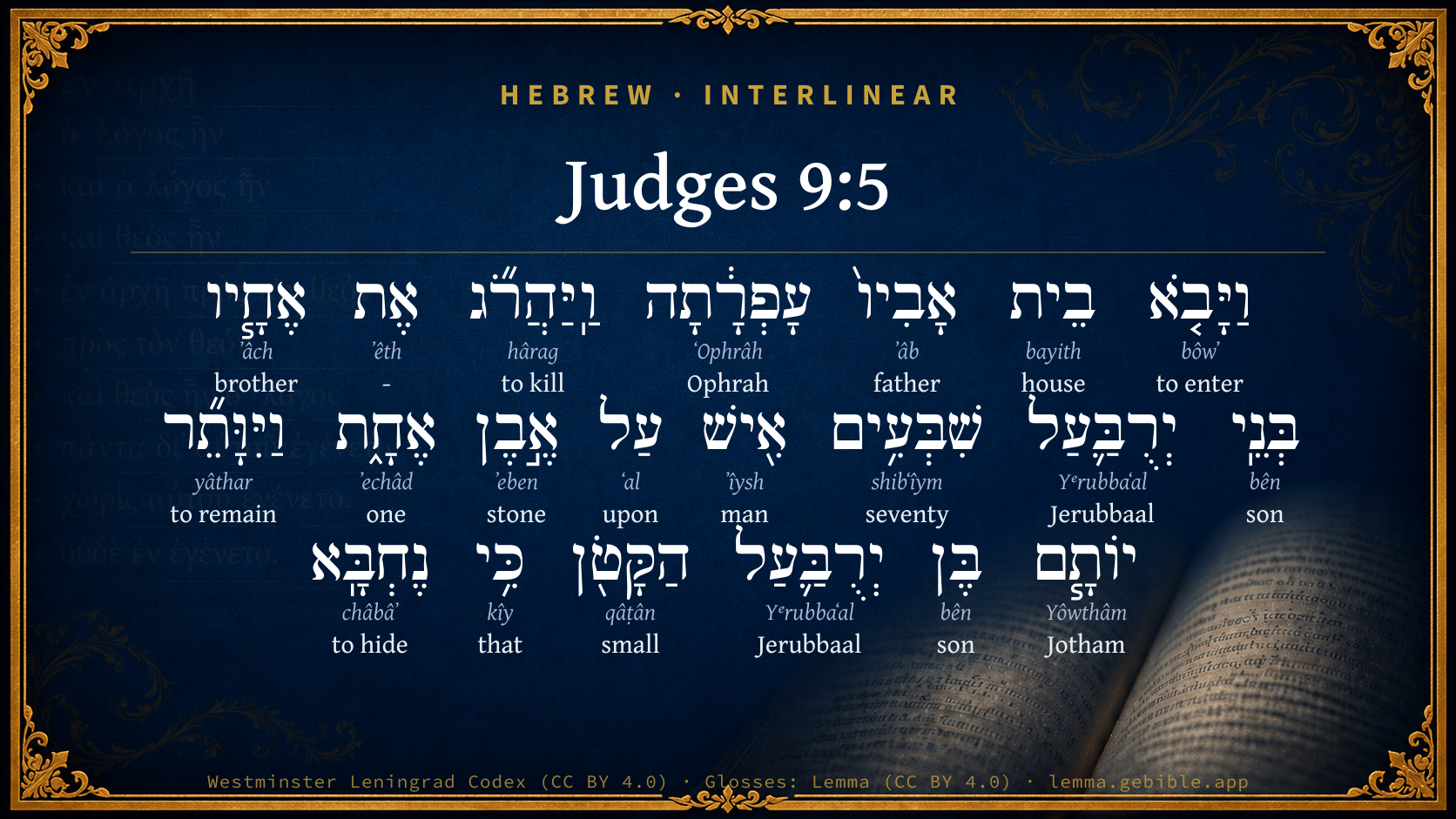
Hebrew (Westminster Leningrad Codex) Judges 9:5 appears in the Hebrew Old Testament. The text above is from the Westminster Leningrad Codex. Each word links to its Strong’s number, a concise gloss, and parsing drawn from the Open Scriptures Hebrew Bible morphology. Click any word for its full Brown-Driver-Briggs (BDB) entry.
Download image
Cite this verse

Judges 9:5 (World English Bible). Public Domain. Lemma interlinear Bible study tool, https://lemma.gebible.app/v/judges/9/5.

Show BibTeX & RIS
BibTeX
RIS
English Translation
He went to his father's house at Ophrah, and killed his brothers the sons of Jerubbaal, being seventy persons, on one stone: but Jotham the youngest son of Jerubbaal was left; for he hid himself.
World English Bible · Public Domain
Highlights
  • 1 first appearance in the Hebrew Bible
Full analysis ↓
Download a study sheet

One document with this verse’s original text, its word-by-word gloss line, the meaning frame, cross-references with their text, attributed commentary, and full source and license credits — printable, and it pastes into notes with its structure intact.

This verse Autodidact and up

Study sheet (.html) Plain text (.txt)

A passage Seminary Student

Up to 50 verses in one chapter. A passage sheet keeps up to 6 commentary sources and 12 cross-references per verse, in the order this page ranks them, and says so on the sheet whenever that leaves anything out. Ask for a single verse and you get the Autodidact verse sheet above.

Everything on this page stays free to read, with no account — the sheet is a download of what is already on screen, not access to it.

Want to remove ads? Support Godless Engineer
Compare translations 3

The same verse in 3 English versions, stacked beneath the original-language interlinear above. Click any original word for its lexicon entry.

Each is an independent rendering of the whole verse — the interlinear is not word-aligned to these translations.

Highlighted words mark where these versions differ — a whole-verse word diff, not a word-by-word alignment.

  • World English Bible Public Domain
    He went to his father's house at Ophrah, and killed his brothers the sons of Jerubbaal, being seventy persons, on one stone: but Jotham the youngest son of Jerubbaal was left; for he hid himself.
  • King James Version Public Domain
    And he went unto his father's house at Ophrah, and slew his brethren the sons of Jerubbaal, being threescore and ten persons, upon one stone: notwithstanding yet Jotham the youngest son of Jerubbaal was left; for he hid himself.
  • unfoldingWord Literal Text CC BY-SA 4.0
    Then he went the house of his father in Ophrah and he killed his brothers, the sons of Jerubbaal, 70 men upon one stone. But Jotham was left, the youngest son of Jerubbaal, for he had hidden himself.

unfoldingWord Literal Text — © unfoldingWord, licensed CC BY-SA 4.0. Word-aligned USFM3 via Door43 (git.door43.org/unfoldingWord/en_ult).

Versions to compare (up to 4)

3 of 4 selected

Show all 18 translations

Every available English version of this verse, each an independent rendering of the whole verse.

  • World English Bible Public Domain
    He went to his father's house at Ophrah, and killed his brothers the sons of Jerubbaal, being seventy persons, on one stone: but Jotham the youngest son of Jerubbaal was left; for he hid himself.
  • Berean Standard Bible Public Domain
    He went to his father’s house in Ophrah, and on one stone murdered his seventy brothers, the sons of Jerubbaal. But Jotham, the youngest son of Jerubbaal, survived, because he hid himself.
  • Majority Standard Bible Public Domain
    He went to his father’s house in Ophrah, and on one stone murdered his seventy brothers, the sons of Jerubbaal. But Jotham, the youngest son of Jerubbaal, survived, because he hid himself.
  • King James Version Public Domain
    And he went unto his father's house at Ophrah, and slew his brethren the sons of Jerubbaal, being threescore and ten persons, upon one stone: notwithstanding yet Jotham the youngest son of Jerubbaal was left; for he hid himself.
  • American Standard Version (1901) Public Domain
    And he went unto his father's house at Ophrah, and slew his brethren the sons of Jerubbaal, being threescore and ten persons, upon one stone: but Jotham the youngest son of Jerubbaal was left; for he hid himself.
  • Revised Version (1885) Public Domain
    And he went unto his father’s house at Ophrah, and slew his brethren the sons of Jerubbaal, being threescore and ten persons, upon one stone: but Jotham the youngest son of Jerubbaal was left; for he hid himself.
  • Geneva Bible (1599) Public Domain
    And he went vnto his fathers house at Ophrah, and slew his brethren, the sonnes of Ierubbaal, about seuentie persons vpon one stone: yet Iotham the yongest sonne of Ierubbaal was left: for he hid himselfe.
  • Douay-Rheims (1899) Public Domain
    And he came to his father's house in Ephra, and slew his brethren the sons of Jerobaal, seventy men, upon one stone: and there remained only Joatham the youngest son of Jerobaal, who was hidden.
  • Young's Literal Translation Public Domain
    and he goeth into the house of his father at Ophrah, and slayeth his brethren, sons of Jerubbaal, seventy men, on one stone; and Jotham, youngest son of Jerubbaal, is left, for he was hidden.
  • Literal Standard Version CC BY-SA 4.0
    and he goes into the house of his father at Ophrah, and slays his brothers, sons of Jerubba‘al, seventy men, on one stone; and Jotham, youngest son of Jerubba‘al, is left, for he was hidden.
  • Unlocked Literal Bible CC BY-SA 4.0
    Abimelech went to his father's house at Ophrah, and upon one stone he murdered his seventy brothers, the sons of Jerub Baal. Only Jotham was left, the youngest son of Jerub Baal, for he hid himself.
  • unfoldingWord Literal Text CC BY-SA 4.0
    Then he went the house of his father in Ophrah and he killed his brothers, the sons of Jerubbaal, 70 men upon one stone. But Jotham was left, the youngest son of Jerubbaal, for he had hidden himself.
  • Darby Bible Public Domain
    And he went to his father's house at Ophrah, and slew his brothers the sons of Jerubba'al, seventy men, upon one stone; but Jotham the youngest son of Jerubba'al was left, for he hid himself.
  • World Messianic Bible Public Domain
    He went to his father’s house at Ophrah, and killed his brothers the sons of Jerubbaal, being seventy persons, on one stone; but Jotham the youngest son of Jerubbaal was left, for he hid himself.
  • Webster's Bible Public Domain
    And he went to his father's house at Ophrah, and slew his brethren the sons of Jerubbaal, being seventy persons, upon one stone; notwithstanding, yet Jotham the youngest son of Jerubbaal was left; for he hid himself.
  • Free Bible Version CC BY-SA 4.0
    He went to his father's house in Ophrah, and on one stone killed his seventy half-brothers, the sons of Jerub-baal. But Jotham, Jerub-baal's youngest son, escaped by going into hiding.
  • Bible in Basic English Public Domain
    Then he went to his father's house at Ophrah, and put his brothers, the seventy sons of Jerubbaal, to death on the same stone; however, Jotham, the youngest, kept himself safe by going away to a secret place.
  • JPS Tanakh (1917) Public Domain
    And he went unto his father's house at Ophrah, and slew his brethren the sons of Jerubbaal, being threescore and ten persons, upon one stone; but Jotham the youngest son of Jerubbaal was left; for he hid himself.

Literal Standard Version (2020), Covenant Press — licensed CC BY-SA 4.0. Text via the HelloAO Bible API (eBible.org). Unlocked Literal Bible (unfoldingWord) — licensed CC BY-SA 4.0. Text via the HelloAO Bible API (eBible.org). unfoldingWord Literal Text — © unfoldingWord, licensed CC BY-SA 4.0. Word-aligned USFM3 via Door43 (git.door43.org/unfoldingWord/en_ult). Free Bible Version, Dr. Jonathan Gallagher — licensed CC BY-SA 4.0. Text via the HelloAO Bible API (eBible.org).

Word by word

More ways to search: Search by grammar → Find every occurrence → Compare this word →

Practice this passage: Drill this verse → Learn its vocabulary →

עָפְרָ֔תָה
ʻOphrâh
H6084
“Ophrah · toward”
Noun, Proper + Suffix, Demonstrative
Part of Speech
Noun
Type
Proper
Full BDB Definition

Origin: fem. of H6082

TWOT: None

Ophrah = "fawn" - a Judaite, son of Meonothai (noun proper masculine) - a town of Benjamin approximately 5 miles (8 kilometers) east of Bethel (noun proper locative) - a place in Manasseh, native place of Gideon; probably located close to Shechem (noun proper locative)
  1. וַיָּבֹ֤א bôwʼ H935 “and · to enter” Conjunction + Verb, Qal, Sequential Imperfect, 3rd Person, Masculine, Singular
  2. בֵית bayith H1004 “house of” Noun, Common, Masculine, Singular, Construct
  3. אָבִיו֙ ʼâb H1 “father · his” Noun, Common, Masculine, Singular, Construct + Suffix, Personal, 3rd Person, Masculine, Singular
  4. וַֽיַּהֲרֹ֞ג hârag H2026 “and · to kill” Conjunction + Verb, Qal, Sequential Imperfect, 3rd Person, Masculine, Singular
  5. אֶת ʼêth H853 “-” Particle, Direct Object
  6. אֶחָ֧יו ʼâch H251 “brothers · his” Noun, Common, Masculine, Plural, Construct + Suffix, Personal, 3rd Person, Masculine, Singular
  7. בְּנֵֽי bên H1121 “sons of” Noun, Common, Masculine, Plural, Construct
  8. יְרֻבַּ֛עַל Yᵉrubbaʻal H3378 “Jerubbaal” Noun, Proper
  9. שִׁבְּעִ֥ים shibʻîym H7657 “seventy” Adjective, Cardinal number, Both, Plural, Absolute
  10. אִ֖ישׁ ʼîysh H376 “man” Noun, Common, Masculine, Singular, Absolute
  11. עַל ʻal H5921 “upon” Preposition
  12. אֶ֣בֶן ʼeben H68 “stone” Noun, Common, Feminine, Singular, Absolute
  13. אֶחָ֑ת ʼechâd H259 “one” Adjective, Cardinal number, Feminine, Singular, Absolute
  14. וַיִּוָּתֵ֞ר yâthar H3498 “and · to remain” Conjunction + Verb, Niphal, Sequential Imperfect, 3rd Person, Masculine, Singular
  15. יוֹתָ֧ם Yôwthâm H3147 “Jotham” Noun, Proper
  16. בֶּן bên H1121 “son of” Noun, Common, Masculine, Singular, Construct
  17. יְרֻבַּ֛עַל Yᵉrubbaʻal H3378 “Jerubbaal” Noun, Proper
  18. הַקָּטֹ֖ן qâṭân H6996 “the · small” Particle, Definite Article + Adjective, Adjective, Masculine, Singular, Absolute
  19. כִּ֥י kîy H3588 “that” Conjunction
  20. נֶחְבָּֽא châbâʼ H2244 “to hide” Verb, Niphal, Perfect, 3rd Person, Masculine, Singular

About this verse

These counts appear in no published source. They are computed here, from the morphology-tagged text and Lemma’s own curated glosses. What Lemma adds →

21
words
19
distinct lemmas
Historical
section

Notable vocabulary

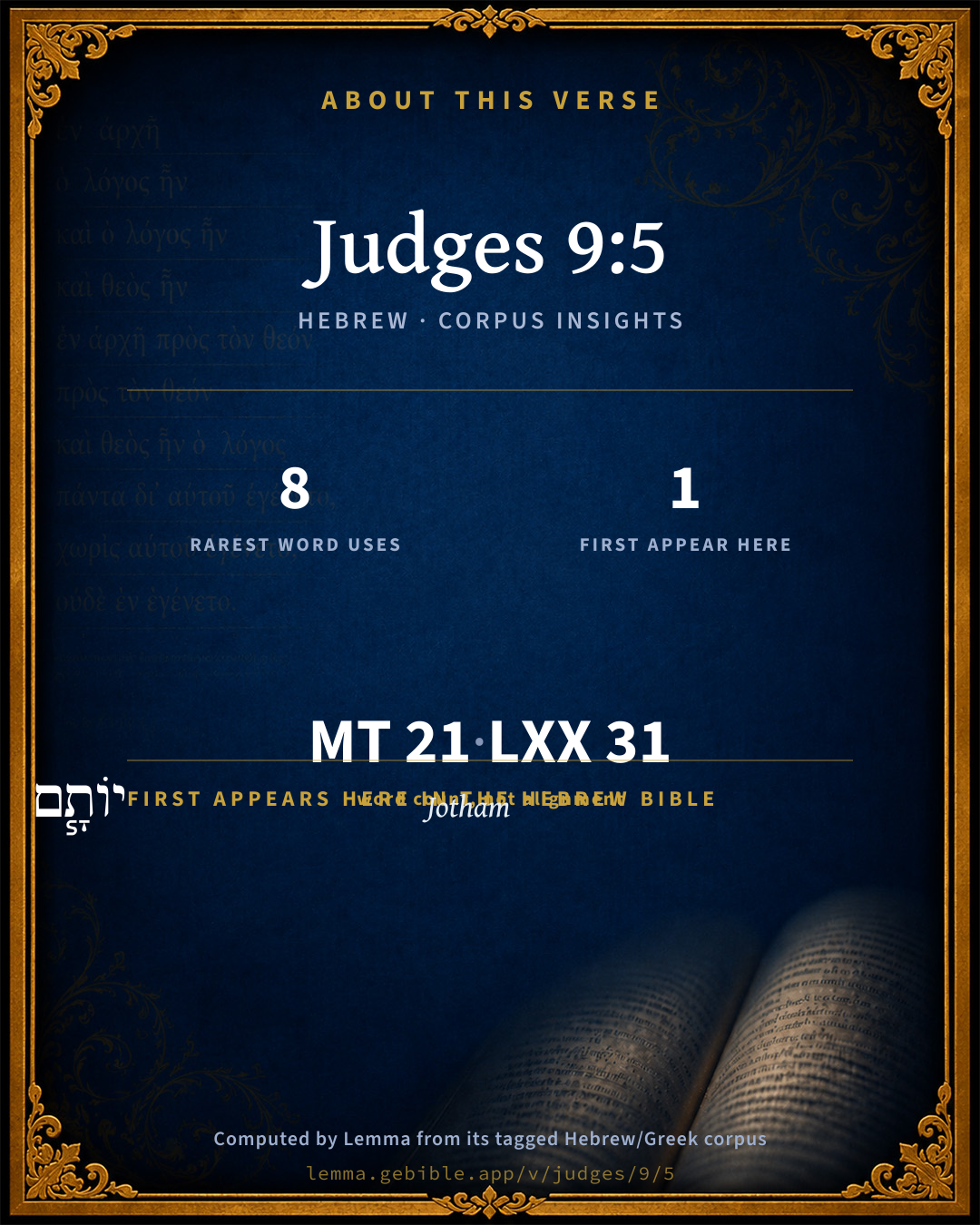
The rarest word here is עָפְרָ֔תָה Ophrah H6084 — appearing just 8 times in the whole Hebrew Bible.

First appearance in Scripture

This word makes its first canonical appearance in the Hebrew Bible here:

  • יוֹתָ֧ם Jotham H3147

Shared distinctive vocabulary

עָפְרָ֔תָה Ophrah H6084 occurs in 8 verses of the Hebrew Bible. Also found in:

Grammatical profile

  • 4 verbs
  • 11 nouns
  • 3 adjectives
  • 1 preposition
  • 1 conjunction
  • 1 particle

Verb forms

  • וַיָּבֹ֤א Qal · Sequential Imperfect
  • וַֽיַּהֲרֹ֞ג Qal · Sequential Imperfect
  • וַיִּוָּתֵ֞ר Niphal · Sequential Imperfect
  • נֶחְבָּֽא Niphal · Perfect

Repetition

Words recur within this verse — often emphatic in Hebrew:

  • בְּנֵֽי son H1121 ×2
  • יְרֻבַּ֛עַל Jerubbaal H3378 ×2

Hebrew & Septuagint length

In English translation the verse runs 35 words from the Hebrew and 37 from the Septuagint (LXX English) — closely comparable.

A rough comparison of the two English renderings, which tokenize alike — not a word-level alignment.

Word counts can differ between the Hebrew and the Greek without any difference in meaning — e.g. the Hebrew direct-object marker אֵת has no separate Greek word, and Greek often adds the article ὁ.

In the original languages it is 21 Hebrew tokens and 31 Greek tokens — but the two are counted differently (Hebrew bundles its prefixes and suffixes into one token; the Greek is in lemma form), so that isn’t a like-for-like length.

Cross-references

8

Topical passages linked to Judges 9:5 in the Treasury of Scripture Knowledge — connected by theme and wording, ordered by reader-vote popularity; previews shown in the World English Bible.

  • 2 Kings 11:1–2 Now when Athaliah the mother of Ahaziah saw that her son was dead, she arose and destroyed all the seed royal.
  • Judges 6:24 Then Gideon built an altar there to Yahweh, and called it Yahweh-shalom: to this day it is yet in Ophrah of the Abiezrites.
  • 2 Chronicles 21:4 Now when Jehoram was risen up over the kingdom of his father, and had strengthened himself, he killed all his brothers with the sword, and various also of the princes of Israel.
  • Judges 8:30 Gideon had seventy sons conceived from his body; for he had many wives.
  • Judges 9:2 Please speak in the ears of all the men of Shechem, Whether is better for you, that all the sons of Jerubbaal, who are seventy persons, rule over you, or that one rule over you? Remember also that I am your bone and your flesh.
  • 2 Kings 10:17 When he came to Samaria, he struck all who remained to Ahab in Samaria, until he had destroyed him, according to the word of Yahweh, which he spoke to Elijah.
  • Matthew 2:16 Then Herod, when he saw that he was mocked by the wise men, was exceedingly angry, and sent out, and killed all the male children who were in Bethlehem and in all the surrounding countryside, from two years old and under, according to the exact time which he had learned from the wise men.
  • Matthew 2:20 "Arise and take the young child and his mother, and go into the land of Israel, for those who sought the young child's life are dead."

Cross-references courtesy of OpenBible.info (CC BY 4.0).

Hebrew and Greek witnesses Masoretic Hebrew ↔ Greek Septuagint

The same verse in the two great witnesses to the Old Testament, shown verse-for-verse.

These are two independent witnesses, not word-aligned to each other, and the Septuagint is shown in lemma (dictionary) form.

Hebrew Judges 9:5 Masoretic · Westminster Leningrad Codex

וַיָּבֹ֤א בֵית אָבִיו֙ עָפְרָ֔תָה וַֽיַּהֲרֹ֞ג אֶת אֶחָ֧יו בְּנֵֽי יְרֻבַּ֛עַל שִׁבְּעִ֥ים אִ֖ישׁ עַל אֶ֣בֶן אֶחָ֑ת וַיִּוָּתֵ֞ר יוֹתָ֧ם בֶּן יְרֻבַּ֛עַל הַקָּטֹ֖ן כִּ֥י נֶחְבָּֽא

He went to his father's house at Ophrah, and killed his brothers the sons of Jerubbaal, being seventy persons, on one stone: but Jotham the youngest son of Jerubbaal was left; for he hid himself.

World English Bible · Public Domain

Greek LXX Judges 9:5 Septuagint · lemma form

καί εἰςἔρχομαι εἰς ὁ οἶκος ὁ πατήρ αὐτός εἰς εφραθα καί ἀποκτείνω ὁ ἀδελφός αὐτός υἱός ιεροβααλ ἑβδομήκοντα ἀνήρ ἐπί λίθος εἷς καί καταλείπω ιωαθαν υἱός ιεροβααλ ὁ νέος ὅτι κρύπτω

And he went to the house of his father to Ephratha, and killed his brethren the sons of Jerobaal, seventy men upon one stone; but Joatham the youngest son of Jerobaal was left, for he hid himself.

LXX2012 (modern English Septuagint) · Public Domain

Hebrew: Westminster Leningrad Codex (CC BY 4.0). Greek: Septuagint (public domain); English from LXX2012 (modern English Septuagint) (Public Domain). How the Septuagint differs from the Hebrew →

Targum (Aramaic paraphrase)

1

The Targum is the ancient Jewish Aramaic paraphrase of the Hebrew Scriptures — an interpretive translation, not the Hebrew text itself. Onkelos (literal) and Pseudo-Jonathan (expansive) render the Torah, and Jonathan the Prophets. Coverage is partial: where no permissively-licensed English translation exists for a verse, only the Aramaic is shown. This is verse-level text, not a word-by-word alignment to the Hebrew.

  1. Targum Jonathan Prophets (Joshua–Malachi)
    וְעַל לְבֵית אֲבוּהִי לְעָפְרָה וּקְטַל יַת אֲחוֹהִי בְנֵי יְרֻבַּעַל שַׁבְעִין גַבְרָא עַל אַבְנָא חֲדָא וְאִשְׁתָּאַר יוֹתָם בַּר יְרֻבַּעַל זְעֵירָא אֲרֵי אִיטַמָר:

    (no public-domain English translation for this verse)

    Targum Jonathan — Aramaic: “Mikraot Gedolot” (public domain). English: “Sefaria Community Translation” (CC0 1.0 (public-domain dedication)); “London "Chaldee Paraphrase," 1871” (public domain). Text via Sefaria.

Commentary

Notes on Judges 9:5 from classic Christian and Jewish commentators (each source and its license shown beneath its notes). The classic Christian expositions comment on the surrounding passage and are grouped to its opening verse, so a note may address several verses; the Jewish commentaries on the Tanakh (Rashi and others) are per-verse, so they appear only where the commentator wrote on this verse.

Lemma curates 59 commentaries, every one of them public domain or Creative Commons licensed, each selected and text-cleaned for this edition rather than reprinted as found. About our sources →

Trapp's Complete Commentary

John Trapp

Jdg 9:5 And he went unto his father’s house at Ophrah, and slew his brethren the sons of Jerubbaal, [being] threescore and ten persons, upon one stone: notwithstanding yet Jotham the youngest son of Jerubbaal was left; for he hid himself.

Ver. 5. And slew his brethren.] So did afterwards Joram, the degenerate son of good Jehoshaphat; Romulus, first king of Rome; Jugurtha, king of tbe Numidians; and so doth the great Turk to this day, so soon as he cometh to the kingdom, that he may have no competitors.

Upon one stone.] Whereon, likely, they laid down their necks, and had their heads stricken off, under some pretence of justice, as if they had conspired against him, or against the state. Howsoever, Abimelech, knowing that it was no good policy to play the villain by half-deal, was resolved to suffer never a rub to lie in the way that might hinder the true running of his bowl.

John Trapp, A Commentary or Exposition upon All the Books of the Old and New Testament (1647–1656) — public domain. Text from a community e-Sword module.

Joseph Benson's Commentary

Jdg 9:5. He went and slew his brethren — The persons who were most likely to hinder him in establishing his tyranny. Threescore and ten — Wanting one, as is here expressed. Here we see the power of ambition; what savage beasts it will render men to each other; how it will break through all the ties of natural affection, and natural conscience, and sacrifice that which is most sacred, dear, and valuable to its designs. We see also the peril attending high birth and honour. It was their being the sons of so great a man as Gideon that made Abimelech jealous of them, and exposed them thus to danger and to death. We find just the same number of Ahab’s sons slain together at Samaria, 2Ki 10:1. “Let none then,” says Henry, “envy those of high extraction, or complain of their own meanness and obscurity: the lower the safer.” Upon one stone — As a stone was sometimes used for an altar, (1Sa 6:14,) some have conjectured from hence, that Abimelech intended to make his brethren a great victim to Baal, in revenge of the sacrifice of the bullock prepared for Baal, chap. Jdg 6:25; and to expiate the crime of Gideon, as these idolaters accounted it, by the sacrifice of all his sons.

Joseph Benson's Commentary on the Old and New Testaments (1811–1818) — public domain. Text from a community e-Sword module.

Geneva Bible (1599)

Geneva Bible translators

Thus tyrants to establish their usurped power, spare not the innocent blood, 2 Kings 10:7; 2 Chron. 21:4.

Geneva Bible (1599) marginal notes — public domain. Text via Bolls.life.

Jamieson, Fausset & Brown

Robert Jamieson, A. R. Fausset & David Brown

went unto . . . Ophrah, and slew his brethren i. e., upon one stone--This is the first mention of a barbarous atrocity which has, with appalling frequency, been perpetrated in the despotic countries of the East--that of one son of the deceased monarch usurping the throne and hastening to confirm himself in the possession by the massacre of all the natural or legitimate competitors. Abimelech slew his brethren on one stone, either by dashing them from one rock, or sacrificing them on one stone altar, in revenge for the demolition of Baal's altar by their father. This latter view is the more probable, from the Shechemites (Jdg 9:24) aiding in it.

threescore and ten persons--A round number is used, but it is evident that two are wanting to complete that number.

Jamieson, Fausset & Brown — Commentary Critical and Explanatory on the Whole Bible (1871) — public domain (CC PDM 1.0). Text via the HelloAO Bible API.

Adam Clarke's Commentary

Verse 5. Slew his brethren] His brothers by the father's side, Jdg 8:30. This was a usual way of securing an ill-gotten throne; the person who had no right destroying all those that had right, that he might have no competitors.

Yet Jotham - was left] That is, all the seventy were killed except Jotham, if there were not seventy besides Jotham. All the histories of all the nations of the earth are full of cruelties similar to those of Abimelech: cousins, uncles, brothers, husbands, and fathers have been murdered by their cousins, nephews, brothers, wives, and children, in order that they might have the undisturbed possession of an ill-gotten throne. Europe, Asia, and Africa, can witness all this. Even now, some of these horribly obtained governments exist.

Adam Clarke's Commentary on the Bible (1810–1826) — public domain. Text from a community e-Sword/MySword module.

Ellicott's Commentary for English Readers

(5) And he went unto his father’s house at Ophrah.—Probably, like Absalom, he seized the opportunity of some local or family feast at which all his brethren would be assembled (2Sa_13:23); it may even have been the anniversary of Gideon’s vision.

Slew his brethren . . .—This is the first mention in Scripture of the hideous custom, which is so common among all Oriental despots, of anticipating conspiracies by destroying all their brothers and near kinsmen. (Comp. Pope, Epistle to Arbuthnot: “Bear, like the Turk, no brother near the throne.”) There is little affection and much jealousy in polygamous households. Abimelech by this vile wickedness set a fatal precedent, which was followed again and again in the kingdom of Israel by Baasha (1Ki_15:29), Zimri (1Ki_16:11), Jehu (2Ki_10:7), and probably by other kings (2 Kings 15); and by Athaliah (2Ki_11:1) in the kingdom of Judah. Herod also put to death most of his kinsmen, and some of his sons (see Life of Christ, i. 43). Seneca says, “Nec regna socium ferre, nec taedae sciunt”—nor realms nor weddings admit a sharer (Agam. 259).

Threescore and ten persons.—Jotham is counted in this number.

Upon one stone.—Perhaps on the rock on which was built Gideon’s altar; at any rate, by some formal execution. How ruthlessly these murders were carried out we see from 2Ki_10:7, and from many events in Eastern history. On one occasion, at a banquet in Damascus. Abdallah-Ebn-Ali murdered no less than ninety of the rival dynasty of the Ommiades.

A Bible Commentary for English Readers, edited by Charles John Ellicott (1878–1897) — public domain. Text from a community e-Sword module.

The Cambridge Bible for Schools and Colleges

gen. ed. J. J. S. Perowne

5. upon one stone] as if they were sacrificial victims (cf. 1Sa_14:33 f.); perhaps also to avoid promiscuous blood-shed. For this Oriental manner of inaugurating a new reign cf. 2Ki_10:1 ff; 2Ki_11:1. Jotham escaped, like Joash 2Ki_11:2.

The Cambridge Bible for Schools and Colleges (gen. ed. J. J. S. Perowne; Cambridge University Press, 1878–1918) — public domain. Text from a community e-Sword module.

John Gill's Exposition

And he went to his father's house at Ophrah,.... Which, according to Bunting (a), was ten miles from Shechem:

and slew his brethren the sons of Jerubbaal, being seventy persons, upon one stone: in which he was assisted by the ruffians he had hired with seventy pieces of silver; these were laid one after another upon one and the same stone, as being convenient for the execution of them; or as serving as an altar on which they were sacrificed to Baal, out of whose temple the money was taken to hire the executioners with. They are said to be seventy that were slain, though one escaped, the round number being given, as in many other instances, as in Gen 46:27,

notwithstanding, yet Jotham the youngest son of Jerubbaal was left; or remained alive, not out of compassion to his youth, but because he could not be found:

for he hid himself; for no doubt Abimelech, and his crew, were most forward to lay hold of the eldest, and sacrifice them first, as being most in his way; this gave Jotham the youngest not only notice of their design, but an opportunity of providing for his safety, or however his friends; for it may be rendered, as in some versions, "he was hidden" (b), that is, by others.

(a) Travels of the Patriarchs, &c. p. 111. (b) Sept. "absconditus est", V. L. "qui absconditus fuit", Tigurine version; so the Targum.

John Gill's Exposition of the Whole Bible (1746–1763) — public domain (CC PDM 1.0). Text via the HelloAO Bible API.

Albert Barnes' Notes on the Bible

Such wholesale slaughters have always been common in Eastern monarchies, and are among the fruits of polygamy.

Albert Barnes' Notes on the Bible (1834–1885) — public domain. Text from a community e-Sword/MySword module.

Haydock's Catholic Bible Commentary

Stone where criminals were, perhaps, commonly executed, that he might seem to act with justice, (Tostat) or he might slaughter his brethren on the very altar, which had been erected to God by Gedeon, after he had thrown down that of Baal. By doing so, he would seem to vindicate the idol, and gratify the people of Sichem, who were zealous idolaters, ver. 46. Joatham escaped his fury, yet he, also, uses a round number, 70, when he says you have killed 70 men, ver. 18. (Calmet) --- Abimelech himself must also be deducted from the number. Thus we say the seventy interpreters, (Menochius) though the Greek interpreters of the Bible are supposed (Haydock) to have been 72. (Menochius) --- The history of nations is full of similar instances of cruelty. Ochus, king of Persia, killed his uncle, and 80 or 100 of his sons. Phraartees, son of Herod, king of the Parthians, by a concubine, slew his father and his 30 children. (Justin. x. and xlii.) --- The Turkish emperors have shewn equal barbarity on many occasions, and they still murder or confine all their brothers. (Serar. q. 6.)

George Leo Haydock (1774–1849), Haydock's Catholic Family Bible and Commentary, 1859 edition — public domain. Excludes Psalms (Douay-Rheims chapter numbering differs from Protestant) and Deuterocanonical books (Catholic canon only).

Matthew Poole's English Annotations

The sons of Jerubbaal; the only persons who were likely to hinder him in establishing his tyranny.

Threescore and ten persons; wanting one, who is here expressed; and these synecdochical expressions are frequent in Scripture: see Gen 35:26; 42:13; Num 14:32,33; Joh 20:24; 1Co 15:5.

Upon one stone; whereby he would signify that this was either,

1. An act of justice, in cutting them all off in an orderly manner, for some supposed crime probably as designing sedition and rebellion; or,

2. An act of religion, in avenging the dishonour and injury done to Baal by Gideon, Jdg 6:27,28, upon his children, whom he offered up as so many sacrifices to Baal upon this stone, which served for an altar; and for this reason it seems the money was taken out of Baal’s house, because it was to be laid out in his service.

Matthew Poole's English Annotations on the Holy Bible (1683–1685) — public domain. Text from a community e-Sword/MySword module.

Whedon's Commentary on the Bible

Daniel D. Whedon

5. Upon one stone — That is, he made his brethren prisoners, and then led them out, and subjected them to a formal execution all at one place and time. Perhaps the place of execution was the rock where the angel had revealed himself to Gideon. Jdg_6:20. This massacre, says Keil, was “a bloody omen of the kingdom of the ten tribes, which was afterwards founded at Shechem by Jeroboam, in which one dynasty overthrew another, and generally sought to establish its power by exterminating the whole family of the dynasty that had been overthrown. Even in Judah, Athaliah, the worshipper of Baal, sought to usurp the government by exterminating the whole of the descendants of her son. 2 Kings 11. Such fratricides have also occurred in quite recent times in the Mohammedan countries of the East.” Abimelech has the unenviable distinction of giving the first example of that barbarous system of state policy.

Daniel D. Whedon (gen. ed.), Commentary on the Old and New Testaments (1874–1909) — public domain. Text from a community e-Sword module.

The Pulpit Commentary

Upon one stone. Used as a block, on which the victims were executed one after another. Compare the similar wholesale murders of the seventy sons of Ahab by order of Jehu, (2Ki_10:7) of the seed royal of Judah by Athaliah, (2Ki_11:1) of the whole house of Jeroboam by Baasha, (1Ki_15:29) of the whole house of Baasha by Zimri. (1Ki_16:11, 1Ki_16:12) Timour, on his conquest of Persia, is said to have destroyed the whole male family of the king. At the conquest of Bagdad he is said to have made a pyramid of 90, 000 human heads. In Persia and Turkey in modern times it has been a common practice for the sovereign to slay or put out the eyes of all his brothers and cousins. So destructive of natural affection is polygamy, and so cruel is power.

Ver. 5. Shortcomings of unscrupulous schemes.

That there are instances of seemingly complete and permanent success cannot be denied. But the cases in which the act just falls short of success are too frequent and dramatically striking not to be pondered.

I A MORAL GOVERNMENT OF THE WORLD IS WITNESSED TO.

II IF EVIDENT IN SOME CASES, MAY NOT THE SAME LAW EXIST WHERE NOT CLEARLY VISIBLE?

III IN THIS IS ILLUSTRATED THE ESSENTIALLY MORAL CHARACTER OF HIGHEST REASON. The wicked always leave something unconsidered or unprovided for. The lives and schemes of the wicked are based on fallacies. Truth and righteousness coincide. M.

The Pulpit Commentary (1880–1919), ed. H.D.M. Spence-Jones & Joseph S. Exell — public domain. Text from a community e-Sword module.

John Wesley's Explanatory Notes

His brethren -- the only persons who were likely to hinder him in establishing his tyranny. Threescore and ten - Wanting one, who is here expressed. Jotham was left - Whereby he would signify, that this was an act of justice, in cutting them all off in an orderly manner, for some supposed crime, probably, as designing sedition and rebellion.

John Wesley, Explanatory Notes Upon the Whole Bible (1754–1765) — public domain. Text via the GEBible commentary corpus.

unfoldingWord translationNotes

Door43 World Missions Community

Ophrah

Translate the name of this city as you did in Judges 6:11.

one stone

"1 stone" (See: Numbers)

seventy

"70" (See: Numbers)

Jerub Baal

This is another name for Gideon. See how you translated this in Judges 6:32.

Beth Millo

This is the name of a place. (See: How to Translate Names)

translationWords

Jotham

Shechem

Abimelech

king

oak

column

unfoldingWord translationNotes — © Distant Shores Media and the Door43 World Missions Community, licensed CC BY-SA 4.0. Source: git.door43.org/Door43/en_tn.

Lesson kit

Teaching starters — assembled from the data on this page, not authored interpretation. Every prompt links to the verse data it draws on. Edit before teaching.

Judges, in the Historical, opens this verse with 21 words (19 distinct Hebrew lemmas). Its most distinctive word is ʻOphrâh (“Ophrah”). A historical commentator’s framing appears above. Read the whole chapter for the surrounding context.

Discussion questions

  1. The word ʻOphrâh carries the sense “Ophrah.” How does it shape the verse?
  2. The word “Jotham” first appears here in Scripture. What is being introduced at this debut?
  3. Joshua 18:23 shares the word «Ophrah» with this verse. How do the two illuminate each other?
  4. “son” occurs 2× in this one verse. What is the effect of the repetition?
  5. The translations on this page render this verse differently — a whole-verse word diff, not a word-by-word alignment. What might account for the different wordings?
  6. The verb «וַיָּבֹ֤א» is Qal Sequential Imperfect. How does its form color the action?
  7. Reading how Trapp's Complete Commentary and Joseph Benson's Commentary read this verse, where do the two commentators agree and where do they part?

Things to notice

Reading settings

Reading text

Shown beneath each verse's original-language words.

Old Testament
Old Testament edition

Read the OT as the Masoretic Hebrew (MT) or the Greek Septuagint (LXX).

English shown for the Greek Septuagint (in the Hebrew ↔ Greek comparison).

Comparing translations? Open the Compare panel on any verse page to stack up to four side by side.