
Esther 9:11

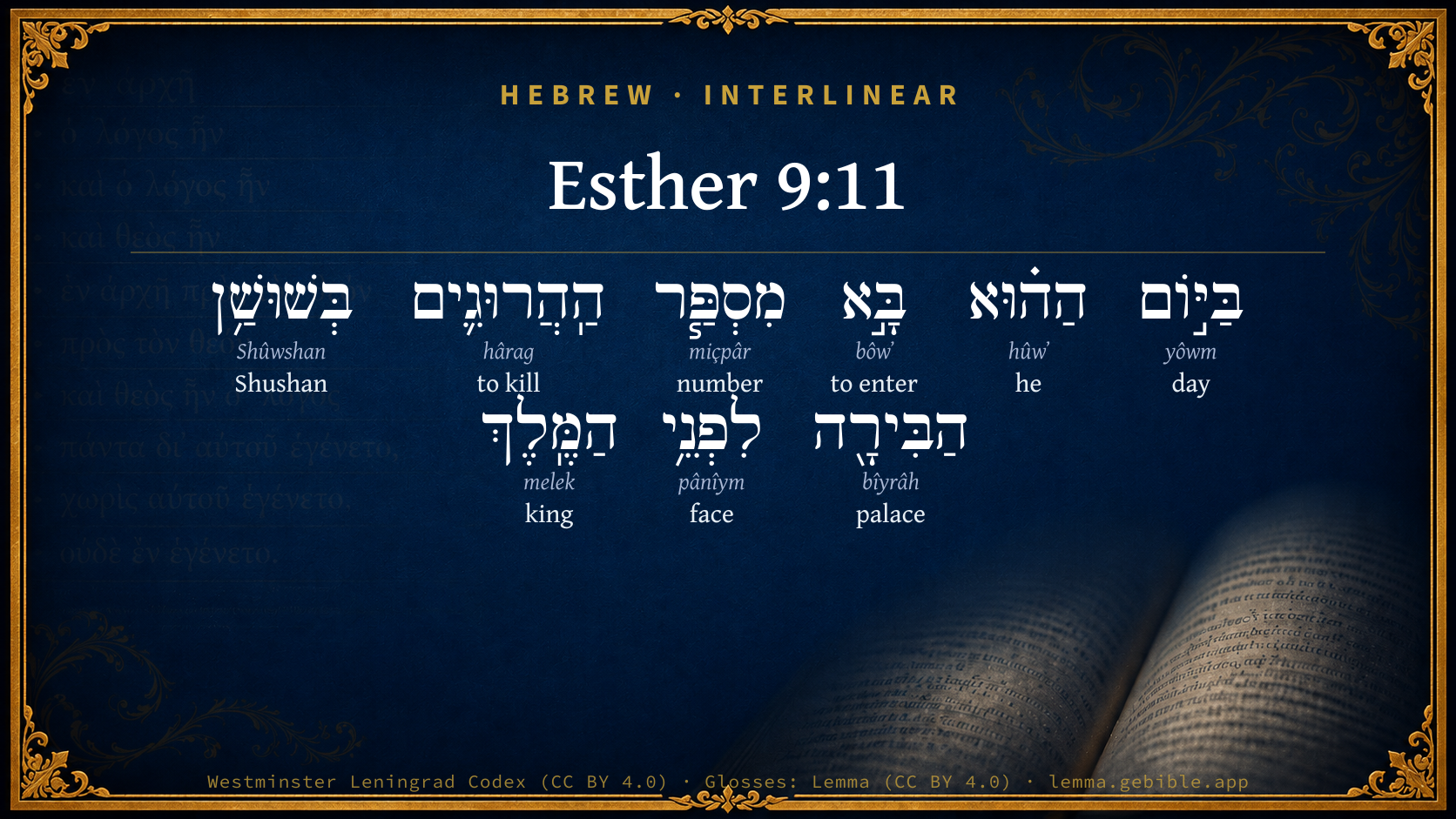
Hebrew (Westminster Leningrad Codex) Esther 9:11 appears in the Hebrew Old Testament. The text above is from the Westminster Leningrad Codex. Each word links to its Strong’s number, a concise gloss, and parsing drawn from the Open Scriptures Hebrew Bible morphology. Click any word for its full Brown-Driver-Briggs (BDB) entry.
Download image
Cite this verse

Esther 9:11 (World English Bible). Public Domain. Lemma interlinear Bible study tool, https://lemma.gebible.app/v/esther/9/11.

Show BibTeX & RIS
BibTeX
RIS
English Translation
On that day the number of those who were slain in Shushan the palace was brought before the king.
World English Bible · Public Domain
Download a study sheet

One document with this verse’s original text, its word-by-word gloss line, the meaning frame, cross-references with their text, attributed commentary, and full source and license credits — printable, and it pastes into notes with its structure intact.

This verse Autodidact and up

Study sheet (.html) Plain text (.txt)

A passage Seminary Student

Up to 50 verses in one chapter. A passage sheet keeps up to 6 commentary sources and 12 cross-references per verse, in the order this page ranks them, and says so on the sheet whenever that leaves anything out. Ask for a single verse and you get the Autodidact verse sheet above.

Everything on this page stays free to read, with no account — the sheet is a download of what is already on screen, not access to it.

Want to remove ads? Support Godless Engineer
Compare translations 3

The same verse in 3 English versions, stacked beneath the original-language interlinear above. Click any original word for its lexicon entry.

Each is an independent rendering of the whole verse — the interlinear is not word-aligned to these translations.

Highlighted words mark where these versions differ — a whole-verse word diff, not a word-by-word alignment.

  • World English Bible Public Domain
    On that day the number of those who were slain in Shushan the palace was brought before the king.
  • King James Version Public Domain
    On that day the number of those that were slain in Shushan the palace was brought before the king.
  • unfoldingWord Literal Text CC BY-SA 4.0
    On that day, the report of the number of those who were killed in Susa the citadel came to the face of the king.

unfoldingWord Literal Text — © unfoldingWord, licensed CC BY-SA 4.0. Word-aligned USFM3 via Door43 (git.door43.org/unfoldingWord/en_ult).

Versions to compare (up to 4)

3 of 4 selected

Show all 18 translations

Every available English version of this verse, each an independent rendering of the whole verse.

  • World English Bible Public Domain
    On that day the number of those who were slain in Shushan the palace was brought before the king.
  • Berean Standard Bible Public Domain
    On that day the number of those killed in the citadel of Susa was reported to the king,
  • Majority Standard Bible Public Domain
    On that day the number of those killed in the citadel of Susa was reported to the king,
  • King James Version Public Domain
    On that day the number of those that were slain in Shushan the palace was brought before the king.
  • American Standard Version (1901) Public Domain
    On that day the number of those that were slain in Shushan the palace was brought before the king.
  • Revised Version (1885) Public Domain
    On that day the number of those that were slain in Shushan the palace was brought before the king.
  • Geneva Bible (1599) Public Domain
    On the same day came ye nomber of those that were slayne, vnto the palace of Shushan before the King.
  • Douay-Rheims (1899) Public Domain
    And presently the number of them that were killed in Susan was brought to the king.
  • Young's Literal Translation Public Domain
    On that day hath come the number of the slain in Shushan the palace before the king,
  • Literal Standard Version CC BY-SA 4.0
    On that day has come the number of the slain in Shushan the palace before the king,
  • Unlocked Literal Bible CC BY-SA 4.0
    That day the number of those killed in the fortress of Susa, was reported to the king.
  • unfoldingWord Literal Text CC BY-SA 4.0
    On that day, the report of the number of those who were killed in Susa the citadel came to the face of the king.
  • Darby Bible Public Domain
    On that day the number of those that were slain in Shushan the fortress was brought before the king.
  • World Messianic Bible Public Domain
    On that day, the number of those who were slain in the citadel of Susa was brought before the king.
  • Webster's Bible Public Domain
    On that day the number of those that were slain in Shushan the palace was brought before the king.
  • Free Bible Version CC BY-SA 4.0
    The same day, when the number of those killed in the fortress of Susa was reported to the king,
  • Bible in Basic English Public Domain
    On that day the number of those who had been put to death in the town of Shushan was given to the king.
  • JPS Tanakh (1917) Public Domain
    On that day the number of those that were slain in Shushan the castle was brought before the king.

Literal Standard Version (2020), Covenant Press — licensed CC BY-SA 4.0. Text via the HelloAO Bible API (eBible.org). Unlocked Literal Bible (unfoldingWord) — licensed CC BY-SA 4.0. Text via the HelloAO Bible API (eBible.org). unfoldingWord Literal Text — © unfoldingWord, licensed CC BY-SA 4.0. Word-aligned USFM3 via Door43 (git.door43.org/unfoldingWord/en_ult). Free Bible Version, Dr. Jonathan Gallagher — licensed CC BY-SA 4.0. Text via the HelloAO Bible API (eBible.org).

Word by word

More ways to search: Search by grammar → Find every occurrence → Compare this word →

Practice this passage: Drill this verse → Learn its vocabulary →

הַבִּירָ֖ה
bîyrâh
H1002
“the · palace”
Particle, Definite Article + Noun, Common, Feminine, Singular, Absolute
Part of Speech
Particle + Noun
Type
Common
Gender
Feminine
Number
Singular
State
Absolute
Full BDB Definition

Origin: of foreign origin

TWOT: 240

palace, castle - temple
  1. בַּיּ֣וֹם yôwm H3117 “in/at the · day” Preposition, Determined + Noun, Common, Masculine, Singular, Absolute
  2. הַה֗וּא hûwʼ H1931 “the · he” Particle, Definite Article + Pronoun, Personal, 3rd Person, Masculine, Singular
  3. בָּ֣א bôwʼ H935 “to enter” Verb, Qal, Perfect, 3rd Person, Masculine, Singular
  4. מִסְפַּ֧ר miçpâr H4557 “number of” Noun, Common, Masculine, Singular, Construct
  5. הַֽהֲרוּגִ֛ים hârag H2026 “the · killed” Particle, Definite Article + Verb, Qal, Participle Passive, Masculine, Plural, Absolute
  6. בְּשׁוּשַׁ֥ן Shûwshan H7800 “in/at · Shushan” Preposition + Noun, Proper
  7. לִפְנֵ֥י pânîym H6440 “to/for · face(s) of” Preposition + Noun, Common, Both, Plural, Construct
  8. הַמֶּֽלֶךְ melek H4428 “the · king” Particle, Definite Article + Noun, Common, Masculine, Singular, Absolute

About this verse

These counts appear in no published source. They are computed here, from the morphology-tagged text and Lemma’s own curated glosses. What Lemma adds →

9
words
9
distinct lemmas
Historical
section

Notable vocabulary

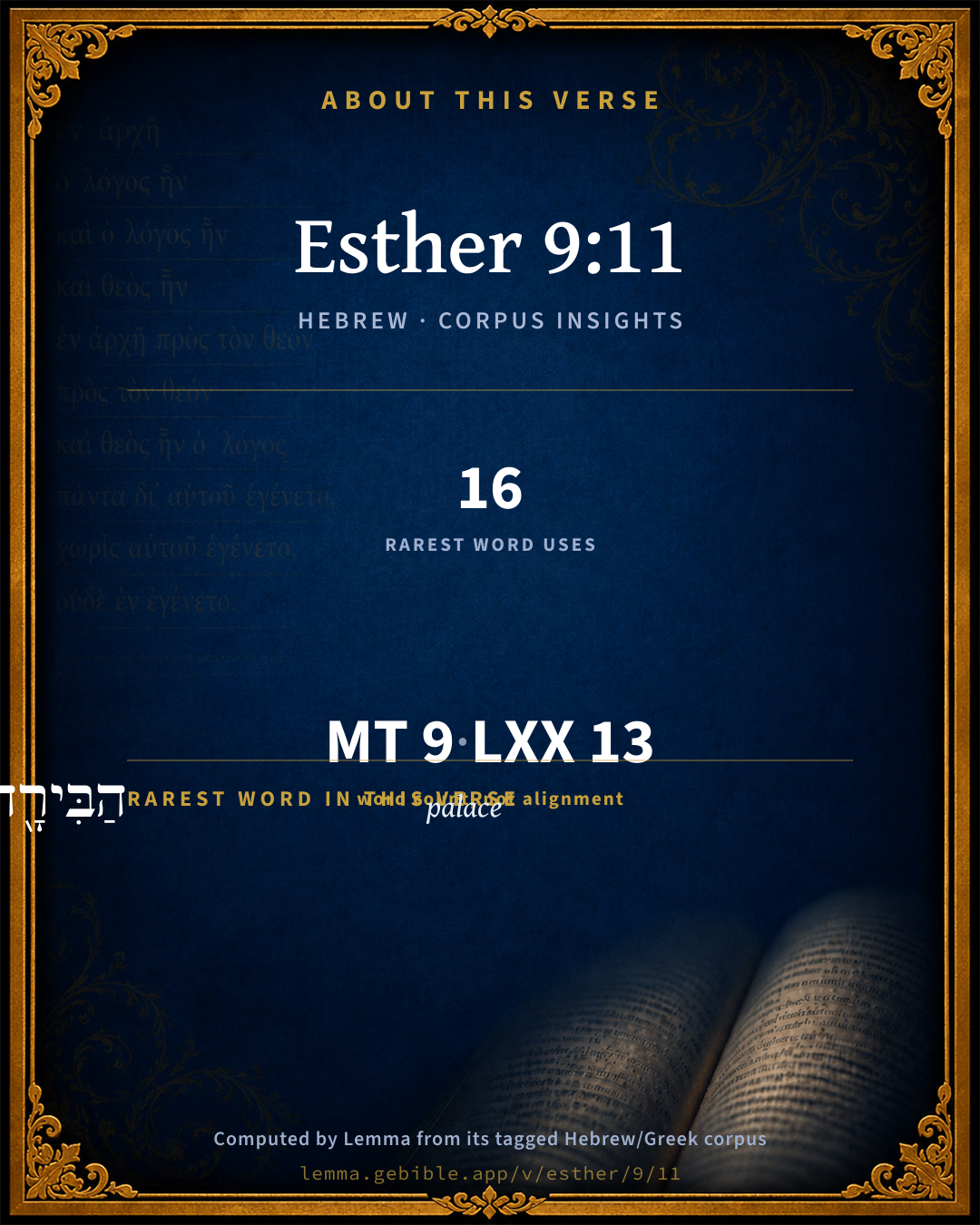
The rarest word here is הַבִּירָ֖ה palace H1002 — appearing just 16 times in the whole Hebrew Bible.

Shared distinctive vocabulary

הַבִּירָ֖ה palace H1002 occurs in 16 verses of the Hebrew Bible. Also found in:

Grammatical profile

  • 2 verbs
  • 6 nouns
  • 1 pronoun

Verb forms

  • בָּ֣א Qal · Perfect
  • הַֽהֲרוּגִ֛ים Qal · Participle Passive

Hebrew & Septuagint length

In English translation the verse runs 19 words from the Hebrew and 14 from the Septuagint (LXX English) — closely comparable.

A rough comparison of the two English renderings, which tokenize alike — not a word-level alignment.

Word counts can differ between the Hebrew and the Greek without any difference in meaning — e.g. the Hebrew direct-object marker אֵת has no separate Greek word, and Greek often adds the article ὁ.

In the original languages it is 9 Hebrew tokens and 13 Greek tokens — but the two are counted differently (Hebrew bundles its prefixes and suffixes into one token; the Greek is in lemma form), so that isn’t a like-for-like length.

Hebrew and Greek witnesses Masoretic Hebrew ↔ Greek Septuagint

The same verse in the two great witnesses to the Old Testament, shown verse-for-verse.

These are two independent witnesses, not word-aligned to each other, and the Septuagint is shown in lemma (dictionary) form.

Hebrew Esther 9:11 Masoretic · Westminster Leningrad Codex

בַּיּ֣וֹם הַה֗וּא בָּ֣א מִסְפַּ֧ר הַֽהֲרוּגִ֛ים בְּשׁוּשַׁ֥ן הַבִּירָ֖ה לִפְנֵ֥י הַמֶּֽלֶךְ

On that day the number of those who were slain in Shushan the palace was brought before the king.

World English Bible · Public Domain

Greek LXX Esther 9:11 Septuagint · lemma form

ἐν αὐτός ὁ ἡμέρα ἐπιδίδωμι ὁ ἀριθμός ὁ βασιλεύς ὁ ἀποὀλλύω ἐν σουσά

and the number of them that perished in Susa was rendered to the king.

LXX2012 (modern English Septuagint) · Public Domain

Hebrew: Westminster Leningrad Codex (CC BY 4.0). Greek: Septuagint (public domain); English from LXX2012 (modern English Septuagint) (Public Domain). How the Septuagint differs from the Hebrew →

Commentary

Notes on Esther 9:11 from classic Christian and Jewish commentators (each source and its license shown beneath its notes). The classic Christian expositions comment on the surrounding passage and are grouped to its opening verse, so a note may address several verses; the Jewish commentaries on the Tanakh (Rashi and others) are per-verse, so they appear only where the commentator wrote on this verse.

Lemma curates 59 commentaries, every one of them public domain or Creative Commons licensed, each selected and text-cleaned for this edition rather than reprinted as found. About our sources →

Trapp's Complete Commentary

John Trapp

Est 9:11 On that day the number of those that were slain in Shushan the palace was brought before the king.

Ver. 11. On that day the number of those that were slain] This was done, haply, by some malignants, that would thereby have incensed the king against the Jews. Or else the king (as became a good shepherd of his people) taketh an account of his slain subjects, by diligent inquiry made thereinto. Similia sunt boni pastoris et boni regis opera Similar are the works of good shepherds and good kings. (Cyr. 5, apud Xenoph.). Whereupon he might have repented him (now in cold blood) of his grant to Esther and the Jews, those foreigners, against his natural subjects, who had done nothing but by his command, &c. But God so ordered it that, all this notwithstanding, the king was well content with that which was done, as supposing that Haman’s sons and complices would be seeking revenge, and plotting mischief, if left alive. He therefore goeth merrily in to the queen, acquainting her with the number of the slain, and giving her leave to ask of him whatever more she desired to be done. This was the Lord’s doing all along.

John Trapp, A Commentary or Exposition upon All the Books of the Old and New Testament (1647–1656) — public domain. Text from a community e-Sword module.

John Gill's Exposition

Then said Esther, if it please the king,.... For she was all submission to his will:

let it be granted to the Jews which are in Shushan; for no further did she desire the grant to be extended:

to do tomorrow also according to this days decree; one Targum makes the request only that they might keep the morrow as a festival, but the other, more rightly, to do according to the decree of this day; which was, to slay as many of their enemies as rose up against them; and whereas many might flee and hide themselves, who were implacable enemies of the Jews, Esther moves for a grant that the decree might be continued for the next day, that these might be found out and slain; in which she sought the glory of divine justice, in their righteous destruction, and the peace of the people of God, and not private revenge, or to indulge malice:

and let Haman's ten sons be hanged upon the gallows; on which their father was; this was deferred, though they were already slain, for their greater reproach, and for a terror to others not to injure the people of God; and it was usual with the Persians to hang persons on a gallows, or fix them to a cross, after they were dead; as Polycrates was by Oroites (i), and Bagspates by Parysatis (k).

(i) Herodot. Thalia, sive, l. 3. c. 125. (k) Ctesias in Persicis, c. 58.

John Gill's Exposition of the Whole Bible (1746–1763) — public domain (CC PDM 1.0). Text via the HelloAO Bible API.

Matthew Poole's English Annotations

Possibly with evil design to incense thee king against the Jews.

Matthew Poole's English Annotations on the Holy Bible (1683–1685) — public domain. Text from a community e-Sword/MySword module.

The Pulpit Commentary

The number was brought before the king. It was customary in all wars for the number of the slain to be carefully made out and recorded. In the Babylonian transcript of the Behistun Inscription the numbers are given with extreme exactness e.g. 546, 2024, 4203, etc. On this occasion it would seem that only a rough calculation was made. Still the king took care to be informed on the subject, and the Jews, aware of this, were not left absolutely uncontrolled.

The Pulpit Commentary (1880–1919), ed. H.D.M. Spence-Jones & Joseph S. Exell — public domain. Text from a community e-Sword module.

Keil & Delitzsch

C. F. Keil & F. Delitzsch

When on the same day an account was given to the king of the result of the conflict, and the number of those slain in Susa reported, he announced to Queen Esther: the Jews have slain in the citadel of Susa 500 men and the ten sons of Haman; "what have they done in the rest of the king's provinces?" i.e., if they have killed 500 men in Susa, how many may they not have slain in other parts of the kingdom? and then asked her what else she wished or required. With respect to the words, comp. Est 5:6, and Est 7:2.

Keil & Delitzsch — Biblical Commentary on the Old Testament (1861–1891) — public domain (CC PDM 1.0). Text via the HelloAO Bible API. (Old Testament only.)

unfoldingWord translationNotes

Door43 World Missions Community

five hundred men

"500 men" (See: Numbers)

ten sons

"10 sons" (See: Numbers)

What then have they done in the rest of the king's provinces?

The king uses this question to show that he believes that the Jews must have also killed many people in the other provinces. AT: "What they must have done in the rest of the king's provinces!" or "They must have killed many more in the rest of the king's provinces!" (See: Rhetorical Question)

what is your petition?

The abstract noun "petition" can be expressed with the verb "ask for" or "want." AT: "what do you ask for?" or "what do you want?" (See: Abstract Nouns)

It will be granted you

This can be expressed in active form. AT: "I will give you what you ask for" or "I will do for you what you ask" (See: Active or Passive)

What is your request?

The abstract noun "request" can be expressed with the verb "ask for" or "want." AT: "What do you ask for?" or "What do you want?" (See: Abstract Nouns)

unfoldingWord translationNotes — © Distant Shores Media and the Door43 World Missions Community, licensed CC BY-SA 4.0. Source: git.door43.org/Door43/en_tn.

Lesson kit

Teaching starters — assembled from the data on this page, not authored interpretation. Every prompt links to the verse data it draws on. Edit before teaching.

Esther, in the Historical, opens this verse with 9 words (9 distinct Hebrew lemmas). Its most distinctive word is bîyrâh (“palace”). A historical commentator’s framing appears above. Read the whole chapter for the surrounding context.

Discussion questions

  1. The word bîyrâh carries the sense “palace.” How does it shape the verse?
  2. 1 Chronicles 29:1 shares the word «palace» with this verse. How do the two illuminate each other?
  3. The translations on this page render this verse differently — a whole-verse word diff, not a word-by-word alignment. What might account for the different wordings?
  4. The verb «בָּ֣א» is Qal Perfect. How does its form color the action?
  5. Reading how Trapp's Complete Commentary and John Gill's Exposition read this verse, where do the two commentators agree and where do they part?

Things to notice

Reading settings

Reading text

Shown beneath each verse's original-language words.

Old Testament
Old Testament edition

Read the OT as the Masoretic Hebrew (MT) or the Greek Septuagint (LXX).

English shown for the Greek Septuagint (in the Hebrew ↔ Greek comparison).

Comparing translations? Open the Compare panel on any verse page to stack up to four side by side.