
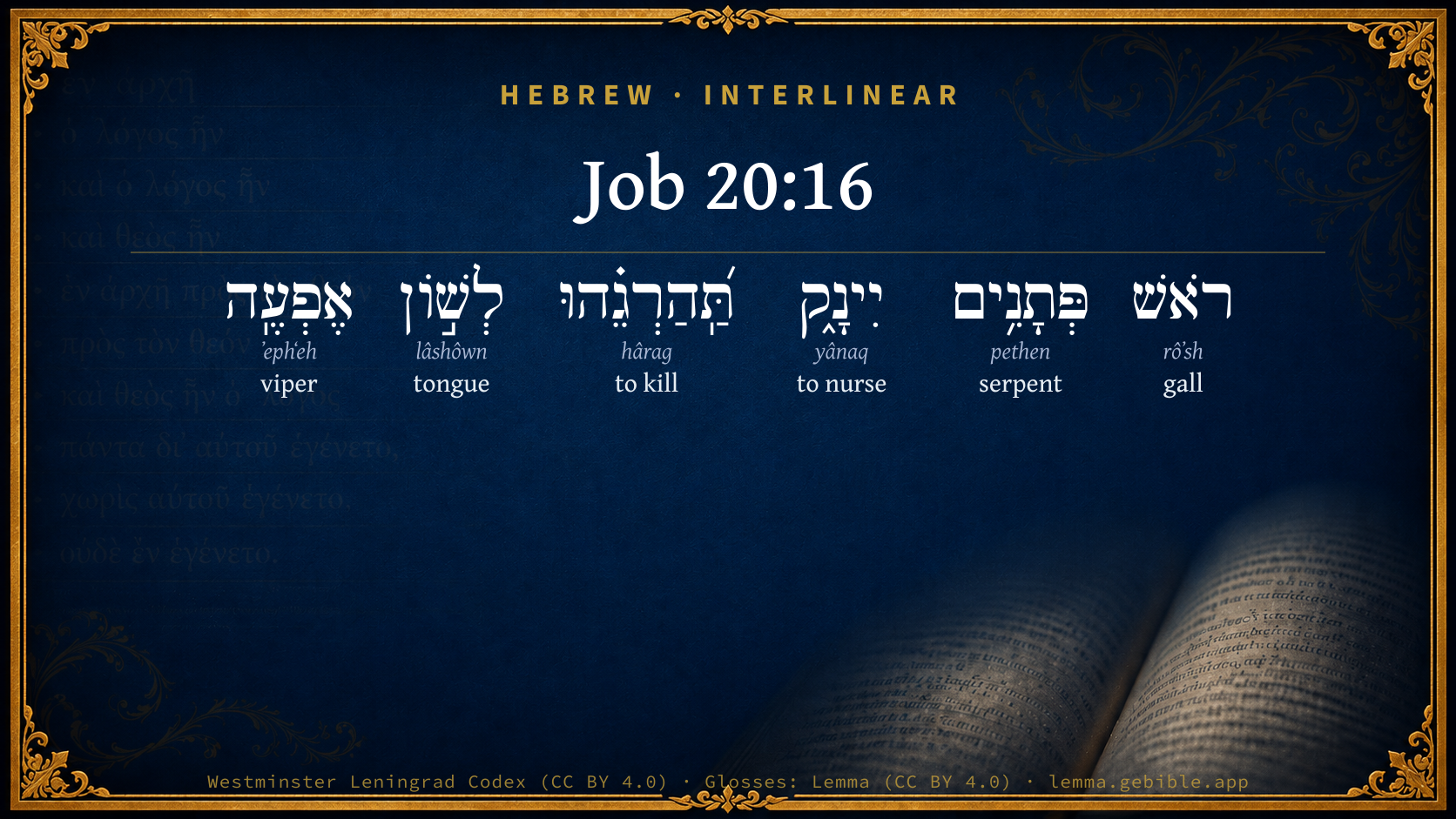
Job 20:16

Hebrew (Westminster Leningrad Codex) Job 20:16 appears in the Hebrew Old Testament. The text above is from the Westminster Leningrad Codex. Each word links to its Strong’s number, a concise gloss, and parsing drawn from the Open Scriptures Hebrew Bible morphology. Click any word for its full Brown-Driver-Briggs (BDB) entry.
Download image
Cite this verse

Job 20:16 (World English Bible). Public Domain. Lemma interlinear Bible study tool, https://lemma.gebible.app/v/job/20/16.

Show BibTeX & RIS
BibTeX
RIS
English Translation
He shall suck cobra venom. The viper's tongue shall kill him.
World English Bible · Public Domain
Highlights
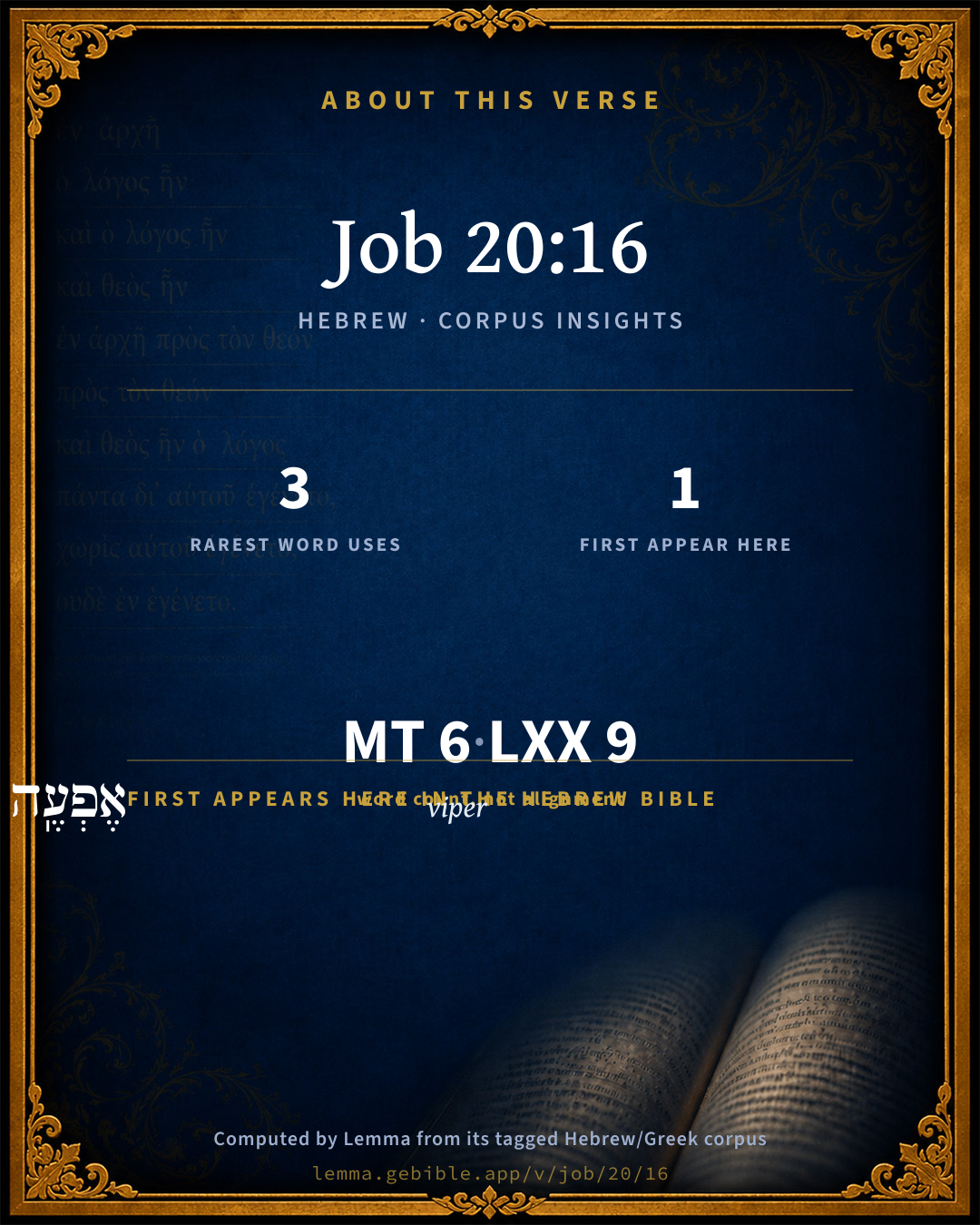
  • 1 first appearance in the Hebrew Bible
Full analysis ↓
Download a study sheet

One document with this verse’s original text, its word-by-word gloss line, the meaning frame, cross-references with their text, attributed commentary, and full source and license credits — printable, and it pastes into notes with its structure intact.

This verse Autodidact and up

Study sheet (.html) Plain text (.txt)

A passage Seminary Student

Up to 50 verses in one chapter. A passage sheet keeps up to 6 commentary sources and 12 cross-references per verse, in the order this page ranks them, and says so on the sheet whenever that leaves anything out. Ask for a single verse and you get the Autodidact verse sheet above.

Everything on this page stays free to read, with no account — the sheet is a download of what is already on screen, not access to it.

Want to remove ads? Support Godless Engineer
Compare translations 3

The same verse in 3 English versions, stacked beneath the original-language interlinear above. Click any original word for its lexicon entry.

Each is an independent rendering of the whole verse — the interlinear is not word-aligned to these translations.

Highlighted words mark where these versions differ — a whole-verse word diff, not a word-by-word alignment.

  • World English Bible Public Domain
    He shall suck cobra venom. The viper's tongue shall kill him.
  • King James Version Public Domain
    He shall suck the poison of asps: the viper's tongue shall slay him.
  • unfoldingWord Literal Text CC BY-SA 4.0
    He will suck the poison of asps; the tongue of the viper will kill him.

unfoldingWord Literal Text — © unfoldingWord, licensed CC BY-SA 4.0. Word-aligned USFM3 via Door43 (git.door43.org/unfoldingWord/en_ult).

Versions to compare (up to 4)

3 of 4 selected

Show all 18 translations

Every available English version of this verse, each an independent rendering of the whole verse.

  • World English Bible Public Domain
    He shall suck cobra venom. The viper's tongue shall kill him.
  • Berean Standard Bible Public Domain
    He will suck the poison of cobras; the fangs of a viper will kill him.
  • Majority Standard Bible Public Domain
    He will suck the poison of cobras; the fangs of a viper will kill him.
  • King James Version Public Domain
    He shall suck the poison of asps: the viper's tongue shall slay him.
  • American Standard Version (1901) Public Domain
    He shall suck the poison of asps: The viper's tongue shall slay him.
  • Revised Version (1885) Public Domain
    He shall suck the poison of asps: the viper’s tongue shall slay him.
  • Geneva Bible (1599) Public Domain
    He shall sucke the gall of Aspes, and the vipers tongue shall slay him.
  • Douay-Rheims (1899) Public Domain
    He shall suck the head of asps, and the viper's tongue shall kill him.
  • Young's Literal Translation Public Domain
    Gall of asps he sucketh, Slay him doth the tongue of a viper.
  • Literal Standard Version CC BY-SA 4.0
    He sucks [the] gall of cobras, the tongue of a viper slays him.
  • Unlocked Literal Bible CC BY-SA 4.0
    He will suck the poison of asps; the viper's tongue will kill him.
  • unfoldingWord Literal Text CC BY-SA 4.0
    He will suck the poison of asps; the tongue of the viper will kill him.
  • Darby Bible Public Domain
    He shall suck the poison of asps; the viper's tongue shall kill him.
  • World Messianic Bible Public Domain
    He will suck cobra venom. The viper’s tongue will kill him.
  • Webster's Bible Public Domain
    He shall suck the poison of asps: the viper's tongue shall slay him.
  • Free Bible Version CC BY-SA 4.0
    They suck in snake venom; the bite of the viper will kill them.
  • Bible in Basic English Public Domain
    He takes the poison of snakes into his mouth, the tongue of the snake is the cause of his death.
  • JPS Tanakh (1917) Public Domain
    He shall suck the poison of asps; the viper's tongue shall slay him.

Literal Standard Version (2020), Covenant Press — licensed CC BY-SA 4.0. Text via the HelloAO Bible API (eBible.org). Unlocked Literal Bible (unfoldingWord) — licensed CC BY-SA 4.0. Text via the HelloAO Bible API (eBible.org). unfoldingWord Literal Text — © unfoldingWord, licensed CC BY-SA 4.0. Word-aligned USFM3 via Door43 (git.door43.org/unfoldingWord/en_ult). Free Bible Version, Dr. Jonathan Gallagher — licensed CC BY-SA 4.0. Text via the HelloAO Bible API (eBible.org).

Word by word

More ways to search: Search by grammar → Find every occurrence → Compare this word →

Practice this passage: Drill this verse → Learn its vocabulary →

About this verse

These counts appear in no published source. They are computed here, from the morphology-tagged text and Lemma’s own curated glosses. What Lemma adds →

6
words
6
distinct lemmas
Wisdom
section

Notable vocabulary

The rarest word here is אֶפְעֶֽה viper H660 — appearing just 3 times in the whole Hebrew Bible.

First appearance in Scripture

This word makes its first canonical appearance in the Hebrew Bible here:

  • אֶפְעֶֽה viper H660

Shared distinctive vocabulary

אֶפְעֶֽה viper H660 occurs in 3 verses of the Hebrew Bible. Also found in:

Grammatical profile

  • 2 verbs
  • 4 nouns

Verb forms

  • יִינָ֑ק Qal · Imperfect
  • תַּֽ֝הַרְגֵ֗הוּ Qal · Imperfect

Hebrew & Septuagint length

In English translation the verse runs 11 words from the Hebrew and 15 from the Septuagint (LXX English) — closely comparable.

A rough comparison of the two English renderings, which tokenize alike — not a word-level alignment.

Word counts can differ between the Hebrew and the Greek without any difference in meaning — e.g. the Hebrew direct-object marker אֵת has no separate Greek word, and Greek often adds the article ὁ.

In the original languages it is 6 Hebrew tokens and 9 Greek tokens — but the two are counted differently (Hebrew bundles its prefixes and suffixes into one token; the Greek is in lemma form), so that isn’t a like-for-like length.

Cross-references

5

Topical passages linked to Job 20:16 in the Treasury of Scripture Knowledge — connected by theme and wording, ordered by reader-vote popularity; previews shown in the World English Bible.

  • Acts 28:3–6 But when Paul had gathered a bundle of sticks and laid them on the fire, a viper came out because of the heat, and fastened on his hand.
  • Romans 3:13 "Their throat is an open tomb. With their tongues they have used deceit." "The poison of vipers is under their lips;"
  • Deuteronomy 32:24 [They shall be] wasted with hunger, and devoured with burning heat Bitter destruction; The teeth of animals will I send on them, With the poison of crawling things of the dust.
  • Isaiah 30:6 The burden of the animals of the South. Through the land of trouble and anguish, from whence come the lioness and the lion, the viper and fiery flying serpent, they carry their riches on the shoulders of young donkeys, and their treasures on the humps of camels, to a people that shall not profit [them].
  • Matthew 3:7 But when he saw many of the Pharisees and Sadducees coming for his baptism, he said to them, "You offspring of vipers, who warned you to flee from the wrath to come?

Cross-references courtesy of OpenBible.info (CC BY 4.0).

Hebrew and Greek witnesses Masoretic Hebrew ↔ Greek Septuagint

The same verse in the two great witnesses to the Old Testament, shown verse-for-verse.

These are two independent witnesses, not word-aligned to each other, and the Septuagint is shown in lemma (dictionary) form.

Hebrew Job 20:16 Masoretic · Westminster Leningrad Codex

רֹאשׁ פְּתָנִ֥ים יִינָ֑ק תַּֽ֝הַרְגֵ֗הוּ לְשׁ֣וֹן אֶפְעֶֽה

He shall suck cobra venom. The viper's tongue shall kill him.

World English Bible · Public Domain

Greek LXX Job 20:16 Septuagint · lemma form

θυμός δέ δράκων θηλάζω ἀνααἱρέω δέ αὐτός γλῶσσα ὄφις

And let him suck the poison of serpents, and let the serpent's tongue kill him.

LXX2012 (modern English Septuagint) · Public Domain

On this verse, Haydock's Catholic Bible Commentary discusses the Septuagint’s reading. Read the note in Commentary ↓

Hebrew: Westminster Leningrad Codex (CC BY 4.0). Greek: Septuagint (public domain); English from LXX2012 (modern English Septuagint) (Public Domain). How the Septuagint differs from the Hebrew →

Commentary

Notes on Job 20:16 from classic Christian and Jewish commentators (each source and its license shown beneath its notes). The classic Christian expositions comment on the surrounding passage and are grouped to its opening verse, so a note may address several verses; the Jewish commentaries on the Tanakh (Rashi and others) are per-verse, so they appear only where the commentator wrote on this verse.

Lemma curates 59 commentaries, every one of them public domain or Creative Commons licensed, each selected and text-cleaned for this edition rather than reprinted as found. About our sources →

Trapp's Complete Commentary

John Trapp

Job 20:16 He shall suck the poison of asps: the viper’s tongue shall slay him.

Ver. 16. He shall suck the poison of asps] That lieth in his head, whence also it hath its name in the original. {See Trapp on "Job 20:14"} Caput aspidis suger, saith the Vulgate. It is said of the toad that he hath in his head a stone of great virtue, called Bufonites. But the asp hath nothing in his head but strong poison. This the rich wretch shall suck, like as he was wont to suck the blood of the poor oppressed, to eat their flesh, Psa 14:4, and to eviscerate them.

The viper’s tongue shall slay him] Perinde cedet ei maleficium, saith Junius; his wickedness shall prove his bane, unless he presently take the antidote of repentance, whereby to expel the poison ere it get to the vitals. Repentance is the soul’s best vomit, the hardest, but wholesomest medicine. It is repentance unto life; whereas the sins of the impenitent are mortal, saith St John 1Jn 5:17, or rather immortal, as saith St Paul, Rom 2:5. The hand that is here and elsewhere lifted up in threatening, Isa 26:11, will fall down in punishing. "The wages of sin is death." When the barbarians saw the viper hanging on St Paul’s hand, they looked when he would fall down dead, Act 28:4; Act 28:6. The devil’s design was there to have slain Paul, but he was defeated. And Brentius holdeth that the metaphor here used is taken not so much from serpents, whose venom lieth in their tongues, as from Satan, who, by the serpent in Paradise, cast our first parents into all kind of evils. Another there is who thus explains this text, Caput viperis suget. When vipers engender, the female sucketh the head of the male, and biteth it off with great delight; then she conceiveth her young ones, which eat out her belly. So the oppressor, getting the poor man’s goods, they seem sweet unto him, but at the last his sin findeth him out, for it biteth like a serpent and stingeth like an adder, as Solomon saith of drunkenness (which Austin calleth dulce venenum, a sweet poison), Pro 23:32.

John Trapp, A Commentary or Exposition upon All the Books of the Old and New Testament (1647–1656) — public domain. Text from a community e-Sword module.

Geneva Bible (1599)

Geneva Bible translators

He compareth evil gotten goods to the venom of Asps, which serpent is most dangerous: noting that Job’s great riches were not truly come by and therefore God did plague him justly for the same.

Geneva Bible (1599) marginal notes — public domain. Text via Bolls.life.

Jamieson, Fausset & Brown

Robert Jamieson, A. R. Fausset & David Brown

shall suck--It shall turn out that he has sucked the poison, &c.

Jamieson, Fausset & Brown — Commentary Critical and Explanatory on the Whole Bible (1871) — public domain (CC PDM 1.0). Text via the HelloAO Bible API.

Adam Clarke's Commentary

Verse 16. He shall suck the poison of asps] That delicious morsel, that secret, easily-besetting sin, so palatable, and so pleasurable, shall act on the life of his soul, as the poison of asps would do on the life of his body.

The poison is called the gall of asps, it being anciently supposed that the poison of serpents consists in their gall, which is thought to be copiously exuded when those animals are enraged; as it has been often seen that their bite is not poisonous when they are not angry. Pliny, in speaking of the various parts of animals, Hist. Nat. lib. xi., c. 37, states, from this circumstance, that in the gall, the poison of serpents consists; ne quis miretur id (fel) venenum esse serpentum. And in lib. xxviii., c. 9, he ranks the gall of horses among the poisons: Damnatur (fel) equinum tantum inter venena. We see, therefore, that the gall was considered to be the source whence the poison of serpents was generated, not only in Arabia, but also in Italy.

Adam Clarke's Commentary on the Bible (1810–1826) — public domain. Text from a community e-Sword/MySword module.

The Cambridge Bible for Schools and Colleges

gen. ed. J. J. S. Perowne

16. A slight change of the figure. The meaning is: that which he sucks shall prove the poison of asps.

The Cambridge Bible for Schools and Colleges (gen. ed. J. J. S. Perowne; Cambridge University Press, 1878–1918) — public domain. Text from a community e-Sword module.

John Gill's Exposition

He shall suck the poison of asps,.... Or "the head of asps" (u); for their poison lies in their heads, particularly in their "teeth" (w); or rather is a liquor in the gums, yellow like oil (x); according to Pliny (y), in copulation the male puts his head into the mouth of the female, which she sucks and gnaws off through the sweetness of the pleasure, then conceives her young, which eat out her belly; this is to be understood not of the man's sin, then it would have been expressed either in the past or present tense, as if that was sweet unto him in the commission of it, sucked in like milk from the breast, or honey from the honeycomb; such were his contrivances and artful methods, and the success of them in getting riches, but in the issue proved like the poison of asps, pernicious and deadly to him, which caused him to vomit them up again; for poison excites vomiting: but of the punishment of his sin; for putting men to death by the poison of asps was a punishment inflicted by some people upon malefactors; and however, it is certain death, and immediately and quickly dispatches, and without sense; so the wages of sin is death, and there is no avoiding it, and it comes insensibly on carnal men; they are not aware of it, and in no pain about it, until in hell they lift up their eyes as the rich man did:

the viper's tongue shall slay him; though it is with its teeth it bites, yet, when it is about to bite, it puts out its tongue, and to it its poison is sometimes ascribed; though it is said (z) to be quite harmless, and therefore not to be understood in a literal sense, but figuratively of the tongue of a detractor, a calumniator and false accuser, such an one as Doeg; but cannot be the sense here, since the fall of the person here described would not be by any such means; but the phrase, as before, denotes the certain and immediate death of such a wicked man; for the bite of a viper was always reckoned incurable, and issued in sudden death, see Act 28:3.

(u) "caput aspidum", V. L. Montanus. (w) Plin. Nat. Hist. l. 11. c. 37. Aelian. Hist. Animal. l. 9. c. 4. (x) Philosoph. Transact. ut supra. (abridged, vol. 2. p. 819.) (y) Ib. c. 62. (z) Scheuchzer, ut supra, (Physic. Sacr. vol. 4.) p. 712.

John Gill's Exposition of the Whole Bible (1746–1763) — public domain (CC PDM 1.0). Text via the HelloAO Bible API.

Albert Barnes' Notes on the Bible

He shall suck the poison of asps - That which he swallowed as pleasant nutriment, shall become the most deadly poison; or the consequence shall be as if he had sucked the poison of asps. It would seem that the ancients regarded the poison of the serpent as deadly, however, it was taken into the system. They seem not to have been aware that the poison of a wound may be sucked out without injury to him who does it; and that it is necessary that the poison should mingle with the blood to be fatal.

The viper’s tongue shall slay him - The early impression probably was, that the injury done by a serpent was by the fiery, forked, and brandished tongue, which was supposed to be sharp and penetrating. It is now known, that the injury is done by the poison ejected through a groove, or orifice in one of the teeth, which is so made as to lie flat on the roof of the mouth, except when the serpent bites, when that tooth is elevated, and penetrates the flesh. The word “viper” here (אפעה 'eph‛eh), “viper,” is probably the same species of serpent that is known among the Arabs by the same name still - El Effah. See the notes at Isa 30:6. It is the most common and venomous of the serpent tribe in Northern Africa and in South-western Asia. It is remarkable for its quick and penetrating poison. It is about two feet long, as thick as a man’s arm, beautifully spotted with yellow and brown, and sprinkled over with blackish specks. They have a large mouth, by which they inhale a large quantity of air, and when inflated therewith, they eject it with such force as to be heard a considerable distance. “Jackson.” Capt. Riley, in his “Authentic Narrative,” (New York, 1817,) confirms this account. He describes the viper as the “most beautiful object in nature,” and says that the poison is so virulent as to cause death in fifteen minutes.

Albert Barnes' Notes on the Bible (1834–1885) — public domain. Text from a community e-Sword/MySword module.

Haydock's Catholic Bible Commentary

Head. Hebrew, "venom." Septuagint, "the wrath of dragons." (Calmet) --- Vipers. The same Hebrew term is elsewhere rendered basilisk, or asp. The precise import of such things is not easily ascertained. (Pineda) --- Tongue. The ancients thought that serpents communicated the venom by the tongue, or sting. Moderns think they do it rather by the teeth. (Calmet)

George Leo Haydock (1774–1849), Haydock's Catholic Family Bible and Commentary, 1859 edition — public domain. Excludes Psalms (Douay-Rheims chapter numbering differs from Protestant) and Deuterocanonical books (Catholic canon only).

Matthew Poole's English Annotations

That which he hath greedily and industriously sucked in as pleasant and wholesome nourishment, shall in the issue be as ungrateful and destructive to him as the

poison or head (for the Hebrew word signifies both, and the poison lies in the head)

of asps would be to one that sucketh it. The viper’s tongue, together with its teeth, in which the poison lurks, which it conveys by biting a man.

Matthew Poole's English Annotations on the Holy Bible (1683–1685) — public domain. Text from a community e-Sword/MySword module.

Whedon's Commentary on the Bible

Daniel D. Whedon

16. The viper — Eph’ha. Tristram (Nat. Hist.) identifies it with the sand-viper, a species of small size, about a foot long, varying in colour and common in Arabia and Syria. He frequently found it in winter under stones by the shores of the Dead Sea. It is very rapid and active in its movements. Though highly poisonous, it is not so much dreaded as the fatal cobra or cerastes.

The viper’s tongue — “Though biting with his teeth the viper appears to bite with the tongue, for it bites with tongue extended.” — Hengstenberg. Not unlike the bite of the serpent, sin brings at once suffering and incipient death. Thus Plato corrects the saying of Hesiod, “that punishment closely follows sin;” it being, as he says, born at the same time with it. Whoever expects punishment already suffers it. Whoever has deserved it, expects it. (SENECA, Epis., 105.)

Daniel D. Whedon (gen. ed.), Commentary on the Old and New Testaments (1874–1909) — public domain. Text from a community e-Sword module.

The Pulpit Commentary

He shall suck the poison of asps. Probably Zophar does not affix any very distinct meaning to his threats. He is content to utter a series of fierce-sounding but vague menaces, which he knows that Job will regard as launched against himself, and does not care whether they are taken metaphorically or literally. Job will be equally distressed in either ease. The viper"s tongue shall slay him. It is really the viper"s tooth, and not his tongue, that slays; but Zophar is not, any more than Job, (Job_27:18) an accomplished naturalist.

The Pulpit Commentary (1880–1919), ed. H.D.M. Spence-Jones & Joseph S. Exell — public domain. Text from a community e-Sword module.

Rashi

Rabbi Shlomo Yitzchaki (Rashi)

carpet viper Heb. אֶפְעֶה, a fiery serpent.

Rashi on the Tanakh — English translations: “The Judaica Press complete Tanach with Rashi, translated by A. J. Rosenberg” (CC BY 4.0); “Pentateuch with Rashi's commentary by M. Rosenbaum and A.M. Silbermann, 1929-1934” (public domain); “The Metsudah Tanach series, Lakewood, N.J” (CC BY 4.0); and “The Book of Joshua, Metsudah Publications, 1997” (CC BY 4.0). Text via Sefaria.

Lesson kit

Teaching starters — assembled from the data on this page, not authored interpretation. Every prompt links to the verse data it draws on. Edit before teaching.

Job, in the Wisdom, opens this verse with 6 words (6 distinct Hebrew lemmas). Its most distinctive word is ʼephʻeh (“viper”). A historical commentator’s framing appears above. Read the whole chapter for the surrounding context.

Discussion questions

  1. What does “viper” (ʼephʻeh) contribute to the verse as a whole?
  2. The word “viper” first appears here in Scripture. What is being introduced at this debut?
  3. Isaiah 30:6 shares the word «viper» with this verse. How do the two illuminate each other?
  4. These translations render this verse differently; the difference is in the English rendering, not the original. What questions does that raise?
  5. The verb «יִינָ֑ק» is Qal Imperfect. How does its form color the action?
  6. Reading how Trapp's Complete Commentary and Geneva Bible (1599) read this verse, where do the two commentators agree and where do they part?

Things to notice

Reading settings

Reading text

Shown beneath each verse's original-language words.

Old Testament
Old Testament edition

Read the OT as the Masoretic Hebrew (MT) or the Greek Septuagint (LXX).

English shown for the Greek Septuagint (in the Hebrew ↔ Greek comparison).

Comparing translations? Open the Compare panel on any verse page to stack up to four side by side.