
1 Chronicles 11:23

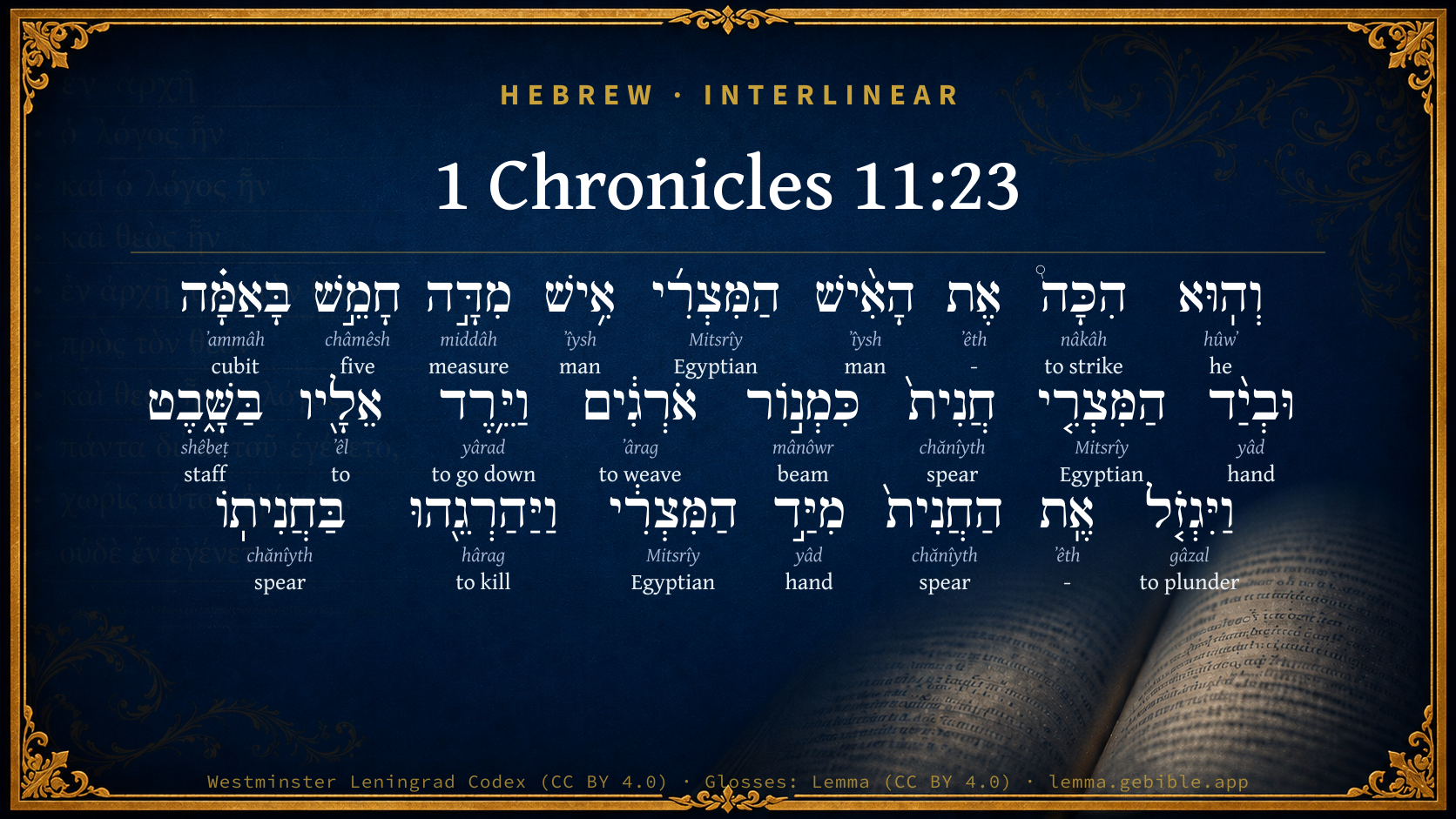
Hebrew (Westminster Leningrad Codex) 1 Chronicles 11:23 appears in the Hebrew Old Testament. The text above is from the Westminster Leningrad Codex. Each word links to its Strong’s number, a concise gloss, and parsing drawn from the Open Scriptures Hebrew Bible morphology. Click any word for its full Brown-Driver-Briggs (BDB) entry.
Download image
Cite this verse

1 Chronicles 11:23 (World English Bible). Public Domain. Lemma interlinear Bible study tool, https://lemma.gebible.app/v/1-chronicles/11/23.

Show BibTeX & RIS
BibTeX
RIS
English Translation
He killed an Egyptian, a man of great stature, five cubits high; and in the Egyptian's hand was a spear like a weaver's beam; and he went down to him with a staff, and plucked the spear out of the Egyptian's hand, and killed him with his own spear.
World English Bible · Public Domain
Download a study sheet

One document with this verse’s original text, its word-by-word gloss line, the meaning frame, cross-references with their text, attributed commentary, and full source and license credits — printable, and it pastes into notes with its structure intact.

This verse Autodidact and up

Study sheet (.html) Plain text (.txt)

A passage Seminary Student

Up to 50 verses in one chapter. A passage sheet keeps up to 6 commentary sources and 12 cross-references per verse, in the order this page ranks them, and says so on the sheet whenever that leaves anything out. Ask for a single verse and you get the Autodidact verse sheet above.

Everything on this page stays free to read, with no account — the sheet is a download of what is already on screen, not access to it.

Want to remove ads? Support Godless Engineer
Compare translations 3

The same verse in 3 English versions, stacked beneath the original-language interlinear above. Click any original word for its lexicon entry.

Each is an independent rendering of the whole verse — the interlinear is not word-aligned to these translations.

Highlighted words mark where these versions differ — a whole-verse word diff, not a word-by-word alignment.

  • World English Bible Public Domain
    He killed an Egyptian, a man of great stature, five cubits high; and in the Egyptian's hand was a spear like a weaver's beam; and he went down to him with a staff, and plucked the spear out of the Egyptian's hand, and killed him with his own spear.
  • King James Version Public Domain
    And he slew an Egyptian, a man of great stature, five cubits high; and in the Egyptian's hand was a spear like a weaver's beam; and he went down to him with a staff, and plucked the spear out of the Egyptian's hand, and slew him with his own spear.
  • unfoldingWord Literal Text CC BY-SA 4.0
    And he, he struck a man of Egypt, a man of measure, five by the cubit. Now in the hand of the Egyptian a spear like a beam of weavers, and he went down against him with a staff. But he seized the spear from the hand of the Egyptian, and he killed him with his spear.

unfoldingWord Literal Text — © unfoldingWord, licensed CC BY-SA 4.0. Word-aligned USFM3 via Door43 (git.door43.org/unfoldingWord/en_ult).

Versions to compare (up to 4)

3 of 4 selected

Show all 18 translations

Every available English version of this verse, each an independent rendering of the whole verse.

  • World English Bible Public Domain
    He killed an Egyptian, a man of great stature, five cubits high; and in the Egyptian's hand was a spear like a weaver's beam; and he went down to him with a staff, and plucked the spear out of the Egyptian's hand, and killed him with his own spear.
  • Berean Standard Bible Public Domain
    He also killed an Egyptian, a huge man five cubits tall. Although the Egyptian had a spear like a weaver’s beam in his hand, Benaiah went against him with a club, snatched the spear from his hand, and killed the Egyptian with his own spear.
  • Majority Standard Bible Public Domain
    He also struck down an Egyptian, a huge man five cubits tall. Although the Egyptian had a spear like a weaver’s beam in his hand, Benaiah went against him with a club, snatched the spear from his hand, and killed the Egyptian with his own spear.
  • King James Version Public Domain
    And he slew an Egyptian, a man of great stature, five cubits high; and in the Egyptian's hand was a spear like a weaver's beam; and he went down to him with a staff, and plucked the spear out of the Egyptian's hand, and slew him with his own spear.
  • American Standard Version (1901) Public Domain
    And he slew an Egyptian, a man of great stature, five cubits high; and in the Egyptian's hand was a spear like a weaver's beam; and he went down to him with a staff, and plucked the spear out of the Egyptian's hand, and slew him with his own spear.
  • Revised Version (1885) Public Domain
    And he slew an Egyptian, a man of great stature, five cubits high; and in the Egyptian’s hand was a spear like a weaver’s beam; and he went down to him with a staff, and plucked the spear out of the Egyptian’s hand, and slew him with his own spear.
  • Geneva Bible (1599) Public Domain
    And he slewe an Egyptian, a man of great stature, euen fiue cubites long, and in the Egyptians hand was a speare like a weauers beame: and he went downe to him with a staffe, and plucked the speare out of the Egyptians hand, and slewe him with his owne speare.
  • Douay-Rheims (1899) Public Domain
    And he slew an Egyptian, whose stature was of five cubits, and who had a spear like a weaver's beam: and he went down to him with a staff, and plucked away the spear, that he held in his hand, and slew him with his own spear.
  • Young's Literal Translation Public Domain
    And he hath smitten the man, the Egyptian -- a man of measure, five by the cubit -- and in the hand of the Egyptian `is' a spear like a beam of weavers, and he goeth down unto him with a rod, and taketh violently away the spear out of the hand of the Egyptian, and slayeth him with his own spear.
  • Literal Standard Version CC BY-SA 4.0
    And he has struck the man, the Egyptian, a man of [great] measure—five by the cubit—and in the hand of the Egyptian [is] a spear like a weavers’ beam, and he goes down to him with a rod, and violently takes away the spear out of the hand of the Egyptian, and slays him with his own spear.
  • Unlocked Literal Bible CC BY-SA 4.0
    He even killed an Egyptian, a man five cubits tall. The Egyptian had a spear like a weaver's beam, but he went down to him with only a staff. He seized the spear out of the Egyptian's hand and killed him with his own spear.
  • unfoldingWord Literal Text CC BY-SA 4.0
    And he, he struck a man of Egypt, a man of measure, five by the cubit. Now in the hand of the Egyptian a spear like a beam of weavers, and he went down against him with a staff. But he seized the spear from the hand of the Egyptian, and he killed him with his spear.
  • Darby Bible Public Domain
    He also smote the Egyptian, a man of stature, five cubits high: and in the Egyptian's hand was a spear like a weaver's beam; and he went down to him with a staff, and plucked the spear out of the Egyptian's hand, and slew him with his own spear.
  • World Messianic Bible Public Domain
    He killed an Egyptian, a man of great stature, five cubits high. In the Egyptian’s hand was a spear like a weaver’s beam; and he went down to him with a staff, plucked the spear out of the Egyptian’s hand, and killed him with his own spear.
  • Webster's Bible Public Domain
    And he slew an Egyptian, a man of great stature, five cubits high; and in the Egyptian's hand was a spear like a weaver's beam; and he went down to him with a staff, and plucked the spear out of the Egyptian's hand, and slew him with his own spear.
  • Free Bible Version CC BY-SA 4.0
    Another time he killed an Egyptian—a huge man who stood seven feet six inches tall. The Egyptian had a spear whose shaft was as thick as a weaver's rod. Benaiah attacked him with just a club, but he was able to grab the spear from the Egyptian's hand, and killed him with his own spear.
  • Bible in Basic English Public Domain
    And he made an attack on an Egyptian, a very tall man about five cubits high, armed with a spear like a cloth-worker's rod; he went down to him with a stick, and pulling his spear out of the hand of the Egyptian, put him to death with that same spear.
  • JPS Tanakh (1917) Public Domain
    And he slew an Egyptian, a man of great stature, five cubits high; and in the Egyptian's hand was a spear like a weaver's beam; and he went down to him with a staff, and plucked the spear out of the Egyptian's hand, and slew him with his own spear.

Literal Standard Version (2020), Covenant Press — licensed CC BY-SA 4.0. Text via the HelloAO Bible API (eBible.org). Unlocked Literal Bible (unfoldingWord) — licensed CC BY-SA 4.0. Text via the HelloAO Bible API (eBible.org). unfoldingWord Literal Text — © unfoldingWord, licensed CC BY-SA 4.0. Word-aligned USFM3 via Door43 (git.door43.org/unfoldingWord/en_ult). Free Bible Version, Dr. Jonathan Gallagher — licensed CC BY-SA 4.0. Text via the HelloAO Bible API (eBible.org).

Word by word

More ways to search: Search by grammar → Find every occurrence → Compare this word →

Practice this passage: Drill this verse → Learn its vocabulary →

כִּמְנ֣וֹר
mânôwr
H4500
“like/as · beam of”
Preposition + Noun, Common, Masculine, Singular, Construct
Part of Speech
Preposition + Noun
Type
Common
Gender
Masculine
Number
Singular
State
Construct
Full BDB Definition

Origin: from H5214

TWOT: 1361a

beam - beam (carrying the heddles in a loom)
  1. וְהֽוּא hûwʼ H1931 “and · he” Conjunction + Pronoun, Personal, 3rd Person, Masculine, Singular
  2. הִכָּה֩ nâkâh H5221 “to strike” Verb, Hiphil, Perfect, 3rd Person, Masculine, Singular
  3. אֶת ʼêth H853 “-” Particle, Direct Object
  4. הָאִ֨ישׁ ʼîysh H376 “the · man” Particle, Definite Article + Noun, Common, Masculine, Singular, Absolute
  5. הַמִּצְרִ֜י Mitsrîy H4713 “the · Egyptian” Particle, Definite Article + Noun, Gentilic, Masculine, Singular, Absolute
  6. אִ֥ישׁ ʼîysh H376 “man of” Noun, Common, Masculine, Singular, Construct
  7. מִדָּ֣ה middâh H4060 “measure” Noun, Common, Feminine, Singular, Absolute
  8. חָמֵ֣שׁ châmêsh H2568 “five” Adjective, Cardinal number, Feminine, Singular, Absolute
  9. בָּאַמָּ֗ה ʼammâh H520 “in/at the · cubit” Preposition, Determined + Noun, Common, Feminine, Singular, Absolute
  10. וּבְיַ֨ד yâd H3027 “and · in/at · hand of” Conjunction + Preposition + Noun, Common, Both, Singular, Construct
  11. הַמִּצְרִ֤י Mitsrîy H4713 “the · Egyptian” Particle, Definite Article + Noun, Gentilic, Masculine, Singular, Absolute
  12. חֲנִית֙ chănîyth H2595 “spear” Noun, Common, Feminine, Singular, Absolute
  13. אֹרְגִ֔ים ʼârag H707 “weaving” Verb, Qal, Participle Active, Masculine, Plural, Absolute
  14. וַיֵּ֥רֶד yârad H3381 “and · to go down” Conjunction + Verb, Qal, Sequential Imperfect, 3rd Person, Masculine, Singular
  15. אֵלָ֖יו ʼêl H413 “to · him” Preposition + Suffix, Personal, 3rd Person, Masculine, Singular
  16. בַּשָּׁ֑בֶט shêbeṭ H7626 “in/at the · staff” Preposition, Determined + Noun, Common, Masculine, Singular, Absolute
  17. וַיִּגְזֹ֤ל gâzal H1497 “and · to plunder” Conjunction + Verb, Qal, Sequential Imperfect, 3rd Person, Masculine, Singular
  18. אֶֽת ʼêth H853 “-” Particle, Direct Object
  19. הַחֲנִית֙ chănîyth H2595 “the · spear” Particle, Definite Article + Noun, Common, Feminine, Singular, Absolute
  20. מִיַּ֣ד yâd H3027 “from · hand of” Preposition + Noun, Common, Both, Singular, Construct
  21. הַמִּצְרִ֔י Mitsrîy H4713 “the · Egyptian” Particle, Definite Article + Noun, Gentilic, Masculine, Singular, Absolute
  22. וַיַּהַרְגֵ֖הוּ hârag H2026 “and · to kill · him” Conjunction + Verb, Qal, Sequential Imperfect, 3rd Person, Masculine, Singular + Suffix, Personal, 3rd Person, Masculine, Singular
  23. בַּחֲנִיתֽוֹ chănîyth H2595 “in/at · spear · his” Preposition + Noun, Common, Feminine, Singular, Construct + Suffix, Personal, 3rd Person, Masculine, Singular

About this verse

These counts appear in no published source. They are computed here, from the morphology-tagged text and Lemma’s own curated glosses. What Lemma adds →

24
words
17
distinct lemmas
Historical
section

Notable vocabulary

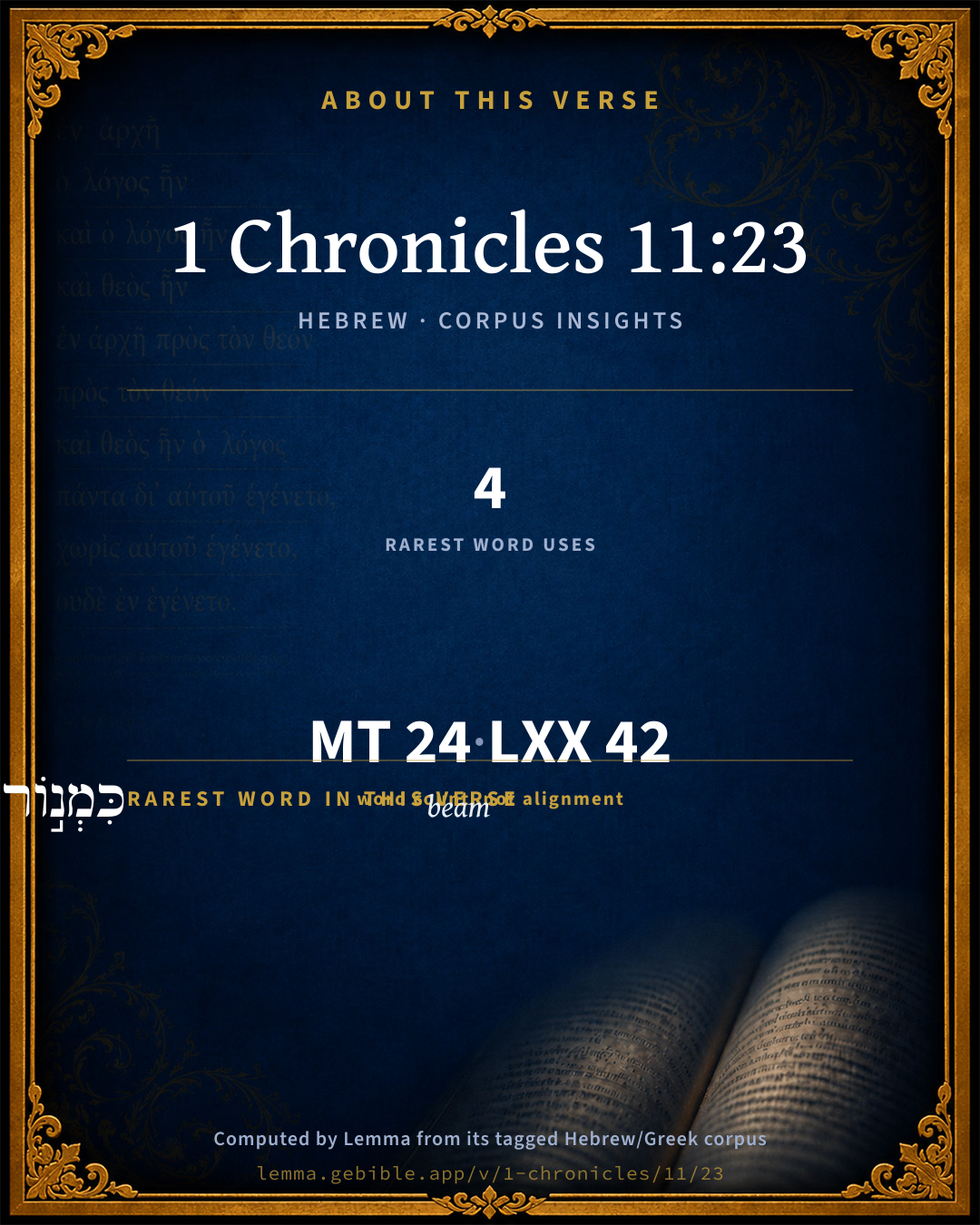
The rarest word here is כִּמְנ֣וֹר beam H4500 — appearing just 4 times in the whole Hebrew Bible.

Shared distinctive vocabulary

כִּמְנ֣וֹר beam H4500 occurs in 4 verses of the Hebrew Bible. Also found in:

Grammatical profile

  • 5 verbs
  • 14 nouns
  • 1 adjective
  • 1 pronoun
  • 1 preposition
  • 2 particles

Verb forms

  • הִכָּה֩ Hiphil · Perfect
  • אֹרְגִ֔ים Qal · Participle Active
  • וַיֵּ֥רֶד Qal · Sequential Imperfect
  • וַיִּגְזֹ֤ל Qal · Sequential Imperfect
  • וַיַּהַרְגֵ֖הוּ Qal · Sequential Imperfect

Repetition

Words recur within this verse — often emphatic in Hebrew:

  • הַמִּצְרִ֜י Egyptian H4713 ×3
  • חֲנִית֙ spear H2595 ×3
  • הָאִ֨ישׁ man H376 ×2
  • וּבְיַ֨ד hand H3027 ×2

Hebrew & Septuagint length

In English translation the verse runs 49 words from the Hebrew and 51 from the Septuagint (LXX English) — closely comparable.

A rough comparison of the two English renderings, which tokenize alike — not a word-level alignment.

Word counts can differ between the Hebrew and the Greek without any difference in meaning — e.g. the Hebrew direct-object marker אֵת has no separate Greek word, and Greek often adds the article ὁ.

In the original languages it is 24 Hebrew tokens and 42 Greek tokens — but the two are counted differently (Hebrew bundles its prefixes and suffixes into one token; the Greek is in lemma form), so that isn’t a like-for-like length.

Cross-references

5

Topical passages linked to 1 Chronicles 11:23 in the Treasury of Scripture Knowledge — connected by theme and wording, ordered by reader-vote popularity; previews shown in the World English Bible.

  • 1 Samuel 17:7 The staff of his spear was like a weaver's beam; and his spear's head [weighed] six hundred shekels of iron: and his shield-bearer went before him.
  • Deuteronomy 3:11 (For only Og king of Bashan remained of the remnant of the Rephaim; behold, his bedstead was a bedstead of iron; isn't it in Rabbah of the children of Ammon? nine cubits was the length of it, and four cubits the breadth of it, after the cubit of a man.)
  • 1 Samuel 17:4 There went out a champion out of the camp of the Philistines, named Goliath, of Gath, whose height was six cubits and a span.
  • 1 Samuel 17:51 Then David ran, and stood over the Philistine, and took his sword, and drew it out of the sheath of it, and killed him, and cut off his head therewith. When the Philistines saw that their champion was dead, they fled.
  • 1 Chronicles 20:5 There was again war with the Philistines; and Elhanan the son of Jair killed Lahmi the brother of Goliath the Gittite, the staff of whose spear was like a weaver's beam.

Cross-references courtesy of OpenBible.info (CC BY 4.0).

Hebrew and Greek witnesses Masoretic Hebrew ↔ Greek Septuagint

The same verse in the two great witnesses to the Old Testament, shown verse-for-verse.

These are two independent witnesses, not word-aligned to each other, and the Septuagint is shown in lemma (dictionary) form.

Hebrew 1 Chronicles 11:23 Masoretic · Westminster Leningrad Codex

וְהֽוּא הִכָּה֩ אֶת הָאִ֨ישׁ הַמִּצְרִ֜י אִ֥ישׁ מִדָּ֣ה חָמֵ֣שׁ בָּאַמָּ֗ה וּבְיַ֨ד הַמִּצְרִ֤י חֲנִית֙ כִּמְנ֣וֹר אֹרְגִ֔ים וַיֵּ֥רֶד אֵלָ֖יו בַּשָּׁ֑בֶט וַיִּגְזֹ֤ל אֶֽת הַחֲנִית֙ מִיַּ֣ד הַמִּצְרִ֔י וַיַּהַרְגֵ֖הוּ בַּחֲנִיתֽוֹ

He killed an Egyptian, a man of great stature, five cubits high; and in the Egyptian's hand was a spear like a weaver's beam; and he went down to him with a staff, and plucked the spear out of the Egyptian's hand, and killed him with his own spear.

World English Bible · Public Domain

Greek LXX 1 Chronicles 11:23 Septuagint · lemma form

καί οὗτος πατάσσω ὁ ἀνήρ ὁ αἰγύπτιος ἀνήρ ὁρατός πεντάπηχυς καί ἐν χείρ ὁ αἰγύπτιος δόρυ ὡς ἀντίον ὑφαίνω καί καταβαίνω ἐπί αὐτός βαναιας ἐν ῥάβδος καί ἀποαἱρέω ἐκ ὁ χείρ ὁ αἰγύπτιος ὁ δόρυ καί ἀποκτείνω αὐτός ἐν ὁ δόρυ αὐτός

And he struck an Egyptian, a wonderful man five cubits high; and in the hand of the Egyptian there was a spear like a weavers' beam; and Banaia went down to him with a staff, and took the spear out of the Egyptian's hand, and killed him with his own spear.

LXX2012 (modern English Septuagint) · Public Domain

On this verse, Ellicott's Commentary for English Readers discusses the Septuagint’s reading. Read the note in Commentary ↓

Hebrew: Westminster Leningrad Codex (CC BY 4.0). Greek: Septuagint (public domain); English from LXX2012 (modern English Septuagint) (Public Domain). How the Septuagint differs from the Hebrew →

Commentary

Notes on 1 Chronicles 11:23 from classic Christian and Jewish commentators (each source and its license shown beneath its notes). The classic Christian expositions comment on the surrounding passage and are grouped to its opening verse, so a note may address several verses; the Jewish commentaries on the Tanakh (Rashi and others) are per-verse, so they appear only where the commentator wrote on this verse.

Lemma curates 59 commentaries, every one of them public domain or Creative Commons licensed, each selected and text-cleaned for this edition rather than reprinted as found. About our sources →

Trapp's Complete Commentary

John Trapp

1Ch 11:23 And he slew an Egyptian, a man of [great] stature, five cubits high; and in the Egyptian’s hand [was] a spear like a weaver’s beam; and he went down to him with a staff, and plucked the spear out of the Egyptian’s hand, and slew him with his own spear.

Ver. 23. And he slew an Egyptian.] See 2Sa 23:21.

John Trapp, A Commentary or Exposition upon All the Books of the Old and New Testament (1647–1656) — public domain. Text from a community e-Sword module.

Jamieson, Fausset & Brown

Robert Jamieson, A. R. Fausset & David Brown

he went down--the ordinary phraseology for expressing an engagement in battle. The encounter of Benaiah with this gigantic Egyptian reminds us, in some respects, of David's combat with Goliath. At least, the height of this giant, which was about eight feet, and his armor, resembled his of Gath.

with a staff--that is, having no other weapon in his hand than his walking stick.

Jamieson, Fausset & Brown — Commentary Critical and Explanatory on the Whole Bible (1871) — public domain (CC PDM 1.0). Text via the HelloAO Bible API.

Adam Clarke's Commentary

Verse 23. Plucked the spear out of the Egyptian's hand, and slew him with his own spear.] 2Sa 23:21.

Adam Clarke's Commentary on the Bible (1810–1826) — public domain. Text from a community e-Sword/MySword module.

Ellicott's Commentary for English Readers

(23) And he slew an Egyptian . . .—Literally, and he it was who smote the Egyptian, a man of measure, five in the cubit. Samuel has only “who (was) a sight;” or “a man to look at” (Heb. margin). The chronicler says why.

Like a weaver’s beam.—Not in Samuel. Perhaps due to a recollection of the combat of David and Goliath. (Comp. also 2Sa_21:19.) Yet the LXX. of 2Sa_23:21 has “like the beam of a ship’s ladder” (ξύλον διαβάθρας); and this may be original.

Went down.—To the combat. (Comp. Latin: descendere in aciem, &c.) The staff (shçbet) of Benaiah differs from David’s (maqqçl, 1Sa_17:40; 1Sa_17:43); and the similarity of the two accounts, so far as it extends, is a similarity not of fiction, but of fact.

With a staff.—Rather, the staff, which he happened to carry.

A Bible Commentary for English Readers, edited by Charles John Ellicott (1878–1897) — public domain. Text from a community e-Sword module.

The Cambridge Bible for Schools and Colleges

gen. ed. J. J. S. Perowne

23. of great stature] Heb. “of measurement.” Samuel has a better reading, “a goodly man” (man of presence), “goodliness” according to the Hebrews consisting in being well-built for warlike exercises.

a staff] Heb. ‘shebhet,’ i.e. the “rod” or “club” carried by shepherds as a defence against wild-beasts; Psa_2:9 (“rod”); 1Ch_23:4 (“rod”); 2Sa_18:14 (“darts”). This “rod” had a point at one end, so that it could on occasion be used as a stabbing weapon.

The Cambridge Bible for Schools and Colleges (gen. ed. J. J. S. Perowne; Cambridge University Press, 1878–1918) — public domain. Text from a community e-Sword module.

Albert Barnes' Notes on the Bible

Five cubits high - About 7 ft. 6 in. high. The height is not so great as that recorded of other giants.

Albert Barnes' Notes on the Bible (1834–1885) — public domain. Text from a community e-Sword/MySword module.

Haydock's Catholic Bible Commentary

Cubits. 2 Kings, "a man of great aspect." --- Ones. Hebrew, "and he had a name among three mighty men." (Kennicott) --- Shelosha, "three," has the u omitted, (2 Kings) as it is frequently on other occasions. (Haydock)

George Leo Haydock (1774–1849), Haydock's Catholic Family Bible and Commentary, 1859 edition — public domain. Excludes Psalms (Douay-Rheims chapter numbering differs from Protestant) and Deuterocanonical books (Catholic canon only).

The Pulpit Commentary

Five cubits high. This height is not given in the parallel passage; it means seven feet six inches. A spear like a weaver"s beam (so 1Sa_17:7; 2Sa_21:19)

The Pulpit Commentary (1880–1919), ed. H.D.M. Spence-Jones & Joseph S. Exell — public domain. Text from a community e-Sword module.

Rashi

Rabbi Shlomo Yitzchaki (Rashi)

a man of great stature Other people do not require to be measured, as [their height] can be determined by estimate; a similar case is (Num. 13:32): “... whom we saw in its midst are men of a measure.”

like a weavers’ beam the pole upon which the cloth is wrapped.

Rashi on the Tanakh — English translations: “The Judaica Press complete Tanach with Rashi, translated by A. J. Rosenberg” (CC BY 4.0); “Pentateuch with Rashi's commentary by M. Rosenbaum and A.M. Silbermann, 1929-1934” (public domain); “The Metsudah Tanach series, Lakewood, N.J” (CC BY 4.0); and “The Book of Joshua, Metsudah Publications, 1997” (CC BY 4.0). Text via Sefaria.

Lesson kit

Teaching starters — assembled from the data on this page, not authored interpretation. Every prompt links to the verse data it draws on. Edit before teaching.

1 Chronicles, in the Historical, opens this verse with 24 words (17 distinct Hebrew lemmas). Its most distinctive word is mânôwr (“beam”). A historical commentator’s framing appears above. Read the whole chapter for the surrounding context.

Discussion questions

  1. What does “beam” (mânôwr) contribute to the verse as a whole?
  2. 1 Samuel 17:7 shares the word «beam» with this verse. How do the two illuminate each other?
  3. “Egyptian” occurs 3× in this one verse. What is the effect of the repetition?
  4. The translations on this page render this verse differently — a whole-verse word diff, not a word-by-word alignment. What might account for the different wordings?
  5. The verb «הִכָּה֩» is Hiphil Perfect. How does its form color the action?
  6. Reading how Trapp's Complete Commentary and Jamieson, Fausset & Brown read this verse, where do the two commentators agree and where do they part?

Things to notice

Reading settings

Reading text

Shown beneath each verse's original-language words.

Old Testament
Old Testament edition

Read the OT as the Masoretic Hebrew (MT) or the Greek Septuagint (LXX).

English shown for the Greek Septuagint (in the Hebrew ↔ Greek comparison).

Comparing translations? Open the Compare panel on any verse page to stack up to four side by side.