
Proverbs 1:32

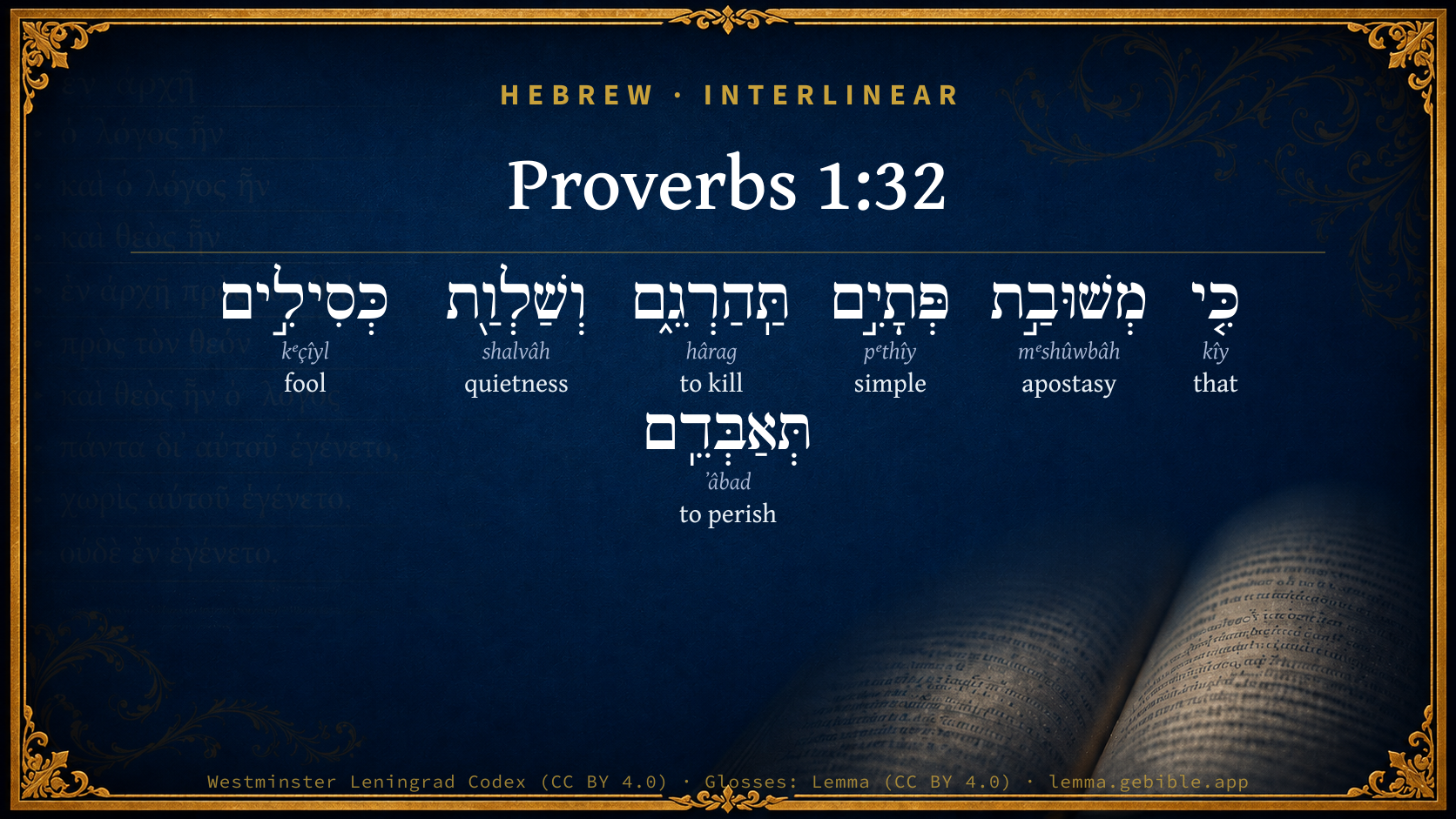
Hebrew (Westminster Leningrad Codex) Proverbs 1:32 appears in the Hebrew Old Testament. The text above is from the Westminster Leningrad Codex. Each word links to its Strong’s number, a concise gloss, and parsing drawn from the Open Scriptures Hebrew Bible morphology. Click any word for its full Brown-Driver-Briggs (BDB) entry.
Download image
Cite this verse

Proverbs 1:32 (World English Bible). Public Domain. Lemma interlinear Bible study tool, https://lemma.gebible.app/v/proverbs/1/32.

Show BibTeX & RIS
BibTeX
RIS
English Translation
For the backsliding of the simple will kill them. The careless ease of fools will destroy them.
World English Bible · Public Domain
Highlights
  • 1 first appearance in the Hebrew Bible
Full analysis ↓
Download a study sheet

One document with this verse’s original text, its word-by-word gloss line, the meaning frame, cross-references with their text, attributed commentary, and full source and license credits — printable, and it pastes into notes with its structure intact.

This verse Autodidact and up

Study sheet (.html) Plain text (.txt)

A passage Seminary Student

Up to 50 verses in one chapter. A passage sheet keeps up to 6 commentary sources and 12 cross-references per verse, in the order this page ranks them, and says so on the sheet whenever that leaves anything out. Ask for a single verse and you get the Autodidact verse sheet above.

Everything on this page stays free to read, with no account — the sheet is a download of what is already on screen, not access to it.

Want to remove ads? Support Godless Engineer
Compare translations 3

The same verse in 3 English versions, stacked beneath the original-language interlinear above. Click any original word for its lexicon entry.

Each is an independent rendering of the whole verse — the interlinear is not word-aligned to these translations.

Highlighted words mark where these versions differ — a whole-verse word diff, not a word-by-word alignment.

  • World English Bible Public Domain
    For the backsliding of the simple will kill them. The careless ease of fools will destroy them.
  • King James Version Public Domain
    For the turning away of the simple shall slay them, and the prosperity of fools shall destroy them.
  • unfoldingWord Literal Text CC BY-SA 4.0
    For the turning away of the naive ones will slay them and security will lead stupid ones to ruin.

unfoldingWord Literal Text — © unfoldingWord, licensed CC BY-SA 4.0. Word-aligned USFM3 via Door43 (git.door43.org/unfoldingWord/en_ult).

Versions to compare (up to 4)

3 of 4 selected

Show all 18 translations

Every available English version of this verse, each an independent rendering of the whole verse.

  • World English Bible Public Domain
    For the backsliding of the simple will kill them. The careless ease of fools will destroy them.
  • Berean Standard Bible Public Domain
    For the waywardness of the simple will slay them, and the complacency of fools will destroy them.
  • Majority Standard Bible Public Domain
    For the waywardness of the simple will slay them, and the complacency of fools will destroy them.
  • King James Version Public Domain
    For the turning away of the simple shall slay them, and the prosperity of fools shall destroy them.
  • American Standard Version (1901) Public Domain
    For the backsliding of the simple shall slay them, And the careless ease of fools shall destroy them.
  • Revised Version (1885) Public Domain
    For the backsliding of the simple shall slay them, and the prosperity of fools shall destroy them.
  • Geneva Bible (1599) Public Domain
    For ease slaieth the foolish, and the prosperitie of fooles destroyeth them.
  • Douay-Rheims (1899) Public Domain
    The turning away of little ones shall kill them, and the prosperity of fools shall destroy them.
  • Young's Literal Translation Public Domain
    For the turning of the simple slayeth them, And the security of the foolish destroyeth them.
  • Literal Standard Version CC BY-SA 4.0
    For the turning of the simple slays them, || And the security of the foolish destroys them.
  • Unlocked Literal Bible CC BY-SA 4.0
    For the naive are killed when they turn away, and the indifference of fools will destroy them.
  • unfoldingWord Literal Text CC BY-SA 4.0
    For the turning away of the naive ones will slay them and security will lead stupid ones to ruin.
  • Darby Bible Public Domain
    For the turning away of the simple shall slay them, and the prosperity of the foolish shall cause them to perish.
  • World Messianic Bible Public Domain
    For the backsliding of the simple will kill them. The careless ease of fools will destroy them.
  • Webster's Bible Public Domain
    For the turning away of the simple shall slay them, and the prosperity of fools shall destroy them.
  • Free Bible Version CC BY-SA 4.0
    Stupid people are killed by their rebellion; foolish people are destroyed by their lack of concern.
  • Bible in Basic English Public Domain
    For the turning back of the simple from teaching will be the cause of their death, and the peace of the foolish will be their destruction.
  • JPS Tanakh (1917) Public Domain
    For the waywardness of the thoughtless shall slay them, and the confidence of fools shall destroy them.

Literal Standard Version (2020), Covenant Press — licensed CC BY-SA 4.0. Text via the HelloAO Bible API (eBible.org). Unlocked Literal Bible (unfoldingWord) — licensed CC BY-SA 4.0. Text via the HelloAO Bible API (eBible.org). unfoldingWord Literal Text — © unfoldingWord, licensed CC BY-SA 4.0. Word-aligned USFM3 via Door43 (git.door43.org/unfoldingWord/en_ult). Free Bible Version, Dr. Jonathan Gallagher — licensed CC BY-SA 4.0. Text via the HelloAO Bible API (eBible.org).

Word by word

More ways to search: Search by grammar → Find every occurrence → Compare this word →

Practice this passage: Drill this verse → Learn its vocabulary →

About this verse

These counts appear in no published source. They are computed here, from the morphology-tagged text and Lemma’s own curated glosses. What Lemma adds →

7
words
7
distinct lemmas
Wisdom
section

Notable vocabulary

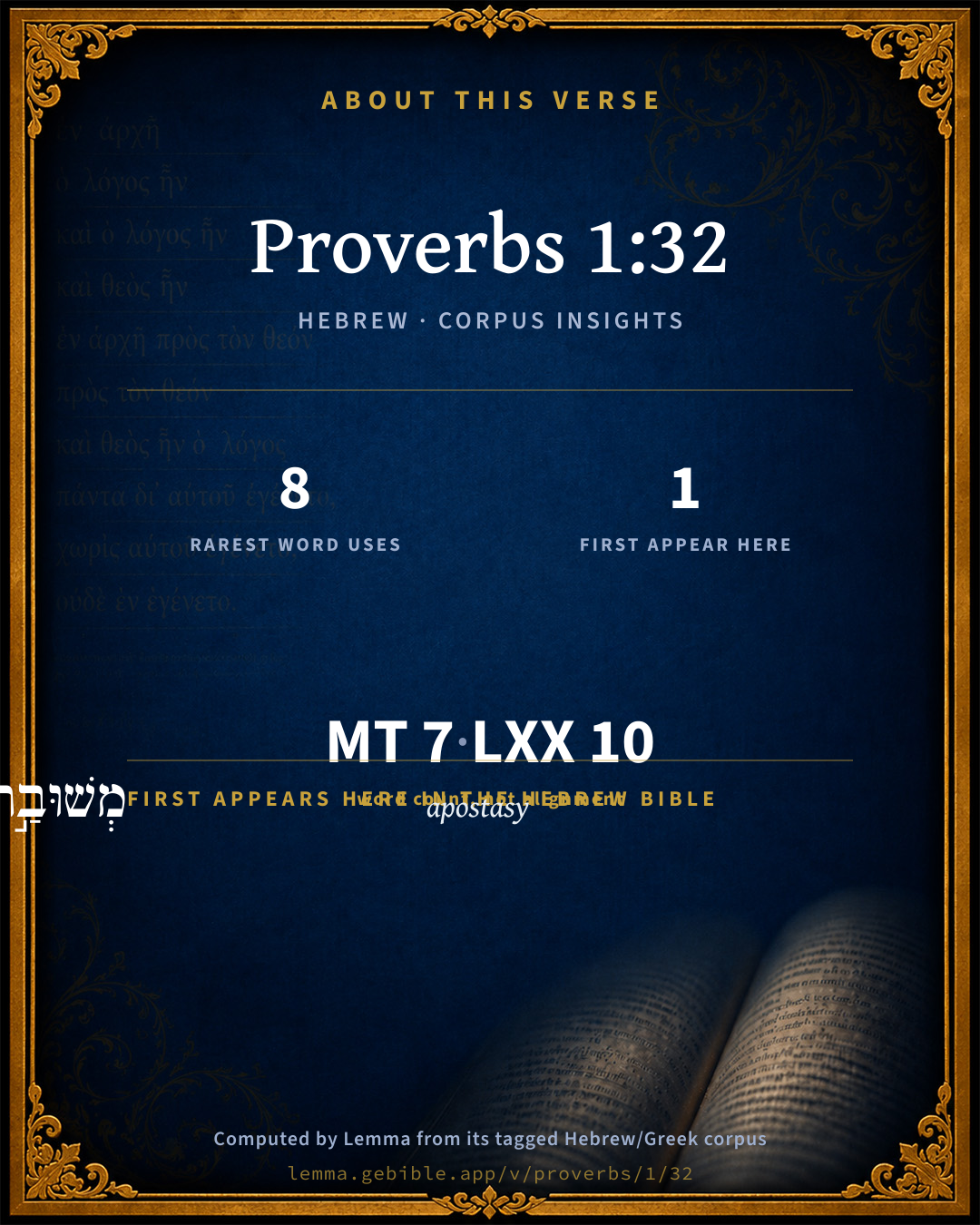
The rarest word here is וְשַׁלְוַ֖ת quietness H7962 — appearing just 8 times in the whole Hebrew Bible.

First appearance in Scripture

This word makes its first canonical appearance in the Hebrew Bible here:

  • מְשׁוּבַ֣ת apostasy H4878

Shared distinctive vocabulary

וְשַׁלְוַ֖ת quietness H7962 occurs in 8 verses of the Hebrew Bible. Also found in:

Grammatical profile

  • 2 verbs
  • 3 nouns
  • 1 adjective
  • 1 conjunction

Verb forms

  • תַּֽהַרְגֵ֑ם Qal · Imperfect
  • תְּאַבְּדֵֽם Piel · Imperfect

Hebrew & Septuagint length

In English translation the verse runs 17 words from the Hebrew and 17 from the Septuagint (LXX English) — the same length.

A rough comparison of the two English renderings, which tokenize alike — not a word-level alignment.

Word counts can differ between the Hebrew and the Greek without any difference in meaning — e.g. the Hebrew direct-object marker אֵת has no separate Greek word, and Greek often adds the article ὁ.

In the original languages it is 7 Hebrew tokens and 10 Greek tokens — but the two are counted differently (Hebrew bundles its prefixes and suffixes into one token; the Greek is in lemma form), so that isn’t a like-for-like length.

Cross-references

13

Topical passages linked to Proverbs 1:32 in the Treasury of Scripture Knowledge — connected by theme and wording, ordered by reader-vote popularity; previews shown in the World English Bible.

  • Proverbs 8:36 But he who sins against me wrongs his own soul. All those who hate me love death."
  • Jeremiah 2:19 Your own wickedness shall correct you, and your backsliding shall reprove you: know therefore and see that it is an evil thing and a bitter, that you have forsaken Yahweh your God, and that my fear is not in you, says the Lord, Yahweh of Hosts.
  • John 3:36 One who believes in the Son has eternal life, but one who disobeys the Son won't see life, but the wrath of God remains on him."
  • Luke 16:19–25 "Now there was a certain rich man, and he was clothed in purple and fine linen, living in luxury every day.
  • Hebrews 12:25 See that you don't refuse him who speaks. For if they didn't escape when they refused him who warned on the Earth, how much more will we not escape who turn away from him who warns from heaven,
  • Deuteronomy 32:15–44 But Jeshurun grew fat, and kicked: You have grown fat, you are grown thick, you are become sleek; Then he forsook God who made him, Lightly esteemed the Rock of his salvation.
  • Psalms 69:22 Let their table before them become a snare. May it become a retribution and a trap.
  • Jeremiah 48:11–12 Moab has been at ease from his youth, and he has settled on his lees, and has not been emptied from vessel to vessel, neither has he gone into captivity: therefore his taste remains in him, and his scent is not changed.
  • Luke 12:16–21 He spoke a parable to them, saying, "The ground of a certain rich man brought forth abundantly.
  • Hebrews 12:8 But if you are without discipline, of which all have been made partakers, then are you illegitimate, and not children.
  • James 5:5 You have lived delicately on the earth, and taken your pleasure. You have nourished your hearts as in a day of slaughter.
  • Psalms 92:6–7 A senseless man doesn't know, Neither does a fool understand this:
  • Hebrews 10:38–39 But the righteous will live by faith. If he shrinks back, my soul has no pleasure in him."

Cross-references courtesy of OpenBible.info (CC BY 4.0).

Hebrew and Greek witnesses Masoretic Hebrew ↔ Greek Septuagint

The same verse in the two great witnesses to the Old Testament, shown verse-for-verse.

These are two independent witnesses, not word-aligned to each other, and the Septuagint is shown in lemma (dictionary) form.

Hebrew Proverbs 1:32 Masoretic · Westminster Leningrad Codex

כִּ֤י מְשׁוּבַ֣ת פְּתָיִ֣ם תַּֽהַרְגֵ֑ם וְשַׁלְוַ֖ת כְּסִילִ֣ים תְּאַבְּדֵֽם

For the backsliding of the simple will kill them. The careless ease of fools will destroy them.

World English Bible · Public Domain

Greek LXX Proverbs 1:32 Septuagint · lemma form

ἀντί ὅς γάρ ἀδικέω νήπιος φονεύω καί ἐξετασμός ἀσεβής ὄλλυμι

For because they wronged the simple, they shall be slain; and an inquisition shall ruin the ungodly.

LXX2012 (modern English Septuagint) · Public Domain

On this verse, Whedon's Commentary on the Bible discusses the Septuagint’s reading. Read the note in Commentary ↓

Hebrew: Westminster Leningrad Codex (CC BY 4.0). Greek: Septuagint (public domain); English from LXX2012 (modern English Septuagint) (Public Domain). How the Septuagint differs from the Hebrew →

Commentary

Notes on Proverbs 1:32 from classic Christian and Jewish commentators (each source and its license shown beneath its notes). The classic Christian expositions comment on the surrounding passage and are grouped to its opening verse, so a note may address several verses; the Jewish commentaries on the Tanakh (Rashi and others) are per-verse, so they appear only where the commentator wrote on this verse.

Lemma curates 59 commentaries, every one of them public domain or Creative Commons licensed, each selected and text-cleaned for this edition rather than reprinted as found. About our sources →

Trapp's Complete Commentary

John Trapp

Pro 1:32 For the turning away of the simple shall slay them, and the prosperity of fools shall destroy them.

Ver. 32. For the turning away.] Whereas it might be objected that meanwhile wicked men live at ease and prosper; it is granted, but withal asserted, that these fatted oxen are but fitted for the slaughter. The sunshine of prosperity ripens the sin of the wicked apace. Bernard calls it misericordiam omni indignatione crudeliorem, a mercy that he had no mind to. What good is there in having a fine suit with the plague in it? As soon may a man miscarry upon the soft sands as upon the hard rocks.

John Trapp, A Commentary or Exposition upon All the Books of the Old and New Testament (1647–1656) — public domain. Text from a community e-Sword module.

The Biblical Illustrator

Joseph S. Exell

Pro_1:32

The prosperity of fools shall destroy them.

Prosperity dangerous to virtue

By fools are here represented all wicked and vicious persons. The misery of such persons is, that when God gives them what they most love, they perish in the embraces of it. The reasons for this are three.

I. Because every foolish or vicious person is either ignorant or regardless of the proper ends and uses for which God designs the prosperity of those to whom He sends it. Which ends are--

1. To try and discover what is in a man.

2. To encourage men in a constant, humble expression of their gratitude to the bounty of their Maker, who deals forth such rich and plentiful provisions to His undeserving creatures.

3. To make them helpful in society. No man holds the abundance of wealth as a proprietor.

II. Because prosperity (as the nature of man now stands) has a peculiar force and fitness to abate mens virtues and to heighten their corruptions. For its abating their virtues. Virtue is such a plant as grows upon no ground save that which is tilled and cultivated with the severest labour. But what a stranger is toil and labour to a great fortune!

2. For heightening and inflaming mens corruptions. Nothing more effectually betrays the heart into a love of sin and a loathing of holiness than an ill-managed prosperity. The vices which particularly receive improvement by prosperity are--

1. Pride.

2. Luxury and uncleanness.

3. Profaneness and neglect of God in the duties of religion. Those who lie soft and warm in a rich estate seldom come to heat themselves at the altar.

III. Because prosperity directly indisposes men to the proper means of their amendment and recovery.

1. It renders them utterly averse to receiving counsel and admonition.

2. It unfits for the sharp trials of adversity which God uses to correct and reduce the soul.

(1) He either faints and desponds and parts with his hope together with his possessions, or

(2) he will murmur and blaspheme the God that afflicts him. The only way for a man not to find prosperity destructive is for him not to be a fool.

This he may avoid by a pious observance of these following rules:

1. Let him consider on what weak hinges his prosperity and felicity hang.

2. Let him consider how little he is bettered by prosperity as to those perfections which are chiefly valuable.

3. Let a man correct the gaieties and wanderings of his spirit by the severe duties of mortification. Since the fool in his best--that is, in his most prosperous condition--stands tottering upon the very brink of destruction, we should solicit God, not for temporal enjoyment, but for a heart that may fit us for it, if it be Gods will that prosperity be our lot. (R. South, D.D.)

The danger of prosperity

The title of fool is the usual character of the sinner in the language of Wisdom, in opposition to prudence. Prosperity comprehends all things desired by worldly men--riches, honours, pleasures, health, strength, peace, plenty, all that is grateful to the carnal mind and appetites. Prosperity abused is fatal and destructive to foolish sinners.

I. Prosperity is destructive to the wicked. There is no pestilence and contagion in the nature of things that are pleasing to our faculties. They are dangerous, not as made by God, but as managed by Satan. The primary design of God, in His most free and rich benefits, is to endear Himself to us and bind us to His service. When the wicked abuse Gods blessings, defeat His kindness, and frustrate the excellent ends of it, He most righteously and severely continues their prosperity, that foments their lusts and renders them more wilful and incorrigible and the more guilty of their own damnation. Prosperity is a fatal ambush for their surprisal and ruin. Prosperity abused is destructive to sinners, both meritoriously, as it induces a deadly guilt and makes them obnoxious to the revenging wrath of God, and effectively, as it is opposite to the felicity and perfection of man.

1. Prosperity is the continual incentive of the vicious affections.

2. Prosperity occasionally incenses an irascible appetite.

3. Prosperity inclines sinners to an impious neglect of God.

4. Prosperity exposes dangerously to the tempting power of Satan.

5. Prosperity is destructive to many, in that it affords them advantages to corrupt others, and reciprocally exposes them to be corrupted by others.

6. Prosperity usually renders the means of grace ineffectual.

7. Prosperity renders men averse to suffering for the sake of Christ.

8. Prosperity makes men careless of evils that might happen.

9. Prosperity is the great temptation to delay repentance until the sinners case is desperate.

II. The folly of prosperous sinners. Folly is the cause of their abusing prosperity and the effect of their prosperity abused.

1. The perfection of man consists in the excellences of his spiritual and immortal part.

2. All the prosperity in the world cannot bring true satisfaction to him that enjoys it, for it is disproportionate to the spiritual and immortal nature of the soul. The folly of the sinner is a voluntarily chosen folly, a culpable and guilty folly; the most ignominious folly, the most woful folly.

III. The justice, certainty, and heaviness of the judgment coming on sinners who abuse their prosperity. Justice, for their destruction is the fruit of their own choice. Certainty, for it is unchangeably established by the Divine ordination that the pleasures of sin shall end in the misery of obstinate sinners. The heaviness will be according to the aggravation of their sin. Temporal prosperity is, therefore, no special sign of Gods favour. (William Bates, D.D.)

The fools prosperity

I. These words describe the ungodly.

1. By their present way of sin.

2. By their future state of misery.

II. They describe the sin of the ungodly.

1. By the occasion.

2. By the act.

3. By the habit. Prosperity and ease is the occasion; turning away from God and rejecting His counsel is the act; and folly or simplicity is part of the habit.

III. They describe the Godly.

1. By their obedience. They hearken.

2. By their privilege or reward. They be quiet from fear of evil.

(1) It is so that the prosperity of fools destroyeth them.

(2) How folly and prosperity concur to their destruction. By the pleasing of their sensitive appetite and fancy, and so overcoming the power of reason. The more amiable the world appears, the more strongly it doth allure the soul to love it. Hereby it taketh the soul off from God. The very noise and bustle of earthly things divert their minds and hinder them from being serious. The sense of present ease and sweetness doth make them forget the change that is near. Pride lifts them up, so that God abhors them, and prosperity engages them in opposition to the word and ways and servants of the Lord.

(3) The uses to make of the text. Do not grudge at the prosperity of ungodly men. Do not desire riches or prosperity. Honour those that are great and godly, rich and religious. Let great men have a double interest in your prayers. (R. Baxter.)

Self-slayers

Suppose an iceberg possessed an intelligence and conscience; suppose it should say while dwelling in the polar region, It is because of the sun that I am an iceberg, what would you answer? You would say, It is not because of the sun, but because of your attitude towards the sun. Go down and place yourself beneath its melting rays, permit yourself to be enfolded in the arms of the Gulf Stream, and you will soon cease to be an iceberg, and become a part of the warm and gentle waters which enfold you. Or suppose we take this same truth in the realm of physical law. Many a Hindoo has stood for years with a napkin bound about his eyes that he might not see the sun, and when the cloth has been removed and he has sought to look upon that sun, he could not see. Behold, he had become blinded. Was it not he who had blinded himself? And yet, was it not also true that working through the natural law God had blinded him? There is a man sweeping toward Niagara, and I, standing on the shore, cry out, Pull for the shore; the rapids are just below you, and you will go over the falls; but he simply says to me, God is too good to permit me to go over the falls; and I cry again and he heeds not. But presently I see him grasp the oars. Alas, it is too late. Sweeping, whirling, plunging, his boat, like a cockle-shell, dashes over the cataract, and he is gone. Now we may say that the God who made water run down hill slew that man, but is the responsibility with Him? No. The man who knew that law and refused to recognise it slew himself. Well, men realise this in relation to their own physical organisation, because they realise that they have a physical constitution; but they do not realise that they have just as truly a moral constitution; that the laws of the one are as inevitable as the other; that in reference to the soul it is as true as of the body; the soul that sinneth against the law of its being shall die. (G. T. Dowling, D.D.)

Whoso hearkeneth unto Me shall dwell safely.

Quiet from the fear of evil

The secret of a quiet life has been the great quest of man. The Confucian, the Buddhist, the Pythagorean have busied themselves with it, as well as Solomon. It was the motive of the mightiest movement of mediaeval Christendom. Simeon on his pillar, Bernard in his cell, Francis in his rags, were all occupied with it; and in these restless, stormy, anxious times it is the question of questions still.

I. The fear of evil is the element of it with which man has most directly to do. Man is a being looking before and after. Apprehension and memory furnish together pretty well the whole of our bitter experience in life. The fear of evil is not an animal, it is strictly a human experience; part of the endowment of our race.

II. It is precisely this fear of evil which, by Gods help, we are to conquer; the evil itself is wholly beyond our power. Calamity haunts the evil air of an evil world, and man catches the infection. He lives fearfully, and faces death fearfully, till he has learnt the Divine secret.

III. How is the power to be won?

1. By realising how purely independent of things is mans peace and happiness.

2. By taking a true measure of the range of our being and its resources.

3. By perfect filial trust in God. We want a heart, an arm to rest on. The only perfect rest is in God. This sense of the Divine love, the clasp of the everlasting arms, is exquisite and blessed rest. (Baldwin Brown, B.A.)

The blessedness of hearkening to the voice of heavenly wisdom

To hearken means not only to hear, but to hear with attention, so as to follow the advice given (Jam_1:25); or, as the Saviour says (Joh_10:27). Such hear, not to forget, but to treasure up in their memories, that they may reduce to practice what they hear: such hear, not to cavil and find fault, but that they may profit by the instruction they receive. Now, this attention is assuredly the work of the Spirit on the heart, as we read of Lydia (Act_16:14). And hence it behoves all, when hearing Gods Word, to lift up their hearts to Him, that it may be with profit to their souls. And what are the promises made to such hearers? Safe dwelling and quietness from fear of evil. The gospel of our Lord Jesus Christ, operating on the heart, brings solid and lasting peace. The first of these promises is beautifully illustrated by our blessed Lord Himself at the close of His sermon on the mount (Mat_7:24-27). The man who hears Christian instruction , and who satisfies himself with listening and approving, but goes no further, never casts away his sins, or really lays hold on Christ, may flatter himself that all is right with his soul, because he has feelings and convictions and desires of a spiritual nature; but such a mans religion will break down entirely under the first flood of tribulation, and fail him completely when his need is the sorest, whereas the man who hears Christian instruction, and practises what he hears, upon such a man the floods of sickness, sorrow, poverty, disappointments, bereavements may beat, but his soul is unmoved, his faith does not give way, his comforts do not forsake him. Not only, however, is safety promised to him who hearkeneth to the voice of heavenly wisdom, but such an assurance of it as shall remove every distressing fear. Not only quietness from evil, but from the fear of it. Men in general suffer much more from fear of evils which they expect may come upon them than from those which they actually have to undergo; but God keeps him in perfect peace whose mind is stayed on Him. A wicked man is terrified with imagined danger; a godly man is not afraid even when the danger is real; for the one has a witness for him in his own breast, whereas the other carries within a witness against himself; and this witness is a judge to condemn him, yea, an executioner to torment and vex him. To be freed from the fear of evil is, in truth, the perfection of a spiritual state; and a great part of the saints portion both on earth and in heaven lies in the deliverance and security from it. But it may be asked, To whom are these gracious promises made? They are made to all: high and low, rich and poor, old and young. The term used is as large as any can desire: Whoso hearkeneth. Let them only listen to Christs invitation in the gospel, and render obedience to His commands, and the promised blessings shall be vouchsafed to them. (T. Grantham.)

.

The Biblical Illustrator, edited by Joseph S. Exell (c. 1880s–1900s) — public domain. Text from a community e-Sword module.

Geneva Bible (1599)

Geneva Bible translators

That is, the prosperity and sensuality wherein they delight.

Geneva Bible (1599) marginal notes — public domain. Text via Bolls.life.

Jamieson, Fausset & Brown

Robert Jamieson, A. R. Fausset & David Brown

turning away--that is, from the call of Pro 1:23.

simple--as in Pro 1:22.

prosperity--quiet, implying indifference.

Jamieson, Fausset & Brown — Commentary Critical and Explanatory on the Whole Bible (1871) — public domain (CC PDM 1.0). Text via the HelloAO Bible API.

Adam Clarke's Commentary

Verse 32. For the turning away of the simple] This difficult place seems to refer to such a case as we term turning king's evidence; where an accomplice saves his own life by impeaching the rest of his gang. This is called his turning or repentance, משובה meshubah; and he was the most likely to turn, because he was of the פתים pethayim, seduced or deceived persons. And this evidence was given against them when they were in their prosperity, שלוה shalvah, their security, enjoying the fruits of their depredations; and being thus in a state of fancied security, they were the more easily taken and brought to justice.

Adam Clarke's Commentary on the Bible (1810–1826) — public domain. Text from a community e-Sword/MySword module.

Ellicott's Commentary for English Readers

(32) The turning away of the simple . . .—i.e., from God. (Comp. Jer_2:19.)

Prosperity of fools—i.e., the security, apathy of dull, stupid people (khesîlîm), who cannot believe that God will fulfil His threatenings. (Comp. Psalms 73 throughout.)

A Bible Commentary for English Readers, edited by Charles John Ellicott (1878–1897) — public domain. Text from a community e-Sword module.

The Cambridge Bible for Schools and Colleges

gen. ed. J. J. S. Perowne

32. turning away] Lit. turning. The word, however, is commonly used of turning away from God and from good. So here: “I called you to turn to me (Pro_1:23), and instead, you have turned from me.” Backsliding (R.V.), is less suitable, as denoting a turning away from a position already taken up, whereas “the simple” are regarded as on neutral ground, and not yet having turned in one direction or the other.

prosperity] Rather, carelessness (R.V. marg.), the fruit of prosperity. securitas, Maurer. Comp. Eze_16:49, where the same word is rendered, prosperous ease, R.V.

The Cambridge Bible for Schools and Colleges (gen. ed. J. J. S. Perowne; Cambridge University Press, 1878–1918) — public domain. Text from a community e-Sword module.

John Gill's Exposition

For the turning away of the simple shall slay them,.... Or be the cause of their being slain; even their turning away from Christ, their aversion to him; their turning their backs on him, and a deaf ear to him; their turning away from his Gospel, and putting it from them, thereby judging themselves unworthy of everlasting life: in all which they showed themselves to be the "simple" and "foolish" persons they were; and for which wrath and ruin came upon them, and they were slain with the sword and famine, and by one another. Some render it, as Aben Ezra, "the rest" or "quietness of the simple" (k), &c. taking up their rest in themselves, and in their observance of ceremonies and traditions; and crying Peace, peace, when sudden destruction was at hand: or a stubborn hardened rest in sin, a seared conscience; having no sense of guilt, nor fear of punishment; living in carnal security till death should seize upon them;

and the prosperity of fools shall destroy them; that is, the abuse of it; leading them to commit sins, which bring destruction upon them; or, seeing sinners live with impunity, and prosper in the world, take encouragement from thence to indulge themselves in sin, which is their ruin; or, being in prosperity, think it will always be well with them, and therefore put away the evil day far from them, which comes upon them at an unawares; which was the case of the Jews.

(k) "requies", Vatablus, Baynus, Mercerus, Gejerus; "quies", Junius & Tremellius; so some in Ben Melech.

John Gill's Exposition of the Whole Bible (1746–1763) — public domain (CC PDM 1.0). Text via the HelloAO Bible API.

Albert Barnes' Notes on the Bible

Turning - Wisdom had called the simple to “turn,” and they had turned, but it was “away” from her. For “prosperity” read carelessness. Not outward prosperity, but the temper which it too often produces, the easy-going indifference to higher truths, is that which destroys.

Albert Barnes' Notes on the Bible (1834–1885) — public domain. Text from a community e-Sword/MySword module.

Haydock's Catholic Bible Commentary

Turning. Hebrew, "the ease of the simple," who have given way to deceit. (Calmet) --- Them. The objects of their eager desires, prove their ruin, Ezechiel xvi. 49.

George Leo Haydock (1774–1849), Haydock's Catholic Family Bible and Commentary, 1859 edition — public domain. Excludes Psalms (Douay-Rheims chapter numbering differs from Protestant) and Deuterocanonical books (Catholic canon only).

Matthew Poole's English Annotations

Turning away, to wit, from God, and from his counsels and reproofs; so this is opposed to hearkening unto God, Pro 1:33. Or, as it is rendered in the margin, and by divers others, the ease or rest, the peace or tranquillity, as it seems to be explained in the next clause.

Shall destroy them; it commonly proves the occasion of their ruin, by making them presumptuous, and secure, and worldly, and proud, and forgetful of God and of their own eternal happiness, whereby they provoke God’s wrath, and bring upon themselves swift and certain destruction. Thus he meets with the common objection against the fear of God, taken from the present impunity and prosperity of ungodly men.

Matthew Poole's English Annotations on the Holy Bible (1683–1685) — public domain. Text from a community e-Sword/MySword module.

Whedon's Commentary on the Bible

Daniel D. Whedon

32. For the turning away — From wisdom; their departure from right and virtue, their defection, (cf. Pro_1:23,) shall be their ruin, and even their very prosperity or success. (“security, carelessness.” — Speaker’s Com.,) shall work their destruction. The worst thing that can happen to a wicked man is to succeed in his devices. It is all in mercy when God early defeats him. It is probable that שׁלות, (shalvath,) rendered prosperity, means careless security. The word occurs, variously rendered, in Jer_22:21, (prosperity,) 2Ch_29:11, (negligent,) Ezekiel xxiii, 42, (being at ease.) The Geneva Bible renders: “For ease slayeth the foolish, and the prosperitie of fooles destroyeth them.” The Septuagint renders the thirty-second verse thus: “Because they wronged the simple, they shall be slain; and an inquisition shall ruin the ungodly.”

Daniel D. Whedon (gen. ed.), Commentary on the Old and New Testaments (1874–1909) — public domain. Text from a community e-Sword module.

The Pulpit Commentary

Wisdom now brings her address to a close by contrasting the destruction and ruin of the foolish, and the security of those who listen to her voice. The turning away; hbWvm (mshuvah), from bWv (shuv ), "to turn about, or to return" (which is used metaphorically of conversion), here means defection, turning away; and hence apostasy (aversio Vulgate, Chaldee Paraphrase, Syriac; perversitio, Cast. Version); the "backsliding" cf. Jer_8:5 Hos_11:7. Abea Ezra understands it to signify "ease," as in the marginal reading; but there seems no warrant for taking the word in that sense. The LXX renders the passage quite differently, Any wn gakoun nhpiouv foneuyhsontai "For because they wronged the young, they shall be slain;" so also the Arabic. The turning away is from the warnings and invitations of Wisdom, and implies rebelliousness against God. The prosperity. The word in the original (hwlv, shal"vah) is here used in a bad sense, and means "carelessness, indolence," that carnal security which is induced by prosperity and worldly success, as in Jer_22:21, "I spoke to thee in thy prosperity (security), but thou saidst, I will not hear" (cf. Eze_16:49, where it is translated "idleness." So Dathe translates, "Incuria ignavorum eos perdit." The Chaldee Paraphrase and Syriac Versions read "error." It occurs in a good sense as "tranquillity," "security," in Pro_17:1 Psa_122:7. The derivation of the word is from hlv (shalah). "to be tranquil, to be safe, secure." Marines remarks that it is more difficult to bear prosperity than adversity, because we endure adversity, we are corrupted by prosperity, and prosperity or ease makes fools mad. The false security of the prosperous is illustrated by our Lord in his parable of the rich fool. (Luk_12:16-21) The LXX differs again from the Hebrew in the second clause of this verse, kai exetasmov asebeiv olei ; i.e. the carefully considered judgment of God concerning them shall destroy them. The LXX, is followed by the Arabia. Them; i.e. the fools themselves, and not other sinners, as Ben Ezra says, though the apparent security of fools, the impunity with which they seem to go on in their wickedness, and the success of their plans, may lead others to destruction.

Fatal prosperity.

It is certainly not incumbent on the Christian preacher to maintain that prosperity is in itself an evil. This would involve a strange paradox, since it must be confessed that we all desire prosperity by natural instinct, and seek it in some form, and when we have met with it are exhorted to be thankful for it; all of which things would need to be deprecated if prosperity were essentially evil. So far is it from being thus represented in the Bible, that the Old Testament regards it as the reward of righteousness, and the New Testament as less important indeed and more full of danger, yet still as something to be enjoyed gratefully. (see 1Ti_4:4) But experience and revelation both warn us that it brings peculiar perils and temptations, and that there are some people to whom it is nothing less than fatal.

I CONSIDER WHO ARE THE PERSONS TO WHOM PROSPERITY IS MOST FATAL. It does not affect all alike. One man can stand calmly on a steep height where another reels with giddiness. The success which is fatal to one may develop magnanimous qualities in another. It is not all prosperity, but the prosperity of fools, that is destructive. The character of the men rather than the inherent evil of the thing determines its effects. Note some of the characters most injured by prosperity.

1. The weak, who are moulded by circumstances instead of mastering them. If a man is not strong enough to direct his course, but suffers himself to drift with the currents of external events, prosperity will lead him away into extravagance and folly. He only is safe under it who is independent of it.

2. The short-sighted men whose views of life are exceptionally limited. These people will be likely to expect too much from prosperity, to forget that riches take to themselves wings and fly away.

3. The empty minded. If people have other resources than external possessions they are the more free to make good use of those possessions. But if they have nothing else, if they have no "inner city of the mind," if their life is all on the outside, prosperity will become a god and the idolatry of it a fatal delusion.

4. The vicious. A bad man will find in prosperity only enlarged means for evil doing, and so will increase his wickedness and bring the greater doom upon his own head. To the intemperate, the profligate, the lovers of corrupt pleasures, prosperity is nothing less than a curse.

II CONSIDER THE WAY IN WHICH PROSPERITY BECOMES FATAL.

1. It hides folly. La Bruyere says, "As riches and favour forsake a man, we discover him to be a fool, but nobody could find it out in his prosperity;" and Hare remarks that "nothing hides a blemish so completely as a cloth of gold." But if folly is hidden, it is unchecked, and grows worse and ripens fatally.

2. It encourages indolence. Prosperity may afford ample means for generous occupation, but weak and foolish people are more likely to be satisfied with idleness and self-indulgence when they find that all their wants are supplied without any effort on their own part. Then the disuse of faculties leads to the loss of them. Hence, as the pressure of adversity quickens our powers, the relaxation of prosperity tends to a sort of atrophy of them.

3. It affords opportunity for the exercise of bad qualities. Many men have tendencies to particular kinds of sin that are checked for want of opportunity. Prosperity will give this with fatal results.

4. It induces satisfaction with itself. Thus it quenches the thirst for deeper satisfaction. Lot, prosperous in Sodom, ceases to be a "pilgrim and stranger," and forgets to seek a "better country" till he is roused by the shock that puts an end w his worldly successes.

"The prosperity of fools.

"The prosperity of fools shall destroy them." Few men fear prosperity; but if they had enough wisdom to know their own weakness, they would see that there was nothing which they had so much reason to dread. We approach the truth of the text by seeing

I THAT IT IS IN OUR HUMAN NATURE TO ASPIRE TO PROSPERITY AND TO STRIVE AFTER IT. The Author of our nature has made us hunger fur success as the food of the soul.

II THAT THE PROSPERITY OF THE WISE IS AN EMINENTLY DESIRABLE THING. For it

(1) will do them no harm, and

(2) will multiply their influence for good.

III THAT THE PROSPERITY OF THE FOOLISH IS A CALAMITOUS THING.

1. It results in ruin to other people often their temporal, still more often their spiritual, ruin.

2. It ends in their own destruction. It leads down to death; for:

(1) It fosters pride, and "pride comes before a fall.

(2) It ministers to passion, and passion conducts to the grave in every sense.

(3) It induces worldliness, and the man who loses himself in the cares, engagements, and excitements of the world is "dead while he lives.

The conclusion of the matter is this:

1. Let those to whom God has denied prosperity cheerfully accept their lowliness. In their humble position they are comparatively safe. They live where many arrows of destruction do not fly.

2. Let those who have attained prosperity ever recognize that the post of honour and of power is the place of danger, and that they need peculiar grace from God that they may not fall,

3. Let those who are being injured by their prosperity beware lest they go down fast to utter and irretrievable ruin. C.

The Pulpit Commentary (1880–1919), ed. H.D.M. Spence-Jones & Joseph S. Exell — public domain. Text from a community e-Sword module.

John Wesley's Explanatory Notes

Turning - From God. Destroy - Shall prove the occasion of their ruin, by making them presumptuous, and secure.

John Wesley, Explanatory Notes Upon the Whole Bible (1754–1765) — public domain. Text via the GEBible commentary corpus.

Keil & Delitzsch

C. F. Keil & F. Delitzsch

The discourse is now summarily brought to a close:

32 For the perverseness of the simple slays them,

And the security of fools destroys them.

33 But whoever harkeneth to me dwells secure,

And is at rest from fear of evil.

Of the two interpretations of שׁוּב, a turning towards (with אל and the like, conversion) or a turning away (with מאחרי or מעל, desertion), in משׁוּבה the latter (as in the post-Bib. תּשׁוּבה, repentance, the former) is expressed; apostasy from wisdom and from God are conjoined. שׁלוה is here carnalis securitas; but the word may also denote the external and the internal peace of the righteous, as שׁאנן, whence שׁלאנן, Job 21:23, as a superlative is formed by the insertion of the ל of שׁלו, is taken in bonam et malam partem. שׁאנן is, according to the Masora (also in Jer 30:10; Jer 46:27; Jer 48:11), 3rd perf. Pilel (Ewald, 120, a), from the unused שׁאן, to be quiet: he has attained to full quietness, and enjoys such. The construction with מן follows the analogy of הניח מן (to give rest from), שׁקט מן (to rest from), and the like. The negative interpretation of מן, sine ullo pavore mali (Schultens, Ewald), is unnecessary; also Job 21:9 may be explained by "peace from terror," especially since שׁלום is derived from the root של, extrahere. פּחד רעה, "fear of evil," one may perhaps distinguish from פחד רע as the genitive of combination.

Keil & Delitzsch — Biblical Commentary on the Old Testament (1861–1891) — public domain (CC PDM 1.0). Text via the HelloAO Bible API. (Old Testament only.)

Bridges on Proverbs

Charles Bridges

Again is the sinner’s ruin laid at his own door. He turns away from Wisdom’s beseeching voice. He despises the only remedy. He dies a suicide. It matters nothing to what we turn. If we turn away from God, we turn from our true, our eternal interests. And, oh! be it remembered, that every inattention, every willful neglect, is a step towards this fearful apostasy. The word gradually becomes a burden, then a scorn. The fool may seem to be spared from judgment. But his prosperity is his destruction.†1 To desire ease, therefore, is to embrace a deadly enemy. Who that knows his own heart will not feel it a matter, not of congratulation, but of deep and anxious prayer — ’In all time of our wealth — Good Lord, deliver us?’†2

But to close with the sunshine of promise — Art thou, Reader, like God’s own child, hearkening unto him? Then art thou under his cover, where no evil can reach thee; dwelling not only safely, but assured of safety; quiet even from fear of evil (Pro 3:21-26 . Job 5:21 . Psa 91:5-7 ; Psa 112:6-7 . Isa 32:17-19 ); as Noah in the ark, in conscious security, while the world were perishing around him (Gen 7:11-16 ); as David, fearless in imminent danger, because realizing a refuge in God. (Psa 3:1-8 . Compare 1Sa 30:6 .) Yes — even the coming day of distress and anguish brings with it no fear of evil. (Contrasting verses Pro 1:26-27 . Luk 21:26 . Rev 6:15-17 .) "The day will burn like an oven." Thou shalt behold the world on fire, and feel thou hast lost, thou canst lose, nothing. The "Day of darkness and gloominess" will be to thee a day of unclouded sunshine, the entrance into everlasting joy. (Mal 4:1-2 . Luk 21:28 . 2Pe 3:10-13 .)

Footnotes

†1 Job 21:11-13. Psa 55:19 ; Psa 73:3-20 . Jer 12:1-3 ; Luk 6:24-25 ; Luk 12:16-21 ; Luk 16:19-24 ; Jas 5:1-5 ; Examples of Israel — Deu 32:15-25 ; Jer 22:20-22 . Hos 13:6-9 ; Amo 6:1-6 ; Babylon. — Isa 47:7-9 . Moab. — Jer 48:11-15 . Sodom. — Eze 16:49 . Tyre. — Eze 27:2, Eze 27:25-27 .

†2 Litany.

Charles Bridges, An Exposition of the Book of Proverbs (1846) — public domain. Text from a community e-Sword module.

Rashi

Rabbi Shlomo Yitzchaki (Rashi)

for the backsliding of the naive Heb. משובת פתים. Insofar as their heart backslides.

and the tranquility of the fools shall cause them to perish Since they see the wicked who prosper, they adhere to their evil and do not repent.

Rashi on the Tanakh — English translations: “The Judaica Press complete Tanach with Rashi, translated by A. J. Rosenberg” (CC BY 4.0); “Pentateuch with Rashi's commentary by M. Rosenbaum and A.M. Silbermann, 1929-1934” (public domain); “The Metsudah Tanach series, Lakewood, N.J” (CC BY 4.0); and “The Book of Joshua, Metsudah Publications, 1997” (CC BY 4.0). Text via Sefaria.

Lesson kit

Teaching starters — assembled from the data on this page, not authored interpretation. Every prompt links to the verse data it draws on. Edit before teaching.

Proverbs, in the Wisdom, opens this verse with 7 words (7 distinct Hebrew lemmas). Its most distinctive word is shalvâh (“quietness”). A historical commentator’s framing appears above. Read the whole chapter for the surrounding context.

Discussion questions

  1. How does “quietness” (shalvâh) shape what this verse is saying?
  2. This is the first place “apostasy” appears in Scripture (first appears here). What does its debut here establish?
  3. How does Psalms 122:7, which shares the word «quietness», read alongside this verse?
  4. These translations render this verse differently. What is at stake in choosing one wording over another?
  5. «תַּֽהַרְגֵ֑ם» is a Qal Imperfect verb. How does that grammatical form shape the action described?
  6. Compare how Trapp's Complete Commentary and The Biblical Illustrator read this verse. Where do they agree or differ?

Things to notice

Reading settings

Reading text

Shown beneath each verse's original-language words.

Old Testament
Old Testament edition

Read the OT as the Masoretic Hebrew (MT) or the Greek Septuagint (LXX).

English shown for the Greek Septuagint (in the Hebrew ↔ Greek comparison).

Comparing translations? Open the Compare panel on any verse page to stack up to four side by side.