
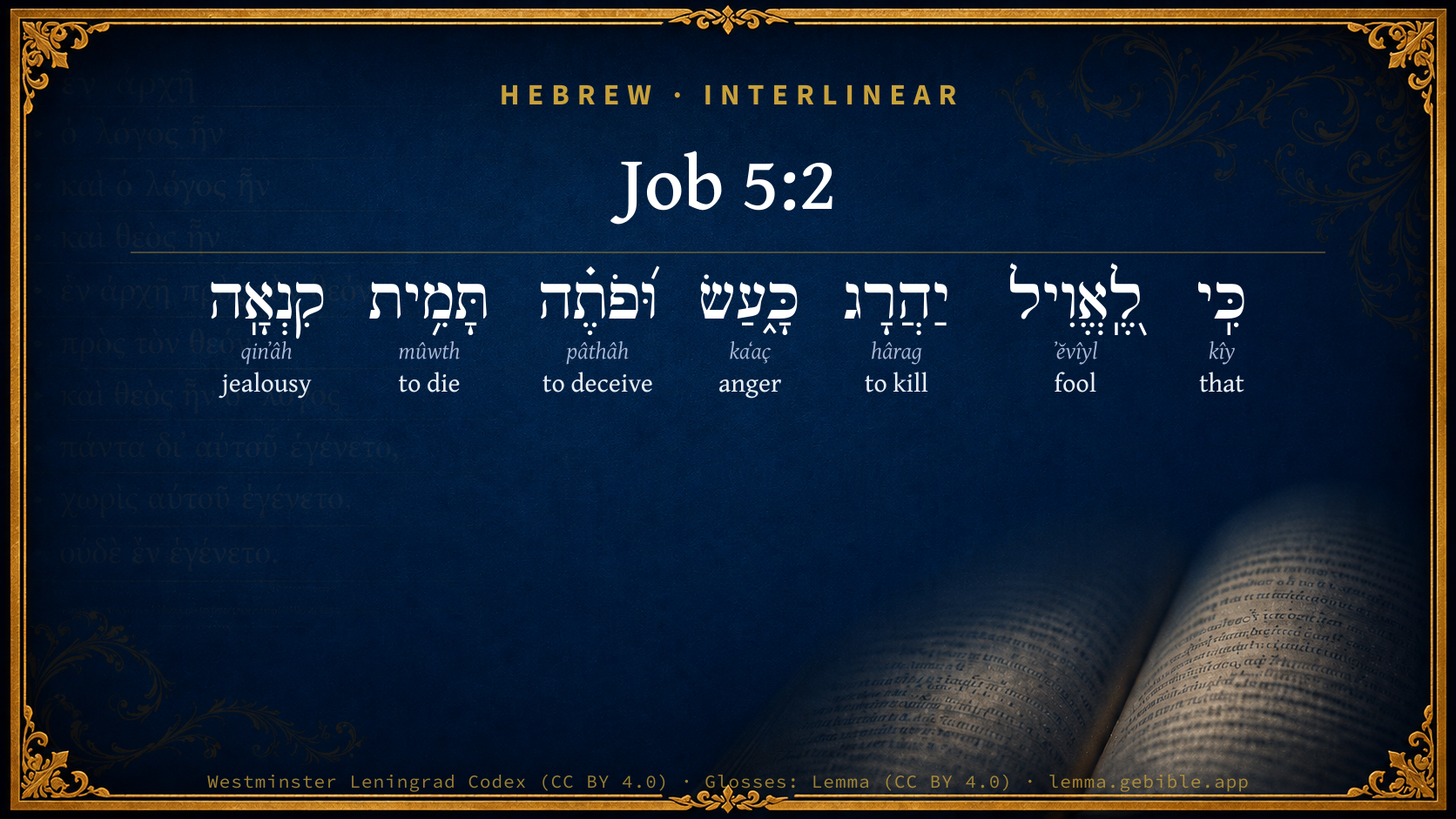
Job 5:2

Hebrew (Westminster Leningrad Codex) Job 5:2 appears in the Hebrew Old Testament. The text above is from the Westminster Leningrad Codex. Each word links to its Strong’s number, a concise gloss, and parsing drawn from the Open Scriptures Hebrew Bible morphology. Click any word for its full Brown-Driver-Briggs (BDB) entry.
Download image
Cite this verse

Job 5:2 (World English Bible). Public Domain. Lemma interlinear Bible study tool, https://lemma.gebible.app/v/job/5/2.

Show BibTeX & RIS
BibTeX
RIS
English Translation
For resentment kills the foolish man, And jealousy kills the simple.
World English Bible · Public Domain
Highlights
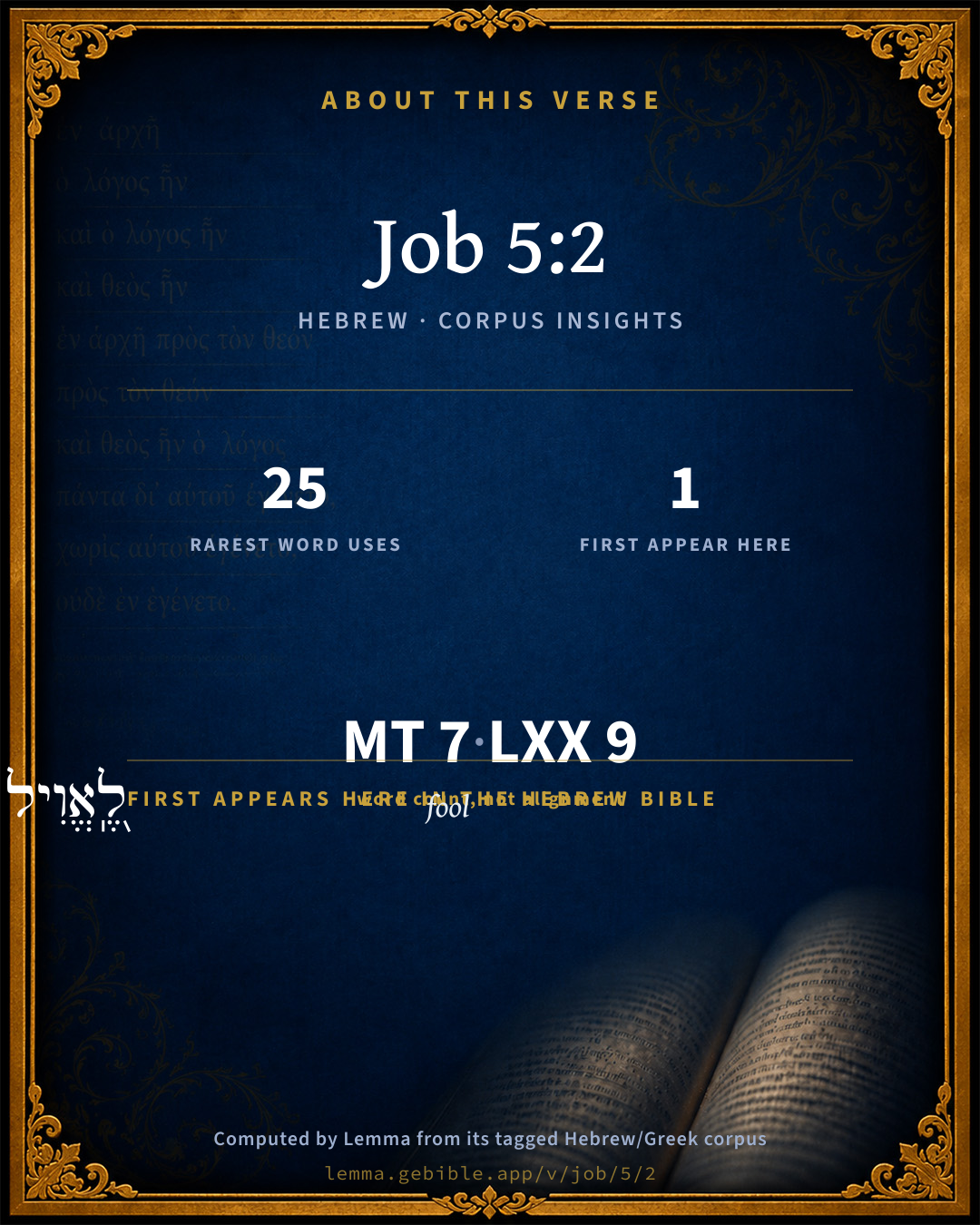
  • 1 first appearance in the Hebrew Bible
Full analysis ↓
Download a study sheet

One document with this verse’s original text, its word-by-word gloss line, the meaning frame, cross-references with their text, attributed commentary, and full source and license credits — printable, and it pastes into notes with its structure intact.

This verse Autodidact and up

Study sheet (.html) Plain text (.txt)

A passage Seminary Student

Up to 50 verses in one chapter. A passage sheet keeps up to 6 commentary sources and 12 cross-references per verse, in the order this page ranks them, and says so on the sheet whenever that leaves anything out. Ask for a single verse and you get the Autodidact verse sheet above.

Everything on this page stays free to read, with no account — the sheet is a download of what is already on screen, not access to it.

Want to remove ads? Support Godless Engineer
Compare translations 3

The same verse in 3 English versions, stacked beneath the original-language interlinear above. Click any original word for its lexicon entry.

Each is an independent rendering of the whole verse — the interlinear is not word-aligned to these translations.

Highlighted words mark where these versions differ — a whole-verse word diff, not a word-by-word alignment.

  • World English Bible Public Domain
    For resentment kills the foolish man, And jealousy kills the simple.
  • King James Version Public Domain
    For wrath killeth the foolish man, and envy slayeth the silly one.
  • unfoldingWord Literal Text CC BY-SA 4.0
    For indignation kills the foolish, and resentment kills the one being simple.

unfoldingWord Literal Text — © unfoldingWord, licensed CC BY-SA 4.0. Word-aligned USFM3 via Door43 (git.door43.org/unfoldingWord/en_ult).

Versions to compare (up to 4)

3 of 4 selected

Show all 18 translations

Every available English version of this verse, each an independent rendering of the whole verse.

  • World English Bible Public Domain
    For resentment kills the foolish man, And jealousy kills the simple.
  • Berean Standard Bible Public Domain
    For resentment kills a fool, and envy slays the simple.
  • Majority Standard Bible Public Domain
    For resentment kills a fool, and envy slays the simple.
  • King James Version Public Domain
    For wrath killeth the foolish man, and envy slayeth the silly one.
  • American Standard Version (1901) Public Domain
    For vexation killeth the foolish man, And jealousy slayeth the silly one.
  • Revised Version (1885) Public Domain
    For vexation killeth the foolish man, and jealousy slayeth the silly one.
  • Geneva Bible (1599) Public Domain
    Doubtlesse anger killeth the foolish, and enuie slayeth the idiote.
  • Douay-Rheims (1899) Public Domain
    Anger indeed killeth the foolish, and envy slayeth the little one.
  • Young's Literal Translation Public Domain
    For provocation slayeth the perverse, And envy putteth to death the simple,
  • Literal Standard Version CC BY-SA 4.0
    For provocation slays the perverse, || And envy puts to death the simple,
  • Unlocked Literal Bible CC BY-SA 4.0
    For anger kills the foolish man; jealousy kills the silly one.
  • unfoldingWord Literal Text CC BY-SA 4.0
    For indignation kills the foolish, and resentment kills the one being simple.
  • Darby Bible Public Domain
    For vexation killeth the foolish man, and envy slayeth the simple.
  • World Messianic Bible Public Domain
    For resentment kills the foolish man, and jealousy kills the simple.
  • Webster's Bible Public Domain
    For wrath killeth the foolish man, and envy slayeth the silly one.
  • Free Bible Version CC BY-SA 4.0
    Surely anger slays the fool and jealousy kills the simple.
  • Bible in Basic English Public Domain
    For wrath is the cause of death to the foolish, and he who has no wisdom comes to his end through passion.
  • JPS Tanakh (1917) Public Domain
    For anger killeth the foolish man, and envy slayeth the silly one.

Literal Standard Version (2020), Covenant Press — licensed CC BY-SA 4.0. Text via the HelloAO Bible API (eBible.org). Unlocked Literal Bible (unfoldingWord) — licensed CC BY-SA 4.0. Text via the HelloAO Bible API (eBible.org). unfoldingWord Literal Text — © unfoldingWord, licensed CC BY-SA 4.0. Word-aligned USFM3 via Door43 (git.door43.org/unfoldingWord/en_ult). Free Bible Version, Dr. Jonathan Gallagher — licensed CC BY-SA 4.0. Text via the HelloAO Bible API (eBible.org).

Word by word

More ways to search: Search by grammar → Find every occurrence → Compare this word →

Practice this passage: Drill this verse → Learn its vocabulary →

About this verse

These counts appear in no published source. They are computed here, from the morphology-tagged text and Lemma’s own curated glosses. What Lemma adds →

7
words
7
distinct lemmas
Wisdom
section

Notable vocabulary

The rarest word here is כָּ֑עַשׂ anger H3708 — appearing just 25 times in the whole Hebrew Bible.

First appearance in Scripture

This word makes its first canonical appearance in the Hebrew Bible here:

  • לֶֽ֭אֱוִיל fool H191

Shared distinctive vocabulary

כָּ֑עַשׂ anger H3708 occurs in 25 verses of the Hebrew Bible. Also found in:

Grammatical profile

  • 3 verbs
  • 2 nouns
  • 1 adjective
  • 1 conjunction

Verb forms

  • יַהֲרָג Qal · Imperfect
  • וּ֝פֹתֶ֗ה Qal · Participle Active
  • תָּמִ֥ית Hiphil · Imperfect

Hebrew & Septuagint length

In English translation the verse runs 11 words from the Hebrew and 14 from the Septuagint (LXX English) — closely comparable.

A rough comparison of the two English renderings, which tokenize alike — not a word-level alignment.

Word counts can differ between the Hebrew and the Greek without any difference in meaning — e.g. the Hebrew direct-object marker אֵת has no separate Greek word, and Greek often adds the article ὁ.

In the original languages it is 7 Hebrew tokens and 9 Greek tokens — but the two are counted differently (Hebrew bundles its prefixes and suffixes into one token; the Greek is in lemma form), so that isn’t a like-for-like length.

Cross-references

15

Topical passages linked to Job 5:2 in the Treasury of Scripture Knowledge — connected by theme and wording, ordered by reader-vote popularity; previews shown in the World English Bible.

  • Ecclesiastes 7:9 Don't be hasty in your spirit to be angry, for anger rests in the bosom of fools.
  • Genesis 30:1 When Rachel saw that she bore Jacob no children, Rachel envied her sister. She said to Jacob, "Give me children, or else I will die."
  • 1 Samuel 18:8–9 Saul was very angry, and this saying displeased him; and he said, They have ascribed to David ten thousands, and to me they have ascribed but thousands: and what can he have more but the kingdom?
  • Job 18:4 You who tear yourself in your anger, Shall the earth be forsaken for you? Or shall the rock be removed out of its place?
  • Psalms 14:1 The fool has said in his heart, "There is no God." They are corrupt. They have done abominable works. There is none who does good.
  • Psalms 75:4 I said to the arrogant, "Don't boast;" To the wicked, "Don't lift up the horn.
  • Psalms 92:6 A senseless man doesn't know, Neither does a fool understand this:
  • Psalms 107:17 Fools are afflicted because of their disobedience, And because of their iniquities.
  • Proverbs 12:16 A fool shows his annoyance the same day, But one who overlooks an insult is prudent.
  • Hosea 7:11 "Ephraim is like an easily deceived dove, without understanding. They call to Egypt. They go to Assyria.
  • Romans 2:8 but to those who are self-seeking, and don't obey the truth, but obey unrighteousness, will be wrath and indignation,
  • Proverbs 1:22–23 "How long, you simple ones, will you love simplicity? How long will mockers delight themselves in mockery, And fools hate knowledge?
  • Jonah 4:9 God said to Jonah, "Is it right for you to be angry about the vine?" He said, "I am right to be angry, even to death."
  • 2 Timothy 3:6 For of these are those who creep into houses, and take captive gullible women loaded down with sins, led away by various lusts,
  • Proverbs 8:5 You simple, understand prudence. You fools, be of an understanding heart.

Cross-references courtesy of OpenBible.info (CC BY 4.0).

Hebrew and Greek witnesses Masoretic Hebrew ↔ Greek Septuagint

The same verse in the two great witnesses to the Old Testament, shown verse-for-verse.

These are two independent witnesses, not word-aligned to each other, and the Septuagint is shown in lemma (dictionary) form.

Hebrew Job 5:2 Masoretic · Westminster Leningrad Codex

כִּֽי לֶֽ֭אֱוִיל יַהֲרָג כָּ֑עַשׂ וּ֝פֹתֶ֗ה תָּמִ֥ית קִנְאָֽה

For resentment kills the foolish man, And jealousy kills the simple.

World English Bible · Public Domain

Greek LXX Job 5:2 Septuagint · lemma form

καί γάρ ἄφρων ἀνααἱρέω ὀργή πλανάω δέ θανατόω ζῆλος

For wrath destroys the foolish one, and envy slays him that has gone astray.

LXX2012 (modern English Septuagint) · Public Domain

On this verse, Albert Barnes' Notes on the Bible discusses the Septuagint’s reading. Read the note in Commentary ↓

Hebrew: Westminster Leningrad Codex (CC BY 4.0). Greek: Septuagint (public domain); English from LXX2012 (modern English Septuagint) (Public Domain). How the Septuagint differs from the Hebrew →

Commentary

Notes on Job 5:2 from classic Christian and Jewish commentators (each source and its license shown beneath its notes). The classic Christian expositions comment on the surrounding passage and are grouped to its opening verse, so a note may address several verses; the Jewish commentaries on the Tanakh (Rashi and others) are per-verse, so they appear only where the commentator wrote on this verse.

Lemma curates 59 commentaries, every one of them public domain or Creative Commons licensed, each selected and text-cleaned for this edition rather than reprinted as found. About our sources →

Trapp's Complete Commentary

John Trapp

Job 5:2 For wrath killeth the foolish man, and envy slayeth the silly one.

Ver. 2. For wrath killeth the foolish man] Such as thou art, Job; hot and hasty, pettish and passionate, fretting thyself to do evil, and so provoking God to fall foul upon thee as a just object of his wrath, to thine utter ruin, without repentance. Surely, with the froward God will show himself froward, Psa 18:26. Neither hath ever any one hardened himself against the Lord and prospered, Job 9:4. For what reason? he is wise in heart, and mighty in strength, as it is there, every way able to overly master an adversary: if he but turn his own passions loose upon him, such as are wrath and envy, they will soon dispatch him. How many are there who, like sullen birds in a cage, beat themselves to death! Did not Bajazet do so? and was Diodorus any wiser (Laert. lib. 2)? or Homer, who died for anger that they could not resolve certain questions put unto them? or Terence, who drowned himself for grief, that he had lost certain comedies that he had composed? We read of some, that, out of discontent, they turned atheists, as Diagoras, Lucian, Porphyry, &c.; and of others, that, missing of bishoprics, or other church preferments, they turned heretics in sui solatium: were not these great sinners against their own souls, like the angry bee, who, to be revenged, loseth her sting, and soon after her life? Died they not like fools indeed, that died of the sullens, and so were deeply guilty of suicide? especially if their wrath were bent against God, if they howl against heaven; such are at once twice slain; slain with the wrath of God, and with their own.

And envy slayeth the silly one] Him that is under the power of his passions, et minima afflictione ab officio abducitur, saith Mercer, and is turned off from duty by every light affliction; such a one doth envy at another man’s prosperity, Aγηνορια δε μιν εκτα (De Ajace, Homer). It is the same with wrath, nisi quod vehementius est, but that it is somewhat worse, saith the same author, as being a most quick sighted and sharp fanged malignity. Hence that of Solomon, Wrath is cruel, and anger outrageous; but who can stand before envy? Pro 27:4. It is the rottenness of the bones, Pro 14:30. And like the serpent porphyrius, it drinks the most part of its own venom. {See Trapp on "Pro 14:30"}

John Trapp, A Commentary or Exposition upon All the Books of the Old and New Testament (1647–1656) — public domain. Text from a community e-Sword module.

The Biblical Illustrator

Joseph S. Exell

Job_5:2

And envy slayeth the silly one.

--Plutarch says of human passions that they are not evil in themselves, but good affections, which nature has furnished us withal, for great and noble uses. Right, reason, wisdom, and discretion ought to rule; but all our powers and passions have their proper place, and they follow the resolution of our judgment, and exert themselves so far as reason shall direct. Were this order well observed, how blest, how happy, should we be! But how shamefully do we invert the order of our nature! If brutes could understand, they would rejoice in their condition of necessity, and despise our estate of liberty and reason, when they observe how fatally we abuse them. By indulging our passions we destroy our happiness. Eliphaz insults this holy sufferer Job, and would have him believe that he was this malicious man whose vice had killed him, and this envious man whose spite had slain him. Still, apart from Job, the maxim of the text remains a truth,--Envy slayeth the silly one.

I. Explain the vice of envy. When may a man be said to be of an envious mind? Envy is a regret of mind, or an inward trouble at the prosperity of another. There are other vices, as ambition, malice, pride, that carry a resemblance of envy, and are related to it; but they either proceed from a different principle, or terminate in some particular object. They are confined and limited, but envy is indefinite. The principle, the formal reason of this singular vice of envy is, a repining, a gnawing, a trouble in the mind, that any man should prosper. It is more or less predominant and rancorous according to the tempers of men and the indulgence that it finds. Sometimes it appears without disguise; the passion of the envious overcomes him. Sometimes you may see it in a mans very gratulations; you may discern his envy in his most kind expressions. Sometimes he vents his angry tumour in a pleasing narration of all the evil, or the darker part, of your condition. Sometimes his envy bubbles out in vain insinuations of his own deserts. Sometimes it lurks in a vain pretence of self-denial, of a mortified temper, and of a contempt of the world. Sometimes they throw their envy upon their spleen, and then they think they may vent it freely, and without reflection upon themselves. Sometimes it appears under a cloak of piety and religion. And envy will express itself, as occasion offers, in rapine, violence, and murder.

II. The truth of his character. Or how justly it is said of an envious man, that he is a silly one. His folly is extreme, apparent, and indisputable. Wisdom consists in three particulars. In a perfect knowledge of our happiness, or what is proper for us to pursue, and what to shun. In a right understanding of the fittest means, whereby we may attain the good and avoid the evil. In a skilful application of those means to their ends, that they may operate the most effectually towards the bringing our designs to pass. How folly is directly opposite to wisdom. A fool is one whose understanding is prejudiced, whose judgment is not free; who is governed by his passions, drawn into false opinions, wild, unreasonable ends, and destructive measures. But such a silly one as this is, is that of the text; he endures and cherishes a vice that blinds his reason, and puts him out of all possibility of being happy. An envious man is a common nuisance, that everyone is offended with, and no man can endure. Silly man; while he designs to hurt his neighbour, he destroys himself. His spite and indignation make him overshoot all modest bounds. There is such a complication of evil qualities in envy and detraction; of curiosity, conceit, and pride; of meddling, judging, and malicious censure, as makes the guilty nauseous to all. No man can be happy but in the way of his nature. And therefore he that will grasp at that which is out of his line, he that must have what he lists, and will have all things go according to his mind, or will be angry, is sure to be always miserable. He that does not consider his condition simply, as it is in itself, but with relation and respect to other persons, shall never be easy while he lives.

III. The fatal effects of this foolish vice. It destroys him.

1. It affects his body. Envy, peevishness, and discontent, ferment and sour the blood, precipitate the motion of the spirits, urge outrageous passions, fill the mind with angry thoughts, hinder rest, destroy appetite, take away all enjoyment, breed grief and melancholy, and end in a sickly, livid look, in lassitude, consumption, and despair.

2. It vitiates his mind, and destroys the moral life. If envy divests a man of his virtue and his reason, it must of necessity destroy his soul too.

IV. The methods of recovery.

1. He that would be free from envy must endeavour to deserve, as well as may be, both of God and man. True virtue gives a man an humble opinion of himself; acquaints him with his own defects, or what he is not, as well as what he is.

2. You must bring your mind to a good opinion of your own condition. He that would be easy in his mind must govern his desires, and make the best of what he has.

3. You must wean your affections from the world, and learn to value it at no higher a rate than it deserves. What then remains but that we endeavour to subdue our passions, to master our spirits, and to live according to reason in the world. (J. Lambe, D. D.)

Wrath and envy

I. We have wrath. Notice--

1. Its nature. Wrath is not comely, but it is sometimes useful. A man who never knows anger is in nine case out of ten a colourless being who has neither energy nor brilliance nor power. God is angry. The apostle implies that it may be indulged in without sin. But there are extremes. It may betoken an ungoverned disposition; it may indicate a cruel, passionate, vindictive spirit. It may show a hasty, thoughtless, impetuous, unbalanced character. Apart from this, unnecessary wrath is disagreeable and unpleasant to all. Its habitual indulgence alienates all good. This brings us to note--

2. Its consequence--Wrath killeth the foolish man. How does it kill? It killeth the best feelings. It stifles all sense of justice, right, caution, honour. It checks the best impulses and engenders cruelty. It killeth peace and happiness. How many an after-pang it produces, how bitter the divisions, the heart-burnings, the evil it causes! It filleth the body itself. Instances are not uncommon of life being forfeited in a fit of anger. It undermines the health and, even if it has no more effect, creates a morose, peevish, miserable disposition.

II. Envy. The word translated envy may mean indignation. The two are only divided one from another by a very narrow line. Envy is an evil indignation with another because he happens to be better off than ourselves. We are told that envy slayeth the silly man. Notice how this is the case--

(1) It weareth away his peace. Look at Ahab envying the vineyard of Naboth. For desire the covetous man fretteth away his life.

(2) It recoils with fatal consequences. It causes deadly results. It leads to the commission of crimes, which bring deadly punishments. Envy is the father of murder. It urged on Cain to put his brother to death. Hence it causeth the slaying of those who give way to it. One word on the description of the characters here spoken of. They are called foolish and silly. What apt and suggestive names for those who give way to the influence of such injurious and pernicious passions, as they afterwards find to their own injury and loss! The name applied to those who refuse to obey the dictates of Divine wisdom is fools. (Homilist.)

The Biblical Illustrator, edited by Joseph S. Exell (c. 1880s–1900s) — public domain. Text from a community e-Sword module.

Joseph Benson's Commentary

Job 5:2. For wrath killeth the foolish man, &c. — That is, say some, a man’s wrath and impatience prey upon his spirit, and so hasten his death. But the meaning seems rather to be, as Bishop Patrick observes, that “God in his anger and indignation destroys the wicked, and such as err from his precepts.” It is probable that Eliphaz intended to distinguish Job by the characters of foolish and silly one, to insinuate that all his misfortunes were owing to his folly and weakness, or to his sins and vices. By the foolish is meant the rash and inconsiderate man, who does not weigh things impartially; and by the silly one, the man who, for want of true wisdom, is soon deceived with false opinions, and with appearances of present things.

Joseph Benson's Commentary on the Old and New Testaments (1811–1818) — public domain. Text from a community e-Sword module.

Geneva Bible (1599)

Geneva Bible translators

Murmuring against God in afflictions increaseth the pain, and uttered man’s folly.

Geneva Bible (1599) marginal notes — public domain. Text via Bolls.life.

Jamieson, Fausset & Brown

Robert Jamieson, A. R. Fausset & David Brown

wrath . . . envy--fretful and passionate complaints, such as Eliphaz charged Job with (Job 4:5; so Pro 14:30). Not, the wrath of God killeth the foolish, and His envy, &c.

Jamieson, Fausset & Brown — Commentary Critical and Explanatory on the Whole Bible (1871) — public domain (CC PDM 1.0). Text via the HelloAO Bible API.

Adam Clarke's Commentary

Verse 2. For wrath killeth the foolish man] Foolish, silly, and simple, are epithets given by Solomon to sinners and transgressors of all kinds. Such parallelisms have afforded a presumptive argument that Solomon was the author of this book. See the preface. Job 1:1 The words of Eliphaz may be considered as a sort of maxim, which the wisdom and experience of ages had served to establish; viz., The wrath of God is manifested only against the wicked and impious; and if thou wert not such, God would not thus contend with thee.

Adam Clarke's Commentary on the Bible (1810–1826) — public domain. Text from a community e-Sword/MySword module.

The Cambridge Bible for Schools and Colleges

gen. ed. J. J. S. Perowne

2. Job_5:1 asked, Will any one answer thy complaint? will complaining bring any deliverance? This verse gives the other side—nay, rather, such murmuring betrays a mind “most incorrect to heaven,” and such a fool will by his impatience but bring upon himself increased calamity till he altogether perish.

Nay, rather, the foolish man impatience killeth,

And the silly one his passion slayeth.

The meaning, of course, is not that the fool and silly one vex themselves to death, but that their rebellious impatience and resentment of the chastisements of heaven bring down upon them more grievous chastisement, under which they perish. There are several words for “fool” in the Old Testament. Two characteristics of the fool here spoken of are mentioned: he rejects instruction or correction, Pro_1:7; Pro_12:15; and he openly exhibits his chagrin or angry impatience, Pro_12:16 (ka‘as as here). The last word describes impatient bearing under affliction, or under that which offends, such as an affront. These words of Eliphaz hurt Job deeply, and in the very first sentence of his reply he alludes to them, “Oh that my impatience (ka‘as) were weighed and laid in the balances against my affliction,” ch. Job_6:2. The word in the second half of the verse means properly heat, hence any strong passion, as jealousy, the wild ardour of battle, Isa_42:13, and the like. On the use of “fool” and similar words in a moral sense to denote wicked, that is, without true insight into the ways of God and right feeling towards Heaven, see on ch. Job_2:10.

The Cambridge Bible for Schools and Colleges (gen. ed. J. J. S. Perowne; Cambridge University Press, 1878–1918) — public domain. Text from a community e-Sword module.

John Gill's Exposition

For wrath killeth the foolish man,.... Not one that is an idiot, and destitute of common sense, and has no understanding in things natural and civil; but a wicked man, who has no knowledge of things divine and spiritual, and so foolish; which is the character of every natural man, and of God's people before conversion; and even of some professors, who are foolish virgins, and carry the lamp of a religious profession without the oil of grace; and such an one Eliphaz took Job to be, whom sooner or later the wrath of the Lord, as the Targum interprets it, which is revealed from heaven, and comes down upon the children of disobedience, would consume like devouring fire: or this may be understood of the wrath and passion of such men themselves, which sometimes rises in them to such an height, as that they die in a fit of it; or do those things which bring them to death, either by the hand of God, or by the civil magistrate:

and envy slayeth the silly one; one that is simple and void of understanding, and is easily persuaded and drawn into sin, either by his own heart, or by evil men, or by the temptations of Satan; and in whose heart envy at the prosperity of others dwells, and which insensibly preys upon him, eats up his own spirits, and is rottenness to his bones, and crumbles them into dust, Pro 14:30; or the word may be rendered "jealousy", or "zeal" (q), as it sometimes is, and may signify the jealousy of the Lord, zeal for his own glory, which he sometimes stirs up as a man of war, and which smokes against wicked men, and consumes them as fire, see Isa 42:13; Eliphaz by all this would represent and insinuate that Job was such a man, hot, passionate, and angry with God and his providence, and envious at the prosperity of others, particularly his friends; and so was a foolish and silly man, in whose breast wrath and envy rested, and would be his ruin and destruction, as he was already under slaying and killing providences.

(q) "zelus", Vatablus, Junius & Tremellius, Piscator, Schmidt, Michaelis, Schultens.

John Gill's Exposition of the Whole Bible (1746–1763) — public domain (CC PDM 1.0). Text via the HelloAO Bible API.

Albert Barnes' Notes on the Bible

For wrath killeth the foolish man - That is, the wrath of God. The word foolish here is used as synonymous with wicked, because wickedness is supreme folly. The general proposition here is, that the wicked are cut off, and that they are overtaken with heavy calamities in this life. In proof of this, Eliphaz appeals in the following verses to his own observation: The implied inference is, that Job, having had all his possessions taken away, and having been overwhelmed with unspeakably great personal calamities, was to be regarded as having been a great sinner. Some suppose, however, that the word “wrath” here relates to the indignation or the repining of the individual himself, and that the reference is to the fact that such wrath or repining preys upon the spirit, and draws down the divine vengeance. This is the view of Schultens, and of Noyes. But it seems more probable that Eliphaz means to state the proposition, that the wrath of God burns against the wicked, and that the following verses are an illustration of this sentiment, derived from his own observation.

And envy - Margin, “indignation.” Jerome, invidia, envy. Septuagint ζῆλος zēlos. Castellio, severitas ac vehementia. The Hebrew word קנאה qı̂n'âh means jealousy, envy, ardor, zeal. It may be applied to any strong affection of the mind; any fervent, glowing, and burning emotion. Gesenius supposes it means here envy, as excited by the prosperity of others. To me it seems that the connection requires us to understand it of wrath, or indignation, as in Deu 29:20; Psa 79:5. As applied to God, it often means his jealousy, or his anger, when the affections of people are placed on other objects than himself; Num 25:11; Zep 1:18, et al.

Slayeth the silly one - Good and Noyes render this, “the weak man.” Jerome, parvulum, the little one. The Septuagint, πεπλανημένον peplanēmenon, the erring. Walton, ardelionem, the busy-body. The Hebrew word פתה poteh is from פתה pâthâh, to open, go expand; and hence, the participleis applied to one who opens his lips, or whose mouth is open; that is, a garrulous person, Pro 20:19; and also to one who is open-hearted, frank, ingenuous, unsuspicious; and hence, one who is easily influenced by others, or whose heart may be easily enticed. Thus, it comes to mean one who is simple and foolish. In this sense it is used here, to denote one who is so simple and foolish as to be drawn aside by weak arguments and unfounded opinions. I have no doubt that Eliphaz meant, by insinuation, to apply this to Job, as being a weak-minded man, for having allowed the views which he entertained to make such an impression on his mind, and for having expressed himself as he had done. The proposition is general; but it would be easy to undertand how he intended it to be applied.

Albert Barnes' Notes on the Bible (1834–1885) — public domain. Text from a community e-Sword/MySword module.

Haydock's Catholic Bible Commentary

Foolish and....little, here denote the wicked, as in the book of Proverbs. (Calmet) --- He accuses Job of anger (Menochius) and folly. (Calmet)

George Leo Haydock (1774–1849), Haydock's Catholic Family Bible and Commentary, 1859 edition — public domain. Excludes Psalms (Douay-Rheims chapter numbering differs from Protestant) and Deuterocanonical books (Catholic canon only).

Matthew Poole's English Annotations

Either,

1. The wrath of God; or rather,

2. A man’s own wrath, fretting, and impatience, and indignation; which kills men, partly, naturally, as it preys upon a man’s spirit, and wasteth him inwardly, and so hastens his death, of which see Pro 14:30; 17:22; partly, morally, as it prompts him to those rash, and furious, and wicked actions which may procure his death; and partly, meritoriously, as it provoketh God to cut him off, and to bring upon him those further and severe strokes which he mentions in the following words.

The foolish man; either,

1. The rash and inconsiderate man, who doth not ponder things impartially; but, like a man mad, rageth against God, and torments himself and all that hear him. Or,

2. The ungodly man, who is frequently called a fool in Scripture language, and who is here opposed to the saints, Job 5:1.

Envy: he taxeth Job, who spoke with great envy at those that were never born, or were in their graves, Job 3:10,12, &c.

The silly one; properly, the man who, for want of true wisdom, is soon deceived with false opinions, and appearances, and present things; which is thy case, O Job. The sense of the verse may be this, I perceive, O Job, that thou art full of envy at wicked men, who at present are, or seem to be, in a happier condition than thou; and of wrath against God, who denies thee that mercy, and loads thee with afflictions; and this shows thee to be a foolish and weak man. For those men, notwithstanding their present prosperity, are doomed to great and certain misery, as it here follows. And so this verse coheres with the following as well as the foregoing verses.

Matthew Poole's English Annotations on the Holy Bible (1683–1685) — public domain. Text from a community e-Sword/MySword module.

Whedon's Commentary on the Bible

Daniel D. Whedon

2. For wrath — כעשׂsignifies also grief. Passionate sorrow, such as Job had indulged, slays the foolish. 2Co_7:10. In the word for, Eliphaz resumes the leading thought of this discourse — men reap what they sow. The passions of a man — for instance, “envy,” (jealousy,) — an envy that even looks wistfully at non-existence, (Job_3:3) — are not only the ruin of a man, but they are the marks of “a fool,” אויל— a word which he repeats in the next verse. “The violence of sin brings no help, but destruction, to itself, which is the nerve of all Eliphaz is saying: Job_5:6-7.” — DAV. At the opening of the debate the implication against Job is of folly, manifesting itself through jealousy and passionate murmurings against God, rather than of crime. The latter is reserved for a direct charge, which the now courteous Eliphaz himself brings against Job at a later stage of the debate; chap. 22. Nevertheless, these words sink deep into the heart of Job, as is seen by his allusion (Job_6:2) to this very word wrath.

Daniel D. Whedon (gen. ed.), Commentary on the Old and New Testaments (1874–1909) — public domain. Text from a community e-Sword module.

The Pulpit Commentary

For wrath killeth the foolish man, and envy slayeth the silly one. For "wrath" and "envy "others suggest "vexation" and "impatience" (Lee), or "vexation" and "jealousy" (Revised Version). The connection of thought seems to be, "For thou art quite foolish enough to let thy vexation and impatience prompt thee to such a course, which could only lead to thy destruction." Eliphaz is quite sure that trust in any other beside God, and appeal to any other against God, is utter folly, sinful infatuation, and must.

The Pulpit Commentary (1880–1919), ed. H.D.M. Spence-Jones & Joseph S. Exell — public domain. Text from a community e-Sword module.

John Wesley's Explanatory Notes

Killeth - A man's wrath, and impatience, preys upon his spirit, and so hastens his death; and provokes God to cut him off. The foolish - The rash and inconsiderate man, who does not weigh things impartially. Envy, &c. - I perceive thou art full of envy at wicked men, who seem to be in a happier condition than thou, and of wrath against God; and this shews thee to be a foolish and weak man. For those men, notwithstanding their present prosperity, are doomed to great and certain misery. I have myself seen the proof of this.

John Wesley, Explanatory Notes Upon the Whole Bible (1754–1765) — public domain. Text via the GEBible commentary corpus.

Rashi

Rabbi Shlomo Yitzchaki (Rashi)

a fool like you, anger will kill him, for had you remained silent, perhaps the Divine standard of clemency would return upon you.

wrath That is anger and fury, as in (Deut. 32:21), “They have provoked Me (קנאוני) to wrath.”

Rashi on the Tanakh — English translations: “The Judaica Press complete Tanach with Rashi, translated by A. J. Rosenberg” (CC BY 4.0); “Pentateuch with Rashi's commentary by M. Rosenbaum and A.M. Silbermann, 1929-1934” (public domain); “The Metsudah Tanach series, Lakewood, N.J” (CC BY 4.0); and “The Book of Joshua, Metsudah Publications, 1997” (CC BY 4.0). Text via Sefaria.

Lesson kit

Teaching starters — assembled from the data on this page, not authored interpretation. Every prompt links to the verse data it draws on. Edit before teaching.

Job, in the Wisdom, opens this verse with 7 words (7 distinct Hebrew lemmas). Its most distinctive word is kaʻaç (“anger”). A historical commentator’s framing appears above. Read the whole chapter for the surrounding context.

Discussion questions

  1. How does “anger” (kaʻaç) shape what this verse is saying?
  2. The word “fool” first appears here in Scripture. What is being introduced at this debut?
  3. Deuteronomy 32:19 shares the word «anger» with this verse. How do the two illuminate each other?
  4. These translations render this verse differently; the difference is in the English rendering, not the original. What questions does that raise?
  5. The verb «יַהֲרָג» is Qal Imperfect. How does its form color the action?
  6. Reading how Trapp's Complete Commentary and The Biblical Illustrator read this verse, where do the two commentators agree and where do they part?

Things to notice

Reading settings

Reading text

Shown beneath each verse's original-language words.

Old Testament
Old Testament edition

Read the OT as the Masoretic Hebrew (MT) or the Greek Septuagint (LXX).

English shown for the Greek Septuagint (in the Hebrew ↔ Greek comparison).

Comparing translations? Open the Compare panel on any verse page to stack up to four side by side.