
1 Kings 11:24

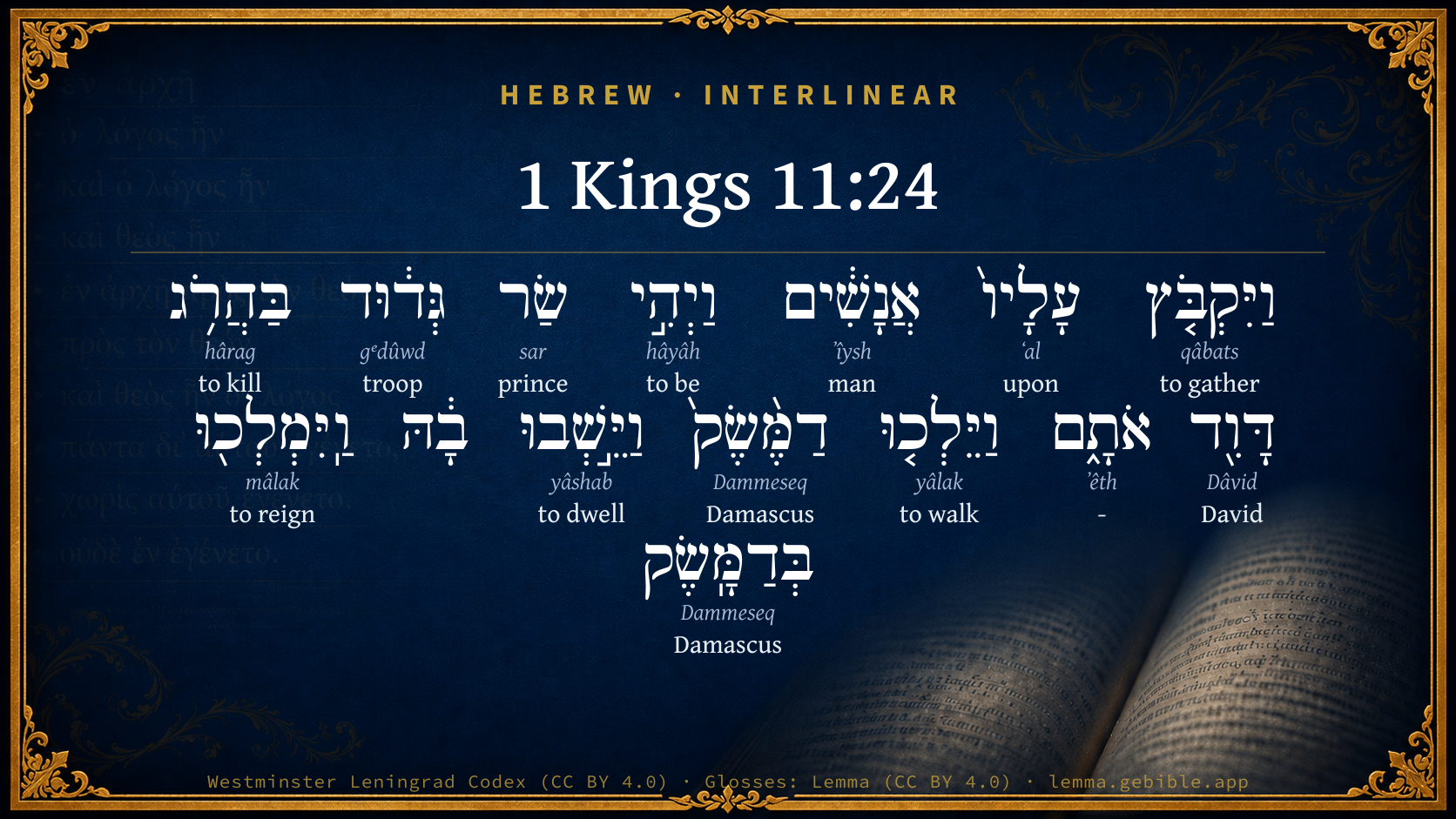
Hebrew (Westminster Leningrad Codex) 1 Kings 11:24 appears in the Hebrew Old Testament. The text above is from the Westminster Leningrad Codex. Each word links to its Strong’s number, a concise gloss, and parsing drawn from the Open Scriptures Hebrew Bible morphology. Click any word for its full Brown-Driver-Briggs (BDB) entry.
Download image
Cite this verse

1 Kings 11:24 (World English Bible). Public Domain. Lemma interlinear Bible study tool, https://lemma.gebible.app/v/1-kings/11/24.

Show BibTeX & RIS
BibTeX
RIS
English Translation
He gathered men to him, and became captain over a troop, when David killed them [of Zobah]: and they went to Damascus, and lived therein, and reigned in Damascus.
World English Bible · Public Domain
Download a study sheet

One document with this verse’s original text, its word-by-word gloss line, the meaning frame, cross-references with their text, attributed commentary, and full source and license credits — printable, and it pastes into notes with its structure intact.

This verse Autodidact and up

Study sheet (.html) Plain text (.txt)

A passage Seminary Student

Up to 50 verses in one chapter. A passage sheet keeps up to 6 commentary sources and 12 cross-references per verse, in the order this page ranks them, and says so on the sheet whenever that leaves anything out. Ask for a single verse and you get the Autodidact verse sheet above.

Everything on this page stays free to read, with no account — the sheet is a download of what is already on screen, not access to it.

Want to remove ads? Support Godless Engineer
Compare translations 3

The same verse in 3 English versions, stacked beneath the original-language interlinear above. Click any original word for its lexicon entry.

Each is an independent rendering of the whole verse — the interlinear is not word-aligned to these translations.

Highlighted words mark where these versions differ — a whole-verse word diff, not a word-by-word alignment.

  • World English Bible Public Domain
    He gathered men to him, and became captain over a troop, when David killed them [of Zobah]: and they went to Damascus, and lived therein, and reigned in Damascus.
  • King James Version Public Domain
    And he gathered men unto him, and became captain over a band, when David slew them of Zobah: and they went to Damascus, and dwelt therein, and reigned in Damascus.
  • unfoldingWord Literal Text CC BY-SA 4.0
    And he gathered men to himself, and he became the commander of a raiding band when David killed them. And they went Damascus, and they dwelled in it and they reigned in Damascus.

unfoldingWord Literal Text — © unfoldingWord, licensed CC BY-SA 4.0. Word-aligned USFM3 via Door43 (git.door43.org/unfoldingWord/en_ult).

Versions to compare (up to 4)

3 of 4 selected

Show all 18 translations

Every available English version of this verse, each an independent rendering of the whole verse.

  • World English Bible Public Domain
    He gathered men to him, and became captain over a troop, when David killed them [of Zobah]: and they went to Damascus, and lived therein, and reigned in Damascus.
  • Berean Standard Bible Public Domain
    and had gathered men to himself. When David killed the Zobaites, Rezon captained a band of raiders and went to Damascus, where they settled and gained control.
  • Majority Standard Bible Public Domain
    and had gathered men to himself. When David killed the Zobaites, Rezon captained a band of raiders and went to Damascus, where they settled and gained control.
  • King James Version Public Domain
    And he gathered men unto him, and became captain over a band, when David slew them of Zobah: and they went to Damascus, and dwelt therein, and reigned in Damascus.
  • American Standard Version (1901) Public Domain
    And he gathered men unto him, and became captain over a troop, when David slew them `of Zobah': and they went to Damascus, and dwelt therein, and reigned in Damascus.
  • Revised Version (1885) Public Domain
    And he gathered men unto him, and became captain over a troop, when David slew them of Zobah: and they went to Damascus, and dwelt therein, and reigned in Damascus.
  • Geneva Bible (1599) Public Domain
    And he gathered men vnto him, and had bene captaine ouer the company, when Dauid slew them. And they went to Damascus, and dwelt there, and they made him King in Damascus.
  • Douay-Rheims (1899) Public Domain
    And he gathered men against him, and he became a captain of robbers, when David slew them of Soba: and they went to Damascus, and dwelt there, and they made him king in Damascus.
  • Young's Literal Translation Public Domain
    and gathereth unto himself men, and is head of a troop in David's slaying them, and they go to Damascus, and dwell in it, and reign in Damascus;
  • Literal Standard Version CC BY-SA 4.0
    and gathers men to himself, and is head of a troop in David’s slaying them, and they go to Damascus, and dwell in it, and reign in Damascus;
  • Unlocked Literal Bible CC BY-SA 4.0
    Rezon gathered men to himself and became captain over a small force, when David defeated the men of Zobah. Rezon's men went to Damascus and lived there, and Rezon controlled Damascus.
  • unfoldingWord Literal Text CC BY-SA 4.0
    And he gathered men to himself, and he became the commander of a raiding band when David killed them. And they went Damascus, and they dwelled in it and they reigned in Damascus.
  • Darby Bible Public Domain
    And he collected men to him, and became captain of a band, when David slew them [of Zobah]; and they went to Damascus, and dwelt there, and reigned in Damascus.
  • World Messianic Bible Public Domain
    He gathered men to himself, and became captain over a troop, when David killed them of Zobah. They went to Damascus and lived there, and reigned in Damascus.
  • Webster's Bible Public Domain
    And he gathered men to him, and became captain over a band, when David slew them of Zobah: and they went to Damascus, and dwelt in it, and reigned in Damascus.
  • Free Bible Version CC BY-SA 4.0
    Rezon gathered around him a rebel band, and became their leader. They went and settled in Damascus, where they took over.
  • Bible in Basic English Public Domain
    He got some men together and made himself captain of a band of outlaws; and went to Damascus and became king there.
  • JPS Tanakh (1917) Public Domain
    And he gathered men unto him, and became captain over a troop, when David slew them of Zobah; and they went to Damascus, and dwelt therein, and reigned in Damascus.

Literal Standard Version (2020), Covenant Press — licensed CC BY-SA 4.0. Text via the HelloAO Bible API (eBible.org). Unlocked Literal Bible (unfoldingWord) — licensed CC BY-SA 4.0. Text via the HelloAO Bible API (eBible.org). unfoldingWord Literal Text — © unfoldingWord, licensed CC BY-SA 4.0. Word-aligned USFM3 via Door43 (git.door43.org/unfoldingWord/en_ult). Free Bible Version, Dr. Jonathan Gallagher — licensed CC BY-SA 4.0. Text via the HelloAO Bible API (eBible.org).

Word by word

More ways to search: Search by grammar → Find every occurrence → Compare this word →

Practice this passage: Drill this verse → Learn its vocabulary →

גְּד֔וּד
gᵉdûwd
H1416
“troop”
Noun, Common, Masculine, Singular, Absolute
Part of Speech
Noun
Type
Common
Gender
Masculine
Number
Singular
State
Absolute
Full BDB Definition

Origin: from H1413

TWOT: 313a

a band, troop, marauding band - marauding band, raiding band - troop, band (of divisions of army) - foray, raid
  1. וַיִּקְבֹּ֤ץ qâbats H6908 “and · to gather” Conjunction + Verb, Qal, Sequential Imperfect, 3rd Person, Masculine, Singular
  2. עָלָיו֙ ʻal H5921 “upon · him” Preposition + Suffix, Personal, 3rd Person, Masculine, Singular
  3. אֲנָשִׁ֔ים ʼîysh H376 “men” Noun, Common, Masculine, Plural, Absolute
  4. וַיְהִ֣י hâyâh H1961 “and · to be” Conjunction + Verb, Qal, Sequential Imperfect, 3rd Person, Masculine, Singular
  5. שַׂר sar H8269 “prince of” Noun, Common, Masculine, Singular, Construct
  6. בַּהֲרֹ֥ג hârag H2026 “in/at · to kill” Preposition + Verb, Qal, Infinitive Construct
  7. דָּוִ֖ד Dâvid H1732 “David” Noun, Proper
  8. אֹתָ֑ם ʼêth H853 “- · them” Particle, Direct Object + Suffix, Personal, 3rd Person, Masculine, Plural
  9. וַיֵּלְכ֤וּ yâlak H3212 “and · to walk” Conjunction + Verb, Qal, Sequential Imperfect, 3rd Person, Masculine, Plural
  10. דַמֶּ֨שֶׂק֙ Dammeseq H1834 “Damascus” Noun, Proper
  11. וַיֵּ֣שְׁבוּ yâshab H3427 “and · to dwell” Conjunction + Verb, Qal, Sequential Imperfect, 3rd Person, Masculine, Plural
  12. וַֽיִּמְלְכ֖וּ mâlak H4427 “and · to reign” Conjunction + Verb, Qal, Sequential Imperfect, 3rd Person, Masculine, Plural
  13. בְּדַמָּֽשֶׂק Dammeseq H1834 “in/at · Damascus” Preposition + Noun, Proper

About this verse

These counts appear in no published source. They are computed here, from the morphology-tagged text and Lemma’s own curated glosses. What Lemma adds →

15
words
13
distinct lemmas
Historical
section

Shared distinctive vocabulary

גְּד֔וּד troop H1416 occurs in 29 verses of the Hebrew Bible. Also found in:

Grammatical profile

  • 6 verbs
  • 6 nouns
  • 2 prepositions
  • 1 particle

Verb forms

  • וַיִּקְבֹּ֤ץ Qal · Sequential Imperfect
  • וַיְהִ֣י Qal · Sequential Imperfect
  • בַּהֲרֹ֥ג Qal · Infinitive Construct
  • וַיֵּלְכ֤וּ Qal · Sequential Imperfect
  • וַיֵּ֣שְׁבוּ Qal · Sequential Imperfect
  • וַֽיִּמְלְכ֖וּ Qal · Sequential Imperfect

Repetition

A word recurs within this verse — often emphatic in Hebrew:

  • דַמֶּ֨שֶׂק֙ Damascus H1834 ×2

Cross-references

6

Topical passages linked to 1 Kings 11:24 in the Treasury of Scripture Knowledge — connected by theme and wording, ordered by reader-vote popularity; previews shown in the World English Bible.

  • 2 Samuel 10:8 The children of Ammon came out, and put the battle in array at the entrance of the gate: and the Syrians of Zobah and of Rehob, and the men of Tob and Maacah, were by themselves in the field.
  • 2 Samuel 10:18 The Syrians fled before Israel; and David killed of the Syrians [the men of] seven hundred chariots, and forty thousand horsemen, and struck Shobach the captain of their host, so that he died there.
  • Genesis 14:15 He divided himself against them by night, he and his servants, and struck them, and pursued them to Hobah, which is on the left hand of Damascus.
  • 1 Kings 19:15 Yahweh said to him, Go, return on your way to the wilderness of Damascus: and when you come, you shall anoint Hazael to be king over Syria;
  • 1 Kings 20:34 [Ben Hadad] said to him, The cities which my father took from your father I will restore; and you shall make streets for you in Damascus, as my father made in Samaria. I, [said Ahab], will let you go with this covenant. So he made a covenant with him, and let him go.
  • Acts 9:2 and asked for letters from him to the synagogues of Damascus, that if he found any who were of the Way, whether men or women, he might bring them bound to Jerusalem.

Cross-references courtesy of OpenBible.info (CC BY 4.0).

Hebrew and Greek witnesses Masoretic Hebrew ↔ Greek Septuagint

The same verse in the two great witnesses to the Old Testament, shown verse-for-verse.

These are two independent witnesses, not word-aligned to each other, and the Septuagint is shown in lemma (dictionary) form.

Hebrew 1 Kings 11:24 Masoretic · Westminster Leningrad Codex

וַיִּקְבֹּ֤ץ עָלָיו֙ אֲנָשִׁ֔ים וַיְהִ֣י שַׂר גְּד֔וּד בַּהֲרֹ֥ג דָּוִ֖ד אֹתָ֑ם וַיֵּלְכ֤וּ דַמֶּ֨שֶׂק֙ וַיֵּ֣שְׁבוּ בָ֔הּ וַֽיִּמְלְכ֖וּ בְּדַמָּֽשֶׂק

He gathered men to him, and became captain over a troop, when David killed them [of Zobah]: and they went to Damascus, and lived therein, and reigned in Damascus.

World English Bible · Public Domain

On this verse, The Cambridge Bible for Schools and Colleges discusses the Septuagint’s reading. Read the note in Commentary ↓

Hebrew: Westminster Leningrad Codex (CC BY 4.0). Greek: Septuagint (public domain); English from a public-domain English Septuagint. How the Septuagint differs from the Hebrew →

Targum (Aramaic paraphrase)

1

The Targum is the ancient Jewish Aramaic paraphrase of the Hebrew Scriptures — an interpretive translation, not the Hebrew text itself. Onkelos (literal) and Pseudo-Jonathan (expansive) render the Torah, and Jonathan the Prophets. Coverage is partial: where no permissively-licensed English translation exists for a verse, only the Aramaic is shown. This is verse-level text, not a word-by-word alignment to the Hebrew.

  1. Targum Jonathan Prophets (Joshua–Malachi)
    וּכְנַשׁ עֲלוֹהִי גַבְרִין וַהֲוָה רַב מַשְׁרִיתָא כַּד קְטִיל דָוִד יַתְהוֹן וַאֲזַלוּ לְדַמֶשֶׂק וִיתִיבוּ בָהּ וּמְלַכוּ בְּדַמֶשֶׂק:

    (no public-domain English translation for this verse)

    Targum Jonathan — Aramaic: “Mikraot Gedolot” (public domain). English: “Sefaria Community Translation” (CC0 1.0 (public-domain dedication)); “London "Chaldee Paraphrase," 1871” (public domain). Text via Sefaria.

Commentary

Notes on 1 Kings 11:24 from classic Christian and Jewish commentators (each source and its license shown beneath its notes). The classic Christian expositions comment on the surrounding passage and are grouped to its opening verse, so a note may address several verses; the Jewish commentaries on the Tanakh (Rashi and others) are per-verse, so they appear only where the commentator wrote on this verse.

Lemma curates 59 commentaries, every one of them public domain or Creative Commons licensed, each selected and text-cleaned for this edition rather than reprinted as found. About our sources →

Trapp's Complete Commentary

John Trapp

1Ki 11:24 And he gathered men unto him, and became captain over a band, when David slew them [of Zobah]: and they went to Damascus, and dwelt therein, and reigned in Damascus.

Ver. 24. He gathered men unto him.] He rallied his master’s scattered forces, and therewith, after a while, he thrust out David’s garrison, and reigned in Damascus.

John Trapp, A Commentary or Exposition upon All the Books of the Old and New Testament (1647–1656) — public domain. Text from a community e-Sword module.

Geneva Bible (1599)

Geneva Bible translators

To wit, the men whom he had gathered unto him.

Geneva Bible (1599) marginal notes — public domain. Text via Bolls.life.

Adam Clarke's Commentary

Verse 24. And reigned in Damascus.] Rezon was one of the captains of Hadadezer, whom David defeated. It seems that at this time Rezon escaped with his men; and; having lived, as is supposed, some time by plunder, he seized on Damascus, and reigned there till David took Damascus, when he subdued Syria, and drove out Rezon. But after Solomon's defection from God, Rezon, finding that God had departed from Israel, recovered Damascus; and joining with Hadad, harassed Solomon during the remaining part of his reign. But some think that Hadad and Rezon were the same person.

Adam Clarke's Commentary on the Bible (1810–1826) — public domain. Text from a community e-Sword/MySword module.

Ellicott's Commentary for English Readers

(24) When David slew them of Zobah.—The account of this war is found in 2Sa_8:1-13. The kingdom of Zobah was evidently a powerful state at that time, at war with the Syrian kingdom of Hamath, but holding supremacy over the Syrians of Damascus, and the “Syrians beyond the river” Euphrates; and (as the record shows) accumulating vast treasures of gold, silver, and brass. The establishment of Rezon (and Hadad?) at Damascus must have taken place later; for at the time we find that David “put governors in Damascus,” and reduced its inhabitants to a tributary condition. Possibly there may have been some rising early in the reign of Solomon; for in 2Ch_8:3, we find that Solomon had to “go up against Hamath-zobah,” with which expedition the foundation of Tadmor seems to be connected. But it is probable that the establishment of an independent power in Damaseus dated only from the later days of Solomon.

A Bible Commentary for English Readers, edited by Charles John Ellicott (1878–1897) — public domain. Text from a community e-Sword module.

The Cambridge Bible for Schools and Colleges

gen. ed. J. J. S. Perowne

24. and he gathered men unto him] The LXX. (Alex.) says ‘men were gathered unto him.’ This only indicates different vowel points to the same consonants. But the difference in the sense would point to Rezon as one whom his countrymen regarded as a leader.

and became captain over a band] (R.V. troop). The word is mostly used of martial gatherings, and organized forces, and this is the sense here. Rezon gathered, and trained his followers till they were able to dislodge the troops of Israel and establish themselves in Damascus.

when David slew them of Zobah] The two last words are necessary to complete the sense. It is clear that others beside Rezon fled away. It may have been that Hadadezer was an unpopular king. Out of the fugitives Rezon formed for himself a troop, and awaiting his time, came back and assumed the sovereignty.

and they went to Damascus] i.e. When an opportunity came about of entering into a city, they left what must before have been a wandering life of guerilla-warfare, and settled within walls.

and dwelt therein] Making a permanent settlement, and may have continued some time before Rezon was made king.

and reigned in Damascus] If this verb be correct, the sense is that this band of warriors seized the city, and made themselves in a body lords of the place and its people. But a very slight variation of the text would give the sense ‘they made them a king in D.’ which, of course, the narrative shews to have been Rezon. The Syriac has ‘and Rezon reigned in D.,’ while the Vulgate gives ‘and they made him king in D.’

The Cambridge Bible for Schools and Colleges (gen. ed. J. J. S. Perowne; Cambridge University Press, 1878–1918) — public domain. Text from a community e-Sword module.

John Gill's Exposition

And he was an adversary to Israel all the days of Solomon,.... Not all the days of his life, see Kg1 5:4, but all his days, from his first going into idolatry, to the end of his life:

beside the mischief that Hadad did; and which, whatever it was, was not done till this time; for either, when he got leave from Pharaoh to go into his country, he lay hid there, waiting an opportunity to seize upon it; or by means of Pharaoh he got himself to be king of it, through the permission of Solomon, paying a tribute to him; but when Solomon was grown old, he revolted and refused to pay it, and rebelled against him, and gave him much trouble:

and he abhorred Israel, and reigned over Syria; not Hadad, but Rezon; he had an aversion to them, was a thorn in their side, and gave them much trouble, as well as had them in contempt, and bid them defiance, having made himself not only master of Damascus, but of all Syria.

John Gill's Exposition of the Whole Bible (1746–1763) — public domain (CC PDM 1.0). Text via the HelloAO Bible API.

Albert Barnes' Notes on the Bible

And (they) reigned - A very slight emendation gives the sense, “they made him king at Damascus.”

Albert Barnes' Notes on the Bible (1834–1885) — public domain. Text from a community e-Sword/MySword module.

Haydock's Catholic Bible Commentary

Robbers, or (Hebrew and Septuagint) "a band" with whom he made depredations. (Haydock) --- Damascus, with David’s consent, on their admitting a garrison, (2 Kings viii. 6,) and consenting to pay tribute; (Menochius) or Razon might make himself master of this place, only after the apostacy of Solomon. His successors became very formidable to the Jews, particularly Razin, (4 Kings xv., and xvi.) who was slain by Theglathphalassar, 4 Kings v. 9. (Calmet)

George Leo Haydock (1774–1849), Haydock's Catholic Family Bible and Commentary, 1859 edition — public domain. Excludes Psalms (Douay-Rheims chapter numbering differs from Protestant) and Deuterocanonical books (Catholic canon only).

Matthew Poole's English Annotations

Over a band, to wit, of soldiers, who fled and dispersed themselves upon that defeat, 2Sa 10, and others who readily joined themselves with them, and lived by robbery, as many Arabians did.

They went to Damascus, when they were increased in number and strength, and took it, whilst Solomon was wallowing in luxury, and grown effeminate.

Matthew Poole's English Annotations on the Holy Bible (1683–1685) — public domain. Text from a community e-Sword/MySword module.

Whedon's Commentary on the Bible

Daniel D. Whedon

24. He gathered men — Partly, perhaps, from among the fugitives that escaped the slaughter of David, and partly from disaffected portions of the kingdom.

Went to Damascus — This was probably towards the close of David’s life, when the garrisons which were put in that section had become thinned or called away, and there was nothing at Damascus to raise any considerable opposition to Rezon and his band, and so he dwelt and reigned there.

Daniel D. Whedon (gen. ed.), Commentary on the Old and New Testaments (1874–1909) — public domain. Text from a community e-Sword module.

The Pulpit Commentary

And he gathered men unto him and became captain over a band either of rebels before or of fugitives after the defeat, when David slew them of Zobah Of Zobah, not in Hebrews "Them" must mean the Syrian army: and they went to Damascus, and dwelt therein As David put garrisons in Syria of Damascus, (2Sa_8:6) this must have been some time after the defeat of the Syrians. But Keil argues that it cannot have been in the middle or later part of Solomon"s reign, inasmuch as Solomon must have been lord of Damascus, or he could not have built Palmyra. But it is not so incontrovertibly settled that Solomon did build Palmyra (see on 1Ki_9:18) as to make this argument of much weight. And even if it were, we might still fix the reign of Rezon at an earlier period of Solomon"s sway. See below, and reigned. i.e., the band or troop of Rezon, either in the confusion of the defeat, or in some subsequent time of anarchy, took possession of Damascus, and he, it would seem, usurped the crown. The word "reigned," however (plural), is somewhat remarkable. It may perhaps be accounted for by the plurals which precede it. The insertion of one "yod" (wkylmyw for wklmyw) gives the sense they made him king," which would certainly be preferable, if the emendation were not purely conjectural.

The Pulpit Commentary (1880–1919), ed. H.D.M. Spence-Jones & Joseph S. Exell — public domain. Text from a community e-Sword module.

John Wesley's Explanatory Notes

A band - Of soldiers, who fled upon that defeat, 2 Sam. x, 18, and others who readily joined them, and lived by robbery; as many Arabians did. Damascus - And took it, whilst Solomon was wallowing in luxury.

John Wesley, Explanatory Notes Upon the Whole Bible (1754–1765) — public domain. Text via the GEBible commentary corpus.

Lesson kit

Teaching starters — assembled from the data on this page, not authored interpretation. Every prompt links to the verse data it draws on. Edit before teaching.

1 Kings, in the Historical, opens this verse with 15 words (13 distinct Hebrew lemmas). Its most distinctive word is gᵉdûwd (“troop”). A historical commentator’s framing appears above. Read the whole chapter for the surrounding context.

Discussion questions

  1. The word gᵉdûwd carries the sense “troop.” How does it shape the verse?
  2. How does Genesis 49:19, which shares the word «troop», read alongside this verse?
  3. What does the repetition of “Damascus” (2× in this one verse) do in this verse?
  4. These translations render this verse differently; the difference is in the English rendering, not the original. What questions does that raise?
  5. «וַיִּקְבֹּ֤ץ» is a Qal Sequential Imperfect verb. How does that grammatical form shape the action described?
  6. Compare how Trapp's Complete Commentary and Geneva Bible (1599) read this verse. Where do they agree or differ?

Things to notice

Reading settings

Reading text

Shown beneath each verse's original-language words.

Old Testament
Old Testament edition

Read the OT as the Masoretic Hebrew (MT) or the Greek Septuagint (LXX).

English shown for the Greek Septuagint (in the Hebrew ↔ Greek comparison).

Comparing translations? Open the Compare panel on any verse page to stack up to four side by side.