
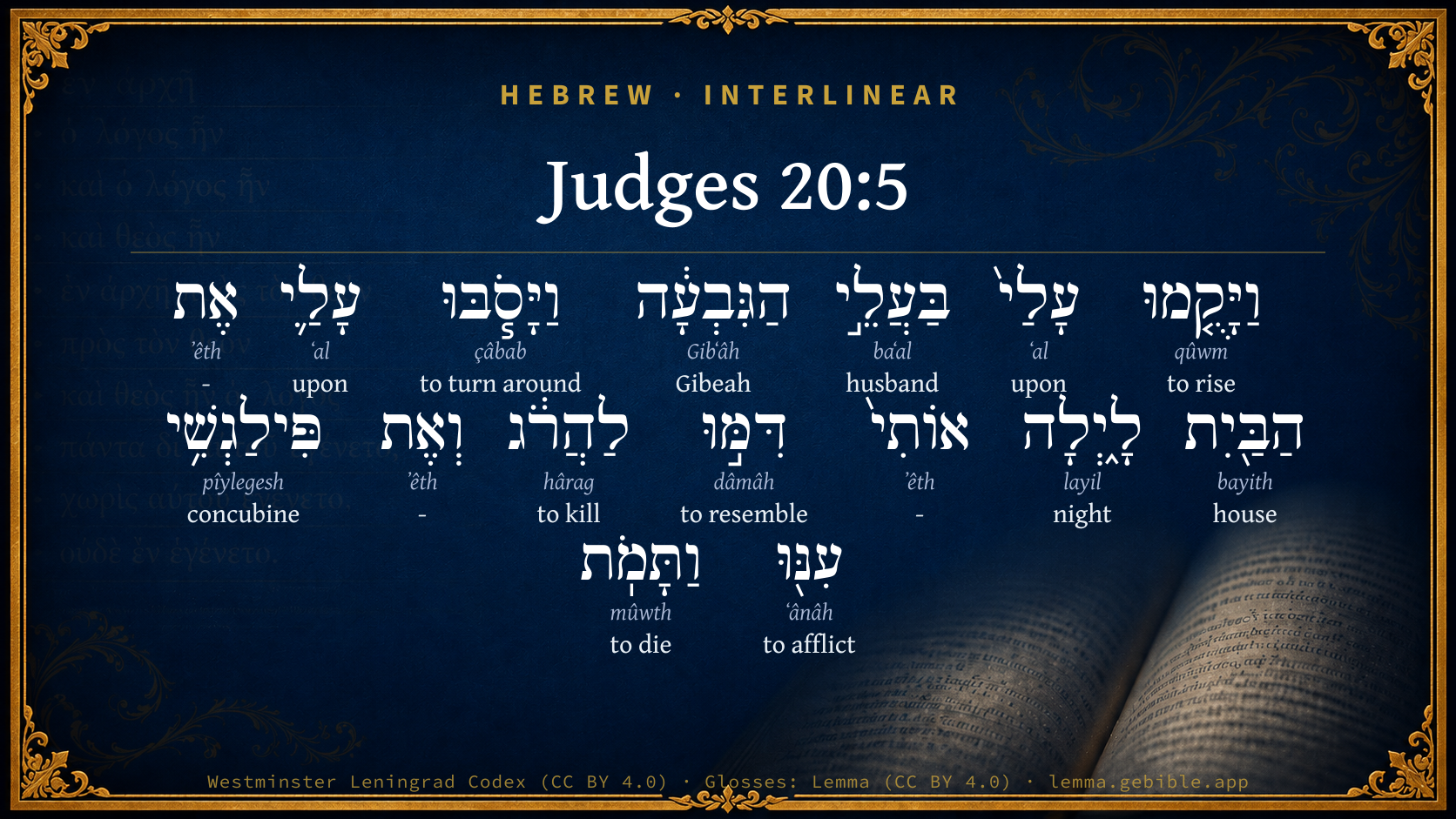
Judges 20:5

Hebrew (Westminster Leningrad Codex) Judges 20:5 appears in the Hebrew Old Testament. The text above is from the Westminster Leningrad Codex. Each word links to its Strong’s number, a concise gloss, and parsing drawn from the Open Scriptures Hebrew Bible morphology. Click any word for its full Brown-Driver-Briggs (BDB) entry.
Download image
Cite this verse

Judges 20:5 (World English Bible). Public Domain. Lemma interlinear Bible study tool, https://lemma.gebible.app/v/judges/20/5.

Show BibTeX & RIS
BibTeX
RIS
English Translation
The men of Gibeah rose against me, and beset the house round about me by night; me they thought to have slain, and my concubine they forced, and she is dead.
World English Bible · Public Domain
Download a study sheet

One document with this verse’s original text, its word-by-word gloss line, the meaning frame, cross-references with their text, attributed commentary, and full source and license credits — printable, and it pastes into notes with its structure intact.

This verse Autodidact and up

Study sheet (.html) Plain text (.txt)

A passage Seminary Student

Up to 50 verses in one chapter. A passage sheet keeps up to 6 commentary sources and 12 cross-references per verse, in the order this page ranks them, and says so on the sheet whenever that leaves anything out. Ask for a single verse and you get the Autodidact verse sheet above.

Everything on this page stays free to read, with no account — the sheet is a download of what is already on screen, not access to it.

Want to remove ads? Support Godless Engineer
Compare translations 3

The same verse in 3 English versions, stacked beneath the original-language interlinear above. Click any original word for its lexicon entry.

Each is an independent rendering of the whole verse — the interlinear is not word-aligned to these translations.

Highlighted words mark where these versions differ — a whole-verse word diff, not a word-by-word alignment.

  • World English Bible Public Domain
    The men of Gibeah rose against me, and beset the house round about me by night; me they thought to have slain, and my concubine they forced, and she is dead.
  • King James Version Public Domain
    And the men of Gibeah rose against me, and beset the house round about upon me by night, and thought to have slain me: and my concubine have they forced, that she is dead.
  • unfoldingWord Literal Text CC BY-SA 4.0
    And the lords of Gibeah arose against me, and they encircled the house at night against me. Me, they intended to kill, but my concubine, they humbled, and she died.

unfoldingWord Literal Text — © unfoldingWord, licensed CC BY-SA 4.0. Word-aligned USFM3 via Door43 (git.door43.org/unfoldingWord/en_ult).

Versions to compare (up to 4)

3 of 4 selected

Show all 18 translations

Every available English version of this verse, each an independent rendering of the whole verse.

  • World English Bible Public Domain
    The men of Gibeah rose against me, and beset the house round about me by night; me they thought to have slain, and my concubine they forced, and she is dead.
  • Berean Standard Bible Public Domain
    And during the night, the men of Gibeah rose up against me and surrounded the house. They intended to kill me, but they abused my concubine, and she died.
  • Majority Standard Bible Public Domain
    And during the night, the men of Gibeah rose up against me and surrounded the house. They intended to kill me, but they abused my concubine, and she died.
  • King James Version Public Domain
    And the men of Gibeah rose against me, and beset the house round about upon me by night, and thought to have slain me: and my concubine have they forced, that she is dead.
  • American Standard Version (1901) Public Domain
    And the men of Gibeah rose against me, and beset the house round about me by night; me they thought to have slain, and my concubine they forced, and she is dead.
  • Revised Version (1885) Public Domain
    And the men of Gibeah rose against me, and beset the house round about upon me by night; me they thought to have slain, and my concubine they forced, and she is dead.
  • Geneva Bible (1599) Public Domain
    And the men of Gibeah arose against me, and beset the house round about vpon mee by night, thinking to haue slaine me, and haue forced my concubine that she is dead.
  • Douay-Rheims (1899) Public Domain
    And behold the men of that city in the night beset the house wherein I was, intending to kill me, and abused my wife with an incredible fury of lust, so that at last she died.
  • Young's Literal Translation Public Domain
    and rise against me do the masters of Gibeah -- and they go round the house against me by night -- me they thought to slay, and my concubine they have humbled, and she dieth;
  • Literal Standard Version CC BY-SA 4.0
    and the masters of Gibeah rise against me—and they go around the house against me by night—they thought to slay me, and they have humbled my concubine, and she dies;
  • Unlocked Literal Bible CC BY-SA 4.0
    During the night, the leaders of Gibeah attacked me, surrounding the house, intending to kill me. They raped my concubine, and she died.
  • unfoldingWord Literal Text CC BY-SA 4.0
    And the lords of Gibeah arose against me, and they encircled the house at night against me. Me, they intended to kill, but my concubine, they humbled, and she died.
  • Darby Bible Public Domain
    And the men of Gib'e-ah rose against me, and beset the house round about me by night; they meant to kill me, and they ravished my concubine, and she is dead.
  • World Messianic Bible Public Domain
    The men of Gibeah rose against me, and surrounded the house by night. They intended to kill me and they raped my concubine, and she is dead.
  • Webster's Bible Public Domain
    And the men of Gibeah rose against me, and surrounded the house upon me by night, and thought to have slain me: and my concubine have they forced, that she is dead.
  • Free Bible Version CC BY-SA 4.0
    The leaders of Gibeah came to attack me at night. They surrounded the house, intending to kill me. They raped my concubine and she died.
  • Bible in Basic English Public Domain
    And the townsmen of Gibeah came together against me, going round the house on all sides by night; it was their purpose to put me to death, and my servant-wife was violently used by them and is dead.
  • JPS Tanakh (1917) Public Domain
    And the men of Gibeah rose against me, and beset the house round about upon me by night; me they thought to have slain, and my concubine they forced, and she is dead.

Literal Standard Version (2020), Covenant Press — licensed CC BY-SA 4.0. Text via the HelloAO Bible API (eBible.org). Unlocked Literal Bible (unfoldingWord) — licensed CC BY-SA 4.0. Text via the HelloAO Bible API (eBible.org). unfoldingWord Literal Text — © unfoldingWord, licensed CC BY-SA 4.0. Word-aligned USFM3 via Door43 (git.door43.org/unfoldingWord/en_ult). Free Bible Version, Dr. Jonathan Gallagher — licensed CC BY-SA 4.0. Text via the HelloAO Bible API (eBible.org).

Word by word

More ways to search: Search by grammar → Find every occurrence → Compare this word →

Practice this passage: Drill this verse → Learn its vocabulary →

דִּמּ֣וּ
dâmâh
H1819
“to resemble”
Verb, Piel, Perfect, 3rd Person, Common, Plural
Part of Speech
Verb
Stem
Piel
Form
Perfect
Person
3rd Person
Gender
Common
Number
Plural
Full BDB Definition

Origin: a primitive root

TWOT: 437

to be like, resemble - (Qal) to be like, resemble - (Piel) - to liken, compare - to imagine, think - (Hithpael) to make oneself like - (Niphal)
  1. וַיָּקֻ֤מוּ qûwm H6965 “and · to rise” Conjunction + Verb, Qal, Sequential Imperfect, 3rd Person, Masculine, Plural
  2. עָלַי֙ ʻal H5921 “upon · me” Preposition + Suffix, Personal, 1st Person, Common, Singular
  3. בַּעֲלֵ֣י baʻal H1167 “husbands of” Noun, Common, Masculine, Plural, Construct
  4. הַגִּבְעָ֔ה Gibʻâh H1390 “the · Gibeah” Particle, Definite Article + Noun, Proper
  5. וַיָּסֹ֧בּוּ çâbab H5437 “and · to turn around” Conjunction + Verb, Qal, Sequential Imperfect, 3rd Person, Masculine, Plural
  6. עָלַ֛י ʻal H5921 “upon · me” Preposition + Suffix, Personal, 1st Person, Common, Singular
  7. אֶת ʼêth H853 “-” Particle, Direct Object
  8. הַבַּ֖יִת bayith H1004 “the · house” Particle, Definite Article + Noun, Common, Masculine, Singular, Absolute
  9. לָ֑יְלָה layil H3915 “night” Noun, Common, Masculine, Singular, Absolute
  10. אוֹתִי֙ ʼêth H853 “- · me” Particle, Direct Object + Suffix, Personal, 1st Person, Common, Singular
  11. לַהֲרֹ֔ג hârag H2026 “to kill” Preposition + Verb, Qal, Infinitive Construct
  12. וְאֶת ʼêth H853 “and · -” Conjunction + Particle, Direct Object
  13. פִּילַגְשִׁ֥י pîylegesh H6370 “concubine · my” Noun, Common, Feminine, Singular, Construct + Suffix, Personal, 1st Person, Common, Singular
  14. עִנּ֖וּ ʻânâh H6031 “to afflict” Verb, Piel, Perfect, 3rd Person, Common, Plural
  15. וַתָּמֹֽת mûwth H4191 “and · to die” Conjunction + Verb, Qal, Sequential Imperfect, 3rd Person, Feminine, Singular

About this verse

These counts appear in no published source. They are computed here, from the morphology-tagged text and Lemma’s own curated glosses. What Lemma adds →

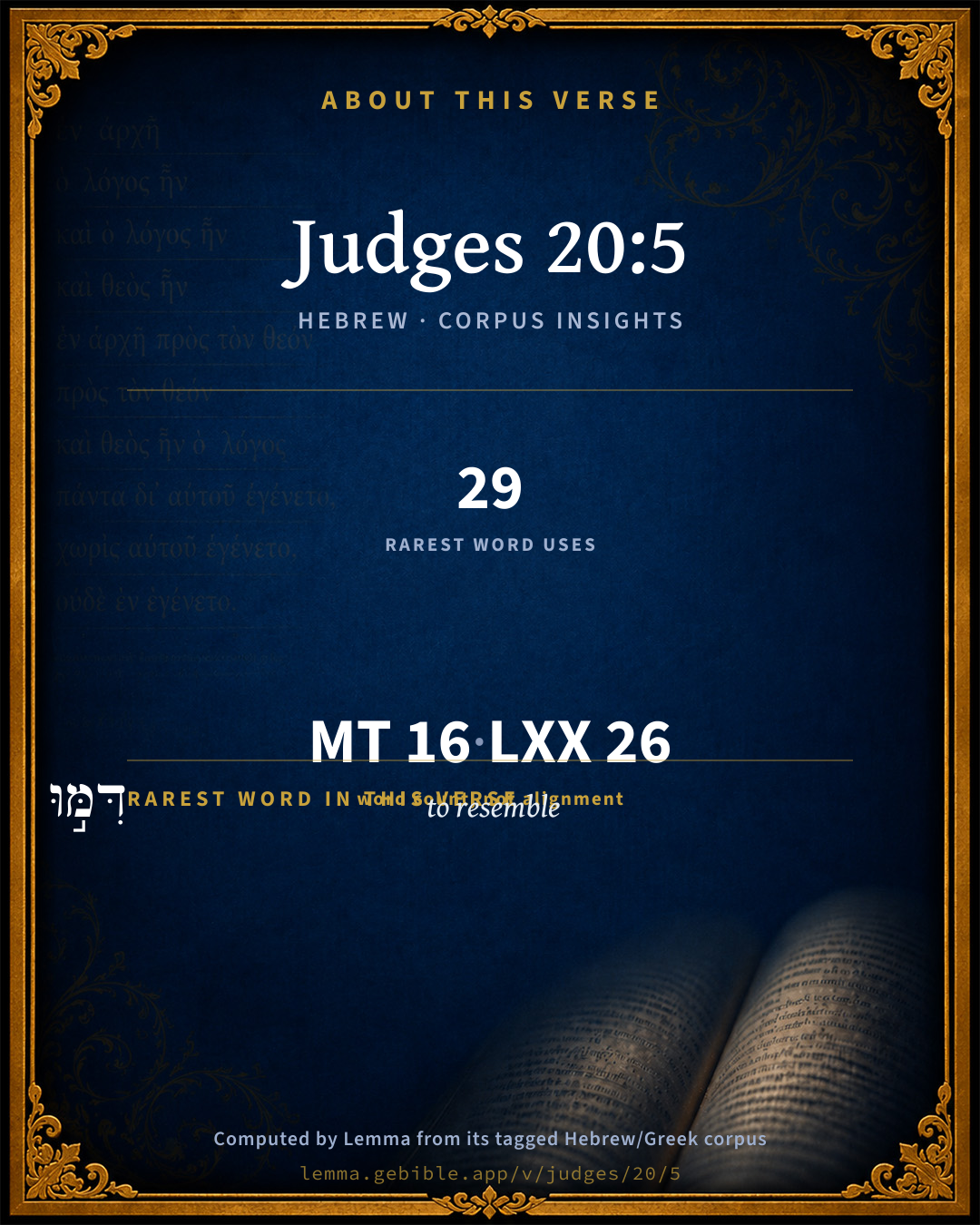
16
words
13
distinct lemmas
Historical
section

Shared distinctive vocabulary

דִּמּ֣וּ to resemble H1819 occurs in 27 verses of the Hebrew Bible. Also found in:

Grammatical profile

  • 6 verbs
  • 5 nouns
  • 2 prepositions
  • 3 particles

Verb forms

  • וַיָּקֻ֤מוּ Qal · Sequential Imperfect
  • וַיָּסֹ֧בּוּ Qal · Sequential Imperfect
  • דִּמּ֣וּ Piel · Perfect
  • לַהֲרֹ֔ג Qal · Infinitive Construct
  • עִנּ֖וּ Piel · Perfect
  • וַתָּמֹֽת Qal · Sequential Imperfect

Repetition

A word recurs within this verse — often emphatic in Hebrew:

  • עָלַי֙ upon H5921 ×2

Hebrew & Septuagint length

In English translation the verse runs 31 words from the Hebrew and 32 from the Septuagint (LXX English) — closely comparable.

A rough comparison of the two English renderings, which tokenize alike — not a word-level alignment.

Word counts can differ between the Hebrew and the Greek without any difference in meaning — e.g. the Hebrew direct-object marker אֵת has no separate Greek word, and Greek often adds the article ὁ.

In the original languages it is 16 Hebrew tokens and 26 Greek tokens — but the two are counted differently (Hebrew bundles its prefixes and suffixes into one token; the Greek is in lemma form), so that isn’t a like-for-like length.

Cross-references

5

Topical passages linked to Judges 20:5 in the Treasury of Scripture Knowledge — connected by theme and wording, ordered by reader-vote popularity; previews shown in the World English Bible.

  • Judges 19:22 As they were making their hearts merry, behold, the men of the city, certain base fellows, beset the house round about, beating at the door; and they spoke to the master of the house, the old man, saying, Bring forth the man who came into your house, that we may know him.
  • Judges 19:25–26 But the men wouldn't listen to him: so the man laid hold on his concubine, and brought her forth to them; and they knew her, and abused her all the night until the morning: and when the day began to spring, they let her go.
  • Genesis 19:4–8 But before they lay down, the men of the city, the men of Sodom, surrounded the house, both young and old, all the people from every quarter.
  • Deuteronomy 22:24 then you shall bring them both out to the gate of that city, and you shall stone them to death with stones; the lady, because she didn't cry, being in the city; and the man, because he has humbled his neighbor's wife: so you shall put away the evil from the midst of you.
  • Ezekiel 22:10–11 In you have they uncovered their fathers' nakedness; in you have they humbled her who was unclean in her impurity.

Cross-references courtesy of OpenBible.info (CC BY 4.0).

Hebrew and Greek witnesses Masoretic Hebrew ↔ Greek Septuagint

The same verse in the two great witnesses to the Old Testament, shown verse-for-verse.

These are two independent witnesses, not word-aligned to each other, and the Septuagint is shown in lemma (dictionary) form.

Hebrew Judges 20:5 Masoretic · Westminster Leningrad Codex

וַיָּקֻ֤מוּ עָלַי֙ בַּעֲלֵ֣י הַגִּבְעָ֔ה וַיָּסֹ֧בּוּ עָלַ֛י אֶת הַבַּ֖יִת לָ֑יְלָה אוֹתִי֙ דִּמּ֣וּ לַהֲרֹ֔ג וְאֶת פִּילַגְשִׁ֥י עִנּ֖וּ וַתָּמֹֽת

The men of Gibeah rose against me, and beset the house round about me by night; me they thought to have slain, and my concubine they forced, and she is dead.

World English Bible · Public Domain

Greek LXX Judges 20:5 Septuagint · lemma form

καί ἀναἵστημι ἐπί ἐγώ ὁ ἀνήρ ὁ γαβαα καί κυκλόω ἐπί ἐγώ ἐπί ὁ οἰκία νύξ ἐγώ θέλω φονεύω καί ὁ παλλακή ἐγώ ταπεινόω καί ἀποθνήσκω

And the men of Gabaa rose up against me, and compassed the house by night against me; they wished to kill me, and they have humbled my concubine, and she is dead.

LXX2012 (modern English Septuagint) · Public Domain

Hebrew: Westminster Leningrad Codex (CC BY 4.0). Greek: Septuagint (public domain); English from LXX2012 (modern English Septuagint) (Public Domain). How the Septuagint differs from the Hebrew →

Targum (Aramaic paraphrase)

1

The Targum is the ancient Jewish Aramaic paraphrase of the Hebrew Scriptures — an interpretive translation, not the Hebrew text itself. Onkelos (literal) and Pseudo-Jonathan (expansive) render the Torah, and Jonathan the Prophets. Coverage is partial: where no permissively-licensed English translation exists for a verse, only the Aramaic is shown. This is verse-level text, not a word-by-word alignment to the Hebrew.

  1. Targum Jonathan Prophets (Joshua–Malachi)
    וְקָמוּ עֲלַי יַתְבֵי גִבְעָתָא וְאַקִיפוּ עֲלַי יַת בֵּיתָא בְּלֵילְיָא עָלַי חֲשִׁיבוּ לְמִקְטַל וְיַת לְחֵינָתִי עַנְיוּהָא וּמִיתַת:

    (no public-domain English translation for this verse)

    Targum Jonathan — Aramaic: “Mikraot Gedolot” (public domain). English: “Sefaria Community Translation” (CC0 1.0 (public-domain dedication)); “London "Chaldee Paraphrase," 1871” (public domain). Text via Sefaria.

Commentary

Notes on Judges 20:5 from classic Christian and Jewish commentators (each source and its license shown beneath its notes). The classic Christian expositions comment on the surrounding passage and are grouped to its opening verse, so a note may address several verses; the Jewish commentaries on the Tanakh (Rashi and others) are per-verse, so they appear only where the commentator wrote on this verse.

Lemma curates 59 commentaries, every one of them public domain or Creative Commons licensed, each selected and text-cleaned for this edition rather than reprinted as found. About our sources →

Trapp's Complete Commentary

John Trapp

Jdg 20:5 And the men of Gibeah rose against me, and beset the house round about upon me by night, [and] thought to have slain me: and my concubine have they forced, that she is dead.

Ver. 5. And the men of Gibeah.] Some certain varlets there; not all the city, as once at Sodom. {Gen 19:4-5} But because these were not punished, but countenanced, all became guilty.

And thought to have slain me.] As they have done my concubine: {a} and perhaps they threatened to kill him, if he would not come forth, and be abused by them.

And my concubine have they forced.] The monks in Bohemia ravished a sister of that noble warrior, Zisca; in revenge whereof he took arms, overthrew three hundred monasteries, and did many more great exploits against the Papists there, and in other parts of Germany.

{a} i.e., Abuti me praepostera libidine usque ad mortem. - Val.

John Trapp, A Commentary or Exposition upon All the Books of the Old and New Testament (1647–1656) — public domain. Text from a community e-Sword module.

Joseph Benson's Commentary

Jdg 20:5-6. Slain me — Except I would either submit to their unnatural lust, which I was resolved to withstand even unto death, or deliver up my concubine to them, which I was forced to do. Lewdness and folly — That is, a lewd folly; most ignominious and impudent wickedness.

Joseph Benson's Commentary on the Old and New Testaments (1811–1818) — public domain. Text from a community e-Sword module.

Geneva Bible (1599)

Geneva Bible translators

Or, chief, or lord.

Geneva Bible (1599) marginal notes — public domain. Text via Bolls.life.

Ellicott's Commentary for English Readers

(5) The men of Gibeah.—Literally, the lords of Gibeah, as in Jdg_9:2. We cannot infer that they were heathen inhabitants of the town, though they behaved as if they were. If the phrase implies that they were men in positions of authority, it perhaps shows why there was no rescue and little resistance. This is also probable, because there could not have been the same unwillingness to give up to justice a few lawless and insignificant offenders.

Thought to have slain me.—Obviously some circumstances of the assault have been omitted in Jdg_19:22-25. The Levite colours the whole story in the way most favourable to himself.

A Bible Commentary for English Readers, edited by Charles John Ellicott (1878–1897) — public domain. Text from a community e-Sword module.

The Cambridge Bible for Schools and Colleges

gen. ed. J. J. S. Perowne

5. men of Gibeah] citizens of G.; cf. Jdg_9:2 n.

me they thought to have slain] See on Jdg_19:22. Their design on the young woman would naturally involve getting rid of her husband (cf. Gen_12:12).

The Cambridge Bible for Schools and Colleges (gen. ed. J. J. S. Perowne; Cambridge University Press, 1878–1918) — public domain. Text from a community e-Sword module.

John Gill's Exposition

And the men of Gibeah rose against me,.... Not all of them, but some that dwelt in that city; he forbears giving them the character they justly deserved, sons of Belial. These came in a tumultuous and violent manner:

and beset the house round about upon me by night; that he might not make his escape, resolving if possible to get him into their hands, and do with him according to their will:

and thought to have slain me; their first intention was to commit the unnatural sin on him, and, if he resisted, to slay him; but this he modestly conceals, as being a sin not to be named in an assembly of saints; and besides he might say this, because he himself chose rather to be slain than to submit to their lust, which he knew must be the case upon his refusal and resistance; and even if he had yielded, being overpowered, this would have been the consequence, that he should have been abused even unto death, as his wife was:

and my concubine have they forced, that she is dead; or "afflicted", or "humbled" (d) her; which is a modest expression for carnal knowledge of her, and which they had to such excess that she died through it.

(d) "afflixerunt", Pagninus, Montanus, Vatablus.

John Gill's Exposition of the Whole Bible (1746–1763) — public domain (CC PDM 1.0). Text via the HelloAO Bible API.

Haydock's Catholic Bible Commentary

Kill me. He expressed an abominable crime by another less horrible. (Salien) --- But he does not say that he brought out his wife. He might conclude, that if he had been exposed to their fury, he would have experienced a similar fate. (Haydock) --- So determined was he to resist to the last extremity. The outrage would have been more hateful to him than death. (Calmet) --- We may reasonably conclude that his wife had the same sentiments, and that she died a martyr to her conjugal fidelity, resisting even unto death, and thus making some atonement for her past misconduct.

George Leo Haydock (1774–1849), Haydock's Catholic Family Bible and Commentary, 1859 edition — public domain. Excludes Psalms (Douay-Rheims chapter numbering differs from Protestant) and Deuterocanonical books (Catholic canon only).

Matthew Poole's English Annotations

Thought to have slain me; except I would either submit to their unnatural lust, which I was resolved to withstand even unto death; or deliver up my concubine to them, which I was forced to do.

Matthew Poole's English Annotations on the Holy Bible (1683–1685) — public domain. Text from a community e-Sword/MySword module.

The Pulpit Commentary

And thought to have slain me. This was so far true that it is likely he was in fear of his life; but he doubtless shaped his narrative so as to conceal his own cowardice in the transaction. We have a similar example of an unfaithful narration of facts in the letter of Claudius Lysias to Felix. (Act_23:27) The men of Gibeah. The masters, as in Jud_1:9:2, meaning the citizens.

The Pulpit Commentary (1880–1919), ed. H.D.M. Spence-Jones & Joseph S. Exell — public domain. Text from a community e-Sword module.

John Wesley's Explanatory Notes

Slain me - Except I would either submit to their unnatural lust, which I was resolved to withstand even unto death: or deliver up my concubine to them, which I was forced to do.

John Wesley, Explanatory Notes Upon the Whole Bible (1754–1765) — public domain. Text via the GEBible commentary corpus.

unfoldingWord translationNotes

Door43 World Missions Community

wickedness and outrage

The word "outrage" describes the "wickedness." AT: "outrageous wickedness" (See: Hendiadys)

Now

This word is used to introduce the conclusion of the speech of the Levite.

give your advice and counsel here

The words "advice" and "counsel" refer to the same thing and are repeated for emphasis. They can be combined. AT: "decide what we need to do about this" (See: Doublet)

translationWords

seize

concubine

Israel

inherit

evil

unfoldingWord translationNotes — © Distant Shores Media and the Door43 World Missions Community, licensed CC BY-SA 4.0. Source: git.door43.org/Door43/en_tn.

Rashi

Rabbi Shlomo Yitzchaki (Rashi)

They thought they would murder me. They intended to murder me. "Apesment" in old French.

Rashi on the Tanakh — English translations: “The Judaica Press complete Tanach with Rashi, translated by A. J. Rosenberg” (CC BY 4.0); “Pentateuch with Rashi's commentary by M. Rosenbaum and A.M. Silbermann, 1929-1934” (public domain); “The Metsudah Tanach series, Lakewood, N.J” (CC BY 4.0); and “The Book of Joshua, Metsudah Publications, 1997” (CC BY 4.0). Text via Sefaria.

Lesson kit

Teaching starters — assembled from the data on this page, not authored interpretation. Every prompt links to the verse data it draws on. Edit before teaching.

Judges, in the Historical, opens this verse with 16 words (13 distinct Hebrew lemmas). Its most distinctive word is dâmâh (“to resemble”). A historical commentator’s framing appears above. Read the whole chapter for the surrounding context.

Discussion questions

  1. What does “to resemble” (dâmâh) contribute to the verse as a whole?
  2. How does Numbers 33:56, which shares the word «to resemble», read alongside this verse?
  3. What does the repetition of “upon” (2× in this one verse) do in this verse?
  4. The translations on this page render this verse differently — a whole-verse word diff, not a word-by-word alignment. What might account for the different wordings?
  5. «וַיָּקֻ֤מוּ» is a Qal Sequential Imperfect verb. How does that grammatical form shape the action described?
  6. Compare how Trapp's Complete Commentary and Joseph Benson's Commentary read this verse. Where do they agree or differ?

Things to notice

Reading settings

Reading text

Shown beneath each verse's original-language words.

Old Testament
Old Testament edition

Read the OT as the Masoretic Hebrew (MT) or the Greek Septuagint (LXX).

English shown for the Greek Septuagint (in the Hebrew ↔ Greek comparison).

Comparing translations? Open the Compare panel on any verse page to stack up to four side by side.