
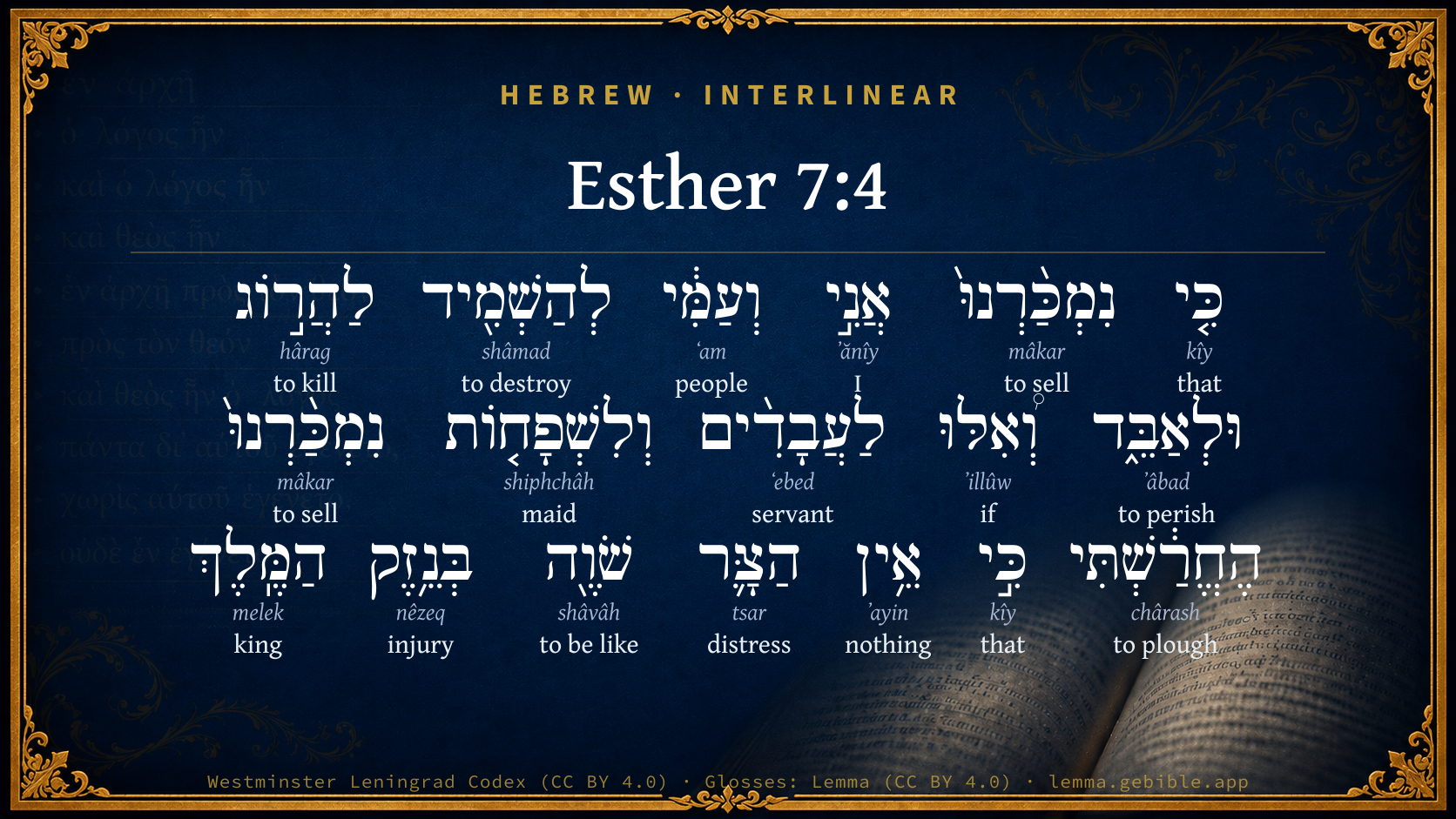
Esther 7:4

Hebrew (Westminster Leningrad Codex) Esther 7:4 appears in the Hebrew Old Testament. The text above is from the Westminster Leningrad Codex. Each word links to its Strong’s number, a concise gloss, and parsing drawn from the Open Scriptures Hebrew Bible morphology. Click any word for its full Brown-Driver-Briggs (BDB) entry.
Download image
Cite this verse

Esther 7:4 (World English Bible). Public Domain. Lemma interlinear Bible study tool, https://lemma.gebible.app/v/esther/7/4.

Show BibTeX & RIS
BibTeX
RIS
English Translation
for we are sold, I and my people, to be destroyed, to be slain, and to perish. But if we had been sold for bondservants and bondmaids, I had held my peace, although the adversary could not have compensated for the king's damage.
World English Bible · Public Domain
Highlights
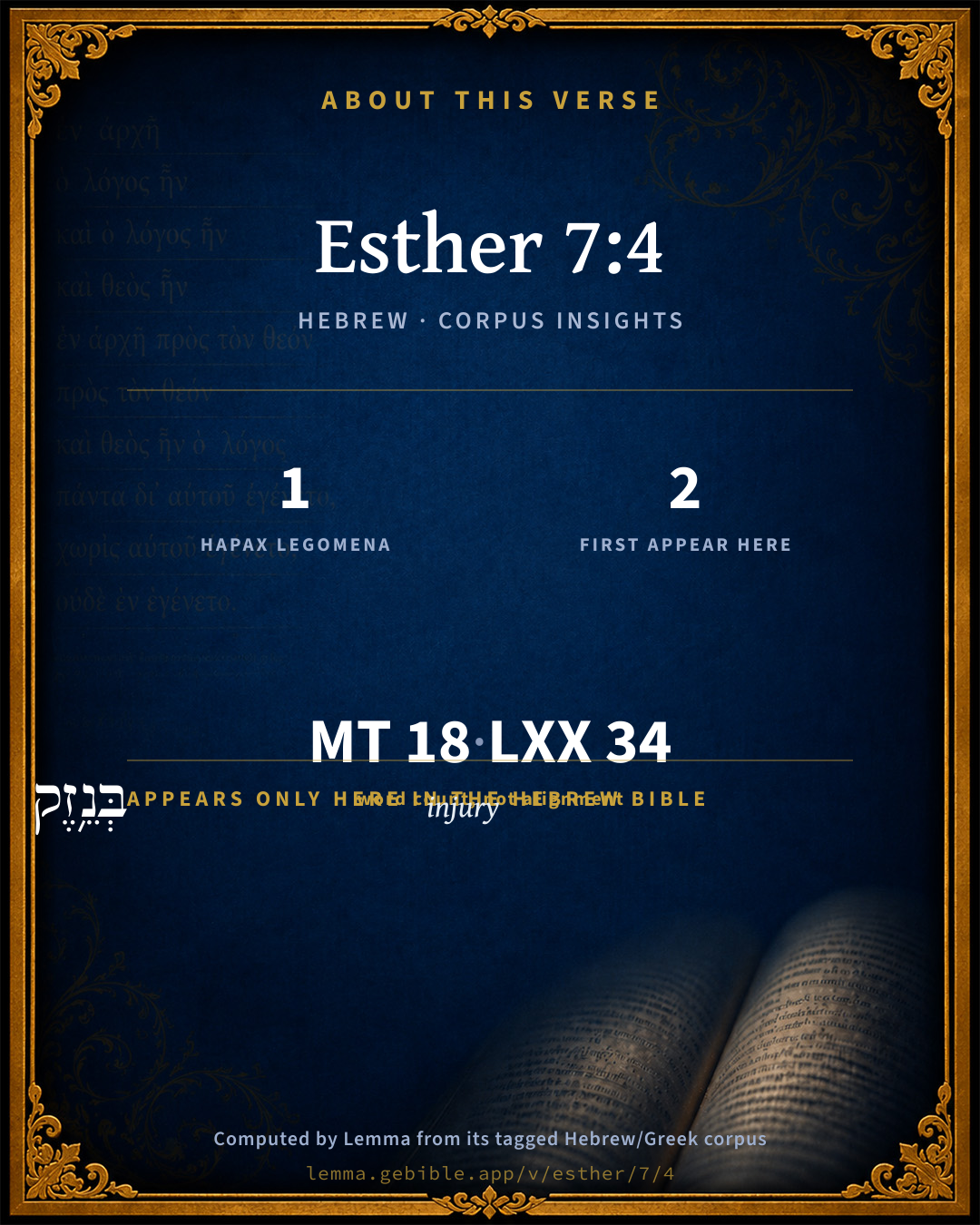
  • 1 hapax legomenon — only here in the Hebrew Bible
  • 2 first appearances in the Hebrew Bible
Full analysis ↓
Download a study sheet

One document with this verse’s original text, its word-by-word gloss line, the meaning frame, cross-references with their text, attributed commentary, and full source and license credits — printable, and it pastes into notes with its structure intact.

This verse Autodidact and up

Study sheet (.html) Plain text (.txt)

A passage Seminary Student

Up to 50 verses in one chapter. A passage sheet keeps up to 6 commentary sources and 12 cross-references per verse, in the order this page ranks them, and says so on the sheet whenever that leaves anything out. Ask for a single verse and you get the Autodidact verse sheet above.

Everything on this page stays free to read, with no account — the sheet is a download of what is already on screen, not access to it.

Want to remove ads? Support Godless Engineer
Compare translations 3

The same verse in 3 English versions, stacked beneath the original-language interlinear above. Click any original word for its lexicon entry.

Each is an independent rendering of the whole verse — the interlinear is not word-aligned to these translations.

Highlighted words mark where these versions differ — a whole-verse word diff, not a word-by-word alignment.

  • World English Bible Public Domain
    for we are sold, I and my people, to be destroyed, to be slain, and to perish. But if we had been sold for bondservants and bondmaids, I had held my peace, although the adversary could not have compensated for the king's damage.
  • King James Version Public Domain
    For we are sold, I and my people, to be destroyed, to be slain, and to perish. But if we had been sold for bondmen and bondwomen, I had held my tongue, although the enemy could not countervail the king's damage.
  • unfoldingWord Literal Text CC BY-SA 4.0
    For we have been sold, I and my people, for annihilation, for slaughter, and for destruction. Now if we had been sold as slaves and female servants, I would have kept silent, because the distress would not have been equal to a burden of the king.”

unfoldingWord Literal Text — © unfoldingWord, licensed CC BY-SA 4.0. Word-aligned USFM3 via Door43 (git.door43.org/unfoldingWord/en_ult).

Versions to compare (up to 4)

3 of 4 selected

Show all 18 translations

Every available English version of this verse, each an independent rendering of the whole verse.

  • World English Bible Public Domain
    for we are sold, I and my people, to be destroyed, to be slain, and to perish. But if we had been sold for bondservants and bondmaids, I had held my peace, although the adversary could not have compensated for the king's damage.
  • Berean Standard Bible Public Domain
    For my people and I have been sold out to destruction, death, and annihilation. If we had merely been sold as menservants and maidservants, I would have remained silent, because no such distress would justify burdening the king.”
  • Majority Standard Bible Public Domain
    For my people and I have been sold out to destruction, death, and annihilation. If we had merely been sold as menservants and maidservants, I would have remained silent, because no such distress would justify burdening the king.”
  • King James Version Public Domain
    For we are sold, I and my people, to be destroyed, to be slain, and to perish. But if we had been sold for bondmen and bondwomen, I had held my tongue, although the enemy could not countervail the king's damage.
  • American Standard Version (1901) Public Domain
    for we are sold, I and my people, to be destroyed, to be slain, and to perish. But if we had been sold for bondmen and bondwomen, I had held my peace, although the adversary could not have compensated for the king's damage.
  • Revised Version (1885) Public Domain
    for we are sold, I and my people, to be destroyed, to be slain, and to perish. But if we had been sold for bondmen and bondwomen, I had held my peace, although the adversary could not have compensated for the king’s damage.
  • Geneva Bible (1599) Public Domain
    For we are solde, I, and my people, to be destroyed, to be slayne and to perish: but if we were solde for seruants, and for handmaides, I woulde haue helde my tongue: although the aduersarie could not recompense the Kings losse.
  • Douay-Rheims (1899) Public Domain
    For we are given up, I and my people, to be destroyed, to be slain, and to perish. And would God we were sold for bondmen and bondwomen: the evil might be borne with, and I would have mourned in silence: but now we have an enemy, whose cruelty redoundeth upon the king.
  • Young's Literal Translation Public Domain
    for we have been sold, I and my people, to cut off, to slay, and to destroy; and if for men-servants and for maid-servants we had been sold I had kept silent -- but the adversity is not equal to the loss of the king.'
  • Literal Standard Version CC BY-SA 4.0
    for we have been sold, I and my people, to cut off, to slay, and to destroy; and if for menservants and for maidservants we had been sold I had kept silent—but the adversity is not equal to the loss of the king.”
  • Unlocked Literal Bible CC BY-SA 4.0
    For we have been sold, I and my people, to be destroyed, killed, and annihilated. If we had only been sold into slavery, as male and female slaves, I would have kept quiet, for no such distress as this would justify disturbing the king.”
  • unfoldingWord Literal Text CC BY-SA 4.0
    For we have been sold, I and my people, for annihilation, for slaughter, and for destruction. Now if we had been sold as slaves and female servants, I would have kept silent, because the distress would not have been equal to a burden of the king.”
  • Darby Bible Public Domain
    for we are sold, I and my people, to be destroyed, to be slain, and to perish. But if we had been sold for bondmen and bondwomen, I had held my tongue, although the adversary could not compensate the king's damage.
  • World Messianic Bible Public Domain
    For we are sold, I and my people, to be destroyed, to be slain, and to perish. But if we had been sold for male and female slaves, I would have held my peace, although the adversary could not have compensated for the king’s loss.”
  • Webster's Bible Public Domain
    For we are sold, I and my people, to be destroyed, to be slain, and to perish. But if we had been sold for bond-men and bond-women, I had held my tongue, although the enemy could not countervail the king's damage.
  • Free Bible Version CC BY-SA 4.0
    For my people and I have been sold to be destroyed, killed, and annihilated. If we had only been sold as slaves, I would have kept quiet, because our suffering would not have justified disturbing the king.”
  • Bible in Basic English Public Domain
    For we are given up, I and my people, to destruction and death and to be cut off. If we had been taken as men-servants and women-servants for a price, I would have said nothing, for our trouble is little in comparison with the king's loss.
  • JPS Tanakh (1917) Public Domain
    for we are sold, I and my people, to be destroyed, to be slain, and to perish. But if we had been sold for bondmen and bondwomen, I had held my peace, for the adversary is not worthy that the king be endamaged.'

Literal Standard Version (2020), Covenant Press — licensed CC BY-SA 4.0. Text via the HelloAO Bible API (eBible.org). Unlocked Literal Bible (unfoldingWord) — licensed CC BY-SA 4.0. Text via the HelloAO Bible API (eBible.org). unfoldingWord Literal Text — © unfoldingWord, licensed CC BY-SA 4.0. Word-aligned USFM3 via Door43 (git.door43.org/unfoldingWord/en_ult). Free Bible Version, Dr. Jonathan Gallagher — licensed CC BY-SA 4.0. Text via the HelloAO Bible API (eBible.org).

Word by word

More ways to search: Search by grammar → Find every occurrence → Compare this word →

Practice this passage: Drill this verse → Learn its vocabulary →

בְּנֵ֥זֶק
nêzeq
H5143
“in/at · injury of”
Preposition + Noun, Common, Masculine, Singular, Construct
Part of Speech
Preposition + Noun
Type
Common
Gender
Masculine
Number
Singular
State
Construct
Full BDB Definition

Origin: from an unused root meaning to injure

TWOT: 1339

injury, damage
  1. כִּ֤י kîy H3588 “that” Conjunction
  2. נִמְכַּ֨רְנוּ֙ mâkar H4376 “to sell” Verb, Niphal, Perfect, 1st Person, Common, Plural
  3. אֲנִ֣י ʼănîy H589 “I” Pronoun, Personal, 1st Person, Common, Singular
  4. וְעַמִּ֔י ʻam H5971 “and · people · my” Conjunction + Noun, Common, Masculine, Singular, Construct + Suffix, Personal, 1st Person, Common, Singular
  5. לְהַשְׁמִ֖יד shâmad H8045 “to destroy” Preposition + Verb, Hiphil, Infinitive Construct
  6. לַהֲר֣וֹג hârag H2026 “to kill” Preposition + Verb, Qal, Infinitive Construct
  7. וּלְאַבֵּ֑ד ʼâbad H6 “and · to perish” Conjunction + Preposition + Verb, Piel, Infinitive Construct
  8. וְ֠אִלּוּ ʼillûw H432 “and · if” Conjunction + Conjunction
  9. לַעֲבָדִ֨ים ʻebed H5650 “to/for · servants” Preposition + Noun, Common, Masculine, Plural, Absolute
  10. וְלִשְׁפָח֤וֹת shiphchâh H8198 “and · to/for · maids” Conjunction + Preposition + Noun, Common, Feminine, Plural, Absolute
  11. נִמְכַּ֨רְנוּ֙ mâkar H4376 “to sell” Verb, Niphal, Perfect, 1st Person, Common, Plural
  12. הֶחֱרַ֔שְׁתִּי chârash H2790 “to plough” Verb, Hiphil, Perfect, 1st Person, Common, Singular
  13. כִּ֣י kîy H3588 “that” Conjunction
  14. אֵ֥ין ʼayin H369 “nothing” Particle, Negative
  15. הַצָּ֛ר tsar H6862 “the · distress” Particle, Definite Article + Noun, Common, Masculine, Singular, Absolute
  16. שֹׁוֶ֖ה shâvâh H7737 “being like” Verb, Qal, Participle Active, Masculine, Singular, Absolute
  17. הַמֶּֽלֶךְ melek H4428 “the · king” Particle, Definite Article + Noun, Common, Masculine, Singular, Absolute

About this verse

These counts appear in no published source. They are computed here, from the morphology-tagged text and Lemma’s own curated glosses. What Lemma adds →

18
words
16
distinct lemmas
Historical
section

Notable vocabulary

1 hapax legomenon — a word that appears only here in the entire Hebrew Bible:

  • בְּנֵ֥זֶק injury H5143

First appearance in Scripture

These words make their first canonical appearance in the Hebrew Bible here:

  • וְ֠אִלּוּ if H432
  • בְּנֵ֥זֶק injury H5143

Shared distinctive vocabulary

וְ֠אִלּוּ if H432 occurs in 2 verses of the Hebrew Bible. Also found in:

Grammatical profile

  • 7 verbs
  • 6 nouns
  • 1 pronoun
  • 3 conjunctions
  • 1 particle

Verb forms

  • נִמְכַּ֨רְנוּ֙ Niphal · Perfect
  • לְהַשְׁמִ֖יד Hiphil · Infinitive Construct
  • לַהֲר֣וֹג Qal · Infinitive Construct
  • וּלְאַבֵּ֑ד Piel · Infinitive Construct
  • נִמְכַּ֨רְנוּ֙ Niphal · Perfect
  • הֶחֱרַ֔שְׁתִּי Hiphil · Perfect
  • שֹׁוֶ֖ה Qal · Participle Active

Repetition

Words recur within this verse — often emphatic in Hebrew:

  • נִמְכַּ֨רְנוּ֙ to sell H4376 ×2
  • כִּ֤י that H3588 ×2

Hebrew & Septuagint length

In English translation the verse runs 43 words from the Hebrew and 38 from the Septuagint (LXX English) — closely comparable.

A rough comparison of the two English renderings, which tokenize alike — not a word-level alignment.

Word counts can differ between the Hebrew and the Greek without any difference in meaning — e.g. the Hebrew direct-object marker אֵת has no separate Greek word, and Greek often adds the article ὁ.

In the original languages it is 18 Hebrew tokens and 34 Greek tokens — but the two are counted differently (Hebrew bundles its prefixes and suffixes into one token; the Greek is in lemma form), so that isn’t a like-for-like length.

Cross-references

13

Topical passages linked to Esther 7:4 in the Treasury of Scripture Knowledge — connected by theme and wording, ordered by reader-vote popularity; previews shown in the World English Bible.

  • Esther 3:9 If it please the king, let it be written that they be destroyed: and I will pay ten thousand talents of silver into the hands of those who have the charge of the [king's] business, to bring it into the king's treasuries.
  • Deuteronomy 28:68 Yahweh will bring you into Egypt again with ships, by the way of which I said to you, You shall see it no more again: and there you shall sell yourselves to your enemies for bondservants and for bondmaids, and no man shall buy you.
  • Esther 3:13 Letters were sent by posts into all the king's provinces, to destroy, to kill, and to cause to perish, all Jews, both young and old, little children and women, in one day, even on the thirteenth [day] of the twelfth month, which is the month Adar, and to take the spoil of them for a prey.
  • Esther 8:11 in which the king granted the Jews who were in every city to gather themselves together, and to stand for their life, to destroy, to kill, and to cause to perish, all the power of the people and province that would assault them, [their] little ones and women, and to take the spoil of them for a prey,
  • Genesis 37:26–28 Judah said to his brothers, "What profit is it if we kill our brother and conceal his blood?
  • Joshua 9:23 Now therefore you are cursed, and there shall never fail to be of you bondservants, both wood cutters and drawers of water for the house of my God.
  • 1 Samuel 22:23 Abide you with me, don't be afraid; for he who seeks my life seeks your life: for with me you shall be in safeguard.
  • Nehemiah 5:5 Yet now our flesh is as the flesh of our brothers, our children as their children: and, behold, we bring into bondage our sons and our daughters to be servants, and some of our daughters are brought into bondage [already]: neither is it in our power to help it; for other men have our fields and our vineyards.
  • Esther 4:7–8 Mordecai told him of all that had happened to him, and the exact sum of the money that Haman had promised to pay to the king's treasuries for the Jews, to destroy them.
  • Esther 7:6 Esther said, An adversary and an enemy, even this wicked Haman. Then Haman was afraid before the king and the queen.
  • Psalms 44:22–23 Yes, for your sake we are killed all day long. We are regarded as sheep for the slaughter.
  • Joel 3:6 And have sold the children of Judah and the children of Jerusalem to the sons of the Greeks, That you may remove them far from their border.
  • Amos 2:6 Thus says Yahweh: "For three transgressions of Israel, yes, for four, I will not turn away its punishment; Because they have sold the righteous for silver, And the needy for a pair of shoes;

Cross-references courtesy of OpenBible.info (CC BY 4.0).

Hebrew and Greek witnesses Masoretic Hebrew ↔ Greek Septuagint

The same verse in the two great witnesses to the Old Testament, shown verse-for-verse.

These are two independent witnesses, not word-aligned to each other, and the Septuagint is shown in lemma (dictionary) form.

Hebrew Esther 7:4 Masoretic · Westminster Leningrad Codex

כִּ֤י נִמְכַּ֨רְנוּ֙ אֲנִ֣י וְעַמִּ֔י לְהַשְׁמִ֖יד לַהֲר֣וֹג וּלְאַבֵּ֑ד וְ֠אִלּוּ לַעֲבָדִ֨ים וְלִשְׁפָח֤וֹת נִמְכַּ֨רְנוּ֙ הֶחֱרַ֔שְׁתִּי כִּ֣י אֵ֥ין הַצָּ֛ר שֹׁוֶ֖ה בְּנֵ֥זֶק הַמֶּֽלֶךְ

for we are sold, I and my people, to be destroyed, to be slain, and to perish. But if we had been sold for bondservants and bondmaids, I had held my peace, although the adversary could not have compensated for the king's damage.

World English Bible · Public Domain

Greek LXX Esther 7:4 Septuagint · lemma form

πιπράσκω γάρ ἐγώ τε καί ὁ λαός ἐγώ εἰς ἀπώλεια καί διαρπαγή καί δουλεία ἐγώ καί ὁ τέκνον ἐγώ εἰς παῖς καί παιδίσκη καί παραἀκούω οὐ γάρ ἄξιος ὁ διάβολος ὁ αὐλή ὁ βασιλεύς

For both I and my people are sold for destruction, and pillage, and slavery; both we and our children for bondmen and bondwomen: and I consented not to it, for the is not worthy of the king's palace.

LXX2012 (modern English Septuagint) · Public Domain

On this verse, The Cambridge Bible for Schools and Colleges discusses the Septuagint’s reading. Read the note in Commentary ↓

Hebrew: Westminster Leningrad Codex (CC BY 4.0). Greek: Septuagint (public domain); English from LXX2012 (modern English Septuagint) (Public Domain). How the Septuagint differs from the Hebrew →

Commentary

Notes on Esther 7:4 from classic Christian and Jewish commentators (each source and its license shown beneath its notes). The classic Christian expositions comment on the surrounding passage and are grouped to its opening verse, so a note may address several verses; the Jewish commentaries on the Tanakh (Rashi and others) are per-verse, so they appear only where the commentator wrote on this verse.

Lemma curates 59 commentaries, every one of them public domain or Creative Commons licensed, each selected and text-cleaned for this edition rather than reprinted as found. About our sources →

Trapp's Complete Commentary

John Trapp

Est 7:4 For we are sold, I and my people, to be destroyed, to be slain, and to perish. But if we had been sold for bondmen and bondwomen, I had held my tongue, although the enemy could not countervail the king’s damage.

Ver. 4. For we are sold] i.e. Given up wholly into the power of the enemy, as that which a man hath bought with his money, is his own to dispose of. She refers, doubtless, to the sum proffered by Haman, Est 3:9, not fearing the face of so potent an enemy, nor going behind his back to set him out in his colours; yea, though her discourse could not but somewhat reflect upon the king, who had given Haman his consent.

I, and my people] She makes it a common cause, and saith to her countrymen, as once David did to Abiathar, 1Sa 22:23, or as Charles V said to Julius Pestugius, who complained that he had been much wronged by the duke of Saxony, Have a little patience, thy cause shall be my cause, neither will I sit down till I have seen you some way righted. See Est 7:3.

To be destroyed, to be slain, and to perish] These were the very words of that bloody decree which she purposely maketh use of, that he might be sensible of what he had consented to, and might see that she complained not without cause. But what a case was Haman in at the hearing of this! and how did he now repent him, but too late, of ever having a hand in so bloody a business! His iniquity was now full, and the bottle of his wickedness, filled up to the brim with those bitter waters, was even about to sink to the bottom. His gallows was finished last night, and now it groaned hard for him, that he might be destroyed, slain, and made to perish.

- Neque enim lex iustior ulla est,

Quam necis artifices arte perire sua.

But if we had been sold for bondmen and bondwomen] Though it had been a hard and sad condition for a queen, especially (which yet was Hecuba’s case and Zenobia’s), yet it would not be grievous to them to sacrifice their liberty to the service of their life: the Gibeonites were glad they might live upon any terms, Jos 9:24-25. Masters might slay their bondservants, but that was counted a cruelty, and when one did it at Rome, he was amerced by the censor; many times they were manumitted for their good service, and came to great estates.

I had held my tongue] Silence is in some cases a crying sin. Taciturnity, I confess, is sometimes a virtue, but not at all where it tends to the betraying of a good cause, or the detriment of the labouring Church. "For Zion’s sake will I not hold my peace, and for Jerusalem’s sake I will not rest," &c., Isa 62:1. Terentius, that noble general, told Valens, the Arian emperor, that he had abandoned the victory and sent it to the enemy, by his persecuting God’s people, and favouring heretics (Niceph. 1. 11, c. 40). That was an excellent saying of Jerome to Vigilantius, Meam iniuriam patienter tul/i, &c., while the wrong thou didst reached only to myself I took it patiently, but thy wickedness against God I cannot bear with; so was that of Oecolampadius to Servetus (blaming him for his sharpness to the self-same purpose). And, lastly, that of Luther in a letter to his friend Staupicius, Inveniar sane superbus, &c., Let me be accounted proud, peremptory, passionate, or what men please, so that I be not found guilty of a sinful silence when called to speak for God.

Although the enemy could not countervail the king’s damage] q.d. It is not his ten thousand talents, Est 3:9, nor all that he is worth, and ten more such as he is, that can make up the loss that the king is sure to sustain by the slaughter of the Jews, a people painful and prayerful (this Daxius made high account of, Ezr 6:16), useful and profitable, careful to maintain good works in St Paul’s sense, Tit 3:8, that is, such as were noted to exceed and excel others in witty inventions, to be their craftmasters, and faithtul to their trust. Besides, if they be taken away, great damage shall redound to the king’s revenue, by non-payment of toll, tribute, and custom, as those malignants could allege, Ezr 4:12, a thing that princes usually are very sensible Of. Or if there should be lucrum in arca, money in the box, yet there would be damnum in conscientia, damnation in the conscience, the foul blur of blood guiltiness would lie heavy, both upon the king’s conscience, and his name among all nations. The Vulgate rendereth this text thus, Nunc autem hostis noster est, cuius crudelitas reduadat in regem. And now he is our enemy, whose cruelty reflecteth upon the king. Tremellius thus, Sed non est hostis iste utilis, damnosus est regi; but now this enemy is no way profitable, but to the king disadvantageous. This the king considers not, and the enemy cares not, so that he may serve his own turn, and satisfy his murderous mind.

John Trapp, A Commentary or Exposition upon All the Books of the Old and New Testament (1647–1656) — public domain. Text from a community e-Sword module.

Joseph Benson's Commentary

Est 7:4. For we are sold, I and my people, to be destroyed, &c. — By the cruelty of that man, who offered a great sum to purchase our destruction. We have not forfeited our lives by any offence against the government, but are sold to gratify the pride and revenge of one man. If we had been sold for bond-men and bond-women — Sold merely into slavery; I had held my tongue — I would not have complained, for in time we might have been ransomed and delivered. But it is not our liberty only, but our lives that are sold. Although the enemy could not countervail the king’s damage — His ten thousand talents would not repair the king’s loss in the customs and tributes, which the king receives from the Jews within his dominions, nor the injury his kingdom would sustain, by the loss of so many industrious hands out of it. To persecute good people is as impolitic as it is impious, and a manifest wrong to the interests of princes and states, which are weakened and empoverished by it.

Joseph Benson's Commentary on the Old and New Testaments (1811–1818) — public domain. Text from a community e-Sword module.

Geneva Bible (1599)

Geneva Bible translators

Haman could not so much profit the king by this his malice, as he should hinder him by the loss of the Jews, and the tribute which he hath of them.

Geneva Bible (1599) marginal notes — public domain. Text via Bolls.life.

Adam Clarke's Commentary

Verse 4. To be destroyed, to be slain] She here repeats the words which Haman put into the decree. See Es 3:13.

Could not countervail the king's damage.] Even the ten thousand talents of silver could not be considered as a compensation to the state for the loss of a whole nation of people throughout all their generations.

Adam Clarke's Commentary on the Bible (1810–1826) — public domain. Text from a community e-Sword/MySword module.

Ellicott's Commentary for English Readers

(4) We are sold.—See above, Est_3:9.

To be destroyed. . . .—Literally, to destroy and to kill, and to cause to perish. The identical words used in the king’s proclamation for the destruction of the Jews. Herein Esther at once makes confession of her nationality, and relying on the king’s still recent gratitude to one of the race, aided by his present cordiality to herself, she risks, as indeed she can no longer help doing, the fate of herself and her race on the momentary impulse of her fickle lord. Happily for her, God has willed that these, perhaps at any other time untrustworthy grounds of reliance, shall suffice. The “hearts of kings are in His rule and governance,” and now the heart of one is “disposed and turned, as it seemeth best to His godly wisdom.”

Although the enemy. . . .—The meaning of this clause is not quite clear. The literal translation is, although (or because) the enemy is not equal to (i.e., does not make up for) the king’s hurt. This may mean (a) that Haman, though willing to pay a large sum into the royal treasury, cannot thereby make up for the loss which the king must incur by wholesale massacre being carried on in his realm; or (b) “were we merely to be sold into slavery, instead of being killed outright, I should have said nothing, because the enemy was not one worth the king’s while to trouble himself about.” We prefer the former view. The word “enemy” is that translated adversary, in Est_7:6, and properly means one who oppresses, afflicts, distresses. The word which is, literally, equal to, comparable with, has already occurred in Est_3:8; Est_5:13.

A Bible Commentary for English Readers, edited by Charles John Ellicott (1878–1897) — public domain. Text from a community e-Sword module.

The Cambridge Bible for Schools and Colleges

gen. ed. J. J. S. Perowne

4. we are sold] She refers to the bribe which Haman had offered the king for permission to destroy her people, and of which Mordecai had told her (Est_3:9, Est_4:7).

although the adversary could not have compensated for the king’s damage] The original text is obscure. The R.V. makes good sense, as meaning that Haman, by enslaving the Jews, would do the king an injury (by depriving him of the persons of so many of his subjects and of the revenues derived from them) for which it would be out of his power to make compensation. The fatal objection to this rendering is that it is impossible as a translation of the Heb. as it stands, inasmuch as the word rendered ‘although’ cannot have that sense, but must be rendered for, or because.

The margin of the R.V., retaining the Heb. consonants as they stand while slightly changing a vowel[74] (for our affliction is not to be compared with the king’s damage), means, ‘the suffering which would be inflicted on us is a trivial matter compared with the loss to the king.’

[74] Reading הַצַּר for הַצָּר.

Other translations are (a) (keeping the same change of vowel in the Heb.) ‘for such oppression would not be worth troubling the king about,’ or (b) (without the change of vowel) ‘for the adversary (Haman) is not worth troubling the king about.’ But we are not justified in forcing the word properly translated ‘damage’ to mean ‘annoyance.[75]’ The LXX. have ‘for the adversary is not worthy of the court of the king.’[76]

[75] It may be noted that the word is a ‘loan-word’ from Aramaic, and occurs in this passage only of the Bible.

[76] οὐ γὰρ ἅξιος ὁ διάβολος τῆς αὐλῆς (apparently reading הצר over again as חצר) τοῦ βασιλέως.

The Cambridge Bible for Schools and Colleges (gen. ed. J. J. S. Perowne; Cambridge University Press, 1878–1918) — public domain. Text from a community e-Sword module.

John Gill's Exposition

For we are sold, I and my people, to be destroyed, to be slain, and to perish,.... She makes use of these several words, to express the utter destruction of her and her people, without any exception; not only the more to impress the king's mind with it, but she has respect to the precise words of the decree, Est 3:13 as she has also to the 10,000 talents of silver Haman offered to pay the king for the grant of it, when she says, "we are sold", or delivered to be destroyed:

but if we had been sold for bondmen and bondwomen, I had held my tongue: should never have asked for deliverance from bondage, but have patiently submitted to it, however unreasonable, unjust, and afflictive it would have been; because it might have been borne, and there might be hope of deliverance from it at one time or another; though it is said, slaves with the Persians were never made free (g); but that being the case would not have been so great a loss to the king, who would have reaped some advantage by their servitude; whereas, by the death of them, he must sustain a loss which the enemy was not equal to, and which he could not compensate with all his riches; which, according to Ben Melech, is the sense of the next clause:

although the enemy could not countervail the king's damage; or, "for the enemy cannot", &c. the 10,000 talents offered by him, and all the riches that he has, are not an equivalent to the loss the king would sustain by the death of such a multitude of people, from whom he received so large a tribute; but this the enemy regarded not; and so Jarchi interprets it, the enemy took no care of, or was concerned about the king's damage; but there is another sense, which Aben Ezra mentions, and is followed by some learned men, who take the word for "enemy" to signify "distress", trouble, and anguish, as in Psa 4:1 and read the words, "for this distress would not be reckoned the king's damage" (h), or loss; though it would have been a distress to the Jews to have been sold for slaves, yet the loss to the king would not be so great as their death, since he would receive benefit by their service.

(g) Alex. ab. Alex. Genial. Dier. l. 3. c. 20. (h) "adversitas", Drusius, De Dieu; "angustia", Cocc. Lexic. in rad.

John Gill's Exposition of the Whole Bible (1746–1763) — public domain (CC PDM 1.0). Text via the HelloAO Bible API.

Albert Barnes' Notes on the Bible

The king now learned, perhaps for the first time, that his favorite was a Jewess.

Although the enemy ... - i. e. “although the enemy (Haman) would not (even in that case) compensate (by his payment to the treasury) for the king’s loss of so many subjects.”

Albert Barnes' Notes on the Bible (1834–1885) — public domain. Text from a community e-Sword/MySword module.

Haydock's Catholic Bible Commentary

Perish. Three terms of the same import express the greatness of the misery. (Haydock) --- King. Whose revenue will be greatly impaired, (Calmet) and character injured, for having given such power to a monster. (Haydock) --- The kings of Persia had taken many precautions not to be thus deluded, having appointed officers, who were styled "the eyes and ears" of the king, purposely to obtain all necessary information. But these eyes were often darkened; these ears were often deaf, (Calmet) and unwilling to act with fidelity; (Haydock) though their diligence in make secret transactions known, caused the people to look upon their kings as gods. (Apul. Mund. Cyrop. viii.) (Calmet)

George Leo Haydock (1774–1849), Haydock's Catholic Family Bible and Commentary, 1859 edition — public domain. Excludes Psalms (Douay-Rheims chapter numbering differs from Protestant) and Deuterocanonical books (Catholic canon only).

Matthew Poole's English Annotations

We are sold by the craft and cruelty of that man, who offered a great sum of money to purchase our destruction.

I and my people; for we are all given up to his malice and rage, without any exception of my own person.

To be destroyed, to be slain, and to perish: she useth variety of expressions to make the deeper impression upon the king’s mind.

I had held my tongue, because that calamity had neither been irrecoverable, nor intolerable, nor yet unprofitable to the king, for whose honour and service I should willingly have submitted myself and people to any kind of bondage.

The enemy could not countervail the king’s damage; his ten thousand talents, if paid into the king’s treasury, would not repair the king’s loss in the customs and tributes which the king receives from the Jews within his dominions.

Matthew Poole's English Annotations on the Holy Bible (1683–1685) — public domain. Text from a community e-Sword/MySword module.

Whedon's Commentary on the Bible

Daniel D. Whedon

4. We are sold — Allusion to Haman’s offer to pay into the king”s treasury ten thousand talents. Est_3:9.

Destroyed… slain… perish — She quotes the very words of the fearful edict, (Est_3:13,) and thus gives a most telling point and emphasis to her plea.

Although the enemy — This sentence is obscure, and, perhaps, Esther meant that it should be ambiguous. The common version conveys the meaning that if the Jews were all sold into slavery, their enemy, who brought that woe upon them, could not, by any payment into the king’s treasury, recompense him for the loss he would sustain. But the Hebrew seems to make this last sentence give a reason for Esther’s keeping silence; namely, because (כי) she does not consider the enemy worthy of the trouble and injury it must cost the king to punish him, and counteract the decree of death that has gone forth against the Jews. The enemy to whom she contemptuously refers is, of course, Haman.

Countervail — שׁוה, the Kal participal, meaning, to be equal with; to be compared with. נזק, damage, may be here taken in the sense of injurious trouble, annoyance, vexation.

Daniel D. Whedon (gen. ed.), Commentary on the Old and New Testaments (1874–1909) — public domain. Text from a community e-Sword module.

The Pulpit Commentary

For we are sold, I and my people. Haman has paid our price, has given ten thousand talents for us, and you, O king, have sold us to him. The reproach is covert, but clearly contained in the words; and so the king must have understood Esther. To be destroyed, to be slain, and to perish. The use of three synonyms for one and the same thing is not mere verbiage, but very expressive. "We are sold, all of us, to be overwhelmed in one universal, promiscuous, unsparing destruction." Although the enemy could not countervail the king"s damage. "Although, even in that case, the enemy (Haman) could not (by the payment that he has made) compensate the king for the damage that he would suffer by losing so many subjects." So Gesenius, Rambach, Dathe, and others. But it is simpler, and Perhaps better, to understand the passage as Bertheau does: "for the enemy (Haman) is not worthy to vex the king," or "is not worth vexing the king about."

The Pulpit Commentary (1880–1919), ed. H.D.M. Spence-Jones & Joseph S. Exell — public domain. Text from a community e-Sword module.

John Wesley's Explanatory Notes

Sold - By the cruelty of that man who offered a great sum to purchase our destruction. Countervail - His ten thousand talents would not repair the king's loss, in the customs and tributes which the king receives from the Jews, within his dominions.

John Wesley, Explanatory Notes Upon the Whole Bible (1754–1765) — public domain. Text via the GEBible commentary corpus.

Rashi

Rabbi Shlomo Yitzchaki (Rashi)

for the adversary has no consideration for the king’s loss He does not care for the king’s loss, for if he sought your benefit, he should have said, “Sell them for slaves and bondswomen and receive the money, or keep them to be your slaves, they and their descendants.”

Rashi on the Tanakh — English translations: “The Judaica Press complete Tanach with Rashi, translated by A. J. Rosenberg” (CC BY 4.0); “Pentateuch with Rashi's commentary by M. Rosenbaum and A.M. Silbermann, 1929-1934” (public domain); “The Metsudah Tanach series, Lakewood, N.J” (CC BY 4.0); and “The Book of Joshua, Metsudah Publications, 1997” (CC BY 4.0). Text via Sefaria.

Lesson kit

Teaching starters — assembled from the data on this page, not authored interpretation. Every prompt links to the verse data it draws on. Edit before teaching.

Esther, in the Historical, opens this verse with 18 words (16 distinct Hebrew lemmas). Its most distinctive word is nêzeq (“injury”). A historical commentator’s framing appears above. Read the whole chapter for the surrounding context.

Discussion questions

  1. How does “injury” (nêzeq) shape what this verse is saying?
  2. This verse holds 1 word here found nowhere else in the Hebrew Bible. What might the rare word draw attention to?
  3. 2 words here appear for the first time in Scripture. What is being introduced at this debut?
  4. Ecclesiastes 6:6 shares the word «if» with this verse. How do the two illuminate each other?
  5. “to sell” occurs 2× in this one verse. What is the effect of the repetition?
  6. These translations render this verse differently. What is at stake in choosing one wording over another?
  7. The verb «נִמְכַּ֨רְנוּ֙» is Niphal Perfect. How does its form color the action?
  8. Reading how Trapp's Complete Commentary and Joseph Benson's Commentary read this verse, where do the two commentators agree and where do they part?

Things to notice

  • 1 word in this verse appears nowhere else in the Hebrew Bible.
  • 2 words make their first canonical appearance in Scripture here.
  • This verse counts 18 Hebrew ↔ 34 Greek words.
  • These translations choose different wording for 34 words in this verse.
  • “to sell” occurs 2× in this single verse.

Reading settings

Reading text

Shown beneath each verse's original-language words.

Old Testament
Old Testament edition

Read the OT as the Masoretic Hebrew (MT) or the Greek Septuagint (LXX).

English shown for the Greek Septuagint (in the Hebrew ↔ Greek comparison).

Comparing translations? Open the Compare panel on any verse page to stack up to four side by side.