
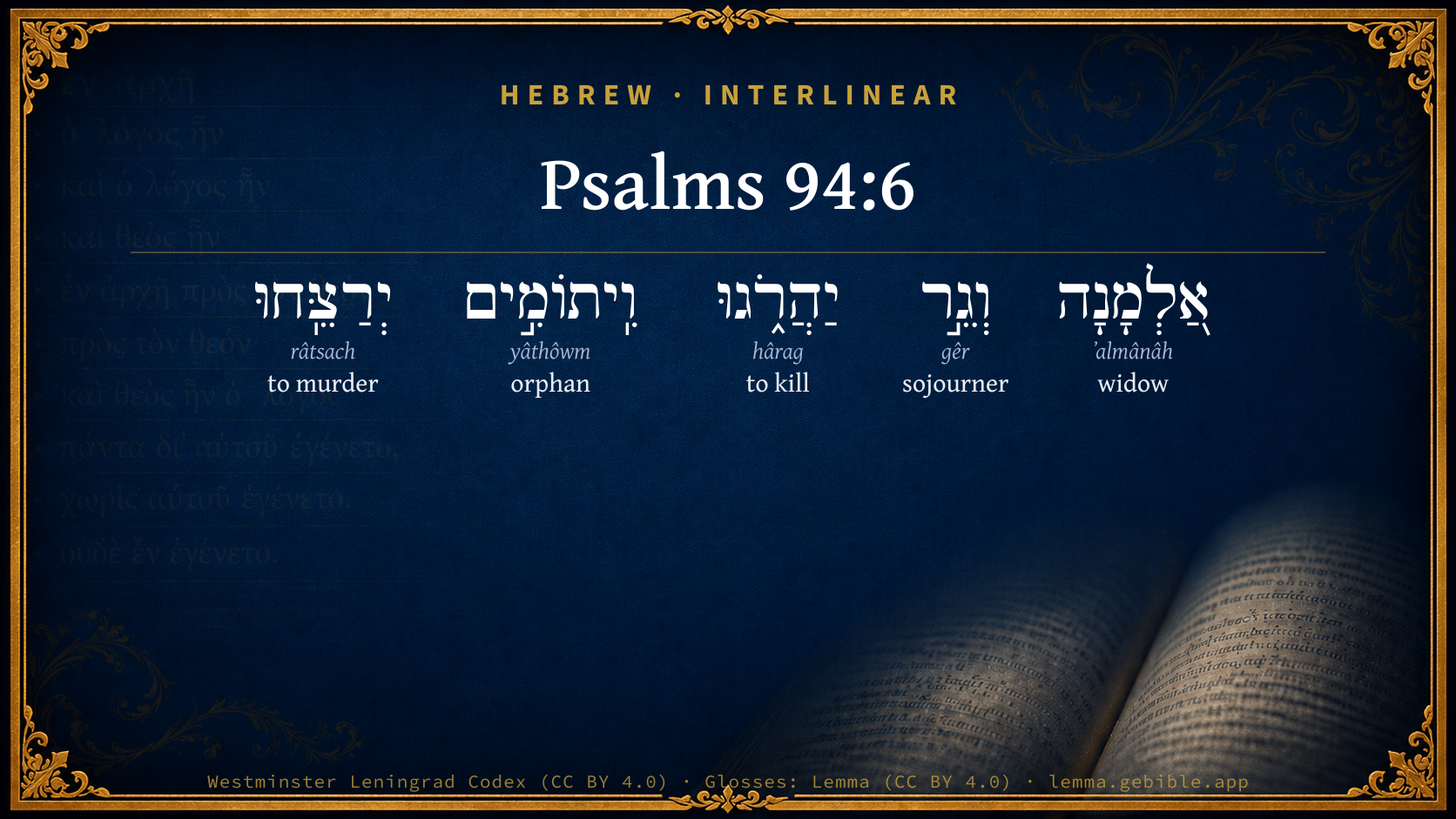
Psalms 94:6

Hebrew (Westminster Leningrad Codex) Psalms 94:6 appears in the Hebrew Old Testament. The text above is from the Westminster Leningrad Codex. Each word links to its Strong’s number, a concise gloss, and parsing drawn from the Open Scriptures Hebrew Bible morphology. Click any word for its full Brown-Driver-Briggs (BDB) entry.
Download image
Cite this verse

Psalms 94:6 (World English Bible). Public Domain. Lemma interlinear Bible study tool, https://lemma.gebible.app/v/psalms/94/6.

Show BibTeX & RIS
BibTeX
RIS
English Translation
They kill the widow and the alien, And murder the fatherless.
World English Bible · Public Domain
Download a study sheet

One document with this verse’s original text, its word-by-word gloss line, the meaning frame, cross-references with their text, attributed commentary, and full source and license credits — printable, and it pastes into notes with its structure intact.

This verse Autodidact and up

Study sheet (.html) Plain text (.txt)

A passage Seminary Student

Up to 50 verses in one chapter. A passage sheet keeps up to 6 commentary sources and 12 cross-references per verse, in the order this page ranks them, and says so on the sheet whenever that leaves anything out. Ask for a single verse and you get the Autodidact verse sheet above.

Everything on this page stays free to read, with no account — the sheet is a download of what is already on screen, not access to it.

Want to remove ads? Support Godless Engineer
Compare translations 3

The same verse in 3 English versions, stacked beneath the original-language interlinear above. Click any original word for its lexicon entry.

Each is an independent rendering of the whole verse — the interlinear is not word-aligned to these translations.

Highlighted words mark where these versions differ — a whole-verse word diff, not a word-by-word alignment.

  • World English Bible Public Domain
    They kill the widow and the alien, And murder the fatherless.
  • King James Version Public Domain
    They slay the widow and the stranger, and murder the fatherless.
  • unfoldingWord Literal Text CC BY-SA 4.0
    They kill the widow and the sojourner, and they murder the fatherless.

unfoldingWord Literal Text — © unfoldingWord, licensed CC BY-SA 4.0. Word-aligned USFM3 via Door43 (git.door43.org/unfoldingWord/en_ult).

Versions to compare (up to 4)

3 of 4 selected

Show all 18 translations

Every available English version of this verse, each an independent rendering of the whole verse.

  • World English Bible Public Domain
    They kill the widow and the alien, And murder the fatherless.
  • Berean Standard Bible Public Domain
    They kill the widow and the foreigner; they murder the fatherless.
  • Majority Standard Bible Public Domain
    They kill the widow and the foreigner; they murder the fatherless.
  • King James Version Public Domain
    They slay the widow and the stranger, and murder the fatherless.
  • American Standard Version (1901) Public Domain
    They slay the widow and the sojourner, And murder the fatherless.
  • Revised Version (1885) Public Domain
    They slay the widow and the stranger, and murder the fatherless.
  • Geneva Bible (1599) Public Domain
    They slay the widowe and the stranger, and murder the fatherlesse.
  • Douay-Rheims (1899) Public Domain
    They have slain the widow and the stranger: and they have murdered the fatherless.
  • Young's Literal Translation Public Domain
    Widow and sojourner they slay, And fatherless ones they murder.
  • Literal Standard Version CC BY-SA 4.0
    They slay widow and sojourner, || And they murder fatherless ones.
  • Unlocked Literal Bible CC BY-SA 4.0
    They kill the widow and foreigner who lives in their country, and they murder the fatherless.
  • unfoldingWord Literal Text CC BY-SA 4.0
    They kill the widow and the sojourner, and they murder the fatherless.
  • Darby Bible Public Domain
    They slay the widow and the stranger, and murder the fatherless,
  • World Messianic Bible Public Domain
    They kill the widow and the alien, and murder the fatherless.
  • Webster's Bible Public Domain
    They slay the widow and the stranger, and murder the fatherless.
  • Free Bible Version CC BY-SA 4.0
    They kill widows and foreigners; they murder orphans.
  • Bible in Basic English Public Domain
    They put to death the widow and the guest, they take the lives of children who have no father;
  • JPS Tanakh (1917) Public Domain
    They slay the widow and the stranger, and murder the fatherless.

Literal Standard Version (2020), Covenant Press — licensed CC BY-SA 4.0. Text via the HelloAO Bible API (eBible.org). Unlocked Literal Bible (unfoldingWord) — licensed CC BY-SA 4.0. Text via the HelloAO Bible API (eBible.org). unfoldingWord Literal Text — © unfoldingWord, licensed CC BY-SA 4.0. Word-aligned USFM3 via Door43 (git.door43.org/unfoldingWord/en_ult). Free Bible Version, Dr. Jonathan Gallagher — licensed CC BY-SA 4.0. Text via the HelloAO Bible API (eBible.org).

Word by word

More ways to search: Search by grammar → Find every occurrence → Compare this word →

Practice this passage: Drill this verse → Learn its vocabulary →

About this verse

These counts appear in no published source. They are computed here, from the morphology-tagged text and Lemma’s own curated glosses. What Lemma adds →

5
words
5
distinct lemmas
Wisdom
section

Shared distinctive vocabulary

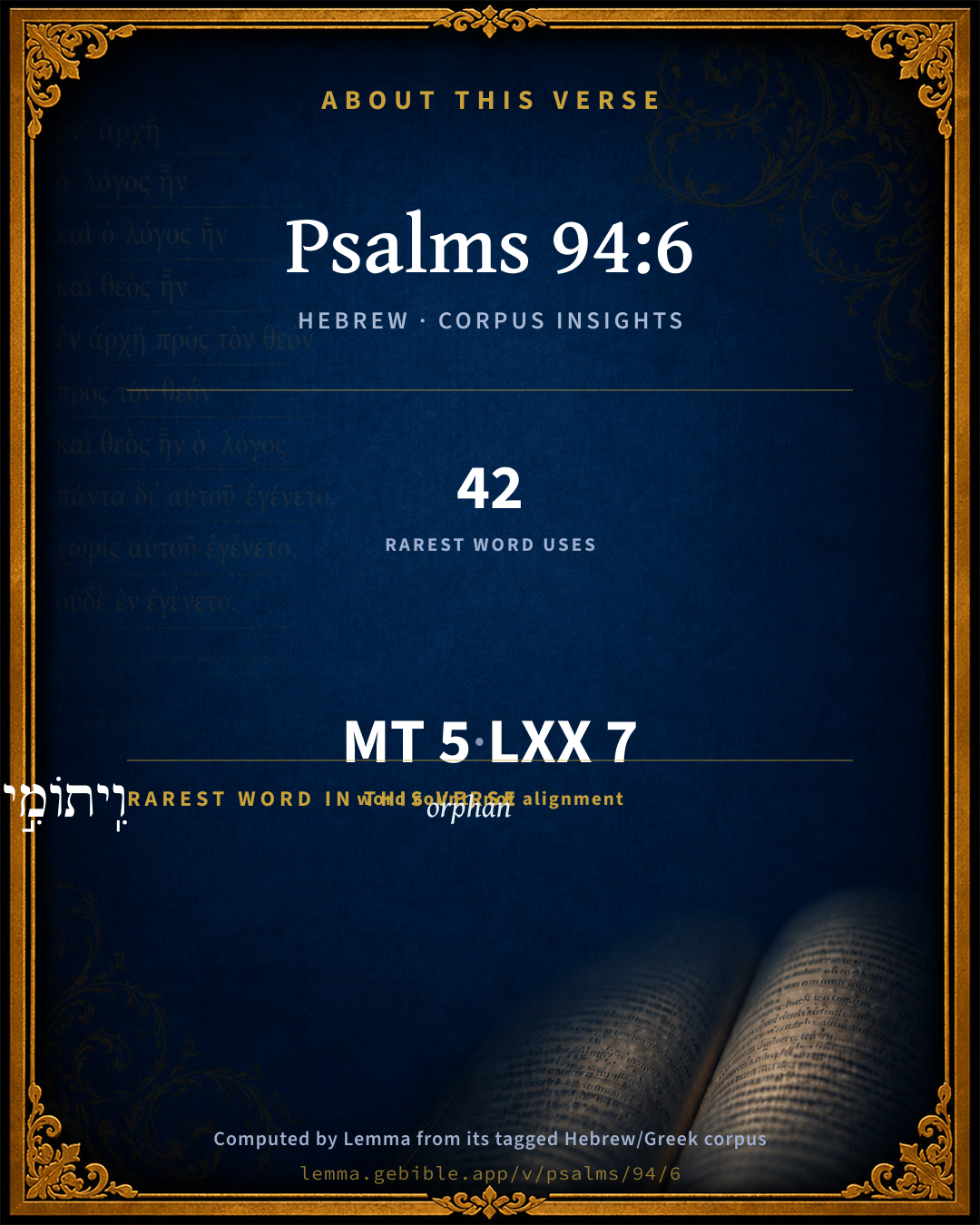
וִֽיתוֹמִ֣ים orphan H3490 occurs in 42 verses of the Hebrew Bible. Also found in:

Grammatical profile

  • 2 verbs
  • 3 nouns

Verb forms

  • יַהֲרֹ֑גוּ Qal · Imperfect
  • יְרַצֵּֽחוּ Piel · Imperfect

Hebrew & Septuagint length

In English translation the verse runs 11 words from the Hebrew and 11 from the Septuagint (LXX English) — the same length.

A rough comparison of the two English renderings, which tokenize alike — not a word-level alignment.

Word counts can differ between the Hebrew and the Greek without any difference in meaning — e.g. the Hebrew direct-object marker אֵת has no separate Greek word, and Greek often adds the article ὁ.

In the original languages it is 5 Hebrew tokens and 7 Greek tokens — but the two are counted differently (Hebrew bundles its prefixes and suffixes into one token; the Greek is in lemma form), so that isn’t a like-for-like length.

Cross-references

6

Topical passages linked to Psalms 94:6 in the Treasury of Scripture Knowledge — connected by theme and wording, ordered by reader-vote popularity; previews shown in the World English Bible.

  • Isaiah 10:2 to turn aside the needy from justice, and to rob the poor of my people of their right, that widows may be their spoil, and that they may make the fatherless their prey!
  • Jeremiah 7:6 if you don't oppress the foreigner, the fatherless, and the widow, and don't shed innocent blood in this place, neither walk after other gods to your own hurt:
  • Ezekiel 22:7 In you have they set light by father and mother; in the midst of you have they dealt by oppression with the foreigner; in you have they wronged the fatherless and the widow.
  • Malachi 3:5 I will come near to you to judgment; and I will be a swift witness against the sorcerers, and against the adulterers, and against the perjurers, and against those who oppress the hireling in his wages, the widow, and the fatherless, and who deprive the foreigner of justice, and don't fear me," says Yahweh of Hosts.
  • Isaiah 13:15–18 Everyone who is found shall be thrust through; and everyone who is taken shall fall by the sword.
  • Jeremiah 22:3 Thus says Yahweh: Execute you justice and righteousness, and deliver him who is robbed out of the hand of the oppressor: and do no wrong, do no violence, to the foreigner, the fatherless, nor the widow; neither shed innocent blood in this place.

Cross-references courtesy of OpenBible.info (CC BY 4.0).

Hebrew and Greek witnesses Masoretic Hebrew ↔ Greek Septuagint

The same verse in the two great witnesses to the Old Testament, shown verse-for-verse.

You’re reading Greek Psalm 93 (Hebrew Psalm 94). The Septuagint counts the superscription, so verse numbers can differ from the Hebrew — chapter-level alignment, not verse-by-verse. Numbering follows Rahlfs.

These are two independent witnesses, not word-aligned to each other, and the Septuagint is shown in lemma (dictionary) form.

Hebrew Psalms 94:6 Masoretic · Westminster Leningrad Codex

אַ֭לְמָנָה וְגֵ֣ר יַהֲרֹ֑גוּ וִֽיתוֹמִ֣ים יְרַצֵּֽחוּ

They kill the widow and the alien, And murder the fatherless.

World English Bible · Public Domain

Greek LXX Greek Psalm 93:6 Septuagint · lemma form

χήρα καί προσήλυτος ἀποκτείνω καί ὀρφανός φονεύω

They have slain the widow and fatherless, and murdered the stranger.

LXX2012 (modern English Septuagint) · Public Domain

Hebrew: Westminster Leningrad Codex (CC BY 4.0). Greek: Septuagint (public domain); English from LXX2012 (modern English Septuagint) (Public Domain). How the Septuagint differs from the Hebrew →

Commentary

Notes on Psalms 94:6 from classic Christian and Jewish commentators (each source and its license shown beneath its notes). The classic Christian expositions comment on the surrounding passage and are grouped to its opening verse, so a note may address several verses; the Jewish commentaries on the Tanakh (Rashi and others) are per-verse, so they appear only where the commentator wrote on this verse.

Lemma curates 59 commentaries, every one of them public domain or Creative Commons licensed, each selected and text-cleaned for this edition rather than reprinted as found. About our sources →

Trapp's Complete Commentary

John Trapp

Psa 94:6 They slay the widow and the stranger, and murder the fatherless.

Ver. 6. They slay the widow and the stranger] Those sacred persons, thy proper clients; to such a height of hard heartedness are they grown, that they pity not them whom nature and courtesy would show compassion to.

Nulla fides, pietasque viris qui castra sequuntur.

Let us bless ourselves out of the bloody fingers of barbarous and brutish men, skilful to destroy.

John Trapp, A Commentary or Exposition upon All the Books of the Old and New Testament (1647–1656) — public domain. Text from a community e-Sword module.

J. A. Alexander on Psalms

Joseph Addison Alexander

6. (Psa 94:6) Widow and stranger they kill, and orphans they murder. The strongest description of injustice and violence is given by saying, that they not only wrong but murder the very classes of sufferers, who in the Law are constantly exhibited as objects of compassion. See Exo 22:21-24, Deu 10:18.

Joseph Addison Alexander, The Psalms Translated and Explained (1850) — public domain. Text from a community e-Sword module.

Tyndale Open Study Notes

Tyndale Open Resources

94:6 widows . . . foreigners . . . orphans: The Lord’s law protects needy people (Deut 24:17; 27:19), but they remain vulnerable in society.

Tyndale Open Study Notes — © Tyndale Open Resources, licensed CC BY-SA 4.0. Text via the HelloAO Bible API.

Adam Clarke's Commentary

Verse 6. They slay the widow] Nebuchadnezzar carried on his wars with great cruelty. He carried fire and sword every where; spared neither age, sex, nor condition. The widow, the orphan, and the stranger, persons in the most desolate condition of life, were not distinguished from others by his ruthless sword.

Adam Clarke's Commentary on the Bible (1810–1826) — public domain. Text from a community e-Sword/MySword module.

Ellicott's Commentary for English Readers

(6) Stranger.—The mention of the stranger as one friendless and helpless (Exo_22:21), under the tyranny of the great, seems to imply that domestic, and not foreign oppression, is the grievance.

A Bible Commentary for English Readers, edited by Charles John Ellicott (1878–1897) — public domain. Text from a community e-Sword module.

The Cambridge Bible for Schools and Colleges

gen. ed. J. J. S. Perowne

6. A proverbial expression for inhumanity and treachery. They do not scruple to murder the most defenceless, and those whose lives, by the traditions of Semitic hospitality, should have been inviolable. “From the earliest times of Semitic life the lawlessness of the desert … has been tempered by the principle that the guest is inviolable.… To harm a guest, or to refuse him hospitality, is an offence against honour, which covers the perpetrator with indelible shame.” Robertson Smith, Rel. of Semites, p. 76. Cp. Exo_22:21-22; Psa_10:14; Mal_3:5.

The Cambridge Bible for Schools and Colleges (gen. ed. J. J. S. Perowne; Cambridge University Press, 1878–1918) — public domain. Text from a community e-Sword module.

John Gill's Exposition

They slay the widow and the stranger,.... Who are so both in a literal and figurative sense, such who are weak and feeble, helpless and friendless; or who are deprived of their faithful pastors, who were as husbands and fathers to them, and who profess themselves pilgrims and strangers here; these the followers of the man of sin have inhumanly put to death, supposing they did God good service:

and murder the fatherless; having slain the parents in a cruel and barbarous manner, murder their infants; or figuratively such who are as orphans, destitute of their spiritual fathers, who were the instruments of begetting them in Christ, and of nourishing them with the words of faith and good doctrine; with the blood of these the whore of Rome has often made herself drunk, and therefore blood shall be given her to drink, Rev 17:5.

John Gill's Exposition of the Whole Bible (1746–1763) — public domain (CC PDM 1.0). Text via the HelloAO Bible API.

Albert Barnes' Notes on the Bible

They slay the widow and the stranger, and murder the fatherless - To do this is everywhere represented as a special crime, and as especially offensive to God from the fact that these classes are naturally feeble and unprotected. See the notes at Isa 1:17; Psa 68:5; Psa 82:3.

Albert Barnes' Notes on the Bible (1834–1885) — public domain. Text from a community e-Sword/MySword module.

Matthew Poole's English Annotations

Whom common humanity obliged them to spare, and pity, and relieve.

Matthew Poole's English Annotations on the Holy Bible (1683–1685) — public domain. Text from a community e-Sword/MySword module.

The Treasury of David

Charles H. Spurgeon

Ver. 6. They slay the widow and the stranger, and murder the fatherless. They deal most arrogantly with those who are the most evident objects of compassion. The law of God especially commends these poor ones to the kindness of good men, and it is peculiar wickedness which singles them out to be the victims not only of fraud but of murder. Must not such inhuman conduct as this provoke the Lord? Shall the tears of widows, the groans of strangers, and the blood of orphans be poured forth in vain? As surely as there is a God in heaven, he will visit those who perpetrate such crimes; though he bear long with them, he will yet take vengeance, and that speedily.

Ver. 6. Widow; fatherless. An old Jewish writer (Philo Judaeus) has pointed out how aptly the titles of widow and orphan befitted the Hebrew nation, because it had no helper save God only, and was cut off from all other people by its peculiar rites and usages, whereas the Gentiles, by their mutual alliances and intercourse, had, as it were, a multitude of kindred to help them in any strait. J. M. Neale.

Ver. 6-9.

1. Conspicuous sin.

2. Absurd supposition.

3. Overwhelming argument.

Psalms 94:7*

Charles H. Spurgeon's The Treasury of David (1869–1885) — public domain. Psalms only. Text from a community e-Sword/MySword module.

Whedon's Commentary on the Bible

Daniel D. Whedon

6. They slay the widow… stranger… fatherless—Proving that the laws of war and of humanity are set aside. Non-combatants—innocent helpless ones—are murdered. It is a massacre, not a war. Murder without the pretence of trial or discrimination. The classes here distinguished were specially protected by the law of Moses, and by the promise of God. Exo_22:21-22; Psa_10:14; Psa_10:18; Psa_68:5; Isa_3:15

Daniel D. Whedon (gen. ed.), Commentary on the Old and New Testaments (1874–1909) — public domain. Text from a community e-Sword module.

The Pulpit Commentary

They slay the widow and the stranger, and murder the fatherless. (comp. Isa_1:17-23 Isa_10:2 Eze_22:6-9 Mal_3:5; also Psa_10:8-10)

The Pulpit Commentary (1880–1919), ed. H.D.M. Spence-Jones & Joseph S. Exell — public domain. Text from a community e-Sword module.

Lesson kit

Teaching starters — assembled from the data on this page, not authored interpretation. Every prompt links to the verse data it draws on. Edit before teaching.

Psalms, in the Wisdom, opens this verse with 5 words (5 distinct Hebrew lemmas). Its most distinctive word is yâthôwm (“orphan”). A historical commentator’s framing appears above. Read the whole chapter for the surrounding context.

Discussion questions

  1. How does “orphan” (yâthôwm) shape what this verse is saying?
  2. How does Exodus 22:22, which shares the word «orphan», read alongside this verse?
  3. The translations on this page render this verse differently — a whole-verse word diff, not a word-by-word alignment. What might account for the different wordings?
  4. «יַהֲרֹ֑גוּ» is a Qal Imperfect verb. How does that grammatical form shape the action described?
  5. Compare how Trapp's Complete Commentary and J. A. Alexander on Psalms read this verse. Where do they agree or differ?

Things to notice

Reading settings

Reading text

Shown beneath each verse's original-language words.

Old Testament
Old Testament edition

Read the OT as the Masoretic Hebrew (MT) or the Greek Septuagint (LXX).

English shown for the Greek Septuagint (in the Hebrew ↔ Greek comparison).

Comparing translations? Open the Compare panel on any verse page to stack up to four side by side.