
Genesis 37:20

Hebrew (Westminster Leningrad Codex) Genesis 37:20 appears in the Hebrew Old Testament. The text above is from the Westminster Leningrad Codex. Each word links to its Strong’s number, a concise gloss, and parsing drawn from the Open Scriptures Hebrew Bible morphology. Click any word for its full Brown-Driver-Briggs (BDB) entry.
Download image
Cite this verse

Genesis 37:20 (World English Bible). Public Domain. Lemma interlinear Bible study tool, https://lemma.gebible.app/v/genesis/37/20.

Show BibTeX & RIS
BibTeX
RIS
English Translation
Come now therefore, and let's kill him, and cast him into one of the pits, and we will say, 'An evil animal has devoured him.' We will see what will become of his dreams."
World English Bible · Public Domain
Highlights
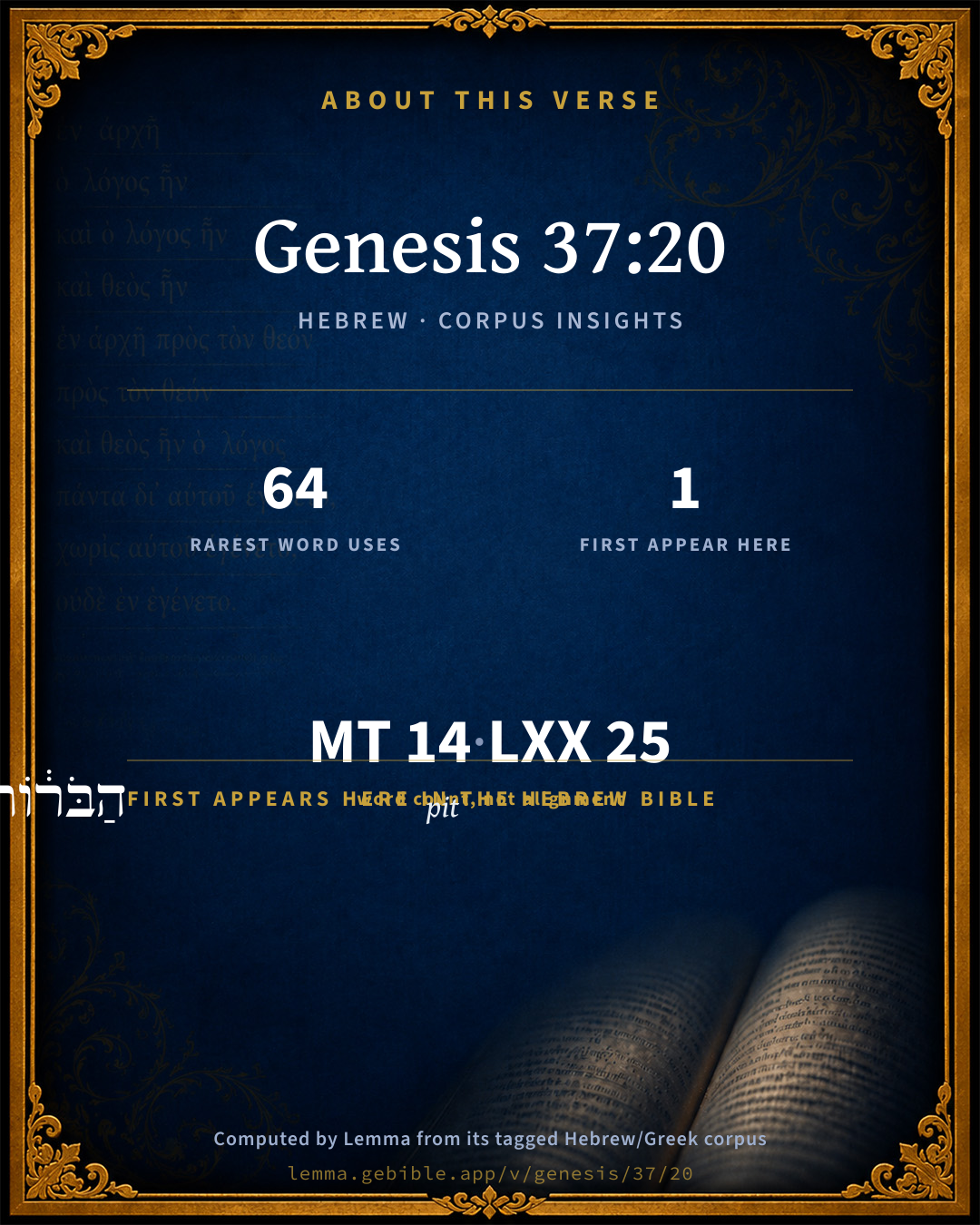
  • 1 first appearance in the Hebrew Bible
Full analysis ↓
Download a study sheet

One document with this verse’s original text, its word-by-word gloss line, the meaning frame, cross-references with their text, attributed commentary, and full source and license credits — printable, and it pastes into notes with its structure intact.

This verse Autodidact and up

Study sheet (.html) Plain text (.txt)

A passage Seminary Student

Up to 50 verses in one chapter. A passage sheet keeps up to 6 commentary sources and 12 cross-references per verse, in the order this page ranks them, and says so on the sheet whenever that leaves anything out. Ask for a single verse and you get the Autodidact verse sheet above.

Everything on this page stays free to read, with no account — the sheet is a download of what is already on screen, not access to it.

Want to remove ads? Support Godless Engineer
Compare translations 3

The same verse in 3 English versions, stacked beneath the original-language interlinear above. Click any original word for its lexicon entry.

Each is an independent rendering of the whole verse — the interlinear is not word-aligned to these translations.

Highlighted words mark where these versions differ — a whole-verse word diff, not a word-by-word alignment.

  • World English Bible Public Domain
    Come now therefore, and let's kill him, and cast him into one of the pits, and we will say, 'An evil animal has devoured him.' We will see what will become of his dreams."
  • King James Version Public Domain
    Come now therefore, and let us slay him, and cast him into some pit, and we will say, Some evil beast hath devoured him: and we shall see what will become of his dreams.
  • unfoldingWord Literal Text CC BY-SA 4.0
    So now, come and let us kill him and throw him into one of the cisterns. Then we will say an evil animal devoured him, and we will see what his dreams become!”

unfoldingWord Literal Text — © unfoldingWord, licensed CC BY-SA 4.0. Word-aligned USFM3 via Door43 (git.door43.org/unfoldingWord/en_ult).

Versions to compare (up to 4)

3 of 4 selected

Show all 18 translations

Every available English version of this verse, each an independent rendering of the whole verse.

  • World English Bible Public Domain
    Come now therefore, and let's kill him, and cast him into one of the pits, and we will say, 'An evil animal has devoured him.' We will see what will become of his dreams."
  • Berean Standard Bible Public Domain
    “Come now, let us kill him and throw him into one of the pits. We can say that a vicious animal has devoured him. Then we shall see what becomes of his dreams!”
  • Majority Standard Bible Public Domain
    “Come now, let us kill him and throw him into one of the pits. We can say that a vicious animal has devoured him. Then we shall see what becomes of his dreams!”
  • King James Version Public Domain
    Come now therefore, and let us slay him, and cast him into some pit, and we will say, Some evil beast hath devoured him: and we shall see what will become of his dreams.
  • American Standard Version (1901) Public Domain
    Come now therefore, and let us slay him, and cast him into one of the pits, and we will say, And evil beast hath devoured him: and we shall see what will become of his dreams.
  • Revised Version (1885) Public Domain
    Come now therefore, and let us slay him, and cast him into one of the pits, and we will say, An evil beast hath devoured him: and we shall see what will become of his dreams.
  • Geneva Bible (1599) Public Domain
    Come now therefore, and let vs slay him, and cast him into some pitte, and wee will say, A wicked beast hath deuoured him: then wee shall see, what will come of his dreames.
  • Douay-Rheims (1899) Public Domain
    Come, let us kill him, and cast him into some old pit: and we will say: Some evil beast hath devoured him: and then it shall appear what his dreams avail him:
  • Young's Literal Translation Public Domain
    and now, come, and we slay him, and cast him into one of the pits, and have said, An evil beast hath devoured him; and we see what his dreams are.'
  • Literal Standard Version CC BY-SA 4.0
    and now, come, and we slay him, and cast him into one of the pits, and have said, An evil beast has devoured him; and we see what his dreams are.”
  • Unlocked Literal Bible CC BY-SA 4.0
    Come now, therefore, let us kill him and cast him into one of the pits. We will say, 'A wild animal has devoured him.' We will see what will become of his dreams.”
  • unfoldingWord Literal Text CC BY-SA 4.0
    So now, come and let us kill him and throw him into one of the cisterns. Then we will say an evil animal devoured him, and we will see what his dreams become!”
  • Darby Bible Public Domain
    And now come and let us kill him, and cast him into one of the pits, and we will say, An evil beast has devoured him; and we will see what becomes of his dreams.
  • World Messianic Bible Public Domain
    Come now therefore, and let’s kill him, and cast him into one of the pits, and we will say, ‘An evil animal has devoured him.’ We will see what will become of his dreams.”
  • Webster's Bible Public Domain
    Come now therefore, and let us slay him, and cast him into some pit; and we will say, Some evil beast hath devoured him; and we shall see what will become of his dreams.
  • Free Bible Version CC BY-SA 4.0
    “Come on, let's kill him and throw him into one of the pits. We'll say that some wild animal has eaten him. Then we'll see what happens to his dreams!”
  • Bible in Basic English Public Domain
    Let us now put him to death and put his body into one of these holes, and we will say, An evil beast has put him to death: then we will see what becomes of his dreams.
  • JPS Tanakh (1917) Public Domain
    Come now therefore, and let us slay him, and cast him into one of the pits, and we will say: An evil beast hath devoured him; and we shall see what will become of his dreams.'

Literal Standard Version (2020), Covenant Press — licensed CC BY-SA 4.0. Text via the HelloAO Bible API (eBible.org). Unlocked Literal Bible (unfoldingWord) — licensed CC BY-SA 4.0. Text via the HelloAO Bible API (eBible.org). unfoldingWord Literal Text — © unfoldingWord, licensed CC BY-SA 4.0. Word-aligned USFM3 via Door43 (git.door43.org/unfoldingWord/en_ult). Free Bible Version, Dr. Jonathan Gallagher — licensed CC BY-SA 4.0. Text via the HelloAO Bible API (eBible.org).

Word by word

More ways to search: Search by grammar → Find every occurrence → Compare this word →

Practice this passage: Drill this verse → Learn its vocabulary →

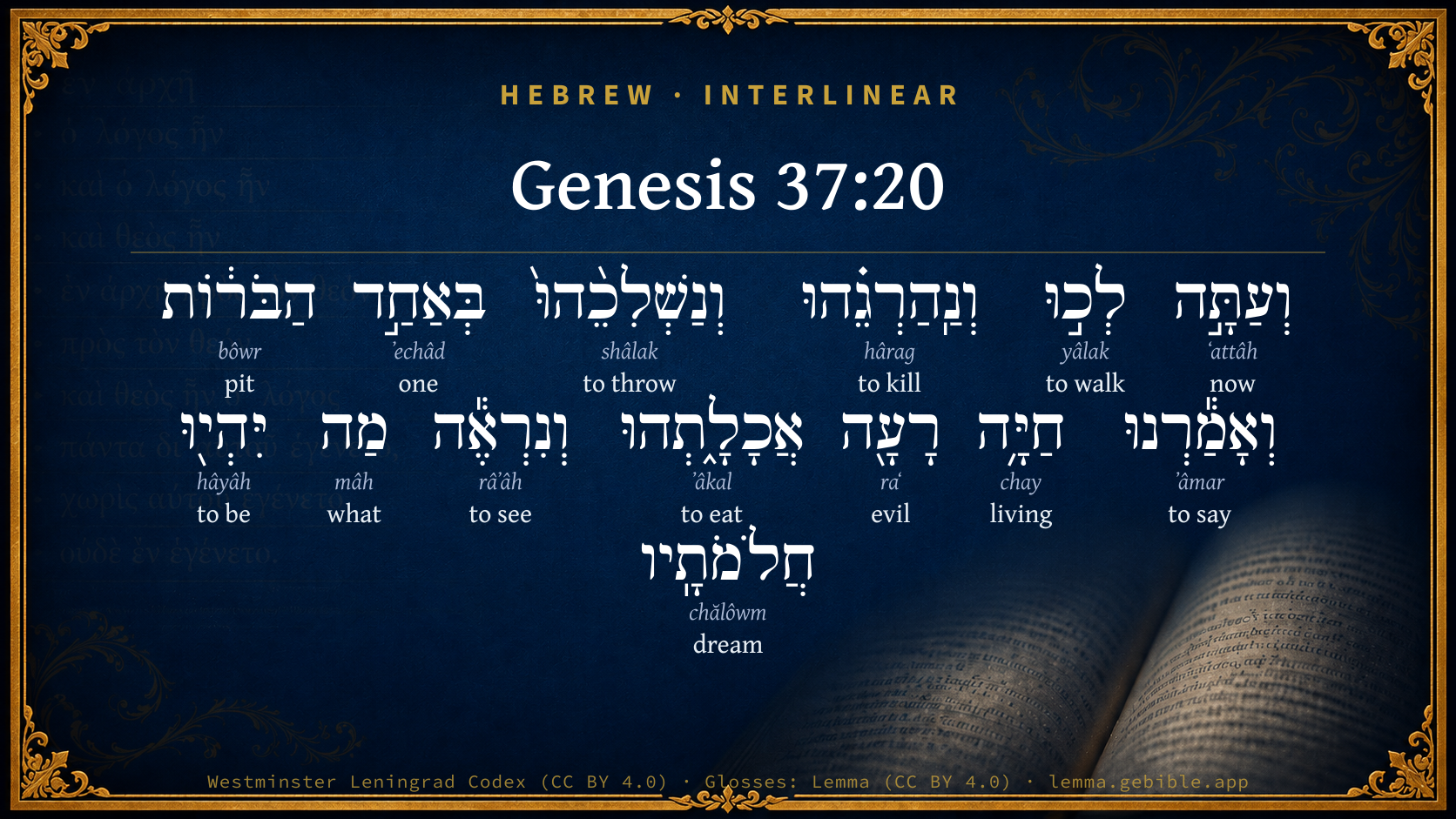
חֲלֹמֹתָֽיו
chălôwm
H2472
“dreams · his”
Noun, Common, Masculine, Plural, Construct + Suffix, Personal, 3rd Person, Masculine, Singular
Part of Speech
Noun
Type
Common
Gender
Masculine
Number
Plural
State
Construct
Full BDB Definition

Origin: from H2492

TWOT: 663a

dream - dream (ordinary) - dream (with prophetic meaning)
  1. וְעַתָּ֣ה ʻattâh H6258 “and · now” Conjunction + Adverb
  2. לְכ֣וּ yâlak H3212 “walk” Verb, Qal, Imperative, 2nd Person, Masculine, Plural
  3. וְנַֽהַרְגֵ֗הוּ hârag H2026 “and · to kill · him” Conjunction + Verb, Qal, Cohortative, 1st Person, Common, Plural + Suffix, Personal, 3rd Person, Masculine, Singular
  4. וְנַשְׁלִכֵ֨הוּ֙ shâlak H7993 “and · to throw · him” Conjunction + Verb, Hiphil, Cohortative, 1st Person, Common, Plural + Suffix, Personal, 3rd Person, Masculine, Singular
  5. בְּאַחַ֣ד ʼechâd H259 “in/at · one” Preposition + Adjective, Cardinal number, Masculine, Singular, Construct
  6. הַבֹּר֔וֹת bôwr H953 “the · pits” Particle, Definite Article + Noun, Common, Masculine, Plural, Absolute
  7. וְאָמַ֕רְנוּ ʼâmar H559 “and · to say” Conjunction + Verb, Qal, Sequential Perfect, 1st Person, Common, Plural
  8. חַיָּ֥ה chay H2416 “living” Noun, Common, Feminine, Singular, Absolute
  9. רָעָ֖ה raʻ H7451 “evil” Adjective, Adjective, Feminine, Singular, Absolute
  10. אֲכָלָ֑תְהוּ ʼâkal H398 “to eat · him” Verb, Qal, Perfect, 3rd Person, Feminine, Singular + Suffix, Personal, 3rd Person, Masculine, Singular
  11. וְנִרְאֶ֕ה râʼâh H7200 “and · to see” Conjunction + Verb, Qal, Imperfect, 1st Person, Common, Plural
  12. מַה mâh H4100 “what” Particle, Interrogative
  13. יִּהְי֖וּ hâyâh H1961 “to be” Verb, Qal, Imperfect, 3rd Person, Masculine, Plural

About this verse

These counts appear in no published source. They are computed here, from the morphology-tagged text and Lemma’s own curated glosses. What Lemma adds →

14
words
14
distinct lemmas
Pentateuch
section

First appearance in Scripture

This word makes its first canonical appearance in the Hebrew Bible here:

  • הַבֹּר֔וֹת pit H953

Grammatical profile

  • 7 verbs
  • 3 nouns
  • 2 adjectives
  • 1 adverb
  • 1 particle

Verb forms

  • לְכ֣וּ Qal · Imperative
  • וְנַֽהַרְגֵ֗הוּ Qal · Cohortative
  • וְנַשְׁלִכֵ֨הוּ֙ Hiphil · Cohortative
  • וְאָמַ֕רְנוּ Qal · Sequential Perfect
  • אֲכָלָ֑תְהוּ Qal · Perfect
  • וְנִרְאֶ֕ה Qal · Imperfect
  • יִּהְי֖וּ Qal · Imperfect

Hebrew & Septuagint length

In English translation the verse runs 34 words from the Hebrew and 35 from the Septuagint (LXX English) — closely comparable.

A rough comparison of the two English renderings, which tokenize alike — not a word-level alignment.

Word counts can differ between the Hebrew and the Greek without any difference in meaning — e.g. the Hebrew direct-object marker אֵת has no separate Greek word, and Greek often adds the article ὁ.

In the original languages it is 14 Hebrew tokens and 25 Greek tokens — but the two are counted differently (Hebrew bundles its prefixes and suffixes into one token; the Greek is in lemma form), so that isn’t a like-for-like length.

Cross-references

18

Topical passages linked to Genesis 37:20 in the Treasury of Scripture Knowledge — connected by theme and wording, ordered by reader-vote popularity; previews shown in the World English Bible.

  • Titus 3:3 For we were also once foolish, disobedient, deceived, serving various lusts and pleasures, living in malice and envy, hateful, and hating one another.
  • Proverbs 27:4 Wrath is cruel, And anger is overwhelming; But who is able to stand before jealousy?
  • 2 Kings 2:24 He looked behind him and saw them, and cursed them in the name of Yahweh. There came forth two she-bears out of the wood, and mauled forty-two lads of them.
  • Proverbs 1:11–12 If they say, "Come with us, Let's lay in wait for blood; Let's lurk secretly for the innocent without cause;
  • Matthew 2:2–16 "Where is he who is born King of the Jews? For we saw his star in the east, and have come to worship him."
  • 1 Samuel 26:2 Then Saul arose, and went down to the wilderness of Ziph, having three thousand chosen men of Israel with him, to seek David in the wilderness of Ziph.
  • 1 Kings 13:24 When he was gone, a lion met him by the way, and killed him: and his body was cast in the way, and the donkey stood by it; the lion also stood by the body.
  • Psalms 64:5 They encourage themselves in evil plans. They talk about laying snares secretly. They say, "Who will see them?"
  • Proverbs 1:16 For their feet run to evil. They hurry to shed blood.
  • Proverbs 6:17 Haughty eyes, a lying tongue, Hands that shed innocent blood;
  • Proverbs 10:18 He who hides hatred has lying lips. He who utters a slander is a fool.
  • Matthew 27:40–42 and saying, "You who destroy the temple, and build it in three days, save yourself! If you are the Son of God, come down from the cross!"
  • Mark 15:29–32 Those who passed by blasphemed him, wagging their heads, and saying, "Ha! You who destroy the temple, and build it in three days,
  • John 3:12 If I told you earthly things and you don't believe, how will you believe if I tell you heavenly things?
  • John 12:10–11 But the chief priests conspired to put Lazarus to death also,
  • Acts 4:16–18 saying, "What shall we do to these men? Because indeed a notable miracle has been done through them, as can be plainly seen by all who dwell in Jerusalem, and we can't deny it.
  • 1 Samuel 24:20 Now, behold, I know that you shall surely be king, and that the kingdom of Israel shall be established in your hand.
  • Proverbs 28:13 He who conceals his sins doesn't prosper, But whoever confesses and renounces them finds mercy.

Cross-references courtesy of OpenBible.info (CC BY 4.0).

Hebrew and Greek witnesses Masoretic Hebrew ↔ Greek Septuagint

The same verse in the two great witnesses to the Old Testament, shown verse-for-verse.

These are two independent witnesses, not word-aligned to each other, and the Septuagint is shown in lemma (dictionary) form.

Hebrew Genesis 37:20 Masoretic · Westminster Leningrad Codex

וְעַתָּ֣ה לְכ֣וּ וְנַֽהַרְגֵ֗הוּ וְנַשְׁלִכֵ֨הוּ֙ בְּאַחַ֣ד הַבֹּר֔וֹת וְאָמַ֕רְנוּ חַיָּ֥ה רָעָ֖ה אֲכָלָ֑תְהוּ וְנִרְאֶ֕ה מַה יִּהְי֖וּ חֲלֹמֹתָֽיו

Come now therefore, and let's kill him, and cast him into one of the pits, and we will say, 'An evil animal has devoured him.' We will see what will become of his dreams."

World English Bible · Public Domain

Greek LXX Genesis 37:20 Septuagint · lemma form

νῦν οὖν δεῦτε ἀποκτείνω αὐτός καί ῥίπτω αὐτός εἰς εἷς ὁ λάκκος καί εἶπον θηρίον πονηρός καταἐσθίω αὐτός καί ὁράω τίς εἰμί ὁ ἐνύπνιον αὐτός

Now then come, let us kill him, and cast him into one of the pits; and we will say, An evil wild beast has devoured him; and we shall see what his dreams will be.

LXX2012 (modern English Septuagint) · Public Domain

Hebrew: Westminster Leningrad Codex (CC BY 4.0). Greek: Septuagint (public domain); English from LXX2012 (modern English Septuagint) (Public Domain). How the Septuagint differs from the Hebrew →

Targum (Aramaic paraphrase)

2

The Targum is the ancient Jewish Aramaic paraphrase of the Hebrew Scriptures — an interpretive translation, not the Hebrew text itself. Onkelos (literal) and Pseudo-Jonathan (expansive) render the Torah, and Jonathan the Prophets. Coverage is partial: where no permissively-licensed English translation exists for a verse, only the Aramaic is shown. This is verse-level text, not a word-by-word alignment to the Hebrew.

  1. Targum Onkelos Torah (Genesis–Deuteronomy)
    וכְעַן אֱתוֹ וְנִקְטְלִנֵּהּ וְנִרְמִנֵּהּ בַּחֲדָא מִן גֻּבַּיָּא וְנֵימַר חַיְתָא בִישְׁתָא אֲכַלְתֵּהּ וְנֶחֱזֵי מָה יְהוֹן בְּסוֹף חֶלְמוֹהִי

    (no public-domain English translation for this verse)

    Targum Onkelos — Aramaic: “Onkelos Genesis” (public domain); “Onkelos Exodus” (public domain); “Onkelos Leviticus” (public domain); “Onkelos Numbers” (public domain); “Onkelos Deuteronomy” (public domain). English: “Sefaria Community Translation” (CC0 1.0 (public-domain dedication)); “J.W. Etheridge. The Targums of Onkelos and Jonathan Ben Uzziel on the Pentateuch. London: Longmans, Green, 1862” (public domain). Text via Sefaria.

  2. Targum Pseudo-Jonathan Torah (Genesis–Deuteronomy)
    וּכְדוֹן אָתוּ וְנִקְטְלִינֵיהּ וְנַרְמִינֵיהּ בְּחַד מִן גוֹבַיָא וְנֵימַר חַיְיתָא בִּישְׁתָּא אַכְלָתֵיהּ וְנִחְמֵי מַה יְהִי פֶּשֶׁר חֶלְמוֹי

    And now come let us kill him and throw him into one of the pits and say that an evil beast hath devoured him; and we shall see what will be the interpretation of his dreams.

    Targum Pseudo-Jonathan — Aramaic: “Targum Jonathan on Genesis” (public domain); “Targum Jonathan on Exodus” (public domain); “Targum Jonathan on Leviticus” (public domain); “Targum Jonathan on Numbers” (public domain); “Targum Jonathan on Deuteronomy” (public domain). English: “The Targum of Jonathan ben Uzziel, trans. J. W. Etheridge, London, 1862” (public domain). Text via Sefaria.

Commentary

Notes on Genesis 37:20 from classic Christian and Jewish commentators (each source and its license shown beneath its notes). The classic Christian expositions comment on the surrounding passage and are grouped to its opening verse, so a note may address several verses; the Jewish commentaries on the Tanakh (Rashi and others) are per-verse, so they appear only where the commentator wrote on this verse.

Lemma curates 59 commentaries, every one of them public domain or Creative Commons licensed, each selected and text-cleaned for this edition rather than reprinted as found. About our sources →

Trapp's Complete Commentary

John Trapp

Gen 37:20 Come now therefore, and let us slay him, and cast him into some pit, and we will say, Some evil beast hath devoured him: and we shall see what will become of his dreams.

Ver. 20. And we will say.] So they consult, to cover their murder with a lie. One sin admitted makes way for another. He that hath fallen down one rung of hell’s ladder, knows not where he shall stop, till he break his neck at the bottom.

John Trapp, A Commentary or Exposition upon All the Books of the Old and New Testament (1647–1656) — public domain. Text from a community e-Sword module.

The Biblical Illustrator

Joseph S. Exell

Gen_37:20

We will say, some evil beast hath devoured him

Plottings of iniquity

This text is no part of revelation.

It is a premeditated falsehood, agreed to and told by Josephs brothers, to account for his absence.

I. THAT WICKED MEN DARE NOT TRUST EACH OTHER TO EXPLAIN THINGS, BUT MUST AGREE TO FALSIFY AND DECEIVE. We will say.

II. THAT IT IS A CHARACTERISTIC OF WICKED MEN TO LAY THE BLAME OF THEIR SINS UPON OTHERS. We will say, a wild beast, etc. From the very first it was so. Adam struck upon that mean device, and threw the blame of his sin upon his wife: The woman that Thou gavest me. I know of no instance in the Bible that so clearly indicates the strength of the tendency as this. Some blame one thing or person, and some another; but, like Josephs brethren, they know there is no wild beast, and they must sooner or later confess their sins and say, We are verily guilty.

III. THAT WICKED MEN FEEL THERE IS A TIME COMING WHEN THEY MUST MAKE OUT A CASE--MUST TELL HOW THINGS HAPPENED, We will say, an evil beast, etc. (T. Kelly.)

The conspiracy

I. THE VICTIM. Joseph. What were his crimes?

1. He had done his duty as superintendent of the shepherds; even though it must have been painful to him to convey bad tidings about his brethren, and painful to grieve his fathers mind by doing so. Yet he only discharged the duty of his office. The fault was theirs, not his.

2. He had been marked as his fathers special favourite and confidant. But they should have tried to be more worthy of trust themselves.

3. He had been favoured with wonderful dreams, in which their future subordinate relation was clearly indicated.

II. THE PLOTTERS.

1. Ten against one. Cowardice of this. Combination of thought and strength for a wicked purpose.

2. Ten brothers against one brother. Fratricical struggles the worst of all. Of all relatives, such near ones as these should agree.

3. Ten men, and brothers, against a youthful brother. Might and numbers are not always a proof of right (once all the world was against our elder Brother).

4. Ten wicked men against one good man. Though hand join in hand, wickedness shall not go unpunished.

5. Ten sons against a father. In plotting against Joseph they were fighting against Jacob. Those who oppose Jesus are rebelling against God.

III. THE PLOT.

1. The opportunity.

(1) They are away from home.

(2) They are alone.

(3) Joseph, in his coat of honour, approaches to inspect the flocks.

2. The conspiracy. The dreamer cometh. All agree on one point. Joseph to be put out of the way. First resolve to kill him and tell a lie to hide the crime (Gen_37:20). Reuben intercedes, intending to rescue him (Gen_37:22). They agree to this, thinking he would die of starvation. Thus they would not shed his blood, and yet would take his life. They strip off his offending coat. Approach of the merchants. Judah would make a profit by the transaction. He little thought of the great profit his wickedness would yield Gen_45:7-8). Joseph is sold. Imagine his cries and tears, &c. Gen_42:21). The remorse of Reuben, and the joy of the rest.

3. The consequences. One sin leads to another. They must resort to lying, &c. The trouble that comes upon Jacob (Gen_42:34-35). Learn:

I. Innocent people are often surrounded by evil (Joh_16:33).

II. Virtue and truth to be pursued, notwithstanding danger.

III. One sin leads to another. Ultimate concealment impossible.

IV. God makes the wrath of man to praise Him.

V. Jesus has saved us from going down into the pit, and has redeemed us from bondage. (J. C. Gray.)

Josephs confinement in a tank

The tank in which Josephs brethren cast him was apparently one of those huge reservoirs excavated by shepherds in the East, that they may have a supply of water for their flocks in the end of the dry season, when the running waters fail them. Being so narrow at the mouth that they can be covered by a single stone, they gradually widen and form a large subterranean room; and the facility they thus afford for the confinement of prisoners was from the first too obvious not to be commonly taken advantage of. In such a place was Joseph left to die--under the ground, sinking in mire, his flesh creeping at the touch of unseen slimy creatures, in darkness, alone; that is to say, in a species of confinement which tames the most reckless and maddens the best balanced spirits, which shakes the nerve of the calmest, and has sometimes left the blankness of idiocy in masculine understandings. A few wild cries that ring painfully round his prison show him he need expect no help from without; a few wild and desperate beatings round the shelving walls of rock show him there is no possibility of escape; he covers his face, or casts himself on the floor of his dungeon to escape within himself, but only to find this also in vain, and to rise and renew efforts he knows to be fruitless. Here, then, is what has come of his fine dreams. With shame he now remembers the beaming confidence with which he had related them; with bitterness he thinks of the bright life above him, from which these few feet cut him so absolutely off, and of the quick termination that has been put to all his hopes. Into such tanks do young persons especially get east; finding themselves suddenly dropped out of the lively scenery and bright sunshine in which they have been living, down into roomy graves where they seem left to die at leisure. They had conceived a way of being useful in the world; they had found an aim or a hope; they had, like Joseph, discerned their place and were making towards it, when suddenly they seem to be thrown out and are left to learn that the world can do very well without them, that the sun and moon and the eleven stars do not drop from their courses or make wail because of their sad condition. High aims and commendable purposes are not so easily fulfilled as they fancied. The faculty and desire in them to be of service are not recognised. Men do not make room for them, and God seems to disregard the hopes He has excited in them. The little attempt at living they have made seems only to have got themselves and others into trouble. They begin to think it a mistake their being in the world at all; they curse the day of their birth. Others are enjoying this life, and seem to be making something of it, having found work that suits and develops them; but, for their own part, they cannot get fitted into life at any point, and are excluded from the onward movement of the world. They are again and again flung back, until they fear they are not to see the fulfilment of any one bright dream that has ever visited them, and that they are never, never at all, to live out the life it is in them to live, or find light and scope for maturing those germs of the rich human nature that they feel within them. All this is in the way to attainment. This or that check, this long burial for years, does not come upon you merely because stoppage and hindrance have been useful to others, but because your advancement lies through these experiences. (M. Dods, D. D.)

Evil and mistaken policy

After this profound scheme no doubt there would follow a chuckle of triumph. The thing was so lucky in its plan, in its seasonableness, in its practicability; it seemed to meet every point of the case; it made an end of the whole difficulty; it turned over a new leaf in the history of the family. Let us understand that our plans are not good simply because they happen to be easy.

Let us understand that a policy is not necessarily sound because it is necessarily final. In the case before us we see both the power and the weakness of men. Let us slay--there is the power; and we will see what will become of his dreams--there is the weakness. You can slay the dreamer, but you cannot touch the dream. You can poison the preacher, but what power have you over his wonderful doctrine? Can you trace it? Where are its footprints? Ten or twelve men have power to take one lad, seventeen years of age, to double him up, and throw him, a dead carcase, into a pit. Wonderful power! What then? And we will see what become of his dreams. A word which perhaps was spoken in scorn or derision, or under a conviction that his dreams would go along with him. Still, underlying all the derision is the fact that, though the dreamer has been slain, the dream remains untouched. The principle applies very widely. You may disestablish an institution externally, politically, financially; but if the institution be founded upon truth, the Highest Himself will establish her. If we suppose that by putting out our puny arms and clustering in eager crowds round the ark of God, we are the only defenders of the faith and conservers of the Church--then be it known unto us that our power is a limited ability, that God himself is the life, the strength, the defence, and the hope of His own kingdom. The principle, then, has a double application--an application to those who would injure truth, and an application tothose who would avail themselves of forbidden facilities to maintain the empire of God amongst men. (J. Parker, D. D.)

Joseph cast into the pit

The favoured son of Jacob was but a type of the Beloved of the Father. Joseph, in being thus murdered in the intention of his brethren, and, as it were, buried in the pit, yet preserved in order to be exalted to the right hand of royalty and power, was a type of Christ crucified, buried, risen, and glorified. Joseph was far away from his father when trouble overwhelmed him, and his loud cries for help died away in the distance without reaching the parental ear. And what were the words of Jesus in the depths of His affliction? (Psa_22:1-2). Pity from man He did not expect, and if His Father had but been near Him, He felt that He could brave every danger and endure every pain. Nay, that suffering would have lost all its sting, and sorrow its misery. But the bitter and the agonizing thing was to feel that He was alone--literally alone in His unparalleled sufferings. He had come to them on a better errand than Josephs, and with a message of mercy from abetter than any earthly father. One would think that a herald from so august a court, and bearing so welcome a message, would have been hailed with acclamations of delight by the Jewish people. That people had long been looking anxiously for their long-promised Messiah. His deportment was far more lovely and prepossessing than Josephs--His innocency of life and warmth of brotherly affection far exceeded Josephs--He was the chiefest among ten thousand, and the altogether lovely. He pleaded with the Jews with a depth of pathos never equalled. Have you ever envied Christ? Do you envy Him His right to the throne of your heart, and have you usurped it, and seated yourself in that throne? There is such a thing, too, as envying the Lord Jesus, in the persons of His happy and highly-favoured followers. Let us cheerfully share our blessings with every afflicted Joseph who is east into the pit of adversity. (E. Dalton.)

No pit can hide from Gods eye

How were Josephs brethren to secure themselves from the reproach of the world, and the indignation of their father? They would cast Josephs body into some pit after they had killed him. But where were they to find a pit deep enough to hide him from the view of God? It was right not to disoblige their father; but was their God less to be regarded than their father? Many heathens will rise up in judgment against those professors of the true religion, who behave in such manner, as if it were a matter of indifference what sins they commit, if they can preserve their characters from suspicion. A certain Hindoo, trained up in the strictest sect of the religion of his country, had macerated his body to such a degree, that his life was in imminent danger. A Christian physician, who went to see him with the governor of the town, begged him to swallow an infusion of the Jesuits bark in wine, which he thought might preserve his life. The religion of the Indian prohibited this cure. The physician promised that none should hear of it. But the poor Indian answered, that he could not hide it from himself, and chose to die, rather than violate his conscience. (G. Lawson, D. D.)

Good intentions must be boldly carried out

Reubens intention was good, and let all due credit be given to every man who has a good intention, a merciful object in view. No one of us has a word to say against such a man. But there are times when everything depends upon tone, precision, definiteness, emphasis. I am not sure that Reuben could not have turned the whole company. There are times when one man can play with a thousand. A little one can put ten thousand to flight. Why? Because wickedness is weakness. There is more craven heartedness among bad men than ever you can find among men who are soundly, living good. Is that a hard message to some of you? You know a very bold wicked man. Well, so you do; but that man is a coward. One day the shaking of a feather will cause him to become pale, and to tremble and turn round suspiciously, and timidly, as if every leaf in the forest had an indictment against him and all the elements in the universe had conspired to destroy him. Here is a call to us, most assuredly. We are placed in critical circumstances. Sometimes eight or nine men upon the board of directors have said that their plan will take this or that particular course. We believe that the plan is corrupt; we believe that it is wicked, displeasing to God, mischievous to man. What is our duty under circumstances such as these? To modify, to pare away, to dilute sound principle and intense conviction, to speak whisperingly, timidly, apologetically? I think not. But to meet the proposition with the definiteness of sound principle, and to be in that minority which in the long run is omnipotent--the minority of God. It is not easy to do this. Far be it from me to say that if I had been in Reubens place I should take a more emphatic course. We are not called upon, in preaching Gods truth, to say what we would have done under such circumstances; but to put out that which is ideal, absolute, final, and then to exhort one another, to endeavour by Gods tender mighty grace to press towards its attainment. (J. Parker. D. D.)

The Biblical Illustrator, edited by Joseph S. Exell (c. 1880s–1900s) — public domain. Text from a community e-Sword module.

Adam Clarke's Commentary

Verse 20. Come now and let us slay him] What unprincipled savages these must have been to talk thus coolly about imbruing their hands in an innocent brother's blood! How necessary is a Divine revelation, to show man what God hates and what he loves! Ferocious cruelty is the principal characteristic of the nations and tribes who receive not the law at his mouth.

Adam Clarke's Commentary on the Bible (1810–1826) — public domain. Text from a community e-Sword/MySword module.

John Calvin's Commentaries

20. And cast him into some pit. Before they perpetrate the murder, they seek a pretext whereby they may conceal their crime from men. Meanwhile, it never enters into their mind, that what is hidden from men cannot escape the eyes of God. But so stupid is hypocrisy, that while it flees from the disgrace of the world, it is careless about the judgment of God. But it is a disease deeply rooted in the human mind, to put some specious color on every extreme act of iniquity. For although an inward judge convicts the guilty, they yet confirm themselves in impudence, that their disgrace may not appear unto others.

And we shall see what will become of his dreams. As if the truth of God could be subverted by the death of one man, they boast that they shall have attained their wish when they have killed their brother; namely, that his dreams will come to nothing. This is not, indeed, their avowed purpose, but turbulent envy drives them headlong to fight against God. But whatever they design in thus contending with God in the dark, their attempts will, at length, prove vain. For God will always find a way through the most profound abyss, to the accomplishment of what he has decreed. If, then, unbelievers provoke us by their reproaches, and proudly boast that our faith will profit us nothing; let not their insolence discourage or weaken us, but let us confidently proceed.

John Calvin's Commentaries (1540-1563) — public domain. Text from the Calvin Translation Society English edition (1840s-50s) via the Christian Classics Ethereal Library (ccel.org). Calvin's coverage is partial (roughly two-thirds of the Bible); uncommented books and verses are honest gaps, never fabricated. The 19th-century editor's footnotes and remarks are omitted so the notes are faithfully Calvin's own voice.

Ellicott's Commentary for English Readers

(20) Into some pit.—Heb., into one of the pits, that is, cisterns dug to catch and preserve the rain water. In summer they are dry, and a man thrown into one of them would have very little chance of escape, as they are not only deep, but narrow at the top. The Jewish interpreters accuse Simeon of being the prime mover in the plot, and say that this was the reason why Joseph cast him into prison (Gen_42:24).

A Bible Commentary for English Readers, edited by Charles John Ellicott (1878–1897) — public domain. Text from a community e-Sword module.

The Cambridge Bible for Schools and Colleges

gen. ed. J. J. S. Perowne

20. one of the pits) Cisterns, or tanks, are necessary in that country for the storage of water. Long droughts are frequent, and the heat very great. Water is needed for the flocks and herds. The tanks are frequently covered with a stone. The aperture is narrow, and the sides of the tank converging.

The Cambridge Bible for Schools and Colleges (gen. ed. J. J. S. Perowne; Cambridge University Press, 1878–1918) — public domain. Text from a community e-Sword module.

John Gill's Exposition

And Reuben heard it,.... Overheard what they said, not being in the consultation; perhaps knowing his temper and disposition to be more mild and gentle, and being the elder brother, might fear he would overrule matters against them, and therefore Simeon and Levi did not choose to have him in the debate; or he might be at some distance and entirely absent when the consultation was held, and their intention was reported to him by some of them:

and he delivered him out of their hands; from slaying him; that is, he endeavoured to do it by proposing another scheme:

and said, let us not kill him; or let us not smite the soul (t); the dear soul, or take away life.

(t) "ne percutiamus vel occidamus animam", Sam. Ar. Syr.

John Gill's Exposition of the Whole Bible (1746–1763) — public domain (CC PDM 1.0). Text via the HelloAO Bible API.

Haydock's Catholic Bible Commentary

Pit: walled around to contain water: Hebrew Bur. Bar means a well that has no walls. (Menochius) --- Shall appear. They resolve to tell a lie, and easily believe that Joseph had been as bad as themselves in telling one first. If they had believed the dreams were from God, they would hardly have supposed that they could prevent them from having their effect. (Haydock)

George Leo Haydock (1774–1849), Haydock's Catholic Family Bible and Commentary, 1859 edition — public domain. Excludes Psalms (Douay-Rheims chapter numbering differs from Protestant) and Deuterocanonical books (Catholic canon only).

Matthew Poole's English Annotations

Cast him into some pit; partly, as unworthy of burial; partly, to cover their villanous action; and partly, that they might quickly put him out of their sight and minds.

Some evil beast hath devoured him, there being great store of such creatures in those parts. See 1Ki 13:24; 2Ki 2:24.

Matthew Poole's English Annotations on the Holy Bible (1683–1685) — public domain. Text from a community e-Sword/MySword module.

Whedon's Commentary on the Bible

Daniel D. Whedon

20. Let us slay him — Here we note the dark and brutal passions to which they had yielded under the power of jealousy and envy. They now show themselves fit for foulest deeds and blackest falsehoods.

Daniel D. Whedon (gen. ed.), Commentary on the Old and New Testaments (1874–1909) — public domain. Text from a community e-Sword module.

The Pulpit Commentary

Come now therefore, and lot us slay him, and cast him into some pit (literally, into one of the pits or cisterns in the neighborhood), and we will say (sc. to his father and ours), Some (literally, an) evil beast hath devoured him (which will account for his disappearance); and we shall see what will become of his dreams or, what his dreams will be.

HOMILIES BY J.F. MONTGOMERY

Vers. 20, 21.

God"s providence and man"s responsibility.

I GOD"S PURPOSES CARRIED OUT BY MEN IRRESPECTIVE OF THEIR OWN PLANS. The word to Abraham (Gen_15:13) does not seem to have been thought of by Jacob. After long wandering he seemed to be settled in Canaan. But God was bringing to pass his word. Jacob"s injudicious fondness for Joseph, the anger and murderous design of his brethren (cf. Joh_11:50; Act_3:17) Reuben"s timid effort for his deliverance, (cf. Act_5:8) Judah"s worldly wise counsel, (cf. Luk_13:31) Joseph"s imprisonment by Potiphar, the conspiracy in Pharaoh"s household, were so many steps by which the sojourn in Egypt was brought about. So in the founding of the Christian Church. The writing on the cross (Joh_19:20) pointed to three separate lines of history, two of them pagan, which combined to bring about the sacrifice of Christ and the spread of the gospel. So in the case of individuals. God s promises are. (2Co_1:20) There may seem to be many hindrances, from ourselves (Psa_65:3) or from circumstances; but no cause for. (Luk_12:32 Luk_22:35) Unlikely or remote causes are often God"s instruments. The envy of the Jews opened for St. Paul, through his imprisonment, a door to the Gentiles which otherwise he would not have (Act_21:28; Php_1:13)

II IT IS NO EXCUSE FOR WRONGDOING THAT IT HAS WORKED GOOD (cf. Rom_9:19) The cruel act of his brethren brought about the realizing of Joseph"s dreams, his greatness in Egypt, the support of the whole family during the famine, and the fulfillment of God"s word; but not the less was it wrong (Gen_42:21; cf. Mat_26:24) Moral guilt depends not upon the result, but on the motive. God has given the knowledge of redemption to move our will, and the example of Christ and the moral law to guide our lives. The fulfillment of his purposes belongs to himself. He needs not our help to bring it to pass. It is not his will that we should forsake his immutable rules of right and Wrong, even for the sake of bringing on the fulfillment of prophecy. Much evil has sprung from neglect of this e.g. the maxim, Faith need not be kept with heretics. God"s will and promise, Psa_37:3-5.

III To EACH ONE THERE IS A HISTORY WITHIN A HISTORY. Our actions lead to their appropriate results (Gal_6:8) at the same time that they tend to carry out God"s purposes, whether we will or not. Each one is a factor in the great plan which in the course of ages God is working out. (Joh_5:17) Men such as they are, wise or ignorant, guided by the Spirit or resisting him, loving or selfish, pressing upwards or following worldly impulses, all are so directed by a power they cannot comprehend that they bring about what he wills. (Psa_2:2-4) But along with this there is a history which concerns ourselves, which we write for ourselves, the issues of which depend immediately upon ourselves. To each a measure of time, knowledge, opportunity has been given, on the use of which the line of our course depends. Nothing can turn aside the course of God"s providence; but upon our faithfulness or unfaithfulness depends our place and joy in it. Hence encouragement to work for Christ, however small our powers. (1Sa_14:6) The little is accepted as well as the great; and as "workers together with him" (2Co_6:1) our work cannot be in vain. M.

The Pulpit Commentary (1880–1919), ed. H.D.M. Spence-Jones & Joseph S. Exell — public domain. Text from a community e-Sword module.

Rashi

Rabbi Shlomo Yitzchaki (Rashi)

ונראה מה יהיו חלמתיו AND WE SHALL SEE WHAT WILL BECOME OF HIS DREAMS — R. Isaac said, this verse calls for a homiletic explanation. The Holy Spirit said this latter part of the text. They say “let us slay him”, and Scripture (i.e. the Holy Spirit) breaks in upon their words concluding them by saying, “and we shall see what will become of his dreams”: we shall see whose words will be fulfilled — yours or mine. For it is impossible that they should have said, “and we shall see what will become of his dreams”, for as soon as they would kill him his dreams would be of no effect (Tanchuma Yashan 1:9:13).

Rashi on the Tanakh — English translations: “The Judaica Press complete Tanach with Rashi, translated by A. J. Rosenberg” (CC BY 4.0); “Pentateuch with Rashi's commentary by M. Rosenbaum and A.M. Silbermann, 1929-1934” (public domain); “The Metsudah Tanach series, Lakewood, N.J” (CC BY 4.0); and “The Book of Joshua, Metsudah Publications, 1997” (CC BY 4.0). Text via Sefaria.

Ramban (Nachmanides)

Rabbi Moshe ben Nachman (Ramban / Nachmanides)

AND WE SHALL SEE WHAT WILL BECOME OF HIS DREAMS. This is a derisive metaphor: “We shall see after his death if we shall prostrate ourselves before him.”The correct interpretation appears to me to be that they said, “Now we shall see what will become of his dreams, for if he shall be rescued from our hands he will surely reign over us.” But our Rabbis said: “It is the Ruach Hakodesh, Note 90. that says, We shall see what will become of his dreams, which completes the sentence, and not Joseph’s brothers. as if to say; ‘We shall see whose words shall stand, Mine or theirs.’”

Ramban (Nachmanides) on the Tanakh — English translation: “Commentary on the Torah by Ramban (Nachmanides). Translated and annotated by Charles B. Chavel. New York, Shilo Pub. House, 1971-1976” (CC BY 4.0). Text via Sefaria.

Radak

Rabbi David Kimhi (Radak)

ועתה לכו, the word לכו in this context is an exhortation to act without delay, as we explained on 28,2. [there it referred to the word קום, Ed.]

Radak on the Tanakh — English translations: “Sefaria Community Translation” (CC0 1.0 (public-domain dedication)); “Eliyahu Munk, HaChut Hameshulash” (CC BY 4.0); “Rabbi Mike Feuer, Jerusalem Anthology” (CC BY 4.0); and “R. David Kimhi on the first book of Psalms, Translated by R.G. Finch, London, 1919” (public domain). Text via Sefaria.

Lesson kit

Teaching starters — assembled from the data on this page, not authored interpretation. Every prompt links to the verse data it draws on. Edit before teaching.

Genesis, in the Pentateuch, opens this verse with 14 words (14 distinct Hebrew lemmas). Its most distinctive word is chălôwm (“dream”). A historical commentator’s framing appears above. Read the whole chapter for the surrounding context.

Discussion questions

  1. What does “dream” (chălôwm) contribute to the verse as a whole?
  2. The word “pit” first appears here in Scripture. What is being introduced at this debut?
  3. Titus 3:3 shares this passage’s theme. How do the two illuminate each other?
  4. The translations on this page render this verse differently — a whole-verse word diff, not a word-by-word alignment. What might account for the different wordings?
  5. The verb «לְכ֣וּ» is Qal Imperative. How does its form color the action?
  6. Reading how Trapp's Complete Commentary and The Biblical Illustrator read this verse, where do the two commentators agree and where do they part?

Things to notice

Reading settings

Reading text

Shown beneath each verse's original-language words.

Old Testament
Old Testament edition

Read the OT as the Masoretic Hebrew (MT) or the Greek Septuagint (LXX).

English shown for the Greek Septuagint (in the Hebrew ↔ Greek comparison).

Comparing translations? Open the Compare panel on any verse page to stack up to four side by side.