Numbers 25:5

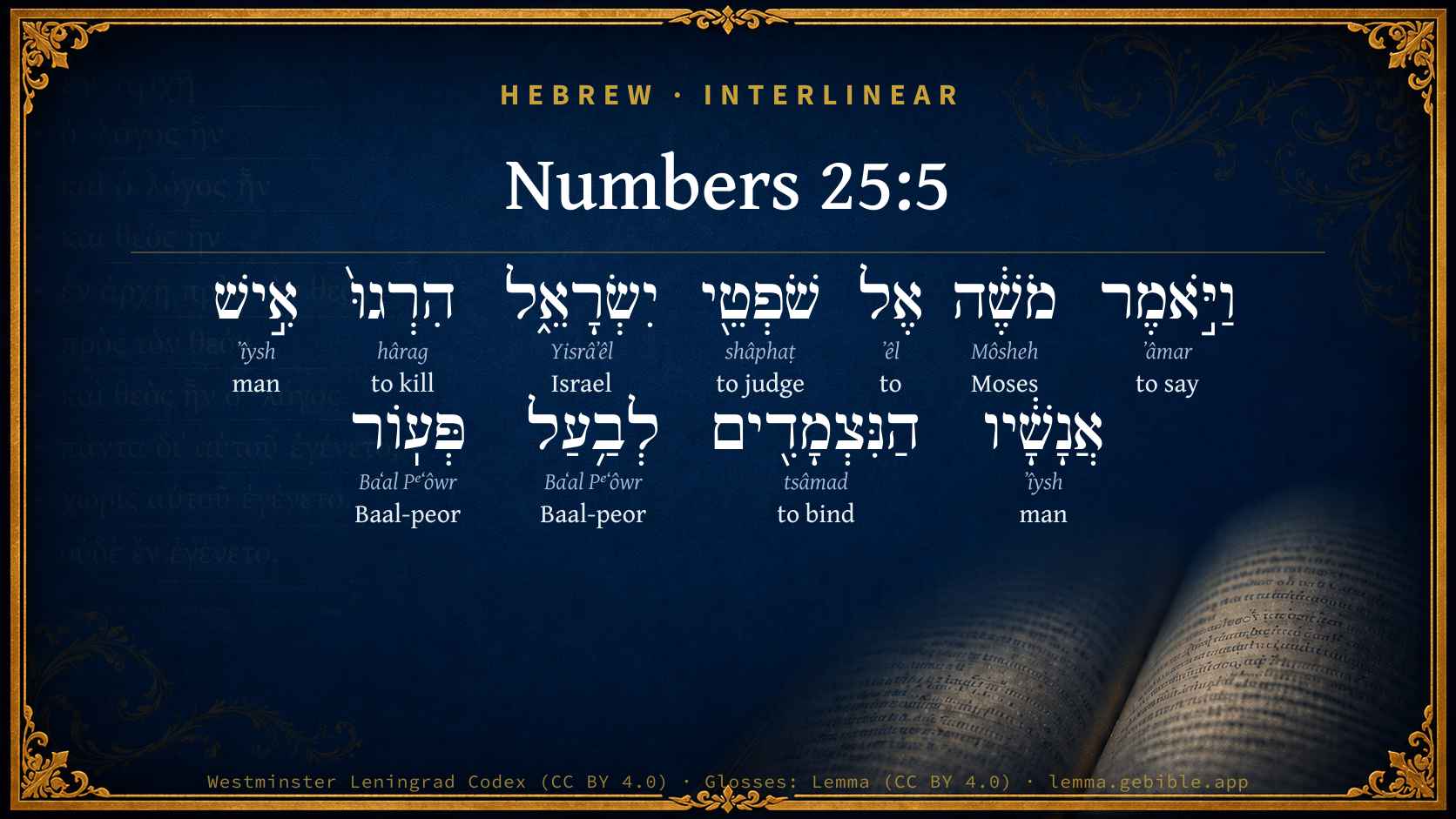
Hebrew (Westminster Leningrad Codex) Numbers 25:5 appears in the Hebrew Old Testament. The text above is from the Westminster Leningrad Codex. Each word links to its Strong’s number, a concise gloss, and parsing drawn from the Open Scriptures Hebrew Bible morphology. Click any word for its full Brown-Driver-Briggs (BDB) entry.
Download image
Cite this verse

Numbers 25:5 (World English Bible). Public Domain. Lemma interlinear Bible study tool, https://lemma.gebible.app/v/numbers/25/5.

Show BibTeX & RIS
BibTeX
RIS
English Translation
Moses said to the judges of Israel, Kill you everyone his men who have joined themselves to Baal Peor.
World English Bible · Public Domain
Download a study sheet

One document with this verse’s original text, its word-by-word gloss line, the meaning frame, cross-references with their text, attributed commentary, and full source and license credits — printable, and it pastes into notes with its structure intact.

This verse Autodidact and up

Study sheet (.html) Plain text (.txt)

A passage Seminary Student

Up to 50 verses in one chapter. A passage sheet keeps up to 6 commentary sources and 12 cross-references per verse, in the order this page ranks them, and says so on the sheet whenever that leaves anything out. Ask for a single verse and you get the Autodidact verse sheet above.

Everything on this page stays free to read, with no account — the sheet is a download of what is already on screen, not access to it.

Want to remove ads? Support Godless Engineer
Compare translations 3

The same verse in 3 English versions, stacked beneath the original-language interlinear above. Click any original word for its lexicon entry.

Each is an independent rendering of the whole verse — the interlinear is not word-aligned to these translations.

Highlighted words mark where these versions differ — a whole-verse word diff, not a word-by-word alignment.

  • World English Bible Public Domain
    Moses said to the judges of Israel, Kill you everyone his men who have joined themselves to Baal Peor.
  • King James Version Public Domain
    And Moses said unto the judges of Israel, Slay ye every one his men that were joined unto Baalpeor.
  • unfoldingWord Literal Text CC BY-SA 4.0
    And Moses said to the judges of Israel, “Slay a man his men, the ones who bound themselves to Baal of Peor.”

unfoldingWord Literal Text — © unfoldingWord, licensed CC BY-SA 4.0. Word-aligned USFM3 via Door43 (git.door43.org/unfoldingWord/en_ult).

Versions to compare (up to 4)

3 of 4 selected

Show all 18 translations

Every available English version of this verse, each an independent rendering of the whole verse.

  • World English Bible Public Domain
    Moses said to the judges of Israel, Kill you everyone his men who have joined themselves to Baal Peor.
  • Berean Standard Bible Public Domain
    So Moses told the judges of Israel, “Each of you must kill all of his men who have joined in worshiping Baal of Peor.”
  • Majority Standard Bible Public Domain
    So Moses told the judges of Israel, “Each of you must kill all of his men who have joined in worshiping Baal of Peor.”
  • King James Version Public Domain
    And Moses said unto the judges of Israel, Slay ye every one his men that were joined unto Baalpeor.
  • American Standard Version (1901) Public Domain
    And Moses said unto the judges of Israel, Slay ye every one his men that have joined themselves unto Baal-peor.
  • Revised Version (1885) Public Domain
    And Moses said unto the judges of Israel, Slay ye every one his men that have joined themselves unto Baal-peor.
  • Geneva Bible (1599) Public Domain
    Then Moses sayd vnto the Iudges of Israel, Euery one slay his men that were ioyned vnto Baal Peor.
  • Douay-Rheims (1899) Public Domain
    And Moses said to the judges of Israel: Let every man kill his neighbours, that have been initiated to Beelphegor.
  • Young's Literal Translation Public Domain
    And Moses saith unto the judges of Israel, `Slay ye each his men who are joined to Baal-Peor.'
  • Literal Standard Version CC BY-SA 4.0
    And Moses says to [the] judges of Israel, “Each slays his men who are joined to Ba‘al-Peor.”
  • Unlocked Literal Bible CC BY-SA 4.0
    So Moses said to Israel's leaders, “Each of you must execute his people who have joined in worshiping Baal of Peor.”
  • unfoldingWord Literal Text CC BY-SA 4.0
    And Moses said to the judges of Israel, “Slay a man his men, the ones who bound themselves to Baal of Peor.”
  • Darby Bible Public Domain
    And Moses said to the judges of Israel, Slay every one his men that have joined themselves to Baal-Peor.
  • World Messianic Bible Public Domain
    Moses said to the judges of Israel, “Everyone kill his men who have joined themselves to Baal Peor.”
  • Webster's Bible Public Domain
    And Moses said to the judges of Israel, Slay ye every one his men that were joined to Baal-peor.
  • Free Bible Version CC BY-SA 4.0
    So Moses instructed Israel's judges, “Each of you has to kill all of your men who have devoted themselves to worshiping Baal of Peor.”
  • Bible in Basic English Public Domain
    So Moses said to the judges of Israel, Let everyone put to death those of his men who have had relations with the women of Moab in honour of the Baal of Peor.
  • JPS Tanakh (1917) Public Domain
    And Moses said unto the judges of Israel: 'Slay ye every one his men that have joined themselves unto the Baal of Peor.'

Literal Standard Version (2020), Covenant Press — licensed CC BY-SA 4.0. Text via the HelloAO Bible API (eBible.org). Unlocked Literal Bible (unfoldingWord) — licensed CC BY-SA 4.0. Text via the HelloAO Bible API (eBible.org). unfoldingWord Literal Text — © unfoldingWord, licensed CC BY-SA 4.0. Word-aligned USFM3 via Door43 (git.door43.org/unfoldingWord/en_ult). Free Bible Version, Dr. Jonathan Gallagher — licensed CC BY-SA 4.0. Text via the HelloAO Bible API (eBible.org).

Word by word

More ways to search: Search by grammar → Find every occurrence → Compare this word →

Practice this passage: Drill this verse → Learn its vocabulary →

הַנִּצְמָדִ֖ים
tsâmad
H6775
“the · bound”
Particle, Definite Article + Verb, Niphal, Participle Passive, Masculine, Plural, Absolute
Part of Speech
Particle + Verb
Stem
Niphal
Form
Participle Passive
Gender
Masculine
Number
Plural
State
Absolute
Full BDB Definition

Origin: a primitive root

TWOT: 1927

to bind, join, fasten - (Niphal) to join, join or attach oneself to - (Pual) to be fastened, be bound - (Hiphil) to combine, fit together, hitch up
  1. וַיֹּ֣אמֶר ʼâmar H559 “and · to say” Conjunction + Verb, Qal, Sequential Imperfect, 3rd Person, Masculine, Singular
  2. מֹשֶׁ֔ה Môsheh H4872 “Moses” Noun, Proper
  3. אֶל ʼêl H413 “to” Preposition
  4. שֹׁפְטֵ֖י shâphaṭ H8199 “judging” Verb, Qal, Participle Active, Masculine, Plural, Construct
  5. יִשְׂרָאֵ֑ל Yisrâʼêl H3478 “Israel” Noun, Proper
  6. הִרְגוּ֙ hârag H2026 “kill” Verb, Qal, Imperative, 2nd Person, Masculine, Plural
  7. אִ֣ישׁ ʼîysh H376 “man” Noun, Common, Masculine, Singular, Absolute
  8. אֲנָשָׁ֔יו ʼîysh H376 “men · his” Noun, Common, Masculine, Plural, Construct + Suffix, Personal, 3rd Person, Masculine, Singular
  9. לְבַ֥עַל Baʻal Pᵉʻôwr H1187 “to/for · Baal-peor” Preposition + Noun, Proper
  10. פְּעֽוֹר Baʻal Pᵉʻôwr H1187 “Baal-peor” Noun, Proper

About this verse

These counts appear in no published source. They are computed here, from the morphology-tagged text and Lemma’s own curated glosses. What Lemma adds →

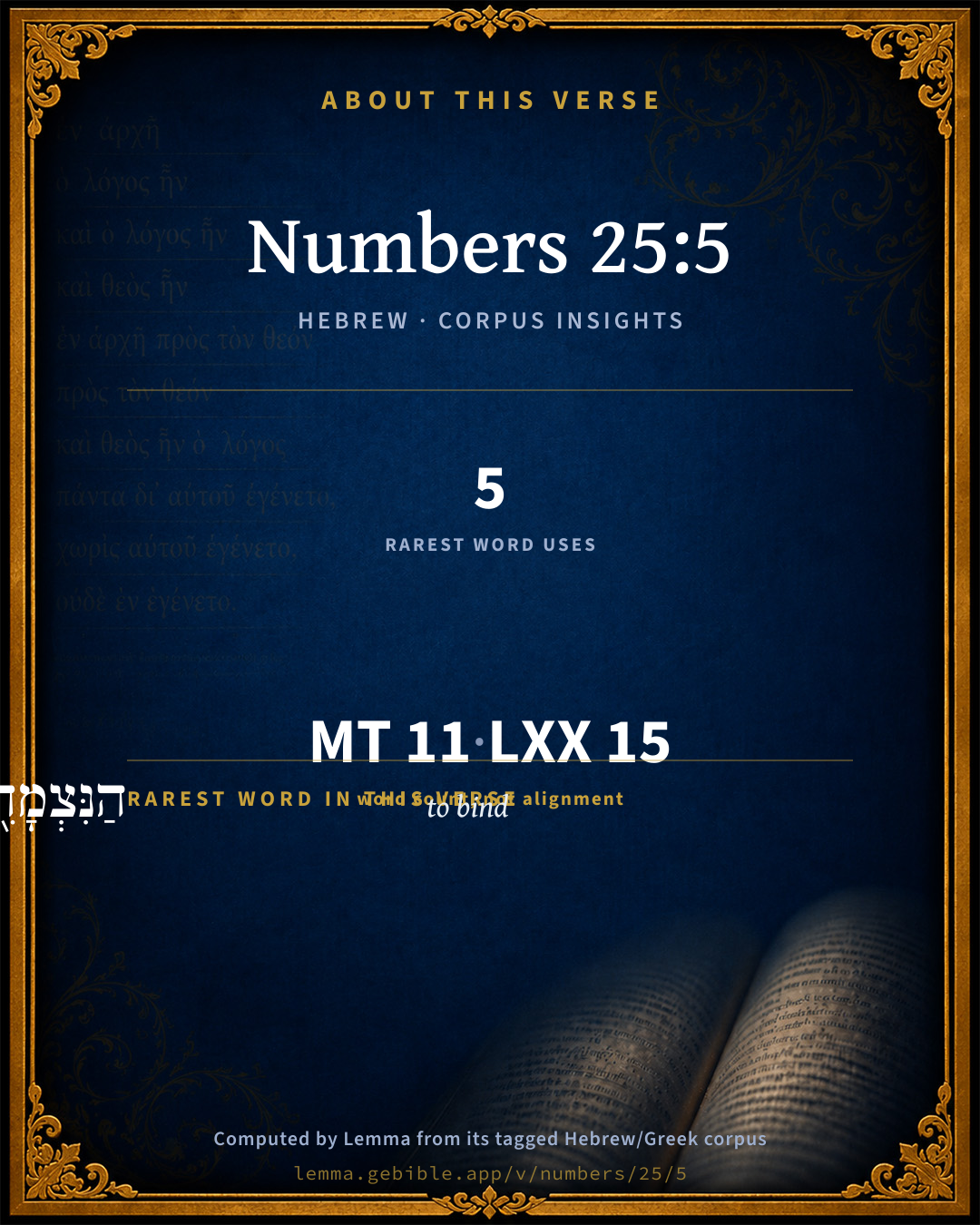
11
words
9
distinct lemmas
Pentateuch
section

Notable vocabulary

The rarest word here is הַנִּצְמָדִ֖ים to bind H6775 — appearing just 5 times in the whole Hebrew Bible.

Shared distinctive vocabulary

הַנִּצְמָדִ֖ים to bind H6775 occurs in 5 verses of the Hebrew Bible. Also found in:

Grammatical profile

  • 4 verbs
  • 6 nouns
  • 1 preposition

Verb forms

  • וַיֹּ֣אמֶר Qal · Sequential Imperfect
  • שֹׁפְטֵ֖י Qal · Participle Active
  • הִרְגוּ֙ Qal · Imperative
  • הַנִּצְמָדִ֖ים Niphal · Participle Passive

Repetition

Words recur within this verse — often emphatic in Hebrew:

  • אִ֣ישׁ man H376 ×2
  • לְבַ֥עַל Baal-peor H1187 ×2

Hebrew & Septuagint length

In English translation the verse runs 19 words from the Hebrew and 19 from the Septuagint (LXX English) — the same length.

A rough comparison of the two English renderings, which tokenize alike — not a word-level alignment.

Word counts can differ between the Hebrew and the Greek without any difference in meaning — e.g. the Hebrew direct-object marker אֵת has no separate Greek word, and Greek often adds the article ὁ.

In the original languages it is 11 Hebrew tokens and 15 Greek tokens — but the two are counted differently (Hebrew bundles its prefixes and suffixes into one token; the Greek is in lemma form), so that isn’t a like-for-like length.

Cross-references

10

Topical passages linked to Numbers 25:5 in the Treasury of Scripture Knowledge — connected by theme and wording, ordered by reader-vote popularity; previews shown in the World English Bible.

  • Exodus 18:21 Moreover you shall provide out of all the people able men, such as fear God: men of truth, hating unjust gain; and place such over them, to be rulers of thousands, rulers of hundreds, rulers of fifties, and rulers of tens.
  • 1 Kings 18:40 and Elijah said to them, Take the prophets of Baal; don't let one of them escape. They took them; and Elijah brought them down to the brook Kishon, and killed them there.
  • Exodus 18:25–26 Moses chose able men out of all Israel, and made them heads over the people, rulers of thousands, rulers of hundreds, rulers of fifties, and rulers of tens.
  • Exodus 22:20 "He who sacrifices to any god, except to Yahweh only, shall be utterly destroyed.
  • Exodus 32:27–28 He said to them, "Thus says Yahweh, the God of Israel, 'Every man put his sword on his thigh, and go back and forth from gate to gate throughout the camp, and every man kill his brother, and every man his companion, and every man his neighbor."
  • Deuteronomy 13:6 If your brother, the son of your mother, or your son, or your daughter, or the wife of your bosom, or your friend, who is as your own soul, entice you secretly, saying, Let us go and serve other gods, which you have not known, you, nor your fathers;
  • Deuteronomy 13:9 but you shall surely kill him; your hand shall be first on him to put him to death, and afterwards the hand of all the people.
  • Deuteronomy 13:13 Certain base fellows are gone out from the midst of you, and have drawn away the inhabitants of their city, saying, Let us go and serve other gods, which you have not known;
  • Deuteronomy 13:15 you shall surely strike the inhabitants of that city with the edge of the sword, destroying it utterly, and all that is therein and the cattle of it, with the edge of the sword.
  • Deuteronomy 17:3–5 and has gone and served other gods, and worshiped them, or the sun, or the moon, or any of the host of the sky, which I have not commanded;

Cross-references courtesy of OpenBible.info (CC BY 4.0).

Hebrew and Greek witnesses Masoretic Hebrew ↔ Greek Septuagint

The same verse in the two great witnesses to the Old Testament, shown verse-for-verse.

These are two independent witnesses, not word-aligned to each other, and the Septuagint is shown in lemma (dictionary) form.

Hebrew Numbers 25:5 Masoretic · Westminster Leningrad Codex

וַיֹּ֣אמֶר מֹשֶׁ֔ה אֶל שֹׁפְטֵ֖י יִשְׂרָאֵ֑ל הִרְגוּ֙ אִ֣ישׁ אֲנָשָׁ֔יו הַנִּצְמָדִ֖ים לְבַ֥עַל פְּעֽוֹר

Moses said to the judges of Israel, Kill you everyone his men who have joined themselves to Baal Peor.

World English Bible · Public Domain

Greek LXX Numbers 25:5 Septuagint · lemma form

καί εἶπον μωυσῆς ὁ φυλή ἰσραήλ ἀποκτείνω ἕκαστος ὁ οἰκεῖος αὐτός ὁ τελέω ὁ βεελφεγωρ

And Moses said to the tribes of Israel, Slay you⌃ every one his friend that is consecrated to Beel-phegor.

LXX2012 (modern English Septuagint) · Public Domain

On this verse, Haydock's Catholic Bible Commentary discusses the Septuagint’s reading. Read the note in Commentary ↓

Hebrew: Westminster Leningrad Codex (CC BY 4.0). Greek: Septuagint (public domain); English from LXX2012 (modern English Septuagint) (Public Domain). How the Septuagint differs from the Hebrew →

Targum (Aramaic paraphrase)

2

The Targum is the ancient Jewish Aramaic paraphrase of the Hebrew Scriptures — an interpretive translation, not the Hebrew text itself. Onkelos (literal) and Pseudo-Jonathan (expansive) render the Torah, and Jonathan the Prophets. Coverage is partial: where no permissively-licensed English translation exists for a verse, only the Aramaic is shown. This is verse-level text, not a word-by-word alignment to the Hebrew.

  1. Targum Onkelos Torah (Genesis–Deuteronomy)
    וַאֲמַר משֶׁה לְדַיָנֵי יִשְׂרָאֵל קְטִילוּ גְבַר גַבְרוֹהִי דְאִתְחַבָּרוּ לְבַעֲלָא פְעוֹר

    (no public-domain English translation for this verse)

    Targum Onkelos — Aramaic: “Onkelos Genesis” (public domain); “Onkelos Exodus” (public domain); “Onkelos Leviticus” (public domain); “Onkelos Numbers” (public domain); “Onkelos Deuteronomy” (public domain). English: “Sefaria Community Translation” (CC0 1.0 (public-domain dedication)); “J.W. Etheridge. The Targums of Onkelos and Jonathan Ben Uzziel on the Pentateuch. London: Longmans, Green, 1862” (public domain). Text via Sefaria.

  2. Targum Pseudo-Jonathan Torah (Genesis–Deuteronomy)
    וַאֲמַר משֶׁה לְדַיְינֵי יִשְרָאֵל קְטוּלוּ אֵינַשׁ גְבַר שִׁבְטֵיהּ דְאַדְבָּקוּ בְּטַעֲוַת פְּעוֹר

    And Mosheh said to the judges of Israel, Slay every one a man of his tribe of those who have joined themselves to the idol of Peor.

    Targum Pseudo-Jonathan — Aramaic: “Targum Jonathan on Genesis” (public domain); “Targum Jonathan on Exodus” (public domain); “Targum Jonathan on Leviticus” (public domain); “Targum Jonathan on Numbers” (public domain); “Targum Jonathan on Deuteronomy” (public domain). English: “The Targum of Jonathan ben Uzziel, trans. J. W. Etheridge, London, 1862” (public domain). Text via Sefaria.

Commentary

Notes on Numbers 25:5 from classic Christian and Jewish commentators (each source and its license shown beneath its notes). The classic Christian expositions comment on the surrounding passage and are grouped to its opening verse, so a note may address several verses; the Jewish commentaries on the Tanakh (Rashi and others) are per-verse, so they appear only where the commentator wrote on this verse.

Lemma curates 59 commentaries, every one of them public domain or Creative Commons licensed, each selected and text-cleaned for this edition rather than reprinted as found. About our sources →

Trapp's Complete Commentary

John Trapp

Num 25:5 And Moses said unto the judges of Israel, Slay ye every one his men that were joined unto Baalpeor.

Ver. 5. Unto the judges of Israel.]. Those of them that had not defiled themselves; else with what face could they punish others? or look upon those, that before their faces had been hanged up against the sun, whose destruction was for ever to be remembered? {Mic 6:5}

John Trapp, A Commentary or Exposition upon All the Books of the Old and New Testament (1647–1656) — public domain. Text from a community e-Sword module.

Joseph Benson's Commentary

Num 25:5. Slay ye every one his men — Moses having, in conjunction with the judges, searched out such as had been guilty of this lewdness and idolatry, allots to each magistrate his number of malefactors for execution, that they might either put them to death with their own hands, as Phinehas did, (Num 25:7,) or by proper officers. It seems probable that the judges were dilatory in executing this order, since God himself thought fit to visit the heads of the idolaters with exemplary punishment, Num 25:8.

Joseph Benson's Commentary on the Old and New Testaments (1811–1818) — public domain. Text from a community e-Sword module.

Geneva Bible (1599)

Geneva Bible translators

Let him see execution done of them that are under his charge.

Geneva Bible (1599) marginal notes — public domain. Text via Bolls.life.

Jamieson, Fausset & Brown

Robert Jamieson, A. R. Fausset & David Brown

judges of Israel--the seventy elders, who were commanded not only to superintend the execution within their respective jurisdictions, but to inflict the punishment with their own hands. (See on Sa1 15:33).

Jamieson, Fausset & Brown — Commentary Critical and Explanatory on the Whole Bible (1871) — public domain (CC PDM 1.0). Text via the HelloAO Bible API.

Adam Clarke's Commentary

Verse 5. Slay ye every one his men] In the different departments where you preside over thousands, hundreds, fifties, and tens, slay all the culprits that shall be found.

Adam Clarke's Commentary on the Bible (1810–1826) — public domain. Text from a community e-Sword/MySword module.

The Cambridge Bible for Schools and Colleges

gen. ed. J. J. S. Perowne

5. every one his men] Each judge was to execute the offenders that belonged to the division over which he had authority (see Exo_18:25 f.).

The Cambridge Bible for Schools and Colleges (gen. ed. J. J. S. Perowne; Cambridge University Press, 1878–1918) — public domain. Text from a community e-Sword module.

John Gill's Exposition

And Moses said unto the judges of Israel,.... Either the same with the heads of the people, or the rulers of thousands, hundreds, fifties, and tens, according to the distribution by the advice of Jethro:

slay ye everyone his men, that were joined unto Baalpeor; all that were under their several districts and jurisdictions, that were found guilty of that crime; these they are ordered to slay, either with their own hands, or rather cause to be slain by proper persons they should appoint to be executioners.

John Gill's Exposition of the Whole Bible (1746–1763) — public domain (CC PDM 1.0). Text via the HelloAO Bible API.

Haydock's Catholic Bible Commentary

Judges, who had not been guilty. Septuagint, "to the tribes." The judges, and even private individuals, were thus authorized to exterminate the guilty, as the Levites had been before, Exodus xxxii. 27. While punishment was inflicted but slowly, and some perhaps of the more noble were spared, so that Zambri, even became more insolent. God began to supply the defect of his ministers, by sending the plague among the people, as Onkelos insinuates. (Haydock)

George Leo Haydock (1774–1849), Haydock's Catholic Family Bible and Commentary, 1859 edition — public domain. Excludes Psalms (Douay-Rheims chapter numbering differs from Protestant) and Deuterocanonical books (Catholic canon only).

Matthew Poole's English Annotations

Every one his men, i.e. those under his charge; for as these seventy were chosen to assist Moses in the government, so doubtless the care and management of the people was distributed among them by just and equal proportions.

Matthew Poole's English Annotations on the Holy Bible (1683–1685) — public domain. Text from a community e-Sword/MySword module.

Whedon's Commentary on the Bible

Daniel D. Whedon

5. Slay ye every one his men — This is far from an indiscriminate slaughter by what is called “lynch law,” but every judge is charged to convict according to the forms of law, and punish every apostate Israelite in his jurisdiction. Exo_18:21-26.

Daniel D. Whedon (gen. ed.), Commentary on the Old and New Testaments (1874–1909) — public domain. Text from a community e-Sword module.

The Pulpit Commentary

The judges of Israel. yfepvoAla. This is the first place where "the judges" are mentioned by this name, (cf. Deu_1:16 Jud_1:2:16) but the verb is freely used in Ex 18, in describing the functions of the officers appointed at Sinai. Every one his men. The men who were under his particular jurisdiction. This command given by Moses is not to be confounded with the previous command given to Moses to hang up all the chiefs. Moses only could deal with the chief, but it was within the power and the province of the judges to deal with ordinary offenders. It does not, however, appear how far either of these commands was put in practice.

The Pulpit Commentary (1880–1919), ed. H.D.M. Spence-Jones & Joseph S. Exell — public domain. Text from a community e-Sword module.

John Wesley's Explanatory Notes

Everyone his men - Those under his charge, for as these seventy were chosen to assist Moses in the government, so doubtless the care and management of the people was distributed among them by just and equal proportions.

John Wesley, Explanatory Notes Upon the Whole Bible (1754–1765) — public domain. Text via the GEBible commentary corpus.

Keil & Delitzsch

C. F. Keil & F. Delitzsch

The judges were to put to death every one his men, i.e., such of the evil-doers as belonged to his forum, according to the judicial arrangements instituted in Ex 18. This command of Moses to the judges was not carried out, however, because the matter took a different turn.

Keil & Delitzsch — Biblical Commentary on the Old Testament (1861–1891) — public domain (CC PDM 1.0). Text via the HelloAO Bible API. (Old Testament only.)

Rashi

Rabbi Shlomo Yitzchaki (Rashi)

הרגו איש אנשיו KILL EVERYONE HIS MEN — Each one of the judges of Israel killed two men (אנשיו is plural), and the judges of Israel were eighty-eight thousand in number, as it is related in Sanhedrin (cf. Sanhedrin 18a).

Rashi on the Tanakh — English translations: “The Judaica Press complete Tanach with Rashi, translated by A. J. Rosenberg” (CC BY 4.0); “Pentateuch with Rashi's commentary by M. Rosenbaum and A.M. Silbermann, 1929-1934” (public domain); “The Metsudah Tanach series, Lakewood, N.J” (CC BY 4.0); and “The Book of Joshua, Metsudah Publications, 1997” (CC BY 4.0). Text via Sefaria.

Ramban (Nachmanides)

Rabbi Moshe ben Nachman (Ramban / Nachmanides)

[AND MOSES SAID UNTO THE JUDGES OF ISRAEL]: ‘SLAY YE EVERY ONE HIS MEN [THAT HAVE JOINED THEMSELVES UNTO BAAL-PEOR].’ “Each one of the judges of Israel killed two [men, as the word anashav — his ‘men,’ in the plural, indicates], and the judges of Israel were seventy-eight thousand, as is stated in Tractate Sanhedrin.” This is Rashi’s language. But I cannot understand this, that [we should say that] those who joined themselves [to Baal-peor] who were judged [liable to death] were more than a hundred and fifty thousand — a quarter [of the total population] of Israel! Heaven forbid! [Moreover], cases punishable by death [cannot be decided] by [only] one judge, but [require] a court of twenty-three judges. And [even if we were to say that two people were killed by each court of twenty-three judges], they would still be very many people! And the difference between the [two] censuses is not so great, although all those who joined themselves to Baal-peor died, as it is written, for all the men that followed Baal-peor, the Eternal thy G-d hath destroyed them from the midst of thee. But the meaning of every one his men is that the judges should kill all those who joined themselves [to Baal-peor], that is to say, each court should judge [the men of] its own tribe and its [groups of] thousands, as it is written, So I took the heads of your tribes, wise men, and full of knowledge, and made them heads over you, captains of thousands, and captains of hundreds … and officers, ‘tribe by tribe’., 1:15. The phrase tribe by tribe indicates that each tribe had its own judges who dealt with offenses committed by men of this tribe. And afterwards I found in the Gemara Yerushalmi [the following statement] in the Chapter Cheilek:, see above, Note 228. “And how many were the judges of Israel? Seventy-eight thousand and six hundred. Moses said to them: ‘Each one of you should kill two.’ Thus you find that those killed were one hundred and fifty-seven thousand and two hundred.” If so, we must say that according to their opinion [that of these Rabbis] the Israelites increased very remarkably between the [time of the first] census and the [second] census [in order to make up the loss of the many people killed because of this sin of Baal-peor]!The correct interpretation of the meaning of this section [of the Torah] appears to me to be that at first it says, And Israel joined himself unto Baal-peor; and the anger of the Eternal was kindled against Israel, [meaning] that there is wrath gone out from the Eternal; the plague is begun; and G-d in His mercy told Moses that the judges should [first] try and then hang those who joined themselves [to Baal-peor], so that the wrath will not indeed sweep away the righteous with the wicked. And Moses gave this command to the judges; and when all the congregation was assembled at the door of the Tent of Meeting to do as Moses commanded, and the plague was still raging amongst them, this Simeonite [Zimri the son of Salu] brazenly brought unto his brethren a Midianite woman to rebel against Moses and the judges, and to do so publicly, because he was a prince and a great man and [knew that] many would come to his help. Or it may be [that he dared to do this publicly] because, as our Rabbis have said, [the people of] his tribe complained to him: “We are being sentenced to death, and you keep quiet!” Then [when Zimri came forth] Moses and the judges began weeping, and Phinehas stood up, and wrought judgment, and so the plague was stayed. Thus none of the people was [actually] sentenced by the judges, for G-d had said, and hang them up unto the Eternal in face of the sun, that the fierce anger of the Eternal may turn away from Israel, and His anger had already turned away [by the action of Phinehas, so that the judges no longer had to proceed with the execution of the judgment]. It is for this reason that Scripture does not say: “and the judges of Israel did so [as they had been commanded].”It is possible that the intention of the text mentioned [above as to the number of men slain in this episode is not that they were actually killed, but means, as explained above], that according to [the strict] command [of G-d] there ought to have been more than one hundred and fifty thousand killed, meaning to say that there were many sinners, but the act of Phinehas protected them. Thus there remained [many of those] who had joined themselves [to Baal-peor], and the Holy One, blessed be He, destroyed them later on before they crossed over the [river] Jordan. This is [the meaning of] the verse which says, for all the men that followed after Baal-peor, the Eternal thy G-d hath destroyed them from the midst of thee. But ye that did cleave unto the Eternal your G-d are alive every one of you this day. Pinchas

Ramban (Nachmanides) on the Tanakh — English translation: “Commentary on the Torah by Ramban (Nachmanides). Translated and annotated by Charles B. Chavel. New York, Shilo Pub. House, 1971-1976” (CC BY 4.0). Text via Sefaria.

Lesson kit

Teaching starters — assembled from the data on this page, not authored interpretation. Every prompt links to the verse data it draws on. Edit before teaching.

Numbers, in the Pentateuch, opens this verse with 11 words (9 distinct Hebrew lemmas). Its most distinctive word is tsâmad (“to bind”). A historical commentator’s framing appears above. Read the whole chapter for the surrounding context.

Discussion questions

  1. What does “to bind” (tsâmad) contribute to the verse as a whole?
  2. Numbers 25:3 shares the word «to bind» with this verse. How do the two illuminate each other?
  3. “man” occurs 2× in this one verse. What is the effect of the repetition?
  4. The translations on this page render this verse differently — a whole-verse word diff, not a word-by-word alignment. What might account for the different wordings?
  5. The verb «וַיֹּ֣אמֶר» is Qal Sequential Imperfect. How does its form color the action?
  6. Reading how Trapp's Complete Commentary and Joseph Benson's Commentary read this verse, where do the two commentators agree and where do they part?

Things to notice

Reading settings

Reading text

Shown beneath each verse's original-language words.

Old Testament
Old Testament edition

Read the OT as the Masoretic Hebrew (MT) or the Greek Septuagint (LXX).

English shown for the Greek Septuagint (in the Hebrew ↔ Greek comparison).

Comparing translations? Open the Compare panel on any verse page to stack up to four side by side.