
Ezekiel 9:6

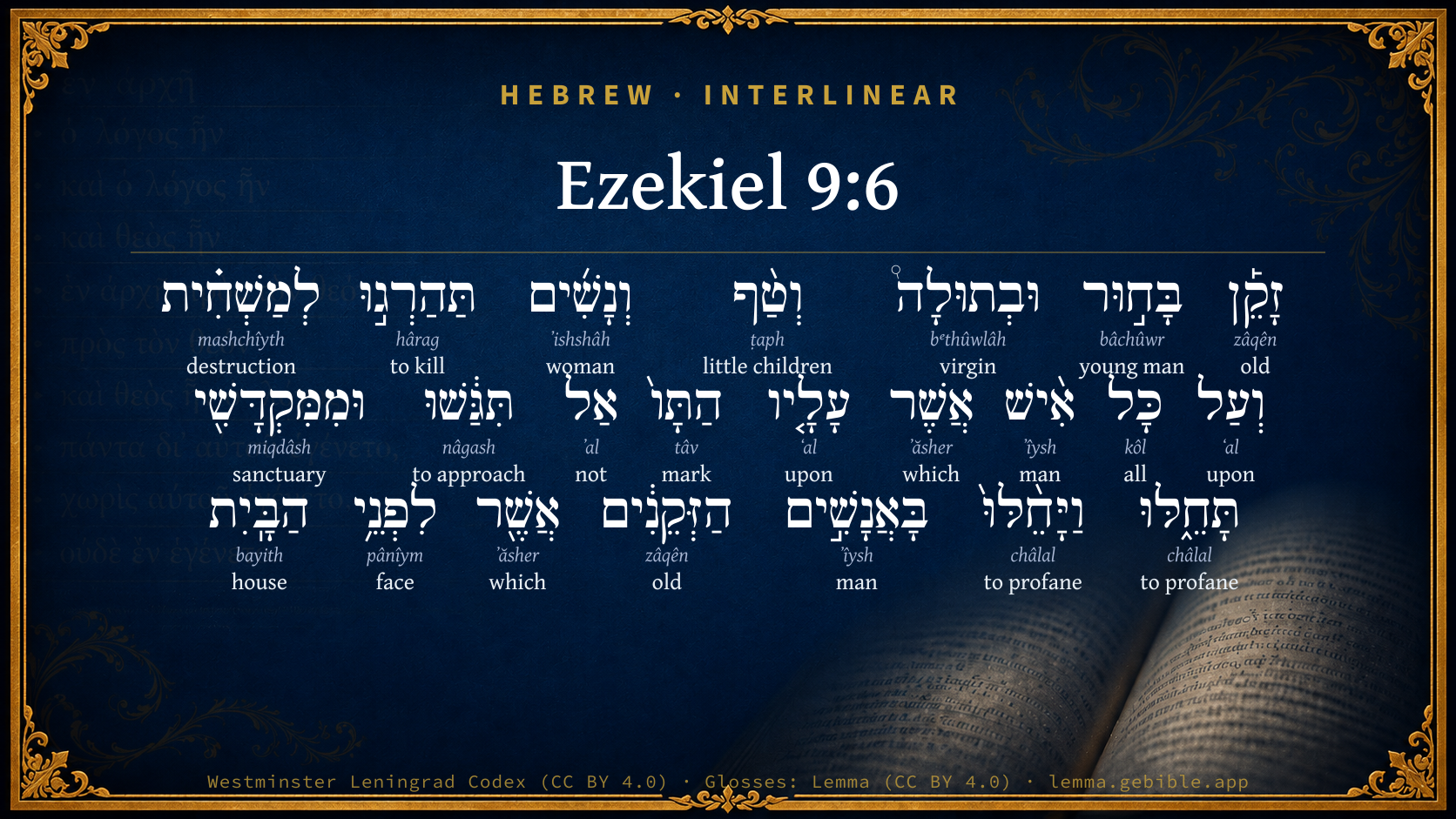
Hebrew (Westminster Leningrad Codex) Ezekiel 9:6 appears in the Hebrew Old Testament. The text above is from the Westminster Leningrad Codex. Each word links to its Strong’s number, a concise gloss, and parsing drawn from the Open Scriptures Hebrew Bible morphology. Click any word for its full Brown-Driver-Briggs (BDB) entry.
Download image
Cite this verse

Ezekiel 9:6 (World English Bible). Public Domain. Lemma interlinear Bible study tool, https://lemma.gebible.app/v/ezekiel/9/6.

Show BibTeX & RIS
BibTeX
RIS
English Translation
kill utterly the old man, the young man and the virgin, and little children and women; but don't come near any man on whom is the mark: and begin at my sanctuary. Then they began at the old men that were before the house.
World English Bible · Public Domain
Download a study sheet

One document with this verse’s original text, its word-by-word gloss line, the meaning frame, cross-references with their text, attributed commentary, and full source and license credits — printable, and it pastes into notes with its structure intact.

This verse Autodidact and up

Study sheet (.html) Plain text (.txt)

A passage Seminary Student

Up to 50 verses in one chapter. A passage sheet keeps up to 6 commentary sources and 12 cross-references per verse, in the order this page ranks them, and says so on the sheet whenever that leaves anything out. Ask for a single verse and you get the Autodidact verse sheet above.

Everything on this page stays free to read, with no account — the sheet is a download of what is already on screen, not access to it.

Want to remove ads? Support Godless Engineer
Compare translations 3

The same verse in 3 English versions, stacked beneath the original-language interlinear above. Click any original word for its lexicon entry.

Each is an independent rendering of the whole verse — the interlinear is not word-aligned to these translations.

Highlighted words mark where these versions differ — a whole-verse word diff, not a word-by-word alignment.

  • World English Bible Public Domain
    kill utterly the old man, the young man and the virgin, and little children and women; but don't come near any man on whom is the mark: and begin at my sanctuary. Then they began at the old men that were before the house.
  • King James Version Public Domain
    Slay utterly old and young, both maids, and little children, and women: but come not near any man upon whom is the mark; and begin at my sanctuary. Then they began at the ancient men which were before the house.
  • unfoldingWord Literal Text CC BY-SA 4.0
    either old man, young man, virgin, little children or women. Kill all of them! But do not approach anyone who has the mark on his head. Begin at my sanctuary!” So they began with the elders who were in front of the house.

unfoldingWord Literal Text — © unfoldingWord, licensed CC BY-SA 4.0. Word-aligned USFM3 via Door43 (git.door43.org/unfoldingWord/en_ult).

Versions to compare (up to 4)

3 of 4 selected

Show all 18 translations

Every available English version of this verse, each an independent rendering of the whole verse.

  • World English Bible Public Domain
    kill utterly the old man, the young man and the virgin, and little children and women; but don't come near any man on whom is the mark: and begin at my sanctuary. Then they began at the old men that were before the house.
  • Berean Standard Bible Public Domain
    Slaughter the old men, the young men and maidens, the women and children; but do not go near anyone who has the mark. Now begin at My sanctuary.” So they began with the elders who were before the temple.
  • Majority Standard Bible Public Domain
    Slaughter the old men, the young men and maidens, the women and children; but do not go near anyone who has the mark. Now begin at My sanctuary.” So they began with the elders who were before the temple.
  • King James Version Public Domain
    Slay utterly old and young, both maids, and little children, and women: but come not near any man upon whom is the mark; and begin at my sanctuary. Then they began at the ancient men which were before the house.
  • American Standard Version (1901) Public Domain
    slay utterly the old man, the young man and the virgin, and little children and women; but come not near any man upon whom is the mark: and begin at my sanctuary. Then they began at the old men that were before the house.
  • Revised Version (1885) Public Domain
    slay utterly the old man, the young man and the maiden, and little children and women: but come not near any man upon whom is the mark; and begin at my sanctuary. Then they began at the ancient men which were before the house.
  • Geneva Bible (1599) Public Domain
    Destroy vtterly the old, and the yong, and the maides, and the children, and the women, but touch no man, vpon whome is the marke, and begin at my Sanctuarie. Then they began at the Ancient men, which were before the house.
  • Douay-Rheims (1899) Public Domain
    Utterly destroy old and young, maidens, children and women: but upon whomsoever you shall see Thau, kill him not, and begin ye at my sanctuary. So they began at the ancient men who mere before the house.
  • Young's Literal Translation Public Domain
    aged, young man, and virgin, and infant, and women, ye do slay -- to destruction; and against any man on whom `is' the mark ye do not go nigh, and from My sanctuary ye begin.'
  • Literal Standard Version CC BY-SA 4.0
    aged, young man, and virgin, and infant, and women, you slay—to destruction; and against any man on whom [is] the mark you do not go near, and you begin from My sanctuary.”
  • Unlocked Literal Bible CC BY-SA 4.0
    either old man, young man, virgin, little children or women. Kill all of them! But do not approach anyone who has the mark on his head. Begin at my sanctuary!” So they began with the elders who were in front of the house.
  • unfoldingWord Literal Text CC BY-SA 4.0
    either old man, young man, virgin, little children or women. Kill all of them! But do not approach anyone who has the mark on his head. Begin at my sanctuary!” So they began with the elders who were in front of the house.
  • Darby Bible Public Domain
    Slay utterly the old man, the young man, and the maiden, and little children, and women; but come not near any man upon whom is the mark; and begin at my sanctuary. Then they began at the elders who were before the house.
  • World Messianic Bible Public Domain
    Kill utterly the old man, the young man, the virgin, little children and women; but don’t come near any man on whom is the mark. Begin at my sanctuary.” Then they began at the old men who were before the house.
  • Webster's Bible Public Domain
    Slay utterly old and young, both maids, and little children, and women: but come not near any man upon whom is the mark; and begin at my sanctuary. Then they began at the elderly men who were before the house.
  • Free Bible Version CC BY-SA 4.0
    Kill the old men, the young men and girls, the women and children, but do not go anywhere near those who have the mark. Start at my sanctuary.” So they started by killing the elders who were in front of the Temple.
  • Bible in Basic English Public Domain
    Give up to destruction old men and young men and virgins, little children and women: but do not come near any man who has the mark on him: and make a start at my holy place. So they made a start with the old men who were before the house.
  • JPS Tanakh (1917) Public Domain
    slay utterly the old man, the young man and the maiden, and little children and women; but come not near any man upon whom is the mark; and begin at My sanctuary.' Then they began at the elders that were before the house.

Literal Standard Version (2020), Covenant Press — licensed CC BY-SA 4.0. Text via the HelloAO Bible API (eBible.org). Unlocked Literal Bible (unfoldingWord) — licensed CC BY-SA 4.0. Text via the HelloAO Bible API (eBible.org). unfoldingWord Literal Text — © unfoldingWord, licensed CC BY-SA 4.0. Word-aligned USFM3 via Door43 (git.door43.org/unfoldingWord/en_ult). Free Bible Version, Dr. Jonathan Gallagher — licensed CC BY-SA 4.0. Text via the HelloAO Bible API (eBible.org).

Word by word

More ways to search: Search by grammar → Find every occurrence → Compare this word →

Practice this passage: Drill this verse → Learn its vocabulary →

הַתָּו֙
tâv
H8420
“the · mark”
Particle, Definite Article + Noun, Common, Masculine, Singular, Absolute
Part of Speech
Particle + Noun
Type
Common
Gender
Masculine
Number
Singular
State
Absolute
Full BDB Definition

Origin: from H8427

TWOT: 2496a

desire, mark - mark (as a sign of exemption from judgment)
  1. זָקֵ֡ן zâqên H2205 “old” Adjective, Adjective, Masculine, Singular, Absolute
  2. בָּח֣וּר bâchûwr H970 “young man” Noun, Common, Masculine, Singular, Absolute
  3. וּבְתוּלָה֩ bᵉthûwlâh H1330 “and · virgin” Conjunction + Noun, Common, Feminine, Singular, Absolute
  4. וְטַ֨ף ṭaph H2945 “and · little children” Conjunction + Noun, Common, Masculine, Singular, Absolute
  5. וְנָשִׁ֜ים ʼishshâh H802 “and · women” Conjunction + Noun, Common, Feminine, Plural, Absolute
  6. תַּהַרְג֣וּ hârag H2026 “to kill” Verb, Qal, Imperfect, 2nd Person, Masculine, Plural
  7. לְמַשְׁחִ֗ית mashchîyth H4889 “to/for · destruction” Preposition + Noun, Common, Masculine, Singular, Absolute
  8. וְעַל ʻal H5921 “and · upon” Conjunction + Preposition
  9. כָּל kôl H3605 “all of” Noun, Common, Masculine, Singular, Construct
  10. אִ֨ישׁ ʼîysh H376 “man” Noun, Common, Masculine, Singular, Absolute
  11. אֲשֶׁר ʼăsher H834 “which” Particle, Relative
  12. עָלָ֤יו ʻal H5921 “upon · him” Preposition + Suffix, Personal, 3rd Person, Masculine, Singular
  13. אַל ʼal H408 “not” Particle, Negative
  14. תִּגַּ֔שׁוּ nâgash H5066 “to approach” Verb, Qal, Jussive, 2nd Person, Masculine, Plural
  15. וּמִמִּקְדָּשִׁ֖י miqdâsh H4720 “and · from · sanctuary · my” Conjunction + Preposition + Noun, Common, Masculine, Singular, Construct + Suffix, Personal, 1st Person, Common, Singular
  16. תָּחֵ֑לּוּ châlal H2490 “to profane” Verb, Hiphil, Imperfect, 2nd Person, Masculine, Plural
  17. וַיָּחֵ֨לּוּ֙ châlal H2490 “and · to profane” Conjunction + Verb, Hiphil, Sequential Imperfect, 3rd Person, Masculine, Plural
  18. בָּאֲנָשִׁ֣ים ʼîysh H376 “in/at the · men” Preposition, Determined + Noun, Common, Masculine, Plural, Absolute
  19. הַזְּקֵנִ֔ים zâqên H2205 “the · old” Particle, Definite Article + Adjective, Adjective, Masculine, Plural, Absolute
  20. אֲשֶׁ֖ר ʼăsher H834 “which” Particle, Relative
  21. לִפְנֵ֥י pânîym H6440 “to/for · face(s) of” Preposition + Noun, Common, Both, Plural, Construct
  22. הַבָּֽיִת bayith H1004 “the · house” Particle, Definite Article + Noun, Common, Masculine, Singular, Absolute

About this verse

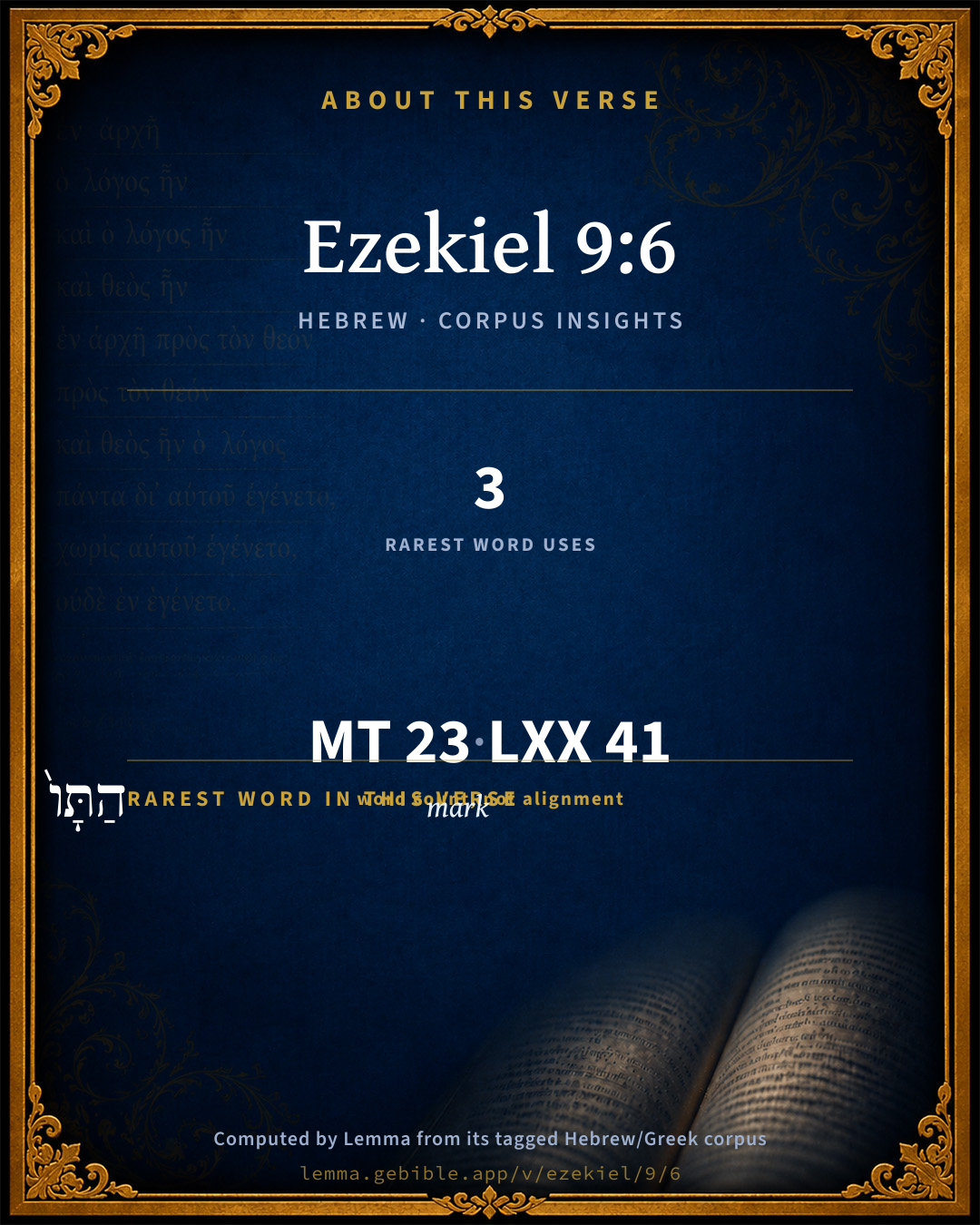
These counts appear in no published source. They are computed here, from the morphology-tagged text and Lemma’s own curated glosses. What Lemma adds →

23
words
18
distinct lemmas
Prophets
section

Notable vocabulary

The rarest word here is הַתָּו֙ mark H8420 — appearing just 3 times in the whole Hebrew Bible.

Shared distinctive vocabulary

הַתָּו֙ mark H8420 occurs in 3 verses of the Hebrew Bible. Also found in:

Grammatical profile

  • 4 verbs
  • 12 nouns
  • 2 adjectives
  • 2 prepositions
  • 3 particles

Verb forms

  • תַּהַרְג֣וּ Qal · Imperfect
  • תִּגַּ֔שׁוּ Qal · Jussive
  • תָּחֵ֑לּוּ Hiphil · Imperfect
  • וַיָּחֵ֨לּוּ֙ Hiphil · Sequential Imperfect

Repetition

Words recur within this verse — often emphatic in Hebrew:

  • זָקֵ֡ן old H2205 ×2
  • וְעַל upon H5921 ×2
  • אִ֨ישׁ man H376 ×2
  • תָּחֵ֑לּוּ to profane H2490 ×2
  • אֲשֶׁר which H834 ×2

Hebrew & Septuagint length

In English translation the verse runs 44 words from the Hebrew and 40 from the Septuagint (LXX English) — closely comparable.

A rough comparison of the two English renderings, which tokenize alike — not a word-level alignment.

Word counts can differ between the Hebrew and the Greek without any difference in meaning — e.g. the Hebrew direct-object marker אֵת has no separate Greek word, and Greek often adds the article ὁ.

In the original languages it is 23 Hebrew tokens and 41 Greek tokens — but the two are counted differently (Hebrew bundles its prefixes and suffixes into one token; the Greek is in lemma form), so that isn’t a like-for-like length.

Cross-references

18

Topical passages linked to Ezekiel 9:6 in the Treasury of Scripture Knowledge — connected by theme and wording, ordered by reader-vote popularity; previews shown in the World English Bible.

  • Revelation 9:4 They were told that they should not hurt the grass of the earth, neither any green thing, neither any tree, but only those people who don't have God's seal on their foreheads.
  • Exodus 12:23 For Yahweh will pass through to strike the Egyptians; and when he sees the blood on the lintel, and on the two side-posts, Yahweh will pass over the door, and will not allow the destroyer to come in to your houses to strike you.
  • Jeremiah 25:29 For, behold, I begin to work evil at the city which is called by my name; and should you be utterly unpunished? You shall not be unpunished; for I will call for a sword on all the inhabitants of the earth, says Yahweh of Hosts.
  • 2 Timothy 2:19 However God's firm foundation stands, having this seal, "The Lord knows those who are his," and, "Let every one who names the name of the Lord depart from unrighteousness."
  • 1 Peter 4:17–18 For the time has come for judgment to begin at the house of God. If it begins first with us, what will happen to those who don't obey the Gospel of God?
  • Revelation 7:3 saying, "Don't harm the earth, neither the sea, nor the trees, until we have sealed the bondservants of our God on their foreheads!"
  • 2 Chronicles 36:17 Therefore he brought on them the king of the Chaldeans, who killed their young men with the sword in the house of their sanctuary, and had no compassion on young man or virgin, old man or gray-headed: he gave them all into his hand.
  • Luke 12:47 That servant, who knew his lord's will, and didn't prepare, nor do what he wanted, will be beaten with many stripes,
  • Joshua 2:18–19 Behold, when we come into the land, you shall bind this line of scarlet thread in the window which you did let us down by: and you shall gather to you into the house your father, and your mother, and your brothers, and all your father's household.
  • Joshua 6:17–25 The city shall be devoted, even it and all that is therein, to Yahweh: only Rahab the prostitute shall live, she and all who are with her in the house, because she hid the messengers that we sent.
  • Numbers 31:15–17 Moses said to them, Have you saved all the women alive?
  • Deuteronomy 2:34 We took all his cities at that time, and utterly destroyed every inhabited city, with the women and the little ones; we left none remaining:
  • 1 Samuel 15:3 Now go and strike Amalek, and utterly destroy all that they have, and don't spare them; but kill both man and woman, infant and suckling, ox and sheep, camel and donkey.
  • Deuteronomy 3:6 We utterly destroyed them, as we did to Sihon king of Heshbon, utterly destroying every inhabited city, with the women and the little ones.
  • Ezekiel 8:5–16 Then said he to me, Son of man, lift up your eyes now the way toward the north. So I lifted up my eyes the way toward the north, and see, northward of the gate of the altar this image of jealousy in the entry.
  • Ezekiel 11:1 Moreover the Spirit lifted me up, and brought me to the east gate of Yahweh's house, which looks eastward: and see, at the door of the gate twenty-five men; and I saw in the midst of them Jaazaniah the son of Azzur, and Pelatiah the son of Benaiah, princes of the people.
  • Amos 3:2 "You only have I chosen of all the families of the earth. Therefore I will punish you for all of your sins."
  • Revelation 14:4 These are those who were not defiled with women, for they are virgins. These are those who follow the Lamb wherever he goes. These were redeemed by Jesus from among men, the first fruits to God and to the Lamb.

Cross-references courtesy of OpenBible.info (CC BY 4.0).

Hebrew and Greek witnesses Masoretic Hebrew ↔ Greek Septuagint

The same verse in the two great witnesses to the Old Testament, shown verse-for-verse.

These are two independent witnesses, not word-aligned to each other, and the Septuagint is shown in lemma (dictionary) form.

Hebrew Ezekiel 9:6 Masoretic · Westminster Leningrad Codex

זָקֵ֡ן בָּח֣וּר וּבְתוּלָה֩ וְטַ֨ף וְנָשִׁ֜ים תַּהַרְג֣וּ לְמַשְׁחִ֗ית וְעַל כָּל אִ֨ישׁ אֲשֶׁר עָלָ֤יו הַתָּו֙ אַל תִּגַּ֔שׁוּ וּמִמִּקְדָּשִׁ֖י תָּחֵ֑לּוּ וַיָּחֵ֨לּוּ֙ בָּאֲנָשִׁ֣ים הַזְּקֵנִ֔ים אֲשֶׁ֖ר לִפְנֵ֥י הַבָּֽיִת

kill utterly the old man, the young man and the virgin, and little children and women; but don't come near any man on whom is the mark: and begin at my sanctuary. Then they began at the old men that were before the house.

World English Bible · Public Domain

Greek LXX Ezekiel 9:6 Septuagint · lemma form

πρεσβύτερος καί νεανίσκος καί παρθένος καί νήπιος καί γυνή ἀποκτείνω εἰς ἐξάλειψις ἐπί δέ πᾶς ἐπί ὅς εἰμί ὁ σημεῖον μή ἐγγίζω καί ἀπό ὁ ἅγιος ἐγώ ἄρχω καί ἄρχω ἀπό ὁ ἀνήρ ὁ πρεσβύτερος ὅς εἰμί ἔσω ἐν ὁ οἶκος

Slay utterly old man and youth, and virgin, and infants, and women: but go you⌃ not near any on whom is the mark: begin at my sanctuary. So they began with the elder men who were within in the house.

LXX2012 (modern English Septuagint) · Public Domain

On this verse, John Gill's Exposition discusses the Septuagint’s reading. Read the note in Commentary ↓

Hebrew: Westminster Leningrad Codex (CC BY 4.0). Greek: Septuagint (public domain); English from LXX2012 (modern English Septuagint) (Public Domain). How the Septuagint differs from the Hebrew →

Targum (Aramaic paraphrase)

1

The Targum is the ancient Jewish Aramaic paraphrase of the Hebrew Scriptures — an interpretive translation, not the Hebrew text itself. Onkelos (literal) and Pseudo-Jonathan (expansive) render the Torah, and Jonathan the Prophets. Coverage is partial: where no permissively-licensed English translation exists for a verse, only the Aramaic is shown. This is verse-level text, not a word-by-word alignment to the Hebrew.

  1. Targum Jonathan Prophets (Joshua–Malachi)
    סָב עוּלֵם וּבְתוּלָה טַפְלָא וּנְשַׁיָא תִּקְטְלוּן לְחַבָּלָא וְעַל כָּל גַבְרָא דַעֲלוֹהִי רוּשָׁם תְּוָא לָא תִקְרְבוּן וּמִבֵּית מַקְדְשִׁי תִּשְׁרוּן וּשְׁרִיאוּ בְּגַבְרַיָא סָבַיָא דְקָדָם בֵּיתָא:

    (no public-domain English translation for this verse)

    Targum Jonathan — Aramaic: “Mikraot Gedolot” (public domain). English: “Sefaria Community Translation” (CC0 1.0 (public-domain dedication)); “London "Chaldee Paraphrase," 1871” (public domain). Text via Sefaria.

Commentary

Notes on Ezekiel 9:6 from classic Christian and Jewish commentators (each source and its license shown beneath its notes). The classic Christian expositions comment on the surrounding passage and are grouped to its opening verse, so a note may address several verses; the Jewish commentaries on the Tanakh (Rashi and others) are per-verse, so they appear only where the commentator wrote on this verse.

Lemma curates 59 commentaries, every one of them public domain or Creative Commons licensed, each selected and text-cleaned for this edition rather than reprinted as found. About our sources →

Trapp's Complete Commentary

John Trapp

Eze 9:6 Slay utterly old [and] young, both maids, and little children, and women: but come not near any man upon whom [is] the mark; and begin at my sanctuary. Then they began at the ancient men which [were] before the house.

Ver. 6. Slay utterly old and young.] {a} A dreadful commission; see it fully executed, 2Ch 36:17 : all sorts, sexes, and sizes of people were corrupted; and since there was no hope of curing, there must be cutting.

But come not near any upon whom is the mark.] These were the "precious sons of Zion," the "excellent ones of the earth" - as whatsoever is sealed is excellent in its kind, {Isa 28:25} hordeum signatum. - these are the darlings, the favourites; handle them gently therefore for my sake, touch not mine anointed, come not near any such to fright them, but keep your distance.

And begin at my sanctuary.] From whence went forth profaneness into the whole land. {Jer 23:15} These sanctuary men were an ill generation; at them therefore begins the judgment. God will be sanctified in all that draw near unto him. Nadab and Abihu found the flames of jealousy hottest about the altar. Uzzah and the Bethshemites felt that justice as well as mercy is most active about the ark. Murderers must be drawn from the altar to the slaughter. {Exo 21:14} Holy places were wont to be refuges; not so here, but the contrary.

Then they began at the ancient men.] At those seventy seniors, {Eze 8:11} whose foul offences had flown far upon the two wings of evil example and scandal.

{a} Immedicabile vulnus ense recidendum.

John Trapp, A Commentary or Exposition upon All the Books of the Old and New Testament (1647–1656) — public domain. Text from a community e-Sword module.

Geneva Bible (1599)

Geneva Bible translators

Which were the chief occasion of all these evils, as Ezek. 8:11.

Thus in all his plagues the Lord preserveth his small number, which he marketh, as Exod. 12:12; Rev. 7:3, but the chief mark is the Spirit of adoption, wherewith the heart is sealed up to life everlasting.

Geneva Bible (1599) marginal notes — public domain. Text via Bolls.life.

Jamieson, Fausset & Brown

Robert Jamieson, A. R. Fausset & David Brown

come not near any . . . upon whom . . . mark-- (Rev 9:4). It may be objected that Daniel, Jeremiah, and others were carried away, whereas many of the vilest were left in the land. But God does not promise believers exemption from all suffering, but only from what will prove really and lastingly hurtful to them. His sparing the ungodly turns to their destruction and leaves them without excuse [CALVIN]. However, the prophecy waits a fuller and final fulfilment, for Rev 7:3-8, in ages long after Babylon, foretells, as still future, the same sealing of a remnant (one hundred forty-four thousand) of Israel previous to the final outpouring of wrath on the rest of the nation; the correspondence is exact; the same pouring of fire from the altar follows the marking of the remnant in both (compare Rev 8:5, with Eze 10:2). So Zac 13:9; Zac 14:2, distinguish the remnant from the rest of Israel.

begin at . . . sanctuary--For in it the greatest abominations had been committed; it had lost the reality of consecration by the blood of victims sacrificed to idols; it must, therefore, lose its semblance by the dead bodies of the slain idolaters (Eze 9:7). God's heaviest wrath falls on those who have sinned against the highest privileges; these are made to feel it first (Pe1 4:17-18). He hates sin most in those nearest to Him; for example, the priests, &c.

ancient men--the seventy elders.

Jamieson, Fausset & Brown — Commentary Critical and Explanatory on the Whole Bible (1871) — public domain (CC PDM 1.0). Text via the HelloAO Bible API.

Adam Clarke's Commentary

Verse 6. Begin at my sanctuary.] Let those who have sinned against most mercy, and most privileges, be the first victims of justice. Those who know their Lord's will, and do it not, shall be beaten with many stripes. The unfaithful members of Christ's church will be first visited and most punished. But let not those who belong to the synagogue of Satan exult in this, for if judgment begin at the house of God, what will the end be of them who obey not the Gospel! However, the truly penitent of all descriptions in such cases shall be safe. The command of God is, "Set a mark on all them that sigh and cry;" and his command to the destroyers is, "Come not near any man on whom is the mark."

Adam Clarke's Commentary on the Bible (1810–1826) — public domain. Text from a community e-Sword/MySword module.

The Cambridge Bible for Schools and Colleges

gen. ed. J. J. S. Perowne

6. begin at my sanctuary] Judgment begins at the house of God. The Lord had returned for a moment to the place of his abode in the temple, and from there the judgment went forth; Amo_1:2, “The Lord shall roar out of Zion and give forth his voice from Jerusalem.” There he was most present, there most fully known, there if possible most forgotten and provoked, and there his holiness and godhead will assert themselves with most terribleness against the sins of men.

the ancient men] the elders, those mentioned, ch. Eze_8:16.

The Cambridge Bible for Schools and Colleges (gen. ed. J. J. S. Perowne; Cambridge University Press, 1878–1918) — public domain. Text from a community e-Sword module.

John Gill's Exposition

Slay utterly old and young, both maids, and little children,

and women,.... All, of them objects of compassion, because of their age and sex; and yet none to be spared; and which orders were exactly obeyed; see Ch2 36:17;

but come not near any man on whom is the mark; these were not to be slain; and though some were carried captive, as Daniel, and others; yet it was for their good and God's glory; see Rev 7:3;

and begin at my sanctuary; the temple, the house of God, and the priests and Levites that dwelt there. The Septuagint version is, "begin at my saints"; those who professed themselves to be the saints of the Lord, and were separated and devoted to his service; and so the Rabbins say (y), do not read "at my sanctuary"; but "at those that sanctify me", or "my sanctified ones"; which they interpret of those that keep the whole law, from "aleph" to "tau"; see Pe1 4:17;

then they began at the ancient men which were before the house; the seventy elders of Israel, who offered incense to the idols portrayed upon the walls of the chambers of the temple, Eze 8:10; these they slew first.

(y) T. Bab. Avoda Zara, fol. 4. 1.

John Gill's Exposition of the Whole Bible (1746–1763) — public domain (CC PDM 1.0). Text via the HelloAO Bible API.

Albert Barnes' Notes on the Bible

Begin at my sanctuary - The first to be punished were those who had brought idolatry nearest to the holy place. The “ancient men,” i. e., the 25 men who had stood with their backs to the altar Eze 8:16 were the first to be slain.

Albert Barnes' Notes on the Bible (1834–1885) — public domain. Text from a community e-Sword/MySword module.

Haydock's Catholic Bible Commentary

Sanctuary. Aquila, "temple," or people (Calmet) consecrated to my service, (Septuagint; Tirinus) particularly (Calmet) the twenty-five idolaters, the ancients and women, (Calmet) chap. viii. 16. --- Judgment beginneth at the house of God, (1 Peter iv. 17.) and those (Haydock) who abuse holy things are justly cut off. (Worthington)

George Leo Haydock (1774–1849), Haydock's Catholic Family Bible and Commentary, 1859 edition — public domain. Excludes Psalms (Douay-Rheims chapter numbering differs from Protestant) and Deuterocanonical books (Catholic canon only).

Matthew Poole's English Annotations

Slay utterly; my purpose is to exterminate and make desolate, therefore slay all that are designed to destruction. Old; whose venerable age, if innocent, might have awed you, whose wisdom might preserve some and themselves.

Young; who should be a seed-plot, or nursery, for posterity, cut them off too. Regard no state or sex, neither the loveliness of the virgin, nor the prettiness of the infant, nor the comeliness and gravity of the matron; spare none: yet in your fervours of revenge look you come not near to any sealed forehead; you may see them; though they blush for their own sins, and for the sins of others, yet they look up to me and wait for me in the way of my judgments, they will lift up their heads, and look you in the faces.

And begin, both the execution and the distinction, at my sanctuary; there are the great sinners, and the abominable sins which have brought this on them; and that all Israel may know nothing but repentance can secure them.

The ancient men; the seventy, or sanhedrim, Eze 8:10,11. Which were before the house; who were governors in the temple and house of God by office, but idolaters by practice and principles.

Matthew Poole's English Annotations on the Holy Bible (1683–1685) — public domain. Text from a community e-Sword/MySword module.

Whedon's Commentary on the Bible

Daniel D. Whedon

6. Begin at my sanctuary — Or, consecrated ones (LXX.). It is fitting that the heaviest and speediest judgment fall upon those who have had greatest privileges, and thus have sinned against greatest light (Amo_1:2; 1Pe_4:17; Mat_11:21). “Dante and Michael Angelo locate bishops in hell. The cardinal’s hat appears in Fra Angelico’s picture of the prison of lost souls. We shall not escape the punishment of our sins by putting on clerical vestments.” — Adeney.

The ancient men — The elders. (Compare Eze_8:16.)

Daniel D. Whedon (gen. ed.), Commentary on the Old and New Testaments (1874–1909) — public domain. Text from a community e-Sword module.

The Pulpit Commentary

Begin at my sanctuary, etc. It was fitting that the spot in which guilt had culminated should be the starting point of punishment. There seems something like a reference to this command in 1Pe_4:17. In each ease judgment "begins at the house of God." So the dreadwork began with the ancient men, or elders, of the same class, i.e., if not the same persons, as those in Eze_8:11.

Beginning at the sanctuary.

The apostles, when entering on their missionary labours, were to "begin at Jerusalem". (Luk_24:47) The destroying messengers were to begin their direful work at the sanctuary.

I THERE IS NO PROTECTION IN THE SANCTUARY. Some might flee to the holy shrine as to an asylum. This was done at heathen temples, and later at Christian churches, and no doubt in rude, violent ages, the pause of vengeance which such places afforded, like the use of the "cities of refuge" for the innocent manslayer, would then serve the purpose of justice. But this would be needless with God, because he is never hasty nor unjust, but slow to anger, and only taking just vengeance. Moreover, the asylum can never be a permanent protection for the guilty, and Ezekiel"s Jews at the temple are guilty.

1. No holy place can secure us against Gods wrath. We are not saved by attending church. The bad man who dies at church will go to the same fate that would have awaited him if he had dropped dead in his familiar haunts of debauchery.

2. No holy office will secure us without holy living. They who minister at the altar are not spared because of their sacred function. Priests share the doom of laity. Dante and Michael Angelo locate bishops in hell. The cardinal"s hat appears in Fra Angelico"s picture of the prison of lost souls. We shall not escape the punishment of our sins by putting on clerical vestments.

II THE GREATEST GUILT IS FOUND IN THE SANCTUARY. No doubt the punishment was to begin there because the worst sin was practised in that place. The previous chapter gives an account of the abominations of the "chambers of imagery" in the temple. Many things concur to make the sins of the sanctuary great.

1. They are sins committed against light. The sins of Christians are worse than the same deeds done by the heathen, because Christians know the evil of them. People brought up under religious influences have not the excuse which may be pleaded for the poor waifs and strays of the streets.

2. They are sins committed by men who profess better things. Hypocrisy is thus added to the guilt of the offences themselves.

3. They are stumbling blocks to others. Where a good example is looked for, people see the shame of a hypocritical pretence. This is enough to destroy all faith in religion.

4. They are dishonouring to God. The holy place is desecrated. Where God should be most honoured his Name is most outraged.

III THE DOOM OF THE SANCTUARY IS A WARNING TO THE WORLD. The beautiful temple of Solomon was burnt; Jerusalem itself was destroyed; the Jews were scattered. These things were done in part for our warning. They show that great guilt will surely bring great punishment. They make it evident that no favouritism will prevent God from punishing the guilty. The members of a Christian Church will have no immunity on account of their membership, nor will pious phrases condone impious deeds. The bosom of destruction wilt make a thorough search of the most secret refuges when God does begin the dreadful work. Let us flee from the sanctuary to the Saviour.

Begin at the sanctuary!

The vision which Ezekiel saw, and which brought vividly before his mind the moral state of his country"s metropolis, contained no feature more painful than the representation of the idolatry prevailing in the very precincts of the temple itself. He saw twenty-five men, apparently representing the priesthood, turning their backs towards the temple of the Lord, and their faces towards the east, and worshipping the rising sun. Upon these, as the most flagrant and inexcusable offenders, the righteous retribution first fell. Those most highly privileged are by that very fact most evidently responsible; and unfaithfulness upon their part deserves and will receive sorer condemnation.

I THOSE SPECIALLY EMPLOYED IN RELIGIOUS SERVICES ARE SPECIALLY BOUND TO WATCHFULNESS, SENSITIVENESS, AND ACTIVITY IN THE PRESENCE OF MORAL ABOMINATIONS. A profession of religion, much more occupation in the ministrations of religion, imposes a peculiar responsibility; for religion is essentially in antagonism to error, to superstition, and to vice. Yet there have been periods in which ministers even of the true religion have been lax in their own conduct, and have connived at prevailing error. There is an obligation on the part of every one who, by reason of office, employment, and public position, is a representative of Christianity, to aim at the prevalence of Christian principles throughout the community.

II THOSE WHO, BEING PROFESSEDLY MINISTERS OF RELIGION, ARE YET NEGLIGENT AND INDIFFERENT IN THE PRESENCE OF FLAGRANT SIN, ARE IN A SPECIAL MANNER OBJECTS OF DIVINE DISPLEASURE. It is not only in privilege and blessing that the sanctuary takes precedence. Unfaithfulness there is observed and reprehended as sin of the first magnitude. Retribution begins at the sanctuary. How should they be clean who bear the vessels of the Lord! God is indeed forbearing towards the failings and infirmities of his true servants. But the insincere and hypocritical are the objects of Divine aversion; those of such character who occupy positions of prominence and influence are regarded as abusing their position and as forfeiting all claim to confidence.

III THE UNFAITHFUL IN THE SANCTUARY ARE THE FIRST TO FEEL THE NATION"S CHASTISEMENT. There is a well known proverb, "Like priest, like people." A corrupt clergy encourages national degeneration. And when such degeneration issues in national calamity and destruction, it is but just that these who have fostered evil principles should be the first to suffer. This has happened again and again in the world"s history. Those who should have led the people aright, who should have enjoyed the people"s confidence and esteem, have too often been the agents in their deterioration; and when the time of trial has come, they have lust their influence, forfeited the position they abused, and paid for their unfaithfulness with the ruin of their reputation, and even with the loss of their life. The destruction which has involved a nation has begun at the sanctuary. T.

The Pulpit Commentary (1880–1919), ed. H.D.M. Spence-Jones & Joseph S. Exell — public domain. Text from a community e-Sword module.

John Wesley's Explanatory Notes

At my sanctuary - There are the great sinners, and the abominable sins which have brought this on them.

John Wesley, Explanatory Notes Upon the Whole Bible (1754–1765) — public domain. Text via the GEBible commentary corpus.

Rashi

Rabbi Shlomo Yitzchaki (Rashi)

and you shall commence from My sanctuary From those standing before My sanctuary. Our Rabbis said: Do not read וּמִמִִִּקְדָשִּׁי, and from My sanctuary, but וּמִמְּקֻדָשַּׁי, and from My sanctified ones, from those sanctified to Me. They are the ones marked with the sign, whom He had warned [them] not to hurt. [Now] He reneged and commanded [the angels] to destroy [even] them because the Divine standard of justice contended before Him, “Why are these different from those? Is it not so that they did not protest?” As is stated in Tractate Shabbath (55a).

Rashi on the Tanakh — English translations: “The Judaica Press complete Tanach with Rashi, translated by A. J. Rosenberg” (CC BY 4.0); “Pentateuch with Rashi's commentary by M. Rosenbaum and A.M. Silbermann, 1929-1934” (public domain); “The Metsudah Tanach series, Lakewood, N.J” (CC BY 4.0); and “The Book of Joshua, Metsudah Publications, 1997” (CC BY 4.0). Text via Sefaria.

Lesson kit

Teaching starters — assembled from the data on this page, not authored interpretation. Every prompt links to the verse data it draws on. Edit before teaching.

Ezekiel, in the Prophets, opens this verse with 23 words (18 distinct Hebrew lemmas). Its most distinctive word is tâv (“mark”). A historical commentator’s framing appears above. Read the whole chapter for the surrounding context.

Discussion questions

  1. What does “mark” (tâv) contribute to the verse as a whole?
  2. Job 31:35 shares the word «mark» with this verse. How do the two illuminate each other?
  3. “old” occurs 2× in this one verse. What is the effect of the repetition?
  4. These translations render this verse differently; the difference is in the English rendering, not the original. What questions does that raise?
  5. The verb «תַּהַרְג֣וּ» is Qal Imperfect. How does its form color the action?
  6. Reading how Trapp's Complete Commentary and Geneva Bible (1599) read this verse, where do the two commentators agree and where do they part?

Things to notice

Reading settings

Reading text

Shown beneath each verse's original-language words.

Old Testament
Old Testament edition

Read the OT as the Masoretic Hebrew (MT) or the Greek Septuagint (LXX).

English shown for the Greek Septuagint (in the Hebrew ↔ Greek comparison).

Comparing translations? Open the Compare panel on any verse page to stack up to four side by side.