
Ezekiel 23:47

Hebrew (Westminster Leningrad Codex) Ezekiel 23:47 appears in the Hebrew Old Testament. The text above is from the Westminster Leningrad Codex. Each word links to its Strong’s number, a concise gloss, and parsing drawn from the Open Scriptures Hebrew Bible morphology. Click any word for its full Brown-Driver-Briggs (BDB) entry.
Download image
Cite this verse

Ezekiel 23:47 (World English Bible). Public Domain. Lemma interlinear Bible study tool, https://lemma.gebible.app/v/ezekiel/23/47.

Show BibTeX & RIS
BibTeX
RIS
English Translation
The company shall stone them with stones, and dispatch them with their swords; they shall kill their sons and their daughters, and burn up their houses with fire.
World English Bible · Public Domain
Download a study sheet

One document with this verse’s original text, its word-by-word gloss line, the meaning frame, cross-references with their text, attributed commentary, and full source and license credits — printable, and it pastes into notes with its structure intact.

This verse Autodidact and up

Study sheet (.html) Plain text (.txt)

A passage Seminary Student

Up to 50 verses in one chapter. A passage sheet keeps up to 6 commentary sources and 12 cross-references per verse, in the order this page ranks them, and says so on the sheet whenever that leaves anything out. Ask for a single verse and you get the Autodidact verse sheet above.

Everything on this page stays free to read, with no account — the sheet is a download of what is already on screen, not access to it.

Want to remove ads? Support Godless Engineer
Compare translations 3

The same verse in 3 English versions, stacked beneath the original-language interlinear above. Click any original word for its lexicon entry.

Each is an independent rendering of the whole verse — the interlinear is not word-aligned to these translations.

Highlighted words mark where these versions differ — a whole-verse word diff, not a word-by-word alignment.

  • World English Bible Public Domain
    The company shall stone them with stones, and dispatch them with their swords; they shall kill their sons and their daughters, and burn up their houses with fire.
  • King James Version Public Domain
    And the company shall stone them with stones, and dispatch them with their swords; they shall slay their sons and their daughters, and burn up their houses with fire.
  • unfoldingWord Literal Text CC BY-SA 4.0
    Then that company will stone them with stones and cut them down with their swords. They will kill their sons and daughters and burn down their houses.

unfoldingWord Literal Text — © unfoldingWord, licensed CC BY-SA 4.0. Word-aligned USFM3 via Door43 (git.door43.org/unfoldingWord/en_ult).

Versions to compare (up to 4)

3 of 4 selected

Show all 18 translations

Every available English version of this verse, each an independent rendering of the whole verse.

  • World English Bible Public Domain
    The company shall stone them with stones, and dispatch them with their swords; they shall kill their sons and their daughters, and burn up their houses with fire.
  • Berean Standard Bible Public Domain
    The mob will stone them and cut them down with their swords. They will kill their sons and daughters and burn down their houses.
  • Majority Standard Bible Public Domain
    The mob will stone them and cut them down with their swords. They will kill their sons and daughters and burn down their houses.
  • King James Version Public Domain
    And the company shall stone them with stones, and dispatch them with their swords; they shall slay their sons and their daughters, and burn up their houses with fire.
  • American Standard Version (1901) Public Domain
    And the company shall stone them with stones, and despatch them with their swords; they shall slay their sons and their daughters, and burn up their houses with fire.
  • Revised Version (1885) Public Domain
    And the assembly shall stone them with stones, and despatch them with their swords; they shall slay their sons and their daughters, and burn up their houses with fire.
  • Geneva Bible (1599) Public Domain
    And the multitude shall stone them with stones, and cut them with their swordes: they shall slay their sonnes, and their daughters, and burne vp their houses with fire.
  • Douay-Rheims (1899) Public Domain
    And lee the people stone them with stones, and let them be stabbed with their swords: they shall kill their sons and daughters, and their houses they shall burn with fire.
  • Young's Literal Translation Public Domain
    And they have cast at them the stone of the assembly, And cut them with their swords, Their sons and their daughters they do slay, And their houses with fire they burn.
  • Literal Standard Version CC BY-SA 4.0
    And they have cast the stone of the assembly at them, || And cut them with their swords, || They slay their sons and their daughters, || And they burn their houses with fire.
  • Unlocked Literal Bible CC BY-SA 4.0
    Then that company will stone them with stones and cut them down with their swords. They will kill their sons and daughters and burn down their houses.
  • unfoldingWord Literal Text CC BY-SA 4.0
    Then that company will stone them with stones and cut them down with their swords. They will kill their sons and daughters and burn down their houses.
  • Darby Bible Public Domain
    And the assemblage shall stone them with stones, and despatch them with their swords; they shall kill their sons and their daughters, and burn their houses with fire.
  • World Messianic Bible Public Domain
    The company will stone them with stones and dispatch them with their swords. They will kill their sons and their daughters, and burn up their houses with fire.
  • Webster's Bible Public Domain
    And the company shall stone them with stones, and dispatch them with their swords; they shall slay their sons and their daughters, and burn their houses with fire.
  • Free Bible Version CC BY-SA 4.0
    The mob will stone them and kill them with their swords, slaughtering their sons and daughters and burning down their houses.
  • Bible in Basic English Public Domain
    And the meeting, after stoning her with stones, will put an end to her with their swords; they will put her sons and daughters to death and have her house burned up with fire.
  • JPS Tanakh (1917) Public Domain
    And the assembly shall stone them with stones, and despatch them with their swords; they shall slay their sons and their daughters, and burn up their houses with fire.

Literal Standard Version (2020), Covenant Press — licensed CC BY-SA 4.0. Text via the HelloAO Bible API (eBible.org). Unlocked Literal Bible (unfoldingWord) — licensed CC BY-SA 4.0. Text via the HelloAO Bible API (eBible.org). unfoldingWord Literal Text — © unfoldingWord, licensed CC BY-SA 4.0. Word-aligned USFM3 via Door43 (git.door43.org/unfoldingWord/en_ult). Free Bible Version, Dr. Jonathan Gallagher — licensed CC BY-SA 4.0. Text via the HelloAO Bible API (eBible.org).

Word by word

More ways to search: Search by grammar → Find every occurrence → Compare this word →

Practice this passage: Drill this verse → Learn its vocabulary →

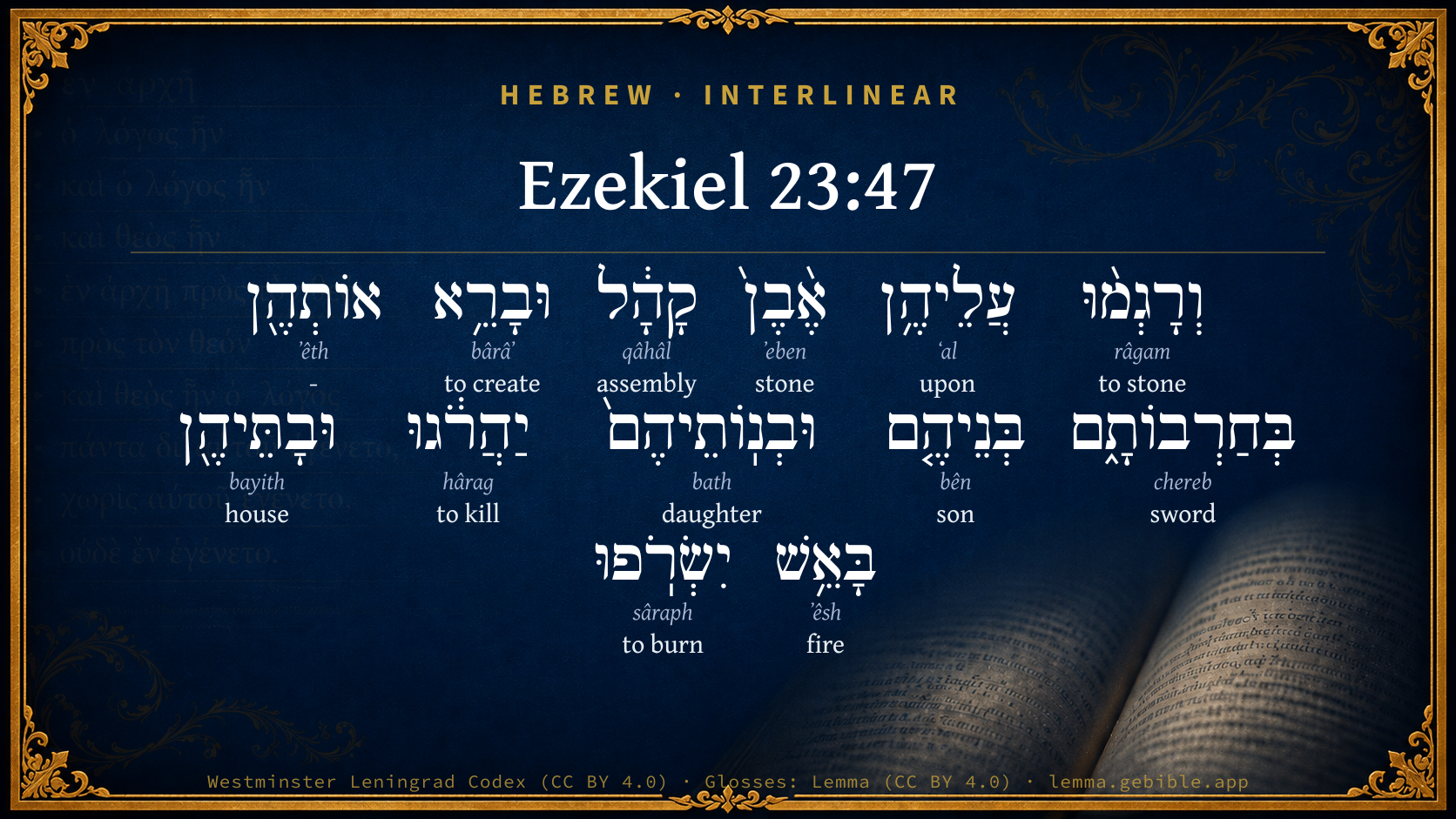
וְרָגְמ֨וּ
râgam
H7275
“and · to stone”
Conjunction + Verb, Qal, Sequential Perfect, 3rd Person, Common, Plural
Part of Speech
Conjunction + Verb
Stem
Qal
Form
Sequential Perfect
Person
3rd Person
Gender
Common
Number
Plural
Full BDB Definition

Origin: a primitive root [compare H7263 , H7321 , H7551 ]

TWOT: 2114

to stone, slay or kill by stoning - (Qal) to stone
  1. עֲלֵיהֶ֥ן ʻal H5921 “upon · them” Preposition + Suffix, Personal, 3rd Person, Feminine, Plural
  2. אֶ֨בֶן֙ ʼeben H68 “stone” Noun, Common, Feminine, Singular, Absolute
  3. קָהָ֔ל qâhâl H6951 “assembly” Noun, Common, Masculine, Singular, Absolute
  4. וּבָרֵ֥א bârâʼ H1254 “and · to create” Conjunction + Verb, Piel, Infinitive Absolute
  5. אוֹתְהֶ֖ן ʼêth H853 “- · them” Particle, Direct Object + Suffix, Personal, 3rd Person, Feminine, Plural
  6. בְּחַרְבוֹתָ֑ם chereb H2719 “in/at · swords · their” Preposition + Noun, Common, Feminine, Plural, Construct + Suffix, Personal, 3rd Person, Masculine, Plural
  7. בְּנֵיהֶ֤ם bên H1121 “sons · their” Noun, Common, Masculine, Plural, Construct + Suffix, Personal, 3rd Person, Masculine, Plural
  8. וּבְנֽוֹתֵיהֶם֙ bath H1323 “and · daughters · their” Conjunction + Noun, Common, Feminine, Plural, Construct + Suffix, Personal, 3rd Person, Masculine, Plural
  9. יַהֲרֹ֔גוּ hârag H2026 “to kill” Verb, Qal, Imperfect, 3rd Person, Masculine, Plural
  10. וּבָתֵּיהֶ֖ן bayith H1004 “and · houses · their” Conjunction + Noun, Common, Masculine, Plural, Construct + Suffix, Personal, 3rd Person, Feminine, Plural
  11. בָּאֵ֥שׁ ʼêsh H784 “in/at the · fire” Preposition, Determined + Noun, Common, Both, Singular, Absolute
  12. יִשְׂרֹֽפוּ sâraph H8313 “to burn” Verb, Qal, Imperfect, 3rd Person, Masculine, Plural

About this verse

These counts appear in no published source. They are computed here, from the morphology-tagged text and Lemma’s own curated glosses. What Lemma adds →

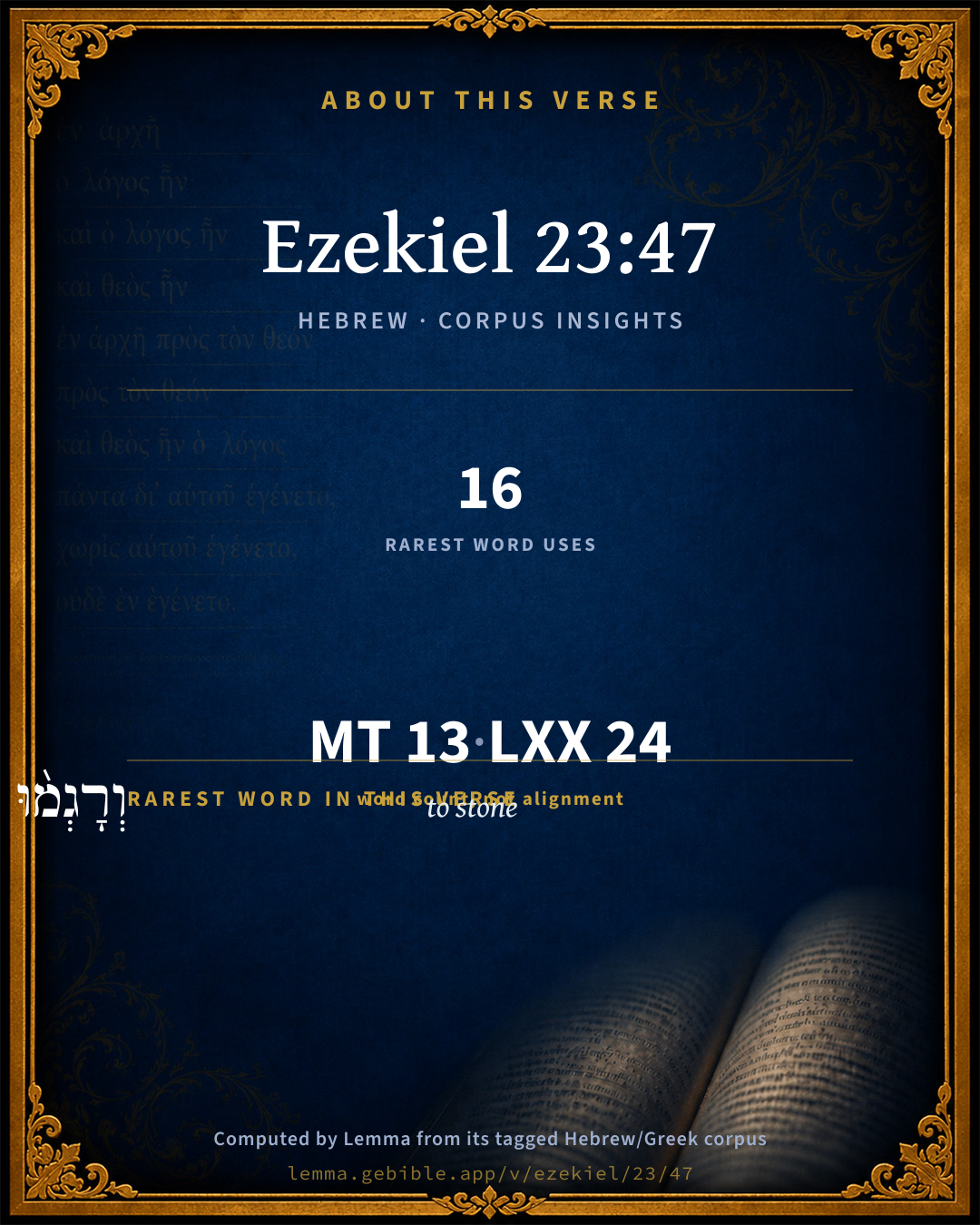
13
words
13
distinct lemmas
Prophets
section

Notable vocabulary

The rarest word here is וְרָגְמ֨וּ to stone H7275 — appearing just 16 times in the whole Hebrew Bible.

Shared distinctive vocabulary

וְרָגְמ֨וּ to stone H7275 occurs in 15 verses of the Hebrew Bible. Also found in:

Grammatical profile

  • 4 verbs
  • 7 nouns
  • 1 preposition
  • 1 particle

Verb forms

  • וְרָגְמ֨וּ Qal · Sequential Perfect
  • וּבָרֵ֥א Piel · Infinitive Absolute
  • יַהֲרֹ֔גוּ Qal · Imperfect
  • יִשְׂרֹֽפוּ Qal · Imperfect

Hebrew & Septuagint length

In English translation the verse runs 28 words from the Hebrew and 29 from the Septuagint (LXX English) — closely comparable.

A rough comparison of the two English renderings, which tokenize alike — not a word-level alignment.

Word counts can differ between the Hebrew and the Greek without any difference in meaning — e.g. the Hebrew direct-object marker אֵת has no separate Greek word, and Greek often adds the article ὁ.

In the original languages it is 13 Hebrew tokens and 24 Greek tokens — but the two are counted differently (Hebrew bundles its prefixes and suffixes into one token; the Greek is in lemma form), so that isn’t a like-for-like length.

Cross-references

11

Topical passages linked to Ezekiel 23:47 in the Treasury of Scripture Knowledge — connected by theme and wording, ordered by reader-vote popularity; previews shown in the World English Bible.

  • Jeremiah 39:8 The Chaldeans burned the king's house, and the houses of the people, with fire, and broke down the walls of Jerusalem.
  • Ezekiel 16:40–41 They shall also bring up a company against you, and they shall stone you with stones, and thrust you through with their swords.
  • Ezekiel 24:21 Speak to the house of Israel, Thus says the Lord Yahweh: Behold, I will profane my sanctuary, the pride of your power, the desire of your eyes, and that which your soul pities; and your sons and your daughters whom you have left behind shall fall by the sword.
  • Deuteronomy 13:16 You shall gather all the spoil of it into the midst of the street of it, and shall burn with fire the city, and all the spoil of it every whit, to Yahweh your God: and it shall be a heap forever; it shall not be built again.
  • 2 Chronicles 36:17–19 Therefore he brought on them the king of the Chaldeans, who killed their young men with the sword in the house of their sanctuary, and had no compassion on young man or virgin, old man or gray-headed: he gave them all into his hand.
  • Jeremiah 33:4–5 For thus says Yahweh, the God of Israel, concerning the houses of this city, and concerning the houses of the kings of Judah, which are broken down [to make a defense] against the mounds and against the sword;
  • Jeremiah 52:13 and he burned the house of Yahweh, and the king's house; and all the houses of Jerusalem, even every great house, burned he with fire.
  • Ezekiel 9:6 kill utterly the old man, the young man and the virgin, and little children and women; but don't come near any man on whom is the mark: and begin at my sanctuary. Then they began at the old men that were before the house.
  • Ezekiel 23:25 I will set my jealousy against you, and they shall deal with you in fury; they shall take away your nose and your ears; and your residue shall fall by the sword: they shall take your sons and your daughters; and your residue shall be devoured by the fire.
  • Ezekiel 23:29 and they shall deal with you in hatred, and shall take away all your labor, and shall leave you naked and bare; and the nakedness of your prostitution shall be uncovered, both your lewdness and your prostitution.
  • Ezekiel 24:6 Therefore thus says the Lord Yahweh: Woe to the bloody city, to the caldron whose rust is therein, and whose rust is not gone out of it! take out of it piece after piece; No lot is fallen on it.

Cross-references courtesy of OpenBible.info (CC BY 4.0).

Hebrew and Greek witnesses Masoretic Hebrew ↔ Greek Septuagint

The same verse in the two great witnesses to the Old Testament, shown verse-for-verse.

These are two independent witnesses, not word-aligned to each other, and the Septuagint is shown in lemma (dictionary) form.

Hebrew Ezekiel 23:47 Masoretic · Westminster Leningrad Codex

וְרָגְמ֨וּ עֲלֵיהֶ֥ן אֶ֨בֶן֙ קָהָ֔ל וּבָרֵ֥א אוֹתְהֶ֖ן בְּחַרְבוֹתָ֑ם בְּנֵיהֶ֤ם וּבְנֽוֹתֵיהֶם֙ יַהֲרֹ֔גוּ וּבָתֵּיהֶ֖ן בָּאֵ֥שׁ יִשְׂרֹֽפוּ

The company shall stone them with stones, and dispatch them with their swords; they shall kill their sons and their daughters, and burn up their houses with fire.

World English Bible · Public Domain

Greek LXX Ezekiel 23:47 Septuagint · lemma form

καί λιθοβολέω ἐπί αὐτός λίθος ὄχλος καί κατακεντέω αὐτός ἐν ὁ ξίφος αὐτός υἱός αὐτός καί θυγάτηρ αὐτός ἀποκτείνω καί ὁ οἶκος αὐτός ἐνπίμπρημι

And stone them with the stones of a multitude, and pierce them with their swords: they shall kill their sons and their daughters, and shall burn up their houses.

LXX2012 (modern English Septuagint) · Public Domain

Hebrew: Westminster Leningrad Codex (CC BY 4.0). Greek: Septuagint (public domain); English from LXX2012 (modern English Septuagint) (Public Domain). How the Septuagint differs from the Hebrew →

Targum (Aramaic paraphrase)

1

The Targum is the ancient Jewish Aramaic paraphrase of the Hebrew Scriptures — an interpretive translation, not the Hebrew text itself. Onkelos (literal) and Pseudo-Jonathan (expansive) render the Torah, and Jonathan the Prophets. Coverage is partial: where no permissively-licensed English translation exists for a verse, only the Aramaic is shown. This is verse-level text, not a word-by-word alignment to the Hebrew.

  1. Targum Jonathan Prophets (Joshua–Malachi)
    וְיִרְגְמוּ יַתְהֶן בְּאַבְנֵי קָלַע מַשִׁרְיָן וְיִבְזְעוּן יַתְהֶן בְּסַיְפֵיהוֹן בְּנֵיהוֹן וּבְנָתְהוֹן יִקְטְלוּן וּבָתֵּיהוֹן יוֹקְדוּן בְּנוּרָא:

    (no public-domain English translation for this verse)

    Targum Jonathan — Aramaic: “Mikraot Gedolot” (public domain). English: “Sefaria Community Translation” (CC0 1.0 (public-domain dedication)); “London "Chaldee Paraphrase," 1871” (public domain). Text via Sefaria.

Commentary

Notes on Ezekiel 23:47 from classic Christian and Jewish commentators (each source and its license shown beneath its notes). The classic Christian expositions comment on the surrounding passage and are grouped to its opening verse, so a note may address several verses; the Jewish commentaries on the Tanakh (Rashi and others) are per-verse, so they appear only where the commentator wrote on this verse.

Lemma curates 59 commentaries, every one of them public domain or Creative Commons licensed, each selected and text-cleaned for this edition rather than reprinted as found. About our sources →

Trapp's Complete Commentary

John Trapp

Eze 23:47 And the company shall stone them with stones, and dispatch them with their swords; they shall slay their sons and their daughters, and burn up their houses with fire.

Ver. 47. And the company shall stone them.] As by the law they did adulteresses.

John Trapp, A Commentary or Exposition upon All the Books of the Old and New Testament (1647–1656) — public domain. Text from a community e-Sword module.

Jamieson, Fausset & Brown

Robert Jamieson, A. R. Fausset & David Brown

stones--the legal penalty of the adulteress (Eze 16:40-41; Joh 8:5). Answering to the stones hurled by the Babylonians from engines in besieging Jerusalem.

houses . . . fire--fulfilled (Ch2 36:17, Ch2 36:19).

Jamieson, Fausset & Brown — Commentary Critical and Explanatory on the Whole Bible (1871) — public domain (CC PDM 1.0). Text via the HelloAO Bible API.

Adam Clarke's Commentary

Verse 47. Shall stone them with stones] As they did adulteresses under the law. See Le 20:10; De 22:22, compared with Joh 8:3.

Adam Clarke's Commentary on the Bible (1810–1826) — public domain. Text from a community e-Sword/MySword module.

Ellicott's Commentary for English Readers

(47) With stones . . . with swords.—The figure and the reality are here designedly mixed. Stoning was the legal punishment of adultery, but the actual overthrow of Jerusalem was by the sword.

A Bible Commentary for English Readers, edited by Charles John Ellicott (1878–1897) — public domain. Text from a community e-Sword module.

John Gill's Exposition

And the company shall stone them with stones,.... Which was the punishment of adulterers and idolaters, Deu 13:10, this seems to refer to the Chaldean army casting out stones from their slings and engines into the city of Jerusalem, when they besieged it, by which they killed some, and beat down the houses, which fell upon others, and destroyed them. So the Targum,

"and the army shall stone them with the stones of a sling:''

and dispatch them with their swords; cut them in pieces with them, such as sallied out of the city upon them, or they found without, or by any means fell into their hands:

they shall slay their sons and their daughters; when they broke into the city, and took it; or when they found them making their escape, and hiding themselves in secret places:

and burn up their houses with fire; as they did; the temple, the king's palace, the houses of noblemen, and all the houses in Jerusalem; see Jer 52:13.

John Gill's Exposition of the Whole Bible (1746–1763) — public domain (CC PDM 1.0). Text via the HelloAO Bible API.

Haydock's Catholic Bible Commentary

Stones, like adulteresses, chap. xvi. 38., and Leviticus xx. 10. (Haydock) --- Let the walls be demolished. (Calmet)

George Leo Haydock (1774–1849), Haydock's Catholic Family Bible and Commentary, 1859 edition — public domain. Excludes Psalms (Douay-Rheims chapter numbering differs from Protestant) and Deuterocanonical books (Catholic canon only).

Matthew Poole's English Annotations

The company, Heb. congregation, the Babylonian army.

Stone them; the punishment of an adulteress; and this was in a manner done when the engines, which cast mighty stones into the besieged city, dashed out the brains of some, and when chimneys, or walls, or towers, beat down by those stones cast out of the engines, fell on others, and buried them alive.

Despatch them with their swords: some of them who escaped the stones fell under the sword of the Babylonian soldier.

Slay their sons; either in fight, or when they break into the city, or light on them wandering on mountains, or hiding in dens and caves.

And their daughters; either in sacking the city, when they regard no sex, or because they choose to die rather than yield to the lust of those vile ones.

Burn up their houses; as the cities, and houses abroad in the country; so the Babylonish army destroyed what they could not carry away with them, as Eze 23:25.

Matthew Poole's English Annotations on the Holy Bible (1683–1685) — public domain. Text from a community e-Sword/MySword module.

John Wesley's Explanatory Notes

The company - The Babylonian army.

John Wesley, Explanatory Notes Upon the Whole Bible (1754–1765) — public domain. Text via the GEBible commentary corpus.

Rashi

Rabbi Shlomo Yitzchaki (Rashi)

shall pelt them with stone The slaying of their sons and daughters and the burning of their houses is the judgment of adulteresses.

and slash them with their swords That is the judgment of murderesses. [The word] וּבָרֵא is an expression of cutting, and so: “and you shall cut it down (וּבֵרֵאתוֹ),” of “the forest shall be yours” in the Book of Joshua (17:18).

Rashi on the Tanakh — English translations: “The Judaica Press complete Tanach with Rashi, translated by A. J. Rosenberg” (CC BY 4.0); “Pentateuch with Rashi's commentary by M. Rosenbaum and A.M. Silbermann, 1929-1934” (public domain); “The Metsudah Tanach series, Lakewood, N.J” (CC BY 4.0); and “The Book of Joshua, Metsudah Publications, 1997” (CC BY 4.0). Text via Sefaria.

Lesson kit

Teaching starters — assembled from the data on this page, not authored interpretation. Every prompt links to the verse data it draws on. Edit before teaching.

Ezekiel, in the Prophets, opens this verse with 13 words (13 distinct Hebrew lemmas). Its most distinctive word is râgam (“to stone”). A historical commentator’s framing appears above. Read the whole chapter for the surrounding context.

Discussion questions

  1. How does “to stone” (râgam) shape what this verse is saying?
  2. How does Leviticus 20:2, which shares the word «to stone», read alongside this verse?
  3. These translations render this verse differently; the difference is in the English rendering, not the original. What questions does that raise?
  4. «וְרָגְמ֨וּ» is a Qal Sequential Perfect verb. How does that grammatical form shape the action described?
  5. Compare how Trapp's Complete Commentary and Jamieson, Fausset & Brown read this verse. Where do they agree or differ?

Things to notice

Reading settings

Reading text

Shown beneath each verse's original-language words.

Old Testament
Old Testament edition

Read the OT as the Masoretic Hebrew (MT) or the Greek Septuagint (LXX).

English shown for the Greek Septuagint (in the Hebrew ↔ Greek comparison).

Comparing translations? Open the Compare panel on any verse page to stack up to four side by side.