
1 Kings 12:27

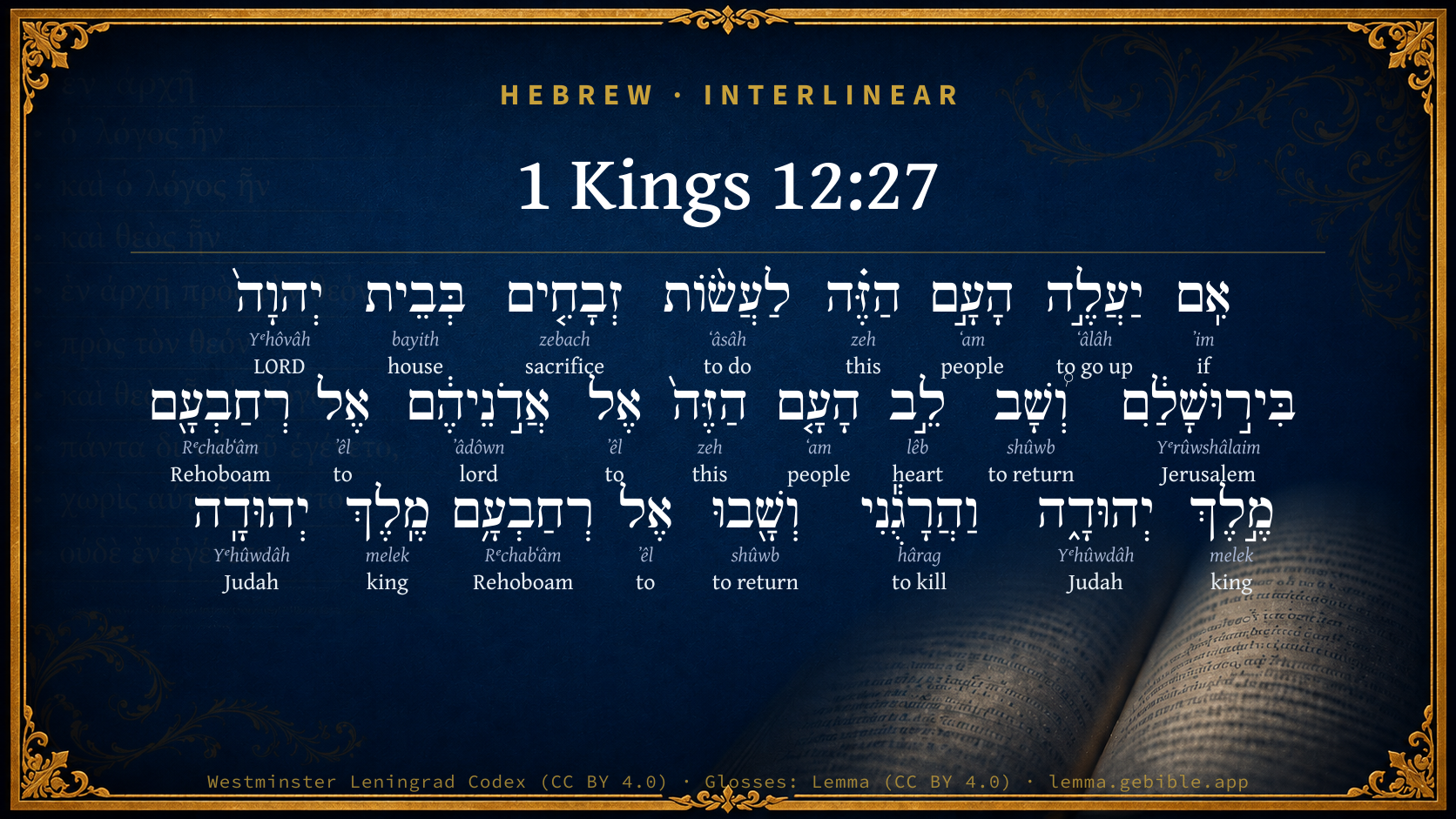
Hebrew (Westminster Leningrad Codex) 1 Kings 12:27 appears in the Hebrew Old Testament. The text above is from the Westminster Leningrad Codex. Each word links to its Strong’s number, a concise gloss, and parsing drawn from the Open Scriptures Hebrew Bible morphology. Click any word for its full Brown-Driver-Briggs (BDB) entry.
Download image
Cite this verse

1 Kings 12:27 (World English Bible). Public Domain. Lemma interlinear Bible study tool, https://lemma.gebible.app/v/1-kings/12/27.

Show BibTeX & RIS
BibTeX
RIS
English Translation
if this people go up to offer sacrifices in the house of Yahweh at Jerusalem, then will the heart of this people turn again to their lord, even to Rehoboam king of Judah; and they will kill me, and return to Rehoboam king of Judah.
World English Bible · Public Domain
Download a study sheet

One document with this verse’s original text, its word-by-word gloss line, the meaning frame, cross-references with their text, attributed commentary, and full source and license credits — printable, and it pastes into notes with its structure intact.

This verse Autodidact and up

Study sheet (.html) Plain text (.txt)

A passage Seminary Student

Up to 50 verses in one chapter. A passage sheet keeps up to 6 commentary sources and 12 cross-references per verse, in the order this page ranks them, and says so on the sheet whenever that leaves anything out. Ask for a single verse and you get the Autodidact verse sheet above.

Everything on this page stays free to read, with no account — the sheet is a download of what is already on screen, not access to it.

Want to remove ads? Support Godless Engineer
Compare translations 3

The same verse in 3 English versions, stacked beneath the original-language interlinear above. Click any original word for its lexicon entry.

Each is an independent rendering of the whole verse — the interlinear is not word-aligned to these translations.

Highlighted words mark where these versions differ — a whole-verse word diff, not a word-by-word alignment.

  • World English Bible Public Domain
    if this people go up to offer sacrifices in the house of Yahweh at Jerusalem, then will the heart of this people turn again to their lord, even to Rehoboam king of Judah; and they will kill me, and return to Rehoboam king of Judah.
  • King James Version Public Domain
    If this people go up to do sacrifice in the house of the LORD at Jerusalem, then shall the heart of this people turn again unto their lord, even unto Rehoboam king of Judah, and they shall kill me, and go again to Rehoboam king of Judah.
  • unfoldingWord Literal Text CC BY-SA 4.0
    If this people goes up to make sacrifices in the house of Yahweh in Jerusalem, then the heart of this people will return to their master, to Rehoboam, the king of Judah. And they will kill me, and they will return to Rehoboam, the king of Judah.”

unfoldingWord Literal Text — © unfoldingWord, licensed CC BY-SA 4.0. Word-aligned USFM3 via Door43 (git.door43.org/unfoldingWord/en_ult).

Versions to compare (up to 4)

3 of 4 selected

Show all 18 translations

Every available English version of this verse, each an independent rendering of the whole verse.

  • World English Bible Public Domain
    if this people go up to offer sacrifices in the house of Yahweh at Jerusalem, then will the heart of this people turn again to their lord, even to Rehoboam king of Judah; and they will kill me, and return to Rehoboam king of Judah.
  • Berean Standard Bible Public Domain
    If these people go up to offer sacrifices in the house of the LORD at Jerusalem, their hearts will return to their lord, Rehoboam king of Judah; then they will kill me and return to Rehoboam king of Judah.”
  • Majority Standard Bible Public Domain
    If these people go up to offer sacrifices in the house of the LORD at Jerusalem, their hearts will return to their lord, Rehoboam king of Judah; then they will kill me and return to Rehoboam king of Judah.”
  • King James Version Public Domain
    If this people go up to do sacrifice in the house of the LORD at Jerusalem, then shall the heart of this people turn again unto their lord, even unto Rehoboam king of Judah, and they shall kill me, and go again to Rehoboam king of Judah.
  • American Standard Version (1901) Public Domain
    if this people go up to offer sacrifices in the house of Jehovah at Jerusalem, then will the heart of this people turn again unto their lord, even unto Rehoboam king of Judah; and they will kill me, and return to Rehoboam king of Judah.
  • Revised Version (1885) Public Domain
    if this people go up to offer sacrifices in the house of the LORD at Jerusalem, then shall the heart of this people turn again unto their lord, even unto Rehoboam king of Judah; and they shall kill me, and return to Rehoboam king of Judah.
  • Geneva Bible (1599) Public Domain
    If this people goe vp and doe sacrifice in the house of the Lord at Ierusalem, then shall the heart of this people turne againe vnto their lorde, euen to Rehoboam King of Iudah: so shall they kill me and goe againe to Rehoboam King of Iudah.
  • Douay-Rheims (1899) Public Domain
    If this people go up to offer sacrifices in the house of the Lord at Jerusalem: and the heart of this people will turn to their lord Roboam the king of Juda, and they will kill me, and return to him.
  • Young's Literal Translation Public Domain
    if this people go up to make sacrifices in the house of Jehovah in Jerusalem, then hath the heart of this people turned back unto their lord, unto Rehoboam king of Judah, and they have slain me, and turned back unto Rehoboam king of Judah.'
  • Literal Standard Version CC BY-SA 4.0
    if this people goes up to make sacrifices in the house of YHWH in Jerusalem, then the heart of this people has turned back to their lord, to Rehoboam king of Judah, and they have slain me, and turned back to Rehoboam king of Judah.”
  • Unlocked Literal Bible CC BY-SA 4.0
    If these people go up to offer sacrifices in the temple of Yahweh at Jerusalem, then the heart of these people will turn again to their master, to Rehoboam king of Judah. They will kill me and return to Rehoboam king of Judah.”
  • unfoldingWord Literal Text CC BY-SA 4.0
    If this people goes up to make sacrifices in the house of Yahweh in Jerusalem, then the heart of this people will return to their master, to Rehoboam, the king of Judah. And they will kill me, and they will return to Rehoboam, the king of Judah.”
  • Darby Bible Public Domain
    If this people go up to do sacrifice in the house of Jehovah at Jerusalem, the heart of this people will turn again to their lord, to Rehoboam king of Judah, and they will kill me, and return to Rehoboam king of Judah.
  • World Messianic Bible Public Domain
    If this people goes up to offer sacrifices in the LORD’s house at Jerusalem, then the heart of this people will turn again to their lord, even to Rehoboam king of Judah; and they will kill me, and return to Rehoboam king of Judah.”
  • Webster's Bible Public Domain
    If this people go up to perform sacrifice in the house of the LORD at Jerusalem, then shall the heart of this people turn again to their lord, even to Rehoboam king of Judah, and they shall kill me, and return to Rehoboam king of Judah.
  • Free Bible Version CC BY-SA 4.0
    When people from here go to offer sacrifices at the Lord's Temple in Jerusalem, they will transfer their loyalty back to Rehoboam, king of Judah. Then they will kill me and go back to King Rehoboam.”
  • Bible in Basic English Public Domain
    If the people go up to make offerings in the house of the Lord at Jerusalem, their heart will be turned again to their lord, to Rehoboam, king of Judah; and they will put me to death and go back to Rehoboam, king of Judah.
  • JPS Tanakh (1917) Public Domain
    If this people go up to offer sacrifices in the house of the LORD at Jerusalem, then will the heart of this people turn back unto their lord, even unto Rehoboam king of Judah; and they will kill me, and return to Rehoboam king of Judah.'

Literal Standard Version (2020), Covenant Press — licensed CC BY-SA 4.0. Text via the HelloAO Bible API (eBible.org). Unlocked Literal Bible (unfoldingWord) — licensed CC BY-SA 4.0. Text via the HelloAO Bible API (eBible.org). unfoldingWord Literal Text — © unfoldingWord, licensed CC BY-SA 4.0. Word-aligned USFM3 via Door43 (git.door43.org/unfoldingWord/en_ult). Free Bible Version, Dr. Jonathan Gallagher — licensed CC BY-SA 4.0. Text via the HelloAO Bible API (eBible.org).

Word by word

More ways to search: Search by grammar → Find every occurrence → Compare this word →

Practice this passage: Drill this verse → Learn its vocabulary →

רְחַבְעָ֖ם
Rᵉchabʻâm
H7346
“Rehoboam”
Noun, Proper
Part of Speech
Noun
Type
Proper
Full BDB Definition

Origin: from H7337 and H5971

TWOT: None

Rehoboam = "a people has enlarged" - son of Solomon and the 1st king of Judah after the split up of the kingdom of Israel
  1. אִֽם ʼim H518 “if” Conjunction
  2. יַעֲלֶ֣ה ʻâlâh H5927 “to go up” Verb, Qal, Imperfect, 3rd Person, Masculine, Singular
  3. הָעָ֣ם ʻam H5971 “the · people” Particle, Definite Article + Noun, Common, Masculine, Singular, Absolute
  4. הַזֶּ֗ה zeh H2088 “the · this” Particle, Definite Article + Pronoun, Demonstrative, Masculine, Singular
  5. לַעֲשׂ֨וֹת ʻâsâh H6213 “to do” Preposition + Verb, Qal, Infinitive Construct
  6. זְבָחִ֤ים zebach H2077 “sacrifices” Noun, Common, Masculine, Plural, Absolute
  7. בְּבֵית bayith H1004 “in/at · house of” Preposition + Noun, Common, Masculine, Singular, Construct
  8. יְהוָה֙ Yᵉhôvâh H3068 “LORD” Noun, Proper
  9. בִּיר֣וּשָׁלִַ֔ם Yᵉrûwshâlaim H3389 “in/at · Jerusalem” Preposition + Noun, Proper
  10. וְ֠שָׁב shûwb H7725 “and · to return” Conjunction + Verb, Qal, Sequential Perfect, 3rd Person, Masculine, Singular
  11. לֵ֣ב lêb H3820 “heart of” Noun, Common, Masculine, Singular, Construct
  12. הָעָ֤ם ʻam H5971 “the · people” Particle, Definite Article + Noun, Common, Masculine, Singular, Absolute
  13. הַזֶּה֙ zeh H2088 “the · this” Particle, Definite Article + Pronoun, Demonstrative, Masculine, Singular
  14. אֶל ʼêl H413 “to” Preposition
  15. אֲדֹ֣נֵיהֶ֔ם ʼâdôwn H113 “lords · their” Noun, Common, Masculine, Plural, Construct + Suffix, Personal, 3rd Person, Masculine, Plural
  16. אֶל ʼêl H413 “to” Preposition
  17. מֶ֣לֶךְ melek H4428 “king of” Noun, Common, Masculine, Singular, Construct
  18. יְהוּדָ֑ה Yᵉhûwdâh H3063 “Judah” Noun, Proper
  19. וַהֲרָגֻ֕נִי hârag H2026 “and · to kill · me” Conjunction + Verb, Qal, Sequential Perfect, 3rd Person, Common, Plural + Suffix, Personal, 1st Person, Common, Singular
  20. וְשָׁ֖בוּ shûwb H7725 “and · to return” Conjunction + Verb, Qal, Sequential Perfect, 3rd Person, Common, Plural
  21. אֶל ʼêl H413 “to” Preposition
  22. רְחַבְעָ֥ם Rᵉchabʻâm H7346 “Rehoboam” Noun, Proper
  23. מֶֽלֶךְ melek H4428 “king of” Noun, Common, Masculine, Singular, Construct
  24. יְהוּדָֽה Yᵉhûwdâh H3063 “Judah” Noun, Proper

About this verse

These counts appear in no published source. They are computed here, from the morphology-tagged text and Lemma’s own curated glosses. What Lemma adds →

25
words
17
distinct lemmas
Historical
section

Shared distinctive vocabulary

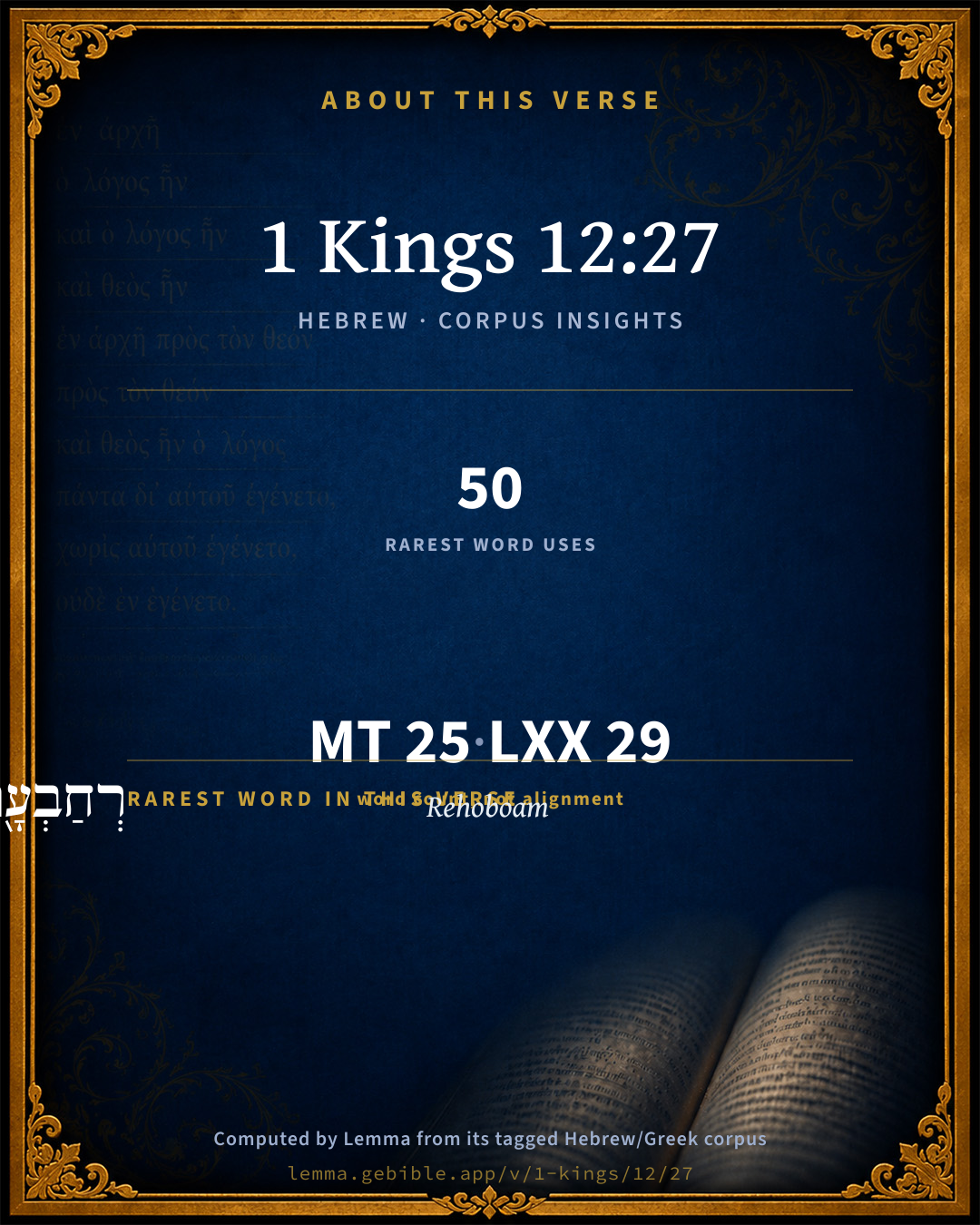
רְחַבְעָ֖ם Rehoboam H7346 occurs in 41 verses of the Hebrew Bible. Also found in:

Grammatical profile

  • 5 verbs
  • 14 nouns
  • 2 pronouns
  • 3 prepositions
  • 1 conjunction

Verb forms

  • יַעֲלֶ֣ה Qal · Imperfect
  • לַעֲשׂ֨וֹת Qal · Infinitive Construct
  • וְ֠שָׁב Qal · Sequential Perfect
  • וַהֲרָגֻ֕נִי Qal · Sequential Perfect
  • וְשָׁ֖בוּ Qal · Sequential Perfect

Repetition

Words recur within this verse — often emphatic in Hebrew:

  • הָעָ֣ם people H5971 ×2
  • וְ֠שָׁב to return H7725 ×2
  • רְחַבְעָ֖ם Rehoboam H7346 ×2
  • מֶ֣לֶךְ king H4428 ×2
  • יְהוּדָ֑ה Judah H3063 ×2
  • אֶל to H413 ×3
  • הַזֶּ֗ה this H2088 ×2

Hebrew & Septuagint length

In English translation the verse runs 45 words from the Hebrew and 42 from the Septuagint (LXX English) — closely comparable.

A rough comparison of the two English renderings, which tokenize alike — not a word-level alignment.

Word counts can differ between the Hebrew and the Greek without any difference in meaning — e.g. the Hebrew direct-object marker אֵת has no separate Greek word, and Greek often adds the article ὁ.

In the original languages it is 25 Hebrew tokens and 29 Greek tokens — but the two are counted differently (Hebrew bundles its prefixes and suffixes into one token; the Greek is in lemma form), so that isn’t a like-for-like length.

Cross-references

11

Topical passages linked to 1 Kings 12:27 in the Treasury of Scripture Knowledge — connected by theme and wording, ordered by reader-vote popularity; previews shown in the World English Bible.

  • Deuteronomy 12:5–7 But to the place which Yahweh your God shall choose out of all your tribes, to put his name there, even to his habitation shall you seek, and there you shall come;
  • Deuteronomy 12:14 but in the place which Yahweh shall choose in one of your tribes, there you shall offer your burnt offerings, and there you shall do all that I command you.
  • Deuteronomy 16:6 but at the place which Yahweh your God shall choose, to cause his name to dwell in, there you shall sacrifice the Passover at even, at the going down of the sun, at the season that you came forth out of Egypt.
  • Proverbs 29:25 The fear of man proves to be a snare, But whoever puts his trust in Yahweh is kept safe.
  • Genesis 12:12–13 It will happen, when the Egyptians will see you, that they will say, 'This is his wife.' They will kill me, but they will save you alive.
  • Genesis 26:7 The men of the place asked him about his wife. He said, "She is my sister," for he was afraid to say, "My wife," lest, he thought, the men of the place might kill me for Rebekah, because she was beautiful to look on.
  • Deuteronomy 16:2 You shall sacrifice the Passover to Yahweh your God, of the flock and the herd, in the place which Yahweh shall choose, to cause his name to dwell there.
  • 1 Kings 8:29–30 that your eyes may be open toward this house night and day, even toward the place of which you have said, My name shall be there; to listen to the prayer which your servant shall pray toward this place.
  • 1 Kings 8:44 If your people go out to battle against their enemy, by whatever way you shall send them, and they pray to Yahweh toward the city which you have chosen, and toward the house which I have built for your name;
  • 1 Kings 11:32 (but he shall have one tribe, for my servant David's sake and for Jerusalem's sake, the city which I have chosen out of all the tribes of Israel);
  • 1 Corinthians 1:19–20 For it is written, "I will destroy the wisdom of the wise, I will bring the discernment of the discerning to nothing."

Cross-references courtesy of OpenBible.info (CC BY 4.0).

Hebrew and Greek witnesses Masoretic Hebrew ↔ Greek Septuagint

The same verse in the two great witnesses to the Old Testament, shown verse-for-verse.

These are two independent witnesses, not word-aligned to each other, and the Septuagint is shown in lemma (dictionary) form.

Hebrew 1 Kings 12:27 Masoretic · Westminster Leningrad Codex

אִֽם יַעֲלֶ֣ה הָעָ֣ם הַזֶּ֗ה לַעֲשׂ֨וֹת זְבָחִ֤ים בְּבֵית יְהוָה֙ בִּיר֣וּשָׁלִַ֔ם וְ֠שָׁב לֵ֣ב הָעָ֤ם הַזֶּה֙ אֶל אֲדֹ֣נֵיהֶ֔ם אֶל רְחַבְעָ֖ם מֶ֣לֶךְ יְהוּדָ֑ה וַהֲרָגֻ֕נִי וְשָׁ֖בוּ אֶל רְחַבְעָ֥ם מֶֽלֶךְ יְהוּדָֽה

if this people go up to offer sacrifices in the house of Yahweh at Jerusalem, then will the heart of this people turn again to their lord, even to Rehoboam king of Judah; and they will kill me, and return to Rehoboam king of Judah.

World English Bible · Public Domain

Greek LXX 1 Kings 12:27 Septuagint · lemma form

ἐάν ἀναβαίνω ὁ λαός οὗτος ἀναφέρω θυσία ἐν οἶκος κύριος εἰς ἰερουσαλήμ καί ἐπιστρέφω καρδία ὁ λαός πρός κύριος καί κύριος αὐτός πρός ροβοαμ βασιλεύς ιουδα καί ἀποκτείνω ἐγώ

If this people shall go up to offer sacrifice in the house of the Lord at Jerusalem, then the heart of the people will return to the Lord, and to their master, to Roboam king of Juda, and they will kill me.

LXX2012 (modern English Septuagint) · Public Domain

On this verse, The Cambridge Bible for Schools and Colleges discusses the Septuagint’s reading. Read the note in Commentary ↓

Hebrew: Westminster Leningrad Codex (CC BY 4.0). Greek: Septuagint (public domain); English from LXX2012 (modern English Septuagint) (Public Domain). How the Septuagint differs from the Hebrew →

Targum (Aramaic paraphrase)

1

The Targum is the ancient Jewish Aramaic paraphrase of the Hebrew Scriptures — an interpretive translation, not the Hebrew text itself. Onkelos (literal) and Pseudo-Jonathan (expansive) render the Torah, and Jonathan the Prophets. Coverage is partial: where no permissively-licensed English translation exists for a verse, only the Aramaic is shown. This is verse-level text, not a word-by-word alignment to the Hebrew.

  1. Targum Jonathan Prophets (Joshua–Malachi)
    אִם יִסַק עַמָא הָדֵין לְמֶעְבַּד נִכְסַת קוּדְשִׁין בְבֵית מַקְדְשָׁא דַייָ בִּירוּשְׁלֵם וְיִתְפְּנֵי לִבָּא דְעַמָא הָדֵין בָּתַר רִבּוֹנְהוֹן בָּתַר רְחַבְעָם מֶלֶךְ שִׁבְטָא דְבֵית יְהוּדָא וְיִקְטְלֻנַנִי וִיתוּבוּן לְוַת רְחַבְעָם מֶלֶךְ שִׁבְטָא דְבֵית יְהוּדָה:

    (no public-domain English translation for this verse)

    Targum Jonathan — Aramaic: “Mikraot Gedolot” (public domain). English: “Sefaria Community Translation” (CC0 1.0 (public-domain dedication)); “London "Chaldee Paraphrase," 1871” (public domain). Text via Sefaria.

Commentary

Notes on 1 Kings 12:27 from classic Christian and Jewish commentators (each source and its license shown beneath its notes). The classic Christian expositions comment on the surrounding passage and are grouped to its opening verse, so a note may address several verses; the Jewish commentaries on the Tanakh (Rashi and others) are per-verse, so they appear only where the commentator wrote on this verse.

Lemma curates 59 commentaries, every one of them public domain or Creative Commons licensed, each selected and text-cleaned for this edition rather than reprinted as found. About our sources →

Trapp's Complete Commentary

John Trapp

1Ki 12:27 If this people go up to do sacrifice in the house of the LORD at Jerusalem, then shall the heart of this people turn again unto their lord, [even] unto Rehoboam king of Judah, and they shall kill me, and go again to Rehoboam king of Judah.

Ver. 27. If this people go up to do sacrifice in the house.] The temple, that proper place of God’s true, doth accidentally become an occasion, through men’s corruption, of setting up of false, worship: so doth, at this day, the holy eucharist, of disunion and dissension; Hinc bellum illud Sacramentarium.

John Trapp, A Commentary or Exposition upon All the Books of the Old and New Testament (1647–1656) — public domain. Text from a community e-Sword module.

Joseph Benson's Commentary

1Ki 12:27. If this people go up to do sacrifice at Jerusalem, &c. — All the people of Israel being bound, at the three great feasts, to go up to Jerusalem; and on other solemn occasions devout persons being used to go thither to offer gifts and sacrifices; he was afraid lest, if they should continue to go, they should be so taken with the magnificence of the temple and the royal city, and should so recall to mind the famous acts of David and Solomon who were buried there, as, by degrees, to be alienated from him, and brought back to their former allegiance to the family of David. And he the rather feared this, because their going to Jerusalem, and attending divine worship there, would have afforded to Rehoboam many occasions of showing them kindness and winning their affections; and to the priests and Levites, the sure and faithful friends of David’s house, many opportunities of soliciting them to unite themselves again to Judah, which tribe must have appeared to them to have the better cause, because it had the temple in possession in which God dwelt. But whatever reasons there might have been for his conjectures and apprehensions, and whatever prudence and policy may appear in his contrivance, considering the providence of God, by which the hearts of all men, and the affairs of all kingdoms are governed, and of which he had lately seen so eminent an instance, the course he took was foolish as well as wicked.

Joseph Benson's Commentary on the Old and New Testaments (1811–1818) — public domain. Text from a community e-Sword module.

Geneva Bible (1599)

Geneva Bible translators

He feared lest his people should have by this means been enticed to rebel against him.

Geneva Bible (1599) marginal notes — public domain. Text via Bolls.life.

Adam Clarke's Commentary

Verse 27. And they shall kill me] He found he had little cause to trust this fickle people; though they had declared for him it was more from caprice, desire of change, and novelty, than from any regular and praiseworthy principle.

Adam Clarke's Commentary on the Bible (1810–1826) — public domain. Text from a community e-Sword/MySword module.

Ellicott's Commentary for English Readers

(27, 28) In these verses is recorded the adoption of the fatal policy which has caused Jeroboam to be handed down in the sacred record as “the son of Nebat, who made Israel to sin.” Hitherto his new royalty had been inaugurated under a Divine sanction, both as receiving distinct promise of permanence and blessing (1Ki_11:37-38), and as protected by open prophetic interference, at the critical moment when its ill-consolidated force might have been crushed. Nor is it unlikely that it may have been supported by a wholesome reaction against the idolatry, as well as against the despotism, of Solomon. Now, unsatisfied with these securities of his kingdom, and desirous to strengthen it by a bold stroke of policy, he takes the step which mars the bright promise of his accession. Yet the policy was exceedingly natural. In Israel, beyond all other nations, civil and religious allegiance were indissolubly united; it was almost impossible to see how separate national existence could have been sustained without the creation, or (as it might seem) the revival, of local sanctuaries to rival the sacredness of Jerusalem. Nor was the breach of Divine law apparently a serious one. The worship at Dan and Bethel was not the bloody and sensual worship of false gods, but the worship of the Lord Jehovah under the form of a visible emblem, meant to be a substitute for the ark and the overshadowing cherubim. It might have been plausibly urged that, to wean Israel from all temptation to the abominations which Solomon had introduced, it was necessary to give their faith the visible support of these great local sanctuaries, and the lesser “high places” which would naturally follow. But the occasion was the critical moment of choice between a worldly policy—“doing evil that good might come”—and the higher and more arduous path of simple faith in God’s promise, and obedience to the command designed to protect the purity and spirituality of His worship. The step, once taken, was never retraced. Eminently successful in its immediate object of making the separation irreparable, it purchased success at the price, first, of destruction of all religious unity in Israel, and next, of a natural corruption, opening the door at once to idolatry, and hereafter to the grosser apostasy, against which it professed to guard. It needed the faith of David—as shown, for example, in the patient acquiescence in the prohibition of the erection of a Temple to be the spiritual glory of his kingdom—to secure the promise of “a sure house, as for David.” That promise was now forfeited for ever.

A Bible Commentary for English Readers, edited by Charles John Ellicott (1878–1897) — public domain. Text from a community e-Sword module.

The Cambridge Bible for Schools and Colleges

gen. ed. J. J. S. Perowne

27. if this people go up to do sacrifice] There appears to have been no thought in the popular mind that the choice of a different ruler for the ten tribes would break their connexion with the worship at the Temple. So that we must judge the Temple to have now become the one recognised place for worship. The R.V. represents the Hebrew more closely by rendering to offer sacrifices.

then shall the heart of this people turn] After the first excitement of the revolt was over, and Jeroboam had begun to exercise lordship in his turn, the attraction of the Temple, and the prestige of the older family, and especially the glories attaching to the house of David would begin to reassert their power. Jeroboam expresses this feeling when he still calls Rehoboam ‘their lord.’

they shall kill me] When they have begun to repent of the step which they have taken at my leading. Such reaction of feeling is more common in Eastern than in Western minds.

and go again to Rehoboam king of Judah] The LXX. omits these words. The title ‘king of Judah’ is first used in this chapter, here and above in 1Ki_12:23.

The Cambridge Bible for Schools and Colleges (gen. ed. J. J. S. Perowne; Cambridge University Press, 1878–1918) — public domain. Text from a community e-Sword module.

John Gill's Exposition

And he set the one in Bethel,.... In the southern part of the land, on the border of Ephraim and Benjamin; and the rather he chose this place, because its name signifies the house of God, and had been a sacred place, where Jacob more than once enjoyed the divine Presence:

and the other put he in Dan: in the northern part of the land, for the convenience of the inhabitants of those parts; and the rather, since it had been a place resorted to in former times, because of the teraphim of Micah there.

John Gill's Exposition of the Whole Bible (1746–1763) — public domain (CC PDM 1.0). Text via the HelloAO Bible API.

Albert Barnes' Notes on the Bible

Kill me - In case his subjects desired a reconciliation with Rehoboam, Jeroboam’s death would at once facilitate the re-establishment of a single kingdom, and obtain favor with the legitimate monarch. (Compare 2Sa 4:7.)

Albert Barnes' Notes on the Bible (1834–1885) — public domain. Text from a community e-Sword/MySword module.

Haydock's Catholic Bible Commentary

Him. Jeroboam chose to follow the dictates of human policy, rather than to depend on the express declaration of God, who had given him the kingdom. It was natural that the people should have a predilection for the house of David; (Calmet) and he might fear that the priests would prevail upon them to return to their old master, as they dwelt about Jerusalem. (Salien)

George Leo Haydock (1774–1849), Haydock's Catholic Family Bible and Commentary, 1859 edition — public domain. Excludes Psalms (Douay-Rheims chapter numbering differs from Protestant) and Deuterocanonical books (Catholic canon only).

Matthew Poole's English Annotations

This in itself might seem a prudent conjecture; for this would give Rehoboam, and the priests and Levites, the sure and faithful friends of David’s house, many opportunities of alienating their minds from him, and of reducing them to their former allegiance. But considering God’s providence, by which the hearts of all men, and the affairs of all kings and kingdoms, are governed, and of which he had lately seen so eminent an instance, it was a foolish as well as wicked course.

Matthew Poole's English Annotations on the Holy Bible (1683–1685) — public domain. Text from a community e-Sword/MySword module.

The Pulpit Commentary

If this people go up to do sacrifice Heb. sacrifices in the house of the Lord at Jerusalem as the law of Moses ordained, (Deu_12:11, 14 16:6, 11) then shall the heart of this people turn again unto their lord The Syriac omits this word. The LXX has prorion karion aujtwn, even unto Rehoboam king of Judah When Wordsworth remarks that Jeroboam "here acknowledges Rehoboam as the "lord" of the people," he surely forgets that these are not the actual words of Jeroboam, but the thoughts which the historian supposes him to have had (ver. 26), and they shall kill me as they would do, if they wished to return to Rehoboam"s rule. Their first offering would be the head of the usurper, (2Sa_20:20, 2Sa_20:21; cf., 2Sa_4:7) and go again lit., turn again, same word as above to Rehoboam king of Judah.

The Pulpit Commentary (1880–1919), ed. H.D.M. Spence-Jones & Joseph S. Exell — public domain. Text from a community e-Sword module.

John Wesley's Explanatory Notes

Will turn - Which in itself might seem a prudent conjecture; for this would give Rehoboam, and the priests, and Levites, the sure and faithful friends of David's house, many opportunities of alienating their minds from him, and reducing them to their former allegiance. But considering God's providence, by which the hearts of all men, and the affairs of all kingdoms are governed, and of which he had lately seen so eminent an instance; it was a foolish, as well as wicked course.

John Wesley, Explanatory Notes Upon the Whole Bible (1754–1765) — public domain. Text via the GEBible commentary corpus.

Rashi

Rabbi Shlomo Yitzchaki (Rashi)

If this people will go up, etc. Sitting in the Temple court is not permitted only for kings of the house of Dovid, therefore, he will be sitting and I will be standing. Moreover, [during Succos] following the Sabbatical Year, at the time of the Assembly, he [is the one who] will read the section [in Devarim] relating to the king, for he is the king of his province, whereas I will be [standing] like the rest of the people, and I will, therefore, be degraded.

Rashi on the Tanakh — English translations: “The Judaica Press complete Tanach with Rashi, translated by A. J. Rosenberg” (CC BY 4.0); “Pentateuch with Rashi's commentary by M. Rosenbaum and A.M. Silbermann, 1929-1934” (public domain); “The Metsudah Tanach series, Lakewood, N.J” (CC BY 4.0); and “The Book of Joshua, Metsudah Publications, 1997” (CC BY 4.0). Text via Sefaria.

Lesson kit

Teaching starters — assembled from the data on this page, not authored interpretation. Every prompt links to the verse data it draws on. Edit before teaching.

1 Kings, in the Historical, opens this verse with 25 words (17 distinct Hebrew lemmas). Its most distinctive word is Rᵉchabʻâm (“Rehoboam”). A historical commentator’s framing appears above. Read the whole chapter for the surrounding context.

Discussion questions

  1. How does “Rehoboam” (Rᵉchabʻâm) shape what this verse is saying?
  2. How does 1 Kings 11:43, which shares the word «Rehoboam», read alongside this verse?
  3. What does the repetition of “people” (2× in this one verse) do in this verse?
  4. These translations render this verse differently. What is at stake in choosing one wording over another?
  5. «יַעֲלֶ֣ה» is a Qal Imperfect verb. How does that grammatical form shape the action described?
  6. Compare how Trapp's Complete Commentary and Joseph Benson's Commentary read this verse. Where do they agree or differ?

Things to notice

Reading settings

Reading text

Shown beneath each verse's original-language words.

Old Testament
Old Testament edition

Read the OT as the Masoretic Hebrew (MT) or the Greek Septuagint (LXX).

English shown for the Greek Septuagint (in the Hebrew ↔ Greek comparison).

Comparing translations? Open the Compare panel on any verse page to stack up to four side by side.