
Jeremiah 4:31

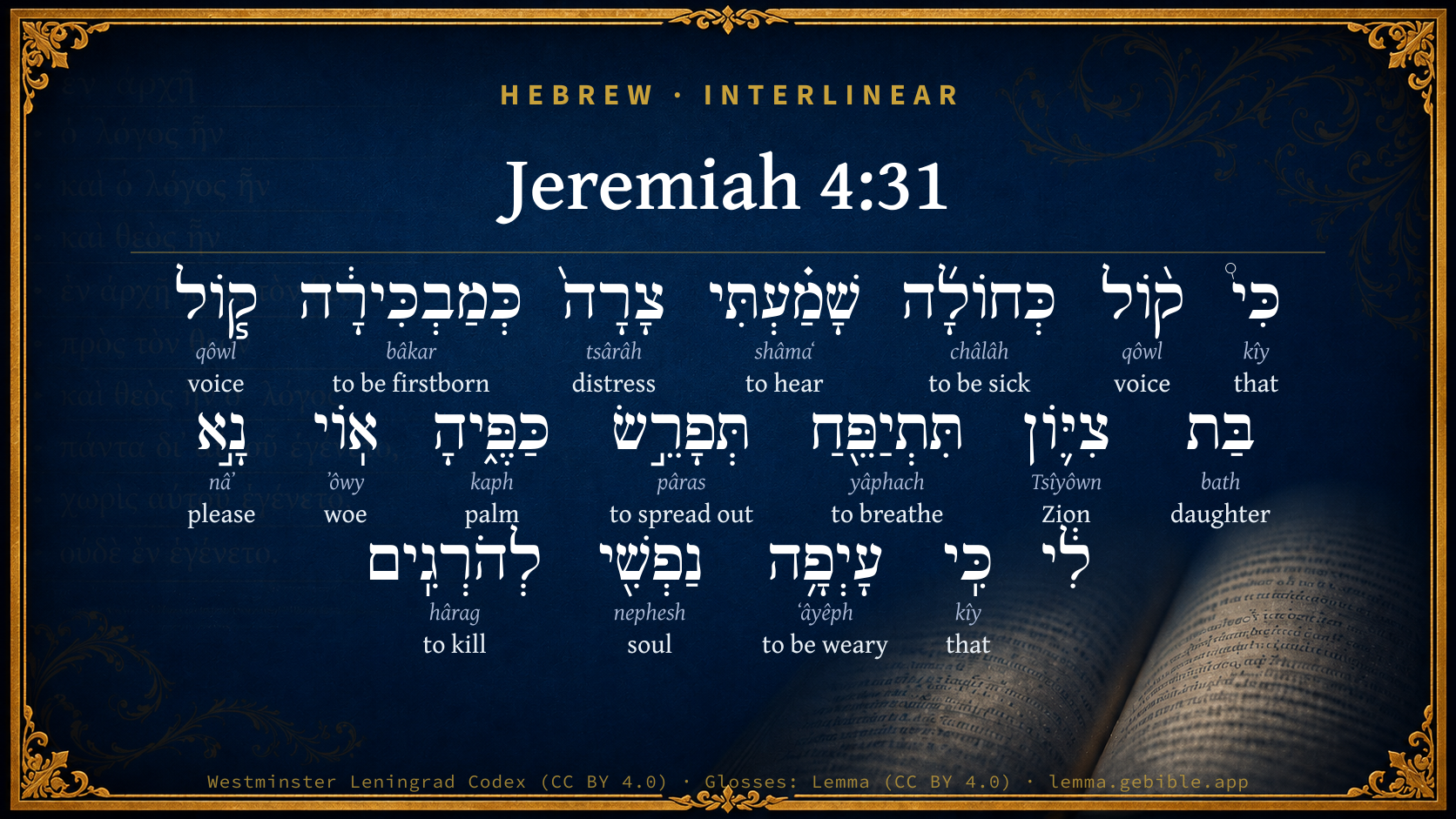
Hebrew (Westminster Leningrad Codex) Jeremiah 4:31 appears in the Hebrew Old Testament. The text above is from the Westminster Leningrad Codex. Each word links to its Strong’s number, a concise gloss, and parsing drawn from the Open Scriptures Hebrew Bible morphology. Click any word for its full Brown-Driver-Briggs (BDB) entry.
Download image
Cite this verse

Jeremiah 4:31 (World English Bible). Public Domain. Lemma interlinear Bible study tool, https://lemma.gebible.app/v/jeremiah/4/31.

Show BibTeX & RIS
BibTeX
RIS
English Translation
For I have heard a voice as of a woman in travail, the anguish as of her who brings forth her first child, the voice of the daughter of Zion, who gasps for breath, who spreads her hands, [saying], Woe is me now! for my soul faints before the murderers.
World English Bible · Public Domain
Highlights
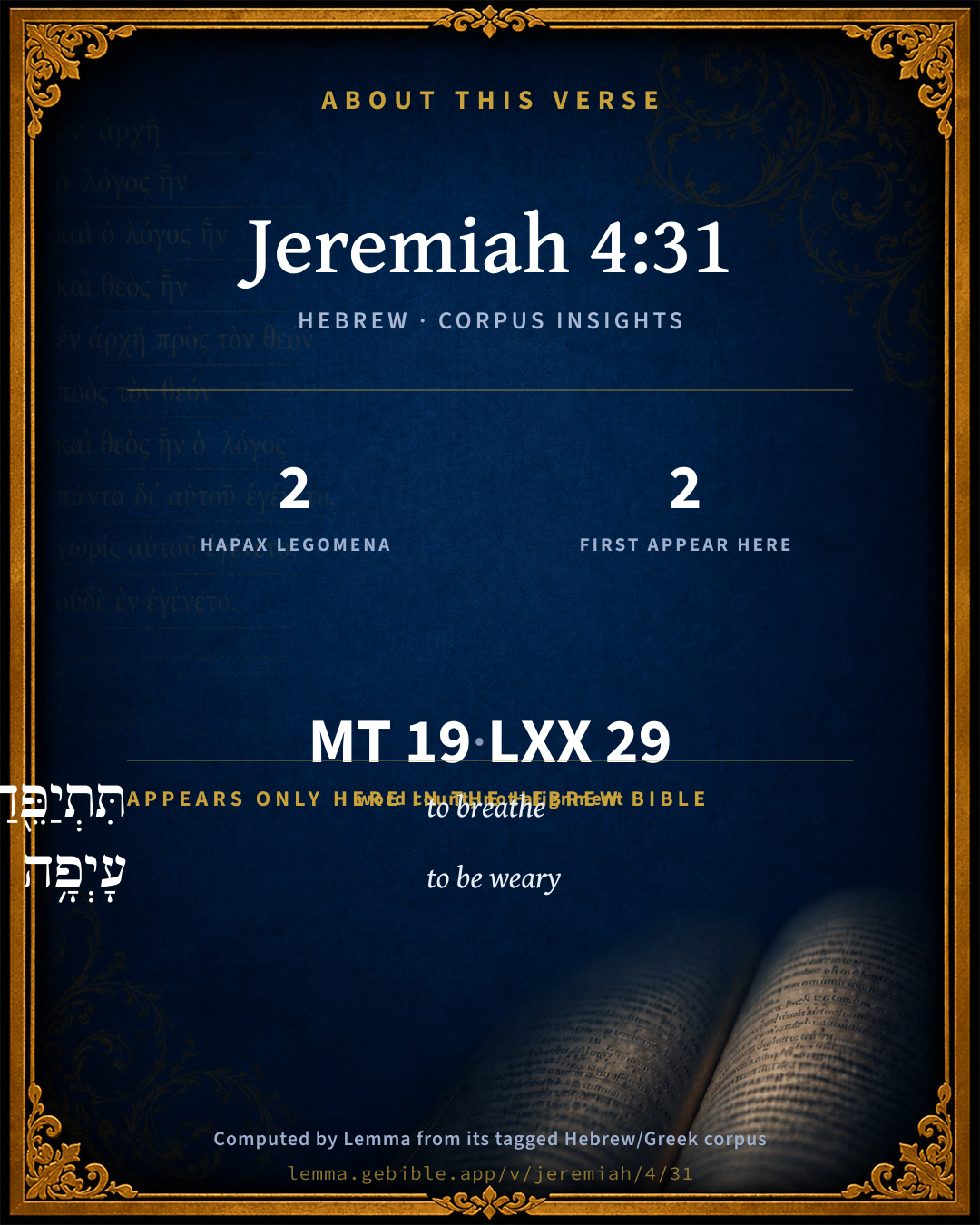
  • 2 hapax legomena — only here in the Hebrew Bible
  • 2 first appearances in the Hebrew Bible
Full analysis ↓
Download a study sheet

One document with this verse’s original text, its word-by-word gloss line, the meaning frame, cross-references with their text, attributed commentary, and full source and license credits — printable, and it pastes into notes with its structure intact.

This verse Autodidact and up

Study sheet (.html) Plain text (.txt)

A passage Seminary Student

Up to 50 verses in one chapter. A passage sheet keeps up to 6 commentary sources and 12 cross-references per verse, in the order this page ranks them, and says so on the sheet whenever that leaves anything out. Ask for a single verse and you get the Autodidact verse sheet above.

Everything on this page stays free to read, with no account — the sheet is a download of what is already on screen, not access to it.

Want to remove ads? Support Godless Engineer
Compare translations 3

The same verse in 3 English versions, stacked beneath the original-language interlinear above. Click any original word for its lexicon entry.

Each is an independent rendering of the whole verse — the interlinear is not word-aligned to these translations.

Highlighted words mark where these versions differ — a whole-verse word diff, not a word-by-word alignment.

  • World English Bible Public Domain
    For I have heard a voice as of a woman in travail, the anguish as of her who brings forth her first child, the voice of the daughter of Zion, who gasps for breath, who spreads her hands, [saying], Woe is me now! for my soul faints before the murderers.
  • King James Version Public Domain
    For I have heard a voice as of a woman in travail, and the anguish as of her that bringeth forth her first child, the voice of the daughter of Zion, that bewaileth herself, that spreadeth her hands, saying, Woe is me now! for my soul is wearied because of murderers.
  • unfoldingWord Literal Text CC BY-SA 4.0
    For I hear a sound like a woman in labor, distress like a woman birthing her firstborn, the sound of the daughter of Zion; she gasps for breath. She spreads out her hands, ‘Woe now to me, for my soul faints murderers!.’”

unfoldingWord Literal Text — © unfoldingWord, licensed CC BY-SA 4.0. Word-aligned USFM3 via Door43 (git.door43.org/unfoldingWord/en_ult).

Versions to compare (up to 4)

3 of 4 selected

Show all 18 translations

Every available English version of this verse, each an independent rendering of the whole verse.

  • World English Bible Public Domain
    For I have heard a voice as of a woman in travail, the anguish as of her who brings forth her first child, the voice of the daughter of Zion, who gasps for breath, who spreads her hands, [saying], Woe is me now! for my soul faints before the murderers.
  • Berean Standard Bible Public Domain
    For I hear a cry like a woman in labor, a cry of anguish like one bearing her first child—the cry of the Daughter of Zion gasping for breath, stretching out her hands to say, “Woe is me, for my soul faints before the murderers!”
  • Majority Standard Bible Public Domain
    For I hear a cry like a woman in labor, a cry of anguish like one bearing her first child—the cry of the Daughter of Zion gasping for breath, stretching out her hands to say, “Woe is me, for my soul faints before the murderers!”
  • King James Version Public Domain
    For I have heard a voice as of a woman in travail, and the anguish as of her that bringeth forth her first child, the voice of the daughter of Zion, that bewaileth herself, that spreadeth her hands, saying, Woe is me now! for my soul is wearied because of murderers.
  • American Standard Version (1901) Public Domain
    For I have heard a voice as of a woman in travail, the anguish as of her that bringeth forth her first child, the voice of the daughter of Zion, that gaspeth for breath, that spreadeth her hands, `saying', Woe is me now! for my soul fainteth before the murderers.
  • Revised Version (1885) Public Domain
    For I have heard a voice as of a woman in travail, the anguish as of her that bringeth forth her first child, the voice of the daughter of Zion, that gaspeth for breath, that spreadeth her hands, saying, Woe is me now! for my soul fainteth before the murderers.
  • Geneva Bible (1599) Public Domain
    For I haue heard a noyse as of a woman trauailing, or as one labouring of her first child, euen the voyce of the daughter Zion that sigheth and stretcheth out her handes: woe is me nowe: for my soule fainteth because of the murtherers.
  • Douay-Rheims (1899) Public Domain
    For I have heard the voice as of a woman in travail, anguishes as of a woman in labor of a child. The voice of the daughter of Sion, dying away, spreading her hands: Woe is me, for my soul hath fainted because of them that are slain.
  • Young's Literal Translation Public Domain
    For a voice as of a sick woman I have heard, Distress, as of one bringing forth a first-born, The voice of the daughter of Zion, She bewaileth herself, she spreadeth out her hands, `Wo to me now, for weary is my soul of slayers!'
  • Literal Standard Version CC BY-SA 4.0
    For I have heard a voice as of a travailing woman, || Distress, as of one bringing forth a firstborn, || The voice of the daughter of Zion, || She laments herself, || She spreads out her hands, || Woe to me now, my soul is weary of slayers!”
  • Unlocked Literal Bible CC BY-SA 4.0
    So I hear the sound of anguish, distress as in the birth of a firstborn child, the sound of the daughter of Zion. She is gasping for breath. She spreads out her hands, 'Woe to me! I am fainting because of these murderers.'”
  • unfoldingWord Literal Text CC BY-SA 4.0
    For I hear a sound like a woman in labor, distress like a woman birthing her firstborn, the sound of the daughter of Zion; she gasps for breath. She spreads out her hands, ‘Woe now to me, for my soul faints murderers!.’”
  • Darby Bible Public Domain
    For I hear a voice, as of a woman in travail, anguish as of her that bringeth forth her first child, the voice of the daughter of Zion: she moaneth, she spreadeth forth her hands, [saying], Woe unto me! for my soul faileth because of murderers.
  • World Messianic Bible Public Domain
    For I have heard a voice as of a woman in travail, the anguish as of her who gives birth to her first child, the voice of the daughter of Zion, who gasps for breath, who spreads her hands, saying, “Woe is me now! For my soul faints before the murderers.”
  • Webster's Bible Public Domain
    For I have heard a voice as of a woman in travail, and the anguish as of her that bringeth forth her first child, the voice of the daughter of Zion, that bewaileth herself, that spreadeth her hands, saying, Woe is me now! for my soul is wearied because of murderers.
  • Free Bible Version CC BY-SA 4.0
    I hear the cries like a woman in labor, the agonizing moans of a woman giving birth to her first child. These are the cries of the Daughter of Zion gasping for air, holding out her hands, saying, “Please help me—I'm being murdered!”
  • Bible in Basic English Public Domain
    A voice has come to my ears like the voice of a woman in birth-pains, the pain of one giving birth to her first child, the voice of the daughter of Zion, fighting for breath, stretching out her hands, saying, Now sorrow is mine! for my strength is gone from me before the takers of life.
  • JPS Tanakh (1917) Public Domain
    For I have heard a voice as of a woman in travail, the anguish as of her that bringeth forth her first child, the voice of the daughter of Zion, that gaspeth for breath, that spreadeth her hands: 'Woe is me, now! for my soul fainteth before the murderers.'

Literal Standard Version (2020), Covenant Press — licensed CC BY-SA 4.0. Text via the HelloAO Bible API (eBible.org). Unlocked Literal Bible (unfoldingWord) — licensed CC BY-SA 4.0. Text via the HelloAO Bible API (eBible.org). unfoldingWord Literal Text — © unfoldingWord, licensed CC BY-SA 4.0. Word-aligned USFM3 via Door43 (git.door43.org/unfoldingWord/en_ult). Free Bible Version, Dr. Jonathan Gallagher — licensed CC BY-SA 4.0. Text via the HelloAO Bible API (eBible.org).

Word by word

More ways to search: Search by grammar → Find every occurrence → Compare this word →

Practice this passage: Drill this verse → Learn its vocabulary →

תִּתְיַפֵּ֖חַ
yâphach
H3306
“to breathe”
Verb, Hithpael, Imperfect, 3rd Person, Feminine, Singular
Part of Speech
Verb
Stem
Hithpael
Form
Imperfect
Person
3rd Person
Gender
Feminine
Number
Singular
Full BDB Definition

Origin: a primitive root

TWOT: 891

to breathe, breathe hard, puff - (Hithpael) to gasp for breath
  1. כִּי֩ kîy H3588 “that” Conjunction
  2. ק֨וֹל qôwl H6963 “voice” Noun, Common, Masculine, Singular, Absolute
  3. כְּחוֹלָ֜ה châlâh H2470 “like/as · being sick” Preposition + Verb, Qal, Participle Active, Feminine, Singular, Absolute
  4. שָׁמַ֗עְתִּי shâmaʻ H8085 “to hear” Verb, Qal, Perfect, 1st Person, Common, Singular
  5. צָרָה֙ tsârâh H6869 “distress” Noun, Common, Feminine, Singular, Absolute
  6. כְּמַבְכִּירָ֔ה bâkar H1069 “like/as · being firstborn” Preposition + Verb, Hiphil, Participle Active, Feminine, Singular, Absolute
  7. ק֧וֹל qôwl H6963 “voice of” Noun, Common, Masculine, Singular, Construct
  8. בַּת bath H1323 “daughter of” Noun, Common, Feminine, Singular, Construct
  9. צִיּ֛וֹן Tsîyôwn H6726 “Zion” Noun, Proper
  10. תְּפָרֵ֣שׂ pâras H6566 “to spread out” Verb, Piel, Imperfect, 3rd Person, Feminine, Singular
  11. כַּפֶּ֑יהָ kaph H3709 “palms · her” Noun, Common, Feminine, Dual, Construct + Suffix, Personal, 3rd Person, Feminine, Singular
  12. אֽוֹי ʼôwy H188 “woe” Particle, Interjection
  13. נָ֣א nâʼ H4994 “please” Particle, Exhortation
  14. כִּֽי kîy H3588 “that” Conjunction
  15. עָיְפָ֥ה ʻâyêph H5888 “to be weary” Verb, Qal, Perfect, 3rd Person, Feminine, Singular
  16. נַפְשִׁ֖י nephesh H5315 “soul · my” Noun, Common, Both, Singular, Construct + Suffix, Personal, 1st Person, Common, Singular
  17. לְהֹרְגִֽים hârag H2026 “to/for · killing” Preposition + Verb, Qal, Participle Active, Masculine, Plural, Absolute

About this verse

These counts appear in no published source. They are computed here, from the morphology-tagged text and Lemma’s own curated glosses. What Lemma adds →

19
words
16
distinct lemmas
Prophets
section

Notable vocabulary

2 hapax legomena — words that appear only here in the entire Hebrew Bible:

  • תִּתְיַפֵּ֖חַ to breathe H3306
  • עָיְפָ֥ה to be weary H5888

First appearance in Scripture

These words make their first canonical appearance in the Hebrew Bible here:

  • תִּתְיַפֵּ֖חַ to breathe H3306
  • עָיְפָ֥ה to be weary H5888

Shared distinctive vocabulary

כְּמַבְכִּירָ֔ה to be firstborn H1069 occurs in 4 verses of the Hebrew Bible. Also found in:

Grammatical profile

  • 7 verbs
  • 7 nouns
  • 1 preposition
  • 2 conjunctions
  • 2 particles

Verb forms

  • כְּחוֹלָ֜ה Qal · Participle Active
  • שָׁמַ֗עְתִּי Qal · Perfect
  • כְּמַבְכִּירָ֔ה Hiphil · Participle Active
  • תִּתְיַפֵּ֖חַ Hithpael · Imperfect
  • תְּפָרֵ֣שׂ Piel · Imperfect
  • עָיְפָ֥ה Qal · Perfect
  • לְהֹרְגִֽים Qal · Participle Active

Repetition

Words recur within this verse — often emphatic in Hebrew:

  • ק֨וֹל voice H6963 ×2
  • כִּי֩ that H3588 ×2

Hebrew & Septuagint length

In the original languages it is 19 Hebrew tokens and 29 Greek tokens — but the two are counted differently (Hebrew bundles its prefixes and suffixes into one token; the Greek is in lemma form), so that isn’t a like-for-like length.

Cross-references

32

Topical passages linked to Jeremiah 4:31 in the Treasury of Scripture Knowledge — connected by theme and wording, ordered by reader-vote popularity; previews shown in the World English Bible.

  • Isaiah 1:15 When you spread forth your hands, I will hide my eyes from you; Yes, when you make many prayers, I will not hear. Your hands are full of blood.
  • Lamentations 1:17 Zion spreads forth her hands; there is none to comfort her; Yahweh has commanded concerning Jacob, that those who are round about him should be his adversaries: Jerusalem is among them as an unclean thing.
  • Jeremiah 13:21 What will you say, when he shall set over you as head those whom you have yourself taught to be friends to you? shall not sorrows take hold of you, as of a woman in travail?
  • Genesis 27:46 Rebekah said to Isaac, "I am weary of my life because of the daughters of Heth. If Jacob takes a wife of the daughters of Heth, such as these, of the daughters of the land, what good will my life do me?"
  • Job 10:1 "My soul is weary of my life; I will give free course to my complaint. I will speak in the bitterness of my soul.
  • Psalms 120:5 Woe is me, that I live in Meshech, That I dwell among the tents of Kedar!
  • Isaiah 6:5 Then I said, "Woe is me! For I am undone, because I am a man of unclean lips, and I dwell in the midst of a people of unclean lips: for my eyes have seen the King, Yahweh of Hosts!"
  • Isaiah 13:8 and they shall be dismayed; pangs and sorrows shall take hold [of them]; they shall be in pain as a woman in travail: they shall look in amazement one at another; their faces [shall be] faces of flame.
  • Isaiah 21:3 Therefore are my loins filled with anguish; pangs have taken hold on me, as the pangs of a woman in travail: I am pained so that I can't hear; I am dismayed so that I can't see.
  • Isaiah 42:14 I have long time held my peace; I have been still, and refrained myself: [now] will I cry out like a travailing woman; I will gasp and pant together.
  • Jeremiah 6:2 The comely and delicate one, the daughter of Zion, will I cut off.
  • Jeremiah 6:23–24 They lay hold on bow and spear; they are cruel, and have no mercy; their voice roars like the sea, and they ride on horses, everyone set in array, as a man to the battle, against you, daughter of Zion.
  • Jeremiah 10:19 Woe is me because of my hurt! my wound is grievous: but I said, Truly this is [my] grief, and I must bear it.
  • Jeremiah 14:18 If I go forth into the field, then, behold, the slain with the sword! and if I enter into the city, then, behold, those who are sick with famine! for both the prophet and the priest go about in the land, and have no knowledge.
  • Jeremiah 15:18 Why is my pain perpetual, and my wound incurable, which refuses to be healed? will you indeed be to me as a deceitful [brook], as waters that fail?
  • Jeremiah 18:21 Therefore deliver up their children to the famine, and give them over to the power of the sword; and let their wives become childless, and widows; and let their men be slain of death, [and] their young men struck of the sword in battle.
  • Jeremiah 22:23 Inhabitant of Lebanon, who makes your nest in the cedars, how greatly to be pitied shall you be when pangs come on you, the pain as of a woman in travail!
  • Jeremiah 30:6 Ask now, and see whether a man does travail with child: why do I see every man with his hands on his loins, as a woman in travail, and all faces are turned into paleness?
  • Jeremiah 45:2 Thus says Yahweh, the God of Israel, to you, Baruch:
  • Jeremiah 48:41 Kerioth is taken, and the strongholds are seized, and the heart of the mighty men of Moab at that day shall be as the heart of a woman in her pangs.
  • Jeremiah 49:22 Behold, he shall come up and fly as the eagle, and spread out his wings against Bozrah: and the heart of the mighty men of Edom at that day shall be as the heart of a woman in her pangs.
  • Jeremiah 49:24 Damascus has grown feeble, she turns herself to flee, and trembling has seized on her: anguish and sorrows have taken hold of her, as of a woman in travail.
  • Jeremiah 50:43 The king of Babylon has heard the news of them, and his hands wax feeble: anguish has taken hold of him, [and] pangs as of a woman in travail.
  • Lamentations 1:20 See, Yahweh; for I am in distress; my heart is troubled; My heart is turned within me; for I have grievously rebelled: Abroad the sword bereaves, at home there is as death.
  • Lamentations 2:21 The youth and the old man lie on the ground in the streets; My virgins and my young men are fallen by the sword: You have killed them in the day of your anger; you have slaughtered, [and] not pitied.
  • Ezekiel 9:5–6 To the others he said in my hearing, Go you through the city after him, and strike: don't let your eye spare, neither have you pity;
  • Ezekiel 23:46–47 For thus says the Lord Yahweh: I will bring up a company against them, and will give them to be tossed back and forth and robbed.
  • Hosea 13:13 The sorrows of a travailing woman will come on him. He is an unwise son; For when it is time, he doesn't come to the opening of the womb.
  • Micah 7:1 Misery is mine! Indeed, I am like one who gathers the summer fruits, as gleanings of the vinyard: There is no cluster of grapes to eat. My soul desires to eat the early fig.
  • Matthew 21:5 "Tell the daughter of Zion, Behold, your King comes to you, Humble, and riding on a donkey, On a colt, the foal of a donkey."
  • 1 Corinthians 9:16 For if I preach the Gospel, I have nothing to boast about; for necessity is laid on me; but woe is to me, if I don't preach the Gospel.
  • 1 Thessalonians 5:3 For when they are saying, "Peace and safety," then sudden destruction will come on them, like birth pains on a pregnant woman; and they will in no way escape.

Cross-references courtesy of OpenBible.info (CC BY 4.0).

Hebrew and Greek witnesses Masoretic Hebrew ↔ Greek Septuagint

The same verse in the two great witnesses to the Old Testament, shown verse-for-verse.

These are two independent witnesses, not word-aligned to each other, and the Septuagint is shown in lemma (dictionary) form.

Hebrew Jeremiah 4:31 Masoretic · Westminster Leningrad Codex

כִּי֩ ק֨וֹל כְּחוֹלָ֜ה שָׁמַ֗עְתִּי צָרָה֙ כְּמַבְכִּירָ֔ה ק֧וֹל בַּת צִיּ֛וֹן תִּתְיַפֵּ֖חַ תְּפָרֵ֣שׂ כַּפֶּ֑יהָ אֽוֹי נָ֣א לִ֔י כִּֽי עָיְפָ֥ה נַפְשִׁ֖י לְהֹרְגִֽים

For I have heard a voice as of a woman in travail, the anguish as of her who brings forth her first child, the voice of the daughter of Zion, who gasps for breath, who spreads her hands, [saying], Woe is me now! for my soul faints before the murderers.

World English Bible · Public Domain

Greek LXX Structure differs

In the Septuagint, Jeremiah is about an eighth shorter than the Hebrew and arranges its material differently — the Oracles Against the Nations (Hebrew chapters 46–51) appear in the middle of the Greek book, after 25:13. Because the chapter and verse boundaries do not line up, a verse-for-verse comparison with the Hebrew is not shown.

A verse-for-verse comparison isn’t shown here because the chapters and verses don’t line up. Switch to the LXX edition with the MT / LXX toggle above to read the Greek directly.

On this verse, Haydock's Catholic Bible Commentary discusses the Septuagint’s reading. Read the note in Commentary ↓

Hebrew: Westminster Leningrad Codex (CC BY 4.0). Greek: Septuagint (public domain); English from a public-domain English Septuagint. How the Septuagint differs from the Hebrew →

Targum (Aramaic paraphrase)

1

The Targum is the ancient Jewish Aramaic paraphrase of the Hebrew Scriptures — an interpretive translation, not the Hebrew text itself. Onkelos (literal) and Pseudo-Jonathan (expansive) render the Torah, and Jonathan the Prophets. Coverage is partial: where no permissively-licensed English translation exists for a verse, only the Aramaic is shown. This is verse-level text, not a word-by-word alignment to the Hebrew.

  1. Targum Jonathan Prophets (Joshua–Malachi)
    אֲרֵי קַל כִּמְעַדְיָא שְׁמָעִית עָקָא כְּאִתָּא דִמְשַׁרְיָא לְמֵילַד בְּכוֹר קַל כְּנִשְׁתָּא בְצִיוֹן דְמִשְׁתַּטְחָא וּפַרְסָא יְדָהָא אָמְרָא וַי כְּעַן לִי אֲרֵי מְשַׁלְהַיָא נַפְשִׁי מִן קֳדָם קָטוֹלִין:

    (no public-domain English translation for this verse)

    Targum Jonathan — Aramaic: “Mikraot Gedolot” (public domain). English: “Sefaria Community Translation” (CC0 1.0 (public-domain dedication)); “London "Chaldee Paraphrase," 1871” (public domain). Text via Sefaria.

Commentary

Notes on Jeremiah 4:31 from classic Christian and Jewish commentators (each source and its license shown beneath its notes). The classic Christian expositions comment on the surrounding passage and are grouped to its opening verse, so a note may address several verses; the Jewish commentaries on the Tanakh (Rashi and others) are per-verse, so they appear only where the commentator wrote on this verse.

Lemma curates 59 commentaries, every one of them public domain or Creative Commons licensed, each selected and text-cleaned for this edition rather than reprinted as found. About our sources →

Trapp's Complete Commentary

John Trapp

Jer 4:31 For I have heard a voice as of a woman in travail, [and] the anguish as of her that bringeth forth her first child, the voice of the daughter of Zion, [that] bewaileth herself, [that] spreadeth her hands, [saying], Woe [is] me now! for my soul is wearied because of murderers.

Ver. 31. As of her that bringeth forth her first child.] Primiparae: such have greatest pains, and least patience oft.

For my soul is wearied because of murderers.] Once her paramours, her sweethearts. There is nothing got by comporting with idolaters. The Duke of Medina’s sword knew no difference between Papists and Protestants in 1588, and that they should have found had the Spaniard then prevailed.

John Trapp, A Commentary or Exposition upon All the Books of the Old and New Testament (1647–1656) — public domain. Text from a community e-Sword module.

Joseph Benson's Commentary

Jer 4:31. For I have heard a voice of a woman in travail — Here Jerusalem is very pathetically described by the character of a woman under the pangs of her first child-bearing, when her pains as well as her fears are usually greatest. Such, saith the prophet, shall be the anguish of Jerusalem, bewailing the loss of her children by the devouring sword of the Chaldeans, and in vain imploring comfort and assistance. That spreadeth her hands, &c. — Spreading out the hands is the gesture of one displaying the helplessness of her condition, and imploring the aid of others.

“Ingemit, et duplices tendens ad sidera palmas, Talia voce refert — — — .”

VIRGIL ÆN., I. 50:97.

“Struck with unusual fright, the Trojan chief, With outspread hands and eyes, invokes relief.” DRYDEN.

Joseph Benson's Commentary on the Old and New Testaments (1811–1818) — public domain. Text from a community e-Sword module.

Keil & Delitzsch

C. F. Keil & F. Delitzsch

Jer 4:31, as giving a reason, is introduced by כּי. Zion's attempts to secure the goodwill of the enemy are in vain, for already the prophet hears in spirit the agonized cry of the daughter of Zion, who beseechingly stretches out her hands for help, and falls exhausted under the assassin's strokes. חולה, partic. Kal faem. from חוּל; see Ew. 151, b, and Gesen. 72, Rem. 1. צרה, in parallelism with קול and dependent on "I hear," means cry of anguish. התיפּח, breathe heavily, pant, sign. תּפרשׂ is joined asynd. with the preceding word, but is in sense subordinate to it: she sighs with hands spread out; a pleading gesture expressing a prayer for protection. עיף, be exhausted, here = sink down faint, succumb to the murderers.

Keil & Delitzsch — Biblical Commentary on the Old Testament (1861–1891) — public domain (CC PDM 1.0). Text via the HelloAO Bible API. (Old Testament only.)

Tyndale Open Study Notes

Tyndale Open Resources

4:31 The people in Jerusalem felt such intense anguish that Jeremiah likened their pain to the agony of a woman giving birth to her first child. Like such women, beautiful Jerusalem was desperate (13:21; 23:23; 30:6; Isa 1:15; 42:14; Lam 1:17).

Tyndale Open Study Notes — © Tyndale Open Resources, licensed CC BY-SA 4.0. Text via the HelloAO Bible API.

Geneva Bible (1599)

Geneva Bible translators

As the Prophets were moved to pity the destruction of their people, so they declared it to the people to move them to repentance, Isa. 22:4; Jer. 9:1.

Geneva Bible (1599) marginal notes — public domain. Text via Bolls.life.

Jamieson, Fausset & Brown

Robert Jamieson, A. R. Fausset & David Brown

anguish--namely, occasioned by the attack of the enemy.

daughter of Zion--There is peculiar beauty in suppressing the name of the person in trouble, until that trouble had been fully described [HENDERSON].

bewaileth herself--rather, "draweth her breath short" [HORSLEY]; "panteth."

spreadeth . . . hands-- (Lam 1:17).

Next: Jeremiah Chapter 5

Jamieson, Fausset & Brown — Commentary Critical and Explanatory on the Whole Bible (1871) — public domain (CC PDM 1.0). Text via the HelloAO Bible API.

Adam Clarke's Commentary

Verse 31. Bringeth forth her first child] In such a case the fear, danger, and pain were naturally the greatest.

Spreadeth her hands] The gesture indicated by nature to signify distress, and implore help. We have met with this figure in other parts, and among the classic writers it is frequent.

Adam Clarke's Commentary on the Bible (1810–1826) — public domain. Text from a community e-Sword/MySword module.

John Calvin's Commentaries

By these words Jeremiah confirms what the latter part of the preceding verse contains: nor was it for the sake of elucidating his subject that he enlarged on it; but when he saw his own nation so hard and almost like stones, he employed many words and set forth in various ways what he might have expressed in one sentence: and what he taught would have been often coldly received, had he not added exhortations and threatenings. It was on this account that he now expresses in other words what he had previously said, I have heard, he says, the voice as of one in labor This hearing, no doubt, is to be taken consistently with the representation which had been made to him; for Jeremiah could not hear in a way different from others; but he speaks according to the discovery made to him of the approaching judgment of God, which was then unheeded by the people; and he had this discovery, that he might by such a representation as this make it known to them. He then says, that he had heard, as though he had witnessed already all that was to come. He then exaggerates the evil; for he puts distress, צרה, tsere, instead of “voice,” קול, kul; and then he mentions, as an instance of greater pain, a woman bringing forth her first — born, instead of a woman in labor. Then Jeremiah means, that final ruin was nigh that people who could not then be restored from their sinful courses; but he intimates, as also the Spirit speaks in other places, that their destruction would be sudden; while they would be saying, Peace and security, sudden destruction would come upon them. (1 Thessalonians 5:3.) And so the Prophet now declares, that the Jews in vain hardened themselves against God, as though their ruin was not approaching, for their sorrow would come suddenly. As a woman may be cheerful at meat or at her leisure, and may be suddenly seized with the pain of labor, so also the Prophet shews, that the Jews had no reason to think that they could escape God’s vengeance by a false confidence, for their destruction would come upon them unexpectedly.

He sets forth at the same time, as already said, the greatness or the extremity of their grief by this similitude, The voice of the daughter of Sion, who complains, etc.; for the relative may be here added. Some take the verb to be in the second person, “Thou wilt lament and extend, “or rend, “thy hands;” but this is not suitable, because the third person is immediately used, “thy hands.” Then what he says is, that the voice of the daughter of Sion would be an evidence of her extreme grief, for she would lament; and he adds, at the same time, the smiting of the hands. This verb is variously rendered; but as פרש, peresh, means properly to rend or to divide, I think the Prophet expresses the posture of a woman in grief; for she usually smites her hands together and as it were divides them by putting the fingers between one another. Some render the word “expand, “for the hands are divided when raised up. As to what is meant, there is nothing ambiguous in the Prophet’s words; for his object is to shew, that God’s vengeance would be so dreadful, that the Jews would lament, not in an ordinary measure, but like women, when in the extreme pain of labor.

He then concludes by saying, Woe to me, for failed has my soul on account of murderers Here the Prophet intimates, that all the rest were blind in the midst of light, yet God’s judgment, which the ungodly and wicked laughed at, or at least disregarded, was seen clearly by him. His soul, he says, fainted for the slain; and yet no one had hitherto been slain: but by this mode of speaking, he shews, that he had as it were before his eyes what was hid from others, and hence their hearts were not affected. Now follows —

John Calvin's Commentaries (1540-1563) — public domain. Text from the Calvin Translation Society English edition (1840s-50s) via the Christian Classics Ethereal Library (ccel.org). Calvin's coverage is partial (roughly two-thirds of the Bible); uncommented books and verses are honest gaps, never fabricated. The 19th-century editor's footnotes and remarks are omitted so the notes are faithfully Calvin's own voice.

Ellicott's Commentary for English Readers

(31) A woman in travail.—Literally, writhing in pain, as in Jer_4:19.

Bewaileth herself.—Literally, pants for breath. The prophet draws his pictures with a terrible intensity. On the one side is Zion as the harlot, in her gold and crimson and cosmetics; on the other we see the forlorn and desperate castaway, in the hour of a woman’s utter helplessness, outraged and abandoned, stretching out her hands to implore mercy from the assassins who attack her, and imploring it in vain.

A Bible Commentary for English Readers, edited by Charles John Ellicott (1878–1897) — public domain. Text from a community e-Sword module.

The Cambridge Bible for Schools and Colleges

gen. ed. J. J. S. Perowne

31. Thy wiles shall have no effect; for already I hear thy cries of agony and dismay.

daughter of Zion] denoting the inhabitants as a whole. Cp. Jer_6:2, etc.

The Cambridge Bible for Schools and Colleges (gen. ed. J. J. S. Perowne; Cambridge University Press, 1878–1918) — public domain. Text from a community e-Sword module.

John Gill's Exposition

For I have heard a voice as of a woman in travail,.... So the distress of the Jews, at the time of their destruction, is compared to the sorrows of a woman in travail; and a word, that signifies that is used to express it, Mat 24:8,

and the anguish as of her that bringeth forth her first child; whose time is more difficult, her pains sharper, her anguish greater, and, having less experience, the more impatient:

the voice of the daughter of Zion, that bewaileth herself; her unhappy condition, and miserable circumstances:

that spreadeth her hands; as persons in distress do, and particularly women in travail: saying,

woe is me now, for my soul is wearied because of murderers: these abounded: under the second temple, and was the reason, the Jews say: (m), of the sanhedrim removing from their usual place in the temple; and why they ceased from the beheading of the red heifer (n).

(m) T. Bab. Avoda Zara, fol. 8. 2. (n) Misn. Sota, c. 9. sect. 9.

Next: Jeremiah Chapter 5

John Gill's Exposition of the Whole Bible (1746–1763) — public domain (CC PDM 1.0). Text via the HelloAO Bible API.

Albert Barnes' Notes on the Bible

For a cry have I heard as of one writhing in vain:

Anguish as of one that bringeth forth her first-born:

The cry of the daughter of Zion.

She gasps for breath: she stretches out her palms:

Woe is me! for my soul faints before the murderers.

Albert Barnes' Notes on the Bible (1834–1885) — public domain. Text from a community e-Sword/MySword module.

Haydock's Catholic Bible Commentary

Child. Hebrew and Septuagint, "a first-born," when the pains are most acute. (Calmet)

George Leo Haydock (1774–1849), Haydock's Catholic Family Bible and Commentary, 1859 edition — public domain. Excludes Psalms (Douay-Rheims chapter numbering differs from Protestant) and Deuterocanonical books (Catholic canon only).

Matthew Poole's English Annotations

A voice as of a woman in travail: when the Scripture would express any exquisite sorrow, exceeding all other pains, it doth it by a woman in travail, Isa 13:8,9; Jer 6:24; 30:6,7. The anguish as of her that bringeth forth her first child, which of all seems to be the most painful, both from natural causes, and because they have less patience to bear, having not had former experience of the like.

The daughter of Zion, viz. Jerusalem, Isa 1:8.

That spreadeth her hands; in her great distress she either reacheth them out to God for some help, Isa 1:15; or rather, according to the use of persons in great anguish, clapping or wringing their hands together, as both the former expression of bewailing herself, fetching of deep sighs and lamentations, and the following woe is me, intimates. See Jer 2:37.

Woe is me now! or, the time of my woe is at hand; it draws near.

My soul is wearied because of murderers; there is no more spirit left within me, I am ready to sink under my distress, considering not only that my destruction is so near, but that those of whom I have been so fond, and whose idols I have so zealously served, should become my murderers, Jer 4:30, and that I should fall into the hands of such as will have no compassion, 2Ch 36:17.

Matthew Poole's English Annotations on the Holy Bible (1683–1685) — public domain. Text from a community e-Sword/MySword module.

Whedon's Commentary on the Bible

Daniel D. Whedon

31. I have heard — But all in vain. The prophet hears the cry of distress as the agony of a woman in travail. The daughter of Zion stretches out her hands in unavailing supplication, and falls beneath the stroke of her murderers.

Daniel D. Whedon (gen. ed.), Commentary on the Old and New Testaments (1874–1909) — public domain. Text from a community e-Sword module.

The Pulpit Commentary

For I have heard a voice, etc. This explains the preceding statement, "They will seek thy life." It is this murderous plot which calls forth the "cry as of a woman in pangs." Bewaileth herself; rather, sigheth deeply. Her hands; literally, her palms. Is wearied because of murderers; rather, fainteth into the hands of (literally, is treaty unto) the murderers.

"There shall be weeping.

The text is a solemn and awful declaration of the retribution of God upon impenitent men.

I NO TRUTH MORE DOUBTED OR DENIED THAN THIS. Lot was "to his sons in law as one that mocked." And so it is still; this truth scarce gains any hearing and yet less belief. Reasons of this are: the prevalent skepticism as to all religious belief; the special dislike to such a subject as this; false views as to the love of God; the busy energy of the evil one, who will not suffer men to consider and ponder this truth.

II BUT IT IS NEVERTHELESS THE TRUTH OF GOD. Scripture is full, plain, and earnest in the matter. The premonitions of conscience endorse the Word of God. The course of observed events lends its strong testimony. The common consent of the wisest and best of men confirms it. The analogy of all human government supports it.

III AND DEMANDS THEREFORE TO BE MADE KNOWN. Compassion would prompt to its proclamation. The severe displeasure of God against the watchman who neglects to warn the people urges this. The example of our Lord, who ever insisted on it. Its manifest fitness to arouse and arrest the sinner. Beware, therefore, of yielding to the temptation to be silent on this theme.

IV BUT TO BE PREACHED ONLY BY SUCH AS BELIEVE AND FEEL ITS TRUTH. Unbelieving or unfeeling setting forth of these awful verities will but steel the heart of the ungodly against them. But in the spirit of Jeremiah, and yet more in the spirit of our Lord, let men be warned that for the impenitent there remaineth the dread retribution of God.

The Pulpit Commentary (1880–1919), ed. H.D.M. Spence-Jones & Joseph S. Exell — public domain. Text from a community e-Sword module.

John Wesley's Explanatory Notes

In travail - When the scripture would express any exquisite sorrow, it doth it by a woman in travail. First child - Which is usually the most painful. Spreadeth her hands - According to the use of persons in great anguish, clapping or wringing their hands together.

John Wesley, Explanatory Notes Upon the Whole Bible (1754–1765) — public domain. Text via the GEBible commentary corpus.

Rashi

Rabbi Shlomo Yitzchaki (Rashi)

like a woman bearing her first child Heb. כמבכירה, like a woman bearing her first child, the beginning of her birth.

who will wail Heb. תתיפח, she will wail and cry out with sighs (konpljjnt in O. F:). Comp. “who speak (ויפח) violence” (Psalms 27:12), an expression of speech.

“Woe is to me...” This is what she says.

Rashi on the Tanakh — English translations: “The Judaica Press complete Tanach with Rashi, translated by A. J. Rosenberg” (CC BY 4.0); “Pentateuch with Rashi's commentary by M. Rosenbaum and A.M. Silbermann, 1929-1934” (public domain); “The Metsudah Tanach series, Lakewood, N.J” (CC BY 4.0); and “The Book of Joshua, Metsudah Publications, 1997” (CC BY 4.0). Text via Sefaria.

Lesson kit

Teaching starters — assembled from the data on this page, not authored interpretation. Every prompt links to the verse data it draws on. Edit before teaching.

Jeremiah, in the Prophets, opens this verse with 19 words (16 distinct Hebrew lemmas). Its most distinctive word is yâphach (“to breathe”). A historical commentator’s framing appears above. Read the whole chapter for the surrounding context.

Discussion questions

  1. What does “to breathe” (yâphach) contribute to the verse as a whole?
  2. 2 words here appear nowhere else in the Hebrew Bible. Why might the author reach for such rare wording?
  3. 2 words make their first appearance in Scripture here. What does this debut establish?
  4. How does Leviticus 27:26, which shares the word «to be firstborn», read alongside this verse?
  5. What does the repetition of “voice” (2× in this one verse) do in this verse?
  6. These translations render this verse differently. What is at stake in choosing one wording over another?
  7. «כְּחוֹלָ֜ה» is a Qal Participle Active verb. How does that grammatical form shape the action described?
  8. Compare how Trapp's Complete Commentary and Joseph Benson's Commentary read this verse. Where do they agree or differ?

Things to notice

  • 2 words in this verse appear nowhere else in the Hebrew Bible.
  • 2 words make their first canonical appearance in Scripture here.
  • This verse counts 19 Hebrew ↔ 29 Greek words.
  • These translations choose different wording for 30 words in this verse.
  • “voice” occurs 2× in this single verse.

Reading settings

Reading text

Shown beneath each verse's original-language words.

Old Testament
Old Testament edition

Read the OT as the Masoretic Hebrew (MT) or the Greek Septuagint (LXX).

English shown for the Greek Septuagint (in the Hebrew ↔ Greek comparison).

Comparing translations? Open the Compare panel on any verse page to stack up to four side by side.