Nehemiah 4:11

Hebrew (Westminster Leningrad Codex) Nehemiah 4:11 appears in the Hebrew Old Testament. The text above is from the Westminster Leningrad Codex. Each word links to its Strong’s number, a concise gloss, and parsing drawn from the Open Scriptures Hebrew Bible morphology. Click any word for its full Brown-Driver-Briggs (BDB) entry.
Download image
Cite this verse

Nehemiah 4:11 (World English Bible). Public Domain. Lemma interlinear Bible study tool, https://lemma.gebible.app/v/nehemiah/4/11.

Show BibTeX & RIS
BibTeX
RIS
English Translation
Our adversaries said, They shall not know, neither see, until we come into the midst of them, and kill them, and cause the work to cease.
World English Bible · Public Domain
Download a study sheet

One document with this verse’s original text, its word-by-word gloss line, the meaning frame, cross-references with their text, attributed commentary, and full source and license credits — printable, and it pastes into notes with its structure intact.

This verse Autodidact and up

Study sheet (.html) Plain text (.txt)

A passage Seminary Student

Up to 50 verses in one chapter. A passage sheet keeps up to 6 commentary sources and 12 cross-references per verse, in the order this page ranks them, and says so on the sheet whenever that leaves anything out. Ask for a single verse and you get the Autodidact verse sheet above.

Everything on this page stays free to read, with no account — the sheet is a download of what is already on screen, not access to it.

Want to remove ads? Support Godless Engineer
Compare translations 3

The same verse in 3 English versions, stacked beneath the original-language interlinear above. Click any original word for its lexicon entry.

Each is an independent rendering of the whole verse — the interlinear is not word-aligned to these translations.

Highlighted words mark where these versions differ — a whole-verse word diff, not a word-by-word alignment.

  • World English Bible Public Domain
    Our adversaries said, They shall not know, neither see, until we come into the midst of them, and kill them, and cause the work to cease.
  • King James Version Public Domain
    And our adversaries said, They shall not know, neither see, till we come in the midst among them, and slay them, and cause the work to cease.
  • unfoldingWord Literal Text CC BY-SA 4.0
    And our adversaries said, “They will not know, and they will not see until when we come into their midst and kill them. And we will cause the work to stop.”

unfoldingWord Literal Text — © unfoldingWord, licensed CC BY-SA 4.0. Word-aligned USFM3 via Door43 (git.door43.org/unfoldingWord/en_ult).

Versions to compare (up to 4)

3 of 4 selected

Show all 18 translations

Every available English version of this verse, each an independent rendering of the whole verse.

  • World English Bible Public Domain
    Our adversaries said, They shall not know, neither see, until we come into the midst of them, and kill them, and cause the work to cease.
  • Berean Standard Bible Public Domain
    And our enemies said, “Before they know or see a thing, we will come into their midst, kill them, and put an end to the work.”
  • Majority Standard Bible Public Domain
    And our enemies said, “Before they know or see a thing, we will come into their midst, kill them, and put an end to the work.”
  • King James Version Public Domain
    And our adversaries said, They shall not know, neither see, till we come in the midst among them, and slay them, and cause the work to cease.
  • American Standard Version (1901) Public Domain
    And our adversaries said, They shall not know, neither see, till we come into the midst of them, and slay them, and cause the work to cease.
  • Revised Version (1885) Public Domain
    And our adversaries said, They shall not know, neither see, till we come into the midst of them, and slay them, and cause the work to cease.
  • Geneva Bible (1599) Public Domain
    Also our aduersaries had sayde, They shall not knowe, neither see, till we come into the middes of them and slay them, and cause the worke to cease.
  • Douay-Rheims (1899) Public Domain
    And our enemies said: Let them not know, nor understand, till we come in the midst of them, and kill them, and cause the work to cease.
  • Young's Literal Translation Public Domain
    And our adversaries say, `They do not know, nor see, till that we come in to their midst, and have slain them, and caused the work to cease.'
  • Literal Standard Version CC BY-SA 4.0
    And our adversaries say, “They do not know, nor see, until we come into their midst, and have slain them, and caused the work to cease.”
  • Unlocked Literal Bible CC BY-SA 4.0
    Our enemies said, “They will not know or see until we come among them and kill them, and stop the work.”
  • unfoldingWord Literal Text CC BY-SA 4.0
    And our adversaries said, “They will not know, and they will not see until when we come into their midst and kill them. And we will cause the work to stop.”
  • Darby Bible Public Domain
    And our adversaries said, They shall not know, neither see, till we come into the midst of them and kill them, and put an end to the work.
  • World Messianic Bible Public Domain
    Our adversaries said, “They will not know or see, until we come in among them and kill them, and cause the work to cease.”
  • Webster's Bible Public Domain
    And our adversaries said, They shall not know, neither see, till we come in the midst among them, and slay them, and cause the work to cease.
  • Free Bible Version CC BY-SA 4.0
    Our enemies were saying to themselves, “Before they know it, before they're aware of anything, we'll appear right in among them, kill them, and put a stop to what they're doing.”
  • Bible in Basic English Public Domain
    And those who were against us said, Without their knowledge and without their seeing us, we will come among them and put them to death, causing the work to come to a stop.
  • JPS Tanakh (1917) Public Domain
    (4-5) And our adversaries said: 'They shall not know, neither see, till we come into the midst of them, and slay them, and cause the work to cease.'

Literal Standard Version (2020), Covenant Press — licensed CC BY-SA 4.0. Text via the HelloAO Bible API (eBible.org). Unlocked Literal Bible (unfoldingWord) — licensed CC BY-SA 4.0. Text via the HelloAO Bible API (eBible.org). unfoldingWord Literal Text — © unfoldingWord, licensed CC BY-SA 4.0. Word-aligned USFM3 via Door43 (git.door43.org/unfoldingWord/en_ult). Free Bible Version, Dr. Jonathan Gallagher — licensed CC BY-SA 4.0. Text via the HelloAO Bible API (eBible.org).

Word by word

More ways to search: Search by grammar → Find every occurrence → Compare this word →

Practice this passage: Drill this verse → Learn its vocabulary →

וְהִשְׁבַּ֖תְנוּ
shâbath
H7673
“and · to cease”
Conjunction + Verb, Hiphil, Sequential Perfect, 1st Person, Common, Plural
Part of Speech
Conjunction + Verb
Stem
Hiphil
Form
Sequential Perfect
Person
1st Person
Gender
Common
Number
Plural
Full BDB Definition

Origin: a primitive root

TWOT: 2323 , 2323c

to cease, desist, rest - (Qal) - to cease - to rest, desist (from labour) - (Niphal) to cease - (Hiphil) - to cause to cease, put an end to - to exterminate, destroy - to cause to desist from - to remove - to cause to fail - (Qal) to keep or observe the sabbath
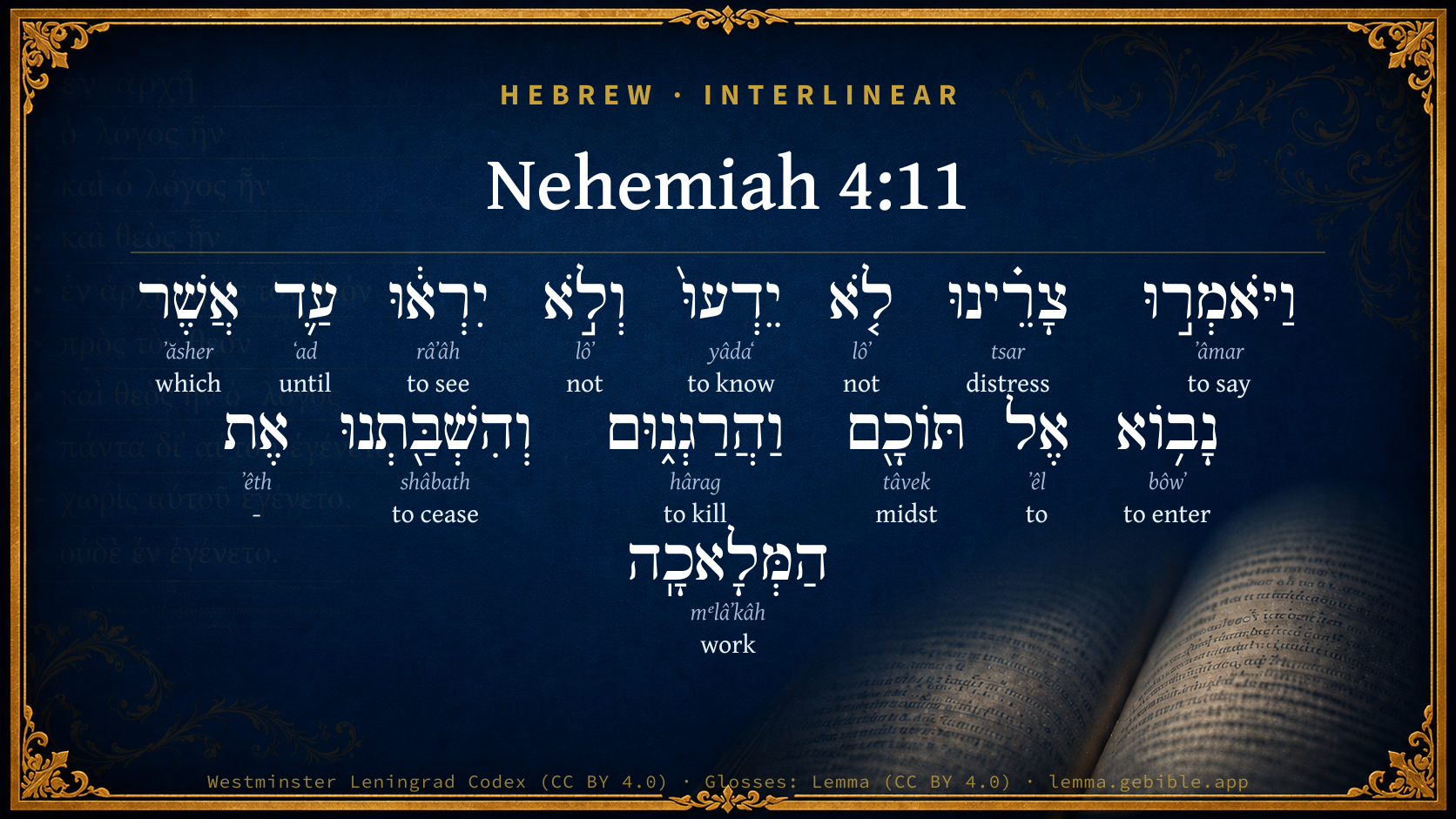
  1. וַיֹּאמְר֣וּ ʼâmar H559 “and · to say” Conjunction + Verb, Qal, Sequential Imperfect, 3rd Person, Masculine, Plural
  2. צָרֵ֗ינוּ tsar H6862 “distresses · our” Noun, Common, Masculine, Plural, Construct + Suffix, Personal, 1st Person, Common, Plural
  3. לֹ֤א lôʼ H3808 “not” Particle, Negative
  4. יֵדְעוּ֙ yâdaʻ H3045 “to know” Verb, Qal, Imperfect, 3rd Person, Masculine, Plural
  5. וְלֹ֣א lôʼ H3808 “and · not” Conjunction + Particle, Negative
  6. יִרְא֔וּ râʼâh H7200 “to see” Verb, Qal, Imperfect, 3rd Person, Masculine, Plural
  7. עַ֛ד ʻad H5704 “until” Preposition
  8. אֲשֶׁר ʼăsher H834 “which” Particle, Relative
  9. נָב֥וֹא bôwʼ H935 “to enter” Verb, Qal, Imperfect, 1st Person, Common, Plural
  10. אֶל ʼêl H413 “to” Preposition
  11. תּוֹכָ֖ם tâvek H8432 “midst · their” Noun, Common, Masculine, Singular, Construct + Suffix, Personal, 3rd Person, Masculine, Plural
  12. וַהֲרַגְנ֑וּם hârag H2026 “and · to kill · them” Conjunction + Verb, Qal, Sequential Perfect, 1st Person, Common, Plural + Suffix, Personal, 3rd Person, Masculine, Plural
  13. אֶת ʼêth H853 “-” Particle, Direct Object
  14. הַמְּלָאכָֽה mᵉlâʼkâh H4399 “the · work” Particle, Definite Article + Noun, Common, Feminine, Singular, Absolute

About this verse

These counts appear in no published source. They are computed here, from the morphology-tagged text and Lemma’s own curated glosses. What Lemma adds →

15
words
14
distinct lemmas
Historical
section

Grammatical profile

  • 6 verbs
  • 3 nouns
  • 2 prepositions
  • 4 particles

Verb forms

  • וַיֹּאמְר֣וּ Qal · Sequential Imperfect
  • יֵדְעוּ֙ Qal · Imperfect
  • יִרְא֔וּ Qal · Imperfect
  • נָב֥וֹא Qal · Imperfect
  • וַהֲרַגְנ֑וּם Qal · Sequential Perfect
  • וְהִשְׁבַּ֖תְנוּ Hiphil · Sequential Perfect

Repetition

A word recurs within this verse — often emphatic in Hebrew:

Cross-references

7

Topical passages linked to Nehemiah 4:11 in the Treasury of Scripture Knowledge — connected by theme and wording, ordered by reader-vote popularity; previews shown in the World English Bible.

  • Judges 20:29–48 Israel set liers-in-wait against Gibeah round about.
  • 2 Samuel 17:2 and I will come on him while he is weary and weak-handed, and will make him afraid; and all the people who are with him shall flee; and I will strike the king only;
  • Psalms 56:6 They conspire and lurk, Watching my steps, they are eager to take my life.
  • Isaiah 47:11 Therefore shall evil come on you; you shall not know the dawning of it: and mischief shall fall on you; you shall not be able to put it away: and desolation shall come on you suddenly, which you don't know.
  • Acts 23:12 When it was day, some of the Jews banded together, and bound themselves under a curse, saying that they would neither eat nor drink until they had killed Paul.
  • Acts 23:21 Therefore don't yield to them, for more than forty men lie in wait for him, who have bound themselves under a curse neither to eat nor to drink until they have killed him. Now they are ready, looking for the promise from you."
  • 1 Thessalonians 5:2 For you yourselves know well that the day of the Lord comes like a thief in the night.

Cross-references courtesy of OpenBible.info (CC BY 4.0).

Hebrew and Greek witnesses Masoretic Hebrew ↔ Greek Septuagint

The same verse in the two great witnesses to the Old Testament, shown verse-for-verse.

These are two independent witnesses, not word-aligned to each other, and the Septuagint is shown in lemma (dictionary) form.

Hebrew Nehemiah 4:11 Masoretic · Westminster Leningrad Codex

וַיֹּאמְר֣וּ צָרֵ֗ינוּ לֹ֤א יֵדְעוּ֙ וְלֹ֣א יִרְא֔וּ עַ֛ד אֲשֶׁר נָב֥וֹא אֶל תּוֹכָ֖ם וַהֲרַגְנ֑וּם וְהִשְׁבַּ֖תְנוּ אֶת הַמְּלָאכָֽה

Our adversaries said, They shall not know, neither see, until we come into the midst of them, and kill them, and cause the work to cease.

World English Bible · Public Domain

Greek LXX Structure differs

The Septuagint has no separate book of Nehemiah. Its Greek text is the second half of Esdras B (2 Esdras), chapters 11–23; Ezra is the first half (1–10).

A verse-for-verse comparison isn’t shown here because the chapters and verses don’t line up. Switch to the LXX edition with the MT / LXX toggle above to read the Greek directly.

Hebrew: Westminster Leningrad Codex (CC BY 4.0). Greek: Septuagint (public domain); English from a public-domain English Septuagint. How the Septuagint differs from the Hebrew →

Commentary

Notes on Nehemiah 4:11 from classic Christian and Jewish commentators (each source and its license shown beneath its notes). The classic Christian expositions comment on the surrounding passage and are grouped to its opening verse, so a note may address several verses; the Jewish commentaries on the Tanakh (Rashi and others) are per-verse, so they appear only where the commentator wrote on this verse.

Lemma curates 59 commentaries, every one of them public domain or Creative Commons licensed, each selected and text-cleaned for this edition rather than reprinted as found. About our sources →

Trapp's Complete Commentary

John Trapp

Neh 4:11 And our adversaries said, They shall not know, neither see, till we come in the midst among them, and slay them, and cause the work to cease.

Ver. 11. And our adversaries said] But their plot was some way discovered, and so prevented. Detexit facinus fatuus et non implevit, saith Tacitus of one in his time. So the gunpowder traitors betrayed themselves; and all came to light, though they had dug as low as hell to hide their counsels from the Lord.

They shall not know, neither see] But what shall he do who is omniscient and ολοφθαλμος, all-eye? whose providence is like a well drawn picture that vieweth all that comes into a room.

Till we come in the midst among them] Either in the night undiscerned; or by day, but unarmed, and not as enemies: for the Florentine secretary, though not yet (nor of many ages later) born into the world; yet the good of this world was as great a master then as afterwards.

And slay them, and cause the work to cease] The craft of the Church’s adversaries is never but accompanied with cruelty; and their cruelty is seldom without craft. The devil lends them his seven heads to plot, and his ten horns to push; but in the thing wherein they deal proudly, God is above these cruel crafties.

John Trapp, A Commentary or Exposition upon All the Books of the Old and New Testament (1647–1656) — public domain. Text from a community e-Sword module.

The Biblical Illustrator

Joseph S. Exell

Neh_4:11

And our adversaries said, They shall not know.

The craft and cruelty of the Churchs adversaries

I. A strong combination against the church of god.

II. A wicked design they were combined in.

III. A bloody means propounded.

IV. A subtle way projected for the affecting of this. (Matthew Newcomen.)

Satanic subtlety

I. In this serpentine, crafty, and malicious dealing of these wicked men appeareth the old serpentine nature and malice of Satan.

II. The next property of the serpent that appeareth in them is that they mercilessly would murder them when they had once thus suddenly invaded them.

III. The last property of Satan appeareth here in these wicked men, in that they would gladly overthrow this building of Jerusalem, that it should never be thought of any more. (Bp. Pilkington.)

The Biblical Illustrator, edited by Joseph S. Exell (c. 1880s–1900s) — public domain. Text from a community e-Sword module.

Joseph Benson's Commentary

Neh 4:11. Our adversaries said, They shall not know, &c. — Their enemies resolved not to appear with an army before Jerusalem, but to march so secretly that the Jews should have no notice of their approach till they saw them in the city, armed and prepared to attack them suddenly, and put them to the sword.

Joseph Benson's Commentary on the Old and New Testaments (1811–1818) — public domain. Text from a community e-Sword module.

Tyndale Open Study Notes

Tyndale Open Resources

4:11 The relentless psychological attack of Israel’s enemies was having a negative effect on morale.

Tyndale Open Study Notes — © Tyndale Open Resources, licensed CC BY-SA 4.0. Text via the HelloAO Bible API.

Ellicott's Commentary for English Readers

(11) They shall not know.—As to the adversaries, their plan was evidently to watch and surprise, instead of making the threatened attack.

A Bible Commentary for English Readers, edited by Charles John Ellicott (1878–1897) — public domain. Text from a community e-Sword module.

The Cambridge Bible for Schools and Colleges

gen. ed. J. J. S. Perowne

11. our adversaries said] ‘adversaries,’ cf. Ezr_4:1. After mentioning the source of weakness within the walls, Nehemiah describes the danger from without. ‘Said.’ He gives, as if in their own words, their secret project of a surprise attack upon Jerusalem, either reporting the information brought by spies or describing by imagination what the intentions of the enemy were.

in the midst among them] R.V. Into the midst of them.

The Cambridge Bible for Schools and Colleges (gen. ed. J. J. S. Perowne; Cambridge University Press, 1878–1918) — public domain. Text from a community e-Sword module.

John Gill's Exposition

And our adversaries said, they shall not know,.... Our designs upon them:

neither see; or perceive what we are about to do:

till we come in the midst of them; with an army suddenly, at an unawares, and unexpected:

and slay them; they being unarmed, and not prepared to defend themselves:

and cause the work to cease; as it must in course, the builders being slain.

John Gill's Exposition of the Whole Bible (1746–1763) — public domain (CC PDM 1.0). Text via the HelloAO Bible API.

Matthew Poole's English Annotations

We will come secretly and unexpectedly upon them so as they shall neither foresee their danger, nor be able to prevent it.

Matthew Poole's English Annotations on the Holy Bible (1683–1685) — public domain. Text from a community e-Sword/MySword module.

Whedon's Commentary on the Bible

Daniel D. Whedon

11. They shall not know — They plotted a secret assault, aiming to surprise the Jews in the midst of their work.

Daniel D. Whedon (gen. ed.), Commentary on the Old and New Testaments (1874–1909) — public domain. Text from a community e-Sword module.

Keil & Delitzsch

C. F. Keil & F. Delitzsch

Their discouragement was increased by the words of their enemies, who said: They (the Jews) shall not know nor see, till we come in the midst among them, and slay them, and cause the work to cease.

Keil & Delitzsch — Biblical Commentary on the Old Testament (1861–1891) — public domain (CC PDM 1.0). Text via the HelloAO Bible API. (Old Testament only.)

Rashi

Rabbi Shlomo Yitzchaki (Rashi)

The builders of the wall, etc. Those who were building the wall and those who were loading and carrying the loads were working with one hand, and carrying weapons with the other.

the sword Heb. הַשָּׁלַח, an implement of war, like (Job 33:18): “...from perishing by the sword (מֵעֲבֹר בַּשָּׁלַח). And so did Menahem associate it (Machbereth Menahem p. 174).

Rashi on the Tanakh — English translations: “The Judaica Press complete Tanach with Rashi, translated by A. J. Rosenberg” (CC BY 4.0); “Pentateuch with Rashi's commentary by M. Rosenbaum and A.M. Silbermann, 1929-1934” (public domain); “The Metsudah Tanach series, Lakewood, N.J” (CC BY 4.0); and “The Book of Joshua, Metsudah Publications, 1997” (CC BY 4.0). Text via Sefaria.

Lesson kit

Teaching starters — assembled from the data on this page, not authored interpretation. Every prompt links to the verse data it draws on. Edit before teaching.

Nehemiah, in the Historical, opens this verse with 15 words (14 distinct Hebrew lemmas). Its most distinctive word is shâbath (“to cease”). A historical commentator’s framing appears above. Read the whole chapter for the surrounding context.

Discussion questions

  1. The word shâbath carries the sense “to cease.” How does it shape the verse?
  2. How does Judges 20:29–48, which shares this passage’s theme, read alongside this verse?
  3. What does the repetition of “not” (2× in this one verse) do in this verse?
  4. The translations on this page render this verse differently — a whole-verse word diff, not a word-by-word alignment. What might account for the different wordings?
  5. «וַיֹּאמְר֣וּ» is a Qal Sequential Imperfect verb. How does that grammatical form shape the action described?
  6. Compare how Trapp's Complete Commentary and The Biblical Illustrator read this verse. Where do they agree or differ?

Things to notice

Reading settings

Reading text

Shown beneath each verse's original-language words.

Old Testament
Old Testament edition

Read the OT as the Masoretic Hebrew (MT) or the Greek Septuagint (LXX).

English shown for the Greek Septuagint (in the Hebrew ↔ Greek comparison).

Comparing translations? Open the Compare panel on any verse page to stack up to four side by side.