
Habakkuk 1:17

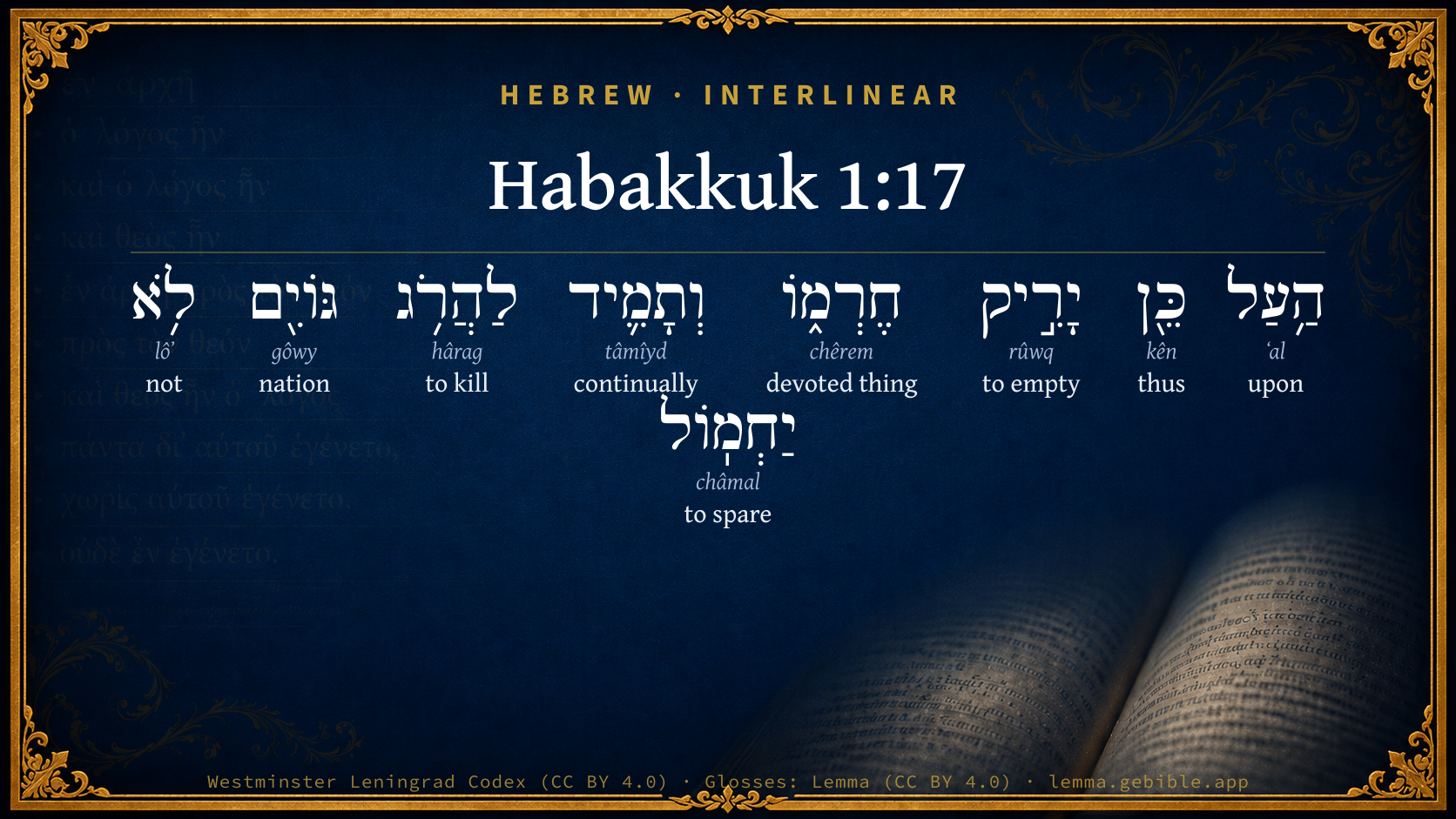
Hebrew (Westminster Leningrad Codex) Habakkuk 1:17 appears in the Hebrew Old Testament. The text above is from the Westminster Leningrad Codex. Each word links to its Strong’s number, a concise gloss, and parsing drawn from the Open Scriptures Hebrew Bible morphology. Click any word for its full Brown-Driver-Briggs (BDB) entry.
Download image
Cite this verse

Habakkuk 1:17 (World English Bible). Public Domain. Lemma interlinear Bible study tool, https://lemma.gebible.app/v/habakkuk/1/17.

Show BibTeX & RIS
BibTeX
RIS
English Translation
Will he therefore continually empty his net, and kill the nations without mercy?
World English Bible · Public Domain
Download a study sheet

One document with this verse’s original text, its word-by-word gloss line, the meaning frame, cross-references with their text, attributed commentary, and full source and license credits — printable, and it pastes into notes with its structure intact.

This verse Autodidact and up

Study sheet (.html) Plain text (.txt)

A passage Seminary Student

Up to 50 verses in one chapter. A passage sheet keeps up to 6 commentary sources and 12 cross-references per verse, in the order this page ranks them, and says so on the sheet whenever that leaves anything out. Ask for a single verse and you get the Autodidact verse sheet above.

Everything on this page stays free to read, with no account — the sheet is a download of what is already on screen, not access to it.

Want to remove ads? Support Godless Engineer
Compare translations 3

The same verse in 3 English versions, stacked beneath the original-language interlinear above. Click any original word for its lexicon entry.

Each is an independent rendering of the whole verse — the interlinear is not word-aligned to these translations.

Highlighted words mark where these versions differ — a whole-verse word diff, not a word-by-word alignment.

  • World English Bible Public Domain
    Will he therefore continually empty his net, and kill the nations without mercy?
  • King James Version Public Domain
    Shall they therefore empty their net, and not spare continually to slay the nations?
  • unfoldingWord Literal Text CC BY-SA 4.0
    Therefore will he empty his net, and will he not spare to slay the nations continually?”

unfoldingWord Literal Text — © unfoldingWord, licensed CC BY-SA 4.0. Word-aligned USFM3 via Door43 (git.door43.org/unfoldingWord/en_ult).

Versions to compare (up to 4)

3 of 4 selected

Show all 18 translations

Every available English version of this verse, each an independent rendering of the whole verse.

  • World English Bible Public Domain
    Will he therefore continually empty his net, and kill the nations without mercy?
  • Berean Standard Bible Public Domain
    Will he, therefore, empty his net and continue to slay nations without mercy?
  • Majority Standard Bible Public Domain
    Will he, therefore, empty his net and continue to slay nations without mercy?
  • King James Version Public Domain
    Shall they therefore empty their net, and not spare continually to slay the nations?
  • American Standard Version (1901) Public Domain
    Shall he therefore empty his net, and spare not to slay the nations continually?
  • Revised Version (1885) Public Domain
    Shall he therefore empty his net, and not spare to slay the nations continually?
  • Geneva Bible (1599) Public Domain
    Shall they therefore stretch out their net and not spare continually to slay the nations?
  • Douay-Rheims (1899) Public Domain
    For this cause therefore he spreadeth his net, and will not spare continually to slay the nations.
  • Young's Literal Translation Public Domain
    Doth he therefore empty his net, And continually to slay nations spare not?
  • Literal Standard Version CC BY-SA 4.0
    Does he therefore empty his net, || And continually not spare to slay nations?
  • Unlocked Literal Bible CC BY-SA 4.0
    Will he therefore keep emptying his net, and will he continually slaughter the nations without mercy?”
  • unfoldingWord Literal Text CC BY-SA 4.0
    Therefore will he empty his net, and will he not spare to slay the nations continually?”
  • Darby Bible Public Domain
    Shall he therefore empty his net, and not spare to slay the nations continually?
  • World Messianic Bible Public Domain
    Will he therefore continually empty his net, and kill the nations without mercy?
  • Webster's Bible Public Domain
    Shall they therefore empty their net, and not spare continually to slay the nations?
  • Free Bible Version CC BY-SA 4.0
    Will they keep on unsheathing their swords forever, killing nations without mercy?
  • Bible in Basic English Public Domain
    For this cause his net is ever open, and there is no end to his destruction of the nations.
  • JPS Tanakh (1917) Public Domain
    Shall they therefore empty their net, and not spare to slay the nations continually?

Literal Standard Version (2020), Covenant Press — licensed CC BY-SA 4.0. Text via the HelloAO Bible API (eBible.org). Unlocked Literal Bible (unfoldingWord) — licensed CC BY-SA 4.0. Text via the HelloAO Bible API (eBible.org). unfoldingWord Literal Text — © unfoldingWord, licensed CC BY-SA 4.0. Word-aligned USFM3 via Door43 (git.door43.org/unfoldingWord/en_ult). Free Bible Version, Dr. Jonathan Gallagher — licensed CC BY-SA 4.0. Text via the HelloAO Bible API (eBible.org).

Word by word

More ways to search: Search by grammar → Find every occurrence → Compare this word →

Practice this passage: Drill this verse → Learn its vocabulary →

About this verse

These counts appear in no published source. They are computed here, from the morphology-tagged text and Lemma’s own curated glosses. What Lemma adds →

9
words
9
distinct lemmas
Prophets
section

Notable vocabulary

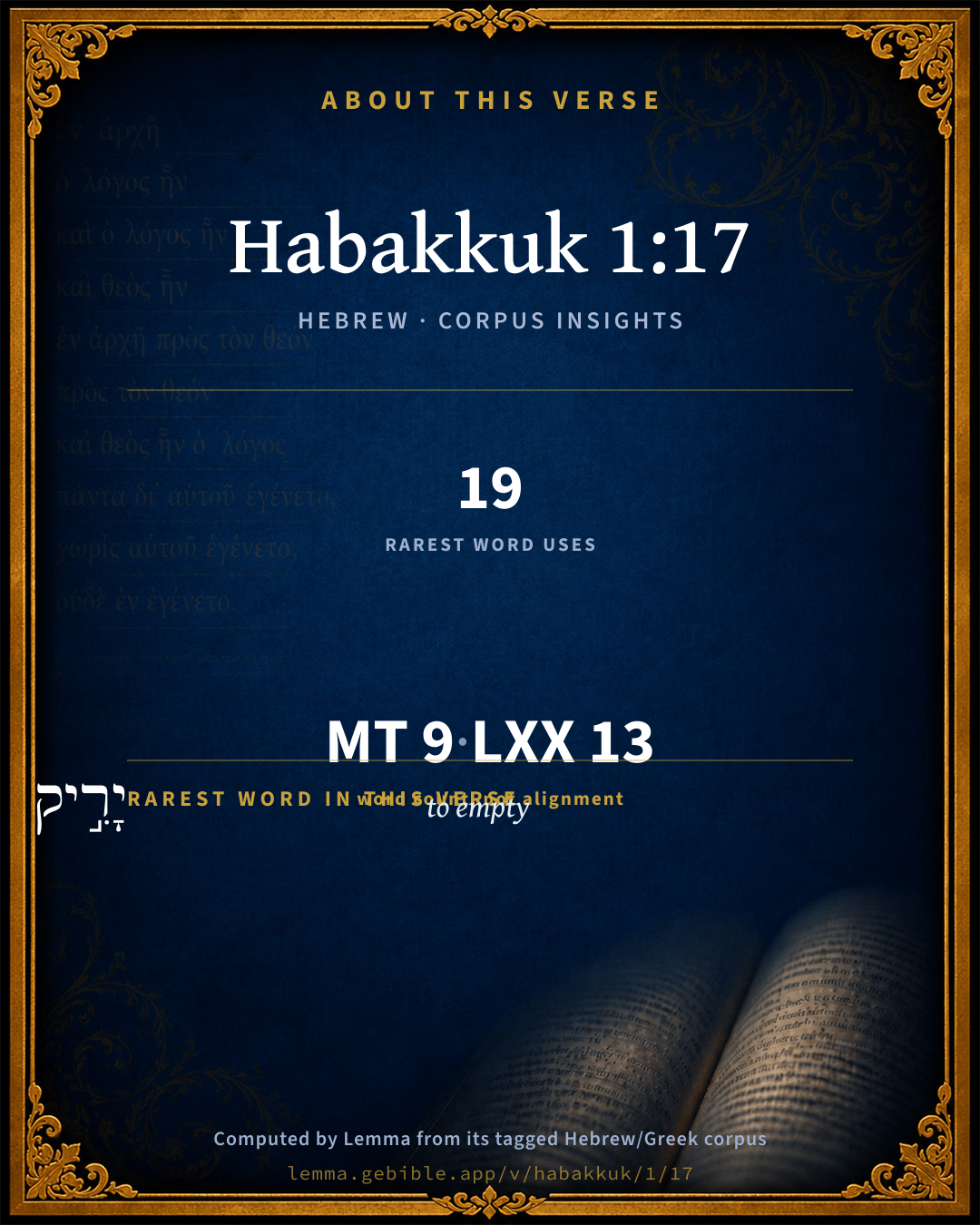
The rarest word here is יָרִ֣יק to empty H7324 — appearing just 19 times in the whole Hebrew Bible.

Shared distinctive vocabulary

יָרִ֣יק to empty H7324 occurs in 19 verses of the Hebrew Bible. Also found in:

Grammatical profile

  • 3 verbs
  • 3 nouns
  • 1 preposition
  • 2 particles

Verb forms

  • יָרִ֣יק Hiphil · Imperfect
  • לַהֲרֹ֥ג Qal · Infinitive Construct
  • יַחְמֽוֹל Qal · Imperfect

Hebrew & Septuagint length

In English translation the verse runs 13 words from the Hebrew and 15 from the Septuagint (LXX English) — closely comparable.

A rough comparison of the two English renderings, which tokenize alike — not a word-level alignment.

Word counts can differ between the Hebrew and the Greek without any difference in meaning — e.g. the Hebrew direct-object marker אֵת has no separate Greek word, and Greek often adds the article ὁ.

In the original languages it is 9 Hebrew tokens and 13 Greek tokens — but the two are counted differently (Hebrew bundles its prefixes and suffixes into one token; the Greek is in lemma form), so that isn’t a like-for-like length.

Cross-references

10

Topical passages linked to Habakkuk 1:17 in the Treasury of Scripture Knowledge — connected by theme and wording, ordered by reader-vote popularity; previews shown in the World English Bible.

  • Isaiah 14:6 who struck the peoples in wrath with a continual stroke, who ruled the nations in anger, with a persecution that none restrained.
  • Isaiah 14:16–17 Those who see you shall gaze at you, they shall consider you, [saying], "Is this the man who made the earth to tremble, who shook kingdoms;
  • Isaiah 19:8 The fishermen shall lament, and all those who cast angle into the Nile shall mourn, and those who spread nets on the waters shall languish.
  • Jeremiah 25:9–26 behold, I will send and take all the families of the north, says Yahweh, and [I will send] to Nebuchadrezzar the king of Babylon, my servant, and will bring them against this land, and against the inhabitants of it, and against all these nations round about; and I will utterly destroy them, and make them an astonishment, and a hissing, and perpetual desolations.
  • Jeremiah 46:1–28 The word of Yahweh which came to Jeremiah the prophet concerning the nations.
  • Jeremiah 52:1–34 Zedekiah was twenty-one years old when he began to reign; and he reigned eleven years in Jerusalem: and his mother's name was Hamutal the daughter of Jeremiah of Libnah.
  • Ezekiel 25:1–17 The word of Yahweh came to me, saying,
  • Habakkuk 1:9–10 All of them come for violence. Their hordes face the desert. He gathers prisoners like sand.
  • Habakkuk 2:5–8 Yes, moreover, wine is treacherous. A haughty man who doesn't stay at home, who enlarges his desire as Sheol, and he is like death, and can't be satisfied, but gathers to himself all nations, and heaps to himself all peoples.
  • Habakkuk 2:17 For the violence done to Lebanon will overwhelm you, and the destruction of the animals, which made them afraid; because of men's blood, and for the violence done to the land, to every city and to those who dwell in them.

Cross-references courtesy of OpenBible.info (CC BY 4.0).

Hebrew and Greek witnesses Masoretic Hebrew ↔ Greek Septuagint

The same verse in the two great witnesses to the Old Testament, shown verse-for-verse.

These are two independent witnesses, not word-aligned to each other, and the Septuagint is shown in lemma (dictionary) form.

Hebrew Habakkuk 1:17 Masoretic · Westminster Leningrad Codex

הַ֥עַל כֵּ֖ן יָרִ֣יק חֶרְמ֑וֹ וְתָמִ֛יד לַהֲרֹ֥ג גּוֹיִ֖ם לֹ֥א יַחְמֽוֹל

Will he therefore continually empty his net, and kill the nations without mercy?

World English Bible · Public Domain

Greek LXX Habakkuk 1:17 Septuagint · lemma form

διά οὗτος ἀμφιβάλλω ὁ ἀμφίβληστρον αὐτός καί διά πᾶς ἀποκτείνω ἔθνος οὐ φείδομαι

Therefore will he cast his net, and will not spare to kill the nations continually.

LXX2012 (modern English Septuagint) · Public Domain

On this verse, The Pulpit Commentary discusses the Septuagint’s reading. Read the note in Commentary ↓

Hebrew: Westminster Leningrad Codex (CC BY 4.0). Greek: Septuagint (public domain); English from LXX2012 (modern English Septuagint) (Public Domain). How the Septuagint differs from the Hebrew →

Targum (Aramaic paraphrase)

1

The Targum is the ancient Jewish Aramaic paraphrase of the Hebrew Scriptures — an interpretive translation, not the Hebrew text itself. Onkelos (literal) and Pseudo-Jonathan (expansive) render the Torah, and Jonathan the Prophets. Coverage is partial: where no permissively-licensed English translation exists for a verse, only the Aramaic is shown. This is verse-level text, not a word-by-word alignment to the Hebrew.

  1. Targum Jonathan Prophets (Joshua–Malachi)
    הַעַל אִילֵין יִשְׁלַח מַשִׁרְיָתֵיהּ בִּתְדִירָא לְאוֹסָפָא עַמְמִין וְלָא בַּחַיָס:

    (no public-domain English translation for this verse)

    Targum Jonathan — Aramaic: “Mikraot Gedolot” (public domain). English: “Sefaria Community Translation” (CC0 1.0 (public-domain dedication)); “London "Chaldee Paraphrase," 1871” (public domain). Text via Sefaria.

Commentary

Notes on Habakkuk 1:17 from classic Christian and Jewish commentators (each source and its license shown beneath its notes). The classic Christian expositions comment on the surrounding passage and are grouped to its opening verse, so a note may address several verses; the Jewish commentaries on the Tanakh (Rashi and others) are per-verse, so they appear only where the commentator wrote on this verse.

Lemma curates 59 commentaries, every one of them public domain or Creative Commons licensed, each selected and text-cleaned for this edition rather than reprinted as found. About our sources →

Trapp's Complete Commentary

John Trapp

Hab 1:17 Shall they therefore empty their net, and not spare continually to slay the nations?

Ver. 17. Shall they therefore empty their net] That they may fill it again anew, and so draw to themselves, as to a pond or pool, the wealth and power of the whole east? Interrogatio precationis speciem habet, saith Gualther. This question is an effectual prayer; and it is as if the prophet should thus say, If, as hitherto, thou go on to wink at their wickedness, O God, will they not grow more audacious every day, and mischievous to mankind? Arise, therefore, O Lord of recompences, to the help of thy people. Set up and show thyself above the heathen, that they may know themselves to be but men.

And not spare continually to slay the nations] q.d. This cannot hold long; and that it may not, is mine earnest suit and supplication. Lord, when thou makest inquisition for blood, remember their blood guiltiness, and forget not the cry of the humble, Psa 9:12. These cruel Chaldeans do not only subjugate, but slay, not a few, but whole nations and that continually, and that without mercy. Is it not high time for thee to set to thy hand, O preserver of men, &c. Note the prophet’s ardency in prayer; and learn of him to get upon the battlements, and look up, to see what comes of it, Hab 2:1. This was also David’s practice, Psa 5:3, where he useth the selfsame military word, atsappeh; importing that he would be as a spy upon a tower, to see whether he prevailed with God, whether he got the day.

John Trapp, A Commentary or Exposition upon All the Books of the Old and New Testament (1647–1656) — public domain. Text from a community e-Sword module.

Geneva Bible (1599)

Geneva Bible translators

Meaning, that they should not.

Geneva Bible (1599) marginal notes — public domain. Text via Bolls.life.

Jamieson, Fausset & Brown

Robert Jamieson, A. R. Fausset & David Brown

Shall they . . . empty their net?--Shall they be allowed without interruption to enjoy the fruits of their violence?

therefore--seeing that they attribute all their successes to themselves, and not to Thee. The answer to the prophet's question, he by inspiration gives himself in the second chapter.

Next: Habakkuk Chapter 2

Jamieson, Fausset & Brown — Commentary Critical and Explanatory on the Whole Bible (1871) — public domain (CC PDM 1.0). Text via the HelloAO Bible API.

Adam Clarke's Commentary

Verse 17. And not spare continually to slay the nations?] They are running from conquest to conquest; burning, slaying, sacking, and slaughtering. Like the fishermen, who throw cast after cast while any fish are to be caught, so Nebuchadnezzar is destroying one nation after another. This last sentence explains the allegory of the net.

Adam Clarke's Commentary on the Bible (1810–1826) — public domain. Text from a community e-Sword/MySword module.

John Calvin's Commentaries

This is an affirmative question, “Shall they therefore;” which, however, requires a negative answer. Then all interpreters are mistaken; for they think that the Prophet here complains, that he presently extends his net after having made a capture, but he rather means, “Is he ever to extend his net?” that is, “How long, O Lord, wilt thou permit the Assyrians to proceed to new plunders, so as to be like the hunter, who after having taken a boar or a stag, is more eager, and immediately renews his hunting; or like the fisherman, who having filled his little ship, with more avidity pursues his vocation? Wilt thou, Lord, he says, suffer the Assyrians to become more assiduous in their work of destruction?” And he shows how unworthy they were of God’s forbearance, for they slew the nations. “I speak not here,” he says, “either of fish or of any other animal, nor do I speak of this or that man, but I speak of many nations. As these slaughters are thus carried on through the whole world, how long, Lord, shall they be unpunished? for they will never cease.” We now see the purport of the Prophet’s complaint; but we shall find in the next lecture how he recovers himself.

John Calvin's Commentaries (1540-1563) — public domain. Text from the Calvin Translation Society English edition (1840s-50s) via the Christian Classics Ethereal Library (ccel.org). Calvin's coverage is partial (roughly two-thirds of the Bible); uncommented books and verses are honest gaps, never fabricated. The 19th-century editor's footnotes and remarks are omitted so the notes are faithfully Calvin's own voice.

Ellicott's Commentary for English Readers

(17) Shall they therefore empty their net. . . .—Literally, Shall he therefore empty his net? i.e., Shall this voracious Chaldæan plunderer be allowed to consume his prey, and cast in his emptied net again and again?

A Bible Commentary for English Readers, edited by Charles John Ellicott (1878–1897) — public domain. Text from a community e-Sword module.

The Cambridge Bible for Schools and Colleges

gen. ed. J. J. S. Perowne

17. A despairing question and appeal to Heaven.

Shall they … their net] Shall he … his net?

The Cambridge Bible for Schools and Colleges (gen. ed. J. J. S. Perowne; Cambridge University Press, 1878–1918) — public domain. Text from a community e-Sword module.

John Gill's Exposition

Shall they therefore empty their net,.... Or "thus", after this manner, so Noldius; as fishermen do, when they have had a good cast, and a large draught, spread the net, and take out the fishes, in order to throw it again, and catch more; and so it is asked, should these Chaldeans, when they have conquered one nation, and so filled their net or themselves with the spoil, carry it to Babylon, and there lay it up, and then proceed to fight against another kingdom and nation, and plunder it in like manner?

and not spare continually to slay the nations? the inhabitants of them one after another, and subdue them under them, and make themselves master of all their treasure, until they are arrived to universal monarchy by such cruel and unmerciful methods. The Targum is,

"shall he send his armies continually to consume nations, and that without mercy?''

This the prophet proposes in the name of the whole body of the Lord's people, and leaves it with him to have an answer to it, which is given in the following chapter Hab 2:1.

John Gill's Exposition of the Whole Bible (1746–1763) — public domain (CC PDM 1.0). Text via the HelloAO Bible API.

Albert Barnes' Notes on the Bible

Shall they therefore empty their net, and not spare continually to slay the nations? - The prophet, like Isaiah Isa 18:4-5, stands at the very last point, before the fury and desire of the enemy was fulfilled. People, like fish, were gathered together for a prey; he who had taken them was rejoicing and exulting beforehand in his booty; his portion and meat were the choice of the earth; the prophet leeks on, as it were, and beholds the net full; there is but one step more; “Shall he empty it? Shall he then devour those whom he has caught? and so cast his emptied net again unceasingly, pitilessly, to slay the nations?” This question he answers in the next chapter - A Deliverer will come!

Albert Barnes' Notes on the Bible (1834–1885) — public domain. Text from a community e-Sword/MySword module.

Haydock's Catholic Bible Commentary

Nations, of every country. (Worthington) --- Few have been so much addicted to war as Nabuchodonosor. (Calmet)

George Leo Haydock (1774–1849), Haydock's Catholic Family Bible and Commentary, 1859 edition — public domain. Excludes Psalms (Douay-Rheims chapter numbering differs from Protestant) and Deuterocanonical books (Catholic canon only).

Matthew Poole's English Annotations

Shall they? the Chaldeans, Nebuchadnezzar and his armies.

Therefore; shall former success be pledge of future? they have prospered, and they think they shall; wilt thou confirm this to them?

Empty their net; as fishermen empty the full net to fill it again, and cast out what they had taken to take in more; shall these proud and cruel Chaldeans do so still?

And not spare continually; shall they as endlessly as mercilessly waste?

To slay, murderer-like, kill,

the nations; not single persons, but whole kingdoms and people at once: wilt thou, O most just and mighty God and Judge, suffer these things always? The prophet by the question intimates to us that God most certainly will not suffer it always. The Lord will in fit time arise and break the oppressors’ arm, and save the oppressed church and people of God.

Matthew Poole's English Annotations on the Holy Bible (1683–1685) — public domain. Text from a community e-Sword/MySword module.

Whedon's Commentary on the Bible

Daniel D. Whedon

17. In Hab_1:7-11 Jehovah is introduced as describing the terribleness of the Chaldean armies; in Hab_1:12 ff, the prophet questions Jehovah, how his attitude toward them can be harmonized with his holiness. Their success in the past has been perplexing enough; how can the prophet explain the new commission intrusted to them?

Shall they therefore empty their nets — Of the fish already caught, so that they may prepare for a new haul. In the last clause the prophet discontinues the use of figurative language, and inquires whether the Chaldeans are to be permitted to continue forever in their career of violence.

The prophet is, indeed, perplexed. Is there no solution? He is not yet ready to give up, and determines to await a divine solution.

Daniel D. Whedon (gen. ed.), Commentary on the Old and New Testaments (1874–1909) — public domain. Text from a community e-Sword module.

The Pulpit Commentary

Shall they therefore empty their net? Because they have had this career of rapine and conquest, shall God allow them to continue it? Shall they be permitted to be continually emptying their net in order to fill it again? The idea is that they carried off their booty and captives and secured them in their own territory, and then set out on new expeditions to acquire fresh plunder. The question is answered in the next chapter, where the judgment on the Chaldeans is pronounced. And not spare continually to slay the nations? And cease not to send forth his armies and to found his empire in the blood of conquered nations. The Septuagint and Vulgate have no interrogation, the assertion being made by way of expostulation.

The Pulpit Commentary (1880–1919), ed. H.D.M. Spence-Jones & Joseph S. Exell — public domain. Text from a community e-Sword module.

John Wesley's Explanatory Notes

Empty their net - As fisher-men empty the full net to fill it again.

John Wesley, Explanatory Notes Upon the Whole Bible (1754–1765) — public domain. Text via the GEBible commentary corpus.

Rashi

Rabbi Shlomo Yitzchaki (Rashi)

Because of this does he arm himself with his net There are many interrogative forms that are affirmative, e.g., (I Sam. 2:27) “Did I appear?” concerning Eli, and (II Sam. 15:27) “Do you see?” Here, too: Does it appear in Your eyes that because of this he prospers every time, in that he arms himself with his net over everyone and to hunt game? arms himself As in (Gen. 14:14) “And he armed (וַיָּרֶק) his trained men” and (Ps. 35:3): “Arm yourself (הָרֵק) with a spear.” He arms himself with his net.

Rashi on the Tanakh — English translations: “The Judaica Press complete Tanach with Rashi, translated by A. J. Rosenberg” (CC BY 4.0); “Pentateuch with Rashi's commentary by M. Rosenbaum and A.M. Silbermann, 1929-1934” (public domain); “The Metsudah Tanach series, Lakewood, N.J” (CC BY 4.0); and “The Book of Joshua, Metsudah Publications, 1997” (CC BY 4.0). Text via Sefaria.

Lesson kit

Teaching starters — assembled from the data on this page, not authored interpretation. Every prompt links to the verse data it draws on. Edit before teaching.

Habakkuk, in the Prophets, opens this verse with 9 words (9 distinct Hebrew lemmas). Its most distinctive word is rûwq (“to empty”). A historical commentator’s framing appears above. Read the whole chapter for the surrounding context.

Discussion questions

  1. The word rûwq carries the sense “to empty.” How does it shape the verse?
  2. How does Genesis 14:14, which shares the word «to empty», read alongside this verse?
  3. These translations render this verse differently. What is at stake in choosing one wording over another?
  4. «יָרִ֣יק» is a Hiphil Imperfect verb. How does that grammatical form shape the action described?
  5. Compare how Trapp's Complete Commentary and Geneva Bible (1599) read this verse. Where do they agree or differ?

Things to notice

Reading settings

Reading text

Shown beneath each verse's original-language words.

Old Testament
Old Testament edition

Read the OT as the Masoretic Hebrew (MT) or the Greek Septuagint (LXX).

English shown for the Greek Septuagint (in the Hebrew ↔ Greek comparison).

Comparing translations? Open the Compare panel on any verse page to stack up to four side by side.