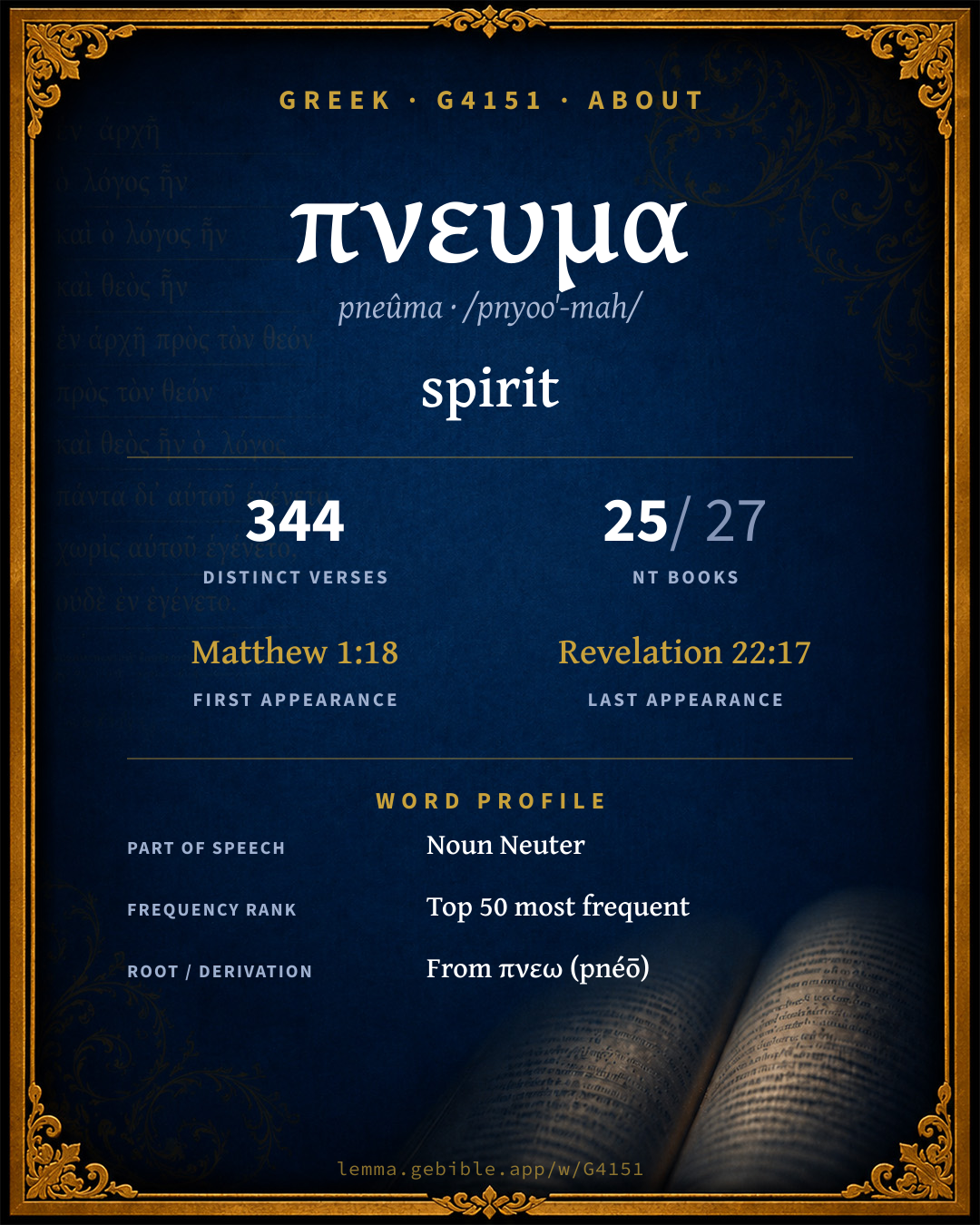
πνεῦμα
spirit
‘spirit’ is one of 5 main senses fuller range ↓
Full lexicon entry — Thayer's Greek Lexicon
From Thayer's Greek Lexicon
Where this word appears
See every Genitive-case word in the Greek New Testament →
Grammar key — what these labels mean
Part of speech
- Noun
- A naming word — a person, place, thing, or idea.
Case
- Genitive
- The case of source, possession, or “of” — answers “whose / from what.”
- Nominative
- The case of the subject (and the predicate nominative).
- Dative
- The case of the indirect object, means, or location — “to / for / with / in.”
- Accusative
- The case of the direct object and of extent.
Gender
- Neuter
- Grammatically neuter.
Number
- Singular
- One.
- Plural
- More than one.
Grammatical forms
- Noun, Genitive, Singular, Neuter 96 times (25%)
- Noun, Nominative, Singular, Neuter 94 times (25%)
- Noun, Dative, Singular, Neuter 91 times (24%)
- Noun, Accusative, Singular, Neuter 64 times (17%)
- Noun, Genitive, Plural, Neuter 11 times (3%)
- Noun, Accusative, Plural, Neuter 10 times (3%)
- Noun, Nominative, Plural, Neuter 8 times (2%)
- Noun, Dative, Plural, Neuter 5 times (1%)
Parsed forms decoded from the imported morphology (Robinson–Tischendorf, public domain), counted across 379 parsed occurrences — not distinct verses.
Page 1 of 2 — showing verses 1–200 of 344 distinct verses where G4151 appears, across 25 books. Click any verse to open its interlinear word-by-word view. Verse text shown in the World English Bible for context — . Each verse’s Greek form is shown with its reference; the English is not keyword-highlighted, since the data carries no word-level English alignment. Use “Compare translations” on any verse to read it across multiple English versions. This concordance covers the Greek New Testament; Septuagint (Greek Old Testament) occurrences of this word are not indexed here.
Matthew 19 verses
- Matthew 1:18 πνεύματος n gen sg neut Now the birth of Jesus Christ was like this; for after his mother, Mary, was engaged to Joseph, before they came together, she was found pregnant by the Holy Spirit.
- Matthew 1:20 πνεύματός n gen sg neut But when he thought about these things, behold, an angel of the Lord appeared to him in a dream, saying, "Joseph, son of David, don't be afraid to take to yourself Mary, your wife, for that which is conceived in her is of the Holy Spirit.
- Matthew 3:11 πνεύματι n dat sg neut I indeed baptize you in water for repentance, but he who comes after me is mightier than I, whose shoes I am not worthy to carry. He will baptize you in the Holy Spirit.
- Matthew 3:16 πνεῦμα n acc sg neut Jesus, when he was baptized, went up directly from the water: and behold, the heavens were opened to him. He saw the Spirit of God descending as a dove, and coming on him.
- Matthew 4:1 πνεύματος n gen sg neut Then Jesus was led up by the Spirit into the wilderness to be tempted by the devil.
- Matthew 5:3 πνεύματι n dat sg neut "Blessed are the poor in spirit, For theirs is the Kingdom of Heaven.
- Matthew 8:16 πνεύματα n acc pl neut When evening came, they brought to him many possessed with demons. He cast out the spirits with a word, and healed all who were sick;
- Matthew 10:1 πνευμάτων n gen pl neut He called to himself his twelve disciples, and gave them authority over unclean spirits, to cast them out, and to heal every disease and every sickness.
- Matthew 10:20 πνεῦμα n nom sg neut For it is not you who speak, but the Spirit of your Father who speaks in you.
- Matthew 12:18 πνεῦμά n acc sg neut "Behold, my servant whom I have chosen; My beloved in whom my soul is well pleased: I will put my Spirit on him. He will proclaim justice to the Gentiles.
- Matthew 12:28 πνεύματι n dat sg neut But if I by the Spirit of God cast out demons, then the Kingdom of God has come upon you.
- Matthew 12:31 πνεύματος n gen sg neut Therefore I tell you, every sin and blasphemy will be forgiven men, but the blasphemy against the Spirit will not be forgiven men.
- Matthew 12:32 πνεύματος n gen sg neut Whoever speaks a word against the Son of Man, it will be forgiven him; but whoever speaks against the Holy Spirit, it will not be forgiven him, neither in this age, nor in that which is to come.
- Matthew 12:43 πνεῦμα n nom sg neut But the unclean spirit, when he is gone out of the man, passes through waterless places, seeking rest, and doesn't find it.
- Matthew 12:45 πνεύματα n acc pl neut Then he goes, and takes with himself seven other spirits more evil than he is, and they enter in and dwell there. The last state of that man becomes worse than the first. Even so will it be also to this evil generation."
- Matthew 22:43 πνεύματι n dat sg neut He said to them, "How then does David in the Spirit call him Lord, saying,
- Matthew 26:41 πνεῦμα n nom sg neut Watch and pray, that you don't enter into temptation. The spirit indeed is willing, but the flesh is weak."
- Matthew 27:50 πνεῦμα n acc sg neut Jesus cried again with a loud voice, and yielded up his spirit.
- Matthew 28:19 πνεύματος n gen sg neut Therefore go, and make disciples of all nations, baptizing them in the name of the Father and of the Son and of the Holy Spirit,
Mark 22 verses
- Mark 1:8 πνεύματι n dat sg neut I baptized you in water, but he will baptize you in the Holy Spirit."
- Mark 1:10 πνεῦμα n acc sg neut Immediately coming up from the water, he saw the heavens parting, and the Spirit descending on him like a dove.
- Mark 1:12 πνεῦμα n nom sg neut Immediately the Spirit drove him out into the wilderness.
- Mark 1:23 πνεύματι n dat sg neut Immediately there was in their synagogue a man with an unclean spirit, and he cried out,
- Mark 1:26 πνεῦμα n nom sg neut The unclean spirit, convulsing him and crying with a loud voice, came out of him.
- Mark 1:27 πνεύμασι n dat pl neut They were all amazed, so that they questioned among themselves, saying, "What is this? A new teaching? For with authority he commands even the unclean spirits, and they obey him!"
- Mark 2:8 πνεύματι n dat sg neut Immediately Jesus, perceiving in his spirit that they so reasoned within themselves, said to them, "Why do you reason these things in your hearts?
- Mark 3:11 πνεύματα n nom pl neut The unclean spirits, whenever they saw him, fell down before him, and cried, "You are the Son of God!"
- Mark 3:29 πνεῦμα n acc sg neut but whoever may blaspheme against the Holy Spirit never has forgiveness, but is guilty of an eternal sin"
- Mark 3:30 πνεῦμα n acc sg neut -- because they said, "He has an unclean spirit."
- Mark 5:2 πνεύματι n dat sg neut When he had come out of the boat, immediately there met him out of the tombs a man with an unclean spirit,
- Mark 5:8 πνεῦμα n nom sg neut For he said to him, "Come out of the man, you unclean spirit!"
- Mark 5:13 πνεύματα n nom pl neut At once Jesus gave them permission. The unclean spirits came out and entered into the pigs. The herd of about two thousand rushed down the steep bank into the sea, and they were drowned in the sea.
- Mark 6:7 πνευμάτων n gen pl neut He called to himself the twelve, and began to send them out two by two; and he gave them authority over the unclean spirits.
- Mark 7:25 πνεῦμα n acc sg neut For a woman, whose little daughter had an unclean spirit, having heard of him, came and fell down at his feet.
- Mark 8:12 πνεύματι n dat sg neut He sighed deeply in his spirit, and said, "Why does this generation seek a sign? Most assuredly I tell you, no sign will be given to this generation."
- Mark 9:17 πνεῦμα n acc sg neut One of the multitude answered, "Teacher, I brought to you my son, who has a mute spirit;
- Mark 9:20 πνεῦμα n nom sg neut They brought him to him, and when he saw him, immediately the spirit convulsed him, and he fell on the ground, wallowing and foaming at the mouth.
- Mark 9:25 πνεύματι πνεῦμα n dat sg neut n nom sg neut When Jesus saw that a multitude came running together, he rebuked the unclean spirit, saying to him, "You mute and deaf spirit, I command you, come out of him, and never enter him again!"
- Mark 12:36 πνεύματι n dat sg neut For David himself said in the Holy Spirit, 'The Lord said to my Lord, Sit at my right hand, Until I make your enemies the footstool of your feet.'
- Mark 13:11 πνεῦμα n nom sg neut When they lead you away and deliver you up, don't be anxious beforehand, or premeditate what you will say, but say whatever will be given you in that hour. For it is not you who speak, but the Holy Spirit.
- Mark 14:38 πνεῦμα n nom sg neut Watch and pray, that you may not enter into temptation. The spirit indeed is willing, but the flesh is weak."
Luke 35 verses
- Luke 1:15 πνεύματος n gen sg neut For he will be great in the sight of the Lord, and he will drink no wine nor strong drink. He will be filled with the Holy Spirit, even from his mother's womb.
- Luke 1:17 πνεύματι n dat sg neut He will go before him in the spirit and power of Elijah, 'to turn the hearts of the fathers to the children,' and the disobedient to the wisdom of the just; to make ready a people prepared for the Lord."
- Luke 1:35 πνεῦμα n nom sg neut The angel answered her, "The Holy Spirit will come on you, and the power of the Most High will overshadow you. Therefore also the holy one who is born from you will be called the Son of God.
- Luke 1:41 πνεύματος n gen sg neut It happened, when Elizabeth heard Mary's greeting, that the baby leaped in her womb, and Elizabeth was filled with the Holy Spirit.
- Luke 1:47 πνεῦμά n nom sg neut My spirit has rejoiced in God my Savior,
- Luke 1:67 πνεύματος n gen sg neut His father, Zacharias, was filled with the Holy Spirit, and prophesied, saying,
- Luke 1:80 πνεύματι n dat sg neut The child was growing, and becoming strong in spirit, and was in the desert until the day of his public appearance to Israel.
- Luke 2:25 πνεῦμα n nom sg neut Behold, there was a man in Jerusalem whose name was Simeon. This man was righteous and devout, looking for the consolation of Israel, and the Holy Spirit was on him.
- Luke 2:26 πνεύματος n gen sg neut It had been revealed to him by the Holy Spirit that he should not see death before he had seen the Lord's Christ.
- Luke 2:27 πνεύματι n dat sg neut He came in the Spirit into the temple. When the parents brought in the child, Jesus, that they might do concerning him according to the custom of the law,
- Luke 3:16 πνεύματι n dat sg neut John answered them all, "I indeed baptize you with water, but he comes who is mightier than I, the latchet of whose sandals I am not worthy to loosen. He will baptize you in the Holy Spirit and fire,
- Luke 3:22 πνεῦμα n nom sg neut and the Holy Spirit descended in a bodily form as a dove on him; and a voice came out of the sky, saying "You are my beloved Son. In you I am well pleased."
- Luke 4:1 πνεύματος πνεύματι n gen sg neut n dat sg neut Jesus, full of the Holy Spirit, returned from the Jordan, and was led by the Spirit into the wilderness
- Luke 4:14 πνεύματος n gen sg neut Jesus returned in the power of the Spirit into Galilee, and news about him spread through all the surrounding area.
- Luke 4:18 πνεῦμα n nom sg neut "The Spirit of the Lord is on me, Because he has anointed me to preach good news to the poor. He has sent me to heal the brokenhearted, To proclaim release to the captives, Recovering of sight to the blind, To deliver those who are crushed,
- Luke 4:33 πνεῦμα n acc sg neut In the synagogue there was a man who had a spirit of an unclean demon, and he cried out with a loud voice,
- Luke 4:36 πνεύμασιν n dat pl neut Amazement came on all, and they spoke together, one with another, saying, "What is this word? For with authority and power he commands the unclean spirits, and they come out!"
- Luke 6:18 πνευμάτων n gen pl neut as well as those who were troubled by unclean spirits, and they were being healed.
- Luke 7:21 πνευμάτων n gen pl neut In that hour he cured many of diseases and plagues and evil spirits; and to many who were blind he gave sight.
- Luke 8:2 πνευμάτων n gen pl neut and certain women who had been healed of evil spirits and infirmities: Mary who was called Magdalene, from whom seven demons had gone out;
- Luke 8:29 πνεύματι n dat sg neut For Jesus was commanding the unclean spirit to come out of the man. For the unclean spirit had often seized the man. He was kept under guard, and bound with chains and fetters. Breaking the bands apart, he was driven by the demon into the desert.
- Luke 8:55 πνεῦμα n nom sg neut Her spirit returned, and she rose up immediately. He commanded that something be given to her to eat.
- Luke 9:39 πνεῦμα n nom sg neut Behold, a spirit takes him, he suddenly cries out, and it convulses him so that he foams, and it hardly departs from him, bruising him severely.
- Luke 9:42 πνεύματι n dat sg neut While he was still coming, the demon threw him down and convulsed him violently. But Jesus rebuked the unclean spirit, and healed the boy, and gave him back to his father.
- Luke 10:20 πνεύματα n nom pl neut Nevertheless, don't rejoice in this, that the spirits are subject to you, but rejoice that your names are written in heaven."
- Luke 10:21 πνεύματι n dat sg neut In that same hour Jesus rejoiced in the Holy Spirit, and said, "I thank you, O Father, Lord of heaven and earth, that you have hidden these things from the wise and understanding, and revealed them to little children. Yes, Father, for so it was well-pleasing in your sight."
- Luke 11:13 πνεῦμα n acc sg neut If you then, being evil, know how to give good gifts to your children, how much more will your heavenly Father give the Holy Spirit to those who ask him?"
- Luke 11:24 πνεῦμα n nom sg neut The unclean spirit, when he has gone out of the man, passes through dry places, seeking rest, and finding none, he says, 'I will turn back to my house from which I came out.'
- Luke 11:26 πνεύματα n acc pl neut Then he goes, and takes seven other spirits more evil than himself, and they enter in and dwell there. The last state of that man becomes worse than the first."
- Luke 12:10 πνεῦμα n acc sg neut Everyone who speaks a word against the Son of Man will be forgiven, but those who blaspheme against the Holy Spirit will not be forgiven.
- Luke 12:12 πνεῦμα n nom sg neut for the Holy Spirit will teach you in that same hour what you must say."
- Luke 13:11 πνεῦμα n acc sg neut Behold, there was a woman who had a spirit of infirmity eighteen years, and she was bent over, and could in no way straighten herself up.
- Luke 23:46 πνεῦμά n acc sg neut Jesus, crying with a loud voice, said, "Father, into your hands I commit my spirit!" Having said this, he breathed his last.
- Luke 24:37 πνεῦμα n acc sg neut But they were terrified and filled with fear, and supposed that they had seen a spirit.
- Luke 24:39 πνεῦμα n nom sg neut See my hands and my feet, that it is truly me. Touch me and see, for a spirit doesn't have flesh and bones, as you see that I have."
John 18 verses
- John 1:32 πνεῦμα n acc sg neut John testified, saying, "I have seen the Spirit descending like a dove out of heaven, and it remained on him.
- John 1:33 πνεῦμα πνεύματι n acc sg neut n dat sg neut I didn't recognize him, but he who sent me to baptize in water, he said to me, 'On whomever you will see the Spirit descending, and remaining on him, the same is he who baptizes in the Holy Spirit.'
- John 3:5 πνεύματος n gen sg neut Jesus answered, "Most assuredly I tell you, unless one is born of water and spirit, he can't enter into the Kingdom of God!
- John 3:6 πνεύματος πνεῦμά n gen sg neut n nom sg neut That which is born of the flesh is flesh. That which is born of the Spirit is spirit.
- John 3:8 πνεῦμα πνεύματος n nom sg neut n gen sg neut The wind blows where it wants to, and you hear its sound, but don't know where it comes from and where it is going. So is everyone who is born of the Spirit."
- John 3:34 πνεῦμα n acc sg neut For he whom God has sent speaks the words of God; for God gives the Spirit without measure.
- John 4:23 πνεύματι n dat sg neut But the hour comes, and now is, when the true worshippers will worship the Father in spirit and truth, for the Father seeks such to be his worshippers.
- John 4:24 πνεῦμα πνεύματι n nom sg neut n dat sg neut God is spirit, and those who worship him must worship in spirit and truth."
- John 6:63 πνεῦμά πνεῦμά n nom sg neut n nom sg neut It is the spirit who gives life. The flesh profits nothing. The words that I speak to you are spirit, and are life.
- John 7:39 πνεύματος πνεῦμα n gen sg neut n nom sg neut But he said this about the Spirit, which those believing in him were to receive. For the Holy Spirit was not yet given, because Jesus wasn't yet glorified.
- John 11:33 πνεύματι n dat sg neut When Jesus therefore saw her weeping, and the Jews weeping who came with her, he groaned in the spirit, and was troubled,
- John 13:21 πνεύματι n dat sg neut When Jesus had said this, he was troubled in spirit, and testified, "Most assuredly I tell you that one of you will betray me."
- John 14:17 πνεῦμα n acc sg neut the Spirit of truth, whom the world can't receive; for it doesn't see him, neither knows him. You know him, for he lives with you, and will be in you.
- John 14:26 πνεῦμα n nom sg neut But the Counselor, the Holy Spirit, whom the Father will send in my name, he will teach you all things, and will remind you of all that I said to you.
- John 15:26 πνεῦμα n nom sg neut "When the Counselor has come, whom I will send to you from the Father, the Spirit of truth, who proceeds from the Father, he will testify about me.
- John 16:13 πνεῦμα n nom sg neut However when he, the Spirit of truth, has come, he will guide you into all truth, for he will not speak from himself; but whatever he hears, he will speak. He will declare to you things that are coming.
- John 19:30 πνεῦμα n acc sg neut When Jesus therefore had received the vinegar, he said, "It is finished." He bowed his head, and gave up his spirit.
- John 20:22 πνεῦμα n acc sg neut When he had said this, he breathed on them, and said to them, "Receive the Holy Spirit!
Acts 68 verses
- Acts 1:2 πνεύματος n gen sg neut until the day in which he was received up, after he had given commandment through the Holy Spirit to the apostles whom he had chosen.
- Acts 1:5 πνεύματι n dat sg neut For John indeed baptized in water, but you will be baptized in the Holy Spirit not many days from now."
- Acts 1:8 πνεύματος n gen sg neut But you will receive power when the Holy Spirit has come upon you. You will be witnesses to me in Jerusalem, in all Judea and Samaria, and to the uttermost parts of the earth."
- Acts 1:16 πνεῦμα n nom sg neut "Brothers, it was necessary that this Scripture should be fulfilled, which the Holy Spirit spoke before by the mouth of David concerning Judas, who was guide to those who took Jesus.
- Acts 2:4 πνεύματος πνεῦμα n gen sg neut n nom sg neut They were all filled with the Holy Spirit, and began to speak with other languages, as the Spirit gave them the ability to speak.
- Acts 2:17 πνεύματός n gen sg neut 'It will be in the last days, says God, That I will pour out my Spirit on all flesh. Your sons and your daughters will prophesy. Your young men will see visions. Your old men will dream dreams.
- Acts 2:18 πνεύματός n gen sg neut Yes, and on my servants and on my handmaidens in those days, I will pour out my Spirit, and they will prophesy.
- Acts 2:33 πνεύματος n gen sg neut Being therefore exalted by the right hand of God, and having received from the Father the promise of the Holy Spirit, he has poured out this, which you now see and hear.
- Acts 2:38 πνεύματος n gen sg neut Peter said to them, "Repent, and be baptized, everyone of you, in the name of Jesus Christ for the forgiveness of sins, and you will receive the gift of the Holy Spirit.
- Acts 4:8 πνεύματος n gen sg neut Then Peter, filled with the Holy Spirit, said to them, "You rulers of the people, and elders of Israel,
- Acts 4:25 πνεύματος n gen sg neut who by the mouth of your servant, David, said, 'Why do the nations rage, And the peoples plot a vain thing?
- Acts 4:31 πνεύματος n gen sg neut When they had prayed, the place was shaken where they were gathered together. They were all filled with the Holy Spirit, and they spoke the word of God with boldness.
- Acts 5:3 πνεῦμα n acc sg neut But Peter said, "Ananias, why has Satan filled your heart to lie to the Holy Spirit, and to keep back part of the price of the land?
- Acts 5:9 πνεῦμα n acc sg neut But Peter asked her, "How is it that you have agreed together to tempt the Spirit of the Lord? Behold, the feet of those who have buried your husband are at the door, and they will carry you out."
- Acts 5:16 πνευμάτων n gen pl neut Multitudes also came together from the cities around Jerusalem, bringing sick people, and those who were tormented by unclean spirits: and they were all healed.
- Acts 5:32 πνεῦμα n acc sg neut We are His witnesses of these things; and so also is the Holy Spirit, whom God has given to those who obey him."
- Acts 6:3 πνεύματος n gen sg neut Therefore select from among you, brothers, seven men of good report, full of the Holy Spirit and of wisdom, whom we may appoint over this business.
- Acts 6:5 πνεύματος n gen sg neut These words pleased the whole multitude. They chose Stephen, a man full of faith and of the Holy Spirit, Philip, Prochorus, Nicanor, Timon, Parmenas, and Nicolaus, a proselyte of Antioch;
- Acts 6:10 πνεύματι n dat sg neut They weren't able to withstand the wisdom and the Spirit by which he spoke.
- Acts 7:51 πνεύματι n dat sg neut "You stiff-necked and uncircumcised in heart and ears, you always resist the Holy Spirit! As your fathers did, so you do.
- Acts 7:55 πνεύματος n gen sg neut But he, being full of the Holy Spirit, looked up steadfastly into heaven, and saw the glory of God, and Jesus standing on the right hand of God,
- Acts 7:59 πνεῦμά n acc sg neut They stoned Stephen as he called out, saying, "Lord Jesus, receive my Spirit!"
- Acts 8:7 πνεύματα n acc pl neut For unclean spirits came out of many of those who had them. They came out, crying with a loud voice. Many who had been paralyzed and lame were healed.
- Acts 8:15 πνεῦμα n acc sg neut who, when they had come down, prayed for them, that they might receive the Holy Spirit;
- Acts 8:17 πνεῦμα n acc sg neut Then they laid their hands on them, and they received the Holy Spirit.
- Acts 8:18 πνεῦμα n nom sg neut Now when Simon saw that the Holy Spirit was given through the laying on of the apostles' hands, he offered them money,
- Acts 8:19 πνεῦμα n acc sg neut saying, "Give me also this power, that whoever I lay my hands on may receive the Holy Spirit."
- Acts 8:29 πνεῦμα n nom sg neut The Spirit said to Philip, "Go near, and join yourself to this chariot."
- Acts 8:39 πνεῦμα n nom sg neut When they came up out of the water, the Spirit of the Lord caught Philip away, and the eunuch didn't see him any more, for he went on his way rejoicing.
- Acts 9:17 πνεύματος n gen sg neut Ananias departed, and entered into the house. Laying his hands on him, he said, "Brother Saul, the Lord, who appeared to you on the road by which you came, has sent me, that you may receive your sight, and be filled with the Holy Spirit."
- Acts 9:31 πνεύματος n gen sg neut So the assemblies throughout all Judea and Galilee and Samaria had peace, and were built up. They were multiplied, walking in the fear of the Lord and in the comfort of the Holy Spirit.
- Acts 10:19 πνεῦμα n nom sg neut While Peter was pondering the vision, the Spirit said to him, "Behold, three men seek you.
- Acts 10:38 πνεύματι n dat sg neut even Jesus of Nazareth, how God anointed him with the Holy Spirit and with power, who went about doing good and healing all who were oppressed by the devil, for God was with him.
- Acts 10:44 πνεῦμα n nom sg neut While Peter was still speaking these words, the Holy Spirit fell on all those who heard the word.
- Acts 10:45 πνεύματος n gen sg neut They of the circumcision who believed were amazed, as many as came with Peter, because the gift of the Holy Spirit was also poured out on the Gentiles.
- Acts 10:47 πνεῦμα n acc sg neut "Can any man forbid the water, that these who have received the Holy Spirit as well as we should not be baptized?"
- Acts 11:12 πνεῦμά n nom sg neut The Spirit told me to go with them, without discriminating. These six brothers also accompanied me, and we entered into the man's house.
- Acts 11:15 πνεῦμα n nom sg neut As I began to speak, the Holy Spirit fell on them, even as on us at the beginning.
- Acts 11:16 πνεύματι n dat sg neut I remembered the word of the Lord, how he said, 'John indeed baptized in water, but you will be baptized in the Holy Spirit.'
- Acts 11:24 πνεύματος n gen sg neut For he was a good man, and full of the Holy Spirit and of faith, and many people were added to the Lord.
- Acts 11:28 πνεύματος n gen sg neut One of them named Agabus stood up, and indicated by the Spirit that there should be a great famine all over the world, which also happened in the days of Claudius.
- Acts 13:2 πνεῦμα n nom sg neut As they served the Lord and fasted, the Holy Spirit said, "Separate Barnabas and Saul for me, for the work to which I have called them."
- Acts 13:4 πνεύματος n gen sg neut So, being sent out by the Holy Spirit, they went down to Seleucia. From there they sailed to Cyprus.
- Acts 13:9 πνεύματος n gen sg neut But Saul, who is also called Paul, filled with the Holy Spirit, fastened his eyes on him,
- Acts 13:52 πνεύματος n gen sg neut The disciples were filled with joy with the Holy Spirit.
- Acts 15:8 πνεῦμα n acc sg neut God, who knows the heart, testified about them, giving them the Holy Spirit, just like he did to us.
- Acts 15:28 πνεύματι n dat sg neut For it seemed good to the Holy Spirit, and to us, to lay no greater burden on you than these necessary things:
- Acts 16:6 πνεύματος n gen sg neut When they had gone through the region of Phrygia and Galatia, they were forbidden by the Holy Spirit to speak the word in Asia.
- Acts 16:7 πνεῦμα n nom sg neut When they had come opposite Mysia, they tried to go into Bithynia, but the Spirit didn't allow them.
- Acts 16:16 πνεῦμα n acc sg neut It happened, as we were going to prayer, that a certain girl having a spirit of divination met us, who brought her masters much gain by fortune telling.
- Acts 16:18 πνεύματι n dat sg neut She was doing this for many days. But Paul, becoming greatly annoyed, turned and said to the spirit, "I charge you in the name of Jesus Christ to come out of her!" It came out that very hour.
- Acts 17:16 πνεῦμα n nom sg neut Now while Paul waited for them at Athens, his spirit was provoked within him as he saw the city full of idols.
- Acts 18:25 πνεύματι n dat sg neut This man had been instructed in the way of the Lord; and being fervent in spirit, he spoke and taught accurately the things concerning Jesus, although he knew only the baptism of John.
- Acts 19:2 πνεῦμα πνεῦμα n acc sg neut n nom sg neut He said to them, "Did you receive the Holy Spirit when you believed?" They said to him, "No, we haven't even heard that there is a Holy Spirit."
- Acts 19:6 πνεῦμα n nom sg neut When Paul had laid his hands on them, the Holy Spirit came on them, and they spoke with other languages and prophesied.
- Acts 19:12 πνεύματα n acc pl neut so that even handkerchiefs or aprons were carried away from his body to the sick, and the evil spirits went out.
- Acts 19:13 πνεύματα n acc pl neut But some of the itinerant Jews, exorcists, took on themselves to name over those who had the evil spirits the name of the Lord Jesus, saying, "We adjure you by Jesus whom Paul preaches."
- Acts 19:15 πνεῦμα n nom sg neut The evil spirit answered, "Jesus I know, and Paul I know, but who are you?"
- Acts 19:16 πνεῦμα n nom sg neut The man in whom the evil spirit was leaped on them, and overpowered them, and prevailed against them, so that they fled out of that house naked and wounded.
- Acts 19:21 πνεύματι n dat sg neut Now after these things had ended, Paul determined in the spirit, when he had passed through Macedonia and Achaia, to go to Jerusalem, saying, "After I have been there, I must also see Rome."
- Acts 20:22 πνεύματι n dat sg neut Now, behold, I go bound by the Spirit to Jerusalem, not knowing what will happen to me there;
- Acts 20:23 πνεῦμα n nom sg neut except that the Holy Spirit testifies in every city, saying that bonds and afflictions wait for me.
- Acts 20:28 πνεῦμα n nom sg neut Take heed, therefore, to yourselves, and to all the flock, in which the Holy Spirit has made you overseers, to shepherd the assembly of the Lord and God which he purchased with his own blood.
- Acts 21:4 πνεύματος n gen sg neut Having found disciples, we stayed there seven days. These said to Paul through the Spirit, that he should not go up to Jerusalem.
- Acts 21:11 πνεῦμα n nom sg neut Coming to us, and taking Paul's belt, he bound his own feet and hands, and said, "Thus says the Holy Spirit: 'So will the Jews at Jerusalem bind the man who owns this belt, and will deliver him into the hands of the Gentiles.'"
- Acts 23:8 πνεῦμα n acc sg neut For the Sadducees say that there is no resurrection, nor angel, nor spirit; but the Pharisees confess all of these.
- Acts 23:9 πνεῦμα n nom sg neut A great clamor arose, and some of the scribes of the Pharisees part stood up, and contended, saying, "We find no evil in this man. But if a spirit or angel has spoken to him, let's not fight against God!"
- Acts 28:25 πνεῦμα n nom sg neut When they didn't agree among themselves, they departed after Paul had spoken one word, "The Holy Spirit spoke rightly through Isaiah, the prophet, to our fathers,
Romans 27 verses
- Romans 1:4 πνεῦμα n acc sg neut who was declared to be the Son of God with power, according to the Spirit of holiness, by the resurrection from the dead, Jesus Christ our Lord,
- Romans 1:9 πνεύματί n dat sg neut For God is my witness, whom I serve in my spirit in the Gospel of his Son, how unceasingly I make mention of you always in my prayers,
- Romans 2:29 πνεύματι n dat sg neut but he is a Jew who is one inwardly, and circumcision is that of the heart, in the spirit not in the letter; whose praise is not from men, but from God.
- Romans 5:5 πνεύματος n gen sg neut and hope doesn't disappoint us, because God's love has been poured out into our hearts through the Holy Spirit who was given to us.
- Romans 7:6 πνεύματος n gen sg neut But now we have been discharged from the law, having died to that in which we were held; so that we serve in newness of the spirit, and not in oldness of the letter.
- Romans 8:2 πνεύματος n gen sg neut For the law of the Spirit of life in Christ Jesus made me free from the law of sin and of death.
- Romans 8:4 πνεῦμα n acc sg neut that the ordinance of the law might be fulfilled in us, who walk not after the flesh, but after the Spirit.
- Romans 8:5 πνεῦμα πνεύματος n acc sg neut n gen sg neut For those who live according to the flesh set their minds on the things of the flesh, but those who live according to the Spirit, the things of the Spirit.
- Romans 8:6 πνεύματος n gen sg neut For the mind of the flesh is death, but the mind of the Spirit is life and peace;
- Romans 8:9 πνεύματι πνεῦμα πνεῦμα n dat sg neut n nom sg neut n acc sg neut But you are not in the flesh but in the Spirit, if it is so that the Spirit of God dwells in you. But if any man doesn't have the Spirit of Christ, he is not his.
- Romans 8:10 πνεῦμα n nom sg neut If Christ is in you, the body is dead because of sin, but the spirit is alive because of righteousness.
- Romans 8:11 πνεῦμα πνεύματος n nom sg neut n gen sg neut But if the Spirit of him who raised up Jesus from the dead dwells in you, he who raised up Christ Jesus from the dead will also give life to your mortal bodies through his Spirit who dwells in you.
- Romans 8:13 πνεύματι n dat sg neut For if you live after the flesh, you must die; but if by the Spirit you put to death the deeds of the body, you will live.
- Romans 8:14 πνεύματι n dat sg neut For as many as are led by the Spirit of God, these are children of God.
- Romans 8:15 πνεῦμα πνεῦμα n acc sg neut n acc sg neut For you didn't receive the spirit of bondage again to fear, but you received the Spirit of adoption, by whom we cry, "Abba! Father!"
- Romans 8:16 πνεῦμα πνεύματι n nom sg neut n dat sg neut The Spirit himself testifies with our spirit that we are children of God;
- Romans 8:23 πνεύματος n gen sg neut Not only so, but ourselves also, who have the first fruits of the Spirit, even we ourselves groan within ourselves, waiting for adoption, the redemption of our body.
- Romans 8:26 πνεῦμα πνεῦμα n nom sg neut n nom sg neut In the same way, the Spirit also helps our weaknesses, for we don't know how to pray as we ought. But the Spirit himself makes intercession for us with groanings which can't be uttered.
- Romans 8:27 πνεύματος n gen sg neut He who searches the hearts knows what is on the Spirit's mind, because he makes intercession for the saints according to God.
- Romans 9:1 πνεύματι n dat sg neut I tell the truth in Christ. I am not lying, my conscience testifying with me in the Holy Spirit,
- Romans 11:8 πνεῦμα n acc sg neut According as it is written, "God gave them a spirit of stupor, eyes that they should not see, and ears that they should not hear, to this very day."
- Romans 12:11 πνεύματι n dat sg neut not lagging in diligence; fervent in spirit; serving the Lord;
- Romans 14:17 πνεύματι n dat sg neut for the Kingdom of God is not eating and drinking, but righteousness, peace, and joy in the Holy Spirit.
- Romans 15:13 πνεύματος n gen sg neut Now may the God of hope fill you with all joy and peace in believing, that you may abound in hope, in the power of the Holy Spirit.
- Romans 15:16 πνεύματι n dat sg neut that I should be a servant of Christ Jesus to the Gentiles, ministering as a priest the Gospel of God, that the offering up of the Gentiles might be made acceptable, sanctified by the Holy Spirit.
- Romans 15:19 πνεύματος n gen sg neut in the power of signs and wonders, in the power of God's Spirit; so that from Jerusalem, and around as far as to Illyricum, I have fully preached the Gospel of Christ;
- Romans 15:30 πνεύματος n gen sg neut Now I beg you, brothers, by our Lord Jesus Christ, and by the love of the Spirit, that you strive together with me in your prayers to God for me,
1 Corinthians 32 verses
- 1 Corinthians 2:4 πνεύματος n gen sg neut My speech and my preaching were not in persuasive words of human wisdom, but in demonstration of the Spirit and of power,
- 1 Corinthians 2:10 πνεύματος πνεῦμα n gen sg neut n nom sg neut But to us, God revealed them through the Spirit. For the Spirit searches all things, yes, the deep things of God.
- 1 Corinthians 2:11 πνεῦμα πνεῦμα n nom sg neut n nom sg neut For who among men knows the things of a man, except the spirit of the man, which is in him? Even so, no one knows the things of God, except God's Spirit.
- 1 Corinthians 2:12 πνεῦμα πνεῦμα n acc sg neut n acc sg neut But we received, not the spirit of the world, but the Spirit which is from God, that we might know the things that were freely given to us by God.
- 1 Corinthians 2:13 πνεύματος n gen sg neut Which things also we speak, not in words which man's wisdom teaches, but which the Holy Spirit teaches, comparing spiritual things with spiritual things.
- 1 Corinthians 2:14 πνεύματος n gen sg neut Now the natural man doesn't receive the things of God's Spirit, for they are foolishness to him, and he can't know them, because they are spiritually discerned.
- 1 Corinthians 3:16 πνεῦμα n nom sg neut Don't you know that you are a temple of God, and that God's Spirit lives in you?
- 1 Corinthians 4:21 πνεύματί n dat sg neut What do you want? Shall I come to you with a rod, or in love and a spirit of gentleness?
- 1 Corinthians 5:3 πνεύματι n dat sg neut For I most assuredly, as being absent in body but present in spirit, have already, as though I were present, judged him who has done this thing.
- 1 Corinthians 5:4 πνεύματος n gen sg neut In the name of our Lord Jesus Christ, you being gathered together, and my spirit, with the power of our Lord Jesus Christ,
- 1 Corinthians 5:5 πνεῦμα n nom sg neut are to deliver such a one to Satan for the destruction of the flesh, that the spirit may be saved in the day of the Lord Jesus.
About this entry
At a glance — auto-summarized from this page’s data, not written by a person. Every figure links to its source below. This summary describes the numbers; it doesn’t interpret them.
πνευμα (pneûma) is a Greek noun most often rendered “spirit.” The King James Version also renders it “ghost,” a usage modern versions have dropped for “spirit” — see the renderings breakdown. With 344 verses in 25 books, it is a common word in the Greek New Testament. It first appears in Matthew 1:18. Ranging over 5 senses, it is not a single-sense word. For the data behind this summary, explore the sense tree and the renderings breakdown below.
Gloss history
Strong's 1890 vs modern scholarship

About this word
Strong's G4151 catalogs a Greek word from the Greek New Testament.
These counts are not copied from any lexicon or concordance. They are computed here, from the morphology-tagged Greek New Testament. What Lemma adds →
- 344
- distinct verses
- The word appears in 344 distinct verses.
- 25 / 27
- NT books
- The word appears in 25 of 27 New Testament books.
- #48
- by frequency
- Top 50 most frequent Greek words (rank 48 of 5,347 Greek words by occurrence).
View all 344 occurrences in the concordance →
Most concentrated in
- Acts 68 verses 20%
- Luke 35 verses 10%
- 1 Corinthians 32 verses 9%
By section of the New Testament
By traditional corpus
Conventional, traditional groupings — biblical authorship is debated, so this is a traditional corpus grouping, not an authorship claim. Some books belong to more than one corpus (Luke is in both the Gospels and the Lukan corpus, and so on), so these shares overlap and need not total 100%. Each figure is a share of the word’s 344 distinct verses.
- Pauline corpus 125 verses · 36%
- Lukan (Luke–Acts) 103 verses · 30%
- Gospels 94 verses · 27%
- Johannine 50 verses · 15%
- Revelation 24 verses · 7%
- General (Catholic) Epistles 21 verses · 6%
- Hebrews 12 verses · 3%
How translations render this word
Counts come from each version’s own published word-to-Strong’s tagging or interlinear alignment — an approximate guide to how each version renders this word, not a word-level alignment the data otherwise carries. Because each total is that version’s own tagged count, the per-version totals vary from one another and need not match the appearance or distinct-verse counts above. These counts may also differ from a printed concordance because Lemma counts each distinctly tagged rendering and does not collapse phrase taggings into a single head-word total. This is a fixed set of word-tagged versions (KJV, ASV, BSB, ULT) and does not change with the reading translation you choose elsewhere. Each version’s license is shown beside its name below (and on Sources).
- King James Version: Spirit 254×, Ghost 91×, Spirits 32×
- American Standard Version: Spirit 322×, The 43×, Spirits 31×
- Berean Standard Bible: Spirit 335×, Spirits 32×, Breath 3×
- unfoldingWord Literal Text: Spirit 339×, The 62×, Spirits 34×
King James Version Public Domain
Renders G4151 across 385 tagged occurrences — most commonly:
Plus 6 renderings that appear only once — usually multi-word phrases or single function words the recovered tagging swept in, not distinct renderings.
American Standard Version Public Domain
Renders G4151 across 428 tagged occurrences — most commonly:
Plus 23 renderings that appear only once — usually multi-word phrases or single function words the recovered tagging swept in, not distinct renderings.
Berean Standard Bible Public Domain
Renders G4151 across 378 tagged occurrences — most commonly:
Plus 8 renderings that appear only once — usually multi-word phrases or single function words the recovered tagging swept in, not distinct renderings. Not rendered by a distinct English word in 1 further occurrence.
unfoldingWord Literal Text CC BY-SA 4.0
Renders G4151 across 462 tagged occurrences — most commonly:
Plus 8 renderings that appear only once — usually multi-word phrases or single function words the recovered tagging swept in, not distinct renderings.
Senses in Thayer's
The 5 senses Thayer's distinguishes for this word, in lexicon order (not ranked by frequency or importance). The full entry — with sub-senses — is in the Lexicon Entry tab.
- the third person of the triune God, the Holy Spirit, coequal, coeternal with the Father and the Son
- the spirit, i.e. the vital principal by which the body is animated
- a spirit, i.e. a simple essence, devoid of all or at least all grosser matter, and possessed of the power of knowing,…
- the disposition or influence which fills and governs the soul of any one
- a movement of air (a gentle blast)
Word origin
Derived from πνεω (pnéō) (G4154) — to breathe.
From G4154 ; a current of air that is breath ( blast ) or a breeze ; by analogy or figuratively a spirit that is (human) the rational soul (by implication) vital principle mental disposition etc. or (superhuman) an angel daemon or (divine) God christ´ s spirit the holy spirit : - ghost life spirit (-ual -ually) mind. Compare G5590 .
— Strong’s Exhaustive Concordance (1890), public domain.
Forms in the corpus
The 10 distinct written forms G4151 takes in the Greek New Testament, most frequent first — each parse links to that case’s occurrences in the concordance.
| Form | Parsing | Example | Uses |
|---|---|---|---|
| πνεῦμα pneûma | Noun, Nominative, Singular, Neuter | Matthew 10:20 | 145 |
| πνεύματος pneúmatos | Noun, Genitive, Singular, Neuter | Matthew 1:18 | 90 |
| πνεύματι pneúmati | Noun, Dative, Singular, Neuter | Matthew 3:11 | 88 |
| πνεύματα pneúmata | Noun, Accusative, Plural, Neuter | Matthew 8:16 | 18 |
| πνεῦμά pneûmá | Noun, Nominative, Singular, Neuter | Luke 1:47 | 13 |
| πνευμάτων pneumátōn | Noun, Genitive, Plural, Neuter | Matthew 10:1 | 11 |
| πνεύματός pneúmatós | Noun, Genitive, Singular, Neuter | Matthew 1:20 | 6 |
| πνεύμασιν pneúmasin | Noun, Dative, Plural, Neuter | Luke 4:36 | 3 |
| πνεύματί pneúmatí | Noun, Dative, Singular, Neuter | Romans 1:9 | 3 |
| πνεύμασι pneúmasi | Noun, Dative, Plural, Neuter | Mark 1:27 | 2 |
Same root — word family
Other Thayer's entries built from the same root as G4151, grouped by Strong’s listed origin. These share a root / origin per the lexicon — not necessarily a shared meaning. Each links to that word’s own entry.
Derives from
Shares the same root
Derived from this word
Compare all same-root words → Showing 4 of 5 — not the complete family. They share a root, not necessarily a meaning.
Septuagint usage
The same Greek word πνευμα appears 285 times in the Greek Old Testament (Septuagint), across 261 verses in 31 books.
- 285
- LXX occurrences
- Tagged occurrences of this Greek word in the Septuagint.
- 261
- verses
- Distinct Septuagint verses containing this word.
- 31 / 39
- OT books
- The word appears in 31 of the 39 Old Testament books.
Sample Septuagint occurrences
- Genesis 1:2 πνεῦμα
- Exodus 15:8 πνεῦμα
- Numbers 5:14 πνεῦμα
- Deuteronomy 2:30 πνεῦμα
- Joshua 2:11 πνεῦμα
- Judges 3:10 πνεῦμα
- 1 Samuel 10:6 πνεῦμα
- 2 Samuel 13:21 πνεῦμα
- 1 Kings 17:17 πνεῦμα
- 2 Kings 2:9 πνεῦμα
- 1 Chronicles 5:26 πνεῦμα
- 2 Chronicles 15:1 πνεῦμα
Septuagint occurrences (same lexeme)
Every verse where the same Strong’s number (G4151) appears in the Greek Septuagint — showing the first 50 of 261. Verse text shown in the World English Bible for context; the Greek form is the matched word — the English is not keyword-highlighted.
- Genesis 1:2 πνεῦμα Now the earth was formless and empty. Darkness was on the surface of the deep. God's Spirit was hovering over the surface of the waters.
- Genesis 6:3 πνεῦμα Yahweh said, "My Spirit will not strive with man forever, because he also is flesh; yet will his days be one hundred twenty years."
- Genesis 6:17 πνεῦμα I, even, I do bring the flood of waters on this earth, to destroy all flesh having the breath of life from under the sky. Everything that is in the earth will die.
- Genesis 7:15 πνεῦμα They went to Noah into the ark, by pairs of all flesh with the breath of life in them.
- Genesis 8:1 πνεῦμα God remembered Noah, all the animals, and all the cattle that were with him in the ark; and God made a wind to pass over the earth. The waters subsided.
- Genesis 41:38 πνεῦμα Pharaoh said to his servants, "Can we find such a one as this, a man in whom is the Spirit of God?"
- Genesis 45:27 πνεῦμα They told him all the words of Joseph, which he had said to them. When he saw the wagons which Joseph had sent to carry him, the spirit of Jacob, their father, revived.
- Exodus 15:8 πνεῦμα With the blast of your nostrils the waters were piled up. The floods stood upright as a heap. The deeps were congealed in the heart of the sea.
- Exodus 15:10 πνεῦμα You blew with your wind. The sea covered them. They sank like lead in the mighty waters.
- Exodus 28:3 πνεῦμα You shall speak to all who are wise-hearted, whom I have filled with the spirit of wisdom, that they make Aaron's garments to sanctify him, that he may minister to me in the priest's office.
- Exodus 31:3 πνεῦμα and I have filled him with the Spirit of God, in wisdom, and in understanding, and in knowledge, and in all manner of workmanship,
- Exodus 35:31 πνεῦμα He has filled him with the Spirit of God, in wisdom, in understanding, in knowledge, and in all manner of workmanship;
- Numbers 5:14 πνεῦμα and the spirit of jealousy comes on him, and he is jealous of his wife, and she is defiled: or if the spirit of jealousy comes on him, and he is jealous of his wife, and she isn't defiled:
- Numbers 5:30 πνεῦμα or when the spirit of jealousy comes on a man, and he is jealous of his wife; then he shall set the woman before Yahweh, and the priest shall execute on her all this law.
- Numbers 11:17 πνεῦμα I will come down and talk with you there: and I will take of the Spirit which is on you, and will put it on them; and they shall bear the burden of the people with you, that you not bear it yourself alone.
- Numbers 11:25 πνεῦμα Yahweh came down in the cloud, and spoke to him, and took of the Spirit that was on him, and put it on the seventy elders: and it happened that when the Spirit rested on them, they prophesied, but they did so no more.
- Numbers 11:26 πνεῦμα But there remained two men in the camp, the name of the one was Eldad, and the name of the other Medad: and the Spirit rested on them; and they were of those who were written, but had not gone out to the Tent; and they prophesied in the camp.
- Numbers 11:29 πνεῦμα Moses said to him, Are you jealous for my sake? would that all Yahweh's people were prophets, that Yahweh would put his Spirit on them!
- Numbers 11:31 πνεῦμα There went forth a wind from Yahweh, and brought quails from the sea, and let them fall by the camp, about a day's journey on this side, and a day's journey on the other side, round about the camp, and about two cubits above the surface of the earth.
- Numbers 14:24 πνεῦμα but my servant Caleb, because he had another spirit with him, and has followed me fully, him will I bring into the land into which he went; and his seed shall possess it.
- Numbers 16:22 πνεῦμα They fell on their faces, and said, God, the God of the spirits of all flesh, shall one man sin, and will you be angry with all the congregation?
- Numbers 23:7 πνεῦμα He took up his parable, and said, From Aram has Balak brought me, The king of Moab from the mountains of the East: Come, curse me Jacob, Come, defy Israel.
- Numbers 24:2 πνεῦμα Balaam lifted up his eyes, and he saw Israel dwelling according to their tribes; and the Spirit of God came on him.
- Numbers 27:16 πνεῦμα Let Yahweh, the God of the spirits of all flesh, appoint a man over the congregation,
- Numbers 27:18 πνεῦμα Yahweh said to Moses, Take Joshua the son of Nun, a man in whom is the Spirit, and lay your hand on him;
- Deuteronomy 2:30 πνεῦμα But Sihon king of Heshbon would not let us pass by him; for Yahweh your God hardened his spirit, and made his heart obstinate, that he might deliver him into your hand, as at this day.
- Deuteronomy 34:9 πνεῦμα Joshua the son of Nun was full of the spirit of wisdom; for Moses had laid his hands on him: and the children of Israel listened to him, and did as Yahweh commanded Moses.
- Joshua 2:11 πνεῦμα As soon as we had heard it, our hearts did melt, neither did there remain any more spirit in any man, because of you: for Yahweh your God, he is God in heaven above, and on earth beneath.
- Judges 3:10 πνεῦμα The Spirit of Yahweh came on him, and he judged Israel; and he went out to war, and Yahweh delivered Cushan Rishathaim king of Mesopotamia into his hand: and his hand prevailed against Cushan Rishathaim.
- Judges 6:34 πνεῦμα But the Spirit of Yahweh came on Gideon; and he blew a trumpet; and Abiezer was gathered together after him.
- Judges 8:3 πνεῦμα God has delivered into your hand the princes of Midian, Oreb and Zeeb: and what was I able to do in comparison with you? Then their anger was abated toward him, when he had said that.
- Judges 9:23 πνεῦμα God sent an evil spirit between Abimelech and the men of Shechem; and the men of Shechem dealt treacherously with Abimelech:
- Judges 11:29 πνεῦμα Then the Spirit of Yahweh came on Jephthah, and he passed over Gilead and Manasseh, and passed over Mizpeh of Gilead, and from Mizpeh of Gilead he passed over to the children of Ammon.
- Judges 13:25 πνεῦμα The Spirit of Yahweh began to move him in Mahaneh-dan, between Zorah and Eshtaol.
- Judges 14:6 πνεῦμα The Spirit of Yahweh came mightily on him, and he tore him as he would have torn a kid; and he had nothing in his hand: but he didn't tell his father or his mother what he had done.
- Judges 14:19 πνεῦμα The Spirit of Yahweh came mightily on him, and he went down to Ashkelon, and struck thirty men of them, and took their spoil, and gave the changes [of clothing] to those who declared the riddle. His anger was kindled, and he went up to his father's house.
- Judges 15:14 πνεῦμα When he came to Lehi, the Philistines shouted as they met him: and the Spirit of Yahweh came mightily on him, and the ropes that were on his arms became as flax that was burnt with fire, and his bands dropped from off his hands.
- Judges 15:19 πνεῦμα But God split the hollow place that is in Lehi, and water came out of it. When he had drunk, his spirit came again, and he revived: therefore the name of it was called En Hakkore, which is in Lehi, to this day.
- 1 Samuel 10:6 πνεῦμα and the Spirit of Yahweh will come mightily on you, and you shall prophesy with them, and shall be turned into another man.
- 1 Samuel 10:10 πνεῦμα When they came there to the hill, behold, a band of prophets met him; and the Spirit of God came mightily on him, and he prophesied among them.
- 1 Samuel 11:6 πνεῦμα The Spirit of God came mightily on Saul when he heard those words, and his anger was kindled greatly.
- 1 Samuel 16:13 πνεῦμα Then Samuel took the horn of oil, and anointed him in the midst of his brothers: and the Spirit of Yahweh came mightily on David from that day forward. So Samuel rose up, and went to Ramah.
- 1 Samuel 16:14 πνεῦμα Now the Spirit of Yahweh departed from Saul, and an evil spirit from Yahweh troubled him.
- 1 Samuel 16:15 πνεῦμα Saul's servants said to him, See now, an evil spirit from God troubles you.
- 1 Samuel 16:16 πνεῦμα Let our lord now command your servants who are before you, to seek out a man who is a skillful player on the harp: and it shall happen, when the evil spirit from God is on you, that he shall play with his hand, and you shall be well.
- 1 Samuel 16:23 πνεῦμα It happened, when the [evil] spirit from God was on Saul, that David took the harp, and played with his hand: so Saul was refreshed, and was well, and the evil spirit departed from him.
- 1 Samuel 19:9 πνεῦμα An evil spirit from Yahweh was on Saul, as he sat in his house with his spear in his hand; and David was playing with his hand.
- 1 Samuel 19:20 πνεῦμα Saul sent messengers to take David: and when they saw the company of the prophets prophesying, and Samuel standing as head over them, the Spirit of God came on the messengers of Saul, and they also prophesied.
- 1 Samuel 19:23 πνεῦμα He went there to Naioth in Ramah: and the Spirit of God came on him also, and he went on, and prophesied, until he came to Naioth in Ramah.
- 1 Samuel 30:12 πνεῦμα They gave him a piece of a cake of figs, and two clusters of raisins: and when he had eaten, his spirit came again to him; for he had eaten no bread, nor drunk any water, three days and three nights.
These are occurrences of the same Greek lexeme (G4151) in the Septuagint — not a translation of any one Hebrew word. The store carries no word-level Hebrew↔Greek alignment, so no Hebrew original is asserted here. Counts come from the recovered LXX Strong's tagging — high-frequency vocabulary is well covered, while rare or late forms may be untagged — so they reflect tagged occurrences and may slightly undercount.