
Acts 19:12

Greek (Tischendorf 8th ed.) Acts 19:12 appears in the Greek New Testament. The text above is from the Tischendorf 8th edition. Each word links to its Strong’s number and a concise gloss. Click any word for its full Thayer’s Greek Lexicon entry.
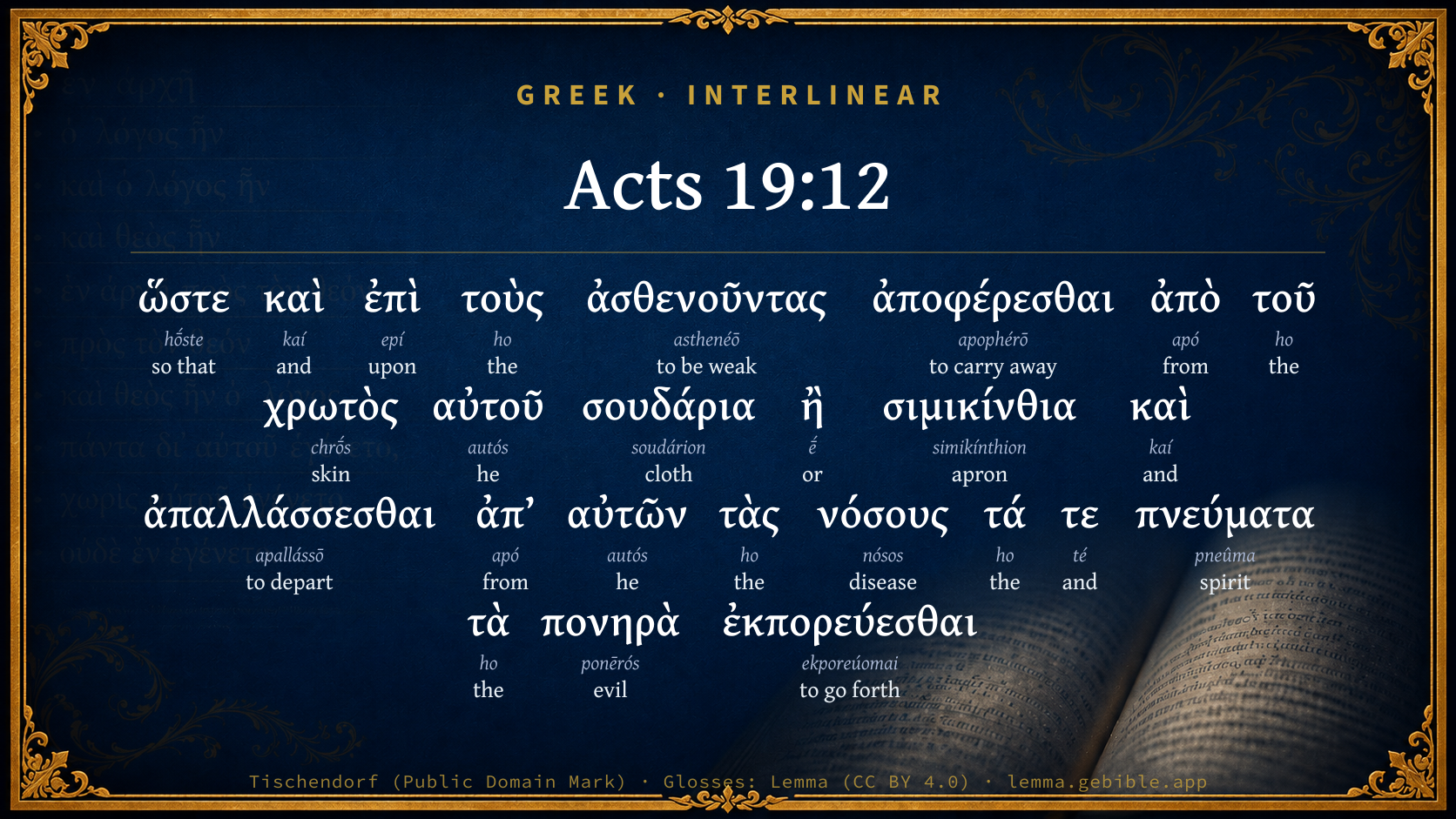
Download image
Cite this verse

Acts 19:12 (World English Bible). Public Domain. Lemma interlinear Bible study tool, https://lemma.gebible.app/v/acts/19/12.

Show BibTeX & RIS
BibTeX
RIS
English Translation
so that even handkerchiefs or aprons were carried away from his body to the sick, and the evil spirits went out.
World English Bible · Public Domain
Highlights
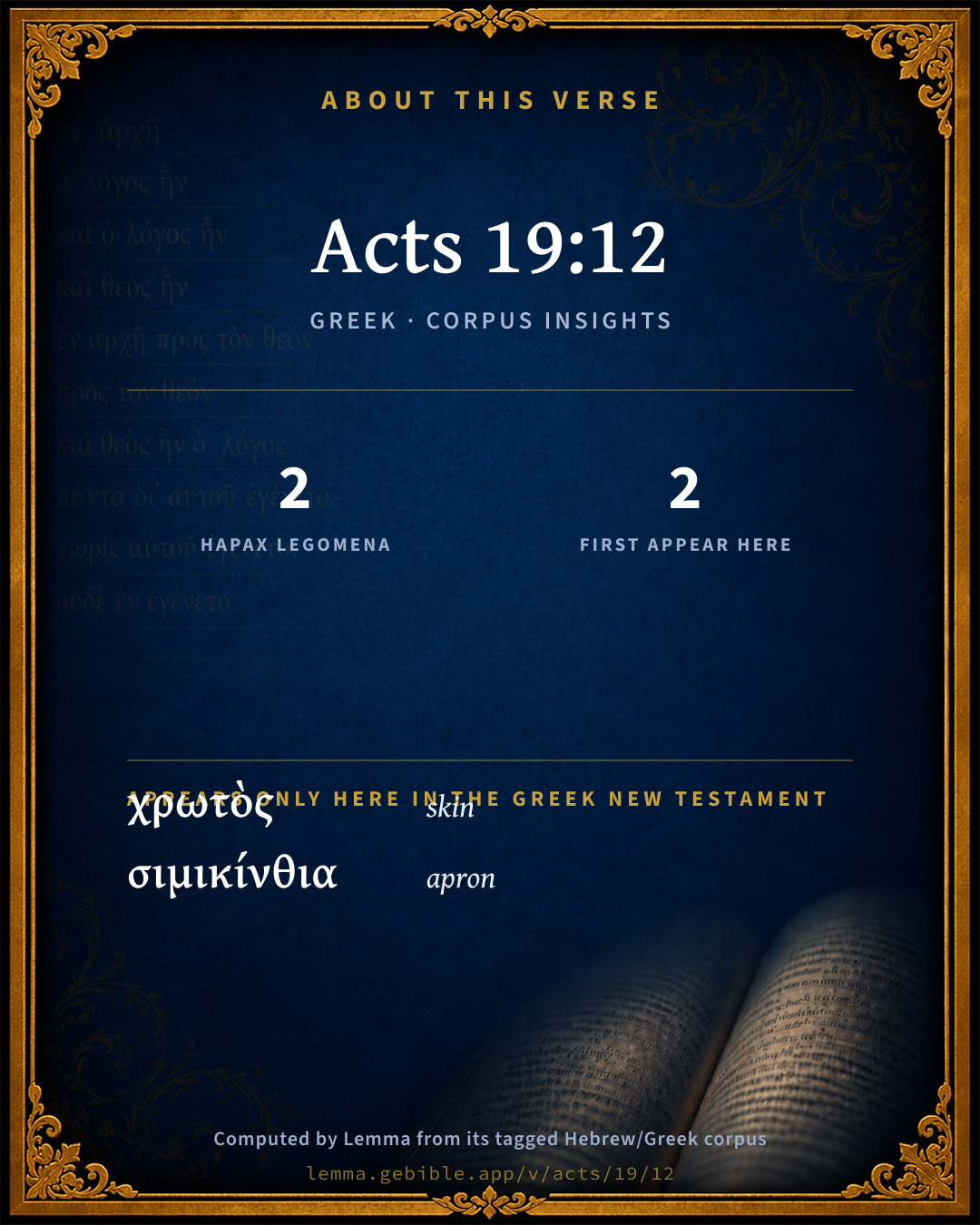
  • 2 hapax legomena — only here in the Greek New Testament
  • 2 first appearances in the Greek New Testament
Full analysis ↓
Download a study sheet

One document with this verse’s original text, its word-by-word gloss line, the meaning frame, cross-references with their text, attributed commentary, and full source and license credits — printable, and it pastes into notes with its structure intact.

This verse Autodidact and up

Study sheet (.html) Plain text (.txt)

A passage Seminary Student

Up to 50 verses in one chapter. A passage sheet keeps up to 6 commentary sources and 12 cross-references per verse, in the order this page ranks them, and says so on the sheet whenever that leaves anything out. Ask for a single verse and you get the Autodidact verse sheet above.

Everything on this page stays free to read, with no account — the sheet is a download of what is already on screen, not access to it.

Want to remove ads? Support Godless Engineer
Compare translations 3

The same verse in 3 English versions, stacked beneath the original-language interlinear above. Click any original word for its lexicon entry.

Each is an independent rendering of the whole verse — the interlinear is not word-aligned to these translations.

Highlighted words mark where these versions differ — a whole-verse word diff, not a word-by-word alignment.

  • World English Bible Public Domain
    so that even handkerchiefs or aprons were carried away from his body to the sick, and the evil spirits went out.
  • King James Version Public Domain
    So that from his body were brought unto the sick handkerchiefs or aprons, and the diseases departed from them, and the evil spirits went out of them.
  • unfoldingWord Literal Text CC BY-SA 4.0
    so that even handkerchiefs or aprons from his skin were taken to the sick and illnesses departed from them, and the evil spirits came out.

unfoldingWord Literal Text — © unfoldingWord, licensed CC BY-SA 4.0. Word-aligned USFM3 via Door43 (git.door43.org/unfoldingWord/en_ult).

Versions to compare (up to 4)

3 of 4 selected

Show all 19 translations

Every available English version of this verse, each an independent rendering of the whole verse.

  • World English Bible Public Domain
    so that even handkerchiefs or aprons were carried away from his body to the sick, and the evil spirits went out.
  • Berean Standard Bible Public Domain
    so that even handkerchiefs and aprons that had touched him were taken to the sick, and the diseases and evil spirits left them.
  • Majority Standard Bible Public Domain
    so that even handkerchiefs and aprons that had touched him were brought to the sick, and the diseases and evil spirits left them.
  • King James Version Public Domain
    So that from his body were brought unto the sick handkerchiefs or aprons, and the diseases departed from them, and the evil spirits went out of them.
  • American Standard Version (1901) Public Domain
    insomuch that unto the sick were carried away from his body handkerchiefs or aprons, and the evil spirits went out.
  • Revised Version (1885) Public Domain
    insomuch that unto the sick were carried away from his body handkerchiefs or aprons, and the diseases departed from them, and the evil spirits went out.
  • Geneva Bible (1599) Public Domain
    So that from his body were brought vnto the sicke, kerchefs or handkerchefs, and the diseases departed from them, and the euill spirits went out of them.
  • Douay-Rheims (1899) Public Domain
    So that even there were brought from his body to the sick, handkerchiefs and aprons, and the diseases departed from them, and the wicked spirits went out of them.
  • Young's Literal Translation Public Domain
    so that even unto the ailing were brought from his body handkerchiefs or aprons, and the sicknesses departed from them; the evil spirits also went forth from them.
  • Literal Standard Version CC BY-SA 4.0
    so that even to the ailing were brought from his body handkerchiefs or aprons, and the diseases departed from them; the evil spirits also went forth from them.
  • Unlocked Literal Bible CC BY-SA 4.0
    so that even handkerchiefs and aprons that had touched him were taken to the sick and their illnesses left them and the evil spirits came out of them.
  • unfoldingWord Literal Text CC BY-SA 4.0
    so that even handkerchiefs or aprons from his skin were taken to the sick and illnesses departed from them, and the evil spirits came out.
  • Darby Bible Public Domain
    so that even napkins or aprons were brought from his body [and put] upon the sick, and the diseases left them, and the wicked spirits went out.
  • World Messianic Bible Public Domain
    so that even handkerchiefs or aprons were carried away from his body to the sick, and the diseases departed from them, and the evil spirits went out.
  • Webster's Bible Public Domain
    So that from his body were brought to the sick, handkerchiefs, or aprons, and the diseases departed from them, and the evil spirits went out of them.
  • Free Bible Version CC BY-SA 4.0
    so much so that they took handkerchiefs or aprons Paul had touched to heal the sick and to drive out evil spirits.
  • Bible in Basic English Public Domain
    So that bits of linen and clothing from his body were taken to people who were ill, and their diseases went away from them and the evil spirits went out.
  • Text-Critical English NT CC BY 4.0
    so that even cloths or aprons that had touched his skin were placed upon the sick, and their diseases left them, and evil spirits came out of them.
  • Tyndale New Testament (1534) Public Domain
    so that from his body were brought vnto the sicke napkyns or partlettes and the diseases departed from the and the evyll spretes went out of them.

Literal Standard Version (2020), Covenant Press — licensed CC BY-SA 4.0. Text via the HelloAO Bible API (eBible.org). Unlocked Literal Bible (unfoldingWord) — licensed CC BY-SA 4.0. Text via the HelloAO Bible API (eBible.org). unfoldingWord Literal Text — © unfoldingWord, licensed CC BY-SA 4.0. Word-aligned USFM3 via Door43 (git.door43.org/unfoldingWord/en_ult). Free Bible Version, Dr. Jonathan Gallagher — licensed CC BY-SA 4.0. Text via the HelloAO Bible API (eBible.org).

Word by word

More ways to search: Search by grammar → Find every occurrence → Compare this word →

Practice this passage: Drill this verse → Learn its vocabulary →

χρωτὸς
chrṓs
G5559
“skin”
Noun, Genitive, Singular, Masculine
Part of Speech
Noun
Case
Genitive
Number
Singular
Gender
Masculine
Full Thayer's Definition

Origin: probably akin to the base of G5530 through the idea of handling

TDNT: None

1. the surface of the body, the skin
  1. ὥστε hṓste G5620 “so that” Conjunction
  2. καὶ kaí G2532 “and” Conjunction
  3. ἐπὶ epí G1909 “upon” Preposition
  4. τοὺς ho G3588 “the” Article, Accusative, Plural, Masculine
  5. ἀσθενοῦντας asthenéō G770 “to be weak” Verb, Present, Active, Participle, Accusative, Plural, Masculine
  6. ἀποφέρεσθαι apophérō G667 “to carry away” Verb, Present, Passive, Infinitive
  7. ἀπὸ apó G575 “from” Preposition
  8. τοῦ ho G3588 “the” Article, Genitive, Singular, Masculine
  9. αὐτοῦ autós G846 “he” Personal pronoun, Genitive, Singular, Masculine
  10. σουδάρια soudárion G4676 “cloth” Noun, Accusative, Plural, Neuter
  11. ἢ ḗ G2228 “or” Particle
  12. σιμικίνθια simikínthion G4612 “apron” Noun, Accusative, Plural, Neuter
  13. καὶ kaí G2532 “and” Conjunction
  14. ἀπαλλάσσεσθαι apallássō G525 “to depart” Verb, Present, Passive, Infinitive
  15. ἀπ’ apó G575 “from” Preposition
  16. αὐτῶν autós G846 “he” Personal pronoun, Genitive, Plural, Masculine
  17. τὰς ho G3588 “the” Article, Accusative, Plural, Feminine
  18. νόσους nósos G3554 “disease” Noun, Accusative, Plural, Feminine
  19. τά ho G3588 “the” Article, Accusative, Plural, Neuter
  20. τε té G5037 “and” Particle
  21. πνεύματα pneûma G4151 “spirit” Noun, Accusative, Plural, Neuter
  22. τὰ ho G3588 “the” Article, Accusative, Plural, Neuter
  23. πονηρὰ ponērós G4190 “evil” Adjective, Accusative, Plural, Neuter
  24. ἐκπορεύεσθαι ekporeúomai G1607 “to go forth” Verb, Present, Middle or Passive deponent, Infinitive

About this verse

These counts appear in no published source. They are computed here, from the morphology-tagged text and Lemma’s own curated glosses. What Lemma adds →

25
words
18
distinct lemmas
Acts
section

Notable vocabulary

2 hapax legomena — words that appear only here in the entire Greek New Testament:

  • χρωτὸς skin G5559
  • σιμικίνθια apron G4612

First appearance in Scripture

These words make their first canonical appearance in the Greek New Testament here:

  • χρωτὸς skin G5559
  • σιμικίνθια apron G4612

Shared distinctive vocabulary

ἀπαλλάσσεσθαι to depart G525 occurs in 3 verses of the Greek New Testament. Also found in:
Repetition

Words recur within this verse:

  • τοὺς the G3588 ×5
  • καὶ and G2532 ×2
  • ἀπὸ from G575 ×2
  • αὐτοῦ he G846 ×2

Cross-references

4

Topical passages linked to Acts 19:12 in the Treasury of Scripture Knowledge — connected by theme and wording, ordered by reader-vote popularity; previews shown in the World English Bible.

  • Acts 5:15 They even carried out the sick into the streets, and laid them on cots and mattresses, so that as Peter came by, at the least his shadow might overshadow some of them.
  • 2 Kings 13:20–21 Elisha died, and they buried him. Now the bands of the Moabites invaded the land at the coming in of the year.
  • Mark 16:17 These signs will accompany those who believe: in my name they will cast out demons; they will speak with new languages;
  • 2 Kings 4:29–31 Then he said to Gehazi, Gird up your loins, and take my staff in your hand, and go your way: if you meet any man, Don't greet him; and if anyone greets you, don't answer him again: and lay my staff on the face of the child.

Cross-references courtesy of OpenBible.info (CC BY 4.0).

Where the printed editions differ

2 variants

Places in this verse where the major printed Greek editions disagree on the wording in a way that affects the translation — a comparison of editions, not a manuscript-by-manuscript collation. The editions are the modern critical texts (Nestlé-Aland 28/27, SBL, Westcott-Hort, Tregelles, Tyndale House) and the traditional texts behind the KJV (the Textus Receptus and the Byzantine/Majority text). It is not a claim about which reading is original.

  1. Different wording
    ἀποφέρεσθαι

    “carrying”

    In NA28NA27TynSBLWHTregKJV Not in TRByz

    ἐπιφέρεσθαι (epipheresthai) 'applying' occurs in a few manuscripts (TR+Byz) instead of ἀποφέρεσθαι (apopheresthai) 'carrying' in older manuscripts (NA28+NA27+Tyn+SBL+WH+Treg+KJV)

  2. Extra text
    αὐτῶν.

    “of them.”

    In TRByz Not in NA28NA27TynSBLWHTreg

    αὐτῶν.¶ (autōn) 'of them.' is only in traditional manuscripts (TR+Byz)

Textual data: Translators Amalgamated Greek New Testament (STEPBible TAGNT) · CC BY 4.0.

Commentary

Notes on Acts 19:12 from classic Christian and Jewish commentators (each source and its license shown beneath its notes). The classic Christian expositions comment on the surrounding passage and are grouped to its opening verse, so a note may address several verses; the Jewish commentaries on the Tanakh (Rashi and others) are per-verse, so they appear only where the commentator wrote on this verse.

Lemma curates 59 commentaries, every one of them public domain or Creative Commons licensed, each selected and text-cleaned for this edition rather than reprinted as found. About our sources →

Bengel's Gnomon

Johann Albrecht Bengel

Act 19:12. Χρωτὸς, from his body) χρὼς, the skin, the outermost part of the body. Here evidently (his) miraculous power reached its highest point.—σιμικίνθια, semi-girdles, narrow aprons) with which they used formerly to be girded.—ἀπʼ αὐτῶν, from them) We read of evil spirits having often excited (caused) a disease, which might seem to be due to natural causes.

Bengel's Gnomon of the New Testament — English translation (T&T Clark, Edinburgh, 1860) — public domain. Text from a community e-Sword module.

Expositor's Greek Testament

ed. W. Robertson Nicoll

Act 19:12 . ὥστε καὶ : so that even to the sick, i.e. , to those who could not be reached by the hands of the Apostle. χρωτὸς : the σουδ . and σιμικ . had been in contact with the body of the Apostle, and thence derived their healing power; so in LXX used for both בָּשָׂר , and עוֹר (twice), see Hatch and Redpath; Zahn, Einleitung , ii., 435, sees in its use here the use of a medical term, so Hobart, p. 242. σουδάρια : Latin, sudaria , used for wiping off sweat, as the noun indicates, cf. Luk 19:20 , Joh 11:44 ; Joh 20:7 . σιμικίνθια : Latin, semicinctium , only here in N.T., aprons worn by artisans at their work, cf. Martial, xiv., 153. Oecumenius and Theophylact apparently regarded the word as simply = handkerchiefs , but the meaning given is far more likely both from the etymology of the word and its use in Martial. For other Latinisms see Blass, in loco , and Wetstein. ἀπαλ . ἀπʼ αὐτῶν , cf. Luk 12:58 , Heb 2:15 , here in connection with sickness, and this use is very frequent in medical writers, Hobart, p. 47; the word is found with ἀπὸ both in classical writers and in the LXX. It should also be noted that here as elsewhere St. Luke distinguishes between natural diseases and the diseases of the demonised, and that he does so more frequently than the other Evangelists, Hobart, pp. 12, 13, so “Demon,” Hastings’ B.D., i., p. 593, cf. especially Luk 6:17 ; Luk 8:2 ; Luk 13:32 , which have no parallels in the other Gospels. πονηρὰ : is applied to evil spirits by St. Luke three times in his Gospel and four times in this passage, and only once elsewhere, St.Mat 12:45 , although the word is very frequent in St. Matthew’s Gospel and in the Epistles; the word was constantly used by medical writers in connection with disease, Hobart, u. s. Blass quotes as a parallel to the present passage εἰ αἱ νόσοι ἀπαλλαγείησαν ἐκ τῶν σωμάτων (Plat.) Eryx , 401 c. τά τε πνεύματα … Were the aprons brought for the healing of the diseases and the banishing of the demons equally? The τε seems to indicate that this was the case (Weiss, Wendt); Blass on the other hand holds that it is not said that the demons were driven out by the sudaria . According to some interpretations of the verse the carrying of the aprons to the sick is only to be regarded as a result of the wonderful impression made by St. Paul’s miraculous power; the writer says nothing of the effect of these aprons, although he places both the healing of the diseases and the expulsion of the demons amongst the δυνάμεις of St. Paul. From this point of view the carrying of the σουδάρια would only illustrate the superstitious practices which showed how often, in the homes of culture, quackery was also found, and the Evangelist gives them no word of commendation, see also note on Act 19:15 . On the other hand we must remember that the miracles are distinctly spoken of as οὐ τὰς τυχ ., and even in the means employed we may perhaps see a possible appeal to the populace, who would recognise that these charms and amulets in which they put such confidence had not the same potency as the handkerchiefs and aprons of the Apostle. But in this accommodation to special forms of ignorance we are never allowed to forget that God is the source of all power and might.

The Expositor's Greek Testament, edited by W. Robertson Nicoll (1897–1910) — public domain. Text from a community e-Sword module.

Jamieson, Fausset & Brown

Robert Jamieson, A. R. Fausset & David Brown

So that from his body were brought unto the sick handkerchiefs or aprons, &c.--Compare Act 5:15-16, very different from the magical acts practiced at Ephesus. "God wrought these miracles" merely "by the hands of Paul"; and the very exorcists (Act 19:13), observing that the name of Jesus was the secret of all his miracles, hoped, by aping him in this, to be equally successful; while the result of all in the "magnifying of the Lord Jesus" (Act 19:17) showed that in working them the apostle took care to hold up Him whom he preached as the source of all the miracles which he wrought.

Jamieson, Fausset & Brown — Commentary Critical and Explanatory on the Whole Bible (1871) — public domain (CC PDM 1.0). Text via the HelloAO Bible API.

Adam Clarke's Commentary

Verse 12. Handkerchiefs or aprons] Σουδαρια η σιμικινθια, Probably the sudaria were a sort of handkerchiefs, which, in travelling, were always carried in the hand, for the convenience of wiping the face; and the simikinthia were either the sashes or girdles that went about the loins. These, borrowed from the apostle, and applied to the bodies of the diseased, became the means, in the hand of God, of their restoration to health.

The diseases departed from them, and the evil spirits went out of them.] Here, there is a most evident distinction made between the diseases and the evil spirits: hence they were not one and the same thing.

Adam Clarke's Commentary on the Bible (1810–1826) — public domain. Text from a community e-Sword/MySword module.

Ellicott's Commentary for English Readers

(12) So that from his body were brought unto the sick handkerchiefs or aprons.—Both words are, in the original, transliterated from the Latin, the former being sudaria, used to wipe off sweat from brow or face; the latter semicincta, the short aprons worn by artisans as they worked. We ask how St. Luke, passing over two years of labour in a few words, came to dwell so fully on these special facts. The answer may be found (1) in St. Luke’s own habit of mind as a physician, which would lead him to dwell on the various phenomena presented by the supernatural gift of healing; (2) a further explanation may be found in the inference suggested in the Note on Act_19:9. Such a report of special and extraordinary phenomena was likely enough to be made by a physician like Tyrannus to one of the same calling, and probably of the same faith. The picture suggested is that of devout persons coming to the Apostle as he laboured at his craft, and carrying away with them the very handkerchiefs and aprons that he had used, as precious relics that conveyed the supernatural gift of healing which he exercised. The efficacy of such media stands obviously on the same footing as that of the hem of our Lord’s garment (see Note on Mat_9:20-21), and the shadow of Peter (see Note on Act_5:15), and, we may add, of the clay in the healing of the blind (see Note on Joh_9:6). The two conditions of the supernatural work of healing were a Divine Power on the one hand, and Faith on the other, and any external medium might serve to strengthen the latter and bring it into contact with the former. Cures more or less analogous, ascribed to the relics of saints, admit, in some measure, of a like explanation. Without pretending to draw a sharp line of demarcation between the natural and supernatural in such cases, it is clear that a strong belief in the possibility of a healing work as likely, or certain, to be accompanied by any special agent, does much to stimulate the activity of the vis medicatrix Naturæ which before was passive and inert. It is not unreasonable to see in the works of healing so wrought a special adaptation to the antecedent habits of mind of a population like that of Ephesus. It was something for them to learn that the prayer of faith and the handkerchief that had touched the Apostle’s skin had a greater power to heal than the charms in which they had previously trusted.

A Bible Commentary for English Readers, edited by Charles John Ellicott (1878–1897) — public domain. Text from a community e-Sword module.

The Cambridge Bible for Schools and Colleges

gen. ed. J. J. S. Perowne

12. so that from his body were brought unto the sick] In the oldest MSS. the verb signifies “to be carried away from.” The Rev. Version brings out the meaning fully, and in a verse like this it is well to keep, as much as may be, the Greek order of the words. Read “Insomuch that unto the sick were carried away from his body.” St Luke is careful to intimate that the Apostle did not of himself adopt or recommend these methods, but the faith of the converts was such that it manifested itself in this way, and God was pleased to bestow blessings because of their faith. In the city of Ephesus where, as we find from this chapter, exorcism and “curious arts” of witchcraft and incantation were familiarly exercised, God appears to have made the cures that were wrought to be specially evidences of the power of faith. Paul does not go to the sick, and even the sons of Sceva (Act_19:13) recognise that it is not to Paul, but to Jesus whom he preacheth, that the “powers” are to be ascribed. Thus was God’s minister made to differ from the pretenders to miraculous power with which the Ephesian people were familiar. A specimen of these may be seen in the life of Apollonius of Tyana, iv. 3 (Kayser, p. 66).

handkerchiefs or aprons] Some take the latter word to signify the cincture, by which the loose robes of the Orientals were gathered together round the waist. This would be expressed by “belts” or “girdles.” Others think they were the aprons used by the Apostle while working at his trade. The derivation of the word favours the latter sense. They seem to have been employed to cover the front half of the dress during work.

and the diseases departed from them, and the evil spirits went out of them] The oldest texts omit the last two words. These converts acted on the popular belief, that virtue proceeded from the bodies of our Lord and His Apostles. St Luke notices this belief in his Gospel (Luk_8:44) and St Mark says of Jesus (Mar_5:30) “perceiving in himself that the power proceeding from him had gone forth.” The words of Scripture can hardly be made to countenance, though they recognise, the popular belief. Yet, even though these men employed means which were unnecessary and superstitious to display their faith, because of the reality of this faith God did not suffer it to lose its reward.

The Cambridge Bible for Schools and Colleges (gen. ed. J. J. S. Perowne; Cambridge University Press, 1878–1918) — public domain. Text from a community e-Sword module.

John Gill's Exposition

And there were seven sons of one Sceva a Jew,.... Who strolled about the country, and used exorcisms: and

chief of the priests; that were at Ephesus; not the high priest of the Jews, for he would have been at Jerusalem, and not at Ephesus; though indeed it does not necessarily follow from the words, that Sceva himself was there, only his seven sons: however, no such name appears in the catalogue of the Jewish high priests, nor is it reasonable to think, that seven sons of an high priest should follow such a vagabond course of life: Beza's ancient copy only calls him "a priest"; and the Alexandrian copy reads his name, Sceuta, and the Ethiopic version omits it; it is the same with and signifies a spectator, or observer; see the Targum on Sa2 13:34.

which did so; adjured the devils in the name of Jesus, to come out; at least they did so in one case, as follows.

John Gill's Exposition of the Whole Bible (1746–1763) — public domain (CC PDM 1.0). Text via the HelloAO Bible API.

Trapp's Complete Commentary

John Trapp

12 So that from his body were brought unto the sick handkerchiefs or aprons, and the diseases departed from them, and the evil spirits went out of them.

Ver. 12. Handkerchiefs or aprons] Which having been touched by Paul’s body, became sovereign (by a miracle) to cure diseases and cast out devils.

John Trapp, A Commentary or Exposition upon All the Books of the Old and New Testament (1647–1656) — public domain. Text from a community e-Sword module.

Albert Barnes' Notes on the Bible

So that from his body - That is, those handkerchiefs which had been applied to his body, which he had used, or which he had touched. An instance somewhat similar to this occurs in the case of the woman who was healed by touching the hem of the Saviour’s garment, Mat 9:20-22.Unto the sick - The sick who were at a distance, and who were unable to go where he was. If it be asked why this was done, it may be observed:

(1) That the working of miracles in that region would greatly contribute to the spread of the gospel.

(2) We are not to suppose that there was any efficacy in the aprons thus brought, or in the mere fact that they had touched the body of Paul, anymore than there was in the hem of the Saviour’s garment which the woman touched, or in the clay which he made use of to open the eyes of the blind man, Joh 8:6.

(3) In this instance, the fact that the miracles were performed in this manner by garments which had touched his body, was a mere sign, or an evidence to the persons concerned, that it was done by the instrumentality of Paul, as the fact that the Saviour put his fingers into the ears of a deaf man, and spit and touched his tongue Mar 7:33, was an evidence to those who saw it that the power of healing came from him. The bearing of these aprons to the sick was, therefore, merely evidence to all concerned that miraculous power was given to Paul.

Handkerchiefs - The word used here σουδάρια soudaria is of Latin origin, and properly denotes “a piece of linen” with which sweat was wiped from the face; and then “any piece of linen used for tying up or containing anything.” In Luk 19:20, it denotes the “napkin” in which the talent of the unprofitable servant was concealed; in Joh 11:44; Joh 20:7, the “napkin” which was used to bind up the face of the dead applied to Lazarus and to our Saviour.

Or aprons - σιμικίνθια simikinthia. This is also Latin word, and means literally a half girdle, or covering half the person a piece of cloth which was girded round the waist to preserve the clothes of those who were engaged in any kind of work. The word “aprons” expresses the idea.

And the diseases departed - The sick were healed.

And the evil spirits - See the notes on Mat 4:24. It is evident that this power of working miracles would contribute greatly to Paul’s success among the people.

Albert Barnes' Notes on the Bible (1834–1885) — public domain. Text from a community e-Sword/MySword module.

Haydock's Catholic Bible Commentary

Aprons. It is likely such as he used in working, cured diseases, and cast out devils. What wonder, then, if God work miracles by the relics of martyrs and saints, to testify the sanctity of his servants, and to encourage others both to give them a reasonable honour, and to imitate their lives? (Witham) --- Thus was fulfilled the promise which Christ had made his disciples, viz. that they should perform greater miracles than he himself had done. St. John Chrysostom repeats more than once, that these clothes raised the dead, and that the apostles’ shadow chased away all maladies, and triumphed over death. Perhaps the unprejudiced reader may observe in this verse some reason for paying due regard to the relics, or whatever has belonged to the saints.

George Leo Haydock (1774–1849), Haydock's Catholic Family Bible and Commentary, 1859 edition — public domain. Excludes Psalms (Douay-Rheims chapter numbering differs from Protestant) and Deuterocanonical books (Catholic canon only).

Matthew Poole's English Annotations

Handkerchiefs or aprons; our habit and attire being so different from what was used so long since, it cannot but occasion some variety in rendering these words; which some think to signify two things; and some, but one and the same part of their clothes or dress: the words are both originally, Latin; the former so called from its use to wipe away sweat; the other, from its being usually tied about such as wore it.

The diseases departed from them; God by such small and unlikely means wrought these miracles:

1. That the power of Christ (whom Paul preached) might the more clearly appear. And:

2. That such as were absent might have a high value for Christ and the gospel, though they had never seen Paul, or heard him preach. Such extraordinary works were also wrought by God to magnify the words preached by Peter, Act 5:15, as our Saviour had foretold and promised, Joh 14:12.

Matthew Poole's English Annotations on the Holy Bible (1683–1685) — public domain. Text from a community e-Sword/MySword module.

Whedon's Commentary on the Bible

Daniel D. Whedon

12. Handkerchiefs or aprons—While Paul is the great preacher in the desk of Tyrannus, he is also the humble mechanic in the shop of some tent-maker. Hence these, his handkerchiefs, were the sudaria, the sweat-clothes, with which literally he had wiped the perspiration from his face. And these aprons were the semi-cincta, the ordinary overalls, bound upon the front of his person, so as to protect it from the dirt of his labour. (See note on Act_8:24.)

While earnestly engaged in founding a Church in Ephesus, Paul was not permitted to forget his already established Churches. Some disorders in the Church of Corinth obliged him, in deep sorrow, to pay a brief visit across the AEgean, and administer tender reproof and correction. Yet he left the offenders with a solemn warning, (as he himself tells us, 2Co_13:2,) “If I come again I will not spare.” On his return, across the same AEgean, to Ephesus, he wrote a brief letter, (previous to his two great Corinthian epistles,) which has not been preserved, enforcing his rebukes, and requiring them to separate wholly from fornicators. To this lost letter he alludes, 1Co_5:9-12.

Daniel D. Whedon (gen. ed.), Commentary on the Old and New Testaments (1874–1909) — public domain. Text from a community e-Sword module.

The Pulpit Commentary

Insomuch for so, A.V.; unto the sick were carried away from his body for from his body were brought unto the sick, A.V.; went out for went out of them, A.V. and T.R. From his body (crwtov); literally, the skin, but used here by St. Luke for the body, in accordance with the usage of medical writers "from Hippocrates to Galen" (Hobart). Handkerchiefs; soudarion, the Latin word sudarium, properly a cloth for wiping off the sweat. It is one of those words, like koustwdia kenturiwn shmikinqion, kodranthv, etc., which exactly represent the political condition of things at the time of the writers, who were living in a country where Greek was the language of common intercourse, but where the dominion was Roman. It is found in Luk_19:20; nqia, Joh_11:44 Joh_20:7, and here. Aprons; simiki more properly written shmikinqia. It is the Latin word semicinctium, a half-girdle; the Greek word is hJmizwnion. According to some, it was a narrow girdle, but according to others, and with more probability, an apron covering only half, i.e. the front of the body. It only occurs here in the New Testament or elsewhere. The careful mention of these cures of the sick may also be connected with St. Luke"s medical profession. As regards these unusual modes of miraculous cure, Act_5:15. It might well be the Divine purpose, in the ease of both Peter and Paul, to invest with such extraordinary power the very persons of the apostles who were to stand forth as his messengers and preach in his Name. In St. Paul this parity of miraculous energy stamped his apostleship with an authority equal to that of St. Peter.

The Pulpit Commentary (1880–1919), ed. H.D.M. Spence-Jones & Joseph S. Exell — public domain. Text from a community e-Sword module.

John Wesley's Explanatory Notes

Evil spirits - Who also occasioned many of those diseases, which yet might appear to be purely natural.

John Wesley, Explanatory Notes Upon the Whole Bible (1754–1765) — public domain. Text via the GEBible commentary corpus.

McGarvey & Pendleton's Commentaries

J. W. McGarvey

See notes on verse 8

J. W. McGarvey (with Philip Y. Pendleton), Commentaries on the New Testament (The Fourfold Gospel, 1914; Acts; and the epistles) — public domain. Text from a community e-Sword/MySword module.

Cambridge Greek Testament for Schools and Colleges

12. ἐκπορεύεσθαι for ἐξέρχεσαι ἀπ’ αὐτῶν with אABDE. Vulg. has ‘egrediebantur’ only.

12. ὥστε καὶ … ἀποφέρεσθαι ἀπὸ χρωτὸς αὐτοῦ, so that from his body there were carried away unto the sick. St Luke is careful to intimate that the Apostle did not of himself adopt or recommend these methods, but the faith of the converts was such that it manifested itself in this way, and God was pleased to bestow blessings because of their faith. In the city of Ephesus where, as we find from this chapter, exorcism and ‘curious arts’ of witchcraft and incantation were familiarly exercised, God appears to have made the cures that were wrought to be specially evidences of the power of faith. Paul does not go to the sick, and even the sons of Sceva (Act 19:13) recognise that it is not to Paul, but to Jesus whom he preacheth, that the ‘powers’ are to be ascribed. Thus was God’s minister made to differ from the pretenders to miraculous power with which the Ephesian people were familiar. A specimen of these may be seen in the life of Apollonius of Tyana, IV. 3 (Kayser, p. 66).

σουδάρια ἢ σιμικίνθια, handkerchiefs or aprons. Some take the latter word to signify the cincture, by which the loose robes of the Orientals were gathered together round the waist. This would be expressed by ‘belts’ or ‘girdles’. Others think they were the aprons used by the Apostle while working at his trade. The derivation of the word favours the latter sense. They seem to have been employed to cover the front half of the dress during work.

The words are both Latin, sudarium and semicinctium, and the latter is sometimes written σημικίνθιον.

καὶ ἀπαλλάσσεσθαι ἀπ’ αὐτῶν … ἐκπορεύεσθαι, and the diseases departed from them and the evil spirits went away. These converts acted on the popular belief, that virtue proceeded from the bodies of our Lord and His Apostles. St Luke notices this belief in his Gospel (Luk 8:44), and St Mark says of Jesus (Mar 5:30) ‘perceiving in Himself that the power proceeding from Him had gone forth.’ The words of Scripture can hardly be made to countenance, though they recognise, the popular belief. Yet, even though these men employed means which were unnecessary and superstitious to display their faith, because of the reality of this faith God did not suffer it to lose its reward.

Cambridge Greek Testament for Schools and Colleges (Cambridge University Press, 1896; 21 vols, various authors incl. Carr, Maclear, Plummer, Farrar, Lumby, Moule, M. R. James, Simcox) — public domain. Text from a community e-Sword module.

Alford’s Greek Testament

Henry Alford

12.] The rec. reading, ἐπιφέρεσθαι, may have been occasioned by the ἐπί preceding: the other, again, by the ἀπό following: in such uncertainty the reading of the ancient mss. must prevail.

σουδ.] handkerchiefs: see ref. Luke, and notes there.

σιμικ.] not napkins, but semicinctia, aprons, such as servants and artisans use. ἀμφότερα λινοειδῆ εἰσι, Schol.

Diseases, and possession by evil spirits, are here plainly distinguished from each other. The rationalists, and semi-rationalists, are much troubled to reconcile the fact related, that such handkerchiefs and aprons were instrumental in working the cures, with what they are pleased to call a popular notion founded in superstition and error. But in this and similar narratives (see ch. 5:15, note) Christian faith finds no difficulty whatever. All miraculous working is an exertion of the direct power of the All-powerful; a suspension by Him of His ordinary laws: and whether He will use any instrument in doing this, or what instrument, must depend altogether on His own purpose in the miracle—the effect to be produced on the recipients, beholders, or hearers. Without His special selection and enabling, all instruments were vain; with these, all are capable. In the present case, as before in ch. 5:15, it was His purpose to exalt His Apostle as the Herald of His gospel, and to lay in Ephesus the strong foundation of His church. And He therefore endues him with this extraordinary power. (Wordsw. sees an especial fitness in this having occurred at Ephesus (see on ver. 19), and refers to God having shewed in Egypt that His power was greater than that of Satan working by magicians: and it may well have been so.)

But to argue by analogy from such a case,—to suppose that because our Lord was able, and Peter, and Paul, and in O. T. times Elisha, were enabled, to exert this peculiar power, therefore the same will be possessed by the body or relics of every real or supposed saint, is the height of folly and fanaticism. The true analogy tends directly the other way. In no cases but these do we find the power, even in the apostolic days: and the general cessation of all extraordinary gifts of the Spirit would lead us to the inference that à fortiori these, which were even then the rarest (οὐχ αἱ τυχοῦσαι), have ceased also.

Henry Alford, The Greek Testament (1849–1861) — public domain. Text from a community e-Sword module.

Vincent's Word Studies in the New Testament

Marvin R. Vincent

Body [χρωτος] . Properly, the surface of the body, the skin; but, in medical language, of the body.

Handkerchiefs [σουδαρια] . See on Luk 19:20.

Aprons [σιμικινθια] . Only here in New Testament. A Latin word, semicinctia. Lit., something passing half - way round the body : an apron or waistband. Perhaps garments worn by Paul when engaged at his trade.

Marvin R. Vincent, Word Studies in the New Testament (1887–1900) — public domain. Text from a community e-Sword/MySword module.

Lesson kit

Teaching starters — assembled from the data on this page, not authored interpretation. Every prompt links to the verse data it draws on. Edit before teaching.

Acts, in the Acts, opens this verse with 25 words (18 distinct Greek lemmas). Its most distinctive word is chrṓs (“skin”). A historical commentator’s framing appears above. Read the whole chapter for the surrounding context.

Discussion questions

  1. The word chrṓs carries the sense “skin.” How does it shape the verse?
  2. This verse holds 2 words here found nowhere else in the Greek New Testament. What might the rare words draw attention to?
  3. 2 words here appear for the first time in Scripture. What is being introduced at this debut?
  4. Luke 12:58 shares the word «to depart» with this verse. How do the two illuminate each other?
  5. “the” occurs 5× in this one verse. What is the effect of the repetition?
  6. These translations render this verse differently. What is at stake in choosing one wording over another?
  7. Reading how Bengel's Gnomon and Expositor's Greek Testament read this verse, where do the two commentators agree and where do they part?

Things to notice

  • 2 words in this verse appear nowhere else in the Greek New Testament.
  • 2 words make their first canonical appearance in Scripture here.
  • These translations choose different wording for 12 words in this verse.
  • “the” occurs 5× in this single verse.
  • 18 distinct Greek lemmas span 25 words in this verse.

Reading settings

Reading text

Shown beneath each verse's original-language words.

Old Testament
Old Testament edition

Read the OT as the Masoretic Hebrew (MT) or the Greek Septuagint (LXX).

English shown for the Greek Septuagint (in the Hebrew ↔ Greek comparison).

Comparing translations? Open the Compare panel on any verse page to stack up to four side by side.