
Acts 18:25

Greek (Tischendorf 8th ed.) Acts 18:25 appears in the Greek New Testament. The text above is from the Tischendorf 8th edition. Each word links to its Strong’s number and a concise gloss. Click any word for its full Thayer’s Greek Lexicon entry.
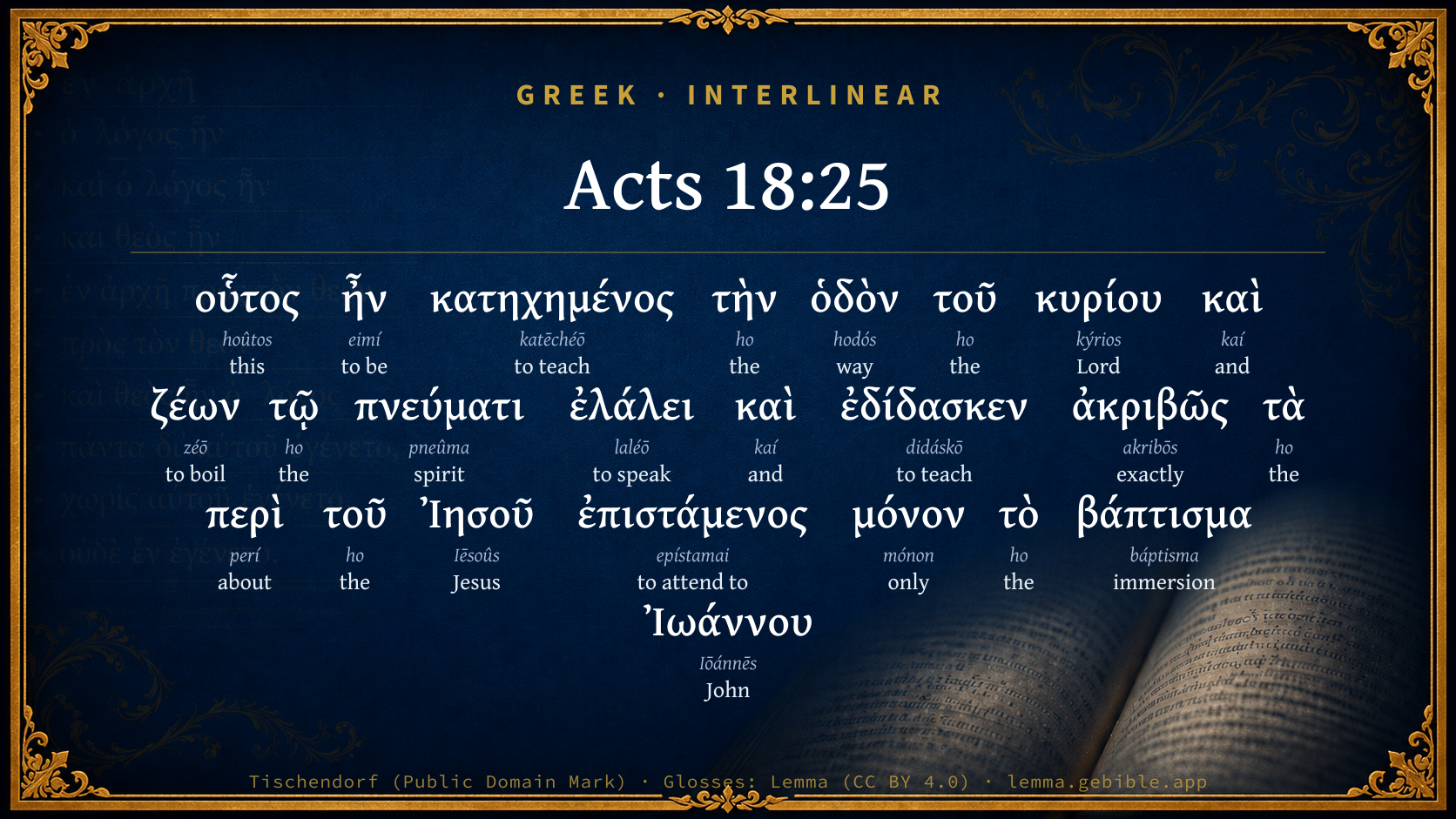
Download image
Cite this verse

Acts 18:25 (World English Bible). Public Domain. Lemma interlinear Bible study tool, https://lemma.gebible.app/v/acts/18/25.

Show BibTeX & RIS
BibTeX
RIS
English Translation
This man had been instructed in the way of the Lord; and being fervent in spirit, he spoke and taught accurately the things concerning Jesus, although he knew only the baptism of John.
World English Bible · Public Domain
Highlights
  • 1 first appearance in the Greek New Testament
Full analysis ↓
Download a study sheet

One document with this verse’s original text, its word-by-word gloss line, the meaning frame, cross-references with their text, attributed commentary, and full source and license credits — printable, and it pastes into notes with its structure intact.

This verse Autodidact and up

Study sheet (.html) Plain text (.txt)

A passage Seminary Student

Up to 50 verses in one chapter. A passage sheet keeps up to 6 commentary sources and 12 cross-references per verse, in the order this page ranks them, and says so on the sheet whenever that leaves anything out. Ask for a single verse and you get the Autodidact verse sheet above.

Everything on this page stays free to read, with no account — the sheet is a download of what is already on screen, not access to it.

Want to remove ads? Support Godless Engineer
Compare translations 3

The same verse in 3 English versions, stacked beneath the original-language interlinear above. Click any original word for its lexicon entry.

Each is an independent rendering of the whole verse — the interlinear is not word-aligned to these translations.

Highlighted words mark where these versions differ — a whole-verse word diff, not a word-by-word alignment.

  • World English Bible Public Domain
    This man had been instructed in the way of the Lord; and being fervent in spirit, he spoke and taught accurately the things concerning Jesus, although he knew only the baptism of John.
  • King James Version Public Domain
    This man was instructed in the way of the Lord; and being fervent in the spirit, he spake and taught diligently the things of the Lord, knowing only the baptism of John.
  • unfoldingWord Literal Text CC BY-SA 4.0
    He had been taught the way of the Lord, and being fervent in spirit, he was speaking and teaching accurately the things concerning Jesus, knowing only the baptism of John.

unfoldingWord Literal Text — © unfoldingWord, licensed CC BY-SA 4.0. Word-aligned USFM3 via Door43 (git.door43.org/unfoldingWord/en_ult).

Versions to compare (up to 4)

3 of 4 selected

Show all 19 translations

Every available English version of this verse, each an independent rendering of the whole verse.

  • World English Bible Public Domain
    This man had been instructed in the way of the Lord; and being fervent in spirit, he spoke and taught accurately the things concerning Jesus, although he knew only the baptism of John.
  • Berean Standard Bible Public Domain
    He had been instructed in the way of the Lord and was fervent in spirit. He spoke and taught accurately about Jesus, though he knew only the baptism of John.
  • Majority Standard Bible Public Domain
    He had been instructed in the way of the Lord and was fervent in spirit. He spoke and taught accurately about the Lord, though he knew only the baptism of John.
  • King James Version Public Domain
    This man was instructed in the way of the Lord; and being fervent in the spirit, he spake and taught diligently the things of the Lord, knowing only the baptism of John.
  • American Standard Version (1901) Public Domain
    This man had been instructed in the way of the Lord; and being fervent in spirit, he spake and taught accurately the things concerning Jesus, knowing only the baptism of John:
  • Revised Version (1885) Public Domain
    This man had been instructed in the way of the Lord; and being fervent in spirit, he spake and taught carefully the things concerning Jesus, knowing only the baptism of John:
  • Geneva Bible (1599) Public Domain
    The same was instructed in the way of the Lord, and hee spake feruently in the Spirite, and taught diligently the things of the Lord, and knew but the baptisme of Iohn onely.
  • Douay-Rheims (1899) Public Domain
    This man was instructed in the way of the Lord; and being fervent in spirit, spoke, and taught diligently the things that are of Jesus, knowing only the baptism of John.
  • Young's Literal Translation Public Domain
    this one was instructed in the way of the Lord, and being fervent in the Spirit, was speaking and teaching exactly the things about the Lord, knowing only the baptism of John;
  • Literal Standard Version CC BY-SA 4.0
    this one was instructed in the way of the LORD, and being fervent in the Spirit, was speaking and teaching exactly the things about the LORD, knowing only the immersion of John;
  • Unlocked Literal Bible CC BY-SA 4.0
    Apollos had been instructed in the teachings of the Lord. Being fervent in spirit, he spoke and taught accurately the things concerning Jesus, but he knew only the baptism of John.
  • unfoldingWord Literal Text CC BY-SA 4.0
    He had been taught the way of the Lord, and being fervent in spirit, he was speaking and teaching accurately the things concerning Jesus, knowing only the baptism of John.
  • Darby Bible Public Domain
    He was instructed in the way of the Lord, and being fervent in his spirit, he spoke and taught exactly the things concerning Jesus, knowing only the baptism of John.
  • World Messianic Bible Public Domain
    This man had been instructed in the way of the Lord; and being fervent in spirit, he spoke and taught accurately the things concerning Yeshua, although he knew only the immersion of Yochanan.
  • Webster's Bible Public Domain
    This man was instructed in the way of the Lord: and being fervent in the spirit, he spoke and taught diligently the things of the Lord, knowing only the baptism of John.
  • Free Bible Version CC BY-SA 4.0
    He had been taught the way of the Lord. He was spiritually passionate, and in his speaking and teaching he presented Jesus accurately, but he only knew about John's baptism.
  • Bible in Basic English Public Domain
    This man had been trained in the way of the Lord; and burning in spirit, he gave himself up to teaching the facts about Jesus, though he had knowledge only of John's baptism:
  • Text-Critical English NT CC BY 4.0
    He had been instructed in the way of the Lord. Being fervent in spirit, he spoke and accurately taught the facts about the Lord, though he knew only about the baptism of John.
  • Tyndale New Testament (1534) Public Domain
    The same was informed in the waye of the Lorde and he spake fervently in the sprete and taught diligently the thinges of the Lorde and knewe but the baptism of Iohn only.

Literal Standard Version (2020), Covenant Press — licensed CC BY-SA 4.0. Text via the HelloAO Bible API (eBible.org). Unlocked Literal Bible (unfoldingWord) — licensed CC BY-SA 4.0. Text via the HelloAO Bible API (eBible.org). unfoldingWord Literal Text — © unfoldingWord, licensed CC BY-SA 4.0. Word-aligned USFM3 via Door43 (git.door43.org/unfoldingWord/en_ult). Free Bible Version, Dr. Jonathan Gallagher — licensed CC BY-SA 4.0. Text via the HelloAO Bible API (eBible.org).

Word by word

More ways to search: Search by grammar → Find every occurrence → Compare this word →

Practice this passage: Drill this verse → Learn its vocabulary →

ζέων
zéō
G2204
“to boil”
Verb, Present, Active, Participle, Nominative, Singular, Masculine
Part of Speech
Verb
Tense
Present
Voice
Active
Mood
Participle
Case
Nominative
Number
Singular
Gender
Masculine
Full Thayer's Definition

Origin: a primary verb

TDNT: 16:35,3

1. to boil with heat, be hot a. used of water b. metaph. 1. used of boiling anger, love, zeal, for what is good or bad etc. 2. fervent in spirit, said of zeal for what is good
  1. οὗτος hoûtos G3778 “this” Demonstrative pronoun, Nominative, Singular, Masculine
  2. ἦν eimí G1510 “to be” Verb, Imperfect, Active, Indicative, 3rd person, Singular
  3. κατηχημένος katēchéō G2727 “to teach” Verb, Perfect, Passive, Participle, Nominative, Singular, Masculine
  4. τὴν ho G3588 “the” Article, Accusative, Singular, Feminine
  5. ὁδὸν hodós G3598 “way” Noun, Accusative, Singular, Feminine
  6. τοῦ ho G3588 “the” Article, Genitive, Singular, Masculine
  7. κυρίου kýrios G2962 “Lord” Noun, Genitive, Singular, Masculine
  8. καὶ kaí G2532 “and” Conjunction
  9. τῷ ho G3588 “the” Article, Dative, Singular, Neuter
  10. πνεύματι pneûma G4151 “spirit” Noun, Dative, Singular, Neuter
  11. ἐλάλει laléō G2980 “to speak” Verb, Imperfect, Active, Indicative, 3rd person, Singular
  12. καὶ kaí G2532 “and” Conjunction
  13. ἐδίδασκεν didáskō G1321 “to teach” Verb, Imperfect, Active, Indicative, 3rd person, Singular
  14. ἀκριβῶς akribōs G199 “exactly” Adverb
  15. τὰ ho G3588 “the” Article, Accusative, Plural, Neuter
  16. περὶ perí G4012 “about” Preposition
  17. τοῦ ho G3588 “the” Article, Genitive, Singular, Masculine
  18. Ἰησοῦ Iēsoûs G2424 “Jesus” Noun, Genitive, Singular, Masculine
  19. ἐπιστάμενος epístamai G1987 “to attend to” Verb, Present, Middle or Passive deponent, Participle, Nominative, Singular, Masculine
  20. μόνον mónon G3440 “only” Adverb
  21. τὸ ho G3588 “the” Article, Accusative, Singular, Neuter
  22. βάπτισμα báptisma G908 “immersion” Noun, Accusative, Singular, Neuter
  23. Ἰωάννου Iōánnēs G2491 “John” Noun, Genitive, Singular, Masculine

About this verse

These counts appear in no published source. They are computed here, from the morphology-tagged text and Lemma’s own curated glosses. What Lemma adds →

24
words
18
distinct lemmas
Acts
section

Notable vocabulary

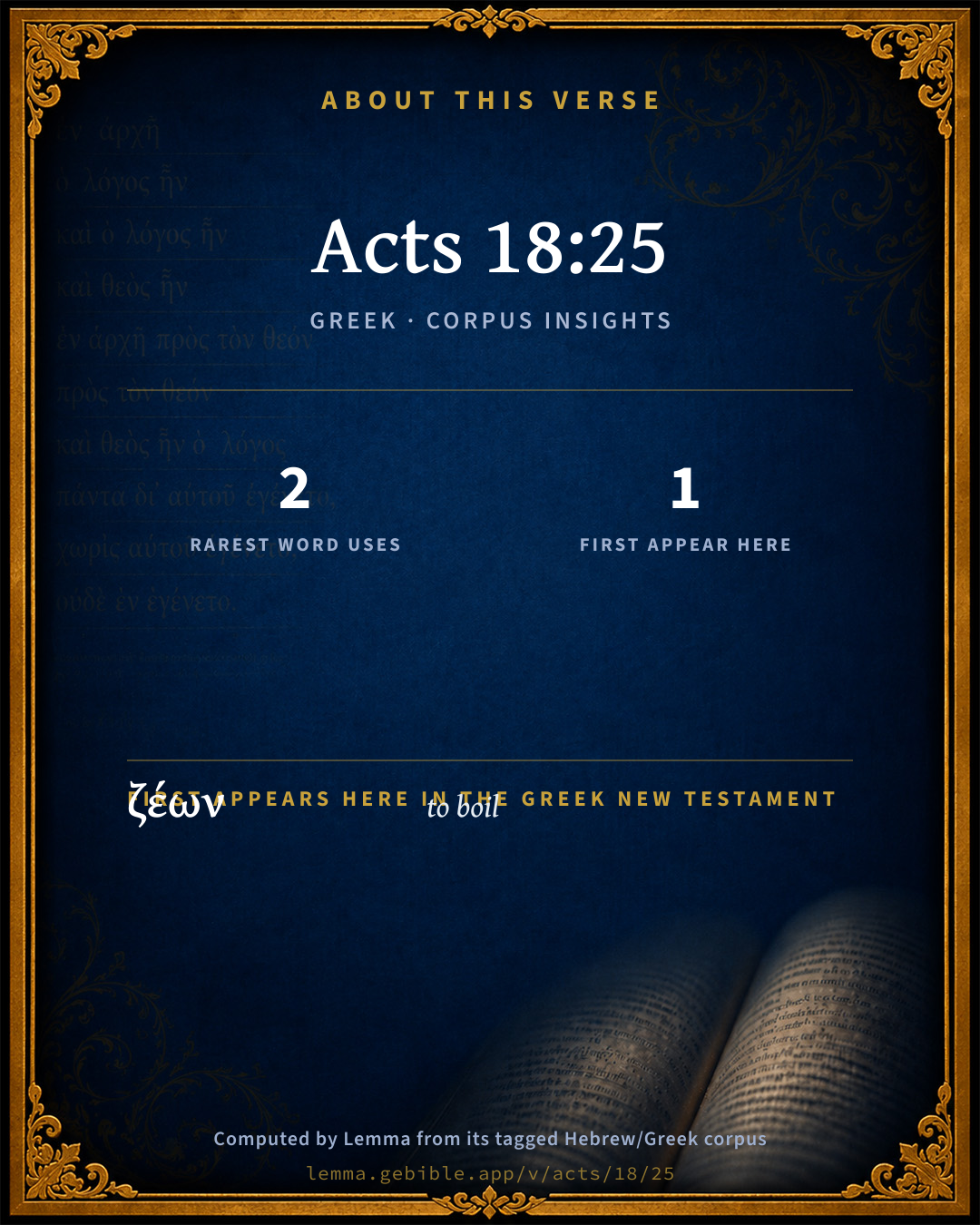
The rarest word here is ζέων to boil G2204 — appearing just 2 times in the whole Greek New Testament.

First appearance in Scripture

This word makes its first canonical appearance in the Greek New Testament here:

Shared distinctive vocabulary

ζέων to boil G2204 occurs in 2 verses of the Greek New Testament. Also found in:
Repetition

Words recur within this verse:

Cross-references

24

Topical passages linked to Acts 18:25 in the Treasury of Scripture Knowledge — connected by theme and wording, ordered by reader-vote popularity; previews shown in the World English Bible.

  • Acts 19:3 He said, "Into what then were you baptized?" They said, "Into John's baptism."
  • Hosea 14:9 Who is wise, that he may understand these things? Who is prudent, that he may know them? For the ways of Yahweh are right, And the righteous walk in them; But the rebellious stumble in them.
  • Romans 12:11 not lagging in diligence; fervent in spirit; serving the Lord;
  • Mark 12:14 When they had come, they asked him, "Teacher, we know that you are honest, and don't defer to anyone; for you aren't partial to anyone, but truly teach the way of God. Is it lawful to pay taxes to Caesar, or not?
  • Acts 9:2 and asked for letters from him to the synagogues of Damascus, that if he found any who were of the Way, whether men or women, he might bring them bound to Jerusalem.
  • Acts 19:9 But when some were hardened and disobedient, speaking evil of the Way before the multitude, he departed from them, and separated the disciples, reasoning daily in the school of Tyrannus.
  • Acts 19:23 About that time there arose no small stir concerning the Way.
  • Genesis 18:19 For I have known him, to the end that he may command his children and his household after him, that they may keep the way of Yahweh, to do righteousness and justice; to the end that Yahweh may bring on Abraham that which he has spoken of him."
  • Judges 2:22 that by them I may prove Israel, whether they will keep the way of Yahweh to walk therein, as their fathers did keep it, or not.
  • 1 Samuel 12:23 Moreover as for me, far be it from me that I should sin against Yahweh in ceasing to pray for you: but I will instruct you in the good and the right way.
  • Psalms 25:8–9 Good and upright is Yahweh, Therefore he will instruct sinners in the way.
  • Psalms 119:1 Blessed are those whose ways are blameless, Who walk according to Yahweh's law.
  • Isaiah 40:3 The voice of one who cries, Prepare you in the wilderness the way of Yahweh; make level in the desert a highway for our God.
  • Jeremiah 6:16 Thus says Yahweh, Stand you in the ways and see, and ask for the old paths, where is the good way; and walk therein, and you shall find rest for your souls: but they said, We will not walk [therein].
  • Matthew 3:1–17 In those days, John the Baptizer came, preaching in the wilderness of Judea, saying,
  • Mark 1:3 The voice of one crying in the wilderness, 'Make ready the way of the Lord! Make his paths straight!'"
  • Luke 3:1–38 Now in the fifteenth year of the reign of Tiberius Caesar, Pontius Pilate being governor of Judea, and Herod being tetrarch of Galilee, and his brother Philip tetrarch of the region of Ituraea and Trachonitis, and Lysanias tetrarch of Abilene,
  • Luke 7:29 When all the people and the tax collectors heard this, they declared God to be just, having been baptized with John's baptism.
  • John 1:19–36 This is John's testimony, when the Jews sent priests and Levites from Jerusalem to ask him, "Who are you?"
  • Acts 13:10 and said, "Full of all deceit and all cunning, you son of the devil, you enemy of all righteousness, will you not cease to pervert the right ways of the Lord?
  • Acts 16:17 Following Paul and us, she cried out, "These men are servants of the Most High God, who proclaim to us the way of salvation!"
  • Colossians 1:28–29 whom we proclaim, admonishing every man and teaching every man in all wisdom, that we may present every man perfect in Christ Jesus;
  • 2 Timothy 2:4 No soldier on service entangles himself in the affairs of life, that he may please him who enrolled him as a soldier.
  • James 5:16 Confess your offenses to one another, and pray one for another, that you may be healed. The effective, earnest prayer of a righteous man is powerfully effective.

Cross-references courtesy of OpenBible.info (CC BY 4.0).

Where the printed editions differ

1 variant

Places in this verse where the major printed Greek editions disagree on the wording in a way that affects the translation — a comparison of editions, not a manuscript-by-manuscript collation. The editions are the modern critical texts (Nestlé-Aland 28/27, SBL, Westcott-Hort, Tregelles, Tyndale House) and the traditional texts behind the KJV (the Textus Receptus and the Byzantine/Majority text). It is not a claim about which reading is original.

  1. Different wording
    Ἰησοῦ

    “Jesus”

    In NA28NA27TynSBLWHTreg Not in TRByz

    κυρίου (kuriou) 'Lord' occurs in traditional manuscripts (TR+Byz) instead of Ἰησοῦ (Iēsou) 'Jesus' in older manuscripts (NA28+NA27+Tyn+SBL+WH+Treg)

Textual data: Translators Amalgamated Greek New Testament (STEPBible TAGNT) · CC BY 4.0.

Commentary

Notes on Acts 18:25 from classic Christian and Jewish commentators (each source and its license shown beneath its notes). The classic Christian expositions comment on the surrounding passage and are grouped to its opening verse, so a note may address several verses; the Jewish commentaries on the Tanakh (Rashi and others) are per-verse, so they appear only where the commentator wrote on this verse.

Lemma curates 59 commentaries, every one of them public domain or Creative Commons licensed, each selected and text-cleaned for this edition rather than reprinted as found. About our sources →

Bengel's Gnomon

Johann Albrecht Bengel

Act 18:25. Τῷ Πνεύματι) He had the Spirit, not in that special way which is treated of in ch. Act 19:6, but in an ordinary way.—ἐλάλει, he spake) in private.—ἐδίδασκεν, taught) in public.—ἀκριβῶς, diligently) suffering no opportunity to pass. There follows in Act 18:26, more diligently, ἀκριβέστερον.—μόνον, only) There is not excluded all knowledge of Christ whatever: but Apollos had not yet heard concerning the death and resurrection of Christ, and concerning the Paraclete: ch. Act 19:2-3.

Bengel's Gnomon of the New Testament — English translation (T&T Clark, Edinburgh, 1860) — public domain. Text from a community e-Sword module.

Meyer's Critical & Exegetical Commentary

Heinrich August Wilhelm Meyer

Act_18:25. Κατηχημένος τ. ὁδ. τ. Κυρ.] Apollos was instructed concerning the way of the Lord (i.e. concerning Christianity as a mode of life appointed and shaped by Christ through means of faith in Him, see on Act_9:2) doubtless by disciples of John, as follows from ἐπιστάμ. μόνον τ. βάπτ. Ἰωάννου. How imperfect this instruction had been in respect of the doctrinal contents of Christianity,[89] appears from the fact that he knew nothing of a distinctively Christian baptism. He stood in this respect on the same stage with the μαθηταί in Act_19:2; but, not maintaining the same passive attitude as they did, he was alreadyunder the influence of the partial and preliminary light of Christian knowledgefull of a profound, living fervour, as if seething and boiling in his spirit, i.e. in the potency of his higher self-conscious life (ζέων τῷ πνεύματι, see on Rom_12:11), so that he ἘΛΆΛΕΙ ΚΑῚ ἘΔΊΔΑΣΚΕΝ ἈΚΡΙΒῶς ΤᾺ ΠΕΡῚ ΤΟῦ ἸΗΣΣῦ. What had reference to Jesus, to whom as the Messiah John had borne witness, was naturally that concerning which he had in his Johannean training received most information and taken the deepest interest. He must have regarded Jesus

His historical personactually as the Messiah (not merely as a precursor of Him, Baumgarten), which Bleek erroneously denies, contrary to the express words of the passage; but he still needed a more accurate Christian instruction, which he received, Act_18:26. The incompleteness and even the lack to some extent of correctness in his Christian knowledge, made him, with his might in the Scriptures and fervour in spiritwhich latter was under the control of the formernot incapable to teach, according to the measure of his knowledge, with accuracy[90] concerning Jesus, although he himself had to be instructed yet ἀκριβέστερον, Act_18:26 (in opposition to Baur and Zeller, who find here contradictory statements). In a corresponding manner, for example, a missionary may labour with an incomplete and in part even defective knowledge of the way of salvation, if he is mighty in the Scriptures and of fervent spirit.

ἐλάλ. κ. ἐδίδ. are simply to be distinguished as genus and species; and ἀκριβῶς, exactly, receives its limitation by ἐπιστ. μόν. τ. β. Ἰ.

ἐπιστάμενος μόν. τ. βάπτ. Ἰωάννου] although, etc. The view, that by this an absolute ignorance of Christian baptism is expressed, is incredible in itself, and not to be assumed on account of Joh_3:26. Notwithstanding, the simple literal sense is not to be interpreted, with Lange (apost. Zeitalt. II. p. 260), as though Apollos was wanting only in complete Christian experience of salvation and maturity; but, inasmuch as he did not recognise the characteristic distinction of the Christian baptism from that of John, he knew not that the former was something superior to the latter (Act_19:3-4); he knew only the baptism of John.[91]

[89] Erasmus, Paraphr.: hic Apollos erat semichristianus.

[90] Not to be taken in a subjective sense; carefully (Beza and others), which the comparative in ver. 26 does not suit.

[91] Comp. Oertel, Paulus in der Apostelgesch. p. 28 f.

Meyer — Critical and Exegetical Commentary on the New Testament — English translation by Peter Christie, edited by Frederick Crombie (T&T Clark, 1880) — public domain. Text from a community e-Sword module.

Expositor's Greek Testament

ed. W. Robertson Nicoll

Act 18:25 . See critical note on the proposed omission of the verse and reading also in . κατηχ ., cf. Luk 1:4 , “taught by word of mouth,” R.V., margin; . adds ἐν τῇ πατρίδι , and Blass holds that we may learn from this that some form of Gospel teaching had already been known in Egypt. But how far had Apollos been instructed? It is commonly held that he only knew the Baptism of John and nothing further, and that he was imperfectly acquainted with the facts of our Lord’s life. But he is said to have taught accurately ( ἀκριβῶς ) “the things concerning Jesus” (see critical note), and not only so, but, as Blass also points out, the mention of the twelve disciples at Ephesus has previously been taken to mean literally that these men were disciples of the Baptist, and had never heard of Jesus, whereas the words used to describe them, μαθηταί and πιστεύσαντες , are never used except of Christians. What is the conclusion? That whilst Apollos, like these twelve men, was acquainted with no other Baptism than John’s, he may have known quite as much of our Lord’s words and deeds as was contained in the Gospel of St. Mark in its mutilated form, Act 16:8 , which tells us nothing of Christian Baptism. And if we further ask from what source did Apollos gain this accurate information, Blass answers: “videlicet non sine scripto aliquo Evangelio”. If, he urges, it had been otherwise, and Apollos had been instructed by some disciple of the Apostles and not through a written Gospel, the position of things in the text would be reversed, and Apollos would have been imperfectly acquainted with our Lord’s life and teaching, whilst he could not have failed to know of Christian Baptism as the admission to Christian churches. Blass therefore believes that before the year 50 (he places the Conference in 45 or 46) written Gospels were to existence, and he evidently leans to the belief that St. Marks Gospel, or some first edition of it, was the Gospel from which Apollos was instructed (see in loco , and cf. also Philology of the Gospels , p. 30). But the word κατηχ . on this view must be taken not to include but to exclude, at all events mainly, a reference to catechetical teaching, and this from the use of the word in the N.T. is most unlikely. In the majority of the cases, as Blass admits, the word denotes oral teaching, although he maintains that this meaning is not always strictly kept. In the N.T. the word is used only by Luke and Paul, altogether eight times, in six of which it is used with reference to oral instruction, according to Mr. Wright: “Apollos: a study in Pre-Pauline Christianity,” Expository Times , October, 1897 (but see also in answer, Blass, Philology of the Gospels , p. 31). Mr. Wright suggests that Apollos may have derived his knowledge of “the facts concerning Jesus” from one of the many Catechists who were sent out from Jerusalem, and visited in large numbers the capital of Egypt, and by him Apollos like Theophilus was instructed in the way of the Lord. This view certainly gives an adequate meaning to κατηχ ., but still it seems strange that a Catechist, even if his chief business was to catechise or instruct in the facts of the Gospel history, should say nothing about Christian Baptism; surely a Catechist would himself be a baptised member of Christ. It is possible that Apollos may have deliberately decided to abide as he was; he may have said that as the Master Himself had fulfilled all righteousness in John’s Baptism, so that Baptism was sufficient for the servant. But on this view one has to suppose that no news of the events of Pentecost had reached Alexandria, although Egyptian Jews had been present at the feast. But the news which Apollos may have received had been imperfect, cf. Act 19:2-3 , and he had not therefore abandoned his position as a follower of the Baptist, who accepted the teaching that Jesus was the Messiah without knowing fully how that claim had been fulfilled, who had been baptised with the Baptism of the Baptist unto repentance without knowing the higher blessings conferred by membership in the Body of the Risen and Ascended Lord: see further Expository Times , vol. vii., pp. 564, 565; Hermathena , xxi. (1895); Weiss and Zöckler, in loco . ἐλάλει καὶ ἐδίδασκεν : Blass prefers ἀπελάλει , which Wright, u. s. , p. 11, renders “repeated by rote”. ζέων τῷ πνεύματι , cf. Rom 12:11 , this fervency was shown not only in speaking what he knew, but in teaching it to others, cf. Act 18:11 , where the same word is used of Paul’s instructions. We can scarcely take ἐλάλει as privatim , ἐδίδασκεν publice (Bengel). ἀκριβῶς : “accurately,” so often in classics, and as agreeing best here with this verse and the comparative in Act 18:26 ; on the use of the word in medical writers see Hobart, p. 251; Weiss, Meyer’s Kommentar , Luk 1:3 , also compares the similarity between St. Luke’s phrase and Galen’s dedication of his work to a friend (he also finds a parallel in Jos., C. Apion. , i., 10); see also below on ἀκριβέστερον and its employment by Dioscorides. The word occurs in Luke twice, Luk 1:3 , Act 18:25 , and elsewhere in Mat 2:8 , and twice in St. Paul, 1Th 5:2 , Eph 5:15 , whilst ἀκριβέστερον occurs four times in N.T., and each time in Acts, cf. Act 18:26 , Act 23:15 ; Act 23:20 , Act 24:22 .

The Expositor's Greek Testament, edited by W. Robertson Nicoll (1897–1910) — public domain. Text from a community e-Sword module.

Jamieson, Fausset & Brown

Robert Jamieson, A. R. Fausset & David Brown

This man was instructed in the way of the Lord . . . knowing only the baptism of John--He was instructed, probably, by some disciple of the Baptist, in the whole circle of John's teaching concerning Jesus, but no more: he had yet to learn the new light which the outpouring of the Spirit at Pentecost had thrown upon the Redeemer's death and resurrection; as appears from Act 19:2-3.

being fervent in the spirit--His heart warm, and conscious, probably, of his gifts and attainments, he burned to impart to others the truth he had himself received.

he spake and taught diligently--rather, "accurately" (it is the same word as is rendered "perfectly" in Act 18:26).

Jamieson, Fausset & Brown — Commentary Critical and Explanatory on the Whole Bible (1871) — public domain (CC PDM 1.0). Text via the HelloAO Bible API.

Adam Clarke's Commentary

Verse 25. This man was instructed in the way of the Lord] κατηχημενος; He was catechized, initiated, in the way, the doctrine, of Jesus as the Christ.

Being fervent in the spirit] Being full of zeal to propagate the truth of God, he taught diligently, ακριβως accurately, (so the word should be translated,) the things of Christ as far as he could know them through the ministry of John the Baptist; for it appears he knew nothing more of Christ than what John preached. Some suppose we should read ουκ, not, before ακριβως, correctly, or accurately, because it is said that Aquila and Priscilla expounded the way of the Lord, ακριβεστερον, more perfectly, rather more accurately; but of this emendation there is not the slightest necessity; for surely it is possible for a man to teach accurately what he knows; and it is possible that another, who possesses more information on the subject than the former, may teach him more accurately, or give him a larger portion of knowledge. Apollo knew the baptism of John; but he knew nothing farther of Jesus Christ than that baptism taught; but, as far as he knew, he taught accurately. Aquila and Priscilla were acquainted with the whole doctrine of the Gospel: the doctrine of Christ dying for our sins, and rising again for our justification; and in this they instructed Apollo; and this was more accurate information than what he had before received, through the medium of John's ministry.

Adam Clarke's Commentary on the Bible (1810–1826) — public domain. Text from a community e-Sword/MySword module.

John Calvin's Commentaries

25. He was instructed. That which Luke addeth shortly after seemeth not to agree with this commendation, to wit, that he knew only the baptism of John. But this latter member is added by way of correction. Nevertheless, these two agree very well together; that he understood the doctrine of the gospel, because he both knew that the Redeemer was given to the world, and also was well and sincerely instructed concerning the grace of reconciliation; and yet had he been trained up only in the principles of the gospel, so much as could be had out of John’s institution. For we know that John was in the midst between Christ and the prophets; and of his office doth both his father Zacharias intreat in his tongue, (Luke 1:76; Luke 1:16 and 17;) and also the angel out of the prophecy of Malachi, (Malachi 3:1.) Surely, seeing that he carried the light before Christ, and did highly extol his power, his disciples are for good causes said to have had knowledge of Christ. Moreover, the speech is worth the noting, that he knew the baptism of John. For thence we gather the true use of the sacraments; to wit, that they enter us in some certain kind of doctrine, or that they establish that faith which we have embraced. Surely, it is wickedness and impious profanation to pull them away from doctrine. Wherefore, that the sacraments may be rightly administered, the voice of the heavenly doctrine must sound there. For what is the baptism of John? Luke comprehendeth all his ministry under this word, not only because doctrine is annexed unto baptism, but also because it is the foundation and head thereof, without which it should be a vain and dead ceremony.

Being fervent in spirit he spake. Apollos hath another commendation given him in these words, that he was inflamed with an holy zeal to teach. Doctrine without zeal is either like a sword in the hand of a madman, or else it lieth still as cold and without use, or else it serveth for vain and wicked boasting. For we see that some learned men become slothful; other some (which is worse) become ambitious; other some (which is of all the worst) trouble the Church with contention and brawling. Therefore, that doctrine shall be unsavory which is not joined with zeal. But let us remember that Luke putteth the knowledge of the Scripture in the first place, which must be the moderation of zeal, for we know that many are fervent without consideration, as the Jews did rage against the gospel, by reason of a perverse affection which they did bear toward the law; and even at this day we see what the Papists be, who carried headlong with furious violence, being pricked forward with an opinion unadvisedly conceived. Therefore, let knowledge be present that it may govern zeal. And now it is said that zeal was the cause of diligence, because Apollos gave himself to teach diligently. But and if that man, being not yet thoroughly and perfectly taught in the gospel, did preach Christ so diligently and freely, what excuse do those men hope to have, who know that more perfectly and fully, which he knew not as yet, if they do not endeavor so much as in them lieth to further and advance the kingdom of Christ? Luke doth attribute zeal to the Spirit, therefore, because it is a rare and peculiar gift; neither do I so expound it that Apollos was moved and pricked forward with the instinct of his mind, but by motion of the Holy Spirit.

John Calvin's Commentaries (1540-1563) — public domain. Text from the Calvin Translation Society English edition (1840s-50s) via the Christian Classics Ethereal Library (ccel.org). Calvin's coverage is partial (roughly two-thirds of the Bible); uncommented books and verses are honest gaps, never fabricated. The 19th-century editor's footnotes and remarks are omitted so the notes are faithfully Calvin's own voice.

Ellicott's Commentary for English Readers

(25) This man was instructed in the way of the Lord.—Better, had been instructed. The verb is the same as that used in Luk_1:1 (where see Note), and was afterwards used technically in the form of Catechumen to describe the status of a convert preparing for baptism. The “way of the Lord” is used in a half-technical sense, as in the phrase “those of the way” (see Note on Act_9:2), as equivalent to what, in modern speech, we should describe as the “religion” of Christ.

And being fervent in the spirit.—The noun is obviously used, as in the identical phrase in Rom_12:11, for the spirit of the man, not for the Holy Spirit of God.

He spake and taught diligently.—Better, he was speaking and teaching accurately. Both verbs are in the tense which implies continuous action.

The things of the Lord.—The better MSS. give, “the things concerning Jesus.” We ask in what the teaching, which is thus described as accurate, was yet defective. The position of Apollos at this stage was, it would seem, that of one who knew the facts of our Lord’s life, and death, and resurrection, and had learnt, comparing these with Messianic prophecies, to accept Him as the Christ. But his teacher had been one who had not gone beyond the standpoint of the followers of the Baptist, who accepted Jesus as the Christ during His ministry on earth. The Christ was for him the head of a glorified Judaism, retaining all its distinctive features. He had not as yet learnt that “circumcision was nothing” (1Co_7:19; Gal_5:6), and that the Temple and all its ordinances were “decaying and waxing old, and ready to vanish away” (Heb_8:13).

Knowing only the baptism of John.—The words are full of interest, as showing a wider extent in the work of the Baptist, as the forerunner of the Christ, than is indicated in the Gospels. Even at Alexandria, probably among the ascetic communities of the Therapeutæ, whose life was fashioned upon the same model, there were those who had come under his influence.

A Bible Commentary for English Readers, edited by Charles John Ellicott (1878–1897) — public domain. Text from a community e-Sword module.

The Cambridge Bible for Schools and Colleges

gen. ed. J. J. S. Perowne

25. This man was instructed in the way of the Lord] Nothing is gained by pressing the tense of the original into the “had been instructed” of the Revised Version. If he had been instructed he consequently was instructed. The word for instructed is that from which comes the English “catechize.” Hence it implies a course of teaching distinct from his own study of the Scriptures. We know from Josephus (Antiq. xviii. 5. 2) that the teaching and baptism of John produced great effect among the Jews. We need not therefore wonder at finding among Jews at Jerusalem and Ephesus men who had accepted the Baptist’s teaching about Jesus. But in considering such cases we must remember where such instruction as they had received would stop short. They would know that John baptized in preparation for the coming of the kingdom, they would have heard that he pointed to Jesus as the Lamb of God, being certified thereof when He came to be baptized. But when John was dead and the life of Jesus was brought to a close on Calvary, except the few of John’s disciples who had joined the followers of our Lord, none would know of the way in which the foundations of the heavenly kingdom were laid, none would understand the institution of the Sacraments, nor the sending down of the Holy Ghost, nor the teaching of repentance, and of the gift of salvation to the faithful through grace. Of these things John had known nothing, and we must not forget in our attempt to estimate his work and its effects, that there came to himself a day when he sent to Christ to ask “Art thou He that should come?” (Mat_11:3.)

and being fervent in the spirit, he spake and taught carefully the things concerning Jesus] These variations from the A.V. are warranted by the best texts of the original. As “the spirit” intended is Apollos’ own it is better to omit the article. The adverb rendered “carefully” indicates the accuracy with which he proclaimed all that he had been taught. “The things of the Lord” seems to have been the suggestion of some one who did not understand the plain statement of the text. In the previous expression “the way of the Lord” we have only the Old Test. words (Isa_40:3) quoted by the Evangelists concerning John’s preaching. (Mat_3:3; Mar_1:3.) There may have been some timidity felt about the further statement that Apollos taught the things “concerning Jesus,” and so the reading of the early part of the verse was brought in here also. But after what has been said above we can see how this Alexandrian Jew might publish with the utmost accuracy all that John had proclaimed about the coming of the Kingdom of Heaven, and enforce it from his own studies of the Old Testament Scriptures, he might declare how John had pointed to Jesus, and might even relate much of the works and words of Christ, as an evidence that God was sending greater prophets than they had known for long, and that therefore Christ’s life was a testimony that redemption was near. All this he might know and preach most carefully, and yet lack all that further knowledge which Aquila and Priscilla imparted.

knowing only the baptism of John] In this sentence we have the solution of any difficulty which there may seem to be in the verse. He knew nothing of that other baptism, which is the entrance into Christ’s kingdom, and therefore he could merely be looking forward for the fulfilment of the prophecies, and the power of his teaching would consist in the zealous way which he published that the voice of God in His older Revelation proclaimed Messiah’s advent very near.

The Cambridge Bible for Schools and Colleges (gen. ed. J. J. S. Perowne; Cambridge University Press, 1878–1918) — public domain. Text from a community e-Sword module.

John Gill's Exposition

And when he was disposed to pass into Achaia, &c. The chief city of which was Corinth, and whither Apollos went, as appears from Act 19:1. What disposed him to go thither, after he had received a greater degree of light and knowledge, was no doubt that he might communicate it, to the good of others, to which he was moved by the Holy Ghost, who had work for him to do there: according to Beza's most ancient copy, there were Corinthians sojourning in Ephesus, who when they had heard him (Apollos), besought him that he would go with them into their country; to which he agreeing, the Ephesians wrote to the disciples at Corinth to receive him, as follows:

the brethren wrote, exhorting the disciples to receive him; that is, the brethren at Ephesus, among whom Aquila was a principal one, wrote letters of recommendation to the brethren of the churches in Achaia, particularly at Corinth, not only that they would receive him into their houses, and hospitably entertain him as a Christian man, but admit him, and behave towards him as a preacher of the Gospel:

who when he was come; into Achaia, and to Corinth:

helped them much which had believed through grace; the phrase "through grace", is omitted in the Vulgate Latin version, but is in all the Greek copies, and may be connected either with the word "helped"; as the Syriac version, "he helped through grace"; and then the sense is, that Apollos, through the gifts of grace bestowed on him, or by the assistance of the grace of God, or both, greatly helped and contributed much to the advantage of the believers in those parts; as to the encouragement of their faith, and the increase of the joy of it; for the quickening, and comforting, and establishing them in the truths and doctrines of the Gospel, by his affectionate, fervent, and nervous way of preaching: or it may be connected with the word "believed", as it is in the Arabic version and in ours; and the meaning is, that he greatly assisted such who were already believers; and who became so, not of themselves, but through the grace of God; for faith is not of nature, nor the produce of man's free will, but is the gift of God's grace; it is a fruit of electing grace, an instance of distinguishing grace, it is owing to efficacious grace, and comes along with effectual calling grace, through the word preached, the means of grace; and is supported and maintained by the grace of God; the Ethiopic version renders it, "he preached much to them, who believed in the grace of God"; that is, in the Gospel, the doctrine of the grace of God, which they had received and professed; or in the love and favour of God, they were rooted and grounded in, and persuaded of.

John Gill's Exposition of the Whole Bible (1746–1763) — public domain (CC PDM 1.0). Text via the HelloAO Bible API.

Trapp's Complete Commentary

John Trapp

25 This man was instructed in the way of the Lord; and being fervent in the spirit, he spake and taught diligently the things of the Lord, knowing only the baptism of John.

Ver. 25. Taught diligently] According to that skill he had. Of Lactantius, Jerome passeth this judgment. Lactantius quasi quidam fluvius Tullianae eloquentiae utinam tam nostra potuisset confirmare, quam facile aliena destruxit. So Cicero (De Nat. Deor.) wished that he could as easily find out the true God as he could disprove the false gods.

John Trapp, A Commentary or Exposition upon All the Books of the Old and New Testament (1647–1656) — public domain. Text from a community e-Sword module.

Albert Barnes' Notes on the Bible

This man was instructed - Greek: was catechised. He was instructed, in some degree, into the knowledge of the Christian religion. By whom this was done we have no information.

In the way of the Lord - The word “way” often refers to doctrine, Mat 21:32. It means here that he had been correctly taught in regard to the Messiah, yet his knowledge was imperfect, Act 18:26. The amount of his knowledge seems to have been:

(1) He had correct views of the Messiah to come - views which he had derived from the study of the Old Testament. He was expecting a Saviour that would be humble, obscure, and a sacrifice, in opposition to the prevailing notions of the Jews.

(2) He had heard of John; had embraced his doctrine; and probably had been baptized with reference to him that was to come. Compare Mat 3:2; Act 19:4. But it is clear that he had not heard that Jesus was the Messiah. With his correct views in regard to the coming of the Messiah he was endeavoring to instruct and reform his countrymen. He was just in the state of mind to welcome the announcement that the Messiah had come, and to embrace Jesus of Nazareth as the hope of the nation.

Being fervent in the spirit - Being zealous and ardent. See the notes on Rom 12:11.

Taught diligently - Defended with zeal and earnestness his views of the Messiah.

The things of the Lord - The doctrines pertaining to the Messiah as far as he understood them.

Knowing only the baptism of John - Whether he had himself heard John, and been baptized by him. has been made a question which cannot now be decided. It is not necessary, however, to suppose this, as it seems that the knowledge of John’s preaching and baptism had been propagated extensively in other nations beside Judea, Act 19:1-3. The Messiah was expected about that time. The foreign Jews would be waiting for him; and the news of John’s ministry, doctrine, and success would be rapidly propagated from synagogue to synagogue in the surrounding nations. John preached repentance, and baptized with reference to him that was to come after him Act 19:4, and this doctrine Apollos seems to have embraced.

Albert Barnes' Notes on the Bible (1834–1885) — public domain. Text from a community e-Sword/MySword module.

Matthew Poole's English Annotations

Instructed; catechised, or taught, viva voce. In the way of the Lord; Christ, who hath by his precepts and example tanght us the way to happiness.

Fervent in the spirit; very zealous to promote God’s glory, and men’s salvation, as Rom 12:11.

Knowing only the baptism of John; who baptized with water, but could not baptize with the Holy Ghost, Mat 3:11; that is, they had not those extraordinary gifts of the Holy Ghost which followed upon baptism after that Christ was ascended, and the Spirit poured out, Act 2:4. But John was a preacher of repentance, and of faith in Christ, pointing at the Lamb of God; and he baptized his disciples into this doctrine; which is the same with the baptism and belief of the apostles afterwards; only now they knew many things more fully than were revealed in the Baptist’s time.

Matthew Poole's English Annotations on the Holy Bible (1683–1685) — public domain. Text from a community e-Sword/MySword module.

Whedon's Commentary on the Bible

Daniel D. Whedon

25. Way of the Lord—Of the Lord, not of Jesus, but, according to the Old Testament, of Jehovah. So John was to prepare the way of the Lord=Jehovah. Apollos had not yet distinctly learned of Jesus.

Knowing only… John—In his native Alexandria, perhaps, some disciple of John, having left Judea before the zenith of Jesus’ ministry, may have unfolded to him the truths with which John had shaken the multitudes of Israel. The kingdom of God is at hand; the prophetic period for the Coming One is expiring; the world spiritually, and perhaps physically, is to be destroyed and renewed. With such truths and bold conceptions, Apollos’ oratory no doubt, like that of John, could sway the multitudes.

Daniel D. Whedon (gen. ed.), Commentary on the Old and New Testaments (1874–1909) — public domain. Text from a community e-Sword module.

The Pulpit Commentary

Vers. 25, 26. Had been for was, A.V.; spirit for the spirit, A.V; carefully for diligently, A.V.; things concerning Jesus for things of the Lord, A.V. and T.R.; but when Priscilla and Aquila heard him for whom when Aquila and Priscilla had heard, A.V. and T.R.; carefully for perfectly, A.V. Knowing only the baptism of John. It is difficult at first sight to conceive how at this time any one could know the baptism of John without knowing further that of Christ. But a possible account of it is that Apollos living at Alexandria, where as yet there was no Christian Church. had met some Jews who had been in Judaea at the time of John"s ministry, and had heard from them of John"s baptism and preaching, and of his testimony to Jesus as the Messiah, but had had no further opportunity of careful instruction in the faith of Jesus Christ till he happened to come to Ephesus and make the acquaintance of his compatriots, Aquila and Priscilla. They hearing him speak with fervor and eloquence, but perceiving that his knowledge was imperfect, immediately invited him to their house, and instructed him in the fullness of the truth of the gospel. This necessarily included the doctrine of Christian baptism, which we cannot doubt was administered to him. (Joh_1:33; Act_1:5 Act_2:38)

The Pulpit Commentary (1880–1919), ed. H.D.M. Spence-Jones & Joseph S. Exell — public domain. Text from a community e-Sword module.

John Wesley's Explanatory Notes

This man had been instructed - Though not perfectly, in the way of the Lord - In the doctrine of Christ. Knowing only the baptism of John - Only what John taught those whom he baptized, namely, to repent and believe in a Messiah shortly to appear.

John Wesley, Explanatory Notes Upon the Whole Bible (1754–1765) — public domain. Text via the GEBible commentary corpus.

Scofield Reference Notes

C. I. Scofield

instructed

taught by word of mouth, or, hearsay, i.e. not by revelation. Cf. Gal 1:11; Gal 1:12.

The N.T. Scriptures were not then written.

The Scofield Reference Bible (1917 edition), notes by C. I. Scofield — public domain. Text from a community e-Sword module.

Godbey's Commentary on the New Testament

William B. Godbey

25. “He was instructed in the way of the Lord, and, boiling over in spirit, he continued to speak and teach clearly the things concerning Jesus, knowing only the baptism of John.” God’s salvation has been identical in all ages and under all dispensations, notwithstanding the didactic diversities characteristic of the progressive stages in the school of Christ from the unlettered simplicity of the Antediluvian, then the divine interventions of the Patriarchal, the glowing symbolism of the Mosaic, the burning pathos of the Johanic, the inimitable parabolic teaching of Jesus, followed by the fiery baptisms and universal evangelism of the Pentecostal, all destined to the glorious eclipse under the brilliancy, majesty, splendor and ineffable glory destined to inundate the world amid the transcendent millennial theocracy. While the gracious economy has thus exhibited a progressive panorama as to its didactic phases during the progressive ages, experimental religion, experienced in the heart by the Holy Ghost, is identical in all ages.

William B. Godbey, Commentary on the New Testament (1896–1900) — public domain. Text from a community e-Sword module.

McGarvey & Pendleton's Commentaries

J. W. McGarvey

See notes on verse 24

J. W. McGarvey (with Philip Y. Pendleton), Commentaries on the New Testament (The Fourfold Gospel, 1914; Acts; and the epistles) — public domain. Text from a community e-Sword/MySword module.

Cambridge Greek Testament for Schools and Colleges

25. Ἰησοῦ for Κυρίου with אABDEL. Vulg. ‘Jesu.’

25. οὗτος ἧν κατηχημένος τὴν ὁδὸν τοῦ κυρίον, this man was instructed in the way of the Lord. The verb κατηχέω (whence our ‘catechize’) implies a course of instruction distinct from his own study of the O.T. Scriptures. We know from Josephus (Antiq. XVIII. 5. 2) that the teaching and baptism of John produced great effect among the Jews. We need not therefore wonder at finding among Jews in Alexandria and Ephesus men who had accepted the Baptist’s teaching about Jesus. But in considering such cases we must remember where such instruction as they had received would stop short. They would know that John baptized in preparation for the coming of the kingdom, they would have heard that he pointed to Jesus as the Lamb of God, being certified thereof when He came to be baptized. But when John was dead and the life of Jesus was brought to a close on Calvary, except the few of John’s disciples who had joined the followers of our Lord, none would know of the way in which the foundations of the heavenly kingdom were laid, none would understand the institution of the Sacraments, nor the sending down of the Holy Ghost, nor the teaching of repentance, and of the gift of salvation to the faithful through grace. Of these things John had known nothing, and we must not forget in our attempt to estimate his work and its effects, that there came to himself a day when he sent to Christ to ask ‘Art thou He that should come?’ (Mat 11:3.)

καὶ ζέων τῷ πνεύματι ἐλάλει καὶ ἐδίδασκεν ἀκριβῶς τὰ περὶ τοῦ Ἰησοῦ, and being fervent in spirit he spake and taught carefully the things concerning Jesus. By πνεῦμα is meant Apollos’s own spirit and zeal. The reading of the Text. recept. τὰ περὶ τοῦ Κυρίου seems to have been the suggestion of some one who did not understand the plain statement of the text. In the previous expression ‘the way of the Lord’ we have only the Old Test. words (Isa 40:3) quoted by the Evangelists concerning John’s preaching. (Mat 3:3; Mar 1:3.) There may have been some timidity felt about the further statement that Apollos taught the things ‘concerning Jesus,’ and so the reading of the early part of the verse was brought in here also. But after what has been said above we can see how this Alexandrian Jew might publish with the utmost accuracy all that John had proclaimed about the coming of the Kingdom of Heaven, and enforce it from his own studies of the Old Testament Scriptures. He might declare how John had pointed to Jesus, and might even relate much of the works and words of Christ, as an evidence that God was sending greater prophets than they had known for long, and that therefore Christ’s life was a testimony that redemption was near. All this he might know and preach most carefully, and yet lack all that further knowledge which Aquila and Priscilla imparted. Chrysostom on the contrary explains πνεῦμα of the Holy Ghost, and suggests that the case of Aquila is somewhat like that of Cornelius, where the Holy Spirit was given before baptism in the name of Christ. For ζέων τῷ πνεύματι cf. Rom 12:11.

ἐπιστάμενος … Ἰωάννου, knowing only the baptism of John. In this sentence we have the solution of any difficulty which there may seem to be in the verse. He knew nothing of that other baptism, which is the entrance into Christ’s kingdom, and therefore he could merely be looking forward for the fulfilment of the prophecies, and the power of his teaching would consist in the zealous way which he published that the voice of God in His older Revelation proclaimed Messiah’s advent very near.

Cambridge Greek Testament for Schools and Colleges (Cambridge University Press, 1896; 21 vols, various authors incl. Carr, Maclear, Plummer, Farrar, Lumby, Moule, M. R. James, Simcox) — public domain. Text from a community e-Sword module.

Alford’s Greek Testament

Henry Alford

25.] Apollos had received (from his youth?) the true doctrine of the Messiahship of Jesus, as pointed out by John the Baptist: doubtless from some disciple of John: but more than this he knew not. The doctrines of the Cross,—the Resurrection,—the outpouring of the Spirit,—these were unknown to him: but more particularly (from the words ἐπιστ. μόνον τὸ βάπτ. Ἰωάν.) the latter, as connected with Christian baptism: see further on ch. 19:2, 3.

The mistake of supposing that he did not know Jesus to be the Messiah, has arisen from the description of his subsequent work at Corinth, ver. 28, but by no means follows from it: this he did before, but not so completely. The same mistake has led to the alteration of Ἰησοῦ into the κυρίου of the rec., it having been well imagined that he could not teach ἀκριβῶς τὰ π. τοῦ Ἰησοῦ if he did not know him to be the Messiah: whereas by these words is imported that he knew and taught accurately the facts respecting Jesus, but of the consequences of that which he taught, of all which may be summed up in the doctrine of Christian baptism, he had no idea.

ἐπιστ. μόνον] Meyer well remarks, that it is not meant that he was absolutely ignorant of the fact of there being such a thing as Christian baptism, but ignorant of its being any thing different from that of John: he knew, or recognized in baptism only that which the baptism of John was: a sign of repentance.

Henry Alford, The Greek Testament (1849–1861) — public domain. Text from a community e-Sword module.

Vincent's Word Studies in the New Testament

Marvin R. Vincent

Instructed. See on Luk 1:4.

Fervent [ζεων] . Fervent, which is formed from the participle of the Latin ferveo, to boil or ferment, is an exact translation of this word, which means to seethe or bubble, and is therefore used figuratively of mental states and emotions. See on leaven, Mt 13:33.

Diligently [ακριβως] . Rather, accurately; so far as his knowledge went. The limitation is given by the words following : knowing only the baptism of John. See on Luk 1:3; and compare the kindred verb, inquired diligently, Mt 2:7, where Rev. renders learned carefully/y.

Marvin R. Vincent, Word Studies in the New Testament (1887–1900) — public domain. Text from a community e-Sword/MySword module.

Lesson kit

Teaching starters — assembled from the data on this page, not authored interpretation. Every prompt links to the verse data it draws on. Edit before teaching.

Acts, in the Acts, opens this verse with 24 words (18 distinct Greek lemmas). Its most distinctive word is zéō (“to boil”). A historical commentator’s framing appears above. Read the whole chapter for the surrounding context.

Discussion questions

  1. The word zéō carries the sense “to boil.” How does it shape the verse?
  2. This is the first place “to boil” appears in Scripture (first appears here). What does its debut here establish?
  3. How does Romans 12:11, which shares the word «to boil», read alongside this verse?
  4. What does the repetition of “the” (6× in this one verse) do in this verse?
  5. The translations on this page render this verse differently — a whole-verse word diff, not a word-by-word alignment. What might account for the different wordings?
  6. Compare how Bengel's Gnomon and Meyer's Critical & Exegetical Commentary read this verse. Where do they agree or differ?

Things to notice

  • 1 word makes its first canonical appearance in Scripture here.
  • These translations choose different wording for 15 words in this verse.
  • “the” occurs 6× in this single verse.
  • 18 distinct Greek lemmas span 24 words in this verse.

Reading settings

Reading text

Shown beneath each verse's original-language words.

Old Testament
Old Testament edition

Read the OT as the Masoretic Hebrew (MT) or the Greek Septuagint (LXX).

English shown for the Greek Septuagint (in the Hebrew ↔ Greek comparison).

Comparing translations? Open the Compare panel on any verse page to stack up to four side by side.