

Acts 5:16
Greek (Tischendorf 8th ed.) Acts 5:16 appears in the Greek New Testament. The text above is from the Tischendorf 8th edition. Each word links to its Strong’s number and a concise gloss. Click any word for its full Thayer’s Greek Lexicon entry.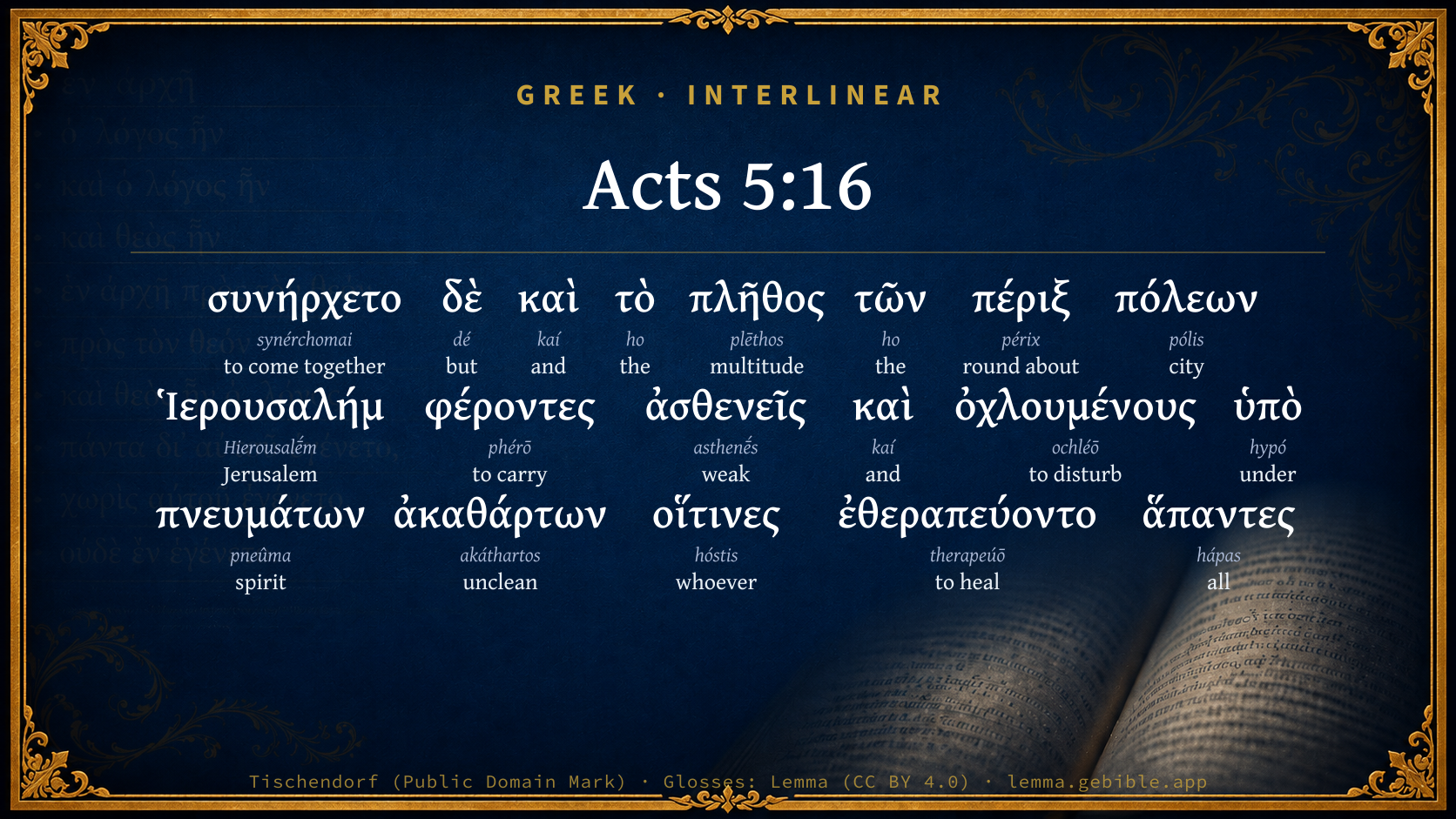
Multitudes also came together from the cities around Jerusalem, bringing sick people, and those who were tormented by unclean spirits: and they were all healed.
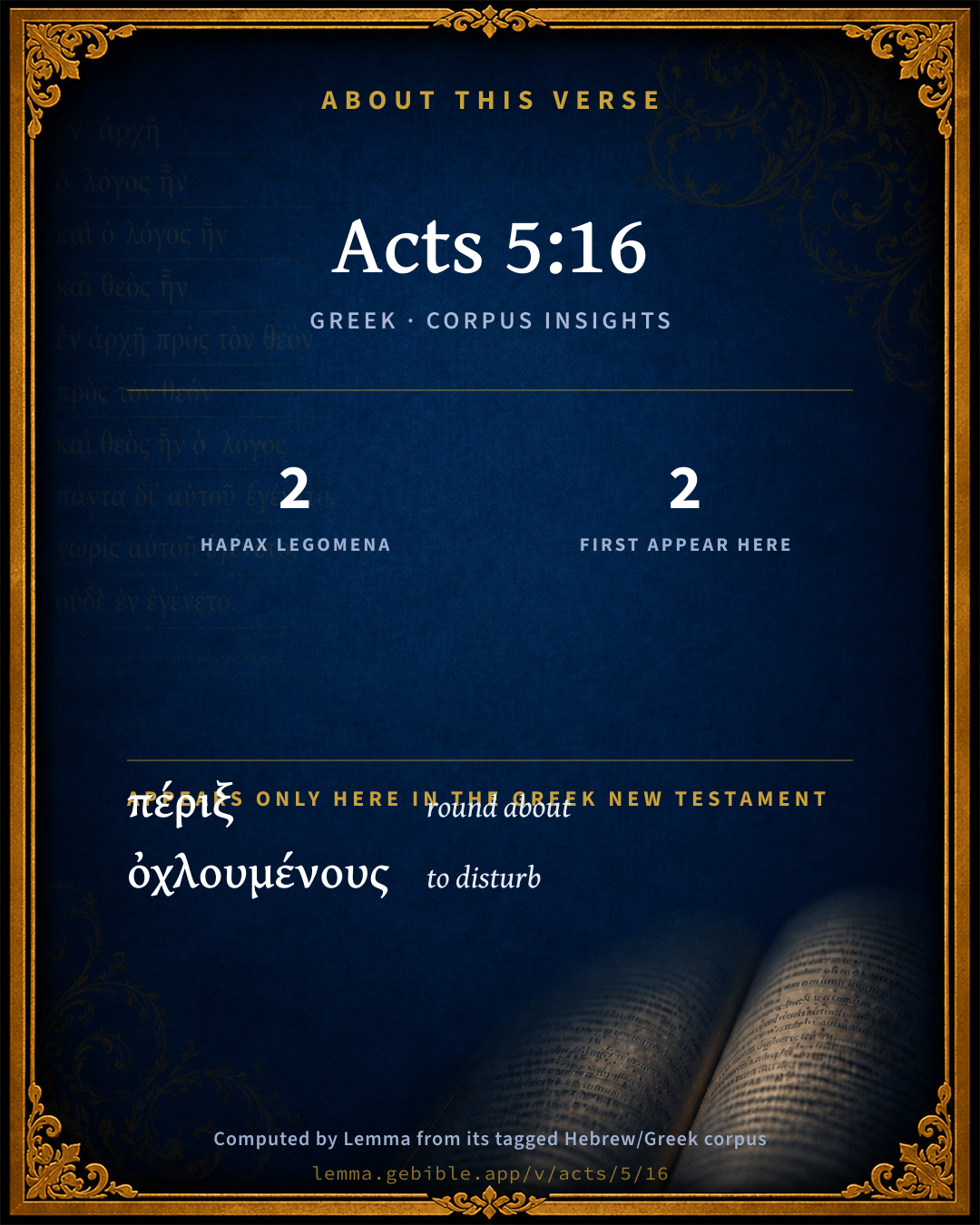
- 2 hapax legomena — only here in the Greek New Testament
- 2 first appearances in the Greek New Testament
Download a study sheet
One document with this verse’s original text, its word-by-word gloss line, the meaning frame, cross-references with their text, attributed commentary, and full source and license credits — printable, and it pastes into notes with its structure intact.
This verse Autodidact and up
A passage Seminary Student
Up to 50 verses in one chapter. A passage sheet keeps up to 6 commentary sources and 12 cross-references per verse, in the order this page ranks them, and says so on the sheet whenever that leaves anything out. Ask for a single verse and you get the Autodidact verse sheet above.
Everything on this page stays free to read, with no account — the sheet is a download of what is already on screen, not access to it.
Compare translations 3
The same verse in 3 English versions, stacked beneath the original-language interlinear above. Click any original word for its lexicon entry.
Each is an independent rendering of the whole verse — the interlinear is not word-aligned to these translations.
Highlighted words mark where these versions differ — a whole-verse word diff, not a word-by-word alignment.
-
World English Bible Public Domain
Multitudes also came together from the cities around Jerusalem, bringing sick people, and those who were tormented by unclean spirits: and they were all healed.
-
King James Version Public Domain
There came also a multitude out of the cities round about unto Jerusalem, bringing sick folks, and them which were vexed with unclean spirits: and they were healed every one.
-
unfoldingWord Literal Text CC BY-SA 4.0
And a multitude also came together from the towns around Jerusalem, bringing the sick and those afflicted by unclean spirits, who were all healed.
unfoldingWord Literal Text — © unfoldingWord, licensed CC BY-SA 4.0. Word-aligned USFM3 via Door43 (git.door43.org/unfoldingWord/en_ult).
Show all 19 translations
Every available English version of this verse, each an independent rendering of the whole verse.
-
World English Bible Public Domain
Multitudes also came together from the cities around Jerusalem, bringing sick people, and those who were tormented by unclean spirits: and they were all healed.
-
Berean Standard Bible Public Domain
Crowds also gathered from the towns around Jerusalem, bringing the sick and those tormented by unclean spirits, and all of them were healed.
-
Majority Standard Bible Public Domain
Crowds also gathered from the towns around Jerusalem, bringing the sick and those tormented by unclean spirits, and all of them were healed.
-
King James Version Public Domain
There came also a multitude out of the cities round about unto Jerusalem, bringing sick folks, and them which were vexed with unclean spirits: and they were healed every one.
-
American Standard Version (1901) Public Domain
And there also came together the multitudes from the cities round about Jerusalem, bring sick folk, and them that were vexed with unclean spirits: and they were healed every one.
-
Revised Version (1885) Public Domain
And there also came together the multitude from the cities round about Jerusalem, bringing sick folk, and them that were vexed with unclean spirits: and they were healed every one.
-
Geneva Bible (1599) Public Domain
There came also a multitude out of the cities round about vnto Hierusalem, bringing sicke folkes, and them which were vexed with vncleane spirits, who were all healed.
-
Douay-Rheims (1899) Public Domain
And there came also together to Jerusalem a multitude out of the neighboring cities, bringing sick persons, and such as were troubled with unclean spirits; who were all healed.
-
Young's Literal Translation Public Domain
and there were coming together also the people of the cities round about to Jerusalem, bearing ailing persons, and those harassed by unclean spirits -- who were all healed.
-
Literal Standard Version CC BY-SA 4.0
and there were also coming together the people of the surrounding cities to Jerusalem, carrying ailing persons, and those harassed by unclean spirits—who were all healed.
-
Unlocked Literal Bible CC BY-SA 4.0
There also came together a great number of people from the towns around Jerusalem, bringing the sick and those afflicted with unclean spirits, and they were all healed.
-
unfoldingWord Literal Text CC BY-SA 4.0
And a multitude also came together from the towns around Jerusalem, bringing the sick and those afflicted by unclean spirits, who were all healed.
-
Darby Bible Public Domain
And the multitude also of the cities round about came together to Jerusalem, bringing sick persons and persons beset by unclean spirits, who were all healed.
-
World Messianic Bible Public Domain
The multitude also came together from the cities around Jerusalem, bringing sick people and those who were tormented by unclean spirits; and they were all healed.
-
Webster's Bible Public Domain
There came also a multitude out of the cities around to Jerusalem, bringing sick persons, and them who were afflicted with unclean spirits: and they were healed every one.
-
Free Bible Version CC BY-SA 4.0
Crowds from the towns around Jerusalem brought their sick and those afflicted by evil spirits. They were all healed.
-
Bible in Basic English Public Domain
And numbers of people came together from the towns round about Jerusalem, with those who were ill and those who were troubled with unclean spirits: and they were all made well.
-
Text-Critical English NT CC BY 4.0
A multitude from the towns all around Jerusalem also gathered together, bringing the sick and those harassed by unclean spirits, and they were all healed.
-
Tyndale New Testament (1534) Public Domain
There came also a multitude out of the cities roud about vnto Ierusalem bringynge sicke folkes and them which were vexed with vnclene spretes. And they were healed every one.
Literal Standard Version (2020), Covenant Press — licensed CC BY-SA 4.0. Text via the HelloAO Bible API (eBible.org). Unlocked Literal Bible (unfoldingWord) — licensed CC BY-SA 4.0. Text via the HelloAO Bible API (eBible.org). unfoldingWord Literal Text — © unfoldingWord, licensed CC BY-SA 4.0. Word-aligned USFM3 via Door43 (git.door43.org/unfoldingWord/en_ult). Free Bible Version, Dr. Jonathan Gallagher — licensed CC BY-SA 4.0. Text via the HelloAO Bible API (eBible.org).
Word by word
More ways to search: Search by grammar → Find every occurrence → Compare this word →
Practice this passage: Drill this verse → Learn its vocabulary →
- Appears 1× in the Greek New Testament
- First appears here
- Part of Speech
- Adverb
Full Thayer's Definition
- συνήρχετο synérchomai G4905 “to come together” Verb, Imperfect, Middle or Passive deponent, Indicative, 3rd person, Singular
- δὲ dé G1161 “but” Conjunction
- καὶ kaí G2532 “and” Conjunction
- τὸ ho G3588 “the” Article, Nominative, Singular, Neuter
- πλῆθος plēthos G4128 “multitude” Noun, Nominative, Singular, Neuter
- τῶν ho G3588 “the” Article, Genitive, Plural, Feminine
- πέριξ périx G4038 “round about” Adverb
- πόλεων pólis G4172 “city” Noun, Genitive, Plural, Feminine
- Ἱερουσαλήμ Hierousalḗm G2419 “Jerusalem” Noun, Proper, indeclinable
- φέροντες phérō G5342 “to carry” Verb, Present, Active, Participle, Nominative, Plural, Masculine
- ἀσθενεῖς asthenḗs G772 “weak” Adjective, Accusative, Plural, Masculine
- καὶ kaí G2532 “and” Conjunction
- ὀχλουμένους ochléō G3791 “to disturb” Verb, Present, Passive, Participle, Accusative, Plural, Masculine
- ὑπὸ hypó G5259 “under” Preposition
- πνευμάτων pneûma G4151 “spirit” Noun, Genitive, Plural, Neuter
- ἀκαθάρτων akáthartos G169 “unclean” Adjective, Genitive, Plural, Neuter
- οἵτινες hóstis G3748 “whoever” Relative pronoun, Nominative, Plural, Masculine
- ἐθεραπεύοντο therapeúō G2323 “to heal” Verb, Imperfect, Passive, Indicative, 3rd person, Plural
- ἅπαντες hápas G537 “all” Adjective, Nominative, Plural, Masculine
About this verse
These counts appear in no published source. They are computed here, from the morphology-tagged text and Lemma’s own curated glosses. What Lemma adds →
- 19
- words
- 17
- distinct lemmas
- Acts
- section
Notable vocabulary
2 hapax legomena — words that appear only here in the entire Greek New Testament:
First appearance in Scripture
These words make their first canonical appearance in the Greek New Testament here:
Shared distinctive vocabulary
ἀσθενεῖς weak G772 occurs in 23 verses of the Greek New Testament. Also found in:
Cross-references
11Topical passages linked to Acts 5:16 in the Treasury of Scripture Knowledge — connected by theme and wording, ordered by reader-vote popularity; previews shown in the World English Bible.
- Mark 16:17–18 These signs will accompany those who believe: in my name they will cast out demons; they will speak with new languages;
- Mark 2:3–4 Four people came, carrying a paralytic to him.
- Matthew 4:24 The report about him went out into all Syria. They brought to him all who were sick, afflicted with various diseases and torments, possessed with demons, epileptics, and paralytics; and he healed them.
- Matthew 8:16 When evening came, they brought to him many possessed with demons. He cast out the spirits with a word, and healed all who were sick;
- Matthew 15:30–31 Great multitudes came to him, having with them the lame, blind, mute, maimed, and many others, and they put them down at his feet. He healed them,
- Mark 6:54–56 When they had come out of the boat, immediately the people recognized him,
- Luke 5:17 It happened on one of those days, that he was teaching; and there were Pharisees and teachers of the law sitting by, who had come out of every village of Galilee, Judea, and Jerusalem. The power of the Lord was with him to heal them.
- Luke 9:11 But the multitudes, perceiving it, followed him. He welcomed them, and spoke to them of the Kingdom of God, and he cured those who needed healing.
- John 14:12 Most assuredly I tell you, he who believes in me, the works that I do, he will do also; and greater works than these will he do; because I am going to my Father.
- Acts 4:30 while you stretch out your hand to heal; and that signs and wonders may be done through the name of your holy Servant Jesus."
- James 5:16 Confess your offenses to one another, and pray one for another, that you may be healed. The effective, earnest prayer of a righteous man is powerfully effective.
Cross-references courtesy of OpenBible.info (CC BY 4.0).
Lesson kit
Teaching starters — assembled from the data on this page, not authored interpretation. Every prompt links to the verse data it draws on. Edit before teaching.
Acts, in the Acts, opens this verse with 19 words (17 distinct Greek lemmas). Its most distinctive word is périx (“round about”). A historical commentator’s framing appears above. Read the whole chapter for the surrounding context.
Discussion questions
- The word périx carries the sense “round about.” How does it shape the verse?
- 2 words here appear nowhere else in the Greek New Testament. Why might the author reach for such rare wording?
- 2 words make their first appearance in Scripture here. What does this debut establish?
- How does Matthew 25:43, which shares the word «weak», read alongside this verse?
- What does the repetition of “and” (2× in this one verse) do in this verse?
- These translations render this verse differently; the difference is in the English rendering, not the original. What questions does that raise?
- Compare how Expositor's Greek Testament and Adam Clarke's Commentary read this verse. Where do they agree or differ?
Things to notice
- 2 words in this verse appear nowhere else in the Greek New Testament.
- 2 words make their first canonical appearance in Scripture here.
- These translations choose different wording for 20 words in this verse.
- “and” occurs 2× in this single verse.
- 17 distinct Greek lemmas span 19 words in this verse.
Commentary
Notes on Acts 5:16 from classic Christian and Jewish commentators (each source and its license shown beneath its notes). The classic Christian expositions comment on the surrounding passage and are grouped to its opening verse, so a note may address several verses; the Jewish commentaries on the Tanakh (Rashi and others) are per-verse, so they appear only where the commentator wrote on this verse.
Lemma curates 59 commentaries, every one of them public domain or Creative Commons licensed, each selected and text-cleaned for this edition rather than reprinted as found. About our sources →
Expositor's Greek Testament
ed. W. Robertson Nicoll
The Expositor's Greek Testament, edited by W. Robertson Nicoll (1897–1910) — public domain. Text from a community e-Sword module.
Adam Clarke's Commentary
Adam Clarke's Commentary on the Bible (1810–1826) — public domain. Text from a community e-Sword/MySword module.
Ellicott's Commentary for English Readers
A Bible Commentary for English Readers, edited by Charles John Ellicott (1878–1897) — public domain. Text from a community e-Sword module.
The Cambridge Bible for Schools and Colleges
gen. ed. J. J. S. Perowne
The Cambridge Bible for Schools and Colleges (gen. ed. J. J. S. Perowne; Cambridge University Press, 1878–1918) — public domain. Text from a community e-Sword module.
John Gill's Exposition
John Gill's Exposition of the Whole Bible (1746–1763) — public domain (CC PDM 1.0). Text via the HelloAO Bible API.
Trapp's Complete Commentary
John Trapp
John Trapp, A Commentary or Exposition upon All the Books of the Old and New Testament (1647–1656) — public domain. Text from a community e-Sword module.
Albert Barnes' Notes on the Bible
Albert Barnes' Notes on the Bible (1834–1885) — public domain. Text from a community e-Sword/MySword module.
Matthew Poole's English Annotations
Matthew Poole's English Annotations on the Holy Bible (1683–1685) — public domain. Text from a community e-Sword/MySword module.
The Pulpit Commentary
The Pulpit Commentary (1880–1919), ed. H.D.M. Spence-Jones & Joseph S. Exell — public domain. Text from a community e-Sword module.
McGarvey & Pendleton's Commentaries
J. W. McGarvey
J. W. McGarvey (with Philip Y. Pendleton), Commentaries on the New Testament (The Fourfold Gospel, 1914; Acts; and the epistles) — public domain. Text from a community e-Sword/MySword module.
Cambridge Greek Testament for Schools and Colleges
Cambridge Greek Testament for Schools and Colleges (Cambridge University Press, 1896; 21 vols, various authors incl. Carr, Maclear, Plummer, Farrar, Lumby, Moule, M. R. James, Simcox) — public domain. Text from a community e-Sword module.
Alford’s Greek Testament
Henry Alford
Henry Alford, The Greek Testament (1849–1861) — public domain. Text from a community e-Sword module.