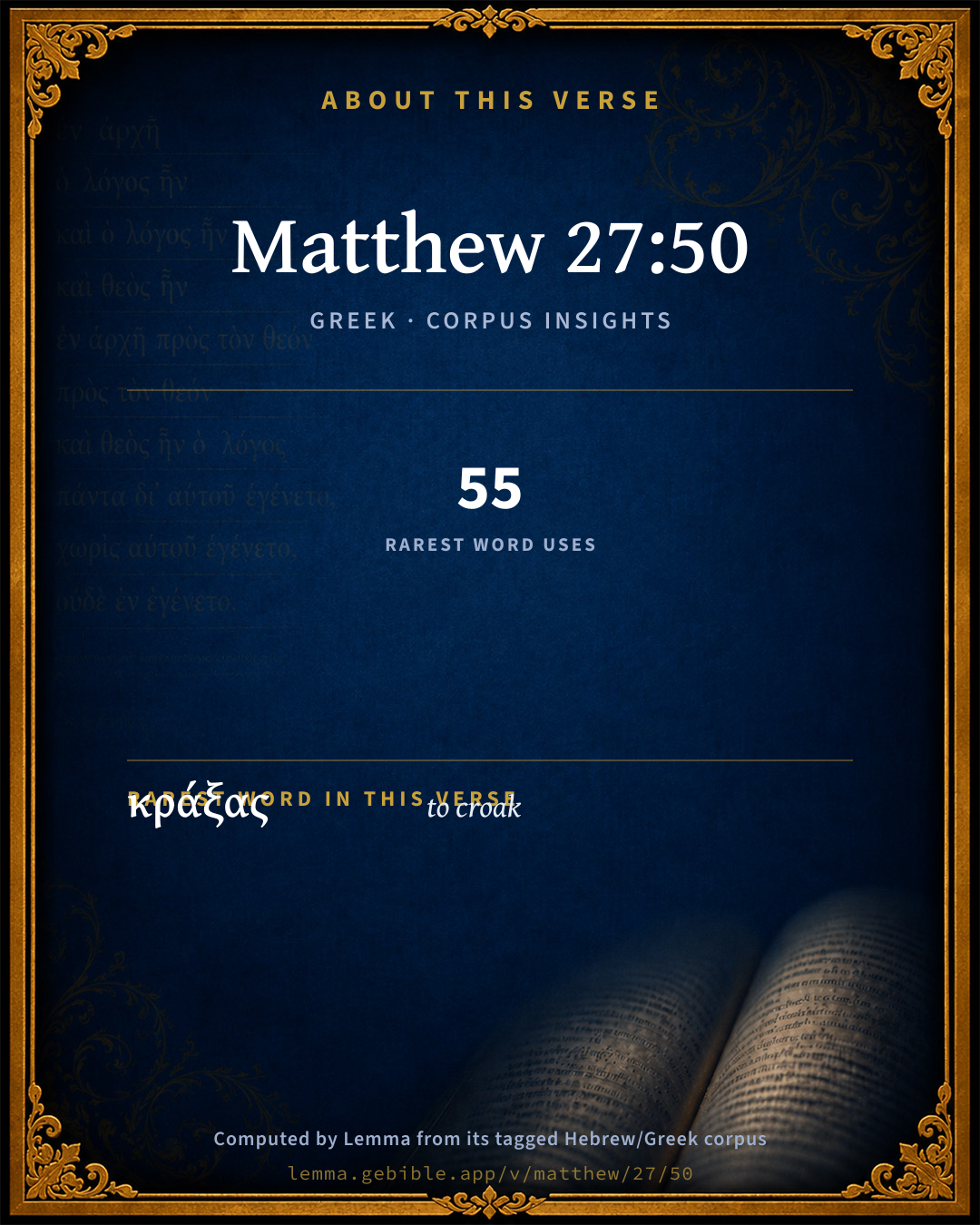
Matthew 27:50

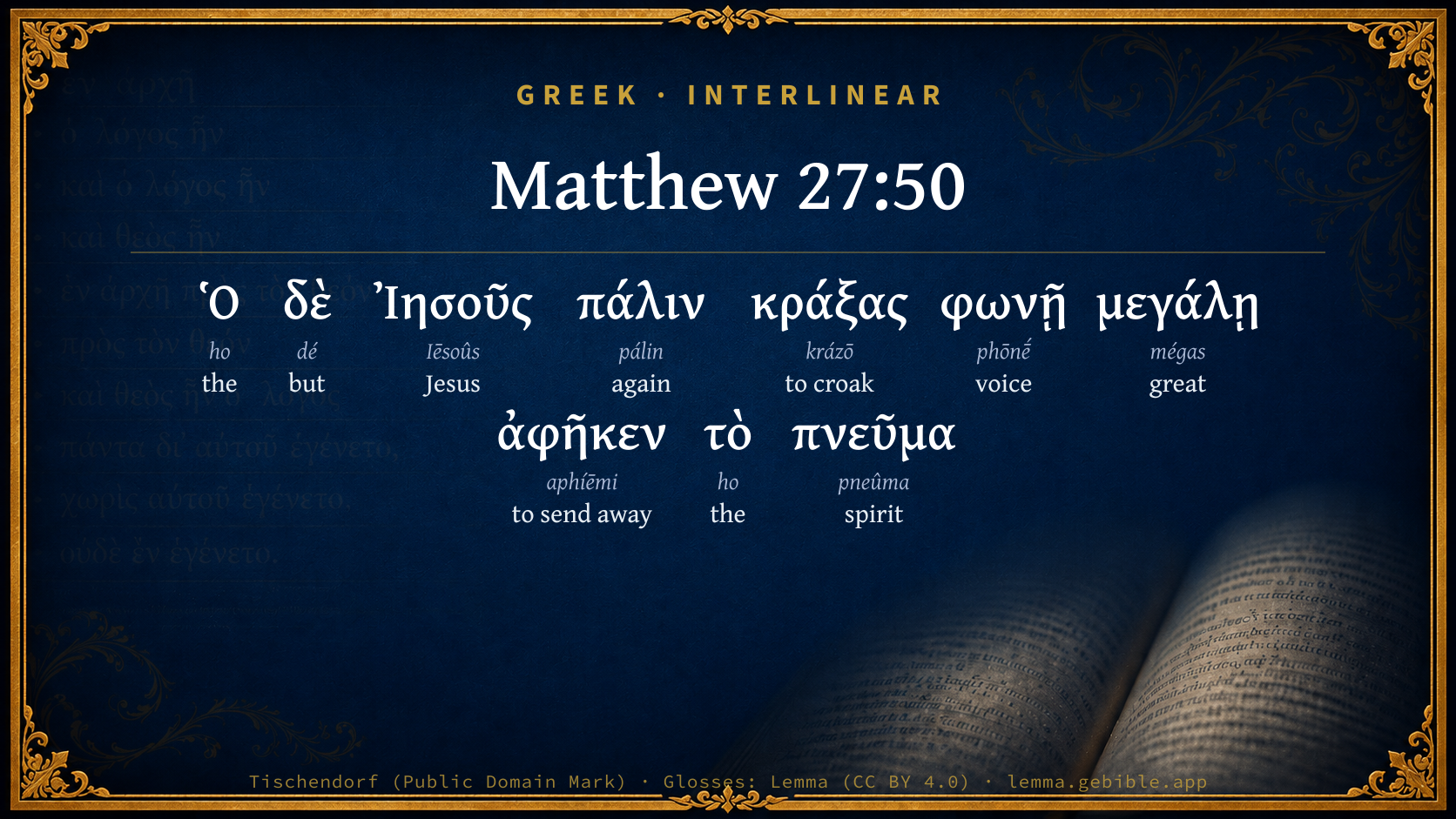
Greek (Tischendorf 8th ed.) Matthew 27:50 appears in the Greek New Testament. The text above is from the Tischendorf 8th edition. Each word links to its Strong’s number and a concise gloss. Click any word for its full Thayer’s Greek Lexicon entry.
Download image
Cite this verse

Matthew 27:50 (World English Bible). Public Domain. Lemma interlinear Bible study tool, https://lemma.gebible.app/v/matthew/27/50.

Show BibTeX & RIS
BibTeX
RIS
English Translation
Jesus cried again with a loud voice, and yielded up his spirit.
World English Bible · Public Domain
Download a study sheet

One document with this verse’s original text, its word-by-word gloss line, the meaning frame, cross-references with their text, attributed commentary, and full source and license credits — printable, and it pastes into notes with its structure intact.

This verse Autodidact and up

Study sheet (.html) Plain text (.txt)

A passage Seminary Student

Up to 50 verses in one chapter. A passage sheet keeps up to 6 commentary sources and 12 cross-references per verse, in the order this page ranks them, and says so on the sheet whenever that leaves anything out. Ask for a single verse and you get the Autodidact verse sheet above.

Everything on this page stays free to read, with no account — the sheet is a download of what is already on screen, not access to it.

Want to remove ads? Support Godless Engineer
Compare translations 3

The same verse in 3 English versions, stacked beneath the original-language interlinear above. Click any original word for its lexicon entry.

Each is an independent rendering of the whole verse — the interlinear is not word-aligned to these translations.

Highlighted words mark where these versions differ — a whole-verse word diff, not a word-by-word alignment.

  • World English Bible Public Domain
    Jesus cried again with a loud voice, and yielded up his spirit.
  • King James Version Public Domain
    Jesus, when he had cried again with a loud voice, yielded up the ghost.
  • unfoldingWord Literal Text CC BY-SA 4.0
    But Jesus, having cried out again with a loud voice, released his spirit.

unfoldingWord Literal Text — © unfoldingWord, licensed CC BY-SA 4.0. Word-aligned USFM3 via Door43 (git.door43.org/unfoldingWord/en_ult).

Versions to compare (up to 4)

3 of 4 selected

Show all 19 translations

Every available English version of this verse, each an independent rendering of the whole verse.

  • World English Bible Public Domain
    Jesus cried again with a loud voice, and yielded up his spirit.
  • Berean Standard Bible Public Domain
    When Jesus had cried out again in a loud voice, He yielded up His spirit.
  • Majority Standard Bible Public Domain
    When Jesus had cried out again in a loud voice, He yielded up His spirit.
  • King James Version Public Domain
    Jesus, when he had cried again with a loud voice, yielded up the ghost.
  • American Standard Version (1901) Public Domain
    And Jesus cried again with a loud voice, and yielded up his spirit.
  • Revised Version (1885) Public Domain
    And Jesus cried again with a loud voice, and yielded up his spirit.
  • Geneva Bible (1599) Public Domain
    Then Iesus cryed againe with a loude voyce, and yeelded vp the ghost.
  • Douay-Rheims (1899) Public Domain
    And Jesus again crying with a loud voice, yielded up the ghost.
  • Young's Literal Translation Public Domain
    And Jesus having again cried with a great voice, yielded the spirit;
  • Literal Standard Version CC BY-SA 4.0
    And Jesus having again cried with a great voice, yielded the spirit;
  • Unlocked Literal Bible CC BY-SA 4.0
    Then Jesus cried out again with a loud voice and gave up his spirit.
  • unfoldingWord Literal Text CC BY-SA 4.0
    But Jesus, having cried out again with a loud voice, released his spirit.
  • Darby Bible Public Domain
    And Jesus, having again cried with a loud voice, gave up the ghost.
  • World Messianic Bible Public Domain
    Yeshua cried again with a loud voice, and yielded up his spirit.
  • Webster's Bible Public Domain
    Jesus, when he had cried again with a loud voice, expired.
  • Free Bible Version CC BY-SA 4.0
    Jesus cried out again with a loud voice, and breathed his last.
  • Bible in Basic English Public Domain
    And Jesus gave another loud cry, and gave up his spirit.
  • Text-Critical English NT CC BY 4.0
    Then Jesus cried out again with a loud voice and gave up his spirit.
  • Tyndale New Testament (1534) Public Domain
    Iesus cryed agayne with a lowde voyce and yelded vp the goost.

Literal Standard Version (2020), Covenant Press — licensed CC BY-SA 4.0. Text via the HelloAO Bible API (eBible.org). Unlocked Literal Bible (unfoldingWord) — licensed CC BY-SA 4.0. Text via the HelloAO Bible API (eBible.org). unfoldingWord Literal Text — © unfoldingWord, licensed CC BY-SA 4.0. Word-aligned USFM3 via Door43 (git.door43.org/unfoldingWord/en_ult). Free Bible Version, Dr. Jonathan Gallagher — licensed CC BY-SA 4.0. Text via the HelloAO Bible API (eBible.org).

Word by word

More ways to search: Search by grammar → Find every occurrence → Compare this word →

Practice this passage: Drill this verse → Learn its vocabulary →

About this verse

These counts appear in no published source. They are computed here, from the morphology-tagged text and Lemma’s own curated glosses. What Lemma adds →

10
words
9
distinct lemmas
Gospels
section

Shared distinctive vocabulary

κράξας to croak G2896 occurs in 54 verses of the Greek New Testament. Also found in:

Repetition

A word recurs within this verse:

Cross-references

11

Topical passages linked to Matthew 27:50 in the Treasury of Scripture Knowledge — connected by theme and wording, ordered by reader-vote popularity; previews shown in the World English Bible.

  • John 19:30 When Jesus therefore had received the vinegar, he said, "It is finished." He bowed his head, and gave up his spirit.
  • Isaiah 53:9–12 They made his grave with the wicked, and with a rich man in his death; although he had done no violence, neither was any deceit in his mouth.
  • Psalms 22:14–15 I am poured out like water. All my bones are out of joint. My heart is like wax; It is melted within me.
  • Luke 23:46 Jesus, crying with a loud voice, said, "Father, into your hands I commit my spirit!" Having said this, he breathed his last.
  • Matthew 20:28 even as the Son of Man came not to be served, but to serve, and to give his life as a ransom for many."
  • Mark 15:37 Jesus cried out with a loud voice, and gave up the spirit.
  • Hebrews 9:14 how much more will the blood of Christ, who through the eternal Spirit offered himself without blemish to God, cleanse your conscience from dead works to serve the living God?
  • John 10:11 I am the good shepherd. The good shepherd lays down his life for the sheep.
  • John 10:15 even as the Father knows me, and I know the Father. I lay down my life for the sheep.
  • Daniel 9:26 After the sixty-two weeks the Anointed One shall be cut off, and shall have nothing: and the people of the prince who shall come shall destroy the city and the sanctuary; and the end of it shall be with a flood, and even to the end shall be war; desolations are determined.
  • Hebrews 2:14 Since then the children have shared in flesh and blood, he also himself in like manner partook of the same, that through death he might bring to nothing him who had the power of death, that is, the devil,

Cross-references courtesy of OpenBible.info (CC BY 4.0).

Commentary

Notes on Matthew 27:50 from classic Christian and Jewish commentators (each source and its license shown beneath its notes). The classic Christian expositions comment on the surrounding passage and are grouped to its opening verse, so a note may address several verses; the Jewish commentaries on the Tanakh (Rashi and others) are per-verse, so they appear only where the commentator wrote on this verse.

Lemma curates 59 commentaries, every one of them public domain or Creative Commons licensed, each selected and text-cleaned for this edition rather than reprinted as found. About our sources →

Adam Clarke's Commentary

Verse 50. Yielded up the ghost.] αφηκε το πνευμα, He dismissed the spirit. He himself willingly gave up that life which it was impossible for man to take away. It is not said that he hung on the cross till he died through pain and agony; nor is it said that his bones were broken, the sooner to put him out of pain, and to hasten his death; but that himself dismissed the soul, that he might thus become, not a forced sacrifice, but a free-will offering for sin.

Now, as our English word ghost, from the Anglo-Saxon [Anglo-Saxon] gast, an inmate, inhabitant, guest, (a casual visitant,) also a spirit, is now restricted among us to the latter meaning, always signifying the immortal spirit or soul of man, the guest of the body and as giving up the spirit, ghost, or soul, is an act not proper to man, though commending it to God, in our last moments, is both an act of faith and piety; and as giving up the ghost, i.e. dismissing his spirit from his body, is attributed to Jesus Christ, to whom alone it is proper; I therefore object against its use in every other case.

Every man, since the fall, has not only been liable to death, but has deserved it; as all have forfeited their lives because of sin. Jesus Christ, as born immaculate, and having never sinned, had not forfeited his life, and therefore may be considered as naturally and properly immortal. No man, says he, taketh it, my life, from me, but I lay it down of myself: I have power to lay it down, and I have power to take it again; therefore doth the Father love me, because I lay down my life that I might take it again, Joh 10:17-18. Hence we rightly translate Mt 27:50, αφηκε το πνευμα, he gave up the ghost; i.e. he dismissed his spirit, that he might die for the sin of the world. The Evangelist St. John (Joh 19:30) makes use of an expression to the same import, which we translate in the same way: παρεδωκε το πνευμα, he delivered up his spirit. We translate Mr 15:37, and Lu 23:46, he gave up the ghost, but not correctly, because the word in both these places is very different - εξεπνευσε, he breathed his last, or expired; though in the latter place, Lu 23:46, there is an equivalent expression - O Father, into thy hands, παρατιθεμαι το πνευμα μου, I commit my spirit; i.e. I place my soul in thy hand: proving that the act was his own; that no man could take his life away from him; that he did not die by the perfidy of his disciple, or the malice of the Jews, but by his own free act. Thus HE LAID DOWN his life for the sheep. Of Ananias and Sapphira, Ac 5:5; Ac 5:10, and of Herod, Ac 12:23, our translation says, they gave up the ghost; but the word in both places is εξεψυξε, which simply means to breathe out, to expire, or die: but in no case, either by the Septuagint in the Old, or any of the sacred writers in the New Testament, is αφηκε το πνευμα, or παρεδωκε το πνευμα, he dismissed his spirit, or delivered up his spirit, spoken of any person but Christ. Abraham, Isaac, Ishmael, Jacob, c., breathed their last Ananias, Sapphira, and Herod, expired; but none, Jesus Christ excepted, gave up the ghost, dismissed, or delivered up his own spirit, and was, consequently, free among the dead. Of the patriarchs, c., the Septuagint use the word εκλειπων, failing or κατεπαυσεν, he ceased, or rested.

Adam Clarke's Commentary on the Bible (1810–1826) — public domain. Text from a community e-Sword/MySword module.

The Biblical Illustrator

Joseph S. Exell

Mat_27:50-53

Jesus, when He had cried again with a loud voice, yielded up the Ghost.

Seven wonders

There were seven wonders which made the death of Christ exceedingly remarkable.

I. Over His head was written an inscription in Hebrew, and Greek, and Latin, Jesus of Nazareth, the King of the Jews. That there should be a distinct recognition of His kingship over the Jewish people has ever been regarded as one of the most remarkable splendours of the Saviours death. Typical of His sovereignty over the entire Church, which is but the prelude to His sovereignty over all worlds. Is He King in your heart?

II. The conversion of the thief (Luk_23:1-56.). See here the majesty of Christ as a Saviour, even in His misery as an atonement. What the thief saw about Christ let us all endeavour to see-His almighty power to save. God hath laid help upon One that is mighty. Trust Him only and fully.

III. The total darkness at noon-day made a fitting cavern into which Christ might retire. A picture of Christs tremendous power. Your darkness is never so black as His.

IV. The rending of the veil. An eminent type of the departure of God from the symbolical dispensation. It was all over now. Now there was no veil between man and God. The dying Saviour rends away for ever every impediment which shuts us out from the Most High.

V. The earthquake. Here we see Christs lordship over the world. The Lord of Providence.

VI. The resurrection of certain of the saints. How I should like to know something about them l They were representative men; they arose as specimens of the way in which all the saints shall in their due time arise.

VII. The confession of the centurion. A picture of Christs convincing power. I hope we have felt this convincing power-it lies in the doctrine of the cross. The unrecorded wonder connected with the cross of Christ is that when we hear of it our hearts do not break, and that our dead souls do not rise. (C. H. Spurgeon.)

Prodigies attending the Crucifixion

I. The great event of the Saviours death

1. That this great event did take place we have abundant testimony-

(1)Profane testimony.

(2) The testimony of the early Christians.

(3) The testimony of the inspired writers.

2. The design of His death.

(1) To atone for the world (2Co_5:18-19; Heb_10:12; Joh_1:29-36; Heb_7:27).

(2) To procure for the guilty, pardon of sin (Heb_9:22; Mat_26:28; Rom_3:25). Withheld from the unforgiving, the unbelieving, the impenitent (Mat_11:26; Joh_7:21; Joh_7:24; Luk_13:2-5).

(3) To procure the Holy Ghost to quicken dead sinners, etc.

(4) To exhibit to the world the amazing love of God.

II. The emblematical and awful prodigies that attended that event. Christ had been charged as an imposter; how important that this testimony should be borne just at this time!

1. The darkness. Dionysius, a heathen, who observed the darkness, declared that it portended something extraordinary, and exclaimed, Either nature is deploring, or the God of nature suffers.

2. The veil of the temple was rent. Signifies: The abolition of the Jewish economy; that the mysteries of that dispensation were now explained; that the way of access to God was open to all believers.

3. The earth did quake. The shaking of the moral world then, since, now, etc.

4. The rocks rent. Emblems of the hard hearts that should be broken by Christs death.

5. Graves were opened, &c, Signifying that the dead in sin should be raised to a life of righteousness; that Christ had won a victory over death; that the saints of the early ages had an interest in the work of Christ; that there shall be a general resurrection of the dead.

III. The clams it has upon us.

1. It claims our attention.

2. Our faith.

3. Our affections.

4. Our zeal. (A. Weston.)

Effects of the death of Christ

I. The circumstances attendant on the Saviours death claim our attention and they attest His Divine character. The earth did quake. The death of Christ shook the moral world and shakes it still. The rocks rent. Emblems of the hard flinty hearts that should be subdued by the power of Christs death. Graves were opened, as if to denote that the hidden things of darkness should be revealed.

II. The manner in which these striking events should influence us.

1. They should confirm us in the dignity of His character.

2. We should reflect upon the power of His death.

3. We should search for these effects upon ourselves. (Dr. Cope.)

I. The fact of the Saviours death.

1. Christ died according to the appointment of the Divine counsels.

2. This design of God was announced in prophecy.

3. The particular manner of our Lords death.

II. The signification of those awful prodigies by which his death was attended.

1. Of the whole of them. So many testimonies to the Messiahship of Jesus, and approbations of His work.

1. The veil of the temple was rent-

(1) That the ceremonial arrangements of the Jewish economy were about to be abolished;

(2) That the way of access is opened to all believers in God;

(3) That the mysteries peculiar to the Mosaic economy were now displayed and explained.

2. The earth did quake.

(1) Another emblem of the destruction of the Jewish system.

(2) How God expressed His wrath at the scenes now transacting.

3. The graves were opened.

(1) It showed that Christ achieved a victory over death.

(2) That the saints of the early ages had an interest in the work of the Redeemer.

(3) That there should be a general resurrection of the dead.

III. The influence which the death of Christ and its prodigies ought to possess, over the human mind.

1. Frequent contemplation on His death.

2. Pungent sorrow for the cause which produced His death.

3. Cordial faith in His merits.

4. Grateful thanksgiving to God for the scenes which have been unfolded. (J. Parsons.)

Miracles of Calvary

I. Miracle evinced itself in the great victim of Calvary. In the voluntary surrender of His life. Christ had power over His own life; and, not depending on the operation of natures laws, He could dismiss the spirit, or retain it at His pleasure.

II. Miracle as it evinced itself in the circumstances attending the crucifixion.

(1) The miraculous facts, darkness, earthquake, rent veil, graves burst open.

(2) The design of this miraculous interposition.

(a) These miracles constituted a Divine attestation to the Messiah, even in the hour of forsaking and death.

(b) The prodigies of Calvary served to betoken the more dread conflict and terrifying darkness of the Saviours soul in the hour of atonement.

(c) In the rending of the veil we are taught that the Mosaic institutions were henceforth to be superseded, the objects which they symbolized being now accomplished.

(d) We see in these miracles the trophies and the earnest of the Redeemers triumphs. (John Ely.)

Yielding up the Ghost

It does not appear that the special agonies which the Saviours mental sufferings created produced death prematurely; for there does not seem to have been a paroxysm producing convulsion, nor does death appear to have been the effect of mere exhaustion: the calm which succeeded the sufferers exclamation under Divine forsakings forbids are former conclusion; the vigour of His dying shout forbids the latter. (John Ely.)

Reasons for these miracles

In respect of-

1. The Sufferer dying.

2. The creatures obeying.

3. The Jews persecuting.

4. The women beholding.

5. The disciples forsaking. (Thos. Adams.)

Divine testimonials to Jesus

I. The dream of Pilates wife.

II. The darkness of the sky.

III. The rending of the veil of the temple.

IV. The earthquake at Calvary.

V. The rising of the dead. (N. Lardner.)

The mysterious resurrections

I. The place where this resurrection happened.

II. Who were raised.

III. The time when they were raised.

IV. To whom they appeared.

V. Whether they soon after ascended up to heaven, or died again.

VI. The truth of this history.

VII. The use of this extraordinary event. Reflections:

1. We may perceive a great agreement between the life and the death of Jesus.

2. It cannot but be pleasing to observe the mildness of all the wonderful works performed by Christ and done in His favour.

3. The testimonials given to Jesus should induce us to show Him all honour and reverence.

4. Let these meditations inspire us with courage and resolution in the profession of His name, (N. Lardner.)

The Biblical Illustrator, edited by Joseph S. Exell (c. 1880s–1900s) — public domain. Text from a community e-Sword module.

Joseph Benson's Commentary

Mat 27:50. And Jesus, when he had cried again with a loud voice — According to Joh 19:30, when Jesus had received the vinegar, he said, It is finished, meaning that the predictions of the prophets, respecting his sufferings and ministry on earth, were all fulfilled, and that the redemption of the world was on the point of being accomplished; and probably these were the words which he uttered with a loud voice, showing thereby, that his strength was not exhausted, but that he was about to give up his life of his own accord. And when he had thus cried, he said, Father, into thy hands I commend my spirit. Luk 23:46. And yielded up the ghost — Or rather, dismissed his spirit, as the original words, αφηκε το πνευμα, properly signify: an expression admirably suited to our Lord’s own words, Joh 10:18, No man taketh my life from me, but I lay it down of myself. He died by a voluntary act of his own, and in a way peculiar to himself. He alone, of all men that ever were, could have continued alive, even in the greatest tortures, as long as he pleased, or have retired from the body whenever he thought fit. And how does it illustrate that love which he manifested in his death! Inasmuch as he did not use his power to quit the body, as soon as it was fastened to the cross, leaving only an insensible corpse to the cruelty of his murderers: but continued his abode in it, with a steady resolution, as long as it was proper. He then retired from it with a majesty and dignity never known, or to be known in any other death: dying, if one may so express it, like the Prince of life.

Joseph Benson's Commentary on the Old and New Testaments (1811–1818) — public domain. Text from a community e-Sword module.

Tyndale Open Study Notes

Tyndale Open Resources

27:50 Each of the four Gospels highlights different aspects of Jesus’ last moments. • released his spirit: This emphasizes the sovereignty of Jesus in that he released himself to death (see also John 19:30). • shouted out again (see Matt 27:46): This cry was Jesus’ final prayer (see Luke 23:46).

Tyndale Open Study Notes — © Tyndale Open Resources, licensed CC BY-SA 4.0. Text via the HelloAO Bible API.

Bengel's Gnomon

Johann Albrecht Bengel

Mat 27:50. Κράξας, κ.τ.λ., having cried, etc.) A free laying down of life. He was not deprived of life by the power of the cross employed by men; see Mar 15:44; but yet they are rightly said to have killed Him, because they did so, as far as lay in their power.—ἀφῆκε τὸ πνεῦμα, He gave up the ghost) The Divine history records the death of Jesus Christ in few words; the homilies and epistles of the Apostles preach the fruit of that death in many: thus the Gospel furnishes the wool, the Apostle makes the dress; which similitude is used by Macarius in his Treatise, de Elevatione mentis, cap. 19. The word κοιμᾶσθαι, to sleep, is never employed concerning the death of the Saviour (cf. Mat 27:52), but ἀποθνήσκειν, to die, which verb expresses the truth, the gravity, the brevity, and the virtue of Christ’s death.[1211]

[1211] By it God was reconciled. Truly, a most precious moment!—V. g.

Bengel's Gnomon of the New Testament — English translation (T&T Clark, Edinburgh, 1860) — public domain. Text from a community e-Sword module.

Meyer's Critical & Exegetical Commentary

Heinrich August Wilhelm Meyer

Mat_27:50 Πάλιν] refers to Mat_27:46. What did Jesus cry in this instance? See Joh_19:30, from which Luk_23:46 diverges somewhat, containing, in fact, an explanatory addition to the account of the great closing scene, that is evidently borrowed from Psa_31:6.

ἀφῆκε τὸ πνεῦμα] i.e. He died. See Herod, iv. 190; Eur. Hec. 571: ἀφῆκε πνεῦμα θανασίμῳ σφαγῇ; Kypke, I. p. 140; Gen_35:18; Sir_38:23; Wis_16:14. There is no question here of a separating of the πνεῦμα from the ψυχή. See in answer to Ströbel, Delitzsch, Psych. p. 400 f. The theory of a merely apparent death (Bahrdt, Venturini Paulus) is so decidedly at variance with the predictions of Jesus Himself regarding His end, as well as with the whole testimony of the Gospel, is so utterly destructive of the fundamental idea of the resurrection, undermines so completely the whole groundwork of the redemption brought about by Christ, is so inconsistent with the accumulated testimony of centuries as furnished by the very existence of the church itself, which is based upon the facts of the death and the resurrection of Jesus, and requires such a remarkable series of other theories and assumptions of an extraordinary and supernatural character in order to explain duly authenticated facts regarding Christs appearance and actings after His resurrection,that, with friends and foes alike testifying to the actual death of Jesus, we are bound at once to dismiss it as an utterly abortive attempt to get rid of the physiological mystery (but see on Luke, Remarks after Mat_24:51) of the resurrection. It is true that though those modern critics (Strauss, Weisse, Ewald, Schweizer, Schenkel, Volkmar, Scholten, Keim) who deny the literal resurrection of Christs body, and who suggest various ways of accounting for His alleged reappearing again on several occasions, do not dispute the reality of His death, their view is nevertheless as much at variance with the whole of the New Testament evidence in favour of the resurrection as is the one just adverted to. Comp. Mat_28:10, Rem., and Luk_24:51, Rem.

Meyer — Critical and Exegetical Commentary on the New Testament — English translation by Peter Christie, edited by Frederick Crombie (T&T Clark, 1880) — public domain. Text from a community e-Sword module.

Expositor's Greek Testament

ed. W. Robertson Nicoll

Mat 27:50-56 . Death and its accompaniments (Mar 15:37-41 , Luk 23:46-49 ).

Mat 27:50 . πάλιν , pointing back to the cry in Mat 27:46 . φωνῇ μεγάλῃ . The Fathers found in the loud cry a proof that Jesus died voluntarily, not from physical exhaustion. Some modern writers, on the contrary, regard the cry as the utterance of one dying of a ruptured heart (Dr. Stroud on The Physical Cause of Christ’s Death ; Hanna, The Last Day of Our Lord’s Passion ). Mt.’s narrative, like Mk.’s, gives the impression that the cry was inarticulate. Brandt recognises this cry as historical.

The Expositor's Greek Testament, edited by W. Robertson Nicoll (1897–1910) — public domain. Text from a community e-Sword module.

Geneva Bible (1599)

Geneva Bible translators

Christ after he had overcome other enemies, at length provoked and setteth upon death itself.

Geneva Bible (1599) marginal notes — public domain. Text via Bolls.life.

Ellicott's Commentary for English Readers

(50) When he had cried again with a loud voice.—It is well that we should remember what the words were which immediately preceded the last death cry; the “It is finished” of Joh_19:30, the “Father, into Thy hands I commend My spirit” of Luk_23:46, expressing as they did, the fulness of peace and trust, the sense of a completed work.

It was seldom that crucifixion, as a punishment, ended so rapidly as it did here, and those who have discussed, what is hardly perhaps a fit subject for discussion, the physical causes of our Lord’s death, have ascribed it accordingly, especially in connection with the fact recorded in Joh_19:34, and with the “loud cry,” indicating the pangs of an intolerable anguish, to a rupture of the vessels of the heart. Simple exhaustion as the consequence of the long vigil, the agony in the garden, the mocking and the scourging, would be, perhaps, almost as natural an explanation.

Yielded up the ghost.—Better, yielded up His spirit. All four Evangelists agree in using this or some like expression, instead of the simpler form, “He died.” It is as though they dwelt on the act as, in some sense, voluntary, and connected it with the words in which He had commended His spirit to the Father (Luk_23:46).

A Bible Commentary for English Readers, edited by Charles John Ellicott (1878–1897) — public domain. Text from a community e-Sword module.

The Cambridge Bible for Schools and Colleges

gen. ed. J. J. S. Perowne

50. when he had cried again with a loud voice] Perhaps an inarticulate cry is meant, or perhaps the sixth word from the cross, “It is finished.” Joh_19:30.

yielded up the ghost] St Luke preserves the exact words, “Father, into thy hands I commend my spirit” (Luk_23:46).

The Cambridge Bible for Schools and Colleges (gen. ed. J. J. S. Perowne; Cambridge University Press, 1878–1918) — public domain. Text from a community e-Sword module.

John Gill's Exposition

And behold, the vail of the temple was rent in twain,.... Just at the time that Christ spake with so loud a voice, and expired, and which was at the time of the offering up of the evening incense; and so must be seen by the priest that was then offering, and those that assisted him, for the incense altar was near the vail; and which must be a very astonishing sight unto them: the vail was of a very great thickness; it was made of fine twined linen,

Exo 26:31, and it is a rule with the Jews (t), that "where ever mention is made in the law of fine linen, or fine twined linen, it means a thread six times doubled:

and whereas this was made of blue, and purple, and scarlet, Jarchi's note on the place is, that "every kind was doubled with each thread of six threads.

His sense is more clearly expressed in his note on Exo 26:1,

"lo! here are four sorts to every thread; one of linen, and three of wool, and every thread is six times doubled; behold four sorts when they are twisted together, make twenty four doubles to a thread.

Yea, some of them make it to be forty eight doubles (u). What a thick piece of tapestry must this be! and this makes the rending of it the more amazing; for no doubt but that the vail of the second temple was made after the manner of the first; and this was rent

from top to bottom; and which was no less than forty cubits in length, which was the height of the holy of holies in the second temple; and which made the rent the more astonishing. The account the Jews give of the vail, is this (w):

"R. Simeon ben Gamaliel said, on account of R. Simeon, the son of the Sagan, the thickness of the vail is an hand's breadth, and it is woven of seventy two threads, and every thread has twenty four threads in it: it is forty cubits long, and twenty broad, and is made of eighty two myriads; (which is either the number of the threads in it, or the sum of the golden pence it cost. Some copies read, is made by eighty two virgins (x);) two are made every year; and three hundred priests wash it.

The Syriac version renders it, "the face of the gate of the temple"; by which may be meant, perhaps, the vail of the gate of Ulam, or of the porch (y). The Jews have a tradition (z) that "forty years before the destruction of the temple, the gates of it opened of themselves. R. Jochanan ben Zaccai reproved them, saying, O temple! temple! wherefore dost thou fright thyself? I know thy end is to be destroyed; for so prophesied of thee Zechariah, the son of, Iddo, "open thy gates, O Lebanon", &c. Zac 11:1.

But whether this may be referred to in the above version, or has any reference to the evangelic history, I will not say. Other writers, as Josephus (a), and Egesippus (b), speak of the eastern gate of the city, which was of brass, and as much as twenty men could shut, opening of its own accord, before the destruction of the temple; which perhaps the Jewish tradition rather regards. This rending of the vail was done, as some think, in token of mourning for, and testifying abhorrence at the crucifixion of Christ; the temple rending its garments, the vail, at the death of its Lord, proprietor, and type, as the high priest did his at supposed blasphemy; or to show that the Lord, who had taken up his residence in the most holy place between the cherubim, over the mercy seat, in thick darkness, was now about to remove, and leave the house desolate; or it signified the rending of Christ's flesh, the breaking of his body for us, which was typified by the vail; see Heb 10:20, and may also denote both the fulfilment and abrogation of the ceremonial law, which had its end in the death of Christ; and likewise the more clear discoveries of the mysteries of grace under the Gospel, in which they are laid to open view, and are beheld with open face: to which may be added, that this pointed out, that the way to the holiest of all, to heaven, of which this was a figure, was now made manifest; and was plain and accessible, as it was, first to Christ, who entered by his own blood, as the forerunner; and also to his people, who likewise have boldness to enter by the same,

And the earth did quake: whether this earthquake reached only to the spot of ground where Christ was crucified, and on which the city and temple of Jerusalem stood; or whether it extended to other parts of the earth; since, in the reign of Tiberius Caesar, as Pliny (c) relates, there was an earthquake, in which twelve cities in Asia fell, is not certain. However, it was an indication of the divine anger and resentment, and in detestation of the sin of crucifying Christ; see Psa 18:7, and was an emblem of the shaking and removing of the Jewish church state and ordinances, Heb 12:26.

And the rocks rent; which were near Mount Calvary, and about Jerusalem; and, as we are told, the clefts are to be seen to this day, and which appear to be supernatural. This was also a token of divine wrath and fury, Nah 1:5, and a rebuke of the stupidity and hardness of the Jews, who were unmoved when rocks were rent asunder, being harder than they; and an emblem of the future conversion of many through the powerful ministry of the word, and in consequence of Christ's death; when hearts, as hard as rocks, were broke in pieces, stony hearts taken away, and hearts of flesh given; of which the three thousand being pricked to the heart under Peter's sermon, were an instance,

(t) Maimon. Cele Hamikdash, c. 8. sect. 14. Kimchi in Sepher Shorash rad. (u) T. Hieros. Shekalim, fol. 51. (w) Misn. Shekalim, c. 8. sect. 5. Shernot Rabba, sect. 50. fol. 144. 2. Bernidbar Rabba, sect. 4. fol. 183. 2. (x) Vid. Bartenora & Yom. Tob. in ib. (y) Vid. Bartenora in ib. (z) T. Bab. Yoma, fol. 39. 2. Jarchi & Kimchi in Zech. xi. i. Ganz Tzemach David, par. 1. fol. 25. 2. (a) L. 8. c. 12. (b) L. 5. c. 44. (c) L. 2. c. 84.

John Gill's Exposition of the Whole Bible (1746–1763) — public domain (CC PDM 1.0). Text via the HelloAO Bible API.

Trapp's Complete Commentary

John Trapp

50 Jesus, when he had cried again with a loud voice, yielded up the ghost.

Ver. 50. Yielded up the ghost] Or, let go his spirit, viz. to God that gave it, to whom also he recommended it, Luk 23:46, teaching us what to do in like case. Our care herein may make even a centurion, a graceless person, to glorify God, saying, "Certainly this was a righteous man," Luk 23:47. When so great a clerk as Erasmus, dying with no better words in his mouth than Domine, fac finem, fac finem, Lord, make an end, make an end, is but hardly thought of. How much more that English Hubertus, a covetous oppressor, who dying made this wretched will: "I yield my goods to the king, my body to the grave, my soul to the devil."

John Trapp, A Commentary or Exposition upon All the Books of the Old and New Testament (1647–1656) — public domain. Text from a community e-Sword module.

Albert Barnes' Notes on the Bible

Cried again with a loud voice - He cried, “It is finished,” Joh 19:30. It was in the height of his agony, probably attended with deep groaning, and uttered amid sorrows which were never else experienced in our world. It finished the work of atonement, made the way of salvation possible, rolled away the curse from guilty people, and opened the kingdom of heaven to all true believers.

Yielded up the ghost - This, though a literal translation, is unhappy. It means resigned his spirit, or “expired.” The same phrase is used by the Septuagint in describing the death of Rachel. Gen 35:18.

Albert Barnes' Notes on the Bible (1834–1885) — public domain. Text from a community e-Sword/MySword module.

Haydock's Catholic Bible Commentary

With a loud voice. In this our Redeemer confirms what he had said to Pilate; I have the power to lay down my life, and I have the power to take it up again: for he cried with a loud voice, and at the very hour of the evening sacrifice, to shew that it was by the effect of his own will that he died. (St. John Chrysostom, hom. lxxxix.)

George Leo Haydock (1774–1849), Haydock's Catholic Family Bible and Commentary, 1859 edition — public domain. Excludes Psalms (Douay-Rheims chapter numbering differs from Protestant) and Deuterocanonical books (Catholic canon only).

Whedon's Commentary on the Bible

Daniel D. Whedon

50. Cried again with a loud voice — The words are given by John: “It is finished!” They mean, that the atonement is wrought. The great work of penal suffering is done. The last pang is suffered, and his soul shall never sorrow again. The body must, indeed, rest in the grave; but the spirit will be in paradise, and glory eternal is won. For the joy that was set before him he had endured the cross, despising the shame, and will henceforth sit down at the right hand of the majesty of God.

Daniel D. Whedon (gen. ed.), Commentary on the Old and New Testaments (1874–1909) — public domain. Text from a community e-Sword module.

The Pulpit Commentary

When he had cried again. He had cried aloud once before (ver. 46). But he does not repeat the former words; the horror of great darkness was past. Probably the cry here resolved itself into the words recorded by St. Luke, "Father, into thy hands I commend my spirit." With a loud voice. This loud cry at the moment of death proved that he laid down his life voluntarily; no man could take it from him; (Joh_10:17, Joh_10:18) he himself willed to die; and this preternatural voice proceeded from one who died not altogether from physical exhaustion, but from determined purpose. Yielded up the ghost (afhke to pneuma); literally, dismissed his spirit; emisit spiritum). The phrase has been interpreted to signify that Christ exerted his power to anticipate the actual moment of dissolution; but there is no necessity of importing this idea into the expression. It is used ordinarily to denote the act of dying, as we say, "He expired." Perhaps the exertion of uttering this great cry ruptured some organ of the body. We know from the effect of the piercing of his side that his sacred heart was previously broken; and thus he verily and really died upon the cross. He, being in the form of God, and equal with God, became obedient unto death, even the death of the cross, suffered death for every man. It is to be noted that the death of Christ occurred at 3 p.m., the very time when the Paschal lambs began to be slain in the temple courts. Thus the long prepared type was at last fulfilled, when "Christ our Passover was sacrificed for us."

The Pulpit Commentary (1880–1919), ed. H.D.M. Spence-Jones & Joseph S. Exell — public domain. Text from a community e-Sword module.

John Wesley's Explanatory Notes

After he had cried with a loud voice - To show that his life was still whole in him. He dismissed his spirit - So the original expression may be literally translated: an expression admirably suited to our Lord's words, John x, xviii, No man taketh my life from me, but I lay it down of myself. He died by a voluntary act of his own, and in a way peculiar to himself. He alone of all men that ever were, could have continued alive even in the greatest tortures, as long as he pleased, or have retired from the body whenever he had thought fit. And how does it illustrate that love which he manifested in his death? Insomuch as he did not use his power to quit his body, as soon as it was fastened to the cross, leaving only an insensible corpse, to the cruelty of his murderers: but continued his abode in it, with a steady resolution, as long as it was proper. He then retired from it, with a majesty and dignity never known or to be known in any other death: dying, if one may so express it, like the Prince of life.

John Wesley, Explanatory Notes Upon the Whole Bible (1754–1765) — public domain. Text via the GEBible commentary corpus.

Scofield Reference Notes

C. I. Scofield

yielded up

Literally, "dismissed his spirit." The (Greek - ἀθέμιτος). This expression, taken with Mar 15:37; Luk 23:46; Joh 19:30. differentiates the death of Christ from all other physical death. He died by his own volition when He could say of His redemptive work, "It is finished." "No man taketh it from me, but I lay it down of myself" Joh 10:18.

The Scofield Reference Bible (1917 edition), notes by C. I. Scofield — public domain. Text from a community e-Sword module.

Kretzmann's Popular Commentary

Paul E. Kretzmann

The death of Jesus:

v. 50. Jesus, when He had cried again with a loud voice, yielded up the ghost.

v. 51. And, behold, the veil of the Temple was rent in twain from the top to the bottom; and the earth did quake, and the rocks rent;

v. 52. and the graves were opened; and many bodies of the saints which slept arose,

v. 53. and came out of the graves after His resurrection, and went into the Holy City, and appeared unto many.

Christ, in His capacity as Vicar and Mediator, as the Substitute for all mankind, had now endured the eternal tortures, the full punishment for the sins of the whole world. While darkness had covered the earth, He had fought His last great battle and remained victorious. And so His last cry was not that of a soul giving up the unequal battle, but that of a victor. Of His own free will and power He gave His soul into the keeping of His heavenly Father. He went into death as its conqueror. But this was like a signal to the forces of nature. The great, costly, and heavy curtain which separated the Holy Place of the Temple from the Most Holy Place, and which was never lifted but on the great Day of Atonement, to enable the high priest to bring the sacrifice for the sins of the people into the presence of God, was torn into two pieces, from the top to the bottom. This was just at the time of evening sacrifice, and must have made a deep impression upon the priest that was officiating at the altar of incense. God here indicated that there was no longer any need for this veil. The sin, which formerly separated God and man, has been removed by the one great sacrifice of the true High Priest, and there are no further sacrifices necessary, Heb 9:1-28. At the same time, an earthquake shook the city and country, causing rocks to be torn asunder and opening many rock-graves of the saints, of such as had died in the hope of the Messiah. Their bodies having been brought back to life, these people left their graves after the resurrection of Christ and were seen by many inhabitants of the city of Jerusalem. This indicated that the cruel reign of death had now been thrown off, that it is impossible for death to hold the bodies of them that fall asleep in Jesus.

Paul E. Kretzmann, Popular Commentary of the Bible (1921–1924) — public domain. Text from a community e-Sword module.

The People's New Testament

B. W. Johnson

50. When he had cried again with a loud voice. “It is finished” (John 19:30), the sixth word from the cross. The three evangelists all dwell upon the loudness of the cry, as if it had been the triumphant note of the conqueror. The last words from the cross were those recorded in Luke 23:46, “Father, into thy hands,” etc. The first “word” is the prayer for his enemies (Luke 23:34). Yielded up his spirit. He voluntarily gave up his life for his sheep, and took it back again (John 10:17).

B. W. Johnson's The People's New Testament with Notes (1889–1891) — public domain. Electronic text from the Christian Classics Ethereal Library (CCEL) ThML edition.

Cambridge Greek Testament for Schools and Colleges

50. κράξας φωνῇ μεγάλῃ. Perhaps an inarticulate cry is meant, or perhaps the sixth word from the cross, τετέλεσται. Joh 19:30.

ἀφῆκεν κ.τ.λ. As in classical Greek, Hdt. IV. 190, φυλάσσοντες ἐπεὰν ἀπίῃ τὴν ψυχήν: and Eur. Hec. 571, ἑπεὶ δʼ ἀφῆκε πνεῦμα. St Luke preserves the exact words, πάτερ, εἰς χεῖράς σου παρατίθεμαι τὸ πνεῦμά μου (Luk 23:46).

Cambridge Greek Testament for Schools and Colleges (Cambridge University Press, 1896; 21 vols, various authors incl. Carr, Maclear, Plummer, Farrar, Lumby, Moule, M. R. James, Simcox) — public domain. Text from a community e-Sword module.

Alford’s Greek Testament

Henry Alford

50.] It has been doubted whether the τετέλεσται of John (ver. 30) and πάτερ, εἰς χ. σου παρατίθεμαι τ. πν. μου of Luke (ver. 46) are to be identified with this crying out, or to be taken as distinct from it. But a nearer examination of the case will set the doubt at rest. The παρέδωκεν of John (ib.) implies the speech in Luke; which accordingly was that uttered in this φωνὴ μεγάλη. The τετέλεσται was said before: see notes on John.

Henry Alford, The Greek Testament (1849–1861) — public domain. Text from a community e-Sword module.

International Critical Commentary

(M) 50. And Jesus, again having cried with a loud voice, gave up the spirit]. Mk. has: “And Jesus, having uttered a loud cry, expired.”—κράξας] Mk. has ἀφείς. Mt. takes this verb, and adding τὸ πνεῦμα, substitutes it for Mk.’s ἐξέπνευσεν, possibly to emphasise the voluntariness of Christ’s death; cf. Joh 19:30. For ἀφιέναι τὸ πνεῦμα, cf. ἀφιέναι τὴν ψυχήν, Gen 35:18. For ἀφιέναι φωνήν, cf. Gen 45:2.

International Critical Commentary — older volumes (1896–1929), various authors — public domain. Text from a community e-Sword module.

Vincent's Word Studies in the New Testament

Marvin R. Vincent

Yielded up the ghost [αφηκε το πνευμα] . Lit., dismissed his spirit. Rev., yielded up his spirit. The fact that the evangelists, in describing our Lord 's death, do not use the neuter verb, eqanen, he died, but he breathed out his life (ejxepneuse, Mr 14:37), he gave up his spirit (paredwke to pneuma, Joh 19:30), seems to imply a voluntary yielding up of his life. Compare Joh 10:18. Augustine says, "He gave up his life because he willed it, when he willed it, and as he willed it."

Marvin R. Vincent, Word Studies in the New Testament (1887–1900) — public domain. Text from a community e-Sword/MySword module.

Lesson kit

Teaching starters — assembled from the data on this page, not authored interpretation. Every prompt links to the verse data it draws on. Edit before teaching.

Matthew, in the Gospels, opens this verse with 10 words (9 distinct Greek lemmas). Its most distinctive word is krázō (“to croak”). A historical commentator’s framing appears above. Read the whole chapter for the surrounding context.

Discussion questions

  1. What does “to croak” (krázō) contribute to the verse as a whole?
  2. Matthew 8:29 shares the word «to croak» with this verse. How do the two illuminate each other?
  3. “the” occurs 2× in this one verse. What is the effect of the repetition?
  4. These translations render this verse differently. What is at stake in choosing one wording over another?
  5. Reading how Adam Clarke's Commentary and The Biblical Illustrator read this verse, where do the two commentators agree and where do they part?

Things to notice

  • These translations choose different wording for 9 words in this verse.
  • “the” occurs 2× in this single verse.
  • 9 distinct Greek lemmas span 10 words in this verse.

Reading settings

Reading text

Shown beneath each verse's original-language words.

Old Testament
Old Testament edition

Read the OT as the Masoretic Hebrew (MT) or the Greek Septuagint (LXX).

English shown for the Greek Septuagint (in the Hebrew ↔ Greek comparison).

Comparing translations? Open the Compare panel on any verse page to stack up to four side by side.