Acts 8:29

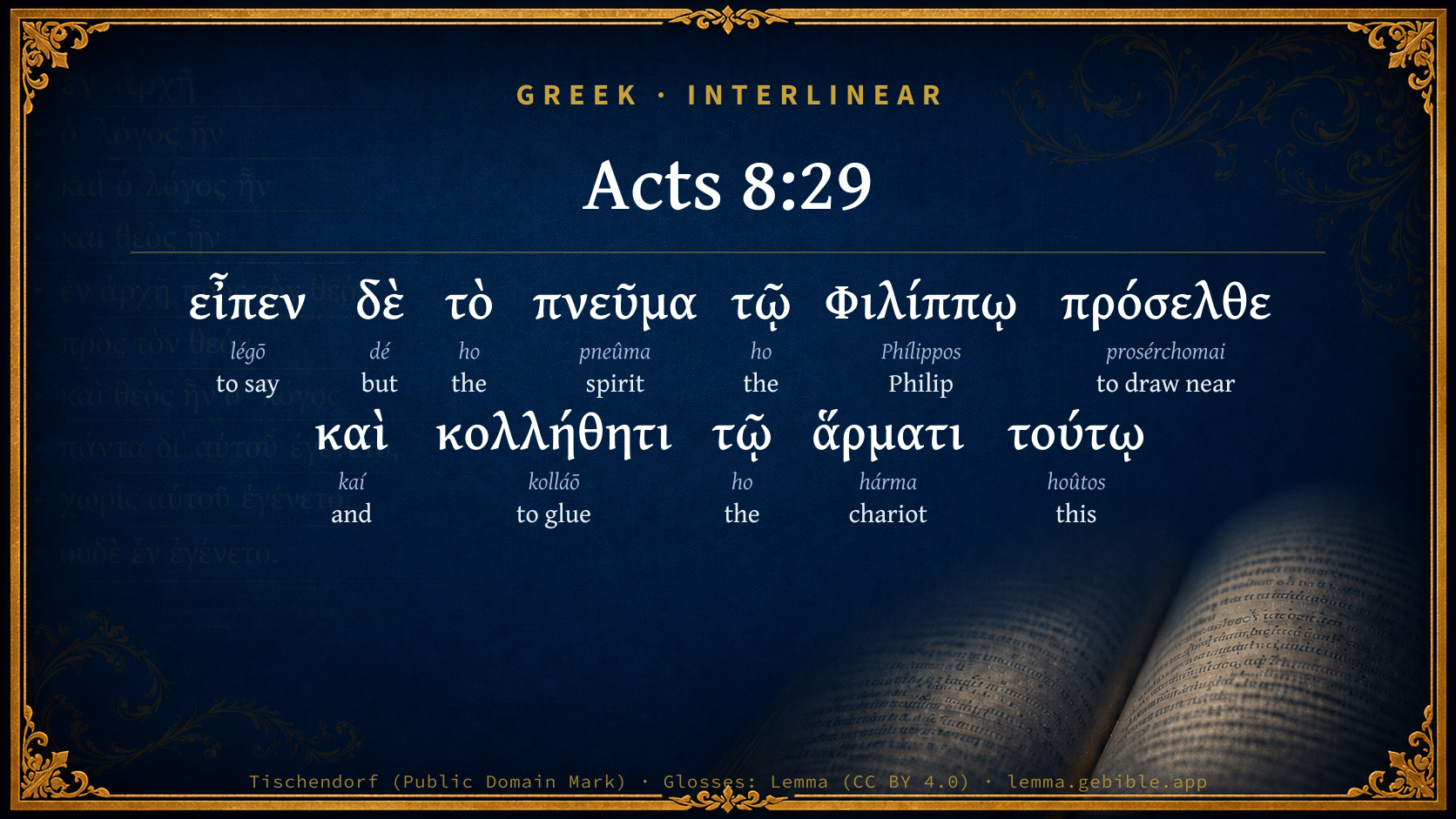
Greek (Tischendorf 8th ed.) Acts 8:29 appears in the Greek New Testament. The text above is from the Tischendorf 8th edition. Each word links to its Strong’s number and a concise gloss. Click any word for its full Thayer’s Greek Lexicon entry.
Download image
Cite this verse

Acts 8:29 (World English Bible). Public Domain. Lemma interlinear Bible study tool, https://lemma.gebible.app/v/acts/8/29.

Show BibTeX & RIS
BibTeX
RIS
English Translation
The Spirit said to Philip, "Go near, and join yourself to this chariot."
World English Bible · Public Domain
Download a study sheet

One document with this verse’s original text, its word-by-word gloss line, the meaning frame, cross-references with their text, attributed commentary, and full source and license credits — printable, and it pastes into notes with its structure intact.

This verse Autodidact and up

Study sheet (.html) Plain text (.txt)

A passage Seminary Student

Up to 50 verses in one chapter. A passage sheet keeps up to 6 commentary sources and 12 cross-references per verse, in the order this page ranks them, and says so on the sheet whenever that leaves anything out. Ask for a single verse and you get the Autodidact verse sheet above.

Everything on this page stays free to read, with no account — the sheet is a download of what is already on screen, not access to it.

Want to remove ads? Support Godless Engineer
Compare translations 3

The same verse in 3 English versions, stacked beneath the original-language interlinear above. Click any original word for its lexicon entry.

Each is an independent rendering of the whole verse — the interlinear is not word-aligned to these translations.

Highlighted words mark where these versions differ — a whole-verse word diff, not a word-by-word alignment.

  • World English Bible Public Domain
    The Spirit said to Philip, "Go near, and join yourself to this chariot."
  • King James Version Public Domain
    Then the Spirit said unto Philip, Go near, and join thyself to this chariot.
  • unfoldingWord Literal Text CC BY-SA 4.0
    And the Spirit said to Philip, “Approach and join this chariot.”

unfoldingWord Literal Text — © unfoldingWord, licensed CC BY-SA 4.0. Word-aligned USFM3 via Door43 (git.door43.org/unfoldingWord/en_ult).

Versions to compare (up to 4)

3 of 4 selected

Show all 19 translations

Every available English version of this verse, each an independent rendering of the whole verse.

  • World English Bible Public Domain
    The Spirit said to Philip, "Go near, and join yourself to this chariot."
  • Berean Standard Bible Public Domain
    The Spirit said to Philip, “Go over to that chariot and stay by it.”
  • Majority Standard Bible Public Domain
    The Spirit said to Philip, “Go over to that chariot and stay by it.”
  • King James Version Public Domain
    Then the Spirit said unto Philip, Go near, and join thyself to this chariot.
  • American Standard Version (1901) Public Domain
    And the Spirit said unto Philip, Go near, and join thyself to this chariot.
  • Revised Version (1885) Public Domain
    And the Spirit said unto Philip, Go near, and join thyself to this chariot.
  • Geneva Bible (1599) Public Domain
    Then the Spirit said vnto Philip, Goe neere and ioyne thy selfe to yonder charet.
  • Douay-Rheims (1899) Public Domain
    And the Spirit said to Philip: Go near, and join thyself to this chariot.
  • Young's Literal Translation Public Domain
    And the Spirit said to Philip, `Go near, and be joined to this chariot;'
  • Literal Standard Version CC BY-SA 4.0
    And the Spirit said to Philip, “Go near, and be joined to this chariot”;
  • Unlocked Literal Bible CC BY-SA 4.0
    The Spirit said to Philip, “Go over and stay close to this chariot.”
  • unfoldingWord Literal Text CC BY-SA 4.0
    And the Spirit said to Philip, “Approach and join this chariot.”
  • Darby Bible Public Domain
    And the Spirit said to Philip, Approach and join this chariot.
  • World Messianic Bible Public Domain
    The Spirit said to Philip, “Go near, and join yourself to this chariot.”
  • Webster's Bible Public Domain
    Then the Spirit said to Philip, Go near and join thyself to this chariot.
  • Free Bible Version CC BY-SA 4.0
    The Spirit told Philip, “Go over close to the chariot.”
  • Bible in Basic English Public Domain
    And the Spirit said to Philip, Go near, and get on his carriage.
  • Text-Critical English NT CC BY 4.0
    The Spirit said to Philip, “Go over and join that chariot.”
  • Tyndale New Testament (1534) Public Domain
    Then the sprete sayde vnto Phillip: Goo neare and ioyne thy selfe to yonder charet.

Literal Standard Version (2020), Covenant Press — licensed CC BY-SA 4.0. Text via the HelloAO Bible API (eBible.org). Unlocked Literal Bible (unfoldingWord) — licensed CC BY-SA 4.0. Text via the HelloAO Bible API (eBible.org). unfoldingWord Literal Text — © unfoldingWord, licensed CC BY-SA 4.0. Word-aligned USFM3 via Door43 (git.door43.org/unfoldingWord/en_ult). Free Bible Version, Dr. Jonathan Gallagher — licensed CC BY-SA 4.0. Text via the HelloAO Bible API (eBible.org).

Word by word

More ways to search: Search by grammar → Find every occurrence → Compare this word →

Practice this passage: Drill this verse → Learn its vocabulary →

About this verse

These counts appear in no published source. They are computed here, from the morphology-tagged text and Lemma’s own curated glosses. What Lemma adds →

12
words
10
distinct lemmas
Acts
section

Notable vocabulary

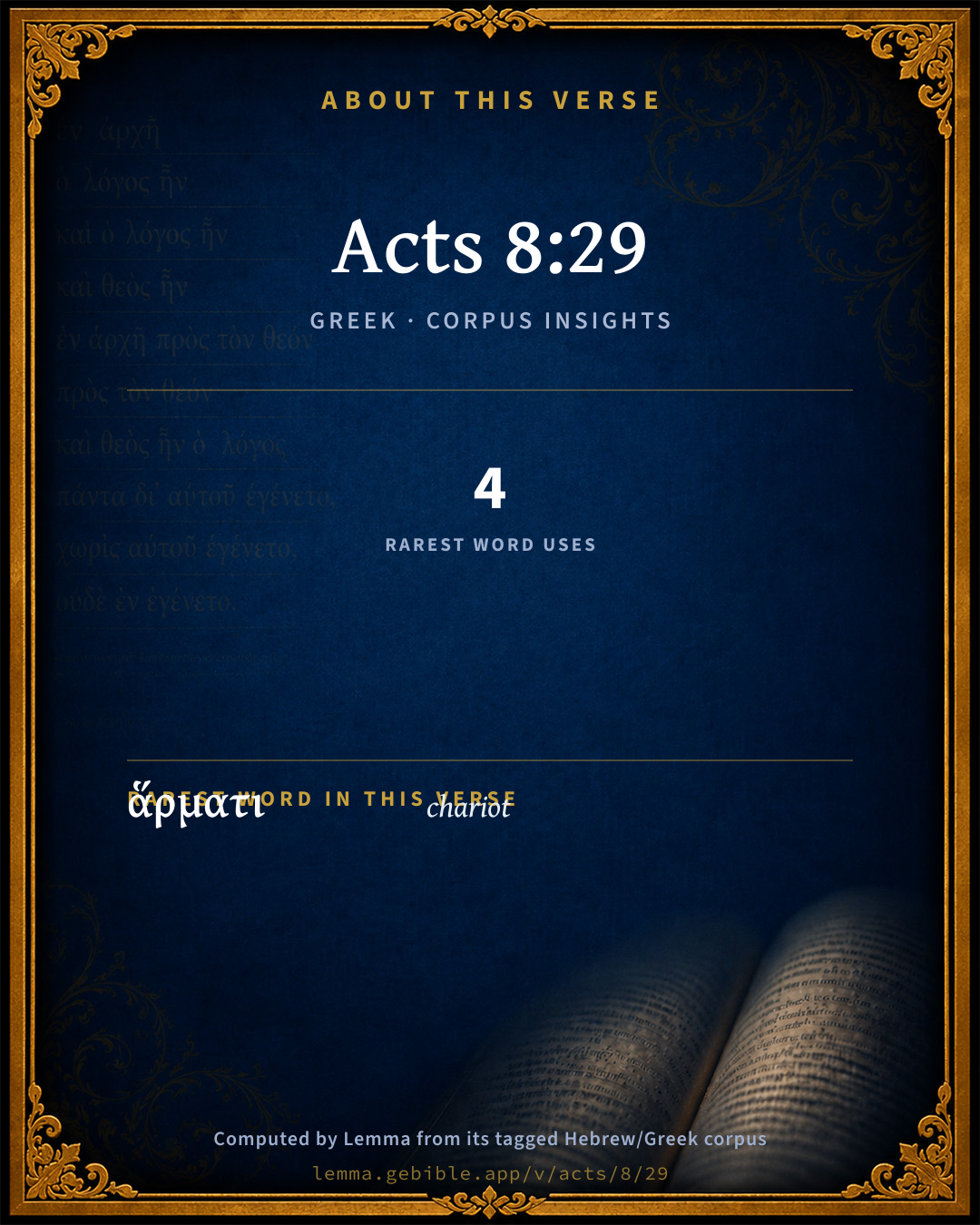
The rarest word here is ἅρματι chariot G716 — appearing just 4 times in the whole Greek New Testament.

Shared distinctive vocabulary

ἅρματι chariot G716 occurs in 4 verses of the Greek New Testament. Also found in:

Repetition

A word recurs within this verse:

Cross-references

10

Topical passages linked to Acts 8:29 in the Treasury of Scripture Knowledge — connected by theme and wording, ordered by reader-vote popularity; previews shown in the World English Bible.

  • Acts 10:19 While Peter was pondering the vision, the Spirit said to him, "Behold, three men seek you.
  • Acts 11:12 The Spirit told me to go with them, without discriminating. These six brothers also accompanied me, and we entered into the man's house.
  • Acts 13:2–4 As they served the Lord and fasted, the Holy Spirit said, "Separate Barnabas and Saul for me, for the work to which I have called them."
  • Acts 20:22–23 Now, behold, I go bound by the Spirit to Jerusalem, not knowing what will happen to me there;
  • Acts 16:6–7 When they had gone through the region of Phrygia and Galatia, they were forbidden by the Holy Spirit to speak the word in Asia.
  • Hosea 6:3 Let us acknowledge Yahweh. Let us press on to know Yahweh. As surely as the sun rises, Yahweh will appear. He will come to us like the rain, Like the spring rain that waters the earth."
  • Acts 21:11 Coming to us, and taking Paul's belt, he bound his own feet and hands, and said, "Thus says the Holy Spirit: 'So will the Jews at Jerusalem bind the man who owns this belt, and will deliver him into the hands of the Gentiles.'"
  • 1 Timothy 4:1 But the Spirit says expressly that in later times some will fall away from the faith, paying attention to seducing spirits and doctrines of demons,
  • Isaiah 65:24 It shall happen that, before they call, I will answer; and while they are yet speaking, I will hear.
  • 1 Corinthians 12:11 But the one and the same Spirit works all of these, distributing to each one separately as he desires.

Cross-references courtesy of OpenBible.info (CC BY 4.0).

Commentary

Notes on Acts 8:29 from classic Christian and Jewish commentators (each source and its license shown beneath its notes). The classic Christian expositions comment on the surrounding passage and are grouped to its opening verse, so a note may address several verses; the Jewish commentaries on the Tanakh (Rashi and others) are per-verse, so they appear only where the commentator wrote on this verse.

Lemma curates 59 commentaries, every one of them public domain or Creative Commons licensed, each selected and text-cleaned for this edition rather than reprinted as found. About our sources →

The Biblical Illustrator

Joseph S. Exell

Act_8:29

Then said the Spirit to Philip, Go near.

Lessons from the desert ways

These two men were alike in a few respects, but in all others different. Both were travellers, both were stewards, and each had authority. But one was rich, the other poor. One was the steward of a great queen, and returning to her court and to the charge of all her treasure; but the other was going clown to Gaza which is desert, in trust with the gospel ministry and the commission of the Most High. Here is an instance to the point; men were feeling after Christ, in the unsatisfied hunger of the soul. Whatever impression that equipage may have made on Philip, as he looked, he was greatly in error if he thought, Here is probably a haughty man of the world! Appearances deceive. The humble and meek may be in kings courts; under the robe of wealth and state may beat a heart uncorrupt before God. This person, for example, had the charge of vast earthly treasure, and yet his thoughts are far away; he is meekly reading the Word of life, and seeking the pearl of great price. (Morgan Dix, D. D.)

Guidance in doing good

There was an unseen chance of serving a fellow-man down in a distant desert. Christ offered that chance to this Christian preacher. If a true believers heart is alert, and his temper willing, the Lord will surely put him and keep him in the way of doing good. Only he must watch for heavenly providences to summon him, and instantly obey.

I. No exertion should be considered too difficult, no prospect too discouraging, if doing good is our purpose. Philip cheerfully started to go sixty or seventy miles just to save a single soul. He arose and went. Sprang to meet the command. On the other hand the eunuch traversed more than half a continent to render God worship and find peace.

II. Sometimes the Holy Spirit chooses the best people in the unlikeliest places. Christ had saints in Caesars household and Herods family; so there was a seeker after truth in the court of Ethiopia.

III. Religious convictions are of inestimable value, and ought to be cherished as we would cherish life itself. The eunuch had been all the way, to Jerusalem without any helpful illumination of grace. Bat he will net give up without the blessing; so he searches the Scriptures on his way back, in spite of the tediousness of the journey.

IV. It is wrong to be fastidious about opportunities. Wherever souls are, in the desert or not, there let us try to save them.

V. We are never to despise the day of small things. Philip, like our Lord at Sychar, had an audience of one-but he preached notwithstanding.

VI. The measureless worth of a single chance of telling a fellow-being about Jesus Christ. Philip had not met this man before: there is nothing to show that he met him again. A moment lost might have been the loss of a soul.

VII. Courtesy is never lost on anybody in this uneasy and somewhat rough world. A churl would have told this stranger to move on and attend to his own concerns.

VIII. Notice the Ethiopians humility. He was ignorant and acknowledged it. To be conscious of ignorance is the first step to knowledge.

IX. Whoever desires to no good must find out where the Spirit is leaning him, and simply and humbly follow on.

X. Watch even chariots passing by. (C. S. Robinson, D. D.)

The meeting

Marriages, they say, are made in heaven; i.e., the steps of two, both being Gods dear children, are so directed that after each has passed over many windings, the two paths converge, and the two lives meet and melt into one like two rivers, flowing thenceforth one broader, deeper, stronger stream. Meetings that are of shorter duration, and partnerships that are less intimate, come under the same rule. It is not in man that walketh to direct his steps. If Gods purposes in creation require the meeting of two circling worlds, He will so arrange that the two shall touch at the very point of space and time which He has designed. The same might and wisdom have been at work to arrange a meeting wherever one earthen vessel charged bears Christ, and another empty receives Christ at a brothers hand. This case is recorded as a specimen of the Lords way. Such meetings occur now, and ye know not the day nor the hour when the messenger sent by God to meet you may heave in sight--in church, street, lonely path, or home. Those who desire to meet him will not miss him. Though the place was desert and the path dimly traced, and the time not told at all, Philip and the Ethiopian met with all the exactitude of tides and seasons. These meetings, long prepared and wisely arranged, are sometimes lost through obstinate unbelief. What a meeting was that between Paul and Felix! How far up the lines of preparation for it ran; and how skilfully they were held by God until the missionary and the ruler met! Now, Felix, or never. Go thy way, etc. Fool! You will never get another. He thought he was only politely putting off the Christian: in reality he was rudely rejecting Christ. To lose such a meeting may be to lose your soul. Philip ran to meet the eunuch. Hitherto he had walked, perhaps slowly. So when two objects attract each other by hidden magnets, their mutual motion towards a meeting is scarcely perceptible at first; but when they have approached near the movement quickens, and they traverse the rest of the space at a rush. (W. Arnot, D. D.)

A providential meeting

At one of Mr. Moodys meetings in Belfast, the Rev. Wesley Guard mentioned an incident of which he said the facts had just been related to him. It was to the effect that a farmer, living three miles out in the country, wanted to come into the meeting one day, but was unexpectedly detained, and did not know how he would get there in time. He started, and presently he heard a car coming behind him. When it came up the vehicle was stopped, and the man said to the driver, Thank you, sir, for giving me a lift. I did not offer you a lift; but as the horse stopped you had better get up. The farmer got up, and they drove on. After a little conversation the driver confessed that he was in great distress about his soul, and the tears began to fall. The good man told him the way of life, and there and then as they journeyed on the car the gentleman found salvation. Said he, I can see now why the horse stopped; it was that I might get into the light.

Little events leading to great

In walking across Alpine glaciers, travellers often come upon narrow and apparently insignificant fissures, that seem to be merely superficial cracks; while the guides know that, if one but sounds them, they shall be found sinking down, fathom after fathom, to the very bottom, and sometimes, though small to the eye externally, they are cavernous, and at the bottom torrents rush and roar in silence, for so far down are they, and so in covered, that their angriest noises are smothered. It is just so in human life. The most insignificant incidents often lead to great events. Often, if we hear Gods voice in the small matters of life, and obey His commands, we shall find that we are led on to great things. Philip was told in what direction to go, and by going in that particular direction he met the Ethiopian, and was able to lead him to Christ.

A timely visit

It is recorded of Mr. Dod, one of the Puritan ministers, that being one night late in his study, his mind was strongly inclined, though he could assign no reason for it, to visit a gentleman of his acquaintance at a very unseasonable hour. Not knowing the design of Providence, he obeyed and went. When he reached the house, after knocking a few times at the door, the gentleman himself came, and inquired if he wanted him upon any particular business. Mr. Dod, having answered in the negative, and signified that he could not rest till he had seen him, the gentleman replied, Oh, sir, you are sent of God at this very hour, for I was just now going to destroy myself, and immediately pulled the halter out of his pocket by which he had intended to commit the horrid deed, which was thus prevented.

The Biblical Illustrator, edited by Joseph S. Exell (c. 1880s–1900s) — public domain. Text from a community e-Sword module.

Joseph Benson's Commentary

Act 8:29-31. Then the Spirit — By that secret suggestion which inspired persons could distinguish with certainty as divine revelation; said to Philip, Go near — Now Philip shall know the reason of his being sent into a desert; join thyself to this chariot — Enter into conversation with the person who sits in it, without fear of offending him, or exposing thyself to any inconvenience. And Philip ran to him — Ran up to the chariot; and heard him read — For he read aloud, both that his own mind might be more deeply impressed with what he read, and that his servants, who were near, might receive some benefit by it. And Philip, being well acquainted with the Holy Scriptures, soon perceived that the book in which he read was that of the Prophet Isaiah, and that the passage he was reading would give him a very proper opportunity of entering into discourse with him concerning Christ, and delivering to him that evangelical message with which he was charged. He therefore took occasion to begin the conversation from this circumstance, saying to the eunuch, Understandest thou what thou readest? — This question Philip puts to him, not by way of reproach, but with a design to offer him his service, and lead him into the true knowledge of the important prophecy which now engaged his attention. Observe, what we read and hear of the word of God, it highly concerns us to understand; especially what we read and hear concerning Christ; and therefore we should often ask ourselves whether we understand it or not. Philip did not begin about the weather, news, or the like. In speaking for God, we may frequently come to the point at once without circumlocution. And he said, How can I — The eunuch was so far from being offended at the freedom Philip took, that he mildly and respectfully said in reply, How should I understand such obscure oracles as these, except some man should guide me — Unless some person, better acquainted with the contents of them than I am, should throw that light upon them which I, who am so much a stranger to the Jewish affairs, must necessarily be destitute of. And he desired Philip to come up and sit with him — Inferring from the question he put, that he was better acquainted with these things than himself. Here we see a remarkable instance of the providence and grace of God. This great man had been at Jerusalem, where the apostles were preaching the Christian faith, and multitudes professing it, and yet there he had taken no notice of it, and made no inquiries after it; nay, it seems had slighted it, and turned his back upon it. Yet the grace of God pursues him, overtakes him in the desert, and there converts him. Thus God is often found of those that sought him not!

Joseph Benson's Commentary on the Old and New Testaments (1811–1818) — public domain. Text from a community e-Sword module.

Tyndale Open Study Notes

Tyndale Open Resources

8:29 The Holy Spirit guides the servants of God in where, when, and what to preach, teach, or do (9:15; 10:19-20; 11:12; 16:6; 1 Cor 2:13; 1 Pet 1:12).

Tyndale Open Study Notes — © Tyndale Open Resources, licensed CC BY-SA 4.0. Text via the HelloAO Bible API.

Bengel's Gnomon

Johann Albrecht Bengel

Act 8:29. Εἶπε, said) The Holy Spirit is therefore a Person: ch. Act 1:16, Act 10:19-20, Act 13:2, Act 21:11 [in all which passages the Holy Ghost is represented speaking as a Person].

Bengel's Gnomon of the New Testament — English translation (T&T Clark, Edinburgh, 1860) — public domain. Text from a community e-Sword module.

Expositor's Greek Testament

ed. W. Robertson Nicoll

Act 8:29 . τὸ πνεῦμα εἶπεν : nothing inconsistent with the previous statement that an angel had spoken to him, as Weiss supposes by referring the angel visit to a reviser. There was no reason why the angel should accompany Philip, or reappear to him, whilst the inward guidance of the Spirit would be always present, as our Lord had promised. κολλήθητι , cf. Act 5:13 , in Acts five times, and in each case of joining or attaching oneself closely to a person, of social or religious communion with a person, twice in Luke’s Gospel, cf. Act 15:15 for its sense here, and elsewhere only once in the Evangelists, Mat 19:5 , and that in a quotation, Gen 2:24 , cf. its use three times in St. Paul, Rom 12:9 , 1Co 6:16-17 . In classical Greek similar usage, and cf. LXX, Rth 2:8 , Sir 2:3 ; Sir 19:2 , 1MMal 3:2 ; 1Ma 6:21 , etc. Hebrew דָּבַק , see Wetstein on Act 10:28 .

The Expositor's Greek Testament, edited by W. Robertson Nicoll (1897–1910) — public domain. Text from a community e-Sword module.

Jamieson, Fausset & Brown

Robert Jamieson, A. R. Fausset & David Brown

the Spirit said--by an unmistakable voice within, as in Act 10:19; Act 16:6-7.

go near and join this chariot--This would reveal to Philip the hitherto unknown object of his journey, and encourage him to expect something.

Jamieson, Fausset & Brown — Commentary Critical and Explanatory on the Whole Bible (1871) — public domain (CC PDM 1.0). Text via the HelloAO Bible API.

Adam Clarke's Commentary

Verse 29. Then the Spirit said unto Philip] This holy man having obeyed the first direction he received from God, and gone southward without knowing the reason why, it was requisite that he should now be informed of the object of his mission: the Spirit said unto him, go near, and join thyself, c. The angel who had given him the first direction had departed and the influence of the Holy Spirit now completed the information. It is likely that what the Spirit did in this case was by a strong impression on his mind, which left him no doubt of its being from God.

Adam Clarke's Commentary on the Bible (1810–1826) — public domain. Text from a community e-Sword/MySword module.

Ellicott's Commentary for English Readers

(29) Join thyself to this chariot.—The act implied is that of laying hold and, as it were, attaching himself to the chariot in which the eunuch rode.

A Bible Commentary for English Readers, edited by Charles John Ellicott (1878–1897) — public domain. Text from a community e-Sword module.

The Cambridge Bible for Schools and Colleges

gen. ed. J. J. S. Perowne

29. Then [And] the Spirit said unto Philip] i.e. by a prompting from within.

Go near, and join thyself to this chariot] No doubt this royal treasurer had a numerous retinue, and a single traveller on a desert road would be doing what was natural in attaching himself to a train of people who were journeying in the same direction. Philip would therefore be able to approach and hear what was read without being deemed an intruder.

The Cambridge Bible for Schools and Colleges (gen. ed. J. J. S. Perowne; Cambridge University Press, 1878–1918) — public domain. Text from a community e-Sword module.

John Gill's Exposition

And Philip ran thither to him,.... Being very ready to obey the divine order, and hoping he might be an instrument of doing some good, which might issue in the glory of God, and the welfare of men:

and heard him read the prophet Esaias; that is, "the Book of Isaiah the Prophet"; as before; and so the Ethiopic and Arabic versions read here, as there: he read it out, with a clear and distinct voice, so that Philip could hear him; and this he did, partly through reverence to the word of God, and partly to fix his attention to it the more, that he might the better understand and remember it, and also for delight and pleasure: it is very likely, that it was the Book of Isaiah in the Hebrew tongue in which he was reading, and which language he might understand, though he might be at a loss about the sense of the prophet:

and said, understandest thou what thou readest? meaning not the language, but the sense; for overhearing him, he perceived it was a prophecy in Isaiah he was reading; which was not so easy to be understood as laws and precepts are, which command this, and forbid that; whereas prophecies were more abstruse, and regarded things to come.

John Gill's Exposition of the Whole Bible (1746–1763) — public domain (CC PDM 1.0). Text via the HelloAO Bible API.

Trapp's Complete Commentary

John Trapp

29 Then the Spirit said unto Philip, Go near, and join thyself to this chariot.

Ver. 29. Then the Spirit said] sc. By revelation, or secret inspiration.

John Trapp, A Commentary or Exposition upon All the Books of the Old and New Testament (1647–1656) — public domain. Text from a community e-Sword module.

Albert Barnes' Notes on the Bible

The Spirit - See the notes on Act 8:26. The Holy Spirit is evidently intended here. The thought in Philip’s mind is here traced to his suggestion. All good thoughts and designs have the same origin.

Join thyself - Join him in his chariot. Go and sit with him.

Albert Barnes' Notes on the Bible (1834–1885) — public domain. Text from a community e-Sword/MySword module.

Matthew Poole's English Annotations

The Spirit said, either by the ministry of an angel, as Act 8:26, or by inspiration immediately by himself.

Go near; so near that you may speak with him that sits in it.

Join thyself to this chariot; stick close unto it, and leave it not.

Matthew Poole's English Annotations on the Holy Bible (1683–1685) — public domain. Text from a community e-Sword/MySword module.

The Pulpit Commentary

And for then, A.V.

The Pulpit Commentary (1880–1919), ed. H.D.M. Spence-Jones & Joseph S. Exell — public domain. Text from a community e-Sword module.

Kretzmann's Popular Commentary

Paul E. Kretzmann

The text from Isaiah:

v. 29. Then the Spirit said unto Philip, Go near and join thyself to this chariot.

v. 30. And Philip ran thither to him, and heard him read the Prophet Esaias, and said, Understandest thou what thou readest?

v. 31. And he said, How can I except some man should guide me? And he desired Philip that he would come up and sit with him.

v. 32. The place of the Scripture which he read was this, He was led as a lamb to the slaughter; and like a lamb dumb before his shearer, so opened He not His mouth;

v. 33. in His humiliation His judgment was taken away; and who shall declare His generation? For His life is taken from the earth.

Philip had followed the command of the angel; he had gone to the place to which he was directed, and was ready for further directions. These were given him by the prompting of the Spirit telling him to stay near the chariot as it moved along, within earshot or easy hailing distance. And as Philip ran toward the chariot, he could hear the words which the eunuch was reading to himself, and recognize the passage from which they were taken. The question with which he introduced himself was not an impertinent form of address, as has been stated, but one calculated to draw out the religious position and conviction of the man: Dost thou really understand what thou readest? It is a question which all Bible readers ought to keep in mind; for there is far too much superficial reading of mere words instead of the earnest attempt to get the connection and meaning of every passage. The answer was: How do you suppose I should be able to if no one shows me the way? This does not imply that the Bible cannot be understood without hierarchical interpretation, but simply shows that a beginner in the study of the Word, one that has not yet carefully compared prophecy and fulfillment, will do well to have the aid of some help in comparing parallel passages and in pointing out the connection. The few really dark passages in the Bible are due to our lack of adequate knowledge of the original tongues and similar reasons; but none of these passages concerns any assurance of the salvation of souls or any other fundamental doctrine. The eunuch now earnestly invited Philip to have a seat at his side in the chariot. The passage which was just then troubling the reader was the beautiful section from Isa 53:7-8. There it is said of the Messiah that He was led like a sheep to the slaughter, that, as a lamb before the shearer is voiceless, so He opened not His mouth. It was written of the great Lamb of God, in His ministry of taking away the sins of the world. In His humiliation His judgment was taken away: in His oppression, when the wrath of the Father had struck Him as the Substitute for all mankind, the full judgment was carried out upon Him, and thus we need no longer fear judgment and condemnation, their force was exhausted in the Christ. His generation who shall declare?: He has been exalted into heaven, and now, even according to His humanity, has no end of His days, has eternal glory in His possession; for His life is taken away from the earth: it was taken from Him suddenly, by the murderous death on the cross; but the result was eternal salvation, final glorification in the interest of His believers. This was the Gospel of the Old Testament, a beautiful and clear account of the Messiah’s sacrifice, but hidden before the eyes of the eunuch, because he did not know the fulfillment.

Paul E. Kretzmann, Popular Commentary of the Bible (1921–1924) — public domain. Text from a community e-Sword module.

McGarvey & Pendleton's Commentaries

J. W. McGarvey

29. Just as Philip entered the road to which he had been directed by the angel, and saw the chariot before him, the Holy Spirit began to work for the conversion of the treasurer. And where does he begin his work? In the heart of the sinner, by direct communication? No. Like the angel, he begins with the preacher. (29) " Then the Spirit said to Philip, Go near, and join yourself to this chariot. " This was a miraculous communication from the Spirit, such as frequently directed the labors of inspired men. The object of it was the same as that of the angel's visit, to bring the preacher and the subject for conversion face to face.

J. W. McGarvey (with Philip Y. Pendleton), Commentaries on the New Testament (The Fourfold Gospel, 1914; Acts; and the epistles) — public domain. Text from a community e-Sword/MySword module.

The People's New Testament

B. W. Johnson

29, 30. The Spirit said. How we are not told. Philip promptly obeyed, ran to the chariot, listened and heard what he read, and then asked his question, the result of which was that he was asked to take his place in the chariot to explain the Scripture.

B. W. Johnson's The People's New Testament with Notes (1889–1891) — public domain. Electronic text from the Christian Classics Ethereal Library (CCEL) ThML edition.

unfoldingWord translationNotes

Door43 World Missions Community

stay close to this chariot

Philip understood that this meant he was to stay close to the person riding in the chariot. AT: "accompany the man in this chariot" (See: Metonymy)

reading Isaiah the prophet

This is the Old Testament book Isaiah. AT: "reading from the book of the prophet Isaiah" (See: Metonymy)

Do you understand what you are reading?

The Ethiopian was intelligent and could read, but he lacked spiritual discernment. AT: "Do you understand the meaning of what you are reading?"

How can I, unless someone guides me?

This question was asked to state emphatically that he could not understand without help. AT: "I cannot understand unless someone guides me" (See: Rhetorical Question)

He begged Philip to ... sit with him

It is implied here that Philip agreed to travel down the road with him to explain the scriptures. (See: Assumed Knowledge and Implicit Information)

translationWords

Holy Spirit

Philip, the evangelist

chariot

Isaiah

prophet

Ethiopia

unfoldingWord translationNotes — © Distant Shores Media and the Door43 World Missions Community, licensed CC BY-SA 4.0. Source: git.door43.org/Door43/en_tn.

Cambridge Greek Testament for Schools and Colleges

29. εἶπεν δὲ τὸ πνεῦμα τῷ Φιλίππῳ, and the Spirit said unto Philip, i.e. by some inward prompting.

πρόσελθε καὶ κολλήθητι κ.τ.λ., go near and join thyself to this chariot. No doubt this royal treasurer had a numerous retinue, and a single traveller on a desert road would be doing what was natural in attaching himself to a train of people who were journeying in the same direction. Philip would therefore be able to approach and hear what was read without being deemed an intruder.

Cambridge Greek Testament for Schools and Colleges (Cambridge University Press, 1896; 21 vols, various authors incl. Carr, Maclear, Plummer, Farrar, Lumby, Moule, M. R. James, Simcox) — public domain. Text from a community e-Sword module.

Alford’s Greek Testament

Henry Alford

29.] This is the first mention of that inner prompting of the Spirit referred to again, probably ch. 13:2, but certainly ch. 10:19; 16:6, 7. Chrysostom understands the words of the appearance of an angel, but the text hardly allows it.

κολλ.] no stress—attach thyself to.

Henry Alford, The Greek Testament (1849–1861) — public domain. Text from a community e-Sword module.

Vincent's Word Studies in the New Testament

Marvin R. Vincent

Join thyself [κολληθητι] . See on Luk 14:15; Luk 10:11; Act 5:12.

Marvin R. Vincent, Word Studies in the New Testament (1887–1900) — public domain. Text from a community e-Sword/MySword module.

Lesson kit

Teaching starters — assembled from the data on this page, not authored interpretation. Every prompt links to the verse data it draws on. Edit before teaching.

Acts, in the Acts, opens this verse with 12 words (10 distinct Greek lemmas). Its most distinctive word is hárma (“chariot”). A historical commentator’s framing appears above. Read the whole chapter for the surrounding context.

Discussion questions

  1. The word hárma carries the sense “chariot.” How does it shape the verse?
  2. Acts 8:28 shares the word «chariot» with this verse. How do the two illuminate each other?
  3. “the” occurs 3× in this one verse. What is the effect of the repetition?
  4. These translations render this verse differently; the difference is in the English rendering, not the original. What questions does that raise?
  5. Reading how The Biblical Illustrator and Joseph Benson's Commentary read this verse, where do the two commentators agree and where do they part?

Things to notice

Reading settings

Reading text

Shown beneath each verse's original-language words.

Old Testament
Old Testament edition

Read the OT as the Masoretic Hebrew (MT) or the Greek Septuagint (LXX).

English shown for the Greek Septuagint (in the Hebrew ↔ Greek comparison).

Comparing translations? Open the Compare panel on any verse page to stack up to four side by side.