Romans 8:11

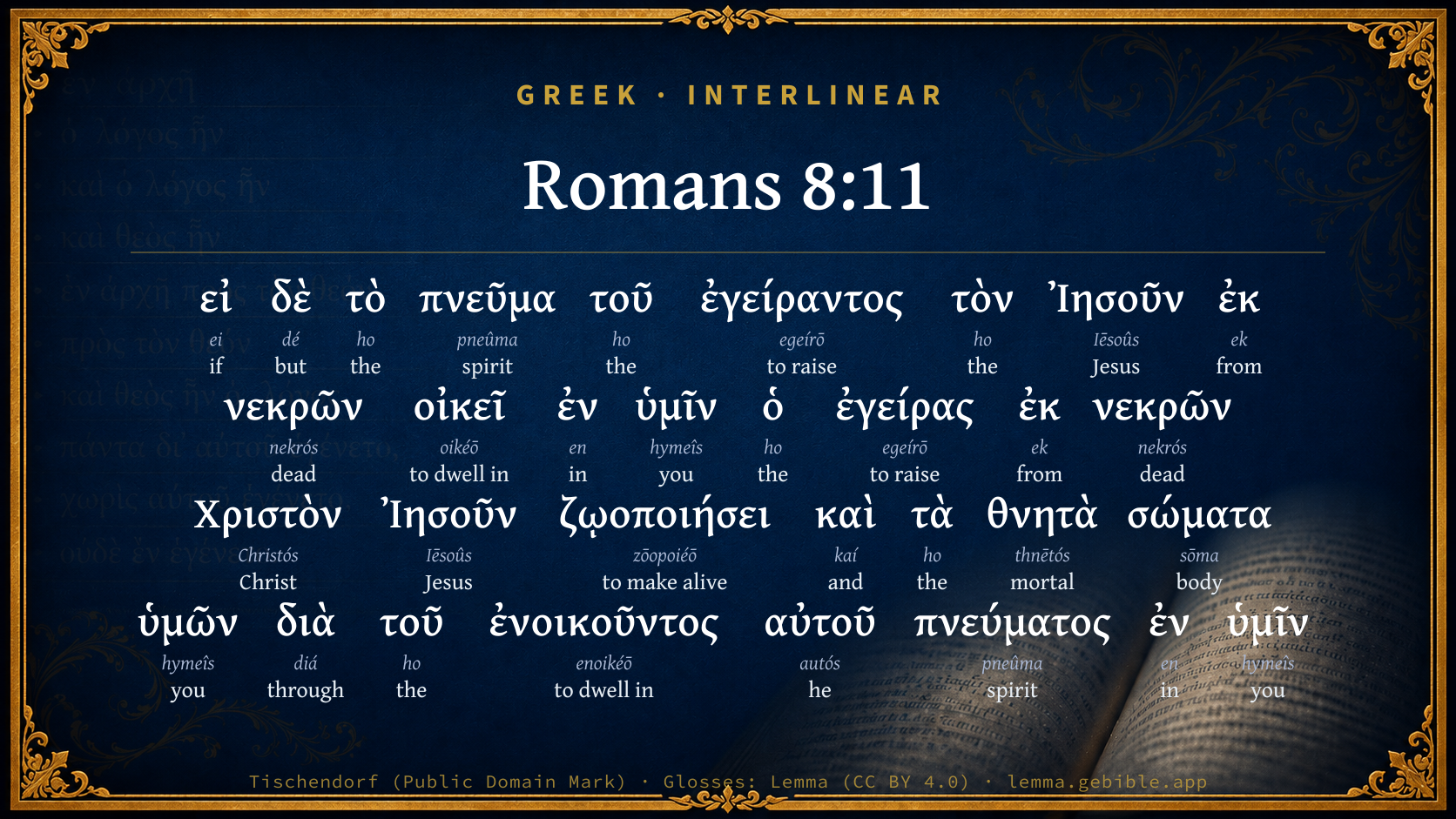
Greek (Tischendorf 8th ed.) Romans 8:11 appears in the Greek New Testament. The text above is from the Tischendorf 8th edition. Each word links to its Strong’s number and a concise gloss. Click any word for its full Thayer’s Greek Lexicon entry.
Download image
Cite this verse

Romans 8:11 (World English Bible). Public Domain. Lemma interlinear Bible study tool, https://lemma.gebible.app/v/romans/8/11.

Show BibTeX & RIS
BibTeX
RIS
English Translation
But if the Spirit of him who raised up Jesus from the dead dwells in you, he who raised up Christ Jesus from the dead will also give life to your mortal bodies through his Spirit who dwells in you.
World English Bible · Public Domain
Download a study sheet

One document with this verse’s original text, its word-by-word gloss line, the meaning frame, cross-references with their text, attributed commentary, and full source and license credits — printable, and it pastes into notes with its structure intact.

This verse Autodidact and up

Study sheet (.html) Plain text (.txt)

A passage Seminary Student

Up to 50 verses in one chapter. A passage sheet keeps up to 6 commentary sources and 12 cross-references per verse, in the order this page ranks them, and says so on the sheet whenever that leaves anything out. Ask for a single verse and you get the Autodidact verse sheet above.

Everything on this page stays free to read, with no account — the sheet is a download of what is already on screen, not access to it.

Want to remove ads? Support Godless Engineer
Compare translations 3

The same verse in 3 English versions, stacked beneath the original-language interlinear above. Click any original word for its lexicon entry.

Each is an independent rendering of the whole verse — the interlinear is not word-aligned to these translations.

Highlighted words mark where these versions differ — a whole-verse word diff, not a word-by-word alignment.

  • World English Bible Public Domain
    But if the Spirit of him who raised up Jesus from the dead dwells in you, he who raised up Christ Jesus from the dead will also give life to your mortal bodies through his Spirit who dwells in you.
  • King James Version Public Domain
    But if the Spirit of him that raised up Jesus from the dead dwell in you, he that raised up Christ from the dead shall also quicken your mortal bodies by his Spirit that dwelleth in you.
  • unfoldingWord Literal Text CC BY-SA 4.0
    If indeed the Spirit of the one having raised Jesus from dead ones lives in you, the one having raised Christ Jesus from dead ones will also make alive your mortal bodies through his Spirit living in you.

unfoldingWord Literal Text — © unfoldingWord, licensed CC BY-SA 4.0. Word-aligned USFM3 via Door43 (git.door43.org/unfoldingWord/en_ult).

Versions to compare (up to 4)

3 of 4 selected

Show all 19 translations

Every available English version of this verse, each an independent rendering of the whole verse.

  • World English Bible Public Domain
    But if the Spirit of him who raised up Jesus from the dead dwells in you, he who raised up Christ Jesus from the dead will also give life to your mortal bodies through his Spirit who dwells in you.
  • Berean Standard Bible Public Domain
    And if the Spirit of Him who raised Jesus from the dead is living in you, He who raised Christ Jesus from the dead will also give life to your mortal bodies through His Spirit, who lives in you.
  • Majority Standard Bible Public Domain
    And if the Spirit of Him who raised Jesus from the dead is living in you, He who raised Christ from the dead will also give life to your mortal bodies through His Spirit, who lives in you.
  • King James Version Public Domain
    But if the Spirit of him that raised up Jesus from the dead dwell in you, he that raised up Christ from the dead shall also quicken your mortal bodies by his Spirit that dwelleth in you.
  • American Standard Version (1901) Public Domain
    But if the Spirit of him that raised up Jesus from the dead dwelleth in you, he that raised up Christ Jesus from the dead shall give life also to your mortal bodies through his Spirit that dwelleth in you.
  • Revised Version (1885) Public Domain
    But if the Spirit of him that raised up Jesus from the dead dwelleth in you, he that raised up Christ Jesus from the dead shall quicken also your mortal bodies through his Spirit that dwelleth in you.
  • Geneva Bible (1599) Public Domain
    But if the Spirit of him that raised vp Iesus from the dead, dwell in you, he that raised vp Christ from the dead, shall also quicken your mortall bodies, by his Spirit that dwelleth in you.
  • Douay-Rheims (1899) Public Domain
    And if the Spirit of him that raised up Jesus from the dead, dwell in you; he that raised up Jesus Christ from the dead, shall quicken also your mortal bodies, because of his Spirit that dwelleth in you.
  • Young's Literal Translation Public Domain
    and if the Spirit of Him who did raise up Jesus out of the dead doth dwell in you, He who did raise up the Christ out of the dead shall quicken also your dying bodies, through His Spirit dwelling in you.
  • Literal Standard Version CC BY-SA 4.0
    and if the Spirit of Him who raised up Jesus out of the dead dwells in you, He who raised up the Christ out of the dead will also quicken your dying bodies, through His Spirit dwelling in you.
  • Unlocked Literal Bible CC BY-SA 4.0
    If the Spirit of him who raised Jesus from the dead lives in you, he who raised Christ from the dead will give life also to your mortal bodies through his Spirit, who lives in you.
  • unfoldingWord Literal Text CC BY-SA 4.0
    If indeed the Spirit of the one having raised Jesus from dead ones lives in you, the one having raised Christ Jesus from dead ones will also make alive your mortal bodies through his Spirit living in you.
  • Darby Bible Public Domain
    But if the Spirit of him that has raised up Jesus from among [the] dead dwell in you, he that has raised up Christ from among [the] dead shall quicken your mortal bodies also on account of his Spirit which dwells in you.
  • World Messianic Bible Public Domain
    But if the Spirit of him who raised up Yeshua from the dead dwells in you, he who raised up Messiah Yeshua from the dead will also give life to your mortal bodies through his Spirit who dwells in you.
  • Webster's Bible Public Domain
    But if the Spirit of him that raised Jesus from the dead dwelleth in you, he that raised Christ from the dead will also revive your mortal bodies by his Spirit that dwelleth in you.
  • Free Bible Version CC BY-SA 4.0
    The Spirit of him who raised Jesus from the dead lives in you. He who raised Jesus from the dead will also give life to your dead bodies through his Spirit that lives in you.
  • Bible in Basic English Public Domain
    But if the Spirit of him who made Jesus come again from the dead is in you, he who made Christ Jesus come again from the dead will in the same way, through his Spirit which is in you, give life to your bodies which now are under the power of death.
  • Text-Critical English NT CC BY 4.0
    And if the Spirit of him who raised Jesus from the dead dwells in you, he who raised Christ from the dead will also give life to your mortal bodies because of his Spirit who dwells in you.
  • Tyndale New Testament (1534) Public Domain
    Wherfore if the sprite of him that raysed vppe Iesus from deeth dwell in you: even he that raysed vp Christ from deeth shall quycken youre mortall bodyes because that this sprite dwelleth in you.

Literal Standard Version (2020), Covenant Press — licensed CC BY-SA 4.0. Text via the HelloAO Bible API (eBible.org). Unlocked Literal Bible (unfoldingWord) — licensed CC BY-SA 4.0. Text via the HelloAO Bible API (eBible.org). unfoldingWord Literal Text — © unfoldingWord, licensed CC BY-SA 4.0. Word-aligned USFM3 via Door43 (git.door43.org/unfoldingWord/en_ult). Free Bible Version, Dr. Jonathan Gallagher — licensed CC BY-SA 4.0. Text via the HelloAO Bible API (eBible.org).

Word by word

More ways to search: Search by grammar → Find every occurrence → Compare this word →

Practice this passage: Drill this verse → Learn its vocabulary →

θνητὰ
thnētós
G2349
“mortal”
Adjective, Accusative, Plural, Neuter
Part of Speech
Adjective
Case
Accusative
Number
Plural
Gender
Neuter
Full Thayer's Definition

Origin: from G2348

TDNT: 03:21,3

1. liable to death, mortal
  1. εἰ ei G1487 “if” Conditional
  2. δὲ dé G1161 “but” Conjunction
  3. τὸ ho G3588 “the” Article, Nominative, Singular, Neuter
  4. πνεῦμα pneûma G4151 “spirit” Noun, Nominative, Singular, Neuter
  5. τοῦ ho G3588 “the” Article, Genitive, Singular, Masculine
  6. ἐγείραντος egeírō G1453 “to raise” Verb, Aorist, Active, Participle, Genitive, Singular, Masculine
  7. τὸν ho G3588 “the” Article, Accusative, Singular, Masculine
  8. Ἰησοῦν Iēsoûs G2424 “Jesus” Noun, Accusative, Singular, Masculine
  9. ἐκ ek G1537 “from” Preposition
  10. νεκρῶν nekrós G3498 “dead” Adjective, Genitive, Plural, Masculine
  11. οἰκεῖ oikéō G3611 “to dwell in” Verb, Present, Active, Indicative, 3rd person, Singular
  12. ἐν en G1722 “in” Preposition
  13. ὑμῖν hymeîs G5210 “you” Personal pronoun, 2nd person, Dative, Plural
  14. ὁ ho G3588 “the” Article, Nominative, Singular, Masculine
  15. ἐγείρας egeírō G1453 “to raise” Verb, Aorist, Active, Participle, Nominative, Singular, Masculine
  16. ἐκ ek G1537 “from” Preposition
  17. νεκρῶν nekrós G3498 “dead” Adjective, Genitive, Plural, Masculine
  18. Χριστὸν Christós G5547 “Christ” Noun, Accusative, Singular, Masculine
  19. Ἰησοῦν Iēsoûs G2424 “Jesus” Noun, Accusative, Singular, Masculine
  20. ζῳοποιήσει zōopoiéō G2227 “to make alive” Verb, Future, Active, Indicative, 3rd person, Singular
  21. καὶ kaí G2532 “and” Conjunction
  22. τὰ ho G3588 “the” Article, Accusative, Plural, Neuter
  23. σώματα sōma G4983 “body” Noun, Accusative, Plural, Neuter
  24. ὑμῶν hymeîs G5210 “you” Personal pronoun, 2nd person, Genitive, Plural
  25. διὰ diá G1223 “through” Preposition
  26. τοῦ ho G3588 “the” Article, Genitive, Singular, Neuter
  27. ἐνοικοῦντος enoikéō G1774 “to dwell in” Verb, Present, Active, Participle, Genitive, Singular, Neuter
  28. αὐτοῦ autós G846 “he” Personal pronoun, Genitive, Singular, Masculine
  29. πνεύματος pneûma G4151 “spirit” Noun, Genitive, Singular, Neuter
  30. ἐν en G1722 “in” Preposition
  31. ὑμῖν hymeîs G5210 “you” Personal pronoun, 2nd person, Dative, Plural

About this verse

These counts appear in no published source. They are computed here, from the morphology-tagged text and Lemma’s own curated glosses. What Lemma adds →

32
words
19
distinct lemmas
Pauline Epistles
section

Notable vocabulary

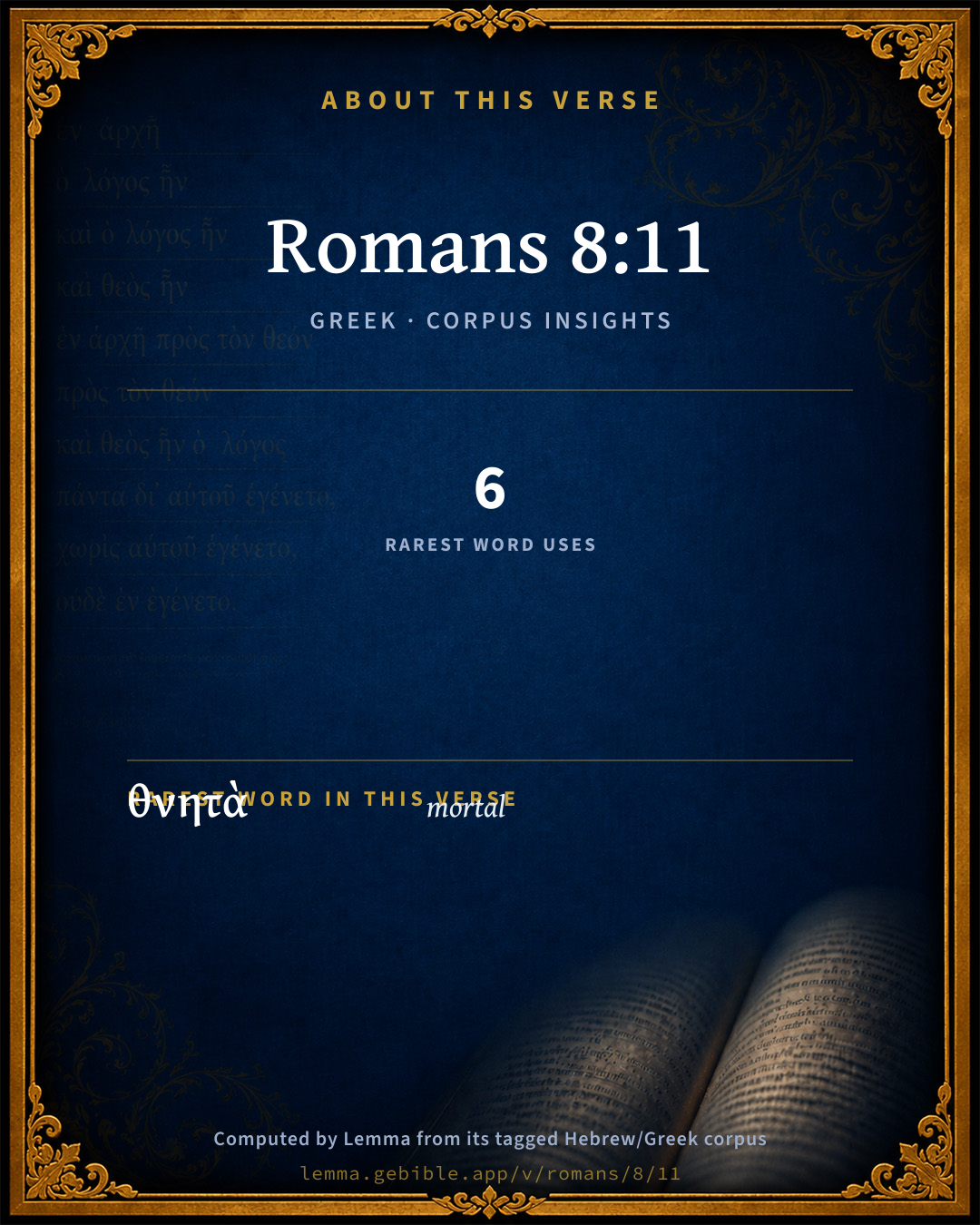
The rarest word here is θνητὰ mortal G2349 — appearing just 6 times in the whole Greek New Testament.

Shared distinctive vocabulary

θνητὰ mortal G2349 occurs in 6 verses of the Greek New Testament. Also found in:

Repetition

Words recur within this verse:

  • πνεῦμα spirit G4151 ×2
  • ἐγείραντος to raise G1453 ×2
  • Ἰησοῦν Jesus G2424 ×2
  • νεκρῶν dead G3498 ×2
  • τὸ the G3588 ×6
  • ὑμῖν you G5210 ×3
  • ἐκ from G1537 ×2
  • ἐν in G1722 ×2

Cross-references

30

Topical passages linked to Romans 8:11 in the Treasury of Scripture Knowledge — connected by theme and wording, ordered by reader-vote popularity; previews shown in the World English Bible.

  • 2 Corinthians 4:14 knowing that he who raised the Lord Jesus will raise us also with Jesus, and will present us with you.
  • Romans 6:4–5 We were buried therefore with him through baptism to death, that just like Christ was raised from the dead through the glory of the Father, so we also might walk in newness of life.
  • 2 Corinthians 4:11 For we who live are always delivered to death for Jesus' sake, that the life also of Jesus may be revealed in our mortal flesh.
  • Ephesians 1:19–20 and what is the exceeding greatness of his power toward us who believe, according to that working of the strength of his might
  • Romans 8:9 But you are not in the flesh but in the Spirit, if it is so that the Spirit of God dwells in you. But if any man doesn't have the Spirit of Christ, he is not his.
  • 1 Corinthians 6:14 Now God raised up the Lord, and will also raise us up by his power.
  • Romans 8:2 For the law of the Spirit of life in Christ Jesus made me free from the law of sin and of death.
  • John 5:21 For as the Father raises the dead and gives them life, even so the Son also gives life to whom he desires.
  • Acts 2:24 whom God raised up, having freed him from the agony of death, because it was not possible that he should be held by it.
  • Philippians 3:21 who will change the body of our humiliation to be conformed to the body of his glory, according to the working by which he is able even to subject all things to himself.
  • 1 Corinthians 15:20–22 But now Christ has been raised from the dead. He became the first fruits of those who are asleep.
  • Ephesians 2:5 even when we were dead through our trespasses, made us alive together with Christ (by grace you have been saved),
  • John 7:38–39 He who believes in me, as the Scripture has said, from within him will flow rivers of living water."
  • Ezekiel 37:14 I will put my Spirit in you, and you shall live, and I will place you in your own land: and you shall know that I, Yahweh, have spoken it and performed it, says Yahweh.
  • Acts 2:32–33 This Jesus God raised up, to which we all are witnesses.
  • Revelation 11:11 After the three and a half days, the breath of life from God entered into them, and they stood on their feet. Great fear fell on those who saw them.
  • Romans 4:24–25 but for our sake also, to whom it will be accounted, who believe in him who raised Jesus, our Lord, from the dead,
  • 1 Thessalonians 4:14–17 For if we believe that Jesus died and rose again, even so those who have fallen asleep in Jesus will God bring with him.
  • John 14:17 the Spirit of truth, whom the world can't receive; for it doesn't see him, neither knows him. You know him, for he lives with you, and will be in you.
  • 1 Peter 1:21 who through him are believers in God, who raised him from the dead, and gave him glory; so that your faith and hope might be in God.
  • 1 Peter 3:18 Because Christ also suffered for sins once, the righteous for the unrighteous, that he might bring you to God; being put to death in the flesh, but made alive in the spirit;
  • 1 Corinthians 15:51–57 Behold, I tell you a mystery. We will not all sleep, but we will all be changed,
  • John 5:28–29 Don't marvel at this, for the hour comes, in which all that are in the tombs will hear his voice,
  • Revelation 1:18 and the Living one. I was dead, and behold, I am alive forevermore. Amen. I have the keys of Death and of Hades.
  • Revelation 20:11–13 I saw a great white throne, and him who sat on it, from whose face the earth and the heaven fled away. There was found no place for them.
  • Isaiah 26:19 Your dead shall live; my dead bodies shall arise. Awake and sing, you who dwell in the dust; for your dew is [as] the dew of herbs, and the earth shall cast forth the dead.
  • Romans 6:12 Therefore don't let sin reign in your mortal body, that you should obey it in its lusts.
  • 1 Corinthians 15:16 For if the dead aren't raised, neither has Christ been raised.
  • Hebrews 13:20 Now may the God of peace, who brought again from the dead the great shepherd of the sheep with the blood of an eternal covenant, our Lord Jesus,
  • 2 Corinthians 5:4 For indeed we who are in this tent do groan, being burdened; not that we desire to be unclothed, but that we desire to be clothed, that what is mortal may be swallowed up by life.

Cross-references courtesy of OpenBible.info (CC BY 4.0).

Where the printed editions differ

1 variant

Places in this verse where the major printed Greek editions disagree on the wording in a way that affects the translation — a comparison of editions, not a manuscript-by-manuscript collation. The editions are the modern critical texts (Nestlé-Aland 28/27, SBL, Westcott-Hort, Tregelles, Tyndale House) and the traditional texts behind the KJV (the Textus Receptus and the Byzantine/Majority text). It is not a claim about which reading is original.

  1. Extra text
    Ἰησοῦν

    “Jesus”

    In SBLWH Not in NA28NA27TynTregTRByz

    Ἰησοῦν (Iēsoun) 'Jesus' is only in a few manuscripts (SBL+WH)

Textual data: Translators Amalgamated Greek New Testament (STEPBible TAGNT) · CC BY 4.0.

Commentary

Notes on Romans 8:11 from classic Christian and Jewish commentators (each source and its license shown beneath its notes). The classic Christian expositions comment on the surrounding passage and are grouped to its opening verse, so a note may address several verses; the Jewish commentaries on the Tanakh (Rashi and others) are per-verse, so they appear only where the commentator wrote on this verse.

Lemma curates 59 commentaries, every one of them public domain or Creative Commons licensed, each selected and text-cleaned for this edition rather than reprinted as found. About our sources →

The Biblical Illustrator

Joseph S. Exell

Rom_8:11

But if the Spirit of Him that raised up Jesus … dwell in you.

The indwelling Spirit

The indwelling of God the Holy Spirit is the common mark of all believers in Christ. It is the shepherds mark of the flock of the Lord Jesus, distinguishing them from the rest of the world. It is the goldsmiths stamp on the genuine sons of God, which separates them from the dross and mass of false professors. It is the kings own seal on those who are his peculiar people, proving them to be his own property. It is the earnest which the Redeemer gives to His believing disciples, while they are in the body, as a pledge of the full redemption yet to come on the resurrection morning. This is the case of all believers. (Bp. Ryle.)

The indwelling Spirit the Raiser of the dead

I. The inhabitation of the Spirit. Dwelling may relate either to a man in his house (1Jn_3:24) or of God in His temple (1Co_6:16). The Spirit buildeth us up for so holy a use, and then dwelleth in us as our Sanctifier, Guide, and Comforter.

1. He sanctifieth and reneweth us (Tit_3:5; Joh_3:6).

2. He guideth and healeth us in the ways of holiness (Rom_15:14; Gal_5:25).

3. He comforts us with the sense of Gods fatherly love and our eternal inheritance (Rom_8:16; 2Co_2:22).

II. Why this inhabitation is the ground of a blessed resurrection.

1. To preserve the order of the personal operations.

(1) The rising from the dead is a work of Divine power (2Co_1:10).

(2) This Divine power belongeth in common to Father, Son, and Holy Ghost, who, being one and the same God, concurred in the same work. We are raised by the Father (text), by Christ (Joh_5:21), by the Spirit (text).

(3) They all concur in a way proper to them. The Holy Ghost is the operative love of God, working from the power of the Father and grace of the Son; and whatever the Father or Son doth, you must still suppose it to be communicated to us by the Spirit.

2. Because the Holy Spirit is the bond of union between us and Christ. We are united to Him, because we have the same Spirit which Christ had; and therefore He will work like effects in you and Him. If the Head rise, the members will follow after.

3. Because the Spirit of sanctification worketh in us that grace which giveth us a right and title to this glorious estate (Luk_20:35-36; Gal_6:8).

4. Because the Spirit abides in us as an earnest (Eph_1:14).

5. Because of His respect to His old dwelling-place (1Co_6:19; 1Th_5:23).

6. Because the great work of the Spirit is to retrench our bodily pleasures, and to bring us to resolve by all means to save the soul, whatever becometh of the body in this world, and to use the body for the service of the Lord Jesus Christ (1Co_6:13; 1Co_6:20; Rom_8:13; Gal_5:16; Gal_5:24; Rom_13:14). (T. Manton, D.D.)

The completing work of the Holy Spirit

The acceptance of Christ does not prevent the death of the body. The destruction of the body by death is complete; but is it destroyed for ever?

1. Infidelity affirms that when you are dead that is the end of you.

2. Science teaches that the substance of the body can never be annihilated.

3. The Bible declares that the body shall be raised up at the last day.

I. The agent. The same power that raised up Jesus.

II. Its order,

1. Regeneration.

2. Sanctification.

3. Resurrection.

III. A complete salvation Christ brings to us.

1. It justifies us before the law.

2. It includes the redemption of the body.

3. It provides for the reunion of body and soul.

4. It establishes personal identity for ever.

5. It makes certain the reunion and recognition of friends throughout eternity.

IV. Present practical bearings.

1. We should now seek after the only possible antidote to spiritual death, with all its glorious provisions for time and eternity. If the Spirit of Christ dwell in us, we have nothing to fear from sin and death.

2. The Spirit comes only to those who welcome His coming and cherish His indwelling. (L. O. Thompson.)

The resurrection of the body

Our attention is not directed to the awakening produced by the trump of the archangel, but to the quickening produced by the Spirit of God. We have to consider here the completion of our freedom from the law of sin and death. Observe--

I. That by the resurrection the last link of the chain of corruption will be finally broken. The work of salvation is an ordered scheme, every step of which is arranged by infinite wisdom. God first uncloses the fingers of sin on the spirit, and at last frees the body from its fatal grasp. The last enemy that shall be destroyed is death. What if the order had been reversed? Why, then the spirit would have been placed beyond that discipline through which its purification is now being carried on. A body fit only for heavenly service would not be fit for earthly pain, sorrow, and death.

II. That this emancipation is to be effected by the Holy Spirit. It is Spirit operating, not on spirit--as in conversion--but on the body. It is the same Spirit, and it follows that it is even part of the same work. The work is effected by the Spirit dwelling in us. There is in the believer a Divine seed, which is destined to break forth from amidst the corruption of the grave into beauteous life.

III. That the resurrection of believers is associated with that of Christ. The relation is that of cause and effect, type and fulfilment, pledge and redemption. Because I live, ye shall live also. (P. Strutt.)

The resurrection maintained

First, to speak of Christs resurrection. If the Spirit of Him that raised up Jesus from the dead. This is a circumlocution whereby we have described unto us God the Father, under this notion of raising up of Christ. For the first, the Person here signified or implied, that is God the Father. Indeed, the whole Trinity of Persons had a share in this performance. But yet it is here ascribed to the Father, as that Person who is usually expressed to be the Fountain of the Godhead, as from whom all the actions of the Deity do originally flow and proceed. The second thing, which is here chiefly considerable, is the action attributed to this Person, and that is, the raising up of Jesus from the dead. Jesus Christ, He is thus risen. This is a main article of our Christian faith. The ground of this dispensation is first of all taken from the nature and condition of Christ Himself, who was such an One as death could not long keep in bondage to itself (Act_2:24). Secondly, He is therefore risen to manifest the completeness of that redemption which He had wrought for us, and to declare us absolved and acquitted in the sight and presence of God (Rom_4:25). The use of this doctrine in hand is especially to oppose it to the scandal and reproach of the Cross. The second is the Spirits inhabitation in those who are the members of Christ. If or forasmuch as this Spirit dwelleth in you. Thus it makes much for the honour and dignity of the servant of God, that He whom the heaven of heavens cannot contain should vouchsafe to take up His residence in such narrow rooms as our hearts. And, further, it also minds us of our duty: so to carry and behave ourselves as fit temples of the Holy Ghost to reside in, and to be continually offering up of sacrifices of praises unto Him. The second, which is principally considerable of us, is the inference in these, He that raised up Christ from the dead shall also quicken your mortal bodies by His Spirit that dwelleth in you. First, to look upon this passage in its simple and absolute consideration, He that raised up Jesus Christ from the dead will also quicken and raise up us, who are, etc. And here, again, two things more: first, the state or condition itself which is here propounded. And that is the resurrection of the saints and true believers. He shall quicken your mortal bodies. Secondly, the conveyance of this state or condition unto them, or the grace of conferring it upon them by or because of His Spirit, which dwelleth in you. First, to speak of the former--viz., the state or condition itself which is here propounded, and that is the resurrection of the saints. He shall quicken your mortal bodies; that is, He shall raise you from death to life. It is that which hath been set forth unto us and shadowed under sundry resemblances--of Aarons dry rod budding forth and flourishing; of the prophet slain by the lion, but not devoured; of Enochs translation; of Elijahs rapture; of Elishas sepulchre reviving a dead man that was cast into it. And it is very suitable and agreeable to reason rightly qualified, though it does not depend upon it. First, to reason that it may be so in regard of the possibility. It is no way opposite or repugnant to this. Let us consider what our bodies were made of and fetched out of at first, and then it will be no difficulty at all. He that thoroughly believes the creation need never to doubt of the resurrection. Could God make the body out of the dust? and cannot He then restore it from the dust? Secondly, it is also in the equity of it, as that which should be; that so there may be an execution of the just judgment of God upon either part of man which hath done either good or evil. Thirdly, it is so also in the necessity of it, as that which must be; and here are divers and sundry things considerable of us as very much making for it. First, from the covenant of grace, I will be thy God, etc. Now to be our God is to be the God of our whole persons; not only of our souls, but of our bodies too (Mat_22:32). Secondly, from the work of redemption, which extends to the destroying of death as the last enemy, and to get the conquest and victory over that. Thirdly, from the resurrection of Christ Himself: He is risen in His body, therefore we also shall rise in ours. Fourthly, from the work of the Spirit. The Spirit of God, which is in us, He does certify and assure us hereof--namely, by these gracious effects of His wrought in our souls; while He raises us from the death of sin, He will also raise us from the death of the grave. He that hath done the one, He is ready also to do the other for us. Hence is the Spirit of God called the earnest and pledge hereof unto us (2Co_5:5). This doctrine of the resurrection is more particularly considerable of us in the expression which is here in the text fastened upon it; whilst it is said that He that raised up Christ from the dead shall also quicken your mortal bodies. And here, again, two things more. First, to speak of the cause of it. He that raised up Christ from the dead; where the resurrection of Christians seems to be made an effect, and consequent of the resurrection of Christ. And so indeed it is, and that according to a threefold influence--first, of merit; secondly, of actual efficacy; and, thirdly, of example. The ground and reason of all is this: because Christ is the Root and Head of all believers, as Adam was of all mankind. And so much may be spoken of the first particular which is here considerable of us, and that is the cause of our resurrection: in these words, He that raised up Christ from the dead. The second is the carriage of it in these: shall quicken your mortal bodies. He shall quicken our mortal bodies by making them absolutely immortal. And so now I have done with the first branch in this second general--to wit, the state or condition itself which is here propounded; and that is the resurrection of the saints and true believers, in these words: He that raised up Christ from the dead shall quicken your mortal bodies. The second is the conveyance of this state and condition unto them, or the ground of conferring it upon them, in these words: By, or because, of His Spirit that, etc., I read it both ways, either by or because, according to the different translation in the text and in the margin, and each of them different, according to different copies in the original. We may, if we please, take it either way. First, take it in the textual translation: By His Spirit that dwelleth in you. Where we see how the dwelling of Gods Spirit in the children of God is the means and cause and conveyance of resurrection to such as are His children. They rise, but they rise by the virtue of the Spirit of God that dwells in them; and that because they rise in reference to their relation to Christ, as we showed before. But, secondly, we may, if we please, take it also in the marginal translation, which is for, or because, of the Spirit that dwelleth in you, as denoting not only the cause from which, but also the reason for which, this resurrection is conferred upon them. First, I say here is that which is implied: that the Spirit of God dwells in the children of God. The second is that which is inferred: that because and in regard of the Spirit of God dwelling in them, therefore their bodies should be raised and restored again to life. This follows from hence, because the Holy Ghost will not quit His own interest, nor lose anything of that which belongs unto Him, which He should do if the bodies of the saints lay still in their graves, or were wholly annihilated and brought to nothing. The second is conditional, or connective with the words which went before in the beginning of the verse: If the Spirit of Him that raised up, etc., where resurrection to eternal life is made dependent upon the inhabitation of the Holy Ghost in such persons as shall so rise, The consideration of this point may be useful to us, to a twofold purpose. First, as matter of comfort to the saints and servants of God. Secondly, here is matter of terror to all wicked and reprobate persons in regard of the different dispensation of it from that of the children of God. First, as to the manner of it. Whereof the one shall be with rejoicing, the other with horror. Secondly, in regard of the end of it. The godly, they rise that they may receive their crown and garland. But the wicked, they rise that they may receive their punishment and torment. Thirdly and lastly, in regard of the cause and proceeding of it. The godly, they rise by virtue of their union with Christ as His members, and by virtue of their relation to the Holy Ghost as His temples; but the wicked, they rise by virtue of Gods curse upon them and designment to everlasting destruction. The godly, they rise by the power of Christ as a Mediator; the wicked, they rise by the power of Christ as a Judge. (Thomas Horton, D.D.)

The Biblical Illustrator, edited by Joseph S. Exell (c. 1880s–1900s) — public domain. Text from a community e-Sword module.

Tyndale Open Study Notes

Tyndale Open Resources

8:11 by this same Spirit: The Holy Spirit is the agent of the resurrection of our bodies. Some manuscripts read “because of the same Spirit,” which would mean that the Spirit is the guarantee that our bodies will be raised (cp. Eph 1:14).

Tyndale Open Study Notes — © Tyndale Open Resources, licensed CC BY-SA 4.0. Text via the HelloAO Bible API.

Bengel's Gnomon

Johann Albrecht Bengel

Rom 8:11. Ἰησοῦν, Jesus) Afterwards in Apodosis, Christ. The name Jesus has respect to Himself; the name Christ has reference to us. The former appellation, as a proper name, belongs to the person; the latter, as an appellative, belongs to the office.—ζωοποιήσει, shall quicken [make alive]) comp. life, Rom 8:6. This life knows no condemnation, Rom 8:1.—διὰ on account of [or by means of]) 2Co 1:22. He is one and the same Spirit, who is the Spirit of Christ, and who is in believers; therefore as Christ lives, so believers shall live: See Appendix. Crit. Ed. ii: on this passage.[90]

[90] ABC and acc. to Dial. c. Maeed. “Several old MSS.,” Memph. and later Syr. Versions read διὰ τοῦ ἐνοικοῦντος—πνεύματος. But D(A)Gfg Vulg. Syr. Theb. Versions, Orig. 2, 534a, and 3, 618c, 812d, Iren. 304, Hil. 803, read δια τὸ ἐνοικοῦν—πνεῦμα. With the accus. the meaning will be on account of the Spirit, etc. with the genit. by or through. Beng. translates it ‘propter.’—ED.

Bengel's Gnomon of the New Testament — English translation (T&T Clark, Edinburgh, 1860) — public domain. Text from a community e-Sword module.

Meyer's Critical & Exegetical Commentary

Heinrich August Wilhelm Meyer

Rom_8:11. According to Rom_8:10, there was still left one power of death, that over the body. Paul now disposes of this also, and hence takes up again, not indeed what had just been inferred (Hofmann, in accordance with his view of τὸ πνεῦμα, Rom_8:10), but the idea conditioning it, εἰ δὲ Χ. ἐν ὑμ.; not, however, in this form, but, as required by the tenor of what he intends to couple with it, in the form: εἰ δὲ τ. πν. τοῦ ἐγειρ. Ἰ. ἐκ νεκρ. οἰκεῖ ἐν ὑμῖν. In substance the two are identical, since the indwelling of the Divine Spirit in us is the spiritual indwelling of Christ Himself in us. See on Rom_8:9.

The δέ, therefore, simply carries on the argument, namely, from the spirit which is ζωή (Rom_8:10), to the quickening that is certain even in the case of the mortal body (for observe the position of the καί). The apostles inference is: The Spirit who dwelleth in you is the Spirit of Him that raised up Jesus; consequently God will also, with respect to your bodies, as dwelling-places of His Spirit, do the same as He has done in the case of Christ. The self-evident presupposition in this inference is, that the Spirit of God dwelt in Jesus during His earthly career (Luk_4:1; Luk_4:14; Luk_4:18; Act_1:2; Joh_3:34; Joh_20:22).

ζωοποιήσει] Not ἐγερεῖ, but the correlate of ζωή, Rom_8:10 (comp. Rom_8:6), and counterpart of νεκρόν and θνητά, is purposely selected. Comp. 1Co_15:22.

θνητά] What he had previously expressed proleptically by νεκρόν, he here describes according to the reality of the present by θνητά. Observe, moreover, that Paul leaves out of view the fate of those still living at the Parousia. Their change is not included in the expression ζωοποιήσει (Hofmann),a view which neither the sense of the word (comp. Rom_4:17; 1Co_15:22; 1Co_15:36; 1Pe_3:18; Joh_5:21) nor the correlation with ἐγείρας permits. But to the readers consciousness of faith it was self-evident from the analogy of what is here said to them with reference to the case of their being already dead at the Parousia; 1Co_15:51; 2Co_5:2-4; 1Th_4:15-17.

On the interchange of Ἰησοῦν and τὸν Χριστόν Bengel rightly remarks: Appellatio Jesu spectat ad ipsum; Christi refertur ad nos; for Jesus as Christ is destined to be the archetype for believers even in an eschatological respect.

διὰ τὸ ἐνοικοῦν κ.τ.λ.] on account of His Spirit that dwelleth in you. Observe the emphatic prefixing of the αὐτοῦ relating to God. How could God, the Raiser up of Christ, who was the possessor of His Spirit, leave the bodies of believers, which are the dwelling-places of the same Spirit, without quickening? The more characteristic ἐνοικοῦν (previously it was only οἰκεῖ) is a climax to the representation.

Köllners explanation may serve to exemplify the conception of our passage in an ethical sense (Erasmus, Calvin, and many others): So will He who raised up Jesus from the dead bring to life also your bodies that are still subject to death (sin and misery), that is, ennoble also your sensuous nature and so perfect you entirely. But even apart from this arbitrary interpretation given to the simple θνητά (which ought rather with van Hengel to be interpreted: quamquam mortalia ideoque minoris numeri sunt), how diffuse and verbose would be the whole mode of expressing the simple thought! How utterly out of place this dualism, of the representation, as if the divine work of the moral revivification of the body were something independent, alongside of and subsequent to that of the spirit! See, moreover, generally on Rom_8:10, and the appropriate remarks of Reiche, Commentar crit. I. p. 62 ff. Lastly, according to de Wettes combination of the two sensesthe moral and the physicalthe thought is: This death-overcoming Spirit of God shall destroy more and more the principle of sin and death in your bodies, and instead of it introduce the principle of the life-bringing Spirit into your whole personality, even into the body itself,a thought which opens up the prospect of the future resurrection or change of the body. But the resurrection will be participated in by all believers at once, independently of the development noticed in our passage, by which their bodies would have first to be made ripe for it; and even the change of the living at the Parousia is, according to 1Co_15:51 ff., not a process developed from within outwardly, but a result produced in a twinkling from without (at the sound of the last trumpet),a result, which cannot be the final consequence of the gradual inward destruction of the principle of sin and death, because in that case all could not participate in it simultaneously, which nevertheless is the case, according to 1Co_15:51. Notwithstanding, this view, which combines the spiritual and bodily process of glorification, has been again brought forward by Philippi, according to whom what is here meant is the progressive merging of death into life, which can only be accomplished by the progressive merging of sin into the righteousness of life, and of the σῶμα into the ΠΝΕῦΜΑ (?). The simple explanation of the resurrection of the body is rightly retained by Tholuck, Umbreit, Hofmann, Weiss, and others: whilst Ewald contents himself with the indeterminate double sense of eternal life beginning in the mortal body.

Meyer — Critical and Exegetical Commentary on the New Testament — English translation by Peter Christie, edited by Frederick Crombie (T&T Clark, 1880) — public domain. Text from a community e-Sword module.

Expositor's Greek Testament

ed. W. Robertson Nicoll

Rom 8:11 . But though the present results of the indwelling of the spirit are not all we might desire, the future is sure. The indwelling spirit is that of Him who raised Jesus from the dead, and as such it is the guarantee that our mortal bodies also (as well as our spirits) shall share in immortality. The same argument, in effect, is used in Eph 1:18-20 . “The power that worketh in us” is the same with which “God wrought in Christ when He raised Him from the dead and set Him at His own right hand in the heavenly places”; and it will work to the same issue in us as in Him. The reading in the last clause is very doubtful, but whether we take the accus. (according to which the indwelling of the spirit is the ground on which God raises our mortal bodies to undying life) or the genit. (according to which the spirit is itself the agent in this resurrection a conception not found elsewhere in Scripture), in either case a share in the Christian resurrection is conditioned by the possession of the Spirit of Christ. It is clear from the alternation of πνεῦμα θεοῦ and πνεῦμα χριστοῦ in Rom 8:9 that the Spirit of Christ is the same as the Spirit of God, and the use of χριστὸς alone in the next verse shows that this same spirit is the alter ego of Christ. Cf. Phi 1:19 ; Gal 4:6 ; Eph 3:17 . This is one of the passages in which the presuppositions of the Trinitarian conception of God come out most clearly.

The Expositor's Greek Testament, edited by W. Robertson Nicoll (1897–1910) — public domain. Text from a community e-Sword module.

Godet's Commentaries

Frédéric Louis Godet

Vv. 11. “Now, if the Spirit of Him that raised up Jesus from the dead dwell in you, He that raised up Christ Jesus from the dead shall quicken also your mortal bodies, because of His Spirit that dwelleth in you.”

The δέ, now, denotes the progress of the life which, after penetrating the spirit, takes hold even of the body. That body in which, as well as in Jesus, the Spirit of God has dwelt, will be judged worthy of the same honor as the body of Jesus Himself.

In the first proposition the apostle uses the name Jesus, because the reference is to His person merely; in the second he says Christ, or Christ Jesus, because the subject in question is the office He fills as Mediator between God and us. As Hofmann remarks, the personal resurrection of Jesus merely assures us that God can raise us; but His resurrection, regarded as that of the Christ, assures us that He will do so actually. Once again we see how carefully Paul weighs every term he uses. We have a new proof of the same in the use of the two expressions ἐγείρειν, to awake (applied to Jesus), and ζωοποιεῖν, to quicken (applied to believers). The death of Jesus was a sleep, unaccompanied with any dissolution of the body...; it was therefore enough to awake Him. In our case, the body, being given over to destruction, must be entirely reconstituted; this is well expressed by the word quicken.

The word καί, also, omitted by the Sinaït. and the Vatic., suits the context well: the spirit is already quickened; the body must be so also.

The apostle had said of the body in Rom 8:10, it is dead, νεκρόν. Why does he here substitute the term mortal, θνητόν? It has been thought that he used this word, which has a wider meaning, to embrace those who shall be alive at the Lord’s coming, and whose bodies shall be not raised, but transformed. Hofmann takes the term mortal, of Rom 8:10, as referring to the future state of the body, the state of death to which it is still only destined, and from which the resurrection will rescue it. The true explanation of the term seems to me simpler: In Rom 8:10, Paul means to speak of the fact (death); in Rom 8:11, of the quality (mortal). For the resurrection will not only change the fact of death into that of life, but it will transform the nature of the body, which from being mortal will become incorruptible (1Co 15:43-44).

The last words of this verse played a somewhat important part dogmatically in the first ages of the church. Those who maintained the divinity and personality of the Holy Spirit were more inclined to read, as is done by some ancient Alex. Mjj., διὰ τοῦ ἐνοικοῦντος αὐτοῦ πνεύματος..., “by the Holy Spirit who dwelleth in you.”

In fact, by this mode of expression the apostle would ascribe the divine operation of raising from the dead (Joh 5:21) to the Holy Spirit, which would imply His power of free causation as well as divinity. The opponents of this doctrine alleged the other reading, which is that of Stephens, and which differs here from the received reading: διὰ τὸ ἐνοικοῦν αὐτοῦ πνεῦμα, “because of the Spirit that dwelleth in you.” This reading is found in authorities of the three families in the oldest versions, the Itala and the Peshito, and in some very ancient Fathers, such as Irenaeus and Origen. Such being the case, we can only ascribe it to Tischendorf’s provoking predilection for the Sinaït., that he adopts the first reading in his eighth edition. Indeed, so far as external authorities are concerned, the decisive fact is the well-attested existence of a reading in the documents of the various countries of the church; now in this case we find the reading διὰ τὸ..., because of, in Egypt (Vatic.), in the West (It. Fathers), in Syria (Peshito), and in the Byzantine Church (K L P, Mnn.), while the received reading is represented by little more than three Alexandrines and a Father of the same country (Clement). The meaning also decides in favor of the best supported reading. The διά with the accusative, because of, follows quite naturally the two similar διά of Rom 8:10: “because of sin, death; because of righteousness, the life of the Spirit;” and because of the life of the Spirit, the resurrection of the body. The entire course of thought is summed up in this thrice repeated because of. Besides, Paul is not concerned to explain here by what agent the resurrection is effected. What is of importance in the line of the ideas presented from Rom 8:5 onward, is to indicate the moral state in consequence of which the granting of resurrection will be possible. That to which God will have respect, is the dwelling of His own Spirit in the believer; the holy use which he shall have made of his body to glorify Him; the dignity to which the Spirit shall have raised the body by making it a temple of God (1Co 6:19). Such a body he will treat as He has treated that of His own Son. This is the glorious thought with which the apostle closes this passage and completes the development of the word: no condemnation.

This difference of reading is the only one in the whole Epistle to the Romans which is fitted to exercise any influence on Christian doctrine. And yet we do not think that the question whether the resurrection of the body takes place by the operation of the Holy Spirit, or because of His dwelling in us, has been very often discussed in our Dogmatics or treated in our Catechisms.

The apostle does not speak of the lot reserved for the bodies of unbelievers, or of unsanctified believers. The same is the case in the passage 1Co 15:20-28. But the word of Rom 8:13 : “If ye live after the flesh, ye shall die,” should suffice. That is not, especially after all that precedes, a word of salvation. Besides, what would be meant by the sharp contrast between the two propositions of Rom 8:5-6? We have to explain his silence by his aim, which was to expound the work of salvation to its completion. It is the same with 1Co 15:20-28.

We believe, finally, that after that it is quite unnecessary to refute the opinion of those who, like De Wette, Philippi, Holsten, think the expression: to quicken the body, Rom 8:11, should be applied in whole or in part to the sanctification of the Christian’s body; Paul does not mix up questions so; he spoke, in Rom 8:2, of two laws to be destroyed, that of sin and that of death. And he has rigorously followed the order which he traced for himself.

Frédéric Louis Godet — Commentaries on Luke, John, Romans, and 1 Corinthians — English translation (T&T Clark, Edinburgh, 1870s–1890s) — public domain. Text from a community e-Sword module.

Hodge's Commentary on Romans, Ephesians & First Corinthians

Charles Hodge

Rom_8:11

But if the Spirit of him that raised up Jesus from the deal dwell in you. Such periphrases for God as that which this verse contains, are very common with the apostle, (see Rom_4:24, etc.,) and are peculiarly appropriate when the force of the argument in some measure rests on the fact to which the descriptive phrase refers. Because God had raised up Christ, there was ground of confidence that he would raise his people up also. Two ideas may be included in this part of the verse: first, that the very possession of that Spirit, which is the source of life is a pledge and security that our bodies shall rise again; because it would be unseemly that anything thus honored by the Spirit, should remain under the dominion of death; and, secondly, that the resurrection of Christ secures the resurrection of those that are his, according to Pauls doctrine in 1Co_15:23. The argument of the apostle is, that the same Spirit which was in Christ, and raised him from the dead dwells in us, even in our bodies (1Co_6:19), and will assuredly raise us up.

He that raised up Christ from the dead shall also quicken your mortal bodies. This clause cannot, with any regard to usage or the context, be understood of a moral resurrection, or deliverance from sin, as it is explained by Calvin and many others. See the analogous passage, 2Co_4:14. The apostle designs to show that the life which we derive from Christ, shall ultimately effect a complete triumph over death. It is true that our present bodies must die, but they are not to continue under the power of death. The same Spirit which raised Christs body from the grave, shall also quicken our mortal bodies. The word is not ἐγειρεῖ, but ζωοποιήσει, which imports more than a mere restoration of life. It is used only of believes. It expresses the idea of the communication of that life of which Christ is the author and the source. And this lifes, so far as the body is concerned, secures its conformity to the glorious body of the risen Son of God.

By his Spirit that dwelleth in you, or, as it must be rendered according to another reading, On account of his Spirit that dwelleth in you. For the reading διὰ τὸ ἐνοικοῦν αὐτοῦ pneu~ma, Wetstein quotes the MSS. D. E. F. G. and many of the more modern MSS., together with the Syriac and Latin versions, and several of the Fathers. This reading is adopted by Erasmus, Stephens, Mill, Bengel, Griesbach, and Knapp. For the reading διὰ τοῦ ἐνοικοῦντος, κ. τ. λ. are quoted the MSS. A. 10. 22. 34. 38. 39., the editions of Colinaeus, Beza, the Complutensian, and many of the Fathers. Lachmann and Tischendorf retain the common text. This passage is of interest, as the reading, ἐνοικοῦντος was strenuously insisted on in be Macedonian controversy respecting the personality of the Holy Ghost. The orthodox Fathers contended, that as the genitive was found in the most ancient copies of the Scriptures then extant, it should be retained. If the dead are raised by the Holy Ghost, then the Holy Ghost is of the same essence with the Father and the Son, to whom, elsewhere, the resurrection of the dead is referred. This argument is valid, and, other things being equal, is a good reason for retaining the common text. The sense, however, is in either case substantially the same. According to the former, the meaning is, that the resurrection of believers will be effected by the power of the Spirit of God; and according to the latter, that the indwelling of the Spirit is the ground or reason why the bodies of believers should not be left in the grave. The internal evidence is decidedly in favor of the former reading:

1. Because Paul uses precisely these words elsewhere, By the Holy Spirit, etc., 2Ti_1:14, etc.

2. Because throughout the Scriptures in the Old and New Testaments, what God does in nature or grace, he is said to do by his Spirit. Passages are too numerous and too familiar to be cited.

3. Because the Jews seem to have referred the resurrection of the body specially to the HolyGhost.‹35›

As the external authorities are nearly equally divided, the case must be considered doubtful. If the latter reading be adopted, this clause would then answer to the phrase, on account of righteousness, in the preceding verse. On account of the indwelling of the Spirit, expressing the same general idea under another form. Our souls shall live in happiness and glory, because they are renewed: and our bodies too shall be raised up in glory, because they are the temples of the Holy Ghost. In the wisest sense then it is true, that to be in the Spirit, is to be secure of life and peace.

It will be remarked, that in this verse, and elsewhere, God is said to have raised up Christ from the dead, whereas, in Joh_10:17, Joh_10:18, the Savior claims for himself the power of resuming his life. So here (according to the common reading) we are said to be raised up by the Holy Spirit; in Joh_6:40, Christ says of the believer, I will raise him up at the last day; and in 2Co_4:14, and in many other places, the resurrection of believers is ascribed to God. These passages belong to that numerous class of texts, in which the same work is attributed to the Father, the Son, and the Holy Spirit, and which, in connection with other sources of proof, show conclusively that these three are one; and that the persons of the Adorable Trinity concur in all works ad extra.

Doctrine

1. As the former part of this chapter is an inference from the previous discussion, and presents a summary of the great truths already taught, we find here united the leading doctrines of the first portion of the epistle. For example, justification is by faith, Rom_8:1; believers are not under the law, Rom_8:2; the law is insufficient for our justification; God has accomplished that object by the sacrifice of his Son; Rom_8:3, Rom_8:4; and this blessing is never disconnected with a holy life, Rom_8:4.

2. The final salvation of those who are really united to Christ, and who show the reality of their union by good works, is secure. This is the doctrine of the whole chapter. This section contains two of the apostles arguments in its support.

1. They are free from the law which condemned them to death, Rom_8:2-4.

2. They are partakers of that Spirit; which is the author and earnest of eternal life, Rom_8:5-11.

3. Jesus Christ is truly divine. He is Gods own Son, i.e. partakers of his nature. The Holy Ghost is his Spirit, and he dwells in all believers, Rom_8:3, Rom_8:11.

4. Jesus Christ is truly a man. He came in the likeness of men, Rom_8:3.

5. Christ was a sacrifice for sin, and his sufferings were penal, i.e., they were judicially inflicted in support of the law. God punished sin in him, Rom_8:3.

6. The justification of believers involves a fulfilling of the law; its demands are not set aside, Rom_8:4.

7. Everything in the Bible is opposed to antinomianism. Paul teaches that justification and sanctification cannot be disjoined. No one is or can be in the favor of God, who lives after the flesh, Rom_8:5-11.

8. The necessity of holiness arises out of the very nature of things. sin is death, whereas holiness is life and peace. God has made the connection between sin and misery, holiness and happiness, necessary and immutable, Rom_8:6. The fact that holy men suffer, and that even the perfect Savior was a man of sorrows, is not inconsistent with this doctrine. Such sufferings never proceed from holiness. On the contrary, the Divine Spirit was, and is a wellspring within of joy and peace, to all who are sanctified. In itself considered, therefore, moral purity is essentially connected with happiness, as cause and effect.

9. All unrenewed men, that is, all who are in the flesh, are at once the enemies of God, and the objects of his displeasure. Their habitual and characteristic state of mind, that state which every man has who is not in the Spirit, is enmity to God, and consequently is the object of his disapprobation, Rom_8:6, Rom_8:8.

10. The Holy Ghost is the source of all good in man. Those who are destitute of his influences, are not subject to the law of God, neither indeed can be; for no man can call Jesus Lord, that is, can really recognize his authority, but by the Holy Ghost, Rom_8:5-8.

11. Death and the other evils to which believers are exposed, are on account of sin, Rom_8:10. They are no longer, however, the evidences of Gods displeasure, but of his paternal love, Heb_12:6.

12. The redemption of Christ extends to the bodies as well as the souls of his people, Rom_8:11.

Remarks

1. There can be no safety, no holiness, and no happiness to those who are out of Christ. No safety, because all such are under the condemnation of the law, Rom_8:1-3; no holiness, because only such as are united to Christ have the Spirit of Christ, Rom_8:9; and no happiness, because to be carnally minded is death, Rom_8:6. Hence those who are in Christ, should be very humble, seeing they are nothing, and he is everything; very grateful, and very holy. And those who are out of Christ, should at once go to him, that they may attain safety, holiness, and happiness.

2. The liberty wherewith Christ has made his people free, is a liberty from the law and from sin, Rom_8:2, Rom_8:5. A legal spirit, and an unholy life, are alike inconsistent with the Christian character.

3. Believers should be joyful and confident, for the law is fulfilled; its demands are satisfied as respects them. Who then can condemn, if God has justified? Rom_8:4.

4. There can be no rational or scriptural hope without holiness, and every tendency to separate the evidence of the divine favor from the evidence of true piety, is anti-Christian and destructive, Rom_8:4-8.

5. The bent of the thoughts, affections, and pursuits, is the only decisive test of character. They who are after the flesh do mind the things of the flesh, etc., Rom_8:5.

6. It is therefore a sure mark of hypocrisy, if a man who professes to be a Christian, still minds earthly things, that is, has his affections and efforts supremely directed towards worldly objects.

7. We may as well attempt to wring pleasure out of pain, as to unite the indulgence of sin with the enjoyment of happiness, Rom_8:6, Rom_8:7.

8. How blinded must those be, who, although at enmity with God, and the objects of his displeasure, are sensible neither of their guilt nor danger! Rom_8:7, Rom_8:8.

9. The great distinction of a true Christian, is the indwelling of the Holy Spirit. Hence his dignity, holiness, and happiness, Rom_8:9-11.

10. If the Spirit of God dwells in the Christian, how careful should he, lest anything in his thoughts or feelings would be offensive to this divine guest!

11. Christians are bound to reverence their bodies, and preserve them from all defilement, because they are the members of Christ, and the temples of the Holy Ghost, Rom_8:11.

Charles Hodge — Commentary on Romans (1835), First Corinthians (1857), and Ephesians (1856) — public domain. Text from a community e-Sword module.

Geneva Bible (1599)

Geneva Bible translators

By the virtue and power of it, which showed the same might first in our head, and daily worketh in his members.

A confirmation of the former sentence. You have the selfsame Spirit, which Christ hath: Therefore at length it shall die the same in you, that it did in Christ, to wit, when all infirmities being utterly laid aside, and death overcome, it shall clothe you with heavenly glory.

Geneva Bible (1599) marginal notes — public domain. Text via Bolls.life.

Jamieson, Fausset & Brown

Robert Jamieson, A. R. Fausset & David Brown

But--"And."

if the Spirit of him that raised up Jesus from the dead dwell in you--that is, "If He dwell in you as the Spirit of the Christ-raising One," or, "in all the resurrection-power which He put forth in raising Jesus."

he that raised up Christ from the dead--Observe the change of name from Jesus, as the historical Individual whom God raised from the dead, to CHRIST, the same Individual, considered as the Lord and Head of all His members, or of redeemed Humanity [ALFORD].

shall also quicken--rather, "shall quicken even"

your mortal bodies by--the true reading appears to be "by reason of."

his Spirit that dwelleth in you--"Your bodies indeed are not exempt from the death which sin brought in; but your spirits even now have in them an undying life, and if the Spirit of Him that raised up Jesus from the dead dwell in you, even these bodies of yours, though they yield to the last enemy and the dust of them return to the dust as it was, shall yet experience the same resurrection as that of their living Head, in virtue of the indwelling of same Spirit in you that quickened Him."

Jamieson, Fausset & Brown — Commentary Critical and Explanatory on the Whole Bible (1871) — public domain (CC PDM 1.0). Text via the HelloAO Bible API.

Adam Clarke's Commentary

Verse 11. But if the Spirit, c.] This verse confirms the sense given to the preceding. He who here receives the grace and Spirit of Christ, and continues to live under its influence a life of obedience to the Divine will, shall have a resurrection to eternal life and the resurrection of Christ shall be the pattern after which they shall be raised.

By his Spirit that dwelleth in you.] Instead of δια του ενοικουντος αυτου πνευματος, because of the Spirit of him who dwelleth in you, DEFG, a great many others, with the Vulgate, Itala, and several of the fathers, have δια το ενοικουν αυτου πνευμα, which gives almost no variety of meaning. The latter may be neater Greek, but it is not better sense than the preceding.

Adam Clarke's Commentary on the Bible (1810–1826) — public domain. Text from a community e-Sword/MySword module.

John Calvin's Commentaries

11. If the Spirit, etc. This is a confirmation of the last verse, derived from the efficient cause, and according to this sense, — “Since by the power of God’s Spirit Christ was raised, and since the Spirit possesses eternal power, he will also exert the same with regard to us.” And he takes it as granted, that in the person of Christ was exhibited a specimen of the power which belongs to the whole body of the Church: and as he makes God the author of the resurrection, he assigns to him a life-giving Spirit.

Who raised, etc. By this periphrasis he describes God; which harmonizes better with his present object, than if he had called him simply by his own name. For the same reason he assigns to the Father the glory of raising Christ; for it more clearly proved what he had in view, than if he had ascribed the act to Christ himself. For it might have been objected, “That Christ was able by his own power to raise up himself, and this is what no man can do.” But when he says, that God raised up Christ by his Spirit, and that he also communicated his Spirit to us, there is nothing that can be alleged to the contrary; so that he thus makes sure to us the hope of resurrection. Nor is there anything here that derogates from that declaration in John,

“I have power to lay down my life, and to take it up again.” (John 10:18.)

No doubt Christ arose through his own power; but as he is wont to attribute to the Father whatever Divine power he possesses, so the Apostle has not improperly transferred to the Father what was especially done by Christ, as the peculiar work of divinity.

By mortal bodies he understands all those things which still remain in us, that are subject to death; for his usual practice is to give this name to the grosser part of us. We hence conclude, that he speaks not of the last resurrection, which shall be in a moment, but of the continued working of the Spirit, by which he gradually mortifies the relics of the flesh and renews in us a celestial life.

John Calvin's Commentaries (1540-1563) — public domain. Text from the Calvin Translation Society English edition (1840s-50s) via the Christian Classics Ethereal Library (ccel.org). Calvin's coverage is partial (roughly two-thirds of the Bible); uncommented books and verses are honest gaps, never fabricated. The 19th-century editor's footnotes and remarks are omitted so the notes are faithfully Calvin's own voice.

Ellicott's Commentary for English Readers

(11) And this vitality extends beyond the grave. It will even react upon that material body which had just been spoken of as given over to death. Die it must; but the same Spirit to which the soul owes its life will also reinfuse life into the dead body, just as the body of Christ of Himself was raised from the dead.

By his Spirit . . .—The balance of authority is in favour of the reading, “because of His Spirit” (as in margin); the other is an Alexandrian correction. It cannot be thought that God would leave in the grave that body in which His own Spirit has dwelt, i.e., has been with not only in close but permanent contact, though the psychological question was, of course, not present to the mind of the Apostle.

A Bible Commentary for English Readers, edited by Charles John Ellicott (1878–1897) — public domain. Text from a community e-Sword module.

The Cambridge Bible for Schools and Colleges

gen. ed. J. J. S. Perowne

11. But] Here the fact of the death-state of the body is met and qualified by the prospect of life for it also.

the Spirit of him that raised, &c.] i.e. of the Father; so described here because of the following statement. See Rom_6:4, and cp. Heb_13:20.—Here again the indwelling of the Spirit is practically identical with the indwelling of Christ in Rom_8:10.—“Jesus” and “Christ” are not mere synonyms here: Jesus is the Risen One as to Himself; Christ the Risen One as the Head of His people. So Bengel.

quicken] make alive. Though the word “raise” is not used, the reference is to the resurrection-day. Cp. 1Co_15:22. The word is no doubt chosen to include the case of those who shall “remain to the coming.”

your mortal bodies] The Religion of Scripture alone of religions (excepting Mahometanism, whose element of truth is all borrowed from it) promises immortal bliss to the body.

by his Spirit] Lit., and far better, on account of His Spirit. The body is the Spirit’s “temple” now, (1Co_6:19,) and as such it is for ever “precious in the sight of the Lord.” Our Lord indicates this same deep connexion between the soul’s intercourse with God now and the body’s glory hereafter, Mat_22:31-32.

The Cambridge Bible for Schools and Colleges (gen. ed. J. J. S. Perowne; Cambridge University Press, 1878–1918) — public domain. Text from a community e-Sword module.

John Gill's Exposition

But if the Spirit of him that raised up Jesus from the dead,.... These words are not to be understood as they are by some, of the continued work of sanctification in the heart by the Spirit of God; for regeneration, and not sanctification, is signified by quickening, which quickening occurs when the Spirit of God first takes up his dwelling in the soul; besides, the apostle had spoke of the life of the spirit or soul before; and they are mortal bodies, and not its mortal souls, which are said to be quickened, for these cannot mean the body of sin, or the remains of corruption, as they are said to be, and which are never quickened, nor never can be. To understand the words in such a sense, is not so agreeable to the resurrection of Christ here mentioned; whereas Christ's resurrection is often used as an argument of ours, which is designed here, where the apostle argues from the one to the other. The Spirit

dwells in the saints as his temples: the Spirit that dwells in them is, "the Spirit of him that raised up Jesus from the dead"; by whom is meant God the Father, to whom the resurrection of Christ from the dead is here and elsewhere ascribed. This "periphrasis" of him is used, to express the power, justice, and grace of God in the resurrection of his Son; to show that the Spirit of God was concerned in it; and the greatness of the person of the Spirit that dwells in the saints; and what reason they have to believe the sanctification of their souls, and the redemption of their bodies, since such a divine Spirit dwells in them; wherefore,

he that raised up Christ from the dead, which is the Father,

shall also quicken your mortal bodies by his Spirit that dwelleth in you; not the souls of the saints, for these die not: but their "bodies", called "mortal", because appointed to death, are under the sentence of it, and in which it already works; "your" bodies and not others; mortal ones, and not airy, celestial, immortal ones; the very same they carry about with them here, and in which the Spirit of God had dwelt. These shall be quickened. The Jews frequently express the resurrection by , "the quickening of the dead" some distinguish (y) between "the resurrection" of the dead, which is common to the wicked, and "the quickening" of them, peculiar to the righteous: though, it is observed, this distinction does not always hold: however, this act of quickening seems here designed to express the peculiar blessing, of the saints; for though the wicked shall be raised from the dead, yet they will not rise with the saints, nor by virtue of union to Christ, nor to an eternal life of joy and happiness; in this sense the saints only will be quickened, "by the Spirit"; not as an instrument, but as a coefficient cause with the Father and Son: or "because of the Spirit that dwelleth in you", the bodies of the saints are the temples of the Holy Ghost, they are sanctified by him, where he continues to dwell by virtue of union to Christ, and in consequence of it will quicken them at the last day; so the Jews say, that the Holy Ghost brings to the resurrection of the dead (z).

(y) Vid. Buxtorf. Lexic. Rabbinic. p. 745, 746. (z) Misn. Sota, c. 9. sect. 15.

John Gill's Exposition of the Whole Bible (1746–1763) — public domain (CC PDM 1.0). Text via the HelloAO Bible API.

Trapp's Complete Commentary

John Trapp

11 But if the Spirit of him that raised up Jesus from the dead dwell in you, he that raised up Christ from the dead shall also quicken your mortal bodies by his Spirit that dwelleth in you.

Ver. 11. Your mortal bodies] As he hath already quickened your souls.

John Trapp, A Commentary or Exposition upon All the Books of the Old and New Testament (1647–1656) — public domain. Text from a community e-Sword module.

Albert Barnes' Notes on the Bible

But if the Spirit of him ... - The Holy Spirit, Rom 8:9.

He that raised up Christ ... - He that had power to restore him to life, has power to give life to you. He that did, in fact, restore him to life, will also restore you. The argument here seems to be founded, first, on the power of God; and, secondly, on the connection between Christ and his people; compare Joh 14:19, “Because I live, ye shall live also.”

Shall also quicken - Shall make alive.

Your mortal bodies - That this does not refer to the resurrection of the dead seems to be apparent, because that is not attributed to the Holy Spirit. I understand it as referring to the body, subject to carnal desires and propensities; by nature under the reign of death, and therefore mortal; that is, subject to death. The sense is, that under the gospel, by the influence of the Spirit, the entire man will be made alive in the service of God. Even the corrupt, carnal, and mortal body, so long under the dominion of sin, shall be made alive and recovered to the service of God. This will be done by the Spirit that dwells in us, because that Spirit has restored life to our souls, abides with us with his purifying influence, and because the design and tendency of his indwelling is to purify the entire man, and restore all to God. Christians thus in their bodies and their spirits become sacred. For even their body, the seat of evil passions and desires, shall become alive in the service of God.

Albert Barnes' Notes on the Bible (1834–1885) — public domain. Text from a community e-Sword/MySword module.

Matthew Poole's English Annotations

Him that raised up Jesus from the dead; a periphrasis of God the Father. The Son raised himself, Joh 2:19; 10:18; and yet the Father is said here to raise him from the dead: see notes on Rom 1:4.

Quicken your mortal bodies; raise them from a state of mortality, and all the attendants, to a glorious immortal life.

By his Spirit that dwelleth in you: q.d. If you are sanctified by the Spirit, you shall be raised up by the Spirit also, as Christ was. The wicked also shall be raised at the last day. But the righteous shall be raised after a peculiar manner; they shall be raised, as by the almighty power of God, so by virtue of their union with Christ as his members, and by virtue of their relation to the Spirit as his temples. They only shall partake of a resurrection that is desirable and beneficial to them. Therefore it is called emphatically the resurrection of the just, Luk 14:14; and these two are joined together, as belonging one to the other; the children of God, and the children of the resurrection, Luk 20:36.

Matthew Poole's English Annotations on the Holy Bible (1683–1685) — public domain. Text from a community e-Sword/MySword module.

The Pulpit Commentary

But if the Spirit of him who raised up Christ from the dead be in us, he will quicken our mortal bodies too, delivering us at last, through the same vivifying Spirit, from all lingering power of death over us.

The Pulpit Commentary (1880–1919), ed. H.D.M. Spence-Jones & Joseph S. Exell — public domain. Text from a community e-Sword module.

Burkitt's Expository Notes on the New Testament

William Burkitt

As if the apostle had said, "Although your body must die, yet it shall live again in the morning of the resurrection, and that by virtue of the Spirit of Christ which dwelleth in you, and is the bond of union with him your head; others shall be raised by the power of Christ as their judge, but you shall be raised by virtue of your union with him as your head: They are raised officio judices, you beneficio mediatoris."

Observe here, An happy resurrection promised, the same Holy Spirit of God that raised Christ shall raise you, because the same Spirit dwelleth in you.

Learn thence, That the bodies of the saints are the temples of the Holy Ghost, his dwelling place, living, dying, and dead; if the Holy Spirit dwells in us here, sanctifying our persons, the same Spirit will not forsake our bodies in the grave, but raise them up to glory and happiness. Death dissolves all other unions, except that betwixt the believer and the Spirit of Christ; but the grave itself cannot separate them.

Observe, 2. The condition upon which this promise is made and insured, If the Spirit of him that raised up Jesus from the dead dwell in you.

Where note, 1. A blessed relation; the Holy Ghost is called the Spirit of the Father, because the Father is the fountain and original of the Deity, and doth communicate it both to the Son and to the Spirit, to teach us to seek unto the Father, for the gift of the Holy Spirit, he being the donor and dispenser of it.

Note, 2. A glorious operation, the Spirit raised up Jesus from the dead.

Where observe, That the holy scriptures ascribe Christ’s resurrection to all the three persons in the glorious Trinity: The Father raised him, Him God raised up the third day Act 10:40; Christ raised himself, I have power to lay down my life, and the take it up again: Joh 10:18

The Holy Ghost raised up Christ, He was put to death in the flesh, but quickened by the Spirit 1Pe 3:18.

Note, 3. A gracious possession, and special inhabitation; He dwelleth in us, in our hearts by his gifts and graces, in our bodies as his living temples, which proves him to be really God, for none but a God possessess a temple; and also to be a distinct person, not an energy or operation, for none but a person can be said to inhabit or dwell; and should teach us to take heed of defiling our bodies by any uncleanness, which are or ought to be the temples of the Holy Ghost: for if any man defile the temple of God, him will God destroy.

William Burkitt's Expository Notes on the New Testament (1700–1703) — public domain. Text from a community e-Sword module.

Godbey's Commentary on the New Testament

William B. Godbey

11. “But if the Spirit of him who raised up Jesus from the dead dwelleth in you.” Here we have again the verb oikei, from oikos, a house, signifying that the Holy Ghost, having moved into your heart, is there keeping house. Since He is the Omnipotent Architect He is always ready to undertake a building job and faithfully stick to the work till the house is completed, after which He moves in permanently to abide. If the house is unfinished, and you meet the conditions, He will abide with you in His Omnipotent executive capacity till He finishes the edifice, i. e., sanctifies you wholly. Then He moves in, brightening, beautifying, electrifying and glorifying your heart by His perpetual presence, making your life an unbroken sunshine, and giving you constant victory over every foe, and an incessant heavenly prelibation. “He that raised up Christ Jesus from the dead will also create life in your mortal bodies by his Spirit who dwelleth in you.” The glorious ultimatum assured in this inspiring promise is the transfiguration of the body, which may take place either in the translation of the saints when the Lord comes to take up His Bride, or in the resurrection; our glorious Redeemer having provided these two methods, through either of which it is possible to enter the glorified state. While the final and perfect restitution of these bodies will take place in glorification, either by translation or resurrection, yet our blessed Savior, in His condescending mercy, gives us many prelibations of this coming glorification, to comfort, revive and reinvigorate us for the labors of this life. Hence this wonderful promise not only reaches forward to final glorification when this mortal shall put on immortality, but it includes the healing mercy of the Great Physician, administered ever and anon in the recuperation of these feeble, faltering tenements, and the alleviation of our diseases indiscriminately. While you live in a house, there is at least a probability that you will repair the breaches accruing from natural dilapidation or the sudden violence of storms, thus keeping your tenement in comfortable repair. Hence it is at least a tenable conclusion that the Holy Ghost will keep His house, — this body — renovated and repaired while He occupies it. He has long been the blessed Healer of my body, wonderfully keeping in repair this frail tenement. Just as your house reaches a period when it is not worth repairing, and, consequently, you no longer restore the breaches; but in that case you soon evacuate it for a new edifice which you have built; so, when the Holy Ghost ceases to heal my body, I will begin to shout louder than ever, concluding that the house is no longer worth repairing, and will soon be evacuated for the occupancy of the “house not made with hands, but eternal and in the heavens” (2Co 5:1). Hence we see that divine healing normally, in the gracious economy, results from the overflow of the spiritual life, the Holy Ghost inundating my spirit and overflowing my body with His healing power and presence. My testimony to personal divine healing would comprise a volume. For all this I magnify the name of the great and infallible Physician. Yet, if He does not soon compliment me with a translation, this tenement will no longer be worth repairing. Then, with triumphant shouts, I will look out for heaven, which is infinitely better than health. God help us all to so sink away into Thy sweet will that we will shout over healing, but shout still louder when we are not healed, hailing the auspicious omen that heaven is very nigh, which is a million times better than health.

William B. Godbey, Commentary on the New Testament (1896–1900) — public domain. Text from a community e-Sword module.

McGarvey & Pendleton's Commentaries

J. W. McGarvey

But if the Spirit of him that raised up Jesus from the dead dwelleth in you, he that raised up Christ Jesus from the dead shall give life also to your mortal bodies through his Spirit that dwelleth in you . [Moreover, if the Spirit of the Father (i. e., the Holy Spirit) who raised up Jesus from the dead dwells in you, then he that raised up Christ Jesus from the dead shall also make alive your mortal bodies through his Holy Spirit that dwelleth in you; i. e., if God employs the same agency, we may expect the same results, and hence we may look for him to raise us from the dead by the indwelling Holy Spirit, just as he raised Christ from the dead by that same indwelling Spirit.]

J. W. McGarvey (with Philip Y. Pendleton), Commentaries on the New Testament (The Fourfold Gospel, 1914; Acts; and the epistles) — public domain. Text from a community e-Sword/MySword module.

The People's New Testament

B. W. Johnson

11. But if the Spirit of him, etc. The Holy Spirit. That Spirit in us is a pledge that God will raise us, even as Christ was raised from the tomb. Shall also quicken your mortal bodies. Though the body be doomed to death “because of sin,” it shall be “quickened” for those who have God's Spirit dwelling in them. Even our mortal bodies shall be raised, not in corruption, but in incorruption (1 Cor. 15:42–44).

B. W. Johnson's The People's New Testament with Notes (1889–1891) — public domain. Electronic text from the Christian Classics Ethereal Library (CCEL) ThML edition.

unfoldingWord translationNotes

Door43 World Missions Community

If the Spirit ... lives in you

Paul assumes that the Holy Spirit lives in his readers. AT: "Since the Spirit ... lives in you"

of him who raised

"of God, who raised"

raised Jesus

Here to raise is an idiom for causing someone who has died to become alive again. AT: "caused Jesus to live again" (See: Idiom)

mortal bodies

"physical bodies" or "bodies, which will die someday"

translationWords

Holy Spirit

raise

Jesus

die

Christ

unfoldingWord translationNotes — © Distant Shores Media and the Door43 World Missions Community, licensed CC BY-SA 4.0. Source: git.door43.org/Door43/en_tn.

Cambridge Greek Testament for Schools and Colleges

11. εἰ δὲ κ.τ.λ. Develops the thought implied in 10 that the body, too, even now is quickened by the new life; it has become a ὅπλον δικαιοσύνης, Rom 6:13.

τὸ πν. τ. ἐγ. The resurrection of Jesus is a measure and warrant both of the will and of the power of the Spirit of GOD, to bring life into what is dead. Cf. Rom 4:24 and Rom 5:6; Rom 5:10-11.

ζωοποιήσει. Cf. Rom 6:8. The reference is not to the final resurrection, but to the present spiritual quickening of the whole man, the foretaste of that. The future is used, because a condition has to be fulfilled by man, πίστις; cf. Rom 6:11 (with 8).

τὰ θνητὰ σώματα. Your bodies, dead though they be; cf. Rom 7:24 and Rom 7:4.

The whole context seems to be decisive in favour of this line of interpretation. The section (Rom 8:1-11) balances the preceding section (Rom 7:7-25). There the inability of the law by itself to produce the higher spiritual life was shown; and the argument dealt primarily and mainly with human life as it is now. Here the whole object is to show that the Gospel provides just such a power as law lacks, a power, that is, to revive and renew the human spirit so as to enable it to mould and master the whole life. The life and death spoken of are the spiritual life and death already described; the raising is the present liberation of the spirit which affects the body also, making it too serve its true ends and live its true life. The raising of Jesus is a proof both of the will and character and power of that Spirit, which operated then and operates now through the risen Life communicated now to man; cf. Rom 6:2-11. The future resurrection is not referred to; but it is of course implied as a consequence of the whole relation thus described between GOD and man. Cf. closely 2Co 4:10-11; 2Co 3:18; 2Co 5:14-16. The thought of the future resurrection life becomes explicit in Rom 8:17. As. Rom 5:1-11 argued that if GOD so loved us as to give His Son to die for us, He must love us enough to complete His saving work in us through His Son; Son 8:1-11 argues that if GOD had power and will to raise Jesus from the dead, He must have power and will to raise us in and through His Son from the death of sin.

Cambridge Greek Testament for Schools and Colleges (Cambridge University Press, 1896; 21 vols, various authors incl. Carr, Maclear, Plummer, Farrar, Lumby, Moule, M. R. James, Simcox) — public domain. Text from a community e-Sword module.

Alford’s Greek Testament

Henry Alford

11.] But (δέ takes up and continues the supposition in the former verse, with which in fact this is nearly identical, but with the important additional particular (whence the contrast) τοῦ ἐγείραντ. κ.τ.λ.) if the Spirit of Him who raised Jesus from the dead, dwells in you (which Spirit is therefore powerful over death, and besides renders you partakers of Christ’s Resurrection), He who raised Christ from the dead (the personal name, Jesus, reminds more of the historic fact of the resurrection of the one Person, Jesus: the official and mystical name, Christ, of the body of which He is the Head and we the members,—all raised with Him by the one Spirit dwelling in all) shall quicken (not merely ἐγερεῖ, because it is not merely the resurrection of the body which is in the Apostle’s view,—see below) even your mortal bodies (the higher phase of the ζωοποιεῖν takes place in the spirit of man: and even of that which takes place in the body, there are two branches—one, the quickening it from being a tool of unrighteousness unto death (eternal),—the other, the quickening it out of death (physical) to be a new and glorified body. And the καί joined with θνητά, here, signifies that the working of the πνεῦμα ζωοποιοῦν shall not stop at the purely spiritual resurrection, nor at that of the body from dead works to serve the living God, but shall extend even to the building up the spiritual body in the future new and glorious life), on account of His Spirit which dwells in you.

Here the reading is much disputed, whether it be the acc. or gen.: see var. readd. The gen. can only mean, ‘by means of,’ ‘through,’ His Spirit, &c.: this the acc. may include, (it not being specified for what reason it is on the Spirit’s account, and leaving it open to be His presence, or His agency,) but must be rendered ‘on account of,’ or ‘because of,’ His Spirit, &c. Thus both may imply that the Holy Spirit is the agent in the quickening; but the gen. cannot bear the other meaning, that God will quicken, &c. because of His Spirit, &c. Hence in dispute with the Macedonians, who denied the divinity of the Holy Spirit, the gen. reading was important to the orthodox, as expressing agency, and that alone. But it seems pretty clear that the variation was older than the time of this heresy, and, however it may then have been appealed to, its origin cannot be assigned to any falsification by either of the then disputant parties. As to how far the Holy Spirit is the direct Agent in the resurrection of the body, see note on πνεῦμα ζωοπ., 1Co 15:45, and on 2Co 5:5. Here, His direct agency cannot be in any way surprising, for it is the whole process of bringing from death to life, extending even to the mortal body, which is here spoken of—and unquestionably, ‘the Lord and Giver of Life’ is the agent throughout in this quickening. ‘Non de ultima resurrectione, quæ momento fiet, habetur sermo, sed de continua Spiritus operatione, quæ reliquias carnis paullatim mortificans, cœlestem vitam in nobis instaurat.’ Calv.:—but perhaps ‘non solum de ultima resurrectione,’ would have been more correct: for it certainly is one thing spoken of.

12,

Henry Alford, The Greek Testament (1849–1861) — public domain. Text from a community e-Sword module.

International Critical Commentary

11. St. Paul is fond of arguing from the Resurrection of Christ to the resurrection of the Christian (see p. 117 sup.). Christ is the ἀπαρχή (1Co 15:20, 1Co 15:23: the same power which raised Him will raise us (1Co 6:14; 2Co 4:14); Php 3:21; 1Th 4:14). But nowhere is the argument given in so full and complete a form as here. The link which connects the believer with Christ, and makes him participate in Christ’s resurrection, is the possession of His Spirit (cp. 1Th 4:14 τοὺς κοιμηθέντας διὰ τοῦ Ἰησοῦ ἄξει σὺν αὐτῷ).

διὰ τοῦ ἐνοικοῦντος αὐτοῦ Πνεύματος. The authorities for the two readings, the gen. as above and the acc. διὰ τὸ ἐνοικοῦν αὐτοῦ Πνεῦμα, seem at first sight very evenly divided. For gen. we have a long line of authorities headed by א A C, Clem.-Alex. For acc. we have a still longer line headed by B D, Orig. Iren.-lat.

In fuller detail the evidence is as follows:

διὰ τοῦ ἐνοικοῦντος κ.τ.λ. א A C P2 al., codd. ap. Ps.-Ath. Dial. c. Macedon., Boh. Sah. Harcl. Arm. Aeth., Clem.-Alex. Method. (codd. Graec. locorum ab Epiphanio citatorum) Cyr.-Hieros codd. plur. et ed. Did. 4/5 Bas 4/4 Chrys. ad 1Co 15:45, Cyr.-Alex. ter, al. plur.

διὰ τὸ ἐνοικοῦν κ.τ.λ. B D E F G K L P &c., codd. ap. Ps.-Ath. Dial. c. Macedon.; Vulg. Pesh. (Sah. codd.); Iren.-lat. Orig. pluries; Method. vers. slav. et codd. Epiphanii 1/3 et ex parte 2/3, Cyr.-Hieros. cod. Did.-lat. semel (interp. Hieron.) Chrys. ad loc. Tert. Hil. al. plur.

When these lists are examined, it will be seen at once that the authorities for the gen. are predominantly Alexandrian, and those for the acc. predominantly Western. The question is how far in each case this main body is reinforced by more independent evidence. From this point of view a somewhat increased importance attaches to Harcl. Arm. Hippol. Cyr.-Hieros. Bas. on the side of the gen. and to B, Orig. on the side of the acc. The testimony of Method. is not quite clear. The first place in which the passage occurs is a quotation from Origen: here the true reading is probably διὰ τὸ ἐνοικοῦν, as elsewhere in that writer. The other two places belong to Methodius himself. Here too the Slavonic version has in both cases acc.; the Greek preserved in Epiphanius has in one instance acc., in the other gen. It is perhaps on the whole probable that Method. himself read acc. and that gen. is due to Epiphanius, who undoubtedly was in the habit of using gen. In balancing the opposed evidence we remember that there is a distinct Western infusion in both B and Orig. in St. Paul’s Epistles, so that the acc. may rest not on the authority of two families of text, but only of one. On the other hand, to Alexandria we must add Palestine, which would count for something, though not very much, as being within the sphere of Alexandrian influence, and Cappadocia, which would count for rather more; but what is of most importance is the attesting of the Alexandrian reading so far West as Hippolytus. Too much importance must not be attached to the assertion of the orthodox controversialist in the Dial. c. Macedonios, that gen. is found in ‘all the ancient copies’; the author of the dialogue allows that the reading is questionable.

On the whole the preponderance seems to be slightly on the side of the gen., but neither reading can be ignored. Intrinsically the one reading is not clearly preferable to the other. St. Paul might have used equally well either form of expression. It is however hardly adequate to say with Dr. Vaughan that if we read the acc. the reference is ‘to the ennobling and consecrating effect of the indwelling of the Holy Spirit in the human body.’ The prominent idea is rather that the Holy Spirit is Itself essentially a Spirit of Life, and therefore it is natural that where It is life should be. The gen. brings out rather more the direct and personal agency of the Holy Spirit, which of course commended the reading to the supporters of orthodox doctrine in the Macedonian controversy.

The Person and Work of the Holy Spirit

The doctrine of the Spirit of God or the Holy Spirit is taken over from the O.T., where we have it conspicuously in relation to Creation (Gen 1:2), in relation to Prophecy (1Sa 10:10; 1Sa 11:6; 1Sa 19:20, 1Sa 19:23, &c.), and in relation to the religious life of the individual (Psa 51:11) and of the nation (Isa 63:10 f.). It was understood that the Messiah had a plenary endowment of this Spirit (Isa 11:2). And accordingly in the N.T. the Gospels unanimously record the visible, if symbolical, manifestation of this endowment (Mar 1:10; Joh 1:32). And it is an expression of the same truth when in this passage and elsewhere St. Paul speaks of the Spirit of Christ convertibly with Christ Himself. Just as there are many passages in which he uses precisely the same language of the Spirit of God and of God Himself, so also there are many others in which he uses the same language of the Spirit of Christ and of Christ Himself. Thus the ‘demonstration of the Spirit’ is a demonstration also of the ‘power of God’ (1Co 2:4, 1Co 2:5); the working of the Spirit is a working of God Himself (1Co 12:11 compared with ver. 6) and of Christ (Eph 4:11 compared with 1Co 12:28, 1Co 12:4). To be ‘Christ’s’ is the same thing as to ‘live in the Spirit’ (Gal 5:22 ff.). Nay, in one place Christ is expressly identified with ‘the Spirit’: ‘the Lord is the Spirit’ (2Co 3:17): a passage which has a seemingly remarkable parallel in Ignat. Ad Magn. xv ἔρρωσθε ὲν ὁμονοίᾳ Θεοῦ, κεκτημένοι ἀδιάκριτον πνεῦμα, ὄς ἐστιν Ἰησοῦς Χριστός (where however Bp. Lightfoot makes the antecedent to ὅς not πνεῦμα but the whole sentence; his note should be read). The key to these expressions is really supplied by the passage before us, from which it appears that the communication of Christ to the soul is really the communication of His Spirit. And, strange to say, we find this language, which seems so individual, echoed not only possibly by Ignatius but certainly by St. John. As Mr. Gore puts it (Bampton Lectures, p. 132), ‘In the coming of the Spirit the Son too was to come; in the coming of the Son, also the Father. “He will come unto you,” “I will come unto you,” “We will come unto you” are interchangeable phrases’ (cf. St. Joh 14:16-23).

This is the first point which must be borne clearly in mind: in their relation to the human soul the Father and the Son act through and are represented by the Holy Spirit. And yet the Spirit is not merged either in the Father or in the Son. This is the complementary truth. Along with the language of identity there is other language which implies distinction.

It is not only that the Spirit of God is related to God in the same sort of way in which the spirit of man is related to the man. In this very chapter the Holy Spirit is represented as standing over against the Father and pleading with Him (Rom 8:26 f.), and a number of other actions which we should call ‘personal’ are ascribed to Him—‘dwelling’ (vv. 9, 11), ‘leading’ (ver. 14), ‘witnessing’ (ver. 16), ‘assisting’ (ver. 26). In the last verse of 2 Corinthians St. Paul distinctly co-ordinates the Holy Spirit with the Father and the Son. And even where St. John speaks of the Son as coming again in the Spirit, it is not as the same but as ‘other’; ‘another Paraclete will He give you’ (St. Joh 14:16). The language of identity is only partial, and is confined within strict limits. Nowhere does St. Paul give the name of ‘Spirit’ to Him who died upon the Cross, and rose again, and will return once more to judgement. There is a method running through the language of both Apostles.

The doctrine of the Holy Trinity is really an extension, a natural if not necessary consequence, of the doctrine of the Incarnation. As soon as it came to be clearly realized that the Son of God had walked the earth as an individual man among men it was inevitable that there should be recognized a distinction, and such a distinction as in human language could only be described as ‘personal’ in the Godhead. But if there was a twofold distinction, then it was wholly in accordance with the body of ideas derived from the O.T. to say also a threefold distinction.

It is interesting to observe that in the presentation of this last step in the doctrine there is a difference between St. Paul and St. John corresponding to a difference in the experience of the two Apostles. In both cases it is this actual experience which gives the standpoint from which they write. St. John, who had heard and seen and handled the Word of Life, who had stood beneath the cross and looked into the empty tomb, when he thinks of the coming of the Paraclete naturally thinks of Him as ‘another Paraclete.’ St. Paul, who had not had the same privileges, but who was conscious that from the moment of his vision upon the road to Damascus a new force had entered into his soul, as naturally connects the force and the vision, and sees in what he feels to be the work of the Spirit the work also of the exalted Son. To St. John the first visible Paraclete and the second invisible could not but be different; to St. Paul the invisible influence which wrought so powerfully in him seemed to stream directly from the presence of Him whom he had heard from heaven call him by his name.

SONSHIP AND HEIRSHIP

8:12-17. Live then as men bound for such a destiny, ascetics as to your worldly life, heirs of immortality. The Spirit implanted and confirms in you the consciousness of your inheritance. It tells you that you are in a special sense sons of God, and that you must some day share the glory to which Christ, your Elder Brother, has gone.

12 Such a destiny has its obligations. To the flesh you owe nothing. 13 If you live as it would have you, you must inevitably die. But if by the help of the Spirit you sternly put an end to the licence of the flesh, then in the fullest sense you will live.

14 Why so? Why that necessary consequence? The link is here. All who follow the leading of God’s Spirit are certainly by that very fact special objects of His favour. They do indeed enjoy the highest title and the highest privileges. They are His sons.

15 When you were first baptized, and the communication of the Holy Spirit sealed your admission into the Christian fold, the energies which He imparted were surely not those of a slave. You had not once more to tremble under the lash of the Law. No: He gave you rather the proud inspiring consciousness of men admitted into His family, adopted as His sons. And the consciousness of that relation unlocks our lips in tender filial appeal to God as our Father. 16 Two voices are distinctly heard: one we know to be that of the Holy Spirit; the other is the voice of our own consciousness. And both bear witness to the same fact that we are children of God. 17 But to be a child implies something more. The child will one day inherit his father’s possessions. So the Christian will one day enter upon that glorious inheritance which his Heavenly Father has in store for him and on which Christ as his Elder Brother has already entered. Only, be it remembered, that in order to share in the glory, it is necessary first to share in the sufferings which lead to it.

International Critical Commentary — older volumes (1896–1929), various authors — public domain. Text from a community e-Sword module.

Lesson kit

Teaching starters — assembled from the data on this page, not authored interpretation. Every prompt links to the verse data it draws on. Edit before teaching.

Romans, in the Pauline Epistles, opens this verse with 32 words (19 distinct Greek lemmas). Its most distinctive word is thnētós (“mortal”). A historical commentator’s framing appears above. Read the whole chapter for the surrounding context.

Discussion questions

  1. The word thnētós carries the sense “mortal.” How does it shape the verse?
  2. Romans 6:12 shares the word «mortal» with this verse. How do the two illuminate each other?
  3. “spirit” occurs 2× in this one verse. What is the effect of the repetition?
  4. These translations render this verse differently; the difference is in the English rendering, not the original. What questions does that raise?
  5. Reading how The Biblical Illustrator and Tyndale Open Study Notes read this verse, where do the two commentators agree and where do they part?

Things to notice

Reading settings

Reading text

Shown beneath each verse's original-language words.

Old Testament
Old Testament edition

Read the OT as the Masoretic Hebrew (MT) or the Greek Septuagint (LXX).

English shown for the Greek Septuagint (in the Hebrew ↔ Greek comparison).

Comparing translations? Open the Compare panel on any verse page to stack up to four side by side.