Acts 5:9

Greek (Tischendorf 8th ed.) Acts 5:9 appears in the Greek New Testament. The text above is from the Tischendorf 8th edition. Each word links to its Strong’s number and a concise gloss. Click any word for its full Thayer’s Greek Lexicon entry.
Download image
Cite this verse

Acts 5:9 (World English Bible). Public Domain. Lemma interlinear Bible study tool, https://lemma.gebible.app/v/acts/5/9.

Show BibTeX & RIS
BibTeX
RIS
English Translation
But Peter asked her, "How is it that you have agreed together to tempt the Spirit of the Lord? Behold, the feet of those who have buried your husband are at the door, and they will carry you out."
World English Bible · Public Domain
Download a study sheet

One document with this verse’s original text, its word-by-word gloss line, the meaning frame, cross-references with their text, attributed commentary, and full source and license credits — printable, and it pastes into notes with its structure intact.

This verse Autodidact and up

Study sheet (.html) Plain text (.txt)

A passage Seminary Student

Up to 50 verses in one chapter. A passage sheet keeps up to 6 commentary sources and 12 cross-references per verse, in the order this page ranks them, and says so on the sheet whenever that leaves anything out. Ask for a single verse and you get the Autodidact verse sheet above.

Everything on this page stays free to read, with no account — the sheet is a download of what is already on screen, not access to it.

Want to remove ads? Support Godless Engineer
Compare translations 3

The same verse in 3 English versions, stacked beneath the original-language interlinear above. Click any original word for its lexicon entry.

Each is an independent rendering of the whole verse — the interlinear is not word-aligned to these translations.

Highlighted words mark where these versions differ — a whole-verse word diff, not a word-by-word alignment.

  • World English Bible Public Domain
    But Peter asked her, "How is it that you have agreed together to tempt the Spirit of the Lord? Behold, the feet of those who have buried your husband are at the door, and they will carry you out."
  • King James Version Public Domain
    Then Peter said unto her, How is it that ye have agreed together to tempt the Spirit of the Lord? behold, the feet of them which have buried thy husband are at the door, and shall carry thee out.
  • unfoldingWord Literal Text CC BY-SA 4.0
    So Peter said to her, “How that it was agreed together by you to test the Spirit of the Lord? Behold, the feet of the ones having buried your husband at the door, and they will carry you out.”

unfoldingWord Literal Text — © unfoldingWord, licensed CC BY-SA 4.0. Word-aligned USFM3 via Door43 (git.door43.org/unfoldingWord/en_ult).

Versions to compare (up to 4)

3 of 4 selected

Show all 19 translations

Every available English version of this verse, each an independent rendering of the whole verse.

  • World English Bible Public Domain
    But Peter asked her, "How is it that you have agreed together to tempt the Spirit of the Lord? Behold, the feet of those who have buried your husband are at the door, and they will carry you out."
  • Berean Standard Bible Public Domain
    “How could you agree to test the Spirit of the Lord?” Peter replied. “Look, the feet of the men who buried your husband are at the door, and they will carry you out also.”
  • Majority Standard Bible Public Domain
    “How could you agree to test the Spirit of the Lord?” Peter replied. “Look, the feet of the men who buried your husband are at the door, and they will carry you out also.”
  • King James Version Public Domain
    Then Peter said unto her, How is it that ye have agreed together to tempt the Spirit of the Lord? behold, the feet of them which have buried thy husband are at the door, and shall carry thee out.
  • American Standard Version (1901) Public Domain
    But Peter `said' unto her, How is it that ye have agreed together to try the Spirit of the Lord? behold, the feet of them that have buried thy husband are at the door, and they shall carry thee out.
  • Revised Version (1885) Public Domain
    But Peter said unto her, How is it that ye have agreed together to tempt the Spirit of the Lord? behold, the feet of them which have buried thy husband are at the door, and they shall carry thee out.
  • Geneva Bible (1599) Public Domain
    Then Peter sayde vnto her, Why haue ye agreed together, to tempt the Spirit of the Lord? beholde, the feete of them which haue buried thine husband, are at the doore, and shall carie thee out.
  • Douay-Rheims (1899) Public Domain
    And Peter said unto her: Why have you agreed together to tempt the Spirit of the Lord? Behold the feet of them who have buried thy husband are at the door, and they shall carry thee out.
  • Young's Literal Translation Public Domain
    And Peter said unto her, `How was it agreed by you, to tempt the Spirit of the Lord? lo, the feet of those who did bury thy husband `are' at the door, and they shall carry thee forth;'
  • Literal Standard Version CC BY-SA 4.0
    And Peter said to her, “How was it agreed by you to tempt the Spirit of the LORD? Behold, the feet of those who buried your husband [are] at the door, and they will carry you forth”;
  • Unlocked Literal Bible CC BY-SA 4.0
    Then Peter said to her, “How is it that you have agreed together to test the Spirit of the Lord? Look, the feet of the men who buried your husband are at the door, and they will carry you out.”
  • unfoldingWord Literal Text CC BY-SA 4.0
    So Peter said to her, “How that it was agreed together by you to test the Spirit of the Lord? Behold, the feet of the ones having buried your husband at the door, and they will carry you out.”
  • Darby Bible Public Domain
    And Peter said to her, Why [is it] that ye have agreed together to tempt the Spirit of [the] Lord? Lo, the feet of those that have buried thy husband [are] at the door, and they shall carry thee out.
  • World Messianic Bible Public Domain
    But Peter asked her, “How is it that you have agreed together to tempt the Spirit of the Lord? Behold, the feet of those who have buried your husband are at the door, and they will carry you out.”
  • Webster's Bible Public Domain
    Then Peter said to her, How is it that ye have agreed together to tempt the Spirit of the Lord? behold the feet of them who have buried thy husband are at the door, and shall carry thee out.
  • Free Bible Version CC BY-SA 4.0
    Then Peter told her, “How could you agree together to swindle the Spirit of the Lord? Look, those who buried your husband are just returning, and they'll carry you out too!”
  • Bible in Basic English Public Domain
    But Peter said to her, Why have you made an agreement together to be false to the Spirit of the Lord? See, the feet of the young men who have put the body of your husband in the earth, are at the door, and they will take you out.
  • Text-Critical English NT CC BY 4.0
    Peter said to her, “Why is it that you have agreed to put the Spirit of the Lord to the test? Behold, the feet of those who buried yoʋr husband are at the door, and they will carry yoʋ out.”
  • Tyndale New Testament (1534) Public Domain
    Then Peter sayde vnto her: why have ye agreed to gether to tept the sprete of the Lorde? Beholde the fete of them which have buryed thy husbande are at the dore and shall cary the out.

Literal Standard Version (2020), Covenant Press — licensed CC BY-SA 4.0. Text via the HelloAO Bible API (eBible.org). Unlocked Literal Bible (unfoldingWord) — licensed CC BY-SA 4.0. Text via the HelloAO Bible API (eBible.org). unfoldingWord Literal Text — © unfoldingWord, licensed CC BY-SA 4.0. Word-aligned USFM3 via Door43 (git.door43.org/unfoldingWord/en_ult). Free Bible Version, Dr. Jonathan Gallagher — licensed CC BY-SA 4.0. Text via the HelloAO Bible API (eBible.org).

Word by word

More ways to search: Search by grammar → Find every occurrence → Compare this word →

Practice this passage: Drill this verse → Learn its vocabulary →

συνεφωνήθη
symphōnéō
G4856
“to agree”
Verb, Aorist, Passive, Indicative, 3rd person, Singular
Part of Speech
Verb
Tense
Aorist
Voice
Passive
Mood
Indicative
Person
3rd person
Number
Singular
Full Thayer's Definition

Origin: from G4859

TDNT: 14:04,1

1. to agree together 2. to agree with one in making a bargain, to make an agreement, to bargain
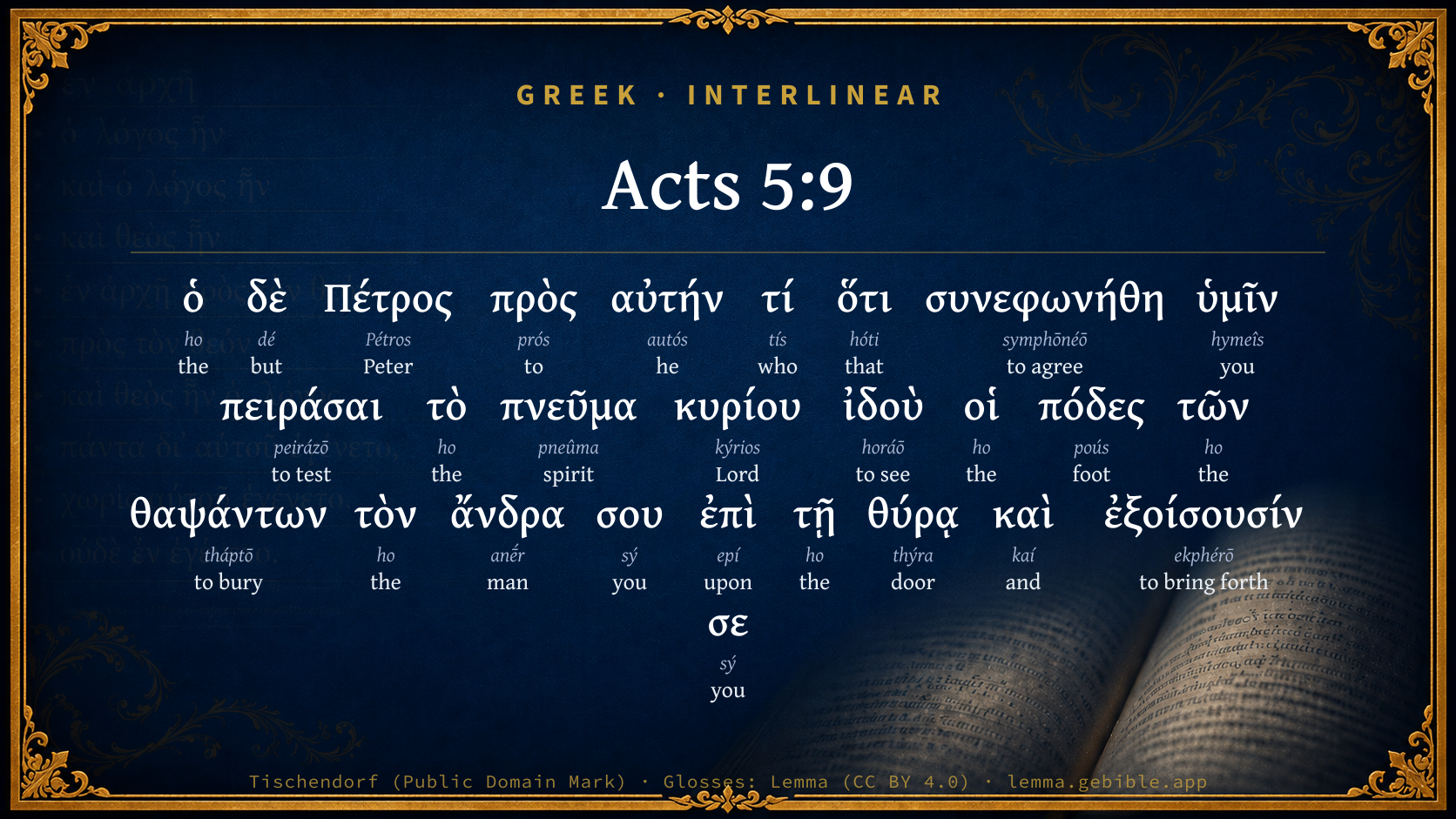
  1. ὁ ho G3588 “the” Article, Nominative, Singular, Masculine
  2. δὲ dé G1161 “but” Conjunction
  3. Πέτρος Pétros G4074 “Peter” Noun, Nominative, Singular, Masculine
  4. πρὸς prós G4314 “to” Preposition
  5. αὐτήν autós G846 “he” Personal pronoun, Accusative, Singular, Feminine
  6. τί tís G5101 “who” Interrogative pronoun, Nominative, Singular, Neuter
  7. ὅτι hóti G3754 “that” Conjunction
  8. ὑμῖν hymeîs G5210 “you” Personal pronoun, 2nd person, Dative, Plural
  9. πειράσαι peirázō G3985 “to test” Verb, Aorist, Active, Infinitive
  10. τὸ ho G3588 “the” Article, Accusative, Singular, Neuter
  11. πνεῦμα pneûma G4151 “spirit” Noun, Accusative, Singular, Neuter
  12. κυρίου kýrios G2962 “Lord” Noun, Genitive, Singular, Masculine
  13. ἰδοὺ horáō G3708 “to see” Verb, Aorist, Middle, Imperative, 2nd person, Singular
  14. οἱ ho G3588 “the” Article, Nominative, Plural, Masculine
  15. πόδες poús G4228 “foot” Noun, Nominative, Plural, Masculine
  16. τῶν ho G3588 “the” Article, Genitive, Plural, Masculine
  17. θαψάντων tháptō G2290 “to bury” Verb, Aorist, Active, Participle, Genitive, Plural, Masculine
  18. τὸν ho G3588 “the” Article, Accusative, Singular, Masculine
  19. ἄνδρα anḗr G435 “man” Noun, Accusative, Singular, Masculine
  20. σου sý G4771 “you” Personal pronoun, 2nd person, Genitive, Singular
  21. ἐπὶ epí G1909 “upon” Preposition
  22. τῇ ho G3588 “the” Article, Dative, Singular, Feminine
  23. θύρᾳ thýra G2374 “door” Noun, Dative, Singular, Feminine
  24. καὶ kaí G2532 “and” Conjunction
  25. ἐξοίσουσίν ekphérō G1627 “to bring forth” Verb, Future, Active, Indicative, 3rd person, Plural
  26. σε sý G4771 “you” Personal pronoun, 2nd person, Accusative, Singular

About this verse

These counts appear in no published source. They are computed here, from the morphology-tagged text and Lemma’s own curated glosses. What Lemma adds →

27
words
21
distinct lemmas
Acts
section

Notable vocabulary

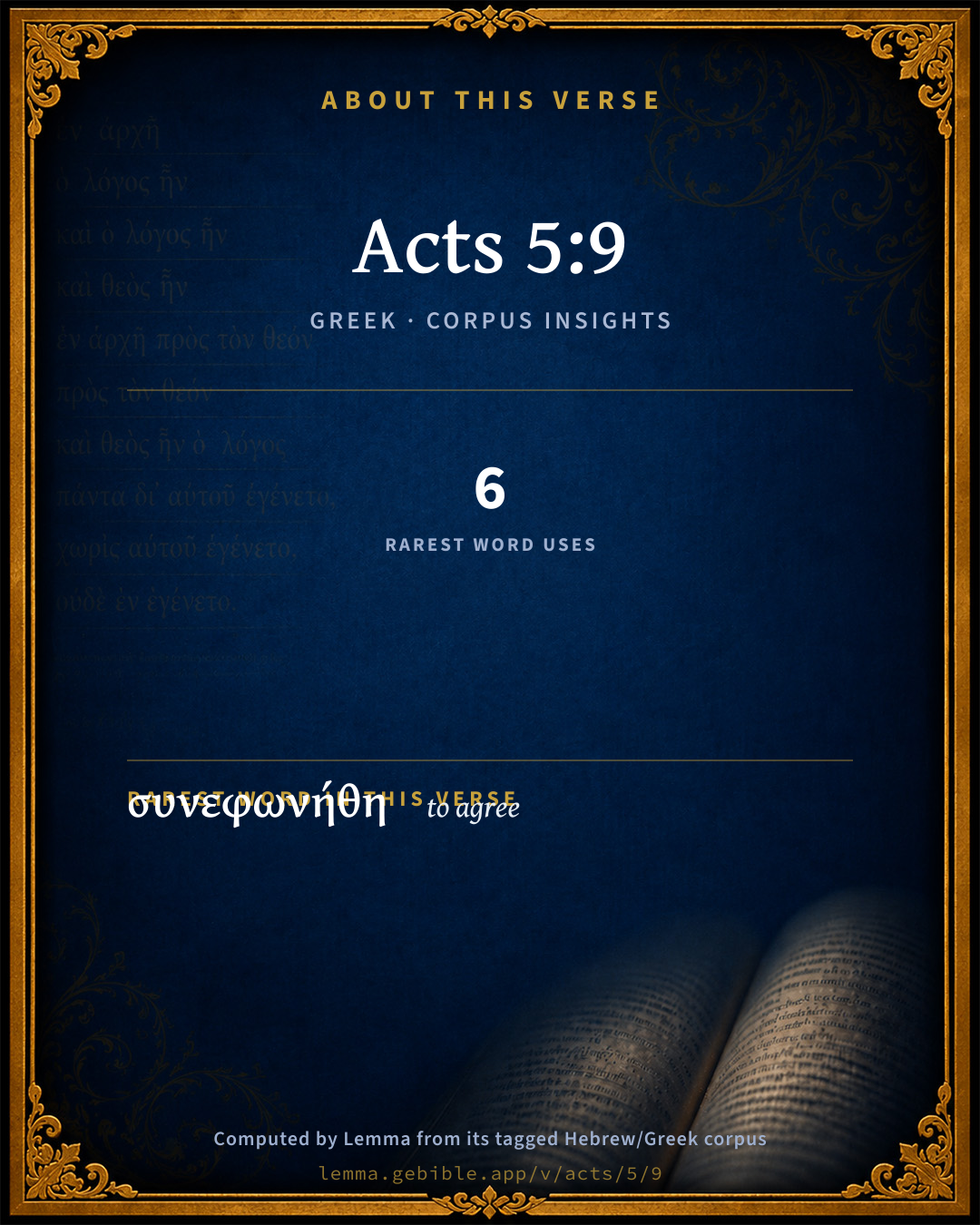
The rarest word here is συνεφωνήθη to agree G4856 — appearing just 6 times in the whole Greek New Testament.

Shared distinctive vocabulary

συνεφωνήθη to agree G4856 occurs in 6 verses of the Greek New Testament. Also found in:

Repetition

Words recur within this verse:

Cross-references

23

Topical passages linked to Acts 5:9 in the Treasury of Scripture Knowledge — connected by theme and wording, ordered by reader-vote popularity; previews shown in the World English Bible.

  • 1 Corinthians 10:9 Neither let us test the Lord, as some of them tested, and perished by the serpents.
  • Psalms 95:8–11 Don't harden your heart, as at Meribah, As in the day of Massah in the wilderness,
  • Acts 5:3–4 But Peter said, "Ananias, why has Satan filled your heart to lie to the Holy Spirit, and to keep back part of the price of the land?
  • Psalms 78:56 Yet they tempted and rebelled against the Most High God, And didn't keep his testimonies;
  • Psalms 78:18–20 They tempted God in their heart By asking food according to their desire.
  • Psalms 78:40–41 How often they rebelled against him in the wilderness, And grieved him in the desert!
  • Acts 15:10 Now therefore why do you tempt God, that you should put a yoke on the neck of the disciples which neither our fathers nor we were able to bear?
  • Genesis 3:9–13 Yahweh God called to the man, and said to him, "Where are you?"
  • Exodus 17:2 Therefore the people quarreled with Moses, and said, "Give us water to drink." Moses said to them, "Why do you quarrel with me? Why do you test Yahweh?"
  • Exodus 17:7 He called the name of the place Massah, and Meribah, because the children of Israel quarreled, and because they tested Yahweh, saying, "Is Yahweh among us, or not?"
  • Numbers 14:22 because all those men who have seen my glory, and my signs, which I worked in Egypt and in the wilderness, yet have tempted me these ten times, and have not listened to my voice;
  • Deuteronomy 13:6–8 If your brother, the son of your mother, or your son, or your daughter, or the wife of your bosom, or your friend, who is as your own soul, entice you secretly, saying, Let us go and serve other gods, which you have not known, you, nor your fathers;
  • 2 Kings 6:32 But Elisha was sitting in his house, and the elders were sitting with him; and [the king] sent a man from before him: but before the messenger came to him, he said to the elders, See you how this son of a murderer has sent to take away my head? behold, when the messenger comes, shut the door, and hold the door fast against him: isn't the sound of his master's feet behind him?
  • Psalms 50:18 When you saw a thief, you consented with him, And have participated with adulterers.
  • Proverbs 11:21 Most assuredly, the evil man will not be unpunished, But the seed of the righteous will be delivered.
  • Proverbs 16:5 Everyone who is proud in heart is an abomination to Yahweh: They shall assuredly not be unpunished.
  • Micah 7:3 Their hands are on that which is evil to do it diligently. The ruler and judge ask for a bribe; And the powerful man dictates the evil desire of his soul. Thus they conspire together.
  • Matthew 4:7 Jesus said to him, "Again, it is written, 'You shall not test the Lord, your God.'"
  • Luke 16:2 He called him, and said to him, 'What is this that I hear about you? Give an accounting of your management, for you can no longer be manager.'
  • Romans 3:19 Now we know that whatever things the law says, it speaks to those who are under the law, that every mouth may be closed, and all the world may be brought under the judgment of God.
  • Acts 5:6 The young men arose and wrapped him up, and they carried him out and buried him.
  • Acts 23:20–22 He said, "The Jews have agreed to ask you to bring Paul down to the council tomorrow, as though intending to inquire somewhat more accurately concerning him.
  • Romans 10:15 And how will they preach unless they are sent? As it is written: "How beautiful are the feet of those who preach the Gospel of peace, Who bring glad tidings of good things!"

Cross-references courtesy of OpenBible.info (CC BY 4.0).

Commentary

Notes on Acts 5:9 from classic Christian and Jewish commentators (each source and its license shown beneath its notes). The classic Christian expositions comment on the surrounding passage and are grouped to its opening verse, so a note may address several verses; the Jewish commentaries on the Tanakh (Rashi and others) are per-verse, so they appear only where the commentator wrote on this verse.

Lemma curates 59 commentaries, every one of them public domain or Creative Commons licensed, each selected and text-cleaned for this edition rather than reprinted as found. About our sources →

Meyer's Critical & Exegetical Commentary

Heinrich August Wilhelm Meyer

Act_5:9-10. Wherefore was it agreed by you (dative with the passive, see on Mat_5:21) to try the Spirit of the Lord (God, see Act_5:4-5)? i.e. to venture the experiment, whether the πνεῦμα ἅγιον, ruling in us apostles, was infallible (comp. Mal_3:15; Mat_4:7). The πειράζων challenges by his action the divine experimental proof.

οἱ πόδες] a trait of vivid delineation (comp. Luk_1:79; Rom_3:15; Rom_10:15); the steps of those returning were just heard at the door (see on Joh_5:2; Act_3:10) outside (Act_5:10).

πρὸς τὸν ἄνδρα αὐτῆς] beside her (just buried) husband.

Meyer — Critical and Exegetical Commentary on the New Testament — English translation by Peter Christie, edited by Frederick Crombie (T&T Clark, 1880) — public domain. Text from a community e-Sword module.

Expositor's Greek Testament

ed. W. Robertson Nicoll

Act 5:9 . τὶ ὅτι , Act 5:4 . συνεφωνήθη : only here in the N.T. in the passive, for its use in the active, Act 15:15 . Blass maintains that this passive usage συμφωνεῖταί τισι is Latin rather than Greek ( convenit inter aliquos ), and that it may have arisen from the intercourse between Greeks and Romans, see in loco , and Grammatik des N. G. , pp. 112, 235; in LXX only in the active. Cf. also Viteau, Le Grec du N. T. , p. 155 (1893). “The aggravation was that they committed the deed as with one soul, just as upon a settled compact between them,” Chrys., Hom. , xii.; cf. the plural ἀπέδοσθε . πειράσαι : the rendering “to tempt,” does not seem to express the idea so well as “to try,” to make trial whether the Holy Ghost would discover their deception, whether He knew all things: cf. Act 15:10 , and in LXX, Exo 17:2 ; Exo 17:7 , Psa 77 (78):41, 56, etc. (in Rev 2:2 the same verb as here = “try,” A. and R.V.). ἰδοὺ , see on Act 1:10 . οἱ πόδες , cf. Luk 1:79 , Rom 3:15 ; Rom 10:15 . A Hebraistic expression the whole description is full of dramatic intensity the returning steps of the νεώτεροι are heard ἐπὶ τῇ θύρᾳ . But Alford thinks that they were probably bare-footed, and that the words mean that the time was just at hand for their return, cf. Jas 5:9 . ἐξοίσουσίν σε , see on Act 5:6 .

The Expositor's Greek Testament, edited by W. Robertson Nicoll (1897–1910) — public domain. Text from a community e-Sword module.

Alford’s Greek Testament

Henry Alford

9.] To try the omniscience of the Spirit then visibly dwelling in the Apostles and the church, was, in the highest sense, to tempt the Spirit of God. It was a saying in their hearts ‘There is no Holy Spirit:’ and certainly approached very closely to a sin against the Holy Ghost. Peter characterizes the sin more solemnly this second time, because by the wife’s answer it was now proved to be no individual lie of a bad and covetous man, but a preconcerted scheme to deceive God.

οἱ πόδες] Not that Peter heard (Olsh.) the tread of the young men outside (they were probably barefooted), but it is an expression common in the poetical or lively description of the Hebrews, and indeed of all nations (see Isa 52:7; Nah 1:15; Rom 10:15; Eurip. Hippol. 656; Soph. Œd. Col. 890, al. freq.), making the member whereby the person acts, the actor. I take the words to mean, that the time was just at hand for their return: see Jas 5:9. The space of three hours was not too long: they would have to carry the corpse to the burying-ground, at a considerable distance from the city (Lightf.), and when there, to dig a grave, and bury it.

ἐξοίσουσιν] This word, spoken before her death, decisively proves that death to have been not a result merely of her detection, but a judicial infliction.

Henry Alford, The Greek Testament (1849–1861) — public domain. Text from a community e-Sword module.

Geneva Bible (1599)

Geneva Bible translators

Are at hand.

Look how oft men do things with an evil conscience; so oft they pronounce sentence against themselves, and as much as in them lieth, provoke God to anger, as of set purpose, minding to try whether he be just and almighty or no.

Geneva Bible (1599) marginal notes — public domain. Text via Bolls.life.

Jamieson, Fausset & Brown

Robert Jamieson, A. R. Fausset & David Brown

How is it that ye have agreed together--(See on Act 5:2).

to tempt the Spirit--try whether they could escape detection by that omniscient Spirit of whose supernatural presence with the apostles they had had such full evidence.

feet of them that buried thy husband are at the door--How awfully graphic!

Jamieson, Fausset & Brown — Commentary Critical and Explanatory on the Whole Bible (1871) — public domain (CC PDM 1.0). Text via the HelloAO Bible API.

Adam Clarke's Commentary

Verse 9. To tempt the Spirit of the Lord?] So the Holy Ghost, God, and the Spirit of the Lord, are the same person.

Adam Clarke's Commentary on the Bible (1810–1826) — public domain. Text from a community e-Sword/MySword module.

John Calvin's Commentaries

9. To tempt the Spirit. He uttereth the same thing in other words which he had said before; to wit, that they did mock God unreverently and contemptibly. But he said that they tempted the Spirit, because they had cunningly packed their fraud, as if the Spirit of God were not the knower of the hearts. For it was a point of too great carelessness, seeing the one made the other privy to their wickedness, to make their match between themselves, having, as it were, excluded God. For the Scripture saith, that God is tempted either when his power is taken from him, or the knowledge of all things is denied him. Furthermore, he meaneth that Spirit which governed the Church by the apostles. For when Christ saith, When the Spirit cometh, he shall judge the world, he noteth no other kind of authority than that which he exerciseth by the ministry of the Church.

John Calvin's Commentaries (1540-1563) — public domain. Text from the Calvin Translation Society English edition (1840s-50s) via the Christian Classics Ethereal Library (ccel.org). Calvin's coverage is partial (roughly two-thirds of the Bible); uncommented books and verses are honest gaps, never fabricated. The 19th-century editor's footnotes and remarks are omitted so the notes are faithfully Calvin's own voice.

Ellicott's Commentary for English Readers

(9) To tempt the Spirit of the Lord—i.e., to try, or test, whether the Spirit that dwelt in the Apostles was really a discerner of the secrets of men’s hearts. The “Spirit of the Lord” is probably used in its Old Testament sense, as the Spirit of Jehovah. The combination is rare in the New Testament, occurring only in 2Co_3:17, but is common in the Old, as in Isa_61:1 (quoted in Luk_4:18); 1Ki_22:24; 2Ki_2:16.

Behold, the feet of them. . . .—In this instance the coming judgment is foretold, and the announcement tended to work out its own completion. Here, to all the shame and agony that had fallen on Ananias, there was now added the bitter thought of her husband’s death as in some sense caused by her, inasmuch as she might have prevented the crime that led to it. The prophetic insight given to St. Peter taught him that the messengers, whose footsteps he already heard, had another task of a like nature before them.

A Bible Commentary for English Readers, edited by Charles John Ellicott (1878–1897) — public domain. Text from a community e-Sword module.

The Cambridge Bible for Schools and Colleges

gen. ed. J. J. S. Perowne

9. ye have agreed together to tempt the Spirit of the Lord] To try whether the deception which you had planned would be found out; whether God’s Spirit would make it known to us.

behold, the feet of them which have buried thy husband are at the door] They were heard returning from the burial of Ananias.

and shall carry thee out] Better, and they shall, &c. thus making it clear that the verb refers to the bearers. St Peter, as before, was prompted by the Holy Ghost in what he said, and was enabled to predict the punishment of Sapphira for her persistent dissembling. We are not told that St Peter knew what would befal Ananias, but as the Spirit shewed him what was to come on the wife we may perhaps conclude that he knew what the fate of the husband would be also.

The Cambridge Bible for Schools and Colleges (gen. ed. J. J. S. Perowne; Cambridge University Press, 1878–1918) — public domain. Text from a community e-Sword module.

John Gill's Exposition

Then Peter said unto her, how is it that ye have agreed together,.... For husband and wife to agree together in what is good, in things civil, honest, and lawful, and in religious matters, is very commendable; but to agree in a fraud, in a lie, is very dreadful:

to tempt the Spirit of the Lord; to try whether the apostles had the Spirit of the Lord, or not; and whether the Spirit of the Lord that was in them was omniscient and omnipotent, would take any notice of it, and inflict punishment for it:

behold, the feet of them which have buried thy husband are at the door; which Peter knew either by hearing the sound of their feet, as Ahijah the prophet heard the sound of the feet of Jeroboam's wife, as she came in at the door, Kg1 14:6 or by the same spirit as Elisha knew that Gehazi ran after Naaman, and received money and garments from him, Kg2 5:26 and shall carry thee out; of this house dead, and bury thee, as they have thy husband.

John Gill's Exposition of the Whole Bible (1746–1763) — public domain (CC PDM 1.0). Text via the HelloAO Bible API.

Trapp's Complete Commentary

John Trapp

9 Then Peter said unto her, How is it that ye have agreed together to tempt the Spirit of the Lord? behold, the feet of them which have buried thy husband are at the door, and shall carry thee out.

Ver. 9. To tempt the Spirit] That is, to make trial of him whether he be omniscient and able to detect and punish your hypocrisy. No man is a gross hypocrite, but he is first an atheist.

John Trapp, A Commentary or Exposition upon All the Books of the Old and New Testament (1647–1656) — public domain. Text from a community e-Sword module.

Albert Barnes' Notes on the Bible

Agreed together - Conspired, or laid a plan. From this it seems that Sapphira was as guilty as her husband,

To tempt - To try; to endeavor to impose on, or to deceive; that is, to act as if the Spirit of the Lord could not detect the crime. They did this by trying to see whether the Spirit of God could detect hypocrisy.

At the door - Are near at hand. They had not yet returned. The dead were buried without the walls of cities; and the space of three hours, it seems, had elapsed before they returned from the burial.

Shall carry thee out - This passage shows that it was by divine interposition or judgment that their lives were taken. The judgment was in immediate connection with the crime, and was designed as an expression of the divine displeasure.

If it be asked here “why” Ananias and Sapphira were punished in this severe and awful manner, an answer may be found in the following considerations:

(1) This was an atrocious crime - a deep and dreadful act of iniquity. It was committed knowingly, and without excuse, Act 5:4. It was important that sudden and exemplary punishment should follow it, because the society of Christians was just then organized, and it was designed that it should be a “pure” society, and should be regarded as a body of holy men. Much depended on making an “impression” on the people that sin could not be allowed in this new community, but would be detected and punished.

(2) God has often, in a most solemn manner, shown his abhorrence of hypocrisy and insincerity. By awful declarations and fearful judgments he has declared his displeasure at it. In a particular manner, no small part of the preaching of the Saviour was employed in detecting the hypocrisy of the scribes and Pharisees, and denouncing heavy judgments on them. See Matt. 23 throughout for the most sublime and awful denunciation of hypocrisy anywhere to be found. Compare Mar 12:15; Luk 12:1; 1Ti 4:2; Job 8:13; Job 13:16; Job 15:34; Job 20:5; Job 36:13; Mat 7:5; Luk 11:44. In the very beginning of the Christian church it was important, by a decided and awful act, to impress upon the church and the world the danger and guilt of hypocrisy. Well did the Saviour know that it would be one of the most insidious and deadly foes to the purity of the church; and at its very “threshold,” therefore, he set up this solemn warning to guard it, and laid the bodies of Ananias and Sapphira in the path of every hypocrite that would enter the church. If they enter and are destroyed, they cannot plead that they were not fully warned. If they practice iniquity “in” the church, they cannot plead ignorance of the fact that God intends to detect and punish them.

(3) The apostles were just then establishing their authority. They claimed to be under the influence of inspiration. To establish that, it was necessary to show that they could know the views and motives of those who became connected with the church. If easily imposed on, it would go far to destroy their authority and their claim to infallibility. If they showed that they could detect hypocrisy, even where most artfully concealed, it would establish the divine authority of their message. At the “commencement” of their work, therefore, they gave this decisive and most awful proof that they were under the guidance of an infallible Teacher.

(4) This case does not stand alone in the New Testament. It is clear from other instances that the apostles had the power of punishing sinners, and that a violation of the commands of Christ was attended by sudden and fearful judgments. See 1Co 11:30, and the case of Elymas the sorcerer in Act 13:8-11.

(5) Neither does this event stand alone in the history of the world. Acts of judgment sometimes occur as sudden and decided, in the providence of God, as in this case. The profane man, the drunkard, the profligate offender is sometimes suddenly stricken down, as in this instance. Cases have not been uncommon where the blasphemer has been smitten in death with the curse on his lips; and God often thus comes forth in judgment to slay the wicked, and to show that there is a God that reigns in the earth. This narrative cannot be objected to as improbable until “all” such cases are disposed of, nor can this infliction be regarded as unjust until all the instances where people die by remorse of conscience, or by the direct judgment of heaven, are “proved” to be unjust also.

In view of this narrative, we may remark:

(1) That God searches the heart, and knows the purposes of the soul. Compare Ps. 139.

(2) God judges the “motives” of people. It is not so much the “external” act, as it is the views and feelings by which it is prompted, that determines the character of the act.

(3) God will bring forth sin which man may not be able to detect, or which may elude human justice. The day is coming when the secrets of all hearts shall be revealed, and God will reward every man according as his works shall be.

(4) Fraud and hypocrisy will be detected. They are often detected in this life. The providence of God often lays them open to human view, and overwhelms the soul in shame at the guilt which was long concealed. But if not in this life, yet the day is coming when they will be disclosed, and the sinner shall stand “revealed” to an assembled universe.

(5) We have here an illustration of the power of conscience. If “such” was its overwhelming effect “here,” what will it be when all the crimes of the life shall be disclosed in the day of judgment, and when the soul shall sink to the woes of hell? Through “eternity” the conscience will do its office; and these terrible inflictions will go on from age to age, forever and ever, in the dark World of hell.

(6) We see here the guilt of attempting to impose on God in regard to “property.” There is no subject in which people are more liable to hypocrisy; none in which they are more apt to keep back a “part.” Christians professedly devote all that they have to God. They profess to believe that he has a “right” to the silver and the gold, and the cattle on a thousand hills, Psa 1:1-6. 10. Their “property,” as well as their bodies and their spirits, they have devoted to him, and they profess to desire to employ it as “he” shall direct and please. And yet, is it not clear that the sin of Ananias has not ceased in the church? How many professing Christians there are who give “nothing” really to God; who contribute nothing for the poor and needy; who devote nothing, or next to nothing, to any purposes of benevolence; who would employ “million” for their own gratification, and their families, “but not a cent for tribute” to God. The case of Ananias is, to all such, a case of most fearful warning. And on no point should Christians more faithfully examine themselves than in regard to the professed devotion of their “property” to God. If God punished this sin in the beginning of the Christian church, he will do it still in its progress; and in nothing have professed Christians more to fear his wrath than on this very subject.

(7) Sinners should fear and tremble before God. He holds their breath in his hands. He can cut them down in an instant. The bold blasphemer, the unjust man, the liar, the scoffer, he can destroy in a moment, and sink them in all the woes of hell. Nor have they any security that he will not do it. The profane man has no evidence that he will live to finish the curse which he has begun; nor the drunkard that he will again become sober; nor the seducer that God will not arrest him in his act of wickedness and send him down to hell! The sinner walks over the grave, and over hell! In an instant he may die, and be summoned to the judgment-seat of God! How awful it is to sin in a world like this; and how fearful the doom which “must” soon overtake the ungodly!

Albert Barnes' Notes on the Bible (1834–1885) — public domain. Text from a community e-Sword/MySword module.

Matthew Poole's English Annotations

To tempt the Spirit of the Lord; this expression, of tempting God, or the Spirit of God, is not used amongst profane writers; and this sin is not (at least to such a degree) committed amongst pagans and heathens, and is to be dreaded by all that profess the gospel. As often as men sin against their conscience, and their consciences condemn them in what they do, so often they dare, tempt, or try, whether God be omniscient, and knows of, or holy hand powerful, and will punish, their sins; which they find at last to their cost.

The feet of them which have buried thy husband, are at the door; this the apostle foretells ere it came to pass, the more to confirm his authority and the truth of the gospel.

Shall carry thee out, after thou art dead, to thy burial.

Matthew Poole's English Annotations on the Holy Bible (1683–1685) — public domain. Text from a community e-Sword/MySword module.

Whedon's Commentary on the Bible

Daniel D. Whedon

9. Agreed together—So that it was a deliberate, contrived, mutual sin.

To tempt the Spirit—That is, to try and put to the test the present Holy Ghost. The Romanist commentator to the Rhemish Testament deduces a strong case here for the hierarchy: “To take from the Church, or from the governors thereof, things dedicated to their use and the service of God, or to lie unto God’s ministers, is so judged before God as if the lie were made and the fraud done to the Holy Ghost himself.”

Daniel D. Whedon (gen. ed.), Commentary on the Old and New Testaments (1874–1909) — public domain. Text from a community e-Sword module.

The Pulpit Commentary

But for then, A.V. ; they shall carry for carry, A.V. To tempt the Spirit, etc.; i.e. thus daringly to put the Holy Ghost on trial, whether or no he is able to discern the thoughts of your evil hearts. (comp. Luk_4:12) The feet of them, etc. The burial, including the distance to and fro, had taken three hours, and they were just returning to the Christian assembly when Sapphira was confirming her guilt as an accomplice in her husband"s lie.

The Pulpit Commentary (1880–1919), ed. H.D.M. Spence-Jones & Joseph S. Exell — public domain. Text from a community e-Sword module.

McGarvey & Pendleton's Commentaries

J. W. McGarvey

See notes on verse 8

J. W. McGarvey (with Philip Y. Pendleton), Commentaries on the New Testament (The Fourfold Gospel, 1914; Acts; and the epistles) — public domain. Text from a community e-Sword/MySword module.

unfoldingWord translationNotes

Door43 World Missions Community

Connecting Statement:

This is the end of the part of the story about Ananias and Sapphira.

General Information:

Here the word "you" is plural and refers to both Ananias and Sapphira. (See: Forms of You)

How is it that you have agreed together to test the Spirit of the Lord?

Peter asks this question to rebuke Sapphira. AT: "You should not have agreed together to test the Spirit of the Lord!" (See: Rhetorical Question)

you have agreed together

"the two of you have agreed together"

to test the Spirit of the Lord

Here the word "test" means to challenge or to prove. They were trying to see if they could get away with lying to God without receiving punishment.

the feet of the men who buried your husband

Here the phrase "the feet" refers to the men. AT: "the men who have buried your husband" (See: Synecdoche)

fell down at his feet

This means that when she died, she fell on the floor in front of Peter. This expression should not be confused with falling down at a person's feet as a sign of humility.

breathed her last

Here "breathed his last" means "breathed her final breath" and is a polite way of saying "she died." See how you translated a similar phrase in Acts 5:5. (See: Euphemism)

translationWords

test

Holy Spirit

breath

fear

church

unfoldingWord translationNotes — © Distant Shores Media and the Door43 World Missions Community, licensed CC BY-SA 4.0. Source: git.door43.org/Door43/en_tn.

Cambridge Greek Testament for Schools and Colleges

9. εἶπε omitted with אBD. Vulg. has ‘Petrus autem ad eam.’

9. τί ὅτι. This form, which occurs also in Act 5:4, is to be explained by the ellipsis of ἐστὶ. ‘Why is it that …’

πειράσαι, to tempt. They would make trial whether the Spirit of the Lord would make their deception known. Nothing could render more manifest their want of faith, their unfitness to be members of the society, than such an attempt.

οἱ πόδες. The footsteps of the young men as they returned were probably now audible without.

καὶ ἐξοίσουσίν σε, and they shall carry thee out, i.e. to burial likewise. St Peter, as before, was prompted by the Holy Ghost in what he said, and was enabled to predict the punishment of Sapphira for her persistent dissembling. We are not told that he knew beforehand what would befal Ananias, but as the Spirit shewed him what was to come on the wife we may perhaps conclude that he knew what the fate of the husband would be also.

Cambridge Greek Testament for Schools and Colleges (Cambridge University Press, 1896; 21 vols, various authors incl. Carr, Maclear, Plummer, Farrar, Lumby, Moule, M. R. James, Simcox) — public domain. Text from a community e-Sword module.

Vincent's Word Studies in the New Testament

Marvin R. Vincent

Ye have agreed together [συνεφωνηθη υμιν] . The verb is passive. Lit., was it agreed by you. The figure in the word is that of concord of sounds. Your souls were attuned to each other respecting this deceit. See on music, Luk 14:25.

To tempt [πειρασαι] . To put it to the proof whether the Holy Spirit, ruling in the apostles, could be deceived. See on ver. 3.

The feet. Graphic. The steps of the young men returning from the burial are heard at the door.

Marvin R. Vincent, Word Studies in the New Testament (1887–1900) — public domain. Text from a community e-Sword/MySword module.

Lesson kit

Teaching starters — assembled from the data on this page, not authored interpretation. Every prompt links to the verse data it draws on. Edit before teaching.

Acts, in the Acts, opens this verse with 27 words (21 distinct Greek lemmas). Its most distinctive word is symphōnéō (“to agree”). A historical commentator’s framing appears above. Read the whole chapter for the surrounding context.

Discussion questions

  1. The word symphōnéō carries the sense “to agree.” How does it shape the verse?
  2. How does Matthew 18:19, which shares the word «to agree», read alongside this verse?
  3. What does the repetition of “the” (6× in this one verse) do in this verse?
  4. These translations render this verse differently. What is at stake in choosing one wording over another?
  5. Compare how Meyer's Critical & Exegetical Commentary and Expositor's Greek Testament read this verse. Where do they agree or differ?

Things to notice

Reading settings

Reading text

Shown beneath each verse's original-language words.

Old Testament
Old Testament edition

Read the OT as the Masoretic Hebrew (MT) or the Greek Septuagint (LXX).

English shown for the Greek Septuagint (in the Hebrew ↔ Greek comparison).

Comparing translations? Open the Compare panel on any verse page to stack up to four side by side.