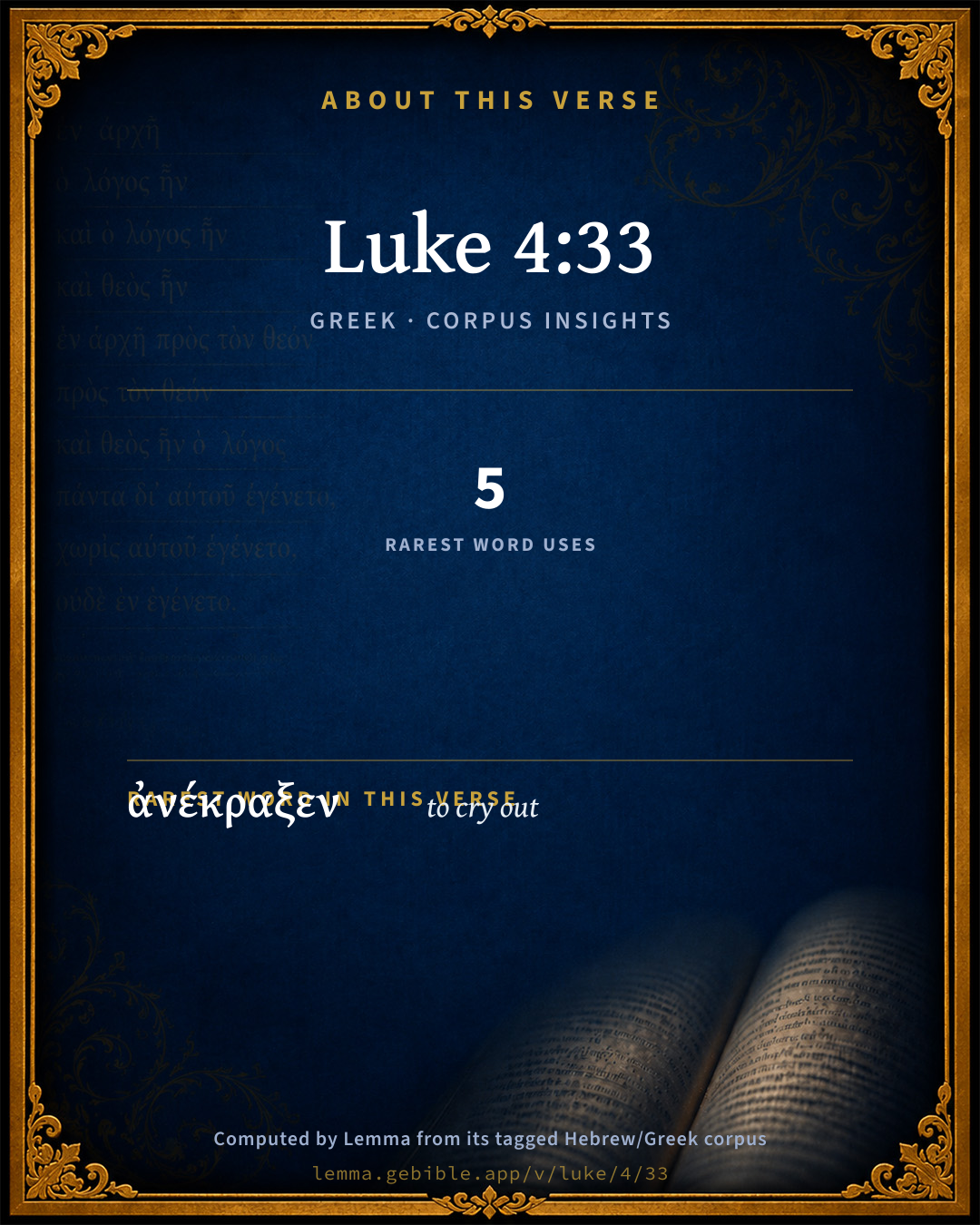
Luke 4:33

Greek (Tischendorf 8th ed.) Luke 4:33 appears in the Greek New Testament. The text above is from the Tischendorf 8th edition. Each word links to its Strong’s number and a concise gloss. Click any word for its full Thayer’s Greek Lexicon entry.
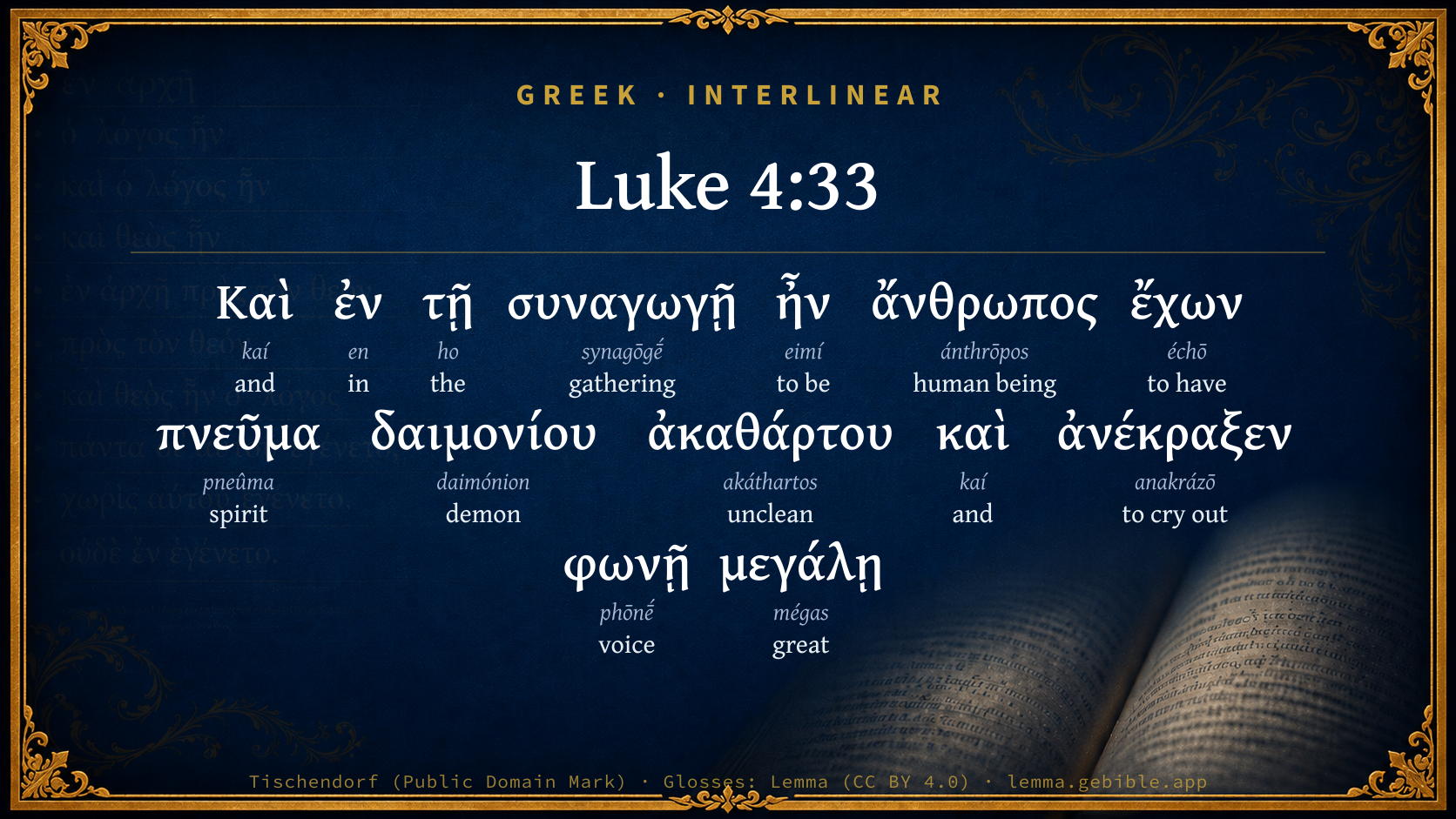
Download image
Cite this verse

Luke 4:33 (World English Bible). Public Domain. Lemma interlinear Bible study tool, https://lemma.gebible.app/v/luke/4/33.

Show BibTeX & RIS
BibTeX
RIS
English Translation
In the synagogue there was a man who had a spirit of an unclean demon, and he cried out with a loud voice,
World English Bible · Public Domain
Download a study sheet

One document with this verse’s original text, its word-by-word gloss line, the meaning frame, cross-references with their text, attributed commentary, and full source and license credits — printable, and it pastes into notes with its structure intact.

This verse Autodidact and up

Study sheet (.html) Plain text (.txt)

A passage Seminary Student

Up to 50 verses in one chapter. A passage sheet keeps up to 6 commentary sources and 12 cross-references per verse, in the order this page ranks them, and says so on the sheet whenever that leaves anything out. Ask for a single verse and you get the Autodidact verse sheet above.

Everything on this page stays free to read, with no account — the sheet is a download of what is already on screen, not access to it.

Want to remove ads? Support Godless Engineer
Compare translations 3

The same verse in 3 English versions, stacked beneath the original-language interlinear above. Click any original word for its lexicon entry.

Each is an independent rendering of the whole verse — the interlinear is not word-aligned to these translations.

Highlighted words mark where these versions differ — a whole-verse word diff, not a word-by-word alignment.

  • World English Bible Public Domain
    In the synagogue there was a man who had a spirit of an unclean demon, and he cried out with a loud voice,
  • King James Version Public Domain
    And in the synagogue there was a man, which had a spirit of an unclean devil, and cried out with a loud voice,
  • unfoldingWord Literal Text CC BY-SA 4.0
    And in the synagogue there was a man having a spirit of an unclean demon, and he cried out with a loud voice,

unfoldingWord Literal Text — © unfoldingWord, licensed CC BY-SA 4.0. Word-aligned USFM3 via Door43 (git.door43.org/unfoldingWord/en_ult).

Versions to compare (up to 4)

3 of 4 selected

Show all 19 translations

Every available English version of this verse, each an independent rendering of the whole verse.

  • World English Bible Public Domain
    In the synagogue there was a man who had a spirit of an unclean demon, and he cried out with a loud voice,
  • Berean Standard Bible Public Domain
    In the synagogue there was a man possessed by the spirit of an unclean demon. He cried out in a loud voice,
  • Majority Standard Bible Public Domain
    In the synagogue there was a man possessed by the spirit of an unclean demon. He cried out in a loud voice,
  • King James Version Public Domain
    And in the synagogue there was a man, which had a spirit of an unclean devil, and cried out with a loud voice,
  • American Standard Version (1901) Public Domain
    And in the synagogue there was a man, that had a spirit of an unclean demon; and he cried out with a loud voice,
  • Revised Version (1885) Public Domain
    And in the synagogue there was a man, which had a spirit of an unclean devil; and he cried out with a loud voice,
  • Geneva Bible (1599) Public Domain
    And in the Synagogue there was a man which had a spirit of an vncleane deuill, which cryed with a loude voyce,
  • Douay-Rheims (1899) Public Domain
    And in the synagogue there was a man who had an unclean devil, and he cried out with a loud voice,
  • Young's Literal Translation Public Domain
    And in the synagogue was a man, having a spirit of an unclean demon, and he cried out with a great voice,
  • Literal Standard Version CC BY-SA 4.0
    And in the synagogue was a man having a spirit of an unclean demon, and he cried out with a great voice,
  • Unlocked Literal Bible CC BY-SA 4.0
    Now in the synagogue there was a man who had the spirit of an unclean demon, and he cried out with a loud voice,
  • unfoldingWord Literal Text CC BY-SA 4.0
    And in the synagogue there was a man having a spirit of an unclean demon, and he cried out with a loud voice,
  • Darby Bible Public Domain
    And there was in the synagogue a man having a spirit of an unclean demon, and he cried with a loud voice,
  • World Messianic Bible Public Domain
    In the synagogue there was a man who had a spirit of an unclean demon; and he cried out with a loud voice,
  • Webster's Bible Public Domain
    And in the synagogue there was a man who had a spirit of an unclean demon; and he cried out with a loud voice,
  • Free Bible Version CC BY-SA 4.0
    In the synagogue there was a man who was possessed by a demon. He cried out,
  • Bible in Basic English Public Domain
    And there was a man in the Synagogue who had an unclean spirit; and he gave a loud cry and said,
  • Text-Critical English NT CC BY 4.0
    Now in the synagogue there was a man who had an unclean demonic spirit, and he cried out with a loud voice,
  • Tyndale New Testament (1534) Public Domain
    And in the synagoge ther was a man which had a sprete of an vncleane devell and cryed with aloude voyce

Literal Standard Version (2020), Covenant Press — licensed CC BY-SA 4.0. Text via the HelloAO Bible API (eBible.org). Unlocked Literal Bible (unfoldingWord) — licensed CC BY-SA 4.0. Text via the HelloAO Bible API (eBible.org). unfoldingWord Literal Text — © unfoldingWord, licensed CC BY-SA 4.0. Word-aligned USFM3 via Door43 (git.door43.org/unfoldingWord/en_ult). Free Bible Version, Dr. Jonathan Gallagher — licensed CC BY-SA 4.0. Text via the HelloAO Bible API (eBible.org).

Word by word

More ways to search: Search by grammar → Find every occurrence → Compare this word →

Practice this passage: Drill this verse → Learn its vocabulary →

ἀνέκραξεν
anakrázō
G349
“to cry out”
Verb, Aorist, Active, Indicative, 3rd person, Singular
Part of Speech
Verb
Tense
Aorist
Voice
Active
Mood
Indicative
Person
3rd person
Number
Singular
Full Thayer's Definition

Origin: from G303 and G2896

TDNT: 17:58,5

1. to raise a cry from the depth of the throat, to cry out
  1. Καὶ kaí G2532 “and” Conjunction
  2. ἐν en G1722 “in” Preposition
  3. τῇ ho G3588 “the” Article, Dative, Singular, Feminine
  4. συναγωγῇ synagōgḗ G4864 “gathering” Noun, Dative, Singular, Feminine
  5. ἦν eimí G1510 “to be” Verb, Imperfect, Active, Indicative, 3rd person, Singular
  6. ἄνθρωπος ánthrōpos G444 “human being” Noun, Nominative, Singular, Masculine
  7. ἔχων échō G2192 “to have” Verb, Present, Active, Participle, Nominative, Singular, Masculine
  8. πνεῦμα pneûma G4151 “spirit” Noun, Accusative, Singular, Neuter
  9. δαιμονίου daimónion G1140 “demon” Noun, Genitive, Singular, Neuter
  10. ἀκαθάρτου akáthartos G169 “unclean” Adjective, Genitive, Singular, Neuter
  11. καὶ kaí G2532 “and” Conjunction
  12. φωνῇ phōnḗ G5456 “voice” Noun, Dative, Singular, Feminine
  13. μεγάλῃ mégas G3173 “great” Adjective, Dative, Singular, Feminine

About this verse

These counts appear in no published source. They are computed here, from the morphology-tagged text and Lemma’s own curated glosses. What Lemma adds →

14
words
13
distinct lemmas
Gospels
section

Notable vocabulary

The rarest word here is ἀνέκραξεν to cry out G349 — appearing just 5 times in the whole Greek New Testament.

Shared distinctive vocabulary

ἀνέκραξεν to cry out G349 occurs in 5 verses of the Greek New Testament. Also found in:

Repetition

A word recurs within this verse:

Cross-references

1

Topical passages linked to Luke 4:33 in the Treasury of Scripture Knowledge — connected by theme and wording, ordered by reader-vote popularity; previews shown in the World English Bible.

  • Mark 1:23 Immediately there was in their synagogue a man with an unclean spirit, and he cried out,

Cross-references courtesy of OpenBible.info (CC BY 4.0).

Commentary

Notes on Luke 4:33 from classic Christian and Jewish commentators (each source and its license shown beneath its notes). The classic Christian expositions comment on the surrounding passage and are grouped to its opening verse, so a note may address several verses; the Jewish commentaries on the Tanakh (Rashi and others) are per-verse, so they appear only where the commentator wrote on this verse.

Lemma curates 59 commentaries, every one of them public domain or Creative Commons licensed, each selected and text-cleaned for this edition rather than reprinted as found. About our sources →

Jamieson, Fausset & Brown

Robert Jamieson, A. R. Fausset & David Brown

DEMONIAC HEALED. (Luk 4:33-37)

unclean--The frequency with which this character of impurity is applied to evil spirits is worthy of notice.

cried out, &c.--(See Mat 8:29; Mar 3:11).

Jamieson, Fausset & Brown — Commentary Critical and Explanatory on the Whole Bible (1871) — public domain (CC PDM 1.0). Text via the HelloAO Bible API.

The Biblical Illustrator

Joseph S. Exell

Luk_4:33-37

And in the synagogue there was a man, which had a spirit of an unclean devil

The expulsion of the unclean spirit

I.

Observe THE CONFESSION THE UNCLEAN SPIRIT MADE concerning the Redeemer. Here Christs righteousness and purity are admitted.

1. He is declared to be the Holy One of God.

(1) Gods Son--Gods Servant.

(2) Having Gods holy nature and attributes.

(3) Formal as to His manhood by the overshadowing of the Holy Ghost.

(4) Coming into the world to exhibit in all its complete excellency Gods holy law.

(5) On the holy mission of redeeming men from sin, and bringing them to the blessedness of personal holiness.

(6) In the world for the express purpose of setting up a holy kingdom--a kingdom of righteousness, peace, and joy in the Holy Ghost.

2. This confession was bold and public.

3. It was deprecatory. The language of dread. The demons knew their time was limited, their power circumscribed, and that their hellish rule and dominion was to be overthrown by the Son of God.

II. Observe THE COURSE CHRIST ADOPTED.

1. Rebuke.

2. Expulsion.

III. Notice THE RESULTS WHICH FOLLOWED.

1. The unclean spirit gives a last struggle to injure his victim.

2. He came out of the man.

3. The people gave homage and glory to Christ.

4. The fame of Christ was spread abroad.

Application:

1. The unrenewed mind is under the power of the unclean spirit.

2. Those who are thus influenced are in circumstances of misery and peril.

3. Christ alone has power to save and deliver.

4. In the gospel this deliverance is proclaimed. (Jabez Burns, D. D.)

Demoniacal possession

Should the possessed mentioned by the evangelists be regarded simply as persons afflicted after the same manner as our lunatics, whose derangement was attributed by Jewish and heathen superstition to supernatural influence? Or did God really permit, at this extraordinary epoch in history, an exceptional display of diabolical power? Or, lastly, should certain morbid conditions, now existing, which medical science attributes to purely natural causes, either physical or psychical, be put down, at the present day also, to the action of higher causes? These are the three hypotheses which present themselves to the mind. Several of the demoniacs healed by Jesus certainly exhibit symptoms very like those which are observed at the present day in those who are simply afflicted; e.g., the epileptic child (Luk_9:37). These strange conditions in every case, therefore, were based on a real disorder, either physical or physicopsychical. The evangelists are so far from being ignorant of this, that they constantly class the demoniacs under the category of the sick, never under that of the vicious. The possessed have nothing in common with the children of the devil. Nevertheless these afflicted persons are constantly made a class by themselves. On what does this distinction rest? On this leading fact, that those who are simply sick enjoy their own personal consciousness, and are in possession of their own will; while in the possessed these faculties are, as it were, confiscated to a foreign power, with which the sick person identifies himself. How is this peculiar system to be explained? Josephus, under Hellenic influence, thought that it should be attributed to the souls of wicked men who came after death seeking a domicile in the living. In the eyes of the people the strange guest was a demon, a fallen angel. This latter opinion Jesus must have shared. Strictly speaking, His colloquies with the demoniacs might be explained by an accommodation to popular prejudice, and the sentiments of those who were thus afflicted; but in His private conversations with His disciples, He must, whatever was true, have disclosed His real thoughts, and sought to enlighten them. But He does nothing of the kind; on the contrary, He gives the apostles and disciples power to cast out devils (Luk_9:1), and to tread on all the power of the enemy (Luk_10:19). In Mar_9:29 He distinguishes a certain class of demons that can only be driven out by prayer and fasting. In Luk_11:21 He explains the facility with which He casts out demons by the personal victory which He had achieved over Satan at the beginning. He therefore admitted the intervention of this being in these mysterious conditions. If this is so, is it not natural to admit that He who exercised over this, as over all other kinds of maladies, such absolute power, best understood its nature, and that therefore His views upon the point should determine ours? Are there not times when God permits a superior evil power to invade humanity? Just as God sent Jesus at a period in history when moral and social evil had reached its culminating point, did not He also permit an extraordinary manifestation of diabolical power to take place at the same time? By this means Jesus could be proclaimed externally and visibly as the conqueror of the enemy of men, as He who came to destroy the works of the devil in the moral sense of the expression. As to the present state of things, it must not be compared with the times of Jesus. Not only might the latter have been of an exceptional character; but the beneficent influence which the gospel has exercised in restoring man to Himself, and bringing his conscience under the power of the holy and true God, may have brought about a complete change in the spiritual world. Lastly, apart from all this, is there nothing mysterious, from a scientific point of view, in certain cases of mental derangement, particularly in those conditions in which the will is, as it were, confiscated to, and paralyzed by, an unknown power? And after deduction has been made for all those forms of mental maladies which a discriminating analysis can explain by moral and physical relations, will not an impartial physician agree that there is a residuum of cases respecting which he must say: Non liquet? Possession is a caricature of inspiration. The latter, attaching itself to the moral essence of a man, confirms him for ever in the possession of his true self; the former, while profoundly opposed to the nature of the subject, takes advantage of its state of morbid passivity, and leads to the forfeiture of personality. The one is the highest work of God; the other, of the devil. (F. Coder, D. D.)

The demoniac in the synagogue

Strange men in strange places I Think of a devil being in the synagogue! It is the same to-day. The sanctuary draws into itself all sorts of human character; not only the rich and the poor, but the best and the worst are there. Evil knows good and hates it. Evil is not so powerful in reality as goodness, though apparently much mightier. Jesus is greater than all evil spirits. Art Thou come to destroy us? is a significant inquiry. For this purpose was He manifested, that He might destroy the works of the devil. (J. Parker, D. D.)

The King casting out evil spirits

The superstition which connects demons with a wilderness has been used to explain our Lords temptation. That explanation has nothing to do with the story given us by the evangelists. They describe the encounter of the Spirit of Christ with the spirit of evil; the test of their veracity lies in the experience of human beings in cities as much as in deserts, in one period as much as another. It seems to me, then, most reasonable, not only for the sake of anything which may have been peculiar to that time, but for the sake of every time, that the evangelist should give these victories over demons a prominent place in the history of Redemption. The impression produced in the synagogue of Capernaum is the simplest testimony to the nature of such a sign. What a word is this? they said. There was the sense of One who did not charm away evils by a look or a touch. The calm Divine energy with which He declared that the kingdom of God was indeed among men--that Gods power was manifesting itself as of old in breaking fetters, insetting captives free--this came forth in the command that the unclean spirit should depart. The evil spirit was not the mans lord. The kingdoms of this world and the glory of them were not his. Holiness was mightier. (F. D. Maurice.)

Possessed by the devil

An affecting case was that of William Pope, of Bolton, in Lancashire. At this place there is a considerable number of deistical persons, who assemble together on Sundays to confirm each other in their infidelity. The oaths and imprecations that arc uttered in that meeting are too horrible to relate, while they toss the Word of God upon the floor, kick it round the house, and tread it under their feet. This William Pope, who had been a steady Methodist for some years, became at length a professed Deist, and joined himself to this hellish crew. After he had been an associate of this company some time, he was taken ill, and the nature of his complaint was such, that he confessed the hand of God was upon him, and he declared he longed to die, that he might go to hell, many times praying earnestly for damnation. Two of the Methodist preachers, Messrs. Rhodes and Barrowclough, were sent for to talk to and pray with the unhappy man. But he was so far from being thankful for their advice and assistance, that he spit in their faces, threw at them whatever he could lay his hands upon, struck one of them upon the head with all his might, and often cried out, when they were praying, Lord, do not hear their prayers! If they said, Lord, save his scull he cried, Lord, damn my scull often adding, My damnation is sealed, and I long to be in hell! In this way he continued, sometimes better and sometimes worse, till he died. He was frequently visited by his deistical brethren during his illness, who would fain have persuaded the public he was out of his senses, which was by no means the ease. The writer of this account saw the unhappy man once, but never desired to see him again. Mr. Rhodes justly said he was as full of the devil as- he could hold. (Simpsons Plea for religion.)

The testimony of the evil spirit to Christ, and His refusal to accept it

Earth has not recognized her King; but heaven has borne witness to Him, and now hell must bear its witness too. But what could have been the motive to this testimony, thus borne? It is strange that the evil spirit should, without compulsion, proclaim to the world the presence in the midst of it of the Holy One of God, of Him who should thus bring all the unholy, on which he battened, and by which he lived, to an end. Might we not rather expect that he should have denied, or sought to obscure, the glory of Christs person? It cannot be replied that this was an unwilling confession to the truth, forcibly extorted by Christs superior power, seeing that it displeased Him in whose favour it professed to be borne, and this so much that He at once stopped the mouth of the utterer. It remains, then, either to understand this as the cry of abject and servile fear, that with fawning and flatteries would fain avert from itself the doom which, with Christs presence in the world, must evidently be near; or else to regard this testimony as intended only to injure the estimation of Him in whose behalf it was rendered. There was hope that the truth itself might be brought into suspicion and discredit, thus receiving attestation from the spirit of lies; and these confessions of Jesus as the Christ may have been meant to traverse and mar His work. The fact that Christ would not allow the testimony goes some way to make this the preferable explanation. Observe it is not here as elsewhere, The Lord rebuke thee, but He rebukes in His own name and by His own authority. (Archbishop Trench.)

Christ at Capernaum

I. HIS PREACHING--He came down to Capernaum, a city of Galilee, and taught them on the Sabbath days. And they were astonished at His doctrine: for His Word was with power.

1. Observe the place--Capernaum.

2. The season--The Sabbath days. Not that He forebore on other days; His lips always dropped like an honey-comb.

3. Then the impression.

II. LET US PASS FROM HIS TEACHING TO HIS MIRACLE.

1. Let us glance at the subject of this miracle. It was a man who was possessed of a spirit of an unclean devil. Satan has much to do in the synagogue--much more than in many other places. In Macgowans Dialogues of Devils there is this relation. Two infernal spirits having met, one of them very warm and weary, and the other cool and lively; after a little explanation it was found that he who was cool and lively, had been at the playhouse where he had nothing to do, where they were all with him, where they were all of one mind, all doing his work: whereas the other who was warm and weary, said, I have been at a place of worship, and I had much to do there; to make some sleep; to induce some to hear for others instead of themselves; to lead the thoughts of some, like the fools eye, unto the ends of the earth; to pick up as fast as I could the seed which was sown in the heart; and to turn away the point of the sword of the Spirit, which is the Word of God, lest it should pierce even to the dividing of soul and body, and of the joints and marrow, and be a discerner of the thoughts and intents of the heart. I hope, none of you employ him thus.

(1) First, aversion. Let us alone--as it is in the margin,--away; be off. Satan wished to have nothing to do with Christ.

(2) Then it expressed fear--Art Thou come to destroy us?

(3) It expressed commendation-- I know Thee, who Thou art, the Holy One of God.

Here, you see, the devil not only believed much, but talked well.

2. Let us look at the Author of this miracle, and we shall see how the enemy of souls is under the dominion of the Lord Jesus; that though an adversary, yet he is restrained, he is chained.

3. Then, as to the spectators-- They were all amazed, and spake among themselves, saying, What a Word is this l for with authority and power He commandeth the unclean spirits, and they come out. Oh! if they had but improved as well as admired!

III. THEN HERE IS HIS FALSE--And the fame of Him went out into every place of the country round about. Who does not rejoice in this spread of His fame? Who does not wish His fame everywhere spread abroad? Gratitude requires you to be thus employed. For benevolence requires you to be thus employed, Many are perishing; and they are perishing for lack of knowledge, and the knowledge of Him; for to know Him is eternal life. (W. Jay.)

The Biblical Illustrator, edited by Joseph S. Exell (c. 1880s–1900s) — public domain. Text from a community e-Sword module.

Joseph Benson's Commentary

Luk 4:33-37. See this paragraph explained at large in the notes on Mar 1:23-28. What have we to do with thee — Thy present business is with men, not with devils. I know thee who thou art — But did he, did even the prince of devils know Jesus, some time before, when he dared to say to him, Luk 4:6, All this power is delivered to me, and to whomsoever I will I give it? The Holy One of God — Either this confession was extorted from him by terror, (for the devils believe and tremble,) or, he made it with a design to render the character of Christ suspected. And Jesus rebuked him — The Holy One of God was a title of the Messiah, Psa 16:10; but Jesus did not allow the devils to give it him, for the reason mentioned in the notes on Mar 1:25; Mar 1:34. Possibly, however, it was from hence the Pharisees took occasion to say, He casteth out devils by the prince of devils. And when the devil had thrown him in the midst — That is, had cast him down on the ground, the effect of this possession being an epilepsy.

Joseph Benson's Commentary on the Old and New Testaments (1811–1818) — public domain. Text from a community e-Sword module.

Whedon's Commentary on the Bible

Daniel D. Whedon

§ 27. HEALING OF THE DEMONIAC IN THE SYNAGOGUE AT CAPERNAUM, Luk_4:33-37.

Mar_1:21-28.

See notes on parallel passages in Mark.

Daniel D. Whedon (gen. ed.), Commentary on the Old and New Testaments (1874–1909) — public domain. Text from a community e-Sword module.

MacLaren's Expositions of Holy Scripture

Alexander MacLaren

Luke

A SABBATH IN CAPERNAUM

Luk 4:33 - Luk 4:44.

There are seven references to Christ’s preaching in the synagogues in this chapter, and only two in the rest of this Gospel. Probably our Lord somewhat changed His method, and Luke, as the Evangelist of the gospel for Gentile as well as Jew, emphasises the change, as foreshadowing and warranting the similar procedure in Paul’s preaching. This lesson takes us down from the synagogue at Nazareth, among its hills, to that at Capernaum, on the lakeside, where Jesus was already known as a worker of miracles. The two Sabbaths are in sharp contrast. The issue of the one is a tumult of fury and hate; that of the other, a crowd of suppliants and an eager desire to keep Him with them. The story is in four paragraphs, each showing a new phase of Christ’s power and pity.

I. Luk 4:33 - Luk 4:37 present Christ as the Lord of that dark world of evil.

The hushed silence of the synagogue, listening to His gentle voice, was suddenly broken by shrieks of rage and fear, coming from a man who had been sitting quietly among the others. Possibly his condition had not been suspected until Christ’s presence roused his dreadful tyrant. The man’s voice is at the demon’s service, and only Jesus recognises who speaks through the wretched victim. We take for granted the reality of demoniacal possession, as certified for all who believe Jesus, by His words and acts in reference to it, as well as forced on us, by the phenomena themselves, which are clearly distinguishable from disease, madness, or sin. The modern aversion to the supernatural is quite as much an unreasonable prejudice as any old woman’s belief in witchcraft and Professor Huxley, making clumsy fun of the ‘pigs at Gadara,’ is holding opinions in the same sublime indifference to evidence of facts as the most superstitious object of his narrow-visioned scorn.

Napoleon called ‘impossible’ a ‘beast of a word.’ So it is in practical life,-and no less so when glibly used to discredit well-attested facts. We neither aspire to the omniscience which pronounces that there can be no possession by evil spirits, nor venture to brush aside the testimony of the Gospels and the words of Christ, in order to make out such a contention.

Note the rage and terror of the demon. The presence of purity is a sharp pain to impurity, and an evil spirit is stirred to its depths when in contact with Jesus. Monstrous growths that love the dark shrivel and die in sunshine. The same presence which is joy to some may be a very hell to others. We may approach even here that state of feeling which broke out in these shrieks of malignity, hatred, and dread. It is an awful thing when the only relief is to get away from Jesus, and when the clearest recognition of His holiness only makes us the more eager to disclaim any connection with Him. That is the hell of hells. In its completeness, it makes the anguish of the demon; in its rudiments, it is the misery of some men.

Observe too, the unclean spirit’s knowledge, not only of the birthplace and name, but of the character and divine relationship of Jesus. That is one of the features of demoniacal possession which distinguish it from disease or insanity, and is quite incapable of explanation on any other ground. It gives a glimpse into a dim region, and suggests that the counsels of Heaven, as effected on earth, are keenly watched and understood by eyes whose gleam is unsoftened by any touch of pity or submission. It is most natural, if there are such spirits, that they should know Jesus while men knew Him not, and that their hatred should keep pace with their knowledge, even while by the knowledge the hatred was seen to be vain.

Observe Christ’s tone of authority and sternness. He had pity for men, who were capable of redemption, but His words and demeanour to the spirits are always severe. He accepts the most imperfect recognition from men, and often seems as if labouring to evoke it, but He silences the spirits’ clear recognition. The confession which is ‘unto salvation’ comes from a heart that loves, not merely from a head that perceives; and Jesus accepts nothing else. He will not have His name soiled by such lips.

Note, still further, Christ’s absolute control of the demon. His bare word is sovereign, and secures outward obedience, though from an unsubdued and disobedient will. He cannot make the foul creature love, but He can make him act. Surely Omnipotence speaks, if demons hear and obey. Their king had been conquered, and they knew their Master. The strong man had been bound, and this is the spoiling of his house. The question of the wondering worshippers in the synagogue goes to the root of the matter, when they ask what they must think of the whole message of One whose word gives law to the unclean spirits; for the command to them is a revelation to us, and we learn His Godhead by the power of His simple word, which is but the forth-putting of His will.

We cannot but notice the lurid light thrown by the existence of such spirits on the possibility of undying and responsible beings reaching, by continued alienation of heart and will from God, a stage in which they are beyond the capacity of improvement, and outside the sweep of Christ’s pity.

II. Luk 4:38 - Luk 4:39 show us Christ in the gentleness of His healing power, and the immediate service of gratitude to Him.

The scene in the synagogue manifested ‘authority and power,’ and was prompted by abhorrence of the demon even more than by pity for his victim; but now the Lord’s tenderness shines unmingled with sternness. Mark gives details of this cure, which, no doubt, came from Peter-such as his joint ownership of the house with his brother, the names of the companions of Jesus, and the infinitely tender action of taking the sick woman by the hand and helping her to rise. But Luke, the physician, is more precise in his description of the case: ‘holden by a great fever.’ He traces the cure to the word of rebuke, which, no doubt, accompanied the clasp of the hand.

Here again Christ puts forth divine power in producing effects in the material sphere by His naked word. ‘He spake and it was done.’ That truly divine prerogative was put forth at the bidding of His own pity, and that pity which wielded Omnipotence was kindled by the beseechings of sorrowing hearts. Is not this miracle, which shines so lustrously by the side of that terrible scene with the demon, a picture in one case, and that the sickness of one poor and probably aged woman, of the great truth that heartens all our appeals to Him? He who moves the forces of Deity still from His throne lets us move His heart by our cry.

Luke is especially struck with one feature in the case-the immediate return of usual strength. The woman is lying, the one minute, pinned down and helpless with ‘great fever,’ and the next is bustling about her domestic duties. No wonder that a physician should think so abnormal a case worthy of note. When Christ heals, He heals thoroughly, and gives strength as well as healing. What could a woman, with no house of her own, and probably a poor dependant on her son-in-law, do for her healer? Not much. But she did what she could, and that without delay. The natural impulse of gratitude is to give its best, and the proper use of healing and new strength is to minister to Him. Such a guest made humble household cares worship; and all our poor powers or tasks, consecrated to His praise and become the offerings of grateful hearts, are lifted into greatness and dignity. He did not despise the modest fare hastily dressed for Him; and He still delights in our gifts, though the cattle on a thousand hills are His. ‘I will sup with him,’ says He, and therein promises to become, as it were, a guest at our humble tables.

III. Luk 4:40 f11 - Luk 4:41 show us the all-sufficiency of Christ’s pity and power.

The synagogue worship would be in the early morning, and the healing of the woman immediately after, and the meal she prepared the midday repast. The news had time to spread; and as soon as the sinking sun relaxed the Sabbatical restrictions, a motley crowd came flocking round the house, carrying all the sick that could be lifted, all eager to share in His healing. The same kind of thing may be seen yet round many a traveller’s tent. It did not argue real faith in Him, but it was genuine sense of need, and expectation of blessing from His hand; and the measure of faith was the measure of blessing. They got what they believed He could give. If their faith had been larger, the answers would have been greater.

But men are quite sure that they want to be well when they are ill, and bodily healing will be sought with far more earnestness and trouble than soul-healing. Crowds came to Jesus as Physician who never cared to come to Him as Redeemer. Offer men the smaller gifts, and they will run over one another in their scramble for them; but offer them the highest, and they will scarcely hold out a languid hand to take them.

But the point made prominent by Luke is the inexhaustible fullness of pity and power, which met and satisfied all the petitioners. The misery spoke to Christ’s heart; and so as the level rays of the setting sun cast a lengthening shadow among the sad groups, He moved amidst them, and with gentle touch healed them all. To-day, as then, the fountain of His pity and healing power is full, after thousands have drawn from it, and no crowd of suppliants bars our way to His heart or His hands. He has ‘enough for all, enough for each, enough for ever more.’

The reference to demoniacs adds nothing to the particulars in the earlier verses except the evidence it gives of the frequency of possession then.

IV. Luk 4:42 - Luk 4:44 show us Jesus seeking seclusion, but willingly sacrificing it at men’s call.

He withdraws in early morning, not because His store of power was exhausted, or His pity had tired, but to renew His communion with the Father. He needed solitude and silence, and we need it still more. No work worth doing will ever be done for Him unless we are familiar with some quiet place, where we and God alone together can hold converse, and new strength be poured into our hearts. Our Lord is here our pattern, also, of willingly leaving the place of communion when duty calls and men implore. We must not stay on the Mount of Transfiguration when demoniac boys are writhing on the plain below, and heart-broken fathers wearying for our coming. A great, solemn ‘must’ ruled His life, as it should do ours, and the fulfilment of that for which He ‘was sent’ ever was His aim, rather than even the blessedness of solitary communion or repose of the silent hour of prayer.

Alexander MacLaren, Expositions of Holy Scripture (1904–1910) — public domain. Text from a community e-Sword module.

Kretzmann's Popular Commentary

Paul E. Kretzmann

Healing of a Demoniac and Other Miracles. Luk 4:33-44

The healing of the demoniac at Capernaum:

v. 33. And in the synagogue there was a man which had a spirit of an unclean devil, and cried out with a loud voice,

v. 34. saying, Let us alone; what have we to do with Thee, Thou Jesus of Nazareth? Art Thou come to destroy us? I know Thee who Thou art; the Holy One of God.

v. 35. And Jesus rebuked him, saying, Hold thy peace, and come out of him. And when the devil had thrown him in the midst, he came out of him, and hurt him not.

v. 36. And they were all amazed, and spake among themselves, saying, What a word is this! for with authority and power He commandeth the unclean spirits, and they come out.

v. 37. And the fame of Him went out into every place of the country round about.

Matthew commonly speaks of these unfortunates whom we meet in this passage as demoniacs, Mark as people with unclean spirits. The man was possessed of a devil, who worked in the body to harm him. He was evidently not always violent, otherwise the man could hardly have come to the synagogue service. But in the course of the morning worship the sick man had an attack, the evil spirit took possession of his members. He screamed with a loud voice, whether from aversion, or horror, or wrath, or fear, or from them all together. The devil knows the Lord, and his words were a revelation concerning Him. He knows His name: Jesus; he knows whence He hails: of Nazareth; he knows Him to be the true Son of God, the Holy One of God, of equal majesty and power with the Father. He wants nothing to do with Jesus, for he fears lest the last destruction will be meted out to him and all his companions at once. Mark well: The devil is a mighty spirit and, together with his angels, can work a great deal of harm, if God permits it. The evil spirits are busily engaged in hurting the souls and the bodies of men wherever this is possible, and they are working with all speed, since they fear the Judgment Day, which will bring to them the final confirmation and the consummation of their eternal damnation. But Jesus earnestly rebuked the evil spirit because of his words. He wants no confession and proclaiming of His name and power from these spirits of darkness. Not by the revelation of devils, but by the preaching of the Gospel people should learn to know Him. The Lord bade him keep silence, and also come out from the man, from the victim of his spite. The spirit had to obey, but in doing so, he took the last opportunity to wrench the poor man in a frightful manner, throwing him down in the midst of the synagogue. But beyond that he could not hurt him; Jesus would not permit it. But the effect upon the congregation was such as to throw a stupor upon them all. They were inclined to doubt the evidence of their own eyes and ears. To hear a man speak words of command, with power and authority, lay down the law to unclean, evil spirits and receive unquestioned obedience, was an entirely new thing in their experience; it filled them with something like horrified relevance. But they thought of promises like Isa 49:24-25, and were soon busily engaged in spreading the news of this deed to every town of the entire neighborhood. The miracle was a proof that Jesus was indeed the Holy One of God, and that He had come to destroy the works of the devil and to deliver men from the bonds of Satan.

Paul E. Kretzmann, Popular Commentary of the Bible (1921–1924) — public domain. Text from a community e-Sword module.

Tyndale Open Study Notes

Tyndale Open Resources

4:33 an evil (literally unclean) spirit: Unclean means “defiled” or “wicked”; hence, the NLT translation “evil spirit.”

Tyndale Open Study Notes — © Tyndale Open Resources, licensed CC BY-SA 4.0. Text via the HelloAO Bible API.

Bengel's Gnomon

Johann Albrecht Bengel

Luk 4:33. Πνεῦμα δαιμονίου ἀκαθάρτου, a spirit of an unclean demon) A peculiar phrase. The word Spirit denotes its operation or mode of working; demon, its nature. The Vulg. simply renders it, dæmonium immundum.[53]—ἀνέκραζε, commenced to cry out) It does not seem to have become known to the people until now, that this man was one possessed.

[53] So abcd. These and Vulg. evidently omit πνεῦμα and read, with D, δαιμόνιον ἀκάθαρτον. Comp. Mar 1:26.—ED. and TRANSL.

Bengel's Gnomon of the New Testament — English translation (T&T Clark, Edinburgh, 1860) — public domain. Text from a community e-Sword module.

Expositor's Greek Testament

ed. W. Robertson Nicoll

Luk 4:33 . φωνῇ μεγάλῃ , added by Lk.: in Lk.’s narratives of cures two tendencies appear (1) to magnify the power displayed, and (2) to emphasise the benevolence . Neither of these is conspicuous in this narrative, though this phrase and ῥίψαν , and μηδὲν βλάψαν αὐτόν in Luk 4:35 , look in the direction of (1).

The Expositor's Greek Testament, edited by W. Robertson Nicoll (1897–1910) — public domain. Text from a community e-Sword module.

International Critical Commentary

33. ἐν τῇ συναγωγῇ. “In the synagogue” in which He was teaching on that sabbath; which confirms the view that ver. 31 refers to a particular occasion. We have already been told that it was His practice to teach in the synagogues. But “in the synagogue” may mean in the only one which Capernaum. possessed (7:5).

ἔχων πνεῦμα δαιμονίου ἀκαθάρτου. The phrase is unique, and the exact analysis of it is uncertain. The gen. may be of apposition (2:41, 22:1; Joh 2:21, Joh 11:13, Joh 13:1), or of quality (see on ver. 22), or of possession, i.e. an influence which belonged to an unclean demon (Rev 16:14). As to the Evangelists’ use of the epithet ἀκάθαρτον, strange mistakes have been made. Wordsworth inaccurately says, “Both St. Mark and St. Luke, writing for Gentiles, add the word ἀκάθαρτον to δαιμόνιον, which St Matthew, writing to Jews (for whom it was not necessary), never does.” Alford in correcting him is himself inaccurate. He says, “The real fact is, that St. Mark uses the word δαιμόνιον thirteen times, and never adds the epithet ἀκάθαρτον to it (his word here is πνεῦμα only); St. Luke, eighteen times, and only adds it this once. So much for the accuracy of the data on which inferences of this kind are founded.” Edersheirn is still more inaccurate in his statement of the facts (L. & T. 1. p. 479 n). Farrar has the strange misstatement that “the word ‘unclean’ is peculiar to St. Luke, who writes fur Gentiles.” It occurs in Mt., Paul, and Apoc., as well as Mk. The facts are these. Mt. uses δαιμόνιον ten times, and has ἀκάθαρτον twice as an epithet of πνεῦμα. Mk. has δαιμόνιον thirteen times, ἀκάθαρτον eleven times as an epithet of πνεῦμα. Lk. in the Gospel has δαιμόνιον twenty-three times, with ἀκάθαρτον as an epithet, once of δαιμόνιον, and five times of πνεῦμα; and with πονηρόν twice as an epithet of πνεῦμα. In the Acts he has δαιμόνιον once; and uses ἀκάθαρτον twice, and πονηρόν four times, as an epithet of πνεῦμα. The fact, therefore, remains, that the two Evangelists who wrote for Gentiles (to whom demons or spirits were indifferent) add a distinctive epithet much more often than the one Who wrote for Jews (who distinguished evil spirits from good). Moreover, both Mk. and Lk. add this epithet the very first time that they mention these beings (Mar 1:23; Luk 4:33); whereas Mt. mentions them several times (7:22, 8:16, 9:33, 34) before he adds the ἀκάθαρτον (10:1). In this passage Lk. and Mk. describe the fact of possession in opposite ways. Here the man has the unclean spirit. There he is in the unclean spirit’s power, ἐν πνεύματι ἀκαθάρτῳ: with which we may compare the expression of Josephus, τοὺς ὑπὸ τῶν δαιμονίων λαμβανομένους (Ant. viii. 2. 5). Similarly, we say of a man that “he is out of his mind,” or that “his mind is gone” out of him. That a man thus afflicted should be in the synagogue is surprising. He may have come in unobserved; or his malady may have been dormant so long as to have seemed to be cured. The presence of “the Holy One of God” provokes a crisis. For ἀνεκραξεν comp. Jos 6:5; 1Sa 4:5; and for φωνῇ μεγάλῃ see on 1:42. D.C.G. art.“Demon.”.

International Critical Commentary — older volumes (1896–1929), various authors — public domain. Text from a community e-Sword module.

Godet's Commentaries

Frédéric Louis Godet

2 d. Luk 4:33-37. Should the possessed mentioned by the evangelists be regarded simply as persons afflicted after the same manner as our lunatics, whose derangement was attributed by Jewish and heathen superstition to supernatural influence? Or did God really permit, at this extraordinary epoch in history, an exceptional display of diabolical power? Or, lastly, should certain morbid conditions now existing, which medical science attributes to purely natural causes, either physical or psychical, be put down, at the present day also, to the action of higher causes? These are the three hypotheses which present themselves to the mind. Several of the demoniacs healed by Jesus certainly exhibit symptoms very like those which are observed at the present day in those who are simply afflicted; for example, the epileptic child, Luk 9:37 et seq., and parall. These strange conditions in every case, therefore, were based on a real disorder, either physical or physico-psychical. The evangelists are so far from being ignorant of this, that they constantly class the demoniacs under the category of the sick (Luk 4:40-41), never under that of the vicious. The possessed have nothing in common with the children of the devil (John 8). Nevertheless these afflicted persons are constantly made a class by themselves. On what does this distinction rest? On this leading fact, that those who are simply sick enjoy their own personal consciousness, and are in possession of their own will; while in the possessed these faculties are, as it were, confiscated to a foreign power, with which the sick person identifies himself (Luk 4:34, Luk 8:30). How is this peculiar symptom to be explained? Josephus, under Hellenic influence, thought that it should be attributed to the souls of wicked men who came after death seeking a domicile in the living. In the eyes of the people the strange guest was a demon, a fallen angel. This latter opinion Jesus must have shared. Strictly speaking, His colloquies with the demoniacs might be explained by an accommodation to popular prejudice, and the sentiments of those who were thus afflicted; but in His private conversations with His disciples, He must, whatever was true, have disclosed His real thoughts, and sought to enlighten them. But He does nothing of the kind; on the contrary, He gives the apostles and disciples power to cast out devils (Luk 9:1), and to tread on all the power of the enemy (Luk 10:19). In Mar 9:29, He distinguishes a certain class of demons that can only be driven out by prayer (and fasting?). In Luk 11:21 and parall., He explains the facility with which He casts out demons by the personal victory which He had achieved over Satan at the beginning. He therefore admitted the intervention of this being in these mysterious conditions. If this is so, is it not natural to admit that He who exercised over this, as over all other kinds of maladies, such absolute power best understood its nature, and that therefore His views upon the point should determine ours?

Are there not times when God permits a superior evil power to invade humanity? Just as God sent Jesus at a period in history when moral and social evil had reached its culminating point, did not He also permit an extraordinary manifestation of diabolical power to take place at the same time? By this means Jesus could be proclaimed externally and visibly as the conqueror of the enemy of men, as He who came to destroy the works of the devil in the moral sense of the word (1Jn 3:8). All the miracles of healing have a similar design. They are signs by which Jesus is revealed as the author of spiritual deliverances corresponding to these physical cures.

An objection is found in the silence of the fourth Gospel; but John in no way professed to relate all he knew. He says himself, Luk 20:30-31, that there are besides many miracles, and different miracles (πολλὰ καὶ ἄλλα), which he does not relate.

As to the present state of things, it must not be compared with the times of Jesus. Not only might the latter have been of an exceptional character; but the beneficent influence which the gospel has exercised in restoring man to himself, and bringing his conscience under the power of the holy and true God, may have brought about a complete change in the spiritual world. Lastly, apart from all this, is there nothing mysterious, from a scientific point of view, in certain cases of mental derangement, particularly in those conditions in which the will is, as it were, confiscated to, and paralyzed by, an unknown power? And after deduction has been made for all those forms of mental maladies which a discriminating analysis can explain by moral and physical relations, will not an impartial physician agree that there is a residuum of cases respecting which he must say: Non liquet?

Possession is a caricature of inspiration. The latter, attaching itself to the moral essence of a man, confirms him for ever in the possession of his true self; the former, while profoundly opposed to the nature of the subject, takes advantage of its state of morbid passivity, and leads to the forfeiture of personality. The one is the highest work of God; the other of the devil.

The question has been asked, How could a man in a state of mental derangement, and who would be regarded as unclean (Luk 4:33), be found in the synagogue? Perhaps his malady had not broken out before as it did at this moment.

Luke says literally: a man who had a spirit (an afflatus) of an unclean devil. In this expression, which is only found in Rev 16:14, the term spirit or afflatus denotes the influence of the unclean devil, of the being who is the author of it.

The crisis which breaks out (Luk 4:34) results from the opposing action of those two powers which enter into conflict with each other,—the influence of the evil spirit, and that of the person and word of Jesus. A holy power no sooner begins to act in the sphere in which this wretched creature lives, than the unclean power which has dominion over him feels its empire threatened. This idea is suggested by the contrast between the epithet unclean applied to the diabolical spirit (Luk 4:33), and the address: Thou art the Holy One of God (Luk 4:34). The exclamation ἔα, ah! (Luk 4:34) is properly the imperative of ἐάω, let be! It is a cry like that of a criminal who, when suddenly apprehended by the police, calls out: Loose me! This is also what is meant in this instance by the expression, in frequent use amongst the Jews with different applications: What is there between us and thee? of which the meaning here is: What have we to contend about? What evil have we done thee? The plural we does not apply to the devil and to the possessed, since the latter still identifies himself altogether with the former. The devil speaks in the name of all the other spirits of his kind which have succeeded in obtaining possession of a human being.

The perdition which he dreads is being sent into the abyss where such spirits await the judgment (Luk 8:31). This abyss is the emptiness of a creature that possesses no point of support outside itself,—neither in God, as the faithful angels have, nor in the world of sense, as sinful men endowed with a body have. In order to remedy this inward destitution, they endeavour to unite themselves to some human being, so as to enter through this medium into contact with sensible realities. Whenever a loss of this position befalls them, they fall back into the abyss of their empty self-dependence (vide subjectivité).

The term Holy One of God expresses the character in which this being recognised his deadly enemy. We cannot be surprised that such homage should be altogether repugnant to the feelings of Jesus. He did not acknowledge it as the utterance of an individual whose will is free, which is the only homage that can please Him; and He sees what occasion may be taken from such facts to exhibit His work in a suspicious light (Luk 11:15). He therefore puts an end to this scene immediately by these two peremptory words (Luk 4:35). Silence! and Come out. By the words ἐξ αὐτοῦ, of him, Jesus forcibly distinguishes between the two beings thus far mingled together. This divorce is the condition of the cure.

A terrible convulsion marks the deliverance of the afflicted man. The tormentor does not let go his victim without subjecting him to a final torture. The words, without having done him any hurt, reproduce in a striking manner the impression of eyewitnesses: they ran towards the unhappy man, expecting to find him dead; and to their surprise, on lifting him up, they find him perfectly restored.

We may imagine the feelings of the congregation when they beheld such a scene as this, in which the two powers that dispute the empire of mankind had in a sensible manner just come into conflict. Luk 4:36-37 describe this feeling. Several have applied the expression this word (What a word is this! A. V.) to the command of Jesus which the devil had just obeyed. But a reference to Luk 4:32 obliges us to take the term word in its natural sense, the preaching of Jesus in general. The authority with which He taught (Luk 4:32) found its guarantee in the authority backed by power (δύναμις), with which He forced the devils themselves to render obedience. The power which Jesus exercises by His simple word is opposed to the prescriptions and pretences of the exorcists; His cures differed from theirs, just as His teaching did from that of the scribes. In both cases He speaks as a master.

The account of this miracle is omitted by Matthew. It is found with some slight variations in Mark (Mar 1:23 et seq.). It is placed by him, as by Luke, at the beginning of this sojourn of Jesus at Capernaum. Instead of ῥίψαν, having thrown him, Mark says, σπαράξαν, having torn, violently convulsed him.

Instead of What word is this? Mark makes the multitude say: What new doctrine is this?—an expression which agrees with the sense which we have given to λόγος in Luke. The meaning of the epithet new in the mouth of the people might be rendered by the common exclamation: Here is something new! According to Bleek, Mark borrowed his narrative from Luke. But how very paltry and insignificant these changes would seem! According to Holtzmann, the original source was the primitive Mark (A.), the narrative of which has been reproduced exactly by our Mark; whilst Luke has modified it with a view to exalt the miracle, by changing, for example, having torn into having thrown, and by adding on his own authority the details, with a loud voice, and without having done him any hurt. Holtzmann congratulates himself, after this, on having made Luke’s dependence on the Proto-Mark quite evident. But the simple term word, which in Luke (Luk 4:36) supplies the place of Mark’s emphatic expression, this new doctrine, contradicts this explanation. And if this miracle was in the primitive Mark, from which, according to Holtzmann, Matthew must also have drawn his narrative, how came the latter to omit an incident so striking? Holtzmann’s answer is, that this evangelist thought another example of a similar cure, that of the demoniac at Gadara, the more striking; and to compensate for the omission of the healing at Capernaum, he has put down two demoniacs, instead of one, to Gadara...! How can such a childish procedure be imputed to a grave historian?

Frédéric Louis Godet — Commentaries on Luke, John, Romans, and 1 Corinthians — English translation (T&T Clark, Edinburgh, 1870s–1890s) — public domain. Text from a community e-Sword module.

Adam Clarke's Commentary

Verse 33. A spirit of an unclean devil] As demon was used both in a good and bad sense before and after the time of the evangelists the word unclean may have been added here by St. Luke, merely to express the quality of this spirit. But it is worthy of remark, that the inspired writers never use the word δαιμων, demon, in a good sense. See the whole of this case explained, Mr 1:23, &c.

Adam Clarke's Commentary on the Bible (1810–1826) — public domain. Text from a community e-Sword/MySword module.

Ellicott's Commentary for English Readers

(33-37) And in the synagogue.—See Notes on Mar_1:23-27. The narrative, as being common to these two Gospels, and not found in St. Matthew, may be looked on as having probably been communicated by one Evangelist to the other when they met at Rome (Col_4:10; Col_4:14). See Introduction to St. Mark.

A Bible Commentary for English Readers, edited by Charles John Ellicott (1878–1897) — public domain. Text from a community e-Sword module.

The Cambridge Bible for Schools and Colleges

gen. ed. J. J. S. Perowne

33. a spirit of an unclean devil] The word ‘unclean’ is peculiar to St Luke, who writes for Gentiles. The word for devil is not diabolos, which is confined to Satan, or human beings like him (Joh_6:70); but daimonion, which in Greek was also capable of a good sense. The Jews believed daimonia to be the spirits of the wicked (Jos. B. J. vii. 6, § 3). Here begins that description of one complete Sabbath-day in the life of Jesus, from morning till night, which is also preserved for us in Mat_8:14-17; Mar_1:21-31. It is the best illustration of the life of ‘the Good Physician’ of which the rarest originality was that “He went about doing good” (Act_10:38). Into the question of the reality or unreality of ‘demoniac possession,’ about which theologians have held different opinions, we cannot enter. On the one hand, it is argued that the Jews attributed nearly all diseases, and especially all mental and cerebral diseases, to the immediate action of evil spirits, and that these ‘possessions’ are ranged with cases of ordinary madness, and that the common belief would lead those thus afflicted to speak as if possessed; on the other hand, the literal interpretation of the Gospels points the other way, and in unenlightened ages, as still in dark and heathen countries, the powers of evil seem to have an exceptional range of influence over the mind of man. The student will see the whole question fully and reverently discussed in Jahn, Archaeologia Biblica, E. T. pp. 200–216.

The Cambridge Bible for Schools and Colleges (gen. ed. J. J. S. Perowne; Cambridge University Press, 1878–1918) — public domain. Text from a community e-Sword module.

John Gill's Exposition

And in the synagogue there was a man,.... That is, in the synagogue at Capernaum, as Christ was there teaching, on one of the sabbath days before mentioned; there was a certain man,

which had a spirit of an unclean devil: who was possessed with the devil, who is by nature and practice unclean; and was filled with the spirit of the devil, with a spirit of divination, and was acted by him, to impose upon the people; he influenced his mind as an enthusiast, as well as possessed his body: and this was on the sabbath day; whereas the Jews say (y), that

"Satan and the evil demon flee on the sabbath day to the mountains of darkness, and do not appear all the sabbath day, because that day is holy, and they are "unclean"; but in the evening of the sabbath they prepare themselves, and meet the children of men, and hurt them.''

And cried out with a loud voice; See Gill on Mar 1:23.

(y) Ib pr. affirm, 29.

John Gill's Exposition of the Whole Bible (1746–1763) — public domain (CC PDM 1.0). Text via the HelloAO Bible API.

Trapp's Complete Commentary

John Trapp

33 And in the synagogue there was a man, which had a spirit of an unclean devil, and cried out with a loud voice,

Ver. 33. And in the synagogue] {See Trapp on "Mar 1:23"}

John Trapp, A Commentary or Exposition upon All the Books of the Old and New Testament (1647–1656) — public domain. Text from a community e-Sword module.

Matthew Poole's English Annotations

We met with the same history related as done in Capernaum, and with the same circumstances, See Poole on "Mar 1:21-22", &c.

Matthew Poole's English Annotations on the Holy Bible (1683–1685) — public domain. Text from a community e-Sword/MySword module.

The Pulpit Commentary

And in the synagogue there was a man, which had a spirit of an unclean devil. After the general picture of Jesus" life and work in Capenaum, St. Luke proceeds to give a detailed account of the way in which one sabbath day was spent, no doubt intending us to understand it as a specimen of the ordinary sabbath-day work of the Master. We meet with here, for the first time in our Gospel, one of those unhappy persons described as either "having a spirit of an unclean devil," or as "possessed with a devil" or "devils," or in similar terms, generally signifying "demoniacs," men or women apparently a class by themselves, directly under the influence of some evil spirit. Who, now, were these unhappy beings with whom Jesus in his ministry of mercy seems often to have come in contact? Many of these "demoniacs" mentioned in the Gospels would nowadays certainly be classed under the ordinary category of the "sick." They seem to have been simply afflicted with disease of one kind or other; for instance, the epileptic child mentioned by St. Luke, (Luk_9:39) or dumbness again, (Mat_9:32) blindness, (Mat_12:22) and insanity, among other instances, are ascribed to demoniac agency. Are we, then, simply to regard these cases, not as exceptional displays of diabolical power, but as instances of sickness and disease which still exist among us? and to suppose that our Lord, in speaking of devils possessing these sick ones, accommodated himself to the popular belief, and spoke of these afflicted persons in the way men were able to understand? for it is disputable that Judaism in the days of Jesus of Nazareth ascribed to "demons," or "devils," much of the suffering and woe with which men are afflicted under the common name of disease. The Talmud, which well represents the Jewish teaching of that time, has endless allusions to evil spirits, or devils, who were permitted to work evil and mischief on the bodies and even on the souls of men. Josephus, the contemporary historian, narrates that a lamb grew at Machaerus, the wool of which had the power of expelling devils; and he toils how he was the eye-witness of the cure of a man possessed of a devil by means of a ring containing a root which had similar properties; this, he says, took place in the presence of the Emperor Vespasian ("Ant.," 8:2, 5; "Bell. Jud:," 7:6, 3). Many believed that these demons, or devils, were the souls of the wicked who returned to earth after death, and sought a new home for themselves in the bodies of the living. This popular belief in demoniacal agency is mentioned by Justin Martyr ("Apol.," 1.), and even seems to have lingered in some parts as late as Chrysostom. But such a theory which represents Jesus in his miraculous cures accommodating himself to popular belief, and speaking of the sufferers as possessed by devils which really had no existence save in imagination is not only quite foreign to the transparently truthful character of all the Master"s words and works, but is perfectly incompatible with the narratives given us by the evangelists of the cures in question. In these, in several instances, the devils are not only spoken to, but they speak themselves they answer questions, they even prefer requests. Jesus, too, gives his own power to cast out devils, (Luk_9:1) and to tread on all the power of the enemy. (Luk_10:19) He even, in St. Mark, (Mar_9:29) is represented as distinguishing a special class of devils over whom a mastery could be obtained alone through prayer and fasting. Evidently the Holy Spirit, who guided the writers of those memoirs of the apostles we call the Gospels, intended that a marked distinction should be impressed upon the readers of the apostolic memoirs as existing between ordinary maladies of the flesh and those terrible and various scourges which the presence of devils inflicted upon those hapless beings in whose bodies, for some mysterious reason, they had been permitted to take up their habitation. The whole question is fraught with difficulties. Dean Plumptre suggests that perhaps we possess not the data for an absolutely certain and exhaustive answer. It seems, on the whole while not denying the possible presence of these evil spirits at different times of the world"s history occupying the bodies and distracting the souls of men best to assume that these devils possessed special and peculiar power over men at that period when Jesus walked among us. By this means, as Godet well says, Jesus could be proclaimed externally and visibly as the Conqueror of the enemy of men (and of his legions of evil messengers). That period, when the Lord taught among us, was a time when, it is generally conceded, moral and social evil had reached its highest point of development. Since that age the power of these unhappy spirits of evil has been, if not destroyed, at least restrained by the influence greater, perhaps, than men choose to acknowledge of the Master"s religion or by the direct command of the Master himself.

The Pulpit Commentary (1880–1919), ed. H.D.M. Spence-Jones & Joseph S. Exell — public domain. Text from a community e-Sword module.

The People's New Testament

B. W. Johnson

33–37. In the synagogue was a man. See notes on Mark 1:21–27. Matthew omits this account.

B. W. Johnson's The People's New Testament with Notes (1889–1891) — public domain. Electronic text from the Christian Classics Ethereal Library (CCEL) ThML edition.

unfoldingWord translationNotes

Door43 World Missions Community

Now ... there was a man

This phrase is used to mark the introduction of a new character into the story; in this case, a demon-possessed man. (See: Introduction of New and Old Participants)

who had the spirit of an unclean demon

"who was possessed by an unclean demon" or "who was controlled by an evil spirit"

he cried out with a loud voice

"he shouted loudly"

What do we have to do with you

This belligerent response is an idiom that means: "What do we have in common?" or "What right do you have to bother us?" (See: Idiom)

What do we have to do with you, Jesus of Nazareth?

This question could be written as a statement. AT: "What do you, Jesus of Nazareth, have to do with us!" or We have nothing to do with you, Jesus of Nazareth!" or "You have no right to bother us, Jesus of Nazareth!" (See: Rhetorical Question)

translationWords

synagogue

spirit

demon

Jesus

Nazareth

Holy One

God

unfoldingWord translationNotes — © Distant Shores Media and the Door43 World Missions Community, licensed CC BY-SA 4.0. Source: git.door43.org/Door43/en_tn.

Cambridge Greek Testament for Schools and Colleges

33. πνεῦμα δαιμονίου ἀκαθάρτου. The word ‘unclean’ is peculiar to St Luke, who writes for Gentiles. The word for devil is not diabolos, which is confined to Satan, or human beings like him (Joh 6:70), but daimonion, which in Greek was also capable of a good sense. The Jews believed daimonia to be the spirits of the wicked (Jos. B. J. VII. 6, § 3). Here begins that description of one complete Sabbath-day in the life of Jesus, from morning till night, which is also preserved for us in Mat 8:14-17; Mar 1:21-31. It is the best illustration of the life of ‘the Good Physician’ of which the rarest originality was that “He went about doing good” (Act 10:38). Into the question of the reality or unreality of ‘demoniac possession,’ about which theologians have held different opinions, we cannot enter. On the one hand, it is argued that the Jews attributed nearly all diseases, and especially all mental and cerebral diseases, to the immediate action of evil spirits; and that these ‘possessions’ are ranged with cases of ordinary madness; and that the common belief would lead those thus afflicted to speak as if possessed:—on the other hand, the literal interpretation of the Gospels points the other way, and in unenlightened ages, as still in dark and heathen countries, the powers of evil seem to have an exceptional range of influence over the mind of man. The student will see the whole question fully and reverently discussed in Jahn, Archaeologia Biblica, E. T. pp. 200–216.

Cambridge Greek Testament for Schools and Colleges (Cambridge University Press, 1896; 21 vols, various authors incl. Carr, Maclear, Plummer, Farrar, Lumby, Moule, M. R. James, Simcox) — public domain. Text from a community e-Sword module.

Alford’s Greek Testament

Henry Alford

33-37.] Healing of a Dæmoniac in the synagogue at Capernaum. Mar 1:23-28, where see notes. The two accounts are very closely cognate—being the same narrative, only slightly deflected; not more, certainly, than might have arisen from oral repetition by two persons, at some interval of time, of what they had received in the same words.

33.] πν. is the influence, δαιμ. the personality, of the possessing dæmon. “Both St. Mark and St. Luke, writing for Gentiles, add the epithet ἀκάθαρτον to δαιμόνιον, which St. Matthew, writing to Jews (for whom it was not necessary), never does.” Wordsw. The real fact is, that St. Mark uses the word δαιμόνιον thirteen times, and never adds the epithet ἀκάθαρτον to it (his word here is πνεῦμα only); St. Luke, eighteen times, and only adds it this once. So much for the accuracy of the data, on which inferences of this kind are founded. The true account of the use of ἀκάθαρτον here seems to be, that this evil spirit was of a kind, in its effects on its victim, especially answering to the epithet.

Henry Alford, The Greek Testament (1849–1861) — public domain. Text from a community e-Sword module.

Vincent's Word Studies in the New Testament

Marvin R. Vincent

A spirit of an unclean devil. Where the rendering should be demon. This is the only case in which Luke adds to that word the epithet unclean.

Marvin R. Vincent, Word Studies in the New Testament (1887–1900) — public domain. Text from a community e-Sword/MySword module.

Lesson kit

Teaching starters — assembled from the data on this page, not authored interpretation. Every prompt links to the verse data it draws on. Edit before teaching.

Luke, in the Gospels, opens this verse with 14 words (13 distinct Greek lemmas). Its most distinctive word is anakrázō (“to cry out”). A historical commentator’s framing appears above. Read the whole chapter for the surrounding context.

Discussion questions

  1. What does “to cry out” (anakrázō) contribute to the verse as a whole?
  2. How does Mark 1:23, which shares the word «to cry out», read alongside this verse?
  3. What does the repetition of “and” (2× in this one verse) do in this verse?
  4. These translations render this verse differently. What is at stake in choosing one wording over another?
  5. Compare how Jamieson, Fausset & Brown and The Biblical Illustrator read this verse. Where do they agree or differ?

Things to notice

Reading settings

Reading text

Shown beneath each verse's original-language words.

Old Testament
Old Testament edition

Read the OT as the Masoretic Hebrew (MT) or the Greek Septuagint (LXX).

English shown for the Greek Septuagint (in the Hebrew ↔ Greek comparison).

Comparing translations? Open the Compare panel on any verse page to stack up to four side by side.