Romans 8:10

Greek (Tischendorf 8th ed.) Romans 8:10 appears in the Greek New Testament. The text above is from the Tischendorf 8th edition. Each word links to its Strong’s number and a concise gloss. Click any word for its full Thayer’s Greek Lexicon entry.
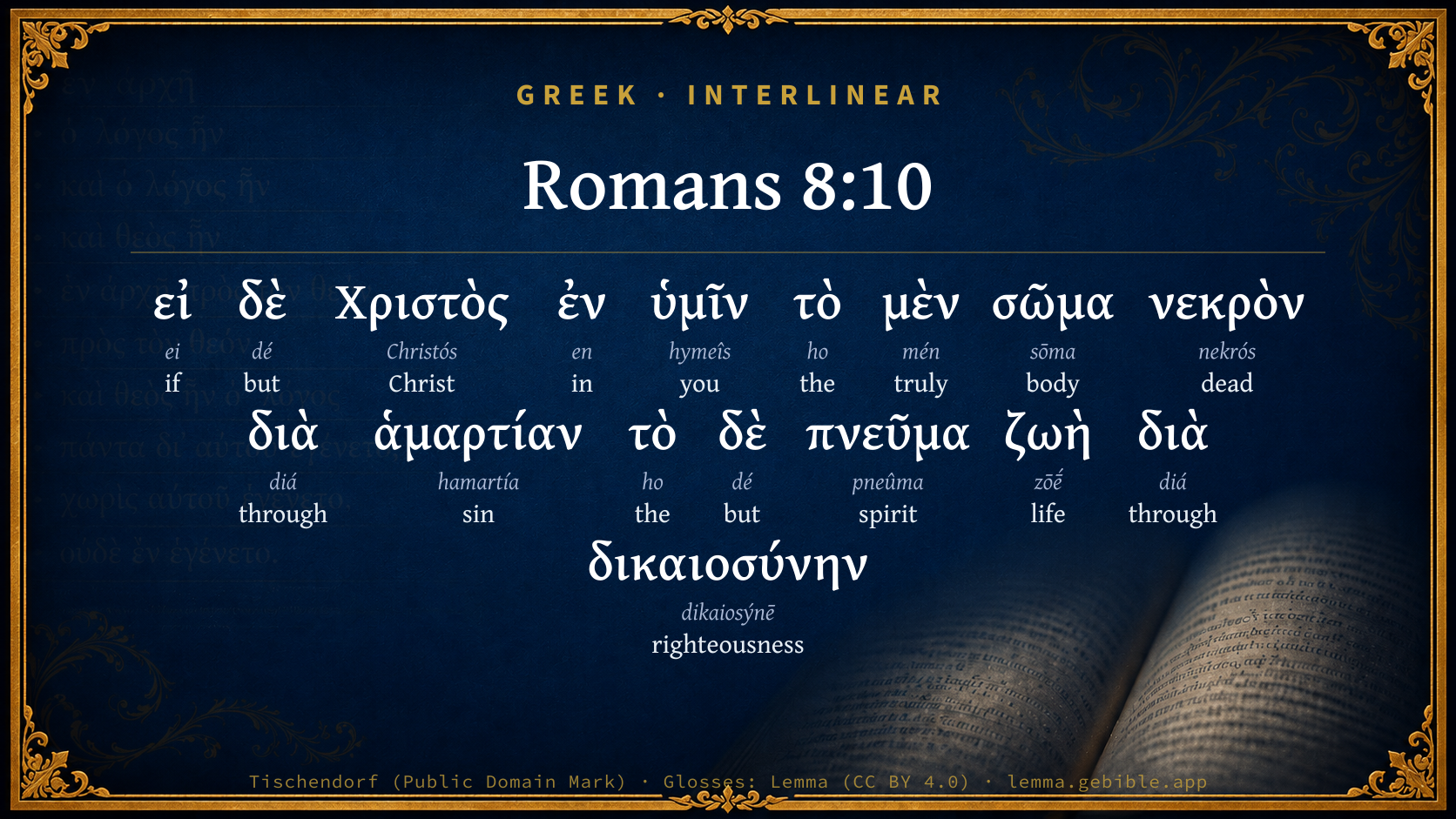
Download image
Cite this verse

Romans 8:10 (World English Bible). Public Domain. Lemma interlinear Bible study tool, https://lemma.gebible.app/v/romans/8/10.

Show BibTeX & RIS
BibTeX
RIS
English Translation
If Christ is in you, the body is dead because of sin, but the spirit is alive because of righteousness.
World English Bible · Public Domain
Download a study sheet

One document with this verse’s original text, its word-by-word gloss line, the meaning frame, cross-references with their text, attributed commentary, and full source and license credits — printable, and it pastes into notes with its structure intact.

This verse Autodidact and up

Study sheet (.html) Plain text (.txt)

A passage Seminary Student

Up to 50 verses in one chapter. A passage sheet keeps up to 6 commentary sources and 12 cross-references per verse, in the order this page ranks them, and says so on the sheet whenever that leaves anything out. Ask for a single verse and you get the Autodidact verse sheet above.

Everything on this page stays free to read, with no account — the sheet is a download of what is already on screen, not access to it.

Want to remove ads? Support Godless Engineer
Compare translations 3

The same verse in 3 English versions, stacked beneath the original-language interlinear above. Click any original word for its lexicon entry.

Each is an independent rendering of the whole verse — the interlinear is not word-aligned to these translations.

Highlighted words mark where these versions differ — a whole-verse word diff, not a word-by-word alignment.

  • World English Bible Public Domain
    If Christ is in you, the body is dead because of sin, but the spirit is alive because of righteousness.
  • King James Version Public Domain
    And if Christ be in you, the body is dead because of sin; but the Spirit is life because of righteousness.
  • unfoldingWord Literal Text CC BY-SA 4.0
    But if Christ in you, the body dead because of sin, but the Spirit life because of righteousness.

unfoldingWord Literal Text — © unfoldingWord, licensed CC BY-SA 4.0. Word-aligned USFM3 via Door43 (git.door43.org/unfoldingWord/en_ult).

Versions to compare (up to 4)

3 of 4 selected

Show all 19 translations

Every available English version of this verse, each an independent rendering of the whole verse.

  • World English Bible Public Domain
    If Christ is in you, the body is dead because of sin, but the spirit is alive because of righteousness.
  • Berean Standard Bible Public Domain
    But if Christ is in you, your body is dead because of sin, yet your spirit is alive because of righteousness.
  • Majority Standard Bible Public Domain
    But if Christ is in you, your body is dead because of sin, yet your spirit is alive because of righteousness.
  • King James Version Public Domain
    And if Christ be in you, the body is dead because of sin; but the Spirit is life because of righteousness.
  • American Standard Version (1901) Public Domain
    And if Christ is in you, the body is dead because of sin; but the spirit is life because of righteousness.
  • Revised Version (1885) Public Domain
    And if Christ is in you, the body is dead because of sin; but the spirit is life because of righteousness.
  • Geneva Bible (1599) Public Domain
    And if Christ bee in you, the body is dead, because of sinne: but the Spirite is life for righteousnesse sake.
  • Douay-Rheims (1899) Public Domain
    And if Christ be in you, the body indeed is dead, because of sin; but the spirit liveth, because of justification.
  • Young's Literal Translation Public Domain
    and if Christ `is' in you, the body, indeed, `is' dead because of sin, and the Spirit `is' life because of righteousness,
  • Literal Standard Version CC BY-SA 4.0
    and if Christ [is] in you, the body, indeed, [is] dead because of sin, and the Spirit [is] life because of righteousness,
  • Unlocked Literal Bible CC BY-SA 4.0
    If Christ is in you, the body is dead with respect to sin, but the spirit is alive with respect to righteousness.
  • unfoldingWord Literal Text CC BY-SA 4.0
    But if Christ in you, the body dead because of sin, but the Spirit life because of righteousness.
  • Darby Bible Public Domain
    but if Christ be in you, the body is dead on account of sin, but the Spirit life on account of righteousness.
  • World Messianic Bible Public Domain
    If Messiah is in you, the body is dead because of sin, but the spirit is alive because of righteousness.
  • Webster's Bible Public Domain
    And if Christ is in you, the body is dead because of sin; but the Spirit is life because of righteousness.
  • Free Bible Version CC BY-SA 4.0
    However, if Christ is in you, even though your body is going to die because of sin, the Spirit gives you life because you're now right with God.
  • Bible in Basic English Public Domain
    And if Christ is in you, the body is dead because of sin, but the Spirit is life because of righteousness.
  • Text-Critical English NT CC BY 4.0
    But if Christ is in you, the body is dead because of sin, but the spirit is alive because of righteousness.
  • Tyndale New Testament (1534) Public Domain
    Yf Christ be in you the body is deed because of synne: but the sprite is lyfe for rightewesnes sake.

Literal Standard Version (2020), Covenant Press — licensed CC BY-SA 4.0. Text via the HelloAO Bible API (eBible.org). Unlocked Literal Bible (unfoldingWord) — licensed CC BY-SA 4.0. Text via the HelloAO Bible API (eBible.org). unfoldingWord Literal Text — © unfoldingWord, licensed CC BY-SA 4.0. Word-aligned USFM3 via Door43 (git.door43.org/unfoldingWord/en_ult). Free Bible Version, Dr. Jonathan Gallagher — licensed CC BY-SA 4.0. Text via the HelloAO Bible API (eBible.org).

Word by word

More ways to search: Search by grammar → Find every occurrence → Compare this word →

Practice this passage: Drill this verse → Learn its vocabulary →

δικαιοσύνην
dikaiosýnē
G1343
“righteousness”
Noun, Accusative, Singular, Feminine
Part of Speech
Noun
Case
Accusative
Number
Singular
Gender
Feminine
Full Thayer's Definition

Origin: from G1342

TDNT: 05:12,2

1. in a broad sense: state of him who is as he ought to be, righteousness, the condition acceptable to God a. the doctrine concerning the way in which man may attain a state approved of God b. integrity, virtue, purity of life, rightness, correctness of thinking feeling, and acting 2. in a narrower sense, justice or the virtue which gives each his due
  1. εἰ ei G1487 “if” Conditional
  2. δὲ dé G1161 “but” Conjunction
  3. Χριστὸς Christós G5547 “Christ” Noun, Nominative, Singular, Masculine
  4. ἐν en G1722 “in” Preposition
  5. ὑμῖν hymeîs G5210 “you” Personal pronoun, 2nd person, Dative, Plural
  6. τὸ ho G3588 “the” Article, Nominative, Singular, Neuter
  7. μὲν mén G3303 “truly” Particle
  8. σῶμα sōma G4983 “body” Noun, Nominative, Singular, Neuter
  9. νεκρὸν nekrós G3498 “dead” Adjective, Nominative, Singular, Neuter
  10. διὰ diá G1223 “through” Preposition
  11. ἁμαρτίαν hamartía G266 “sin” Noun, Accusative, Singular, Feminine
  12. τὸ ho G3588 “the” Article, Nominative, Singular, Neuter
  13. δὲ dé G1161 “but” Conjunction
  14. πνεῦμα pneûma G4151 “spirit” Noun, Nominative, Singular, Neuter
  15. ζωὴ zōḗ G2222 “life” Noun, Nominative, Singular, Feminine
  16. διὰ diá G1223 “through” Preposition

About this verse

These counts appear in no published source. They are computed here, from the morphology-tagged text and Lemma’s own curated glosses. What Lemma adds →

17
words
14
distinct lemmas
Pauline Epistles
section

Repetition

Words recur within this verse:

Cross-references

29

Topical passages linked to Romans 8:10 in the Treasury of Scripture Knowledge — connected by theme and wording, ordered by reader-vote popularity; previews shown in the World English Bible.

  • Galatians 2:20 I have been crucified with Christ, and it is no longer I that live, but Christ living in me. That life which I now live in the flesh, I live by faith in the Son of God, who loved me, and gave himself up for me.
  • Ephesians 3:17 that Christ may dwell in your hearts through faith; to the end that you, being rooted and grounded in love,
  • 2 Corinthians 5:21 For him who knew no sin he made to be sin on our behalf; so that in him we might become the righteousness of God.
  • John 11:25–26 Jesus said to her, "I am the resurrection and the life. He who believes in me, though he die, yet will he live.
  • John 17:23 I in them, and you in me, that they may be perfected into one; that the world may know that you sent me, and loved them, even as you loved me.
  • Romans 8:11 But if the Spirit of him who raised up Jesus from the dead dwells in you, he who raised up Christ Jesus from the dead will also give life to your mortal bodies through his Spirit who dwells in you.
  • 2 Corinthians 5:1–4 For we know that if the earthly house of our tent is dissolved, we have a building from God, a house not made with hands, eternal, in the heavens.
  • Philippians 1:23 But I am in a dilemma between the two, having the desire to depart and be with Christ, which is far better.
  • Colossians 1:27 to whom God was pleased to make known what are the riches of the glory of this mystery among the Gentiles, which is Christ in you, the hope of glory;
  • Colossians 3:3–4 For you died, and your life is hidden with Christ in God.
  • John 14:19–20 Yet a little while, and the world will see me no more; but you will see me. Because I live, you will live also.
  • Philippians 3:9 and be found in him, not having a righteousness of my own, that which is of the law, but that which is through faith in Christ, the righteousness which is from God by faith;
  • John 14:23 Jesus answered him, "If a man loves me, he will keep my word. My Father will love him, and we will come to him, and make our home with him.
  • 1 Corinthians 15:45 So also it is written, "The first man, Adam, became a living soul." The last Adam became a life-giving spirit.
  • John 15:5 I am the vine. You are the branches. He who remains in me, and I in him, the same bears much fruit, for apart from me you can do nothing.
  • Romans 5:21 that as sin reigned in death, even so might grace reign through righteousness to eternal life through Jesus Christ our Lord.
  • 2 Corinthians 4:11 For we who live are always delivered to death for Jesus' sake, that the life also of Jesus may be revealed in our mortal flesh.
  • 2 Corinthians 5:6–8 Being therefore always of good courage, and knowing that, while we are at home in the body, we are absent from the Lord;
  • Hebrews 9:27 Inasmuch as it is appointed for men to die once, and after this, judgment,
  • Revelation 14:13 I heard the voice from heaven saying, "Write, 'Blessed are the dead who die in the Lord from now on.'" "Yes," says the Spirit, "that they may rest from their labors; for their works follow with them."
  • 2 Corinthians 13:5 Test your own selves, whether you are in the faith. Test your own selves. Or don't you know as to your own selves, that Jesus Christ is in you?--unless indeed you are disqualified.
  • 1 Thessalonians 4:16 For the Lord himself will descend from heaven with a shout, with the voice of the archangel, and with God's trumpet. The dead in Christ will rise first,
  • Hebrews 12:23 to the general assembly and assembly of the firstborn who are enrolled in heaven, to God the Judge of all, to the spirits of just men made perfect,
  • John 4:14 but whoever drinks of the water that I will give him will never thirst again; but the water that I will give him will become in him a well of water springing up to eternal life."
  • John 6:56 He who eats my flesh and drinks my blood lives in me, and I in him.
  • Romans 5:12 Therefore, as sin entered into the world through one man, and death through sin; and so death passed to all men, because all sinned.
  • 2 Peter 1:13–14 I think it right, as long as I am in this tent, to stir you up by reminding you;
  • Revelation 7:14–17 I told him, "My lord, you know." He said to me, "These are those who came out of the great tribulation. They washed their robes, and made them white in the Lamb's blood.
  • John 6:54 He who eats my flesh and drinks my blood has eternal life, and I will raise him up at the last day.

Cross-references courtesy of OpenBible.info (CC BY 4.0).

Commentary

Notes on Romans 8:10 from classic Christian and Jewish commentators (each source and its license shown beneath its notes). The classic Christian expositions comment on the surrounding passage and are grouped to its opening verse, so a note may address several verses; the Jewish commentaries on the Tanakh (Rashi and others) are per-verse, so they appear only where the commentator wrote on this verse.

Lemma curates 59 commentaries, every one of them public domain or Creative Commons licensed, each selected and text-cleaned for this edition rather than reprinted as found. About our sources →

Matthew Henry's Commentary

In these verses the apostle represents two more excellent benefits, which belong to true believers.

I. Life. The happiness is not barely a negative happiness, not to be condemned; but it is positive, it is an advancement to a life that will be the unspeakable happiness of the man (Rom 8:10, Rom 8:11): If Christ be in you. Observe, If the Spirit be in us, Christ is in us. He dwells in the heart by faith, Eph 3:17. Now we are here told what becomes of the bodies and souls of those in whom Christ is.

1. We cannot say but that the body is dead; it is a frail, mortal, dying body, and it will be dead shortly; it is a house of clay, whose foundation is in the dust. The life purchased and promised does not immortalize the body in its present state. It is dead, that is, it is appointed to die, it is under a sentence of death: as we say one that is condemned is a dead man. In the midst of life we are in death: be our bodies ever so strong, and healthful, and handsome, they are as good as dead (Heb 11:12), and this because of sin. It is sin that kills the body. This effect the first threatening has (Gen 3:19): Dust thou art. Methinks, were there no other argument, love to our bodies should make us hate sin, because it is such an enemy to our bodies. The death even of the bodies of the saints is a remaining token of God's displeasure against sin.

2. But the spirit, the precious soul, that is life; it is now spiritually alive, nay, it is life. Grace in the soul is its new nature; the life of the saint lies in the soul, while the life of the sinner goes no further than the body. When the body dies, and returns to the dust, the spirit if life; not only living and immortal, but swallowed up of life. Death to the saints is but the freeing of the heaven-born spirit from the clog and load of this body, that it may be fit to partake of eternal life. When Abraham was dead, yet God was the God of Abraham, for even then his spirit was life, Mat 22:31, Mat 22:32. See Psa 49:15. And this because of righteousness. The righteousness of Christ imputed to them secures the soul, the better part, from death; the righteousness of Christ inherent in them, the renewed image of God upon the soul, preserves it, and, by God's ordination, at death elevates it, and improves it, and makes it meet to partake of the inheritance of the saints in light. The eternal life of the soul consists in the vision and fruition of God, and both assimilating, for which the soul is qualified by the righteousness of sanctification. I refer to Psa 17:15, I will behold thy face in righteousness.

3. There is a life reserved too for the poor body at last: He shall also quicken your mortal bodies, Rom 8:11. The Lord is for the body; and though at death it is cast aside as a despised broken vessel, a vessel in which is no pleasure, yet God will have a desire to the work of his hands (Job 14:15), will remember his covenant with the dust, and will not lose a grain of it; but the body shall be reunited to the soul, and clothed with a glory agreeable to it. Vile bodies shall be newly fashioned, Phi 3:21; Co1 15:42. Two great assurances of the resurrection of the body are mentioned: - (1.) The resurrection of Christ: He that raised up Christ from the dead shall also quicken. Christ rose as the head, and first-fruits, and forerunner of all the saints, Co1 15:20. The body of Christ lay in the grave, under the sin of all the elect imputed, and broke through it. O grave, then, where is thy victory? It is in the virtue of Christ's resurrection that we shall rise. (2.) The indwelling of the Spirit. The same Spirit that raiseth the soul now will raise the body shortly: By his Spirit that dwelleth in you. The bodies of the saints are the temples of the Holy Ghost, Co1 3:16; Co1 6:19. Now, though these temples may be suffered for awhile to lie in ruins, yet they shall be rebuilt. The tabernacle of David, which has fallen down, shall be repaired, whatever great mountains may be in the way. The Spirit, breathing upon dead and dry bones, will make them live, and the saints even in their flesh shall see God. Hence the apostle by the way infers how much it is our duty to walk not after the flesh, but after the Spirit, Rom 8:12, Rom 8:13. Let not our life be after the wills and motions of the flesh. Two motives he mentions here: - [1.] We are not debtors to the flesh, neither by relation, gratitude, nor any other bond or obligation. We owe no suit nor service to our carnal desires; we are indeed bound to clothe, and feed, and take care of the body, as a servant to the soul in the service of God, but no further. We are not debtors to it; the flesh never did us so much kindness as to oblige us to serve it. It is implied that we are debtors to Christ and to the Spirit: there we owe our all, all we have and all we can do, by a thousand bonds and obligations. Being delivered from so great a death by so great a ransom, we are deeply indebted to our deliverer. See Co1 6:19, Co1 6:20. [2.] Consider the consequences, what will be at the end of the way. Here are life and death, blessing and cursing, set before us. If you live after the flesh, you shall die; that is, die eternally. It is the pleasing, and serving, and gratifying, of the flesh, that are the ruin of souls; that is, the second death. Dying indeed is the soul's dying: the death of the saints is but a sleep. But, on the other hand, You shall live, live and be happy to eternity; that is the true life: If you through the Spirit mortify the deeds of the body, subdue and keep under all fleshly lusts and affections, deny yourselves in the pleasing and humouring of the body, and this through the Spirit; we cannot do it without the Spirit working it in us, and the Spirit will not do it without our doing our endeavour. So that in a word we are put upon this dilemma, either to displease the body or destroy the soul.

II. The Spirit of adoption is another privilege belonging to those that are in Christ Jesus, Rom 8:14-16.

1. All that are Christ's are taken into the relation of Children to God, Rom 8:14. Observe, (1.) Their property: They are led by the Spirit of God, as a scholar in his learning is led by his tutor, as a traveller in his journey is led by his guide, as a soldier in his engagements is led by his captain; not driven as beasts, but led as rational creatures, drawn with the cords of a man and the bands of love. It is the undoubted character of all true believers that they are led by the Spirit of God. Having submitted themselves in believing to his guidance, they do in their obedience follow that guidance, and are sweetly led into all truth and all duty. (2.) Their privilege: They are the sons of God, received into the number of God's children by adoption, owned and loved by him as his children.

2. And those that are the sons of God have the Spirit,

(1.) To work in them the disposition of children.

[1.] You have not received the spirit of bondage again to fear, Rom 8:15. Understand it, First, Of that spirit of bondage which the Old Testament church was under, by reason of the darkness and terror of that dispensation. The veil signified bondage, Co2 3:15. Compare Rom 8:17. The Spirit of adoption was not then so plentifully poured out as now; for the law opened the wound, but little of the remedy. Now you are not under that dispensation, you have not received that spirit. Secondly, Of that spirit of bondage which many of the saints themselves were under at their conversion, under the convictions of sin and wrath set home by the Spirit; as those in Act 2:37, the jailer (Act 16:30), Paul, Act 9:6. Then the Spirit himself was to the saints a spirit of bondage: "But," says the apostle, "with you this is over." "God as a Judge," says Dr. Manton, "by the spirit of bondage, sends us to Christ as Mediator, and Christ as Mediator, by the spirit of adoption, sends us back again to God as a Father." Though a child of God may come under fear of bondage again, and may be questioning his sonship, yet the blessed Spirit is not again a spirit of bondage, for then he would witness an untruth.

[2.] But you have received the Spirit of adoption. Men may give a charter of adoption; but it is God's prerogative, when he adopts, to give a spirit of adoption - the nature of children. The Spirit of adoption works in the children of God a filial love to God as a Father, a delight in him, and a dependence upon him, as a Father. A sanctified soul bears the image of God, as the child bears the image of the father. Whereby we cry, Abba, Father. Praying is here called crying, which is not only an earnest, but a natural expression of desire; children that cannot speak vent their desires by crying. Now, the Spirit teaches us in prayer to come to God as a Father, with a holy humble confidence, emboldening the soul in that duty. Abba, Father. Abba is a Syriac word signifying father or my father; patēr, a Greek work; and why both, Abba, Father? Because Christ said so in prayer (Mar 14:36), Abba, Father: and we have received the Spirit of the Son. It denotes an affectionate endearing importunity, and a believing stress laid upon the relation. Little children, begging of their parents, can say little but Father, Father, and that is rhetoric enough. It also denotes that the adoption is common both to Jews and Gentiles: the Jews call him Abba in their language, the Greeks may call him patēr in their language; for in Christ Jesus there is neither Greek nor Jew.

(2.) To witness to the relation of children, Rom 8:16. The former is the work of the Spirit as a Sanctifier; this as a Comforter. Beareth witness with our spirit. Many a man has the witness of his own spirit to the goodness of his state who has not the concurring testimony of the Spirit. Many speak peace to themselves to whom the God of heaven does not speak peace. But those that are sanctified have God's Spirit witnessing with their spirits, which is to be understood not of any immediate extraordinary revelation, but an ordinary work of the Spirit, in and by the means of comfort, speaking peace to the soul. This testimony is always agreeable to the written word, and is therefore always grounded upon sanctification; for the Spirit in the heart cannot contradict the Spirit in the word. The Spirit witnesses to none the privileges of children who have not the nature and disposition of children.

Matthew Henry's Commentary on the Whole Bible (1708–1710) — public domain (CC PDM 1.0). Text via the HelloAO Bible API.

The Biblical Illustrator

Joseph S. Exell

Rom_8:10

And if Christ be in you, the body is dead because of sin; but the Spirit is life because of righteousness.

The indwelling of Christ

I. For the present the indwelling of Christ in believers, by His Spirit, removes the power of death from the sphere of their spiritual nature only.

1. From that nature, however, it is removed. For if Christ be in you,…the Spirit is life because of righteousness (1Jn_5:12). But on account of what righteousness? Surely not our own, for apart from Christ we have none. Under law, indeed, being alive, we should have continued to live, if we had maintained a perfect righteousness (Rom_10:5). But under the gospel, being found dead, we must first be made to live, in order to become holy. This righteousness, therefore, is that righteousness of God which is by faith of Jesus Christ (Rom_3:22; Rom_5:17-18). That one thing which of necessity precedes our life in Christ is justification in Christ (2Co_5:21; Rom_4:1-13; Rom_4:22-25), which is hence called a justification of life (Rom_5:18).

2. The new life, however, does not as yet extend beyond the spirit. The body is dead because of sin, and for the furtherance of the great mediatorial purpose. The postponement of the completed adoption, to wit, the redemption of their body (Rom_8:23), is made, not on account of any sin yet remaining in believers (Rom_8:1), but on account of the sin of the world, in so far as the deferring of their redemption from death promotes the worlds salvation. And how needful and wise that it should be so! How obviously inconsistent with a state of probation it would have been for believers to be exempted from death! If only these at the end of their probation were translated to heaven, how completely would the free exercise of the human will, in respect to matters of religion and the free development of human character, be fettered or overborne! Not to insist upon the anguish which would come into every stricken household if death were known to be the precursor of hell; nor to think how dark and dreary this world would become if there were in it no cemeteries in which were to be found the treasured remains of those who sweetly sleep in Jesus, awaiting the call to a deathless life. Let anyone try to imagine what possible advantage there could accrue from such an arrangement. Therefore Christians must continue to die, that they may fill up that which is behind of the afflictions of Christ … for His bodys sake, which is the Church (Col_1:24).

II. The removal of the dominion of death from the bodies of believers is but delayed till the Saviours second coming (Cf. Heb_9:28; Joh_6:39-40; Rom_8:19-23; 1Th_4:16; 1Co_15:42-54)

. Of this believers have a double earnest.

1. The objective fact that God raised the body of Jesus. So strongly did the apostle feel upon this point as to maintain that the whole fabric of Christianity stands or falls with it (1Co_15:12-23).

2. The subjective fact of the indwelling of the resurrective Spirit. If the Spirit of Him who raised up Jesus … dwell in you.

(1) If we are entitled to that Spirit as the life of our souls, we have an equal title to the same Spirit as the life of our bodies.

(2) This assurance is made still stronger by the fact that the indwelling of this Spirit sanctifies and marks out for the Lord these very bodies in which He dwells. The living temple claimed by Him, consecrated by His glorious presence, and made to become, even here and now, the instrument of His purposes, can never be suffered to remain a permanent prey to corruption. This is the earnest of our inheritance (Eph_1:14). Therefore, professed Christians,--

1. Abjure the flesh and its debasing service. You are in no sense such debtors to the flesh as to be required to live according to its desires. Either you must slay the sinful flesh, or it will slay you (Rom_8:18).

2. Remember that the Spirit of Christ is yours. Say not that you are unequal to the work (Php_4:13).

3. When called to endure suffering and death, shrink not as though they were tokens of Gods displeasure, but rather be comforted that herein you are called to share the sufferings of your Lord, and to further His redeeming work (Php_3:10-11).

4. And bear in mind that the state of suffering on account of sin is but for a time (Rom_6:5; 2Ti_2:11-12). (W. Tyson.)

Christ in believers, notwithstanding death, is a sure pledge and earnest of eternal life

I. The supposition. If Christ be in you (2Co_13:5; Col_1:27).

1. Christ is in us--

(1) Objectively. As the things we think of and love are in our hearts and minds, so Christ is in us, as He is apprehended and embraced by faith and love (Eph_3:17; 1Jn_4:18).

(2) Effectively. So Christ is in us by His Spirit and gracious influence. Now, the effects of His Spirit are--

(a) Life (Gal_2:20).

(b) Likeness or renovation of our natures (Gal_4:19; 2Co_5:17).

(c) Strength by the continued influence of His grace to overcome temptation (1Jn_4:4; Php_4:12; 1Co_15:10; Heb_13:21).

2. None are Christians but those who have Christ in them.

(1) Because we must be partakers of Christ before we can be partakers of any benefit purchased by Him (1Jn_5:12).

(2) Where Christ once enters, there He takes up His abode, not to depart thence (1Jn_3:24; Joh_14:28; Joh_15:5).

(3) Where Christ is, He rules and reigns (Col_2:6).

II. The concession. The body is dead because of sin. Because--

1. The sentence is passed (Gen_2:17; Heb_9:27). As we say of a condemned man, he is a dead man.

2. Sin is the cause of death.

(1) The meritorious cause. Death is not a natural accident, but a punishment; we die not as the beasts die, or as the plants decay (chap. 5:12; 6:23). Sin procured it, and the law ratifies it. As regards the faithful, though their sins be forgiven, yet God would leave this mark of His displeasure and teach the world the sure connection between death and sin.

(2) Its end and use.

(a) To finish transgression and make an end of sin.

(b) To free us from the natural infirmities which render us incapable of that happy life in heaven which is intended for us.

(3) Had it not been for sin, we had never had cause to fear dissolution.

III. The assertion or correction, The Spirit is life because of righteousness. In which observe--

1. That believers have a life, notwithstanding death (Joh_11:25). Though the union between body and soul be dissolved, yet not their union with God.

2. This life is to be understood of body and soul (Rom_8:11).

(1) The soul, being the noblest part, is most happily provided for; being purified from all her imperfections, is brought into the sight and presence of God (Luk_20:33-38; Heb_12:23).

(2) At the resurrection the soul shall assume its body again (Php_3:21; Joh_6:40).

3. The grounds are--

(1) The Spirit is life. He doth not draw His argument from the immortality of the soul, for that is common to good and bad; but from the new life wrought in us by the Spirit, which is the beginning and earnest of a blessed immortality (1Jn_3:15; 1Pe_1:23).

(2) The meritorious cause is the righteousness of Christ. When once forgiven, we are out of the reach of the second death (1Co_15:56; Heb_2:14-15).

Conclusion: To enforce the great things of Christianity.

1. To live holily.

(1) The comforts of Christianity are not common to all indifferently, but suspended on this condition, if Christ be in you, by His sanctifying Spirit (Eph_1:4; 2Co_5:5).

(2) From the concession, the body is dead; sentence is passed, and in part executed; this awakeneth us to think of another world, and to make serious preparation (Rom_6:12; Gal_6:8).

(3) The corrective assertion that there is the life promised for body and soul, breedeth the true spirit of faith (2Co_4:13-14), true diligence and godliness (1Co_15:58), and patience (Rom_2:7).

(4) It is the effect both of the Spirits renewing, and the righteousness of Christ.

2. To die comfortably. Christianity affordeth the proper comfort against death, as it is a natural and penal evil (Heb_9:27). Heathens could only teach them to submit to it out of necessity, or as a debt to nature, or an end of the present miseries; but for us the sting of it is gone (1Co_15:56) and the property is altered (1Co_3:22). (T. Manton, D. D.)

True life

I. Its efficient cause--Christ in you.

II. Its development.

1. The body dies, through sin, preparatory to life.

2. The spirit lives, through righteousness, as the earnest of a better life. (J. Lyth, D. D.)

Christ our life

He dwells in us.

I. As the source of life.

1. By faith.

2. In the power of His Word and Spirit.

3. Producing a new birth unto righteousness.

II. As the Spirit of life.

1. Quickening.

2. Sanctifying.

3. Invigorating the soul.

4. By righteousness.

III. As the earnest of life.

1. The body is mortal through sin.

2. Shall be raised again in glory.

3. By the same Spirit that now dwelleth in us.

4. By whom also Christ was raised from the dead. (J. Lyth, D. D.)

Body and spirit

A gifted poet (Rev. W. Calvert) has feigned a most instructive allegory, to illustrate the connection and history of the body and soul, with respect to the Christian believer. He calls the soul Psyche, and the body Sarx, which are the proper terms in the Greek. These two start forth together on the pilgrimage of life. At the outset of their journey both are equally small, infantile, and feeble. Ere long, however, it is seen that Sarx grows faster than his more delicate companion, and begins to exercise an ascendency over her. Alas! if she were abandoned to his tyranny, she would in time be reduced to the most abject slavery, and finally sink with her despotic lord into the abyss of eternal woe. But the discordant pilgrims are met by a radiant stranger, Christ the Lord. To Him Psyche lends a charmed ear, as He tells her of her heavenly parentage and immortal destiny, and bids her take up arms against her coarse and cruel master, nor rest till she has brought him down to his proper position as her slave. It is only by subjecting him that she can either secure her own freedom or fit him for being her equal and honoured companion hereafter. Fired by the Lords exhortations, and assisted by His prowess, Psyche asserts her liberty, assumes superiority, and attempts the subjugation of the flesh. When symptoms of this change appear, Sarx, like an insolent giant, is first disdainful, then indignant, and finally takes up cudgels against his fair companion. This opposition calls forth all her strength, and, aided by her Saviour, she at length obtains the victory, binds the strong man with cords and fetters, and compels him to follow her footsteps, obedient to her pleasure. Many a treacherous effort doth he make, if Psyche remits her watchfulness and care, to regain his forfeited dominion; but, by the grace of Christ, she maintains her headship, waxing stronger and stronger as the pilgrimage advances, until at its close she seems endowed with the might of an angel, while her vanquished companion has sunk into the imbecility of an infant. Thus, though the outward man perish, the inward man is renewed day by day (2Co_4:16). A little longer, the day of trial closes, and their pilgrimage comes to an end. Sarx, exhausted, sinks on the cold strand and dies; while Psyche, released and happy, passes on, to cross the silver stream and enter the flowery land beyond. Yet is not her former companion forgotten. The Lord hath marked the spot where he fell, and will return again, at the last day, to bid him rise from the dust, and rejoin the glorified Psyche in the skies. (T. G. Horton.)

The body dead because of sin

The work of the Spirit in us does not pour the elixir of immortality into the material frame, however much it may strengthen and prepare the imperishable spirit for its immortal well-being. After Christ hath made a temple of our body, there remaineth a virus in the fabric that sooner or later will work its dissolution. Were the body, by some preternatural operation, to be wholly delivered of its corrupt ingredient, we do not understand why death should interpose between our earthly and heavenly state ever. And accordingly, on natures dissolution, they who remain alive must, to become incorruptible, at least be changed. And the reason why those in whom Christ dwells have still a death to undergo, is that sin still adheres to them--and the wearing down of the body by disease, and the mouldering of it into dust, and then its re-ascent from the grave--would appear to be the steps of a refining process, whereby the now vile body is changed into a glorious one--the souls suitable equipment for the delights and the services of eternity. For death, in the case of Christians, cannot surely be because of the judicial sentence on transgression; for those who believe in Christ are delivered from this (Rom_8:1). It cannot be that by any death of ours we eke out, as it were, the satisfaction which hath been already rendered for sin. A believers death, then, must be to root out the existence of sin. It is not inflicted upon him as the last discharge of the wrath of God, but is sent as a release from the plague which adheres, it would seem, as long as the body adheres to us. Now this fact that the body is still subjected to death because of sin is the strongest experimental argument for heaven being a place to which sin can find no entry. It is not in the way of penalty that the Christian has to die--for the whole of that penalty has already been sustained. It is not exacted from him as the payment of a debt--for Christ our surety hath paid a full and a satisfying ransom. It is not to help out the justification which is already complete in Him, nor to remove a flaw from that title deed which we have received perfect from His hand. It stands connected, in short, with the sanctification of the believer. The justice of God would have recoiled from the acceptance of a sinner, and so an expiation had to be made; and the holiness of that place where God dwelleth would have recoiled from the approaches of one whose character was still tainted with sin, even though its guilt had been expiated; and so it is, that there must be a sanctification as well as an atonement. For the one, Christ had to suffer and to die; for the other, man has also to die, and so to fill up that Which is behind of the sufferings of Christ. And it is indeed a most emphatic demonstration of heavens sacredness, that, to protect its courts from violation, not even the most pure and sainted Christian upon earth, can, in his present earthly garb, find admittance therein. (T. Chalmers, D. D.)

The doom and destiny of the body

I. The mortal doom of the flesh. The body is dead because of sin.

1. The fact is that Christians die even as others. If Christians were not to die, as other men, what else could be done with them?

(1) Imagine the wicked dying at various ages and in the usual way, while the holy lingered on to extreme old age, waiting for the consummation of all things--what then? Why, this detention would be an unutterable disappointment and torture. They wish not to live here always. When they have filled up the ordinary term of human life they have a desire to depart and to be with Christ, which is far better. Better by far, that, having served their generation according to the will of God, they should fall on sleep; that, like a shock of corn fully ripe, they should be gathered into the Masters garner. Besides, so marked a departure from the law of mortality, in favour of believers, would destroy the essential conditions of our present life as a probation for eternity. How could we be said to walk by faith, and not by sight, when we beheld the way in which religion suspended the laws of nature, and placed a most conspicuous difference between the evil and the good?

(2) Look, then, at the alternative. Suppose that every believer might expect a miraculous translation like that of Enoch and Elijah; then, plainly, such a translation must be accompanied by a transformation as well, for flesh and blood cannot inherit the kingdom of God; and such a transformation will take effect on those who are alive at Christs coming (1Co_15:51-52). But now such a procedure would be highly impolitic and injurious, for it would constitute a perpetually recurring miracle, and destroy the probationary character of mans career on earth. Belief in Christianity would then be inevitable, and unbelief impossible.

2. The reason is assigned--because of sin.

(1) Our death, like that of other men, is a mark or expression of Gods anger at sin; and we are forcibly taught by it how fearful a thing it is to fall into the hands of the living God. It was just in this way that Moses was treated; when, though his sin was forgiven, he was still prevented by it from entering the promised land.

(2) Death may possibly stand connected with some special sin. John speaks of a sin unto death; that is, a sin which, though forgiven, demands that our fleshly life should be required of us.

(3) We may regard sin as intimately connected with the body; so much so as to render it doubtful whether any believer ever wholly escapes from its virus and contamination so long as he remains in the flesh; and therefore it is better for this tabernacle to be taken down, like an old Hebrew house incurably infected with the leprosy, and destroyed because of sin.

II. Its eventual resuscitation and recovery (verse 11). The doctrine of the resurrection is peculiar to the Bible. The peculiarity to be observed is that here our resurrection is ascribed to the operation of the Holy Ghost, and also to the Father. Jesus Himself claims to be the resurrection and the life. All that is done by any one of the adorable Trinity may, in some sense, be said to be done by the others as well; for Father, Son, and Holy Ghost are one. But still there is a reason why the resurrection is here ascribed to the Spirit. The Holy Ghost is the giver of life to the soul of the believer; and the same Spirit, who is the author of our holiness, is also to be the resuscitator of our lower nature. Hence, we learn the connection there is between present holiness and future glory. As sin is the defilement of the flesh, and occasions its consignment to decay and corruption, so holiness sanctifies the flesh, and tends to its conservation and incorruption. The body may be temporarily dissolved, but it is not to be lastingly destroyed. Therefore the surest pledge you can have of a joyful resurrection is the conscious possession of the Spirit of holiness now. Conclusion:

1. If the body be dead because of sin, let us keep it in subjection.

2. Yet, if this body is to rise again by virtue of the Spirit dwelling in it, let us not despise it.

3. Let us have patience under bodily affliction and submission in death.

4. Let us, while seeking to live as long as we can, be also willing, at Gods behest, to die and lay this body down. (T. G. Horton.)

The Christian aspect of death

I. Its present limit.

1. It is associated with a moral cause as its explanation. The death of the body, apart from the gospel, could be accounted for only by causes such as a physician could furnish. Its great lesson would, however, thus be lost. To the heathen death was a gloomy necessity, and its only lesson was that men should seize the joys of the passing hour. The gospel associates death with sin, and its removal with the removal of sin. It is intended as a witness for God that sin is an evil thing.

2. Death in the case of believers is limited to the body. There are three classes of death. Spiritual death, which has ceased to exist in the believer. To be spiritually minded is life. Eternal death, which has been abolished by Christ. He that believeth on Me shall never die. Bodily death, from which believers are not exempt; but it is limited to the lowest part of our nature. The body is indeed dead, but the spirit is life.

3. Death in this limited dominion is associated with the believers welfare. Why does Paul say, because of sin? Is it that there is some remainder of condemnation for sin which is still to be executed on the believer himself? If so, how can it be said, There is now no condemnation? If it be in wrath, why does the apostle say, All things are yours, whether life or death? The body is dead because of sin, in mercy. It shall work good. It shall be a process of refinement, a furnace for gold. Let the captive of sin be redeemed, and the hand of death shall take off his prison dress, and he shall be clothed upon with his house which is from heaven.

4. Death, thus confined to a narrowed dominion, and even then made subservient to our good, is altogether subservient to the higher power which occupies the centre of our being. Death has been forced out of the metropolis of his empire, and now the spirit is life because of righteousness.

(1) As its cause, when righteousness works and produces this life, viz., the righteousness of faith. He that believeth in Him hath everlasting life.

(2) As its end. That, being made free from sin, we might have our fruit unto holiness, and the end everlasting life. (P. Strutt.)

The blessed experience and hope of a true Christian

I. What is the religion of a true Christian?

1. It does not chiefly consist--

(1) In any opinions which he may embrace, however scriptural and correct.

(2) In any modes or forms of piety, however excellent.

(3) In preserving an inoffensive and blameless conduct before men.

(4) In what are termed good works, whether done to the bodies or souls of men.

2. But in being in Christ, and having Christ in him. These two phrases are not quite synonymous, yet they imply each other, and cannot be separated (Joh_14:20).

(1) The former is used in Rom_8:1; Rom_16:7; 1Co_1:30; 2Co_5:17; 1Th_4:14; Rev_14:13. It implies--

(a) Having an interest in Him, as a woman in her husband (Rom_7:4).

(b) Union with Him, as a branch with the tree in which it grows.

(c) Or a member with the head of the body to which it belongs.

(2) The other implies that Christ is in us, as the leaven in the meal, the sap of the root in the branch, as the light of the sun in the air, as the heat of the fire in the coal or the iron. He is in us--

(a) As our wisdom, enlightening us in the knowledge of God and ourselves, so as to produce repentance; and of Christ, so as to beget confidence (chap. 15:12; Eph_1:12-13) and love.

(b) As our righteousness, producing justification, peace with God, and a hope of immortality.

(c) As our sanctification, delivering us from the power, and, at length, from the whole influence of sin, consecrating us to God, and conforming us to His image.

(d) As our redemption, that having redeemed our whole persons by price, He may rescue all by power.

(3) Christ is thus formed in us. On our part, by faith (Joh_17:20-23; Gal_2:20; Eph_3:17), and on the part of God by His Spirit (Joh_14:20; 1Jn_3:24; Rom_8:8-9).

II. This religion, at present, produces no material change in the body, which still remains dead because of sin.

1. The body is under sentence to die (Gal_3:19; Heb_9:27).

(1) It is in its own nature mortal, having all the seeds of dissolution, bringing upon us old age and death, even if particular diseases should be escaped.

(2) It is encompassed with infirmities and exposed to diseases.

(3) It is a constant clog to the soul, impeding its motions and preventing its activity. Hence we groan, being burdened (2Co_5:4).

2. All this is because of sin; the sin of our first parents (Rom_5:12), being seminally one with them, or through the derivation of our nature from them, just as Levi paid tithes to Melchisedec in Abraham (Heb_7:9-10); besides which we have committed actual sins, the wages of which are death (Rom_6:23).

3. Here we have the true reason why the world knoweth us not as being the children of God. They only judge by appearance, and hence they conclude that all that is said of Christians as having the Spirit of God, and being new creatures, is mere enthusiasm. For they have no idea of any spiritual change.

III. This religion produces a blessed change in the inner man. The Spirit is life because of righteousness, in which clause the opposition to the former is three fold: spirit is opposed to body, life to death, and righteousness to sin.

1. Man consists of a soul as well as a body, which soul will live when the body dies.

2. This spiritual part is by nature involved in moral death (Eph_2:1-5; Col_2:13), under wrath (Eph_4:18), and carnally minded (Rom_8:6). But by Christ in it it is made alive from this death (Rom_6:13). Christians live by Him, through His influence; to Him, in fulfilling His will; like Him, a wise, holy, useful, happy life.

3. This spiritual life they have because of, or through, righteousness (Joh_20:31; Joh_6:53; Joh_6:57; Joh_11:25-26; Gal_2:20). Through justifying righteousness they have the favour of God, through sanctifying righteousness they have the image of God; through practical righteousness, or obedience, they walk with God, and obtain more and more of a spiritual mind. Through the same righteousness they have eternal life. Through their justification they are entitled to it; through their sanctification they are tilted for it; through practical obedience they are in the way to it; and through faith (Heb_11:1) they have an earnest of it (Joh_6:47). Happiness is indeed the result of the whole. Justification, and the favour of God, bring peace, hope, and joy; sanctification brings deliverance from restless and distressing lusts and passions; practical righteousness brings the approbation of God, and the testimony of a good conscience.

IV. This religion will hereafter produce, or be rewarded with, a most important change, even of the outward man. For if the Spirit of Him that raised, etc. Not only is immortality implied, but this mortal body also shall be quickened. The bodies of all, indeed, will rise from their graves (Joh_5:28-29), but the righteous only to what is worthy the name of life. For this we have Christs promise (Joh_6:39-44; Joh_6:54), of which we have pledges in His resurrection (1Co_15:12-20) and His Spirits indwelling. The mortal body shall be quickened.

1. That we may be judged in the body for the deeds done in the body.

2. That the children of the great King, and the brethren and sisters of the Son of God, may not be found naked, but clothed with an external glory, exactly answering to, and perfectly descriptive of, their internal graces and virtues.

3. That we may be conformable to the Lord Jesus, in body as well as soul, and so fit to dwell with Him (1Co_15:47-49).

4. In honour of the Holy Spirit, whose temples our bodies now are.

5. That our triumph over Satan may be perfectly complete, no part of us being lost.

6. And with respect to all, that we may rise higher from the ruins of the fall than the state we had been in before (1Co_15:36-38; 1Co_15:42-44). (J. Benson.)

Believers not subject to spiritual death

For the first, to wit, the evil itself, that is here expressed to be mortality or bodily death, the body is dead. Dead--that is, subject to death. This is the state of the body, and even in the servants of God themselves, in whom Christ Himself dwells by His Spirit, are subject to death as well as others. The bodies of Christians are frail and mortal as well as the bodies of any other men. This is grounded partly upon the general sentence which is passed upon all men (Heb_9:27). And partly also upon those frail principles whereof the godly themselves do consist in their natural condition. It is no wonder for dust to return to dust. First, to teach us to be frequently in the thoughts and meditations hereof, we should look upon our bodies as mortal and corruptible, even the best that are here in this world. That they have this treasure in earthen vessels. Secondly, we should hence be persuaded against all inordinate care of the body, pampering of it, and glorying in the excellencies and accomplishments of it; for, alas! it will quickly be dissolved and lie in the dust. Thirdly, let us not from hence be offended at the troubles of the children of God here in this life, that they are in deaths oft. While their bodies are subject to death, it is no marvel that their lives are also subject to affliction. Though Christ be in you, yet the body which you carry about you is dead. And that is the first particular here considerable, which is the evil itself. The second is the occasion of this evil, or the ground whereupon it proceeds, and that is guilt. The body is dead because of sin (Rom_5:12). It is sin which exposes all men, both good and bad, to the stroke of death. First, take it remotely, because of sin; that is, of the first sin and transgression that was in the world. Secondly, because of sin; that is, because of actual sin, and sin considered more immediately and proximately. There is a double influence which sin may be said to have upon death as causal of it. First, it hath sometimes, and in some cases and persons, a physical and productive influence upon it, as immediately and directly effecting it, and bringing it about. There are abundance of persons in the world whose very sins are their death by their luxury, and wantonness, and intemperance--the body is dead because of sin. But secondly, it is always so in a moral, and considered demeritoriously. So that wherever there is death there is sin antecedent to it. The consideration of this point may be thus far useful to us, as it may serve, first, to convince us of the grievous nature of sin, and to humble us under the guilt and sense of it, as being that which brings so much evil and mischief with it, as consequent upon it. And if we are not sensible of it as it is an offence and dishonour to God, yet let us at least be sensible of it as it is a grievance and annoyance to ourselves, and occasions the greatest evil to us of anything else. And so let us learn to justify God in His dealings with us, and to condemn ourselves as the causes of our own suffering. The second is the qualification, But the Spirit is life because of righteousness. Wherein, as in the former, we have two particulars more. First, the benefit itself; and secondly, the ground of this benefit. First, for the benefit itself, The Spirit is life. This, it is life, or lives (as some translations carry it), namely, the life of grace here, and the life of glory hereafter. This is the meaning of the words. And the point which we learn from them is this--that Gods children, although they be mortal, in regard of their bodies, yet they are in a state of immortality in regard of their souls: The Spirit is life. While we say that Gods children do live in regard of their souls, this is not to be taken exclusively, but rather emphatically; not exclusively, as denying the immortality of the souls of other men, but emphatically, as fastening a special immortality upon these. But now when it is said here in the text that the souls of Gods children live, we are to take it in a two-fold explication. First, for the life of grace. They live such a life as this even when their bodies are in a manner dead, that is, subject or near unto it. The just shall live by faith (Rom_1:17). There may be a lively and vigorous soul in a withered and decayed body. Then when the flesh is ready to perish, yet the spirit may flourish (2Co_4:17). This is so upon this account--first, because they are lives of a several nature and kind. Now thus it is with the flesh and the spirit, with the body and the soul, the life of nature and the life of grace. These are lives of a different kind, and so they do not mutually depend one upon the other. These things which are hurtful to the one, they do not prejudice the other. Secondly, there is this also in it, that the good of one is sometimes so much the more advanced and promoted by the prejudice of the other. Those who are always well and in health, they do for the most part little consider of their latter end, neither are they so careful to provide for a better world; whereas those who are sick, they are often put upon such thoughts as these are. Those tenants who have often warning given them to depart out of their house, they are careful to provide themselves a dwelling somewhere else. The consideration of this point may be thus far useful to us. First, as it may serve for an encouragement to the children of God in the midst of all those bodily infirmities which they are subject to here in this life. What though their bodies decay, yet their souls and spirits may live; and this is that which is chiefly to be looked after by them. There are a good many people in the world whose care is all taken up about their outward man. Secondly, here is that also which calls us to search and self-inquiry. And whether does sickness and weakness and diseases and distempers of body make us better or no in our spirits and inward man? The second is the life of glory. The Spirit is life--that is, it lives such a life as this. This is grounded not only upon the nature of the soul itself, which cannot die, but more especially upon the decree and purpose and promise of God Himself, who hath appointed us to obtain salvation by Jesus Christ, as the apostle elsewhere speaks. The use of this point is very comfortable against the inordinate fear of death. And so as for death in any other way whatsoever, here is that which does serve very much to mollify and mitigate it to them, and the thoughts of it either as to their own particular persons or to their Christian friends dying in the Lord. That though it be a privation of one life, yet it is a promotion of another; and though it separates the soul from the body, and other friends here below in the world, yet it joins it so much the closer to Christ, and makes them partakers of a better estate and condition in a better place. If Christ be in them, though the body be dead, yet the Spirit is life. And that is the first particular which is here observable and considerable of us in this second general, to wit, the benefit itself. The second is the ground of this benefit, and that is expressed in these words, Because of righteousness. We are to understand two things, either first of all the righteousness of Christ imputed, which gives us a right and title to salvation; or else, secondly, inherent righteousness, as a condition required in that subject which shall indeed be saved: in either sense it is because of righteousness. This shows us, first, what great cause we have, all that may be, to labour to get into Christ, and to endeavour to become members of His body, that so, partaking of His righteousness, we may consequently partake of His salvation and of eternal life itself. Secondly, seeing our souls came to live by virtue of the righteousness of Christ, meriting and procuring at the hands of God this life for us, this, then, shows us how for we are indeed beholden to Christ, and what cause we have to be thankful to Him, even as much as to one who has redeemed us from death itself and hath bestowed life upon us. And so now, according to this interpretation of the words, we have here in this present verse set forth unto us the admirable effects of the being of Christ in believers, and that in two points especially. First, in point of mortification, there is a killing of sin in them; the body is dead because of sin. Secondly, in point of vivification, grace is alive and active in them. The Spirit is life because of righteousness. The ground hereof is taken, first, from the nature of all life in general, which is to be operative and active. Secondly, from the end of spiritual life in particular, which is especially to serve God. (Thomas Horton, D. D.)

Delivered from sin rather than from its natural consequences

Some of the hardest burdens which men bear are the consequences of their past weaknesses and sins. There is a certain deep and lasting satisfaction in making expiation for ones offences, and in recognising in ones own soul the evidences of a genuine sorrow; but when the sin, instead of retreating into the background, walks with us day by day in its effects and results, there are times when the bravest spirit grows faint and discouraged in such companionship. One feels in such moments as if the sin ought to be blotted out in its material effects as truly as in its spiritual results. But this cannot be. No such promise is anywhere to be found in the revelation of Gods purpose to men. We are delivered from our sins, and that is matter for deep and eternal rejoicing; but we are not and cannot be delivered wholly from the consequences o! our sins. Those offences have become operative causes in the universal order of things, and we must stand by and see results flow from them, no matter how agonising the spectacle may be. But this experience, though often intensely painful, ought not to be crushing; it is from our sins and not from their effects that we care most to be delivered. That deliverance is for eternity; the effects are for time only. But there is in the immutability of the law which preserves the evil that men do in life a sublime and awful vindication of the steadfastness and eternal justice of Him who forgiveth our iniquities--who has, in fact, borne them. Once forgiven for Christs sake, these iniquities are washed clean from the soul; but there is constant need that he who has gone through this ordeal shall see clearly the awful crime of offending against the laws of life, and that he shall be accompanied perpetually by the witnesses to this great truth. When the consequences of former weaknesses and sins, accompanying us year after year, become to us, not avenging Furies, but angels of Divine justice, this companionship will not dismay us, but will serve as a new inspiration. One may make, even of the consequences of his sins, sources of strength rather than of weakness. He who accepts these things as the inevitable results of his own action, and recognises in them the working of an immutable and righteous law, will be kept humble by them, will be restrained from other departures from rectitude, and will draw from their companionship a deeper and deeper sense of that misery from which he has escaped, and of the permanent joy and peace into which he has entered.

The Biblical Illustrator, edited by Joseph S. Exell (c. 1880s–1900s) — public domain. Text from a community e-Sword module.

Joseph Benson's Commentary

Rom 8:10-11. And if Christ be in you — Namely, by his Spirit dwelling in you: where the Spirit of Christ is, there is Christ: the body is dead — Το μεν σωμα νεκρον, the body indeed is dead, devoted to death; for our belonging to Christ, or having Christ in us, does not exempt the body from undergoing the sentence of death passed on all mankind; because of sin — Heretofore committed; especially the sin of Adam, by which death entered into the world, and the sinful nature derived from him; but the Spirit is life — The soul is quickened and made alive to God; and shall, after the death of the body, continue living, active, and happy; because of righteousness — Now attained through the second Adam, the Lord our righteousness. But — Rather, and, for the apostle proceeds to speak of a further blessing; as if he had said, If you have Christ in you, not only shall your souls live after the death of the body in felicity and glory, but your bodies also shall rise to share therein; for we have this further joyful hope, that if the Spirit of him that raised up Jesus — Our great covenant head; from the dead, dwell in you; he — God the Father; that raised up Christ from the dead — The first-fruits of them that sleep; shall also quicken your mortal bodies — Though corrupted and consumed in the grave; by his Spirit — Or on account of his Spirit; which dwelleth in you — And now communicates divine life to your souls, and creates them anew.

Joseph Benson's Commentary on the Old and New Testaments (1811–1818) — public domain. Text from a community e-Sword module.

Tyndale Open Study Notes

Tyndale Open Resources

8:10 the Spirit gives you life: The Spirit opposes sin (which leads to physical death) and brings resurrection from the dead.

Tyndale Open Study Notes — © Tyndale Open Resources, licensed CC BY-SA 4.0. Text via the HelloAO Bible API.

Bengel's Gnomon

Johann Albrecht Bengel

Rom 8:10. Εἰ δὲ Χριστὸς, And truly if Christ) Where the Spirit of Christ is, there Christ is, comp. the preceding verse.—σῶμα) the body, sinful, for here it is opposed to the Spirit, not to the soul.—νεκρὸν) The concrete [not the abstract death; as the antithetic ζωή life in the abstract]: he says dead, instead of, about to die, with great force; [already] adjudged, and delivered over to death. This is the view and feeling of those, who have experienced in themselves [in whom there succeeds] the separation of soul and spirit, or of nature and grace.—δὲ, but) Implying, that the opposition is immediate [and direct between the body and the spirit], which excludes Purgatory, [a notion] suited neither to body nor spirit, and not consonant to the remaining economy of this very full epistle, Rom 8:30; Rom 8:34; Rom 8:38, ch. Rom 6:22-23.—ζωὴ, life) The abstract.—διὰ on account of) Righteousness brings forth life, as sin brings forth death; life does not bring forth righteousness, [justification] contrary to the opinion of the Papists.—δικαιοσύνην, justice [righteousness]) The just—shall live [Rom 1:17].

Bengel's Gnomon of the New Testament — English translation (T&T Clark, Edinburgh, 1860) — public domain. Text from a community e-Sword module.

Meyer's Critical & Exegetical Commentary

Heinrich August Wilhelm Meyer

Rom_8:10. The contrast to the foregoing. Whosoever has not the Spirit of Christ, is not His; if, on the other hand; Christ (i.e. πνεῦμα Χριστοῦ, see on Rom_8:9) is in you, then ye enjoy the following blissful consequences:(1) Although the body is the prey of death on account of sin, nevertheless the Spirit is life on account of righteousness, Rom_8:10. (2) And even the mortal body shall be revivified by Him who raised up Christ from the dead, because Christs Spirit dwelleth in you, Rom_8:11.

Rom_8:10-11 have been rightly interpreted as referring to life and death in the proper (physical) sense by Augustine (de. pecc. merit. et rem. i. 7), Calvin, Beza, Calovius, Bengel, Michaelis, Tholuck, Klee, Flatt, Rückert, Reiche, Glöckler, Usteri, Fritzsche, Maier, Weiss l.c. p. 372, and others. For, first, on account of the apostles doctrine regarding the connection between sin and death (Rom_5:12) with which his readers were acquainted, he could not expect his τ. σῶμα νεκρ. διʼ ἁμ. to be understood in any other sense; secondly, the parallel between the raising up of Christ from death, which was in fact bodily death, and the quickening of the mortal bodies does not permit any other view, since ζωοπ. stands without any definition whatever altering or modifying the proper sense; and lastly, the proper sense is in its bearing quite in harmony with the theme of Rom_8:2 (which is discussed in Rom_8:3-11): for the life of the Spirit unaffected by physical death (Rom_8:10), and the final revivification also of the body (Rom_8:11), just constitute the highest consummation, and as it were the triumph, of the deliverance from the law of sin and death (Rom_8:2). These grounds, collectively, tell at the same time against the divergent explanations: (1) that in Rom_8:10-11 it is spiritual death and life that are spoken of; so Erasmus, Piscator, Locke, Heumann, Ch. Schmidt, Stolz, Böhme, Benecke, Köllner, Schrader, Stengel, Krehl, and van Hengel. (2) That Rom_8:10 is to be taken in the spiritual, but Rom_8:11 in the proper sense; so Origen, Chrysostom, Theodoret, Oecumenius, Grotius, Koppe, Olshausen, Reithmayr, and others; de Wette unites the moral and physical sense in both verses, comp. also Nielsen and Umbreit; see the particulars below.

νεκρόν] With this corresponds the ΘΝΗΤΆ in Rom_8:11. It conveys, however, the idea conditioni mortis obnoxium (Augustine) more forcibly, and so as vividly to realize the certain resulthe is dead!a prolepsis of the final fate, which cannot now be altered or avoided. Well is it said by Bengel: magni vi; morti adjudicatum deditumque. Our body is a corpse! Analogous is the ἐγὼ δὲ ἀπέθανον in Rom_7:10, though in that passage not used in the sense of physical death; comp. Rev_3:1; also ἜΜΨΥΧΟΝ ΝΕΚΡΌΝ, Soph. Ant. 1167; Epict. fr. 176: ψυχάριον εἶ βαστάζον νεκρόν. The commentators who do not explain it of physical death are at variance. And how surprising the diversity! Some take ΝΕΚΡ. as a favourable predicate, embracing the new birth = ΘΑΝΑΤΩΘῈΝ Τῇ ἉΜΑΡΤΊᾼ (so with linguistic inaccuracy even on account of ΔΙʼ ἉΜ., Origen, Chrysostom, Theodoret, Oecumenius, Theophylact, and with various modifications, also Erasmus, Raphel, Grotius, Locke, Heumann, Böhme, Baumgarten-Crusius, Reithmayr, and Märcker; comp. van Hengel, mortui instar ad inertiam redactum). Others take it as: miserable by reason of sin (Michaelis, Koppe, Köllner), comp. de Wette: Even in the redeemed there still remains the sinful inclination as source of the death, which expresses its power; Krehl as: morally dead; Olshausen: not in the glory of its original destiny; Tholuck: in the sense of Rom_7:10 f., but also including in itself the elements of moral life-disturbance and of misery. Since, however, it is the body that is just spoken of, and since διʼ ἁμαρτίαν could only bring up the recollection of the proposition in Rom_5:12, every view, which does not understand it of bodily death, is contrary to the context and far-fetched, especially since θνητά in Rom_8:11 corresponds to it.

ΔΙʼ ἉΜΑΡΤΊΑΝ] The ground: on account of sin, in consequence of sin (Kühner, II. 1, p. 419), which is more precisely known from Rom_5:12. Death, which has arisen and become general through the entrance of sin into the world, can be averted in no case, not even in that of the regenerate man. Hence, even in his case, the body is νεκρόν διʼ ἁμαρτίαν. But how completely different is it in his case with the spirit! Τὸ πνεῦμα, namely, in contrast to the ΣῶΜΑ, is necessarily not the transcendent (Holsten) or the Holy Spirit (Chrysostom, Theophylact, Calvin, Grotius, and others); nor yet, as Hofmann turns the conception, the spirit which we now have when Christ is in us and His righteousness is ours; but simply our human spirit, i.e. the substratum of the personal self-consciousness, and as such the principle of the higher cognitive and moral activity of life as directed towards God, different from the ψυχή, which is to be regarded as the potentiality of the human natural life. The faculty of the ΠΝΕῦΜΑ is the ΝΟῦς (Rom_7:25), and its subject the moral Ego (Rom_7:15 ff.). That the spirit of those who are here spoken of is filled with the Holy Spirit, is in itself a correct inference from the presupposition ΕἸ ΧΡΙΣΤῸς ἘΝ ὙΜῖΝ, but is not implied in the word τὸ πνεῦμα, as if this meant (Theodoret and de Wette) the human spirit pervaded by the Divine Spirit, the pneumatic essence of the regenerate man. That is never the case; comp: on Rom_8:16.

ΖΩΉ] i.e. life is his essential element; stronger than ζῇ, the reading of F. G. Vulg. and MSS. of the It. Comp. Rom_7:7. With respect to the spirit of the true Christian, therefore, there can be no mention of death (which would of necessity be eternal death); comp. Joh_11:26. He is eternally alive, and that διὰ δικαιοσύνην, on account of righteousness; for the eternal ζωή is based on the justification that has taken place for Christs sake and is appropriated by faith. Rückert, Reiche, Fritzsche, Philippi (comp. also Hofmann), following the majority of ancient expositors, have properly taken ΔΙΚΑΙΟΣΎΝΗΝ thus in the Pauline-dogmatic sense, seeing that the moral righteousness of life (Erasmus, Grotius, Tholuck, de Wette, Klee, and Maier), because never perfect (1Co_4:4; Php_3:9, al.), can never be ground of the ζωή. If, however, ΔΙᾺ ΔΙΚΑΙΟΣΎΝΗΝ be rendered: for the sake of righteousness, in order that the latter may continue and rule (Ewald, comp. van Hengel), it would yield no contrast answering to the correct interpretation of νεκρὸν διʼ ἁμ. It is moreover to be noted, that as ΔΙʼ ἉΜΑΡΤ. does not refer to ones own individual sin (on the contrary, see on ἘΦʼ ᾯ ΠΆΝΤΕς ἭΜΑΡΤΟΝ, Rom_5:12), so neither does ΔΙᾺ ΔΙΚΑΙΟΣΎΝΗΝ refer to ones own righteousness.

Observe, further, the fact that, and the mode in which, the ΔΙΚΑΙΟΣΎΝΗ may be lost according to our passage, namely, if Christ is not in us,a condition, by which the moral nature of the ΔΙΚΑΙΟΣΎΝΗ is laid down and security is guarded against.

Meyer — Critical and Exegetical Commentary on the New Testament — English translation by Peter Christie, edited by Frederick Crombie (T&T Clark, 1880) — public domain. Text from a community e-Sword module.

Expositor's Greek Testament

ed. W. Robertson Nicoll

Rom 8:10 . Consequences of this indwelling of Christ in the Christian. In one respect, they are not yet so complete as might be expected. τὸ μὲν σῶμα νεκρὸν : the body, it cannot be denied, is dead because of sin: the experience we call death is inevitable for it. τὸ δὲ πνεῦμα ζωή : but the spirit ( i.e. , the human spirit, as is shown by the contrast with σῶμα ) is life, God-begotten, God-sustained life, and therefore beyond the reach of death. As death is due to sin, so is this life to δικαιοσύνη . It is probably not real to distinguish here between “justification” and “moral righteousness of life,” and to say that the word means either to the exclusion of the other. The whole argument of chaps. 6 8. is that neither can exist without the other. No man can begin to be good till he is justified freely by God’s grace in Christ Jesus, and no one has been so justified who has not begun to live the good life in the spirit.

The Expositor's Greek Testament, edited by W. Robertson Nicoll (1897–1910) — public domain. Text from a community e-Sword module.

Godet's Commentaries

Frédéric Louis Godet

Vv. 10. “Now if Christ be in you, the body is indeed dead because of sin; but the Spirit is life because of righteousness.”

As the apostle had substituted the Spirit of Christ for the Spirit of God, he now substitutes for the Spirit of Christ His person: Now if Christ be in you. “Where the Spirit of Christ is,” says Hofmann, “there he is also Himself.” In fact, as the Spirit proceeds from Christ, His action tends to make Christ live in us. “I shall come again to you,” said Jesus (Joh 14:17-18), when He was describing the work of the Spirit. This new expression brings out more forcibly than the preceding the solidarity between the person of Jesus and ours, and so prepares for Rom 8:11, in which the resurrection of Jesus is set forth as the pledge of ours.

This hope of sharing His resurrection rests on the fact that even now His life has penetrated the spiritual part of our being (Rom 8:10 b). No doubt this spiritual life will not prevent the body from dying; but it is the earnest of its participation in the resurrection of Christ. From chap. Rom 5:12; Rom 5:15; Rom 5:17, we know the apostle’s view respecting the cause of death: “Through one man’s offence many are dead.” The fact of universal death does not therefore arise from the sins of individuals, but from the original transgression. The meaning of these words: because of sin, is thus fixed; they refer to Adam’s sin. It is sometimes asked why believers still die if Christ really died for them; and an argument is drawn hence against the doctrine of expiation. But it is forgotten that, death not being an individual punishment, there is no connection between this fact and the pardon of sins granted to believing individuals. Death, as a judgment on humanity, bearing on the species as such, remains till the general consummation of Christ’s work; comp. 1Co 15:26.

The term dead here signifies: irrevocably smitten with death. The human body bears within itself from its formation the germ of death; it begins to die the instant it begins to live. Commentators who, like Chrys., Er., Grot., explain this term dead, as dead unto sin (in a good sense), evidently do not understand the course of thought in these verses, 9-11.

But if the believer’s death cannot be prevented, there is a domain in him where life has already established its reign, the spirit in which Christ dwells. Hofmann insists strongly that the term spirit should here be applied to the Spirit of God. In that case the words: the spirit is life, must be understood in the sense: the spirit produces and sustains life in the soul. But this sense is unnatural, and the contrast between spirit and body leads us rather to apply the former term to the spiritual element in the believer. In the passage, 1Th 5:23, Paul distinguishes these three elements in man: body, soul, and spirit.By the third term he denotes the organ with which the soul of man, and of man alone of all animated beings, is endowed, whereby he perceives and appropriates the divine; by this spiritual faculty it is that the Spirit of God can penetrate into the soul, and by it rule the body. Hence arises the sanctification of the body (Rom 6:11-13), not its deliverance from death. But Paul can already say, nevertheless, that in consequence of its union with the Spirit of God the spirit of the believer is life. This expression no doubt sounds somewhat strong; why not say simply: living? This peculiarity seems to have been observed very early; it is certainly the origin of the reading ζῇ, lives, instead of ζωή, life, in two Greco-Latin MSS.; but Paul’s thought went further. The life of God does not become merely an attribute of the spirit in man through the Holy Spirit; it becomes his nature, so that it can pass from the spirit to his whole person, psychical and bodily (Rom 8:11).

The last words: because of righteousness, cannot refer to the restoration of holiness in the believer; not that the word righteousness cannot have this meaning in Paul’s writings (comp. Rom 6:13; Rom 6:19), but because it is impossible to say life exists because of holiness; for in reality the one is identical with the other. We must therefore take the word righteousness in the sense of justification, as in chaps. 1-5. To this meaning we are also led by the meaning of the clause which forms an antithesis to this in the first proposition: because of sin. As the body dies because of a sin which is not ours individually, so the spirit lives in consequence of a righteousness which is not ours.

But will this body, given over to death, be abandoned to it forever? No; the last trace of condemnation behoves to be effaced.

Frédéric Louis Godet — Commentaries on Luke, John, Romans, and 1 Corinthians — English translation (T&T Clark, Edinburgh, 1870s–1890s) — public domain. Text from a community e-Sword module.

Hodge's Commentary on Romans, Ephesians & First Corinthians

Charles Hodge

Rom_8:10

And if, or rather, but if, (εἰ de&) Christ be in you. If a man have not the Spirit of Christ, he is none of his; but if Christ be in him, he is partaker of his life. From this interchange of expression it is plain that to say that the Spirit of Christ dwells in us, and to say that Christ dwells in us is the same thing. And as the former phrase is interchanged with Spirit of God, and that again elsewhere with God, it follows, that to say, God dwells in us, the Spirit of God dwells in us, Christ dwells in us, and the Spirit of Christ dwells in us, are only different ways of expressing the same thing. Qui Spiritum habet, Christum habet; qui Christum habet, Deum habet. Bengel. This scriptural usage finds its explanation in the doctrine of the Trinity. While there is one only, the living and true God; yet as there are three persons in the Godhead, and as these three are the same in substance, it follows, that where the Father is, there the Son is, and where the Son is, there is the Spirit. Hence our Lord says, If any man love me, he will keep my words, and my Father will love him, and we will come unto him, and make our abode With him. Joh_14:23. And the apostle John says, Whosoever shall confess that Jesus is the Son of God, God dwelleth in him, and he in God, 1Jo_4:15. I and my Father, says Christ, are one. He therefore who hath the Son, hath the Father also. There is another familiar scriptural usage illustrated in this verse. Christ is properly an official designation of the Theanthropos, as the anointed Prophet, Priest, and King of his people. It is however used as a personal designation, and is applied to our Lord, as well in reference to his human as to his divine nature. Hence the Bible says indifferently, Christ died, and that he created all things. In this and other passages, therefore, when Christ is said to dwell in us, it is not Christ as man, nor Christ as the Theanthropos, but Christ as God. Compare 2Co_13:5, Know ye not that Jesus Christ is in you. His indwelling in his people is as much a function of his divine nature, as his creating and upholding all things by the word of his power.

And if Christ (be) in you, the body is dead because of sin, etc. As this verse is antithetical to the preceding, δέ should be rendered but: If any man have not the Spirit of Christ, he is none of his; but if Christ be in you, although the body must die on account of sin, the spirit shall live because of righteousness. The Spirit is the source of life, and wherever he dwells, there is life.

The body indeed is dead, τὸ μὲν σῶμα νεκρόν. That σῶμα here is to be taken in its literal sense is plain, because such is the proper meaning of the word. It is rarely, if at all, used in the figurative sense in which σάρξ (flesh) so often occurs. This interpretation also is required by the antithesis between body and spirit, in this verse. The context also demands this view of the passage, both because of the reference to the resurrection of Christ, which was of course literal, and because in the next verse we have the phrase mortal bodies, which does not admit of a figurative interpretation. The sense also afforded by the literal meaning of the word is so natural, and so suited to the context, as to preclude the necessity of seeking for any other. In this view the majority of commentators concur. Others, however, understand by σῶμα the corrupt nature, or the whole nature of man, his soul and body, as distinguished from the Spirit as the principle of divine life. The word νεκρόν is made to mean νενεκρωμένον, put to death, mortified; and δι ̓ ἁμαρτίαν, on account of sin, is made equivalent το τῇ ἁμαρτίᾳ, as to sin. This evidently does unnecessary violence to the literal meaning of the words. The body is dead in the sense that it is not only obnoxious to death, but as it is already the seat of death. It includes in it the principle of decay. This necessity of dying is on account of sin. It is not inconsistent with the perfection of the redemption of Christ, that its benefits are not received in their fullness the moment we believe. We remain subject to the pains, the sorrows, the trials of life, and the necessity of dying, although partakers of the life of which he is the author. That life which is imparted in regeneration, is gradually developed until it has its full consummation at the resurrection.

The spirit is life because of righteousness. By spirit here, is not to be understood the Holy Spirit, but the human spirit, because it stands opposed to body in the former clause. The body is dead, but the spirit is life. It should not therefore be printed with a capital S, as in the ordinary copies of the English version. The sense in which the spirit is life, is antithetical to that in which the body is dead. As the body is infected with a principle of decay which renders its dissolution inevitable, so the soul, in which the Holy Spirit dwells, is possessed of a principle of life which secures its immortal and blessed existence. Because of righteousness; δικαιοσύνη, as opposed to ἁμαρτία, must be taken in its subjective sense. It is inward righteousness or holiness, of which the apostle here speaks, and not our justifying righteousness. It is because the Holy Ghost, as dwelling in believers, is the source of holiness, that he is the source of life. The life of which he is the author, is the life of God in the soul, and is at once the necessary condition and the effect of the enjoyment of his fellowship and favor. We shall continue in the enjoyment of the life just spoiled of; because the principles of this new and immortal existence are implanted within us. Regeneration is the commencement of eternal life. The present possession of the Spirit is an earnest of the unsearchable riches of Christ, Eph_1:14. In this view the verse is directly connected with the main object of the chapter, viz. the security of all who are in Christ Jesus. To such there is no condemnation, because they have been freed from the law which condemned them to death; and because the work of salvation is already begun in them. They have eternal life, Joh_6:47.

Charles Hodge — Commentary on Romans (1835), First Corinthians (1857), and Ephesians (1856) — public domain. Text from a community e-Sword module.

Geneva Bible (1599)

Geneva Bible translators

He confirmeth the faithful against the relics of flesh and sin, granting that they are yet (as appeareth by the corruption which is in them) touching one of their parts (which he calleth the body, that is to say, a lump) which is not yet purged from the earthly filthiness in death: but therewithall willing them to doubt nothing of the happy success of their combat, because that even the little spark of the Spirit, (that is, of the grace of regeneration) which appeareth to be in them by the fruits of righteousness, is the seed of life.

The flesh, or all that which as yet sticketh fast in the clefts of sin, and death.

Geneva Bible (1599) marginal notes — public domain. Text via Bolls.life.

Jamieson, Fausset & Brown

Robert Jamieson, A. R. Fausset & David Brown

And if Christ be in you--by His indwelling Spirit in virtue of which we have one life with him.

the body--"the body indeed."

is dead because of--"by reason of"

sin; but the spirit is life because--or, "by reason"

of righteousness--The word "indeed," which the original requires, is of the nature of a concession--"I grant you that the body is dead . . . and so far redemption is incomplete, but," &c.; that is, "If Christ be in you by His indwelling Spirit, though your 'bodies' have to pass through the stage of 'death' in consequence of the first Adam's 'sin,' your spirit is instinct with new and undying 'life,' brought in by the 'righteousness' of the second Adam" [THOLUCK, MEYER, and ALFORD in part, but only HODGE entirely].

Jamieson, Fausset & Brown — Commentary Critical and Explanatory on the Whole Bible (1871) — public domain (CC PDM 1.0). Text via the HelloAO Bible API.

Adam Clarke's Commentary

Verse 10. And if Christ be in you, c.] This is the criterion by which you may judge of the state of grace in which ye stand. If Christ dwell in your hearts by faith, the body is dead because of sin, δι' ἁμαρτιαν, in reference to sin the members of your body no more perform the work of sin than the body of a dead man does the functions of natural life. Or the apostle may mean, that although, because of sin, the life of man is forfeited; and the sentence, dust thou art, and unto dust thou shalt return, must be fulfilled on every human being, until the judgment of the great day; yet, their souls being quickened by the indwelling Spirit of Christ, which enables them to live a life of righteousness, they receive a full assurance that their bodies, which are now condemned to death because of sin, shall be raised again to a life of immortal glory.

Adam Clarke's Commentary on the Bible (1810–1826) — public domain. Text from a community e-Sword/MySword module.

John Calvin's Commentaries

10. But if Christ be in us, etc. What he had before said of the Spirit he says now of Christ, in order that the mode of Christ’s dwelling in us might be intimated; for as by the Spirit he consecrates us as temples to himself, so by the same he dwells in us. But what we have before referred to, he now explains more fully — that the children of God are counted spiritual, not on the ground of a full and complete perfection, but only on account of the newness of life that is begun in them. And he anticipates here an occasion of doubt, which might have otherwise disturbed us; for though the Spirit possesses a part of us, we yet see another part still under the power of death. He then gives this answer — that the power of quickening is in the Spirit of Christ, which will be effectual in swallowing up our mortality. He hence concludes that we must patiently wait until the relics of sin be entirely abolished.

Readers have been already reminded, that by the word Spirit they are not to understand the soul, but the Spirit of regeneration; and Paul calls the Spirit life, not only because he lives and reigns in us, but also because he quickens us by his power, until at length, having destroyed the mortal fesh, he perfectly renews us. So, on the other hand, the word body signifies that gross mass which is not yet purified by the Spirit of God from earthly dregs, which delight in nothing but what is gross; for it would be otherwise absurd to ascribe to the body the fault of sin: besides the soul is so far from being life that it does not of itself live. The meaning of Paul then is — that although sin adjudges us to death as far as the corruption of our first nature remains in us, yet that the Spirit of God is its conqueror: nor is it any hindrance, that we are only favored with the first-fruits, for even one spark of the Spirit is the seed of life.

John Calvin's Commentaries (1540-1563) — public domain. Text from the Calvin Translation Society English edition (1840s-50s) via the Christian Classics Ethereal Library (ccel.org). Calvin's coverage is partial (roughly two-thirds of the Bible); uncommented books and verses are honest gaps, never fabricated. The 19th-century editor's footnotes and remarks are omitted so the notes are faithfully Calvin's own voice.

Ellicott's Commentary for English Readers

(10) The results of the presence of Christ in the soul.

The body is dead because of sin.—Here the word is evidently used of physical death. The doom entailed by sin still, indeed, attaches to the body—but only to the body. The body, indeed, must die, but there the hold of sin upon the Christian ends; it cannot touch him farther.

The Spirit is life because of righteousness.—But turn to another side of human nature; take it in its highest part and faculty—the spirit. That is full of vitality because it is full of righteousness, first imputed and then real. Life and righteousness are correlative terms, the one involving the other.

A Bible Commentary for English Readers, edited by Charles John Ellicott (1878–1897) — public domain. Text from a community e-Sword module.

The Cambridge Bible for Schools and Colleges

gen. ed. J. J. S. Perowne

10. If Christ be in you] Observe the immediate transition from “the Spirit of Christ” to “Christ.” See again Eph_3:16, for a deeply suggestive parallel. See too each of the Seven Epistles (Revelation 2, 3) for the identification (in a certain sense) of the Voice of Christ and the Voice of the Spirit. The supreme work of the Spirit is to acquaint the soul with Christ; hence the indwelling of the Spirit as the Divine Teacher results by holy necessity in the indwelling of Christ as the Divine Guest. Again cp. 2Co_13:5.

the body, &c.] Lit. the body indeed is dead, &c. The sentence may be paraphrased; “though the body is dead, &c., yet the spirit is life.”—“The body” is here the literal body (see next ver.), doomed to death, and so already “as good as dead;” not yet “redeemed” (Rom_8:23). It cannot here mean “the flesh” (in the sense of that word in this context) because just below it is promised that the body shall be “made alive” hereafter by the Holy Ghost; whereas “crucifixion” is the doom of “the flesh.” In short, the Christian is here reminded that the penal results of sin still affect the body so that it must die; but that the regenerate spirit is rescued from the spirit’s death.—Many bodies, indeed, (those of the living at the Last Day) will not, in the common sense, die; but they will cease to be “flesh and blood.” (1Co_15:50-52.)

the spirit] Here the context seems to give the sense of the human spirit; that which now “liveth unto God” in the regenerate man; the soul, in the highest sense of that word. See long note on Rom_8:4.

is life] A powerful phrase. Cp. “ye are light,” Eph_5:8. The spirit is not only “alive:” life is its inmost characteristic. The “life” here is that of acceptance and peace with God; the antithesis of the doom of death. Of course the idea of the “life” of love and energy is inseparably connected with this; but it is not identical with it.

Observe here that “Christ in us” is presented as the proof that the “spirit is life.” Here again (as on Rom_8:6; see last note there,) we must remember that “Christ for us” is the procuring cause of life; “Christ in us” is the evidence that that cause has, for us, taken effect. See next note.

righteousness] Here, surely, the Righteousness of Christ, the meriting cause of justification, and so of the gift of the Spirit, and so of the indwelling of Christ. See on Rom_1:17; Rom_5:17; Rom_5:21; where it is explained in what way “righteousness” may be taken as a practical synonym (in proper contexts) for Justification.

The Cambridge Bible for Schools and Colleges (gen. ed. J. J. S. Perowne; Cambridge University Press, 1878–1918) — public domain. Text from a community e-Sword module.

John Gill's Exposition

And if Christ be in you,.... Not as he is in the whole world, and in all his creatures, or circumscriptively, and to the exclusion of himself elsewhere; for his person is above in heaven, his blood is within the vail, his righteousness is upon his people, and his Spirit and grace are in them; and so he comes to be in them, he is formed in their hearts by the Spirit of God in regeneration, when the Father reveals him not only to them, but in them; and he himself enters and takes possession of them as his own, manifests himself to them, communicates his grace, and grants them communion with him. This being their case,

the body is dead because of sin: by which is meant, not the body of sin, though this is called a body, and a body of death, yet is not dead, much less is it so by reason of sin; but this fleshly body, because liable to afflictions, which are called deaths, has the seeds of mortality in it, and shall in a little time die, notwithstanding the gift of it to Christ, though it is redeemed by his blood, and united to him; the reason of it is not merely the decree of God, nor does it arise from the original constitution of the body, but sin is the true reason of it, sin original and actual, indwelling sin, but not by way of punishment for it, for Christ has bore that, death is one of the saints' privileges, it is for their good, and therefore desired by them; but that they might be rid of it, and free from all those troubles which are the consequences of it:

but the spirit is life, because of righteousness; not the Spirit of God, who lives in himself, is the author of life to others, of natural and spiritual life, continues as a principle of life in the saints, is the pledge of everlasting life, and is so to them because of the righteousness of Christ nor grace, or the new creature, which is sometimes called Spirit, and may be said to be life, it lives unto righteousness, and is owing to and supported by the righteousness of the Son of God; but the soul of man is here meant, in opposition to the body, which is of a spiritual nature, immaterial and immortal; and this may be said in believers to be life or live, for it not only lives naturally, but spiritually; it lives a life of holiness from Christ, a life of faith upon him, and a life of justification by him, and will live eternally; first in a separate state from the body after death, till the resurrection morn, it does not die with the body, nor sleep with it in the grave, nor is it in any "limbus" or state of purgatory, but in paradise, in heaven, in the arms and presence of Christ, where it is not inactive, but employed in the best of service: and after the resurrection it will live with the body in glory for evermore; and this is owing to righteousness, not to the righteousness of man, but the imputed righteousness of Christ; for as it was sin, and loss of righteousness thereby which brought death on man, the righteousness of Christ is that on which believers live now, and is their right and title to eternal life hereafter.

John Gill's Exposition of the Whole Bible (1746–1763) — public domain (CC PDM 1.0). Text via the HelloAO Bible API.

Trapp's Complete Commentary

John Trapp

10 And if Christ be in you, the body is dead because of sin; but the Spirit is life because of righteousness.

Ver. 10. The body is dead] Death to the saints is neither total, but of the body only, nor perpetual, but for a season only, Rom 8:11.

John Trapp, A Commentary or Exposition upon All the Books of the Old and New Testament (1647–1656) — public domain. Text from a community e-Sword module.

Albert Barnes' Notes on the Bible

And if Christ be in you - This is evidently a figurative expression, where the word “Christ” is used to denote his spirit, his principles; that is, he influences the man. Literally, he cannot be in a Christian; but the close connection between him and Christians, and the fact that they are entirely under his influence, is expressed by this strong figurative language. It is language which is not infrequently used; compare Gal 2:20; Col 1:27.

(The union between Christ and his people is sometimes explained of a merely relative in opposition to a real union. The union which subsists between a substitute, or surety, and the persons in whose room he has placed himself, is frequently offered in explanation of the Scripture language on the subject. In this view, Christ is regarded as legally one with his people, inasmuch, as what he has done or obtained, is held as done and obtained by them. Another relative union, employed to illustrate that which subsists between Christ and believers, is the union of a chief and his followers, which is simply a union of design, interest, sentiment, affection, destiny, etc. Now these representations are true so far as they go; and furnish much interesting and profitable illustration. They fall short, however, of the full sense of Scripture on the point. That there is a real or vital union between Christ and his people, appears from the language of the inspired writers in regard to it.

The special phraseology which they employ, cannot well be explained of any relative union At all events, it is as strong as they could have employed, on the supposition, that they had wished to convey the idea of the most intimate possible connection. Christ is said to be “in them,” and they are represented as “in him.” He “abides in them, and they in him.” They “dwelt” in each other; Joh 14:20; Joh 15:4; 1Jo 3:24; 1Jo 4:12. Moreover, the Scripture illustrations of the subject furnish evidence to the same effect. The mystical union, as it has been called, is compared to the union of stones in a building, branches in a vine, members in a human body, and even to what subsists between the Father and the Son; 1Pe 2:4; Eph 2:20, Eph 2:22; Joh 15:1-8; 1Co. 12:12-31; Joh 17:20-23. Now if all these are real unions, is not this union real also? If not, where is the propriety or justice of the comparisons? Instead of leading us to form accurate notions on the subject, they would seem calculated to mislead.

This real and vital union is formed by the one Spirit of Christ, the Holy Spirit pervading the Head and the members of the mystical body; 1Co 6:17; 1Co 12:13; 1Jo 3:24; 1Jo 4:13. It is true, indeed, that the essential presence of Christ’s Spirit is everywhere, but he is present in Christ’s members, in a special way, as the fountain of spiritual influence. This spiritual presence, which is the bond of union, is manifested immediately upon a man’s reception of Christ by faith. From that hour he is one with Christ, because the same Spirit lives in both. Indeed this union is the foundation of all the relative unions which have been employed to illustrate the subject; without it, we could have no saving relation to Christ whatever. That it is mysterious cannot be denied. The apostle himself affirms as much, Eph 5:32; Col 1:27. Although we know the fact, we cannot explain the manner of it, but must not on this account reject it, any more than we would the doctrine of the Spirit’s essential presence, because we do not understand it.)

The body is dead - This passage has been interpreted in very different ways. Some understand it to mean that the body is dead in respect to sin; that is, that sin has no more power to excite evil passions and desires; others, that the body must die on account of sin but that the spiritual part shall live, and even the body shall live also in the resurrection. Thus, Calvin, Beza, and Augustine. Doddridge understands it thus: Though the body is to die on account of the first sin that entered into the world, yet the spirit is life, and shall continue to live on forever, through that righteousness which the second Adam has introduced.” To each of these interpretations there are serious objections, which it is not necessary to urge. I understand the passage in the following manner: The body refers to that of which the apostle had said so much in the previous chapters - the flesh, the man before conversion. It is subject to corrupt passions and desires, and may be said thus to be dead, as it has none of the elements of spiritual life. It is under the reign of sin and death. The word μέν men, indeed, or truly, has been omitted in our translation, and the omission has obscured the sense. The expression is an admission of the apostle, or a summary statement of what had before been shown. “It is to be admitted, indeed, or it is true, that the unrenewed nature, the man before conversion, under the influence of the flesh, is spiritually dead. Sin has its seat in the fleshly appetites; and the whole body may be admitted thus to be dead or corrupt.”

Because of sin - Through sin δἰ ἁμαρτία di' hamartia; by means of sinful passions and appetites.

But the spirit - This stands opposed to the body; and it means that the soul, the immortal part, the renovated man, was alive, or was under the influence of living principles. It was imbued with the life which the gospel imparts and had become active in the service of God. The word “spirit” here does not refer to the Holy Spirit, but to the spirit of man, the immortal part, recovered, renewed, and imbued with life under the gospel.

Because of righteousness - Through righteousness διὰ δικαιοσύνην dia dikaiosunēn. This is commonly interpreted to mean, with reference to righteousness, or that it may become righteous. But I understand the expression to be used in the sense in which the word is so frequently used in this Epistle, as denoting God’s plan of justification; see the note at Rom 1:17. “The spirit of man has been recovered and made alive through his plan of justification. It communicates life, and recovers man from his death in sin to life.”

The “body” in this passage has generally been understood in the literal sense, which, doubtless, ought not to be rejected without some valid reason. There is nothing in the connection that demands the figurative sense. The apostle admits that, notwithstanding of the indwelling of the Spirit, the body must die. “It indeed (μεν men ) is dead because of sin.” The believer is not delivered from temporal death. Yet there are two things which may well reconcile him to the idea of laying aside for a while the clay tabernacle. The “mortal body,” though it now die, is not destined to remain forever under the dominion of death, but shall be raised again incorruptible and glorious, by the power of the same Spirit that raised up Jesus from the dead. Meanwhile, “the spirit, or soul, is life, because of righteousness.” In consequence of that immaculate righteousness, of which Paul had had said so much in the previous part of this Epistle, the souls of believers, even now, enjoy spiritual life, which shall issue in eternal life and glory.

Those who understand σῶμα sōma figuratively in the 10th verse, insist, indeed, that the resurrection in the 11th, is figurative also. But “the best commentators” says Bloomfield, “both ancient and modern, with reason prefer the literal view, especially on account of the phrase θνητα thnēta σῶματα sōmata which seems to confine it to this sense.”)

Albert Barnes' Notes on the Bible (1834–1885) — public domain. Text from a community e-Sword/MySword module.

Matthew Poole's English Annotations

If Christ be in you; before he said, the Spirit of God and Christ dwelt in them; here, Christ himself. Christ dwells in believers by his Spirit.

The body is dead because of sin: by body some understand the corrupt and unregenerate part in the godly, as if that were as good as dead in them. But others take the word in its proper signification, and think no more is meant thereby than that the bodies, even of believers, are mortal bodies; so they are called in the next verse: they are subject to death as the bodies of other men.

But the Spirit is life: some by Spirit here do understand the Spirit of God; and he is life, that is, he will quicken and raise up your bodies again to an immortal life.

Others by Spirit do understand the soul, yet not simply and absolutely considered, but as renewed by grace; that is life, or that doth live; it lives a life of grace here, and it shall live a life of glory hereafter.

Because of righteousness; by righteousness here understand, either imputed righteousness, which gives us a right and title to salvation; or inherent righteousness, which is a necessary condition required in every person that shall indeed be saved. The sum is: If you be Christians indeed, though your bodies die, ye; your souls shall live, and that for ever; and your dead bodies shall not finally perish, but shall certainly be raised again; so it follows in the next verse.

Matthew Poole's English Annotations on the Holy Bible (1683–1685) — public domain. Text from a community e-Sword/MySword module.

Whedon's Commentary on the Bible

Daniel D. Whedon

10. Body is dead… Spirit is life—We agree with Afford that the physical body is here intended. The indwelling Spirit of Christ not only sanctifies, but will quicken our body with a final glorifying life in the better resurrection. (Heb_11:35; Php_3:11.) The body is, in spite of regeneration, dead in its unreversed destiny of mortality; but the human spirit is still an immortal life, and the power that raises Jesus will gloriously raise all in whom dwells the spirit of Jesus.

Daniel D. Whedon (gen. ed.), Commentary on the Old and New Testaments (1874–1909) — public domain. Text from a community e-Sword module.

The Pulpit Commentary

Vers. 10, 11. But (or, and) if Christ be in you, the body is dead because of sin; bat the Spirit is life because of righteousness. But if the Spirit of him that raised up Jesus from the dead dwelleth in you, he that raised up Christ (the previous Ihsoun denotes the human person of our Lord; Criston his office, fitly used here in connection with the thought of his resurrection ensuring ours. Some readings give ton before, and Ihsoun after, Criston) from the dead shall quicken also your mortal bodies, through his Spirit that dwelleth in you. These verses have been variously understood. It has been supposed by some that ver. 10 continues the thought of ver. 9; "the body" (to swma) meaning the same as "the flesh (sarx), and dead (nekron) meaning nenekrwmenon , i.e. mortified, or lifeless with respect to the power of sin that was in it. (cf. Rom_6:6, ina katarghyh to swma thv amartiav) Thus the meaning of the first clause of ver. 10 would be, "If Christ be in you, the body of sin in you is dead; but you are alive in the Spirit." Decisive objections to this view are,

(1) that the word swma by itself is not elsewhere used as an equivalent to sarx , but as denoting our mere bodily organization. This statement is consistent with the metaphorical application of the word sometimes in a different verse, as in Rom_6:6, above quoted, and in Rom_7:24. Observe also ta ynhta swmata umwn in ver. 11, which can hardly be taken but as expressing what is intended here;

(2) that dia with the accusative (dia than) cannot be forced out of its proper meaning of because of," which, according to the view we are considering, would be unintelligible;

(3) that ver. 11, which is obviously connected in thought with ver. 10, cannot well be brought into tune with it according to the view proposed. All is made clear, in view both of language and of context, by taking these two verses as introducing a new thought, which is carried out afterwards in ver. 18, viz. that of the drawback to the full enjoyment and development of our spiritual life owing to the mortal bodies which clothe us now and the purpose is to bid us believe in the reality of our redemption, and persevere in correspondent life, notwithstanding such present drawback. Thus the idea is that, though in our present earthly state the mortal body is death-stricken in consequence of sin (di amartian) subject to the doom of Adam, that extended to all his race (cf. Rom_5:12, etc.) yet, Christ being in us now, the same Divine Spirit that raised him from the dead will in us too at last overcome mortality. cf. 1Co_15:22, "As in Adam all die, even so in Christ shall all be made alive" (zwopoihyhsontai , the same word as in ver. 11 here); and compare also all that follows in that chapter. This view of the meaning of the passage before us is strongly confirmed by our finding, in 2Co_4:7-18; 2Co_5:1-6, exactly the same idea carried out at length, with a correspondence also of the language used. The frail, mortal, ever-dying earthen vessels, in which we have now the treasure of our life in Christ, are there regarded as crippling the expansion of our spiritual life, and causing us to "groan, being burdened" (cf. in the chapter before us, ver. 23, en eautoiv stenazomen); but the very consciousness of this higher life within him, yearning so for an adequate and deathless organism, assures the apostle that God has one in store for him, having already given him "the earnest of the Spirit." And this seems to be what is meant hereby "shall also quicken your mortal bodies by his Spirit that dwelleth in you." As to particular expressions in the verses before us, nekron , applied to "the body," may be taken to mean infected with death, and doomed to it (cf. 1Co_15:31 2Co_1:9 2Co_4:10 Dia dikaiosunhn , in opposition to di amartian , given as the reason for the Spirit being life, may be explained with reference to the essential conception of righteousness throughout the Epistle, as God"s righteousness, revealed in Christ, and made over to man as the remedy of human sin. Before carrying out the thought peculiarly suggested by the last two verses (as is done at ver. 18), the apostle now draws a conclusion (expressed by ara oun) from what has been so far said, so as to press the more the obligation of a spiritual life in Christians.

So our condition is this: We have within us the Spirit, which is life; but we have the body clinging to us still, which is death-stricken because of sin.

Vers. 10, 11. The redemption of the body.

He has said (ver. 6) that the "mind of the spirit is life." We have seen in what a large, rich sense these words are true. But it might be objected and our special familiarity with one aspect of the meaning of "life" would lead to this that after all, we die; that, in Solomon"s language, "all things come alike to all; there is one event to the righteous, and to the wicked." And at first sight this would seem to be a formidable objection. The brand of condemnation is upon us to the last: we die! Of what validity, then, is the justification through Christ? and of what reality the renewal by the Spirit? The objection is answered in these verses, in which are set forth the persistence of death, the triumph of life.

I THE PERSISTENCE OF DEATH. It is, indeed, true that, in spite of our justification and renewal, death seems to have dominion over us in our physical relations: "the body is dead." This needs no proving; no human fact can be more patent. We die daily, and at last yield to the final triumph of the foe. How is this reconcilable with the new life? The body is dead "because of sin," viz. the sin of the first man, our federal head. This is the sad heritage which descends to the race on account of the transgression.

1. And one main secret of the persistence of death consists in this, that mankind, in all its natural relations, is one organism. If one member suffer, the other members suffer with it. More especially do ancestral actions, entailing physical consequences, affect the condition of succeeding generations. Therefore, as above, (ver. 15 of Ro 5) "by the trespass of the one the many died." The complex unity of man"s natural relations necessitated this permanent consequence to the race.

2. Yes, each one"s mortality is linked on to the mortality of the race; man, by necessary natural entailment, is "born to die." But why, it may be asked, does not the individual, volitional agency by which the Christian believer is linked on to a new federation, and made partaker of the power of life, involve of equal necessity the reversal of the original cause? The answer in part is this: that, for reasons which we may or may not partially discern, in the present economy of things there is a permanence of natural causation even in spite of altered spiritual conditions. It is this principle which effectuates the ordained unity of the race, as above set forth; and the same principle involves that, not merely must each member of the race accept at birth his natural heritage, but even his own free spiritual choice and action may not, at least now, effect a change in the sequence of natural causation. This is true of such natural consequences as may have resulted from each one"s individual transgressions; it is equally true of the inherited consequences of the first transgression; it is eminently true of the unique entailment of mortality.

3. And one special reason for this permanence of natural causation, in addition to the economic considerations requiring the organic unity of the race, is the necessity that man, under a process of redemptive recovery from sin, should be subjected to the chastening influence which only an experience of the evil of sin"s effects can supply. Illustrate by continuance of penalty resulting from individual transgression; as, e.g., drunkenness, dishonesty. So, generally, the continuance of all the ills that flesh is heir to, on account of human sin. In this twofold sense, then, "the body is dead because of sin:" the transgression involved it as a natural consequence; also, in view of redemption, as a remedial discipline.

II THE TRIUMPH OF LIFE. "But oh, what a "but" is this! spirit is life because of righteousness." Observe, not living, as the body is said to be dead, i.e. not merely possessed of an attribute; but life! itself, through the inhabitation of the Spirit of God, a living power, which shall eventually penetrate with its vitality all man"s psychical and even bodily nature (see Godet). All this is involved in the peculiar phraseology of the tenth verse, and is plainly set forth in the eleventh.

1. A new organic unity of the race, with its own laws of natural causation, is established in Christ. He is the second Adam, the "greater Man." And as by the "sin" of the former came death, so by the "righteousness the justification which is through the latter comes life.

2. "With its own laws of natural causation:" yes; for, though we may not trace their working, they are at work, and shall eventuate in our triumph, through Christ, over even the mortality to which we now must submit. The case is complex; the two humanities are as yet commingled; the two trains of causation are jointly at work. But of the triumph of life, we have the pledge in that he was raised from the dead; himself submitted to the old law, and rose by the power of the new. "Christ the Firstfruits, afterward they that are Christ"s at his coming.

3. "Afterward:" yes, when the remedial discipline shall have done its work, and from a restored world, from a renewed mankind, the curse shall be utterly removed. For this we wait, for this we work; and we do not work and wait in vain. "The Spirit of him that raised up Jesus from the dead shall quicken also your mortal bodies.

Such, then, is our assurance, such is our hope. But on what is it conditioned? "If Christ be in you;" "If the Spirit of him that raised up Jesus from the dead dwell in you." Oh, let us hasten to him who is the Source of the new life, the Giver of the living Spirit! T.F.L.

An indwelling Saviour.

Awe-struck must Israel have been when the cloud of the Lord rested upon the tabernacle, the sign of the interest of Jehovah in his people and of his intention to dwell amongst them. And when the dedication of the temple of Solomon was completed, and the glory of the Lord filled the house, the nearness and condescension of their God caused the Israelites to bow with their faces to the ground, and to praise the Lord, saying, "For he is good: his mercy endureth for ever." It was much when the angelic messengers appeared to patriarchs and prophets, brightening their homes for a space. But how vast the honour conferred upon the humblest Christian when the Son of God fulfils his promise by not only visiting him, but taking up his abode in his heart! The visit of a sovereign invests the meanest domicile with interest. Look with wonder, therefore, on the man with whom the Deity is a constant Guest.

I THE INTIMACY OF THE UNION. Jesus employed the figure of a vine to set it forth. He used the same way of speaking as with reference to the union between his Father and himself. "At that day ye shall know that I am in the Father, and ye in me, and I in you." Paul, alluding to his conversion, said, "It pleased God to reveal his Son in me." The heart of man is pictured in Scripture as a house at which the Saviour knocks for admission. Thus is the question answered, that God will "dwell with man upon the earth." Christ is said to abide in us when his words are retained in the memory and acted upon in the life, becoming a source of inspiration for high and holy thoughts and deeds. "If ye abide in me, and my words abide in you," etc. Christ bestows upon his people the gift of his Spirit, to be his Representative, the living, present Comforter. "Hereby know we that he abideth in us, by his Spirit which he hath given us." To aspire to such a relationship we had never dared of ourselves; the conception is manifestly Divine.

II SOME EFFECTS OF THE INDWELLING OF CHRIST.

1. It is not intended to nullify all the natural results upon the body of the fall of man. "The body is dead because of sin." The reception of Christ by faith, and the consequent obedience to his teachings, does indeed tend to produce such temperateness, industry, and contentment as are most fitted to preserve the corporeal frame in pure and wholesome condition and to prolong its existence. Nevertheless, the gospel does not avert the operation of physical laws, and longevity is not the Christian"s chief aim. The youthful may pass away because of inheriting a weak constitution, and their early decease is not to be regarded as mysterious, and as a scourge from God"s hand to the sorrowing relatives. Every death does speak to us of the evil of sin in the race. The forcible wrenching asunder of soul and body can never be beautiful to contemplate. God writes in dreadful character his opinion of sin.

2. It leads to the mortification of wrong desires. As the Messiah drove nut from his Father"s house the thieves and law-breakers who polluted the sanctuary, so he cannot enter the temple of the soul without vindicating it against profanation by unholy passions. "They that are Christ"s have crucified the flesh." There is a spiritual death of the body in the sense that the Shechinah of the Divine presence involves a restraint upon corrupt longings, a controlling of rebellion against the laws of God, against unruly will and envious, impure affections. Inclinations contrary to righteousness are not henceforth to have their way, but to be as if dead.

3. It vivifies the spirit of man. As the sap invigorates the branches, so the power of Christ works in us mightily. "The Spirit is life because of righteousness." Man"s good purposes and feelings are strengthened, the seed of life fructifies, the dethroned spirit restored to supremacy is aided in the government of the kingdom by the auxiliary forces of the King of kin? No unrighteous confederacy is permanent; its union is external, not internal; it carries within itself the germs of its own decay. Righteousness alone unites a people in strength, forbidding discord and promoting progress and prosperity. The presence of Jesus conforms us to his image, as friends grow like one another. Having Christ, we have the principle of life, of holiness, of perfection; work it must, until it attains the designed development. The acorn prophesies the oak, and the stainless spirits of heaven are predicted in the saints of this earthly sphere.

4. It promises a quickening of the mortal body. In view of the comparison instituted in ver. 11, it is impossible to restrict the interpretation to a merely spiritual resurrection. The triumph of our Deliverer is not consummated till these frail tenements of clay are freed from corruption and glorified. In what the exact relationship or identity consists, we may not know. "Thou sowest not that body that shall be, but bare grain. But God giveth it a body as it pleased him." Look not on the graveyards as charnel-houses of the dead, but as nurseries where seeds of immortal plants are deposited, to bloom with undying vigour in the heavenly garden.

CONCLUSION. It is our connection with Christ which alleviates affliction. Through him does God educe good out of evil, triumphing over opposing threes, and making sin to contribute to righteousness, and death to be the gate of life. But if there be no loving communion between us and Christ, if we stand aloof from him, we cut ourselves off from salvation and glory. It is not sufficient to hear of the Saviour; we must entrust ourselves to him; we must entreat him to "come in and tarry with us, S.R.A.

The Pulpit Commentary (1880–1919), ed. H.D.M. Spence-Jones & Joseph S. Exell — public domain. Text from a community e-Sword module.

John Wesley's Explanatory Notes

Now if Christ be in you - Where the Spirit of Christ is, there is Christ. The body indeed is dead - Devoted to death. Because of sin - Heretofore committed. But the Spirit is life - Already truly alive. Because of righteousness - Now attained. From ver. 13, St. Paul, having finished what he had begun, chap. vi, 1, describes purely the state of believers.

John Wesley, Explanatory Notes Upon the Whole Bible (1754–1765) — public domain. Text via the GEBible commentary corpus.

Scofield Reference Notes

C. I. Scofield

sin

Sin. (See Scofield "Rom 5:21").

The Scofield Reference Bible (1917 edition), notes by C. I. Scofield — public domain. Text from a community e-Sword module.

Burkitt's Expository Notes on the New Testament

William Burkitt

If Christ be in you, that is by his Holy Spirit, the body is dead, that is, still subject to death, because of sin, which will never cease to be in us till we die; but the Spirit is life, that is, will give life to it again, because of righteousness, or of that justification which is unto life.

Learn hence, That Christ in believers is a sure pledge and earnest to them of eternal life, both in body and soul; Christ is in believers two ways,

1. Objectively, as the object is in the faculty, or the things we think of, love and delight in, are in our hearts and minds: Thus Christ is said to dwell in our hearts by faith.

2. Effectively, so Christ is in believers by his Spirit, whose gracious influences produce life in them, and likeness unto him.

Learn, 2. That the bodies of believers, in whom Christ dwells, are subject to death as well as other men’s, and that because of sin, both original and actual: Sin brought mortality into their natures, death entered the world by sin, and sin goes out of the world by death; true, they are by Christ delivered from the sting, but not from the stroke of death; Their bodies are dead because of sin.

Learn, 3. That believers, though mortal, and subject to death in regard of their bodies, yet they live, and are in a state of immortality, in regard of their souls: The Spirit is life; that is, the spirit of the believer is immortal, yet not exclusively, but emphatically; not as if other men’s souls did not live after death, but it is a life worse than death; it is a special immortality that the believer is a partaker of.

Learn, 4. The Spirit is life because of righteousness. If we understand it of Christ’s righteousness, that gives us a right and title to salvation; if of our own inherent righteousness, that is a qualification to fit and prepare us for eternal life and salvation; take it in either sense, it teaches us, that without righteousness there can be no hope of eternal life and happiness; we can be neither fit for the employment of heaven, nor for the enjoyment of heaven without it, Col 1:12.

William Burkitt's Expository Notes on the New Testament (1700–1703) — public domain. Text from a community e-Sword module.

Godbey's Commentary on the New Testament

William B. Godbey

10. “But if Christ is in you, the body is indeed dead as to sin, and the spirit life as to righteousness.” This verse is very beautiful and plainly affirmative of the ostensible fact that if whether in the capacity of an Architect in the regenerated life, or enthroned King in the sanctified experience, your body is dead so far as sinful activity is concerned, i. e., is as free from committing actual sin as the dead man lying in his grave from taking part in the activities of life around him; meanwhile your spirit is responsive to all the activities and enterprises involved in a life devoted to obedience to the divine administration.

William B. Godbey, Commentary on the New Testament (1896–1900) — public domain. Text from a community e-Sword module.

McGarvey & Pendleton's Commentaries

J. W. McGarvey

And if Christ is in you, the body is dead because of sin; but the spirit is life because of righteousness . [That the fleshly mind leads to death is obvious, for the mind of the flesh is opposed to the God of life, since it is not only not subject to him, but can not become subject to him: so they that cherish it can not please him. The mind of man must be changed from carnal to spiritual, and he must cease to serve the flesh before he can serve God. But ye Roman Christians are not carnally, but spiritually minded, if indeed ye are truly regenerate, so that the Spirit of God dwells in you. If ye have not the Holy Spirit who proceeds from Christ, ye are not regenerate, ye are not his. And though Christ dwells in you (representatively by means of his Spirit), your body is doomed to natural death (and hence is to be accounted as already dead) because of (Adam's) sin; yet your spirit lives because it is justified and accounted righteous (by reason of Christ ).]

J. W. McGarvey (with Philip Y. Pendleton), Commentaries on the New Testament (The Fourfold Gospel, 1914; Acts; and the epistles) — public domain. Text from a community e-Sword/MySword module.

The People's New Testament

B. W. Johnson

10. But if Christ be in you. Christ is in us by his Spirit. Notice that the indwelling of the Spirit of God, having the Spirit of Christ, belonging to Christ, having Christ in us, are all varied expressions of the same great fact. The body is dead because of sin. Our bodies have died physically because death came into the world through sin. But the Spirit is life. Our spirit is made alive by union with Christ, and partaking of his righteousness.

B. W. Johnson's The People's New Testament with Notes (1889–1891) — public domain. Electronic text from the Christian Classics Ethereal Library (CCEL) ThML edition.

Cambridge Greek Testament for Schools and Colleges

10. εἰ δὲ Χριστὸς ἐν ὑμῖν. The converse of ἐν Χριστῷ; the consequence of having Christ’s Spirit.

διἀ ἁμαρτίαν = for the sake of, for the purposes of sin. Cf. Mar 2:27; 1Co 11:9; Blass, p. 132.

τὀ … πνεῦμα ζωἠ. The spirit is not merely alive, but a principle of life in the man; under its power the body too is alive.

διὰ δικαιοσύνην. For the purposes of righteousness; cf. 4.

Cambridge Greek Testament for Schools and Colleges (Cambridge University Press, 1896; 21 vols, various authors incl. Carr, Maclear, Plummer, Farrar, Lumby, Moule, M. R. James, Simcox) — public domain. Text from a community e-Sword module.

International Critical Commentary

10. εἰ δὲ Χριστός. It will be observed that St. Paul uses the phrases Πνεῦμα Θεοῦ, Πνεῦμα Χριστοῦ, and Χριστός in these two verses as practically interchangeable. On the significance of this in its bearing upon the relation of the Divine Persons see below.

τὸ μὲν σῶμα νεκρὸν διʼ ἁμαρτίαν. St. Paul is putting forward first the negative and then the positive consequences of the indwelling of Christ, or the Spirit of Christ, in the soul. But what is the meaning of ‘the body is dead because of sin?’ Of many ways of taking the words, the most important seem to be these: (i) ‘the body is dead imputative, in baptism (6:2 ff.), as a consequence of sin which made this implication of the body in the Death of Christ necessary’ (Lips.). But in the next verse, to which this clearly points forward, the stress lies not on death imputed but on physical death. (ii) ‘The body is dead mystice, as no longer the instrument of sin (sans énergie productrice des actes charnels), because of sin—to which it led’ (Oltr.). This is open to the same objection as the last, with the addition that it does not give a satisfactory explanation of διʼ ἁμαρτίαν. (iii) It remains to take νεκρόν in the plain sense of ‘physical death,’ and to go back for διʼ ἁμαρτίαν not to 6:2 ff. but to 5:12 ff., so that it would be the sin of Adam and his descendants (Aug. Gif. Go.) perpetuated to the end of time. Oltr. objects that νὲκρόν in this case ought to be θνητόν, but the use of νεκρόν gives a more vivid and pointed contrast to ζωή—‘a dead thing.’

τὸ δὲ πνεῦμα ζωὴ διὰ δικαιοσύνην. Clearly the πνεῦμα here meant is the human πνεῦμα which has the properties of life infused into it by the presence of the Divine πνεῦμα. ζωή is to be taken in a wide sense, but with especial stress on the future eternal life. διὰ δικαιοσύνην is also to be taken in a wide sense: it includes all the senses in which righteousness is brought home to man, first imputed, then imparted, then practised.

International Critical Commentary — older volumes (1896–1929), various authors — public domain. Text from a community e-Sword module.

Lesson kit

Teaching starters — assembled from the data on this page, not authored interpretation. Every prompt links to the verse data it draws on. Edit before teaching.

Romans, in the Pauline Epistles, opens this verse with 17 words (14 distinct Greek lemmas). Its most distinctive word is dikaiosýnē (“righteousness”). A historical commentator’s framing appears above. Read the whole chapter for the surrounding context.

Discussion questions

  1. What does “righteousness” (dikaiosýnē) contribute to the verse as a whole?
  2. How does Galatians 2:20, which shares this passage’s theme, read alongside this verse?
  3. What does the repetition of “through” (2× in this one verse) do in this verse?
  4. The translations on this page render this verse differently — a whole-verse word diff, not a word-by-word alignment. What might account for the different wordings?
  5. Compare how Matthew Henry's Commentary and The Biblical Illustrator read this verse. Where do they agree or differ?

Things to notice

  • These translations choose different wording for 2 words in this verse.
  • “through” occurs 2× in this single verse.
  • 14 distinct Greek lemmas span 17 words in this verse.

Reading settings

Reading text

Shown beneath each verse's original-language words.

Old Testament
Old Testament edition

Read the OT as the Masoretic Hebrew (MT) or the Greek Septuagint (LXX).

English shown for the Greek Septuagint (in the Hebrew ↔ Greek comparison).

Comparing translations? Open the Compare panel on any verse page to stack up to four side by side.