Acts 8:39

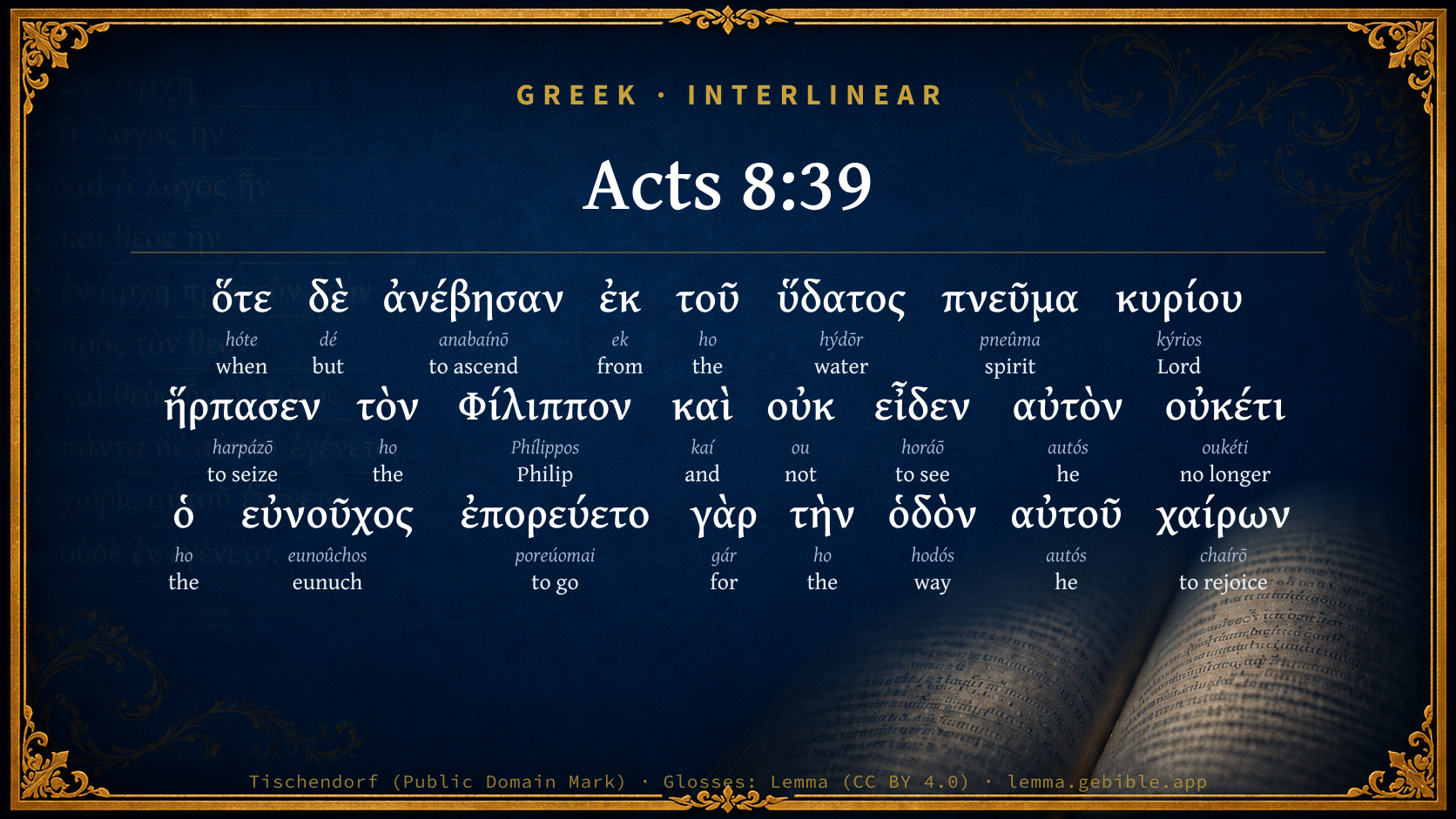
Greek (Tischendorf 8th ed.) Acts 8:39 appears in the Greek New Testament. The text above is from the Tischendorf 8th edition. Each word links to its Strong’s number and a concise gloss. Click any word for its full Thayer’s Greek Lexicon entry.
Download image
Cite this verse

Acts 8:39 (World English Bible). Public Domain. Lemma interlinear Bible study tool, https://lemma.gebible.app/v/acts/8/39.

Show BibTeX & RIS
BibTeX
RIS
English Translation
When they came up out of the water, the Spirit of the Lord caught Philip away, and the eunuch didn't see him any more, for he went on his way rejoicing.
World English Bible · Public Domain
Download a study sheet

One document with this verse’s original text, its word-by-word gloss line, the meaning frame, cross-references with their text, attributed commentary, and full source and license credits — printable, and it pastes into notes with its structure intact.

This verse Autodidact and up

Study sheet (.html) Plain text (.txt)

A passage Seminary Student

Up to 50 verses in one chapter. A passage sheet keeps up to 6 commentary sources and 12 cross-references per verse, in the order this page ranks them, and says so on the sheet whenever that leaves anything out. Ask for a single verse and you get the Autodidact verse sheet above.

Everything on this page stays free to read, with no account — the sheet is a download of what is already on screen, not access to it.

Want to remove ads? Support Godless Engineer
Compare translations 3

The same verse in 3 English versions, stacked beneath the original-language interlinear above. Click any original word for its lexicon entry.

Each is an independent rendering of the whole verse — the interlinear is not word-aligned to these translations.

Highlighted words mark where these versions differ — a whole-verse word diff, not a word-by-word alignment.

  • World English Bible Public Domain
    When they came up out of the water, the Spirit of the Lord caught Philip away, and the eunuch didn't see him any more, for he went on his way rejoicing.
  • King James Version Public Domain
    And when they were come up out of the water, the Spirit of the Lord caught away Philip, that the eunuch saw him no more: and he went on his way rejoicing.
  • unfoldingWord Literal Text CC BY-SA 4.0
    And when they came up from the water, the Spirit of the Lord snatched Philip away, and the eunuch did not see him anymore, for he went on his way rejoicing.

unfoldingWord Literal Text — © unfoldingWord, licensed CC BY-SA 4.0. Word-aligned USFM3 via Door43 (git.door43.org/unfoldingWord/en_ult).

Versions to compare (up to 4)

3 of 4 selected

Show all 19 translations

Every available English version of this verse, each an independent rendering of the whole verse.

  • World English Bible Public Domain
    When they came up out of the water, the Spirit of the Lord caught Philip away, and the eunuch didn't see him any more, for he went on his way rejoicing.
  • Berean Standard Bible Public Domain
    When they came up out of the water, the Spirit of the Lord carried Philip away, and the eunuch saw him no more, but went on his way rejoicing.
  • Majority Standard Bible Public Domain
    When they came up out of the water, the Spirit of the Lord carried Philip away, and the eunuch saw him no more, but went on his way rejoicing.
  • King James Version Public Domain
    And when they were come up out of the water, the Spirit of the Lord caught away Philip, that the eunuch saw him no more: and he went on his way rejoicing.
  • American Standard Version (1901) Public Domain
    And when they came up out of the water, the Spirit of the Lord caught away Philip; and the eunuch saw him no more, for he went on his way rejoicing.
  • Revised Version (1885) Public Domain
    And when they came up out of the water, the Spirit of the Lord caught away Philip; and the eunuch saw him no more, for he went on his way rejoicing.
  • Geneva Bible (1599) Public Domain
    And assoone as they were come vp out of the water, the Spirit of the Lord caught away Philip, that the Eunuche sawe him no more: so he went on his way reioycing.
  • Douay-Rheims (1899) Public Domain
    And when they were come up out of the water, the Spirit of the Lord took away Philip; and the eunuch saw him no more. And he went on his way rejoicing.
  • Young's Literal Translation Public Domain
    and when they came up out of the water, the Spirit of the Lord caught away Philip, and the eunuch saw him no more, for he was going on his way rejoicing;
  • Literal Standard Version CC BY-SA 4.0
    and when they came up out of the water, the Spirit of the LORD snatched up Philip, and the eunuch saw him no more, for he was going on his way rejoicing;
  • Unlocked Literal Bible CC BY-SA 4.0
    When they came up out of the water, the Spirit of the Lord took Philip away, and the eunuch saw him no more, but went on his way rejoicing.
  • unfoldingWord Literal Text CC BY-SA 4.0
    And when they came up from the water, the Spirit of the Lord snatched Philip away, and the eunuch did not see him anymore, for he went on his way rejoicing.
  • Darby Bible Public Domain
    But when they came up out of the water [the] Spirit of [the] Lord caught away Philip, and the eunuch saw him no longer, for he went on his way rejoicing.
  • World Messianic Bible Public Domain
    When they came up out of the water, the Spirit of the Lord caught Philip away, and the eunuch didn’t see him any more, for he went on his way rejoicing.
  • Webster's Bible Public Domain
    And when they had come up out of the water, the Spirit of the Lord caught away Philip, that the eunuch saw him no more: and he went on his way rejoicing.
  • Free Bible Version CC BY-SA 4.0
    When they came out of the water the Spirit of the Lord took Philip away. The eunuch never saw him again, but he continued on his way full of joy. Philip found himself at Azotus.
  • Bible in Basic English Public Domain
    And when they came up out of the water, the Spirit of the Lord took Philip away; and the Ethiopian saw him no more, for he went on his way full of joy.
  • Text-Critical English NT CC BY 4.0
    When they came up out of the water, the Spirit of the Lord caught Philip away, and the eunuch saw him no more, but went on his way rejoicing.
  • Tyndale New Testament (1534) Public Domain
    And assone as they were come out of the water the sprete of the lorde caught awaye Philip that the chamberlayne sawe him no moore. And he wet on his waye reioysinge:

Literal Standard Version (2020), Covenant Press — licensed CC BY-SA 4.0. Text via the HelloAO Bible API (eBible.org). Unlocked Literal Bible (unfoldingWord) — licensed CC BY-SA 4.0. Text via the HelloAO Bible API (eBible.org). unfoldingWord Literal Text — © unfoldingWord, licensed CC BY-SA 4.0. Word-aligned USFM3 via Door43 (git.door43.org/unfoldingWord/en_ult). Free Bible Version, Dr. Jonathan Gallagher — licensed CC BY-SA 4.0. Text via the HelloAO Bible API (eBible.org).

Word by word

More ways to search: Search by grammar → Find every occurrence → Compare this word →

Practice this passage: Drill this verse → Learn its vocabulary →

εὐνοῦχος
eunoûchos
G2135
“eunuch”
Noun, Nominative, Singular, Masculine
Part of Speech
Noun
Case
Nominative
Number
Singular
Gender
Masculine
Full Thayer's Definition

Origin: from eune (a bed) and G2192

TDNT: 14:45,3

1. a bed keeper, bed guard, superintendent of the bedchamber, chamberlain a. in the palace of oriental monarchs who support numerous wives the superintendent of the women's apartment or harem, an office held by eunuchs b. an emasculated man, a eunuch 1. eunuchs in oriental courts held by other offices of greater, held by the Ethiopian eunuch mentioned in Ac. 8:27-39 . c. one naturally incapacitated 1. for marriage 2. begetting children d. one who voluntarily abstains from marriage
  1. ὅτε hóte G3753 “when” Adverb
  2. δὲ dé G1161 “but” Conjunction
  3. ἀνέβησαν anabaínō G305 “to ascend” Verb, Aorist, Active, Indicative, 3rd person, Plural
  4. ἐκ ek G1537 “from” Preposition
  5. τοῦ ho G3588 “the” Article, Genitive, Singular, Neuter
  6. ὕδατος hýdōr G5204 “water” Noun, Genitive, Singular, Neuter
  7. πνεῦμα pneûma G4151 “spirit” Noun, Nominative, Singular, Neuter
  8. κυρίου kýrios G2962 “Lord” Noun, Genitive, Singular, Masculine
  9. ἥρπασεν harpázō G726 “to seize” Verb, Aorist, Active, Indicative, 3rd person, Singular
  10. τὸν ho G3588 “the” Article, Accusative, Singular, Masculine
  11. Φίλιππον Phílippos G5376 “Philip” Noun, Accusative, Singular, Masculine
  12. καὶ kaí G2532 “and” Conjunction
  13. οὐκ ou G3756 “not” Particle, Negative
  14. εἶδεν horáō G3708 “to see” Verb, Aorist, Active, Indicative, 3rd person, Singular
  15. αὐτὸν autós G846 “he” Personal pronoun, Accusative, Singular, Masculine
  16. οὐκέτι oukéti G3765 “no longer” Adverb, Negative
  17. ὁ ho G3588 “the” Article, Nominative, Singular, Masculine
  18. ἐπορεύετο poreúomai G4198 “to go” Verb, Imperfect, Middle or Passive deponent, Indicative, 3rd person, Singular
  19. γὰρ gár G1063 “for” Conjunction
  20. τὴν ho G3588 “the” Article, Accusative, Singular, Feminine
  21. ὁδὸν hodós G3598 “way” Noun, Accusative, Singular, Feminine
  22. αὐτοῦ autós G846 “he” Personal pronoun, Genitive, Singular, Masculine
  23. χαίρων chaírō G5463 “to rejoice” Verb, Present, Active, Participle, Nominative, Singular, Masculine

About this verse

These counts appear in no published source. They are computed here, from the morphology-tagged text and Lemma’s own curated glosses. What Lemma adds →

24
words
20
distinct lemmas
Acts
section

Notable vocabulary

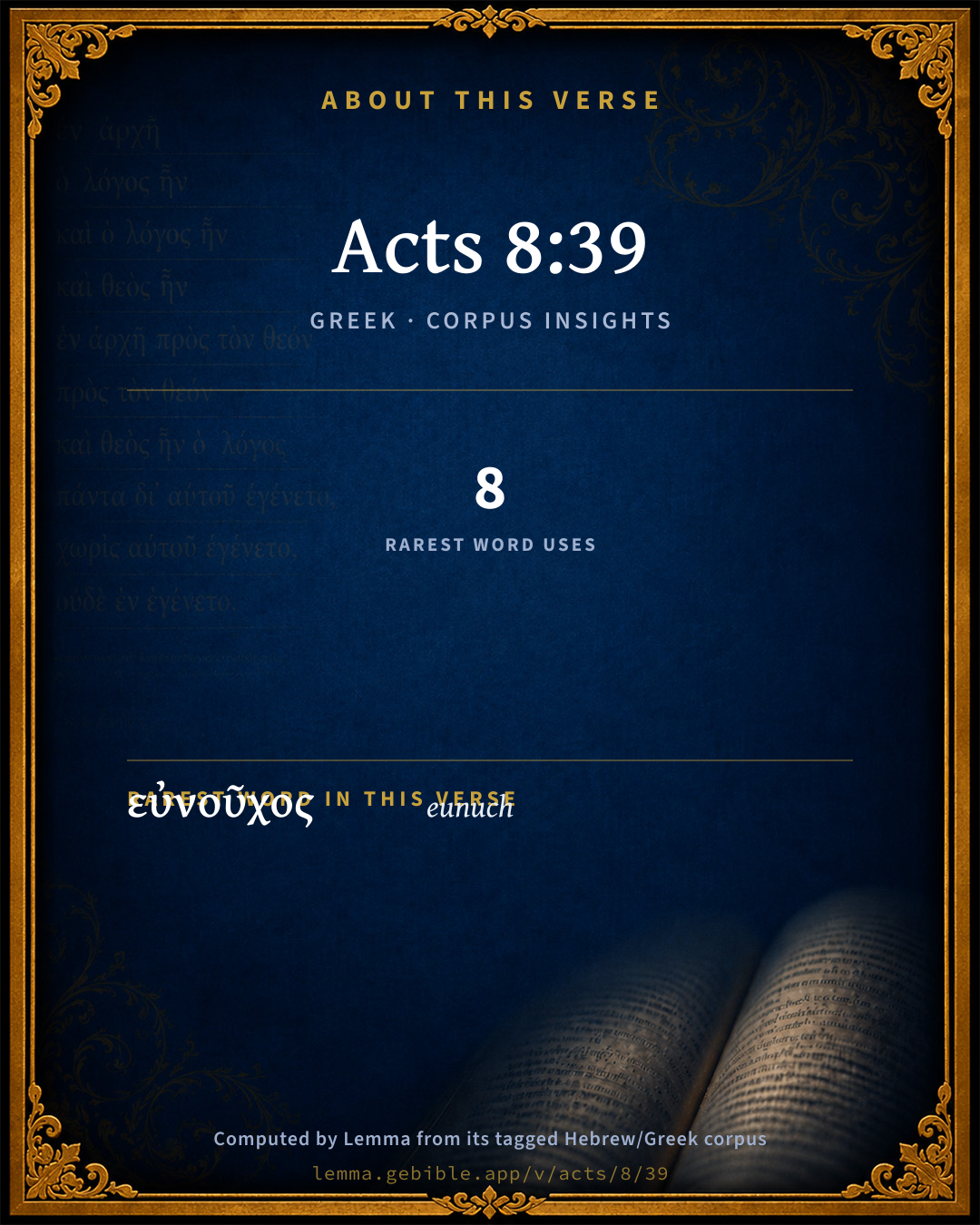
The rarest word here is εὐνοῦχος eunuch G2135 — appearing just 8 times in the whole Greek New Testament.

Shared distinctive vocabulary

εὐνοῦχος eunuch G2135 occurs in 6 verses of the Greek New Testament. Also found in:

Repetition

Words recur within this verse:

  • τοῦ the G3588 ×4
  • αὐτὸν he G846 ×2

Cross-references

11

Topical passages linked to Acts 8:39 in the Treasury of Scripture Knowledge — connected by theme and wording, ordered by reader-vote popularity; previews shown in the World English Bible.

  • 1 Kings 18:12 It will happen, as soon as I am gone from you, that the Spirit of Yahweh will carry you I don't know where; and so when I come and tell Ahab, and he can't find you, he will kill me: but I your servant fear Yahweh from my youth.
  • 2 Kings 2:16 They said to him, See now, there are with your servants fifty strong men; let them go, we pray you, and seek your master, lest the Spirit of Yahweh has taken him up, and cast him on some mountain, or into some valley. He said, You shall not send.
  • Ezekiel 8:3 He put forth the form of a hand, and took me by a lock of my head; and the Spirit lifted me up between earth and the sky, and brought me in the visions of God to Jerusalem, to the door of the gate of the inner [court] that looks toward the north; where was the seat of the image of jealousy, which provokes to jealousy.
  • Ezekiel 43:5 The Spirit took me up, and brought me into the inner court; and, behold, the glory of Yahweh filled the house.
  • Ezekiel 11:1 Moreover the Spirit lifted me up, and brought me to the east gate of Yahweh's house, which looks eastward: and see, at the door of the gate twenty-five men; and I saw in the midst of them Jaazaniah the son of Azzur, and Pelatiah the son of Benaiah, princes of the people.
  • Ezekiel 3:12–14 Then the Spirit lifted me up, and I heard behind me the voice of a great rushing, [saying], Blessed be the glory of Yahweh from his place.
  • Ezekiel 11:24 The Spirit lifted me up, and brought me in the vision by the Spirit of God into Chaldea, to them of the captivity. So the vision that I had seen went up from me.
  • 2 Corinthians 12:2–4 I know a man in Christ, fourteen years ago (whether in the body, I don't know, or whether out of the body, I don't know; God knows), such a one caught up into the third heaven.
  • Mark 1:10 Immediately coming up from the water, he saw the heavens parting, and the Spirit descending on him like a dove.
  • Romans 15:10–13 Again he says, "Rejoice, you Gentiles, with his people."
  • Philippians 3:3 For we are the circumcision, who worship God in the Spirit, and rejoice in Christ Jesus, and have no confidence in the flesh;

Cross-references courtesy of OpenBible.info (CC BY 4.0).

Commentary

Notes on Acts 8:39 from classic Christian and Jewish commentators (each source and its license shown beneath its notes). The classic Christian expositions comment on the surrounding passage and are grouped to its opening verse, so a note may address several verses; the Jewish commentaries on the Tanakh (Rashi and others) are per-verse, so they appear only where the commentator wrote on this verse.

Lemma curates 59 commentaries, every one of them public domain or Creative Commons licensed, each selected and text-cleaned for this edition rather than reprinted as found. About our sources →

Joseph Benson's Commentary

Act 8:39. And when they were come up out of the water — Or, from the water, as εκ του υδατος may be properly rendered; the Spirit of the Lord caught away Philip — Namely, in a miraculous manner, probably transporting him, part of the way at least, through the air; a thing which seems to have happened with respect to some of the prophets. See 1Ki 18:12; 2Ki 2:16; Eze 3:14. That the eunuch saw him no more — This fact is as surprising as the other parts of the story. One would have expected that the eunuch should either have stayed with Philip, or have taken him along with him into his own country, especially as it seems he might have been spared in these parts of Palestine, where there were so many apostles, evangelists, and other teachers of Christianity; and his ministry was much needed in Ethiopia, where, at this time, there were none; and where, recommended by a person so high in power as the eunuch was, he might probably have been remarkably useful in converting the Ethiopians to the faith of the gospel. But God ordered it otherwise, and took away Philip so suddenly as not even to give him time to address an exhortation to the eunuch after his baptism, as it is probable he intended to do. His sudden departure, however, in so miraculous a way, was sufficient to make up the want of that exhortation, especially if we suppose that he was caught up and carried through the air in the eunuch’s sight. It may not be improper to observe here, that the Alexandrian MS., and several other old copies, read it, Πνευμα αγιον επεσεν επι τον ευνουχον, αγγελος δε Κυριου ηρπασε, The Holy Spirit fell upon the eunuch, but an angel of the Lord snatched away Philip: and certainly it is not improbable that God should communicate a large measure of his Spirit, and even some extraordinary gifts thereof, to such a person going into a country where the gospel was entirely unknown, and should thereby furnish him for the great work of preaching it there. And he went on his way rejoicing — His heart being full of thankfulness, that he had been favoured with the privilege of so important an interview with such a divinely-commissioned teacher, and highly-favoured servant of Christ, and that, after having received the gospel from his lips, he had seen such a miraculous confirmation of its truth in his sudden removal from his sight; a fact to which all his attendants were witnesses. He rejoiced also, 1st, That he himself was united to Christ, had an interest in him, and was thereby made a child of God, and an heir of eternal felicity and glory: and, 2d, That he had such good tidings to bring to his countrymen, and a prospect of bringing them also, by virtue of his interest among them, into fellowship with Christ; for he returned, not only a Christian, but a minister. And Eusebius assures us, (Ecclesiastes Hist., lib. 2. cap. 1,) that he planted a flourishing church in Ethiopia, a fact in which all the most ancient histories of that country agree.

Joseph Benson's Commentary on the Old and New Testaments (1811–1818) — public domain. Text from a community e-Sword module.

Tyndale Open Study Notes

Tyndale Open Resources

8:39-40 After the Spirit of the Lord snatched Philip away, Philip continued northward from Azotus (=Ashdod, 1 Sam 5:1-7; Neh 13:23-24; Isa 20:1) up the coast, preaching in every town along the way until he came to Caesarea, where he settled (Acts 21:8). • Caesarea Maritima, a major seaport on the Mediterranean, was the seat of Roman government in Judea. It was built by Herod the Great about 22–9 BC and was named to honor Caesar Augustus.

Tyndale Open Study Notes — © Tyndale Open Resources, licensed CC BY-SA 4.0. Text via the HelloAO Bible API.

Bengel's Gnomon

Johann Albrecht Bengel

Act 8:39. Ἥρπασε, caught away) with miraculous velocity, without any action or exertion on the part of Philip, to a distance; as was needed in a pathless region. Such things often happened to the prophets: 1Ki 18:12; 2Ki 2:16. The same verb occurs, 2Co 12:2; 2Co 12:4; 1Th 4:17. By this very mode of departure the faith of the Eunuch was confirmed. By a like mode of transit one or two apostles might (may) have reached even America, if no other way was open to them.—γὰρ) in the strict sense, for. He did not see, nor did he anxiously care to see, Philip more, by reason of joy. He who has obtained the Scripture and Christ can now dispense with a human guide. We do not read of the imposition of hands on the Eunuch.—[χαίρων, rejoicing) To a soul disposed aright, what an amount of good can be vouchsafed at one and the same time!—V. g.]

Bengel's Gnomon of the New Testament — English translation (T&T Clark, Edinburgh, 1860) — public domain. Text from a community e-Sword module.

Meyer's Critical & Exegetical Commentary

Heinrich August Wilhelm Meyer

Act_8:39-40. Luke relates an involuntary removal[232] of Philip effected by the Spirit of God (κυρίον). Comp. 2Co_12:2; 2Co_12:4; 1Th_4:17; Eze_3:14; 1Ki_18:12; 2Ki_2:16; also what happened with Habakkuk in Bel and the Dragon, 33. He now had to apply himself to further work, after the design of the Spirit (Act_8:29) had been attained in the case of the Ethiopian. The Spirit snatched him away (comp. Joh_6:15), in which act not only the impulse and the impelling power, but also the mode, is conceived of as miraculousas a sudden unseen transportation as far as Ashdod, Act_8:40. The sudden and quick hurrying away which took place on the impulse of the Spirit (Kuinoel, Olshausen, comp. also Lange, apost. Zeitalt. II. p. 113) is the historical element in the case, to which tradition (and how easily this was suggested by the O. T. conception in 1Ki_18:12; 2Ki_2:16) annexed, in addition to the miraculous operative cause, also the miraculous mode of the event. But to go even beyond this admission, and to allow merely the country and person of the converted Ethiopian to pass as historical (Zeller), is wholly without warrant with such an operation of angel and Spirit as the narrative contains, when viewed in connection with the super-sensuous causal domain of N. T. facts in general.

ἐπορεύετο γὰρ κ.τ.λ.] he obtained no further sight of Philip, for he made no halt, nor did he take another road in order to seek again him who was removed from him, but he went on his way with joy, namely, over the salvation obtained in Christ (comp. Act_16:34). He knew that the object of his meeting with Philip was accomplished.

εἰς Ἄζωτον] He was found removed to Ashdod. Winer, pp. 387, 572 [E. T. 516, 769]; Buttmann, neut. Gr. p. 287 [E. T. 333]. Transported thither, he again became visible. Comp. Act_21:13; Est_1:5; Xen. Anab. iii. 4. 13 : εἰς τοῦτον δὲ τὸν σταθμὸν Τισσαφέρνης ἐπεφάνη, 2Ma_1:33.

ἌΖΩΤΟς (Herod. ii. 157; Diod. xix. 85; in Strabo, xvi. 29, p. 759; oxytone[233]), אַשְׂדוֹד, Jos_13:3, 1Sa_5:5, was a Philistine city, the seat of a prince; after its destruction by Jonathan rebuilt by Gabinius (Joseph. Antt. xiv. 5. 3), 270 stadia to the north of Gaza, to the west of Jerusalem, now as a village named Esdud (Volney, Travels, II. p. 251; Robinson, II. p. 629). See Ruetschi in Herzogs Encykl. II. p. 556.

ΚΑΙΣΆΡΕΙΑ is the celebrated ΚΑΙΣ. ΣΕΒΑΣΤΉ (so called in honour of Augustus), built by Herod I. on the site of the Castellum Stratonis,the residency of the Roman procurators, on the Mediterranean, sixty-eight miles north-west of Jerusalem; it became the abode of Philip; see Act_21:8. He thus journeyed northward from Ashdod, perhaps through Ekron, Ramah, Joppa, and the plain of Sharon. There is no reason to regard the notice ἕως … Καισάρειαν as prophetic, and to assume that Philip, at the time of the conversion of Cornelius, Act_10:1 ff., was not yet in Caesarea (Schleiermacher, Lekebusch, Laurent), seeing that Cornelius is by special divine revelation directed to Peter, and therefore has no occasion to betake himself to Philip.

[232] The excellent Bengel strangely remarks: that one or other of the apostles may have gone even to America pari trajectu.

[233] Incorrectly; see Lipsius, grammat. Unters. p. 30.

Meyer — Critical and Exegetical Commentary on the New Testament — English translation by Peter Christie, edited by Frederick Crombie (T&T Clark, 1880) — public domain. Text from a community e-Sword module.

Expositor's Greek Testament

ed. W. Robertson Nicoll

Act 8:39 . Πνεῦμα Κ . ἥρπασε : although the expression is simply Πνεῦμα Κ . the reference is evidently to the same divine power as in Act 8:29 , and cannot be explained as meaning an inward impulse of the Evangelist, or as denoting a hurricane or storm of wind (as even Nösgen and Stier supposed). The article is omitted before Πνεῦμα Κ . in Luk 4:18 , so also in LXX, Isa 61:1 , and we cannot therefore conclude anything from its omission here. ἥρπασε , abripuit , the disappearance, as the context shows, was regarded as supernatural, cf. LXX, 1Ki 18:12 , 2Ki 2:16 (Eze 3:14 , Hebrew only רוח ). Thus Hilgen feld recognises not only a likeness here to the O.T. passages quoted, but that a miraculous transference of Philip to another place is implied. No doubt, as Hilgenfeld points out, πνεῦμα may mean wind , Joh 3:8 , but this by no means justifies exclusion of all reference here to the Holy Spirit. No doubt we may see with Blass a likeness in the language of the narrative to the O.T. passages just cited, and St. Luke’s informants may have been the daughters of Philip, who were themselves προφήτιδες (see Blass, in loco ); but there is no reason why he should not have heard the narrative from St. Philip himself, and the rendering πνεῦμα by ventus is not satisfactory, although Blass fully recognises that Philip departed by the same divine impulse as that by which he had come. Holtzmann endorses the reference to the O.T. passages above, but specially draws attention to the parallel which he supposes in Bel and the Dragon, Act 8:34 ff. But this passage should be contrasted rather than compared with the simple narrative of the text, so free from any fantastic embellishment, while plainly implying a supernatural element; cf. for the verb ἁρπάζω , 1Th 4:17 , 2Co 12:2 ; 2Co 12:4 (a reference to which as explaining Philip’s withdrawal is not to the point, since the narrative cannot imply that Philip was ἐκτὸς τοῦ σώματος ), Rev 12:5 , used of a snatching or taking up due to divine agency, cf. Wis 4:11 , where it is said of Enoch ἡρπάγη . Both in classical Greek and in the LXX the word implies forcible or sudden seizure (Joh 6:15 ). καὶ οὐκ εἶδεν … ἐπορεύετο γὰρ κ . τ . λ . If these two clauses are closely connected as by R.V., they do not simply state that the eunuch went on his own way (Rendall), (in contrast with Philip who went his way), rejoicing in the good news which he had heard, and in the baptism which he had received; and R.V. punctuation surely need not prevent the disappearance of Philip from being viewed as mysterious, even if the words καὶ οὐκ εἶδον αὐτὸν οὐκέτι do not imply this. Moreover αὐτοῦ may rather emphasise the fact that the eunuch went his way, which he would not have done had he seen Philip, but would perhaps have followed him who had thus enlightened his path (so Weiss, in loco , reading αὐτοῦ τῆν ὁδόν αὐτοῦ emphatic: see also St. Chrysostom’s comment in loco ). χαίρων : “the fruit of the Spirit is … joy,” Gal 5:22 (the word at the end of a clause is characteristic of Luke; Luk 15:5 ; Luk 19:6 , see Vogel, p. 45). Eusebius describes the eunuch, to whom he gives the name of Indich, as the first preacher to his countrymen of the tidings of great joy, and on the possible reception in the earliest Christian times of the Gospel message in the island of Meroë at least, see “Ethiopian Church,” Dict. of Christ. Biog. , ii., 234 (Smith & Wace). In the conversion of the Ethiopian eunuch men have seen the first fulfilment of the ancient prophecy, Psa 68:31 (Luckock, Footprints of the Apostles as traced by St Luke , i., 219, and C. and H., p. 66).

The Expositor's Greek Testament, edited by W. Robertson Nicoll (1897–1910) — public domain. Text from a community e-Sword module.

Jamieson, Fausset & Brown

Robert Jamieson, A. R. Fausset & David Brown

the Spirit of the Lord caught away Philip--To deny [as MEYER, OLSHAUSEN, BLOOMFIELD] the miraculous nature of Philip's disappearance, is vain. It stands out on the face of the words, as just a repetition of what we read of the ancient prophets, in Kg1 18:12; Kg2 2:16. And the same word (as BENGEL remarks) is employed to express a similar idea in Co2 12:2, Co2 12:4; Th1 4:17.

the eunuch saw him no more--nor, perhaps, for very joy, cared to see him [BENGEL].

and he went on his way rejoicing--He had found Christ, and the key to the Scriptures; his soul was set free, and his discipleship sealed; he had lost his teacher, but gained what was infinitely better: He felt himself a new man, and "his joy was full." Tradition says he was the first preacher of the Gospel in Ethiopia; and how, indeed, could he choose but "tell what the Lord had done for his soul?" Yet there is no certainty as to any historical connection between his labors and the introduction of Christianity into that country.

Jamieson, Fausset & Brown — Commentary Critical and Explanatory on the Whole Bible (1871) — public domain (CC PDM 1.0). Text via the HelloAO Bible API.

Adam Clarke's Commentary

Verse 39. The Spirit of the Lord caught away Philip] Perhaps this means no more than that the Holy Spirit suggested to the mind of Philip that he should withdraw abruptly from the eunuch, and thus leave him to pursue his journey, reflecting on the important incidents which had taken place. Some suppose that the angel of the Lord, and the Spirit of the Lord, are the same person throughout this chapter. There is a remarkable reading in the Codex Alexandrinus which exists thus in two lines:-

πνααγιονεπεπεχενεπιτονευνουξον

The Spirit of the Lord fell upon the eunuch:

αγγελοχδεκυηρπαχεντονφιλιππον.

But the angel of the Lord snatched away Philip. This reading is found in several other MSS. and in some versions. Many think that the Spirit or angel of God carried off Philip in some such manner as the Apocrypha represents the transportation of Habakkuk, who was taken up by the hair of the head, and carried from Judea to Babylon! For such an interposition there was no need. When Philip had baptized the eunuch, the Spirit of God showed him that it was not the will of God that he should accompany the eunuch to Meroe, but, on the contrary, that he should hasten away to Ashdod; as God had in that, and the neighbouring places, work sufficient to employ him in.

Adam Clarke's Commentary on the Bible (1810–1826) — public domain. Text from a community e-Sword/MySword module.

John Calvin's Commentaries

39. When they were come up. To the end Luke may at length conclude his speech concerning the eunuch, he saith that Philip was caught away out of his sight. And that was of no small weight to confirm him, forasmuch as he saw that that man was sent unto him by God like to an angel, and that he vanished away before he could offer him any reward for all his pains; whence he might gather that it was no gainful insinuation, seeing that he was vanished away before he had one halfpenny given him. Whereas Philip had no reward at the eunuch’s hand, let the servants of Christ learn hereby to serve him freely, or rather let them so serve men for nothing that they hope for a reward from heaven. The Lord granteth leave, indeed, to the ministers of the gospel to receive a reward at their hands whom they teach, (1 Corinthians 9:9,) but he forbiddeth them therewithal to be hirelings which labor for lucre’s sake, (John 10:12, 13.) For this must be the mark whereat they must shoot, to gain the men themselves to God.

Rejoicing. Faith and the knowledge of God bring forth this fruit always of themselves. For what truer matter of joy can be invented than when the Lord doth not only set open unto us the treasures of his mercy, but poureth out his heart into us, (that I may so speak,) and giveth us himself in his Son, that we may want nothing to perfect felicity? The heavens begin to look clear, and the earth beginneth to be quiet then; the conscience being then delivered from the doleful and horrible feelings of God’s wrath, being loosed from the tyranny of Satan, escaping out of the darkness of death, beholdeth the light of life. Therefore it is a solemn thing amongst the prophets to exhort us to be joyful and to triumph, so often as they are about to speak of the kingdom of Christ. But because those men whose minds are possessed with the vain joys of the world, cannot lift up themselves unto this spiritual joy, let us learn to despise the world and all vain delights thereof, that Christ may make us merry indeed.

John Calvin's Commentaries (1540-1563) — public domain. Text from the Calvin Translation Society English edition (1840s-50s) via the Christian Classics Ethereal Library (ccel.org). Calvin's coverage is partial (roughly two-thirds of the Bible); uncommented books and verses are honest gaps, never fabricated. The 19th-century editor's footnotes and remarks are omitted so the notes are faithfully Calvin's own voice.

Ellicott's Commentary for English Readers

(39) The Spirit of the Lord caught away Philip.—Human feeling would have naturally led the teacher to continue his work, and to accompany the convert with a view to further instruction; but an impulse so strong and irresistible that it was felt to be from the Spirit of the Lord led Philip to an abrupt and immediate departure. He was literally snatched away from his companion. So understood, the history presents a striking parallel to the Spirit hindering St. Paul from going in this or that direction in Act_16:6-7. Many commentators have, however, taken the words in a yet more literal and material sense, as stating that Philip was caught up into the air and carried out of sight, and compare the cases of Elijah (1Ki_18:12; 2Ki_2:11), Ezekiel (Eze_3:12; Eze_3:14), and St. Paul (2Co_12:2; 2Co_12:4). In the last two cases, however, the language of the writer implies a spiritual rather than a bodily transport, and the case of Elijah, in 1Ki_18:12, admits of an explanation like that which has now been offered in the case of Philip. The use of the same verb in 2Co_12:2; 2Co_12:4, suggests the thought that here also there was a suspension of the normal activity of consciousness. As St. Bernard walked by the Lake of Geneva, and knew not that he was near it, so Philip rushed away, as drawn on he knew not whither, as in a state of ecstasy; and so, in informing St. Luke of what passed (it is obvious that the report must, in the first instance, have come from him), could give no other account of his journeying than that he was “found” at Azotus.

Went on his way rejoicing.—A remarkable various-reading runs: “The Holy Spirit fell on the eunuch, and an angel of the Lord caught away Philip;” but it does not appear to be more than a conjectural emendation. Joy at the new-found truth prevailed, we must believe, over any sorrow at the disappearance of the preacher. Eusebius (Hist. ii. 1) speaks of him as returning to his native country, and there preaching “the knowledge of the God of the universe and the life-giving abode of the Saviour with men,” and so fulfilling the words that “Ethiopia should stretch forth her hands unto God” (Psa_68:31); but it does not appear that he was acquainted with any historical facts. It is, perhaps, not without significance in connection with this history, that the Ethiopian Church has been throughout its history the most strongly Jewish in its worship and tone of thought ‘of all Christian communities (Stanley, Eastern Church, p. 12).

A Bible Commentary for English Readers, edited by Charles John Ellicott (1878–1897) — public domain. Text from a community e-Sword module.

The Cambridge Bible for Schools and Colleges

gen. ed. J. J. S. Perowne

39. the Spirit of the Lord caught away Philip] Just as Obadiah expected Elijah would be caught away while he himself went on his errand to Ahab (1Ki_18:12). Compare the language of Ezekiel (Act_3:12; Act_3:14, Act_8:3, &c.), “So the spirit lifted me up and took me away.”

that [and] the eunuch saw him no more] This marvellous removal of Philip would confirm the eunuch and his companions in their faith. They would recognize that he who had been sent unto them was a man of God.

and he went on his way rejoicing] The Greek says “for he went, &c.,” and thus gives the reason why Philip was seen no more of the eunuch. He did not go back, like the sons of the prophets at Jericho, who went to seek Elijah, but being filled with joy at the new light which God had sent to him, felt no anxiety for the messenger by whom God had sent it, but an assurance that he was cared for by the hand which had sent him forth.

The Cambridge Bible for Schools and Colleges (gen. ed. J. J. S. Perowne; Cambridge University Press, 1878–1918) — public domain. Text from a community e-Sword module.

John Gill's Exposition

But Philip was found at Azotus,.... The same with the Ashdod of the Philistines, famous for the temple of Dagon, Sa1 5:1 where the Septuagint call it Azotus, as here: and so it is called in the Apocrypha:

"Howbeit all the hindmost of them were slain with the sword: for they pursued them unto Gazera, and unto the plains of Idumea, and

Azotus, and Jamnia, so that there were slain of them upon a three thousand men.'' (1Mac 4:15)

"Whereof when Apollonius heard, he took three thousand horsemen, with a great host of footmen, and went to

Azotus as one that journeyed, and therewithal drew him forth into the plain. because he had a great number of horsemen, in whom he put his trust.'' (1Mac 10:77)

"But Jonathan set fire on

Azotus, and the cities round about it, and took their spoils; and the temple of Dagon, with them that were fled into it, he burned with fire.'' (1Mac 10:84)

"And when he came near to

Azotus, they shewed him the temple of Dagon that was burnt, and

Azotus and the suburbs thereof that were destroyed, and the bodies that were cast abroad and them that he had burnt in the battle; for they had made heaps of them by the way where he should pass.'' (1Mac 11:4)

where mention is made of Beth Dagon, and the idol's temple in it; and by Herodotus (p), Pliny (q), and Ptolomy (r); and it is now called Palmis, according to R. Benjamin (s); it was about fifty four miles from Jerusalem, and two hundred and seventy furlongs, Or four and thirty miles (t) from Gaza:

and passing through; or, as he passed along through that and other places:

he preached in all the cities; that lay in his way; which shows his zeal and diligence:

till he came to Caesarea; not Caesarea Philippi, Mat 16:13 but that which was before called Strato's tower, and was rebuilt by Herod, and called Caesarea, in honour of Augustus Caesar (u); and not by Caesar himself, as R. Benjamin says (w): it was six hundred furlongs, or seventy five miles from Jerusalem (x), This place was famous for Jewish Rabbins, and their schools of learning; frequent mention is made of , "the Rabbins of Caesarea" (y); here Philip seems to have stopped, and stayed awhile.

(p) L. 2. c. 157. (q) L. 5. c. 13. (r) L. 5. c. 16. (s) Itinerar. p. 51. (t) Diodor. Sicul. l. 19. c. 95. (u) Joseph. de Bello Jud. l. 1. c. 7. sect. 8. & c. 21. sect. 5. 7. (w) ltinerar. p. 37. (x) Joseph. de Bello Jud. l. 1. c. 3. sect. 5. & Antiqu. l. 13. c. 19. (y) T. Hieros. Challa, fol. 57. 2. & passim.

Next: Acts Chapter 9

John Gill's Exposition of the Whole Bible (1746–1763) — public domain (CC PDM 1.0). Text via the HelloAO Bible API.

Trapp's Complete Commentary

John Trapp

39 And when they were come up out of the water, the Spirit of the Lord caught away Philip, that the eunuch saw him no more: and he went on his way rejoicing.

Ver. 39. Went on his way rejoicing] Bernard, for a certain time after his conversion, remained, as it were, deprived of his senses, by the excessive consolations he had from God. Cyprian confesseth to Donatus, his friend, that before his conversion he thought it was impossible for him to change his manners, and to find such comfort as now he did in a Christian life. He beginneth thus, Accipe quod sentitur antequam discitur. Augustine saith the same of himself (Confess. vi. 12.)

John Trapp, A Commentary or Exposition upon All the Books of the Old and New Testament (1647–1656) — public domain. Text from a community e-Sword module.

Albert Barnes' Notes on the Bible

Out of the water - ἐκ ek. This preposition stands opposed to εἰς eis, “into”; and as that may mean to, so this may mean From; if that means into, this means here out of.

The Spirit of the Lord - See Act 8:29. The Spirit had suggested to Philip to go to meet the eunuch, and the same Spirit, now that he had fulfilled the design of his going there, directed his departure.

Caught away - This phrase has been usually understood of a forcible or miraculous removal of Philip to some other place. Some have even supposed that he was borne through the air by an angel (see even Doddridge). To such foolish interpretations have many expositors been led. The meaning is, clearly, that the Spirit, who had directed Philip to go near the eunuch, now removed him in a similar manner. That this is the meaning is clear:

(1) Because it accounts for all that occurred. It is not wise to suppose the existence of a miracle except where the effect cannot otherwise be accounted for, and except where there is a plain statement that there was a miracle.

(2) The word “caught away” ἥρπασεν hērpasen does not imply that there was a miracle. The word properly means “to seize and bear away anything violently, without the consent of the owner,” as robbers and plunderers do. Then it signifies to remove anything in a forcible manner; to make use of strength or power to remove it, Act 23:10; Mat 13:19; Joh 10:28; 2Co 12:2, 2Co 12:4, etc. In no case does it ever denote that a miracle is performed. And all that can be signified here is, that the Spirit strongly admonished Philip to go to some other place; that he so forcibly or vividly suggested the duty to his mind as to tear him away, as it were, from the society of the eunuch. He had been deeply interested in the case. He would have found pleasure in continuing the journey with him. But the strong convictions of duty urged by the Holy Spirit impelled him, as it were, to break off this new and interesting acquaintanceship, and to go to some other place. The purpose for which he was sent, to instruct and baptize the eunuch, was accomplished, and now he was called to some other field of labor. A similar instance of interpretation has been considered in the notes on Mat 4:5.

And he went on his way rejoicing - His mind was enlightened on a perplexing passage of Scripture. He was satisfied respecting the Messiah. He was baptized; and he experienced what all feel who embrace the Saviour and are baptized - joy. It was joy resulting from the fact that he was reconciled to God; and a joy the natural effect of having done his duty promptly in making a profession of religion. If we wish happiness if we would avoid clouds and gloom, we should do our duty at once. If we delay until tomorrow what we ought to do today, we may expect to be troubled with melancholy thoughts. If we find peace, it will be in doing promptly just what God requires at our hands. This is the last that we hear of this man. Some have supposed that he carried the gospel to Ethiopia, and preached it there. But there is strong evidence to believe that the gospel was not preached there successfully until about the year 330 a.d., when it was introduced by Frumentius, sent to Abyssinia for that purpose by Athanasius, Bishop of Alexandria. From this narrative we may learn:

That God often prepares the mind to receive the truth.

(2)That this takes place sometimes with the great and the noble, as well as the poor and obscure.

(3)That we should study the Scriptures. This is the way in which God usually directs the mind in the truths of religion.

(4)That they who read the Bible with candor and care may expect that God will, in some mode, guide them into the truth. It will often be in a way which they least expect; but they need not be afraid of being left to darkness or error.

(5)That we should be ready at all times to speak to sinners. God often prepares their minds, as he did that of the eunuch, to receive the truth.

(6)That we should not be afraid of the great, he rich, or of strangers. God often prepares their minds to receive the truth; and we may find a man willing to hear of the Saviour where we least expected it.

(7)That we should do our duty in this respect, as Philip did, promptly. We should not delay or hesitate, but should at once do that which we believe to be in accordance with the will of God. See Psa 119:60.

Albert Barnes' Notes on the Bible (1834–1885) — public domain. Text from a community e-Sword/MySword module.

Matthew Poole's English Annotations

Philip was suddenly and extraordinarily taken away from the eunuch’s sight and company, that thereby the eunuch might be the more assured of the truth of those things which had been taught by him. The rejoicing was the effect of his faith; being now justified, he had peace with God through our Lord Jesus Christ, Rom 5:1.

Matthew Poole's English Annotations on the Holy Bible (1683–1685) — public domain. Text from a community e-Sword/MySword module.

The Pulpit Commentary

Came up for were come up, A.V.; and the eunuch for that the eunuch, A.V.; for he went for and he went, A.V. The eunuch made no attempt to follow Philip, but went on his road to Egypt, his whole heart filled with the new joy of Christ"s salvation.

The way of pleasantness.

"He went on his way rejoicing.

I A RETROSPECT.

1. Heathenism compared with Christianity.

2. A state of doubt and inquiry compared with knowledge, faith, decision, open dedication.

3. Loneliness changed into fellowship; some one helping and guiding; remembered instructions, and opened Scripture.

II A PROSPECT. The way of rejoicing opened.

1. Sense of reconciliation. Inward peace. Joy "springing up as a well of water into everlasting, life.

2. Hopes for himself and for others. He was carrying the gospel to his home, to his duties, his anxieties, his sovereign, his fellow-countrymen.

3. A baptized man rejoicing in the sense of Divine approval of his conscience and a new position in life. We get rid of much difficulty both within and without by public confession of Christ. We draw round our souls the visible tokens of Divine presence and favor. We associate ourselves with God"s people in every age, and feel that our way is

The way the holy prophets went God"s highway from banishment.

Recognize the turning-point. Take the straight road that leads through a joyful obedience to glory. R.

The Pulpit Commentary (1880–1919), ed. H.D.M. Spence-Jones & Joseph S. Exell — public domain. Text from a community e-Sword module.

John Wesley's Explanatory Notes

The Spirit of the Lord caught away Philip - Carried him away with a miraculous swiftness, without any action or labour of his own. This had befallen several of the prophets.

John Wesley, Explanatory Notes Upon the Whole Bible (1754–1765) — public domain. Text via the GEBible commentary corpus.

Godbey's Commentary on the New Testament

William B. Godbey

39. “And when they came up out of the water. . .” That translation sounds favorable to immersion. I now give you another, which is equally correct:

39. “And when they came up from the water. . .” I verily trow the blessed Holy Spirit gave us this passage in that ambiguous verbiage, lest some one might be stickleristic on the quantity of water and the manner of its application, and thus run into a very dangerous form of idolatry, i. e., hydrolatry, i. e., water-worship, i. e., the imputation of saving efficacy to water baptism, which is a fond delusion, and has doubtless sent multitudes to hell who relied on water-baptism and human works instead of Jesus only. Such is the ambiguity of this passage that we can not tell whether they went into it and Philip immersed the entire body, or whether they simply went to the spring and took up some water with which Philip baptized him according to Isa 52:15, which the eunuch had read and Philip preached. When the publicans demanded of our Savior and Peter the payment of taxes, and He sent Peter to the sea to catch that fish with the money in its mouth, the statement of Peter’s going down to the sea is precisely identical with the Greek in this passage. Hence if you do not believe that Peter waded into the sea to catch the fish, you need not believe that Philip and the eunuch waded into the sea in order to the baptism. Suffice it to say, reader, God has made plenty of water. So take all you want in your baptism. If you are not satisfied, go on till your conscience is perfectly satisfied (1Pe 3:21). You had better live and die without water-baptism than to receive it under the popish heresy of baptismal regeneration, which is very likely to so blind your eyes that you will never see the Savior, live and die ignorant of God and make your bed in hell. So pay no attention to baptism nor anything else, but fly to the Savior, get intelligently saved and receive the Savior’s baptism with the Holy Ghost and fire. There abide, keeping your eye on Jesus, and assuredly He will keep His hand on you. When you are thus clearly and intelligently saved and sanctified, consciously baptized by the Savior with the Holy Ghost and fire, witnessed clearly and unmistakably by the indwelling Holy Spirit, then we can safely tell you to take all the water you want and any way you want, fully satisfying all of your convictions, as then there is no danger of your becoming a poor, superstitious, deluded devotee of Satan’s water-god like multiplied millions, who have thus been side-tracked by the devil into idolatry and lost their souls. We have not a word of criticism for immersion, trine immersion, copious effusion or simple sprinkling, pursuant to your convictions, if you only receive the “one baptism” (Eph 4:5), i. e., the baptism of the Holy Ghost administered by the Savior. What was the character of the eunuch’s conversion? It is simply preposterous to conclude that this man was a sinner.

(a) He was a man of sterling integrity, actually entrusted with the money of the kingdom;

(b) he was a Jewish proselyte, a bona fide member of God’s Church in his dispensation;

(c) he actually traveled fifteen hundred miles to worship God in His temple on Mt. Moriah in the holy city;

(d) he loved his precious Bible, so that he carried it with him and even read it as he rode along;

(e) he hailed God’s prophet with delight, gave him a seat by his side and received with enthusiasm the thrilling tidings that the Christ of prophecy, whom he worshipped and trusted for salvation, had already come into the world in the person of Jesus of Nazareth, suffered and died on Calvary’s cross, risen and ascended into heaven. The argument even favors the conclusion that he was a sanctified man, as we see not a vestige of prejudice, bigotry or jealousy rising to eclipse his eyes to the truth which Philip preached. The case is clear and even demonstrative that he was a pious and faithful member of the Jewish Church, like Zacharias and Elizabeth, Simeon, Anna and many others, and simply needed conversion to the Christhood of Jesus, like thousands of other pious Jews serving God in the full light of their dispensation, needing not conversion to God, but to the Christhood of Jesus, a mere matter of historic faith, having already been saved by justifying faith in the Christ of prophecy. I doubt not that item of history which certifies that the Ethiopian eunuch who raised the shout in the presence of Philip, “went on his way rejoicing,” stirring the people along the road, telling them of Jesus, His redeeming grace and dying love, arriving at Thebes, the Ethiopian capital, turns preacher and shakes the whole country with a spiritual earthquake, pressing the evangelistic work as the years go by, till finally the Apostle Matthew comes to his relief, taking Ethiopia for his field of labor, where he preached on till bloody martyrdom crowned his triumphant exit from earth to heaven.

William B. Godbey, Commentary on the New Testament (1896–1900) — public domain. Text from a community e-Sword module.

McGarvey & Pendleton's Commentaries

J. W. McGarvey

See notes on verse 38

J. W. McGarvey (with Philip Y. Pendleton), Commentaries on the New Testament (The Fourfold Gospel, 1914; Acts; and the epistles) — public domain. Text from a community e-Sword/MySword module.

The People's New Testament

B. W. Johnson

39, 40. When they were come up out of the water. They did not go to and come away from the water, but they went, “both Philip and the eunuch,” down into (Greek, eis) and came up out of (Greek, ek) the water. The Spirit … caught away Philip. Led him to depart abruptly. He was snatched away. Went on his way rejoicing. In his new-found Savior.

But Philip was found at Azotus. The old Philistine city of Ashdod, near the sea-coast, between Gaza and Joppa. It is now a ruin. Here he preached in all the sea-coast cities, probably founding churches (see Acts 9:32, 36), till he came to Cæsarea, the seaport northwest of Jerusalem, the Roman capital of Judea. We are not told how soon he reached Cæsarea. It may have been months or years. At any rate, it is likely that it did not take place until after Peter's missionary work there. Many years later we find Philip living in this city (Acts 21:8).

B. W. Johnson's The People's New Testament with Notes (1889–1891) — public domain. Electronic text from the Christian Classics Ethereal Library (CCEL) ThML edition.

unfoldingWord translationNotes

Door43 World Missions Community

Connecting Statement:

This is the end of the part of the story about Philip and the man from Ethiopia. The story of Philip ends at Caesarea.

the eunuch saw him no more

"the eunuch did not see Philip again"

Philip appeared at Azotus

There was no indication of Philip's traveling between where he baptized the Ethiopian and Azotus. He just suddenly disappeared along the road to Gaza and reappeared at the town of Azotus.

that region

This refers to the area around the town of Azotus.

to all the cities

"to all the cities in that region"

translationWords

Holy Spirit

lord

caught up

Philip, the evangelist

eunuch

joy

Ashdod

good news

Caesarea

unfoldingWord translationNotes — © Distant Shores Media and the Door43 World Missions Community, licensed CC BY-SA 4.0. Source: git.door43.org/Door43/en_tn.

Cambridge Greek Testament for Schools and Colleges

39. πνεῦμα κυρίου κ.τ.λ., the Spirit of the Lord caught away Philip. Just as Obadiah expected that Elijah would be carried away while he himself went on his errand to Ahab (1Ki 18:12). Compare the language of Ezekiel (Act 3:12; Act 3:14, Act 8:3, &c.), ‘So the spirit lifted me up (ἀνέλαβε) and took me away.

Chrysostom says of this removal of Philip: συμφερόντως οὖν ἤρπασεν αὐτὸν τὸ πνεῦμα, ἐπεὶ ἠξίωσεν ἂν καὶ συνεπανελθεῖν αὐτῷ ὁ εὐνοῦχος, ὃν καὶ ἐλύπησεν ἂν ἐκεῖνος, ἀνανεύσας καὶ ἀρνησάμενος οὐδέπω καιροῦ ὄντος.

καὶ οὐκ εἶδεν αὐτὸν οὐκέτι ὁ εὐνοῦχος, and the eunuch saw him no more. This marvellous removal of Philip would confirm the eunuch and his companions in their faith. They would recognize that he who had been sent unto them was a man of God.

ἐπορεύετο γὰρ τὴν ὁδὸν αὐτοῦ χαίρων, for he went on his way rejoicing. The words explain why Philip was no more seen of the eunuch. He was not like the sons of the prophets at Jericho, who went to seek Elijah when they heard of his being carried away. The eunuch was filled with joy at the new light which God had sent to him, and felt no anxiety for the safety of Philip, being sure that he was cared for by the same hand which had sent him forth.

Cambridge Greek Testament for Schools and Colleges (Cambridge University Press, 1896; 21 vols, various authors incl. Carr, Maclear, Plummer, Farrar, Lumby, Moule, M. R. James, Simcox) — public domain. Text from a community e-Sword module.

Alford’s Greek Testament

Henry Alford

39. πν. κυρ. ἥρπ. τ. Φ.] The reading, ‘the Spirit fell on the Eunuch, and an angel of the Lord caught away Philip,’ is curious, and has probably arisen from a desire to conform the results of the eunuch’s baptism to the usual method of the divine procedure, and the snatching away of Philip to his commission, ver. 26. But the Spirit did not fall on the Samaritans after baptism by Philip.

The text clearly relates a supernatural disappearance of Philip: compare μήποτε ᾖρεν αὐτὸν πνεῦμα κυρίου, 4 Kings 2:16; no interpretation (as Eichhorn, Kuin., Olsh., Meyer) of his being suddenly hurried away by the prompting of the Spirit, will satisfy the analogy of the above-cited passage, and of (see below) a parallel one in Luke’s own Gospel. The ἁρπάζειν of ref. John, which Meyer cites to justify his view, tells in my mind the other way; the fear was lest the multitude should come and carry Him off to make Him a King: and in the reff. I have therefore marked the two as bearing the same meaning.

οὐκ εἶδεν αὐτὸν οὐκέτι] Not ‘never saw him from that day,’ though (see below) that meaning may be indirectly included:—but as Luk 24:31, αὐτὸς ἄφαντος ἐγένετο ἀπʼ αὐτῶν, and as in the strictly parallel words of 4 Kings 2:12, οὐκ εἶδεν αὐτὸν ἔτι,—after the going up of Elijah. These last words in my view decide the question, that the departure of Philip was miraculous.

γάρ] refers to what follows (Φ. δὲ εὑρ.). Philip was found at Azotus: if the eunuch had gone that way, he might have met with him again: but he did not, for he went from the fountain on his own way, which did not lead through Azotus.

Henry Alford, The Greek Testament (1849–1861) — public domain. Text from a community e-Sword module.

Vincent's Word Studies in the New Testament

Marvin R. Vincent

Caught away. Suddenly and miraculously.

And he went, etc. [επορευετο γαρ] . A mistranslation. Rev., rightly, "for he went." A reason is given for the eunuch 's seeing Philip no more. He did not stop nor take another road to seek him, but went on his way.

Marvin R. Vincent, Word Studies in the New Testament (1887–1900) — public domain. Text from a community e-Sword/MySword module.

Lesson kit

Teaching starters — assembled from the data on this page, not authored interpretation. Every prompt links to the verse data it draws on. Edit before teaching.

Acts, in the Acts, opens this verse with 24 words (20 distinct Greek lemmas). Its most distinctive word is eunoûchos (“eunuch”). A historical commentator’s framing appears above. Read the whole chapter for the surrounding context.

Discussion questions

  1. What does “eunuch” (eunoûchos) contribute to the verse as a whole?
  2. How does Matthew 19:12, which shares the word «eunuch», read alongside this verse?
  3. What does the repetition of “the” (4× in this one verse) do in this verse?
  4. The translations on this page render this verse differently — a whole-verse word diff, not a word-by-word alignment. What might account for the different wordings?
  5. Compare how Joseph Benson's Commentary and Tyndale Open Study Notes read this verse. Where do they agree or differ?

Things to notice

Reading settings

Reading text

Shown beneath each verse's original-language words.

Old Testament
Old Testament edition

Read the OT as the Masoretic Hebrew (MT) or the Greek Septuagint (LXX).

English shown for the Greek Septuagint (in the Hebrew ↔ Greek comparison).

Comparing translations? Open the Compare panel on any verse page to stack up to four side by side.