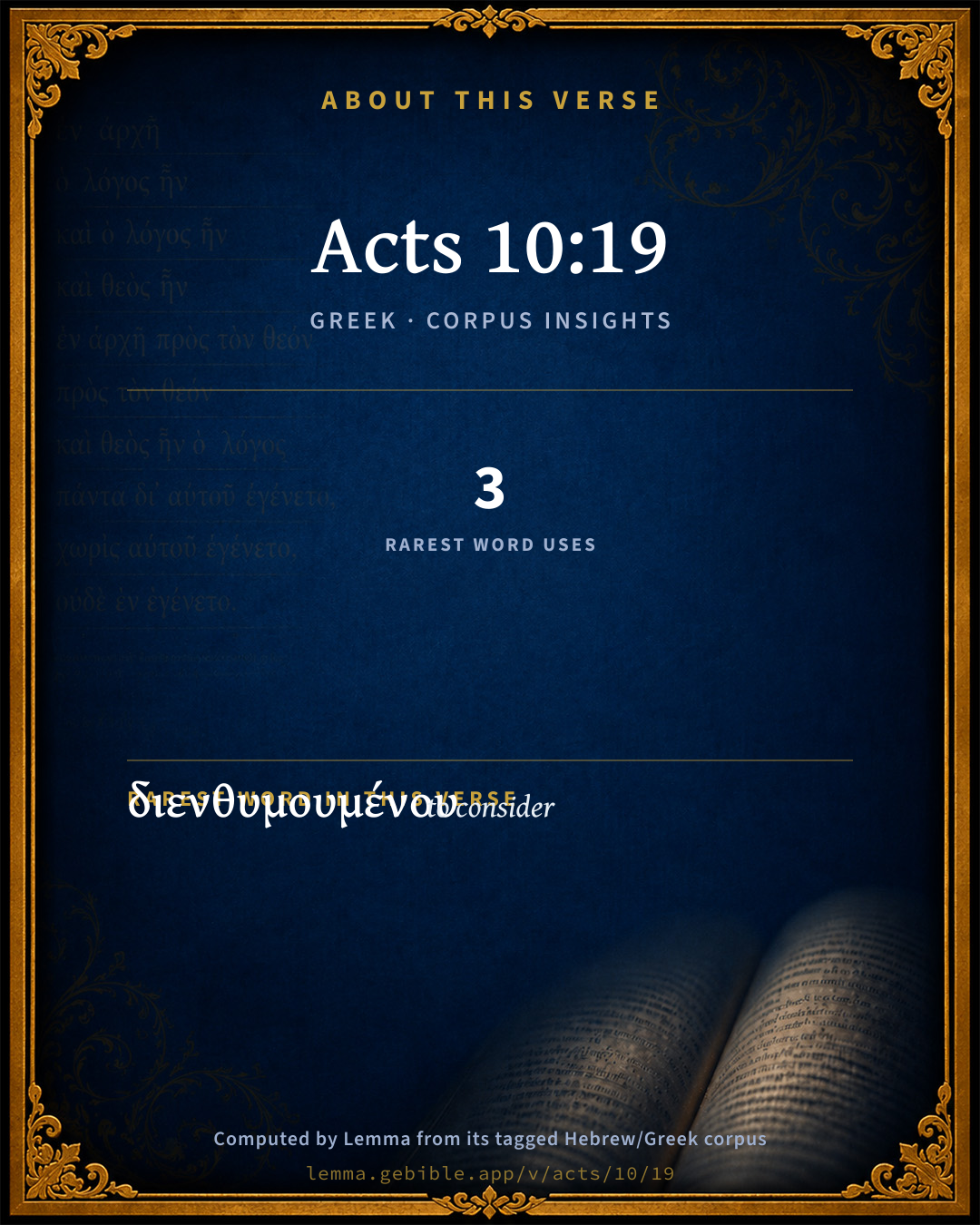
Acts 10:19

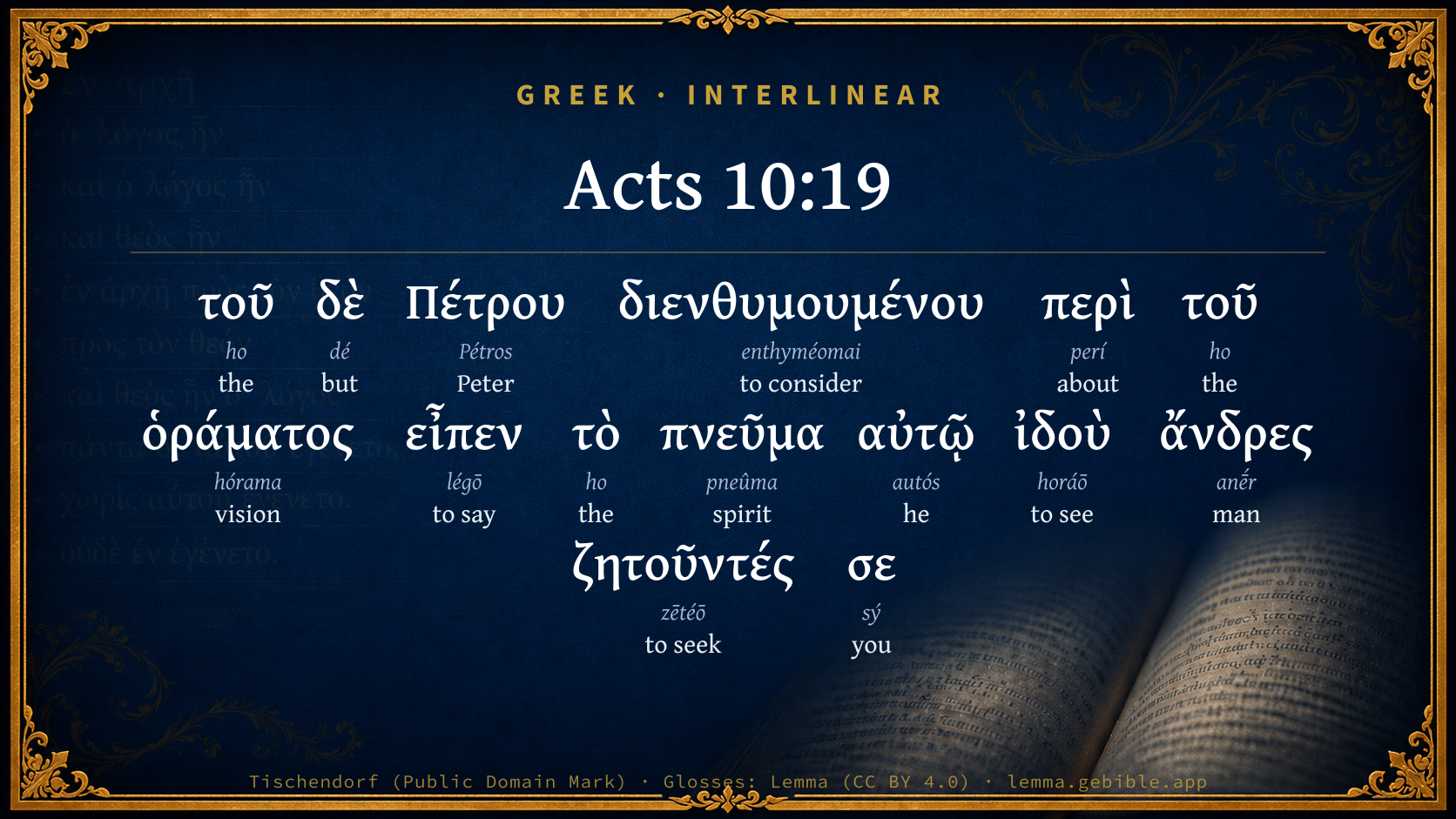
Greek (Tischendorf 8th ed.) Acts 10:19 appears in the Greek New Testament. The text above is from the Tischendorf 8th edition. Each word links to its Strong’s number and a concise gloss. Click any word for its full Thayer’s Greek Lexicon entry.
Download image
Cite this verse

Acts 10:19 (World English Bible). Public Domain. Lemma interlinear Bible study tool, https://lemma.gebible.app/v/acts/10/19.

Show BibTeX & RIS
BibTeX
RIS
English Translation
While Peter was pondering the vision, the Spirit said to him, "Behold, three men seek you.
World English Bible · Public Domain
Download a study sheet

One document with this verse’s original text, its word-by-word gloss line, the meaning frame, cross-references with their text, attributed commentary, and full source and license credits — printable, and it pastes into notes with its structure intact.

This verse Autodidact and up

Study sheet (.html) Plain text (.txt)

A passage Seminary Student

Up to 50 verses in one chapter. A passage sheet keeps up to 6 commentary sources and 12 cross-references per verse, in the order this page ranks them, and says so on the sheet whenever that leaves anything out. Ask for a single verse and you get the Autodidact verse sheet above.

Everything on this page stays free to read, with no account — the sheet is a download of what is already on screen, not access to it.

Want to remove ads? Support Godless Engineer
Compare translations 3

The same verse in 3 English versions, stacked beneath the original-language interlinear above. Click any original word for its lexicon entry.

Each is an independent rendering of the whole verse — the interlinear is not word-aligned to these translations.

Highlighted words mark where these versions differ — a whole-verse word diff, not a word-by-word alignment.

  • World English Bible Public Domain
    While Peter was pondering the vision, the Spirit said to him, "Behold, three men seek you.
  • King James Version Public Domain
    While Peter thought on the vision, the Spirit said unto him, Behold, three men seek thee.
  • unfoldingWord Literal Text CC BY-SA 4.0
    And while Peter was still thinking about the vision, the Spirit said to him, “Behold, three men are seeking you.

unfoldingWord Literal Text — © unfoldingWord, licensed CC BY-SA 4.0. Word-aligned USFM3 via Door43 (git.door43.org/unfoldingWord/en_ult).

Versions to compare (up to 4)

3 of 4 selected

Show all 19 translations

Every available English version of this verse, each an independent rendering of the whole verse.

  • World English Bible Public Domain
    While Peter was pondering the vision, the Spirit said to him, "Behold, three men seek you.
  • Berean Standard Bible Public Domain
    As Peter continued to reflect on the vision, the Spirit said to him, “Behold, three men are looking for you.
  • Majority Standard Bible Public Domain
    As Peter continued to reflect on the vision, the Spirit said to him, “Behold, men are looking for you.
  • King James Version Public Domain
    While Peter thought on the vision, the Spirit said unto him, Behold, three men seek thee.
  • American Standard Version (1901) Public Domain
    And while Peter thought on the vision, the Spirit said unto him, Behold, three men seek thee.
  • Revised Version (1885) Public Domain
    And while Peter thought on the vision, the Spirit said unto him, Behold, three men seek thee.
  • Geneva Bible (1599) Public Domain
    And while Peter thought on the vision, the Spirit sayde vnto him, Beholde, three men seeke thee.
  • Douay-Rheims (1899) Public Domain
    And as Peter was thinking of the vision, the Spirit said to him: Behold three men seek thee.
  • Young's Literal Translation Public Domain
    And Peter thinking about the vision, the Spirit said to him, `Lo, three men do seek thee;
  • Literal Standard Version CC BY-SA 4.0
    And Peter thinking about the vision, the Spirit said to him, “Behold, three men seek you;
  • Unlocked Literal Bible CC BY-SA 4.0
    While Peter was still thinking about the vision, the Spirit said to him, “Behold, three men are looking for you.
  • unfoldingWord Literal Text CC BY-SA 4.0
    And while Peter was still thinking about the vision, the Spirit said to him, “Behold, three men are seeking you.
  • Darby Bible Public Domain
    But as Peter continued pondering over the vision, the Spirit said to him, Behold, three men seek thee;
  • World Messianic Bible Public Domain
    While Peter was pondering the vision, the Spirit said to him, “Behold, three men seek you.
  • Webster's Bible Public Domain
    While Peter thought on the vision, the Spirit said to him, Behold, three men seek thee.
  • Free Bible Version CC BY-SA 4.0
    While Peter was still wondering about the vision, the Spirit said to him, “Look, there are three men looking for you.
  • Bible in Basic English Public Domain
    And, while Peter was turning the vision over in his mind, the Spirit said to him, See, three men are looking for you.
  • Text-Critical English NT CC BY 4.0
    As Peter continued pondering the vision, the Spirit said to him, “Behold, some men are looking for yoʋ.
  • Tyndale New Testament (1534) Public Domain
    Whyll Peter thought on this vision the sprete sayde vnto him: Beholde men seke the:

Literal Standard Version (2020), Covenant Press — licensed CC BY-SA 4.0. Text via the HelloAO Bible API (eBible.org). Unlocked Literal Bible (unfoldingWord) — licensed CC BY-SA 4.0. Text via the HelloAO Bible API (eBible.org). unfoldingWord Literal Text — © unfoldingWord, licensed CC BY-SA 4.0. Word-aligned USFM3 via Door43 (git.door43.org/unfoldingWord/en_ult). Free Bible Version, Dr. Jonathan Gallagher — licensed CC BY-SA 4.0. Text via the HelloAO Bible API (eBible.org).

Word by word

More ways to search: Search by grammar → Find every occurrence → Compare this word →

Practice this passage: Drill this verse → Learn its vocabulary →

διενθυμουμένου
enthyméomai
G1760
“to consider”
Verb, Present, Middle or Passive deponent, Participle, Genitive, Singular, Masculine
Part of Speech
Verb
Tense
Present
Voice
Middle or Passive deponent
Mood
Participle
Case
Genitive
Number
Singular
Gender
Masculine
Full Thayer's Definition

Origin: from a compound of G1722 and G2372

TDNT: 05:52,3

1. to bring to mind, revolve in mind, ponder 2. to think, to deliberate
  1. τοῦ ho G3588 “the” Article, Genitive, Singular, Masculine
  2. δὲ dé G1161 “but” Conjunction
  3. Πέτρου Pétros G4074 “Peter” Noun, Genitive, Singular, Masculine
  4. περὶ perí G4012 “about” Preposition
  5. τοῦ ho G3588 “the” Article, Genitive, Singular, Neuter
  6. ὁράματος hórama G3705 “vision” Noun, Genitive, Singular, Neuter
  7. εἶπεν légō G3004 “to say” Verb, Aorist, Active, Indicative, 3rd person, Singular
  8. τὸ ho G3588 “the” Article, Nominative, Singular, Neuter
  9. πνεῦμα pneûma G4151 “spirit” Noun, Nominative, Singular, Neuter
  10. αὐτῷ autós G846 “he” Personal pronoun, Dative, Singular, Masculine
  11. ἰδοὺ horáō G3708 “to see” Verb, Aorist, Middle, Imperative, 2nd person, Singular
  12. ἄνδρες anḗr G435 “man” Noun, Nominative, Plural, Masculine
  13. ζητοῦντές zētéō G2212 “to seek” Verb, Present, Active, Participle, Nominative, Plural, Masculine
  14. σε sý G4771 “you” Personal pronoun, 2nd person, Accusative, Singular

About this verse

These counts appear in no published source. They are computed here, from the morphology-tagged text and Lemma’s own curated glosses. What Lemma adds →

15
words
13
distinct lemmas
Acts
section

Notable vocabulary

The rarest word here is διενθυμουμένου to consider G1760 — appearing just 3 times in the whole Greek New Testament.

Shared distinctive vocabulary

διενθυμουμένου to consider G1760 occurs in 3 verses of the Greek New Testament. Also found in:

Repetition

A word recurs within this verse:

Cross-references

8

Topical passages linked to Acts 10:19 in the Treasury of Scripture Knowledge — connected by theme and wording, ordered by reader-vote popularity; previews shown in the World English Bible.

  • Acts 8:29 The Spirit said to Philip, "Go near, and join yourself to this chariot."
  • Acts 11:12 The Spirit told me to go with them, without discriminating. These six brothers also accompanied me, and we entered into the man's house.
  • Acts 13:2 As they served the Lord and fasted, the Holy Spirit said, "Separate Barnabas and Saul for me, for the work to which I have called them."
  • Acts 21:4 Having found disciples, we stayed there seven days. These said to Paul through the Spirit, that he should not go up to Jerusalem.
  • John 16:13 However when he, the Spirit of truth, has come, he will guide you into all truth, for he will not speak from himself; but whatever he hears, he will speak. He will declare to you things that are coming.
  • 1 Corinthians 12:11 But the one and the same Spirit works all of these, distributing to each one separately as he desires.
  • 1 Timothy 4:1 But the Spirit says expressly that in later times some will fall away from the faith, paying attention to seducing spirits and doctrines of demons,
  • Acts 16:6–7 When they had gone through the region of Phrygia and Galatia, they were forbidden by the Holy Spirit to speak the word in Asia.

Cross-references courtesy of OpenBible.info (CC BY 4.0).

Where the printed editions differ

1 variant

Places in this verse where the major printed Greek editions disagree on the wording in a way that affects the translation — a comparison of editions, not a manuscript-by-manuscript collation. The editions are the modern critical texts (Nestlé-Aland 28/27, SBL, Westcott-Hort, Tregelles, Tyndale House) and the traditional texts behind the KJV (the Textus Receptus and the Byzantine/Majority text). It is not a claim about which reading is original.

  1. Different wording
    τρεῖς

    “three”

    In NA28NA27TynTregTR Not in SBLWHByz

    δύο (duo) 'two' occurs in a few manuscripts (WH) instead of τρεῖς (treis) 'three' in older manuscripts (NA28+NA27+Tyn+Treg+TR)

Textual data: Translators Amalgamated Greek New Testament (STEPBible TAGNT) · CC BY 4.0.

Commentary

Notes on Acts 10:19 from classic Christian and Jewish commentators (each source and its license shown beneath its notes). The classic Christian expositions comment on the surrounding passage and are grouped to its opening verse, so a note may address several verses; the Jewish commentaries on the Tanakh (Rashi and others) are per-verse, so they appear only where the commentator wrote on this verse.

Lemma curates 59 commentaries, every one of them public domain or Creative Commons licensed, each selected and text-cleaned for this edition rather than reprinted as found. About our sources →

Matthew Henry's Commentary

We have here the meeting between Peter the apostle, and Cornelius the centurion. Though Paul was designed to be the apostle of the Gentiles, and to gather in the harvest among them, and Peter to be the apostle of the circumcision, yet it is ordered that Peter shall break the ice, and reap the first-fruits of the Gentiles, that the believing Jews, who retained too much of the old leaven of ill-will to the Gentiles, might be the better reconciled to their admission into the church, when they were first brought in by their own apostle, which Peter urges against those that would have imposed circumcision upon the Gentile converts (Act 15:7), You know that God made choice among us that the Gentiles by my mouth should hear the word of the gospel. Now here,

I. Peter is directed by the Spirit to go along with Cornelius's messengers (Act 10:19, Act 10:20), and this is the exposition of the vision; now the riddle is unriddled: While Peter thought on the vision; he was musing upon it, and then it was opened to him. Note, Those that would be taught the things of God must think on those things; those that would understand the scriptures must meditate in them day and night. He was at a loss about it, and then had it explained, which encourages us, when we know not what to do, to have our eyes up unto God for direction. Observe, 1. Whence he had the direction. The Spirit said to him what he should do. It was not spoken to him by an angel, but spoken in him by the Spirit, secretly whispering it in his ear as it were, as God spoke to Samuel (Sa1 9:15), or impressing it powerfully upon his mind, so that he knew it to be a divine afflatus or inspiration, according to the promise, Joh 16:13. 2. What the direction was. (1.) He is told, before any of the servants could come up to tell him, that three men below want to speak with him (Act 10:19), and he must arise from his musings, leave off thinking of the vision, and go down to them, Act 10:20. Those that are searching into the meaning of the words of God, and the visions of the Almighty, should not be always poring, no, nor always praying, but should sometimes look abroad, look about them, and they may meet with that which will be of use to them in their enquiries; for the scripture is in the fulfilling every day. (2.) He is ordered to go along with the messengers to Cornelius, though he was a Gentile, doubting nothing. He must not only go, but go cheerfully, without reluctance or hesitation, or any scruple concerning the lawfulness of it; not doubting whether he might go, no, nor whether he ought to go; for it was his duty "Go with them, for I have sent them: and I will bear thee out in going along with them, however thou mayest be censured for it." Note, When we see our call clear to any service, we should not suffer ourselves to be perplexed with doubts and scruples concerning it arising from former prejudices or pre-possessions, or a fear of men's censure. Let every man be fully persuaded in his own mind, and prove his own work.

II. He receives both them and their message: He went down to them, Act 10:21. So far was he from going out of the way, or refusing to be spoken with, as one that was shy of them, or making them tarry, as one that took state upon him, that he went to them himself, told them he was the person they were enquiring for. And 1. He favourably receives their message; with abundance of openness and condescension he asks what their business is, what they have to say to him: What is the cause wherefore you are come? and they tell him their errand (Act 10:22): "Cornelius, an officer of the Roman army, a very honest gentleman, and one who has more religion than most of his neighbours, who fears God above many (Neh 7:2), who, though he is not a Jew himself, has carried it so well that he is of good report among all the people of the Jews - they will all give him a good word, for a conscientious, sober, charitable man, so that it will be no discredit to thee to be seen in his company - he was warned from God," echrēmatisthē - "he had an oracle from God, sent to him by an angel" (and the lively oracles of the law of Moses were given by the disposition of angels), "by which he was ordered to send for thee to his house (where he is expecting thee, and ready to bid thee welcome), and to hear words of thee: they know not what words, but they are such as he may hear from thee, and not from any one else so well." Faith comes by hearing. When Peter repeats this, he tells us more fully, they are words whereby thou and all thy house shall be saved, Act 11:14. "Come to him, for an angel bade him send for thee: come to him, for he is ready to hear and receive the saving words thou hast to bring to him." 2. He kindly entertained the messengers (Act 10:23): He called them in, and lodged them. He did not bid them go and refresh and repose themselves in an inn at their own charge, but was himself at the charge of entertaining them in his own quarters. What was getting ready for him (Act 10:10) they should be welcome to share in; he little thought what company he should have when he bespoke his dinner, but God foresaw it. Note, It becomes Christians and ministers to be hospitable, and ready, according as their ability is, and there is occasion for it, to entertain strangers. Peter lodged them, though they were Gentiles, to show how readily he complied with the design of the vision in eating with Gentiles; for he immediately took them to eat with him. Though they were two of them servants, and the other a common soldier, yet Peter thought it not below him to take them into his house. Probably he did it that he might have some talk with them about Cornelius and his family; for the apostles, though they had instructions from the Spirit, yet made use of other information, as they had occasion for it.

III. He went with them to Cornelius, whom he found ready to receive and entertain him. 1. Peter, when he went with them, was accompanied by certain brethren from Joppa, where he now was, Act 10:23. Six of them went along with him, as we find, Act 11:12. Either Peter desired their company, that they might be witnesses of his proceeding cautiously with reference to the Gentiles, and of the good ground on which he went, and therefore he invited them (Act 11:12), or they offered their service to attend him, and desired they might have the honour and happiness of being his fellow travellers. This was one way in which the primitive Christians very much showed their respect to their ministers: they accompanied them in their journeys, to keep them in countenance, to be their guard, and, as there was occasion, to minister to them; with a further prospect not only of doing them service, but of being edified by their converse. It is a pity that those who have skill and will to do good to others by their discourse should want an opportunity for it by travelling alone. 2. Cornelius, when he was ready to receive him, had got some friends together of Cesarea. It seems, it was above a day's journey, nearly two, from Joppa to Cesarea; for it was the day after they set out that they entered into Cesarea (Act 10:24), and the afternoon of that day, Act 10:30. It is probable that they travelled on foot; the apostles generally did so. Now when they came into the house of Cornelius Peter found, (1.) That he was expected, and this was an encouragement to him. Cornelius waited for them, and such a guest was worth waiting for; nor can I blame him if he waited with some impatience, longing to know what that mighty thing was which an angel bade him expect to hear from Peter. (2.) That he was expected by many, and this was a further encouragement to him. As Peter brought some with him to partake of the spiritual gift he had now to dispense, so Cornelius had called together, not only his own family, but kinsmen and near friends, to partake with him of the heavenly instructions he expected from Peter, which would give Peter a larger opportunity of doing good. Note, We should not covet to eat our spiritual morsels alone, Job 31:17. It ought to be both given and taken as a piece of kindness and respect to our kindred and friends to invite them to join with us in religious exercises, to go with us to hear a sermon. What Cornelius ought to do he thought his kinsmen and friends ought to do too; and therefore let them come and hear it at the first hand, that it may be no surprise to them to see him change upon it.

IV. Here is the first interview between Peter and Cornelius, in which we have, 1. The profound and indeed undue respect and honour which Cornelius paid to Peter (Act 10:25): He met him as he was coming in, and instead of taking him in his arms, and embracing him as a friend, which would have been very acceptable to Peter, he fell down at his feet, and worshipped him; some think, as a prince and a great man, according to the usage of the eastern countries; others think, as an incarnate deity, or as if he took him to be the Messiah himself. His worshipping a man was indeed culpable; but, considering his present ignorance, it was excusable, nay, and it was an evidence of something in him that was very commendable - and that was a great veneration for divine and heavenly things: no wonder if, till he was better informed, he took him to be the Messiah, and therefore worshipped him, whom he was ordered to send for by an angel from heaven. But the worshipping of his pretended successor, who is not only a man, but a sinful man, the man of sin himself, is altogether inexcusable, and such an absurdity as would be incredible if we were not told before that all the world would worship the beast, Rev 13:4. 2. Peter's modest and indeed just and pious refusal of this honour that was done him (Act 10:26): He took him up into his arms, with his own hands (though time was when he little thought he should ever either receive so much respect from or show so much affection to an uncircumcised Gentile), saying, "Stand up, I myself also am a man, and therefore not to be worshipped thus." The good angels of the churches, like the good angels of heaven, cannot bear to have the least of that honour shown to them which is due to God only. See thou do it not, saith the angel to John (Rev 19:10; Rev 22:9), and in like manner the apostle to Cornelius. How careful was Paul that no man should think of him above what he saw in him! Co2 12:6. Christ's faithful servants could better bear to be vilified than to be deified. Peter did not entertain a surmise that his great respect for him, though excessive, might contribute to the success of his preaching, and therefore if he will be deceived let him be deceived; no, let him know that Peter is a man, that the treasure is in earthen vessels, that he may value the treasure for its own sake.

V. The account which Peter and Cornelius give to each other, and to the company, of the hand of Heaven in bringing them together: As he talked with him - sunomilōn autō, he went in, Act 10:27. Peter went in, talking familiarly with Cornelius, endeavouring, by the freedom of his converse with him, to take off something of that dread which he seemed to have of him; and, when he came in, he found many that were come together, more than he expected, which added solemnity, as well as opportunity of doing good, to this service. Now,

1. Peter declares the direction God gave to him to come to those Gentiles, Act 10:28, Act 10:29. They knew it had never been allowed by the Jews, but always looked upon as an unlawful thing, athemiton - an abomination, for a man that is a Jew, a native Jew as I am, to keep company or come unto one of another nation, a stranger, an uncircumcised Gentile. It was not made so by the law of God, but by the decree of their wise men, which they looked upon to be no less binding. They did not forbid them to converse or traffic with Gentiles in the street or shop, or upon the exchange, but to eat with them. Even in Joseph's time, the Egyptians and Hebrews could not eat together, Gen 43:32. The three children would not defile themselves with the king's meat, Dan 1:8. They might not come into the house of a Gentile, for they looked upon it to be ceremonially polluted. Thus scornfully did the Jews look upon the Gentiles, who were not behindhand with them in contempt, as appears by many passages in the Latin poets. "But now," saith Peter, "God hath shown me, by a vision, that I should not call any man common or unclean, nor refuse to converse with any man for the sake of his country." Peter, who had taught his new converts to save themselves from the untoward generation of wicked men (Act 2:40), is now himself taught to join himself with the towardly generation of devout Gentiles. Ceremonial characters were abolished, that more regard might be had to moral ones. Peter thought it necessary to let them know how he came to change his mind in this matter, and that it was by a divine revelation, lest he should be upbraided with it as having used lightness. God having thus taken down the partition-wall, (1.) He assures them of his readiness to do them all the good offices he could; that, when he kept at a distance, it was not out of any personal disgust to them, but only because he wanted leave from heaven, and, having now received permission, he was at their service: "Therefore came I unto you without gainsaying, as soon as I was sent for, ready to preach the same gospel to you that I have preached to the Jews." The disciples of Christ could not but have some notion of the preaching of the gospel to the Gentiles, but they imagined it must be only to those Gentiles that were first proselyted to the Jewish religion, which mistake Peter acknowledges was not rectified. (2.) He enquires wherein he might be serviceable to them: "I ask, therefore, for what intent you have sent for me? What do you expect from me, or what business have you with me?" Note, Those that desire the help of God's ministers ought to look well to it that they propose right ends to themselves in it, and do it with a good intention.

2. Cornelius declares the directions God gave to him to send for Peter, and that it was purely in obedience to those directions that he had sent for him. Then we are right in our aims, in sending for and attending on a gospel-ministry, when we did it with a regard to the divine appointment instituting that ordinance and requiring us to make use of it. Now,

(1.) Cornelius gives an account of the angel's appearing to him, and ordering him to send for Peter; not as glorying in it, but as that which warranted his expectation of a message from heaven by Peter. [1.] He tells how this vision found him employed (Act 10:30): Four days ago I was fasting until this hour, this hour of the day that it is now when Peter came, about the middle of the afternoon. By this it appears that religious fasting, in order to the greater seriousness and solemnity of praying, was used by devout people who were not Jews; the king of Nineveh proclaimed a fast, Jon 3:5. Some give these words another sense: From four days ago I have been fasting until this hour; as if he had eaten no meat, or at least no meal, from that time to this. But it comes in as an introduction to the story of the vision; and therefore the former must be the meaning. He was at the ninth hour praying in his house, not in the synagogue, but at home. I will that men pray wherever they dwell. His praying in his house intimates that it was not a secret prayer in his closet, but in a more public room of his house, with his family about him; and perhaps after prayer he retired, and had this vision. Observe, At the ninth hour of the day, three of the clock in the afternoon, most people were travelling or trading, working in the fields, visiting their friends, taking their pleasure, or taking a nap after dinner; yet then Cornelius was at his devotions, which shows how much he made religion his business; and then it was that he had this message from heaven. Those that would hear comfortably from God must be much in speaking to him. [2.] He describes the messenger that brought him this message from heaven: There stood a man before me in bright clothing, as Christ's was when he was transfigured, and that of the two angels who appeared at Christ's resurrection (Luk 24:4), and at his ascension (Act 1:10), showing their relation to the world of light. [3.] He repeats the message that was sent to him (Act 10:31, Act 10:32), just as we had it, Act 10:4-6. Only here it is said, thy prayer is heard. We are not told what his prayer was; but if this message was an answer to it, and it should seem it was, we may suppose that finding the deficiency of natural light, and that it left him at a loss how to obtain the pardon of his sin and the favour of God, he prayed that God would make some further discoveries of himself and of the way of salvation to him. "Well," saith the angel, "send for Peter, and he shall give thee such a discovery."

(2.) He declares his own and his friends' readiness to receive the message Peter had to deliver (Act 10:33): Immediately therefore I sent to thee, as I was directed, and thou hast well done that thou hast come to us, though we are Gentiles. Note, Faithful ministers do well to come to people that are willing and desirous to receive instruction from them; to come when they are sent for; it is as good a deed as they can do. Well, Peter is come to do his part; but will they do theirs? Yes. "Thou art here prepared to speak, and we are here prepared to hear," Sa1 3:9, Sa1 3:10. Observe, [1.] Their religious attendance upon the word: "We are all here present before God; we are here in a religious manner, are here as worshippers" (they thus compose themselves into a serious solemn frame of spirit): "therefore, because thou art come to us by such a warrant, on such an errand, because we have such a price in our hand as we never had before and perhaps may never have again, we are ready now at this time of worship, here in this place of worship" (though it was in a private house): "we are present, paresmen - we are at the business, and are ready to come at a call." If we would have God's special presence at an ordinance, we must be there with a special presence, an ordinance presence: Here I am. "We are all present, all that were invited; we, and all that belong to us; we, and all that is within us." The whole of the man must be present; not the body here, and the heart, with the fool's eyes, in the ends of the earth. But that which makes it indeed a religious attendance is, We are present before God. In holy ordinances we present ourselves unto the Lord, and we must be as before him, as those that see his eye upon us. [2.] The intention of this attendance: "We are present to hear all things that are commanded thee of God, and given thee in charge to be delivered to us." Observe, First, Peter was there to preach all things that were commanded him of God; for, as he had an ample commission to preach the gospel, so he had full instructions what to preach. Secondly, They were ready to hear, not whatever he pleased to say, but what he was commanded of God to say. The truths of Christ were not communicated to the apostles to be published or stifled as they thought fit, but entrusted with them to be published to the world. "We are ready to hear all, to come at the beginning of the service and stay to the end, and be attentive all the while, else how can we hear all? We are desirous to hear all that thou art commissioned to preach, though it be ever so displeasing to flesh and blood, and ever so contrary to our former notions or present secular interests. We are ready to hear all, and therefore let nothing be kept back that is profitable for us."

Matthew Henry's Commentary on the Whole Bible (1708–1710) — public domain (CC PDM 1.0). Text via the HelloAO Bible API.

Joseph Benson's Commentary

Act 10:19-22. While Peter thought on the vision — Was meditating on what he had seen and heard; the Spirit said unto him — God, by his Spirit, suggested to his mind, as manifestly as if he had whispered in his ear, (as he spake to Samuel, 1Sa 9:15;) Behold three men seek thee; arise therefore &c. — Delay not, but go down to these men, and go with them — The journey which they shall propose; doubting nothing — Without any hesitation or scruple on account of the messengers being Gentiles, and coming from one who is also a Gentile. For I have sent them — And have shown thee, that the great ceremonial distinction between Jew and Gentile, clean and unclean, is now to be abolished. And when thou comest to compare their message with what thou hast now seen, thou wilt easily know the intent of this vision, and the use thou art to make of it for thine own direction. How gradually was Peter prepared to receive this new admonition of the Spirit! Thus God is wont to lead on his children by degrees, always giving them light for the present hour. Then Peter went down to the men — Instantly, before any message from them could reach him. And said — To them, while they continued at the door; Behold, I am he whom you seek — The person you inquire for; what is the cause wherefore ye are come? — Peter, not perfectly knowing yet whither all this tended, makes the more exact inquiry. And they said, Cornelius, &c. — Endeavouring to prevent any prejudice which Peter might have against Cornelius, on account of his being a Gentile, they inform him: 1st, That he was a just, or righteous, Man 1:2 d, That he worshipped the true God, the God whom the Jews worshipped, and not the false gods of the Gentiles. 3d, That he was of good report even among the Jews; was reputed by them a pious and good man; so that it would be no disparagement to him to go to him. And, 4th, What must have been an irresistible argument with Peter, that he had been warned by an angel to send for him to his house. When God’s command is evident, his true people do not hesitate to obey.

Joseph Benson's Commentary on the Old and New Testaments (1811–1818) — public domain. Text from a community e-Sword module.

Bengel's Gnomon

Johann Albrecht Bengel

Act 10:19. Ἰδοὺ, Behold) Peter was prepared by degrees for receiving this new direction (suggestion) of the Spirit. Believers are led gradually, so far as is sufficient for the time being, in each particular case.—ἄνδρες, men[61]) Peter had not heard the three men ‘calling.’

[61] The reading ἄνδρες τρεῖς, which was pronounced to be less established by the margins of the Greek Editions, is notwithstanding received by the Germ. Vers.—E. B.

ACEe Vulg. Memph. read the τρεῖς: and so Lachm. But Dd and later Syr. omit it: and so Tisch. B has δύο: comp. ver. 7.—E. and T.

Bengel's Gnomon of the New Testament — English translation (T&T Clark, Edinburgh, 1860) — public domain. Text from a community e-Sword module.

Expositor's Greek Testament

ed. W. Robertson Nicoll

Act 10:19 . ἐνθυμουμένου : compound verb best, see critical notes: “pondered on the vision,” Rendall; διενθ . verb = to weigh in the mind, only here, not found in LXX or elsewhere, except in ecclesiastical writers. ἄνδρες τρεῖς , so A. and R.V., see critical notes.

The Expositor's Greek Testament, edited by W. Robertson Nicoll (1897–1910) — public domain. Text from a community e-Sword module.

Ellicott's Commentary for English Readers

(19) The Spirit said unto him, . . . .—The words seem to imply a state of consciousness intermediate between the “trance” that had passed away and the normal state of every-day life. The “voice” no longer seemed to come from heaven to the outward ear, but was heard as not less divine in the secret recesses of his soul.

A Bible Commentary for English Readers, edited by Charles John Ellicott (1878–1897) — public domain. Text from a community e-Sword module.

The Cambridge Bible for Schools and Colleges

gen. ed. J. J. S. Perowne

19. While Peter thought on the vision] The original has a conjunction “Now” at the beginning of this verse.

Peter was turning over his difficulty in his mind, and asking what God would have him learn by this lesson about the abolition of differences in meats. And while he was thus pondering the explanation came.

the Spirit said unto him] Thus the arrival of the three men was, by the inward admonition of the Spirit, connected with his vision.

three men] The two servants and the soldier whom Cornelius had sent (Act_10:7).

The Cambridge Bible for Schools and Colleges (gen. ed. J. J. S. Perowne; Cambridge University Press, 1878–1918) — public domain. Text from a community e-Sword module.

John Gill's Exposition

Which greatly amused him, affected his mind, and employed his thoughts what should be the meaning and design of it:

the Spirit said unto him; the holy Spirit of God, either by an articulate voice, or by making an impulse on his mind;

behold, three men seek thee; the Arabic version leaves out the word "three": the Spirit of God is omniscient, and knows all things; if the deep things of God, then much more man, and the things of man.

John Gill's Exposition of the Whole Bible (1746–1763) — public domain (CC PDM 1.0). Text via the HelloAO Bible API.

Trapp's Complete Commentary

John Trapp

19 While Peter thought on the vision, the Spirit said unto him, Behold, three men seek thee.

Ver. 19. While Peter thought on] διενθυμουμενου, Gr. thought in his mind; cogitabat quasi coagitabat. He was busily plodding, and the Spirit came in to help him. Divine meditation is a studious act of the mind, searching the knowledge of a hidden truth, by the discourse of reason. Or, it is a steadfast and earnest bending of the mind upon some heavenly matter, for the settling of our judgments and bettering of our heart and lives.

John Trapp, A Commentary or Exposition upon All the Books of the Old and New Testament (1647–1656) — public domain. Text from a community e-Sword module.

Albert Barnes' Notes on the Bible

The Spirit - See the notes on Act 8:29. Compare Isa 65:24, “And it shall come to pass, that before they call I will answer,” etc.

Albert Barnes' Notes on the Bible (1834–1885) — public domain. Text from a community e-Sword/MySword module.

Matthew Poole's English Annotations

Thought on the vision; set himself to meditate upon that he had seen and heard.

The Spirit said unto him; the Holy Spirit informs him further. Thus whosoever meditares carefully upon what he hears from God’s word, God will never leave him without sufficient instruction.

Matthew Poole's English Annotations on the Holy Bible (1683–1685) — public domain. Text from a community e-Sword/MySword module.

Whedon's Commentary on the Bible

Daniel D. Whedon

19. The Spirit said—In Act_10:13-14 there was a voice; but the change of the phraseology here seems to imply that, although there were words, there was no voice. Spirit spoke to spirit, silently yet significantly.

Daniel D. Whedon (gen. ed.), Commentary on the Old and New Testaments (1874–1909) — public domain. Text from a community e-Sword module.

The Pulpit Commentary

And while for while, A.V. Thought (dienqumoumenou, R.T.), stronger than the ejnqumoumenou of the T.R.; thought over through and through; considered in all its bearings. It only occurs here and two or three times in Cyril and other Church writers. The Spirit. (so Act_11:12) Ingion. Act_13:2 it is to pneuma to a.

The Pulpit Commentary (1880–1919), ed. H.D.M. Spence-Jones & Joseph S. Exell — public domain. Text from a community e-Sword module.

John Wesley's Explanatory Notes

Behold three men seek thee, arise therefore and go down, and go with them, doubting nothing - How gradually was St. Peter prepared to receive this new admonition of the Spirit! Thus God is went to lead on his children by degrees, always giving them light for the present hour.

John Wesley, Explanatory Notes Upon the Whole Bible (1754–1765) — public domain. Text via the GEBible commentary corpus.

McGarvey & Pendleton's Commentaries

J. W. McGarvey

See notes on verse 17

J. W. McGarvey (with Philip Y. Pendleton), Commentaries on the New Testament (The Fourfold Gospel, 1914; Acts; and the epistles) — public domain. Text from a community e-Sword/MySword module.

unfoldingWord translationNotes

Door43 World Missions Community

thinking about the vision

"wondering about the meaning of the vision"

the Spirit

"the Holy Spirit"

Behold, three

"Pay attention, because what I am about to say is both true and important: three"

three men are looking for you

Some ancient texts have a different number of men. (See: Textual Variants)

go down

"go down from the roof of the house"

Do not hesitate to go with them

It would be natural for Peter not to want to go with them, because they were strangers and they were Gentiles.

I am he whom you are seeking

"I am the man you are looking for"

translationWords

Peter

vision

Holy Spirit

raise

send

seek

unfoldingWord translationNotes — © Distant Shores Media and the Door43 World Missions Community, licensed CC BY-SA 4.0. Source: git.door43.org/Door43/en_tn.

Cambridge Greek Testament for Schools and Colleges

19. τοῦ δὲ Πέτρου διενθυμουμένου περὶ τοῦ ὁράματος, now while Peter pondered over the vision. He was turning over his difficulty in his mind, and asking what God would have him learn by this lesson about the abolition of differences in meats. And while he was thus pondering the explanation came.

εἶπεν τὸ πνεῦμα αὐτῷ, the Spirit said to him. Thus the arrival of the messengers was, by an inward admonition of the Spirit, connected with the vision which he had just seen.

τρεῖς, i.e. the two servants and the soldier whom Cornelius had sent (see Act 10:7).

Cambridge Greek Testament for Schools and Colleges (Cambridge University Press, 1896; 21 vols, various authors incl. Carr, Maclear, Plummer, Farrar, Lumby, Moule, M. R. James, Simcox) — public domain. Text from a community e-Sword module.

Alford’s Greek Testament

Henry Alford

19.] See ch. 8:29, note.

Henry Alford, The Greek Testament (1849–1861) — public domain. Text from a community e-Sword module.

Vincent's Word Studies in the New Testament

Marvin R. Vincent

Thought on [διενθυμουμενου] . Was earnestly [δια] pondering.

Marvin R. Vincent, Word Studies in the New Testament (1887–1900) — public domain. Text from a community e-Sword/MySword module.

Lesson kit

Teaching starters — assembled from the data on this page, not authored interpretation. Every prompt links to the verse data it draws on. Edit before teaching.

Acts, in the Acts, opens this verse with 15 words (13 distinct Greek lemmas). Its most distinctive word is enthyméomai (“to consider”). A historical commentator’s framing appears above. Read the whole chapter for the surrounding context.

Discussion questions

  1. The word enthyméomai carries the sense “to consider.” How does it shape the verse?
  2. Matthew 1:20 shares the word «to consider» with this verse. How do the two illuminate each other?
  3. “the” occurs 3× in this one verse. What is the effect of the repetition?
  4. These translations render this verse differently. What is at stake in choosing one wording over another?
  5. Reading how Matthew Henry's Commentary and Joseph Benson's Commentary read this verse, where do the two commentators agree and where do they part?

Things to notice

Reading settings

Reading text

Shown beneath each verse's original-language words.

Old Testament
Old Testament edition

Read the OT as the Masoretic Hebrew (MT) or the Greek Septuagint (LXX).

English shown for the Greek Septuagint (in the Hebrew ↔ Greek comparison).

Comparing translations? Open the Compare panel on any verse page to stack up to four side by side.