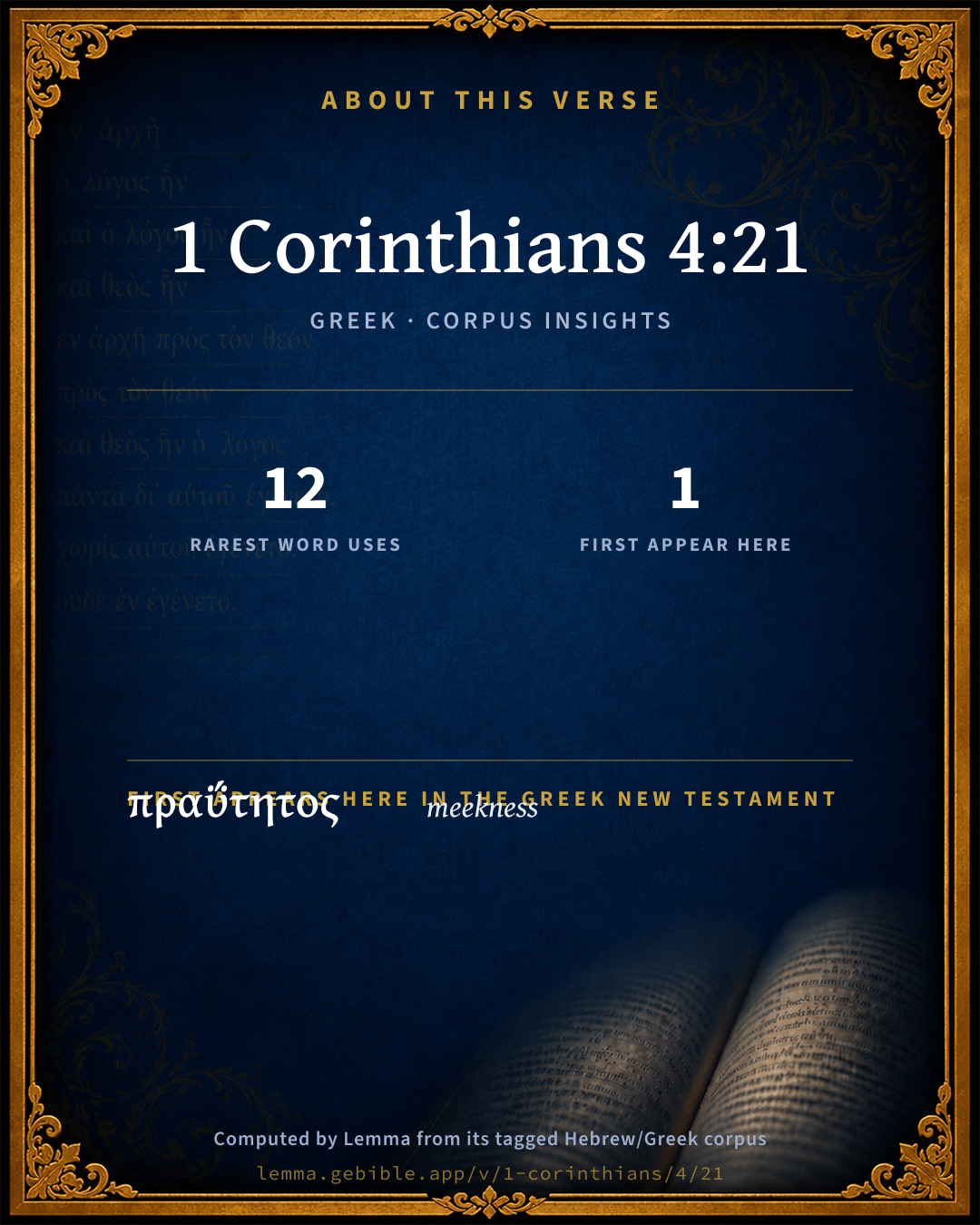
1 Corinthians 4:21

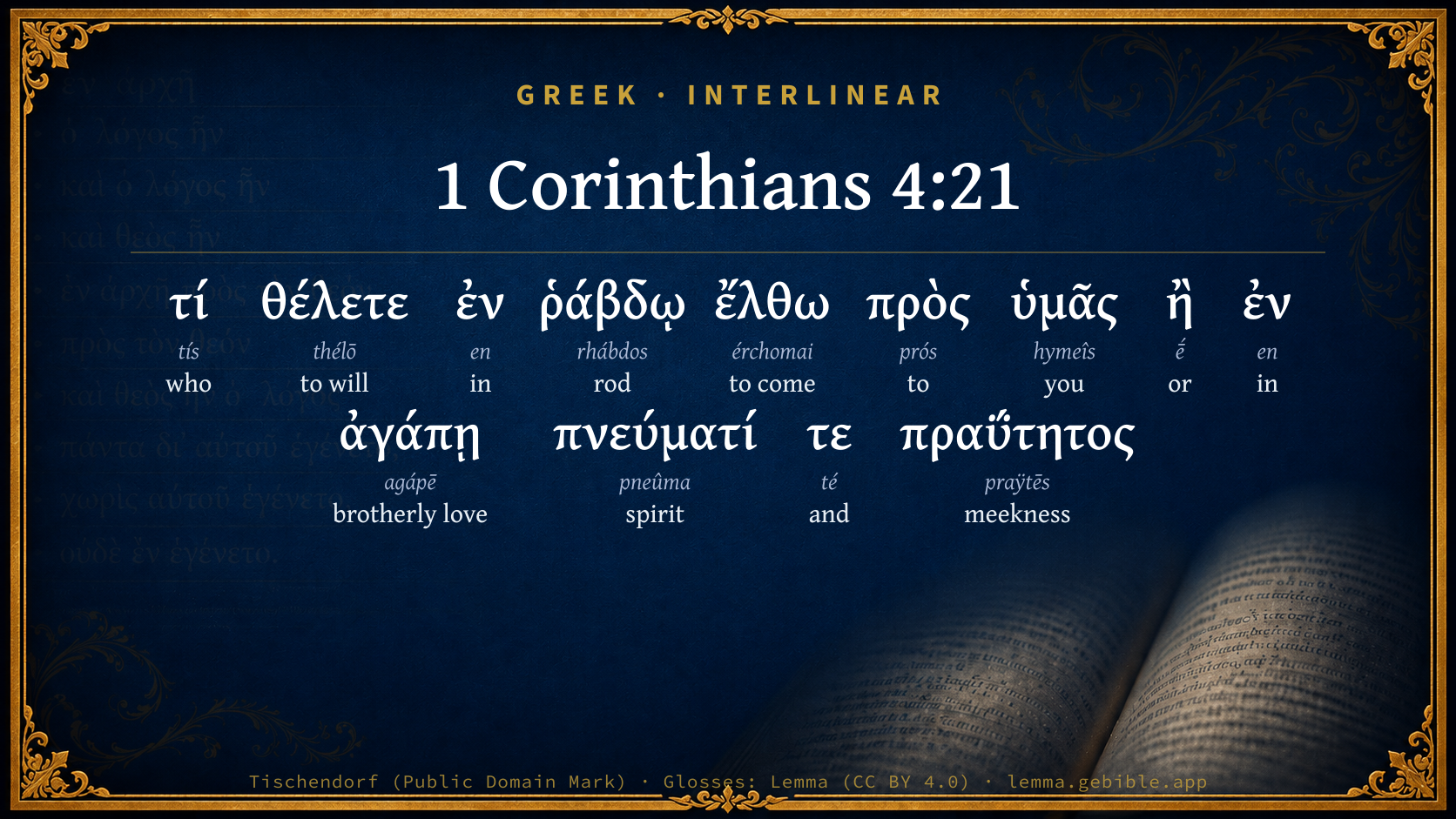
Greek (Tischendorf 8th ed.) 1 Corinthians 4:21 appears in the Greek New Testament. The text above is from the Tischendorf 8th edition. Each word links to its Strong’s number and a concise gloss. Click any word for its full Thayer’s Greek Lexicon entry.
Download image
Cite this verse

1 Corinthians 4:21 (World English Bible). Public Domain. Lemma interlinear Bible study tool, https://lemma.gebible.app/v/1-corinthians/4/21.

Show BibTeX & RIS
BibTeX
RIS
English Translation
What do you want? Shall I come to you with a rod, or in love and a spirit of gentleness?
World English Bible · Public Domain
Highlights
  • 1 first appearance in the Greek New Testament
Full analysis ↓
Download a study sheet

One document with this verse’s original text, its word-by-word gloss line, the meaning frame, cross-references with their text, attributed commentary, and full source and license credits — printable, and it pastes into notes with its structure intact.

This verse Autodidact and up

Study sheet (.html) Plain text (.txt)

A passage Seminary Student

Up to 50 verses in one chapter. A passage sheet keeps up to 6 commentary sources and 12 cross-references per verse, in the order this page ranks them, and says so on the sheet whenever that leaves anything out. Ask for a single verse and you get the Autodidact verse sheet above.

Everything on this page stays free to read, with no account — the sheet is a download of what is already on screen, not access to it.

Want to remove ads? Support Godless Engineer
Compare translations 3

The same verse in 3 English versions, stacked beneath the original-language interlinear above. Click any original word for its lexicon entry.

Each is an independent rendering of the whole verse — the interlinear is not word-aligned to these translations.

Highlighted words mark where these versions differ — a whole-verse word diff, not a word-by-word alignment.

  • World English Bible Public Domain
    What do you want? Shall I come to you with a rod, or in love and a spirit of gentleness?
  • King James Version Public Domain
    What will ye? shall I come unto you with a rod, or in love, and in the spirit of meekness?
  • unfoldingWord Literal Text CC BY-SA 4.0
    What do you want? Shall I come to you with a rod or with love and a spirit of gentleness?

unfoldingWord Literal Text — © unfoldingWord, licensed CC BY-SA 4.0. Word-aligned USFM3 via Door43 (git.door43.org/unfoldingWord/en_ult).

Versions to compare (up to 4)

3 of 4 selected

Show all 19 translations

Every available English version of this verse, each an independent rendering of the whole verse.

  • World English Bible Public Domain
    What do you want? Shall I come to you with a rod, or in love and a spirit of gentleness?
  • Berean Standard Bible Public Domain
    Which do you prefer? Shall I come to you with a rod, or in love and with a gentle spirit?
  • Majority Standard Bible Public Domain
    Which do you prefer? Shall I come to you with a rod, or in love and with a gentle spirit?
  • King James Version Public Domain
    What will ye? shall I come unto you with a rod, or in love, and in the spirit of meekness?
  • American Standard Version (1901) Public Domain
    What will ye? shall I come unto you with a rod, or in love and a spirit of gentleness?
  • Revised Version (1885) Public Domain
    What will ye? shall I come unto you with a rod, or in love and a spirit of meekness?
  • Geneva Bible (1599) Public Domain
    What will ye? shall I come vnto you with a rod, or in loue, and in ye spirite of meekenes?
  • Douay-Rheims (1899) Public Domain
    What will you? shall I come to you with a rod; or in charity, and in the spirit of meekness?
  • Young's Literal Translation Public Domain
    what do ye wish? with a rod shall I come unto you, or in love, with a spirit also of meekness?
  • Literal Standard Version CC BY-SA 4.0
    What do you wish? Will I come to you with a rod, or in love, also with a spirit of meekness?
  • Unlocked Literal Bible CC BY-SA 4.0
    What do you want? Shall I come to you with a rod or with love and in a spirit of gentleness?
  • unfoldingWord Literal Text CC BY-SA 4.0
    What do you want? Shall I come to you with a rod or with love and a spirit of gentleness?
  • Darby Bible Public Domain
    What will ye? that I come to you with a rod; or in love, and [in] a spirit of meekness?
  • World Messianic Bible Public Domain
    What do you want? Shall I come to you with a rod, or in love and a spirit of gentleness?
  • Webster's Bible Public Domain
    What will ye? shall I come to you with a rod, or in love, and in the spirit of meekness?
  • Free Bible Version CC BY-SA 4.0
    So what do you want? Shall I come with a stick to beat you, or in love and a gentle spirit?
  • Bible in Basic English Public Domain
    What is your desire? is my coming to be with punishment, or is it to be in love and a gentle spirit?
  • Text-Critical English NT CC BY 4.0
    What do you prefer? Shall I come to you with a rod, or with love and a spirit of gentleness?
  • Tyndale New Testament (1534) Public Domain
    What will ye? Shall I come vnto you with a rodde or els in love and in the sprete of mekenes?

Literal Standard Version (2020), Covenant Press — licensed CC BY-SA 4.0. Text via the HelloAO Bible API (eBible.org). Unlocked Literal Bible (unfoldingWord) — licensed CC BY-SA 4.0. Text via the HelloAO Bible API (eBible.org). unfoldingWord Literal Text — © unfoldingWord, licensed CC BY-SA 4.0. Word-aligned USFM3 via Door43 (git.door43.org/unfoldingWord/en_ult). Free Bible Version, Dr. Jonathan Gallagher — licensed CC BY-SA 4.0. Text via the HelloAO Bible API (eBible.org).

Word by word

More ways to search: Search by grammar → Find every occurrence → Compare this word →

Practice this passage: Drill this verse → Learn its vocabulary →

ῥάβδῳ
rhábdos
G4464
“rod”
Noun, Dative, Singular, Feminine
Part of Speech
Noun
Case
Dative
Number
Singular
Gender
Feminine
Full Thayer's Definition

Origin: from the base of G4474

TDNT: 22:07,0

1. a staff, a walking stick, a twig, rod, branch 2. a rod with which one is beaten 3. a staff a. as used on a journey, or to lean upon, or by shepherds b. when applied to kings 1. with a rod of iron, indicates the severest, most rigorous rule 2. a royal sceptre
  1. τί tís G5101 “who” Interrogative pronoun, Accusative, Singular, Neuter
  2. θέλετε thélō G2309 “to will” Verb, Present, Active, Indicative, 2nd person, Plural
  3. ἐν en G1722 “in” Preposition
  4. ἔλθω érchomai G2064 “to come” Verb, Aorist, Active, Subjunctive, 1st person, Singular
  5. πρὸς prós G4314 “to” Preposition
  6. ὑμᾶς hymeîs G5210 “you” Personal pronoun, 2nd person, Accusative, Plural
  7. ἢ ḗ G2228 “or” Particle
  8. ἐν en G1722 “in” Preposition
  9. ἀγάπῃ agápē G26 “brotherly love” Noun, Dative, Singular, Feminine
  10. πνεύματί pneûma G4151 “spirit” Noun, Dative, Singular, Neuter
  11. τε té G5037 “and” Particle
  12. πραΰτητος praÿtēs G4240 “meekness” Noun, Genitive, Singular, Feminine

About this verse

These counts appear in no published source. They are computed here, from the morphology-tagged text and Lemma’s own curated glosses. What Lemma adds →

13
words
12
distinct lemmas
Pauline Epistles
section

Notable vocabulary

The rarest word here is ῥάβδῳ rod G4464 — appearing just 12 times in the whole Greek New Testament.

First appearance in Scripture

This word makes its first canonical appearance in the Greek New Testament here:

  • πραΰτητος meekness G4240

Shared distinctive vocabulary

ῥάβδῳ rod G4464 occurs in 11 verses of the Greek New Testament. Also found in:

Repetition

A word recurs within this verse:

Cross-references

13

Topical passages linked to 1 Corinthians 4:21 in the Treasury of Scripture Knowledge — connected by theme and wording, ordered by reader-vote popularity; previews shown in the World English Bible.

  • 2 Corinthians 13:2 I have said beforehand, and I do say beforehand, as when I was present the second time, so now, being absent, I write to those who have sinned before now, and to all the rest, that, if I come again, I will not spare;
  • 2 Corinthians 13:10 For this cause I write these things while absent, that I may not deal sharply when present, according to the authority which the Lord gave me for building up, and not for tearing down.
  • 2 Corinthians 12:20–21 For I am afraid that by any means, when I come, I might find you not the way I want to, and that I might be found by you as you don't desire; that by any means there would be strife, jealousy, outbursts of anger, factions, slander, whisperings, proud thoughts, riots;
  • 1 Thessalonians 2:7 But we were gentle among of you, as when a nurse cherishes her own children.
  • 2 Corinthians 1:23 But I call God for a witness to my soul, that I didn't come to Corinth to spare you.
  • 2 Corinthians 2:3 And I wrote this very thing to you, so that, when I came, I wouldn't have sorrow from them of whom I ought to rejoice; having confidence in you all, that my joy would be shared by all of you.
  • James 3:17 But the wisdom that is from above is first pure, then peaceful, gentle, reasonable, full of mercy and good fruits, without partiality, and without hypocrisy.
  • 2 Corinthians 2:1 But I determined this for myself, that I would not come to you again in sorrow.
  • 2 Corinthians 10:1–2 Now I Paul, myself, entreat you by the humility and gentleness of Christ; I who in your presence am lowly among you, but being absent am of good courage toward you.
  • 2 Corinthians 10:6 and being in readiness to avenge all disobedience, when your obedience will be made full.
  • 1 Corinthians 5:5 are to deliver such a one to Satan for the destruction of the flesh, that the spirit may be saved in the day of the Lord Jesus.
  • 2 Corinthians 3:10 For most assuredly that which has been made glorious has not been made glorious in this respect, by reason of the glory that surpasses.
  • 2 Corinthians 10:8 For though I should boast somewhat abundantly concerning our authority, (which the Lord gave for building you up, and not for casting you down) I will not be disappointed,

Cross-references courtesy of OpenBible.info (CC BY 4.0).

Commentary

Notes on 1 Corinthians 4:21 from classic Christian and Jewish commentators (each source and its license shown beneath its notes). The classic Christian expositions comment on the surrounding passage and are grouped to its opening verse, so a note may address several verses; the Jewish commentaries on the Tanakh (Rashi and others) are per-verse, so they appear only where the commentator wrote on this verse.

Lemma curates 59 commentaries, every one of them public domain or Creative Commons licensed, each selected and text-cleaned for this edition rather than reprinted as found. About our sources →

Bengel's Gnomon

Johann Albrecht Bengel

1Co 4:21. Τί θέλετε, what will ye?) Choose. [Comp. 2Co 13:3. So this phrase, what wilt thou? is still of importance both as to the principal point, and as to its various accessory cases; see that you make room (that you choose rather to leave scope) for Love.—V.g.]—ἐν ῥάβδῳ, with a rod) wielded by a father’s hand. Comp. Isa 11:4.—ἢ, or) Paul would prefer the latter.

Bengel's Gnomon of the New Testament — English translation (T&T Clark, Edinburgh, 1860) — public domain. Text from a community e-Sword module.

Meyer's Critical & Exegetical Commentary

Heinrich August Wilhelm Meyer

1Co_4:21. As the conclusion of the entire section, we have here another warning useful for the readers as a whole, indicating to them the practical application which they generally were to make of the assurance of his speedy coming. Lachmann, followed by Hofmann (after Oecumenius, Cajetanus, Beza, Calvin), begins the new section with 1Co_4:21. But this appears hardly admissible, since chap. 1Co_5:1 commences without any connective particle (such as ἀλλά, or δέ, or γάρ),[731] and since, too, in 1Co_5:1 ff. there is no further reference to the speedy arrival of the apostle.

ΤΊ] in the sense of ΠΌΤΕΡΟΝ. Comp Plato, Phil. p. 52 D, and Stallbaum in loc[733] He fears the first, and wishes the second. Una quidem charitas est, sed diversa in diversis operatur, Augustine.

ἐν ῥάβδῳ] with a rod; but this is no Hebraism, for ἐν denotes in pure Greek the being provided with. Heb_9:25; 1Jn_5:6. See Matthiae, p. 1340; Buttmann, neut. Gr. p. 284 [E. T. 330]. Comp Sir_47:4 : ἘΝ ΛΊΘῼ, armed with a stone. Lucian, D. M. xxiii. 3 : καθικόμενος ἐν τῇ ῥάβδῳ. The meaning of the figurative phrase, borrowed as it is from the relation of father, is: ἐν κολάσει, ἐν τιμωρίᾳ, Chrysostom.

ἜΛΘΩ] am I to come? See Winer, p. 268 [E. T. 356]. Chrysostom puts it happily: ἐν ὑμῖν τὸ πρᾶγμα κεῖται.

πνεῦματί τε πραοτ.] not: with a gentle spirit (Luther, and most interpreters), so that πνεῦμα would be the subjective principle which should dispose the inner life to this quality; but: with the Spirit of gentleness, so that πνεῦμα is to be understood, with Chrysostom and Theophylact, of the Holy Spirit; and πραοτ. denotes that specific effect of this πνεῦμα (Gal_5:22) which from the context is brought peculiarly into view. So in all the passages of the N. T. where ΠΝΕῦΜΑ, meaning the Holy Spirit, is joined with the genitive of an abstract noun; and in each of these cases the connection has indicated which effect of the Spirit was to be named. Hence He is called πνεῦμα τῆς ἀληθείας (Joh_15:26; Joh_16:13; 1Jn_4:6), ΥἹΟΘΕΣΊΑς (Rom_8:15), Τῆς ΠΊΣΤΕΩς (2Co_4:13), ΣΟΦΊΑς (Eph_1:17), ΔΥΝΆΜΕΩς Κ.Τ.Λ[735] (2Ti_1:7), just according as the one or other effect of His working is exhibited by the context as characteristic of Him. Respecting the present passage, comp 1Co_6:1. It is to be observed, moreover, that the apostolic rod of discipline too is wielded in the power of the Holy Spirit, so that the selfsame Spirit works as a Spirit of gentleness and of corrective severity: ἔστι γὰρ πνεῦμα πραότητος καὶ πνεῦμα αὐστηρότητος, Chrysostom. Comp on Luk_9:55.

Instead of the form πραότης, Lachmann and Tischendorf have, in every passage in which it occurs in Pauls writings, the later πραΰτης (except that in Gal_6:1 Lachmann retains πραότης; see regarding both, Lobeck, a[738] Phryn. p. 403 f.). The change is justified by weighty testimony, especially that of A B C (although they are not unanimous in the case of all the passages). In the other places in which it is found, Jam_1:21; Jam_3:13, 1Pe_3:15, πραΰτης is undoubtedly the true reading.

[731] For to regard 1Co_5:1 as an answer which Paul gives to himself unto his own question, as Hofmann does, is a forced device, which, in view of τί θέλετε alone, is not even logically practicable.

[733] n loc. refers to the note of the commentator or editor named on the particular passage.

[735] .τ.λ. καὶ τὰ λοιπά.

[738] d refers to the note of the commentator or editor named on the particular passage.

Meyer — Critical and Exegetical Commentary on the New Testament — English translation by Peter Christie, edited by Frederick Crombie (T&T Clark, 1880) — public domain. Text from a community e-Sword module.

Expositor's Greek Testament

ed. W. Robertson Nicoll

1Co 4:21 . τί θέλετε ; “What is your will?” what would you have? τί a sharper πότερον ; the latter only once (Joh 7:17 ) in N.T. “ With a rod am I to come to you? or in love and a spirit of meekness?” ἐνῥ άβδῳ (= ἐν κολάσει , ἐν τιμωρίᾳ , Cm [786] ) is sound Gr [787] for “armed with a rod” ( cf. Sir 47:4 , ἐν λίθῳ ; Lucian, Dial. Mort. , xxiii., 3, καθικόμενος ἐν τ . ῥάβδῳ ; add Heb 9:25 , 1Jn 5:6 ) the implement of paternal discipline (1Co 4:14 ) called for by the behaviour of “some” (1Co 4:18 ).

[786] John Chrysostom’s Homiliœ († 407).

[787] Greek, or Grotius’ Annotationes in N.T.

There is reason, however, in the stern note of this question, for connecting it with ch. 1Co 5:1 (so Oec [788] , Cv [789] , Bz [790] , Hf [791] ). P. is approaching the subject of the following Section, which already stirs his wrath. For the sbj [792] of the dubitative question , ἔλθω , see Wr [793] , p. 356: ἐν ὑμῖν τὸ πρᾶγμα κεῖται (Cm [794] ). ἐν ἀγάπῃ κ . τ . λ . ( ἔλθω ); cf. 2Co 2:1 ; the constr [795] of 1Co 2:3 above is somewhat diff [796] (see note). πνεύματί τε πραΰτητος defines the particular expression of love in which P. desires to come: cf. 1Co 13:6 f. The Ap. does not mean the Holy Spirit here specifically, though the thought of Him is latent in every ref [797] to the “spirit” of a Christian man. Πραΰτης ( cf. 2Co 10:1 ) is the disposition most opposed to, and exercised by, the spirit of the conceited and insubordinate τινὲς at Cor [798]

[788] Oecumenius, the Greek Commentator.

[789] Calvin’s In Nov. Testamentum Commentarii .

[790] Beza’s Nov. Testamentum: Interpretatio et Annotationes (Cantab., 1642).

[791] J. C. K. von Hofmann’s Die heilige Schrift N.T. untersucht , ii. 2 (2te Auflage, 1874).

[792] subjunctive mood.

[793] Winer-Moulton’s Grammar of N.T. Greek (8th ed., 1877).

[794] John Chrysostom’s Homiliœ († 407).

[795] construction.

[796] difference, different, differently.

[797] reference.

[798] Corinth, Corinthian or Corinthians.

DIVISION II. QUESTIONS OF SOCIAL MORALS, 5 7. The Ap. has done with the subject of the Parties, which had claimed attention first because they sprung from a radical misconception of Christianity. But in this typical Hellenic community, social corruptions had arisen which, if not so universal, were still more malignant in their effect. The heathen converts of Cor [799] , but lately washed from the foulest vice (1Co 6:9 ff.), were some of them slipping back into the mire (2Co 12:21 ). An offence of incredible turpitude had just come to the Apostle’s ears, to the shame of which the Church appeared indifferent (5.). This case, demanding instant judicial action (1Co 4:1-5 ), leads the Ap. to define more clearly the relation of Christians to men of immoral life, as they may be found within or without the Church (1Co 4:6-13 ). From sins of uncleanness he passes in ch. 6 to acts of injustice committed in this Church, which, in one instance at least, had been scandalously dragged before the heathen law-courts (1Co 4:1-8 ). In 1Co 6:12-20 P. returns to the prevalent social evil of Cor [800] , and launches his solemn interdict against fornication , which was, seemingly, sheltered under the pretext of Christian liberty! It is just here, and in the light of the principles now developed, that P. takes up the question of marriage or celibacy , discussed at large in ch. 7. The fact that the Ap. turns at this juncture to the topics raised in the Church Letter, and that ch. 7 is headed with the formula Περὶ δὲ ὧν ἐγράψατέ μοι , must not be allowed to break the strong links of subject-matter and thought binding it to chh. 5 and 6 Its connexion with the foregoing context is essential, with the following comparatively accidental.

[799] Corinth, Corinthian or Corinthians.

[800] Corinth, Corinthian or Corinthians.

The Expositor's Greek Testament, edited by W. Robertson Nicoll (1897–1910) — public domain. Text from a community e-Sword module.

International Critical Commentary

21. ἐν ῥάβδῳ. Exactly as in 1Sa 17:43, σὺ ἔρχῃ ἐπʼ ἐμὲ ἐν ῥάβδῳ καὶ λίθοις; and 2Sa 7:14, ἐλέγξω αὐτὸν ἐν ῥαβδῳ καὶ ἐν ἁφαῖς: where the ἐν means ‘accompanied by’ or ‘provided with.’ Cf. Heb 9:25, ἐν αἵματι ἀλλοτρίῳ. ‘To lift up his hand with a sling-stone,’ ἐπᾶραι χεῖρα ἐν λίθῳ σφενδόνης (Ecclus. 47:5). Abbott (Johan. Gr. 2332) gives examples from papyri. The idea of environment easily passes into that of equipment. Cf. Stat. Theb. iv.221, Gravi metuendus in hasta; and Ennius, levesque sequunfur in hasta. The rod is that of spiritual rebuke and discipline; cf. οὐ φείσομαι (2Co 13:3). It is strange that any one should contend, even for controversial purposes, such as defence of the temporal power, that a literal rod is meant. But cf. Tarquini, Juris eccles. inst. p. 41, 19th ed. An allusion to the lictor’s rod is not likely.*

ἔλθω. Deliberative subjunctive; ‘Am I to come?’ It is possible to make the verb dependent upon θέλετε, but it is more forcible to keep it independent (AV., RV.). Cf. ἐπιμένωμεν τῇ ἁμαρτίᾳ; (Rom 6:1).

ἐν ἀγάπῃ. The preposition here is inevitably ἐν, and it was probably the antithesis with ἐν ἀγάπῃ that led to the expression ἐν ῥάβδῳ here, just as the bear-skin led to Virgil’s Horridus in jaculis, the rest of the line being et pelle Libystidis ursae (Aen. v.37).

πνεύματί τε πραΰτητος. Either ‘the Spirit of meekness’, i.e. the Holy Spirit, manifested in one of His special gifts or fruits (Gal 5:23), or ‘a spirit of meekness,’ i.e. a disposition of that character (cf. 2Co 4:13). The latter would be inspired by the Holy Spirit (Rom 8:5). The absence of the article is in favour of the latter here. Contrast τὸ πνεῦμα τῆς ἀληθείας (Joh 14:17, Joh 16:13) with πνεῦμα σοφίας (Eph 1:17), and see J.A. Robinson, Ephesians, pp. 38, 39, and the note on πνεῦμα ἁγιωσύνης (Rom 1:4). Had the Apostle meant the Holy Spirit, he would probably have written ἐν τῷ πν. τῆς πρ. By πραΰτης is meant the opposite of ‘harshness’ or ‘rudeness.’ Trench, Syn. § § xlii., xliii., xcii.; Westcott on Eph 4:2.

πραΰτητος (A B C 17) rather than πραότητος (א D E F G P). In Gal 5:23, א joins A B C in favour of πραΰτης. In Eph 4:2, א B C 17 support πραΰτης, in 2Co 10:1, א B F G P 17 do so, in Col 3:12, א A B C P 17. Lachmann, following Oecumenius and Calvin, makes 4:21 the beginning of a new paragraph: it is a sharp, decisive dismissal of the subject of the σχίσματα.

* St Paul is probably not thinking of the derivation; ‘Christ is the pilot; we are rowers under Him.’ By Χριστοῦ he may mean ‘not of any earthly master.’

* Chadwick, The Pastoral Teaching of St Paul, p. 164 f. He does not say ‘be judged trustworthy,’ but ‘be found actually to be so.’ In 1Pe 4:10 every Christian is a steward.

אԠא (Fourth century.) The Sinaitic MS., now at St Petersburg, the only MS. containing the whole N.T.

A A (Fifth century.) The Codex Alexandrinus; now at the British Museum.

B B (Fourth century.) The Vatican MS.

C C (Fifth century). The Codex Ephraem, a Palimpsest; now at Paris. Lacks 7:18 ἐν ἀκροβυστίᾳ-9:6 τοῦ μὴ ἐργάζεσθαι: 13:8 παύσονται-14:40 ἀλλὰ ἕτερα.

D D (Sixth century.) Codex Clarmontanus; now at Paris. A Graeco-Latin MS. 14:13 διο͂ ὁ λαλῶν-22 σημεῖον ἐστίν is supplied by a later but ancient hand. Many subsequent hands (sixth to ninth centuries) have corrected the MS. (See Gregory, Prolegomena , pp. 418-422).

F F (Late ninth century). Codex Augiensis (from Reichenau); now at Trin. Coll. Cambr. Probably a copy of G in any case, secondary to G, from which it very rarely varies (see Gregory, p. 429).

G G (Late ninth century). Codex Boernerianus; at Dresden. Interlined with the Latin (in minluscules). Lacks 1Co 3:8-16, 1Co 6:7-14 (F).

P P (Ninth century). Porfirianus Chiovensis. A palimpsest acquired in the East by Porphyrius Bishop of Kiew. Lacks 7:15 ὑμᾶς ὁ θεός-17 περιπάτει: 12:23 τοῦ σώματος-13:5 οὐ λογί-: 14:23 τὸ λαλεῖν μή. A good type of text in St Paul’s Epistles.

17 17. (Ev. 33, Act_13. Ninth century.) At Paris (Nat. Gr. 14). See Westcott and Hort., Introd. §§ 211, 212.

e e The Latin text of E

E E (Ninth century). At Petrograd. A copy of D, and unimportant

L L (Ninth century). Codex Angelicus; At Rome.

d d The Latin text of D

f f The Latin text of F

g g The Latin text of G

* Aesch. in Ctes. p. 587; Είς τρία μέρη διαιρεῖται ἡ ἡμέρα, ἱταν είσίῃ γραφὴ παραυόμων εἰς τὸ δικαστήριον, where ἡ ἡμέρα means the time of the trial.

† We might have expected ἀλλʼ οὐδὲ αὐτὸς ἐμαυτὸν ἀνακρίνω, but the meaning is clear. He does not base his refusal to pass judgment on himself on the difficulty of being impartial. Such a judgment, however impartial and just, could not be final, and therefore would be futile.

* The use is perhaps not yet extinct in Yorkshire. “I know nothing by him” might still be heard for “I know nothing against him.”

* That there was no jealousy or rivalry between St Paul and Apollos is clear from 3:6, 8-10, 16:12. It is possible that it was the factious conduct of his partizans that drove Apollos from Corinth (Renan, S. Paul, p. 375).

† Rudolf Steck would refer this to Rom 12:3; an extraordinary conjecture.

* Chrysostom points out that “piety is insatiable.” A Christian can never be satisfied with his condition; and for those who were as yet scarcely beginners to suppose that they had reached the end, was childish. Bachmann quotes the well-known Logion preserved by Clement of Alexandria (704 ed. Potter, and found in a somewhat different form in Oxyrhynchsu papyri: οὐ παύσεται ὁ ζητῶν ἕως ἃν εὔρῃ, εὑρὼν δὲ θαμβήσεται, θαμβηθεὶς δὲ βασιλεύσει, βασιλεύσας δὲ ἐπαναπαύεται. See Deissmann, Light, p. xiii.

* The Epistle contains a number of illustrations taken from heathen life; here and 7:31, the theatre; the idol-feasts, 8:10, 10:20; racing and boxing in the games, with a crown as a prize, 9:24-27; the syssitia, 10:27; the fighting with wild beasts, 15:32.

* Plato (Crito 49) puts into the mouth of Socrates; “We ought not to retaliate or render evil for evil to any one, whatever evil we may have suffered from him … Warding off evil by evil is never right.” But returning good for evil goes far beyond that.

† Tertullian and the Vulgate transliterate, peripsema; Beza has sordes, Luther Fegopfer (Auswurf).

* Cf. τούτους ὡς πατὴρ νουθετῶν ἐδοκίμασας (Wisd. 11:10), and νουθετήσει δίκαιον ὡς υἰὸν ἀγαπήσεως (Pss. Sol. 13:8). Excepting Timothy (v. 17; 2Ti 1:2), St Paul nowhere else calls any one τέκνον ἀγαπητόν. Spiritualis paternitas singutarem necessitudinem et affectionem conjunctam habet, prae omni alia propinquitate (Beng.).

† See Ramsay, Galatians, p. 383; Smith, Dict. of Ant. ii. p. 307. The same usage is found in papyri.

* Findlay quotes Sanhedrin, f. xix 2; “Whoever teachers the son of his friend the Law, it is as if he had begotten him.”

† See Deissmann, Dis neutestamentliche Formel “in Christo Jesu.”

* The verb is peculiar to Paul in N.T., and (excepting Col 2:18) is peculiar to this Epistle.

* See Regnum Dei, the Bampton Lectures for 1901, pp. 47-61, in which St Paul’s views of the Kingdom are examined in detail.

* This has been suggested by Dr. E. Hicks, Roman Law in the N.T. p. 182. But the rod as a metaphor for correction is common enough (Job 9:34, Job 9:21:9; Psa 89:32; Isa 10:5, etc.).

International Critical Commentary — older volumes (1896–1929), various authors — public domain. Text from a community e-Sword module.

Hodge's Commentary on Romans, Ephesians & First Corinthians

Charles Hodge

1Co_4:21

What will ye? shall I come unto you with a rod, or in love, and (in) the Spirit of meekness?

Paul, so far from being afraid to go to Corinth, as his enemies imagined, was prepared to go there with authority. He was their spiritual father and ruler. He had the right and the ability to punish them. It depended on themselves in what character he should appear among them, whether as a punisher or as a comforter whether in the exercise of discipline, or as a kind and tender parent. The preposition (ἐν) rendered with in the first clause, is the same as that rendered in in those which follow. It has the same force in them all. It means furnished with, attended by. That is, it marks the attending circumstances. The expression spirit of meekness is commonly understood to mean a meek or gentle Spirit or disposition of mind. As, however, the word Spirit, when connected with an abstract noun, always refers to the Holy Spirit, as in the phrases Spirit of truth, Spirit of wisdom, Spirit of adoption, Spirit of love, of fear, or of glory, it should be so understood here. Paul asks whether he should come with severity, or filled with the Spirit as the author of meekness. It is plain from this, as from numerous other passages, that the apostles exercised the right of discipline over all the churches; they could receive into the communion of the church, or excommunicate from it, at their discretion. This prerogative was inseparable from their infallibility as the messengers of Christ, sent to establish and to administer his kingdom. The following chapter furnishes a notable instance of the exercise of this authority.

Charles Hodge — Commentary on Romans (1835), First Corinthians (1857), and Ephesians (1856) — public domain. Text from a community e-Sword module.

Geneva Bible (1599)

Geneva Bible translators

A passing over to another part of this Epistle, wherein he reprehended more sharply a very heinous offence, showing the use of ecclesiastical correction.

Meekly affected towards you.

Geneva Bible (1599) marginal notes — public domain. Text via Bolls.life.

Jamieson, Fausset & Brown

Robert Jamieson, A. R. Fausset & David Brown

with a rod, or in love--The Greek preposition is used in both clauses; must I come IN displeasure to exercise the rod, or IN love, and the Spirit of meekness (Isa 11:4; Co2 13:3)?

Next: 1 Corinthians Chapter 5

Jamieson, Fausset & Brown — Commentary Critical and Explanatory on the Whole Bible (1871) — public domain (CC PDM 1.0). Text via the HelloAO Bible API.

Adam Clarke's Commentary

Verse 21. Shall I come unto you with a rod, or in love] Here he alludes to the case of the teacher and father, mentioned in 1Co 4:15. Shall I come to you with the authority of a teacher, and use the rod of discipline? or shall I come in the tenderness of a father, and entreat you to do what I have authority to enforce? Among the Jews, those who did not amend, after being faithfully admonished, were whipped, either publicly or privately, in the synagogue. If on this they did not amend, they were liable to be stoned. We see, from the cases of Ananias and Sapphira, Elymas the sorcerer, Hymenaeus and Alexander, c., that the apostles had sometimes the power to inflict the most awful punishments on transgressors. The Corinthians must have known this, and consequently have dreaded a visit from him in his apostolical authority. That there were many irregularities in this Church, which required both the presence and authority of the apostle, we shall see in the subsequent chapters.

1. IN the preceding chapter we find the ministers of God compared to STEWARDS, of whom the strictest fidelity is required.

(1.) Fidelity to GOD, in publishing his truth with zeal, defending it with courage, and recommending it with prudence.

(2.) Fidelity to CHRIST, whose representatives they are, in honestly and fully recommending his grace and salvation on the ground of his passion and death, and preaching his maxims in all their force and purity.

(3.) Fidelity to the CHURCH, in taking heed to keep up a godly discipline, admitting none into it but those who have abandoned their sins and permitting none to continue in it that do not continue to adorn the doctrine of God their Saviour.

(4.) Fidelity to their own MINISTRY, walking so as to bring no blame on the Gospel; avoiding the extremes of indolent tenderness on one hand, and austere severity on the other. Considering the flock, not as their flock, but the flock of Jesus Christ; watching, ruling, and feeding it according to the order of their Divine Master.

2. A minister of God should act with great caution: every man, properly speaking, is placed between the secret judgment of God and the public censure of men. He should do nothing rashly, that he may not justly incur the censure of men; and he should do nothing but in the loving fear of God, that he may not incur the censure of his Maker. The man who scarcely ever allows himself to be wrong, is one of whom it may be safely said, he is seldom right. It is possible for a man to mistake his own will for the will of God, and his own obstinacy for inflexible adherence to his duty. With such persons it is dangerous to have any commerce. Reader, pray to God to save thee from an inflated and self-sufficient mind.

3. Zeal for God's truth is essentially necessary for every minister; and prudence is not less so. They should be wisely tempered together, but this is not always the case. Zeal without prudence is like a flambeau in the hands of a blind man; it may enlighten and warm, but it play also destroy the spiritual building. Human prudence should be avoided as well as intemperate zeal; this kind of prudence consists in a man's being careful not to bring himself into trouble, and not to hazard his reputation, credit, interest, or fortune, in the performance of his duty. Evangelical wisdom consists in our suffering and losing all things, rather than be wanting in the discharge of our obligations.

4. From St. Paul's account of himself we find him often suffering the severest hardships in the prosecution of his duty. He had for his patrimony, hunger, thirst, nakedness, stripes, c. and wandered about testifying the Gospel of the grace of God, without even a cottage that he could claim as his own. Let those who dwell in their elegant houses, who profess to be apostolic in their order, and evangelic in their doctrines, think of this. In their state of affluence they should have extraordinary degrees of zeal, humility, meekness, and charity, to recommend them to our notice as apostolical men. If God, in the course of his providence, has saved them from an apostle's hardships, let them devote their lives to the service of that Church in which they have their emoluments; and labour incessantly to build it up on its most holy faith. Let them not be masters to govern with rigour and imperiousness; but tender fathers, who feel every member in the Church as their own child, and labour to feed the heavenly family with the mysteries of God, of which they are stewards.

5. And while the people require much of their spiritual pastors, these pastors have equal right to require much of their people. The obligation is not all on one side; those who watch for our souls have a right not only to their own support, but to our reverence and confidence. Those who despise their ecclesiastical rulers, will soon despise the Church of Christ itself, neglect its ordinances, lose sight of its doctrines, and at last neglect their own salvation.

Adam Clarke's Commentary on the Bible (1810–1826) — public domain. Text from a community e-Sword/MySword module.

John Calvin's Commentaries

21. What will ye? The person who divided the Epistles into chapters ought to have made this the beginning of the fifth chapter. For having hitherto reproved the foolish pride of the Corinthians, their vain confidence, and their judgment as perverted and corrupted by ambition, he now makes mention of the vices with which they were infected, and on account of which they ought to be ashamed — “You are puffed up, as though everything were on the best possible footing among you, but it were better if you did with shame and sighing acknowledge the unhappiness of your condition, for if you persist, I shall be under the necessity of laying aside mildness, and exercising towards you a paternal severity.” There is, however, still more of emphasis in this threatening in which he gives them liberty to choose, for he declares that it does not depend upon himself whether he shall show himself agreeable and mild, but that it is their own fault that he is necessitated to use severity. “It is for you,” says he, “to choose in what temper you would have me. As for me, I am prepared to be mild, but if you go on as you have done hitherto, I shall be under the necessity of taking up the rod.” He thus takes higher ground, after having laid claim to fatherly authority over them, for it would have been absurd to set out with this threatening, without first opening up the way by what he said, and preparing them for entertaining fears.

By the term rod, he means that severity with which a pastor ought to correct his people’s faults. He places in contrast with this, love, and the spirit of meekness — not, as though the father hated the sons whom he chastises, for on the contrary the chastisement proceeds from love, but because by sadness of countenance and harshness of words, he appears as though he were angry with his son. To express myself more plainly — in one word, a father always, whatever kind of look he may put on, regards his son with affection, but that affection he manifests when he teaches him pleasantly and lovingly; but when, on the other hand, being displeased with his faults, he chastises him in rather sharp terms, or even with the rod, he puts on the appearance of a person in a passion. As then love does not appear when severity of discipline is exercised, it is not without good reason, that Paul here conjoins love with a spirit of meekness There are some that understand the term rod to mean excommunication — but, for my part, though I grant them that excommunication is a part of that severity with which Paul threatens the Corinthians, I at the same time extend it farther, so as to include all reproofs that are of a harsher kind.

Observe here what system a good pastor ought to observe; for he ought of his own accord to be inclined to mildness, with the view of drawing to Christ, rather than driving. This mildness, so far as in him lies, he ought to maintain, and never have recourse to bitterness, unless he be compelled to do so. On the other hand, he must not spare the rod, (Proverbs 13:24,) when there is need for it, for while those that are teachable and agreeable should be dealt with mildly, sharpness requires to be used in dealing with the refractory and contumacious. We see, too, that the Word of God does not contain mere doctrine, but contains an intermixture of bitter reproofs, so as to supply pastors with a rod For it often happens, through the obstinacy of the people, that those pastors who are naturally the mildest are constrained to put on, as it were, the countenance of another, and act with rigor and severity.

John Calvin's Commentaries (1540-1563) — public domain. Text from the Calvin Translation Society English edition (1840s-50s) via the Christian Classics Ethereal Library (ccel.org). Calvin's coverage is partial (roughly two-thirds of the Bible); uncommented books and verses are honest gaps, never fabricated. The 19th-century editor's footnotes and remarks are omitted so the notes are faithfully Calvin's own voice.

Ellicott's Commentary for English Readers

(21) What will ye?—I give you a choice. I am coming to you as a father in any case. But shall I come as a father comes with a rod (Isa_11:4), and going to inflict punishment with it (such is the force of the Greek, “in a rod”); or as a father would come when no faults on the child’s part need interfere with the perfect and unrestricted outflowing of his gentleness and love. The pathos of these last few words sufficiently indicate what the Apostle would himself prefer. The choice, however, rested with them. His love would be no love, if without any change on their part, it led him to show no displeasure where correction was for their sake absolutely needed. This is a great and striking example of St. Paul having the “mind of God.” He treats the Corinthians as God ever treats His children.

This verse at once concludes this first part of the Epistle, in which the party-spirit and the evils resulting from it in Corinth are treated of, and naturally introduces the second topic to be discussed, viz., the case of incest which had occurred, it being one of the things which would compel the Apostle to visit Corinth, not “in love and in the spirit of meekness,” but “with a rod.”

A Bible Commentary for English Readers, edited by Charles John Ellicott (1878–1897) — public domain. Text from a community e-Sword module.

The Cambridge Bible for Schools and Colleges

gen. ed. J. J. S. Perowne

21. with a rod] That is either (1) with some commentators, e.g. Chrysostom, the resolution to deliver the rebellious over to Satan (see next chapter). If this be the case, the word ‘power’ in the last verse must include power to do harm. But it is better (2) to refer the expression to the severity of language which the Apostle would be compelled to use, if there were no signs of improvement when he came. This falls in best with the fatherly relation, involving of course the idea of correction, in which he describes himself as standing towards the Corinthian Church. See 1Co_4:15, and compare Pro_13:24; Pro_23:13-14, &c. The words ‘spirit of meekness’ in the last part of the verse confirm this last interpretation. The literal translation is ‘in a rod,’ referring to the spirit in which the Apostle was to come. ‘Am I to come to you in a spirit of correction, or in a spirit of meekness?’

The Cambridge Bible for Schools and Colleges (gen. ed. J. J. S. Perowne; Cambridge University Press, 1878–1918) — public domain. Text from a community e-Sword module.

John Gill's Exposition

What will ye?.... Or "how will ye, that I should come unto you?" as the Arabic and Ethiopic versions read it: since the apostle had determined upon his coming to them: and had made mention of it, he puts it to them, in what manner they themselves would choose he should come unto them;

shall I come unto you with a rod; either as a schoolmaster, as were their false teachers, with a "ferula"; or as a father with a rod of correction and chastisement, assuming his paternal authority, putting on severe looks, and using roughness; or rather as an apostle with the apostolical rod; by which is meant not excommunication, which is what belongs to a whole community, and not any single person; but a power of inflicting punishment on the bodies of delinquents, by smiting with diseases, and even with death itself; for as the prophets of the Old Testament had a power from God of inflicting diseases and death upon offenders; so had the apostles of the New, as appears from the instances of Ananias, and Sapphira, and Elymas the sorcerer:

or in love, and in the spirit of meekness? with the affection of a father, with a pleasant countenance, and a meek spirit; in opposition to that roughness and sharpness, he had an authority, as an apostle of Christ, to use in proper cases; and therefore as the latter would be most eligible by them, his suggestion is, that they would behave accordingly, that there might be no occasion to come to them in the former manner, which was not desirable by him, There seems to be an allusion to a practice among the Jews, in the punishing of a drunkard or gluttonous person; the rule for which was this (w),

"they first correct him "with words", or "with a rod", as it is written, Deu 21:18 and have chastened him; but if he adds and repeats (i.e. goes on in his sin), then they stone him.''

Or rather the allusion is to the judges in the sanhedrim, one of the instruments or ensigns of whose office was "a rod or staff" to smite with; it is said (x) of R. Hona, when he went to the sanhedrim, he used to say, bring me the instruments of the Tabernae (the place where the sanhedrim sat); what are they? "the staff" (in Cocceius's edition it is "the rods", and the sandals, the trumpets, and the thongs); the gloss is, "the thong" for scourging, "the staff" (or rods) for beating the rebellious until they return, the "trumpets" for excommunication, and the "sandals" for plucking off the shoe; things in which the judges of the court were concerned, and here the apostle proposes to come as judge; see Co1 5:3.

(w) R. Elias in Adderet apud Trigland. de sect. Karaeor. c. 10. p. 161. (x) T. Bab. Sanhedrim, fol. 7. 2.

Next: 1 Corinthians Chapter 5

John Gill's Exposition of the Whole Bible (1746–1763) — public domain (CC PDM 1.0). Text via the HelloAO Bible API.

Trapp's Complete Commentary

John Trapp

21 What will ye? shall I come unto you with a rod, or in love, and in the spirit of meekness?

Ver. 21. With a rod, or in love?] Both; but (as children) we think not so. Sed sinite virgam corripientem, ne sentiatis malleum conterentem, saith one father. (Bern.) Non erudit pater nisi quem amat, nec corripit nisi quem diligit, saith another. (Jerome.)

John Trapp, A Commentary or Exposition upon All the Books of the Old and New Testament (1647–1656) — public domain. Text from a community e-Sword module.

Albert Barnes' Notes on the Bible

What will ye - It depends on yourselves how I shall come. If you lay aside your contentions and strifes; if you administer discipline as you should; if you give yourselves heartily and entirely to the work of the Lord, I shall come, not to reprove or to punish, but as a father and a friend. But if you do not heed my exhortations or the labors of Timothy; if you still continue your contentions, and do not remove the occasions of offence, I shall come with severity and the language of rebuke.

With a rod - To correct and punish.

In the spirit of meekness - Comforting and commending instead of chastising. Paul intimates that this depended on themselves. They had the power, and it was their duty to administer discipline; but if they would not do it, the task would devolve on him as the founder and father of the church, and as entrusted with power by the Lord Jesus to administer the severity of Christian discipline, or to punish those who offended by bodily suffering; see 1Co 5:5; 1Co 11:30. See also the case of Ananias and Sapphira (Act 5:1 ff), and of Elymas the sorcerer. Act 13:10-11.

Remarks On 1 Corinthians 4

1. We should endeavor to form a proper estimate of the Christian ministry; 1Co 4:1. We should regard ministers as the servants of Jesus Christ, and honor them for their Master’s sake; and esteem them also in proportion to their fidelity. They are entitled to respect as the ambassadors of the Son of God; but that respect also should be in proportion to their resemblance of him and their faithfulness in their work. They who love the ministers of Christ, who are like him, and who are faithful, love the Master that sent them; they who hate and despise them despise him; see Mat 10:40-42.

2. Ministers should be faithful; 1Co 4:2. They are the stewards of Christ. They are appointed by him. They are responsible to him. They have a most important trust - more important than any other stewards, and they should live in such a manner as to receive the approbation of their master.

3. It is of little consequence what the world thinks of us; 1Co 4:3. A good name is on many accounts desirable; but it should not be the leading consideration; nor should we do anything merely to obtain it. Desirable as is a fair reputation, yet the opinion of the world is not to be too highly valued; because -

It often misjudges; It is prejudiced for or against us; It is not to decide our final destiny;

(4) To desire that simply, is a selfish and base passion.

4. The esteem even of friends is not to be the leading object of life; 1Co 4:2. This is valuable, but not so valuable as the approbation of God. Friends are partial, and even where they do not approve our course, if we are conscientious, we should be willing to bear with their disapprobation. A good conscience is everything. The approbation even of friends cannot help us on the Day of Judgment.

5. We should distrust ourselves; 1Co 4:3-4. We should not pronounce too confidently on our motives or our conduct. We may be deceived. There may be much even in our own motives that may elude our most careful inquiry. This should teach us humility, self-distrust, and charity. Knowing our own liableness to misjudge ourselves, we should look with kindness on the faults and failings of others.

6. We see here the nature of the future Judgment; 1Co 4:5;

(1) The hidden things of darkness will be brought out - all the secret crimes, and plans, and purposes of people will be developed. All that has been done in secret, in darkness, in the night, in palaces and in prisons, will be developed. What a development will take place in the great Day when the secret crimes of a world shall be revealed; and when all that has now escaped the notice of people, and the punishment of courts, shall be brought out!

(2) Every person’s secret thoughts shall be revealed. There will be no concealment then. All that we have devised or desired; all the thoughts that we have forgotten, shall there be brought out to noon-day. How will the sinner tremble when all his thoughts are made known! Suppose, unknown to him, some person had been writing down all that a man has thought for a day, a week, or a year, and should begin to read it to him. Who is there that would not hang his head with shame, and tremble at such a record? Yet at the Day of Judgment the thoughts of “the whole life” will be revealed.

(3) Every man shall be judged as he ought to be. God is impartial. The man that ought to be saved will be; the man that ought not will not be. How solemn will be the “impartial trial of the world!” Who can think of it but with alarm!

7. We have no occasion for pride or vain-boasting; 1Co 4:7. All that we have of beauty, health, wealth, honor, grace, has been given to us by God. For what he has given us we should be grateful; but it should not excite pride. It is, indeed, valuable because God gives it, and we should remember his mercies, but we should not boast. We have nothing to boast of. Had we our deserts, we should be driven away in his wrath, and made wretched. That any are out of hell is matter of thankfulness; that one possesses more than another proves that God is a sovereign, and not that we are more worthy than another, or that there is by nature any ground of preference which one has over another.

8. Irony and sarcasm are sometimes lawful and proper; 1Co 4:8-10. But it is not often as safe as it was in the hands of the apostle Paul. Few people can regulate the talent properly; few should allow themselves to indulge in it. It is rarely employed in the Bible; and it is rarely employed elsewhere where it does not do injury. The cause of truth can be usually sustained by sound argument; and that which cannot be thus defended is not worth defense. Deep wounds are often made by the severity of wit and irony; and an indulgence in this usually prevents a man from having a single friend.

9. We see from this chapter what religion has cost; 1Co 4:9-13. Paul states the sufferings that he and the other apostles endured in order to establish it. They were despised, and persecuted, and poor, and regarded as the refuse of the world. The Christian religion was founded on the blood of its author, and has been reared amidst the sighs and tears of its friends. All its early advocates were subjected to persecution and trial; and to engage in this work involved the certainty of being a martyr. We enjoy not a blessing which has not thus been purchased; and which has not come to us through the self-denials and toils of the best people that the earth has known. Persecution raged around all the early friends of the church; and it rose and spread while the fire of martyrdom spread, and while its friends were everywhere cast out as evil, and called to bleed in its defense.

10. We have here an illustrious instance of the manner in which reproach, and contempt, and scorn should be borne; 1Co 4:12-13. The apostles imitated the example of their Master and followed his precepts. They prayed for their enemies, persecutors, and slanderers. There is nothing but religion that can produce this spirit; and this can do it always. The Saviour evinced it; his apostles evinced it; and all should evince it, who profess to be its friends - We may remark:

(1) This is not produced by nature. It is the work ot grace alone.

(2) It is the very spirit and genius of Christianity to produce it.

(3) Nothing but religion will enable a man to bear it, and will produce this temper and spirit.

(4) We have an instance here of what all Christians should evince. All should be in this like the apostles. All should be like the Saviour himself.

11. We have an argument here for the truth of the Christian religion. The argument is founded on the fact that the apostles were willing to suffer so much in order to establish it - They professed to have been eye-witnesses of what they affirmed. They had nothing to gain by spreading it if it was not true. They exposed themselves to persecution on this account, and became willing to die rather than deny its truth - Take, for example, the case of the apostle Paul:

(1) He had every prospect of honor and of wealth in his own country. He had been liberally educated, and had the confidence of his countrymen. He might have risen to the highest station of trust or influence. He had talents which would have raised him to distinction anywhere.

(2) He could not have been mistaken in regard to the events connected with his conversion; Acts 9. The scene, the voice, the light, the blindness, were all things which could not have been counterfeited. They were open and public. They did not occur “in a corner.”

(3) He had no earthly motive to change his course. Christianity was despised when he embraced it; its friends were few and poor; and it had no prospect of spreading through the world. It conferred no wealth; bestowed no diadem; imparted no honors; gave no ease; conducted to no friendship of the great and the mighty. It subjected its friends to persecution, and tears, and trials, and death. What should induce such a man to make such a change? Why should Paul have embraced this, but from a conviction of its truth? How could he be convinced of that truth except by some argument that should be so strong as to overcome his hatred to it, make him willing to renounce all his prospects for it; to encounter all that the world could heap upon him, and even death itself, rather than deny it? But such a religion had a higher than any earthly origin, and must have been from God.

12. We may expect to suffer reproach. It has been the common lot of all, from the time of the Master himself to the present. Jesus was reproached; the apostles were reproached; the martyrs were reproached, and we are not to be surprised that ministers and Christians are called to similar trials now. It is enough “for the disciple that he be as his Master, and the servant as his Lord.”

Albert Barnes' Notes on the Bible (1834–1885) — public domain. Text from a community e-Sword/MySword module.

Matthew Poole's English Annotations

Which will ye rather choose? That I should come unto you as a father cometh to his child under some guilt for which he must punish and correct him, or as a father cometh to his child that hath done nothing provoking his displeasure, in love, and meekly? I am not willing to come to you to correct and punish any of you by ecclesiastical censures, which are a rod which Christ hath intrusted to me; I had rather come in love and meekness, that we might mutually rejoice in each other’s society.

Matthew Poole's English Annotations on the Holy Bible (1683–1685) — public domain. Text from a community e-Sword/MySword module.

Whedon's Commentary on the Bible

Daniel D. Whedon

21. What—Now St. Paul brings the assertion of his apostolic absoluteness to its final and sharpest point.

A rod—An emblem denoting right to punish, whether by parent, by tutor, or by magistrate, and St. Paul was now all three.

Love—As the antithesis of severity, which, however, is often only a form of love.

Spirit—The temper.

Meekness—Gentleness in action.

On this chapter we note:—

1. St. Paul claims to speak with a binding authority; not because he was personally infallible in all he said and did, but because he was writing to the Church in his apostolic office, whereto he was called by Christ, and wherein he spoke with the inspiration and authority of Christ. Reciprocally the spiritual in the Church was endowed with more or less power to discern the Spirit of Christ as speaking in him with a divine authority. So St. Paul in 1Co_10:15 appeals to the wisest Corinthians to judge what he says; in 1Co_14:33 he quotes the “Churches of the saints;” and in 1Co_14:37 he appeals specially to the judgment of the “spiritual.” Hence it is by the double witness of inspired apostle and inspired Church that our holy canon of Scripture is authenticated.

2. The Church is, indeed, earlier and older than Scripture. The Church of the New Testament was for a time without a New Testament. And we may concede to the Romanist that it is the Church that gives the Scriptures to the world. Nevertheless the same Spirit that gave the Church gave also the Scripture, as rule and law to the Church. Just because tradition is, by lapse of time, liable to mutation and misunderstanding, the Spirit moved holy men to write. The Church of Corinth, being endowed by the Spirit to realize the divine authority of the apostle, was bound by that authority. So even the Church that gives the Scripture is not superior, but subordinate, to the Scripture she gives, and must be judged by it.

3. Doubtless the apostles wrote many a letter which has not been preserved, as they spoke many a word that was never recorded. It does not follow that those lost letters were inspired, or that the loss was a loss to the sacred canon. Very probably the Church, as a whole, was moved and overruled to deposit in her archives, to read in her Sunday service, and to hand down to posterity, only those writings that were truly canonical.

Daniel D. Whedon (gen. ed.), Commentary on the Old and New Testaments (1874–1909) — public domain. Text from a community e-Sword module.

The Pulpit Commentary

What will ye? "The whole thing lies with you" (Chrysostom). With a rod; literally, in a rod a not uncommon Greek phrase. The meaning of this expression is best seen from 2Co_10:2 2Co_13:10. In love. He would come to them "in love" in any case; but if they now rejected his appeals the love would be compelled to manifest itself in sharpness and stern deeds. In the spirit of meekness. Meyer here gives to the word "spirit" the sense of "the Holy Spirit," as in Joh_15:26; 2Co_4:13; but the simpler sense of the term is almost certainly the true one.

Adaptation the teacher"s power.

Evidently St. Paul desired to be precisely adapted to those whom he would teach. The tone and the substance of his teachings would directly depend on their moral condition. As a faithful teacher, he tells them it must depend on them whether he came to them "with a rod, or in love, and in the spirit of meekness." A brief outline will sufficiently guide thought on this subject.

I ADAPTATION INVOLVES KNOWLEDGE.

1. General knowledge of human nature.

2. Particular knowledge of those to whom we minister.

3. Sufficient knowledge of the measure of our authority and influence.

4. Practical knowledge of the corrective instruments which we may use.

II ADAPTATION INVOLVES DISCERNMENT.

1. Discrimination of the precise condition in which those we influence are at the time.

2. Of the differences in which each one may stand related to the evil we reprove.

3. Of the limitations to which reproof may be wisely subject, and of the time when the tone may be changed to one of encouragement.

III ADAPTATION MAY DEMAND SEVERITY. Which may be very trying to our feelings, and very difficult in view of our disposition; but must be made to characterize our relations, if we would be found faithful. The severity of gentle souls is the mightiest persuasive to goodness. It was quite out of St. Paul"s way to be severe, but, for that very reason, we feel his severity the more.

IV ADAPTATION PREFERS COMMENDATION. So St. Paul writes, urging the Corinthians to remove the evils before he comes, for he would so much rather have only kindly and encouraging things to say. Impress that, as we are to God, he must show himself to us. See Psa_18:24-26. And in the same way, as we are in godly habits, in moral and spiritualcondition, so in precise adaptation must our faithful teachers be. R.T.

The Pulpit Commentary (1880–1919), ed. H.D.M. Spence-Jones & Joseph S. Exell — public domain. Text from a community e-Sword module.

John Wesley's Explanatory Notes

With a rod - That is, with severity.

John Wesley, Explanatory Notes Upon the Whole Bible (1754–1765) — public domain. Text via the GEBible commentary corpus.

Burkitt's Expository Notes on the New Testament

William Burkitt

As if the apostle had said, "Come I will among you, to regulate disorders, and to rectify abuses: now choose how I shall come; whether in the milder way of kindness, love, and meekness towards you, or exercising the power God has given me, of inflicting corporal punishments on offenders, by delivering them to Satan as God’s executioner upon their bodies."

Note here, 1. A power, which the apostle intimates himself to have in the Christian church; namely, the power of the rod, that is, a power of inflicting the severest of corporal punishments, even death itself, upon notorious offenders.

Thus Elymas the sorcerer was smitten with blindness by St. Paul, Act 13:8-11.

Ananias and Sapphira struck dead by St. Peter, Act 5:1-10.

Hymenaeus and Philetus delivered unto Satan, 1Ti 1:20.

It was usual with God, in the earlier days of the gospel, to give Satan leave to seize the bodies of such as were, for their obstinate perseverance in sin, cut off from the communion of the church; who plagued them with diseases, and sometimes with death, which is called the destruction of the flesh, 1Co 5:5.

Note, 2. The necessary reason for investing such a power, so great a power as this, in the apostle; because then there being no civil power of the magistrate on his side, had he been destitute of this extraordinary power, to punish bold and hardened transgressors, he could never have vindicated Christianity from contempt, much less have conciliated any tolerable respect either to himself or it. People would have despised his person, and made a mock of his new religion; whereas, finding him clothed with this power, great fear fell upon the church, yea, on as many as heard these things, and the name of the Lord Jesus was magnified, Act 5:11.

Note, 3. How loath and unwilling the apostle was to exercise this power of his, and to come unto them with a rod, desiring rather to use fair and gentle methods, and to come unto them in love, and in the spirit of meekness. His paternal tenderness and fatherly affection prompted him to menace and threaten punishment, but only to the end that he might not execute and inflict it, provided they would by but obliged by kindness, and reclaimed by candid usage.

Note, 4. That the apostle was sometimes forced out of mere pity to take his rod into his hand, to use sharpness, though with great reluctancy; scourging them, to show his compassion to them.

In like manner must ecclesiastical rulers, to the end of the world, in order to maintain the church’s purity and peace, by church-censures chastise that vice which doth deface the one, and those divisions that do disturb the other.

William Burkitt's Expository Notes on the New Testament (1700–1703) — public domain. Text from a community e-Sword module.

Godbey's Commentary on the New Testament

William B. Godbey

21. The apostle here refers to the castigatory rod of church discipline, which he may find it necessary to wield with great severity; however, he hopes to be able to come to them in “Divine love and the spirit of meekness.”

William B. Godbey, Commentary on the New Testament (1896–1900) — public domain. Text from a community e-Sword module.

McGarvey & Pendleton's Commentaries

J. W. McGarvey

What will ye? [which do you choose or prefer?] shall I come unto you with a rod [to punish you], or in love and a spirit of gentleness? [Because ye will have repented of your factious spirit.]

J. W. McGarvey (with Philip Y. Pendleton), Commentaries on the New Testament (The Fourfold Gospel, 1914; Acts; and the epistles) — public domain. Text from a community e-Sword/MySword module.

The People's New Testament

B. W. Johnson

21. What will ye? When he comes, how shall he come? Will it be necessary to rebuke and exert his apostolic authority, or will the condition of the church be such that only love and gentleness will be called for?

B. W. Johnson's The People's New Testament with Notes (1889–1891) — public domain. Electronic text from the Christian Classics Ethereal Library (CCEL) ThML edition.

Cambridge Greek Testament for Schools and Colleges

21. ἐν ῥάβδῳ. That is either (1) with some commentators, e. g. Chrysostom, the resolution to deliver the rebellious over to Satan (see next chapter). If this be the case, the word ‘power’ in the last verse must include power to do harm. But it is better (2) to refer the expression to the severity of language which the Apostle would be compelled to use, if there were no signs of improvement when he came. This falls in best with the fatherly relation, involving of course the idea of correction, in which he describes himself as standing towards the Corinthian Church. See 1Co 4:15, and compare Pro 13:24; Pro 23:13-14, &c. The words ‘spirit of meekness’ in the last part of the verse confirm this last interpretation. ἐν here refers to the spirit in which the Apostle was to come. ‘Am I to come to you in a spirit of correction, or in a spirit of meekness?’ See note on 1Co 1:5.

ἔλθω. Should I come?

Cambridge Greek Testament for Schools and Colleges (Cambridge University Press, 1896; 21 vols, various authors incl. Carr, Maclear, Plummer, Farrar, Lumby, Moule, M. R. James, Simcox) — public domain. Text from a community e-Sword module.

Alford’s Greek Testament

Henry Alford

21.] He offers them, with a view to their amendment, the alternative: ‘shall his coming be in a judicial or in a friendly spirit?’ as depending on themselves. τί not for πότερον (as Meyer, De W.), but general, and afterwards confined to the two alternatives: What will ye (respecting my coming)?

ἔλθω, must I come?

ἐν ῥάβδῳ, with a rod; but not only ‘with,’ as accompanied with: the prep. gives the idea of the element in which, much as ἐν δόξῃ: not only with a rod, but in such purpose as to use it. There is no Hebraism: see Passow under ἐν, No. 3 and 4. He speaks as a father: τί ἐστιν, ἐν ῥάβδῳ; ἐν κολάσει, ἐν τιμωρίᾳ, Chrys.

πνεύμ. τ. πραΰτητος] Generally, and by De Wette, explained, a gentle spirit, meaning by πνεύμ. his own spirit: but Meyer has remarked, that in every place in the N. T. where πνεῦμα is joined with an abstract genitive, it imports the Holy Spirit, and the abstract genitive refers to the specific working of the Spirit in the case in hand. So πν. τῆς ἀληθείας (Joh 15:26; Joh 16:13; 1Jn 4:6), υἱοθεσίας (Rom 8:15), τῆς πίστεως (2Co 4:13), σοφίας (Eph 1:17), ἁγιωσύνης (Rom 1:4). (This does not however appear to be without exceptions: ef. πνεῦμα ἀσθενείας, Luk 13:11; δουλείας, Rom 8:15; κατανύξεως, Rom 11:8; δειλίας, 2Ti 1:7; τῆς πλάνης, 1Jn 4:6. We may indeed say, that in none of these cases is the πνεῦμα subjective, or the phrase a mere periphrasis: but the πνεῦμα is objective, a possessing, indwelling spirit, whether of God or otherwise.) And so Chrys., Theophyl.,—ἔνι γὰρ καὶ πνεῦμα αὐστηρότητος κ. τιμωρίας, ἀλλʼ ἀπὰ τῶν χρηστοτέρων αὐτὸ καλεῖ· ὡς καὶ τὸν θεὸν οἰκτίρμονα κ. ἐλεήμονά φαμεν, ἀλλʼ οὐ κολαστήν, καίτοιγε καὶ τοῦτο ὄντα. Theophyl.

Henry Alford, The Greek Testament (1849–1861) — public domain. Text from a community e-Sword module.

Godet's Commentaries

Frédéric Louis Godet

Vv. 21. “What will ye? That I come unto you with a rod, or in love, and with a spirit of meekness?”

It is as if Paul said to them: “Peace or war: choose!” The emotion caused by this challenge, so boldly thrown out, explains the asyndeton. The preposition ἐν, in, is applied in classic Greek, as here, to denote the use of a weapon.

The figure ῥάβδος, rod, is connected with that of father, used above. It is the emblem of the disciplinary power with which the apostle feels himself armed.

There is something startling in the antithesis: or with love. Supposing he required to use the rod, would he not do so in love? Certainly; but if there is love in the act of striking, there is also something else: hatred of evil. And this will have no occasion to show itself, except in so far as there shall be something to correct. Let us add that the Greek term ἀγάπη denotes the love of complacency which is expressed by approving manifestations.

Some have understood the phrase, spirit of meekness, as if it were, with a disposition of meekness. But it is impossible wholly to make abstraction of the Divine breath in the use of the word πνεῦμα, spirit. Paul knows well that the meekness he will use, if it is in his power, will not be natural good-naturedness, but the fruit of the Spirit, of which he himself speaks Gal 5:23.

Already in these last verses we can discern the idea of discipline rising, which will be the subject of the following chapter. One is struck also at the degree of audacious hostility to which his adversaries in the Church had gone, in daring to express themselves in regard to him as they were doing (1Co 4:18), and in giving occasion to the use of so menacing a tone. But, as has been well observed by Weizsäcker, Paul does not wish for the present to open hostilities. He throws out a word in passing, then he resumes the course of his letter.

The first part of the Epistle is closed. The divisions which had arisen revealed to Paul the deep corruption which the gospel had undergone in this Church. He understood it: teachers are not changed into heads of schools, except because the gospel has been changed into a system. To ascend then to the true notion of Christianity, in order to deduce from it that of the Christian ministry, and to restore the normal relation between this office and the whole Church, such was his first task. The flock once gathered under the shepherd’s crook, he may with hope of success attack the particular vices which had crept into it. These first four chapters are thus the foundation of the whole Epistle.

Frédéric Louis Godet — Commentaries on Luke, John, Romans, and 1 Corinthians — English translation (T&T Clark, Edinburgh, 1870s–1890s) — public domain. Text from a community e-Sword module.

Lesson kit

Teaching starters — assembled from the data on this page, not authored interpretation. Every prompt links to the verse data it draws on. Edit before teaching.

1 Corinthians, in the Pauline Epistles, opens this verse with 13 words (12 distinct Greek lemmas). Its most distinctive word is rhábdos (“rod”). A historical commentator’s framing appears above. Read the whole chapter for the surrounding context.

Discussion questions

  1. What does “rod” (rhábdos) contribute to the verse as a whole?
  2. The word “meekness” first appears here in Scripture. What is being introduced at this debut?
  3. Matthew 10:10 shares the word «rod» with this verse. How do the two illuminate each other?
  4. “in” occurs 2× in this one verse. What is the effect of the repetition?
  5. These translations render this verse differently; the difference is in the English rendering, not the original. What questions does that raise?
  6. Reading how Bengel's Gnomon and Meyer's Critical & Exegetical Commentary read this verse, where do the two commentators agree and where do they part?

Things to notice

  • 1 word makes its first canonical appearance in Scripture here.
  • These translations choose different wording for 5 words in this verse.
  • “in” occurs 2× in this single verse.
  • 12 distinct Greek lemmas span 13 words in this verse.

Reading settings

Reading text

Shown beneath each verse's original-language words.

Old Testament
Old Testament edition

Read the OT as the Masoretic Hebrew (MT) or the Greek Septuagint (LXX).

English shown for the Greek Septuagint (in the Hebrew ↔ Greek comparison).

Comparing translations? Open the Compare panel on any verse page to stack up to four side by side.