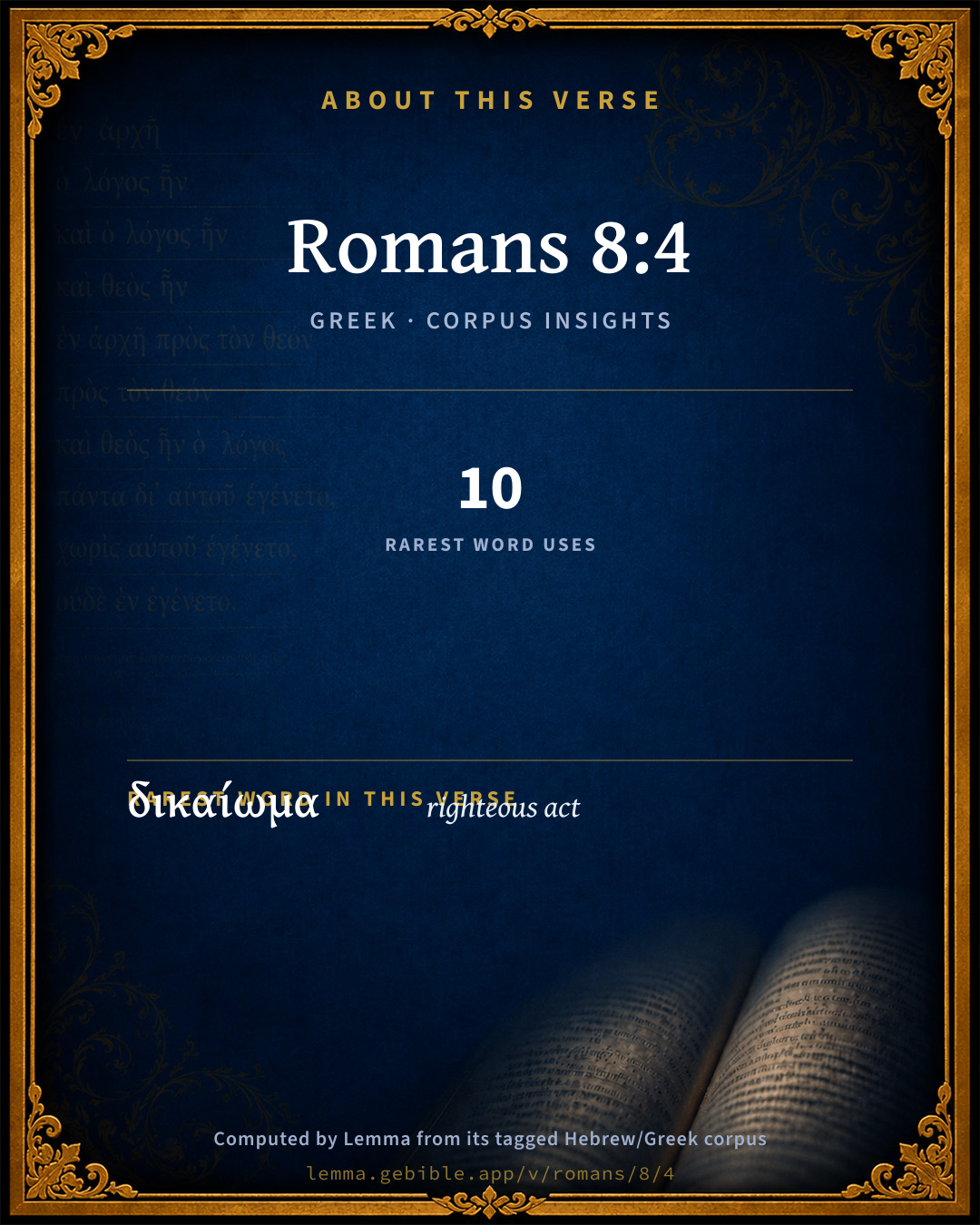
Romans 8:4

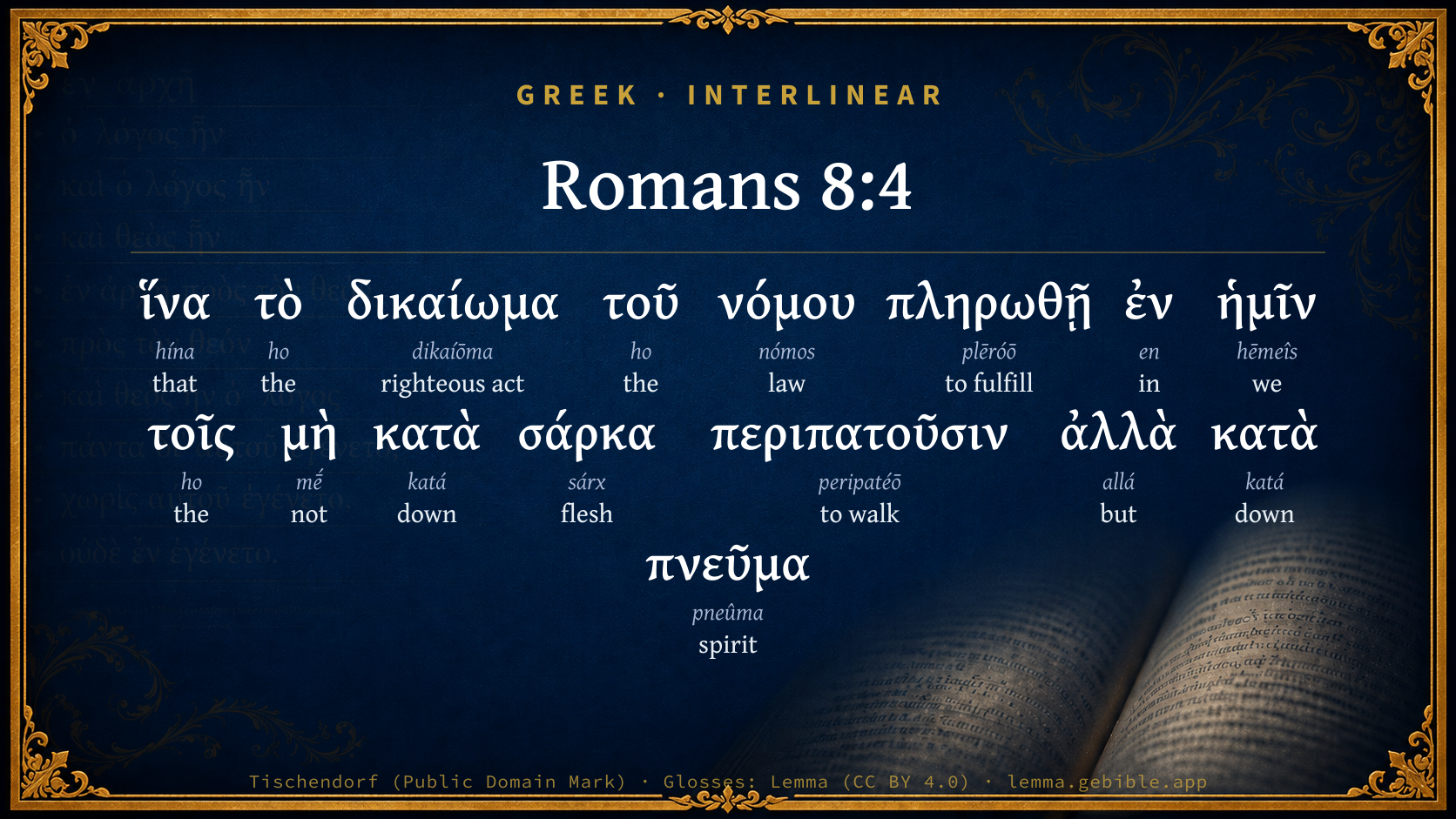
Greek (Tischendorf 8th ed.) Romans 8:4 appears in the Greek New Testament. The text above is from the Tischendorf 8th edition. Each word links to its Strong’s number and a concise gloss. Click any word for its full Thayer’s Greek Lexicon entry.
Download image
Cite this verse

Romans 8:4 (World English Bible). Public Domain. Lemma interlinear Bible study tool, https://lemma.gebible.app/v/romans/8/4.

Show BibTeX & RIS
BibTeX
RIS
English Translation
that the ordinance of the law might be fulfilled in us, who walk not after the flesh, but after the Spirit.
World English Bible · Public Domain
Download a study sheet

One document with this verse’s original text, its word-by-word gloss line, the meaning frame, cross-references with their text, attributed commentary, and full source and license credits — printable, and it pastes into notes with its structure intact.

This verse Autodidact and up

Study sheet (.html) Plain text (.txt)

A passage Seminary Student

Up to 50 verses in one chapter. A passage sheet keeps up to 6 commentary sources and 12 cross-references per verse, in the order this page ranks them, and says so on the sheet whenever that leaves anything out. Ask for a single verse and you get the Autodidact verse sheet above.

Everything on this page stays free to read, with no account — the sheet is a download of what is already on screen, not access to it.

Want to remove ads? Support Godless Engineer
Compare translations 3

The same verse in 3 English versions, stacked beneath the original-language interlinear above. Click any original word for its lexicon entry.

Each is an independent rendering of the whole verse — the interlinear is not word-aligned to these translations.

Highlighted words mark where these versions differ — a whole-verse word diff, not a word-by-word alignment.

  • World English Bible Public Domain
    that the ordinance of the law might be fulfilled in us, who walk not after the flesh, but after the Spirit.
  • King James Version Public Domain
    That the righteousness of the law might be fulfilled in us, who walk not after the flesh, but after the Spirit.
  • unfoldingWord Literal Text CC BY-SA 4.0
    so that the righteous deeds of the law might be fulfilled in us, those walking not according to the flesh, but according to the Spirit.

unfoldingWord Literal Text — © unfoldingWord, licensed CC BY-SA 4.0. Word-aligned USFM3 via Door43 (git.door43.org/unfoldingWord/en_ult).

Versions to compare (up to 4)

3 of 4 selected

Show all 19 translations

Every available English version of this verse, each an independent rendering of the whole verse.

  • World English Bible Public Domain
    that the ordinance of the law might be fulfilled in us, who walk not after the flesh, but after the Spirit.
  • Berean Standard Bible Public Domain
    so that the righteous standard of the law might be fulfilled in us, who do not walk according to the flesh but according to the Spirit.
  • Majority Standard Bible Public Domain
    so that the righteous standard of the law might be fulfilled in us, who do not walk according to the flesh but according to the Spirit.
  • King James Version Public Domain
    That the righteousness of the law might be fulfilled in us, who walk not after the flesh, but after the Spirit.
  • American Standard Version (1901) Public Domain
    that the ordinance of the law might be fulfilled in us, who walk not after the flesh, but after the Spirit.
  • Revised Version (1885) Public Domain
    that the ordinance of the law might be fulfilled in us, who walk not after the flesh, but after the spirit.
  • Geneva Bible (1599) Public Domain
    That that righteousnes of the Law might be fulfilled in vs, which walke not after ye flesh, but after the Spirit.
  • Douay-Rheims (1899) Public Domain
    That the justification of the law might be fulfilled in us, who walk not according to the flesh, but according to the spirit.
  • Young's Literal Translation Public Domain
    that the righteousness of the law may be fulfilled in us, who do not walk according to the flesh, but according to the Spirit.
  • Literal Standard Version CC BY-SA 4.0
    that the righteousness of the Law may be fulfilled in us, who do not walk according to the flesh, but according to the Spirit.
  • Unlocked Literal Bible CC BY-SA 4.0
    He did this in order that the requirements of the law might be fulfilled in us, we who walk not according to the flesh, but according to the Spirit.
  • unfoldingWord Literal Text CC BY-SA 4.0
    so that the righteous deeds of the law might be fulfilled in us, those walking not according to the flesh, but according to the Spirit.
  • Darby Bible Public Domain
    in order that the righteous requirement of the law should be fulfilled in us, who do not walk according to flesh but according to Spirit.
  • World Messianic Bible Public Domain
    that the ordinance of the law might be fulfilled in us who don’t walk according to the flesh, but according to the Spirit.
  • Webster's Bible Public Domain
    That the righteousness of the law may be fulfilled in us, who walk not according to the flesh, but according to the Spirit.
  • Free Bible Version CC BY-SA 4.0
    In this way we could fulfill the good requirements of the law by following the Spirit and not our sinful nature.
  • Bible in Basic English Public Domain
    So that what was ordered by the law might be done in us, who are living, not in the way of the flesh, but in the way of the Spirit.
  • Text-Critical English NT CC BY 4.0
    so that the requirement of the law might be fulfilled in us, who walk not according to the flesh but according to the Spirit.
  • Tyndale New Testament (1534) Public Domain
    that the rightewesnes requyred of the lawe myght be fulfilled in vs which walke not after the flesshe but after the sprete.

Literal Standard Version (2020), Covenant Press — licensed CC BY-SA 4.0. Text via the HelloAO Bible API (eBible.org). Unlocked Literal Bible (unfoldingWord) — licensed CC BY-SA 4.0. Text via the HelloAO Bible API (eBible.org). unfoldingWord Literal Text — © unfoldingWord, licensed CC BY-SA 4.0. Word-aligned USFM3 via Door43 (git.door43.org/unfoldingWord/en_ult). Free Bible Version, Dr. Jonathan Gallagher — licensed CC BY-SA 4.0. Text via the HelloAO Bible API (eBible.org).

Word by word

More ways to search: Search by grammar → Find every occurrence → Compare this word →

Practice this passage: Drill this verse → Learn its vocabulary →

δικαίωμα
dikaíōma
G1345
“righteous act”
Noun, Nominative, Singular, Neuter
Part of Speech
Noun
Case
Nominative
Number
Singular
Gender
Neuter
Full Thayer's Definition

Origin: from G1344

TDNT: 05:39,2

1. that which has been deemed right so as to have force of law a. what has been established, and ordained by law, an ordinance b. a judicial decision, sentence 1. of God 1b c. either the favourable judgment by which he acquits man and declares them acceptable to Him 1b d. unfavourable: sentence of condemnation 2. a righteous act or deed
  1. ἵνα hína G2443 “that” Conjunction
  2. τὸ ho G3588 “the” Article, Nominative, Singular, Neuter
  3. τοῦ ho G3588 “the” Article, Genitive, Singular, Masculine
  4. νόμου nómos G3551 “law” Noun, Genitive, Singular, Masculine
  5. πληρωθῇ plēróō G4137 “to fulfill” Verb, Aorist, Passive, Subjunctive, 3rd person, Singular
  6. ἐν en G1722 “in” Preposition
  7. ἡμῖν hēmeîs G2249 “we” Personal pronoun, 1st person, Dative, Plural
  8. τοῖς ho G3588 “the” Article, Dative, Plural, Masculine
  9. μὴ mḗ G3361 “not” Particle, Negative
  10. κατὰ katá G2596 “down” Preposition
  11. σάρκα sárx G4561 “flesh” Noun, Accusative, Singular, Feminine
  12. περιπατοῦσιν peripatéō G4043 “to walk” Verb, Present, Active, Participle, Dative, Plural, Masculine
  13. ἀλλὰ allá G235 “but” Conjunction
  14. κατὰ katá G2596 “down” Preposition
  15. πνεῦμα pneûma G4151 “spirit” Noun, Accusative, Singular, Neuter

About this verse

These counts appear in no published source. They are computed here, from the morphology-tagged text and Lemma’s own curated glosses. What Lemma adds →

16
words
13
distinct lemmas
Pauline Epistles
section

Notable vocabulary

The rarest word here is δικαίωμα righteous act G1345 — appearing just 10 times in the whole Greek New Testament.

Shared distinctive vocabulary

δικαίωμα righteous act G1345 occurs in 10 verses of the Greek New Testament. Also found in:

Repetition

Words recur within this verse:

Cross-references

9

Topical passages linked to Romans 8:4 in the Treasury of Scripture Knowledge — connected by theme and wording, ordered by reader-vote popularity; previews shown in the World English Bible.

  • Galatians 5:16 But I say, walk by the Spirit, and you won't fulfill the lust of the flesh.
  • Galatians 5:22–25 But the fruit of the Spirit is love, joy, peace, patience, kindness, goodness, faithfulness,
  • Colossians 1:22 yet now he has reconciled in the body of his flesh through death, to present you holy and without blemish and blameless before him,
  • Ephesians 5:26–27 that he might sanctify it, having cleansed it by the washing of water with the word,
  • Hebrews 12:23 to the general assembly and assembly of the firstborn who are enrolled in heaven, to God the Judge of all, to the spirits of just men made perfect,
  • Jude 1:24 Now to him who is able to keep them from stumbling, and to present you faultless before the presence of his glory in great joy,
  • Revelation 14:5 In their mouth was found no lie, for they are blameless.
  • Romans 2:26 If therefore the uncircumcised keep the ordinances of the law, won't his uncircumcision be accounted as circumcision?
  • 1 John 3:2 Beloved, now we are children of God, and it is not yet revealed what we will be. But we know that, when he is revealed, we will be like him; for we will see him just as he is.

Cross-references courtesy of OpenBible.info (CC BY 4.0).

Commentary

Notes on Romans 8:4 from classic Christian and Jewish commentators (each source and its license shown beneath its notes). The classic Christian expositions comment on the surrounding passage and are grouped to its opening verse, so a note may address several verses; the Jewish commentaries on the Tanakh (Rashi and others) are per-verse, so they appear only where the commentator wrote on this verse.

Lemma curates 59 commentaries, every one of them public domain or Creative Commons licensed, each selected and text-cleaned for this edition rather than reprinted as found. About our sources →

The Biblical Illustrator

Joseph S. Exell

Rom_8:4

That the righteousness of the law might he fulfilled in us.

Righteousness fulfilled

I. The design of God in thus, by Christ, condemning sin in the flesh. The penalty of the law is fulfilled in us when, as members of Christs body by spiritual union, we are freed from condemnation; but it is in sanctification that the righteousness of the law is fulfilled--i.e., when we have the law written in our heart, and obedience, flowing without constraint, is the inward instinct and law of life. Bear in mind that Love is the fulfilling of the law. In this respect the law and the gospel are one. But as two dispensations or modes of treatment they differ in toto. The action of the law is by precept and constraint--it seeks to guide from without--urging its minute details upon a reluctant heart. The gospel frees us from this bondage of verbal precepts and details, and by the manifestation of Gods love awakens love, thus beginning where the law left off, with love, which was the end of the commandment. There is nothing in the way of obedience that we cannot by love accomplish. Note--

1. That the gospel does not destroy the law. Do we make void the law through faith?--nay, we establish the law. We are free from the law only that we may be under the law to Christ.

2. That the salvation of the gospel is not only a salvation from wrath, but from sin.

3. That however imperfectly this salvation is realised by us it may be fully accomplished--a righteousness fulfilled.

II. The persons in whom this design is accomplished--In us who walk, etc.

1. Only in proportion as the spirit works within can we take full possession of our privilege as believers in Christ, as free from the bondage of the law. Hence it is that character becomes the test of our Christian state.

2. Character is determined by the prevailing principle (or law) which governs the life. Two such principles divide all mankind--the flesh and the spirit.

3. Christian experience is a practical realisation of the spiritual life. It is not thinking or feeling, but walking after the spirit. They who sit down in spiritual sloth are not walking after the spirit, and therefore we have no evidence of their acceptance with God. Examine yourselves. Is your life Christ-like, or worldly? (P. Strutt.)

The righteousness of the law fulfilled

In this verse the apostle lays down the end of Gods sending His Son in the flesh for the condemnation of sin, and that is, that the righteousness of the law might be fulfilled in us. There are two general parts which are here observable of us. First, the benefit itself which is conveyed by Christ, and that is, a fulfilling of the righteousness of the law in us. Secondly, the qualification of the persons who have particular interest in this benefit, and those are they who walk not after the flesh but after the spirit.

I. We begin with the first, viz., the benefit itself. That the righteousness of the law, etc. Where first we are to explain the words, and then to come to the doctrine observable from them. That whatsoever the law could demand and require of us, the same is fully satisfied and fulfilled by Christ. He hath fulfilled the righteousness of the law in our behalf. For the opening of this present point unto us, we must know that the righteousness of the law may be taken two manner of ways. There is a double right which the law of God does challenge in us--a preceptive or commanding right, and a vindictive or avenging right. Now both these rights has Christ satisfied and discharged for us. First, He hath satisfied the right of obedience, in that He hath fulfilled the whole law of God in our stead. Secondly, He hath satisfied the right of punishment, in that He hath endured all the wrath which was due unto us for our transgression of this law. Thirdly, Christs satisfaction of the law, as concerning obedience unto it, is accounted as ours; insomuch as the righteousness of the law is said to be fulfilled in us. Fulfilled in us; how is that? Not in our persons, but in our Surety. In regard of the intention and purpose of God Himself, who does bestow Christ upon us to this end; Christ was given by God for righteousness, and for righteousness in this explication, namely, of full and perfect observation of the whole law. The use and improvement of this point to ourselves in a way of application comes to this--

1. As a word of singular comfort to all the true servants of God which groan under the burden of their own failings and omissions.

2. We may hence also take notice of the infinite wisdom and goodness of God which hath made such a happy repair of that righteousness which we lost in Adam; and that upon two considerations it is more full and complete.

(1) It is more full and complete. For Adams obedience to the law, it could at the most have been no more than just answerable and adequate to the law. Yea, but now Christs obedience, through the excellency and infiniteness of the person, is transcendent and far above the law. As for a Kings Son to pay our debt for us is a more transcendent and meritorious act than our own payment of it would be, from the dignity and transcendency of the person; even so is it here.

(2) As this righteousness of Christ is more full and complete, so it is also more certain and sure. The second follows, that whatever could be required of us for punishment is discharged likewise. This must needs be so upon this account--First, Gods acceptation of Christ for a full and sufficient redemption. Secondly, Christs suffering itself, which was of the whole anger and wrath of God, expressed in all particulars. Thirdly, the infiniteness of the person.

II. Now the second is the qualification of the persons. Who walk not, etc. From hence observe, first in general, that all men indifferently have not a share in the comforts of the gospel. Therefore let none too rashly and over-hastily apply them to themselves. Secondly, in particular observe this, that justification and sanctification must go together; they only who walk after the spirit have Christs righteousness imputed to them, and have the law fulfilled in them. Secondly, because Christ came by water as well as by blood; there is His spirit as well as His merit. Thirdly, because God is exact and complete in His works in us; and so as He justifies, so also will He sanctify. It shows the vanity of those who hope to be saved by Christ, while they live in all manner of sin. Those that walk in the spirit, they have here an evidence of their justification from their sanctification. We see here that it is not enough to abstain from evil, but we must also do good. (Thomas Horton, D. D.)

The righteousness of the law accomplished in the believer

I. The exalted character of the law.

1. Emanating from a Being infinitely perfect, it follows--

(1) That the law, designed to be a transcript of God, must be in every respect perfect. The law of the Lord is perfect.

(2) That the law being perfectly holy, all its requirements must be equally so. It cannot compromise, nor soften down a single enactment.

2. In requiring this, the creature shall have no ground for impeaching the Divine goodness. As if fearful of perplexing the mind with a multitude of enactments, our Lord has presented one precept, the perfect keeping of which involves a virtual fulfilment of all (Mat_22:37). What an unfolding of the wisdom of God is here! In securing to Himself the supreme love of His creatures, He wins a willing obedience to every precept of His law.

II. Is what sense is the righteousness of the law accomplished in the believer?

1. Not in our own persons. Where, then, would be the weakness of the law? The law has never yet received a complete fulfilment in any fallen creature. Where is the creature who can assert his plea of perfect love to God?

2. The Lord Jesus fulfilled the righteousness of the law in the behalf of His people. He only could do so who was Himself holy, harmless, undefiled, and separate from sinners. The first step in this wondrous achievement was His being made under the law. Having made Himself amenable to the law, He then proceeds to its fulfilment. Trace the outline of His obedience. Is the grand moving spring of the law, love? Where was ever seen such love to God as our Surety displayed? And did not that affection constrain Him to a supreme consecration to His Fathers glory? In addition to supreme love, was there not the most perfect sanctity of life? Accompany Him to the baptismal waters, and hear Him exclaim, Thus it becometh us to fulfil all righteousness. Then follow Him to Calvary, and behold His obedience unto death--was there ever such a law fulfiller as the Son of God?

III. In what way are we to reconcile the honouring of the law by Christ and the fulfilment of its righteousness in us? The difficulty is solved by a reference to the federal union of Christ and His Church. Standing to His people in the relation of a covenant Head, the law being fulfilled by Him in a legal sense, it was virtually a fulfilment of the law by us, His obedience being accepted in lieu of ours (2Co_5:21; Rom_5:19). Thus every humble sinner who, feeling the plague of his own heart, breaking away from his dependence upon a covenant of works, and reposing in simple faith beneath the righteousness of the Incarnate God, shall never come into condemnation.

IV. The rightful claimants of this privileged state are described as those who walk, etc. A Christian may be ensnared and stumble, but he walks not after the flesh. A just man falleth seven times, and riseth up again. An unrighteous man falls, but where he falls he lies. He that is unrighteous is unrighteous still. But those in whom the righteousness of the law is fulfilled in their Surety, and in whom a gospel righteousness, an evangelical obedience, is performed by themselves, walk after the Spirit. Conclusion:

1. Behold, what an open door does this subject set before the humble, convinced sinner. The law, now honoured as it never was--think you that the Lord will reject the application of a single sinner who humbly asks to be saved?

2. Saints of God, keep the eye of your faith immovably fixed upon Christ, your sole pattern. Our Lord did not keep that law that His people might be lawless. The righteousness of the law is fulfilled in us when we walk after the Spirit, in conformity to Christs example. (O. Winslow, D. D.)

The Biblical Illustrator, edited by Joseph S. Exell (c. 1880s–1900s) — public domain. Text from a community e-Sword module.

Tyndale Open Study Notes

Tyndale Open Resources

8:4 just requirement of the law . . . fully satisfied for (Greek en, “in”) us: The Greek preposition en might indicate that the law is fulfilled in us because of our connection with Jesus Christ, who perfectly fulfilled the law for us. It could also mean that by setting us free from sin’s power, Jesus Christ enables us to please God and fulfill the true intention of the law. • As in the Old Testament (see Gen 6:3, 12; Ps 78:39; Isa 40:6), sinful nature refers to human weakness and bondage to sin (also in Rom 8:5-9, 12-13). Paul uses the phrase to describe the conflict between the ingrained human tendency to sin and the Holy Spirit.

Tyndale Open Study Notes — © Tyndale Open Resources, licensed CC BY-SA 4.0. Text via the HelloAO Bible API.

Bengel's Gnomon

Johann Albrecht Bengel

Rom 8:4. Τὸ δικαίωμα, the law’s just commandment [jus. Engl. Vers. ‘righteousness’]) an antithesis to condemnation, Rom 8:1.—πληρωθῇ, might be fulfilled) That fulfilment is presently after described, Rom 8:5-11; thence it is that we have the for, Rom 8:5. Works of justice [righteousness] follow him that is justified [i.e. follow as the consequent fruits of his justification]: sin is condemned, he who had been a sinner, now acts rightly, and the law does not prosecute its claims against him.—ἐν ἡμῖν) in us.—μὴ κατὰ σαρκὰ, not after the flesh) an antithesis to, in the flesh, Rom 8:3. Now at length Paul has come to the open distinction between flesh and spirit.[89] The spirit denotes either the Spirit of God, or the spirit of believers, Rom 8:16. The latter is a new power produced and maintained in us by Him; and it is to this that the reference is, wherever flesh stands in opposition.

[89] A proof against the words ἀλλὰ κατὰ πνεῦμα, ver. 1, which would be too premature a distinguishing of πνεῦμα and σὰρξ.—ED.

Bengel's Gnomon of the New Testament — English translation (T&T Clark, Edinburgh, 1860) — public domain. Text from a community e-Sword module.

Meyer's Critical & Exegetical Commentary

Heinrich August Wilhelm Meyer

Rom_8:4. The purpose which God had in this κατέκρ. τ. ἁμ. ἐν τ. ς. was: in order that (now that the rule of sin which hindered the fulfilment of the law has been done away) the rightful requirement of the law might be fulfilled, etc.

τὸ δικ. τ. νόμου] Quite simply, as in Rom_1:32, Rom_2:26 (comp. also on 16, and Krüger on Thuc. i. 41. 1): what the law has laid down as its rightful demand. The singular comprehends these collective (moral) claims of right as a unity. Others, contrary to the signification of the word, have taken it as justification (Vulg.), understanding thereby sometimes the making righteous as the aim of the law, which desires sinlessness (Chrysostom and his followers, including Theodore of Mopsuestia), sometimes the satisfaction of justice (Rothe; comp. on Rom_5:16). Köllner, following Eckermann, makes it the justifying sentence of the law: that the utterance of the law, which declares as righteous, and thus not only frees from the punishment of sin, but secures also the reward of righteousness, might be fulfilled on us, if we, etc. Substantially so (δικ. = sententia absolutoria), Fritzsche, Philippi, and Ewald (the verdict of the law, since it has condemnation only for the sinners, and good promises for the remainder, Deu_28:1-14). But against this it may be urged, first, that δικαίωμα τ. νόμου, because the genitive is a rule-prescribing subject, cannot, without urgent ground from the context, be taken otherwise than as demand, rightful claim (comp. also Luk_1:6; Heb_9:1; Heb_9:10; LXX. Num_31:21); secondly, that Rom_8:3-4 contain the proof, not for οὐδὲν κατάκριμα in Rom_8:1, but for Rom_8:2, and consequently ἽΝΑ … ἩΜῖΝ must be the counterpart of the state of bondage under the law of sin and death (Rom_8:2)the counterpart, however, not consisting in the freedom from punishment and the certainty of reward, but in the morally free condition in which one does what the law demands, being no longer hampered by the power of sin and death, so that the fulfilment of the ΔΙΚΑΊΩΜΑ ΤΟῦ ΝΌΜΟΥ is the antithesis of the ἉΜΑΡΤΊΑ so strongly emphasized previously; thirdly, that ΤΟῖς ΜῊ … ΠΝΕῦΜΑ is not the condition of justification (that is faith), but of the fulfilment of the law; and finally, that in Rom_8:7, Τῷ ΓᾺΡ ΝΌΜῼ Τ. ΘΕΟῦ ΟὐΧ ὙΠΟΤΆΣΣΕΤΑΙ, ΟὐΔῈ ΓᾺΡ ΔΎΝΑΤΑΙ is manifestly the counterpart of ΤῸ ΔΙΚ. Τ. ΝΌΜΟΥ ΠΛΗΡΩΘῇ in Rom_8:3.

ΠΛΗΡΩΘῇ] as in Mat_3:15; Act_14:26; Rom_13:8; Gal_5:14, al. Those commentators who take δικαίωμα as sententia absolutoria take πληρ. as may be accomplished on us (ἐν ἡμῖν).

ἘΝ ἩΜῖΝ] Not: through us, nor yet: in us, which is explained as either: in our life-activity (de Wette), or as referring to the inward fulfilling of the law (Reiche, Klee, and Hofmann), and to the fact that God fulfils it in man (Olshausen; comp. Tholuck); but, as shown by the following τοῖς … περιπατοῦσιν κ.τ.λ.: on us, so that the fulfilling of the laws demand shall be accomplished and made manifest in the entire walk and conversation of Christians. This by no means conveys the idea of a merely outward action (as Hofmann objects), but includes also the inner morality accordant with the law; comp. Ernesti Ethik d. Ap. P. p. 69 f. Regarding this use of ἐν, see Bernhardy, p. 211 f.; Winer, p. 361 [E. T. 483]. The passive form (not: ἵνα πληρώσωμεν) is in keeping with the conception that here the law, and that so far as it must be fulfilled, stands out in the foreground of the divine purpose. The accomplishment of its moral requirement is supposed to present itself as realized in the Christian, and that ἀδύνατον τοῖ νόμου of Rom_8:3 is assumed to be thereby remedied.

ΤΟῖς ΜῊ ΚΑΤᾺ ΣΆΡΚΑ Κ.Τ.Λ.] quippe qui ambularemus, etc. These words give negatively and positively the specific moral character, which is destined to be found in Christians, so far as the just requirement of the law is fulfilled in them. The μὴ is here, on account of the connection with ἽΝΑ, quite according to rule; Baeumlein, Partik. p. 287 f. In what that fulfilment manifests itself (Hofmann) Paul does not say, but he announces the moral regulative that is to determine the inward and outward life of the subjects. He walks according to the flesh, who obeys the sinful lust dwelling in the σάρξ (Rom_7:18); and he walks according to the Spirit, who follows the guidance, the impelling and regulating power (Rom_8:2), of the Holy Spirit. The one excludes the other, Gal_5:16. To take πνεῦμα without the article (which, after the nature of a proper noun, it did not at all need), in a subjective sense, as the pneumatic nature of the regenerate man, produced by the Holy Spirit (see esp. Harless on Eph_2:22, and van Hengel)as it is here taken, but independently of the putting the article, by Bengel, Rückert, Philippi, and others, following Chrysostomis erroneous. See on Gal_5:16. It never means, not even in contrast to σάρξ, the renewed spiritual nature of man (Philippi), but the sanctifying divine principle itself, objectively, and distinct from the human πνεῦμα. The appeal to Joh_3:6 is erroneous. See on that passage.

Meyer — Critical and Exegetical Commentary on the New Testament — English translation by Peter Christie, edited by Frederick Crombie (T&T Clark, 1880) — public domain. Text from a community e-Sword module.

Expositor's Greek Testament

ed. W. Robertson Nicoll

Rom 8:4 . All this was done ἵνα τὸ δικ . τοῦ νόμου πληρωθῇ ἐν ἡμῖν : that the just requirement of the law ( i.e. , a righteous life) might be fulfilled in us. See note on Rom 3:31 . ἐν ἡμῖν (not ὑφʼ ἡμῶν ), for it is not our doing, though done in us (Weiss). τοῖς μὴ κατὰ σάρκα κ . τ . λ . = inasmuch as we walk not, etc. This is the condition under which the Divine purpose is fulfilled: there is no physical necessity in it. κατὰ σάρκα : the flesh meant is our corrupt human nature. κατὰ πνεῦμα : the spirit is the Divine spirit which is given to those who are in Christ Jesus. It is in them “both law and impulse”.

The Expositor's Greek Testament, edited by W. Robertson Nicoll (1897–1910) — public domain. Text from a community e-Sword module.

Godet's Commentaries

Frédéric Louis Godet

Vv. 4. The relation we have just indicated between Rom 8:3-4 forbids us to give here to δικαίωμα, what the law lays down as just, the meaning of: sentence of absolution, which some, and Philippi most recently, have given to it. The matter in question here is not guilt to be removed; and to say that the law itself can henceforth declare as just, the term πληρωθῆναι, to be fulfilled, would not be very suitable. The matter in question, according to the context and the terms employed, is what the law demands of man. All the postulates contained in the righteousness demanded by the law (comp. the Sermon on the Mount, for example) are fulfilled in us, as soon as we walk, no more after the flesh, but after the Spirit. For, as we have seen, the law being spiritual, must coincide at all points in its statutes with the impulses of the Spirit. The participle περιπατοῦσιν, who walk, expresses the condition on which Paul can affirm of believers what he has just said (comp. the τοῖς πιστεύουσιν, Joh 1:12).

Commentators differ as to the meaning of the word πνεῦμα, spirit. Does it denote, as Lange thinks, the spiritual life in believers? But would this be a very sure standard, and does Rom 8:2 admit of this subjective sense? Most, therefore, understand by the expression: the Holy Spirit. This meaning does not seem to us open to question (comp. also Rom 8:9; Rom 8:11). Only from the use of the word spirit in the sequel (Rom 8:5-8), it follows that the apostle is not speaking of the Holy Spirit, independently of His union with the human πνεῦμα, but of the former as dwelling in the latter, or of the latter as wholly directed by the former. And hence the reason why the one and the other idea becomes alternately the dominant one in the following passage.

But the most important word in this verse is the conjunction that. In this word is contained Paul’s real notion of sanctification. How does the fulfilment of the law in believers follow from the fact expounded in Rom 8:3: the condemnation of sin wrought in the person of Christ? The strangest answer to this question is that of Holsten: “The power of the flesh in humanity was destroyed by the death-blow which slew the flesh of Christ on the cross.” But how could sin of nature, objective sin, in humanity, be destroyed by the fact of Christ’s death? If sin is inherent in the flesh, the flesh which needs to be destroyed is not only Christ’s, but that of the entire human race. As Wendt rightly observes, nothing but the death of all men could secure the desired result.

Gess thinks that the part played by Christ’s death in sanctification was to render possible the gift of the Spirit, who alone has power to sanctify (comp. Gal 3:13-14). But Paul does not say in Rom 8:4 : “that the Spirit might be given” (as he does Gal 3:14 : that we might receive the Spirit). He passes directly from the condemnation of sin in Christ (Rom 8:3) to the fulfilment of the law in believers (Rom 8:4). This mode of expression supposes another relation. And this relation is easy to comprehend if the right meaning of Rom 8:3 has been taken. The believer’s holiness is nothing else than that which Jesus Himself realized during His earthly existence. “For their sakes I sanctify myself,” says Jesus, Joh 17:19, “that they also might be sanctified through the truth.” Here, as in other respects, the Spirit only takes what is His, to communicate it to us (Joh 16:14). Our Lord’s holy life on the earth is the type which the Holy Spirit is commissioned to reproduce in us, the treasure from which He draws the renewing of our life (Col 3:10; 2Co 3:17-18). The holiness of all of us is only this unique holiness which the Spirit makes ours: He is our sanctification as well as our righteousness, the latter by His death (which faith makes our death), the former by His holy life (which the Spirit makes our life). Witness the two διά, through, by, of Rom 5:1-2; and the mysterious by His life, ἐν τῇ ζωῃ αὐτοῦ, of Rom 5:10. Such is the rich and profound sense of the that, Rom 5:4.

The expression ἐν ἡμῖν, in us, perfectly suits this meaning. It says first, that therein we are receptive; then it contains also the by us.

The term περιπατεῖν, to walk, is Paul’s usual figure for moral conduct.

The subjective negation μή is used because Paul is speaking not of the fact in itself, but of the fact as being the assumed condition of the preceding affirmation.

Thus the first idea of this passage has been developed: emancipation from the law of sin. What the law condemns was condemned in Christ, that henceforth through His Spirit the law might be fully carried out in us. No doubt the power of sin is not annihilated within, but it cannot control the active part of our being and determine the περιπατεῖν (the walk). There remains the second idea: deliverance from the last condemnation, that of death: death spiritual, Rom 8:5-10, and finally also from bodily death, Rom 8:11.

Frédéric Louis Godet — Commentaries on Luke, John, Romans, and 1 Corinthians — English translation (T&T Clark, Edinburgh, 1870s–1890s) — public domain. Text from a community e-Sword module.

Hodge's Commentary on Romans, Ephesians & First Corinthians

Charles Hodge

Rom_8:4

That the righteousness of the law might be fulfilled in us, etc. This verse expresses the design of God in sending his Son, and in condemning sin in the flesh. He did thus condemn it, ἵνα, in order that the righteousness of the law might be fulfilled. The meaning, therefore, of this passage is determined by the view taken of Rom_8:3. If that verse means, that God, by sending his Son, destroyed sin in us, then of course this verse must mean, He destroyed sin, in order that we should fulfill the law; i.e. that we should be holy. But if Rom_8:3 is understood of the sacrificial death of Christ, and of the condemnation of sin in him as the substitute of sinners, then this verse must be understood of justification, and not of sanctification. He condemned sin, in order that the demands of the law might be satisfied. This is the view of the passage given even by the majority of the early Fathers, and by almost all evangelical interpreters, including the Reformers. Qui intelligunt Spiritu Christi renovatos legem implere, commentum a sensu Pauli penitus alienum afferunt; nique enim eo usque proficiunt fideles, quamdia peregrinantur in mundo ut justificatio legis in illis plena sit, vel integra. Ergo hoc ad veniam referre necesse est; quia, dum nobis accepta fertur Christi obedientia, legi satisfactum est, ut pro justis censeamur. That this is the true meaning of the passage appears not only from the connection and the course of the argument, but also from the following considerations:

1. It is consistent with the strict and natural meaning of the words. The word δικαίωμα, here used, means, first, something righteous, and then, second, something declared to be righteous and obligatory, an ordinance concept; and, third, a righteous decision, a just judgment, as when in Rom_1:29, the heathen are said to know the δικαίωμα, the righteousness judgment of God; and, fourth, the act of declaring righteous, justification. In this sense δικαίωμα is antithetical to κατάκριμα. The δικαίωμα τοῦ νόμου, therefore, may mean, the righteous requirement of the law, that which satisfies its demands. In strict accordance therefore with the sense of the words, we may explain the passage to mean, that the demands of the law might be satisfied in us. That is, that we might be justified. Christ was condemned, that to us there might be no condemnation. He was made sin that we might be made righteousness, 2Co_5:21. Or, if we take δικαίωμα in the sense of (Rechtfertigungsurtheil) a declaration of righteousness, an act of justification, the same idea is expressed: Sin was condemned in Christ, in order that the sentence of justification might be fulfilled, or carried into effect in us. This is the explanation which Eckermann, Köllner, Philippi, and other modern interpreters adopt.

2. The analogy of Scripture. To make this passage teach the doctrine of subjective justification, that we are freed from condemnation or delivered from the law by our inward sanctification, is to contradict the plain teaching of the Bible, and the whole drift and argument of this epistle.

3. The concluding clause of the verse, (who walk not after the flesh, etc.) demands the interpretation given above. In the other view of the passage, the latter clause is altogether unnecessary. Why should Paul say, that Christ died in order that they should be holy who are holy, i.e. those who walk not after the flesh? On the other hand, the second clause of the verse is specially pertinent, if the first treats of justification. The benefits of Christs death are experienced only by those who walk not after the flesh. The gospel is not antinomian. Those only are justified who are also sanctified. Holiness is the fruit and evidence of reconciliation with God. There is no condemnation to those who walk after the Spirit; and the righteousness of the law is fulfilled by those who walk after the Spirit. In both cases, the latter clause is designed to describe the class of persons who are entitled to appropriate to themselves the promise of justification in Christ.

4. Finally, as intimated in the above quotation from Calvin, it is not true that, the righteousness of the law, in the sense of complete obedience, is fulfilled in believes. The interpretation which makes the apostle say, that we are delivered from the law by the work of Christ, in order that the complete obedience which the law demands might be rendered by us, supposes what all Scripture and experience contradicts. For an exposition of the last clause of the verse, see Rom_8:1.

Charles Hodge — Commentary on Romans (1835), First Corinthians (1857), and Ephesians (1856) — public domain. Text from a community e-Sword module.

Geneva Bible (1599)

Geneva Bible translators

The very substance of the law of God might be fulfilled, or that same which the law requireth, that we may be found just before God: for if with our justification there be joined that sanctification which is imputed to us, we are just, according to the perfect form which the Lord requireth.

He returneth to that which he said, that the sanctification which is begun in us, is a sure testimony of our ingrafting into Christ, which is a most plentiful fruit of a godly and honest life.

Geneva Bible (1599) marginal notes — public domain. Text via Bolls.life.

Jamieson, Fausset & Brown

Robert Jamieson, A. R. Fausset & David Brown

That the righteousness of the law--"the righteous demand," "the requirement" [ALFORD], Or "the precept" of the law; for it is not precisely the word so often used in this Epistle to denote "the righteousness which justifies" (Rom 1:17; Rom 3:21; Rom 4:5-6; Rom 5:17-18, Rom 5:21), but another form of the same word, intended to express the enactment of the law, meaning here, we believe, the practical obedience which the law calls for.

might be fulfilled in us--or, as we say, "realized in us."

who walk--the most ancient expression of the bent of one's life, whether in the direction of good or of evil (Gen 48:15; Psa 1:1; Isa 2:5; Mic 4:5; Eph 4:17; Jo1 1:6-7).

not after--that is, according to the dictates of

the flesh, but after the spirit--From Rom 8:9 it would seem that what is more immediately intended by "the spirit" here is our own mind as renewed and actuated by the Holy Ghost.

Jamieson, Fausset & Brown — Commentary Critical and Explanatory on the Whole Bible (1871) — public domain (CC PDM 1.0). Text via the HelloAO Bible API.

Adam Clarke's Commentary

Verse 4. That the righteousness of the law might be fulfilled in us] That the guilt might be pardoned through the merit of that sacrifice; and that we might be enabled, by the power of his own grace and Spirit, to walk in newness of life; loving God with all our heart, soul, mind, and strength, and our neighbour as ourselves: and thus the righteousness, the spirit, design, and purpose of the law is fulfilled in us, through the strength of the Spirit of Christ, which is here put in opposition to the weakness of the law through the flesh.

It is very likely that the concluding clause of this verse, which is the very same as that found in the common text of the first verse, has been transferred to that verse from this place.

Adam Clarke's Commentary on the Bible (1810–1826) — public domain. Text from a community e-Sword/MySword module.

John Calvin's Commentaries

4. That the justification of the law might be fulfilled, etc. They who understand that the renewed, by the Spirit of Christ, fulfil the law, introduce a gloss wholly alien to the meaning of Paul; for the faithful, while they sojourn in this world, never make such a proficiency, as that the justification of the law becomes in them full or complete. This then must be applied to forgiveness; for when the obedience of Christ is accepted for us, the law is satisfied, so that we are counted just. For the perfection which the law demands was exhibited in our flesh, and for this reason — that its rigor should no longer have the power to condemn us. But as Christ communicates his righteousness to none but to those whom he joins to himself by the bond of his Spirit, the work of renewal is again mentioned, lest Christ should be thought to be the minister of sin: for it is the inclination of many so to apply whatever is taught respecting the paternal kindness of God, as to encourage the lasciviousness of the flesh; and some malignantly slander this doctrine, as though it extinquished the desire to live uprightly.

John Calvin's Commentaries (1540-1563) — public domain. Text from the Calvin Translation Society English edition (1840s-50s) via the Christian Classics Ethereal Library (ccel.org). Calvin's coverage is partial (roughly two-thirds of the Bible); uncommented books and verses are honest gaps, never fabricated. The 19th-century editor's footnotes and remarks are omitted so the notes are faithfully Calvin's own voice.

Ellicott's Commentary for English Readers

(4) The consequence of this was a great change. Hitherto the Law could not be kept because of the antagonistic influence of the flesh; henceforth it may be kept for the reason that this influence has ceased and that its place is taken by the influence of the Spirit.

The righteousness.—The just requirement of the Law, its due and rightful claims.

Might be fulfilled in us.—That we might be examples of its fulfilment.

Who walk not after the flesh.—Who direct our conduct not as the flesh would guide us. but according to the dictates and guidance of the Spirit—i.e., the indwelling Spirit of Christ, as in Rom_8:2.

A Bible Commentary for English Readers, edited by Charles John Ellicott (1878–1897) — public domain. Text from a community e-Sword module.

The Cambridge Bible for Schools and Colleges

gen. ed. J. J. S. Perowne

4. that the righteousness of the law, &c.] Here is the (for us) Final Cause of the Atonement. Both as a satisfaction of the Law as regards God, and as the manifestation and pledge of Divine Love as regards man, it was to give man peace with God (see on ch. Rom_5:1, &c.), and so to bring his will into real working harmony with the will of God. Atonement was to result in love and holiness.

righteousness] Better, legal claim; that which the Law laid down as the requisite for man, as his only possible right state. (The form of the Gr. word is different from that usually rendered “righteousness.”) What this “claim” is we find in the Lord’s definition of the Great Commandments; supreme love to God, and unselfish love to man.

fulfilled] The context, as now interpreted, will explain this word. The saints “fulfil” the law’s “claim” not in the sense of sinless perfection, (for see last chapter, and cp. 1Jn_1:8-10,) but in that of a true, living, and working consent to its principles; the consent of full conviction, and of a heart whose affections are won to God. The Law could not compel them to “delight with” itself; but the gift and work of the Son of the Father do draw them “with the cords of love” to find the Law (as the expression of His now all-beloved will) “good, perfect, and acceptable.” This state of things is further described in the next clause.

in us] The justified.

who walk, &c.] “Who live and act;” a very frequent Scripture metaphor, from Gen_5:22 onwards.—“After the flesh:”—on its principles, by its rule. So “after the Spirit:”—as the Spirit animates and guides.

The Flesh—The Spirit

This seems to be a proper place for a few general remarks on these two important words.

A. The Flesh. In N. T. usage, on the whole, this word bears in each place (where its meaning is not merely literal) one of two meanings. It denotes either (a) human nature as conditioned by the body; (e.g. Rom_9:3; Rom_9:5; Rom_9:8; 2Co_7:5, &c. &c.;) or (b) human nature as conditioned by the Fall, or in other words by the dominion of sin, which then began, and which works so largely through the conditions of bodily life that those conditions are almost, in language, identified with sinfulness. (See e.g. the present passage, and Rom_7:5; Rom_7:18; Rom_7:25, Rom_13:14; Gal_5:17-24, &c., &c.) In the first connexion “the flesh” may bear a neutral, or a holy, meaning; (Joh_1:14;) in the second, it means a state which is essentially evil, and which may be described with practical correctness as (1) the state of man unregenerate, and (2), in the regenerate, the state of that element of the being which still resists grace. For manifestly (see Gal_5:17) “the flesh” is an element still in the regenerate, not only in the sense of corporeal conditions, but in that of sinful conditions. But, in the latter sense, they are no longer characterized by it; they are not “fleshly,” because the dominant element is now not “the flesh,” but the renewed will, energized by the Divine Spirit.

B. The Spirit. In the present context this word, in our view, denotes the Holy Ghost, except in Rom_8:10; Rom_8:16, where the human spirit is spoken of. That it means here the Holy Ghost seems plain, because it is regarded as a regulating principle, and immediately below (Rom_8:13-14) the Divine Spirit is described as the regulator of the will of the saints. We do not of course deny the reality of the human spirit, even in the unregenerate (1Co_2:11; Ecc_12:7). But here, as in a large majority of N. T. passages, the personal Divine Spirit is depicted as in such a sense inhabiting and informing the regenerate human spirit that He, rather than it, is regarded as the dominant rule and influence in the being. Thus, Rom_8:9, the regenerate are said to be “in the Spirit,” not “in the flesh,” not because their human spirits are in command of their being, but because the Divine Spirit dwells in them. He does not dispossess their spirit, but so possesses it that He in and through it is the ruler of the man.

As regards the human spirit, (Rom_8:10; Rom_8:16;) the word, in both O. T. and N. T., has now a wider, now a narrower meaning. Now it is the whole incorporeal element of the being—the whole antithesis of “the body;” now it is the “nobler powers” of that element—the antithesis of “the soul,” in that narrower sense of “soul” which concerns instincts rather than conscience, reflection, and deliberate affections. Man is thus sometimes “body and soul;” (e.g. Mat_10:28, and cf. Rev_6:9;) and sometimes “body, soul, and spirit;” (e.g. 1Th_5:23). And in 1Co_15:44, in the Gr., a remarkable contrast is drawn between the present body, “characterized by soul,” and the future body, “characterized by spirit.”—It must be remembered, however, that, unless in passages of exceptional antithesis, the distinction of soul and spirit may easily be pressed too far, and that in no case are they to be thought of as distinct in the sense in which they both are distinct from the body. We have no hint that they are two separable elements; they are rather different aspects and exercises of the same incorporeal element.

The Cambridge Bible for Schools and Colleges (gen. ed. J. J. S. Perowne; Cambridge University Press, 1878–1918) — public domain. Text from a community e-Sword module.

John Gill's Exposition

That the righteousness of the law might be fulfilled in us,.... By the righteousness of the law, is not meant the righteousness of the ceremonial law, though that was fulfilled by Christ; but of the moral law, which requires holiness of nature, righteousness of life, and death in case of disobedience; active righteousness, or obedience to the precepts of the law, is designed here. This is what the law requires; obedience to the commands of it is properly righteousness; and by Christ's obedience to it we are made righteous, and this gives the title to eternal life: now this is said to be "fulfilled in us"; this is not fulfilled by us in our own persons, nor can it be; could it, where would be the weakness of the law? man might then be justified by it, and so the grace of God, and the righteousness of Christ, must be set aside: there never was any mere man that could fulfil it; for obedience to it must not only be performed perfectly, but with intenseness of mind and spirit; a man must be sinless in thought, word, and deed; and this would be to put man upon a level with Adam in a state of innocence, and the angels in heaven: nor is this to be understood of any righteousness inherent in man; internal holiness is never called the righteousness of the law; and could it be thought to be righteousness, yet it can never be reckoned the whole righteousness of the law: and though it is a fruit of Christ's death, it is the work of the Spirit, and is neither the whole, nor any part of our justification: but this is to be understood of the righteousness of the law fulfilled by Christ, and imputed to us; Christ has fulfilled the whole righteousness of the law, all the requirements of it; this he has done in the room and stead of his people; and is imputed to them, by virtue of a federal union between him and them, he being the head, and they his members; and the law being fulfilled by him, it is reckoned all one as it was fulfilled in, or if by them; and hence they are personally, perfectly, and legally justified; and this is the end of Christ's being sent, of sin being laid on him, and condemned in him. The descriptive character of the persons, who appear to be interested in this blessing, is the same with that in Rom 8:1,

who walk not after the flesh, but after the Spirit: See Gill on Rom 8:1.

John Gill's Exposition of the Whole Bible (1746–1763) — public domain (CC PDM 1.0). Text via the HelloAO Bible API.

Trapp's Complete Commentary

John Trapp

4 That the righteousness of the law might be fulfilled in us, who walk not after the flesh, but after the Spirit.

Ver. 4. Might be fulfilled] In us applicative, in Christ inhaesive.

John Trapp, A Commentary or Exposition upon All the Books of the Old and New Testament (1647–1656) — public domain. Text from a community e-Sword module.

Albert Barnes' Notes on the Bible

That the righteousness of the law - That we might be conformed to the Law, or be obedient to its requirements, and no longer under the influence of the flesh and its corrupt desires.

Might be fulfilled - That we might be obedient, or comply with its demands.

Who walk - Note, Rom 8:1.

Albert Barnes' Notes on the Bible (1834–1885) — public domain. Text from a community e-Sword/MySword module.

Haydock's Catholic Bible Commentary

That the justification of the law. That is, that was aimed at, but never attained to, by the written law, might now be fulfilled in us; that is, that we, by the grace of Christ, may be enabled to fulfil and comply with the law, and its moral precepts, by walking according to the spirit of Christ. (Witham)

George Leo Haydock (1774–1849), Haydock's Catholic Family Bible and Commentary, 1859 edition — public domain. Excludes Psalms (Douay-Rheims chapter numbering differs from Protestant) and Deuterocanonical books (Catholic canon only).

Matthew Poole's English Annotations

That the righteousness of the law might be fulfilled in us: here is another end of God’s sending his Son, as before; it was that he might perfectly fulfil the righteousness of the law in or for us, which for us ourselves to do in our own persons was utterly impossible; and yet upon which (as being imputed unto them, and accepted of God on our behalf) we shall be accounted just and righteous, as if we had done it ourselves. Christ’s being a sacrifice for sin was not sufficient to answer all the ends and demands of the law; there must be doing of what it commanded, as well as suffering of what it threatened: therefore Christ was sent for both, and both were accomplished by him; and what he did and suffered is accounted unto us as if we had done and suffered it. This is the imputed righteousness which was so often spoken of, Rom 4:1-25; and in reference to this he is said to be made righteousness for us, 1Co 1:30, and we are said to be made the righteousness of God in him, Rom 5:19; 2Co 5:21.

Who walk not after the flesh, but after the Spirit: this was the description before of those that had union with Christ, and exemption from condemnation; and it is again set down, as the description of those who partake of the righteousness of Christ in this way of imputation; and it is added here again, to stave off all others from laying claim to this grace. None but holy walkers can warrantably apply Christ’s fulfilling or satisfying the law to themselves: because Christ hath fulfilled the righteousness of the law for us, none may infer there is nothing for us to do, we may live as we list; for though Christ hath fulfilled the law in all respects, yet all those for whom he hath so done, or have benefit thereby, are, and must be, such as walk not after the flesh, but after the Spirit: for the opening of which terms, see Rom 8:1.

Matthew Poole's English Annotations on the Holy Bible (1683–1685) — public domain. Text from a community e-Sword/MySword module.

Whedon's Commentary on the Bible

Daniel D. Whedon

4. Righteousness of the law—The righteousness required by the law, and which the law cannot condemn. This is not an “imputed righteousness,” nor the simple innocence or freedom from guilt included in justification, but an actual and active personal righteousness, energized by the Spirit, and individually, through grace, our own.

Walk… Spirit—(See note on Rom_8:1.) Spirit-guided, justified Christian life is actually and actively holy life.

Daniel D. Whedon (gen. ed.), Commentary on the Old and New Testaments (1874–1909) — public domain. Text from a community e-Sword module.

The Pulpit Commentary

That the ordinance (or, righteous requirement, rather than righteousness, as in the Authorized Version. The word is dikaiwma , not dikaiosunh . It Occurs elsewhere in the New Testament, Luk_1:6 Rom_1:32 Rom_2:26 Heb_9:1; and in a like sense often in the LXX; also, though with a difference of meaning, Rom_5:16, Rom_5:18) of the Law may be fulfilled in us, who walk not after the flesh, but after the Spirit. This, then, is the purpose of Christ"s victory over sin that the requirement of the Law in us too may be fulfilled; which evidently means more than that his victory may be imputed to us, on the ground of our faith only, while we remain as we were. The expression, di , and also the condition appended at the end of the verse, imply that the "Spirit of life" must so dominate over the flesh in ourselves that the Law may forfeit its claims over us. The sinful propensions of the flesh remain in us still (as the verses that follow distinctly show); but the Spirit that is in us is strong enough to overcome them now. (cf. Gal_5:16-18) It does not follow from this that any Christians will actually avoid all sin, or that they can be accepted on the ground of their own performance: to say this would be to contradict other Scripture; (cf. Jam_2:10 1Jn_1:8) and Paul confessed himself to be not already perfected. (Php_3:12) But perfection, through Christ who lives in them, is put before us as, at any rate, the aim of the regenerate; (cf. Mat_5:48) and by actual and progressive holiness they are to show that their union with Christ is real. His Spirit within them must, at any rate, give a new direction and tone to their characters and lives.

And in us Leo (united to him by faith, and having spiritually died and risen again with him) the requirement of the Law is fulfilled, so that it forfeits its claim to condemn us now; but only on this condition in ourselves, that we walk not after the flesh, but after the Spirit.

The Pulpit Commentary (1880–1919), ed. H.D.M. Spence-Jones & Joseph S. Exell — public domain. Text from a community e-Sword module.

John Wesley's Explanatory Notes

That the righteousness of the law - The holiness it required, described, ver. 11. Might be fulfilled in us, who walk not after the flesh, but after the Spirit - Who are guided in all our thoughts, words, and actions, not by corrupt nature, but by the Spirit of God. From this place St. Paul describes primarily the state of believers, and that of unbelievers only to illustrate this.

John Wesley, Explanatory Notes Upon the Whole Bible (1754–1765) — public domain. Text via the GEBible commentary corpus.

Burkitt's Expository Notes on the New Testament

William Burkitt

Our apostle here assigns another end and cause, for which God sent his Son into the world; namely, to do what the law commanded, as well as to suffer what the law threatened; perfectly to fulfil the righteousness of the law for us, which it was impossible for us to do for ourselves; for the sake of which we are accounted righteous in the sight of God.

Learn hence, 1. That our Lord Jesus Christ, being made under the law, fulfilled the law; whatsoever the law did or could demand, is fully satisfied and fulfilled by Christ.

Learn, 2. That Christ having fulfilled the law on our behalf, whatever can be required of us by way of punishment, is discharged likewise.

Learn, 3. That though the righteousness of the law be fulfilled for us by Christ, yet the gospel-righteousness must be performed by us ourselves.

Christ has answered the demands of the law for us, but will never fulfil the conditions of the gospel for us. We must repent ourselves, obey ourselves, or Christ’s obedience will profit us nothing; none can safely or comfortably pretend to an interest in Christ’s obedience, either active or passive, but only such who in their course are actuated and influenced by the spirit, and not by the flesh. That the righteousness of the law might be fulfilled in us, who walk not after the flesh but after the Spirit.

William Burkitt's Expository Notes on the New Testament (1700–1703) — public domain. Text from a community e-Sword module.

Godbey's Commentary on the New Testament

William B. Godbey

4. “In order that the righteous judgment of the law may be fulfilled in us who walk not after the flesh but after the Spirit.” The righteous judgment of the law is, “The soul that sinneth, it shall die” (Eze 18:4). Hence the sin-principle in every heart must die. God’s method with sin is extermination. That is always done in “those who walk not after the flesh, but after the Spirit.” When your walk is mixed you never get sin destroyed. It is only those who are solidly out and out for God who get sin exterminated.

William B. Godbey, Commentary on the New Testament (1896–1900) — public domain. Text from a community e-Sword module.

McGarvey & Pendleton's Commentaries

J. W. McGarvey

that the ordinance of the law might be fulfilled in us, who walk not after the flesh, but after the Spirit . [For what the law could not possibly do (viz.: condemn sin in the flesh, so as to destroy it and free us from it), because the flesh through which it operated was too weak, God, by sending his own Son in the likeness of sinful flesh, and for sin, did; that is to say, he condemned sin in the flesh, that justification from the law might be accomplished in us who walk not according to the flesh, but according to the Spirit. Though the law was designed to condemn and banish sin, and was in itself a perfect means of deliverance from sin and death to those who kept it, it was really, because of the sinful weakness of the human race, to which it was given, no means of deliverance at all, but a source of complete and perfect condemnation. Hence, some other deliverance became necessary. God provided this other means of salvation by sending his Son to die for man, and man's sin. That he might do this, God sent his Son to become a fleshly human being, to be incarnate in the same kind of flesh as that belonging to the rest of sinful mankind, thus fully sharing their nature. He sent him in this manner for the purpose of dying, to remove all the sin of the flesh he bore thus representatively, no matter by whom committed. Jesus, by his sinless life, lived in the flesh, as the Son of man, resisted, conquered, condemned, sentenced, and destroyed the power of sin in the flesh. Thus God sent his Son as a conqueror of sin, and as an offering for sin, that the ordinance of the law, which we fail to fulfill, might, by him who bore our flesh, and was our federal head and representative, be fulfilled in us who walk not according to the outward, fleshly nature, which lusts to do wrong, but after the inward, spiritual nature, which desires to do right.]

J. W. McGarvey (with Philip Y. Pendleton), Commentaries on the New Testament (The Fourfold Gospel, 1914; Acts; and the epistles) — public domain. Text from a community e-Sword/MySword module.

The People's New Testament

B. W. Johnson

4. That the righteousness of the law. The righteous demand of the law, its substance, is a loving obedience to God (see Luke 10:27). By the Gospel the love of God is shed abroad in our hearts through the Spirit. Hence, we comply with its righteous demands when we walk, not after the flesh, but after the Spirit. To walk after the flesh is to obey the dictates of the flesh; to walk after the Spirit is to obey its dictates. It dwells in the believer to help him, but its dictates are found in the “words of the Holy Spirit.”

B. W. Johnson's The People's New Testament with Notes (1889–1891) — public domain. Electronic text from the Christian Classics Ethereal Library (CCEL) ThML edition.

Cambridge Greek Testament for Schools and Colleges

4. ἵνα. The object of the sending and the condemnation of sin.

τὸ δικαίωμα, the righteous claim of the law. The law as GOD‘s revealed will has a claim over man: the same act which repudiated the claim of sin provided for the fulfilment of the claim of the law. Law and sin are here conceived as litigants for the ownership of man.

ἐν ἡμῖν. Not ὑφ’ ἡμῶν: in us as renewed in Christ.

τοῖς μὴ κ.τ.λ. Not = if we walk, but in us in the character of men whose principle of conduct is regulated not by flesh but by spirit. A summary description of the true life of man, seen and made possible in Christ.

κατὰ σάρκα … κατὰ πνεῦμα. This antithesis at last becomes explicit, and is developed in Rom 8:5-8. In Rom 7:25 the antithesis was νοῦς and σάρξ; here, when it is more a question of the roots of action, it is πνεῦμα and σάρξ.

Cambridge Greek Testament for Schools and Colleges (Cambridge University Press, 1896; 21 vols, various authors incl. Carr, Maclear, Plummer, Farrar, Lumby, Moule, M. R. James, Simcox) — public domain. Text from a community e-Sword module.

Alford’s Greek Testament

Henry Alford

4.] in order that (the purpose of God’s condemning sin in the flesh) the righteous demand (or, requirement) of the law (= all its requirements (statutes), but here combined in one for the sake of more distinct objectivity. The variations in interpretation of ver. 3 have given rise to corresponding ones here. But here the matter has been more complicated still by the Vulg. rendering δικαίωμα, ‘justificatio,’ which has thrown the weight of the Romanist interpreters on the side of ‘justitia imputata.’ The usage of the word itself would preclude any such reference here, besides the considerations urged in the note above) might be fulfilled in us (find its full accomplishment;—not merely = ‘be performed by us,’—for the Apostle has a much deeper meaning, viz. that the aim of God in giving the Law might be accomplished in us, in our sanctification, which is the ultimate end of our redemption, Eph 2:10; Col 1:22. The passive is used, to shew that the work is not ours, but that of God by His grace, Olsh., Thol., De Wette) who walk (not ‘walking as we do,’ which would be anarthrous,—but a description of all those of whom the above is true) not after the flesh but after the Spirit (who, notwithstanding that we are bound up with a σὰρξ ἁμαρτίας, do not walk in our daily life according to, or led by, the νόμος τῆς ἁμαρτίας ὁ ἐν τοῖς μέλεσιν ἡμῶν, but according to and led by the νόμος τοῦ πνεύματος τῆς ζωῆς, in Christ Jesus—members of Him, and participating in that victory over sin which He obtained, by which the power of sin in our flesh is broken).

Henry Alford, The Greek Testament (1849–1861) — public domain. Text from a community e-Sword module.

International Critical Commentary

4. τὸ δικαίωμα: ‘the justifying,’ Wic., ‘the justification,’ Rhem. after Vulg. iustificatio; Tyn. is better, ‘the rightewesnes requyred of (i.e. by) the lawe.’ We have already seen that the proper sense of δικαίωμα is ‘that which is laid down as right,’ ‘that which has the force of right’: hence it = here the statutes of the Law, as righteous statutes. Comp. on 1:32; 2:26.

It is not clear how Chrys. ( = Euthym.-Zig.) gets for δικαίωμα the sense τὸ τέλος, ὁ σκοπός, τὸ κατόρθωμα.

τοῖς μὴ κατὰ σάρκα περιπατοῦσιν: ‘those who walk by the rule of the flesh,’ whose guiding principle is the flesh (and its gratification). The antithesis of Flesh and Spirit is the subject of the next section.

THE LIFE OF THE FLESH AND THE LIFE OF THE SPIRIT

8:5-11. Compare the two states. The life of self-indulgence involves the breach of God’s law, hostility to Him, and death. Submission to the Spirit brings with it true life and the sense of reconciliation. You therefore, if you are sincere Christians, have in the presence of the Spirit a sure pledge of immortality.

5These two modes of life are directly opposed to one another. If any man gives way to the gratifications of sense, then these and nothing else occupy his thoughts and determine the bent of his character. And on the other hand, those who let the Holy Spirit guide them fix their thoughts and affections on things spiritual. 6They are opposed in their nature; they are opposed also in their consequences. For the consequence of having one’s bent towards the things of the flesh is death—both of soul and body, both here and hereafter. Just as to surrender one’s thoughts and motives to the Spirit brings with it a quickened vitality through the whole man, and a tranquillizing sense of reconciliation with God.

7The gratifying of the flesh can lead only to death, because it implies hostility to God. It is impossible for one who indulges the flesh at the same time to obey the law of God. 8And those who are under the influence of the flesh cannot please God. 9But you, as Christians, are no longer under the influence of the flesh. You are rather under that of the Spirit, if the Spirit of God (which, be it remembered, is the medium of personal contact with God and Christ) is really in abiding communion with you. 10But if Christ, through His Spirit, thus keeps touch with your souls, then mark how glorious is your condition. Your body it is true is doomed to death, because it is tainted with sin; but your spirit—the highest part of you—has life infused into it because of its new state of righteousness to which life is so nearly allied. 11In possessing the Spirit you have a guarantee of future resurrection. It links you to Him whom God raised from the dead. And so even these perishable human bodies of yours, though they die first, God will restore to life, through the operation of (or, having regard to) that Holy Spirit by whom they are animated.

International Critical Commentary — older volumes (1896–1929), various authors — public domain. Text from a community e-Sword module.

Vincent's Word Studies in the New Testament

Marvin R. Vincent

Righteousness [δικαιωμα] . Rev., ordinance. Primarily that which is deemed right, so as to have the force of law; hence an ordinance. Here collectively, of the moral precepts of the law : its righteous requirement. Compare Luk 1:6; Rom 2:26; Heb 9:1. See on ch. Rom 5:16.

The Spirit [πνευμα] . From pnew to breathe or blow. The primary conception is wind or breath. Breath being the sign and condition of life in man, it comes to signify life. In this sense, physiologically considered, it is frequent in the classics. In the psychological sense, never. In the Old Testament it is ordinarily the translation of ruach. It is also used to translate chai life, Isa 38:12; n'shamah breath, 1Ki 17:17. In the New Testament it occurs in the sense of wind or breath, Joh 3:8; 2Th 2:8; Heb 1:7. Closely related to the physiological sense are such passages as Luk 8:55; Jas 2:26; Rev 13:15.

PAULINE USAGE :

1. Breath, 2Th 2:8.

2. The spirit or mind of man; the inward, self - conscious principle which feels and thinks and wills (1Co 2:11; 1Co 5:3; 1Co 7:34; Col 2:5).

In this sense it is distinguished from swma body, or accompanied with a personal pronoun in the genitive, as my, our, his spirit (Rom 1:9; Rom 8:16; 1Co 5:4; 1Co 16:18, etc.). It is used as parallel with yuch soul, and kardia heart. See 1Co 5:3; 1Th 2:17; and compare Joh 13:21 and Joh 12:27; Mt 26:38 and Luk 1:46, 47. But while yuch soul, is represented as the subject of life, pneuma spirit, represents the principle of life, having independent activity in all circumstances of the perceptive and emotional life, and never as the subject.

Generally, pneuma spirit, may be described as the principle, yuch soul, as the subject, and kardia heart, as the organ of life.

Rom 8:3The spiritual nature of Christ. Rom 1:4; 1Co 14:45; 1Ti 3:16.

Marvin R. Vincent, Word Studies in the New Testament (1887–1900) — public domain. Text from a community e-Sword/MySword module.

Lesson kit

Teaching starters — assembled from the data on this page, not authored interpretation. Every prompt links to the verse data it draws on. Edit before teaching.

Romans, in the Pauline Epistles, opens this verse with 16 words (13 distinct Greek lemmas). Its most distinctive word is dikaíōma (“righteous act”). A historical commentator’s framing appears above. Read the whole chapter for the surrounding context.

Discussion questions

  1. What does “righteous act” (dikaíōma) contribute to the verse as a whole?
  2. Luke 1:6 shares the word «righteous act» with this verse. How do the two illuminate each other?
  3. “down” occurs 2× in this one verse. What is the effect of the repetition?
  4. These translations render this verse differently; the difference is in the English rendering, not the original. What questions does that raise?
  5. Reading how The Biblical Illustrator and Tyndale Open Study Notes read this verse, where do the two commentators agree and where do they part?

Things to notice

  • These translations choose different wording for 9 words in this verse.
  • “down” occurs 2× in this single verse.
  • 13 distinct Greek lemmas span 16 words in this verse.

Reading settings

Reading text

Shown beneath each verse's original-language words.

Old Testament
Old Testament edition

Read the OT as the Masoretic Hebrew (MT) or the Greek Septuagint (LXX).

English shown for the Greek Septuagint (in the Hebrew ↔ Greek comparison).

Comparing translations? Open the Compare panel on any verse page to stack up to four side by side.