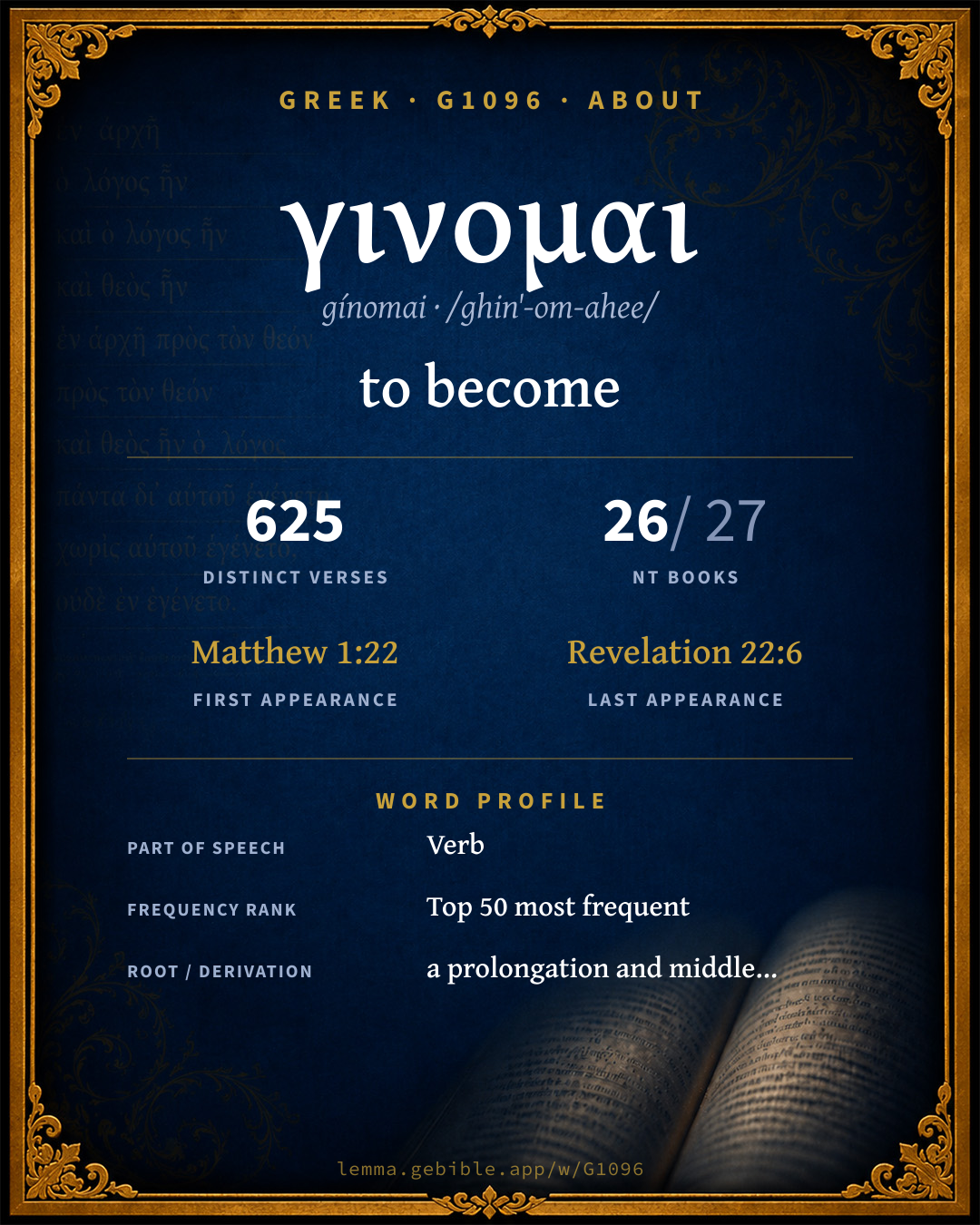
γίνομαι
to become
also: begin to be, receive being fuller range ↓
Full lexicon entry — Thayer's Greek Lexicon
From Thayer's Greek Lexicon
Where this word appears
See every Aorist-tense verb in the Greek New Testament →
Grammar key — what these labels mean
Part of speech
- Verb
- An action or state-of-being word.
Tense
- Aorist
- Action viewed as a simple whole, without regard to duration — often past (perfective aspect).
- Perfect
- A completed past action with continuing present results.
- Present
- Ongoing or general action in present time (imperfective aspect).
- Future
- Action expected in future time.
- Imperfect
- Continuous or repeated action in past time (“was writing”).
- Pluperfect
- A past action completed before another past point (“had written”).
Voice
- Middle deponent
- Middle in form but active in meaning.
- Active
- The subject performs the action.
- Middle or Passive deponent
- Middle/passive in form but active in meaning.
- Passive deponent
- Passive in form but active in meaning.
- Passive
- The subject receives the action.
Mood
- Indicative
- States a fact or asks a factual question (the mood of reality).
- Subjunctive
- Expresses probability, purpose, or possibility (the mood of contingency).
- Infinitive
- A verbal noun (“to write”), unmarked for person or number.
- Participle
- A verbal adjective (“writing,” “having written”).
- Imperative
- Expresses a command or request.
- Optative
- Expresses a wish or a remote possibility.
Case
- Genitive
- The case of source, possession, or “of” — answers “whose / from what.”
- Nominative
- The case of the subject (and the predicate nominative).
- Accusative
- The case of the direct object and of extent.
- Dative
- The case of the indirect object, means, or location — “to / for / with / in.”
Person
- 3rd person
- The one spoken about (“he / she / it / they”).
- 2nd person
- The one addressed (“you”).
- 1st person
- The speaker (“I / we”).
Gender
- Feminine
- Grammatically feminine.
- Masculine
- Grammatically masculine.
- Neuter
- Grammatically neuter.
Number
- Singular
- One.
- Plural
- More than one.
Grammatical forms 80 distinct
- Verb, Aorist, Middle deponent, Indicative, 3rd person, Singular 204 times (31%)
- Verb, Aorist, Middle deponent, Subjunctive, 3rd person, Singular 46 times (7%)
- Verb, Aorist, Middle deponent, Infinitive 38 times (6%)
- Verb, Aorist, Middle deponent, Participle, Genitive, Singular, Feminine 31 times (5%)
- Verb, Perfect, Active, Indicative, 3rd person, Singular 30 times (4%)
- Verb, Aorist, Middle deponent, Participle, Nominative, Singular, Masculine 26 times (4%)
- Verb, Present, Middle or Passive deponent, Indicative, 3rd person, Singular 26 times (4%)
- Verb, Present, Middle or Passive deponent, Imperative, 2nd person, Plural 24 times (4%)
+72 more forms (242 occurrences)
Parsed forms decoded from the imported morphology (Robinson–Tischendorf, public domain), counted across 667 parsed occurrences — not distinct verses.
Page 1 of 4 — showing verses 1–200 of 625 distinct verses where G1096 appears, across 26 books. Click any verse to open its interlinear word-by-word view. Verse text shown in the World English Bible for context — . Each verse’s Greek form is shown with its reference; the English is not keyword-highlighted, since the data carries no word-level English alignment. Use “Compare translations” on any verse to read it across multiple English versions. This concordance covers the Greek New Testament; Septuagint (Greek Old Testament) occurrences of this word are not indexed here.
Matthew 70 verses
- Matthew 1:22 γέγονεν perf act ind 3sg Now all this has happened, that it might be fulfilled which was spoken by the Lord through the prophet, saying,
- Matthew 4:3 γένωνται aor mid.dep subj 3pl The tempter came and said to him, "If you are the Son of God, command that these stones become bread."
- Matthew 5:18 γένηται aor mid.dep subj 3sg For most assuredly, I tell you, until heaven and earth pass away, not even one smallest letter or one tiny pen stroke shall in any way pass away from the law, until all things are accomplished.
- Matthew 5:45 γένησθε aor mid.dep subj 2pl that you may be children of your Father who is in heaven. For he makes his sun to rise on the evil and the good, and sends rain on the just and the unjust.
- Matthew 6:10 γενηθήτω aor pass.dep impv 3sg Let your Kingdom come. Let your will be done, as in heaven, so on earth.
- Matthew 6:16 γίνεσθε pres mid/pass.dep impv 2pl "Moreover when you fast, don't be like the hypocrites, with sad faces. For they disfigure their faces, that they may be seen by men to be fasting. Most assuredly I tell you, they have received their reward.
- Matthew 7:28 ἐγένετο aor mid.dep ind 3sg It happened, when Jesus had finished saying these things, that the multitudes were astonished at his teaching,
- Matthew 8:13 γενηθήτω aor pass.dep impv 3sg Jesus said to the centurion, "Go your way. Let it be done for you as you have believed." His servant was healed in that hour.
- Matthew 8:16 γενομένης aor mid.dep ptcp gen sg fem When evening came, they brought to him many possessed with demons. He cast out the spirits with a word, and healed all who were sick;
- Matthew 8:24 ἐγένετο aor mid.dep ind 3sg Behold, a great tempest arose in the sea, so much that the boat was covered with the waves, but he was asleep.
- Matthew 8:26 ἐγένετο aor mid.dep ind 3sg He said to them, "Why are you fearful, oh you of little faith?" Then he got up, rebuked the wind and the sea, and there was a great calm.
- Matthew 9:10 ἐγένετο aor mid.dep ind 3sg It happened as he sat in the house, behold, many tax collectors and sinners came and sat down with Jesus and his disciples.
- Matthew 9:16 γίνεται pres mid/pass.dep ind 3sg No one puts a piece of unshrunk cloth on an old garment; for the patch would tear away from the garment, and a worse hole is made.
- Matthew 9:29 γενηθήτω aor pass.dep impv 3sg Then he touched their eyes, saying, "According to your faith be it done to you."
- Matthew 10:16 γίνεσθε pres mid/pass.dep impv 2pl "Behold, I send you out as sheep in the midst of wolves. Therefore be wise as serpents, and harmless as doves.
- Matthew 10:25 γένηται aor mid.dep subj 3sg It is enough for the disciple that he be like his teacher, and the servant like his lord. If they have called the master of the house Beelzebul, how much more those of his household!
- Matthew 11:1 ἐγένετο aor mid.dep ind 3sg It happened that when Jesus had finished directing his twelve disciples, he departed from there to teach and preach in their cities.
- Matthew 11:20 ἐγένοντο aor mid.dep ind 3pl Then he began to denounce the cities in which most of his mighty works had been done, because they didn't repent.
- Matthew 11:21 ἐγένοντο γενόμεναι aor mid.dep ind 3pl aor mid.dep ptcp nom pl fem "Woe to you, Chorazin! Woe to you, Bethsaida! For if the mighty works had been done in Tyre and Sidon which were done in you, they would have repented long ago in sackcloth and ashes.
- Matthew 11:23 ἐγενήθησαν γενόμεναι aor pass.dep ind 3pl aor mid.dep ptcp nom pl fem You, Capernaum, who are exalted to Heaven, you will go down to Hades. For if the mighty works had been done in Sodom which were done in you, it would have remained until this day.
- Matthew 11:26 ἐγένετο aor mid.dep ind 3sg Yes, Father, for so it was well-pleasing in your sight.
- Matthew 12:45 γίνεται pres mid/pass.dep ind 3sg Then he goes, and takes with himself seven other spirits more evil than he is, and they enter in and dwell there. The last state of that man becomes worse than the first. Even so will it be also to this evil generation."
- Matthew 13:21 γενομένης aor mid.dep ptcp gen sg fem yet he has no root in himself, but endures for a while. When oppression or persecution arises because of the word, immediately he stumbles.
- Matthew 13:22 γίνεται pres mid/pass.dep ind 3sg What was sown among the thorns, this is he who hears the word, but the cares of this age and the deceitfulness of riches choke the word, and he becomes unfruitful.
- Matthew 13:32 γίνεται pres mid/pass.dep ind 3sg which indeed is smaller than all seeds. But when it is grown, it is greater than the herbs, and becomes a tree, so that the birds of the air come and lodge in its branches."
- Matthew 13:53 ἐγένετο aor mid.dep ind 3sg It happened that when Jesus had finished these parables, he departed from there.
- Matthew 14:6 γενομένοις aor mid.dep ptcp dat pl neut But when Herod's birthday came, the daughter of Herodias danced among them and pleased Herod.
- Matthew 14:15 γενομένης aor mid.dep ptcp gen sg fem When evening had come, his disciples came to him, saying, "This place is deserted, and the hour is already late. Send the multitudes away, that they may go into the villages, and buy themselves food."
- Matthew 14:23 γενομένης aor mid.dep ptcp gen sg fem After he had sent the multitudes away, he went up into the mountain by himself to pray. When evening had come, he was there alone.
- Matthew 15:28 γενηθήτω aor pass.dep impv 3sg Then Jesus answered her, "Woman, great is your faith! Be it done to you even as you desire." And her daughter was healed from that hour.
- Matthew 16:2 γενομένης aor mid.dep ptcp gen sg fem But he answered them, "When it is evening, you say, 'It will be fair weather, for the sky is red.'
- Matthew 17:2 ἐγένετο aor mid.dep ind 3sg He was transfigured before them. His face shone like the sun, and his garments became as white as the light.
- Matthew 18:3 γένησθε aor mid.dep subj 2pl and said, "Most assuredly I tell you, unless you turn, and become as little children, you will in no way enter into the Kingdom of Heaven.
- Matthew 18:12 γένηταί aor mid.dep subj 3sg "What do you think? If a man has one hundred sheep, and one of them goes astray, doesn't he leave the ninety-nine, go to the mountains, and seek that which has gone astray?
- Matthew 18:13 γένηται aor mid.dep subj 3sg If he finds it, most assuredly I tell you, he rejoices over it more than over the ninety-nine which have not gone astray.
- Matthew 18:19 γενήσεται fut mid.dep ind 3sg Again, assuredly I tell you, that if two of you will agree on earth concerning anything that they will ask, it will be done for them by my Father who is in heaven.
- Matthew 18:31 γενόμενα γενόμενα aor mid.dep ptcp acc pl neut aor mid.dep ptcp acc pl neut So when his fellow servants saw what was done, they were exceedingly sorry, and came and told to their lord all that was done.
- Matthew 19:1 ἐγένετο aor mid.dep ind 3sg It happened when Jesus had finished these words, he departed from Galilee, and came into the borders of Judea beyond the Jordan.
- Matthew 19:8 γέγονεν perf act ind 3sg He said to them, "Moses, because of the hardness of your hearts, allowed you to divorce your wives, but from the beginning it has not been so.
- Matthew 20:8 γενομένης aor mid.dep ptcp gen sg fem When evening had come, the lord of the vineyard said to his steward, 'Call the laborers and pay them their wages, beginning from the last to the first.'
- Matthew 20:26 γενέσθαι aor mid.dep inf It shall not be so among you, but whoever desires to become great among you shall be your servant.
- Matthew 21:4 γέγονεν perf act ind 3sg All this was done, that it might be fulfilled which was spoken through the prophet, saying,
- Matthew 21:19 γένηται aor mid.dep subj 3sg Seeing a fig tree by the road, he came to it, and found nothing on it but leaves. He said to it, "Let there be no fruit from you forever!" Immediately the fig tree withered away.
- Matthew 21:21 γενήσεται fut mid.dep ind 3sg Jesus answered them, "Most assuredly I tell you, if you have faith, and don't doubt, you will not only do what is done to the fig tree, but even if you told this mountain, 'Be taken up and cast into the sea,' it would be done.
- Matthew 21:42 ἐγενήθη ἐγένετο aor pass.dep ind 3sg aor mid.dep ind 3sg Jesus said to them, "Did you never read in the Scriptures, 'The stone which the builders rejected, The same was made the head of the corner. This was from the Lord. It is marvelous in our eyes?'
- Matthew 23:15 γένηται aor mid.dep subj 3sg Woe to you, scribes and Pharisees, hypocrites! For you travel around by sea and land to make one proselyte; and when he becomes one, you make him twice as much of a son of Gehenna as yourselves.
- Matthew 23:26 γένηται aor mid.dep subj 3sg You blind Pharisee, first clean the inside of the cup and of the platter, that the outside of it may become clean also.
- Matthew 24:6 γενέσθαι aor mid.dep inf You will hear of wars and rumors of wars. See that you aren't troubled, for all this must happen, but the end is not yet.
- Matthew 24:20 γένηται aor mid.dep subj 3sg Pray that your flight will not be in the winter, nor on a Sabbath,
- Matthew 24:21 ἐγένετο γένηται aor mid.dep ind 3sg aor mid.dep subj 3sg for then there will be great oppression, such as has not been from the beginning of the world until now, no, nor ever will be.
- Matthew 24:32 γένηται aor mid.dep subj 3sg "Now from the fig tree learn this parable. When its branch has now become tender, and puts forth its leaves, you know that the summer is near.
- Matthew 24:34 γένηται aor mid.dep subj 3sg Most assuredly I tell you, this generation will not pass away, until all these things are accomplished.
- Matthew 24:44 γίνεσθε pres mid/pass.dep impv 2pl Therefore also be ready, for in an hour that you don't expect, the Son of Man will come.
- Matthew 25:6 γέγονεν perf act ind 3sg But at midnight there was a cry, 'Behold! The bridegroom is coming! Come out to meet him!'
- Matthew 26:1 ἐγένετο aor mid.dep ind 3sg It happened, when Jesus had finished all these words, that he said to his disciples,
- Matthew 26:2 γίνεται pres mid/pass.dep ind 3sg "You know that after two days the Passover is coming, and the Son of Man will be delivered up to be crucified."
- Matthew 26:5 γένηται aor mid.dep subj 3sg But they said, "Not during the feast, lest a riot occur among the people."
- Matthew 26:6 γενομένου aor mid.dep ptcp gen sg masc Now when Jesus was in Bethany, in the house of Simon the leper,
- Matthew 26:20 γενομένης aor mid.dep ptcp gen sg fem Now when evening had come, he was reclining at the table with the twelve disciples.
- Matthew 26:42 γενηθήτω aor pass.dep impv 3sg Again, a second time he went away, and prayed, saying, "My Father, if this cup can't pass away from me unless I drink it, your desire be done."
- Matthew 26:54 γενέσθαι aor mid.dep inf How then would the Scriptures be fulfilled that it must be so?"
- Matthew 26:56 γέγονεν perf act ind 3sg But all this has happened, that the Scriptures of the prophets might be fulfilled." Then all the disciples left him, and fled.
- Matthew 27:1 γενομένης aor mid.dep ptcp gen sg fem Now when morning had come, all the chief priests and the elders of the people took counsel against Jesus to put him to death:
- Matthew 27:24 γίνεται pres mid/pass.dep ind 3sg So when Pilate saw that nothing was being gained, but rather that a disturbance was starting, he took water, and washed his hands before the multitude, saying, "I am innocent of the blood of this righteous person. You see to it."
- Matthew 27:45 ἐγένετο aor mid.dep ind 3sg Now from the sixth hour there was darkness over all the land until the ninth hour.
- Matthew 27:54 γινόμενα pres mid/pass.dep ptcp acc pl neut Now the centurion, and those who were with him watching Jesus, when they saw the earthquake, and the things that were done, feared exceedingly, saying, "Truly this was the Son of God."
- Matthew 27:57 γενομένης aor mid.dep ptcp gen sg fem When evening had come, a rich man from Arimathaea, named Joseph, who himself was also Jesus' disciple came.
- Matthew 28:2 ἐγένετο aor mid.dep ind 3sg Behold, there was a great earthquake, for an angel of the Lord descended from the sky, and came and rolled away the stone from the door, and sat on it.
- Matthew 28:4 ἐγενήθησαν aor pass.dep ind 3pl For fear of him, the guards shook, and became like dead men.
- Matthew 28:11 γενόμενα aor mid.dep ptcp acc pl neut Now while they were going, behold, some of the guards came into the city, and told the chief priests all the things that had happened.
Mark 51 verses
- Mark 1:4 ἐγένετο aor mid.dep ind 3sg John came baptizing in the wilderness and preaching the baptism of repentance for forgiveness of sins.
- Mark 1:9 ἐγένετο aor mid.dep ind 3sg It happened in those days, that Jesus came from Nazareth of Galilee, and was baptized by John in the Jordan.
- Mark 1:17 γενέσθαι aor mid.dep inf Jesus said to them, "Come after me, and I will make you into fishers for men."
- Mark 1:32 γενομένης aor mid.dep ptcp gen sg fem At evening, when the sun had set, they brought to him all who were sick, and those who were possessed by demons.
- Mark 2:15 γίνεται pres mid/pass.dep ind 3sg It happened, that he was reclining at the table in his house, and many tax collectors and sinners sat down with Jesus and his disciples, for there were many, and they followed him.
- Mark 2:21 γίνεται pres mid/pass.dep ind 3sg No one sews a piece of unshrunk cloth on an old garment, or else the patch shrinks and the new tears away from the old, and a worse hole is made.
- Mark 2:23 ἐγένετο aor mid.dep ind 3sg It happened that he was going on the Sabbath day through the grain fields, and his disciples began, as they went, to pluck the ears of grain.
- Mark 2:27 ἐγένετο aor mid.dep ind 3sg He said to them, "The Sabbath was made for man, not man for the Sabbath.
- Mark 4:4 ἐγένετο aor mid.dep ind 3sg and it happened, as he sowed, some seed fell by the road, and the birds came and devoured it.
- Mark 4:10 ἐγένετο aor mid.dep ind 3sg When he was alone, those who were around him with the twelve asked him about the parables.
- Mark 4:11 γίνεται pres mid/pass.dep ind 3sg He said to them, "To you is given the mystery of the Kingdom of God, but to those who are outside, all things are done in parables,
- Mark 4:17 γενομένης aor mid.dep ptcp gen sg fem They have no root in themselves, but are short-lived. When oppression or persecution arises because of the word, immediately they stumble.
- Mark 4:19 γίνεται pres mid/pass.dep ind 3sg and the cares of this age, and the deceitfulness of riches, and the lusts of other things entering in choke the word, and it becomes unfruitful.
- Mark 4:22 ἐγένετο aor mid.dep ind 3sg For there is nothing hidden, except that it should be made known; neither was anything made secret, but that it should come to light.
- Mark 4:32 γίνεται pres mid/pass.dep ind 3sg yet when it is sown, grows up, and becomes greater than all the herbs, and puts out great branches, so that the birds of the sky can lodge under its shadow."
- Mark 4:35 γενομένης aor mid.dep ptcp gen sg fem On that day, when evening had come, he said to them, "Let's go over to the other side."
- Mark 4:37 γίνεται pres mid/pass.dep ind 3sg There arose a great wind storm, and the waves beat into the boat, so much that the boat was already filled.
- Mark 4:39 ἐγένετο aor mid.dep ind 3sg He awoke, and rebuked the wind, and said to the sea, "Peace! Be still!" The wind ceased, and there was a great calm.
- Mark 5:14 γεγονός perf act ptcp nom sg neut Those who fed them fled, and told it in the city and in the country. The people came to see what it was that had happened.
- Mark 5:16 ἐγένετο aor mid.dep ind 3sg Those who saw it declared to them how it happened to him who was possessed by demons, and about the pigs.
- Mark 5:33 γέγονεν perf act ind 3sg But the woman, fearing and trembling, knowing what had been done to her, came and fell down before him, and told him all the truth.
- Mark 6:2 γενομένου γίνονται aor mid.dep ptcp gen sg neut pres mid/pass.dep ind 3pl When the Sabbath had come, he began to teach in the synagogue, and many hearing him were astonished, saying, "Where did this man get these things?" and, "What is the wisdom that is given to this man, that such mighty works come about by his hands?
- Mark 6:14 ἐγένετο aor mid.dep ind 3sg King Herod heard this, for his name had become known, and he said, "John the Baptizer has risen from the dead, and therefore these powers are at work in him."
- Mark 6:21 γενομένης aor mid.dep ptcp gen sg fem Then a convenient day came, that Herod on his birthday made a supper for his nobles, the high officers, and the chief men of Galilee.
- Mark 6:26 γενόμενος aor mid.dep ptcp nom sg masc The king was exceedingly sorry, but for the sake of his oaths, and of his dinner guests, he didn't wish to refuse her.
- Mark 6:35 γινομένης pres mid/pass.dep ptcp gen sg fem When it was late in the day, his disciples came to him, and said, "This place is deserted, and it is late in the day.
- Mark 6:47 γενομένης aor mid.dep ptcp gen sg fem When evening had come, the boat was in the midst of the sea, and he was alone on the land.
- Mark 9:3 ἐγένετο aor mid.dep ind 3sg His clothing became glistening, exceedingly white, like snow, such as no launderer on earth can whiten them.
- Mark 9:6 ἐγένοντο aor mid.dep ind 3pl For he didn't know what to say, for they were very afraid.
- Mark 9:7 ἐγένετο ἐγένετο aor mid.dep ind 3sg aor mid.dep ind 3sg A cloud came, overshadowing them, and a voice came out of the cloud, "This is my beloved Son. Listen to him."
- Mark 9:21 γέγονεν perf act ind 3sg He asked his father, "How long has it been since this has come to him?" He said, "From childhood.
- Mark 9:26 ἐγένετο aor mid.dep ind 3sg Having cried out, and convulsed greatly, it came out of him. The boy became like one dead; so much that most of them said, "He is dead."
- Mark 9:33 γενόμενος aor mid.dep ptcp nom sg masc He came to Capernaum, and when he was in the house he asked them, "What were you arguing among yourselves on the way?"
- Mark 9:50 γένηται aor mid.dep subj 3sg Salt is good, but if the salt has lost its saltiness, with what will you season it? Have salt in yourselves, and be at peace with one another."
- Mark 10:43 γενέσθαι aor mid.dep inf But it shall not be so among you, but whoever wants to become great among you shall be your servant.
- Mark 10:44 γενέσθαι aor mid.dep inf Whoever of you wants to become first among you, shall be bondservant of all.
- Mark 11:19 ἐγένετο aor mid.dep ind 3sg When evening came, he went out of the city.
- Mark 11:23 γίνεται pres mid/pass.dep ind 3sg For most assuredly I tell you, whoever may tell this mountain, 'Be taken up and cast into the sea,' and doesn't doubt in his heart, but believes that what he says is happening; he shall have whatever he says.
- Mark 12:10 ἐγενήθη aor pass.dep ind 3sg Haven't you even read this Scripture: 'The stone which the builders rejected, The same was made the head of the corner.
- Mark 12:11 ἐγένετο aor mid.dep ind 3sg This was from the Lord, It is marvelous in our eyes'?"
- Mark 13:7 γενέσθαι aor mid.dep inf "When you hear of wars and rumors of wars, don't be troubled. For those must happen, but the end is not yet.
- Mark 13:18 γένηται aor mid.dep subj 3sg Pray that your flight won't be in the winter.
- Mark 13:19 γέγονεν γένηται perf act ind 3sg aor mid.dep subj 3sg For in those days there will be oppression, such as there has not been the like from the beginning of the creation which God created until now, and never will be.
- Mark 13:28 γένηται aor mid.dep subj 3sg "Now from the fig tree, learn this parable. When the branch has now become tender, and puts forth its leaves, you know that the summer is near;
- Mark 13:29 γινόμενα pres mid/pass.dep ptcp acc pl neut even so you also, when you see these things coming to pass, know that it is near, at the doors.
- Mark 13:30 γένηται aor mid.dep subj 3sg Most assuredly I say to you, this generation will not pass away until all these things happen.
- Mark 14:4 γέγονεν perf act ind 3sg But there were some who were indignant among themselves, saying, "Why has this ointment been wasted?
- Mark 14:17 γενομένης aor mid.dep ptcp gen sg fem When it was evening he came with the twelve.
- Mark 15:33 γενομένης ἐγένετο aor mid.dep ptcp gen sg fem aor mid.dep ind 3sg When the sixth hour had come, there was darkness over the whole land until the ninth hour.
- Mark 15:42 γενομένης aor mid.dep ptcp gen sg fem When evening had now come, because it was the Preparation Day, that is, the day before the Sabbath,
- Mark 16:10 γενομένοις aor mid.dep ptcp dat pl masc She went and told those who had been with him, as they mourned and wept.
Luke 128 verses
- Luke 1:2 γενόμενοι aor mid.dep ptcp nom pl masc even as those who from the beginning were eyewitnesses and ministers of the word delivered them to us,
- Luke 1:5 Ἐγένετο aor mid.dep ind 3sg There was in the days of Herod, the king of Judea, a certain priest named Zacharias, of the priestly division of Abijah. He had a wife of the daughters of Aaron, and her name was Elizabeth.
- Luke 1:8 ἐγένετο aor mid.dep ind 3sg Now it happened, while he executed the priest's office before God in the order of his division,
- Luke 1:20 γένηται aor mid.dep subj 3sg Behold, you will be silent and not able to speak, until the day that these things will happen, because you didn't believe my words, which will be fulfilled in their proper time."
- Luke 1:23 ἐγένετο aor mid.dep ind 3sg It happened, when the days of his service were fulfilled, he departed to his house.
- Luke 1:38 γένοιτό aor mid.dep opt 3sg Mary said, "Behold, the handmaid of the Lord; be it to me according to your word." The angel departed from her.
- Luke 1:41 ἐγένετο aor mid.dep ind 3sg It happened, when Elizabeth heard Mary's greeting, that the baby leaped in her womb, and Elizabeth was filled with the Holy Spirit.
- Luke 1:44 ἐγένετο aor mid.dep ind 3sg For behold, when the voice of your greeting came into my ears, the baby leaped in my womb for joy!
- Luke 1:59 ἐγένετο aor mid.dep ind 3sg It happened on the eighth day, that they came to circumcise the child; and they would have called him Zacharias, after the name of the father.
- Luke 1:65 ἐγένετο aor mid.dep ind 3sg Fear came on all who lived around them, and all these sayings were talked about throughout all the hill country of Judea.
- Luke 2:1 Ἐγένετο aor mid.dep ind 3sg Now it happened in those days, that a decree went out from Caesar Augustus that all the world should be enrolled.
- Luke 2:2 ἐγένετο aor mid.dep ind 3sg This was the first enrollment made when Quirinius was governor of Syria.
- Luke 2:6 Ἐγένετο aor mid.dep ind 3sg It happened, while they were there, that the day had come that she should give birth.
- Luke 2:13 ἐγένετο aor mid.dep ind 3sg Suddenly, there was with the angel a multitude of the heavenly host praising God, and saying,
- Luke 2:15 ἐγένετο γεγονὸς aor mid.dep ind 3sg perf act ptcp acc sg neut It happened, when the angels went away from them into the sky, that the shepherds said one to another, "Let's go to Bethlehem, now, and see this thing that has happened, which the Lord has made known to us."
- Luke 2:42 ἐγένετο aor mid.dep ind 3sg When he was twelve years old, they went up to Jerusalem according to the custom of the feast,
- Luke 2:46 ἐγένετο aor mid.dep ind 3sg It happened after three days they found him in the temple, sitting in the midst of the teachers, both listening to them, and asking them questions.
- Luke 3:2 ἐγένετο aor mid.dep ind 3sg in the high priesthood of Annas and Caiaphas, the word of God came to John, the son of Zacharias, in the wilderness.
- Luke 3:21 Ἐγένετο aor mid.dep ind 3sg Now it happened, when all the people were baptized, Jesus also had been baptized, and was praying. The sky was opened,
- Luke 3:22 γενέσθαι aor mid.dep inf and the Holy Spirit descended in a bodily form as a dove on him; and a voice came out of the sky, saying "You are my beloved Son. In you I am well pleased."
- Luke 4:3 γένηται aor mid.dep subj 3sg The devil said to him, "If you are the Son of God, command this stone to become bread."
- Luke 4:23 γενόμενα aor mid.dep ptcp acc pl neut He said to them, "Doubtless you will tell me this parable, 'Physician, heal yourself! Whatever we have heard done at Capernaum, do also here in your hometown.'"
- Luke 4:25 ἐγένετο aor mid.dep ind 3sg But truly I tell you, there were many widows in Israel in the days of Elijah, when the sky was shut up three years and six months, when a great famine came over all the land.
- Luke 4:36 ἐγένετο aor mid.dep ind 3sg Amazement came on all, and they spoke together, one with another, saying, "What is this word? For with authority and power he commands the unclean spirits, and they come out!"
- Luke 4:42 Γενομένης aor mid.dep ptcp gen sg fem When it was day, he departed and went into an uninhabited place, and the multitudes looked for him, and came to him, and held on to him, so that he wouldn't go away from them.
- Luke 5:1 Ἐγένετο aor mid.dep ind 3sg Now it happened, while the multitude pressed on him and heard the word of God, that he was standing by the lake of Gennesaret.
- Luke 5:12 ἐγένετο aor mid.dep ind 3sg It happened, while he was in one of the cities, behold, there was a man full of leprosy. When he saw Jesus, he fell on his face, and begged him, saying, "Lord, if you want to, you can make me clean."
- Luke 5:17 ἐγένετο aor mid.dep ind 3sg It happened on one of those days, that he was teaching; and there were Pharisees and teachers of the law sitting by, who had come out of every village of Galilee, Judea, and Jerusalem. The power of the Lord was with him to heal them.
- Luke 6:1 Ἐγένετο aor mid.dep ind 3sg Now it happened on the second Sabbath after the first, that he was going through the grain fields. His disciples plucked the heads of grain, and ate, rubbing them in their hands.
- Luke 6:6 Ἐγένετο aor mid.dep ind 3sg It also happened on another Sabbath that he entered into the synagogue and taught. There was a man there, and his right hand was withered.
- Luke 6:12 Ἐγένετο aor mid.dep ind 3sg It happened in these days, that he went out to the mountain to pray, and he continued all night in prayer to God.
- Luke 6:13 ἐγένετο aor mid.dep ind 3sg When it was day, he called his disciples, and from them he chose twelve, whom he also named apostles:
- Luke 6:16 ἐγένετο aor mid.dep ind 3sg Judas the son of James; and Judas Iscariot, who also became a traitor.
- Luke 6:36 γίνεσθε pres mid/pass.dep impv 2pl Therefore be merciful, Even as your Father is also merciful.
- Luke 6:48 γενομένης aor mid.dep ptcp gen sg fem He is like a man building a house, who dug and went deep, and laid a foundation on the rock. When a flood arose, the stream broke against that house, and could not shake it, because it was founded on the rock.
- Luke 6:49 ἐγένετο aor mid.dep ind 3sg But he who hears, and doesn't do, is like a man who built a house on the earth without a foundation, against which the stream broke, and immediately it fell, and the ruin of that house was great."
- Luke 7:11 ἐγένετο aor mid.dep ind 3sg It happened soon afterwards, that he went to a city called Nain. Many of his disciples, along with a great multitude, went with him.
- Luke 8:1 ἐγένετο aor mid.dep ind 3sg It happened soon afterwards, that he went about through cities and villages, preaching and bringing the good news of the Kingdom of God. With him were the twelve,
- Luke 8:17 γενήσεται fut mid.dep ind 3sg For nothing is hidden, that will not be revealed; nor anything secret, that will not be known and come to light.
- Luke 8:22 Ἐγένετο aor mid.dep ind 3sg Now it happened on one of those days, that he entered into a boat, himself and his disciples, and he said to them, "Let's go over to the other side of the lake." So they launched out.
- Luke 8:24 ἐγένετο aor mid.dep ind 3sg They came to him, and awoke him, saying, "Master, master, we are dying!" He awoke, and rebuked the wind and the raging of the water, and they ceased, and it was calm.
- Luke 8:34 γεγονὸς perf act ptcp acc sg neut When those who fed them saw what had happened, they fled, and told it in the city and in the country.
- Luke 8:35 γεγονός perf act ptcp acc sg neut People went out to see what had happened. They came to Jesus, and found the man from whom the demons had gone out, sitting at Jesus' feet, clothed and in his right mind; and they were afraid.
- Luke 8:40 Ἐγένετο aor mid.dep ind 3sg It happened, when Jesus returned, that the multitude welcomed him, for they were all waiting for him.
- Luke 8:56 γεγονός perf act ptcp acc sg neut Her parents were amazed, but he charged them to tell no one what had been done.
- Luke 9:7 γινόμενα pres mid/pass.dep ptcp acc pl neut Now Herod the tetrarch heard of all that was done by him; and he was very perplexed, because it was said by some that John had risen from the dead,
- Luke 9:18 ἐγένετο aor mid.dep ind 3sg It happened, as he was praying alone, that the disciples were with him, and he asked them, "Who do the multitudes say that I am?"
- Luke 9:28 Ἐγένετο aor mid.dep ind 3sg It happened about eight days after these sayings, that he took with him Peter, John, and James, and went up onto the mountain to pray.
- Luke 9:29 ἐγένετο aor mid.dep ind 3sg As he was praying, the appearance of his face was altered, and his clothing became white and dazzling.
- Luke 9:33 ἐγένετο aor mid.dep ind 3sg It happened, as they were parting from him, that Peter said to Jesus, "Master, it is good for us to be here. Let's make three tents: one for you, and one for Moses, and one for Elijah," not knowing what he said.
- Luke 9:34 ἐγένετο aor mid.dep ind 3sg While he said these things, a cloud came and overshadowed them, and they were afraid as they entered into the cloud.
- Luke 9:35 ἐγένετο aor mid.dep ind 3sg A voice came out of the cloud, saying, "This is my beloved Son. Listen to him!"
- Luke 9:36 γενέσθαι aor mid.dep inf When the voice came, Jesus was found alone. They were silent, and told no one in those days any of the things which they had seen.
- Luke 9:37 Ἐγένετο aor mid.dep ind 3sg It happened on the next day, when they had come down from the mountain, that a great multitude met him.
- Luke 9:51 Ἐγένετο aor mid.dep ind 3sg It came to pass, when the days were near that he should be taken up, he intently set his face to go to Jerusalem,
- Luke 10:13 ἐγενήθησαν γενόμεναι aor pass.dep ind 3pl aor mid.dep ptcp nom pl fem "Woe to you, Chorazin! Woe to you, Bethsaida! For if the mighty works had been done in Tyre and Sidon which were done in you, they would have repented long ago, sitting in sackcloth and ashes.
- Luke 10:21 ἐγένετο aor mid.dep ind 3sg In that same hour Jesus rejoiced in the Holy Spirit, and said, "I thank you, O Father, Lord of heaven and earth, that you have hidden these things from the wise and understanding, and revealed them to little children. Yes, Father, for so it was well-pleasing in your sight."
- Luke 10:32 γενόμενος aor mid.dep ptcp nom sg masc In the same way a Levite also, when he came to the place, and saw him, passed by on the other side.
- Luke 10:36 γεγονέναι perf act inf Now which of these three do you think seemed to be a neighbor to him who fell among the robbers?"
- Luke 10:38 Ἐγένετο aor mid.dep ind 3sg It happened as they went on their way, he entered into a certain village, and a certain woman named Martha received him into her house.
- Luke 11:1 ἐγένετο aor mid.dep ind 3sg It happened, that when he finished praying in a certain place, one of his disciples said to him, "Lord, teach us to pray, just as John also taught his disciples."
- Luke 11:14 ἐγένετο aor mid.dep ind 3sg He was casting out a demon, and it was mute. It happened, when the demon had gone out, the mute man spoke; and the multitudes marveled.
- Luke 11:26 γίνεται pres mid/pass.dep ind 3sg Then he goes, and takes seven other spirits more evil than himself, and they enter in and dwell there. The last state of that man becomes worse than the first."
- Luke 11:27 Ἐγένετο aor mid.dep ind 3sg It came to pass, as he said these things, a certain woman out of the multitude lifted up her voice, and said to him, "Blessed is the womb that bore you, and the breasts which nursed you!"
- Luke 11:30 ἐγένετο aor mid.dep ind 3sg For even as Jonah became a sign to the Ninevites, so will also the Son of Man be to this generation.
- Luke 12:40 γίνεσθε pres mid/pass.dep impv 2pl Therefore be ready also, for the Son of Man is coming in an hour that you don't expect him."
- Luke 12:54 γίνεται pres mid/pass.dep ind 3sg He said to the multitudes also, "When you see a cloud rising from the west, immediately you say, 'A shower is coming,' and so it happens.
- Luke 12:55 γίνεται pres mid/pass.dep ind 3sg When a south wind blows, you say, 'There will be a scorching heat,' and it happens.
- Luke 13:2 ἐγένοντο aor mid.dep ind 3pl Jesus answered them, "Do you think that these Galileans were worse sinners than all the other Galileans, because they suffered such things?
- Luke 13:4 ἐγένοντο aor mid.dep ind 3pl Or those eighteen, on whom the tower in Siloam fell, and killed them; do you think that they were worse offenders than all the men who dwell in Jerusalem?
- Luke 13:17 γινομένοις pres mid/pass.dep ptcp dat pl neut As he said these things, all his adversaries were disappointed, and all the multitude rejoiced for all the glorious things that were done by him.
- Luke 13:19 ἐγένετο aor mid.dep ind 3sg It is like a grain of mustard seed, which a man took, and put in his own garden. It grew, and became a large tree, and the birds of the sky lodged in its branches."
- Luke 14:1 ἐγένετο aor mid.dep ind 3sg It happened, when he went into the house of one of the rulers of the Pharisees on a Sabbath to eat bread, that they were watching him.
- Luke 14:12 γένηται aor mid.dep subj 3sg He also said to the one who had invited him, "When you make a dinner or a supper, don't call your friends, nor your brothers, nor your kinsmen, nor rich neighbors, or perhaps they might also return the favor, and pay you back.
- Luke 14:22 γέγονεν perf act ind 3sg "The servant said, 'Lord, it is done as you commanded, and there is still room.'
- Luke 15:10 γίνεται pres mid/pass.dep ind 3sg Even so, I tell you, there is joy in the presence of the angels of God over one sinner repenting."
- Luke 15:14 ἐγένετο aor mid.dep ind 3sg When he had spent all of it, there arose a severe famine in that country, and he began to be in need.
- Luke 16:11 ἐγένεσθε aor mid.dep ind 2pl If therefore you have not been faithful in the unrighteous mammon, who will commit to your trust the true riches?
- Luke 16:12 ἐγένεσθε aor mid.dep ind 2pl If you have not been faithful in that which is another's, who will give you that which is your own?
About this entry
At a glance — auto-summarized from this page’s data, not written by a person. Every figure links to its source below. This summary describes the numbers; it doesn’t interpret them.
The Greek verb γινομαι centers on the idea of “to become.” The King James Version usually renders it “was,” while modern versions prefer “happened” (unfoldingWord Literal Text) — see the renderings breakdown. Spanning 625 verses in 26 books, it ranks among the most common words of the Greek New Testament. Debuting at Matthew 1:22, it then recurs through the corpus. Thayer's distinguishes 5 senses; alongside “to become” it spans “begin to be” and “receive being”. For the data behind this summary, explore the sense tree and the renderings breakdown below.
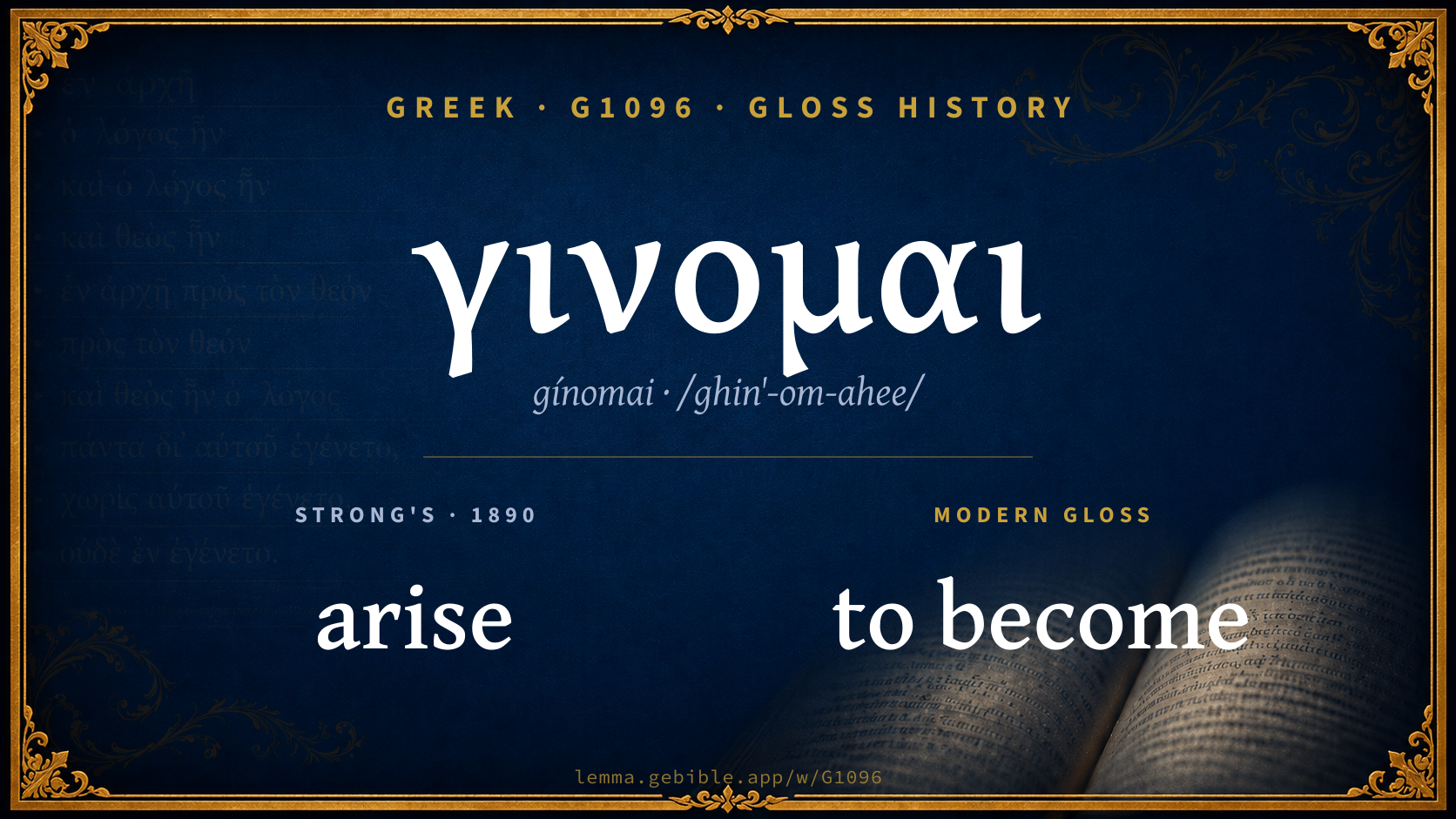
Gloss history
Strong's 1890 vs modern scholarship
About this word
Strong's G1096 catalogs a Greek word from the Greek New Testament.
These counts are not copied from any lexicon or concordance. They are computed here, from the morphology-tagged Greek New Testament. What Lemma adds →
- 625
- distinct verses
- The word appears in 625 distinct verses.
- 26 / 27
- NT books
- The word appears in 26 of 27 New Testament books.
- #28
- by frequency
- Top 50 most frequent Greek words (rank 28 of 5,347 Greek words by occurrence).
View all 625 occurrences in the concordance →
By section of the New Testament
By traditional corpus
Conventional, traditional groupings — biblical authorship is debated, so this is a traditional corpus grouping, not an authorship claim. Some books belong to more than one corpus (Luke is in both the Gospels and the Lukan corpus, and so on), so these shares overlap and need not total 100%. Each figure is a share of the word’s 625 distinct verses.
- Gospels 294 verses · 47%
- Lukan (Luke–Acts) 246 verses · 39%
- Pauline corpus 130 verses · 21%
- Johannine 79 verses · 13%
- Revelation 31 verses · 5%
- Hebrews 28 verses · 4%
- General (Catholic) Epistles 24 verses · 4%
How translations render this word
Counts come from each version’s own published word-to-Strong’s tagging or interlinear alignment — an approximate guide to how each version renders this word, not a word-level alignment the data otherwise carries. Because each total is that version’s own tagged count, the per-version totals vary from one another and need not match the appearance or distinct-verse counts above. These counts may also differ from a printed concordance because Lemma counts each distinctly tagged rendering and does not collapse phrase taggings into a single head-word total. This is a fixed set of word-tagged versions (KJV, ASV, BSB, ULT) and does not change with the reading translation you choose elsewhere. Each version’s license is shown beside its name below (and on Sources).
- King James Version: Was 94×, Came to pass 65×, Be 38×
- American Standard Version: Came to pass 60×, Was 53×, Be 28×
- Berean Standard Bible: Was 39×, Came 35×, Be 26×
- unfoldingWord Literal Text: Happened 71×, Happened that 57×, Became 48×
King James Version Public Domain
Renders G1096 across 680 tagged occurrences — most commonly:
Plus other, less common renderings. Plus 112 renderings that appear only once — usually multi-word phrases or single function words the recovered tagging swept in, not distinct renderings. Not rendered by a distinct English word in 29 further occurrences.
American Standard Version Public Domain
Renders G1096 across 682 tagged occurrences — most commonly:
Plus other, less common renderings. Plus 122 renderings that appear only once — usually multi-word phrases or single function words the recovered tagging swept in, not distinct renderings. Not rendered by a distinct English word in 2 further occurrences.
Berean Standard Bible Public Domain
Renders G1096 across 544 tagged occurrences — most commonly:
Plus other, less common renderings. Plus 127 renderings that appear only once — usually multi-word phrases or single function words the recovered tagging swept in, not distinct renderings. Not rendered by a distinct English word in 85 further occurrences.
unfoldingWord Literal Text CC BY-SA 4.0
Renders G1096 across 755 tagged occurrences — most commonly:
Plus other, less common renderings. Plus 81 renderings that appear only once — usually multi-word phrases or single function words the recovered tagging swept in, not distinct renderings.
Senses in Thayer's
The 5 senses Thayer's distinguishes for this word, in lexicon order (not ranked by frequency or importance). The full entry — with sub-senses — is in the Lexicon Entry tab.
- to become, i.e. to come into existence, begin to be, receive being
- to become, i.e. to come to pass, happen
- to arise, appear in history, come upon the stage
- of miracles, to be performed, wrought
- to become, be made
Word origin
Origin: a prolongation and middle voice form of a primary verb
A prolonged and middle form of a primary verb; to cause to be (gen -erate) that is (reflexively) to become ( come into being ) used with great latitude (literally figuratively intensively etc.): - arise be assembled be (come -fall -have self) be brought (to pass) (be) come (to pass) continue be divided be done draw be ended fall be finished follow be found be fulfilled + God forbid grow happen have be kept be made be married be ordained to be partake pass be performed be published require seem be showed X soon as it was sound be taken be turned use wax will would be wrought.
— Strong’s Exhaustive Concordance (1890), public domain.
Forms in the corpus
The 85 distinct written forms G1096 takes in the Greek New Testament, most frequent first — each parse links to that tense’s occurrences in the concordance.
The 60 most common forms are shown; 25 rarer forms follow in the full concordance.
Same root — word family
Other Thayer's entries built from the same root as G1096, grouped by Strong’s listed origin. These share a root / origin per the lexicon — not necessarily a shared meaning. Each links to that word’s own entry.
Derived from this word
Compare all same-root words → They share a root, not necessarily a meaning.
Septuagint usage
The same Greek word γινομαι appears 1,711 times in the Greek Old Testament (Septuagint), across 1,567 verses in 37 books.
- 1,711
- LXX occurrences
- Tagged occurrences of this Greek word in the Septuagint.
- 1,567
- verses
- Distinct Septuagint verses containing this word.
- 37 / 39
- OT books
- The word appears in 37 of the 39 Old Testament books.
Sample Septuagint occurrences
- Genesis 1:3 γίγνομαι
- Exodus 1:7 γίγνομαι
- Leviticus 8:29 γίγνομαι
- Numbers 1:20 γίγνομαι
- Deuteronomy 1:3 γίγνομαι
- Joshua 1:1 γίγνομαι
- Judges 1:1 γίγνομαι
- Ruth 1:1 γίγνομαι
- 1 Samuel 1:4 γίγνομαι
- 2 Samuel 1:1 γίγνομαι
- 1 Kings 1:7 γίγνομαι
- 2 Kings 2:1 γίγνομαι
Septuagint occurrences (same lexeme)
Every verse where the same Strong’s number (G1096) appears in the Greek Septuagint — showing the first 50 of 1,567. Verse text shown in the World English Bible for context; the Greek form is the matched word — the English is not keyword-highlighted.
- Genesis 1:3 γίγνομαι God said, "Let there be light," and there was light.
- Genesis 1:5 γίγνομαι God called the light Day, and the darkness he called Night. There was evening and there was morning, one day.
- Genesis 1:6 γίγνομαι God said, "Let there be an expanse in the midst of the waters, and let it divide the waters from the waters."
- Genesis 1:8 γίγνομαι God called the expanse sky. There was evening and there was morning, a second day.
- Genesis 1:9 γίγνομαι God said, "Let the waters under the sky be gathered together to one place, and let the dry land appear," and it was so.
- Genesis 1:11 γίγνομαι God said, "Let the earth put forth grass, herbs yielding seed, and fruit trees bearing fruit after their kind, with its seed in it, on the earth," and it was so.
- Genesis 1:13 γίγνομαι There was evening and there was morning, a third day.
- Genesis 1:14 γίγνομαι God said, "Let there be lights in the expanse of sky to divide the day from the night; and let them be for signs, and for seasons, and for days and years;
- Genesis 1:15 γίγνομαι and let them be for lights in the expanse of sky to give light on the earth," and it was so.
- Genesis 1:19 γίγνομαι There was evening and there was morning, a fourth day.
- Genesis 1:20 γίγνομαι God said, "Let the waters swarm with swarms of living creatures, and let birds fly above the earth in the open expanse of sky."
- Genesis 1:23 γίγνομαι There was evening and there was morning, a fifth day.
- Genesis 1:24 γίγνομαι God said, "Let the earth bring forth living creatures after their kind, cattle, creeping things, and animals of the earth after their kind," and it was so.
- Genesis 1:30 γίγνομαι To every animal of the earth, and to every bird of the sky, and to everything that creeps on the earth, in which there is life, I have given every green herb for food." And it was so.
- Genesis 1:31 γίγνομαι God saw everything that he had made, and, behold, it was very good. There was evening and there was morning, the sixth day.
- Genesis 2:4 γίγνομαι This is the history of the generations of the heavens and of the earth when they were created, in the day that Yahweh God made earth and the heavens.
- Genesis 2:5 γίγνομαι No plant of the field was yet in the earth, and no herb of the field had yet sprung up; for Yahweh God had not caused it to rain on the earth. There was not a man to till the ground,
- Genesis 2:7 γίγνομαι Yahweh God formed man from the dust of the ground, and breathed into his nostrils the breath of life; and man became a living soul.
- Genesis 3:22 γίγνομαι Yahweh God said, "Behold, the man has become like one of us, knowing good and evil. Now, lest he put forth his hand, and also take of the tree of life, and eat, and live forever..."
- Genesis 4:2 γίγνομαι Again she gave birth, to Cain's brother Abel. Abel was a keeper of sheep, but Cain was a tiller of the ground.
- Genesis 4:3 γίγνομαι As time passed, it happened that Cain brought an offering to Yahweh from the fruit of the ground.
- Genesis 4:6 γίγνομαι Yahweh said to Cain, "Why are you angry? Why has the expression of your face fallen?
- Genesis 4:8 γίγνομαι Cain said to Abel, his brother, "Let's go into the field." It happened, when they were in the field, that Cain rose up against Abel, his brother, and killed him.
- Genesis 4:18 γίγνομαι To Enoch was born Irad. Irad became the father of Mehujael. Mehujael became the father of Methushael. Methushael became the father of Lamech.
- Genesis 4:26 γίγνομαι There was also born a son to Seth, and he named him Enosh. Then men began to call on Yahweh's name.
- Genesis 5:4 γίγνομαι The days of Adam after he became the father of Seth were eight hundred years, and he became the father of sons and daughters.
- Genesis 5:5 γίγνομαι All the days that Adam lived were nine hundred thirty years, then he died.
- Genesis 5:8 γίγνομαι All the days of Seth were nine hundred twelve years, then he died.
- Genesis 5:11 γίγνομαι All the days of Enosh were nine hundred five years, then he died.
- Genesis 5:14 γίγνομαι and all the days of Kenan were nine hundred ten years, then he died.
- Genesis 5:17 γίγνομαι All the days of Mahalalel were eight hundred ninety-five years, then he died.
- Genesis 5:20 γίγνομαι All the days of Jared were nine hundred sixty-two years, then he died.
- Genesis 5:23 γίγνομαι all the days of Enoch were three hundred sixty-five years.
- Genesis 5:27 γίγνομαι All the days of Methuselah were nine hundred sixty-nine years, then he died.
- Genesis 5:31 γίγνομαι All the days of Lamech were seven hundred seventy-seven years, then he died.
- Genesis 6:1 γίγνομαι It happened, when men began to multiply on the surface of the ground, and daughters were born to them,
- Genesis 7:6 γίγνομαι Noah was six hundred years old when the flood of waters came on the earth.
- Genesis 7:10 γίγνομαι It happened after the seven days, that the waters of the flood came on the earth.
- Genesis 7:12 γίγνομαι The rain was on the earth forty days and forty nights.
- Genesis 7:17 γίγνομαι The flood was forty days on the earth. The waters increased, and lifted up the ark, and it was lifted up above the earth.
- Genesis 8:6 γίγνομαι It happened at the end of forty days, that Noah opened the window of the ark which he had made,
- Genesis 8:13 γίγνομαι It happened in the six hundred first year, in the first month, the first day of the month, the waters were dried up from off the earth. Noah removed the covering of the ark, and looked. He saw that the surface of the ground was dried.
- Genesis 9:27 γίγνομαι God enlarge Japheth, Let him dwell in the tents of Shem; Let Canaan be his servant."
- Genesis 9:29 γίγνομαι All the days of Noah were nine hundred fifty years, then he died.
- Genesis 10:1 γίγνομαι Now this is the history of the generations of the sons of Noah and of Shem, Ham, and Japheth. Sons were born to them after the flood.
- Genesis 10:10 γίγνομαι The beginning of his kingdom was Babel, Erech, Accad, and Calneh, in the land of Shinar.
- Genesis 10:19 γίγνομαι The border of the Canaanites was from Sidon, as you go toward Gerar, to Gaza; as you go toward Sodom, Gomorrah, Admah, and Zeboiim, to Lasha.
- Genesis 10:21 γίγνομαι To Shem, the father of all the children of Eber, the elder brother of Japheth, to him also were children born.
- Genesis 10:25 γίγνομαι To Eber were born two sons. The name of the one was Peleg, for in his days was the earth divided. His brother's name was Joktan.
- Genesis 10:30 γίγνομαι Their dwelling was from Mesha, as you go toward Sephar, the mountain of the east.
These are occurrences of the same Greek lexeme (G1096) in the Septuagint — not a translation of any one Hebrew word. The store carries no word-level Hebrew↔Greek alignment, so no Hebrew original is asserted here. Counts come from the recovered LXX Strong's tagging — high-frequency vocabulary is well covered, while rare or late forms may be untagged — so they reflect tagged occurrences and may slightly undercount.