
Luke 9:29

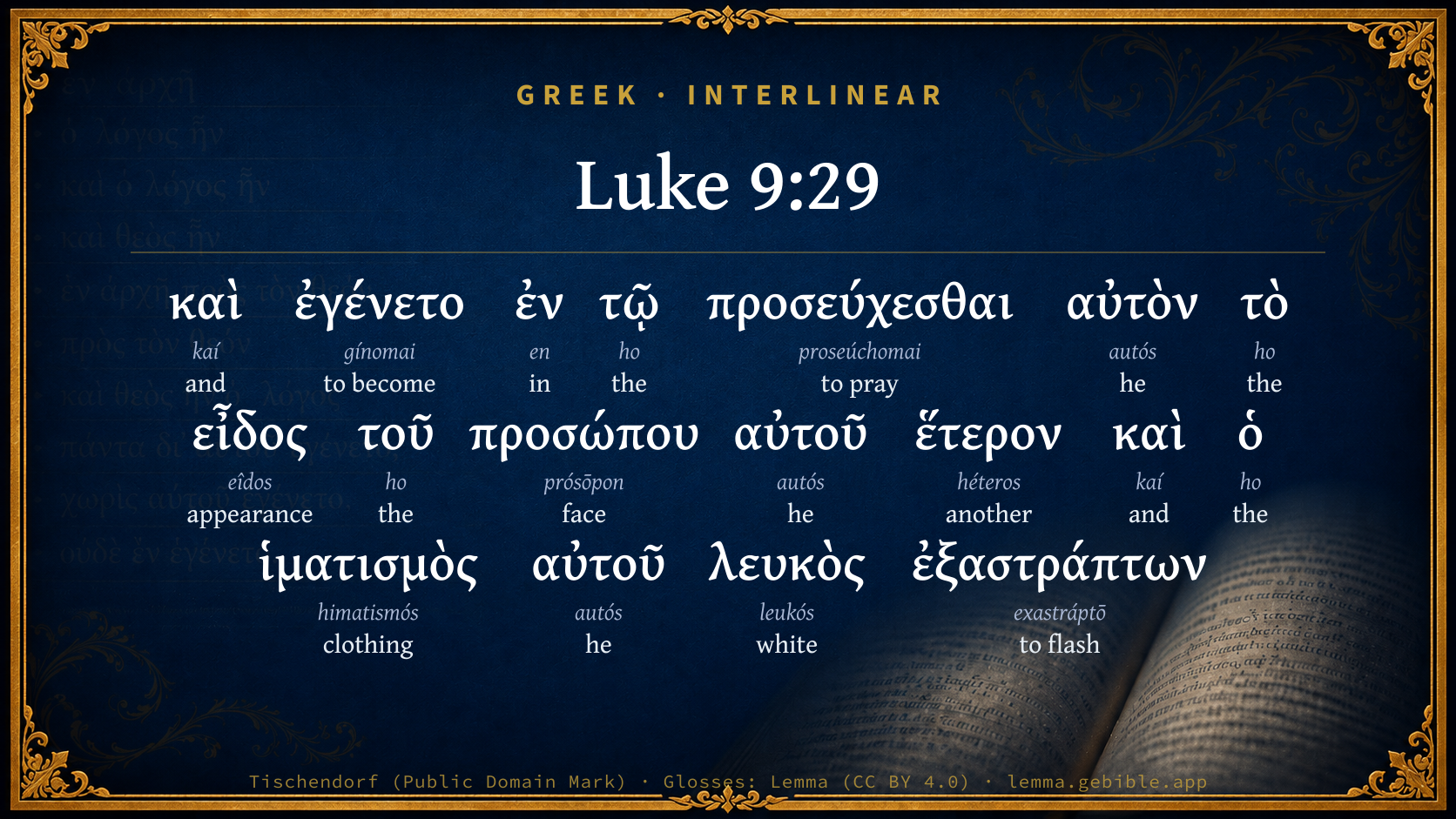
Greek (Tischendorf 8th ed.) Luke 9:29 appears in the Greek New Testament. The text above is from the Tischendorf 8th edition. Each word links to its Strong’s number and a concise gloss. Click any word for its full Thayer’s Greek Lexicon entry.
Download image
Cite this verse

Luke 9:29 (World English Bible). Public Domain. Lemma interlinear Bible study tool, https://lemma.gebible.app/v/luke/9/29.

Show BibTeX & RIS
BibTeX
RIS
English Translation
As he was praying, the appearance of his face was altered, and his clothing became white and dazzling.
World English Bible · Public Domain
Highlights
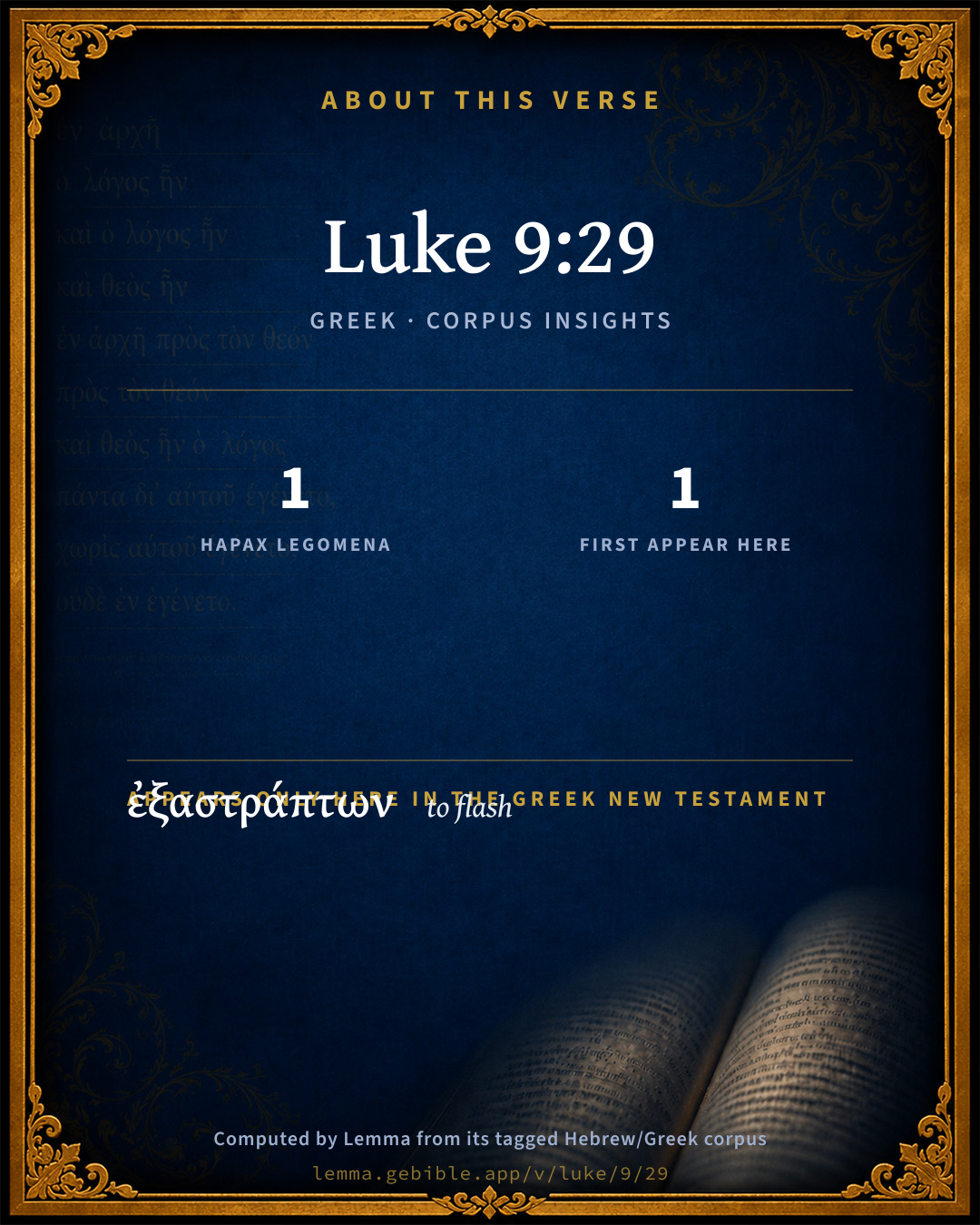
  • 1 hapax legomenon — only here in the Greek New Testament
  • 1 first appearance in the Greek New Testament
Full analysis ↓
Download a study sheet

One document with this verse’s original text, its word-by-word gloss line, the meaning frame, cross-references with their text, attributed commentary, and full source and license credits — printable, and it pastes into notes with its structure intact.

This verse Autodidact and up

Study sheet (.html) Plain text (.txt)

A passage Seminary Student

Up to 50 verses in one chapter. A passage sheet keeps up to 6 commentary sources and 12 cross-references per verse, in the order this page ranks them, and says so on the sheet whenever that leaves anything out. Ask for a single verse and you get the Autodidact verse sheet above.

Everything on this page stays free to read, with no account — the sheet is a download of what is already on screen, not access to it.

Want to remove ads? Support Godless Engineer
Compare translations 3

The same verse in 3 English versions, stacked beneath the original-language interlinear above. Click any original word for its lexicon entry.

Each is an independent rendering of the whole verse — the interlinear is not word-aligned to these translations.

Highlighted words mark where these versions differ — a whole-verse word diff, not a word-by-word alignment.

  • World English Bible Public Domain
    As he was praying, the appearance of his face was altered, and his clothing became white and dazzling.
  • King James Version Public Domain
    And as he prayed, the fashion of his countenance was altered, and his raiment was white and glistering.
  • unfoldingWord Literal Text CC BY-SA 4.0
    And it happened that, as he was praying, the appearance of his face became different, and his clothing flashed white like lightning.

unfoldingWord Literal Text — © unfoldingWord, licensed CC BY-SA 4.0. Word-aligned USFM3 via Door43 (git.door43.org/unfoldingWord/en_ult).

Versions to compare (up to 4)

3 of 4 selected

Show all 19 translations

Every available English version of this verse, each an independent rendering of the whole verse.

  • World English Bible Public Domain
    As he was praying, the appearance of his face was altered, and his clothing became white and dazzling.
  • Berean Standard Bible Public Domain
    And as He was praying, the appearance of His face changed, and His clothes became radiantly white.
  • Majority Standard Bible Public Domain
    And as He was praying, the appearance of His face changed, and His clothes became radiantly white.
  • King James Version Public Domain
    And as he prayed, the fashion of his countenance was altered, and his raiment was white and glistering.
  • American Standard Version (1901) Public Domain
    And as he was praying, the fashion of his countenance was altered, and his raiment `became' white `and' dazzling.
  • Revised Version (1885) Public Domain
    And as he was praying, the fashion of his countenance was altered, and his raiment became white and dazzling.
  • Geneva Bible (1599) Public Domain
    And as he prayed, the fashion of his countenance was changed, and his garment was white and glistered.
  • Douay-Rheims (1899) Public Domain
    And whilst he prayed, the shape of his countenance was altered, and his raiment became white and glittering.
  • Young's Literal Translation Public Domain
    and it came to pass, in his praying, the appearance of his face became altered, and his garment white -- sparkling.
  • Literal Standard Version CC BY-SA 4.0
    and it came to pass, in His praying, the appearance of His face became altered, and His clothing became flashing white.
  • Unlocked Literal Bible CC BY-SA 4.0
    As he was praying, the form of his face was changed, and his clothes became brilliant white.
  • unfoldingWord Literal Text CC BY-SA 4.0
    And it happened that, as he was praying, the appearance of his face became different, and his clothing flashed white like lightning.
  • Darby Bible Public Domain
    And as he prayed the fashion of his countenance became different and his raiment white [and] effulgent.
  • World Messianic Bible Public Domain
    As he was praying, the appearance of his face was altered, and his clothing became white and dazzling.
  • Webster's Bible Public Domain
    And as he prayed, the fashion of his countenance was altered, and his raiment was white and glistening.
  • Free Bible Version CC BY-SA 4.0
    While he was praying, his face changed in appearance, and his clothing became a dazzling white.
  • Bible in Basic English Public Domain
    And while he was in prayer, his face was changed and his clothing became white and shining.
  • Text-Critical English NT CC BY 4.0
    As he was praying, the appearance of his face was altered, and his clothing became dazzling white.
  • Tyndale New Testament (1534) Public Domain
    And as he prayed the facion of his countenaunce was changed and his garment was whyte and shoone.

Literal Standard Version (2020), Covenant Press — licensed CC BY-SA 4.0. Text via the HelloAO Bible API (eBible.org). Unlocked Literal Bible (unfoldingWord) — licensed CC BY-SA 4.0. Text via the HelloAO Bible API (eBible.org). unfoldingWord Literal Text — © unfoldingWord, licensed CC BY-SA 4.0. Word-aligned USFM3 via Door43 (git.door43.org/unfoldingWord/en_ult). Free Bible Version, Dr. Jonathan Gallagher — licensed CC BY-SA 4.0. Text via the HelloAO Bible API (eBible.org).

Word by word

More ways to search: Search by grammar → Find every occurrence → Compare this word →

Practice this passage: Drill this verse → Learn its vocabulary →

ἐξαστράπτων
exastráptō
G1823
“to flash”
Verb, Present, Active, Participle, Nominative, Singular, Masculine
Part of Speech
Verb
Tense
Present
Voice
Active
Mood
Participle
Case
Nominative
Number
Singular
Gender
Masculine
Full Thayer's Definition

Origin: from G1537 and G797

TDNT: None

1. to send forth lightning, to lighten 2. to flash out like lightning, to shine, be radiant a. of garments
  1. καὶ kaí G2532 “and” Conjunction
  2. ἐγένετο gínomai G1096 “to become” Verb, Aorist, Middle deponent, Indicative, 3rd person, Singular
  3. ἐν en G1722 “in” Preposition
  4. τῷ ho G3588 “the” Article, Dative, Singular, Neuter
  5. προσεύχεσθαι proseúchomai G4336 “to pray” Verb, Present, Middle or Passive deponent, Infinitive
  6. αὐτὸν autós G846 “he” Personal pronoun, Accusative, Singular, Masculine
  7. τὸ ho G3588 “the” Article, Nominative, Singular, Neuter
  8. εἶδος eîdos G1491 “appearance” Noun, Nominative, Singular, Neuter
  9. τοῦ ho G3588 “the” Article, Genitive, Singular, Neuter
  10. προσώπου prósōpon G4383 “face” Noun, Genitive, Singular, Neuter
  11. αὐτοῦ autós G846 “he” Personal pronoun, Genitive, Singular, Masculine
  12. ἕτερον héteros G2087 “another” Adjective, Nominative, Singular, Neuter
  13. καὶ kaí G2532 “and” Conjunction
  14. ὁ ho G3588 “the” Article, Nominative, Singular, Masculine
  15. ἱματισμὸς himatismós G2441 “clothing” Noun, Nominative, Singular, Masculine
  16. αὐτοῦ autós G846 “he” Personal pronoun, Genitive, Singular, Masculine
  17. λευκὸς leukós G3022 “white” Adjective, Nominative, Singular, Masculine

About this verse

These counts appear in no published source. They are computed here, from the morphology-tagged text and Lemma’s own curated glosses. What Lemma adds →

18
words
12
distinct lemmas
Gospels
section

Notable vocabulary

1 hapax legomenon — a word that appears only here in the entire Greek New Testament:

  • ἐξαστράπτων to flash G1823

First appearance in Scripture

This word makes its first canonical appearance in the Greek New Testament here:

  • ἐξαστράπτων to flash G1823

Shared distinctive vocabulary

εἶδος appearance G1491 occurs in 5 verses of the Greek New Testament. Also found in:
Repetition

Words recur within this verse:

Cross-references

12

Topical passages linked to Luke 9:29 in the Treasury of Scripture Knowledge — connected by theme and wording, ordered by reader-vote popularity; previews shown in the World English Bible.

  • Matthew 17:2 He was transfigured before them. His face shone like the sun, and his garments became as white as the light.
  • Mark 9:2–3 After six days Jesus took with him Peter, James, and John, and brought them up onto a high mountain privately by themselves, and he was changed into another form in front of them.
  • Exodus 34:29–35 It happened, when Moses came down from Mount Sinai with the two tablets of the testimony in Moses' hand, when he came down from the mountain, that Moses didn't know that the skin of his face shone by reason of his speaking with him.
  • 2 Peter 1:16–18 For we did not follow cunningly devised fables, when we made known to you the power and coming of our Lord Jesus Christ, but we were eyewitnesses of his majesty.
  • Isaiah 33:17 Your eyes shall see the king in his beauty: they shall see a land that reaches afar.
  • Isaiah 53:2 For he grew up before him as a tender plant, and as a root out of a dry ground: he has no form nor comeliness; and when we see him, there is no beauty that we should desire him.
  • Philippians 3:7–8 However, what things were gain to me, these have I counted loss for Christ.
  • Revelation 20:11 I saw a great white throne, and him who sat on it, from whose face the earth and the heaven fled away. There was found no place for them.
  • Mark 16:12 After these things he was revealed in another form to two of them, as they walked, on their way into the country.
  • John 1:14 The Word became flesh, and lived among us. We saw his glory, such glory as of the one and only Son of the Father, full of grace and truth.
  • Acts 6:15 All who sat in the council, fastening their eyes on him, saw his face like it was the face of an angel.
  • Revelation 1:13–16 And among the lampstands was one like a son of man, clothed with a robe reaching down to his feet, and with a golden sash around his chest.

Cross-references courtesy of OpenBible.info (CC BY 4.0).

Commentary

Notes on Luke 9:29 from classic Christian and Jewish commentators (each source and its license shown beneath its notes). The classic Christian expositions comment on the surrounding passage and are grouped to its opening verse, so a note may address several verses; the Jewish commentaries on the Tanakh (Rashi and others) are per-verse, so they appear only where the commentator wrote on this verse.

Lemma curates 59 commentaries, every one of them public domain or Creative Commons licensed, each selected and text-cleaned for this edition rather than reprinted as found. About our sources →

MacLaren's Expositions of Holy Scripture

Alexander MacLaren

Luke

PRAYER AND TRANSFIGURATION

Luk 9:29.

This Evangelist is especially careful to record the instances of our Lord’s prayers. That is in accordance with the emphasis which he places on Christ’s manhood. In this narrative of the Transfiguration it is to Luke that we owe our knowledge of the connection between our Lord’s prayer and the radiance of His face. It may be a question how far such transfiguration was the constant accompaniment of our Lord’s devotion. It is to be remembered that this is the only time at which others were present while He prayed, and perhaps it may be that whensoever, on the mountain top or in the solitude of the wilderness, He entered into closer communion with His heavenly Father, that radiance shone from His face, though no eye beheld and no tongue has recorded the glory.

But that is a mere supposition. However that may be, it would seem that the light on Christ’s face was not merely a reflection caught from above, but it was also a rising up from within of what always abode there, though it did not always shine through the veil of flesh. And in so far it presents no parallel with anything in our experience, nor any lesson for us. But to regard our Lord’s Transfiguration as only the result of the indwelling divinity manifested is to construe only one half of the fact that we have to deal with, and the other half does afford for us a precious lesson. ‘As He prayed the fashion of His countenance was altered’; and as we pray, and in the measure in which we truly and habitually do hold communion, shall we, too, partake of His Transfiguration.

The old story of the light that flashed upon the face of the Lawgiver, caught by reflection from the light of God in which He walked, is a partial parallel to Christ’s Transfiguration, and both the one and the other incident, amongst their other lessons, do also point to some mysterious and occult relation between the indwelling soul and the envious veil of flesh which, under certain circumstances, might become radiant with the manifestation of that indwelling power.

I. The one great lesson which I seek now to enforce from this incident is, that communion with God transfigures.

Prayer is more than petitions. It is not necessarily cast into words at all. In its widest, which is its truest sense, it is the attitude and exercise of devout contemplation of God and intercourse in heart, mind, and will with Him, a communion which unites aspiration and attainment, longing and fruition, asking and receiving, seeking and finding, a communion which often finds itself beggared for words, and sometimes even seems to transcend thought. How different is such an hour of rapt communion with the living God from the miserable notions which so many professing Christians have of prayer, as if it were but spoken requests, more or less fervent and sincere, for things that they want! The noblest communion of a soul with God can never be free from the consciousness of need and dependence. Petition must ever be an element in it, but supplication is only a corner of prayer. Such conscious converse with God is the very atmosphere in which the Christian soul should always live, and if it be an experience altogether strange to us we had better ask ourselves whether we yet know the realities of the Christian life, or have any claim to the name. ‘Truly, our fellowship is with the Father and with His Son, Jesus Christ,’ and if we have no share in that fellowship we do not belong to the class of whom it is the mark and possession.

Of course, such communion is not to be attained or maintained without effort. Sense wars against it. Tasks which are duties interrupt the enjoyment of it in its more conscious forms. The hard-working man may well say, ‘How can I, with my business cares calling-for my undivided attention all day long, keep up such communion?’ The toiling mother may well say, ‘How can I, in my little house, with my children round me, and never a quiet minute to myself, get such?’ True, it is hard, and the highest and sweetest forms of communion cannot be reached by us while so engaged, and therefore we all need seasons of solitude and repose, in which, being left alone, we may see the Great Vision, and, the clank of the engines being silenced, we may hear the Great Voice saying, ‘Come up hither.’ Such seasons the busiest have on one day in every week, and such seasons we shall contrive to secure for ourselves daily, if we really want to be intimate with our heavenly Friend.

And for the rest it is not impossible to have real communion with God in the midst of anxious cares and absorbing duties; it is possible to be like the nightingales, that sing loudest in the trees by the dusty roadsides, possible to be in the very midst of anxiety and worldly work, and yet to keep our hearts in heaven and in touch with God. We do not need many words for communion, but we do need to make efforts to keep ourselves near Him in desire and aspiration, and we need jealous and constant watchfulness over our motives for work, and our temper and aim in it, that neither the work nor our way of doing it may draw us away. There will be breaches in the continuity of our conscious communion, but there need not be any in the reality of our touch with God. For He can be with us, ‘like some sweet, beguiling melody, so sweet we know not we are listening to it.’ There may be a real contact of the spirit with Him, though it would be hard at the moment to put it into words.

‘As He prayed, the fashion of His countenance was altered.’ Such communion changes and glorifies a man. The very secret of the Gospel way of making men better is-transfiguration by the vision of God. Yes! to be much with God is the true way to mend our characters, and to make them like His. I do not under-value the need of effort in order to correct faults and acquire virtues. We do not receive sanctification as we receive justification, by simple faith. For the latter the condition is ‘Only believe,’ for the former it is ‘Work out your own salvation.’ No man is cured of his evil tendencies without a great deal of hard work conscientiously directed to curbing them.

But all the hard work, and all the honest purpose in the world, will not do it without this other thing, the close communion with God, and incomparably the surest way to change what in us is wrong, and to raise what in us is low, and to illumine what in us is dark, is to live in habitual beholding of Him who is righteousness without flaw, and holiness supreme, and light without any darkness at all. That will cure faults. That will pull the poison fangs out of passions. That will do for the evil in us what the snake-charmers do by subtle touches, turn the serpent into a rigid rod that does not move nor sting. That will lift us up high above the trifles of life, and dwarf all here that imposes upon us with the lie that it is great, and precious, and permanent; and that will bring us into loving contact with the living ‘Beauty of holiness,’ which will change us into its own fair likeness.

We see illustrations of this transforming power of loving communion in daily life. People that love each other, and live beside each other, and are often thinking about one another, get to drop into each other’s ways of looking at things; and even sometimes you will catch strange imitations and echoes of the face and voice, in two persons thus knit together. And if you and I are bound to God by a love which lasts, even when it does not speak, and which is with us even when our hands are busy with other things, then be sure of this, we shall get like Him whom we love. We shall be like Him even here, for even here we shall see Him. Partial assimilation is the condition of vision; and the vision is the condition of growing assimilation. The eye would not see the sun unless there were a little sun imaged on the retina. And a man that sees God gets like the God he sees; ‘for we all, with unveiled face, beholding as in a glass {or, rather, mirroring as a glass does} the glory of God, are changed into the same image.’ The image on the mirror is only on the surface; but if my heart is mirroring God He sinks in, and abides there, and changes me from glory to glory. So it is when we keep near Christ, who is manifest in the flesh, that we get liker Him day by day, and the fashion of our countenances will be altered.

Now there is a test for our Christianity. Does my religion alter me? If it does not, what right or reason have I to believe that it is genuine at all? Is there a process of purifying going on in my inward nature? Am I getting any more like Jesus Christ than I was ten years ago? I say I live with Him and by Him. If I do I shall become like Him. Do not work at the hopeless task of purifying yourselves without His help, but go and stay in the sun if you want to get warm. Lo as the bleachers do, spread the foul cloth on the green grass, below the blazing sunshine, and that will take all the dirt out. Believing and loving, and holding fast by Jesus Christ in true communion, we, too, become like Him we love.

II. Another thought is suggested by these words-namely, that this transfiguring will become very visible in the life if it be really in our inmost selves.

Even in the most literal sense of the words it will be so. Did you never see anybody whose face was changed by holier and nobler purposes coming into their lives? I have seen more than one or two whose features became as the face of an angel as they grew more and more unselfish, and more and more full of that which, in the most literal sense of the words, was in them the beauty of holiness. The devil writes his mark upon people’s faces. The world and the flesh do so. Go into the streets and look at the people that you meet. Care, envy, grasping griping avarice, discontent, unrest, blotches of animalism, and many other prints of black fingers are plain enough on many a face. And on the other hand, if a man or a woman get into their hearts the refining influences of God’s grace and love by living near the Master, very soon the beauty of expression which is born of consecration and unselfishness, the irradiation of lofty emotions, the tenderness caught from Him, will not be lacking, and some eyes that look upon them will recognise the family likeness.

But that may be said to be mere fancy. Perhaps it is, or perhaps there is truth in it deeper and more far-reaching than we know. Perhaps the life fashions the body, and the ‘body of our glory’ may be moulded in immortal loveliness by the perfect Christ-derived life within it. But be that as it may, the main point to be observed here is rather this. If we have the real, transforming influence of communion with Jesus Christ in our hearts, it will certainly rise to the surface, and show itself in our lives. As oil poured into water will come to the top, so that inward transforming will not continue hidden within, ‘The king’s daughter is all-glorious within, but also ‘her clothing is of wrought gold.’ The inward life, beautiful because knit to Him, will have corresponding with it and flowing from it an outward life of manifest holy beauty.

‘His name shall be in their foreheads,’ stamped there, where everybody can see it. Is that where you and I carry Christ’s name? It is well that it should be in our hearts, it is hypocrisy that it should be in our foreheads unless it is in our hearts first. But if it be in the latter it will surely be in the former.

Now, dear friends, there is a simple and sure touchstone for us all. Do not talk about communion with Christ being the life of your religion, unless the people that have to do with you, your brothers and sisters, or fathers and mothers, your wives and children, your servants or your masters, would endorse it and say ‘Yes! I take knowledge of him, he has been with Jesus.’ Do you think that it is easier for anybody to believe in, and to love God, ‘whom he hath not seen’ because of you, ‘his brother whom he hath seen’? The Christ in the heart will be the Christ in the face and in the life.

Alas! why is it that so little of this radiance caught from heaven shines from us? There is but one answer. It is because our communion with God in Christ is so infrequent, hurried, and superficial. We should be like those luminous boxes which we sometimes see, shining in the dark with light absorbed from the day; but, like them, we need to be exposed to the light and to lie in it if we are to be light. ‘Now are ye light in the Lord,’ and only as we abide in Him by continuous communion shall we resemble Him or reflect Him.

III. The perfection of communion will be the perfection of visible transformation.

Possibly the Transfiguration of Jesus Christ had an element of prophecy in it, and pointed onwards to the order of things when His glorified humanity should be enthroned on the throne of the universe, and have left the limitations of flesh with the folded grave-clothes in the empty sepulchre. As the two majestic forms of the Lawgiver and the Prophet shared His glory on Hermon, and held converse with Him there, so we may see in that mysterious group wrapped in the bright cloud the hint of a hope which was destined to grow to clearness and certainty. Christ’s glorified bodily humanity is the type to which all His followers will be conformed. Gazing on Him they shall be like Him, and will grow liker as they gaze. Through eternal ages the double process will go on, and they shall become ever more assimilated, and therefore capable of truer, completer vision, and ever seeing Him more fully as He is, and therefore progressively changed into more perfect resemblance. Nor will that blessed change into advancing glory be shut up in their hearts nor lack beholders. For in that realm of truth and reality all that is within will be visible, our life will no longer fall beneath our aspirations, nor practice be at variance with the longings and convictions of our best selves. Then the Christlike spirit will possess a body which is its glad and perfect servant, and through which its beauty will shine undimmed. ‘When Christ, who is our life, shall be manifested, then shall we also be manifested with Him in glory.’

Alexander MacLaren, Expositions of Holy Scripture (1904–1910) — public domain. Text from a community e-Sword module.

Tyndale Open Study Notes

Tyndale Open Resources

9:29 his clothes became dazzling white (literally became bright as a flash of lightning): Jesus’ glory shone through his human body (cp. Ezek 1:4; Dan 7:9; see also Exod 34:29).

Tyndale Open Study Notes — © Tyndale Open Resources, licensed CC BY-SA 4.0. Text via the HelloAO Bible API.

Bengel's Gnomon

Johann Albrecht Bengel

Luk 9:29. Εἶδος) the aspect, the expression and look of His countenance.—ἕτερον, altered) The language of the earth does not suffice to express things strictly celestial. So it is said of the godly, ἀλλαγησόμεθα, we shall be changed, 1Co 15:51.—ἐξαστράπτων. glistering [flashing brightly forth]) the glory of His body shining out transparently from within, and passing through the pores of the garment.

Bengel's Gnomon of the New Testament — English translation (T&T Clark, Edinburgh, 1860) — public domain. Text from a community e-Sword module.

Expositor's Greek Testament

ed. W. Robertson Nicoll

Luk 9:29 . ἐν τῷ προσεύχεσθαι , while praying, and as the result of the exercise. ἕτερον , different; a real objective change, not merely to the view of the three disciples. Lk. omits ἔμπροσθεν αὐτῶν . λευκὸς may be viewed as an adverb in function , qualifying ἐξαστράπτων (De Wette), but there is no reason why it should not be co-ordinate with ἐξασ ., καὶ being omitted = white, glistering. ἐξαστράπτων : in N. T. here only, flashing like lightning.

The Expositor's Greek Testament, edited by W. Robertson Nicoll (1897–1910) — public domain. Text from a community e-Sword module.

Jamieson, Fausset & Brown

Robert Jamieson, A. R. Fausset & David Brown

as he prayed, the fashion, &c.--Before He cried He was answered, and while He was yet speaking He was heard. Blessed interruption to prayer this! Thanks to God, transfiguring manifestations are not quite strangers here. Ofttimes in the deepest depths, out of groanings which cannot be uttered, God's dear children are suddenly transported to a kind of heaven upon earth, and their soul is made as the chariots of Amminadab. Their prayers fetch down such light, strength, holy gladness, as make their face to shine, putting a kind of celestial radiance upon it (Co2 3:18, with Exo 34:29-35).

raiment white, &c.--Matthew says, "His face did shine as the sun" (Mat 17:2), and Mark says (Mar 9:3), "His raiment became shining, exceeding white as snow, so as no fuller on earth can white them" (Mar 9:3). The light, then, it would seem, shone not upon Him from without, but out of Him from within; He was all irradiated, was in one blaze of celestial glory. What a contrast to that "visage more marred than men, and His form than the sons of men!" (Isa 52:14).

Jamieson, Fausset & Brown — Commentary Critical and Explanatory on the Whole Bible (1871) — public domain (CC PDM 1.0). Text via the HelloAO Bible API.

Ellicott's Commentary for English Readers

(29) And as he prayed.—We again note, as characteristic of St. Luke, the stress laid upon our Lord’s prayers here, as before in Luk_3:21; Luk_5:16; Luk_6:12.

The fashion of his countenance was altered.—It is, perhaps, noticeable that the Evangelist who had the most classical culture avoids the use of the classical word “transfigured” or “metamorphosed,” employed by the others. For him that word might have seemed too suggestive of the “metamorphoses” which the great work of Ovid had connected with the legends of Greek mythology.

A Bible Commentary for English Readers, edited by Charles John Ellicott (1878–1897) — public domain. Text from a community e-Sword module.

The Cambridge Bible for Schools and Colleges

gen. ed. J. J. S. Perowne

29. as he prayed] The enquiry whether this heavenly brightness came from within, or—as when the face of Moses shone—by reflection from communion with God, seems irreverent and idle; but we may say that the two things are practically one.

the fashion of his countenance was alteread] “His face did shine as the sun,” Mat_17:2. It is interesting to see how St Luke avoids the word “He was metamorphosed” which is used by the other Synoptists.

He was writing for Greeks, in whose mythology that verb was vulgarised by foolish associations.

white and glistering] Literally, “lightning forth,” as though from some inward radiance. St Matthew compares the whiteness of His robes to the light (Luk_17:2), St Mark to the snow (Luk_9:3), and St Luke in this word to the lightning. See Joh_1:14; Psa_104:2; Hab_3:4.

The Cambridge Bible for Schools and Colleges (gen. ed. J. J. S. Perowne; Cambridge University Press, 1878–1918) — public domain. Text from a community e-Sword module.

John Gill's Exposition

Who appeared in glory,.... In a very glorious manner, in most divine and beautiful forms to Christ, and to his disciples:

and spake of his decease, which he should accomplish at Jerusalem; the word, rendered "decease", is "Exodus", the name of the second book of Moses; so called from the departure of the children of Israel out of Egypt, it gives an account of; and which departure is expressed by this word, in Heb 11:22 and to which the allusion is here. Death is a departure out of this world, and goes by this name, Pe2 1:15 and so here it signifies Christ's death, or exit, which he was to make at Jerusalem; and Moses and Elias talk with him about this; the nature, manner, use, and near approach of it; and to which they might encourage him, as man. The sufferings and death of Christ were what Moses and the prophets had foretold; and these two speak of the same things now; and which must serve to confirm what Christ a few, days ago had showed his disciples, that he must go to Jerusalem, and there suffer and die. Dr. Lightfoot thinks that the ascension of Christ to heaven is contained in the word "Exodus", which was his final departure out of this world, as well as his sufferings and death; and especially if there is any, allusion to the Israelites' departure out of Egypt, which was in victory and triumph; and the rather, because "the time of his receiving up", Luk 9:51 may be thought to refer to this; and so Moses and Elias conversed with him, not only about, his sufferings and death; but his ascension, and of which also the "Exodus", or going of Elias out of this world to heaven, which was by a translation and ascension, was a figure. Some render this word, "Expedition", and think it refers to the whole affair of the redemption of Christ's people by him, from the bondage of sin, Satan, and the law, by his sufferings and death; of which the deliverance of the people of Israel out of Egypt was a lively representation: an expedition which Moses was sent upon, and accomplished: but now the discourse turns upon an expedition of greater importance, which shortly was to be accomplished at Jerusalem, where Christ was to be arraigned, and condemned, and then suffer without the gates of it, in order to obtain eternal redemption for the whole Israel of God.

John Gill's Exposition of the Whole Bible (1746–1763) — public domain (CC PDM 1.0). Text via the HelloAO Bible API.

Trapp's Complete Commentary

John Trapp

29 And as he prayed, the fashion of his countenance was altered, and his raiment was white and glistering.

Ver. 29. And as he prayed] Dum ipsius mens tota Deo se immergeret, saith one (Luc. Burgens.). Christians, while they are praying, are often times carried out and beyond themselves. See Mat 17:2-3. {See Trapp on "Mat 17:2"} {See Trapp on "Mat 17:3"}

John Trapp, A Commentary or Exposition upon All the Books of the Old and New Testament (1647–1656) — public domain. Text from a community e-Sword module.

The Pulpit Commentary

And as he prayed, the fashion of his countenance was altered, etc. The marvellous change evidently passed over Jesus while he was in prayer, probably because of his intense prayer. Real, close communion with God ever imparts to the countenance of the one who has thus entered into communion with the High and Holy One, a new and strange beauty. Very many have noticed at times this peculiar and lovely change pass over the faces of God"s true saints as they prayed faces perhaps old and withered, grey with years and wrinkled with care. A yet higher degree of transfiguration through communion with God is recorded in the case of Moses, whose face, after he had been with his God-Friend on the mount, shone with so bright a glory that mortal eye could not bear to gaze on it until the radiance began to fade away. A similar change is recorded to have taken place in the case of Stephen when he pleaded his Divine Master"s cause in the Sanhedrin hall at Jerusalem with such rapt eloquence that to the by-standers his face then, we read, "was as the face of an angel." Stephen told his audience later on, in the course of that earnest and impassioned pleading, that to him the very heavens were opened, and that his eyes were positively gazing on the beatific vision. Yet a step higher still was this transfiguration of our Lord. St. Luke tells us simply that, "as he prayed, the fashion of his countenance was altered." St. Matthew tells us how it was altered when he writes that "his countenance shone as the sun." And his raiment was white and glistering; literally, lightening forth, as if from some inward source of glorious light. The earthly robes were so beautified by contact with this Divine light that human language is exhausted by the evangelists to find terms and metaphors to picture them. St. Matthew compares these garments of the Blessed One to light; St. Mark, to the snow; St. Luke, to the flashing lightning.

The Pulpit Commentary (1880–1919), ed. H.D.M. Spence-Jones & Joseph S. Exell — public domain. Text from a community e-Sword module.

Cambridge Greek Testament for Schools and Colleges

29. ἐν τῷ προσεύχεσθαι. The inquiry whether this heavenly brightness came from within, or—as when the face of Moses shone—by reflection from communion with God, seems irreverent and idle; but we may say that the two things are practically one.

τὸ εἶδος τοῦ προσώπου. “His face did shine as the sun,” Mat 17:2. It is interesting to see how St Luke avoids the word ‘He was metamorphosed’ which is used by the other Synoptists. He was writing for Greeks, in whose mythology that verb was vulgarised by foolish associations.

ἐξαστράπτων. Literally, ‘lightning forth,’ as though from some inward radiance. St Matthew compares the whiteness of His robes to the light (Luk 17:2), St Mark to the snow (Luk 9:3), and St Luke in this word to the lightning. See Joh 1:14; Psa 104:2; Hab 3:4.

Cambridge Greek Testament for Schools and Colleges (Cambridge University Press, 1896; 21 vols, various authors incl. Carr, Maclear, Plummer, Farrar, Lumby, Moule, M. R. James, Simcox) — public domain. Text from a community e-Sword module.

Alford’s Greek Testament

Henry Alford

29.] “St. Luke seems to have declined the use of μετεμορφώθη (employed by the other two Evangelists here), that he might not awaken in his Greek readers any ideas or feelings connected with the fabulous metamorphoses of their heathen deities.” Wordsw.

Henry Alford, The Greek Testament (1849–1861) — public domain. Text from a community e-Sword module.

International Critical Commentary

29. ἐγένετο … ἓτερον.The Gentile Lk. writing for Gentiles avoids the word μετεμορφώθη (Mat 17:2; Mar 9:2), which might be understood of the metamorphosis of heathen deities. Comp ἐν ἑτέρᾳ μορφῇ ([Mk.] 16:12). The λευκός need not be made adverbial. The asyndeton is not violent, if it be made co-ordinate with ἐξαστράπτων, a word which occurs Eze 1:4, Eze 1:7; Nah 3:3.

International Critical Commentary — older volumes (1896–1929), various authors — public domain. Text from a community e-Sword module.

Vincent's Word Studies in the New Testament

Marvin R. Vincent

Was altered [εγενετο] . Lit., became different. Luke avoids Matthew's word, metamorfwqh, was metamorphosed. He was writing for Greek readers, to whom that word represented the transformations of heathen deities into other forms. See, for instance, the story of the capture of Proteus by Menelaus, in the fourth book of Homer's "Odyssey." See on Mt 17:2.

White [λευκος] . In classical Greek very indefinite as an expression of color; being used, not only of the whiteness of the snow, but of gray dust. Its original sense is clear. All three evangelists use the word, but combined with different terms. Thus, Matthew, as the light. Mark, stilbonta, glistering (see on Mr 9:3). Luke, ejxastraptwn (only here in New Testament), flashing as with the brilliance of lightning. Rev., dazzling.

Marvin R. Vincent, Word Studies in the New Testament (1887–1900) — public domain. Text from a community e-Sword/MySword module.

Lesson kit

Teaching starters — assembled from the data on this page, not authored interpretation. Every prompt links to the verse data it draws on. Edit before teaching.

Luke, in the Gospels, opens this verse with 18 words (12 distinct Greek lemmas). Its most distinctive word is exastráptō (“to flash”). A historical commentator’s framing appears above. Read the whole chapter for the surrounding context.

Discussion questions

  1. The word exastráptō carries the sense “to flash.” How does it shape the verse?
  2. 1 word here appears nowhere else in the Greek New Testament. Why might the author reach for such rare wording?
  3. This is the first place “to flash” appears in Scripture (first appears here). What does its debut here establish?
  4. How does Luke 3:22, which shares the word «appearance», read alongside this verse?
  5. What does the repetition of “the” (4× in this one verse) do in this verse?
  6. These translations render this verse differently. What is at stake in choosing one wording over another?
  7. Compare how MacLaren's Expositions of Holy Scripture and Tyndale Open Study Notes read this verse. Where do they agree or differ?

Things to notice

  • 1 word in this verse appears nowhere else in the Greek New Testament.
  • 1 word makes its first canonical appearance in Scripture here.
  • These translations choose different wording for 17 words in this verse.
  • “the” occurs 4× in this single verse.
  • 12 distinct Greek lemmas span 18 words in this verse.

Reading settings

Reading text

Shown beneath each verse's original-language words.

Old Testament
Old Testament edition

Read the OT as the Masoretic Hebrew (MT) or the Greek Septuagint (LXX).

English shown for the Greek Septuagint (in the Hebrew ↔ Greek comparison).

Comparing translations? Open the Compare panel on any verse page to stack up to four side by side.