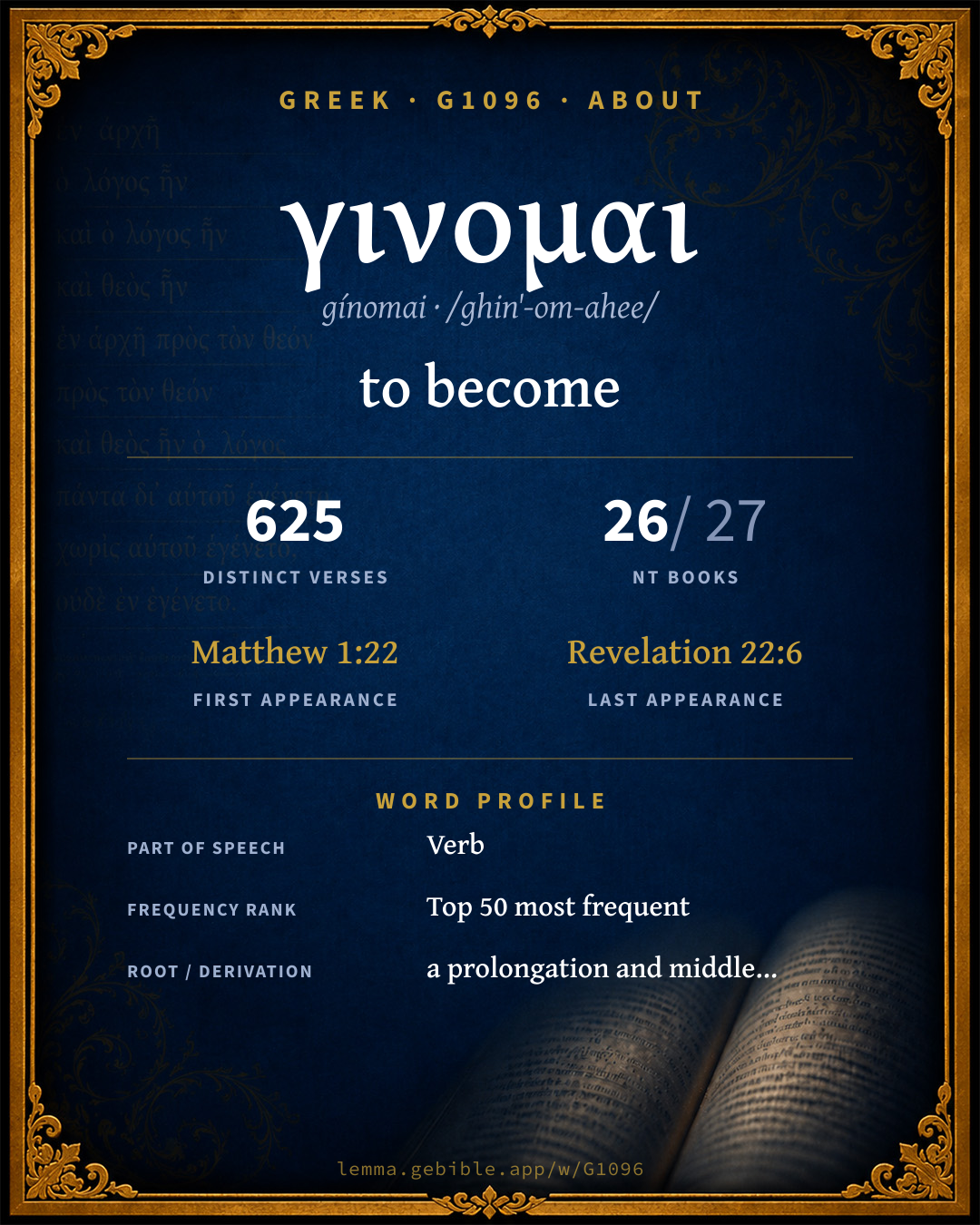
γίνομαι
to become
also: begin to be, receive being fuller range ↓
Full lexicon entry — Thayer's Greek Lexicon
From Thayer's Greek Lexicon
Where this word appears
See every Aorist-tense verb in the Greek New Testament →
Grammar key — what these labels mean
Part of speech
- Verb
- An action or state-of-being word.
Tense
- Aorist
- Action viewed as a simple whole, without regard to duration — often past (perfective aspect).
- Perfect
- A completed past action with continuing present results.
- Present
- Ongoing or general action in present time (imperfective aspect).
- Future
- Action expected in future time.
- Imperfect
- Continuous or repeated action in past time (“was writing”).
- Pluperfect
- A past action completed before another past point (“had written”).
Voice
- Middle deponent
- Middle in form but active in meaning.
- Active
- The subject performs the action.
- Middle or Passive deponent
- Middle/passive in form but active in meaning.
- Passive deponent
- Passive in form but active in meaning.
- Passive
- The subject receives the action.
Mood
- Indicative
- States a fact or asks a factual question (the mood of reality).
- Subjunctive
- Expresses probability, purpose, or possibility (the mood of contingency).
- Infinitive
- A verbal noun (“to write”), unmarked for person or number.
- Participle
- A verbal adjective (“writing,” “having written”).
- Imperative
- Expresses a command or request.
- Optative
- Expresses a wish or a remote possibility.
Case
- Genitive
- The case of source, possession, or “of” — answers “whose / from what.”
- Nominative
- The case of the subject (and the predicate nominative).
- Accusative
- The case of the direct object and of extent.
- Dative
- The case of the indirect object, means, or location — “to / for / with / in.”
Person
- 3rd person
- The one spoken about (“he / she / it / they”).
- 2nd person
- The one addressed (“you”).
- 1st person
- The speaker (“I / we”).
Gender
- Feminine
- Grammatically feminine.
- Masculine
- Grammatically masculine.
- Neuter
- Grammatically neuter.
Number
- Singular
- One.
- Plural
- More than one.
Every verse where G1096 appears in the Book of Hebrews — 28 distinct verses. Click any verse to open its interlinear word-by-word view. Verse text shown in the World English Bible for context — . Each verse’s Greek form is shown with its reference; the English is not keyword-highlighted, since the data carries no word-level English alignment. Use “Compare translations” on any verse to read it across multiple English versions. This concordance covers the Greek New Testament; Septuagint (Greek Old Testament) occurrences of this word are not indexed here.
Hebrews
- Hebrews 1:4 γενόμενος aor mid.dep ptcp nom sg masc having become so much better than the angels, as he has inherited a more excellent name than they have.
- Hebrews 2:2 ἐγένετο aor mid.dep ind 3sg For if the word spoken through angels proved steadfast, and every transgression and disobedience received a just recompense;
- Hebrews 2:17 γένηται aor mid.dep subj 3sg Therefore he was obligated in all things to be made like his brothers, that he might become a merciful and faithful high priest in things pertaining to God, to make atonement for the sins of the people.
- Hebrews 3:14 γεγόναμεν perf act ind 1pl For we have become partakers of Christ, if we hold fast the beginning of our confidence firm to the end:
- Hebrews 4:3 γενηθέντων aor pass.dep ptcp gen pl neut For we who have believed do enter into that rest, even as he has said, "As I swore in my wrath, they will not enter into my rest;" although the works were finished from the foundation of the world.
- Hebrews 5:5 γενηθῆναι aor pass.dep inf So also Christ didn't glorify himself to be made a high priest, but it was he who said to him, "You are my Son. Today I have become your father."
- Hebrews 5:9 ἐγένετο aor mid.dep ind 3sg Having been made perfect, he became to all of those who obey him the author of eternal salvation,
- Hebrews 5:11 γεγόνατε perf act ind 2pl About him we have many words to say, and hard to interpret, seeing you have become dull of hearing.
- Hebrews 5:12 γεγόνατε perf act ind 2pl For when by reason of the time you ought to be teachers, you again need to have someone teach you the rudiments of the first principles of the oracles of God. You have come to need milk, and not solid food.
- Hebrews 6:4 γενηθέντας aor pass.dep ptcp acc pl masc For concerning those who were once enlightened and tasted of the heavenly gift, and were made partakers of the Holy Spirit,
- Hebrews 6:12 γένησθε aor mid.dep subj 2pl that you won't be sluggish, but imitators of those who through faith and patience inherited the promises.
- Hebrews 6:20 γενόμενος aor mid.dep ptcp nom sg masc where as a forerunner Jesus entered for us, having become a high priest forever after the order of Melchizedek.
- Hebrews 7:12 γίνεται pres mid/pass.dep ind 3sg For the priesthood being changed, there is of necessity a change made also in the law.
- Hebrews 7:16 γέγονεν perf act ind 3sg who has been made, not after the law of a fleshly commandment, but after the power of an endless life:
- Hebrews 7:18 γίνεται pres mid/pass.dep ind 3sg For there is an annulling of a foregoing commandment because of its weakness and uselessness
- Hebrews 7:20 γεγονότες perf act ptcp nom pl masc Inasmuch as he was not made priest without the taking of an oath
- Hebrews 7:22 γέγονεν perf act ind 3sg By so much has Jesus become the collateral of a better covenant.
- Hebrews 7:23 γεγονότες perf act ptcp nom pl masc Many, indeed, have been made priests, because they are hindered from continuing by death.
- Hebrews 7:26 γενόμενος aor mid.dep ptcp nom sg masc For such a high priest was fitting for us: holy, guiltless, undefiled, separated from sinners, and made higher than the heavens;
- Hebrews 9:15 γενομένου aor mid.dep ptcp gen sg masc For this reason he is the mediator of a new covenant, since a death has occurred for the redemption of the transgressions that were under the first covenant, that those who have been called may receive the promise of the eternal inheritance.
- Hebrews 9:22 γίνεται pres mid/pass.dep ind 3sg According to the law, nearly everything is cleansed with blood, and apart from shedding of blood there is no remission.
- Hebrews 10:33 γενηθέντες aor pass.dep ptcp nom pl masc partly, being exposed to both reproaches and oppressions; and partly, becoming partakers with those who were treated so.
- Hebrews 11:3 γεγονέναι perf act inf By faith, we understand that the universe has been framed by the word of God, so that what is seen has not been made out of things which are visible.
- Hebrews 11:6 γίνεται pres mid/pass.dep ind 3sg Without faith it is impossible to be well pleasing to him, for he who comes to God must believe that he exists, and that he is a rewarder of those who seek him.
- Hebrews 11:7 ἐγένετο aor mid.dep ind 3sg By faith, Noah, being warned about things not yet seen, moved with godly fear, prepared an ark for the saving of his house, through which he condemned the world, and became heir of the righteousness which is according to faith.
- Hebrews 11:24 γενόμενος aor mid.dep ptcp nom sg masc By faith, Moses, when he had grown up, refused to be called the son of Pharaoh's daughter,
- Hebrews 11:34 ἐγενήθησαν aor pass.dep ind 3pl quenched the power of fire, escaped the edge of the sword, from weakness were made strong, grew mighty in war, and turned to flight armies of aliens.
- Hebrews 12:8 γεγόνασιν perf act ind 3pl But if you are without discipline, of which all have been made partakers, then are you illegitimate, and not children.
About this entry
At a glance — auto-summarized from this page’s data, not written by a person. Every figure links to its source below. This summary describes the numbers; it doesn’t interpret them.
The Greek verb γινομαι centers on the idea of “to become.” The King James Version usually renders it “was,” while modern versions prefer “happened” (unfoldingWord Literal Text) — see the renderings breakdown. Spanning 625 verses in 26 books, it ranks among the most common words of the Greek New Testament. Debuting at Matthew 1:22, it then recurs through the corpus. Thayer's distinguishes 5 senses; alongside “to become” it spans “begin to be” and “receive being”. For the data behind this summary, explore the sense tree and the renderings breakdown below.
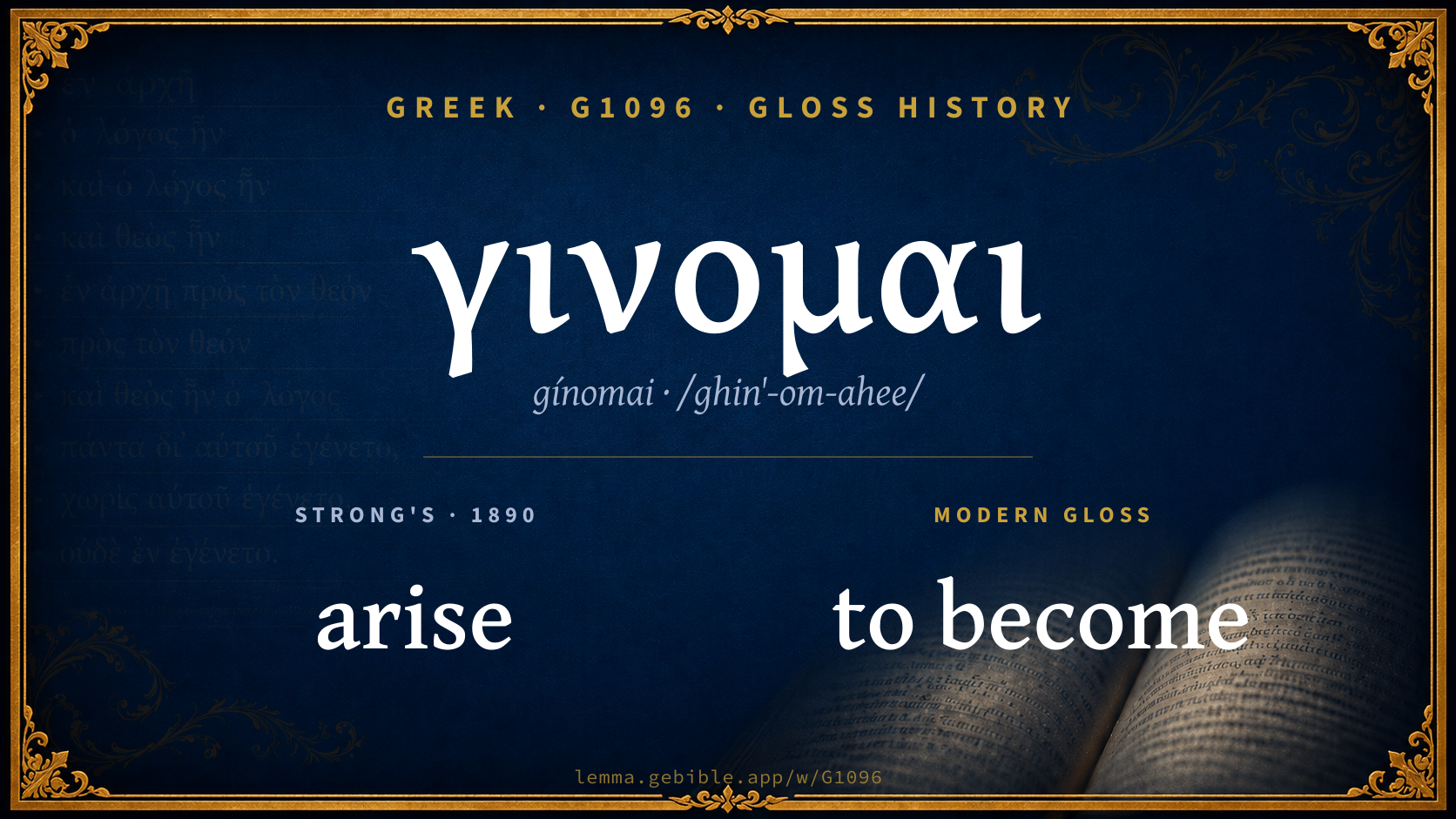
Gloss history
Strong's 1890 vs modern scholarship
About this word
Strong's G1096 catalogs a Greek word from the Greek New Testament.
These counts are not copied from any lexicon or concordance. They are computed here, from the morphology-tagged Greek New Testament. What Lemma adds →
- 625
- distinct verses
- The word appears in 625 distinct verses.
- 26 / 27
- NT books
- The word appears in 26 of 27 New Testament books.
- #28
- by frequency
- Top 50 most frequent Greek words (rank 28 of 5,347 Greek words by occurrence).
View all 625 occurrences in the concordance →
By section of the New Testament
By traditional corpus
Conventional, traditional groupings — biblical authorship is debated, so this is a traditional corpus grouping, not an authorship claim. Some books belong to more than one corpus (Luke is in both the Gospels and the Lukan corpus, and so on), so these shares overlap and need not total 100%. Each figure is a share of the word’s 625 distinct verses.
- Gospels 294 verses · 47%
- Lukan (Luke–Acts) 246 verses · 39%
- Pauline corpus 130 verses · 21%
- Johannine 79 verses · 13%
- Revelation 31 verses · 5%
- Hebrews 28 verses · 4%
- General (Catholic) Epistles 24 verses · 4%
How translations render this word
Counts come from each version’s own published word-to-Strong’s tagging or interlinear alignment — an approximate guide to how each version renders this word, not a word-level alignment the data otherwise carries. Because each total is that version’s own tagged count, the per-version totals vary from one another and need not match the appearance or distinct-verse counts above. These counts may also differ from a printed concordance because Lemma counts each distinctly tagged rendering and does not collapse phrase taggings into a single head-word total. This is a fixed set of word-tagged versions (KJV, ASV, BSB, ULT) and does not change with the reading translation you choose elsewhere. Each version’s license is shown beside its name below (and on Sources).
- King James Version: Was 94×, Came to pass 65×, Be 38×
- American Standard Version: Came to pass 60×, Was 53×, Be 28×
- Berean Standard Bible: Was 39×, Came 35×, Be 26×
- unfoldingWord Literal Text: Happened 71×, Happened that 57×, Became 48×
King James Version Public Domain
Renders G1096 across 680 tagged occurrences — most commonly:
Plus other, less common renderings. Plus 112 renderings that appear only once — usually multi-word phrases or single function words the recovered tagging swept in, not distinct renderings. Not rendered by a distinct English word in 29 further occurrences.
American Standard Version Public Domain
Renders G1096 across 682 tagged occurrences — most commonly:
Plus other, less common renderings. Plus 122 renderings that appear only once — usually multi-word phrases or single function words the recovered tagging swept in, not distinct renderings. Not rendered by a distinct English word in 2 further occurrences.
Berean Standard Bible Public Domain
Renders G1096 across 544 tagged occurrences — most commonly:
Plus other, less common renderings. Plus 127 renderings that appear only once — usually multi-word phrases or single function words the recovered tagging swept in, not distinct renderings. Not rendered by a distinct English word in 85 further occurrences.
unfoldingWord Literal Text CC BY-SA 4.0
Renders G1096 across 755 tagged occurrences — most commonly:
Plus other, less common renderings. Plus 81 renderings that appear only once — usually multi-word phrases or single function words the recovered tagging swept in, not distinct renderings.
Senses in Thayer's
The 5 senses Thayer's distinguishes for this word, in lexicon order (not ranked by frequency or importance). The full entry — with sub-senses — is in the Lexicon Entry tab.
- to become, i.e. to come into existence, begin to be, receive being
- to become, i.e. to come to pass, happen
- to arise, appear in history, come upon the stage
- of miracles, to be performed, wrought
- to become, be made
Word origin
Origin: a prolongation and middle voice form of a primary verb
A prolonged and middle form of a primary verb; to cause to be (gen -erate) that is (reflexively) to become ( come into being ) used with great latitude (literally figuratively intensively etc.): - arise be assembled be (come -fall -have self) be brought (to pass) (be) come (to pass) continue be divided be done draw be ended fall be finished follow be found be fulfilled + God forbid grow happen have be kept be made be married be ordained to be partake pass be performed be published require seem be showed X soon as it was sound be taken be turned use wax will would be wrought.
— Strong’s Exhaustive Concordance (1890), public domain.
Forms in the corpus
The 85 distinct written forms G1096 takes in the Greek New Testament, most frequent first — each parse links to that tense’s occurrences in the concordance.
The 60 most common forms are shown; 25 rarer forms follow in the full concordance.
Same root — word family
Other Thayer's entries built from the same root as G1096, grouped by Strong’s listed origin. These share a root / origin per the lexicon — not necessarily a shared meaning. Each links to that word’s own entry.
Derived from this word
Compare all same-root words → They share a root, not necessarily a meaning.
Septuagint usage
The same Greek word γινομαι appears 1,711 times in the Greek Old Testament (Septuagint), across 1,567 verses in 37 books.
- 1,711
- LXX occurrences
- Tagged occurrences of this Greek word in the Septuagint.
- 1,567
- verses
- Distinct Septuagint verses containing this word.
- 37 / 39
- OT books
- The word appears in 37 of the 39 Old Testament books.
Sample Septuagint occurrences
- Genesis 1:3 γίγνομαι
- Exodus 1:7 γίγνομαι
- Leviticus 8:29 γίγνομαι
- Numbers 1:20 γίγνομαι
- Deuteronomy 1:3 γίγνομαι
- Joshua 1:1 γίγνομαι
- Judges 1:1 γίγνομαι
- Ruth 1:1 γίγνομαι
- 1 Samuel 1:4 γίγνομαι
- 2 Samuel 1:1 γίγνομαι
- 1 Kings 1:7 γίγνομαι
- 2 Kings 2:1 γίγνομαι
Septuagint occurrences (same lexeme)
Every verse where the same Strong’s number (G1096) appears in the Greek Septuagint — showing the first 50 of 1,567. Verse text shown in the World English Bible for context; the Greek form is the matched word — the English is not keyword-highlighted.
- Genesis 1:3 γίγνομαι God said, "Let there be light," and there was light.
- Genesis 1:5 γίγνομαι God called the light Day, and the darkness he called Night. There was evening and there was morning, one day.
- Genesis 1:6 γίγνομαι God said, "Let there be an expanse in the midst of the waters, and let it divide the waters from the waters."
- Genesis 1:8 γίγνομαι God called the expanse sky. There was evening and there was morning, a second day.
- Genesis 1:9 γίγνομαι God said, "Let the waters under the sky be gathered together to one place, and let the dry land appear," and it was so.
- Genesis 1:11 γίγνομαι God said, "Let the earth put forth grass, herbs yielding seed, and fruit trees bearing fruit after their kind, with its seed in it, on the earth," and it was so.
- Genesis 1:13 γίγνομαι There was evening and there was morning, a third day.
- Genesis 1:14 γίγνομαι God said, "Let there be lights in the expanse of sky to divide the day from the night; and let them be for signs, and for seasons, and for days and years;
- Genesis 1:15 γίγνομαι and let them be for lights in the expanse of sky to give light on the earth," and it was so.
- Genesis 1:19 γίγνομαι There was evening and there was morning, a fourth day.
- Genesis 1:20 γίγνομαι God said, "Let the waters swarm with swarms of living creatures, and let birds fly above the earth in the open expanse of sky."
- Genesis 1:23 γίγνομαι There was evening and there was morning, a fifth day.
- Genesis 1:24 γίγνομαι God said, "Let the earth bring forth living creatures after their kind, cattle, creeping things, and animals of the earth after their kind," and it was so.
- Genesis 1:30 γίγνομαι To every animal of the earth, and to every bird of the sky, and to everything that creeps on the earth, in which there is life, I have given every green herb for food." And it was so.
- Genesis 1:31 γίγνομαι God saw everything that he had made, and, behold, it was very good. There was evening and there was morning, the sixth day.
- Genesis 2:4 γίγνομαι This is the history of the generations of the heavens and of the earth when they were created, in the day that Yahweh God made earth and the heavens.
- Genesis 2:5 γίγνομαι No plant of the field was yet in the earth, and no herb of the field had yet sprung up; for Yahweh God had not caused it to rain on the earth. There was not a man to till the ground,
- Genesis 2:7 γίγνομαι Yahweh God formed man from the dust of the ground, and breathed into his nostrils the breath of life; and man became a living soul.
- Genesis 3:22 γίγνομαι Yahweh God said, "Behold, the man has become like one of us, knowing good and evil. Now, lest he put forth his hand, and also take of the tree of life, and eat, and live forever..."
- Genesis 4:2 γίγνομαι Again she gave birth, to Cain's brother Abel. Abel was a keeper of sheep, but Cain was a tiller of the ground.
- Genesis 4:3 γίγνομαι As time passed, it happened that Cain brought an offering to Yahweh from the fruit of the ground.
- Genesis 4:6 γίγνομαι Yahweh said to Cain, "Why are you angry? Why has the expression of your face fallen?
- Genesis 4:8 γίγνομαι Cain said to Abel, his brother, "Let's go into the field." It happened, when they were in the field, that Cain rose up against Abel, his brother, and killed him.
- Genesis 4:18 γίγνομαι To Enoch was born Irad. Irad became the father of Mehujael. Mehujael became the father of Methushael. Methushael became the father of Lamech.
- Genesis 4:26 γίγνομαι There was also born a son to Seth, and he named him Enosh. Then men began to call on Yahweh's name.
- Genesis 5:4 γίγνομαι The days of Adam after he became the father of Seth were eight hundred years, and he became the father of sons and daughters.
- Genesis 5:5 γίγνομαι All the days that Adam lived were nine hundred thirty years, then he died.
- Genesis 5:8 γίγνομαι All the days of Seth were nine hundred twelve years, then he died.
- Genesis 5:11 γίγνομαι All the days of Enosh were nine hundred five years, then he died.
- Genesis 5:14 γίγνομαι and all the days of Kenan were nine hundred ten years, then he died.
- Genesis 5:17 γίγνομαι All the days of Mahalalel were eight hundred ninety-five years, then he died.
- Genesis 5:20 γίγνομαι All the days of Jared were nine hundred sixty-two years, then he died.
- Genesis 5:23 γίγνομαι all the days of Enoch were three hundred sixty-five years.
- Genesis 5:27 γίγνομαι All the days of Methuselah were nine hundred sixty-nine years, then he died.
- Genesis 5:31 γίγνομαι All the days of Lamech were seven hundred seventy-seven years, then he died.
- Genesis 6:1 γίγνομαι It happened, when men began to multiply on the surface of the ground, and daughters were born to them,
- Genesis 7:6 γίγνομαι Noah was six hundred years old when the flood of waters came on the earth.
- Genesis 7:10 γίγνομαι It happened after the seven days, that the waters of the flood came on the earth.
- Genesis 7:12 γίγνομαι The rain was on the earth forty days and forty nights.
- Genesis 7:17 γίγνομαι The flood was forty days on the earth. The waters increased, and lifted up the ark, and it was lifted up above the earth.
- Genesis 8:6 γίγνομαι It happened at the end of forty days, that Noah opened the window of the ark which he had made,
- Genesis 8:13 γίγνομαι It happened in the six hundred first year, in the first month, the first day of the month, the waters were dried up from off the earth. Noah removed the covering of the ark, and looked. He saw that the surface of the ground was dried.
- Genesis 9:27 γίγνομαι God enlarge Japheth, Let him dwell in the tents of Shem; Let Canaan be his servant."
- Genesis 9:29 γίγνομαι All the days of Noah were nine hundred fifty years, then he died.
- Genesis 10:1 γίγνομαι Now this is the history of the generations of the sons of Noah and of Shem, Ham, and Japheth. Sons were born to them after the flood.
- Genesis 10:10 γίγνομαι The beginning of his kingdom was Babel, Erech, Accad, and Calneh, in the land of Shinar.
- Genesis 10:19 γίγνομαι The border of the Canaanites was from Sidon, as you go toward Gerar, to Gaza; as you go toward Sodom, Gomorrah, Admah, and Zeboiim, to Lasha.
- Genesis 10:21 γίγνομαι To Shem, the father of all the children of Eber, the elder brother of Japheth, to him also were children born.
- Genesis 10:25 γίγνομαι To Eber were born two sons. The name of the one was Peleg, for in his days was the earth divided. His brother's name was Joktan.
- Genesis 10:30 γίγνομαι Their dwelling was from Mesha, as you go toward Sephar, the mountain of the east.
These are occurrences of the same Greek lexeme (G1096) in the Septuagint — not a translation of any one Hebrew word. The store carries no word-level Hebrew↔Greek alignment, so no Hebrew original is asserted here. Counts come from the recovered LXX Strong's tagging — high-frequency vocabulary is well covered, while rare or late forms may be untagged — so they reflect tagged occurrences and may slightly undercount.